



Abstract
It is generally accepted that violations of state-nation congruence can cause conflict, but it remains unclear which configurations cause civil and interstate conflict, and how these conflict types interact. Inspired by Myron Weiner’s classical model of the “Macedonian Syndrome,” we propose an integrated theoretical framework that links specific nationality questions to both conflict types. Using spatial data on state borders and ethnic settlements in Europe since 1816, we show that excluded and divided groups are more likely to rebel and, where they govern on only one side of the border, to initiate territorial claims and militarized disputes. To make things worse, rebellion and interstate conflict reinforce each other where ethnic division coincides with partial home rule. We obtain similar findings for civil wars and territorial claims in a global sample post-1945. Yet governments shy away from engaging in interstate disputes to address nationality questions and instead support ethnic rebels abroad.
To many liberal observers in the West, Putin’s invasion of Ukraine in February 2022 came as a complete surprise. In fact, already in 2014, Russia’s annexation of Crimea heralded a “return of geopolitics” (Mead 2014). Some analysts, especially those of a realist persuasion, interpret Russia’s aggression as a confirmation of a gradual return to the multipolar great-power politics of the nineteenth century (see e.g., Mearsheimer 2014).
Indeed, geopolitics is back with a vengeance, but the question is: which type of geopolitics? Great-power competition, and territorial conquest dominated international relations long before the nineteenth century. Starting with the French Revolution, however, these forces have been profoundly reshaped by nationalism and the concomitant shift of political legitimacy from dynastic rulers to mostly ethnically defined peoples. The nationalist age has seen large-scale upheaval both within and between states. After the relative geopolitical stability of the post-Cold War era, state borders have again been contested by nationalist leaders, not only in Ukraine, but also in disputes pitting India against Pakistan, and Armenia against Azerbaijan. These irredentist conflicts show that nationalism is linked to both internal and external conflict, and that these conflict types are often intimately intertwined.
It is generally accepted that a lack of congruence between state and national borders generates nationalist frustrations (Gellner 1983, 1), but less is known about how such violations of the nationality principle cause armed conflict. While existing conflict research helps to explain how nationalism increases the mobilizational potential of states within fixed borders (Cederman et al. 2011; Clausewitz 1984; Posen 1993; Tilly 1994) and how specific types of state-nation incongruence can trigger either internal (Cederman et al. 2013; Gurr 1993) or external conflict (Saideman and Ayres 2008; Siroky and Hale 2017), it remains theoretically scattered, and focuses on either civil or interstate conflict in addition to lacking historical depth.
This theoretical and conceptual fragmentation blocks a comprehensive view of the link between ethnonationalist configurations and conflict patterns. Furthermore, previous research on nationalism’s violent consequences tends to analyze either civil or interstate conflict but rarely both, and even less so how they interact. Finally, most quantitative conflict scholarship studies the post-1945 period which has been characterized by norms and security architectures that heavily constrained territorial conquest and nationalist conflict between states (Atzili 2011; Fazal 2007; Zacher 2001). Because of data scarcity, few if any studies analyze the period from the early nineteenth century until World War II.
Using Myron Weiner’s (1971) classical model of the “Macedonian Syndrome” as an analytical starting point, this study addresses all three challenges. First, to overcome theoretical fragmentation, we construct a comprehensive conceptual framework capturing foreign rule and ethnic division as well as all possible combinations of these deviations from the nation-state ideal, with Weiner’s model appearing as a special case.
Second, we link these configurations to both civil and interstate conflict, and interactions between these conflict types. The analysis shows that Weiner’s irredentist constellation featuring groups that are divided by state borders and enjoy only partial home rule is particularly prone to experiencing an interaction between internal and external conflict. In this classic irredentist setting, nationalist principles and mobilization provide a plausible mechanism of how domestic and international conflict may reinforce each other.
Third, to test our theoretical expectations, we collect and integrate large amounts of data on state borders, ethnic settlement areas, civil wars, territorial claims, and militarized interstate disputes in post-Napoleonic Europe. Our findings show that ethnic segments under foreign rule by an ethnically distinct host government are particularly likely to rebel. Division of excluded groups by state borders increases civil-war risk further, regardless of whether the kin group across the border holds power. For groups that enjoy home rule, division does not significantly increase the risk of intra-ethnic conflict. The combination of ethnic division with home rule on one side of the border and foreign rule on the other is associated with interstate disputes. In this irredentist constellation, past ethnic rebellion makes conflict between the host and irredentist kin states more likely. By the same token, there is some relatively weak evidence that a history of conflict between kin and host state increases the risk of ethnic rebellion in the latter. Home rule for both parts of an ethnic group divided by state borders, if anything, reduces the probability of interstate trouble suggesting that national unification wars between coethnic state governments are the exception rather than the rule. All our findings are driven by the pre-1945 period and get weaker or disappear in postwar Europe.
Additionally, we broaden the scope to the entire world after World War II. Based on existing datasets, this empirical extension reveals that nationality questions spur ethnic rebellion within states, and territorial claims between them, but are no longer systematically associated with interstate violence. We also find that the reinforcing dynamics between domestic and international conflict found in pre-1945 Europe no longer hold. Consistent with international norms and institutions that have made territorial conquest and interstate warfare increasingly risky and unacceptable, potential irredentist states instead support ethnic rebels fighting the host governments of their powerless kin abroad. Ethnic civil war thus appears as a driver and consequence of irredentist interstate conflict in pre-1945 Europe but seems to have turned into its feasible substitute under the global postwar order.
Taken together, our analysis paints a more comprehensive theoretical and empirical picture of the link between nationalism and conflict than the existing literature, which remains theoretical scattered, while being focused on either civil or interstate conflict, as well as lacking historical depth. While the configurational macro analyses conducted in this article necessarily remain correlational, we use various types of fixed effects and control variables to address the most obvious endogeneity threats and alternative explanations. Our findings on pre-1945 Europe may offer some lessons on what could be in store if Putin gets away with his land grabs in Ukraine. Other nationalist leaders might draw from his script and challenge the international norms and institutions that have successfully contained nationalist conflict between states since 1945 (Simmons and Goemans 2021).
We begin by providing an overview of how the literature has approached the link between nationalism and conflict onset. We then derive operational hypotheses and introduce our main datasets. This description is followed by empirical analyses focusing on internal and external conflict in post-Napoleonic Europe and on the post-World War II period globally. The last section summarizes the main findings and discusses their broader implications.
Nationalism and Conflict in the Literature
Following Clausewitz’s (1984) classic insights, scholarship has shown how nationalism helps the modern state mobilize resources for interstate warfare (Cederman et al. 2011; Posen 1993; Tilly 1994), and also how warfare promotes nation building (Sambanis et al. 2015). Other, more recent studies explore how different types of nationalism, especially ethnic, internally inclusive but externally exclusive types, increase the risk of war (Powers 2022; Schrock-Jacobson 2012; Snyder 2000). But the influence of nationalism goes beyond the internal dynamics within given state borders. As suggested by Gellner (1983), much of nationalism’s destabilizing effect derives from violations of its very core principle, namely the congruence of the state and the typically ethnically defined nation.
An important, but relatively limited, empirical literature studies how specific nationalist actor constellations cause interstate disputes and wars. Carment and James (1995) show how irredentist configurations make international crises more severe, violent, and difficult to manage (see also Moore and Davis 1997; Woodwell 2004). In a significant study, Miller (2007) offers an explicit analysis of how specific deviations from “state-to-nation balance” trigger characteristic patterns of interstate conflict, including irredentist war by revisionist states with stranded ethnic kin abroad. Using detailed case studies from Eastern Europe, Saideman and Ayres (2008) explore the conditions under which latent irredentist constellations lead to mobilization and violence. Focusing on Africa, Goemans and Schultz (2017) find that transborder ethnic links increase the risk of territorial claims, especially when partitioned groups are in power on one side of the border and marginalized on the other. Analyzing domestic conditions that make irredentist conflict more likely, Siroky and Hale (2017) show that economic status inconsistency and majoritarian systems increase the risk of violent interstate disputes. But these studies say little about internal conflict and how it may trigger and/or result from interstate trouble.
Other studies analyze how foreign rule and cross-border ethnic ties make domestic rebellion more likely. Early quantitative research on “minorities at risk” shows that different types of marginalization, including political exclusion, are conducive to civil conflict (see e.g., Gurr 1993). The civil-war literature also explores how internal conflict in one country may spread across state borders, especially in the presence of border-straddling ethnicity (see e.g., Buhaug and Gleditsch 2008; Checkel 2013; Gleditsch 2007) and how transborder ethnic links may facilitate rebellion (Denny and Walter 2014). In contrast, relying on bargaining theory, Cetinyan (2002) finds no effect, although this null-effect could be due to data limitations. Along similar lines, Jenne (2007) uses a bargaining framework to study irredentist claim making. Cederman et al. (2009, 2013) find that the risk of civil conflict depends on power relations between ethnic minorities and host governments as well as between host and kin states. 1 Focusing on external intervention in civil wars rather than their onset, Saideman (1997, 2001, 2002) and San-Akca (2016) show how governing ethnic groups may support co-ethnic rebels abroad.
Despite their focus on ethnic links and irredentism, neither of these clusters of research systematically scrutinizes how internal and external conflict patterns reinforce each other. There is a deep-seated division of labor between research on civil war and studies of interstate conflict. But the solution is not to treat internal and external conflicts as if they were caused by the same correlates (cf. Cunningham and Lemke 2013). Some studies blur the two conflict types, especially under the heading of “ethnic conflict.” For instance, in a conceptual piece, Van Evera (1994) proposes a series of “hypotheses on nationalism and war,” but his study does not make explicit whether “war” stands for confrontations between governments or between governments and non-state actors, nor does it try to test hypotheses.
In one of the few studies that analyze the interaction between internal and external conflict, Gleditsch et al. (2008) demonstrate that states that experience civil war are more likely to get involved in militarized disputes. They attribute this link to mechanisms that are endogenous to the issues that caused civil war in the first place. Such mechanisms include externalization, spillovers, and interventions, some of which relate directly to irredentist configurations and the desire to protect ethnic transborder kin. But their study does not assess whether irredentist ethnic links make the escalation from civil to interstate conflict more likely.
Similarly adopting a two-level logic, Edry et al. (2021) analyze how alliance patterns respond not only to external threats, but also to internal ones. While considering the risk of both civil and interstate conflict in the same framework, they analyze preventive alliances rather than conflict itself. Analyzing strategies of nation building, Mylonas (2012) studies how governments may choose to exclude minorities supported by enemy states rather than pursuing accommodation or assimilation.
In sum, current conflict research addresses the link between nationalism and conflict but, with respect to actor constellations and to conflict types, the analytical focus tends to be relatively narrow. Furthermore, data limitations, especially the lack of reliable data on ethnic groups before 1945, still obstruct attempts to assess whether Weiner’s Macedonian Syndrome can be generalized to other parts of Europe, let alone the rest of the world.
A Theory of Nationality Questions and Conflict
As an analytical starting point, we build on Weiner’s (1971) informal model of the Macedonian Syndrome. Although mostly descriptive and covering a particular part of the world, Weiner’s seminal study offers the necessary complexity to understand the full scope of nationality questions and their link to conflict patterns. Seeking to generate lessons for multi-ethnic postcolonial states, he outlines a dynamic conflict process that centers on an ethnic group straddling the border between two states, at least one of which is dissatisfied with the geopolitical status quo. Together these three actors constitute a triad that extends conventional dyadic conceptions of conflict processes. This revisionist scenario centers on a situation in which the group is powerless in at least one of the states. Where its members are in power in the revisionist state, there are likely to be strong incentives to incorporate or support the powerless kin. Irredentist politics thus increases the likelihood of both rebellion and interstate disputes involving the two states. 2
Weiner’s two-level process includes several stages of mounting tensions and mutual suspicion that ultimately trigger violent conflict. The status-quo oriented host state fears that a minority desires to be liberated by the revisionist state. In such a climate of fear and suspicion, miscalculation and emotional overreactions foster excessive risk-taking and militarization that increase the chance of violent conflict both inside the host state and between the two states. As the conflict progresses, bitterness and hatred prevail, thus drastically decreasing the chances of finding a compromise to end the ethno-nationalist conflict.
The Macedonian Syndrome serves as an excellent first step for conceptualizing the link between nationalist configurations and conflict, but it is only a starting point. Indeed, Weiner’s descriptive model needs to be embedded into the general theoretical framework that we use to derive testable hypotheses with applicability well beyond the Balkans. In this section, we construct such a contextual account of the link between nationality questions and conflict patterns.
In the era of nationalism following the French Revolution, political legitimacy shifted from the dynastic ruler to “the people,” typically defined as “the nation” (Mann 2005; Roshwald 2015). This transition from territorial to popular sovereignty paved the way for ethno-nationalist politics. In theory, there are many possible definitions of “the people” that can serve as the basis of popular sovereignty. But from the French Revolution onward, “the nation” as a politicized ethnic community emerged as the prevailing answer to this critical question (Yack 2001).
Once “the people” had been identified with “the nation,” the normative implications were clear. According to Gellner (1983, 1), nationalism can be defined as a doctrine that prescribes that the state and the nation should coincide. Any deviation from this principle can be expected to generate grievances, which may in turn facilitate collective mobilization and trigger violent conflict. As recognized by Gellner (1983, 1), state-to-nation congruence can be violated in two main ways: either there is a deficit of states, which means that some nations are exposed to alien rule or there is a surplus, which implies that ethnic nations suffer from division. 3 In irredentist situations, which occur if at least part of a border-transgressing nationalist community is dominated by another ethnonationalist group in addition to being politically fragmented by state borders, alien rule and division coincide, as in the case of the Macedonian Syndrome.
To further clarify, we introduce our main configurations in Figure 1. Rather than treating ethnic nations as groups nested inside states, we conceptualize them as potentially border-transgressing communities. We use the term segment to refer to each subpopulation of a transnational group. Five configurations with or without alien rule and division.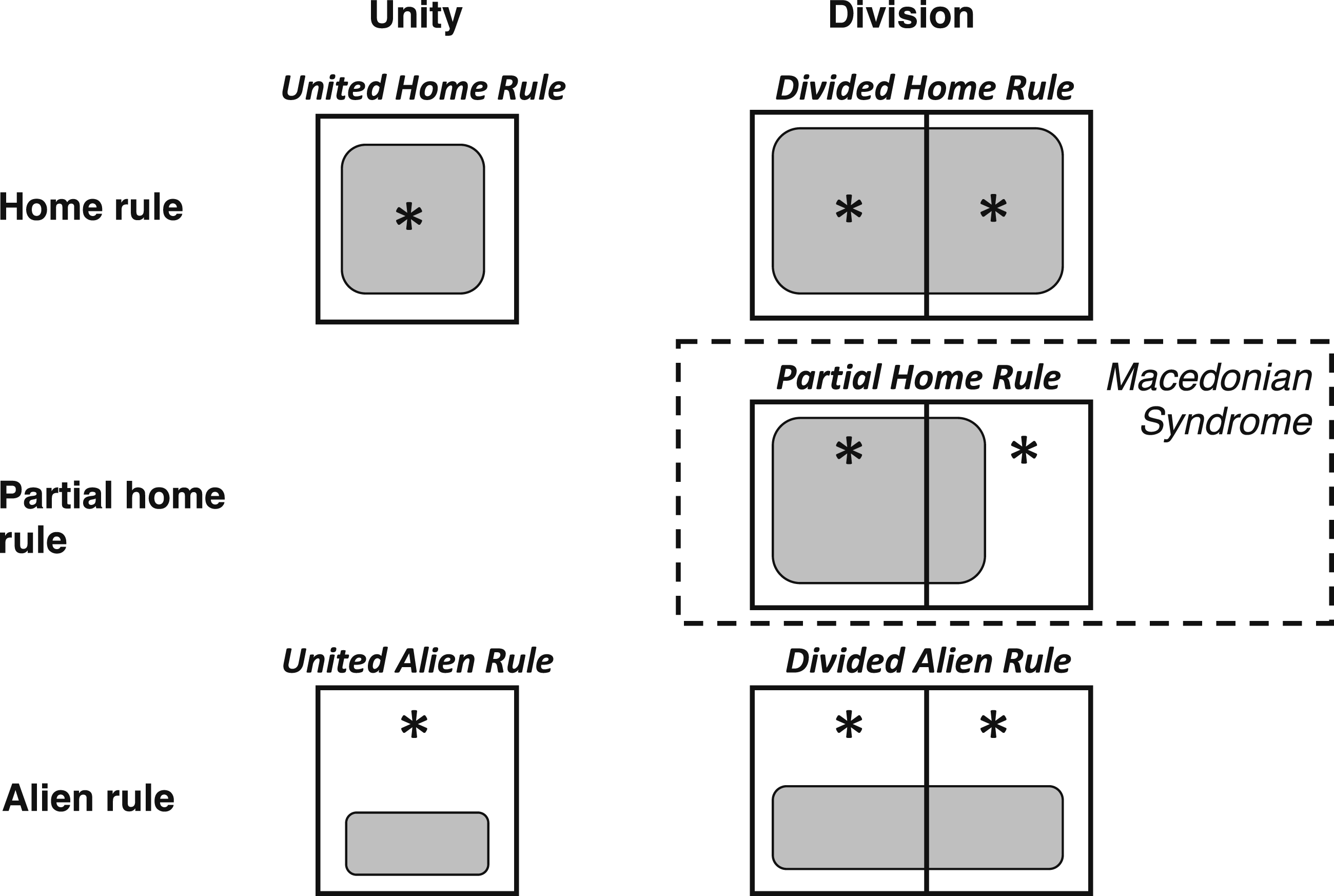
By covering all possible combinations, the figure allows us to contextualize the Macedonian Syndrome as one of five main ethno-nationalist configurations. The rows indicate whether the nation in question enjoys home rule, alien rule, or partial home rule. The latter applies in case some segments of the nation are in power whereas others are exposed to alien rule. The columns denote whether the nation is unified or divided. Based on this classification, we arrive at five possibilities rather than six, since partial home rule presupposes that the ethnic nation is split.
Under United Home Rule, the nationality principle is fully satisfied and we expect no nationalist conflict due to nationality questions. If one disregards its overseas colonies, the past couple of centuries of Portuguese history capture the ideal of a nation-state. 4
In configurations of United Alien Rule, the segment is powerless and may rebel against the host government, with the aim of ousting the incumbent group or seceding from the state. Typical cases include secessionist action against imperial centers, such as the Hungarian uprising against Austrian domination in 1848 and the Baltic peoples’ rebellions against the Soviet occupiers in 1946.
Configurations of Divided Home Rule capture classical unification nationalism. Unification typically proceeds peacefully thanks to nationalist affinities, as illustrated by the German reunification that began in 1989, but interstate conflict due to competition over who would take the lead cannot be excluded. The Austro-Prussian War of 1866 is a prominent example of such a violent national unification process.
(Divided) Partial Home Rule represents the irredentist configuration that we have referred to as the Macedonian Syndrome. 5 Irredentism can produce both civil conflict and interstate disputes. Whether the dominated segment strives to secede from its host state or unify with its homeland state, nationality questions increase the risk of political violence (Horowitz 1991). The Russian-sponsored rebellion in Ukraine since 2014 and its invasion of Ukraine in 2022 fall into this category. 6 Other cases include the Bulgarians rebelling in Serbia in 1885 and the Greeks in the Ottoman Empire rebelling after the creation of the Greek state in 1821. Beyond Eastern Europe, the Troubles in Northern Ireland until the Good Friday Agreement in 1998 illustrate another instance of rebellion in an irredentist setting.
Finally, Divided Alien Rule describes a situation in which all segments of the ethno-nationalist group experience alien rule. This configuration is likely to produce rebellion, as the nationalists are fighting alien rule imposed by their respective governments. The ultimate goal of this rebellion is typically unification in an independent state. Much of Kurdish modern history falls into this category, as do the Serbian challenges to Austrian and Ottoman rule, and the Polish struggle against foreign domination by Russia, Prussia and Austria in the nineteenth century.
Based on this reasoning, we are now ready to derive theoretical expectations for civil wars (
Under United Alien Rule, onset of civil conflict is more likely.
Under Partial Home Rule, onset of civil conflict is more likely.
Under Divided Alien Rule, onset of civil conflict is more likely.
In all three configurations, the lack of home rule constitutes the main motivation driving conflict. Hypotheses 1b and 1c allow us to test whether division amplifies conflict risk above and beyond the effect of alien rule. We do not expect effects for ethnic division on its own because groups that enjoy home rule seem unlikely to fight their co-national governing elites in the name of unification.
Rather than triggering conflict deterministically, these hypotheses are probabilistic because several conditions need to be met for these structural configurations to translate into mass-held grievances and mobilization for violent conflict, the latter being a rare event. The step from state-nation mismatch to grievances requires that the nondominant group members frame alien rule or division as unjust while targeting the dominant group (Horowitz 1985; Tajfel and Turner 1979). Furthermore, mass grievances are unlikely to materialize without a recognition of injustice, which in most cases emanates from normative frameworks, such as nationalism or self-determination (Brass 1991; Williams 2003). Grievance formation also hinges on nationalist activists’ framing of alien rule and/or division as being caused by incumbent power wielders, typically representatives of the dominant group (Benford and Snow 2000; Gamson 1992).
Once mass-held grievances materialize, the potential for collective action increases, but it is still far from guaranteed. At this point, a successful challenge to incumbent power calls for considerable resources and organization (Tilly 1978). Such efforts can profit from preexisting social networks (Tarrow 1994) and identity categories (Goldstone 2001), the latter allowing mobilization to exceed the constraints of direct interpersonal relations in “imagined communities” (Anderson 1991 [1983]). Importantly, instead of constituting a rival explanation, the emotional power of grievances helps non-state challengers overcome the collective-action dilemma imposed by incumbent state power (Petersen 2002).
Under the heading of Hypothesis 2, we now turn to the probability of interstate conflict:
Under Divided Home Rule, onset of interstate conflict is more likely.
Under Partial Home Rule, onset of interstate conflict is more likely.
The mechanisms responsible for interstate conflict differ somewhat from those that produce rebellion. In former cases, it is typically governments and their ethnonational constituencies rather than non-state movements that mobilize to fight. In case of Hypothesis 2a, frustrations with division motivate the proponents of unification to take the lead. Since this process involves conational states, we expect them to consider violence only as a last resort, which should translate to a lower risk of interstate conflict than in the irredentist setup of the Macedonian Syndrome.
In case of Partial Home Rule, the co-ethnics governing the homeland state view division as scandalous, but grievances relating to alien rule are also at play. In this scenario, the unhappiness concerns not only the fact that a governing segment’s kin is cut off from the homeland state, but also more or less substantiated worries about the ethnically foreign government’s treatment of its kin inside the other state (see e.g., Cederman et al. 2022). Grievances may be genuinely felt by a considerable share of the population, or they may be stoked up and instrumentalized by non-dominant elites to launch an attack against the host government allegedly mistreating their kin across the border. In a classic example, Hitler fabricated claims that the Polish government was mistreating ethnic Germans to justify the invasion of Poland in 1939, which in turn triggered World War II (Bergen 2008). Whether motivated by invented or actual mistreatment of minorities, state leaders need to foster grievances and support to prepare their country for mass mobilization and military action.
Our final analytical step captures the interaction between civil and interstate conflict. These hypotheses apply only to Partial Home Rule, which features both conflict types:
Under Partial Home Rule, past interstate conflict makes onset of civil conflict more likely.
Under Partial Home Rule, past civil conflict makes onset of interstate conflict more likely.
Hypothesis 3a assumes that the host and homeland states have a history of interstate disputes. According to this outside-in logic, hostility spilling over from the rivalry between the two states’ may end up poisoning the domestic politics of the host state. For example, the irredentist setting with a disputed interstate border has made the conflict in Northern Ireland more intractable. A similarly enduring dynamic applies to repeated Greek rebellions against the Ottoman Empire in the nineteenth century that were fueled by warfare between the newly independent Greek state and the Ottoman Porte. In the eyes of the host government, the homeland state’s co-nationalists appear as a potentially threatening fifth column that deserves to be selected out for particularly harsh treatment, thus increasing the risk of violent rebellion (Weiner 1971, 678).
In the opposite direction, Hypothesis 3b seeks the roots of interstate conflict in the domestic conditions of the host state. If the co-nationalists are already fighting against their government, their homeland kin may be tempted to intervene in the civil conflict on their side. But such interventions are far from automatic since action against a neighboring state is inherently risky (see e.g., Horowitz 1985, Chapter 6; Cederman et al. 2009) and may involve considerable normative costs at the international level, as has been the case especially in the post-1945 period (Fazal 2007; Zacher 2001). Therefore, full-fledged armed intervention in such conflict interactions have increasingly been substituted by covert support for domestic armed actors in the host state (see e.g., Joseph and Poznansky 2018; Saideman 2002). Balkan history provides several examples of this pattern. The repeated interstate disputes between Greece and the Ottoman Empire/Turkey originated in the Greek uprising against the Ottomans in 1821, especially since newly independent Greece still excluded many Greek settlements that remained unredeemed.
Together, these two hypotheses could set off an entire series of exchanges where repeated conflict at the intra- and interstate levels create a positive feedback effect. Students of interstate warfare analyze this phenomenon as enduring rivalries, especially in regard to repeated outbreaks of conflict between the same two states. (see e.g., Diehl and Goertz 2000). More recently, DeRouen and Bercovitch (2008) extend the concept to civil conflict. Taking it a step further, the triadic nexus of the Macedonian Syndrome helps us to conceptualize persistent and recurrent ethno-political conflict patterns that unfold both between and within states. Prominent examples of this extended notion of enduring rivalries include persistent conflicts pitting India against Pakistan over Kashmir (Saideman 2006), as well as Greek and Turkish competition over various territories, including the region of Thrace and several Aegean islands (Heraclides 2011).
Finally, to help the reader navigate through the empirical part, we summarize these hypotheses in Figure 2. Expected conflict patterns in the five configurations.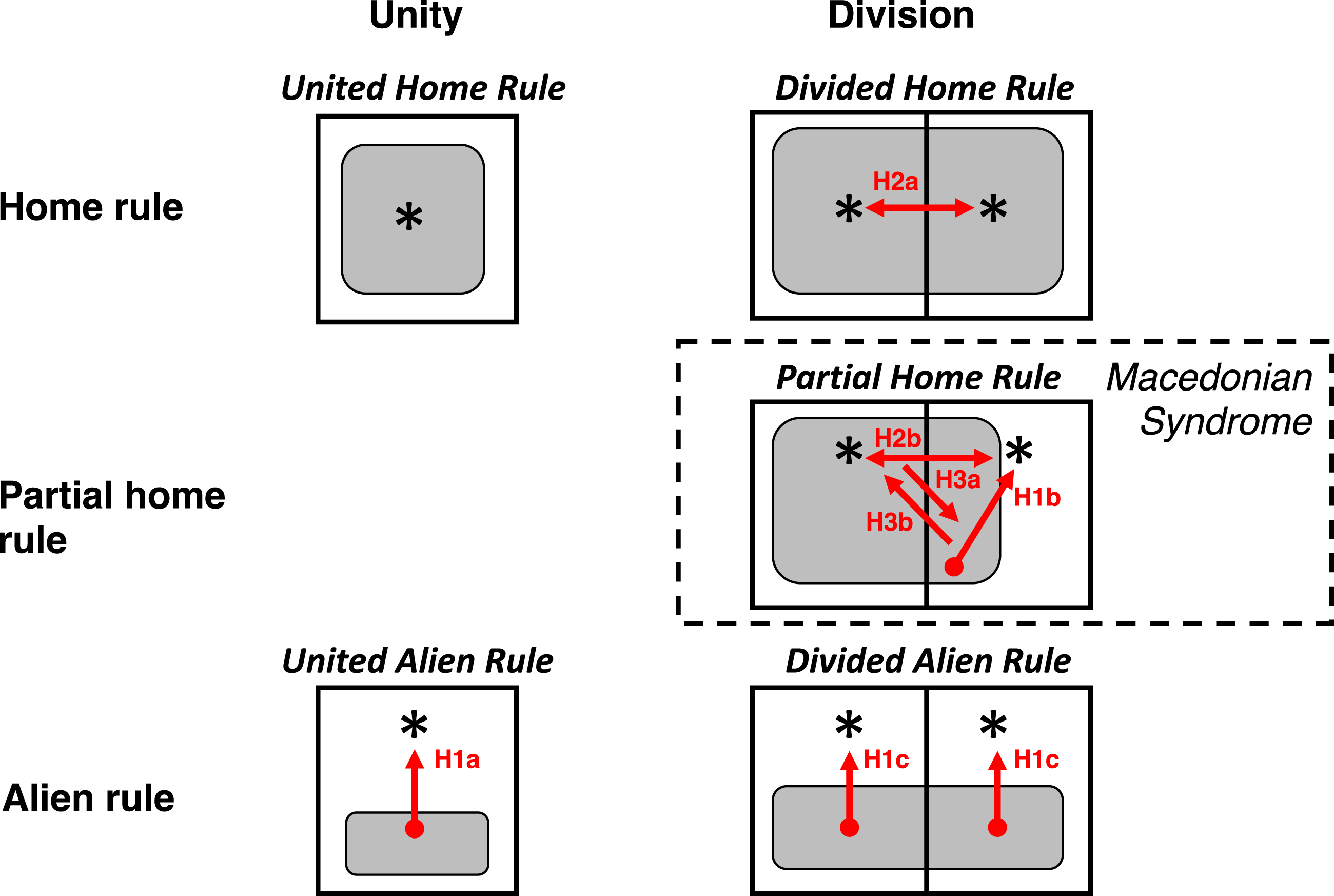
Data and Variables
Identifying nationality questions requires data on both state and ethnic borders. All analyses of civil conflict rely on yearly observations of ethnic segments as units of analysis, defined as the spatial intersections between country borders and (potentially) border-transgressing ethnic settlement areas. We aggregate ethnic-segment-level conflict data to the level of country dyads. This section describes the data construction pipeline for our analyses covering Europe post-1816.
Ethnic Settlement Data
Information on historical ethnic settlements comes from our newly compiled Historical Ethnic Geography (HEG) dataset. This European dataset is based on 200 historical ethnic maps compiled from online map collections such as the British Library, Library of Congress, and the Bibliothèque Nationale de France. From this candidate set, we selected 73 high-quality maps with (a) high geographic resolution, (b) broad spatial coverage (i.e., depicting large subregions or the entirety of Europe), and (c) authors of varying nationality. 7 Turning the maps into geocoded data, we first standardized the identity labels across different maps and time periods using the Ethnologue language tree (Lewis 2009). The map data are further rasterized and aggregated into group polygons for analytical use (see the Online Appendix).
The main goal of our map-based approach is to capture a typically ethno-nationalist worldview rather than historical facts. While most map makers aspired to scientific objectivity, the actual drawing of some maps reflected implicit nationalist claims (see, e.g., Hansen 2015). Overall, these deviations seem marginal and there is major spatial agreement between the maps as illustrated in Figure A3. Where the maps diverge, the statistical averaging of our procedure should further even out extreme views. Furthermore, identifying potential ethnic nations from historical linguistic maps does not require mass adoption of nationalist ideologies and elimination of local dialects. For nationality questions to result in armed conflict, elite-level convictions and a critical mass of nationalist activism often suffice to trigger mobilization. As long as our maps capture existing linguistic boundaries relatively accurately and correspond to what nationalists perceived as the cultural bases of their imagined nations, our approach yields a valid measure of the structural potential for nationalist grievances and mobilization. 8
Historical State Borders
Spatial data on state borders since 1886 come from the CShapes 2.0 dataset, which offers global coverage of all sovereign states and their dependencies since the “Scramble for Africa” (Schvitz et al. 2021). We extend CShapes 2.0 for Europe back to 1816 drawing on non-spatial data from the Gleditsch and Ward (1999) dataset of independent states, the Correlates of War’s Territorial Change dataset (Tir et al. 1998), and historical GIS data from the Centennia Historical Atlas (Reed 2008) (see Appendix for further details).
Units of Analysis and Main Independent Variables
Spatially intersecting the aggregate group polygons with yearly data on European state borders yields our main unit of analysis – ethnic segments years (ect) starting in 1816. For each segment year, as well as for the country and aggregate group years in which it is nested, we calculate absolute area in sqkm to derive size-based control variables. Wherever ethnic polygons intersect, we equally divide the area among all locally overlapping segments assuming mixed settlements. The sample is restricted to ethnic segment that are larger than 500 square kilometers (sqkm) and thus eliminates tiny units that emerge due to cartographic or digitization errors.
We assign dichotomous indicators for home vs. alien rule and national unity vs. division to each segment year. Home rule applies to the ethnic segment that holds most power in the respective country’s capital in a given year. The largest ethnic segment that contains the capital serves as our first guess complemented by manually correction wherever necessary.
Division is present wherever an ethnic segment has a transborder ethnic kin segment. Combining values on alien rule and division allows us to operationalize the configurations illustrated in Figure 1. The nation-state ideal of United Home Rule serves as the baseline category. United Alien Rule apply to all segment years governed by a non-coethnic group but without transborder ethnic links (Divided Alien Rule). Divided Home Rule captures governing segments that have governing or non-governing peers abroad. For segments with alien rule and division, we further distinguish whether the foreign kin segment enjoys home rule or is also affected by alien rule to differentiate between (Partial Home Rule) and (Divided Alien Rule).
Our analyses of territorial claims and interstate disputes use directed country dyad-years as the unit of analyses and require aggregating the ethnic segment data to this level. As argued above, nationalist interstate conflict requires division combined with home rule on at least one side of the border. As a result, the dyadic interstate analyses only use proxies for Divided Home Rule and Partial Home Rule. Again, the nation-state ideal, that is a dyad year in which the governing group in country A does not have a kin segment in state B, constitutes the baseline for comparison.
Conflict Outcomes and Two-Level Dynamics
This study features three distinct outcome variables to operationalize intrastate and interstate conflict: • First, we code a dummy of ethnic civil war onsets at the ethnic segment-year level covering the period 1816–2017. For the post-1945 period, we use existing data from UCDP/PRIO (Gleditsch et al. 2002) linked to ethnic groups via the ACD2EPR dataset (Wucherpfennig et al. 2012). We manually match the post-1945 EPR conflict groups to the corresponding groups in our analysis data. For the period 1816–1945, we identify all civil wars listed in the datasets provided by Gleditsch (2004) and Sarkees and Wayman (2010) that correspond to the post-1945 definitional criteria of UCDP/PRIO and are fought in the name of a specific ethnic group. The coding rules are the same as in the ACD2EPR dataset, requiring explicit ethnic claims and recruitment from a particular ethnic group. The main analyses rely on an onset dummy that includes both territorial and governmental civil wars (for robustness tests by conflict type, see Tables A8 and A9). • Second, territorial claim onsets with coverage until 2001 are defined at the level of directed country dyads (Frederick et al. 2017). In the robustness section, we investigate theoretically relevant subsets of plausibly irredentist territorial claims. First, we use information coded by Frederick et al. (2017) to distinguish whether the claimed “territory includes significant portions of ethnic, religious, linguistic, or other identity groups linked to the challenger state.” Second, we extend the original claims dataset and code, for each European claim, whether it is ethnically motivated and identify the specific ethnic segment in country B that is targeted (in which case we refer to State B as the target state). • Third, the Dyadic Militarized Interstate Dispute (MID) dataset codes dispute initiation at the level of directed country-dyad years Maoz et al. (2019). The baseline analyses rely on all dyadic MIDs, whereas the supplemental online appendix shows replications based on the more restrictive subset of fatal MIDs (Table A24).
Combining information on interstate conflict, ethnic rebellion, and transborder ethnic kin relations allows to test Hypotheses 3a and 3b. In the civil war analysis, we identify all segment-years in which a specific ethnic segment ect has state-owning ethnic kin abroad and there were territorial claims and/or militarized disputes between the ethnically related foreign government and the ethnically distinct host government in the past. We construct the variable Past Interstate Trouble (Host vs. TEK) as the total years with ongoing territorial claims or MIDs between 1816 and year t-1. The idea is to capture governing groups’ claims, fears, and grievances about potential fifth columns within the country. Repressive or assimilationist policies taken by the host government to address such fears are expected to make ethnic rebellion more likely. For the dyadic interstate conflict sample, we code all dyad years in which the state-leading segment in country A has powerless ethnic kin abroad who violently challenged their ethnically distinct host government in country B. The variable Past Civil War (TEK vs. Host) counts the years between 1816 and t-1 with ongoing civil war of this type.
Analyzing Nationality Questions and Conflict in Europe from 1816
To identify specific nationality problems, we draw state borders from the CShapes Europe data set and rely on the HEG data for ethnic groups in Europe. Extensive robustness analysis can be found in the Online Appendix. Here we begin by testing the association between the theoretically derived nationality mismatches and territorial conflict within and across country borders in post-1816 Europe. The following section extends the empirical focus to a global sample covering the post-WWII period and tests whether the European findings travel to other world regions post-1945.
Throughout, we rely on linear probability models that include a measure of the territorial balance between countries A and B, log-transformed country size of B, log-transformed aggregate group sizes of state-leading ethnic groups in A and B, log-transformed minimum distance between countries A and B, a dummy for neighboring dyads, and the sum of past years with ongoing territorial claims as control variables. Again, we add fixed effects for peace years and calendar year. Additional specifications introduce fixed effects for both countries and time since last border change affecting countries A and B. Standard errors are clustered on the directed dyad as well as on countries A and B.
First, we explore the link between ethno-nationalist configurations and civil conflict in Figure 3. The top row indicates that for United Alien Rule, civil conflict is more likely than in an ideal nation-state, thus confirming Hypothesis 1a. We also include the result for Divided Home Rule, although this does not refer to any postulated effect, and indeed, the effects are small and not separable from zero. Under Partial Home Rule, there is a strong effect corresponding roughly to five times the average effect among all segments in our data, thus confirming Hypothesis 1b. Likewise, the next row indicates that alien rule together with division yields about the same risk of civil conflict (see Hypothesis 1c). Finally, there is some, but considerably weaker, evidence that past or present interstate disputes make internal conflict even more likely in constellations of division and partial home rule (see the bottom row, referring to Hypothesis 3a). Main findings: Ethnic rebellion in Europe, 1816–2017.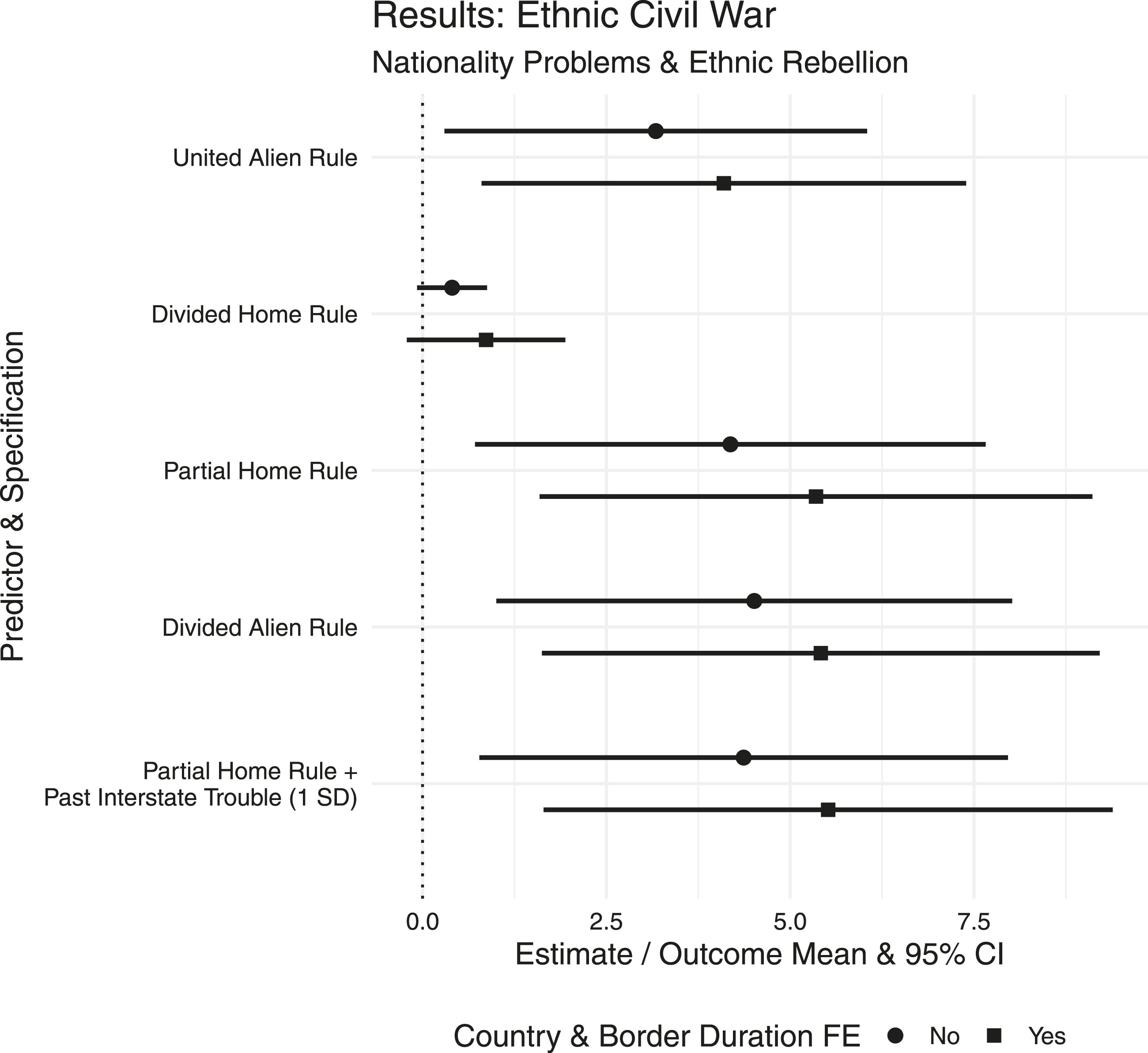
Our second set of analyses investigates how nationality mismatches relate to territorial claims between countries. We study yearly observations of country pairs covering the period between 1816 and 2001. Figure 4 presents the results. As expected, we find no clear sign that Divided Home Rule would make interstate territorial claims more likely, thus casting doubt on Hypothesis 2a (see the first row). But Partial Home Rule is associated with a clearly positive effect on interstate claim making (Hypothesis 2b). The potential for conflict increases even further if the fought-over kin segment has been fighting its host government (Hypothesis 3b). Main findings: Territorial claim onset in Europe, 1946–2001.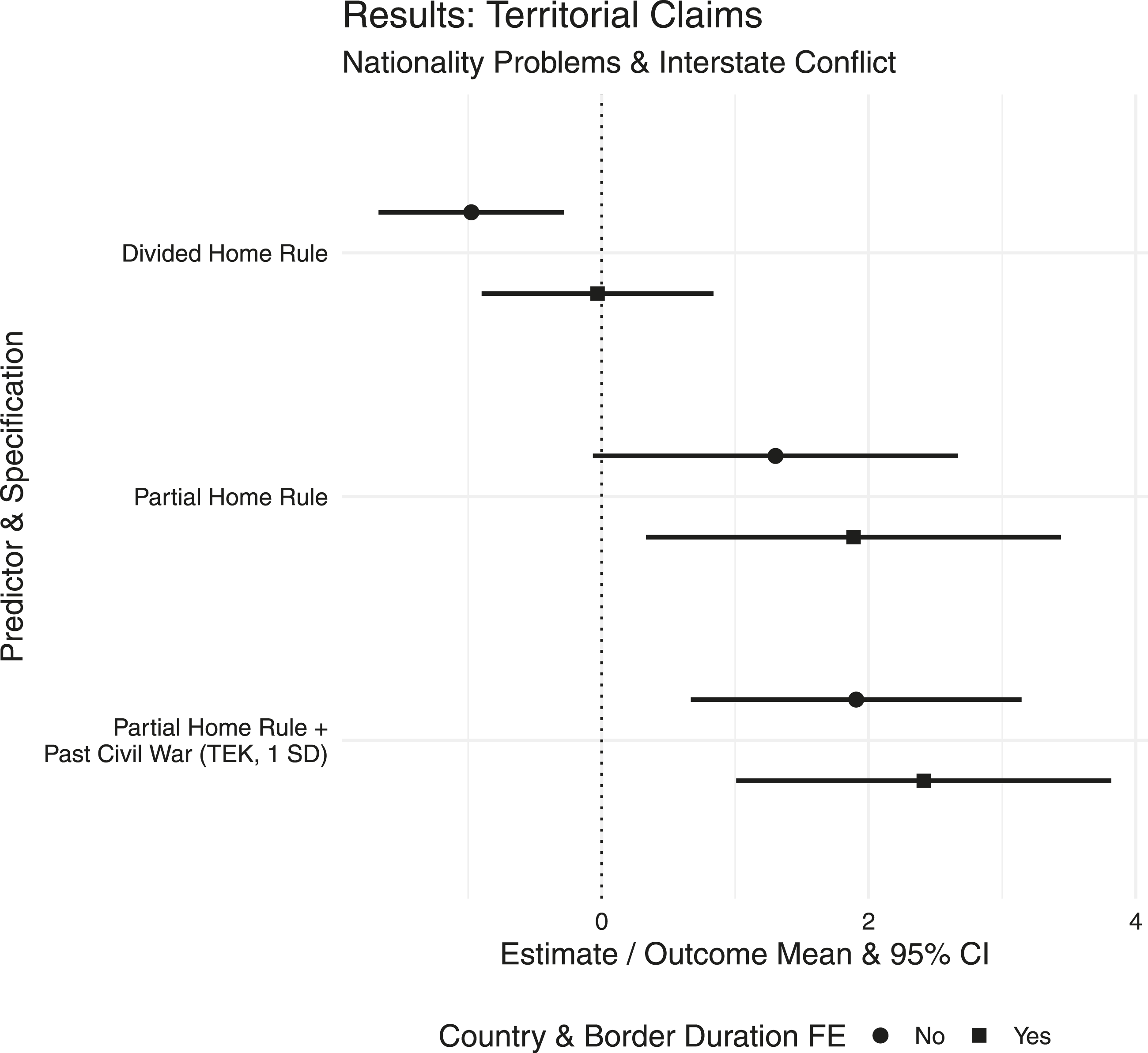
We next shift our attention from territorial claims to actual militarized interstate disputes. It is well known that not all territorial claims turn violent. As an alternative measure of interstate conflict at a higher level of escalation than claims, we analyze the initiation of dyadic militarized interstate disputes (see Figure 5). In this case, a clearly negative effect can be detected for divided groups enjoying home rule in both countries of the respective dyad (Hypothesis 2a), which underlines the conclusion drawn from the claims analysis. But we do find an effect of the irredentist constellation of Partial Home Rule, although in this case it is somewhat less precisely estimated (Hypothesis 2b). As with territorial claims above, disputes become even more likely if the relevant ethnic kin had been involved in a civil conflict with their host government (Hypothesis 3b). Main findings: MID initiation in Europe, 1816–2014.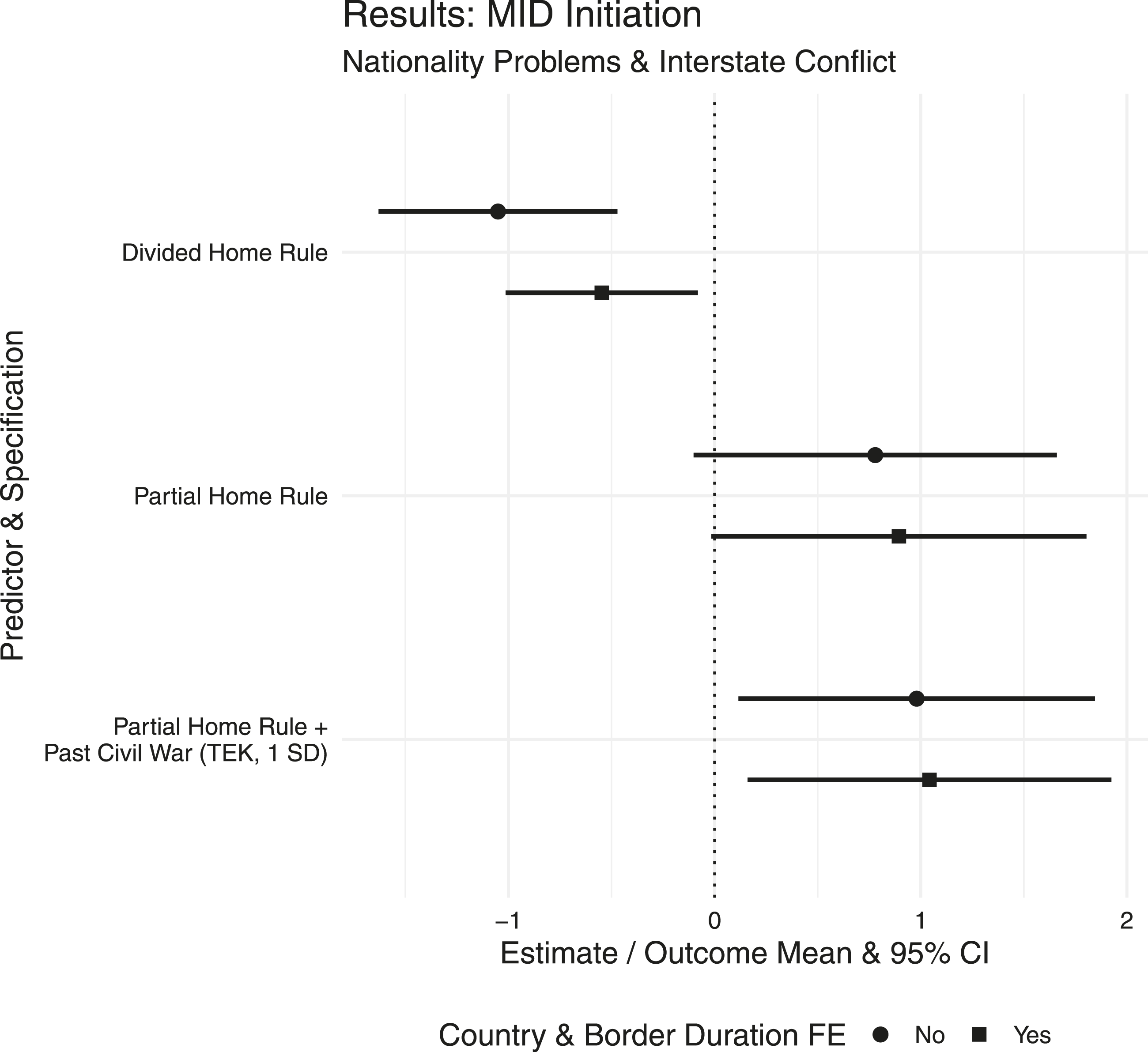
In the Online Appendix, we confirm the robustness of the main results for alternative dependent variables, including secessionist vs. governmental rebellions (Tables A8 and A9) as well as fatal MIDs (Table A24). A second robustness exercise augments the dyadic specifications with controls for past civil war in country A and B that does not involve ethnic kin of A in B (Tables A13 and A27). In line with Gleditsch et al. (2008), the models without fixed effects show some evidence for diversionary claim-making and MID initiation of state A after domestic conflict. More importantly, Hypothesis 3b receives further support indicating that ethnic rebellion in target state B may escalate into interstate conflict by motivating irredentist interventions of state A. Third, we recreate our datasets based on the earliest available map for each group to address concerns about endogeneous change in ethnic settlement patterns. All findings persist but the estimates for MIDs lose some precision (Tables A10, A14, and A28). Fourth, distinguishing plausibly irredentist territorial claims from cases without an identity basis reveals that our findings are entirely driven by the former category (Tables A11 and A12). Fifth, we show that the civil war and territorial claim results are stronger for the pre-1946 period and get weaker or disappear post-WWII (Tables A19, A20, A22, and A23), whereas the coefficients in the MID models remain similar in both subsets (Tables A25 and A26). Finally, we analyze territorial claims at the level of targeted ethnic segments rather than directed country dyads. The results in Table A21 suggest that powerless segments with governing kin abroad are significantly more likely to be targeted with territorial claims, again confirming Hypothesis 2b.
In summary, our analysis has established that Weiner’s (1971) original analysis applies quite well to Europe as a whole from 1816 through the early twenty-first century, with most of the action appearing before 1945. As expected, the irredentist configuration of Partial Home Rule generates both more civil and interstate conflict than the nation-state baseline. Also in accordance with the Macedonian Syndrome, the analysis reveals considerable interdependence between these two conflict types, but mostly from civil to interstate conflict rather than in the other direction.
Global Analysis of Nationality Questions and Conflict from 1946
This section investigates whether our findings for post-Napoleonic Europe apply to the rest of the world after World War II. 9 To conduct this extended test, we construct a global dataset from 1946 until 2017. The basic setup resembles the European analysis described above. We derive information on global ethnic settlement patters from the GeoEPR dataset (Wucherpfennig et al. 2012) and intersect the group polygons with data on state borders from the CShapes 2.0 dataset (Schvitz et al. 2021). 10 We use the Ethnic Power Relations dataset (EPR) to code ethnic groups in positions of monopoly, dominance or senior power-sharing as leading the respective government. 11 The information on state-leading groups is then used to derive indicators of alien rule as well as full or partial home rule. 12
For the dependent variables, we rely on the same data sources as described above. The ACD2EPR and UCDP/PRIO data on civil conflict provide global coverage of ethnic conflicts since 1946. The datasets on militarized interstate disputes and territorial claims cover the entire world. We compute the same set of spatial control variables as in the European analysis and estimate equivalent empirical specifications.
Analyzing the effect on civil conflict, Figure 6 reveals results similar to the European case for alien rule and unity, although the increase in conflict risk relative to the sample average is lower than in the European analysis. Furthermore, as in Europe, the global effect increases for Partial Home Rule, confirming that the Macedonian Syndrome is particularly conflict-prone, as well as for Divided Alien Rule. There is no clear evidence, however, that past interstate trouble makes a difference (see Hypothesis 3a). Main findings: Civil-conflict onset, global sample, 1946–2001.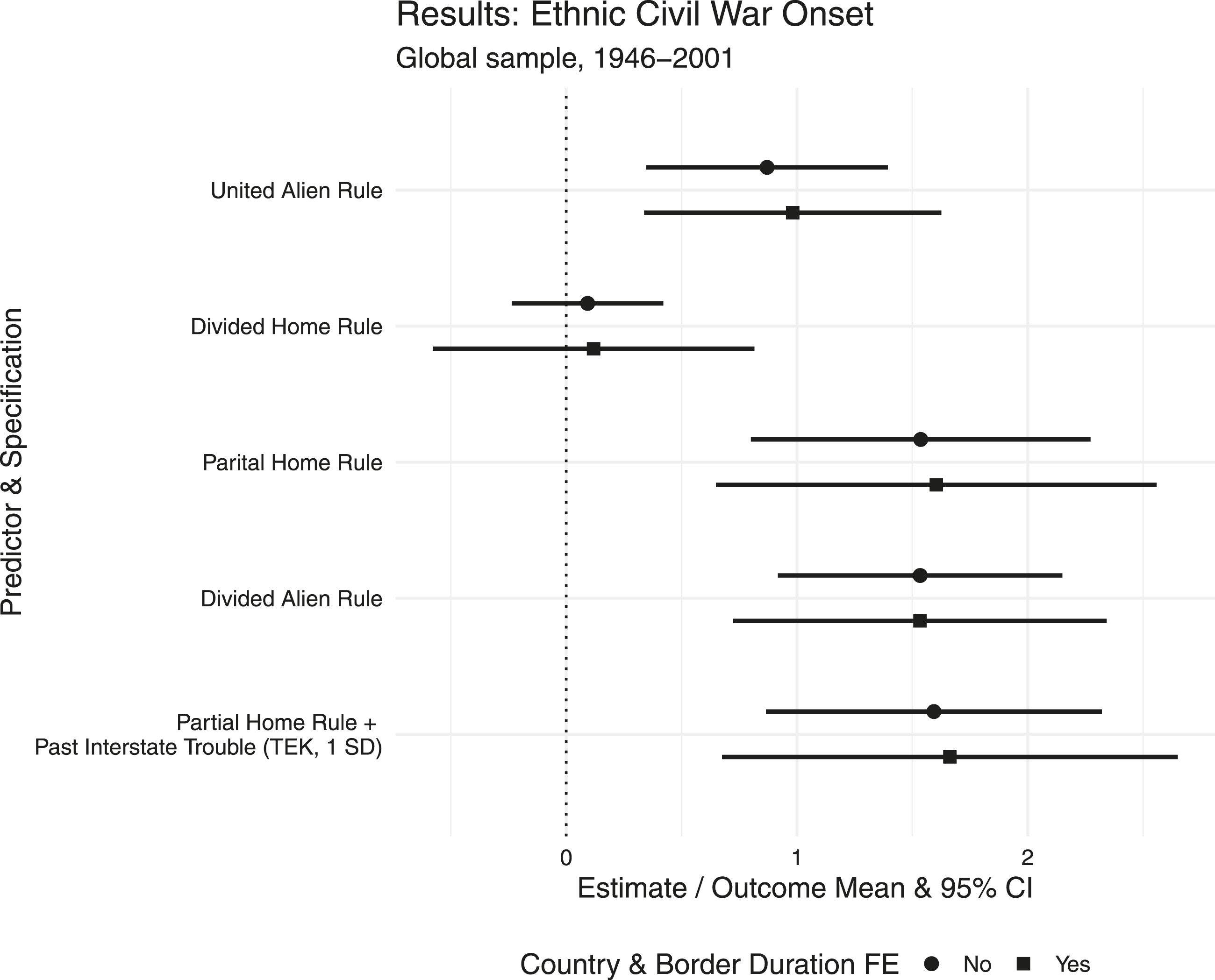
Interstate Claims and Disputes
Shifting to the interstate level, Figure 7 indicates Partial Home Rule is indeed associated with a higher risk of irredentist territorial claims. In contrast to the European findings, the effect of past civil conflict does not appear to be influential, thus contradicting Hypothesis 3b. If anything, the findings for militarized interstate disputes are even weaker (see Figure 8). In such a case, the irredentist configuration of partial home rule fails to stand out in terms of conflict risk, and the influence of previous civil conflict again does not appear relevant. Main findings: Territorial-claim onset, global sample, 1946–2001. Main findings: MID initiation, global sample, 1946–2014.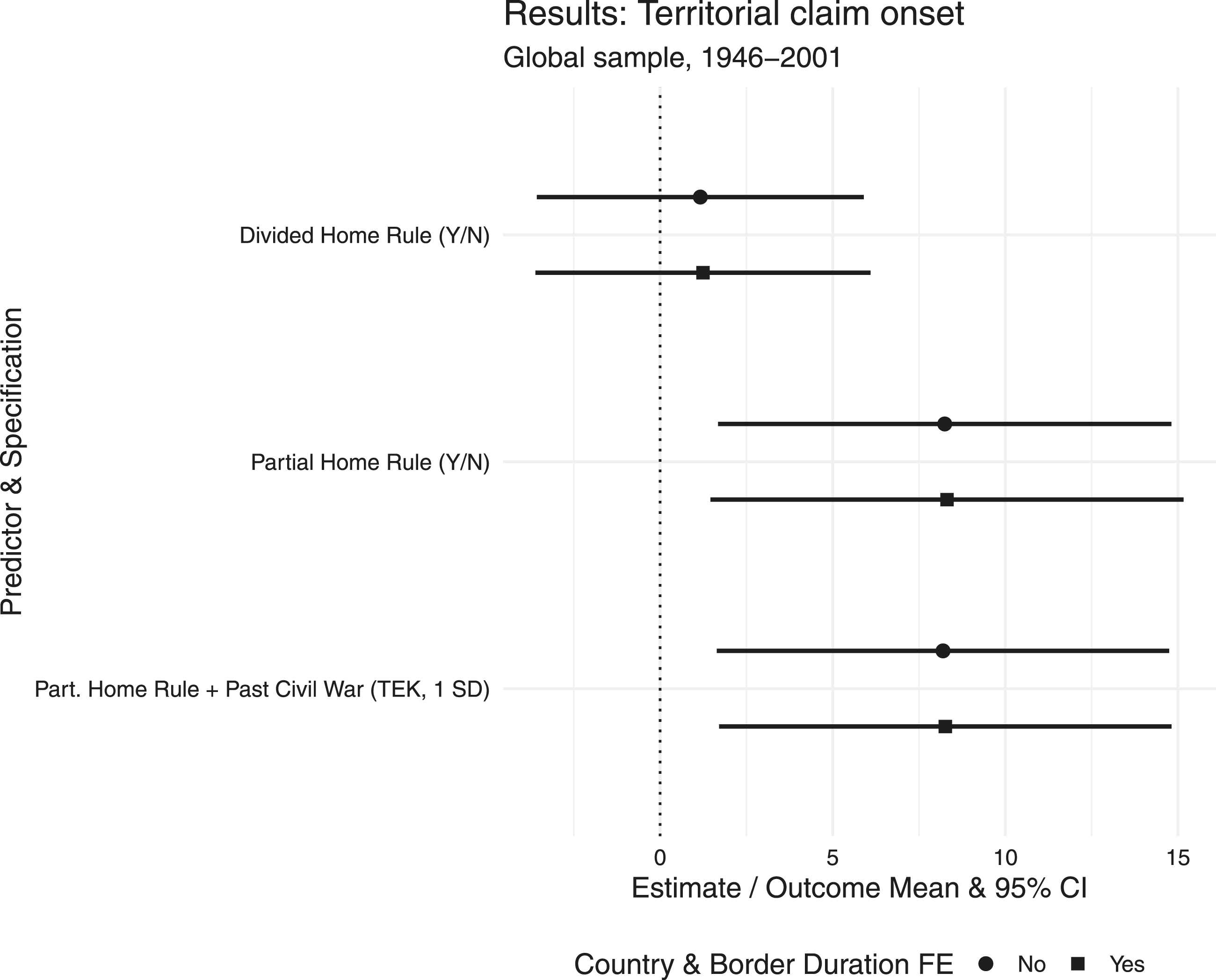
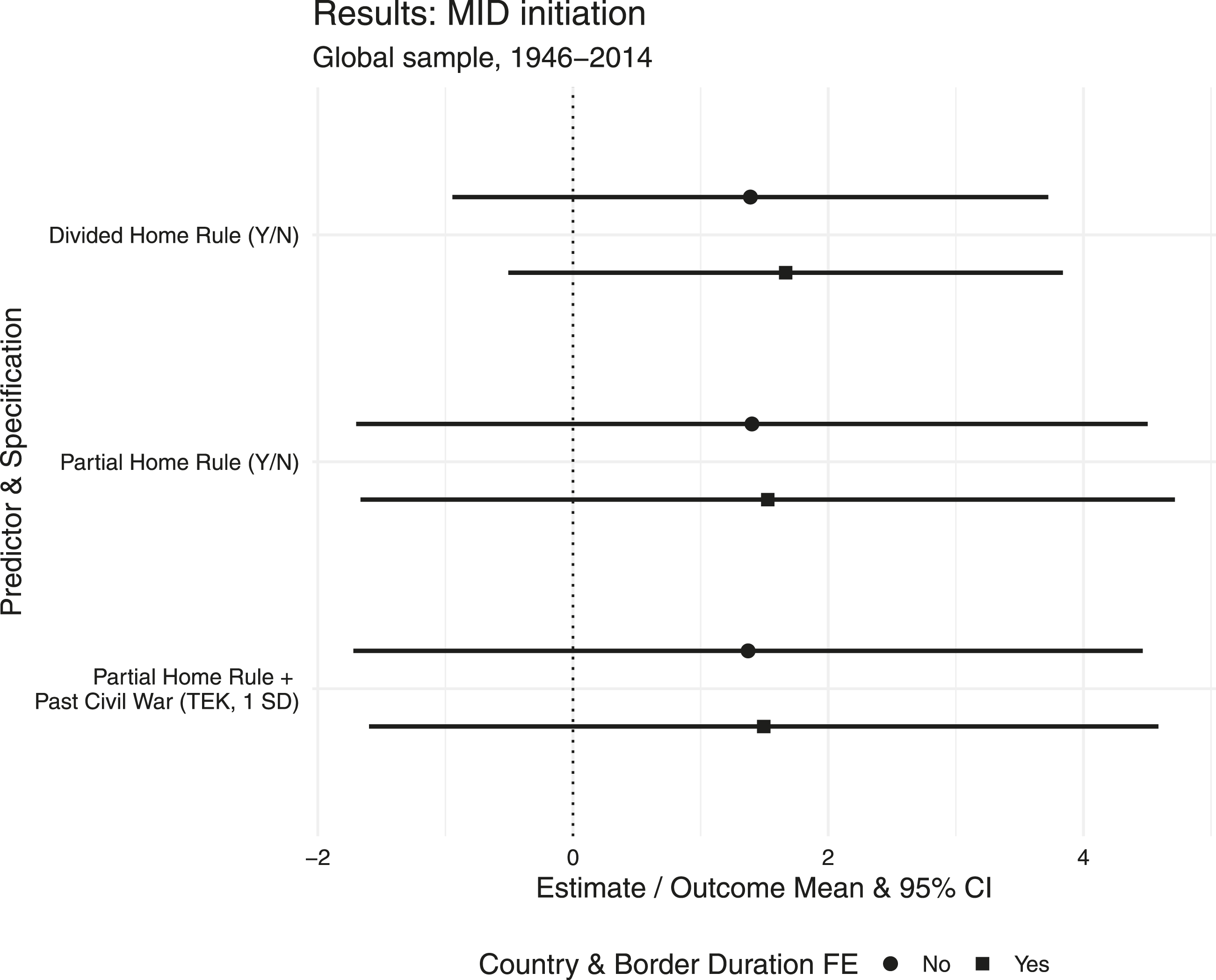
These relatively weak effects could be due to changes in the international environment over time, especially the gradual consolidation of the territorial integrity norm after World War II (Fazal 2007; Zacher 2001). Furthermore, during the Cold War, great power interests arguably contributed to pacification within each superpower’s sphere of influence, as illustrated by Soviet suppression of conflict in the Balkans (Weiner 1971, 682). That said, the global findings suggest that ethnic division combined with foreign or partial home rule continue to drive ethnic rebellion within and territorial claim-making between states. Postwar norms and institutions thus appear to have contained nationalist interstate conflict without resolving the underlying grievances and motivations.
If this interpretation is correct and the postwar international order merely raises the normative and material costs of land grabs and violent interstate action, we would expect states with irredentist inclinations to search for less risky alternatives. Existing literature on external intervention in civil wars has highlighted one such alternative: providing support to rebel groups fighting in the name of marginalized co-ethnics abroad (Saideman 2001; San-Akca 2016).
Based on data from San-Akca (2016), additional empirical analysis confirms our interpretation that rebel support often functions as a substitute for interstate conflict. Figure 9 reveals that governments are particularly likely to support rebels under Partial Home Rule. Combined with the null findings for MID initiation, this suggests that irredentist interventions are by no means a thing of the past, but continue in another, plausibly less costly form. Main findings: External support for rebels, global sample, 1946–2017.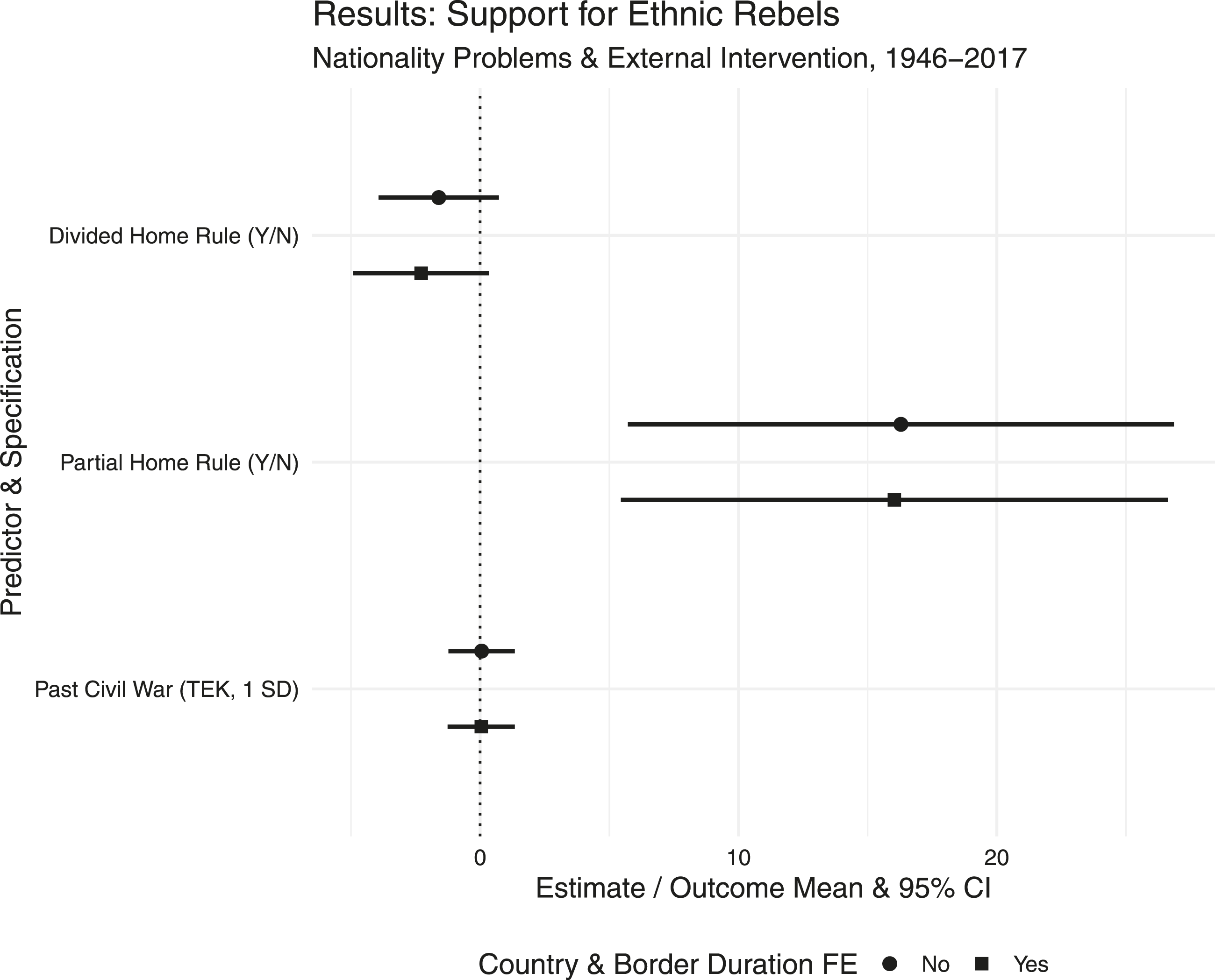
Additional Specifications
Because the global analysis may obscure regional differences, we rerun all post-45 models for different world regions (see Tables A16, A17, A18, and A39). The findings for ethnic rebellion and territorial claims are mainly driven by Asia and Africa, with similar but generally insignificant estimates for the European subsample. The American subsample clearly deviates from the general pattern with small and, if anything, negative coefficients throughout. These weak results reflect ethnic similarity among settlers elites and their overwhelming power over minorities in “ranked systems” (Horowitz 1985; Vogt 2019). The weak findings for MIDs under Partial Home Rule derive from substantively non-negligible positive but insignificant coefficients in Europe, Asia, and Africa on the one hand, and large negative and significant estimates in the Americas on the other. Finally, the strong association between partial home rule and rebel support is mainly driven by the African subsample, with similar but weaker estimates for Asia, and small or negative ones for Europe and the Americas.
We further show that the effects of nationality questions on ethnic rebellion are similar and sometimes stronger for governmental than for secessionist conflict (Tables A32 and A33), and, just as in the European analysis, the association between Partial Home Rule and territorial claims is clearly driven by plausibly irredentist cases (Tables A34 and A35). Finally, we confirm that our results hold for conventional logit estimation (Tables A29, A30 and A31 for Europe and A43, A44 and A45 for the global sample).
And so, extending Weiner’s descriptive model far beyond its original spatiotemporal reference frame yields mixed empirical support. The global analysis of civil conflict suggests that nationality questions are an important driver, particularly for ethnic groups that are both divided and powerless. Focusing on territorial claims, there is support for Hypothesis 2b, which corresponds to the irredentist setting of partial home rule that is at the heart of Weiner’s model. Yet this finding does not translate into militarized action, arguably because international norms have inhibited most open interstate conflict since World War II. Interestingly and consistent with this view, the irredentist constellation strongly predicts external support for ethnic rebels, a plausibly more feasible strategy to further ethnonationalist goals abroad. But the global analysis offers no evidence of a reinforcing effect between intrastate and interstate conflict via transborder ethnic links. 13
Conclusion
In this article, we have used Weiner’s (1971) model as an analytical starting point for a more general explanation of why specific nationalist configurations are more conflict-prone than others. Our main findings confirm the original intuition of Weiner’s conjectures. On their own, both alien rule and division are associated with a higher likelihood of conflict outbreaks in Europe. What is unique about the Macedonian Syndrome, however, is that these two violations of the nationality principle coincide. Furthermore, it is the only configuration in which both internal and external conflicts are likely to break out due to state-nation incongruence. It is precisely this irredentist logic that fuels such explosive dynamics, as illustrated by the combined civil and interstate conflict affecting Ukraine from 2014. 14
Extending the focus from the Balkans to the whole of Europe, we find strong evidence that rebellions involving ethnonationalist groups challenging their host states increase the probability that the homeland state may in fact get involved in disputes with the host state. There is also some, although considerably weaker, support for the reverse effect (going from interstate conflict to internal strife), which may reflect host governments’ fears and claims about ethnic “fifth columns” within their own borders.
Focusing on the post-1945 period beyond Europe, our analysis underlines the conflict potential of specific ethno-nationalist constellations. Division and alien rule significantly increase the risk of civil conflict, as illustrated by the Kurds’ persistent struggle. We find somewhat weaker effects of division and partial home rule on intrastate conflict. Furthermore, this irredentist constellation also appears to generate interstate trouble only in terms of territorial claims and external support for ethnic rebels and not as militarized disputes. Yet beyond the historical European cases, there is little evidence of spillover from one level to the other. International norm shifts against violent border change could account for these differences. In this sense, global post-1945 conflict patterns between states are less extreme than could be expected based on Weiner’s decades-old model. But unfortunately, Russia’s military interventions in Ukraine since 2014 suggest that the very norms that had previously tamed nationalist interstate conflict may now be weakening (Simmons and Goemans 2021).
More generally, this study contributes to a recent trend in conflict research that analyzes interactions between different types of political violence (Cederman and Vogt 2017; Kalyvas 2019). While our analysis has focused purely on civil and interstate conflict, Weiner’s (1971) process also includes one-sided violence perpetrated by vulnerable host governments that fear subversion orchestrated by revisionist neighbors (see e.g., Mylonas 2012). We have not attempted to empirically capture such phenomena, but future research would profit from adding ethnic cleansing and other types of victimization to the repertoire of political violence to be analyzed.
There is also room for further exploration of how historical legacies affect the risk of conflict within and between states. Indeed, within irredentist triads there is typically “a great concern, almost an obsession, with the past, as each actor seeks to define or justify its identity” (Weiner 1971, 680). While we have refrained from considering the retrospective aspect of nationalist conflict in an effort to limit the complexity of our configurational analysis, Cederman et al. (2024) offer precisely such an analysis.
There is also room for further exploration of how historical legacies impact on the risk of conflict, both within and between states. Indeed, within irredentist triads there is typically “a great concern, almost an obsession, with the past, as each actor seeks to define or justify its identity” (Weiner 1971, 680). Although the current study refrains from considering the retrospective aspect of nationalist conflict in order to limit the complexity of the configurational analysis, it is well known that nationalists make their territorial claims depend on the return to “golden ages” (Smith 1986) and the securing of historical “homelands” (Shelef 2020). Future research needs to take into account not only the impact of current structures, but also historical ones, in some cases dating back centuries. 15
Despite these limitations, this article provides several new conceptual and empirical insights. Thanks to our new data, this analysis highlights structural similarities in a large number of internal and external conflict processes, while linking them to a new systematic classification of nationality questions. To some it may seem that these issues are no more than esoteric details that are better left to conflict researchers and historians to debate. Yet this would be a mistake, because more than two centuries after the French Revolution, the intersection of borders of states and nations continues to generate conflict. One needs look no further than the territorial disputes concerning Ukraine and Taiwan to realize that state-nation incongruence still poses a major risk of war. Given the ubiquity of nationality questions around the world, peace requires compromises within given borders rather than letting violent border change fuel the flames of revisionist nationalism.
Supplemental Material
Supplemental Material - Nationality Questions and War: How Ethnic Configurations Affect Conflict Within and Between States
Supplemental Material for Nationality Questions and War: How Ethnic Configurations Affect Conflict Within and Between States by Lars-Erik Cederman, Yannick I. Pengl, Dennis Atzenhofer, and Luc Girardin in Journal of Conflict Resolution
Supplemental Material
Supplemental Material - Nationality Questions and War: How Ethnic Configurations Affect Conflict Within and Between States
Supplemental Material for Nationality Questions and War: How Ethnic Configurations Affect Conflict Within and Between States by Lars-Erik Cederman, Yannick I. Pengl, Dennis Atzenhofer, and Luc Girardin in Journal of Conflict Resolution
Footnotes
Acknowledgments
Earlier versions of this paper were presented at the conference “Ungleichheit, Frieden und Konflikt” at University of Konstanz, 17–19 March, 2022, and at the Robert Schuman Center at the European University Institute, February 16, 2022.
Declaration of Conflicting Interests
The author(s) declared no potential conflicts of interest with respect to the research, authorship, and/or publication of this article.
Funding
The author(s) disclosed receipt of the following financial support for the research, authorship, and/or publication of this article: We are grateful for excellent feedback from the participants of these events and generous financial support from the Advanced ERC Grant 787478 NASTAC (ERC AdvG 787478 NASTAC), “Nationalist State Transformation and Conflict.”

Data Availability Statement
Data sharing not applicable to this article as no datasets were generated or analyzed during the current study.
Supplemental Material
Supplemental material for this article is available online.
Notes
References
Supplementary Material
Please find the following supplemental material available below.
For Open Access articles published under a Creative Commons License, all supplemental material carries the same license as the article it is associated with.
For non-Open Access articles published, all supplemental material carries a non-exclusive license, and permission requests for re-use of supplemental material or any part of supplemental material shall be sent directly to the copyright owner as specified in the copyright notice associated with the article.
