




Abstract
Why do states that simultaneously support rebel groups in each other’s intrastate conflicts enter negotiations to resolve such mutual interventions? This is an important question, as negotiations between interveners typically lead to negotiated settlements, which in turn tend to make their intrastate conflicts far less deadly. We argue that international crises make negotiations more likely. Crises raise the costs of intervention and often lead potential mediators to put pressure on states to negotiate. Using new monthly data on mutual interventions in Africa, the article shows that crises are indeed significantly associated with the likelihood that negotiations will occur. This finding is robust to using fixed effects and matching. The article contributes to the literature by investigating a widespread though little-studied type of conflict, as well as by studying the impact of state leaders’ crisis perception using a quantitative research design, which helps overcome a methodological limitation seen in previous studies.
Keywords
Introduction
Rivalries between African states are common, but conventional wars between them are rare. African states have long struggled to “project authority over inhospitable territories that contain relatively low densities of people” (Herbst 2000, 11). The threat of coups d’état has led African leaders to prioritize “coup-proofing” their regimes, undermining the combat effectiveness of their armed forces and increasing the risk of civil wars (Pilster and Böhmelt 2011; Roessler 2016). Due to these circumstances, rival African states tend to fight each other via mutual intervention rather than conventional war: they simultaneously intervene in each other’s intrastate conflicts by supporting rebel groups. Duursma and Tamm (2021) identify 23 mutual interventions that together span 117 dyad years in Africa between 1960 and 2010. In that same period, there were only nine direct interstate conflicts, spanning 14 dyad years.
The conflict management literature has so far overlooked this type of international conflict. Scholars have investigated conflict management efforts in interstate wars (Min 2020), militarized interstate disputes (Frazier and Dixon 2006), international rivalries (Rasler et al. 2013), international crises (Beardsley et al., 2006), and internationalized civil wars (Kane 2022), but not mutual interventions. This is a significant research gap, not least because intrastate conflicts that are part of mutual interventions on average witness far more battle-related deaths than other intrastate conflicts (Duursma and Tamm 2021, 1078). To alleviate the severity of intrastate conflicts, it is thus important to understand the occurrence, conduct, and outcome of conflict management efforts in mutual interventions.
Mutual Interventions in Africa, 1960 to 2010.
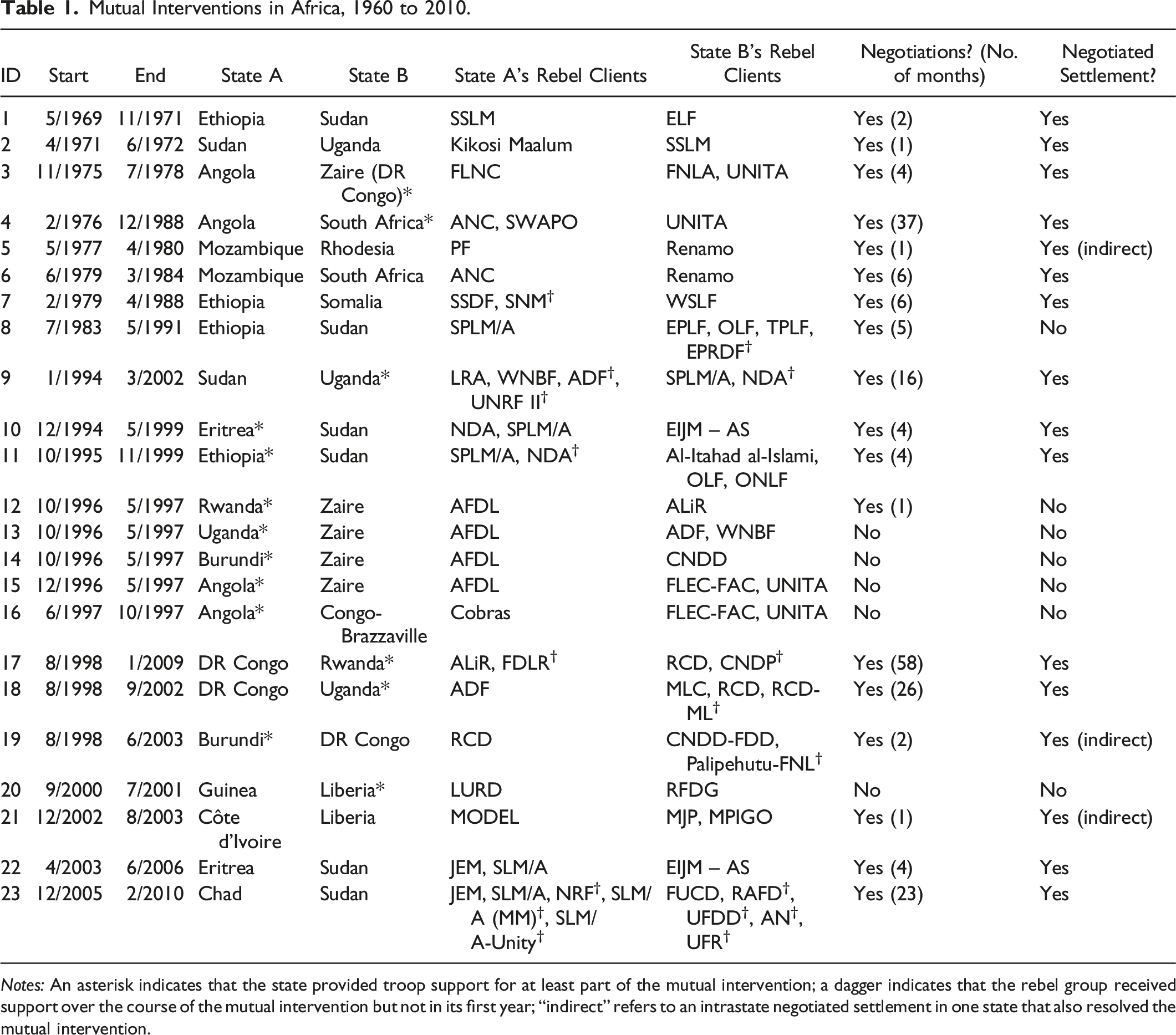
Notes: An asterisk indicates that the state provided troop support for at least part of the mutual intervention; a dagger indicates that the rebel group received support over the course of the mutual intervention but not in its first year; “indirect” refers to an intrastate negotiated settlement in one state that also resolved the mutual intervention.
The central argument developed in this article is that negotiations in mutual interventions become more likely when the two intervening states experience an international crisis. Crises are situations in which the highest-level decision makers of at least one of the states involved perceive a threat to basic goals, finite time to respond to this threat, and a heightened probability of involvement in military hostilities (Brecher and Wilkenfeld 1997, 3-4). Crises occur frequently in the context of mutual interventions. For instance, they can be triggered by attacks on rebel bases located in the other state, the deployment of foreign soldiers who support the rebels, or foreign-sponsored rebel attacks that threaten regime change. We put forward two specific arguments for why negotiations in mutual interventions become more likely when the interveners experience an international crisis. First, crises highlight an increase in the costs of a mutual intervention, prompting the leaders of the intervening states to seek a way out of their costly predicament through engaging in negotiations. Second, crises attract potential mediators that put pressure on the interveners to accept negotiations.
Perceptions are central to the International Crisis Behavior (ICB) project’s definition of, and data on, international crises, which we leverage to test our argument. Brecher and Wilkenfeld (1997, 3) explicitly define their three necessary conditions for a crisis – a threat to basic values, finite time for response, and heightened probability of military hostilities – as “perceptions held by the highest level decision makers of the state actor concerned.” The ICB data identifies these perceptions “from the decision makers’ indication – in diaries, memoirs, speeches, etc.” (Brecher et al. 2021). Using this data, we find that international crises in the context of mutual interventions are indeed positively and significantly associated with the occurrence of negotiations. These findings hold when accounting for the non-randomness of crises through using fixed effects and matching.
Our article contributes to the conflict management literature by extending the focus to a new empirical domain. While previous studies have looked at negotiations in interstate or intrastate armed conflicts (Greig 2005, 2013; Hinkkainen Elliott et al. 2020; Maundi et al. 2006; Melin 2011; Melin et al. 2013; Melin and Svensson 2009; Stein 1989), negotiations in mutual interventions have not received any attention. These negotiations typically address issues that are relevant for both intrastate conflict dynamics and interstate relations, such as troop withdrawals, curtailing outside military assistance, non-intervention pledges, and sometimes even foreign policy reforms (Kane 2022).
In addition to extending the research on the occurrence of negotiations to a new empirical domain, this article makes a broader contribution to the conflict management literature through zooming in on conflict parties’ perceptions. Specifically, we theorize how the perceptions held by state leaders embroiled in a mutual intervention shape their decisions to engage in negotiations. Much of the quantitative literature has focused on the “material” characteristics of conflict – such as intensity measured in battle deaths – to explain the occurrence of conflict management efforts (Greig 2005, 2013; Hinkkainen Elliott et al. 2020; Melin 2011; Melin et al. 2013; Melin and Svensson 2009). These studies do not explicitly consider whether the conflict parties perceive the conflict as too costly and want to look for a way out.
Studies that do explicitly look at conflict parties’ perceptions to explain the occurrence of negotiations instead rely on case studies (Sisk 2009; Stein 1989; Zartman 1989). A problem with these case studies is that they do not explicitly compare the parties’ perceptions when negotiations are initiated to cases where negotiations are not initiated. In other words, these studies select on the dependent variable, which could lead to biased conclusions (Geddes 1990; Lieberson 1991).
In this article, we try to overcome this methodological problem and explain the occurrence of negotiations by systematically comparing periods in mutual interventions where the conflict parties perceive a crisis to periods where they do not perceive a crisis. To this purpose, we leverage monthly data on negotiations and international crises in mutual interventions. We extend existing mutual interventions data (Duursma and Tamm 2021) by disaggregating that annual data to the monthly level. Moreover, we draw on unique data on rounds of negotiations that have been coded based on a variety of sources, including reports by international and nongovernmental organizations (NGOs), media reports, scholarly literature, and other datasets. The data on international crises is based on the ICB project. These data together allow us to conduct a quantitative analysis of the association between crisis perception and the occurrence of negotiations.
This article proceeds as follows. We first review the literature and then put forward our arguments about how perceiving a crisis moves leaders toward entering negotiations. Third, we outline our research design, discussing the data, variables, and models we use. Fourth, we present our main findings and some robustness checks to deal with the non-random occurrence of crises. Fifth, we provide two causal pathway illustrations. Lastly, we reflect on policy implications and discuss avenues for further research.
Previous Literature on the Occurrence of Negotiations in Armed Conflict
Three distinct phases can be recognized in peace processes: the pre-negotiation phase, the negotiation phase, and the post-settlement phase (Maundi et al. 2006, 1). Most studies within the field of peace research focus on explaining the conclusion of a negotiated settlement once negotiations have already been initiated (e.g., Beardsley et al. 2006; Duursma 2020; Svensson 2007) or look at the durability of peace once a settlement has been concluded (e.g., DeRouen et al. 2010; Reid 2015).
Relatively little research exists on the occurrence of negotiations. This is highlighted in several literature reviews. For instance, when it comes to mediated negotiations, Stephens (1988, 52) notes that “a great deal of conflict research has centered on the process of mediation and what factors or tactics speed or hinder settlement of disputes” but that “the question of how this process begins has been relatively ignored.” Similarly, Stedman (1996, 363) argues that “mediators need to know the conditions that facilitate negotiation, the barriers that negotiations face, and how these barriers can be overcome more effectively.” In a more recent review, Melin (2011, 692) also notes that the “existing literature on conflict management focuses almost exclusively on understanding the conditions under which third parties successfully resolve conflicts.”
The limited attention the pre-negotiation phase has received in comparison to other phases does not mean that this topic has been completely ignored. As early as 1966, Schelling theorized on the “power to hurt” to explain why conflict parties are willing to participate in negotiations. A state’s power to hurt consists of its ability to impose costs on the opponent while taking into account the opponent’s ability to bear those costs. According to Schelling (1966), the greater a state’s power to hurt relative to the other side, the more likely the other side will prefer negotiations to avoid further losses.
However, studies that highlight the power to hurt as an explanation for the occurrence of negotiations overlook the logic that when one party to a conflict is stronger, it will probably prefer to continue the conflict and achieve victory. Indeed, contrary to Schelling’s power-to-hurt logic, most studies that aim to explain the occurrence of negotiations suggest that the conflict parties’ incentives to initiate negotiations are shaped by the existence of power parity between the conflict parties rather than one side dominating the other side (Hultquist 2013; Maundi et al. 2006; Sisk 2009; Stedman 1991; Zartman 1989, 2001). These studies are also rooted within a bargaining framework in which it is assumed that the conflict parties make cost–benefit analyses based on their interests, but unlike the power-to-hurt theory, these studies stress the need for a situation in which both sides experience high costs. Most prominently within this camp, Zartman (1989; 2001) has argued that negotiations are most likely when the parties experience what he refers to as a mutually hurting stalemate. Under such conditions, none of the parties have a clear military advantage, but both sides suffer from the costs of continued war. This makes a conflict “ripe for resolution.”
Quantitative support for Zartman’s ripeness theory is largely absent from the literature, though some studies have produced findings that indirectly provide some evidence. For instance, several quantitative studies have shown that conflict intensity is associated with the occurrence of negotiations (Greig 2005; Melin et al. 2013; Regan and Stam 2000). Yet, other studies do not find conflict intensity to have a significant effect (Greig 2015). Some quantitative studies even show that negotiations become less likely as the severity of conflict increases, which some suggest is because it alienates the parties and hardens their negotiating positions (Bercovitch et al. 1991). In addition, Clayton (2013) finds quantitative evidence that the stronger rebels are in relation to the government side in a civil war, the more likely mediation becomes. Greig (2015) finds that mediation becomes more likely when rebels approach a major city or the capital. The findings by Clayton (2013) and Greig (2015) suggest that military pressure on the government side could make governments more amenable to peace talks.
Regardless of these findings, conflict intensity and rebel strength are not good indicators of a mutually hurting stalemate because they do not say anything about the conflict parties’ perceptions. For instance, a high conflict intensity might provide the conflict parties with incentives to find a way out of the conflict, but it could also be that one side is close to winning the war in a final offensive. In such a scenario, rebels may suffer far more fatalities than government forces, highlighting that aggregate death counts cannot serve as reliable proxies for individual conflict parties’ cost perceptions.
A good proxy for perceptions about conflict costs has so far been missing in quantitative research. Since studying conflict parties’ perceptions requires a highly contextualized assessment, it is only logical that the research on this is qualitative in nature (Maundi et al. 2006; Rothchild 1997; Sisk 2009; Stedman 1991; Zartman 1989). These studies have generated important insights. Yet, a problem with solely relying on qualitative methods to study how perceptions influence the parties’ willingness to initiate negotiations to avoid further costs is that the findings risk being tautological. In most cases in which negotiations are initiated this can be explained through looking at parties’ perceptions, but the perceptions about the costliness of continued conflict might be similar in cases where no negotiations are initiated. Put differently, the bulk of qualitative research on mutually hurting stalemates selects on the dependent variable by looking only at cases where negotiations were initiated. Not taking into account the parties’ perceptions in the “negative cases” in which no negotiations occurred might lead to biased conclusions (Geddes 1990; Lieberson 1991).
In addition to mainly relying on qualitative methods, most studies that examine conflict parties’ perceptions have focused on mutually hurting stalemates while ignoring the impact of the occurrence of crises. In one of the rare reflections on crises and peace processes, Zartman and Touval (1996, 453) liken a crisis to a precipice and contrast it with a hurting stalemate, which they liken to a plateau. The latter involves “flat, unpleasant terrain stretching into the future, providing no later possibilities for decisive escalation.” By contrast, a crisis “represents the realization that matters are swiftly becoming worse” and, like a precipice, “implies impending catastrophe, such as probable military defeat or economic collapse.”
Zartman and Touval’s notion of a crisis is more extreme than that of the ICB project, which involves the perception of a significant threat that may result in interstate armed conflict (Brecher and Wilkenfeld 1997, 3-4). Nevertheless, both ways of understanding crises are different from the hurting stalemate concept, which is also evident from the fact that crises – as coded by the ICB project – sometimes occur right at the start of a mutual intervention.
In sum, Zartman and Touval (1996) postulate that both hurting stalemates and crises lead to the occurrence of negotiations. However, crises, also as conceptualized by the ICB project, have received much less attention compared to hurting stalemates. More broadly, many studies have looked at the material conditions – such as conflict intensity – that shape the prospects for negotiations. There are, however, few studies that examine how the perceptions held by leaders of conflict parties influence the prospects for the initiation of negotiations. Those studies that do focus on perceptions about conflict costs solely rely on qualitative methods and have predominantly focused on hurting stalemates. By contrast, in this article, we conduct a quantitative analysis of crisis perception and prospects for negotiations. To this purpose, the next section develops our arguments about how international crises in the context of mutual interventions make the occurrence of negotiations more likely.
Crises and the Occurrence of Negotiations in Mutual Interventions
We proceed in three parts. First, we discuss how crises are defined within the ICB project. Second, we explore the timing of crises during mutual interventions and outline why such crises occur. Third, we present increasing costs and third-party pressure as the main reasons for why crises make negotiations more likely.
Defining Crises
Brecher and Wilkenfeld (1997, 3-4) define an international crisis by three necessary conditions that together are sufficient. First, the leaders of a state must perceive another state as a threat to one or more of their basic values. In the context of mutual interventions, regime survival is sometimes threatened. For example, Zairian President Mobutu Sese Seko saw the Angolan-backed Congolese National Liberation Front (FLNC) offensive in the Shaba region in March 1977 as an attempt to overthrow his regime. This contributed to triggering the Shaba I crisis between Angola and Zaire from March to May 1977 (ICB crisis no. 277).
Second, a state must face a finite time horizon for decision making. In the previous example, Mobutu perceived an urgent need to appeal for Western military aid to help tackle the FLNC offensive (Kennes and Larmer 2016, 124).
Third, a state must perceive a heightened probability of involvement in military hostilities. In our example, Mobutu feared direct Angolan involvement in the FLNC offensive. The Angolan leadership, in turn, feared a Zairian counterattack on its territory (Gleijeses 2013, 39-44).
It is important to note that crises can be one-sided. A one-sided crisis occurs when only one of the states satisfies all three of the ICB’s necessary conditions.
Crises and Mutual Interventions
Crises can occur at any stage of mutual interventions. Seven of the ten mutual interventions that experienced crises featured a crisis at their very start. In these cases, the state that intervened second was already experiencing a crisis and/or anticipated that its retaliation may cause a crisis. For instance, Chad’s crisis perception was triggered by a Sudan-backed rebel attack on December 18, 2005. This attack led Chad to retaliate by supporting Sudanese rebels and declaring a state of war with Sudan five days later, which not only marked the start of the mutual intervention but also triggered a crisis for Sudan and thus turned the briefly one-sided crisis into a two-sided one (ICB crisis no. 447).
On the other hand, 21 (75 percent) out of the 28 crises in our dataset occurred after the start of mutual interventions. Returning to a previous example, the Shaba I crisis occurred in the seventeenth month of the Angola–Zaire mutual intervention and was preceded by 12 months without crisis (after four initial crisis months). As we discuss further in the next subsection, these crises are not necessarily anticipated by interveners, which means that these crises are more likely to heighten awareness of increasing costs than crises at the outset of mutual interventions.
Overall, 18 percent of mutual intervention months featured a crisis. There are at least three reasons why crises occur frequently in the context of mutual interventions. First, the provision of external sanctuary can provoke attacks on rebel bases in the host state, triggering fears of further escalation. For instance, Rhodesian armed forces entered southwest Mozambique in late May 1977 to destroy Zimbabwe African National Liberation Army (ZANLA) bases, triggering a one-sided crisis for Mozambique (ICB crisis no. 278).
Second, foreign troop support to rebels can also increase threat perceptions and concerns about direct hostilities. Table 1 above shows that in 11 out of the 23 mutual interventions, at least one state at some point sent troops across its borders to fight alongside rebels. For instance, Rwanda helped create the Rally for Congolese Democracy (RCD) rebels and invaded the Democratic Republic of Congo alongside the RCD in August 1998. This troop support triggered a crisis for the Congolese government, making it a two-sided crisis as Rwanda’s invasion was itself caused by crisis perceptions triggered by Congo’s rapprochement with Rwandan rebels and its related request to end Rwandan counterinsurgency operations stretching into eastern Congo (ICB crisis no. 426).
Third, the provision of external support to rebels in the context of mutual interventions can lead to a sudden threat of rebel victory. For example, Chadian rebels, supported by Sudan, launched an attack on the Chadian capital N’djamena in April 2006, triggering a one-sided crisis for Chad (ICB crisis no. 449).
In sum, the provision of external support to rebels can provoke attacks on rebel bases located in the hostile state, involve the deployment of foreign troops, and lead to a sudden threat of rebel victory. These are all circumstances that can trigger a crisis.
Why Crises Make Negotiations in Mutual Interventions More Likely
Crisis Costs
Mutual interventions are costly in general. States incur material costs associated both with providing support (such as weapons) to foreign rebels and with fighting domestic rebels supported by the other state. A crisis increases these costs: an acute threat to regime survival increases psychological costs, and the heightened probability of direct hostilities signals the potential for escalating material costs.
Whereas crises that occur at the outset of mutual interventions are typically anticipated and thus already “priced in” by the interveners, crises that occur after the start of mutual interventions are more likely to raise costs unexpectedly or at least to serve as focal points (Schelling 1960) that heighten the interveners’ awareness of significant costs. This can lead one intervener to propose, and the other to accept, negotiations either to sincerely try to resolve the mutual intervention (Pillar 1983, 40; Reiter 2009, 15-16) or to deviously try to mitigate crisis costs without sincerely trying to resolve the mutual intervention itself. Examples of “devious objectives” (Richmond 1998) in the context of crises during mutual interventions include mitigating third-party pressure (a factor we address in detail below) and allowing rebel clients to regroup. The penultimate section illustrates both sincere and devious negotiating stances resulting from crises in the context of the Angola–South Africa mutual intervention.
Regarding the possibility of unexpected costs, it is important to highlight that crisis costs are sometimes disproportionately high for the state that did not initiate the crisis. This is typically the case in a one-sided crisis but can also occur in a two-sided crisis. In these cases, the disproportionately affected state is often surprised by the high costs and thus particularly motivated to find a way out of its predicament. Returning once more to the Shaba I example, Zaire was clearly surprised by, and thus militarily ill-prepared for, the Angolan-backed FLNC offensive (Gleijeses 2013, 39). As a result, Zaire’s foreign minister rushed to Nigeria to urge its government to mediate negotiations between Angola and Zaire. Nigerian Foreign Minister Joseph Garba (1991, 135) discusses this request in his autobiography: We did not realize the full impact of this event [i.e., the FLNC offensive] and its serious implications for political instability in Central Africa until the unannounced arrival in Lagos of the Zairean Foreign Minister, Nguza Karl-i-Bond on 18 March, 1977. He came, according to him, to apprise the Nigerian Government of the seriousness of the situation[.] … Nguza now wanted Nigeria to extend its original offer of good offices into a full-scale mediatory role.
Highlighting both that Zaire faced disproportionately high costs and that Angola agreed to negotiations primarily due to third-party pressure, Garba (1991, 140) writes that “Zaire was in an extremely desperate situation” and that Angola only “grudgingly accepted Nigeria’s mediation.” This brings us to the importance of third parties.
Third-Party Pressure
A second reason why negotiations are more likely to occur during crises is that they make third parties more aware of the potential negative consequences of the mutual intervention, often leading them to exert pressure. Previous studies show that greater international awareness of armed conflict makes international action more likely. Specifically, greater coverage by international media and human rights NGOs increases the likelihood of interventions in civil war (Bell et al. 2013; Murdie and Peksen 2014). A similar logic is at play during crises in mutual interventions. While mutual interventions sometimes go under the international community’s radar, the heightened probability of direct military hostilities can prompt third parties to put pressure on the interveners to accept mediation and initiate negotiations.
This causal mechanism can operate in crises at all stages of mutual interventions. It is likely the main pathway linking crises and negotiations that occur at the outset of mutual interventions: having already priced in these crisis costs, interveners agree to negotiations merely to placate third parties. Indeed, this was the case in three mutual interventions in our data that experienced simultaneous crises and negotiations within the first three months: Rwanda, Uganda, and the DRC, as well as Chad and Sudan, attended summits organized by regional organizations in August–October 1998 and January–February 2006, respectively, but Rwanda and Uganda had no desire to end their troop support to Congolese rebels at that early stage (Prunier 2009, 203), and Chad and Sudan were determined to continue their proxy war, signing an agreement to stop backing each other’s rebels only to then pay no heed to implementing it (Tubiana 2011, 24).
Two types of third-party pressure can be distinguished. A first type of pressure involves creating (or threatening to create) additional material costs to convince the states to conduct negotiations. This includes, for example, imposing sanctions, cutting development aid, intervening militarily, or threatening to do so. Several studies suggest that third-party pressure based on sanctions can make negotiations in civil wars more likely because it provides the conflict parties with material incentives to comply with the third party (Maundi et al. 2006; Pechenkina 2020; Sisk 2009). This type of material pressure has also persuaded states embroiled in a mutual intervention to conduct negotiations. For instance, the crisis relating to the Second Congo War led to severe pressure on Uganda to negotiate with the Congolese government about an end of Ugandan involvement in eastern Congo (ICB crisis no. 426). Due to the risk of losing development aid he sorely needed, Ugandan President Yoweri Museveni entered into negotiations with Congolese President Joseph Kabila (Prunier 2009, 265).
A second type of pressure is based on the idea that complying with a particular mediator is the right thing to do. This type of pressure relies on the mediator’s legitimacy rather than its economic or military power (Duursma 2020; Reid 2015). For instance, based on their unique standing within the realm of international diplomacy, the UN Secretary-General can appeal to interveners to resolve their conflict via negotiations. Skjelsbæk (1991, 99) highlights in this regard how the UN Secretary-General “does not command economic or physical power, but has to rely on the moral status emanating from the principles of the charter, and on reputed impartiality.”
Leaders of other international organizations also frequently make such moral appeals. In response to the first crisis during the Chad–Sudan mutual intervention, the Secretary-General of the Organization of Islamic Conference (OIC) expressed his concern about the growing tensions. He urged both governments to engage in negotiations, reminding them of a recent summit meeting that had called for “genuine brotherhood, cooperation and mutual support so as to achieve unity of rank and promote intra-Islamic solidarity” (OIC 2005).
Third parties, especially in Africa, can also put moral pressure on states to enter negotiations based on international norms such as sovereignty and territorial integrity. While external support to armed opposition groups in rival states is common in Africa, there is somewhat paradoxically a strong norm against interference in domestic affairs of sovereign states (Duursma 2020). Regional mediators can emphasize these norms, persuading the interveners that they at least must attend peace talks to be seen publicly to try to resolve the crisis.
Summary and Hypothesis
First, crises are typically costly and can thus lead to a sincere desire of states to resolve a mutual intervention through negotiations. States sometimes also initiate negotiations in response to crises to “buy time” and to temporarily mitigate the negative effects of a mutual intervention. Second, crises are likely to attract third-party pressure that provides the states with incentives to initiate negotiations. This pressure can take the form of sanctions or cuts in development aid, but third parties can also put moral pressure on the states, convincing them that negotiating is the right thing to do in light of international or regional norms. These reasons cumulatively explain why crises generally make negotiations more likely. In some cases, a mix of these reasons propels states to conduct negotiations, while in other cases it is just one reason that explains why both states enter negotiations.
The occurrence of a crisis in the context of a mutual intervention increases the likelihood of the occurrence of negotiations between the two states.
Research Design
The universe of cases on which we base our analysis pertains to all mutual interventions in Africa between 1960 and 2010 as identified by Duursma and Tamm (2021). Table 1 above lists these 23 mutual interventions, including information on negotiations and settlements. We provide more precise start and end dates of these mutual interventions to construct a dataset in which the unit of analysis is the mutual intervention month. We record a total of 1,117 mutual intervention months.
Main Variables of Interest
Our main independent variable of interest is the occurrence of an international crisis. As noted by Zartman and Touval (1996, 435), a crisis is a perceptual condition. We rely on Version 14 of the ICB Dyadic-Level Crisis Data to code whether at least one of the states embroiled in a mutual intervention perceives a crisis between the two states, as defined in the previous section. Specifically, the ICB project considers a crisis dyad as “a pair of states satisfying each of the following three conditions: (1) both are members of the interstate system, (2) at least one of the states satisfies all three of the ICB necessary conditions for crisis involvement, and (3) at least one of the states has directed a hostile action against the other” (Brecher et al. 2021). The ICB’s dyadic-level data is more suitable than the system-level or actor-level data because it includes dyad-specific trigger and termination dates, which in cases of crises involving more than two states sometimes differ from the system-level or actor-level data (Hewitt 2003).
The ICB data allows us to code whether a crisis takes place in a given mutual intervention month. In line with how it identifies a crisis start date (see introduction), the ICB project identifies a crisis end date “from the decision makers’ indication – in diaries, memoirs, speeches, etc. – of the date that their perception of threat, time pressure, and war likelihood declined toward the pre-crisis norm” (Brecher et al. 2021). Both the crisis start date and its end date typically pinpoint an exact day, and always at least a month. Together, these two dates enable us to code whether the leaders of a state perceived a crisis in a given month. We record 204 crisis months in the context of 10 out of the 23 mutual interventions in Africa included in our dataset. These 204 crisis months were part of a total of 28 crises identified by the ICB project. Table A1 in the appendix provides further information on these crises.
The dependent variable in our analyses is a dummy variable that is coded as 1 if a round of negotiations between the two states embroiled in a mutual intervention takes place. We define negotiations as talks between the states concerning one or more issues relating to the mutual intervention. These talks can be direct (i.e., the states meet in the same venue), but they can also be indirect (i.e., a mediator shuttles between the states). We also coded mutually exclusive dummy variables that record whether the talks were bilateral or involved third-party mediation. We collected the data on negotiations from a wide range of sources, including news media, monographs, academic articles, NGO and UN reports, and other datasets such as the Peace Data dataset (Goertz et al. 2016), the ICB dataset (Brecher et al. 2021), and the African Peace Processes dataset (Duursma and Gamez 2022). It is important to not solely rely on news media for coding whether negotiations take place in mutual interventions because several of these negotiations were conducted secretly and were thus not reported in the news media.
We record a total of 201 months in which at least one round of negotiations occurred in our dataset. These negotiations were exclusively bilateral in 58 months (29 percent) and involved mediation in the other 143 months (71 percent). Table 1 includes a column that contains information on whether a mutual intervention experienced any negotiations and, if so, how many months saw the occurrence of at least one round of negotiations. Negotiations occurred in 18 out of the 23 mutual interventions.
Control Variables
Our theory addresses how the costliness of crises and third-party pressure move conflict parties toward negotiations. It is, however, possible to conceive of alternative explanations for why negotiations occur in the context of mutual interventions. First, the parties might perceive high costs associated with a mutual intervention but still refuse to enter into negotiations because they fear that the other state will exploit this opportunity and encourage their proxy to step up attacks. Indeed, some studies suggest that conflict parties might be unwilling to enter into negotiations because of such a commitment problem (Duursma and Gamez 2022; Svensson 2007). The presence of peacekeepers might help reduce the fear that the other side will exploit the negotiations to gain an advantage on the battlefield. For instance, the United Nations Organization Mission in the Democratic Republic of the Congo was explicitly mandated by the UN Security Council in late 1999 to observe the disengagement of foreign states from the DRC. We therefore account for whether peacekeepers were deployed in the countries where mutual interventions took place, drawing on data on both UN and regional peace missions (Bara and Hultman 2020; Kathman 2013).
In addition, previous research on international conflict suggests that regime changes often lead to negotiations because new leaders often break with past policies (Crocker et al. 2004; Rasler et al. 2013, 22). We therefore account for the number of months since the more recent leader of the two states took office. We use the Archigos dataset to construct this variable (Goemans et al. 2009).
We also control for whether one of the states embroiled in the mutual intervention experiences a crisis with a third state. Some work on interstate rivalries shows that states may accommodate one rival if another presents a more immediate threat (Akcinaroglu et al. 2014; Rasler et al. 2013, 21-22). The same might hold true for crises. For instance, following the start of the crisis between Eritrea and Ethiopia in May 1998 (ICB crisis no. 424), both Eritrea and Ethiopia initiated negotiations to reconcile with Sudan (Akcinaroglu et al. 2014, 86-87). We rely on Version 14 of the ICB Dyadic-Level Crisis Data to determine whether at least one of the interveners experienced a crisis with another state (Brecher et al. 2021).
Moreover, we control for the conflict intensity of the intrastate conflicts that were part of a given mutual intervention. While we think that battle deaths should not be interpreted as proxies for perceived costs (see our literature review), it could be that a relatively high number of deaths both triggers a crisis and influences the decision to initiate negotiations to resolve the mutual intervention. This makes it important to control for conflict intensity. We do this in three ways. First, we measure whether at least one of the intrastate conflicts that forms part of the mutual interventions is coded as “war” in the UCDP Dyadic Dataset version 22.1 (Davies et al. 2022; Harbom et al. 2008), meaning that 1,000 or more annual deaths are recorded. Second, we measure whether intrastate conflicts in both countries involved in the mutual intervention reach the war level. This variable might better capture the effect of conflict intensity on the occurrence of negotiations, as one could argue that both states need to experience high deaths to agree to negotiations.
The problem with measuring whether intrastate conflicts experience 1,000 or more deaths is that this variable is aggregated on the yearly level, meaning that we assign the same value to all the months in a given calendar year. Using this measurement might thus entail missing crucial variation in conflict intensity in a given calendar year. Accordingly, a third way we measure conflict intensity is through drawing on the UCDP Georeferenced Event Dataset (GED) to create a count variable of the number of deaths in a given month of an intrastate conflict (Sundberg and Melander 2013). 1 We then take the sum of all the deaths of the intrastate conflicts of a given mutual intervention month and, due to their skewed distribution, use the natural logarithms of these sums (plus one). Since the UCDP GED has coverage only from 1989 onward, we use this variable only for the subset of our dataset that covers the 1989–2010 period.
Finally, we take time into account in our analysis. Some studies point out that negotiations are more likely in the early stages of conflict, when the parties have not yet inflicted heavy losses on each other (e.g., Bercovitch and Houston 1996, 23). Other studies find that conflict management efforts are more likely in the later stages of conflict (e.g., Melin and Svensson 2009). Since crises might also be more or less likely during certain stages of a mutual intervention, we control for its duration measured in months. Moreover, we also control for the time since the last round of negotiations, as previous studies find that negotiations are likely to be related to prior conflict management efforts (Greig 2005; Melin 2011; Regan and Stam 2000). Following Carter and Signorino (2010), we also include the polynomial terms of the time since the last negotiations occurred.
The Models
We use logit models since our dependent variable – whether negotiations occur in a given mutual intervention month – is a binary indicator. We further use robust standard errors clustered on the mutual intervention.
As a robustness check, we also run models in which we lag the crisis variable by t–1 (see appendix, Table A2). The rationale behind lagging the crisis variable is to account for the possibility that negotiations in a mutual intervention might cause a crisis rather than the other way around, though it should be noted that we do not find any evidence for this in the analytical summaries of the international crises compiled by the ICB project. We also lag the external crisis, peacekeeping, and deaths variables by one month. Since we measure the war variable on the yearly level, we lag this variable for an entire calendar year rather than a single month.
In addition to reverse causality, our findings might be biased because crises do not occur randomly. The contextual circumstances under which crises erupt are likely to be different to situations in which no crises erupt. It might be the case that these contextual circumstances, rather than a crisis, explain the occurrence of negotiations. While we control for several possible confounding variables in the models, we also account for the non-randomness of international crises in two other distinct ways. First, we include mutual intervention fixed effects in the models. These fixed effects models control for unobserved time-invariant heterogeneity across the mutual interventions. The fixed effects models thus allow us to assess whether temporal variation in the occurrence of negotiations within mutual interventions is influenced by temporal variation in the perception of international crises.
Second, we use coarsened exact matching (Iacus et al. 2012). Matching creates a more balanced “quasi-experimental” sample in which the “treated” observations in which an international crisis is recorded have similar values on observable covariates as “control” observations in which no international crisis is recorded. In the matching algorithm, we include all the control variables that are also included in the main model. We cluster the robust standard errors on the different strata of matched observations in the matching analysis (Austin and Small 2014).
Findings
Out of the 1,117 mutual intervention months in our dataset, 204 experienced an international crisis as recorded by the ICB. This constitutes 18.3 percent of the total number of observations.
There are 201 mutual intervention months in which negotiations were held, which is 18.0 percent of the total number of observations in our dataset. These negotiations occurred far more frequently in mutual intervention months in which a crisis was unfolding. Our dataset records negotiations in 90 out of the 204 mutual intervention months in which there was a crisis, which is 44.1 percent. By contrast, out of 913 mutual intervention months in which no crisis was unfolding, 111 saw negotiations occur, which is only 12.2 percent. This already provides some preliminary support for our hypothesis that negotiations in mutual interventions are more likely to occur when an international crisis is ongoing.
Main Logit Estimates on the Likelihood of Negotiations in Mutual Interventions in Africa.
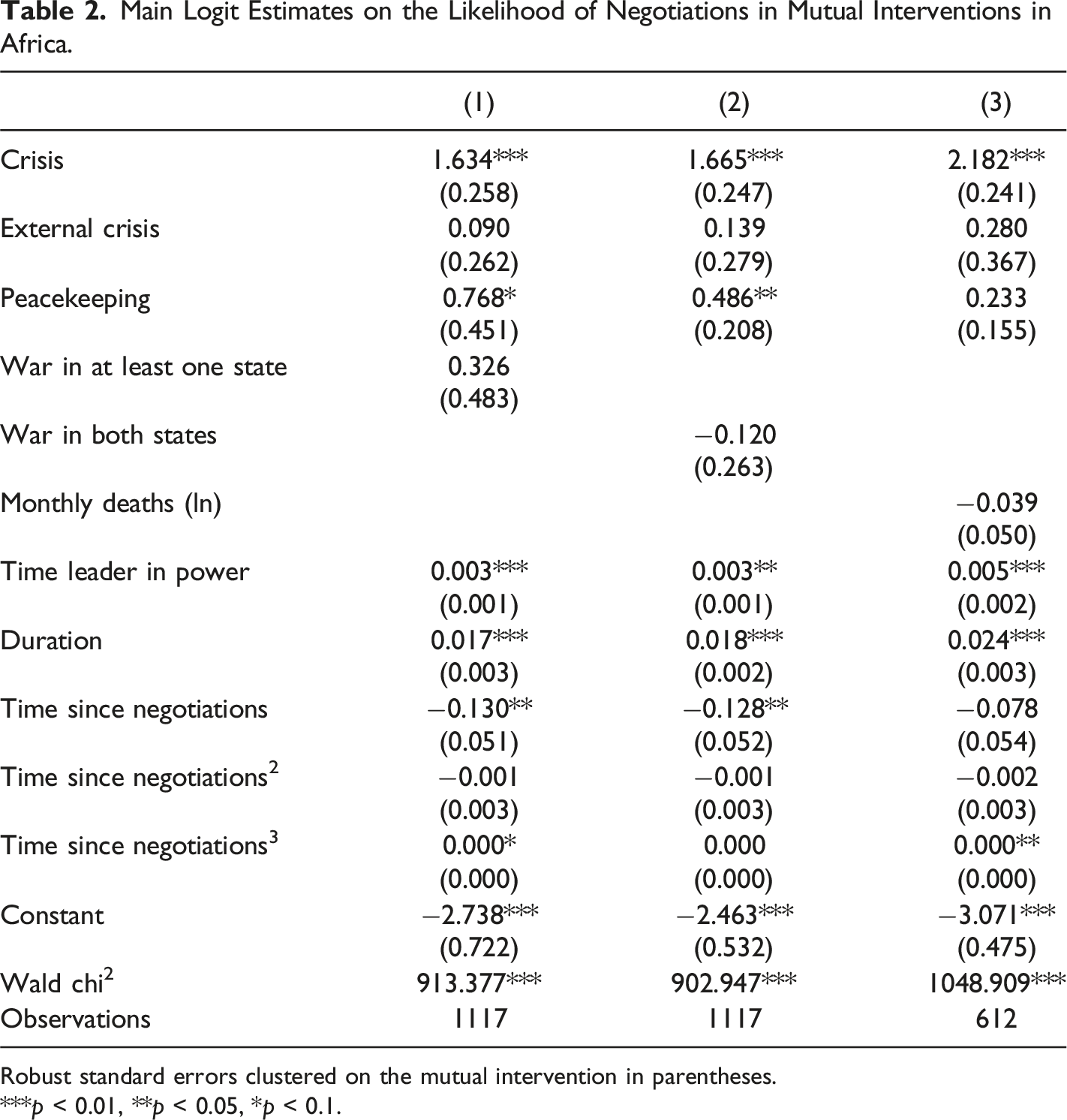
Robust standard errors clustered on the mutual intervention in parentheses.
***p < 0.01, **p < 0.05, *p < 0.1.
In Model 2, we include a variable that measures whether the intrastate conflicts linked to the mutual intervention reach the war level in both states. This variable is negatively but insignificantly associated with negotiations. Crucially, the association between the occurrence of crises and negotiations remains positive and statistically significant at the 1 percent level while controlling for situations in which both states experience an intrastate conflict at the intensity of a war. The substantive effect of a crisis is also fairly similar to Model 1. Model 2 suggests that the probability of negotiations grows from 12.8 percent to 36.3 percent when a crisis is ongoing.
In Model 3, we use the variable that measures the monthly sum of the deaths in the intrastate conflicts that are part of the mutual intervention instead of the war dummy variable. This makes it necessary to restrict the sample to the 1989–2010 period. The monthly deaths variable is not statistically significant. Model 3 shows that an ongoing international crisis is significantly associated with the occurrence of negotiations while controlling for monthly deaths. The substantive effect of a crisis is also very strong in Model 3. The probability of negotiations increases from 13.6 percent to 47.5 percent when a crisis is ongoing.
We further find that duration and the more recent leader’s time in power are positive and significant across all three models. The significant effect of duration is unsurprising: many mutual interventions terminate through a negotiated settlement (Tamm and Duursma 2023), so one would expect negotiations to be more likely to occur in the final stages of mutual interventions. Counterintuitively, the more recent leader’s time in power is positively associated with the occurrence of negotiations. This contradicts the idea that new leaders often break with past policies and therefore are likely to engage in negotiations with a rival state.
Table A2 in the appendix includes three models that are similar to those in Table 2, with some lagged variables as the only difference. It shows that the significant association between crises and negotiations remains when lagging the occurrence of a crisis by one month.
Next, we include mutual intervention fixed effects in Models A4–A6 in Table A3 in the appendix. These fixed effects models drop the observations of mutual interventions in which no negotiations took place at all, since these models rely on within-group variation. Models A4–A6 show that the association between the occurrence of crises and negotiations remains highly statistically significant when including fixed effects. This suggests that this finding is not driven by unobserved confounders related to mutual interventions being associated with the occurrence of both crises and negotiations.
Models A7–A9 in Table A4 in the appendix present the results of our matching analysis, in which the hypothesized association also remains statistically significant. We discuss the benefits of matching and details of the results in the appendix.
Finally, to explore whether the occurrence of a crisis has divergent effects on bilateral negotiations and mediated negotiations, Table A5 in the appendix presents the findings of a multinomial logit model. This model allows us to estimate the probability of no negotiations, bilateral negotiations, and mediated negotiations, depending on whether a crisis occurs. Observations in which no negotiations take place serve as the reference category. The results from Table A5 indicate that there is no significant association between crises and bilateral negotiations. In contrast, the association between crises and mediated negotiations is both positive and highly significant. Substantively, the probability of mediated negotiations is only 7.2 percent in the absence of a crisis, whereas this probability increases to 31.8 percent during a crisis.
In sum, the baseline model, the lagged models, the fixed effects models, and the matching models all support our hypothesis that the occurrence of a crisis in the context of a mutual intervention increases the likelihood of the occurrence of negotiations. In addition, we find that crises are significantly associated with mediated negotiations but not with bilateral negotiations. This highlights the importance of third-party mediation during crises, but it does not necessarily imply that the third-party pressure mechanism is more important than the costs mechanism. Crisis costs can lead interveners to request mediation, as Zaire did in the example given in the theory section. That example, however, also shows that Angola agreed to mediated negotiations primarily due to pressure from Nigeria, the mediator that Zaire requested. In short, the two mechanisms sometimes interact in ways that are difficult to tease apart via quantitative methods. Their relative importance and potential interaction are best assessed qualitatively. The next section presents two examples to further substantiate this point and illustrate the causal pathways from crises to negotiations.
Causal Pathway Illustrations from the Angola–South Africa Mutual Intervention
In this section, we briefly examine how two crises that occurred during the second half of the mutual intervention between Angola and South Africa caused negotiations that each resulted in an agreement. The first, the February 1984 Lusaka Agreement, led to 11 months of follow-up talks between March 1984 and May 1985 (see Figure 1) but largely failed. The second, the December 1988 New York Accords, largely succeeded: it led to Namibia’s independence in return for Cuban troop withdrawals and, due to Angola’s support termination, ended the mutual intervention; South African support to Angolan rebels continued, but on a much smaller scale. Both negotiation processes were preceded by third-party pressure and involved mediation. Yet in both, crisis costs also played key causal roles. Crises and negotiations in the mutual intervention between Angola and South Africa.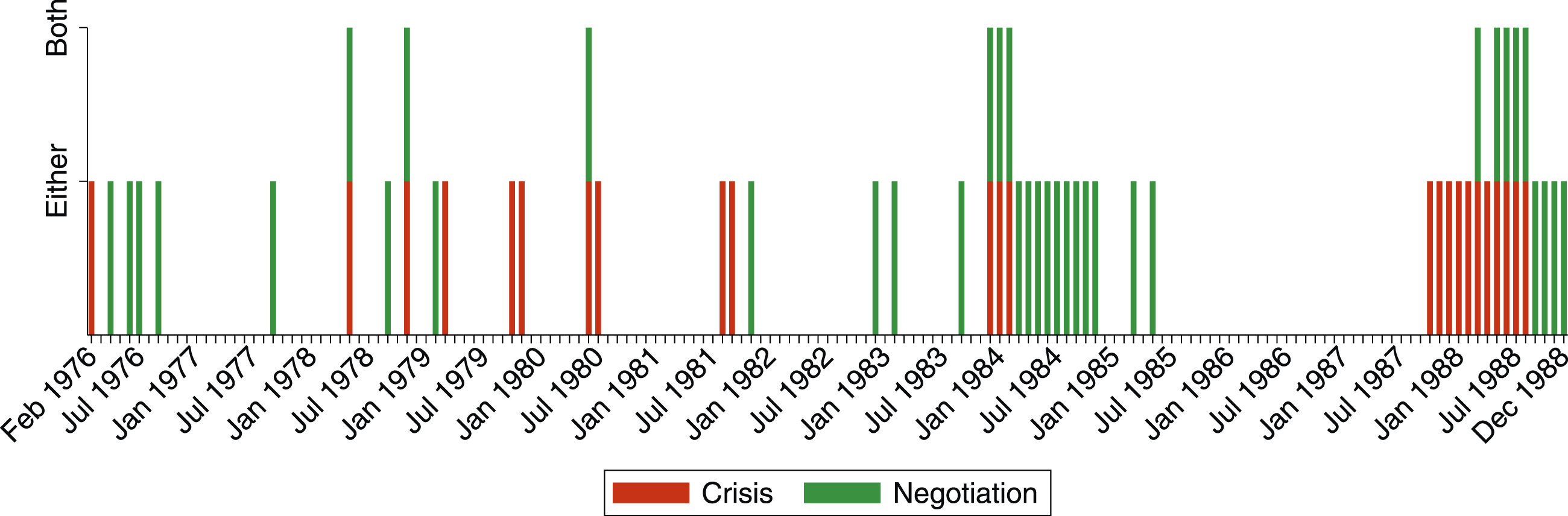
The Angola–South Africa mutual intervention is the longest in our dataset, lasting 155 months. Third parties played particularly prominent roles: Angola was backed by thousands of Cuban troops and large-scale Soviet assistance; Angola’s rebel clients, the South West Africa People’s Organization (SWAPO) and the African National Congress (ANC), received military assistance not just from several other African states but also from China, Cuba, East Germany, and the Soviet Union, with SWAPO furthermore recognized by the UN as the sole legitimate representative of the Namibian people; and South Africa’s rebel client, the National Union for the Total Independence of Angola (UNITA), benefited from significant US support. In short, this was a mutual intervention in which one would expect third-party pressure to play a particularly important causal role. Demonstrating that costs were nonetheless similarly important thus increases the plausibility of our argument that crises raise the likelihood of negotiations through both costs and third-party pressure.
The Operation Askari Crisis and the Lusaka Agreement Negotiations, 1983–84
In December 1983, South Africa launched Operation Askari, involving air and ground operations up to 200 miles into Angolan territory that led to clashes with Angolan, Cuban, and SWAPO troops (Crocker 1992, 190). This invasion triggered a one-sided crisis for Angola (ICB crisis no. 347). Prior South African incursions in 1981 and 1982 “had dealt very harsh blows to SWAPO” (Gleijeses 2013, 209), whereas UNITA had steadily grown stronger over these years and, during 1983, “gradually committed over ten thousand troops to its first nearly nationwide offensive” (Weigert 2011, 74). In short, Angola was already on the back foot before Operation Askari, which created even higher costs. A South African Defence Force (SADF 1985, 10) report argues that “it was clear that Angola was beginning to wilt under the sustained pressure of OP ASKARI.” These costs significantly contributed to Angola’s decision to renew previously stalled negotiations and sign the Lusaka Agreement, which stipulated that Angola must rein in SWAPO (Gleijeses 2013, 236).
While costs primarily drove Angola’s willingness to negotiate, the SADF (1985, 6) report leaves little doubt that third-party pressure was the decisive factor for South Africa’s decision to negotiate and sign the agreement, which stipulated a phased withdrawal of its forces but did not mention its support for UNITA: “by December 1983 international political pressure over South Africa’s actions in Angola had reached alarming proportions. So much so, that the South African Government was forced to sacrifice the SADF’s hard-won military advantage in Angola on the altar of purely political considerations.” For example, the UN Security Council (1983) strongly condemned South Africa’s operation, with even the United States merely abstaining.
The Lusaka Agreement ended the crisis but not the mutual intervention. The implementation of the agreement failed partly because Angola’s negotiating stance had been devious. Indeed, South Africa’s foreign minister was skeptical of Angolan intentions from the start, telling the US Secretary of State that Angola was constrained by its relations with Cuba and the Soviet Union and that “gaining unilateral advantage from agreements with capitalist countries is a central principle in Marxist foreign policy doctrine” (quoted in Saunders 2011, 116). UNITA’s advances constituted a growing threat that required Cuban and Soviet assistance, yet Angola would have been at risk of losing that assistance if it had prevented SWAPO from operating in its country. This dilemma helps explain why Angola’s attempts to stop SWAPO’s violations of the agreement quickly became “ever more lacklustre” (Scholtz 2015, 189).
The Cuito Cuanavale Crisis and the New York Accords Negotiations, 1987–88
In October 1987, South Africa again attacked SWAPO bases on Angolan territory, triggering a crisis for Angola. It became a two-sided crisis two months later, when Angola launched a counterattack (ICB crisis no. 380). The crisis involved the largest land battle in Africa since World War II, pitting UNITA rebels and South African troops against Angolan, Cuban, and SWAPO troops near the town of Cuito Cuanavale. Neither side could claim a decisive victory and both sides incurred heavy losses (Crocker 1992, 369-371). These costs – and subsequent costs incurred by a joint Angolan-Cuban-SWAPO advance toward the Namibian border while negotiations were ongoing – played a key role in the initiation and continuation of negotiations between Angola, Cuba, and South Africa. These negotiations first occurred indirectly in March 1988 via shuttle diplomacy by Chester Crocker, the US Assistant Secretary of State who had helped mediate the Lusaka Agreement. They then continued directly via mediated talks between May and December 1988, which culminated in the New York Accords (Gleijeses 2013, 438-442, 453-457).
Alongside costs, Angola’s willingness to negotiate (this time sincerely) was crucially influenced by third-party pressure from Cuba, which had sent reinforcements with the explicit goal of gaining a military advantage that would force South Africa into negotiations (Gleijeses 2013, 438-439; Weigert 2011, 89-90). For South Africa, steadily increasing international pressure also contributed to its decision to renew negotiations. More precisely attributing relative causal weight to costs and third-party pressure would require a more detailed assessment than space here permits, but the increase in third-party pressure caused by South Africa’s attacks was arguably less significant than the escalating military costs that followed. US President Ronald Reagan remained favorably inclined toward South Africa, thus lessening international pressure, including by vetoing or softening UN Security Council draft resolutions (Gleijeses 2013, 506).
In sum, how these two crises led to negotiations cannot be understood by focusing on third-party pressure alone. Costs played a more important role for Angola in 1983–84 and an at least similarly important role for both Angola and South Africa in 1987–88.
Conclusion
Mutual interventions have been the dominant type of interstate conflict in Africa since independence. That they involve often rather shadowy indirect (or “proxy”) warfare may partly explain why conflict management scholars have thus far paid little systematic attention to them. Yet, the fact that intrastate conflicts associated with mutual interventions are far more deadly than those not associated with mutual interventions highlights the importance of addressing this research gap: ending mutual interventions via negotiated settlement is likely to substantially decrease the severity of the related intrastate conflicts. Moreover, external support for rebels reduces the likelihood of negotiations between the targeted government and the sponsored rebels (Karlén 2023); settling mutual interventions can thus also help facilitate the occurrence of intrastate negotiations.
This article used original monthly data on mutual interventions and interstate negotiations to demonstrate that the interveners’ perception of an international crisis between them makes the occurrence of negotiations significantly more likely. In other words, if state leaders feel seriously threatened and believe that an urgent response is needed to avoid direct military hostilities, they are more likely to come to the negotiating table than when they perceive the mutual intervention to involve more manageable risks.
Our finding has important policy implications. It can help third parties identify windows of opportunity for mediation efforts during mutual negotiations: the clearer it is that at least one state perceives itself to be in a particularly threatening situation, the more open it will be to mediated negotiations. In addition, the more credibly third parties can threaten to impose sanctions that would be severe enough to threaten an intervener’s regime survival, the more these threats could themselves create a crisis-like situation and thus push interveners to negotiate. Such third-party pressure is most likely to be effective if it involves coordination among all major third parties, as multilateral sanctions will generally be more threatening than unilateral ones. Still, there are limits to how much third parties can affect the dynamics of a mutual intervention; certain battlefield trends may be required for negotiations to succeed (Tamm and Duursma 2023).
Future research should extend our focus on crises and the occurrence of negotiations to another type of indirect interstate conflict: competitive interventions, in which rival states support opposite sides in the same intrastate conflict, often significantly prolonging it (Anderson 2019). Due to conflict dynamics especially in Libya, Syria, and Yemen, competitive interventions have received much media and scholarly attention in recent years, often under the rubric of proxy wars (Moghadam et al. 2023). But how to get competitive interveners to the negotiating table has received relatively little attention. Do crises also lead competitive interveners to try to find a way out? Does the fact that, unlike a mutual intervention, a competitive intervention takes place entirely on foreign soil mean that intervening states rarely face an international crisis between each other, in turn making them less willing to end competitive interventions?
Lastly, this article’s quantitative research design has overcome the methodological problem of selecting on the dependent variable faced by previous qualitative research linking perceptions to the occurrence of negotiations. The flip side of our approach is that we treat perceptions in a binary fashion, using the ICB project’s data on the presence or absence of an international crisis. While the ICB data is of high quality, measuring perceptions in this way is of course imperfect. Future work could thus further assess our hypothesis by qualitatively investigating state leaders’ perceptions and their causal effects, ideally using a combination of archival sources, media statements, and elite interviews. Such research could leverage within-case variation identified in our monthly data to avoid previous methodological limitations.
Supplemental Material
Supplemental Material - Crises and Negotiations in Mutual Interventions
Supplemental Material for Crises and Negotiations in Mutual Interventions by Allard Duursma and Henning Tamm in Journal of Conflict Resolution
Supplemental Material
Supplemental Material - Crises and Negotiations in Mutual Interventions
Supplemental Material for Crises and Negotiations in Mutual Interventions by Allard Duursma and Henning Tamm in Journal of Conflict Resolution
Footnotes
Declaration of Conflicting Interests
The author(s) declared no potential conflicts of interest with respect to the research, authorship, and/or publication of this article.
Funding
The author(s) received no financial support for the research, authorship, and/or publication of this article.
Data Availability Statement
The dataset used in this study is available at https://doi.org/10.7910/DVN/WHSH7W ( ).
).
Supplemental Material
Supplemental material for this article is available online.
Note
References
Supplementary Material
Please find the following supplemental material available below.
For Open Access articles published under a Creative Commons License, all supplemental material carries the same license as the article it is associated with.
For non-Open Access articles published, all supplemental material carries a non-exclusive license, and permission requests for re-use of supplemental material or any part of supplemental material shall be sent directly to the copyright owner as specified in the copyright notice associated with the article.
