



Abstract
Who are the leaders who end civil wars through peace agreements? I theorize that the prior combat experience of a state leader is an important life experience with direct relevance for how leaders evaluate conflict outcomes. Combat experience increases sensitivity to human losses and gives the state leader a hawkish reputation, increasing internal support, boosting their risk-tolerance, and convincing the rebel leader to take the leader seriously. Using a nested research design, I show that civil wars are more likely to terminate in peace agreements when the leader in charge knows the battlefield. I supplement the quantitative analysis of all state leaders in civil conflicts from 1989 to 2015 with a qualitative pathway case of Indonesia’s President Yudhoyono. These findings expand upon insights on leaders’ attributes indicating that prior combat experience has different effects on potential conflict outcomes in intrastate than in international wars.
Introduction
Peace agreements have become the most common path to resolve conflict since the end of the Cold War and in many civil war cases they are the most rational path to reduce human loss (Fearon 2004). One of the key insights to emerge from the literature on how civil wars end in peace agreements is that civil wars can persist even if favorable conditions for peace exist (Powell 2012; Thyne 2012; Walter 2002). Research provides limited insight into which individual leaders, rather than governments as unitary actors, are most likely to view peace agreements as the path to end conflicts. From this perspective, all leaders should sign peace agreements when there is a mutually hurting stalemate or high cost of war (Walch 2016; Zartman 2001), but some of them spoil peace opportunities and prefer the continuation of war or military victory.
Taking leaders’ preferences and characteristics into consideration, an increasing number of scholars has worked with leader characteristics to understand why leaders prefer other conflict outcomes over peace deals (Chaudhry et al. 2021; Horowitz et al. 2018; Saunders 2016). This literature consistently holds that particularly combat experience influences the way leaders evaluate the costs, benefits, and risks of armed conflict and that the effects of military experience on socialization are strongest for individuals who experienced combat (Endicott 2020; Lupton 2022; Miller 2020). 1
Leaders’ combat experience increases motivation to initiate international conflicts (Carter 2024) and engenders a resolve to preserve the status quo once conflict occurs (Blair and Horowitz 2021; Horowitz et al. 2015). At the same time, combat-experienced state leaders might face less domestic punishment than leaders without combat experience when they want to reconcile with international adversaries (Mattes and Weeks 2019; Robinstain 2019; Schultz 2005). For ex-combatants, combat experience seems to reduce hawkish foreign policy attitudes (Endicott 2020) but also decrease support for negotiated compromise (Grossman et al. 2015). Among civilians, exposure to violence increases support for peace agreements (Tellez 2019). Much heterogeneity exists in terms of whether combat experience fosters hawkishness and aggression or increases intentions and behavior toward peace.
Building on these mixed findings, I propose that one element of preferring peace agreements over other intrastate conflict outcomes is leaders’ former combat experience. Leaders with combat experience are more likely to end conflicts through peace agreements for four reasons. First, they are sensitive to human losses, having witnessed the suffering of civilians and military at first hand; second and third, due to their ex-ante hawkish experience, they face and believe they face fewer risks in ending conflicts through peace agreements. Fourth, combat experience facilitates negotiations because rebel leaders are more likely to comply with the terms of a peace agreement if they perceive that the opponent is militarily capable and understands the realities of the conflict.
To test these assertions, I use a nested research design. First, I employ a competing risks model of the outcome of all intrastate conflicts from 1989 to 2015 to estimate whether the relative likelihood of a peace agreement compared to a non-peace conflict termination outcome is influenced by leaders’ combat experience. The results suggest that state leaders with prior combat experience are more likely than other leaders to end conflicts via peace agreements. Additionally, the place of where the combat experience took place could potentially matter since the few state leaders with combat experience in a non-state armed group signed more peace agreements than leaders with combat experience in a national army. To elucidate why combat experience has this effect among leaders, I complement the findings with a qualitative case study on battle-hardened President Susilo Bambang Yudhoyono, who signed a peace agreement with the Gerakan Aceh Merdeka (GAM) in 2005.
This article contributes to a burgeoning research agenda that explores how leaders’ military experience affects interstate war initiation, duration, and post-war coalitions but that has paid less attention to intrastate conflicts. Counterintuitively, it underscores that combat experience can be rather productive for peaceful settlements in civil wars. In contrast to Horowitz et al. (2015) it shows that battle-hardened leaders do not preserve the status quo once civil wars occur or initiate wars to survive (Carter 2024) but prefer signing peace agreements to end conflicts. Leaders in civil wars cannot sit out conflicts without long-term damage to their legitimacy.
The focus on intrastate peace agreements allows for a deeper exploration of the risks leaders face when signing peace deals (Mattes and Weeks 2019; Robinstain 2019; Schultz 2005) confirming empirically that for leaders with combat experience peace agreements are less risky because they benefit from their hawkish credentials when it comes to pursuing reconciliation (Tappe Ortiz 2024). This has important policy implications for civil war peace processes, as mediators could be made aware that leaders with hawkish credentials are suitable for successful peace agreements.
Research on Leader Characteristics and Conflict Outcomes
Literature that accounts for the influence of leaders on conflict outcomes often explores external factors and their effect on leadership tenure or survival. This literature convincingly shows that leadership changes due to new elections or a leader’s death can be fruitful for civil war termination (Ryckman and Braithwaite 2020; Tiernay 2015). Similarly, leadership survival in post-conflict governments may be particularly buoyant (Meyer 2021). Other quantitative studies have demonstrated that leaders who are culpable for conflict initiation have high incentives to avoid punishment and, hence, prefer to prolong ongoing conflicts (Croco 2015; Prorok 2018).
As noted by Horowitz et al. (2018), a focus on leader turnover undervalues the specific role of individual leaders in creating and resolving conflict. Most individuals have had experiences that caused them to develop personal preferences or display characteristics that either oppose or favor accepting negotiated outcomes (Porat et al. 2015). Leaders who benefit from the conflict can be peace spoilers and will not sign peace agreements ending the conflict (Stedman 1997). Leaders who prefer to end conflicts based on biographical experiences (Tappe Ortiz 2020), traits, or attitudes (Lieberfeld 2018) will sign peace agreements. For instance, Mozambique’s former president, Joaquim Chissano, claimed that his combat experience made him more aware of the atrocities of war and led him to understand the inevitability of ending conflicts via peace deals (Chissano 2012). Hence, not all leaders bring to the table the same potential for terminating conflicts through peace agreements.
Sociological and psychological contributions strengthen the idea that individuals evaluate strategies and potential costs and benefits of their decisions based on lessons drawn from prior experiences (Caspi et al. 2005). Even if leaders know that their adversaries cannot be defeated, they might refuse to consider a peace agreement a viable conflict outcome due to personal preferences. Scholars have shown that leaders’ cognitive processes, threat perception, and information processing affect diplomacy and crisis bargaining outcomes (Jervis 2013; Porat et al. 2015). Therefore, leaders’ assessment of the adversary based on their personal experience, their intentions (Yarhi-Milo et al. 2018), and beliefs and values are crucial in policy decisions.
Leaders have had life experiences that have significant and persistent effects on their willingness to take risks and on their perceptions about their own efficacy, meaning their ability to achieve their goals (Horowitz et al. 2015; Huang et al. 2021). If leaders underwent an impactful prior experience, they would believe they possessed a high level of expertise in that terrain, and this would reduce their doubts when deciding on taking a certain course of action. Combat experience is known to have a direct influence on an individual’s social and political behavior, and willingness to take risks (Britt et al. 2006; Grossman et al. 2015). This suggests that combat experience could be linked to preferences for conflict outcomes.
Leaders with combat experience initiate more international wars than doves (Carter 2024) and prefer the security of nuclear weapons (Kim 2024). Combat experience among Israeli soldiers reduced their support for peace (Grossman et al. 2015), along with hardening attitudes in support of military action and increasing support for a punitive peace (Blair and Horowitz 2021). Veterans who were exposed to severe combat trauma also express low levels of political trust (Usry 2019), a key impediment to successful peace negotiations, and higher levels of revenge and anger (Holowka et al. 2012). Independent of actual exposure to combat, former or current members of the military are consistently more hawkish than civilians (Endicott 2020; Jost et al. 2022).
On the other hand, combat experience makes leaders more knowledgeable about the realities of military personnel, capacities, and armaments (Janowitz 1960; Smith 2006) and battle-hardened ex-combatants have high organizational skills (Jha and Wilkinson 2012). Combat experience might lead to conservatism about the use of force; this might manifest in less hawkish foreign policy positions (Endicott 2020), a preference for peacemaking (Robinstain 2019) or the status-quo (Horowitz et al. 2015). Leaders with a reputation for hawkishness are theoretically better positioned to initiate reconciliation than doves (Mattes and Weeks 2019; Schultz 2005). Thus, combat experience could cause leaders to be more or less inclined towards preferring peace agreements to end conflicts.
State Leaders’ Combat Experience and Peace Agreements
There are four central reasons why leaders with combat experience might prefer a peace agreement to end a conflict over other possible civil conflict outcomes. The four reasons are about how the leaders perceive the conflict, how they are perceived by the domestic audience, how they perceive themselves, and how they are perceived by the rebel leaders in charge.
First, combat experience means that leaders evaluate potential conflict outcomes in relation to their own combat experience. They could have witnessed comrades and enemy soldiers being wounded or even killed and may have been wounded themselves. Based on how painful the loss of comrades-in-arms is, they could have developed a cost sensitivity, a preference to avoid human losses. The willingness to reduce human losses could later further be strengthened knowing that voters will punish leaders for deaths during military operations (Gelpi et al. 2006). Their experience on the battlefield makes them know the costs of war and view peace agreements as the least costly conflict outcome, unlike leaders who are less aware of the cost of human casualties. Hence, someone who has fought a war and potentially experienced trauma as a result of combat might be the leader who prefers ending conflicts through peace agreements to reduce loss of life.
While Horowitz et al. (2015) and Carter (2024) argue that leaders with combat experience often prefer to initiate or continue international conflicts, I argue that this does not hold true for civil wars. In civil wars, conflict occurs within the leader’s own domain, involving human casualties directly affecting exclusively their own population. This proximity to the suffering makes it difficult for leaders to ignore or remain detached from the conflict. Consequently, leaders with combat experience in civil wars are more likely to recognize the high costs of continued fighting within their own territory and thus prefer to end the conflict through peace agreements to prevent further bloodshed among their citizens. In contrast, leaders with combat experience engaged in international conflicts typically face fewer casualties among their own citizens, which can distance them from the immediate human costs of war. Driven by a need to maintain political legitimacy, they may be more inclined to support the continuation of conflict.
Combat experience in a non-state armed group could be harsher than in a state military since rebel groups are smaller and rebels need to earn their respect and legitimacy on the battlefield (Hoover Green 2018). State leaders who have fought in a non-state armed group are likely to know the human costs much better than those who have fought in the state military forces. Moreover, these leaders may be more sensitive to the costs of conflict because they have experienced first-hand the suffering of the population on the ground where the fighting has taken place. If the proposed mechanism that combat experience induces a cost sensitivity that has a positive effect on peace agreements holds, it is reasonable to assume that leaders with combat experience in a non-state armed group who have been more directly exposed to human costs will sign more peace agreements.
Second, combat experience gives leaders an ex-ante hawkish reputation that changes their risk tolerance and by extension, their evaluation of peace agreements to end conflicts. In general, all leaders have a rational interest in avoiding punishment from internal and external audiences and securing their political survival (Croco 2015; Prorok 2018). They will carefully weigh the costs and benefits of possible conflict outcomes and consider that most often a peace agreement is the publicly least accepted conflict outcome because it is seen as an admission of military defeat (Carter 2024; Schultz 2005). Moreover, peace agreements are uncertain conflict outcomes. Leaders cannot be sure that the rebels have a genuine interest in peace or are trying to fool the government into believing that they want to end the conflict, when in fact they are strengthening their military capabilities. Leaders, and especially women leaders who choose a peace agreement (Blair and Schwartz 2023) risk losing political support or even being physically threatened for ending the conflict.
Leaders with an ex-ante hawkish reputation due to their combat experience display a higher risk tolerance for ending conflicts via peace agreements. They face fewer risks after signing such conflict terminating agreements than non-combat experienced leaders. This is because many voters trust the judgment of battle-hardened military leaders who have led the country in times of conflict, as exemplified by Churchill and de Gaulle in World War II (Mattes and Weeks 2019). When these leaders suggest a peace agreement, voters are more likely to accept it as the most viable conflict outcome. Therefore, their previous combat experience, which contributes to their ex-ante hawkish reputation, allows them to expect a lower risk of public rejection for ending a conflict without a military defeat.
Third, leaders’ combat experience not only increases voters’ trust in their military and political judgment reducing the risk of losing political support associated with peace agreements, but also enhances their own risk-tolerance (Killgore et al. 2008). Through their combat experience, these leaders have developed confidence in evaluating their adversaries that they associate fewer risks with ending a conflict through peace agreements. They have the knowledge and expertise of military units, weapons, and attacks to rationally understand when a stalemate has been reached and political solutions should be sought. Consequently, other conflict outcomes are less attractive for these battle-hardened leaders because they do not fear making wrong judgments, a concern that might affect leaders less confident in their own effectiveness. Hence, peace agreements emerge as the preferred conflict outcome not only because of their sensitivity to human costs, but also because they represent a viable option for the leader. Combat experience enhances the leader’s confidence in their ability to assess peace agreements as a feasible outcome and provides them with a sense of protection from domestic punishment.
Fourth and finally, state leaders with combat experience are more likely to end conflicts through peace agreements because of how they are perceived by the rebel leaders in charge. Peace agreements require both the government and rebel sides to sign the deal. Combat experience is biographical information that combatants are almost certainly aware of at the outset of a leadership change (Miller 2020). This knowledge facilitates a rebel leader’s assessment of a state leader and could be particularly relevant to conflict resolution. Rebel leaders are more likely to comply with the terms of a peace agreement when confronted with battle-hardened state leaders because they expect them to be more aggressive and militarily capable in the event of renewed war. In addition, peace agreements signed by battle-hardened state leaders may be more effective in ending conflicts because rebel leaders perceive, judge and trust these opposing leaders more than those without direct experience of violence. They simply believe these leaders understand the realities of the conflict.
In short, battlefield-experienced leaders end conflicts through peace agreements because they have developed a cost sensitivity on the battlefield. This cost sensitivity leads them to prefer a peace agreement, reducing human losses, over other civil conflict outcomes. Second and third, battle-hardened state leaders face and believe to face fewer risks associated with ending conflicts through peace agreements due to their ex-ante hawkish experience. Hence, combat experience alters leaders’ risk-tolerance because of the way the civilian population perceives them and how they see themselves. Finally, the other side of the conflict could be more motivated to end conflicts with combat-experienced state leaders because rebel leaders perceive them to be military capable and understand the realities of conflict. Hence, I expect:
A state leader with combat experience should be more likely to end conflicts through peace agreements than one without combat experience.
Research Design
To assess whether leaders’ combat experience matters for the likelihood of conflict termination through peace agreements, I use data on state leaders in all instances of intrastate conflict termination between 1989 and 2015. 2 The data on intrastate conflicts are drawn from the Uppsala Conflict Data Program (UCDP) Conflict Termination Dataset (Kreutz 2010). Specifically, the UCDP Conflict Termination Dataset includes dyadic-level data on the start dates, end dates, and outcomes of all intrastate conflicts in which at least 25 battle-related deaths occurred within a year of fighting. The unit of analysis is the civil conflict-year dyad meaning that each civil war dyad consists of one government and one rebel group. In the time period of this study, there were a total of 242 conflict episodes, including 60 that ended via a peace agreement. 3 “Conflicts coded as terminated by peace agreement are those where agreements were signed during the last year of conflict activity or the first year of inactivity that follows” (Kreutz 2010, 245) meaning that the research design focuses exclusively on peace agreement terminations.
State Leaders’ Combat Experience Between 1989 and 2015.
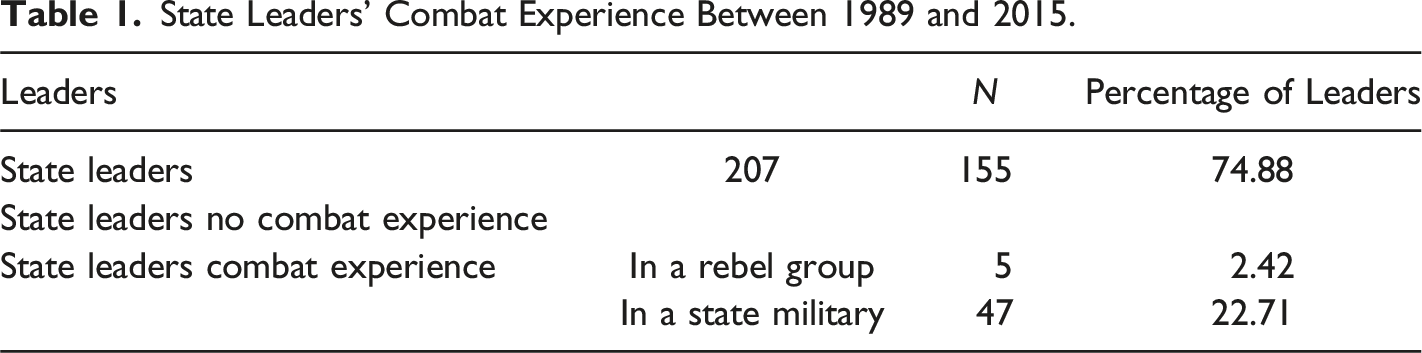
To understand how combat experience affects the likelihood of peace agreement, I apply a competing risks model, estimating the relative risk of a peace agreement as compared to all other civil war outcomes. Results indicate the probability of experiencing a peace agreement at any point in time. The competing risks analysis is conducted using Cox proportional hazard models to compare the relative likelihood of terminating a conflict through peace agreement versus experiencing a non-peace conflict outcome.
The statistical analysis includes controls on the leader, adversaries, external actors, and the conflict environment, which have been shown to influence the outcome of civil conflicts. First, I control for leadership change (Prorok 2018; Ryckman and Braithwaite 2020). I also control for foreign intervention (Cunningham 2010) in the conflict. Second, several controls are added in the tradition of theories on the moment of ripeness (Zartman 2001). As such, I control for rebel strength (Cunningham et al. 2013), and conflict intensity (Kreutz 2010). Drawing on the UCDP Conflict Termination Dataset (Kreutz 2010), I also control for the topicality of the conflict, territorial dispute, active dyads, and the number of past negotiations, assuming that many failed negotiations reduce the likelihood of reaching an agreement (Cunningham and Sawyer 2019). Finally, I include other characteristics of the state, including democracy and gross domestic product (GDP) per capita (Cunningham et al. 2009). 10
A caveat here is that combat experience could be endogenous to the leadership selection process, meaning that individuals who have combat experience are also the ones who will become leaders in civil wars due to their perceived toughness. Resolving this issue is challenging because soldiers select into military service, and are assigned non-randomly to front-line deployments. However, studies on leaders show that leader effects persist even after accounting for the possibility of selection (Horowitz and Stam 2014). Endogeneity tests from Tiernay (2015) and Ryckman and Braithwaite (2020), among others, indicate that leadership changes can be considered exogenous in civil wars. It cannot be completely ruled out that leader selection is endogenous to willingness to fight/compromise, however, even with high casualties I find no evidence that more leaders with combat experience are selected than those without (see Online Supplement Table 16). Hence, the potential role of combat experience should not be underestimated.
Results: Leaders Who Signed Peace Agreements
Competing Risks of a Peace Agreement Versus Other Termination Types.
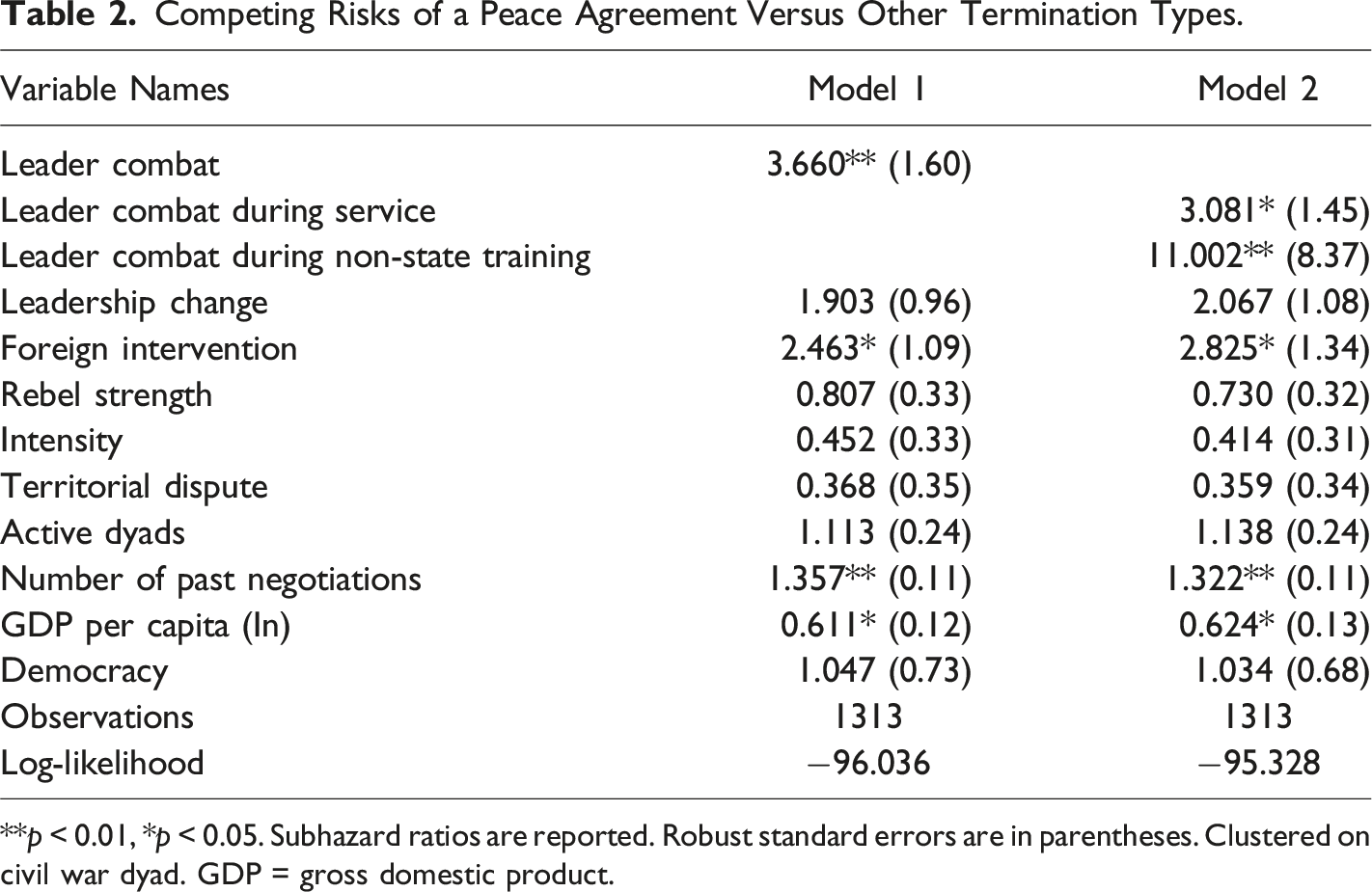
**p < 0.01, *p < 0.05. Subhazard ratios are reported. Robust standard errors are in parentheses. Clustered on civil war dyad. GDP = gross domestic product.
Figure 1 charts the cumulative subhazard rate for Model 1. The lines show that the combat experience of leaders has a positive effect on the likelihood of peace agreements vis-à-vis leaders with no battlefield background. Cumulative subhazard of a peace agreement versus other termination types (model 1).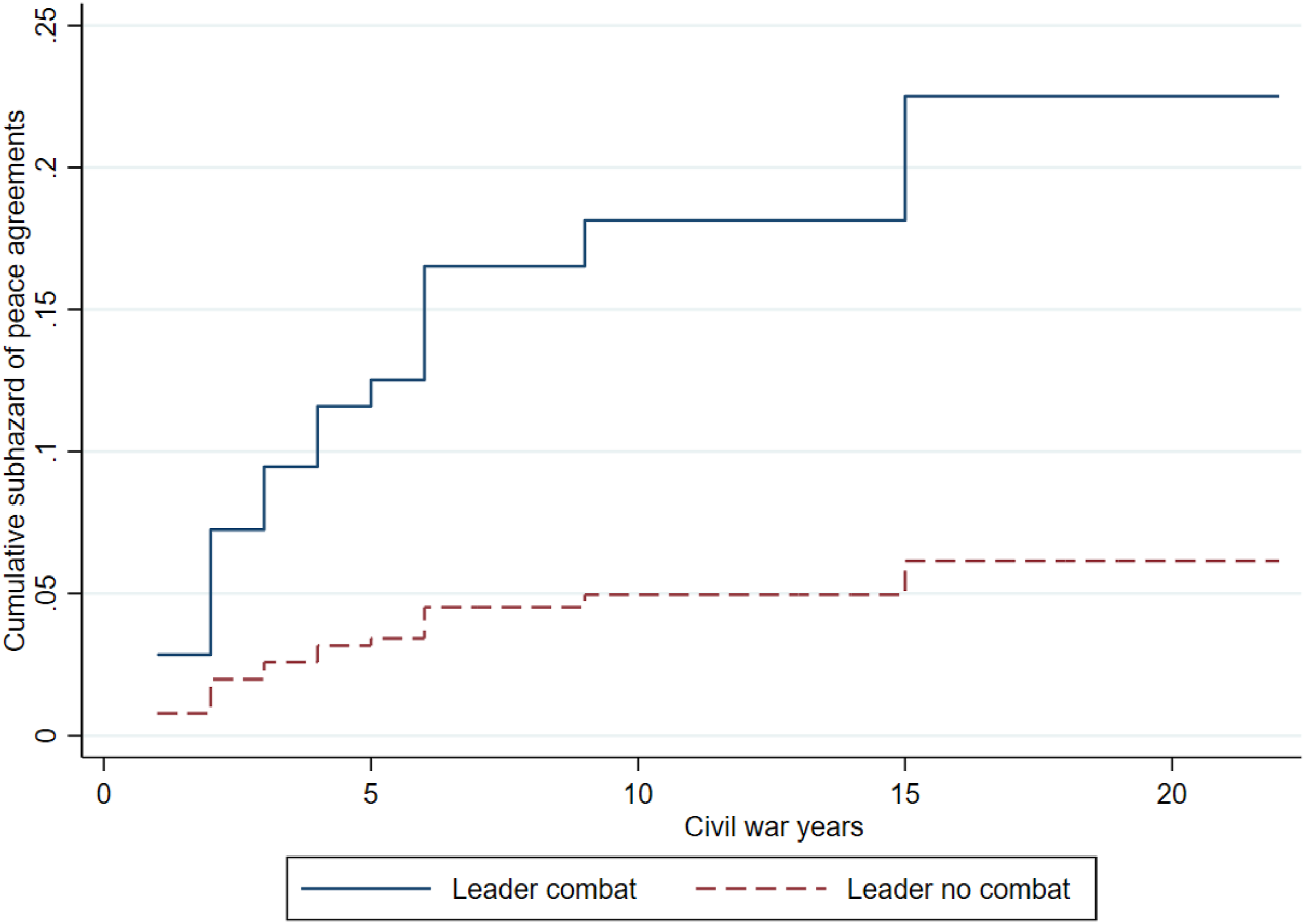
Within 6 years of fighting, the probability of ending conflict through a peace agreement is roughly 17 percent when the state leader has combat experience. The likelihood increases over time because early in intrastate wars, governments often feel little pressure to negotiate with rebel groups because they pose little immediate threat.
I test the proposed mechanism between combat and sensitivity to losses with Model 2. By differentiating between where combat experience took place with leaders with no combat experience as the reference group, this model allows me to test whether leaders who have combat experience in a non-state armed group are more likely to end conflicts through peace agreements than leaders who have been on the battlefield as combatants in the armed forces. This is based on the assumption that ‘former rebel’ state leaders are likely to have been more exposed to the loss of life in combat than those leaders who served in the state military. The results indicate that leaders with combat experience in non-state armed groups are 11 times more likely to end conflicts through peace agreements compared to leaders with no combat experience. Similarly, leaders with combat experience during military service are three times more likely to reach peace agreements than those without any combat experience. Due to the limited size of the sample, this is very tentative evidence. The results discussed above provide support for the article’s main hypothesis that state leaders with combat experience are more likely to end conflicts through a peace agreement. However, the results could be affected by alternate specifications of combat experience, and other leader-level factors such as rebel participation, age, and responsibility for causing the conflict. The results from these additional models are presented in the Online Supplement. I tested if the results hold for alternate specifications of the dependent variable, other conflict outcomes, and the conditions of peace agreements.
The results might as such be tied to coups because leaders might experience more battles in conflicts in which rebel groups have the power to overthrow the government. A possible interaction effect between rebel and state leaders was also tested. Moreover, a comparison of the results of a basic logistic regression and a closer look at how leaders with/without combat experience might not be distributed randomly at different times of a civil conflict is needed. Similarly to Prorok (2018), I created a proxy for war costs measuring whether the group suffered higher or lower than average deaths per battle in the last year to predict whether battle-hardened leaders are more likely to come to power when a weak or a strong state is suffering high war costs, with the expectation that if endogeneity is a concern, high costs will predict battle-experienced leaders coming to power. Finally, I conduct formal sensitivity analyses (Cinelli and Hazlett 2020).
I find that results remain robust to the existence of prior participation in a rebel group. Leaders with no combat experience, but military service are slightly less likely to sign peace agreements. This advances Horowitz and Stam’s (2014) assumption that these leaders initiate more conflicts by showing that they are also less interested in terminating conflicts through peace agreements (Online Supplement Table 4). Results remain robust to inclusion of age, and responsibility for causing the conflict (Online Supplement Tables 5 and 6). Using a different dependent variable, I widened the variable to peace agreements and ceasefires meaning that the conflict ended in peace agreements or ceasefires. Results remain robust, supporting the theoretical assumption that leaders with combat experience are cost-sensitive and want to reduce human losses quickly, regardless of ending the conflict in peace agreements or ceasefires. Combat experience matters for peace agreements and ceasefires but not military victories or losses (Online Supplement Table 7). The results remain robust to coups and the exclusion of territorial conflicts (Online Supplement Table 8). The effect of combat experience also holds to inclusion of contrasting ethnic, religious, and economic ideologies (Online Supplement Table 9). Results remain robust to inclusion of peace agreement provisions such as mediation and concessions (Online Supplement Table 10). The results are also robust to inclusion of additional country-, group-and state leader-level controls such as size of population, ethnic division, gender inequality, political organizational capacity, smuggling activities, and other leader characteristics such as level of education (Online Supplement Table 11).
The interaction between rebel and state leaders indicates that rebel leader turnover is key for the likelihood of peace agreements (Online Supplement Table 14). The importance of rebel leadership change for the likelihood of conflict terminating peace agreements emphasizes that a new rebel leader could judge his opposer based on previous combat experience and then take the decision to end a conflict through a peace deal because he perceives the state leader to understand the conflict and to be military capable if war breaks out again. The results of the basic logistic regression confirm the results (Online Supplement Table 15) and the results for the endogeneity test demonstrate that increasing war costs do not significantly impact the likelihood that a leader with combat experience takes power (Online Supplement Table 16). The results suggest that the selection of state leaders with or without combat experience is unrelated to the costs of war. Finally, I added formal and informal sensitivity analyses to establish the extent of confounding necessary to explain away the results (Online Supplement Table 17). I replicated the results in a leave one leader out analysis (Online Supplement Table 18 and Table 19) and I used a manual inspection of possible overfitting (Online Supplement Table 20).
While this statistical analysis is useful for drawing out broad patterns across countries, it has limited utility for specifying causal processes in more detail. With this latter aim in mind, I turn to the qualitative part of the nested design. Since quantitative results are robust, the nested design is meant to reveal the mechanism between combat experience and peace agreements (Weller and Barnes 2014). I focus on a pathway case with a peace agreement as the outcome to understand the logic behind combat experience and peace.
Case Selection
Having demonstrated that leaders’ combat experience is an important factor in facilitating peace agreements, the case study is meant to elucidate why combat experience matters. Based on Weller and Barnes (2014) I chose a pathway case with peace agreement as outcome to explore this mechanism. Since the large-N results are robust, the most important leaders that explain the outcome peace agreement in the model can be visualized. These leaders are the ones that most influence the outcome of the main analysis based on the reduced residuals of model 1 (see Online Supplement Figure 1). Out of the three most relevant leaders, the one with the highest feasibility of finding primary and secondary sources about the actual leader was chosen. For this model, Yudhoyono, President of Sri Lanka, also known as the ‘thinking general,’ was the most suitable case to reveal the link between combat and peace. Then, the main question for the case study was how the leader talks about his combat experience and how it relates to his signing of peace agreements. If he explains the signing otherwise, this is also explored.
Case Study: Bambang Yudhoyono
After more than 30 years of conflict, the Indonesian government and the GAM signed a peace agreement in 2005. The two leaders involved recognized that an agreement was the most viable solution to the conflict’s stalemate. Both leaders had experienced combat: GAM’s leader Hasan di Tiro was severely injured during an attack in 1977, and President Yudhoyono was an army general directly involved in the occupation of Timor-Leste.
Before his political career, Yudhoyono enjoyed a decorated military career. Among other trainings, he attended the Ranger courses in the United States in 1975, where he learned how to engage the enemy in hand-to-hand combat and direct fire combat. Based on these experiences, he became a platoon commander in the occupation of Timor-Leste, during which he was actively involved in combat (Suryadinata 2005). East Timor must have been a formative experience because the military misjudged the situation and became even more brutal and violent in order to achieve a military victory (Honna 2003, 89–102). Later, Yudhoyono had several other military positions and, among other posts, served as a UN observer in Bosnia. To understand if his combat experience was instrumental in making him a proponent of peace agreements, I consider interviews made by Yudhoyono and what the public, military elites, and GAM leaders thought about him in relation to his signing of the peace agreement.
In an interview from 2017, Yudhoyono described that much of his political decision-making was based on military reasoning. He mentioned that the military taught him to take the initiative, to persist, and to finish tasks: “We know that there are set of values that we adopted in the military arena, such as: can-do spirit, never give up, mission must be accomplished” (Yudhoyono 2017, 1). Further, he learned that problems can be solved. He described how his combat experience made him understand that military operations are not the objective of a conflict: In my own experiences after around thirty years served in the military, I do believe in several things—among others, that peace is better than war. Combat experience made me aware. If we are talking about war, then there is war of choice, and war of necessity. It means we could choose whether we should go for war or not (Yudhoyono 2017, 4).
This statement shows that Yudhoyono saw war only as an option to achieving peace. However, he also remained pragmatic and stated that if peace fails, a military solution is inevitable (Stange and Missbach 2018, 236). His perception of the costs of conflict was also pragmatic, as he understood that “there were too many victims on both sides. And it was expensive, costing us about $130 million per year in security operations” (Morfit 2007, 125). When asked how his military experience interacted with the presidency, he explained that more concessions and discussion are needed to run the government than to command the army and succeed in military operations (Yudhoyono 2017, 2).
Yudhoyono was not elected as president of Indonesia in 2004 for his combat experience. He won in a landslide victory because voters across political and demographic spectrums believed that the retired army general would improve their economic situation (Mujani and Liddle 2010). He was also able to impress voters with his international experience and physical stature, as many Indonesians wanted their political leader to be as tall as other world leaders (Ziegenhain 2009). 11 At the beginning of his presidency, Yudhoyono enjoyed a reputation for decisiveness and authority because of his military experience and his willingness to reform the military’s political role (Aspinall et al. 2015, 3–5). This may have made it easier to convince the public of the need for an agreement, as the public tends to reject peace initiatives from dovish, indecisive, and compromising political leaders (Mattes and Weeks 2019), which is how Yudhoyono was seen toward the end of his presidency.
At the start, Yudhoyono and his vice president, Jusuf Kalla, brought expertise in peace negotiations, having negotiated secret peace deals with local elites in the Moluccas and Poso (Törnquist et al. 2010, 33). Yudhoyono had developed a reputation for supporting peace agreements while many other hardline military men rejected negotiated outcomes. When he became president, he had to deal with hardliners within the Indonesian National Military and GAM leaders who, from exile in Sweden, continued their struggle for an independent Aceh, righteous in their struggle and confident victory was attainable. Peace negotiations officially resumed after the 2004 tsunami, but secret talks had already taken place, and the disaster further wakened GAM and reinforced the general consensus that peace must prevail in Aceh to facilitate reconstruction. Yudhoyono used this window of opportunity and, finally, representatives of the two parties signed a peace agreement to end the 30-year insurgency after only 5 months of negotiations.
Yudhoyono was known for his sharp intellect, strict discipline, and organisational capability, which he attributes to his military experience. His support network in the military and in the elite circles of Jakarta described his leadership style as conciliant because he forged coalitions and organized broad majorities for his policies. They also perceived him as cautious, a person who weighed all the costs and benefits of a decision (Törnquist et al. 2010, 189). Most importantly in a country with much military influence, Yudhoyono could rely on the trust and loyalty of the military elites who admired him for his combat experience. He sidelined the most conservative elements in the armed forces and created a degree of effective authority over the military that made it possible to push for a peace agreement (Sebastian 2022; Mietzner 2008, 291–328). Still, Yudhoyono could have probably pushed for more reforms if he had been less hesitant and reluctant to face conflict (Jones 2015).
On the other side, GAM leaders were pleased with the way Yudhoyono and Kalla demonstrated the political will to reach a settlement (Stange and Missbach 2018). As early as 2002, GAM leaders supported the appointment of Yudhoyono as coordinating minister for political and security affairs because they perceived him as an architect of the military reforms (Morfit 2007). Hence, GAM leaders had a positive image of Yudhoyono based on his past positions and political signals.
The case of Yudhoyono shows that military and combat experience are closely connected to perceptions of pragmatism, rationality, and respect. It cannot be denied that Yudhoyono’s ‘real’ military experience on the battleground was key to getting a major potential peace spoiler on board: the military. He also enjoyed a credibility with hardliners that gave him much political liberty at the beginning of his presidency.
Discussion and Conclusion
This article argued that state leaders with combat experience are more likely to end conflicts through peace agreements because combat experience increases their sensitivity to human losses and gives them a hawkish reputation. Their hawkishness increases internal support, boosts their risk-tolerance and convinces the rebel leaders to take the respective state leaders seriously. Empirical findings confirm that leaders with combat experience are three to four times more likely to sign peace agreements than leaders without battlefield background. Hence, the statistical analyses lend macro-level support to the theoretical framework of leaders’ combat experience and its effect on the likelihood of conflict termination through peace agreements.
Obviously, leaders’ combat experience is not the only driver of peace agreements, and this theory is complementary to accounts of mutually detrimental stalemates, foreign support, and group processes. The case study of Yudhoyono indicates that his combat experience was a key factor that facilitated public and military support for an agreement and reduced the likelihood of public punishment by hawkish audiences. The pathway case study provided micro-level support for the mechanism of hawkish credentials and further indicated that leaders’ combat experience cannot be considered in isolation as it is often intertwined with military service. Therefore, it speaks to other theories that have tried to open the black box of those in charge by looking at their past experiences.
This research has several implications. First, it further expands quantitative research on how state leaders influence the outcome of civil wars and that counterintuitively, combat experience can be beneficial for ending conflicts. Contrary to theories of leaders in international conflicts, it is emphasized that leaders with hawkish credentials do not let the conflict continue once it has erupted, but rather prefer to end conflicts through peace agreements. Future studies should expand the black box of combat experience, as it can vary in intensity, severity, and duration and cause specific trauma. Outcomes could differ depending on the position and the time in life in which combat was experienced. For example, combat experience as a naval officer could differ greatly from combat in the field.
The present analysis could be strengthened by including group-level characteristics to examine how leaders make decisions for peace agreements based on the perceptions of their followers and advisors. It is also possible that other experiences, such as leaders’ international experience or traits such as self-confidence, make leaders more open to considering peace agreements a viable conflict termination. Future studies might also attempt to operationalize mutually detrimental stalemates better than simply through the ratio of state-to-rebel strength. In addition, future research could specify the terms of peace agreements by showing whether not only strong concessions but also the prospect of judicial punishment influences rebel leaders’ decisions against peace agreements.
In sum, there are several drivers of the likelihood of conflict termination through peace agreements. I argue that in this multitude of driving factors, previous research overlooked the individual package that each leader brings to conflict. I show that leaders with combat experience might be more inclined towards ending conflicts through peace agreements than previously acknowledged.
Supplemental Material
Supplemental Material - Dovish Hawks: How Leaders’ Previous Combat Experience Influences the End of Civil Conflicts in Peace Agreements
Supplemental Material for Dovish Hawks: How Leaders’ Previous Combat Experience Influences the End of Civil Conflicts in Peace Agreements by Juliana Tappe Ortiz in Journal of Conflict Resolution
Supplemental Material
Supplemental Material - Dovish Hawks: How Leaders’ Previous Combat Experience Influences the End of Civil Conflicts in Peace Agreements
Supplemental Material for Dovish Hawks: How Leaders’ Previous Combat Experience Influences the End of Civil Conflicts in Peace Agreements by Juliana Tappe Ortiz in Journal of Conflict Resolution
Footnotes
Acknowledgments
Special thanks are due to Matthias Basedau, Christopher Blair, Margit Bussmann, Sabine Carey and the Women Publication Support Group, Belén González, Peter Marquardt, Cosima Meyer, Madison Schramm, Anastasia Shesterinina, Andreas Ufen, and the anonymous reviewers.
Declaration of Conflicting Interests
The author(s) declared no potential conflicts of interest with respect to the research, authorship, and/or publication of this article.
Funding
The author(s) received no financial support for the research, authorship, and/or publication of this article.
Data Availability Statement
Data and other files for replication can be accessed at: Tappe Ortiz 2024, “Replication Data for “Dovish Hawks: How leaders’ previous combat experience influences the end of civil conflicts in peace agreements””,  , Harvard Dataverse.
Supplemental Material
Supplemental material for this article is available online.
Notes
References
Supplementary Material
Please find the following supplemental material available below.
For Open Access articles published under a Creative Commons License, all supplemental material carries the same license as the article it is associated with.
For non-Open Access articles published, all supplemental material carries a non-exclusive license, and permission requests for re-use of supplemental material or any part of supplemental material shall be sent directly to the copyright owner as specified in the copyright notice associated with the article.
