




Abstract
This paper is concerned with state capacity and autocrat survival. We argue that state strength in autocracies increases leader tenure but reduces the stability of the regime itself; stronger autocracies run a higher risk of transitioning to democracy. This trade-off arises as a result of how state capacity affects the behavior of elite challengers. A stronger state reduces the likelihood of the ruler being ousted by force, inducing rival elites to switch tactics to peaceful support for democracy. An autocrat may prolong his tenure by investing in state capacity, but this brings on the downfall of the autocratic regime itself. We analyze the implications of our argument using a variety of historical sources providing information on 47 autocracies from 1800 to 2012. Our empirical findings, in part based on original data collection, are in line with the theoretical expectations: in strong states autocrats survive, but autocracies die.
How is autocratic survival related to state strength? In this paper we seek to answer this question by focusing on how state capacity affects the two main threats to an autocrat: forceful removals – such as assassinations and coups – and democratization. How these threats are managed cannot be explained by the decisions of the autocrat alone, but also need to take elite challengers into account. A challenger can attempt to change the political status quo either by replacing the ruler by the use of force, or working for democratization (for instance together with a popular movement for democracy). The first option, if successful, changes the leader of the autocratic regime; the second option, if successful, changes the regime itself.
Previous research on the link between regimes and state capacity has focused both on the determinants of state capacity (e.g., Aidt and Eterovic 2011; Besley and Persson 2009; Cox 2016), and on how state capacity affects institutional change. Scholars in the latter camp have focused mainly on how state strength stabilizes democracies (e.g., Andersen and Doucette 2020; Andersen et al., 2014; Cornell and Lapuente 2014; Linz and Stepan 1996), but also, to a lesser extent, how it prevents democratization in autocracies (e.g., Hariri 2012; Stasavage 2020; Way 2005). Military strength in particular has been found to prolong survival and protect autocracies against democratization (Albertus and Menaldo 2012; Hariri and Wingender 2021; Seeberg 2014; Skocpol 1979; Slater and Fenner 2011).
Our conceptualization of state capacity – focusing on revenues, the public administration, and information – is, however, broader than military strength and more akin to the notion of a state’s “infrastructural power” Mann (1984). 1 Previous research has paid less attention to the role played by this broader, civilian state capacity, vis-á-vis the dual threat of forceful removal and democratization. This is an important omission given that in the era in which modern states were born, the majority of the worlds’ countries were undemocratic. Moreover, the literature on state capacity in democracies has little to say about why the state in some autocracies – such as China – is relatively strong while the state in other autocracies – such as Venezuela – is relatively weak. If we want to understand the relationship between state strength and political regime development, we need a framework which includes the two most important causes of autocratic downfall: forceful removal and transitions to democracy. In contrast to previous research on autocratic resistance to democratization and irregular removal (e.g., Escribà-Folch 2013; Wright and Escribà-Folch 2012), we focus on the strategy of the opposition, in particular the decision whether to use force or not.
Consider the case of South Africa under the apartheid regime. Prior to the 1980s, the main contender for power in the country was the ANC, who after the Sharpville massacre in 1960 had turned to violent tactics. The ANC and its Communist revolutionary allies faced a capacious autocratic state, seemingly untouched by efforts to overturn it. After its leaders had been imprisoned, however, the South African opposition movement in the 1980s changed tactics. Spearheaded by the United Democratic Front (UDF) and the Congress of South African Trade Unions (COSATU), a broad-based series of non-violent campaigns were organized including demonstrations, marches, rent and consumer boycotts, worker strikes, and “stayaways.” The authoritarian regime finally caved in and, after protracted negotiations, transited to democracy in the early 1990s (Schock 2005).
Now consider the case of the post-World War II dictatorship in Spain, which with generalísimo Franco in office for more than 37 years saw one of the longest-tenured dictators in modern history. After emerging victorious from civil war, among the priorities of Franco was, first, to weaken the military and make it subservient to the state, and, second, to modernize the patrimonial Spanish state administration (Berman 2019, 328-331). The democratic opposition, either killed in battle, imprisoned or executed, stood no chance of challenging the dictatorship through armed rebellion or forceful removal. Starting in the 1960s, it therefore changed tracks and turned to unarmed resistance through, in particular, intense labor mobilization, eventually to the point that Spain had one of the highest per capita strike rates in Europe. In the early seventies, both the Communist and Social Democratic parties joined broad organized platforms with the outspoken goal of establishing democracy. Despite facing serious state repression, and although violent tactics also were used on the fringes (particular by Basque nationalists), the unarmed resistance persevered. After Franco’s death in November 1975, labor strikes and demonstrations reached new, unprecedented levels, effectively undermining any attempts by regime elites to prolong autocratic rule. In an orderly process, starting with the appointment of the moderate Suarez in 1976, Spain transitioned to democracy (Berman 2019; Collier 1999; Foweraker and Landman 1997).
Compare these developments to the typical trajectory in weaker states, such as Sudan, where one autocratic leader replaces another in a series of coups and counter-coups. In this paper we make a distinction between these two types of threats to an autocrat: forceful removals and pro-democratic movements. We argue that, as in South Africa or Spain, state capacity increases the resilience against forceful removals (such as assassination, coups, or armed rebellion), but also increases the vulnerability to democratization. Forceful removal means that the leader is replaced while the country remains undemocratic, as has happened many times in Sudan. A transition, in contrast, may imply a new leader but most importantly a new political regime, as happened in South Africa and Spain. Accordingly, an autocrat can be replaced by another dictator or be replaced as the result of a transition to democracy.
These dual threats pose a problem for the autocrat: By strengthening the state, an autocrat can prolong his tenure, but this gain in leadership stability comes at the cost of an increased risk of democratic transition. We argue this trade-off arises as a result of how state capacity affects the behavior of other elite groups. An elite challenger seeking to take power can do so either by replacing the ruler using force or by supporting democratization. A strong state makes a forceful removal less likely to succeed for three reasons: modernization of taxation means less dependence on economic elites; a competent bureaucracy diminishes the ability of local elites to engage in clientelism; and access to high-quality information gives the state autonomy vis-à-vis local strongmen. This encourages the rival elite to focus on regime change, for instance by backing a peaceful popular movement for democracy. Thus, investing in state capacity is a double-edged sword: by investing in their own survival, autocrats bring on the downfall of autocracy as a political system. Since the most common type of forceful removal – coups – are already very unlikely in states with particularly strong militaries (Svolik 2013), we do not expect civilian capacity to matter much in these contexts. Much as in Spain under Franco, however, we expect (civilian) state capacity to matter if the power of the military has been weakened (or, more generally, if the military is relatively weak).
Our empirical analyses are based on a novel index of state capacity, based on measures of fiscal, administrative and information capacity, observed for 47 autocracies around the world from 1800 to 2012. We first look at the link between state capacity and the survival in office of autocrats, relying in part on novel data collection on the exit reasons for leaders going back to the 19th century. We then study the relationship between state capacity and the probability of a transition to democracy (and, as a robustness test, a graded measure of democratization). Taking a vast array of control variables into account, we find evidence in support of our theoretical expectations. First, state capacity decreases the likelihood of forceful removals of autocrats – conditional on domestic military strength being relatively low. Second, we find that stronger states are more likely to transition to democracy, particularly by means of peaceful popular mobilization.
The rest of the paper is structured as follows. After a brief review of the literature we build on, we present our theoretical argument of how state capacity is linked to leadership survival and regime change in autocracies. In the following sections we describe our data and explain our empirical strategy, followed by the empirical results. The final section concludes.
How Autocracies Die
At least in the post-WWII era, the most common way for an autocracy to end was by a coup, tightly followed by elections in which the dictator lost. The third most common way to end was through popular mobilization (Geddes, Wright, and Frantz 2018, p. 178).
One strand of previous research on autocracies has focused on the role of the military, security forces, and outside threats. Strong, effective, unified armed forces (Svolik 2012; cf. Paine 2021) and secret police (Greitens 2016) are needed to fight wars and rebellions (outside threats). 2 A strong military might intuitively seem effective also against other threats to the ruler such as coups. However, if this is the case we would observe more coups in Costa Rica, which has no army, than Argentina that – at least historically – had very capable armed forces. Instead, what we observe is the opposite. Similarly, the reason coups are not a threat to most modern developed democracies is not that these countries have well-equipped and well-staffed security apparatuses. In fact, domain-specific, coercive capacity is associated with a dilemma: an army strong enough to defend the ruler against threats from below (or from abroad) is also strong enough to take power itself. Reducing this threat, however, involves fragmenting military and security forces – for example by building up parallel security organizations answering directly to the dictator (De Bruin 2020; Geddes, Wright, and Frantz 2018) – which in turn makes the autocrat more vulnerable to outside threats.
Another strand of literature has focused on how the organization of autocratic power affects its longevity. By including elite opposition members in the policy-making process, one potent threat to the dictator is neutralized. Institutions such as legislatures and parties can be used to co-opt the opposition (Gandhi 2010; Gandhi and Przeworski 2007) or help overcome informational asymmetries between the ruler and the elite (Boix and Svolik 2013; Svolik 2012). Wright and Escribà-Folch (2012) find that parties increase the vulnerability to democratization, while authoritarian legislatures reduce the risk of being replaced by another non-democratic regime. Moreover, concentrating power in the hands of a leader has been found to increase the survival chances of military regimes (Geddes, Wright, and Frantz 2018), regimes that themselves are more likely to democratize than other non-democratic systems (Debs 2016). Other contributions emphasize how in Africa, succession rules, term limits, and the composition of cabinets can help the regime survive leadership turnover (Meng 2020).
We add to this literature by emphasizing the role played by civilian state capacity (in contrast to military strength), and by distinguishing between forceful removals and transitions to democracy. In addition, while most previous research is concerned with the post-WWII era, our theoretical framework allows us to make predictions about a longer time period, and our empirical strategy allows us to test them.
Our approach has similarities with, but is also different from, a recent literature linking state capacity to political development. Stasavage (2020) argues that democracy and state capacity are substitutes, implying that strong states can escape the fiscal contract in which taxation is exchanged for representation. Stasavage thus makes the opposite prediction from us: strong autocracies should be the least likely to democratize. In line with this opposite argument, Hariri (2012) finds that early state development during colonialism hinders further democratization after independence. Two other studies find that the robustness of a state’s coercive apparatus – as measured by the size of its military (Albertus and Menaldo 2012) and the early adoption of military technology (Hariri and Wingender 2021) – reduces the likelihood of democratization. Based on case study evidence, Way (2005) makes the similar argument that the evolution of at least partially (or incomplete) competitive regimes can be seen as the outgrowth of state weakness. 3
The state, depending on who wields it, may thus be turned into a weapon against democracy rather than a vehicle for regime change. Although contained within a more nuanced overarching argument, this also seems to be the bottom line of Rueschemeyer, Stephens, and Stephens (1992, 65-6) in arguing that: “The more resourceful and powerful the state apparatus, the less likely that the subordinate classes of the population are strong enough to impose democratic rule on the system of domination.” Similarly, Slater and Fenner (2011) argue that autocracies can use state capacity to extend their lifetime.
While intuitively convincing, the idea that autocracies with strong states survive longer gets into trouble empirically: among the strongest states in the world today, few are autocracies. This empirical observation of course does not refute the idea, but it weakens it. Moreover, this literature conceptualizes state strength primarily as the coercive capacity to repress and focuses on resilience to democratization. However, it is not straight-forward that coercive capacity can protect against popular democratization movements since violent repression of peaceful pro-democratic protests often backfire, causing an even more rapid disintegration of the regime (Treisman 2020). For instance, when Ceaușescu ordered the army to disperse demonstrators, the soldiers refused and turned on him, effectively terminating the regime (Svolik 2012).
Our paper complements previous work by focusing on state capacity in the broader sense – not restricted to coercive capacity – and by analyzing both autocrat survival and democratic transitions. Most importantly, our approach is different in that we expand the choice set of the opposition. In the face of insurmountable obstacles to remove the dictator by force, our opposition actor does not simply give up – or cease to be in opposition – but instead chooses other ways to change the status quo.
State Capacity and Autocratic Survival
We follow Ansell and Samuels (2014) in analyzing non-democratic politics as a struggle between two main actors: the ruling elite group (the incumbent) and a rival elite group (the opposition). As mentioned above, we focus on two of the most common threats to autocratic survival: removal by force and popular mobilizations for democracy. We assume that the actors gain more from being in power in an autocracy than in a democracy since the position in power in the latter system is regularly contested. The worst outcome is being in opposition in an autocracy. Although there might be some value to be in opposition in an autocracy – for instance if this implies cooptation by the autocrat – there are also risks such as exile, imprisonment, or even death. While being in opposition in a democracy may not entail much possibility of being paid off by the incumbent, it also does not entail the risks. Moreover, the democratic opposition has regular opportunities to take power.
We think of the state as an organization that implements specific policies in order to achieve specific outcomes, and – following Lindvall and Teorell (2020) – we define state capacity as the strength of the causal relationship between policies and outcomes. When the government of a high-capacity state decides to adopt a certain policy in order to achieve a certain outcome, it is thus more likely to be successful than the government of a low-capacity state would be if it adopted the same policy. This simple conceptualization is congruent with other influential definitions proposed by scholars of state capacity such as Mann (1984)’s conception of “infrastructural power”.
While the causal impact of policies on outcomes itself (and thus state capacity) is hard to observe, we can observe resources that amplify this impact. More concretely, Lindvall and Teorell (2020) argue that revenues, a capable bureaucracy, and information, are three key resources increasing the ability of the state to achieve its goals. While (tax) revenue by many is seen as a particularly important aspect of state capacity (see, e.g., Levi 1988), a high level of human capital in the state administration is arguably also necessary to enhance the effectiveness of most government policies (see, e.g., Centeno, Kohli, and Yashar 2017). In addition to revenue and a competent bureaucracy, a capable state also needs up-to-date information about the territory and the population it controls (see, e.g., Scott 1998).
Investments in state capacity can thus be seen as an effort on part of the government to bolster one or more of these three resources. In practical terms this can mean the adoption of a new tax, a (successful) civil service reform, or the establishment of population registers. Importantly, our concept of state capacity focuses strictly on civilian capacity, such as a competent bureaucracy and an efficient tax system, not military capacity as such. Civilian state capacity is not well-suited for repressing popular mobilizations for democracy; just as cutting-edge fighter jets are not the best tools to improve tax collection, a new statistical office is not the most efficient way to crack down on protests. However, state revenues can of course, among other things, be used to bolster military capacity. 4
State Capacity and Forceful Removals
We define forceful removals as when the incumbent leader is ousted from power through the threat or use of force by a domestic political actor. Forceful removal is thus one in many ways in which a dictator may leave office, others being death by natural causes or removal through regular, legal or constitutional means. It should be noted that our concept of forceful removal is broader than that of a coup d’état (Chin, Carter, and Wright 2021; Powell and Thyne 2011), the most important difference being that we also include assassinations and removals instigated by actors outside of the current regime elite such as armed rebellion. We believe this broader conception is warranted, however, since, the incumbent autocrat should prefer to be protected from any attempt to remove him from office – be it through armed rebellion by forces extraneous to the current elite, assassination attempts, or “coups d’état” in the stricter sense.
Our theoretical expectation is that state capacity decreases the likelihood of forceful removals, and thus prolongs an autocrat’s tenure, by weakening the rival elite and strengthening the incumbent. This occurs in three ways. First, by professionalizing and centralizing tax collection, the state becomes less dependent on the compliance of economic elites. It also reduces the state’s dependence on elites for the collection of taxes. Moreover, higher fiscal capacity means that as the economy grows the state captures the part of this wealth that would otherwise only increase the economic power of private sector elites. In this sense, fiscal capacity helps the state maintain its “…advantage over society even as society grows wealthier” (Slater and Fenner 2011, p. 21).
Second, a well-functioning, competent public administration reduces the opportunities for local strongmen to provide patronage and building up clientelistic networks. A professional bureaucracy can also have a direct effect on autocrat survival. According to Luttwak (2016), “some states are so well organised that the machine [the bureaucracy] is sufficiently sophisticated to exercise discretion, according to a given conception of what is proper and what is not, in the orders that it executes. This is the case in the most advanced countries, and, in such circumstances, a coup is very difficult to carry out” (pp. 21-22). Additionally, meritocracy severs the link between bureaucrats and the leader in power. If civil servants hold their position not as a reward for supporting a particular ruler but because of their competence, democratization becomes less of a threat to them. Replacing one autocrat for another by the use of force may, however, lead to a politicization of the bureaucracy, resulting in purges and a system of promotions based on loyalty rather than competence. 5
Third, centralized information capacity cuts out local elites as middlemen. Standardizing and regularizing information collection and analysis makes the state more autonomous from local elites when implementing policies and collecting taxes. Elites can no longer use their informational resources to amass more influence locally, influence that can be used to challenge the government. 6 To remove the ruler by force, the rival elite also needs support from elements within the armed forces, security organizations, or other actors able to use violence such as paramilitaries. A stronger state is more capable of detecting and addressing potential grievances within these forces in time, and thus more able to keep them on the side of the incumbent. 7
Finally, previous literature has emphasized the key role played by the military. Specifically, as the military grows stronger the likelihood of a successful coup increases, but only up to a point: when the military is powerful, it does not need to stage a coup to get its way (Svolik 2013). At this point, it is unlikely that marginal changes in civilian state capacity matters for the ability of a leader to survive an attempted forceful removal. In other words, when the military is so strong that the ruler prefers to acquiesce to its demands rather than fight, a stronger civilian state does not matter. For example, China since 1979 is a case in our sample with a high level of military strength. It is doubtful that an increase in civilian state capacity would significantly affect the risk of a forceful removal in this case. By contrast, in Spain under Franco, as argued in the introduction, the military was weakened and made subservient to the state to the extent that we expect civilian state capacity to matter for autocratic tenure.
Note that, theoretically speaking, it makes no big difference if we treat the military as a distinct actor or an agent of the state: if the military is strong and a potential threat, the risk of a forceful removal is low since the threat is credible and the ruler cooperates with the military’s demands. If the military is strong and under complete control of the ruler, the risk of forceful removal is equally low. What matters is not what mechanism is at play, but that when the military is strong, the ruler does not have to invest in civilian state capacity to protect against a potential forceful removal. Put differently, a ruler will not invest in state capacity if this does not affect the behavior of the opposition elite. 8
State Capacity and Democratization
If the state is strong enough to discourage the opposition from attempting to replace the ruler with the use of force, the rival elite may instead use its resources to support – or join – a popular mobilization for democratization. We define democratization as a change not necessarily of the leader in office but of the regime itself: to one where the leading offices of state are filled through free and fair elections under broad suffrage rules (Dahl 1971). As state capacity grows the opposition elite may, in other words, change tactics. This can occur both as a change in strategy of the existing leadership, but also – as in the example of South Africa in the 1980s, or Spain in the 1960s–1970s, cited in the introduction – as a change in the composition of the leadership.
There are actually two components of this argument: (a) state capacity makes opposition elites more likely to change to peaceful protest tactics, or to support an existing popular movement for democracy, and (b) peaceful protest tactics are more likely to result in democracy than violent tactics. Let’s discuss each in turn.
First, while less attractive than controlling the state as autocratic rulers, being in opposition in a democracy is preferable to being in opposition in an autocracy. As elaborated upon above, democracy entails fewer risks when in opposition and, crucially, provides regular opportunities for taking power. Note that this is not about the true motivation of the elite; they may support democratization purely out out opportunism, not out of a genuine preference for democracy. Thus, our argument is about democratization as a process of regime change, not about democratic consolidation. It is entirely possible that the consolidation of democracy fails if powerful elites are able to derail the process. The key point is that if forceful removal is unlikely to succeed, the best cause of action for the opposition in order to change the political status quo is to push for democratization.
Second, why is it the case that the stronger the movement for peaceful popular mobilization, as numerous studies have documented (Brancati 2016; Celestino and Gleditsch 2013; Chenoweth and Stephan 2011; Kim and Kroeger 2019; Marino et al. 2020; Teorell 2010), the more likely democratization becomes? The literature seems to be in agreement on at least three mechanisms at play (see, e.g., Schock 2005). First, since non-violent resistance strategies requires no special technology or equipment, it can mobilize larger parts of the population than violent tactics, which requires weaponry and a certain physical fitness among its participants. Second, non-violent tactics are more likely to spawn the kind of division between “hardliners” and “soft-liners” that the literature argues is one of the critical conditions for transitions to democracy (O’Donnell and Schmitter 1986). Violent tactics, by contrast, justifies the state’s use of repression and can hence close the lines between rivaling factions. Third, unarmed tactics – by increasing the chances of being sustained in the face of repression and by mobilizing third-party forces – raises the prospects of hurting the economy and hence disrupting the authoritarian regime’s material support base. 9
Putting these two arguments together, if the opposition elite, too weak to remove the leader by force, chooses an alliance with the movement for democracy in order to topple the regime, the chances of a successful transition increase. 10 This alliance relies on a commitment to democracy as the masses would not trust policy promises from the elite. 11
Finally, we need to address the link between capacity and repression. Some elements of state capacity may facilitate repression of pro-democracy movements, for instance by paying for a well-equipped security force (Seeberg 2014, 2021). However, such coercive capacity may be domain-specific, that is, high levels of repression are possible to achieve without a high degree of general state capacity. If repression is the goal, there are more direct ways of attaining it than to build general capacity (for instance by restricting civil liberties, e.g., Escribà-Folch (2013)). State repression in the form of armed forces can be used as a tool to fight insurgents and rebellions. A strong military can thus affect the strategy of an armed opposition, inducing them to lay down arms and organize peacefully in support of democracy (Madrid and Schenoni 2023). This does not necessarily mean a higher likelihood of transition, given that a strong military has been linked to autocratic survival (Hariri and Wingender 2021). In contrast to military strength, a strong civilian state is less likely to protect autocratic rule against democratization as laid out above. Just because the opposition chooses peaceful methods does not mean those tactics are equally successful in all contexts. If a strong military correlate with a strong state (which may be the case if military expenditure is covered by domestic taxes and not resource revenues or foreign aid) we might in our empirical analysis be picking up the effect of military and not civilian capacity. In order to exclude this possibility we control for military strength.
Empirical Implications
To sum up, the opposition elite decides whether to remove the leader by using force or by supporting democratization. The likelihood of a successful removal is higher if the state is weak. In a weak state, we therefore expect a forceful removal to be the more likely end for an autocrat, whereas in strong states, we expect forceful removals to be rare. But this effect can be supplanted by a strong military – we therefore only expect the (negative) effect of state capacity on forceful removal to materialize if the military is relatively weak. If the state is sufficiently strong to discourage attempts to remove the ruler by force, the opposition elite diverts its resources to supporting democratization – and this applies regardless of the strength of the military. The main threat to the autocrat in this situation is thus democratization.
More formally, our hypotheses are:
The probability of forceful removal is decreasing in state capacity, particularly when the military is weak.
Autocracies with higher state capacity are more likely to transition to democracy.
Data
In order to test our theoretical expectations, we need data on three things. First, we need a measure of civilian state capacity (SC) conceptualized along the lines developed above, that is, as the latent capacity of states to get things done. Since we believe that SC is a slow-moving construct, we need a measure that allows us to put together long time series for as many countries as possible. In this paper, we will therefore draw on the measure suggested by Lindvall and Teorell (2020), which combines indicators of the most important resources that contribute to SC: government revenue, the quality (human capital) of the bureaucracy, and information capacity.
To begin with, data on total state revenue as a share of GDP for the long nineteenth century from Goenaga, Sabaté, and Teorell (2023), graciously shared by the authors, is complemented with data on tax revenue as a share of GDP for the twentieth century from Andersson and Brambor (2019) and Cagé and Gadenne (2018). 12 To proxy for the human-capital stock of the bureaucracy, we rely on expert-based assessments of the extent to which state administrators were recruited and promoted based on their formal merits rather than political or clientelistic ties from the Historical V-Dem project (Knutsen et al. 2019). Finally, we rely on Brambor et al.’s measure of information capacity (2019), which is based on data on the introduction of the census, the establishment of civil and population registers, statistical agencies, and the publication of statistical yearbooks from 1789 to the present.
Since state capacity according to Lindvall and Teorell (2020)’s conceptualization is something states produce by deploying resources, the proper way to analyze the relationship between resources and state capacity is in the form of a production function (i.e., a function that describes the conversion of inputs into outputs). Production functions are generally not additive, that is, do not consist of the sum of the inputs, but of their product (Cobb and Douglas 1928). After having normalized the three indicators to range from 0 to 1, we therefore multiply them to arrive at our index of state capacity, in turn normalized to range from 0 to 100, with data on 5881 yearly observations in 59 countries from 1800 to 2012 (12 of which are however only observed when democracies). What the multiplicative aggregation rule implies is that states cannot compensate for scarcity in one resource by investing in another. For instance, information alone is of no help if you do not have the bureaucracy to use the information to collect revenues and deliver services. In the same way, a competent bureaucracy is less potent without reliable information about the lay of the land.
Second, we need data on leadership survival in autocracies. Most importantly, this data needs to include information on the mode of exit of autocratic leaders, so that we can distinguish cases where the leader was replaced through the threat or use of force (which is what our models attempts to predict) from cases where the leader for example died from natural causes or stepped down voluntarily. Our main data is the category of “irregular removals” in Archigos, which for the most part “are the result of the threat or use of force as exemplified in coups, (popular) revolts, and assassinations …and occur at the hands of domestic opponents” (Goemans, Gleditsch, and Chiozza 2009, 273). 13 For the time period prior to 1875, and for additional heads of state (HOS) and, if that is not the same person, heads of government (HOG) not included in the Archigos data, we have complemented Archigos with new, original coding of exit reasons in the Political Leaders through Time (PLT) data (Gerring et al. 2023).
The set of leaders included (HOSs and HOGs) are the same as in the Varieties of Democracy data, but the PLT data also separates out a subset of what we call “de facto leaders” (thus excluding symbolic heads of states etc.). As in the original Archigos coding, the other exit reasons coded are: removal by regular procedures (such as stepping down voluntarily, term limits, or electoral defeat), retired from ill health, committed suicide, or being deposed by a foreign power. What this data allows us is thus to track (autocratic) leaders through their spells of tenure with irregular exits coded as 1, the other types of exit as 0.
Third, we need a measure of regime type, both in order to distinguish between democratic and autocratic leadership spells and to study transitions from dictatorship to democracy. We will primarily rely on the dichotomous indicator developed by Boix, Miller, and Rosato (2013), but for robustness tests we will also study change toward more democracy using the continuous polyarchy index from V-Dem (Teorell et al. 2019). To explore our posited causal mechanism, we rely on the NAVCO 1.3 data on non-violent campaigns (Chenoweth and Stephan 2011), although that data only goes back to 1900.
Combining the leadership data with our measure of state capacity, and restricting attention to autocracies, we have information on 1,139 leaders, 1,005 which the PLT data deem as “de facto,” in 47 countries from 1800 to 2012. While the vast majority of research on autocratic survival is concerned with the post 1945-era, we study a historical sample going back all the way to 1800. This means that we cover a smaller geographical sample – since there were fewer sovereign states pre-1945 – but are able to observe more variation in types of autocratic rulers, from monarchs and emperors to juntas and one-party states. It should also be recalled that there were fewer independent states, going back in time. In 1900, for example, Boix, Miller, and Rosato (2013) only codes 53 states, 42 of which were autocracies.
Figure 1 gives a descriptive overview of this data for our key independent variable, the index of state capacity (in black), and our two dependent variables, irregular removal (in red) and democratization (in green). During autocratic spells when we also observe the level of state capacity, 221 of these leaders were removed from office by force. The sample of countries in total experienced 61 episodes of democratization within 5 years of our measure of state capacity being observed. Already this descriptive graph makes clear, in accordance with our theory, that irregular removals are clustered at lower levels of state capacity, whereas democratization tends to occur at higher levels. State capacity, irregular removal and democratization.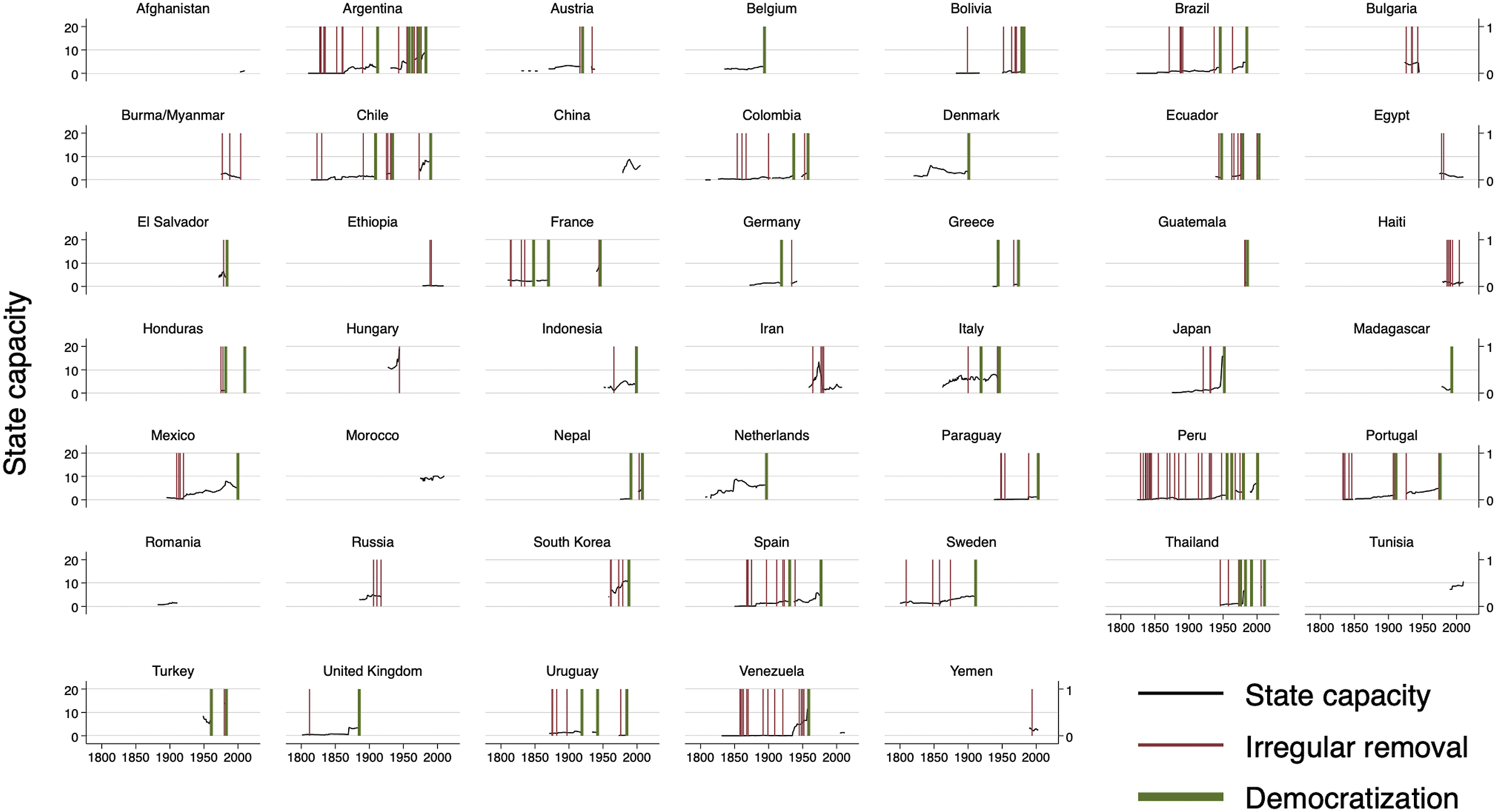
However, we also need controls to reduce omitted variable bias. To begin with, following Albertus and Menaldo (2012), we control for (the log of) military personnel per 100 inhabitants to account for military strength (with data from the Correlates of War project). Since our expectations regarding the link between state capacity and forceful removal changes when the military is particularly powerful, this part of the analysis includes an interaction term between the two. In our models of leadership survival, in order to control for heterogeneity in how powerful different leaders are we also include a measure of the relative power of leaders who are heads of states vis-a-vis those that are heads of government (based on country expert assessments of who appoints and dismisses cabinet ministers in V-Dem). 14 Moreover, following Boix and Svolik (2013), we control for the presence of a legislature (with data from V-Dem’s v2lgbicam), whether the leader is partisan (i.e., affiliated to a political party, with data from PLT), the age of the leader (years since birth), and a Cold War dummy. In our models of transition to democracy, we also control for the average level of democracy in the region in order to take diffusion effects into account. Finally, all our specifications include controls for economic growth, population size and GDP/capita (data from Fariss et al. 2021), oil dependence (data from Haber and Menaldo 2011), as well as domestic and international armed conflict (data from clio-infra.eu).
Descriptive information on all variables for the two samples (autocratic leadership survival and transitions to democracy) are provided in the online Appendix tables A1 and A2.
Results
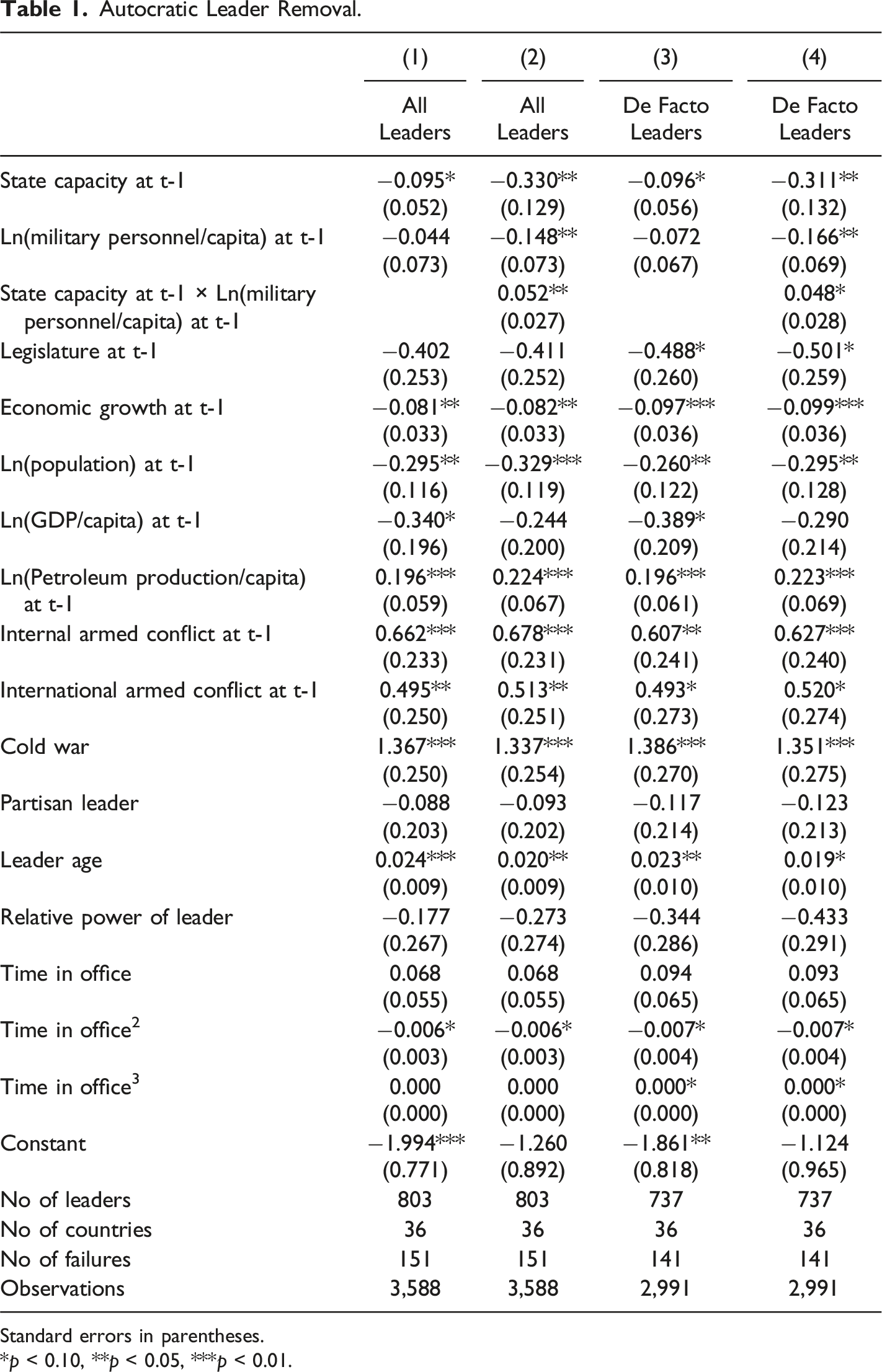
Autocratic Leader Removal.
Standard errors in parentheses.
*p < 0.10, **p < 0.05, ***p < 0.01.
By and large, the controls work as expected: the relationship between time in office and the risk of irregular replacement is U-shaped, so leaders are at the greatest risk of being deposed a few years into their reign. They are at greater risk of being deposed during economic crises and when involved in armed conflict. Leaders are also more likely to be removed through irregular means in poorer countries and during the Cold War era.
Even when taking these time-varying covariates into account, in line with H1, state strength makes leaders in autocracies less likely to be removed through irregular means. Unconditionally, this effect is not very precisely estimated however (only being marginally significant). But as indicated by the positive and statistically significant interaction effect, this result is conditional on military strength: the link between state capacity and ruler tenure is mainly present when the military is relatively weaker. We illustrate this graphically in Figure 2, based on model (2), which plots the marginal effect of a unit change in state capacity depending on the level of military strength. As can be seen, the effect is negative and statistically significant up to around the score of 4 on military strength. Although the rug plot of the latter indicates that there are more scattered observations in this lower range, the median level of military strength in the estimation sample is actually 3.71, implying that our expected effect is significant in the bulk of our data. The conditional effect of state capacity on irregular removal.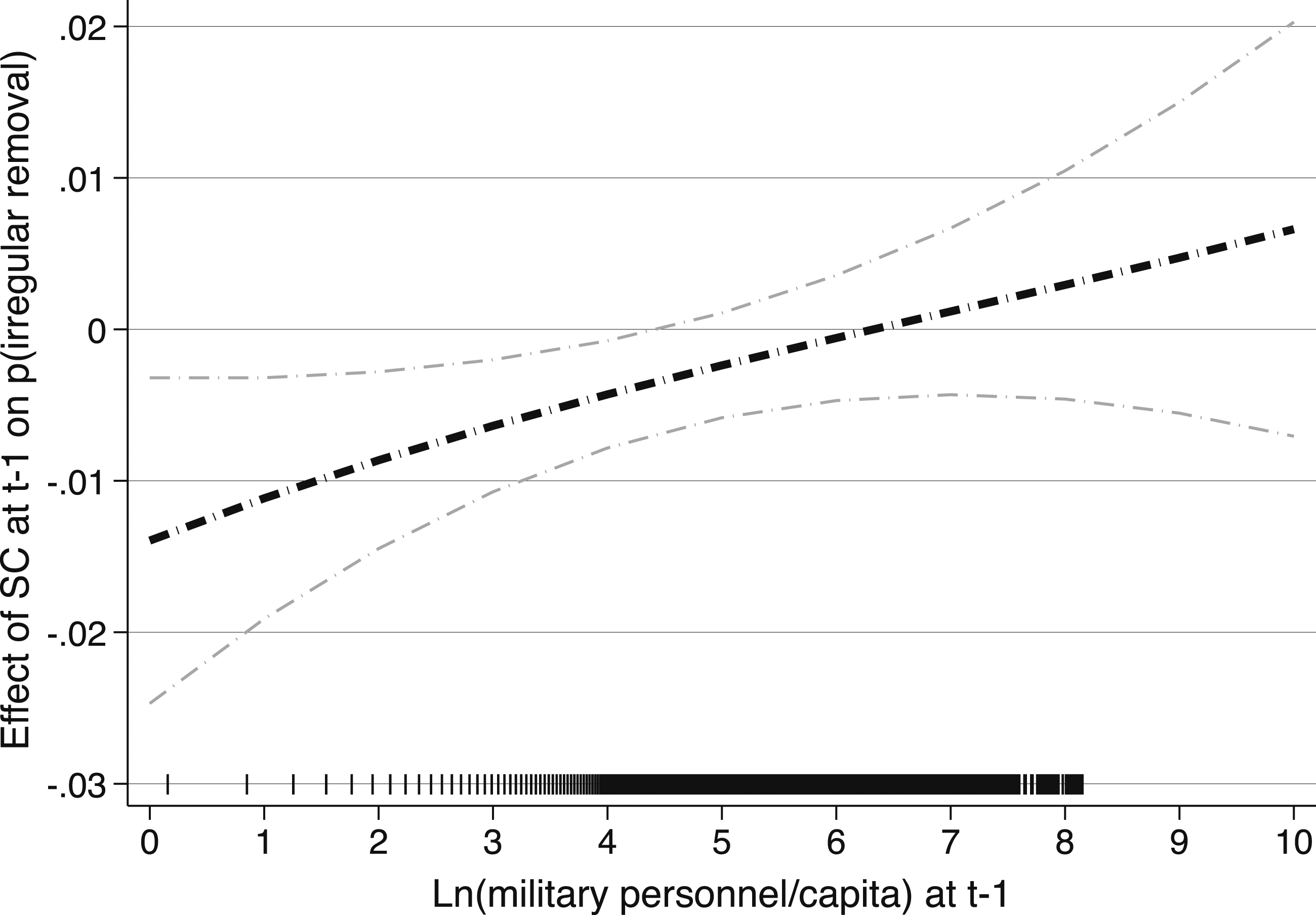
More specifically, the estimated effect of a unit change in state capacity in a state like Denmark in 1890, that scores close to the 25th percentile of military strength (at around 2.89), is a 0.007 reduction in the probability of a forceful removal, which is significantly different from zero. This should be seen in relation to the fact that the overall probability of a forceful removal in the estimation sample is only 0.042. But as the military becomes stronger, this effect becomes weaker, and at around the level of military strength achieved in for example China 1979–2012 (which is close the 99th percentile, at 8.07), there is no measurable link between state capacity and forceful removal (the point estimate being at 0.003 and not statistically significantly different from zero). These results imply that once the military becomes strong enough, civilian state building does not matter for autocrat survival. However, for the majority of our cases, the military does not reach this level of strength. In other words: in strong states, autocrats survive.
This result holds also if we restrict the sample by excluding heads of state or government that are not the effective leaders of their country (models 3–4). In the online Appendix, moreover, we show robustness of these results to the use of a Cox proportional hazards model instead of logit, while also including shared frailty at country-level to control for additional unobserved heterogeneity. In these models, we also apply the standard setup in survival analysis by not lagging any independent variables. Reassuringly, the results remain substantively the same.
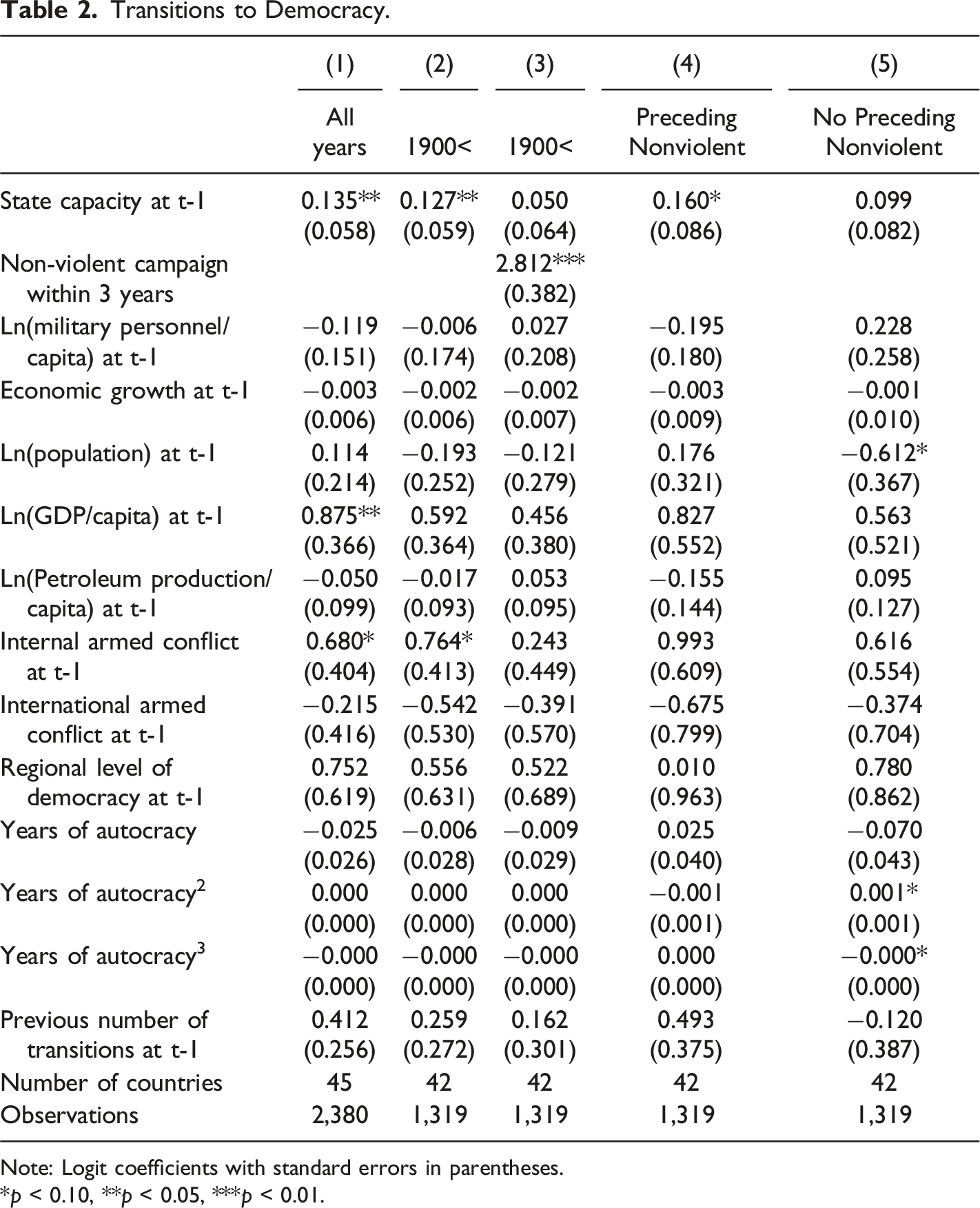
Transitions to Democracy.
Note: Logit coefficients with standard errors in parentheses.
*p < 0.10, **p < 0.05, ***p < 0.01.
Figure 3 illustrates the relationship (based on model 1). Increasing the state capacity index from its minimum of 0 to its maximum of around 15 in the autocracies of our sample, leads to an increase in the probability of a transition to democracy from around 1.5 to around 8.0 percent. Since very few autocracies appear at the latter end of the scale, this probability is very imprecisely estimated for this group. But that very few autocracies end up there is also an implication of our theoretical argument. In other words: in strong states, autocracy dies. The effect of state capacity on democratic transitions.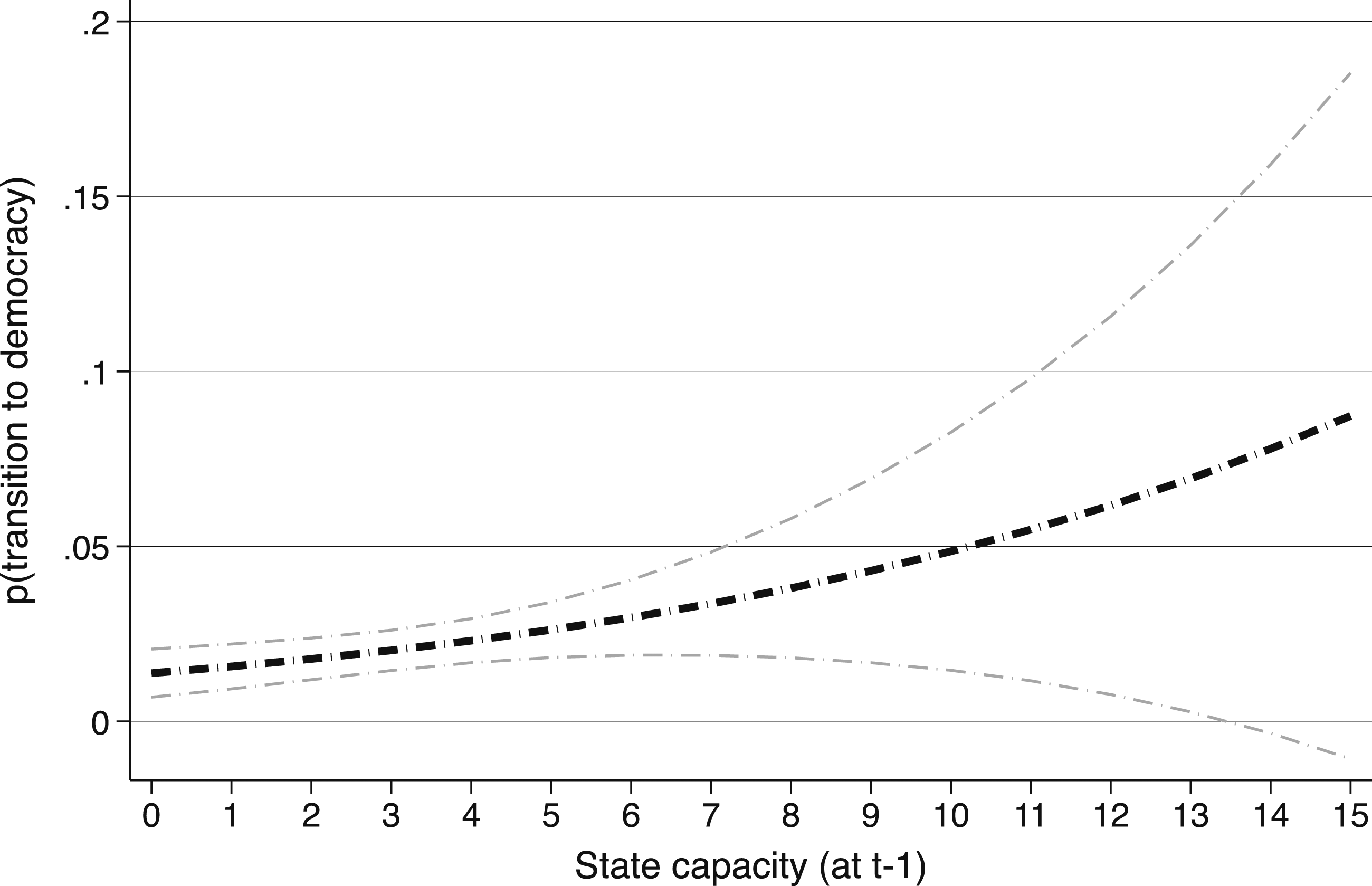
Next, we explore the extent to which the effect of state capacity runs through our posited mechanism, that is, by bolstering the opposition’s likelihood to join non-violent campaigns. By this data, 21 out of the 52 transitions completed after 1900 (for which there is information from NAVCO) occurred within 3 years from the end of a non-violent campaign. In models (2)–(5) of Table 2, we perform two tests. First, we show that the effect of state capacity is still positive and of similar size when restricting the sample to the post-1900 period (model 2). But once we control for whether a transition occurred within 3 years of a non-violent campaign, which is according to our theory post-treatment, this effect is substantially reduced and no longer statistically significant (model 3). Second, when we split the transitions to democracy (again, occurring post-1900) into two groups, one consisting of those transitions that occurred within 3 years of a non-violent campaign, the other consisting of the rest, state capacity has (model 4) a positive effect on the former (which is also much larger than its average effect reported in model 1) but not the latter (model 5).
In the online Appendix we show robustness of these results to two alternative estimation strategies. First, in Table B2, while still drawing on the BMR binary measure of democracy, we replace logit with linear probability models (LPM). Our main model (1) specification from Table 2 here remains robust, also in the presence of country- and year-fixed effects. This is reassuring, as this test controls for all sources of nonvariant country-level heterogeneity, together with coincidental global over-time trends in state capacity and democracy. In models 3 and 4, we also show that our results are not sensitive to increasing the lag length from 1 to 5 years.
Second, in Table B3 we instead use a continuous measure of democracy – the V-Dem polyarchy measure (Teorell et al. 2019) – which allows us to rely on the full sample of 57 countries for which we have data on state capacity. That is, without forcing us to restrict attention to autocracies (or autocratic spells) only. In order to capture the key theoretical idea that state capacity promotes changes toward democracy in more authoritarian settings, we include in these specifications an interaction term between the lagged level of polyarchy and our measure of state capacity (both at t-1). In line with our expectations, these models show consistently that state capacity has a positive effect on change in democracy levels as polyarchy is held at 0 (i.e., in fully closed autocracies), but this effect then dissipates (as indicated by the negative and statistically significant interaction effect) as countries move toward more democracy. This result remains as we control for both country- and year-fixed effects, as well as with the introduction of 5-year lags in the independent variables. 15
Conclusion
In this paper we explain autocrat survival and democratic transitions as the outcome of a struggle between elites. Autocrats can protect themselves against forceful removal by investing in state capacity, but by doing so are pushing the rival elites to use their resources to aim for democratization (for instance by bolstering peaceful popular movements for democratization), threatening the survival of the regime. Our results have implications for several strands of research.
Recent contributions to democratization research highlight democracy as the outcome of mistakes (Treisman 2020). In our model, democracy is the result not of a mistake but of autocracies building state capacity as protection against forceful leader replacement. By using state capacity as a tool in an ongoing elite struggle, autocrats sow the seeds of their own demise.
In contrast to redistributive models of democratization (such as Acemoglu and Robinson 2001) – in which autocracies fall as the result of revolutionary threats, and coups only occur in democracies – our approach deals with coups and democratization in the same framework. Thus, our dictators face the whole range of threats, from coups and assassinations to popular mobilizations for democracy. We also allow the challengers to use non-violent means, as an alternative to threats of revolution (which may not be credible in the face of a strong state).
Our paper also complements research on democratization which highlights how inequality affects elite competition (e.g., Ansell and Samuels 2014) by stressing how state strength provides an additional incentive for rival elites to cooperate with the masses.
In contrast to previous research emphasizing the stabilizing effects of civilian state capacity (e.g., Slater and Fenner 2011) we find that this is only the case for autocratic leader tenure. That is, state capacity provides protection against one threat to the regime – forceful removal – but not against another: democratic transitions.
We also complement a strand of literature that has argued that coercive state capacity prevents democratization (e.g., Albertus and Menaldo 2012; Hariri 2012; Slater and Fenner 2011; Stasavage 2020; Way 2005). By instead focusing on civilian state capacity, we show that a strong state may indeed protect an autocrat from forceful removal but that this instead increases the prospects for democratization.
Finally, while we have focused on the opposition’s choice whether to use violence or not when seeking to topple the leader, further research should investigate more closer the decision of the leader whether to invest in capacity or not. Our argument would suggest that when the state is very strong or very weak, investments in state capacity should remain low (in a similar vein as Acemoglu and Robinson 2019). However, our argument suggest that this is the outcome a competition between political elites, not a competition between the state and society. Further research could investigate these predictions empirically.
Supplemental Material
Supplemental Material - The Double-Edged Sword: How State Capacity Prolongs Autocratic Tenure but Hastens Democratization
Supplemental Material for The Double-Edged Sword: How State Capacity Prolongs Autocratic Tenure but Hastens Democratization by Per F. Andersson and Jan Teorell in Journal of Conflict Resolution
Supplemental Material
Supplemental Material - The Double-Edged Sword: How State Capacity Prolongs Autocratic Tenure but Hastens Democratization
Supplemental Material for The Double-Edged Sword: How State Capacity Prolongs Autocratic Tenure but Hastens Democratization by Per F. Andersson and Jan Teorell in Journal of Conflict Resolution
Footnotes
Acknowledgments
We wish to thank Swaantje Marten, Ben Chatterton, Cem Mert Dalli, and Joseph Noonan for excellent research assistance. We are grateful for comments from Magnus Åsblad, Lasse Aaskoven, Carles Boix, Tiago Fernandes, David Andersen, Kunal Sen, two anonymous reviewers, and seminar participants at the University of Gothenburg, the Danish Historical Political Economy Workshop, the Historical Political Economy Workshop at the University of Zurich, APSA, CES, and DPSA. All errors remain our own.
Declaration of Conflicting Interests
The author(s) declared no potential conflicts of interest with respect to the research, authorship, and/or publication of this article.
Funding
We acknowledge generous support from the Swedish Research council (grants no. 2019-00582 and 2019-03174).

Data Availability Statement
All data generated or analyzed during this study will be made available upon publication.
Supplemental Material
Supplemental material for this article is available online.
Notes
References
Supplementary Material
Please find the following supplemental material available below.
For Open Access articles published under a Creative Commons License, all supplemental material carries the same license as the article it is associated with.
For non-Open Access articles published, all supplemental material carries a non-exclusive license, and permission requests for re-use of supplemental material or any part of supplemental material shall be sent directly to the copyright owner as specified in the copyright notice associated with the article.
