




Abstract
International courts lack traditional enforcement mechanisms. Scholars theorize that compliance with human rights rulings is therefore often driven by domestic processes, including political mobilization and parliamentary agenda setting. A necessary condition underlying these processes is attention to the rulings which is in part expected to be mediated by media attention. However, these conditions have not been explicitly addressed by the existing compliance literature. In this paper, we assess the impact of media attention to rulings by the European Court of the Human Rights on the likelihood of their implementation, using a novel dataset of case-specific news coverage. Exploiting exogenous variation in media attention caused by competing newsworthy events, we find that the probability of compliance increases, the more coverage a ruling receives. Our findings indicate that domestic news media play a key role for compliance with international courts.
In a discussion at the Consultative Assembly about possible enforcement mechanisms for a future European Court of the Human Rights (“ECtHR”), Winston Churchill argued that such a court would not need sanctions for enforcing its rulings since he had “no doubt that the great body of public opinion in all these countries would press for action in accordance with the freely given decision”. 1
This statement is based on the assumption that the general public would notice instances of non-compliance and pressure its executive and legislature to comply with that court’s judgments. Many years have passed since this statement and indeed neither the ECtHR, nor most international adjudicating bodies, have sanctions or strong enforcement mechanisms to deter instances of non-compliance. Yet, we observe a decent amount of compliance with their rulings.
Much like Churchill, many scholars theorize that the main drivers of compliance with international courts can be found in domestic politics (e.g., Dai 2005; Hillebrecht 2014b; Simmons 2009). These theories posit that international legal rulings may help shifting the political agenda to the specific issue addressed in these rulings or help local activists to mobilize and increase the pressure for compliance. However, the assumption implicit in these theories—that domestic audiences notice information produced by international courts—has not been studied so far. Hence, it remains unclear whether and to what extent domestic attention to international rulings affects respondents' compliance, and what role the news media plays in this context.
Processing information about international legal rulings is a cognitively complex task. Given that individuals cannot be experts on all issues, and that gathering and evaluating information is costly, media coverage likely plays an important role in raising attention and informing the public about international legal rulings (e.g., Brutger and Strezhnev 2022; Downs 1957). However, it is widely known that media coverage provides a far from perfect portrait of events (e.g., Boydstun 2013). Attention is scarce and, consequently, so is the space of a week’s news cycle, which implies that not all relevant events can be picked up by the media.
Whether a ruling receives media coverage is a complex process, depending on factors both related and unrelated to the ruling. Human rights rulings, like other events, vary in their “newsworthiness” (e.g., Galtung and Ruge 1965), due to factors such as the parties involved, the nature of the violation or its perceived gravity. In addition, coverage of a ruling likely depends on how congested the news cycle is or, putting it differently, how many alternative newsworthy events overlap with the ruling (e.g., Durante and Zhuravskaya 2018; Garz and Sörensen 2017; McCombs and Zhu 1995).
Given that domestic attention to human rights rulings is a first necessary condition for many domestic politics theories of compliance and that media coverage cannot be taken for granted, the lack of research on media coverage of human rights rulings and its impact on compliance is a serious gap in the literature. This paper attempts to fill this gap by assessing the impact of media coverage on the likelihood of swift ruling implementation in the context of ECtHR rulings.
The Strasbourg court provides a good case study because most countries under its jurisdiction are either democracies or semidemocracies—at least during the period covered by our sample—which is expected to impact the viability of domestic politics mechanisms of compliance (Simmons 2009). In addition, the availability of compliance data and data on case-specific controls (Stiansen and Voeten 2017), such as the type of remedy, allows us to study the impact of media attention while controlling for known compliance covariates.
This paper contributes to the literature in three ways. First, we address an important gap in the literature by outlining the role of domestic attention in domestic politics theories of compliance with human rights rulings. We argue that media attention provides an opportunity for the public and other key actors to be exposed to human rights rulings information. Our findings help us to substantiate assumptions about attention made (but not spelled out) by existing models of compliance. Media attention might not only be relevant in the case of human rights rulings but also in the context of other courts that have similar enforcement issues, such as the European Court of Justice.
Second, to the best of our knowledge, our paper provides the first attempt at measuring case-specific domestic media coverage of ECtHR rulings for a large set of countries. We compile this media dataset by applying an innovative, supervised machine learning approach that allows us to accurately match news articles to specific rulings, covering 1113 cases from 30 countries over a period of 25 years. The data are a prerequisite to study the issue at hand, which in turn allows us to formulate practical recommendations for decision-makers.
Third, we empirically assess the causal impact of media coverage. To address endogeneity concerns, we implement an instrumental variable (IV) strategy that exploits plausibly exogenous variation in the news agenda caused by disasters, such as earthquakes, floods, or industrial accidents. We show that ECtHR rulings receive less media coverage when overlapping with these exogenous events, and that less coverage decreases the chances of compliance.
In the next section, we review the literature on compliance with international human rights rulings. We then discuss the role of media attention in compliance mechanisms and derive a testable hypothesis. Afterwards, we describe the data and empirical strategy, followed by a presentation of the results. We conclude with a discussion of limitations and policy implications.
Compliance with International Human Rights Courts: Review of Previous Findings
International politics scholars have long debated the role of the regime type for compliance with human rights law and rulings (e.g. Moravcsik 2000; Neumayer 2005). Regarding the ECtHR, previous findings indicate that a country’s compliance is highly associated with the quality of its political institutions, especially the extent of constraints to the executive branch (Hillebrecht, 2012, 2014a, 2014). In this regard, new democracies are on average quicker in implementing comparable rulings than stable democracies (Grewal and Voeten 2015), but stable democracies are more likely to comply in the long run (Grewal and Voeten, 2015; Hillebrecht, 2014a; Voeten, 2014).
Several studies suggest that state capacity is crucial for compliance. In an extensive case-study analysis of several pilot judgments from the ECtHR, Leach et al. (2010) find that lack of bureaucratic capacity or resources is one of the most important causes of non-compliance. Similarly, compliance is associated with the capacity of the legal infrastructure, government effectiveness, and fiscal flexibility (Anagnostou and Mungiu-Pippidi, 2014; Haglund, 2020b).
The evidence is mixed regarding the role of domestic judicial institutions. Huneeus (2011) finds that Inter-American Court of Human Rights (“IACtHR”) rulings directed at domestic courts have the lowest compliance rate. However, according to Haglund (2020a), ECtHR rulings are more effective in countries with higher judicial independence.
Many scholars argue that the enforcement of human rights rests on mobilization by civil society actors (e.g., Creamer and Simmons 2019; Ritter and Conrad 2016). Parente (2018) argues that both public support for compliance with a ruling and the extent to which the public poses a threat to the executive impact the likelihood of compliance with IACtHR rulings. Haglund and Welch (2021) argue that effective mobilization requires a strong civil society and the presence of national human rights institutions to diffuse information about human rights practices.
Finally, many scholars posit compliance depends on the nature of the remedies. For example, monetary compensations are associated with the highest rates of compliance (Fikfak 2018). In contrast, remedies requiring legislative changes tend to have slower implementation rates, as these changes require actions by national parliaments, where the set of possible veto players is larger (Stiansen 2019).
Attention to Human Rights Rulings and Compliance
It is often said that international adjudicating bodies lack the “purse and the sword” to enforce their rulings (e.g., Huneeus 2014) but we still observe a decent amount of compliance. Most mechanisms of compliance proposed by the literature operate at the state level and refer to factors such as relative power and state interests (e.g., Mearsheimer 1994), states' reputations (e.g., Guzman 2008), sanctions and third-state enforcement (e.g., Peksen 2009), capacity building and persuasion (e.g., Chayes and Chayes 1998), or naming and shamming by international organizations and non-profits (e.g., Keck and Sikkink 1999; Murdie and Davis 2012; Terman and Voeten 2018). However, some researchers look into domestic politics for possible mechanisms, as compliance typically depends on decisions of domestic actors. We argue that many mechanisms underlying domestic politics models of compliance with international legal rulings are mediated by the amount of attention the rulings receive at home, for which mass media plays a crucial role.
International legal rulings often convey information about the (mis-)behavior of national governments to key domestic actors (e.g., Carrubba 2005). While there is some variation in the amount of information international courts share about ongoing proceedings, most of them make their rulings accessible to the general public (Reis 2021). This information can be empirical, normative, or both (Creamer and Simmons 2019). For example, a ruling may provide information that a state has engaged in torture and therefore has violated international law. Experimental studies suggest that framing state behavior as a violation of international legal norms impacts how the general public (Chaudoin 2014; Chilton 2015; Wallace 2013) and activists (Hafner-Burton, Victor, and LeVeck 2016) perceive this behavior.
The earliest domestic politics approaches to compliance with international institutions focused on the role of the public in monitoring and enforcing international law (e.g., Dai 2005, 2007; Mansfield, Milner, and Rosendorff 2002; Simmons 2009). According to these models, when domestic constituents are informed of an international law violation, they may react by withdrawing political support or by mobilizing civil society groups against the executive (Ritter and Conrad 2016). By naming violations and specifying remedies, international legal rulings create a specific legal claim which may help civil society groups and political opposition to overcome collective action problems (Creamer and Simmons 2019; Simmons 2009). However, a necessary condition for these mechanisms to work is that the ruling is sufficiently salient, so that the relevant groups are aware of it. Media coverage of the ruling is then a crucial causal pathway for establishing the plausibility of mobilization-based compliance mechanisms (Creamer and Simmons 2019, 1058). 2
While the executive is key in designing, monitoring, and enforcing human rights policy, other domestic actors have the power to nudge domestic politics towards compliance. These actors include judges and members of administrative agencies, security forces, and political parties (Alter 2014, 50 ff.). Media attention might be key in both informing as well as pressuring these actors to follow the rulings. As Alter notes, the publicity of the rulings, which depends on the amount of media coverage it receives, is crucial in “encouraging recalcitrant actors” to follow the ruling of the court (Alter 2014, 59 ff.).
The legislative branch may also be a source of compliance. It can use its formal agenda-setting power to diffuse information about the behavior of the executive (Lupu 2015) and implement strict oversight of compliance with international legal rulings. We argue that while parliament always has formal agenda setting power, media coverage increases the likelihood that a ruling actually receives parliamentary attention. This argument is in line with evidence that media coverage impacts actions of political actors and public officials, such as decisions related to government spending (e.g., Drago, Nannicini, and Sobbrio 2014; Eisensee and Strömberg 2007), antitrust proceedings (Garz and Maass 2021), or criminal sentencing (Philippe and Ouss 2018). More to the point of our paper, several studies show that media coverage of a topic precedes subsequent attention in parliaments of parties to the ECHR (e.g., Bonafont and Baumgartner 2013; Sevenans and Vliegenthart 2016; Van Aelst and Vliegenthart 2014; Vliegenthart and Walgrave 2011).
Similarly, compliance with human rights rulings could also be affected via reactions from a country’s judicial branch. Judges may strategically react to public opinion because deviating from social norms could incite critical media coverage that undermines their institutional legitimacy. Alternatively, judges may change their subjective views about an issues in response to public opinion and media coverage (e.g., Giles, Blackstone, and Vining 2008). Research in the context of the US Supreme Court provides empirical support for these arguments (e.g., Casillas, Enns, and Wohlfarth 2011).
Judges and legal practitioners seem to acknowledge the role of public attention in increasing the costs of non-compliance. Staton (2010) theorizes that courts may conduct public relation campaigns to raise the costs of non-compliance for the executive and presents evidence of these practices in Mexico’s Supreme Court. In the realm of international human rights courts, practitioners have recommended for the IACtHR to implement measures that help to increase media coverage of rulings as a possible compliance-enhancing mechanism: “We thus suggest that the media attention inherent in public hearings may help to generate popular support and compliance pressure around a case” (Cavallaro and Brewer 2008, 793).
Besides nudging reluctant states towards compliance by bolstering the above-mentioned mechanisms of compliance, media coverage may also impact the likelihood of compliance with a ruling because it allows decision-makers to learn both about policy problems and public opinion about these problems (Walgrave and Van Aelst 2016). That is, media coverage induces learning as posited by political agenda-setting theory (e.g., Kepplinger 2007; Walgrave and Van Aelst 2006), through amplification, interpretation, revelation, or a combination of these (Sevenans 2018).
In our context, amplification means that decision-makers may deduce from the amount of coverage that a ruling receives the degree of public interest, which helps them to decide how much attention to devote themselves. Interpretation means that media reports may offer new perspectives or additional context about a ruling, which allows policy-makers to learn something about the issue they did not know before. Similarly, learning could be induced via the revelation of new facts. Hence, there are multiple reasons why media coverage of a ruling induces decision-makers to take immediate action, such as the initiation of investigations, consultations, or drafting of laws. Due to the length of those processes, any results typically become visible only after a delay of years though.
In conclusion, we expect the amount of media attention to a ruling to impact the likelihood of compliance either by empowering domestic politics mechanisms or by increasing public attention surrounding the ruling: 3
All things equal, the greater the domestic media attention to a ECtHR ruling, the higher the probability of compliance with that ruling.
Data
Compliance
Summary Statistics.
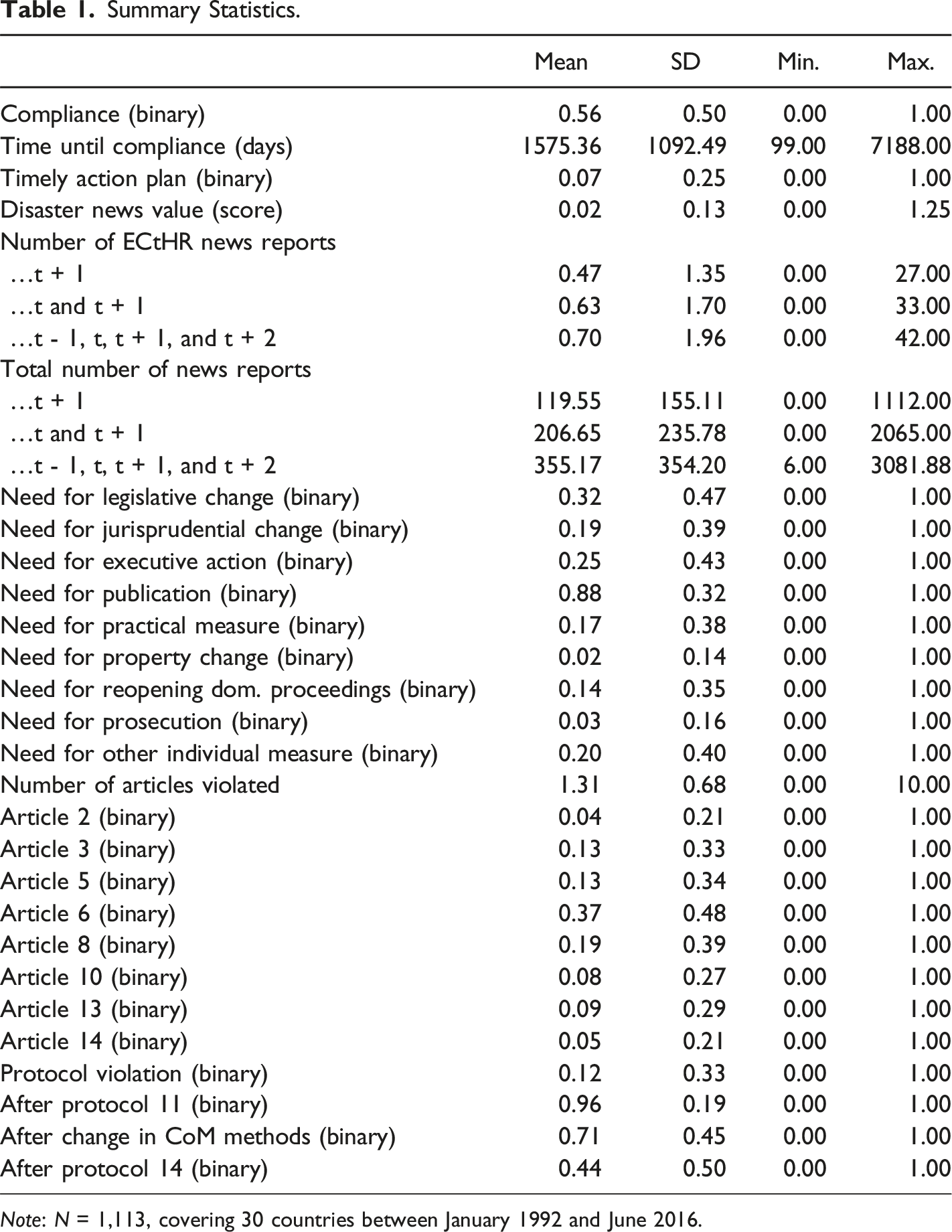
Note: N = 1,113, covering 30 countries between January 1992 and June 2016.
Media Coverage
We created a novel dataset that measures the media coverage of rulings. To begin with, we collected all articles published within a window of 10 days before and after a ruling for those cases (N = 1113) where we could access at least one media source via Factiva 5 or, if the country or period was not covered by Factiva, from the websites of individual newspapers. When selecting the newspapers, we attempted to strike a balance between availability, popularity, and ideological balance (see Table A1 in Online Appendix A). That is, whenever possible—given the availability of data—we aimed at selecting both left- and right-leaning newspapers such as El Pais and El mundo for measuring coverage of Spanish cases, Le Figaro and L’Humanité in France, or the Times and the Guardian in the UK.
We count 16 countries 6 for which it was not possible to collect any media data because neither Factiva included any mainstream media sources nor could we retrieve news reports from the website of any major outlet (e.g., because of paywalls or deleted content). As Table A2 shows, cases for which media data are available differ from cases that lack those data. For example, we observe a lower share of cases with compliance in our analysis sample because media data are more often available for more recent rulings where remedial actions might still be in progress. The included cases also more often involve violations of Articles 3 (prohibition of torture), 8 (right to privacy and family life), 10 (right to freedom of expression), 13 (right to effective remedy), and 14 (prohibition of discrimination) than the excluded cases. It is important to keep the selection of cases in mind when interpreting the results. While our sample is slightly skewed towards bigger countries, it includes both democracies (e.g., France, Germany) and authoritarian states (e.g., Russia, Turkey), developed and developing (e.g., Armenia, Georgia) countries, as well as nations ranking high (e.g., Ireland, Norway) and low (Azerbaijan, Greece) on the freedom of press index (Reporters sans frontières, 2021).
Given a case against a country and the interval [t − 10, t + 10] around the date of the ruling, we first collected all articles from the selected news outlets in that country. This procedure resulted in a corpus of 1,107,045 unique news articles. After filtering keywords pertaining to the ECtHR and human rights, translated to the publisher’s language (see Online Appendix B), the number of articles was narrowed down to 16 316. These news articles were then paired with the tentative ruling based on the above-mentioned date interval and, where applicable, both the ruling and the news article were translated into English, using the Google Translate API.
Considering the Court’s large backlog, keyword matching within the relevant temporal interval was not sufficient to confidently pair articles and rulings because of a high number of false positives. For that reason, we used supervised machine learning to accurately match news articles and rulings (see Online Appendix C for details). That is, we hand-coded approximately one third of the relevant articles (n = 5304) and used a random forests classifier to predict matches. With a balanced accuracy of 0.86 and a Cohen’s Kappa of 0.71 (see Table C1), our classifier identified 1001 articles as being about a specific ECtHR ruling in our data. 7
As Figure 1 shows, the majority of articles are published on the day after the respective ruling. This pattern is characteristic for the 1-day publication lag that most newspapers exhibit. Consequently, in most specifications, we use the article count on day t + 1. As a sanity check, we compare the number of news reports about a case published on the day after the ruling with the Google search volume on the topic “European Court of Human Rights” (see Appendix D for all details). Both measures are highly correlated (Figure D1). Timing of media coverage of ECtHR rulings.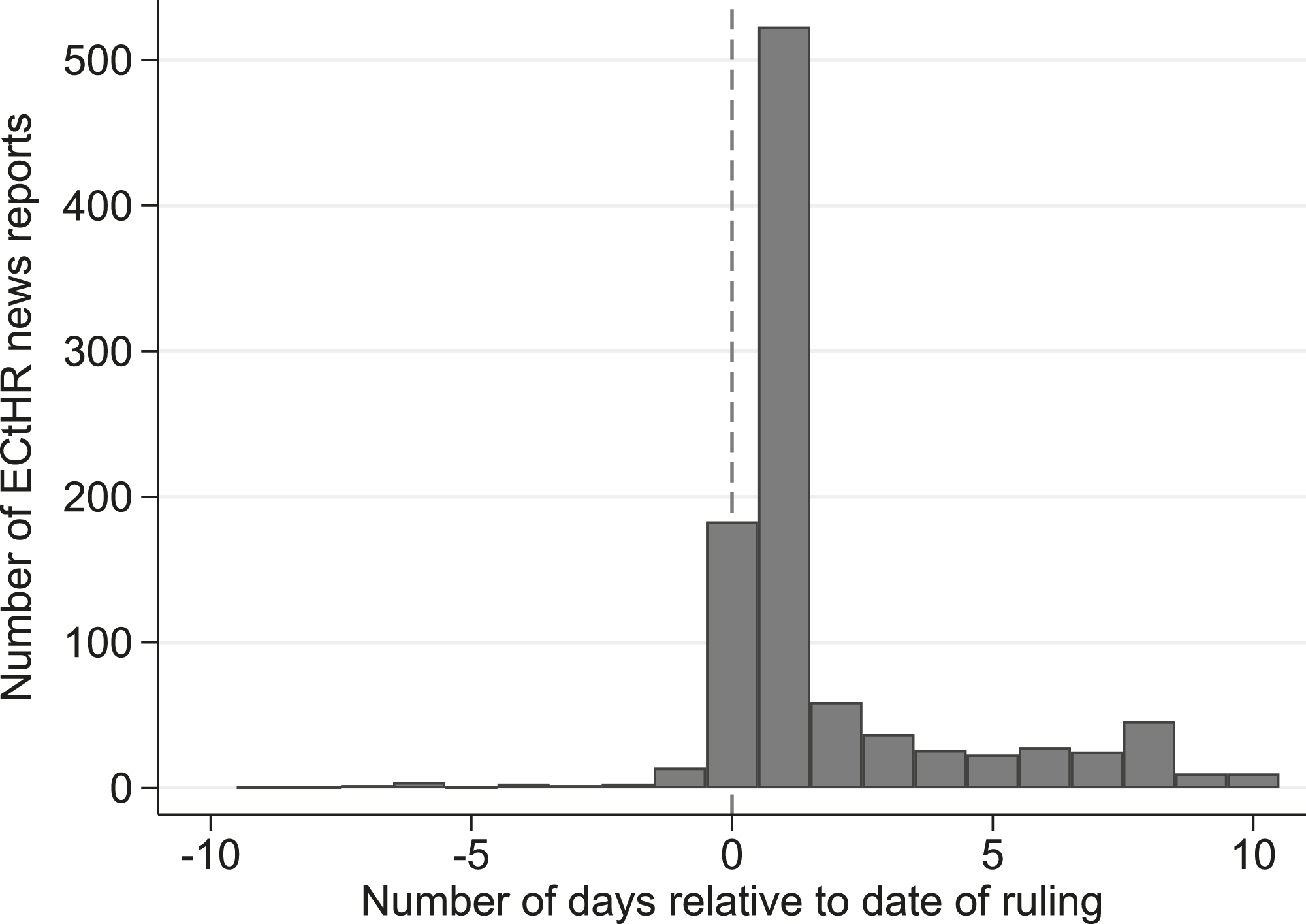
Disasters
We use the Emergency Events Database at the Université Catholique de Louvain to create measures of the occurrence and severity of disasters at the time a country is subject to an ECtHR ruling. The database includes information about any disaster meeting one the following criteria: the relevant country declared a state of emergency, the country requested international assistance, or at least ten people were killed due to the disaster. The data cover the date, country, and type of disaster (i.e., natural or technological), as well as the number of people killed.
During our observation period, the database lists a total of 11190 disasters (killing approx. 116 people on average). Following previous studies (e.g., Balles, Matter, and Stutzer 2023; Durante and Zhuravskaya 2018; Garz and Maass 2021; Jetter 2019), we focus on the number of fatalities to capture the severity of disasters. Intuitively, the more severe a disaster, the higher the degree of public attention to the disaster. However, the number of fatalities is not always comparable across countries regarding the implied “news value” (Galtung and Ruge 1965). For example, the public might pay more attention when a catastrophe occurs in a country that hardly ever experiences any disasters, due to the uniqueness of the news. For that reason, we divide disasters into quartiles according to the distribution of the number of fatalities within a country, as quartile ranks are easier to compare than total numbers.
We also consider differences in news value resulting from the location of a disaster. Ceteris paribus, domestic disasters arguably receive more attention than disasters abroad, and among disasters abroad those far away are likely less newsworthy than those close by. We therefore use the geographical proximity between countries—using the GeoDist database (Mayer and Zignago 2011)—to capture the relevance of a disaster abroad from each country’s individual perspective.
Overall, to account for differences in severity, uniqueness, and proximity, we approximate the news value of disaster(s) d occurring on date t from the perspective of country j as follows:
The information provided by the Emergency Events Database allows us to link the occurrence of a disaster to an ECtHR ruling by the exact date. However, in most specifications, we use the mean news value of disasters within a window of 4 days around the date of a ruling (i.e., from t − 1 to t + 2). The rationale being that certain kinds of disasters are semipredictable (e.g., a hurricane might draw media attention already a few days before it hits the coast) or the opposite, that relevant information becomes available with a delay (e.g., when a disaster takes place in a secluded part of the world). Taking the mean over several days helps to reduce noise in the data. Formally, our instrumental variable is defined as the 4-day average news value of disasters coinciding with ECtHR ruling i on date t from the perspective of country j addressed in the ruling:
Empirical Strategy
Estimation Approach
Estimating the causal effect of media attention on compliance with human rights rulings is difficult because of omitted variables and endogeneity issues. For instance, some cases might be inherently more salient than others (e.g., if a celebrity is involved), and cases where the government is initially particularly likely to comply could receive different media coverage than cases where compliance is unlikely. To tackle this identification problem, we exploit exogenous variation in media attention at the time of the ruling caused by plausibly exogenous events, in our case disasters. The rationale is that disasters soak up media attention from human rights rulings, which decreases the chances that the public learns about these rulings. In turn, less media attention implies less domestic pressure for compliance.
Our estimation strategy involves two equations:

We estimate the first stage using OLS and model the second stage as proportional hazards (Cox 1972; Tchetgen Tchetgen et al. 2015). In the first stage, OLS is consistent for the linear approximation to the conditional expectation function. 9 In the second stage, we follow previous studies on compliance with human rights rulings (e.g., Grewal and Voeten 2015; Stiansen 2019, 2021) and model the number of days until compliance with an ECtHR ruling as a right-censored variable, since we do not observe compliance with 44 percent of rulings by the end of the sample period. The term compliance0(t) denotes the baseline hazard.
We estimate equations (3) and (4) in two stages because there is no single-equation estimator when the second stage is a survival model. Following Tchetgen Tchetgen et al. (2015), we compute the standard errors by bootstrapping the entire estimation procedure.
Both equations are estimated conditional on the set of case-specific control variables (X i ) previously used in research on compliance rates at the ECtHR (e.g., Grewal and Voeten 2015; Stiansen 2019, 2021): the number of articles violated, dummies capturing the kind of violation, dummies capturing the kind of remedy requested by the ECtHR, and dummies for changes in CoM working methods over time 10 (see Table 1). We use these variables to account for baseline differences in news value across cases. For example, violations of Article 8 (prohibition of torture) generally receive more coverage than violations of Article 6 (right for fair trial). Similarly, these controls help to account for overall differences in the likelihood of compliance (e.g., remedies that require legislative changes are generally more difficult to implement than remedies involving the publication of a verdict). These variables primarily improve the precision of the estimates. However, they are also needed for identification if certain case characteristics affect the timing of judgments (and hence the chances to coincide with a disaster) as well as compliance.
Moreover, we include dummy variables to capture the month of the judgment, which allows us to control for potential seasonality in the occurrence of certain disasters (e.g., cold waves). We include country dummies to account for the possibility that more developed countries are less likely to experience disasters and are better able to respond to them, and to control for differences in the baseline hazard of compliance across countries. There are also mechanical differences in the occurrence of disasters resulting from differences in countries' population size and area size. Hence, the country dummies account for factors that likely act as confounders between disasters and compliance. In addition, we control for the total number of news reports by the media sources in the relevant country (i.e., reports unrelated to the case), to rule out that our results are mechanically driven by variation in the number of sources available in Factiva or variation in newspaper size.
Instrument Validity
A valid instrument needs to fulfil several conditions: (i) there must be no reverse causality; (ii) the instrument must not correlate with any unobserved variable that simultaneously correlates with the outcome or endogenous regressor; (iii) the exclusion restriction needs to be fulfilled; (iv) the instrument must be a strong predictor of the endogenous regressor; and (v) the instrument must not increase the treatment level in some cases and decrease it in others.
Condition (i) is unproblematic because there are no reasons to expect reverse causality running from compliance or ECtHR news coverage to disasters. Condition (ii) could be violated if those countries that tend to experience more severe disasters have governments that are less inclined to comply with human rights. In the regressions, we account for this possibility by including country fixed effects. Another threat to this condition are time trends in the occurrence of certain disasters as well as general trends in compliance. Those trends are controlled for by the dummies capturing the working methods of the CoM applicable at the time of the ruling, since these dummies can be interpreted as time fixed effects.
Condition (iii) could be violated if disasters crowd out attention to ECtHR rulings via channels not included in our sample of media sources. That is, our results could be biased if coverage of unsampled media sources is systematically different than the coverage of the outlets in the sample. We argue that our efforts to compile a balanced set of mainstream sources minimizes the risk of systematic differences between sampled and unsampled outlets. Hence, our measure of ECtHR coverage acts as a proxy for the true magnitude of that coverage. More generally, the exclusion restriction could be violated if disasters exert an effect on compliance via mechanisms unrelated to media coverage. For example, as previous studies show, disasters may influence national income via trade shocks (Felbermayr and Gröschl 2013), civil conflict via population size (Brückner 2010) or economic growth (Bergholt and Lujala 2012), migration via agricultural production (Trinh, Feeny, and Posso 2021), and quality of democracy via oil price shocks (Ramsay 2011). That is, an instrument as popular as disasters may drive a variety of factors, all of which are potential violations of the exclusion restriction (Mellon 2023).
It is arguably fairly unlikely for disasters that coincide with a ruling to have a positive effect on compliance via those alternative mechanisms. A positive effect would require for a disaster to increase the willingness or capability of decision-makers to take actions necessary to remedy a human rights violation. While it might be possible in some situations that a disaster creates a spirit of “now more than ever” among those in charge, it is difficult to see this kind of reverse psychological effect to be a systematic phenomenon. Alternatively, disasters could increase the chances that the incumbent government is voted out of office and replaced by a new government that is less committed to keeping in place the policy that led to the human rights violation. If any of these mechanisms are relevant, media coverage would be even stronger in its effect on compliance. That is, if disasters exert a positive influence on compliance, β1 in equation (4) underestimates the true media effect.
In contrast, β1 overestimates the true media effect if disasters have a negative effect on compliance through non-media mechanisms. For instance, disasters may negatively affect agricultural production, income levels, or other macroeconomic variables, which in turn could induce the government to shift resources (e.g., monetary resources or staff) away from human rights processes towards disaster relief. We believe that this alternative mechanism is unlikely because disaster relief and human rights ruling implementation are typically dealt with by different branches of an administration. The results of placebo tests with lagged values of our instrument in Table A3 confirm this argument. That is, given the fast pace of the news cycle, we would not expect disasters that took place several weeks before the judgment date to crowd out coverage of a judgment, as confirmed by the estimates. However, those disasters should still affect compliance if the resource-shifting mechanism was relevant, considering that governmental reallocation decisions have long-lasting consequences. As the table shows, this is not the case though, which supports the exclusion restriction.
Condition (iv) – the strength of the instrument in the first stage – can be tested empirically. We confirm this condition in the results section. Condition (v) – monotonicity – is fundamentally untestable. However, there is no clear mechanism through which disasters increase the treatment level in some cases and decrease it in others.
Results
We first present results from our baseline model, followed by a discussion of robustness checks. We then provide complementary evidence on short-term responses to rulings and results from analyzing the tone of the media coverage.
Baseline Specification
Effect of Media Coverage on Compliance.
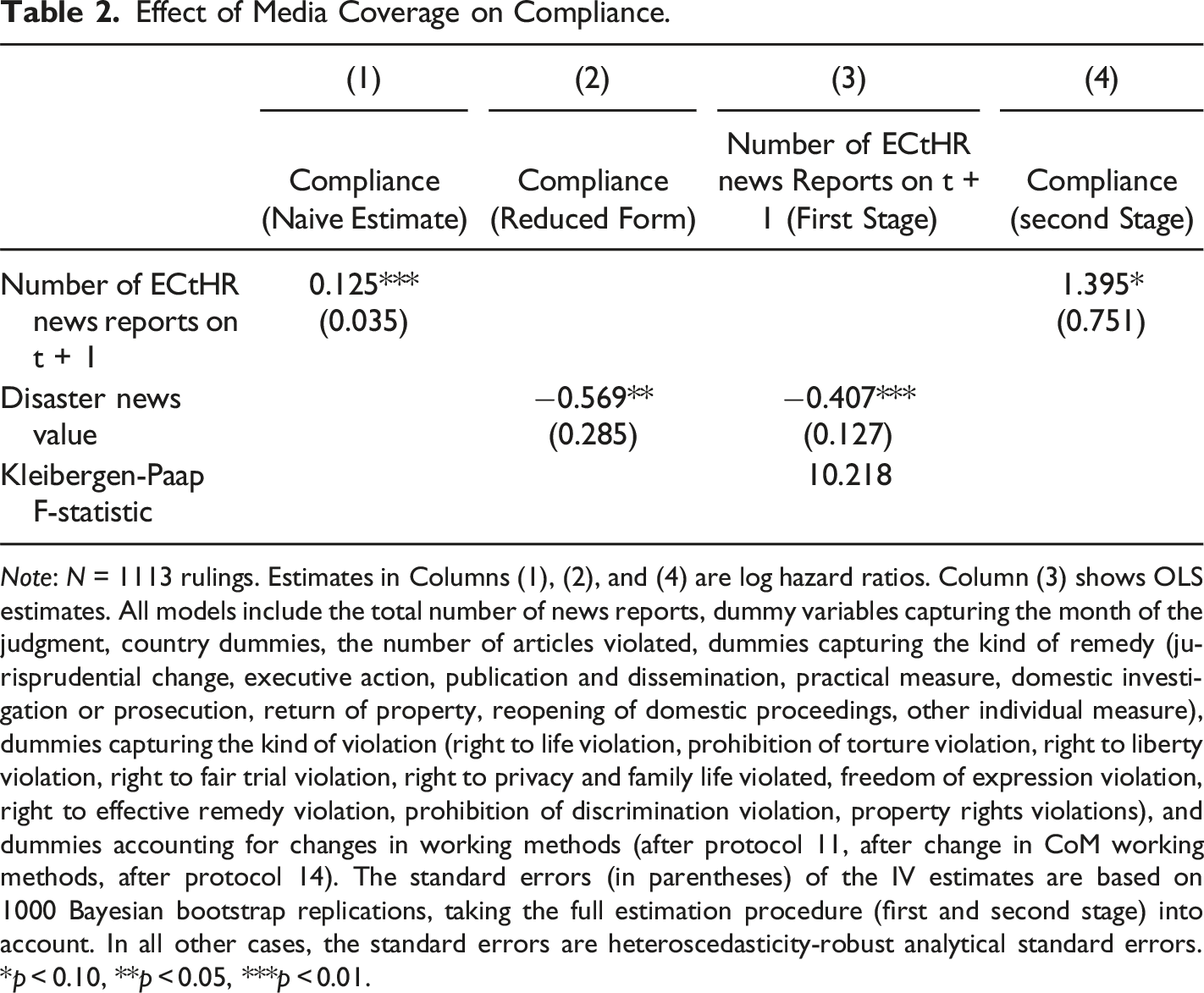
Note: N = 1113 rulings. Estimates in Columns (1), (2), and (4) are log hazard ratios. Column (3) shows OLS estimates. All models include the total number of news reports, dummy variables capturing the month of the judgment, country dummies, the number of articles violated, dummies capturing the kind of remedy (jurisprudential change, executive action, publication and dissemination, practical measure, domestic investigation or prosecution, return of property, reopening of domestic proceedings, other individual measure), dummies capturing the kind of violation (right to life violation, prohibition of torture violation, right to liberty violation, right to fair trial violation, right to privacy and family life violated, freedom of expression violation, right to effective remedy violation, prohibition of discrimination violation, property rights violations), and dummies accounting for changes in working methods (after protocol 11, after change in CoM working methods, after protocol 14). The standard errors (in parentheses) of the IV estimates are based on 1000 Bayesian bootstrap replications, taking the full estimation procedure (first and second stage) into account. In all other cases, the standard errors are heteroscedasticity-robust analytical standard errors. *p
Regarding the first stage (Column 3), we find a highly significant negative effect of disasters on ECtHR media coverage. The point estimate implies that a one unit increase in disaster news values leads to a reduction in the number of ECtHR news reports by 0.407. A one standard deviation increase in disaster news value implies a reduction in coverage by 0.134 × 0.407/0.469 = 11.6 percent compared to the mean number of ECtHR articles (0.469). The value of the F-statistic on the excluded instrument (F = 10.218, p = 0.001) suggests that the first stage is reasonably strong.
In the second stage (Column 4), the IV coefficient is positive and significant at the 10 percent level, which implies that ECtHR media coverage increases the hazard of compliance. The point estimate suggests that an increase in coverage in the magnitude of the mean value of the number of ECtHR reports (0.469) leads to an increase in the hazard of compliance by e(1.395×0.469) − 1 = 92.4 percent. In other words, if the amount of coverage is doubled, the chances of compliance are doubled. Hence, the effect of ECtHR coverage on compliance is practically meaningful. The difference in magnitudes between the IV estimate (Column 4) and the naive estimate (Column 1) indicates that the effect of ECtHR media coverage on compliance is masked by confounding, which highlights the necessity to use an IV design.
Robustness Checks
In the baseline specification, our measure of ECtHR media coverage pertains to the number of reports published on the day after the ruling—in line with the publication pattern shown in Figure 1—whereas our instrument refers to the mean news value of disasters over a window of 4 days around the ruling (to reduce noise in the data). In Table A4, we check whether our results hold when counting the number of ECtHR reports over different time windows. While this exercise confirms the baseline estimates, we note that the strength of the first stage decreases, the longer the window for counting the number of news reports.
Relatedly, it is useful to decompose the aggregate effect of the 4-day average news value of disasters. Figure A1 show estimates of the first stage when using the individual values of the instruments on various days around the ruling. The figure indicates that disasters have significant negative effects on ECtHR media coverage when they occur on days t, t + 1, or t + 2 relative to the ruling. While the effect of disasters on day t − 1 individually is not significant, we find that including this date when computing the 4-day average increases the strength of the first stage.
The instrumental variable defined in equation (2) involves several assumptions about factors driving the newsworthiness of different disasters. Hence, it is important to evaluate whether the results hold when a simpler, more conventional version of the disaster instrument is used. Following the literature (e.g., Garz and Pagels 2018; Jetter 2017; Jetter 2019), we replicate the analysis while using the plain number of fatalities of domestic disasters as an instrument. The resulting estimates in Table A5 confirm our findings. However, the F-statistic on the exclusion of the instrument is slightly lower here, which is why we prefer using this version of the instrument for robustness checks only.
In Table A6, we re-estimate the first stage while using a binary version of our measure ECtHR media coverage. This exercise allows us to evaluate whether disasters not only affect the extent by which a ruling is covered but also if disasters determine whether or not a ruling is covered at all. As the estimates in Column (1) show, disasters do not affect the overall probability that a ruling is covered. Thus, they primarily influence the extent. We also re-estimate the first stage with a coarsened version of the instrumental variable, which makes it possible to check whether the occurrence of any disaster is sufficient to induce a crowding out of ECtHR coverage. Results in Columns (2) and (3) indicate that a binary disaster instrument is not a statistically significant predictor in the first stage. Hence, differences in the news value of disasters matter.
It could be argued that the dummies for the working methods applicable at the time of the ruling (i.e., “after protocol 11”, “after change in CoM working methods”, and “after protocol 14”) are insufficient to capture overall trends in the occurrence and severity of disasters and trends in compliance. In Table A7, we present estimates based on models that include year fixed effects and a third order trend polynomial, respectively. The results remain similar.
Finally, we evaluate whether our results hold when using an alternative measure of public attention: the volume of searches pertaining to Google’s search topic “European Court of Human Rights” at the time of the ruling in the relevant country (see Appendix D for details on the construction of this measure). As Table D1 shows, we do not find any significant effects of Google searches on compliance. We can think of several explanations for these null effects. First, due to their agenda-setting power, attention created by mass media might simply be more effective in influencing decision-makers than attention online. Second, considering that we do not find a significant first stage in most specifications, attention online might be less sensitive to competing events than media coverage. For example, media outlets often face space restrictions or restrictions related to editorial capacities (e.g., number of journalists), which are not or only indirectly relevant for Google users.
Short-Term Responses to Rulings
There is a considerable time lag between ECtHR-related media coverage (on the day after the ruling) and the conclusion of a case (on average 4 years after the ruling), which raises the question of what the pathway from initial attention to subsequent actions by respondent states looks like. There could be path dependency in the sense that initial media coverage helps to create a collective memory of a case that increases the likelihood of later media coverage, and where governments predict future levels of media attention based on the initial level of attention. In line with that, previous research shows that prior media attention to an issue is a robust predictor of subsequent attention, even years later (Boydstun 2013, 47 ff. and 124–125).
It is difficult to systematically assess these and other mechanisms because of data limitations. However, we can test whether initial media coverage impacts compliance efforts in the short run. To get a sense of whether governments initiate processes to implement a judgment, we consider a procedural feature of the ECtHR compliance mechanism that creates transparency about countries' implementation efforts, the so-called action plan, which sets out the “individual” and “general” measures that the country intends to take, including a preliminary timetable of the necessary steps. The action plan is supposed to be submitted no later than 6 months after the judgment (ECtHR 2015) but respondent states often fail to do so. We therefore argue that a timely submission of an action plan can be used as a proxy to evaluate whether immediate actions toward compliance took place.
We retrieved information from the HUDOC-EXEC database 11 about action plans submitted by respondent states to test these knock-on effects. The data indicate that action plans were submitted in 33.8 percent of cases in our sample but we observe a timely submission (i.e., within 6 months) only in 6.7 percent of cases. As Table A8 shows, judgments are indeed more likely to be implemented in cases where the respondent submitted an action plan within the requested time of 6 months after the ruling.
Effect of Media Coverage on Action Planning.
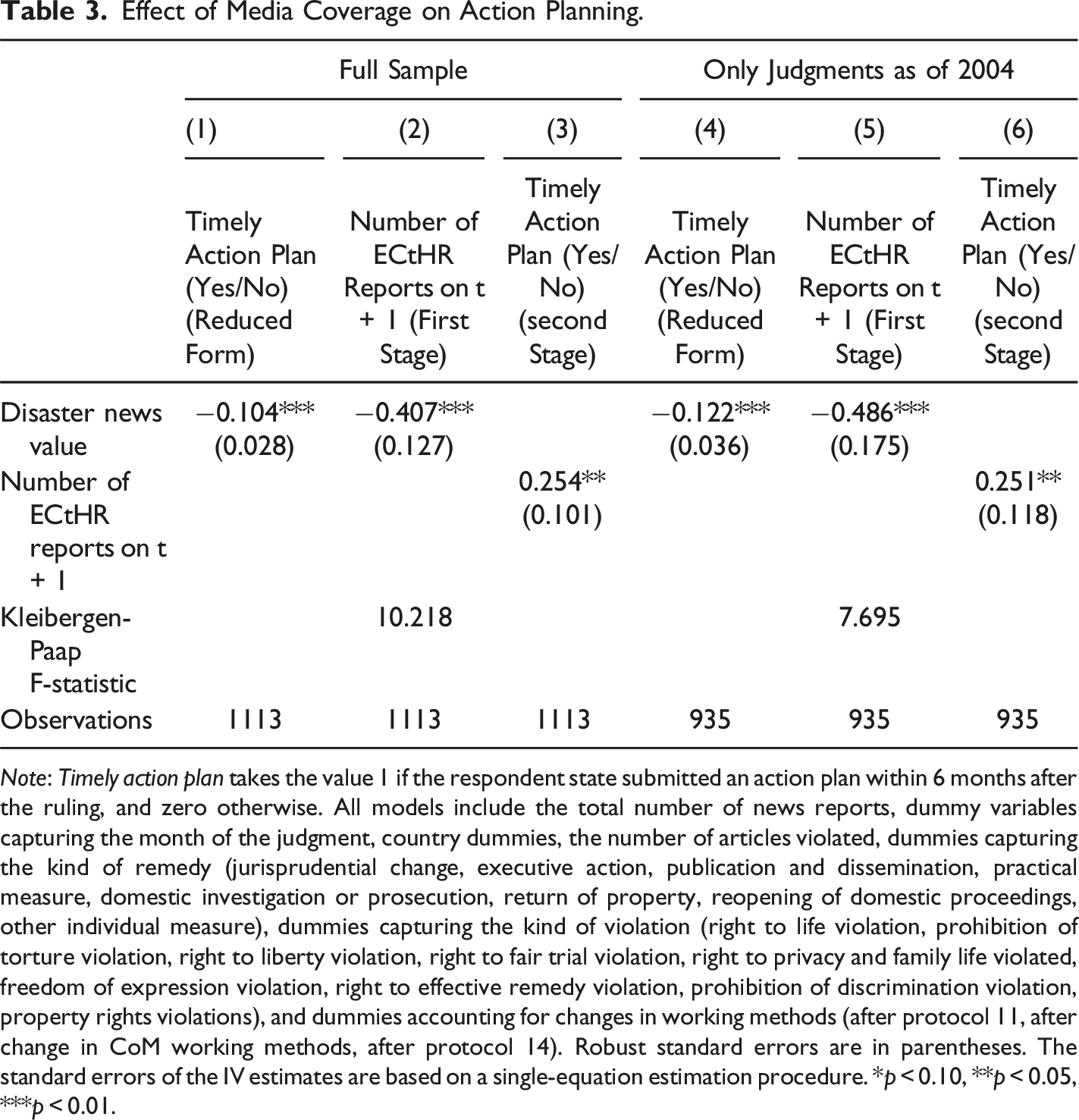
Note: Timely action plan takes the value 1 if the respondent state submitted an action plan within 6 months after the ruling, and zero otherwise. All models include the total number of news reports, dummy variables capturing the month of the judgment, country dummies, the number of articles violated, dummies capturing the kind of remedy (jurisprudential change, executive action, publication and dissemination, practical measure, domestic investigation or prosecution, return of property, reopening of domestic proceedings, other individual measure), dummies capturing the kind of violation (right to life violation, prohibition of torture violation, right to liberty violation, right to fair trial violation, right to privacy and family life violated, freedom of expression violation, right to effective remedy violation, prohibition of discrimination violation, property rights violations), and dummies accounting for changes in working methods (after protocol 11, after change in CoM working methods, after protocol 14). Robust standard errors are in parentheses. The standard errors of the IV estimates are based on a single-equation estimation procedure. *p
Overall, these results are consistent with the notion that initial media coverage of a ruling affects compliance via knock-on effects. This argument can be illustrated by two cases where the ECtHR requested juridical changes from the UK. In case 66069/09 (“Vinter and others v. the United Kingdom”), our data indicate a level of media attention in the top 5 percent of the distribution of the number of articles. Prime Minister David Cameron and several Members of Parliament commented on the ruling, which stated that life sentences for murder constitute a human rights violation if there is no possibility of rehabilitation. The UK government submitted a timely action plan, outlining the intended remedies, including an investigation of the legal situation. The UK eventually implemented various changes and the CoM closed the case after 1058 days. In another ruling (46477/99: “Paul and Audrey Edwards v. the United Kingdom”), the ECtHR detected a violation of human rights in a case where a prisoner was killed by his cell mate. The ruling was neither covered by the media outlets in our sample, nor was an action plan filed. The resolution of the case took 2821 days.
Tonality of ECtHR-Related News Reports
Our result that news coverage of a ruling has a positive effect on compliance hinges on the assumption that the coverage is neutral or supportive of the content of the ruling. In contrast, if media coverage were to criticize the ruling, it would not be plausible to expect the coverage to increase the chances of compliance. To test this assumption, we evaluated the content of a random sample of 300 articles stratified by respondent. Specifically, for each article in this sub-sample, we manually coded the tone towards the respondent and the ECtHR, respectively (i.e., positive, negative, or neutral/ambiguous).
Accordingly, the articles can be roughly categorized in three groups. Most of them (91 percent) offer a relatively objective description of the case, reference the ECtHR in a neutral manner, and implicitly depict the respondent state (or the government, domestic law, court, or authority) in a negative way. For example, if an article reports that a country violated human rights, the tone toward that country is implicitly negative because a domestic institution did something “wrong”. We added a few examples of this type of article in Table C2 in the Online Appendix. In addition, we observe a small share of reports that are predominantly negative toward the ECtHR, while defending the respondent (5 percent). These articles typically cite members of the government who accuse the ECtHR of rendering a ruling for ideological reasons. Finally, a small share of reports are explicitly critical toward the respondent while praising the ruling (4 percent), which mostly happens when a report features quotes of the plaintiff. Thus, the tone of the vast majority of articles is compatible with the assumptions underlying our theoretical arguments.
Conclusion
Using a novel dataset of media coverage of ECtHR cases, this study presents causal evidence suggesting that a higher level of attention to a ruling increases the chances of compliance with that ruling. The analysis is not without limitations though: Our sample is restricted to cases for which media data are available, which implies that we cannot analyze approximately two-thirds of the rulings rendered during the observation period. While there are some differences between sampled and unsampled cases (i.e., especially regarding the underlying violations), we believe that our results are generally applicable to ECtHR rulings because the sample does not exclude any specific type of country or system (e.g., democratic vs. authoritarian, developed vs. developing, free vs. censored press). However, the ECtHR is in many ways an outlier among the regional human rights courts, e.g., in terms of its institutional set-up, granting citizens direct access to the court, as well as case load and baseline compliance rate. Thus, future research is needed to assess to what extent our findings can be replicated in other courts, such as the IACtHR.
The evidence presented in this paper allows us to formulate practical policy recommendations. First, our result supports the notion that strategies to enhance media and public relations, as proposed by Cavallaro and Brewer (2008), may be useful to increase compliance. Public hearings, salient press conferences, or procedural transparency measures (Reis 2021) could be effective tools for pushing states to take remedial actions fast. Second, it seems advisable that human rights courts do not schedule or issue any rulings on days where the news agenda in the relevant country can be expected to be particularly busy due to predictable, competing news events, such as elections or important sports matches (e.g., FIFA World Cup or Champions League games).
We invite future research to take up the challenge of disentangling the mechanisms that mediate the relationship between media attention and compliance. For example, does attention trigger parliamentary agenda setting or influence domestic judges' reactions to ECtHR precedents? Do ECtHR rulings with more media coverage lead to more derivative disputes at domestic courts on the same grounds? Is media attention correlated with actual mobilization, such as demonstrations or social media discourse? These questions are crucial for improving our understanding of the domestic politics of compliance with the ECtHR. We played our role in investigating one of the main assumptions of domestic politics models of compliance, but media attention, on its own, cannot explain compliance. We conclude by revisiting the popular adage that international courts lack “the purse and the sword” to enforce their own rulings and note that their “pen” might help.
Supplemental Material
Supplemental Material - Media Attention and Compliance With the European Court of Human Rights
Supplemental Material for Media Attention and Compliance With the European Court of Human Rights by José M. Reis and Marcel Garz in Journal of Conflict Resolution
Supplemental Material
Supplemental Material - Media Attention and Compliance With the European Court of Human Rights
Supplemental Material for Media Attention and Compliance With the European Court of Human Rights by José M. Reis and Marcel Garz in Journal of Conflict Resolution
Footnotes
Declaration of Conflicting Interests
The author(s) declared no potential conflicts of interest with respect to the research, authorship, and/or publication of this article.
Funding
The author(s) received no financial support for the research, authorship, and/or publication of this article.

Data Availability Statement
Supplemental Material
Supplemental material for this article is available online.
Notes
References
Supplementary Material
Please find the following supplemental material available below.
For Open Access articles published under a Creative Commons License, all supplemental material carries the same license as the article it is associated with.
For non-Open Access articles published, all supplemental material carries a non-exclusive license, and permission requests for re-use of supplemental material or any part of supplemental material shall be sent directly to the copyright owner as specified in the copyright notice associated with the article.
