




Abstract
“Loyalty trials” are common to a range of conflict settings, with consequences that range from harassment to imprisonment, torture, or death. Yet, they have received little if any attention as a general phenomenon in studies of state repression, civil war, or rebel governance, which focus on particular behaviors that authorities use to put people on trial, such as dissent, defection, and resistance. Using a computational model and data on the German Democratic Republic and the Occupied Palestinian Territories, we focus on the dynamics of “loyalty trials” held to identify enemy collaborators—the interaction between expectations, perceptions, and behavior. We use our framework to explore the conditions under which trials result in widespread defection, as in the German Democratic Republic, or in conformity as illustrated by our study of the Occupied Palestinian Territories. The polarizing nature of loyalty trials and the propensity to over- or under-identify threats to political order have notable implications for democratic and non-democratic societies alike.
Introduction
From rebel rulers to nation-state governments, we observe a recurrent pattern as political actors define loyalty expectations for their subjects, delineating deviant behavior that “departs from the normative” and poses a threat to political order (see Raybeck 1991, 23). In the wake of the 2015 Paris attacks, emergency laws authorized raids to identify individuals capable of causing “big harm” (Chassany 2017). The Chinese government placed millions of Uyghurs under surveillance and detained hundreds of thousands “under suspicion of political disloyalty” to prevent separatism (Roberts 2018, 19). And following the Taliban takeover in Afghanistan, individuals who collaborated with the Karzai regime either fled the country or went into hiding to avoid being identified, despite official assurances of amnesty (Gwladys et al. 2021).
Spanning the gamut from ethnic minorities with alleged ties to extremists (Mueller and Stewart 2012) to collaborators accused of being subversive foreign agents (O’Brian 1948), political actors hold loyalty trials to more palpably distinguish conformers from defectors, and label those identified as deviant (see Åkerström 1991, 11-16; Coser 1956). Trials comprise long judicial procedures or instant judgements devoid of due process, as with public denunciations or vigilante killings, typically held in a “zone of anomie in which legal determinations—the very distinction between public and private—are deactivated” (Agamben 2005, 50-51). Underpinning these ostensibly disparate phenomena is the notion of betrayal—established, perceived, or fabricated. Whereas the ‘true’ loyalty of individuals is typically private information, the onus lies on those “labeled” to demonstrate loyalty, failing which they are deemed culpable of defection—defectors then subject to harassment, ostracism, imprisonment, torture or death. As political actors specify the criteria for membership in their communities (see Schlichte and Schneckener 2015, 415; Thiranagama and Kelly 2010, 2) and use trials as an enforcement mechanism, their actions spur widespread social conformity or resistance.
Research on defection has paid scant attention to what constitutes disloyalty, disregarding the interplay between expectations, perceptions, and behavior—the dynamic nature of “labeling defection” (see, for example, work by Kalyvas 2008; Schutte 2017; Sullivan 2016a). Given that each loyalty trial effectively redefines the boundaries between behavior considered acceptable and unacceptable, who accuses whom, who defects or conforms, and under what conditions, is key. The challenge, in this regard, lies in reconstructing the individual experiences of the labelers and the labeled, as well as the associated implications. Our effort to better understand the dynamics of loyalty trials is driven by two key questions: under what conditions do loyalty trials generate conformity or defection? And in undertaking loyalty trials, to what extent do political actors over- or under-identify threats to their political order, prosecuting innocents (Type I error) or failing to prosecute those guilty of defection (Type II error)?
We draw on existing research in criminology and conflict studies to specify mechanisms that link loyalty trials to shifts in allegiance, formalizing our theory by means of an agent-based computational model (ABM). The model, validated by qualitative evidence from two markedly different conflict settings (Bhavnani, Donnay, and Reul 2020)—the German Democratic Republic (GDR) during the leadership of Erich Honecker (1971-1989) and the Occupied Palestinian Territories (OPT) during the Second Intifada (2000-2004)—permits us to identify the drivers of allegiance for different types of regimes. In the GDR, the misidentification of defectors—quotidian behavior being perceived as disloyalty—generated cascades of defection given unrealistically high expectations. By contrast in the OPT, social incentives for loyalty drove an increase in group allegiance, effectively curtailing defection.
In the following section, we review existing literature that pertains to loyalty trials from various, closely related domains. We then specify the mechanisms that underpin loyalty trials, formalizing these by means of a computational model. Next, we show how our model simulates allegiance shifts between conformity and defection, adjusting model parameters to capture the particularities of the GDR and the OPT. We conclude by discussing the implications of our framework and analysis for loyalty trials held in both democratic and non-democratic settings.
Related Work
Loyalty trials are common to a range of conflict settings, yet, have received little if any explicit attention as a general phenomenon in studies of state repression, civil war, or rebel governance. Instead, studies focus on particular behaviors that authorities use to put people on trial, such as dissent, defection, and resistance, short of developing an account of what we refer to as “loyalty trials” that is comparable across contexts.
Beginning with the literature on state repression, the prevailing paradigm suggests that state actors repress social and political rights, with targets for repression selected on the basis of de jure or de facto rules (Tilly 2003). As such, repression may be overt or covert (Davenport 2005), preventive or reactive (Dragu and Przeworski 2019), target more open or hidden forms of mobilization (Sullivan 2016b), and serve to deter or increase future challenges (Lichbach 1987, 269). Opposition groups, in turn, adapt their behavior in response to opportunity structures (Tarrow 1994), with research focusing on varying expressions of “voice” or “exit” (Hirschman 1970; 1993).
Sullivan’s work (2016b) on state repression in Guatemala is notable in this regard, given his coding of “overt” and “covert” mobilization perceived to constitute a political challenge. However, even here the focus is on exceptional mobilization against political order, disregarding quotidian behavior that poses no ostensible threat to the regime. 1 In a similar vein, work on counter-terrorism focuses on minimizing the over- or under-identification of exceptional defectors by state authorities (Dragu 2017; Polo and Wucherpfennig 2022), disregarding defection below a threshold of violent attacks.
Scholarship on civil war also pays short shrift to the interplay between perceived and private loyalty. Drawing on evidence from the Greek Civil War (1943-1949), Kalyvas (2006) argues that violence by armed groups is ‘selective’ in areas characterized by incomplete territorial control where defection to rival authorities occurs, yet he remains agnostic about the range of behaviors construed as disloyal as well as the consequences of misidentification. Much of the literature that builds on Kalyvas’ seminal work focuses on the cohesion of armed organizations (e.g. Sinno 2008; Staniland 2012; Pearlman and Cunningham 2012), including the conditions for fighters to desert or defect to rival organizations (Albrecht and Ohl 2016; McLauchlin 2010; Oppenheim et al. 2015; Koehler, Ohl, and Albrecht 2016) and those that underpin the incidence of selective or indiscriminate violence (Kalyvas 2012). Arjona (2016, 174-176) finds that armed groups vying for control of Colombian communities took popular norms into account, killing social deviants in an effort to ‘bootstrap’ their legitimacy and that local populations, in turn, exercised agency over denunciations to authorities (Arjona 2016). In her work on the Spanish Civil War, (Balcells 2010, 301-302) notes that local councils provided militias with lists of suspected right-wing supporters who were placed on loyalty trials, resulting in imprisonment or execution. By punishing those they could justifiably label as defectors, authorities assigned blame for governance failures to “defecting, criminal or disloyal elements among the fighters or the population” (Schlichte and Schneckener 2015, 419). Notable for its attention to the varied nature of authority-subject relations during civil conflict, including the ability of civilians to resist authorities (e.g. Arjona 2016), this literature also stops short addressing what behaviors and perceptions result in labeling of “threat” or “disloyalty” via loyalty trials.
A handful of case studies do consider how the interplay between loyalty expectations and perceptions of disloyalty result in loyalty trials: coercive models of social control were less likely to elicit denunciations than voluntary models during the Spanish Inquisition and in Romanov Russia (Bergemann 2017); popular perceptions drove the killing of Republican officers during the Spanish Civil War (McLauchlin and Parra-Pérez 2018); local populations in Afghanistan were found less likely to denounce enemy activity to ethnic others (Lyall, Shiraito, and Imai 2015), and minority Arab Americans with personal experiences of repression were more likely to protest in Detroit (Santoro and Azab 2015). In Mosul, a survey experiment on post-conflict perceptions found that civilians who collaborated with the Islamic State were more likely to be forgiven by their peers when service provision was perceived as involuntary (Kao and Revkin 2022). Yet, these rich and variegated studies fall short of formalizing the mechanisms that link defection to loyalty expectations and their associated consequences, what we turn to in the section that follows.
The Micro-dynamics of Loyalty Trials
We suggest that political order is co-produced by authorities who expect loyalty—personal sacrifice meant to enhance group welfare (Levine and Moreland 2002)—and subordinates, who to varying degrees, conform to loyalty expectations. The micro-dynamics of loyalty trials—the interplay between explicit and observable loyalty expectations and perceptions of disloyalty, on the one hand, and an individual’s true allegiance, on the other—have significant implications for political order. We begin by discussing these dynamics below, before turning to our formal model.
The identification or labeling of defectors has a profound implications for how the labeled see themselves and are seen by others. In most instances, perceived defection is sufficient to initiate a loyalty trial, based on peer-to-peer accusations or official suspicion and arrest. Those labeled may or may not have violated loyalty expectations, and not all of those who violate expectations are labeled (Becker 1963, 9). To distinguish between ‘true’ and ‘false’ labels, loyalty trials consider both the motivations of suspects as well as perceptions of their behavior: loyalty, in this regard, is effectively co-produced by the ‘labeler’ and the ‘labeled’ (see Levine and Moreland 2002; Poulsen 2020, 9). A label can be perceived as false on substantive grounds when defection was not intended by the labeled; on procedural or emotional grounds when the conduct of the labeler is disrespectful (see Sherman 1993); or on normative grounds when defection is attributed to conflicting loyalties that are socially acceptable (see Sykes and Matza 1957).
Typology of Individual Defection.
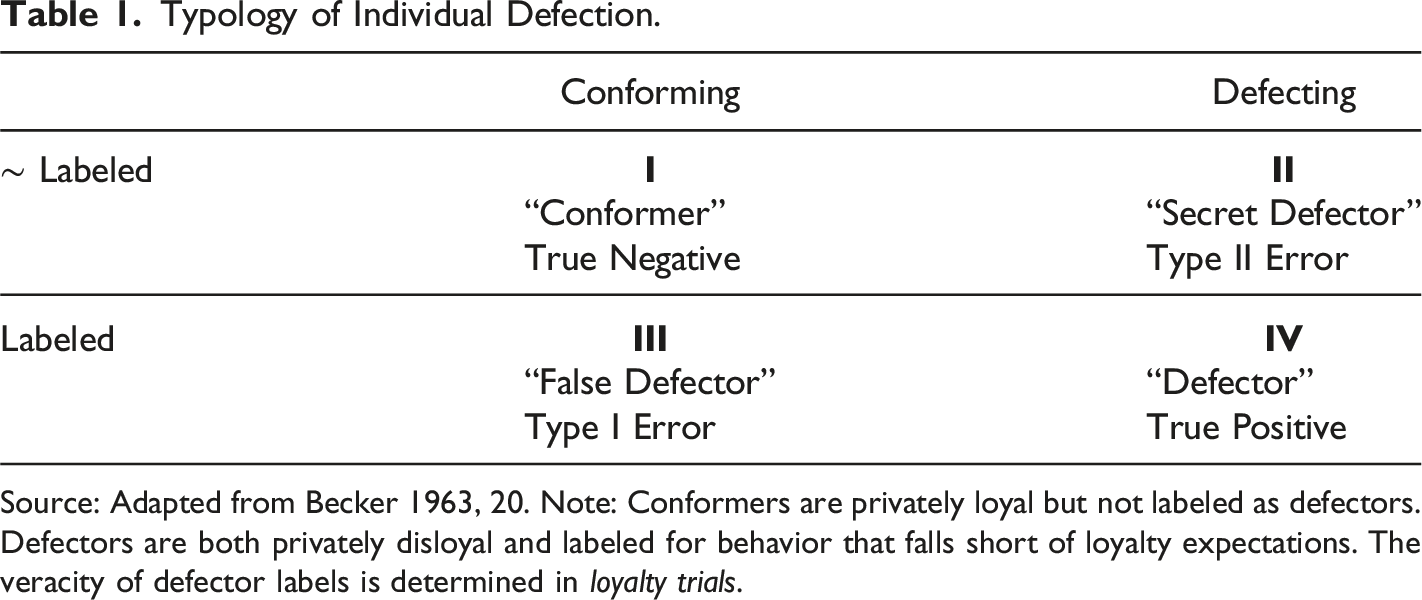
Source: Adapted from Becker 1963, 20. Note: Conformers are privately loyal but not labeled as defectors. Defectors are both privately disloyal and labeled for behavior that falls short of loyalty expectations. The veracity of defector labels is determined in loyalty trials.
Second, defector labels generally present a claim that the individual may be threatening group goals to the benefit of a rival, thus directly challenging their status as a group member. But the reaction of the labeled depends on the particular circumstances under which the label was assigned. False defectors are expected to view themselves as members of the group and attempt to convince their peers of their innocence, engaging in demonstrably loyal behavior to do so. By contrast, defectors tend to have few opportunities to demonstrate loyalty, and may prefer to be ostracized from the group whose goals or beliefs they no longer identify with. Thus, labeling need not determine allegiance, though it reduces the agency of the labeled, coercing them into demonstrating loyalty or seeking acceptance by rival groups.
Third, defector labels directly politicize individual behavior, influencing how such behavior is perceived by those labeled and their peers, with notable consequences for political order. The constitutive act of labeling serves as a signal to others who exhibit similar characteristics or behavior. For the disloyal, trials alter both the perceived risks of being labeled (see Oliver, Marwell, and Teixeira 1985) and the benefits of collaboration (see Kalyvas 2006). For those tasked with labeling, true positives (defector, cell IV) serve to increase suspicion and mistrust, whereas true negatives (conformer, cell I) serve to maintain or increase trust. It follows that under certain conditions, loyalty trials may effectively erode challenges to political order or exacerbate them (see Lichbach 1987), as with over- or under-identification—false positives (false defector, cell III) or false negatives (secret defector, cell II) respectively (Schutte, 2017).
Fourth, private loyalty increases with social and material rewards—as with the approval of behavior that visibly benefits a group (see Marques et al. 1998) or monetary rewards for denouncing rival activity (e.g. Piotrowska 2020)—and decreases by means of social control and sanctions (see Hechter 1987; Heckathorn 1988). Disloyalty too is either positively incentivized by rival authorities—through public declarations of support and political asylum—or negatively under threat of punishment, as with the blackmailing of group members by intelligence organizations. Where the incentives provided by the ingroup exceed those provided by the outgroup, behavior is more likely to shift towards conformity, and vice-versa for defection (see Kalyvas 2008, 1059).
To summarize the discussion thus far, loyalty trials both directly and indirectly shape behavior in conflict settings: directly as a function of expectations, behavior, and perceptions of disloyalty; and indirectly by means of demonstration effects, as individuals observe the trials of others and act on private knowledge about their own behavior. The micro-dynamics of labeling therefore have consequences for both individual and group allegiance: when misidentification is low, group allegiance is likely to be maintained; as misidentification increases, allegiance is likely to shift towards conformity or defection, driven by expectation and the use of selective incentives, such as punishment and reward. Empirically, the micro-dynamics of loyalty trials—the interplay between loyalty expectations, private allegiance and perceptions, on the one hand, and individual reactions to loyalty trials, on the other—leads to socially complex outcomes that are challenging to conceptualize and analyze in a systematic fashion. In the section that follows, we formally specify the attributes, mechanisms and resulting behaviors.
Model Specification
We use an agent-based computational model (ABM) to systematically explore the relationship between loyalty expectations and perceptions of disloyalty on the one hand, and group conformity on the other. Agent-based modeling is a “computational approach that enables a researcher to create, analyze, and experiment with models composed of agents that interact within an environment” (Gilbert 2008, 1). In an ABM, each agent’s behavior shapes the behavior of other agents, as well as the properties of their shared social environment. The social environment, in turn, changes in response to changes in individual and aggregate behavior. Specified computationally, ABM can be run and rerun to assess variations in key model parameters, a task that is difficult to achieve by means of closed-form solutions. ABM therefore constitute one means of studying complex adaptive systems, and have been applied to a host of issue domains including residential segregation (Schelling 1969), political parties and elections (Kollman, Miller, and Page 1998), civil conflict (Epstein 2002) and urban violence (Bhavnani et al. 2014), to name but a few.
We begin by specifying a general model and in a second step, set model parameters to capture the particularities of loyalty trials in two contexts: the GDR and the OPT. Our specification builds on the Riolo, Cohen, and Axelrod (2001) tag-tolerance model, which is in turn motivated by Holland (1995). Readers who wish to skip the technical model description may move directly to the summary of model steps below.
Key Model Parameters.
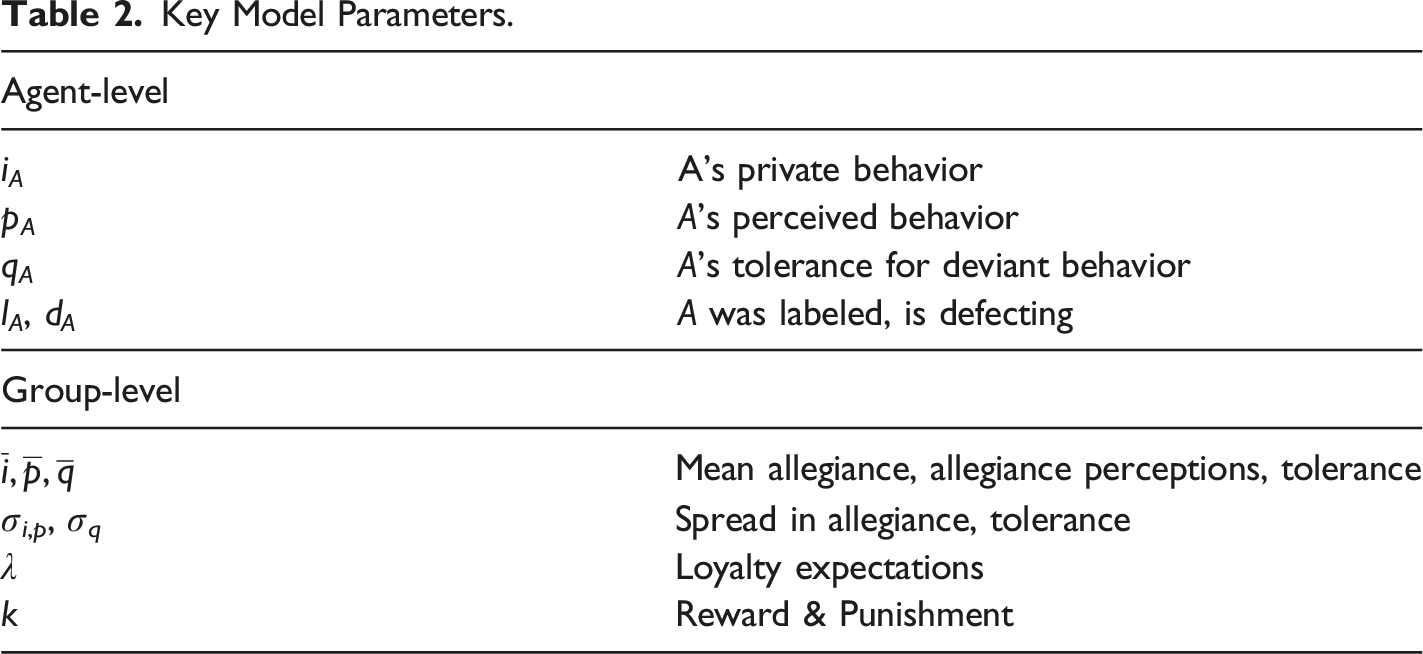
Whereas tag values vary across agents and over time, official loyalty expectations are given by λ ∈ [0, 1]. As loyalty expectations increase, so does the range of outgroup interactions considered unacceptable and the personal sacrifice required to maintain allegiance. When λ = 1, any indication of disloyalty is considered defection from the group. In such cases, even the failure to demonstrate group conformity, for example with violent attacks against nominal rivals, can lead to being labeled a defector. Conversely, λ = 0 signifies that there are no loyalty expectations.
Incentives, provided by a mix of rewards and punishments, are given by k ∈ [−1, 1]. When k = 0, incentives provided by the in- and outgroup are balanced, for example when a political authority taxes literature which glorifies its rivals just as much as the rival is willing to pay for its distribution, or when an ingroup vilifies and ostracizes regime critics but an outgroup is glorifying and welcoming the vilified as political refugees. Conversely, when k = 1, behavior in service of the ingroup is more strongly incentivized, whereas when k = −1, it is behavior in service of the outgroup that is incentivized more strongly.
We provide a formal description of key model mechanisms below. To interpret the results we focus on group conformity, defined by the difference between private behavior and loyalty expectations:
Additional outcomes, parameter sweeps and model specifications are provided in Appendix B.
Mechanism I: Loyalty Trials
Key Model Steps
We define the relationship between A’s public allegiance and perceived deviation from loyalty expectations:
Loyalty trials are conducted for T = 10% of agents in each iteration. An agent B has p = 3 opportunities to randomly select some other agent A for pairwise interaction.
2
The probability of selecting A over any other agent decreases with k or p
A
:
3

When A’s defection deviates from loyalty expectations more than B can tolerate, A is labeled a defector by B. Conversely, A is not labeled by B if her defection is tolerable:
Irrespective of perceptions, A is defecting if private behavior violates loyalty expectations:
A’s defector type is then determined by crossing l
A
, d
A
:
Mechanism II: Allegiance Shifts
We capture the direct effects of loyalty trials with updates to public and private allegiance. After every interaction t with agent B, the public perception of A’s behavior is updated as follows:
It follows that perceptions are additive and contagious—the more (less) frequently A is perceived as a defector by some other agent, the greater (lower) the likelihood she will be perceived as a defector by others. We define the relationship between A’s private behavior and deviance from loyalty expectations:
After P interactions, labeled agents change their behavior based on deviance from loyalty expectations:
Thus, defectors with i A < λ decrease allegiance, and false defectors with i A > λ increase allegiance.
Mechanism III: Adaptation
We capture indirect effects of loyalty trials by updating agent characteristics. First, for every true (false) defector, aggregate tolerance decreases (increases):
When defectors outnumber false defectors, aggregate tolerance for defection decreases, and vice-versa, with intensity increasing as a function of labeled defectors.
Second, we assign a fitness score to agents that increases with the distance between private and perceived behavior and deviance from loyalty expectations—an effect moderated by punishment and reward—and decreases with labeling. Formally:
We provide a more detailed discussion of fitness scores in Appendix A. Fitness scores are assigned to T = 10% of agents, which are then randomly paired (with replacement) and agents with lower fitness adopt the properties (i, p, q) of their partners. Following Riolo, Cohen, and Axelrod (2001), each agent mutates her new tags and tolerance level with probability M = 0.1. 4
Key Model Steps
Each model run consists of the following steps: 1. Experimental Condition: Set initial parameter values (e.g. loyalty expectations and allegiance perceptions). 2. Simulate dynamics of loyalty trials repeatedly: I. Loyalty Trials: Agent B interacts with some other agent A, who is labeled a defector (conformer) if her behavior is perceived as more (less) deviant from loyalty expectations than B can tolerate. Agents are (not) guilty of defection if their private allegiance is (not) violating loyalty expectations of political authorities. Crossing labels with their veracity yields the defector types from Table 1. II. Allegiance Shifts: The public perception of A’s allegiance is decreased (increased) with every label. Labeled defectors update their private allegiance, such that false defectors tend to increase and true defectors tend to decrease their allegiance. III. Adaptation: The tolerance of all agents increases (decreases) based on the difference between true and false defectors. Agents are selected for play in the next generation based on fitness—the trade-off between benefits of disloyalty (loyalty), defector repression, and accusations of defection—with agent tags and tolerance subject to random mutation. 3. Results: Analyze defector type prevalence and group conformity across experimental conditions.
Model Results
General Model
We begin by discussing how group conformity changes in response to loyalty expectations and behavior in the context of our model. The general relationship is depicted in Figure 1, with each cell representing a different experimental setting. We note that small changes in initial behavior (x-axis) and loyalty expectations (y-axis) can lead to significant changes in group conformity (given by the coloring of heatmap cells). Group conformity decreases with increasing loyalty expectations, and endogenous allegiance shifts are most likely when agents are borderline conforming. Assuming that agents are initially as loyal as perceived, the model produces two straightforward equilibria: conformity for General model: Group conformity.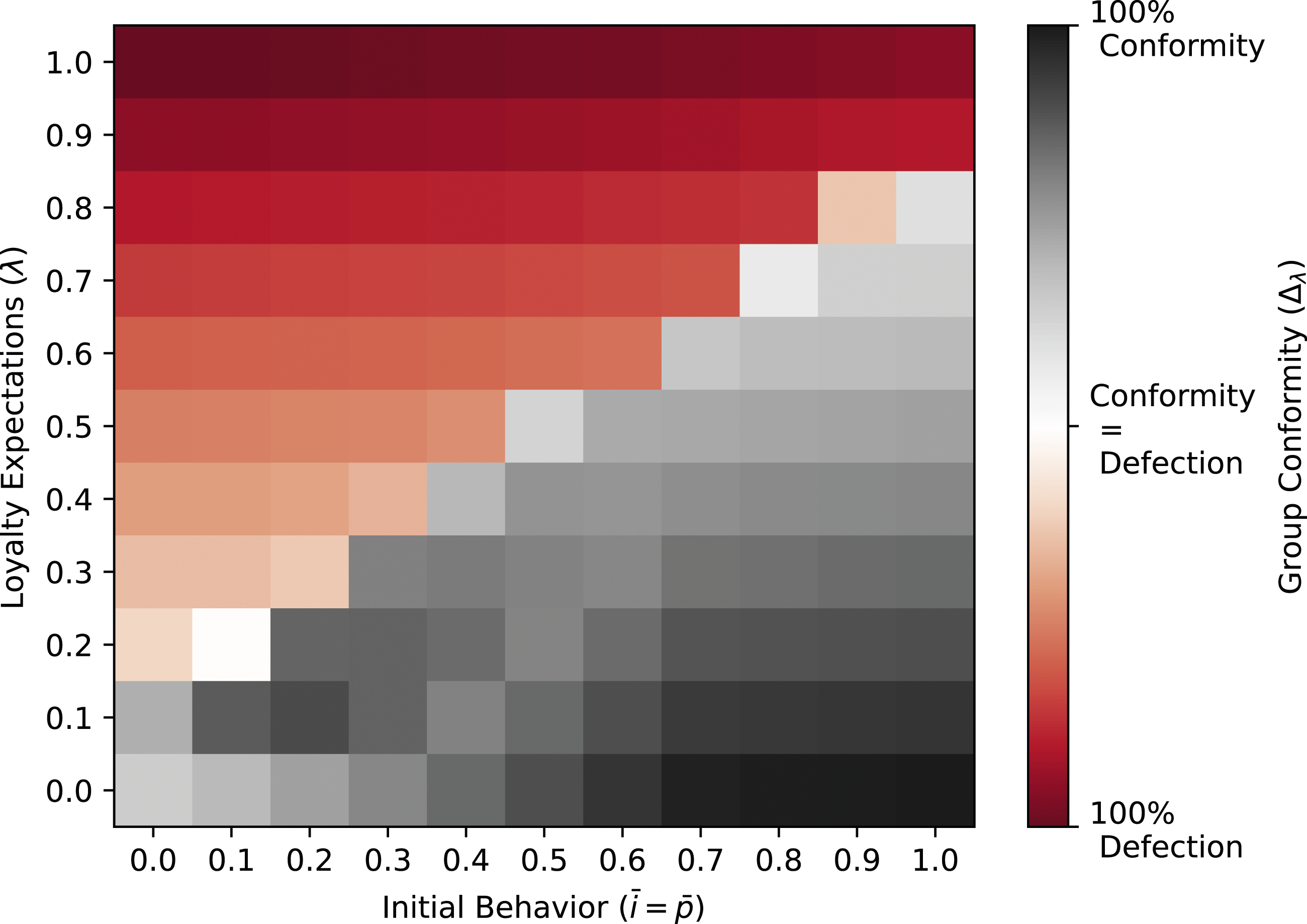
Figure 2 depicts two typical patterns of allegiance shifts by defector types over the course of model runs. In panel (A), loyalty is rewarded and conformity increases as defection decreases. Labeled defectors are rewarded for increasing their loyalty more than secret defectors are for disloyalty, and tolerance for defection increases as ‘Type I’ outweigh ‘Type II’ errors. Ultimately, loyalty trials subside with increasing tolerance and group conformity. Conversely in panel (B), disloyalty is rewarded and defection increases as conformity decreases. Opportunities for secret defection outweigh the benefits of loyalty in response to labeling, and ‘Type II’ outweigh ‘Type I’ errors. As in Granovetter models of political protest (Granovetter 1978; Kuran 1989), cascades of true defection ensue.
5
Types of allegiance shifts.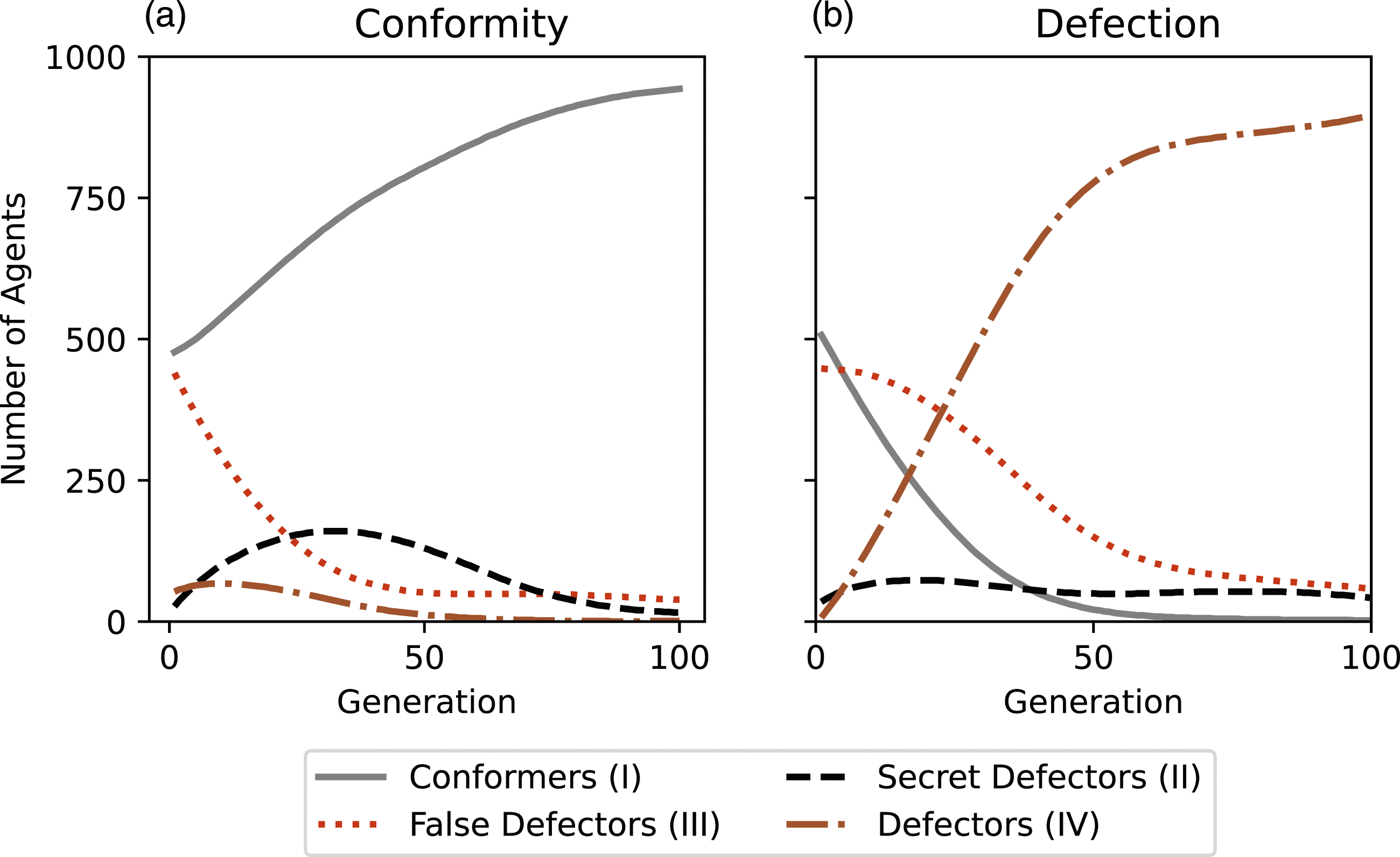
These two patterns, robust to a wide range of auxiliary parameter specifications (see Appendix B), result in highly polarized outcomes (see Montalvo and Reynal-Querol 2005): conformity increases in populations that are rewarded for loyalty (pattern A), whereas defection increases in population rewarded for disloyalty (pattern B). As these conditions are not mutually exclusive, the dynamics of loyalty trials can result in oscillation between conformity (k = 1) and defection (k = −1).
A key assumption in the general model is that most agents are initially conformers and perceived as such
Contextualized Model
Conflict in the GDR took the form of state repression until the fall of the Berlin Wall in 1989. Against the backdrop of the Cold War, the SED-led regime feared attempts by the West, the Federal Republic of Germany (FRG) in particular, to undermine its economy and status as an independent state. By contrast, the OPT are characterized by periods of civil violence, from the first Arab Uprising in 1936 against the British administration to the Second Intifada in 2000 against the Israeli occupation. In this section, we explore how the dynamics of loyalty trials operate in settings characterized by vast contextual differences. Model validation in the GDR is based on existing literature and selected Stasi surveillance, purposefully sampled from archives in Berlin. In the OPT, information on loyalty trials was gleaned from existing literature and public databases. To ensure that we interpret this information correctly, we conducted 20 interviews with Israeli and Palestinian experts selected for their familiarity with the topic of collaboration and their ability to transfer knowledge at minimal personal risk (see Appendix C). 6
Model contextualization comes with numerous challenges: it requires ontological assumptions about the reference “group”, the situational context in which defector labels are applied to presumed members, and the minimal expression of a label that constitutes an accusation of disloyalty. Moreover, defection as construed by political authorities is both rare and challenging to observe: when defection exceeds conformity, social order is likely compromised, failing which defection either remains undetected or is detected and punished. The observational challenge is exacerbated by the relational nature of loyalty: expectations, perceptions and tolerance for disloyal behavior are permanently in flux in conflict settings, and their overt expression is rarely documented. It follows that available estimates of defection are unreliable, given that the requisite data is either classified or unverifiable, with even the most diligent government employees prone to conceal Type I and Type II errors in an effort to justify their activities (see Appendix C.1 for details). Given that the available data provides at best a poor approximation of true defection, with little to no indication of false or secret defection, we rely upon a qualitative, most-different case comparison—a critical engagement with historical sources resulting in an interpretive coding of loyalty trials.
Contextualization for GDR & OPT Settings.
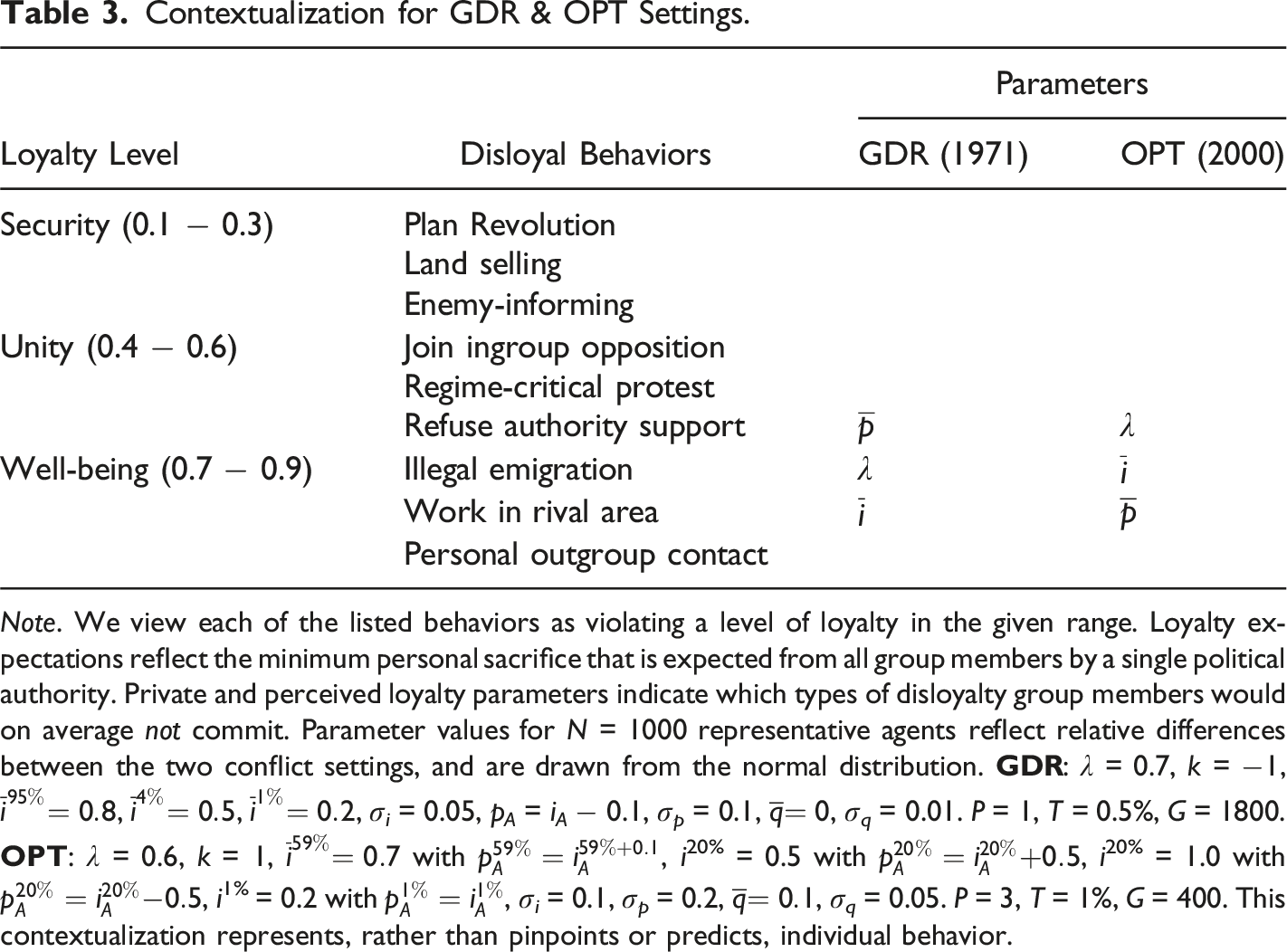
Note. We view each of the listed behaviors as violating a level of loyalty in the given range. Loyalty expectations reflect the minimum personal sacrifice that is expected from all group members by a single political authority. Private and perceived loyalty parameters indicate which types of disloyalty group members would on average not commit. Parameter values for N = 1000 representative agents reflect relative differences between the two conflict settings, and are drawn from the normal distribution.
Despite these differences, we argue that the mechanisms linking loyalty trials to allegiance outcomes work similarly in both settings, with the caveat that some behaviors construed as disloyal in one case are not in the other, such as selling land to the outgroup or emigration. For the purposes of comparison, we limit our discussion to a single authority expecting the same level of loyalty from all ingroup members, but note that the dynamics of loyalty trials may be applicable to smaller units of analysis with appropriate adjustments to model parameters. We associate an increase in loyalty with more quotidian behavior—from defending the group’s physical security (e.g. refusing enemy-informing to the outgroup), to maintaining its unity and status (e.g. supporting policies unfavorable to the outgroup) and improving the socio-economic well-being and independence of its members (e.g. employment and taxation benefiting the ingroup). 7
We assess model outcomes in relation to empirical evidence from our cases. In both settings, most group members are privately conforming with loyalty expectations
GDR Allegiance During the East-West Détente
In the GDR, the Central Committee of the Socialist Unity Party (SED) was the sole political authority to enforce loyalty expectations during the Cold War, with a view towards countering the Federal Republic of Germany (FRG). The Ministry for State Security (MfS or Stasi) drew on an infamously vast surveillance and reporting system to conduct loyalty trials, which generally took the form of denunciations followed by interrogations and sometimes mock court trials. Punishments ranged from demotions and party reprimands to imprisonment and (until 1987) death sentences (Raschka 2001). We focus on Erich Honecker’s tenure as general secretary of the SED between 1971 and 1989, a period with relatively stable loyalty expectations until authorities acquiesced to mass protests and border-crossings in the fall of 1989 (see Opp 1994).
Parameter Settings
Loyalty Expectations
Demands for unification with the FRG and related resistance to the Soviet-backed SED-regime had been violently repressed during the 1950s (Pollack and Rink 1997, 8; Thomson 2018), as border fortifications and closure of the East-West Berlin crossing in 1961 stemmed the flow of emigration to the West (Passens 2012, 114). To justify its relevance and activities, the MfS and its head Erich Mielke coined the term “political-ideological diversion” to construe social deviance driven by Western aggression as defection (Gieseke 2014, 48-59).
By 1971, GDR authorities had high loyalty expectations, despite widespread conformity. They over-identified defectors, but could not match the incentives for disloyalty provided by their Western rivals.
Results
Following the pattern of defection in Figure 2 (b), Figure 3 shows how East German allegiance declines as falsely labeled defection increases tolerance and secret defection, resulting in cascades of true defection. To corroborate this shift, we draw on individual cases from the ‘Stasi archives’ and statistics compiled by historians. GDR allegiance.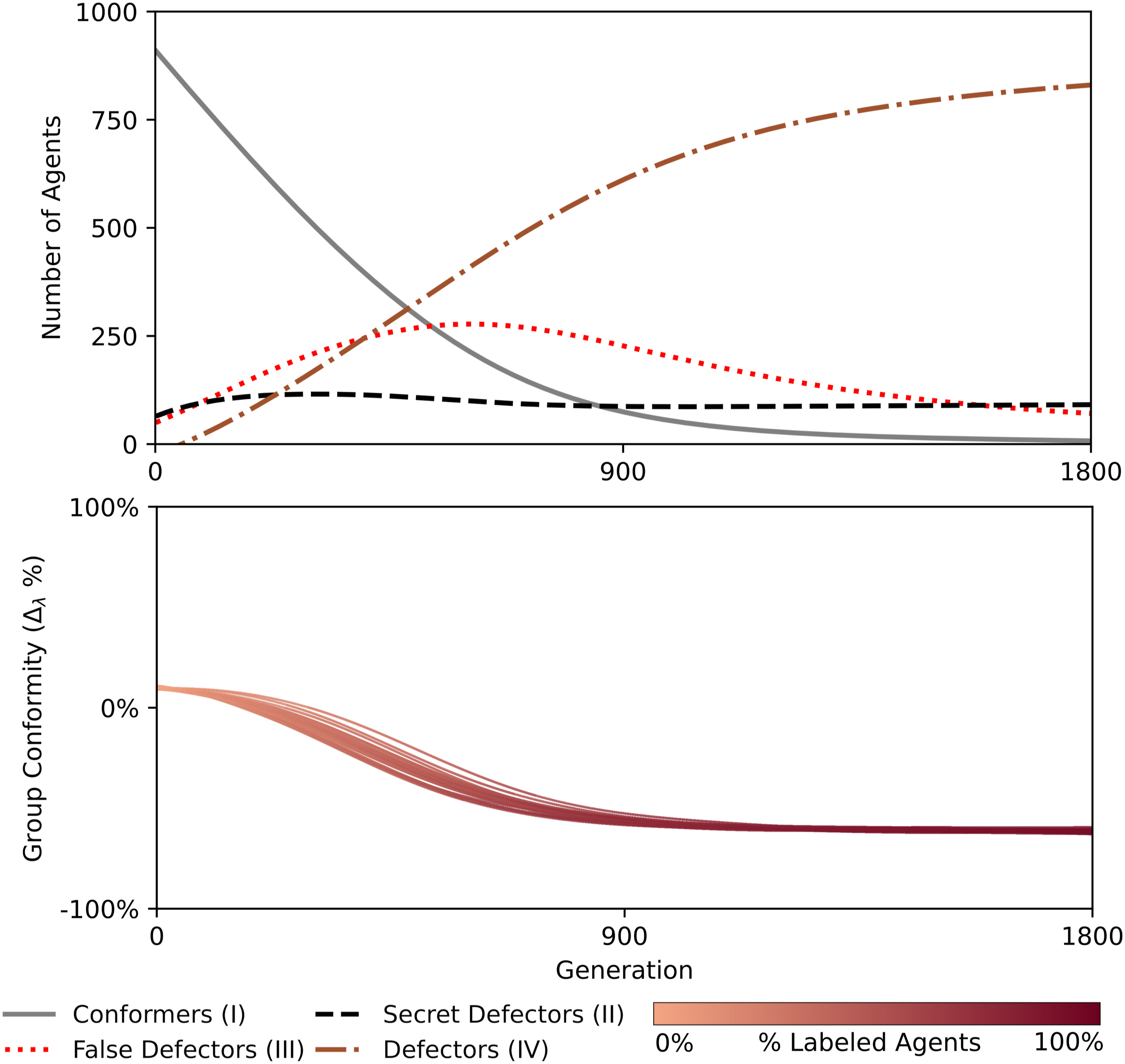
For
OPT Allegiance During the Second Intifada
In the OPT, loyalty expectations were contested by Israel, the Fatah-led Palestinian Authority, Hamas, and affiliated armed organizations (see Pearlman 2011, 150-186). These expectations varied considerably with the threat posed by the Israeli occupation as well as the control exercised by means of administrative detention, blackmail, and restrictions on movement—all invariably used to recruit informers (Cohen 2010; Sorek 2010; Nerenberg 2016; Berda 2017). For the purpose of comparison, we limit our discussion to a single authority expecting the same level of loyalty from all ingroup members, with arguably less control over the identification of defectors relative to the Stasi (Tartir 2015; B’Tselem 2021b). We focus on the Second Intifada from 2000 until the death of president Yasser Arafat in 2004, a period marked by relatively stable loyalty expectations when Arafat was at the helm (see Tartir 2015). During this time, loyalty trials generally took the form of ad-hoc accusations, followed by instant punishment by armed groups or government military court procedures (Nerenberg 2016, 244-246; Human Rights Watch 2001, 24-27).
Parameter Settings
Loyalty Expectations
The years after the 1993 Oslo Accords had been marked by a normalization of collaboration with Israel. The accords constrained the ruling PA to enforce moderate loyalty expectations in exchange for international support, including provisions to prevent the prosecution of Palestinian collaborators. By the onset of the Second Intifada in 2000, the PA accommodated Israeli pressure to maintain moderate loyalty expectations, though political authorities did not officially expect members to contribute to the well-being of their own group (see Nerenberg 2016, 198).
Overall, the PA expected a moderate level of loyalty from Palestinians, most of whom were either perceived as loyal or whose disloyalty was tolerated. Over-identification occurred where defector perceptions diverged between official PA and unofficial NSAG labeling, and where the fear of forcible recruitment spurred false perceptions of defection (see Table 11 in the Appendices for specific parameter values).
Results
Figure 4 shows how Palestinian allegiance increases as less defectors are labeled, following the pattern of conformity in Figure 2(a): falsely labeled defectors have incentives to increase their loyalty and are increasingly tolerated by authorities. OPT allegiance.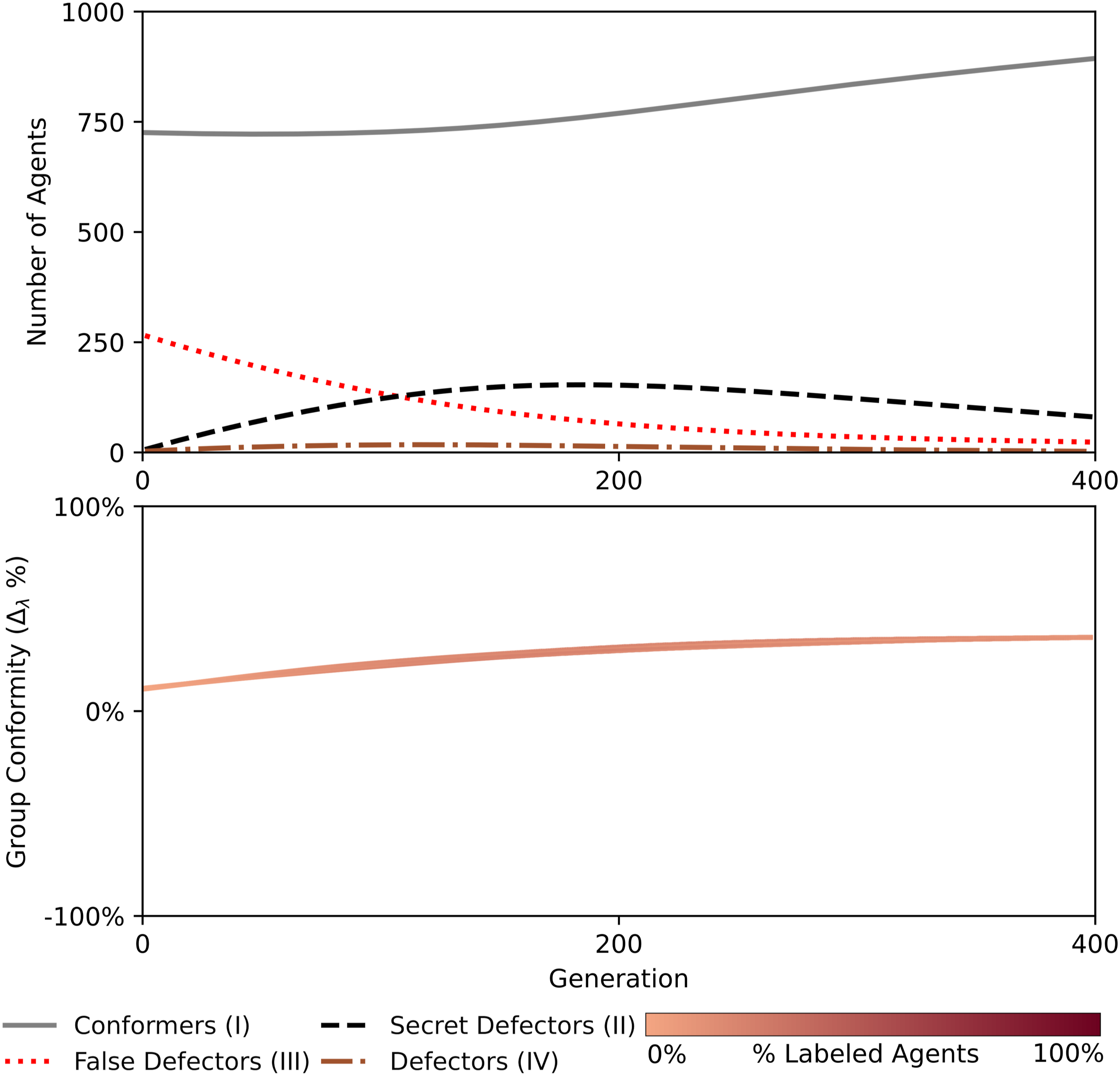
Most
Conclusion
Loyalty trials occur across a range of conflict settings characterized by marked differences in regimes, social identification, and the use of selective incentives. Using archival data from the GDR and secondary data from the OPT, our analysis of loyalty trials identifies two polarized outcomes: cascades of defection in the GDR and a surge of conformity in the OPT. In the GDR, misidentification increased defection, with disloyalty further incentivized by Western organizations externally and by the protestant church internally. In the OPT, by contrast, increased loyalty expectations resulted in greater conformity—loyalty to Palestinian factions that promoted violent resistance. It follows that defection was more likely in the GDR relative to the OPT, given higher expectations and misidentification, and lower incentives for loyalty.
Our analysis of the two cases underscores the measurement problem associated with loyalty trials—the discrepancies between expectations, perceptions and behavior. The case studies also illustrate how both exceptional behavior and “quotidian struggles” effectively undermine regime stability (Scott 1985; Wedeen 1999, 87), highlighting the co-production of loyalty by incumbents and rivals alike. In this regard, our framework goes beyond recent scholarship that explains indiscriminate repression with the number or quality of informants (e.g. Steinert 2022, 4-7). Whereas more and better information may reduce the distance between perceived and private loyalties, it also exerts an influence on the tolerance and ability of political actors to label suspects in more subtle ways. Given that conformity and defection are relative to loyalty expectations, with some behaviours construed as disloyal in some contexts but not in others, research on the repression-mobilization nexus would benefit from taking these intricacies into account.
Beyond the particularities of the two cases, our theoretical framework has implications for the study of political order writ large. A key implication concerns the propensity of political actors to over- or under-identify threats to political order, prosecuting innocents (Type I error) or failing to prosecute the guilty (Type II error). Stalin’s dictum that every communist was a potential enemy effectively turned Blackstone’s ratio (William 1893)—the notion that it is better that ten guilty persons escape than that one innocent suffer—on its head, with implications for some tens of millions of innocent Russians who were killed (Baberowski 2012, 161-172). By contrast, under Communist rule in the GDR, some tens of thousands of delinquent youth and political activists were falsely accused of disloyalty (see Appendix C.1.2), yet a far greater number of ‘disloyal’ East Germans likely evaded loyalty trials.
We conclude by noting that while treason most commonly ranks among the crimes considered ‘worthy’ of capital punishment (Thiranagama and Kelly 2010, 1-2), loyalty trials rarely assume center-stage in studies of social conflict. Noteworthy, in this regard, is that loyalty expectations persist well beyond their original manifestations, with attendant implications for ‘ethnic defection” (Kalyvas 2008), social trust and cohesion. Former collaborators with the GDR regime are considered untrustworthy some 30 years after unification with West Germany (Zeit 2019), and the PA’s history of collaboration with Israel continues to undermine its legitimacy (Tartir 2019). It follows that the interplay between expectations, perceptions, and behavior, as well as the associated perils of over- or under-estimating defection, have appreciable consequences for intra-group polarization and conflict.
Supplemental Material
Supplemental Material - How Loyalty Trials Shape Allegiance to Political Order
Supplemental Material for How Loyalty Trials Shape Allegiance to Political Order by Mirko Reul and Ravi Bhavnani in Journal of Conflict Resolution.
Supplemental Material
Supplemental Material - How Loyalty Trials Shape Allegiance to Political Order
Supplemental Material for How Loyalty Trials Shape Allegiance to Political Order by Mirko Reul and Ravi Bhavnani in Journal of Conflict Resolution.
Footnotes
Acknowledgments
We thank various research partners in the Occupied Palestinian Territories for sharing their insights on this topic, as well as Christian Carlsen and Friedrich Rother for their help with the archival materials. We also thank Janine Bressmer, Juliette Ganne, Ellen Lust, Laura Nowzohour, Christiana Parriera, Sungmin Rho, Alessandra Romani, David Sylvan, and discussants at ISA 2019, EPSA 2019, SPSA 2020; CYBIS 2020 for helpful comments and suggestions. All remaining errors are our own.
Declaration of Conflicting Interests
The author(s) declared no potential conflicts of interest with respect to the research, authorship, and/or publication of this article.
Funding
The author(s) disclosed receipt of the following financial support for the research, authorship, and/or publication of this article: This project was supported by SNF research grant 188287.

Data Availability Statement
Supplemental Material
Supplemental material for this article is available online.
Notes
References
Supplementary Material
Please find the following supplemental material available below.
For Open Access articles published under a Creative Commons License, all supplemental material carries the same license as the article it is associated with.
For non-Open Access articles published, all supplemental material carries a non-exclusive license, and permission requests for re-use of supplemental material or any part of supplemental material shall be sent directly to the copyright owner as specified in the copyright notice associated with the article.
