



Abstract
Major weapon system imports are significant as they are useful for domestic and international security. However, states regularly imported weapons they want in addition to weapons they need. One explanation is that states import unnecessary weapons to gain status. We argue that states suffering from higher levels of negative status inconsistency (SI) import a greater proportion of status symbol weapons. To account for differing security motives, we also separate non-democratic regime types – strongman, junta, boss, and machine – as they vary in their international conflict propensity and domestic stability. Due to the differences across these regimes, we further argue that non-democratic personalist regimes will import more status symbol weapons. Using data covering 1965–1999, we find that negatively status inconsistent regimes import more status symbol weapons.
Introduction
States regularly import major weapon systems they do not require for domestic or international security (Wezeman 2014), but why is this the case? For some states, particularly the US, it may be politically motivated to support arms industries in alliance partners. However, the US is often the exception to the rule when considering international actions. Another explanation is that status considerations drive procurement patterns, otherwise explaining irrational procurement patterns (e.g., Kaldor 1982; Kinsella and Chima 2001; Kinsella 2006; Suchman and Eyre 1992; Wendt and Barnett 1993).
A burgeoning area of research examines the impact of international status on a state’s actions (Dafoe, Renshon, and Huth 2014; Duque 2018; Larson and Shevchenko 2019; Murray 2018; Renshon 2016, 2017; Ward 2017). We focus on status inconsistency (SI), which occurs when a state’s achieved status – based on achievements – differs from their ascribed status – given by others (Galtung 1964; Linton 1936). Status inconsistency has adverse effects that cause states to assuage or avoid it. We are primarily concerned with negative SI, which occurs when achieved status outpaces ascribed status. Past studies suggest that status inconsistent states are more conflict-prone (East 1972; Galtung 1964; Lebow 2010; Maoz 2010; Midlarsky 1975; Renshon 2016, 2017; Volgy and Mayhall 1995; Wallace 1971, 1973; Wohlforth 2009). However, the linkages between status and arms procurement are not as well-known as the connection between status and conflict.
We believe conflict is a last resort for states seeking status. The result of conflict is inherently uncertain; thus, states may use other foreign policy pursuits first to reduce SI. There are multiple dimensions of status (Maoz 2010; Volgy and Mayhall 1995) and several strategies states can take to alter their status; we are concerned with pursuing specific major weapon systems as a form of status-seeking.
While recent arms literature tends to focus on normative aspects of the arms trade from the exporter’s viewpoint, particularly importer human rights (e.g., Blanton 2005; Erickson, 2013; Hansen and Marsh 2015; Johnson and Willardson 2018), it often overlooks importer motivations. As arms imports directly link to international and domestic conflict and security, we also account for the fact that regime types differ in domestic accountability and foreign policy actions (e.g., Siverson and Johnson 2018; Weeks 2012, 2014) and domestic stability with coup risk (Debs and Goemans 2010). Therefore, to examine SI and arms imports, we separate regimes: democracy, machine, junta, boss, and strongman, with the latter two being personalist (Weeks 2012).
We argue that the proportion of imports of what we define as status symbol weapons – large ships, offensive-oriented aircraft, air defense systems (ADS), and tanks – is impacted by SI and regime type while controlling for the threats a regime faces. Personalist regimes face the most instability: they are more likely to initiate international conflict (Weeks 2012) and face the highest coup risk (Debs and Goemans 2010). Our tests employ fractional general linear models to study the proportion of status symbol arms imported over 5-year moving averages. When personalist regimes are negative status inconsistent, they import more status symbol weapons than other regimes. The differences between regime types all but disappear as negative SI decreases or when states experience positive SI.
Status Inconsistency
We view status as an actor’s position in a system or social hierarchy. However, there are various understandings of status in international relations. 1 For example, Dafoe, Renshon, and Huth (2014) and Renshon (2017) differentiate status from concepts like reputation, honor, and authority. Despite several ways to define status, MacDonald and Parent (2021) point out that recent scholarship has coalesced around status as relational (Duque 2018; He and Feng 2022; Larson, Paul, and Wohlforth 2014; Renshon 2017) and as an actor’s position in a system or social hierarchy (Larson, Paul, and Wohlforth 2014; Larson and Shevchenko 2019; Murray 2018; Renshon 2017; Ward 2017).
This positional view of status differs from the membership view of status. Drawing on social identity theory, Larson and Shevchenko (2019) describe status as a club good and positional. While Duque recognizes status as relational, club acceptance and membership are integral as “Status emerges from practices such as granting recognition, attaching esteem to attributes, and assigning privileges to clubs” (2018, 582). Similarly, Murray states that status “refers to a recognized identity, not the acknowledgement or acceptance of a state’s characteristics or capabilities” (2018, 46). Examples of clubs that may confer status include the major powers, nuclear powers, the G7, the UN Security Council, and rising power clubs such as BRICS. One benefit of the club membership view of status is that membership is clear, though club admittance is based on various factors and idiosyncrasies, including “nonstatus considerations” (MacDonald and Parent 2021, 365). Ultimately, we think of status as positional because rank is the fundamental unit of status and status “concerns how much we have relative to others” (Renshon 2017, 35).
Status incorporates both state attributes and the perceptions of others. Larson, Paul, and Wohlforth (2014) suggest wealth, culture, demographic positions, sociopolitical organization, and other factors contribute to status. Fixed attributes, like geographic size and state age, regime type, IGO membership, and military capabilities, also lead to more status (Duque 2018; Renshon 2017). There is almost universal agreement that status is beneficial and desirable. Status may help states achieve foreign policy goals, contributes to political legitimacy, and provides material and intrinsic benefits (Butt 2019; Khong 2019; Maoz 2010; Renshon 2017; Ward 2017).
Linton (1936) and Galtung (1964) have classified status as achieved and ascribed. Achieved status is the position of actors based on their qualities and achievements. Ascribed status is the position other actors give and is sometimes described as international prestige (Galtung 1964; Maoz 2010; Volgy and Mayhall 1995). However, some status scholars, like Renshon (2017), suggest that status and prestige are distinct concepts, with separation also occurring in the arms transfer literature (e.g., Kinsella 2006; Kinsella and Chima 2001). Mercer (2017, 136) further states, “Status can mean prestige, but it can also mean one’s rank in a hierarchy,” which is the definition we use as our measures of achieved and ascribed status are based on rank in a hierarchy, which matches Renshon’s (2017) view of state status being linked with their position in a system. Using both achieved and ascribed status is beneficial because (1) it incorporates the positional nature of status discussed above and (2) it allows us to leverage the concept of SI, which we discuss below.
Both status types create status roles (Linton 1936). Roles are a set of expected behaviors corresponding with an actor’s status. Stratification results from states having different roles that guide behavior and expectations. For example, high-achieving states, such as China, are expected and allowed to behave differently than low-achieving states, like Nepal. A consequence of social stratification is SI. Since states are stratified along two dimensions, not all states have consistent status. Past research argues that when achieved status is greater than ascribed status – i.e., negative SI – states suffer from treatment that differs from what they think is deserved. A negative SI state is “reminded of [its] objective state of disequilibrium by the differential treatment [it] is exposed to” (Galtung 1964, 99). Following Galtung, a research program on the relationship between SI and conflict ensued. Scholars have traditionally operationalized achieved status as military and industrial capacity via CINC scores. Ascribed status is usually measured using the number and rank of diplomatic representation received by a state from other states. This initial research saw mixed results. Wallace (1971, 1973) found higher levels of negative SI are associated with greater onset and severity of international conflict. Other research found no relationship (Ray 1974) or a negative relationship (East 1972) between negative SI and increased conflict.
Two explanations persist for the mixed results. The first is the different temporal patterns and the overall structure of the international system (Gochman 1980; Volgy and Mayhall 1995). More recently, research using network centrality as a proxy for ascribed status and more theoretically appropriate status reference group shows a strengthened relationship between negative SI and conflict (Maoz 2010; Renshon 2016, 2017). The second explanation is that a clear logic connecting SI and its effects is lacking. Previous arguments and results suggest SI leads to frustration, which leads to aggression (East 1972; Galtung 1964; Maoz 2010; Midlarsky 1975; Volgy and Mayhall 1995; Wallace 1971, 1973). However, it is unclear how aggression and conflict consistently and positively affect SI since conflict is costly and its effects are uncertain. One reason is the uncertainty of the outcome, as conflict likely affects both the achieved and ascribed status of the states involved. Yet, we are uncertain ex-ante in which direction the effect is or for which state the effect is the greatest. For example, states could gain achieved status, like territory or natural resources, from the conflict. Concurrently, if cooperative ties are cut, states could lose ascribed status because of the conflict. Both outcomes only serve to worsen the SI of the initiating state.
We seek to explain how SI impacts a state’s decision to undertake actions meant to improve ascribed status. While militarized conflict was the primary concern of SI in international relations research (e.g., Galtung 1964; Wallace 1971, 1973; East 1972; Midlarsky 1975; Volgy and Mayhall 1995; Maoz 2010; Volgy et al. 2011, 2014; Renshon 2016, 2017), we examine arms buildups as one alternative of many to increase ascribed status. Importing arms does not have the same risk, cost, and uncertainty of conflict; thus, it is a more attractive choice to increase ascribed status to balance SI. First, however, we discuss regime type and ascribed status linkages.
Status Inconsistency and Regime Type
The motivation to build ascribed status to assuage SI is likely ever-present and universal, yet democracies and non-democracies differ in baseline ascribed status. First, legitimacy, the belief the leader has the right to govern (Hurd 1999), of democracies increases with the increased prevalence of democracies in the system and affects ascribed status and SI. As democracies comprise approximately 60 percent of the international system (Marshall, Gurr, and Jaggers 2002) and legitimacy is positively associated with ascribed status (O’Neill 2001), democracies possess more ascribed status. Recent work finds that democracy is among the strongest indicators for ascribed status (e.g., Duque 2018; Maoz 2010; Renshon 2017). Kinne (2014) also finds that democracies are more likely to send and receive diplomatic missions, an indicator of ascribed status (Singer and Small 1966; Small and Singer 1973).
We believe it is essential to move beyond traditional democratic/non-democratic classifications as recent research identifies important differences across types of non-democratic regimes (e.g., Debs and Goemans 2010; Lai and Slater 2006; Weeks 2012, 2014). 2 The different typologies all acknowledge that the strong majority of authoritarian leaders are of a civilian or military variety. Lai and Slater (2006) and Weeks (2012, 2014) further separate the categories into whether they are led by an individual or a group: strongman, junta, boss, or machine. The former two are military regimes; the latter two are civilian regimes. There are also anocratic regimes that are not fully democratic or fully authoritarian. Personalist regimes are empirically different than group regimes. Personalist regimes are more belligerent (Weeks 2012) and are more likely to pursue nuclear weapons (Way and Weeks 2014). Both personalist regime types seek increased international ambition and recognition for revisionist goals (Weeks 2012).
We use Weeks’ (2012) classification as it is based on different institutional constraints that impact the leader’s ability to act internationally. Consistent with recent literature (e.g., Maoz 2010; Renshon 2016, 2017), the measures we focus on are regime capability (achieved status) and alliance centrality (ascribed status). The literature shows democracies have greater baseline ascribed status than non-democracies, which is also true with our measure of ascribed status on average. Democracies also have higher average achieved status with our measure. However, SI has a remarkably similar distribution between democracies and non-democracies with our measures. However, our data show clear differences in SI across different non-democratic regime types, further justifying our choice to separate non-democratic regime types. 3
Anocratic leaders are typically associated with political parties in semi-democratic systems where elections may be held, but their competitiveness is subject. These are states where leaders face some executive constraints from domestic institutions yet are not democracies.
Machine regimes have a leader from a civilian background who is typically an official of the dominant political party in a non-competitive system, e.g., China after Mao and Mexico under the PRI. While leaders have significant power, the party still has the opportunity to constrain actions.
Junta regimes have a leader selected from a group of military leaders running the country, e.g., Myanmar after 1988 and Thailand, but the group still has significant power over decisions. Junta regimes’ military roots make them more prone to engage in international conflict due to the leaders’ military backgrounds that have socialized them to believe that force is an appropriate foreign policy tool (Weeks 2012).
Bosses are personalist dictators, e.g., the Kims of North Korea and Saddam Hussein in Iraq. These regimes differ from the head of machine regimes as they typically gained status through participation in revolution, civil war, and coups (Weeks 2012). Though these leaders may have a military background, the initial support for their ascension to power is not directly linked to the military. Parties do not constrain Bosses.
Strongmen are personalist dictators with a military background unconstrained by domestic audiences, e.g., Nasser of Egypt and Amin of Uganda. They are separate from bosses due to their support from the military in the rise to power. These leaders are surrounded by military advisors, which affect their decisions, but are not constrained by domestic elites in their activities (Weeks 2012).
Negative SI and Arms Imports
Importing arms is one path for states to ease negative SI. Larson and Shevchenko (2019) suggest several paths, including social mobility, social competition, and social creativity strategies. Social mobility strategies mimic the success of high-status states. Social competition strategies attempt to surpass high-status states by using the same means by which others became high-status. Arms imports are best described as social competition as states aim to match others. Social creativity seeks to redefine negative traits as positive or a new domain to seek status. These strategies may take several forms, including conflict, along with other status-seeking behaviors like democratization and joining international institutions (Larson and Shevchenko 2019), withdrawing from international institutions (Ward 2013), norm compliance (Miller et al. 2015), foreign aid provision (Bezerra et al. 2015), success at the Olympics and hosting the Olympics (Rhamey and Early 2013), civilian space programs (Early 2014), foreign aid provision (Bezerra et al. 2015), norm compliance (Miller et al. 2015), and as we and others suggest arms buildups.
States pursue major weapon systems to protect the regime’s sovereignty, territory, and society from domestic and international threats. The puzzle is that regimes often pursue major weapon systems that domestic and international security do not require (Wezeman 2014). One explanation that rationalizes importers’ procurement patterns is status considerations (Kaldor 1982; Kinsella 2006; Kinsella and Chima 2001; Suchman and Eyre 1992; Wendt and Barnett 1993).
Negative SI influences arms import decisions because it can cause frustration and uncertainty. If state A outranks state B in achieved status and state B outranks state A in ascribed status, both think of themselves as superior, and neither will accept being considered inferior, creating frustration in their interactions. This frustration is exacerbated because the low ascribed status blocks the high expectations of state A. In other words, negative SI states cannot reap the benefits of high achievements because of low ascribed status. Uncertainty occurs because states are unsure of what to expect of others and what others expect of them due to diverging role expectations for each status position. Due to biases like confirmation bias (Nickerson 1998), negative SI states are more likely to emphasize their highest level of status – achieved status – to portray a beneficial bargaining position. However, other states are more likely to stress the SI state’s lower ascribed status. These differences cause uncertainty, which can damage negative SI states. Externally, these states have instability introduced into their interactions. Internally, these states may also experience instability in their ‘self-image’ and may have trouble simultaneously dealing with superior achieved status and inferior ascribed status. Both status roles have diverging expectations, and negative SI states cannot fulfill them concurrently.
When a regime is frustrated, facing uncertainty in the international system, and seeking redress via arms acquisition, they have two options to address status issues. First, states can engage in a broad military buildup to increase their achieved status and prepare for conflict. For example, Imperial Japan in the 20th century experienced frustration with how other powers treated it. The Japanese distrusted diplomacy with traditional Western powers and believed they had not given Japan its just due. Specifically, the Japanese were dissatisfied with the Treaty of Versailles because Japan was unsuccessful when it arrived to negotiate its share of the spoils (Harries and Harries, 1991). The US and Great Britain were hesitant to grant Japanese control of Shandong. The Allies, particularly the US, also blocked the Japanese proposal of racial equality from being inserted into the charter of the League of Nations. Feelings of the Japanese being cheated out of their deserved status continued with the 1921–1922 Washington Conference, which ended with the Washington Naval Treaty. The Western powers, led by the US and UK, were determined to “keep Japan in her place” (Harries and Harries 1991, 132). The Washington Naval Treaty codified the status quo balance of naval power. Japan consented to the Treaty but felt cheated and ultimately used this motivation to build up its military (Asada 2006).
This example highlights the option to produce status symbol weapons instead of importation. States with the ability to produce status symbol weapons most likely have already maxed out their status associated with arms, and importing more from other sources will have little impact. Alternatively, pursuing achieved status by shifting to production is extremely expensive and time-consuming. Developing a defense manufacturing base capable of producing status symbol weapons in the post-World War II era has only been undertaken by a few states. Those undertaking this route are still highly dependent on imports as they cannot produce a full range of major weapons systems, let alone status symbol weapons.
Second, states can engage in arms imports as one of many methods meant to increase their ascribed status by importing a higher proportion of what we call status symbol weapons. Status symbol weapons have different qualities than other weapons. First, status symbol weapons are expensive. Status symbols must be costly to separate those states that can and cannot afford to acquire them (Renshon 2016). Second, status symbol weapons are conspicuous and public. Actions meant to gain status must be visible for other states to be able to grant it (Gilady 2018). Third, status symbol weapons are salient. Weapons that draw the attention of several other states are more likely to garner more status (Bitzinger 2010). Finally, status symbol weapons are exclusive. If all states have a weapons system, then that weapons system does not provide status. Weapons systems must differentiate across states to carry status.
We believe that importing a higher proportion of status symbol weapons is likely because adopting and acquiring new military technology depends on the regime’s financial resources and organizational capital (Horowitz 2010), and defense industrialization is cost-prohibitive for many states (Bitzinger 2017). Nevertheless, weapon imports do not directly assuage negative SI. Arms imports may worsen negative SI by increasing achieved status unless that action also increases ascribed status at a greater level. However, regimes cannot directly change ascribed status as others bestow it. States can only take action that they expect (or hope) will improve SI. 4 In other words, the actions are signals to the international community driven by frustration and uncertainty meant to gain ascribed status, in our case, alliances. However, there are two reasons why importing status symbol weapons may ease negative SI. First, status symbol weapons are meant to draw attention from other states and increase engagement with the negative SI state. This attention and engagement can result in the acknowledgment that the importing state is worthy of recognition, such as the German naval buildup pre-World War I. The German acquisition of large naval warships, partly motivated by Germany’s desire for status (Murray 2010), forced the UK and others to recognize Germany as a major international player (Kennedy 1987). Second and more directly, importing status weapons may make the negative SI state a more attractive alliance partner. The negative SI state’s status increases as it enters into additional alliances. Overall, we believe regimes seeking to redress status issues will import more status symbol weapons than other major weapon systems. States motivated more by security considerations would import a better balance of major weapon systems, which we discuss later. Of course, an implicit assumption of our argument is all states have an equal opportunity to import whatever status symbol they desire, regardless of potential exporter restrictions.
The goal is for the imported status symbol weapons to draw attention to the negative SI state. If these actions gain the attention of the international public or media, it can pressure others to act, thereby amplifying the salience of the negative SI regime. The attention is magnified with status symbol weapons as they are more visible and salient (Bitzinger 2010; Gilady 2018), and importing a greater proportion of them further increases visibility. Actions by other states need not be all positive as all publicity is good publicity. Since many regimes may obfuscate defense spending, the impact of status symbol weapons may be highlighted as a signal of broader defense spending that may or may not be occurring. In turn, status symbol imports may boost the respect for the SI state’s capabilities and increase engagement with other states via additional alliances.
As SI worsens, the proportion of status symbol weapons imported increases.
Regime Types and Status Symbol Weapons
Since our focus is non-democracies, our argument pays less attention to democracies, but democratic regimes are the baseline category in our tests. One reason we suggest that democracies and non-democracies pursue different status-building strategies to minimize SI is due to leaders’ time horizon. Democratic leaders are likelier to have and observe term limits than non-democratic leaders. Non-democratic leaders also have longer tenures than democratic leaders (Goemans, Gleditsch, and Chiozza 2009). Building ascribed status is slow, as a significant increase requires several other states to change their behavior.
For our measure of achieved status, the regime needs to order weapons and it may take non-democratic regimes longer to receive approval, but the initial action is in their control. For ascribed status, regimes need to take actions that other regimes view as worthy of receiving recognition. In our case, this action is being deemed worthy of being an alliance partner. As non-democratic regimes’ reliability is partially determined by their leader, these leaders need enough time to adjust their achieved status to see an increase in ascribed status to alleviate negative SI. Due to the length of the status-building process and the longer tenure of non-democratic leaders, we suggest that non-democratic leaders have greater motivation to build ascribed status via importing status symbol weapons since they are more likely to be around to reap the rewards. Democratic leaders are beholden to the public who are sensitive to status losses (Powers and Renshon 2023), and actions taken to assuage negative SI are also reliant on other states choosing to be institutionalized partners – e.g., politically via IGOs or economically via trade – as with non-democracies.
We now apply the above general arguments to Weeks’ (2012, 2014) non-democratic authoritarian regime types: machines, juntas, bosses, and strongmen. Bosses and strongmen are personalist regimes; the others are group. We expect and argue that the regime's structure impacts negative SI as status relates to identity and how groups and individuals draw identity from different sources.
Personalist regimes seek strong militaries to achieve their goals; however, we argue they seek to bolster these militaries by importing a greater proportion of status symbol weapons when they are negative SI. The focus of others on the negative SI regime’s ascribed status “tends to arouse anger and a self-protective urge to re-establish one’s ‘rightful position’” (Wolf 2011, 106). But why would personalist regimes differ from other regimes? In personalist regimes, the leader is essentially synonymous with the state in decision-making. Therefore, the reaction to negative SI by the state is the reaction of the individual leader. Or, as Mercer (2014, 317) states, “Concern over my status involves a personal identity: it is social but individual. Concern over my country’s status involves a social (or group) identity: it is social and depends upon a group”; thus, personalist leaders’ concern over their status is also their concern over the state’s status. Applying these ideas to personalist regimes, when a personalist regime’s status is misrecognized, strong emotional and even irrational behavior – such as importing a disproportionate amount of status symbol weapons – is easier to understand.
Furthermore, personalist leaders can pursue weapon imports without domestic constraints limiting their actions. Status symbol weapons do not replace a strong military but can help increase the personalist regime’s reputation (in their eyes) when they are negatively SI. Personalist leaders suffer from a grandiose self-image and have the political power to undertake projects to satisfy their self-image (Glad 2002). This can occur because personalist leaders surround themselves with key advisors based on loyalty instead of military knowledge (Bratton and Van de Walle 1994; Egorov and Sonin 2011). This motivation to reinforce self-image and the lack of domestic political and military constraint is why we expect personalist leaders to import more status symbol weapons.
The leaders of group regimes – democracies, machines, juntas, and anocracies – have more domestic constraints as they are responsible to domestic audiences to maintain power. While the domestic audiences include the military, it is not the only audience of interest. Additionally, large groups and institutions do not necessarily react to disrespect like an individual would (Wolf 2011).
Machines need to satisfy the upper level of members to maintain domestic order and power. One way to do this is to focus on domestic institutions, albeit corrupt institutions. Therefore, leaders of machine regimes are only concerned about arms procurement as it relates to security and corruption in the procurement process. Alternatively, juntas will want to import arms to satisfy the military. Due to the direct involvement in governance, the military has more input over what arms are imported and at what level. The implication is that a well-rounded military is sought. Alternatively, as juntas include members from different military areas when corruption occurs in procurement, each member will want to maintain their piece in their area.
As SI worsens, personalist regimes import more status symbol weapons than non-personalist regimes and positive status inconsistent personalist regimes.
We also argue that bosses will pursue a greater level of status symbol weapons when they are increasingly negatively SI compared to strongmen because of the strongmen’s military background and links with the military. Personalist leaders surround themselves based on loyalty, as opposed to competence, and strongmen come to power with the help of the military. As a result, more of the military is in the upper echelon of the elite in strongmen regimes than boss regimes. While both bosses and strongmen have grandiose and expansive international ambitions and fewer domestic constraints to pursue those ambitions, strongmen rose through the military. The strongmen’s military experience gives them a better understanding of the weapons necessary for a well-rounded military. This understanding is necessary as strongmen engage in international conflict at greater levels than bosses (Weeks 2012), which requires different patterns of arms imports. Bosses do not have the vast military experience of strongmen, but still have the international aspirations and the lack of domestic constraints to pursue those aspirations. Compared to strongmen, bosses are freer to seek status symbol weapons.
As SI worsens, negative status inconsistent bosses import more status symbol weapons than strongmen and positive status inconsistent bosses.
Categorizing Status Symbol Weapons
The discussion above identifies the characteristics of status symbol weapons – costly, conspicuous, salient, and exclusive – but not which types of major weapon systems are linked with status. Historically, nuclear weapons are considered status symbols in the international system because the possession or pursuit of nuclear weapons indicates independence, modernity, and military might (O'Neill 2006). However, this also applies to other weapons systems. We categorize status symbol weapons in two ways. First, based on their designation from the literature (e.g., Bitzinger 2010; Gilady 2018; Suchman and Eyre 1992; Wezeman 2014). Second, we argue that some aircraft and land weapons are status symbols based on their exclusivity – those produced and imported by fewer states are inherently more exclusive.
Large ships representing status symbols include frigates, landing ships, destroyers, corvettes, submarines, nuclear submarines, and aircraft carriers (Wezeman 2014). Aircraft carriers and nuclear submarines provide the most status as their value relates to possession as opposed to operational capabilities, evidenced by the fact that Brazil acquired both ships for no apparent security reason (Wezeman 2014). Aircraft carriers provide status due to their scarcity and conspicuousness; however, an aircraft carrier is vulnerable without a supporting battle group of other large ships (Gilady 2018). The other large ships serve a functional purpose but are also not regularly deployed as a blue water navy by most states. Only Italy and India have blue water navies other than the P5 UNSC members, which means few states can properly deploy an aircraft carrier. Another difference between aircraft carriers and most other large ships is that the military must also stock them with aircraft that provide status.
Aircraft classically providing status are fighter-jets. Yet naval fighter-jets for aircraft carriers are often more expensive and have fewer capabilities than ground-based versions (Gilady 2018). The status of modern fighter-jets comes from, in part, the ability to conduct promotional flyovers like parades (Bitzinger 2010). Fighter-jets possession by lesser developed states increases status at home and abroad as no military benefit occurs (Morgenthau 1962). Morgenthau further states that possessing “some of the more spectacular instruments of modern warfare…[creates] the illusion of having become a modern military power” (1962, 303). For example, many developing countries purchase used fighter-jets that are rarely deployed and sometimes do not even have the proper training for pilots; such planes likely cannot boost a state’s national security. Rather, these states acquire weapons systems because others in their region also possess the weapons and they do not want to be left behind, so they seek “novel but showy weapons” like fighter-jets (Suchman and Eyre 1992, 157). One example is Ethiopia and Eritrea acquiring similar aircraft in the late 1990s (Henk and Rupiya 2001).
The F-104 fighter-jet is a specific example of a status symbol weapon. The US-designed fighter-jet, known as the Starfighter, was quite “showy.” It was literally shiny (Spindel 2018), and its unique design led to its being nicknamed the “missile with the man in it” (Bowman 2017). The US and other states that acquired the fighter-jets ultimately concluded the F-104 had many military limitations. US Under Secretary of State during the Kennedy and Johnson admirations, George Ball, called the Starfighter a “glamour object” (quoted in Spindel 2018, 4), and US Ambassador to India Chester Bowles said it was “extremely costly, hard to fly, and prone to accidents” (quoted in Spindel 2018, 108). Despite these concerns, Pakistan wanted to import the F-104 from the US and was ultimately successful. The F-104 transfer helped crystalize the US-Pakistan alliance (Spindel 2018) and, thus, Pakistan’s ascribed status.
Two other “showy” aircraft meet the expensive, conspicuous, salient, and exclusive criteria: bombers and combat helicopters. Both are only produced by a few states – the US, USSR, France (combat helicopter), and the UK (bomber). Bombers have only been imported by 62 states and combat helicopters by 77 states, compared to 159 states for transport aircraft and 157 states for transport helicopters (Johnson 2017). Both are conspicuous and salient in military parades.
Status among land weapons is more difficult to identify. The issue is that land weapons are necessary to maintain domestic control and provide border security. Based on the status symbol criteria, two types of land weapons stand out: tanks and ADS. Both systems have fewer than ten producers (Johnson 2017). While tanks may not be considered exclusive due to the number of states that have imported them, they are expensive, conspicuous, and salient. Tanks were driven into Tiananmen Square in 1989 as a show of force. States also often import a level unnecessary for their security; for example, Indonesian procurement of tanks, despite being an archipelago with unsuitable terrain for their use (Acharya 1994), and Uganda importing 1950s Soviet models in the late 1990s (Henk and Rupiya 2001). Also, we can point to an unrealized tank project that fits with our conception of status symbol weapons. The planned Nazi tank, the Ratte, was likely too large and heavy to be used effectively in any terrain (Gilady 2018). Ninety-nine states have imported ADS, whereas 141 states have imported the next closest non-status symbol land weapon category (SIPRI 2010). Air defense system imports also follow the logic of fighter-jets – many states import fighter-jets that serve no security purpose, meaning many states do not need ADS for security purposes.
Data
We create a data set combining regime, arms transfer, and status data to test our arguments. Arms transfer data comes from the Stockholm International Peace Research Institute (SIPRI). Regime data comes from Weeks (2012). Status data come from various international relations datasets.
Dependent Variable
The dependent variable is the proportion of status symbol weapon systems ordered from SIPRI’s Arms Trade Register. As arms transfers are comparatively rare events and do not occur yearly, we use a 5-year moving average of the proportion of status symbol arms imports. We create the dependent variable from SIPRI’s Trend Indicator Value for each model of a major weapon system. We use the value of each unit ordered in each category of arms. We divide the sum of TIV for each status symbol weapon system ordered by the total TIV for the category. The number of units ordered correlates above 0.98 with the number delivered; however, delivery can occur over several years. Additionally, we use the regime in the year of the order because the exporter must agree to the transfer. These data provide information on the type and number of weapons transferred from 1950 on.
Independent Variables
SI occurs when there is an imbalance between how states are viewed versus how they think they should be viewed (Rathbun, Rathbun, and Pomeroy 2022; Renshon 2016; Volgy et al. 2011, 2014). To calculate SI, we created measures of achieved and ascribed status. We use Souva’s (2023) material military power (MMP) measure to operationalize achieved status. Material military power scores are based on the state's level of armament, such as land power, naval tonnage, airpower, ballistic missiles, and nuclear weapons. 5
Ascribed status is based on alliance membership based on network centrality measures. Defense pact data is from Leeds et al. (2002). While alliance membership is not the traditional measure of ascribed status – as opposed to diplomatic representation, 6 we believe it is an appropriate measure as arms imports and alliances are directly linked with international security. We do not inherently believe this is a better measure than the traditional one, but an appropriate alternative. Additionally, Gotz (2021) cites Ward’s (2017) assertion that ranking criteria for status should be of geopolitical significance in relevant time periods and alliances were and continue to be geopolitically significant, as is military power.
Centrality is used in social network analyses to indicate importance and ascribed status is the degree of respect that other states give a state. States with high centrality have many relations with other states, regardless of whether the ties are sent or received (Knoke and Yang 2008). We use four types of centrality to operationalize ascribed status, each capturing a different type of importance. The four network centrality measures are degree, closeness, betweenness, and eigenvector (Wasserman and Faust 1994). Degree centrality is the relative size of an actor’s egonet. The degree centrality of a given state in an international network measures how many, or what type of, other states choose to have ties with the focal state. Closeness centrality accounts for the distance an individual is connected to others. Closeness centrality with states reflects their reputation to the extent to which states are willing to form alliances not only directly with the focal state, but also with states that have alliances with the focal state. Betweenness centrality examines the position of actors concerning other actors in terms of how and to what extent one actor serves as a link between any two other states. Betweenness centrality examines states' reputations in a potential negotiation situation between allies. Eigenvector centrality considers the centrality of the units the focal state is connected to. In other words, connections with more central units are given more weight in determining centrality than connections with less central units. We use each state's mean of betweenness, closeness, degree, and eigenvector centrality each year. 7
To create the SI variable, we rank achieved and ascribed statuses yearly for three reasons. First, status is relative, defined as a unit’s position in a system. Second, ranking status allows for comparison across different types of status. The comparison between MMP scores (achieved status) and network centrality (ascribed status) is meaningless without ranking MMP scores and network centrality each year. Material military power scores measure military capacity yearly and network centrality measures a state’s position in each system yearly. These measures are not comparable without first ranking them. Finally, ranking of status allows for the comparison over time. For example, a state’s placement in the 19th and 21st centuries trade network is substantively different and should not be directly compared.
We calculate the SI score as the difference between the two ranks by subtracting ascribed status from achieved status. We then standardize the SI score to decrease the possibility of multicollinearity with the SI variable, as some controls are related to the component parts of SI. Standardization also reduces the influence of outliers. Negative values indicate that a state is negative SI. Status inconsistency ranges from −3.33 to 3.35.
The Weeks (2012) leader and regime data cover 1950 to 1999. We use dummy variables coded ‘1’ for each type of non-democratic regime: strongman, junta, boss, machine, other non-democracies, and democracy. There are 2107 democracies, 696 machines, 407 juntas, 667 bosses, 617 strongmen, and 1108 other non-democracies. We code Strongmen and Boss regimes as personalist.
Controls
We cannot dismiss the literature’s alternative argument that a regime’s security environment matters. International security revolves around the threat of international conflict and the presence of alliances. Domestic security consists of the threat of domestic conflict and the risk of a coup.
We use Gibler and Tir’s (2014) territorial threat measure as a proxy to control for some aspects of the security environment. This measure accounts for violent territorial shifts, defense pacts with neighbors, militarization levels among neighbors, past territorial MIDs, civil war occurring in either state, border age, and how long the state has been at peace. Territorial threat is the maximum predicted probability of a state engaging in conflict in any given year and ranges between 0.009 and 0.35; these data are available through 2001.
We include coup risk to account for coup-proofing as a motive to import status symbol weapons. These data come from Sudduth (2017). Coup risk is the likelihood of a coup attempt in any given year based on a Bayesian process to calculate the military’s willingness and ability to organize a coup based on GDP/pc, democracy, military regime, and time since the previous coup. This measure ranges from 0.0005 to 0.2262. These data cover 1965–2003.
As status symbol weapon systems require a larger economic investment to acquire and maintain, many states importing for status allow the units to go into disrepair or lack trained operators (Henk and Rupiya 2001; Pollack 2004). As these weapon systems create a larger economic burden, it may be that states relying solely on themselves – i.e., lacking international alliances – have a greater motivation to acquire more systems focused on international security. To account for alliances, we control for the total capabilities of a regime’s defense pact network, which ranges from 0 to 0.62. Alliance data come from Leeds et al. (2002). Capabilities come from the CINC data (Singer 1988).
We also control for economic and social factors that might impact the need for weapons. First, to control for economic factors, we include the logged real GDP of the importer (4.80–16.39) (Gleditsch and Ward 1999) and a dummy for if oil is greater than 1/3 of the state’s export revenue (Gibler and Tir 2014). States with greater economic resources have more interests to protect and can purchase arms to protect those interests. Second, larger states have a greater need for major weapon systems, so we control for the logged population size (2.56–14.12) (Singer 1988). Third, we control for the percentage of the state that is mountainous as these states may desire aircraft over land weapons the more mountainous it is (0–4.56) (Gibler and Tir 2014). We do not include the territorial threat or mountain controls in the ship models. 8
Test
We use a fractional generalized linear model to test our arguments. We use this model because our dependent variable is the proportion of status symbol weapons a state imports and there is a high proportion of zeroes and ones in our data. The fracglm model by Williams (2018) is more flexible than using logit, probit, or heteroskedastic probit models on proportion dependent variables. Using a linear model would ignore the lower bound of zero. We include all junta, machine, boss, strongman, and democratic regimes in the tests. Democracies are the baseline category. We also use robust fixed standard errors and a complementary log-log link function because the cumulative probability of zero is high.
Robustness
We ran many alternative specifications of our models that have similar results, which are in the online appendix. These models include an alternative dependent variable with the number of units ordered as opposed to TIV to calculate the proportion of status weapon systems imported, alternative operationalization of SI that uses centrality measures of Level of Representation and Embassy from Diplometrics as the main independent variable SI, and using CINC instead of MMP for calculating SI.
Results
Fractional Generalized Linear Model on Regime Type Effect on Status Symbol Arms Imports – 1965–1999.
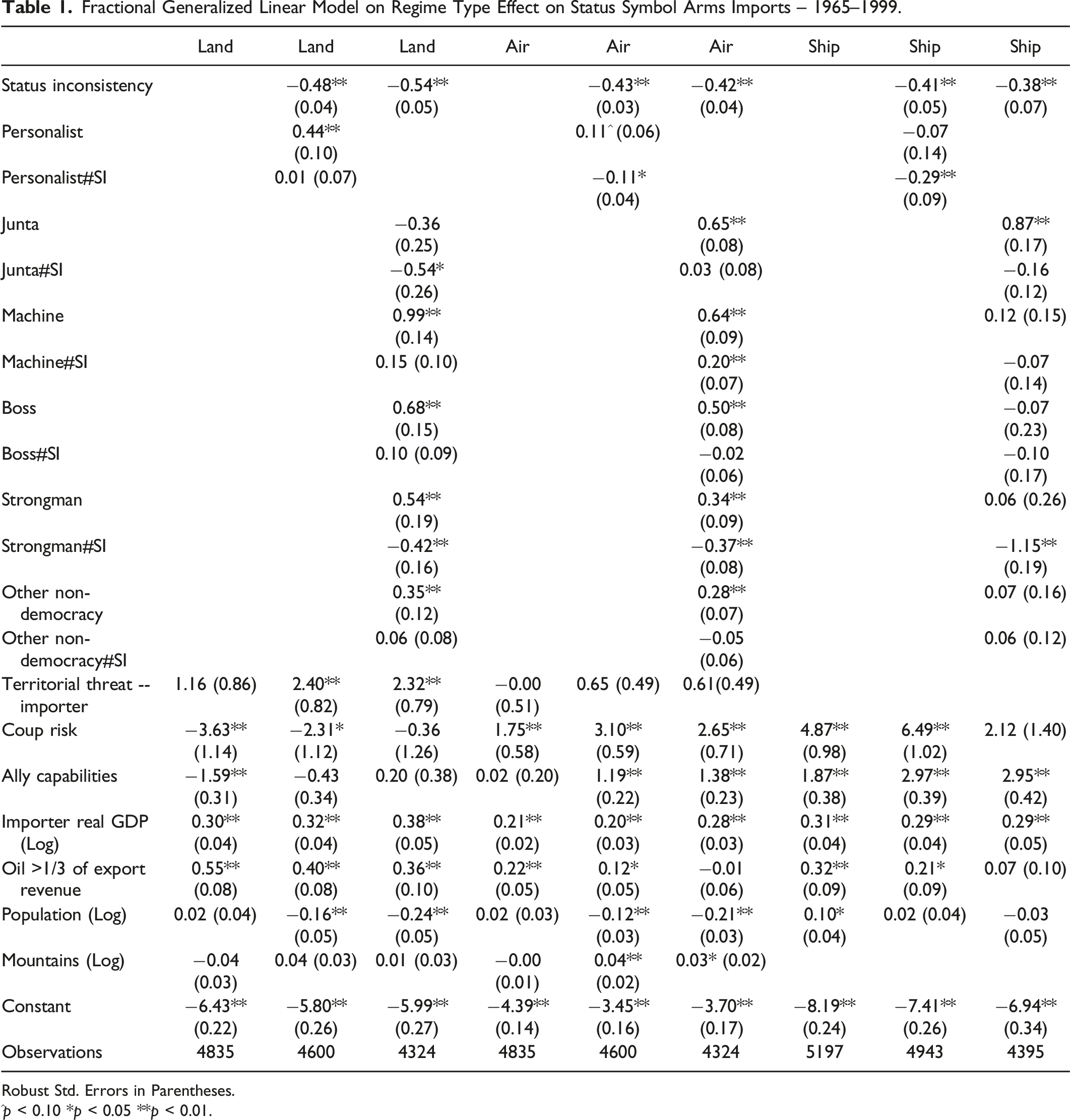
Robust Std. Errors in Parentheses.
^p < 0.10 *p < 0.05 **p < 0.01.
As our arguments involve SI, regime type, and their interaction, we discuss the results using plots of the interaction effects with 95 percent confidence intervals. We hold other regime variables at 0 and the controls at the mean. In the graphs in Figures 1 and 2, the y-axis is the proportion of status symbol arms transferred and the x-axis is SI. The dashed line represents if the relevant regime type is present. Interaction effects for personalist regimes and status inconsistency with 95 percent confidence intervals – 1965-1999. Interaction effects for regime type and status inconsistency with 95 percent confidence intervals – 1965-1999.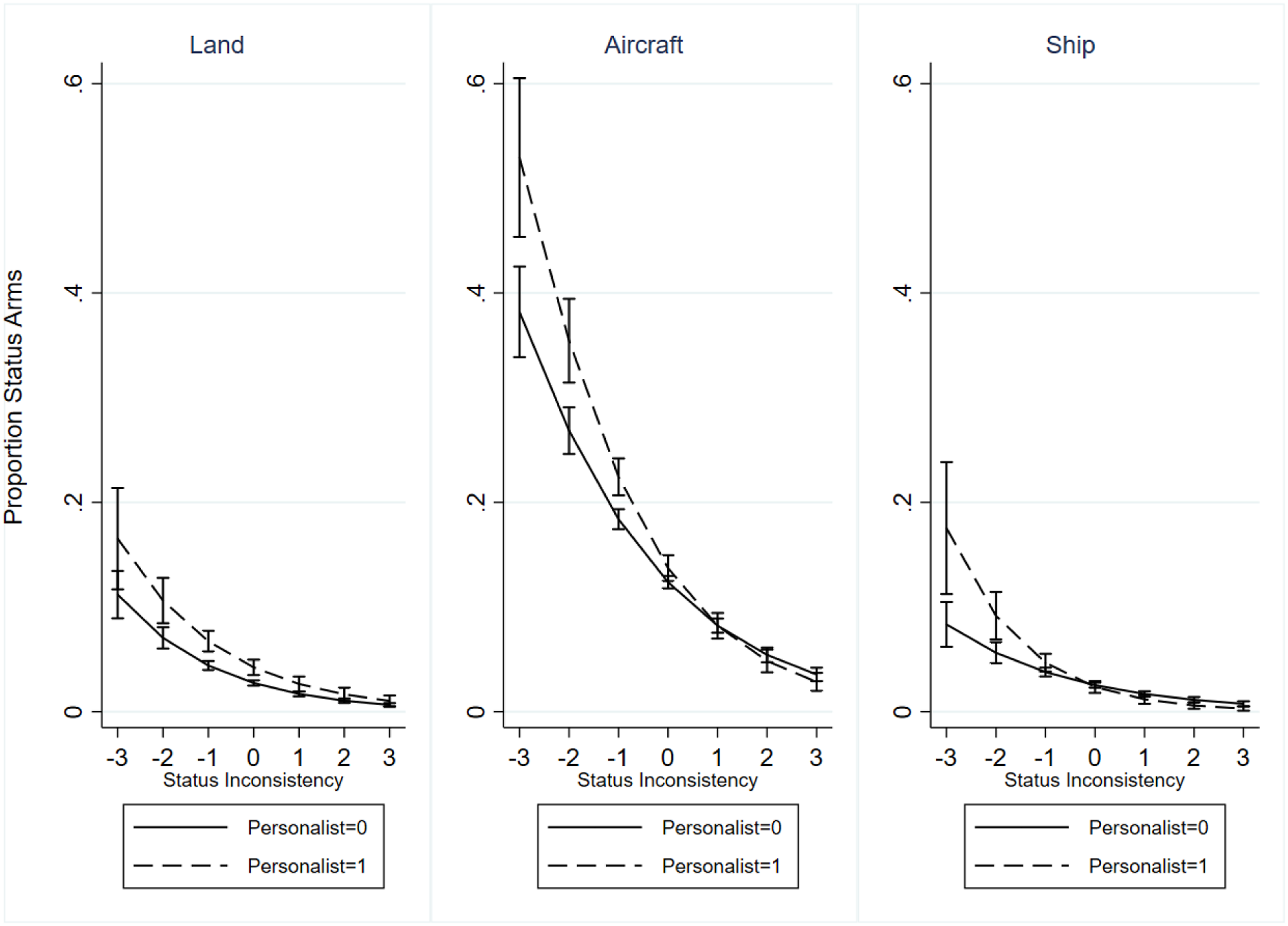
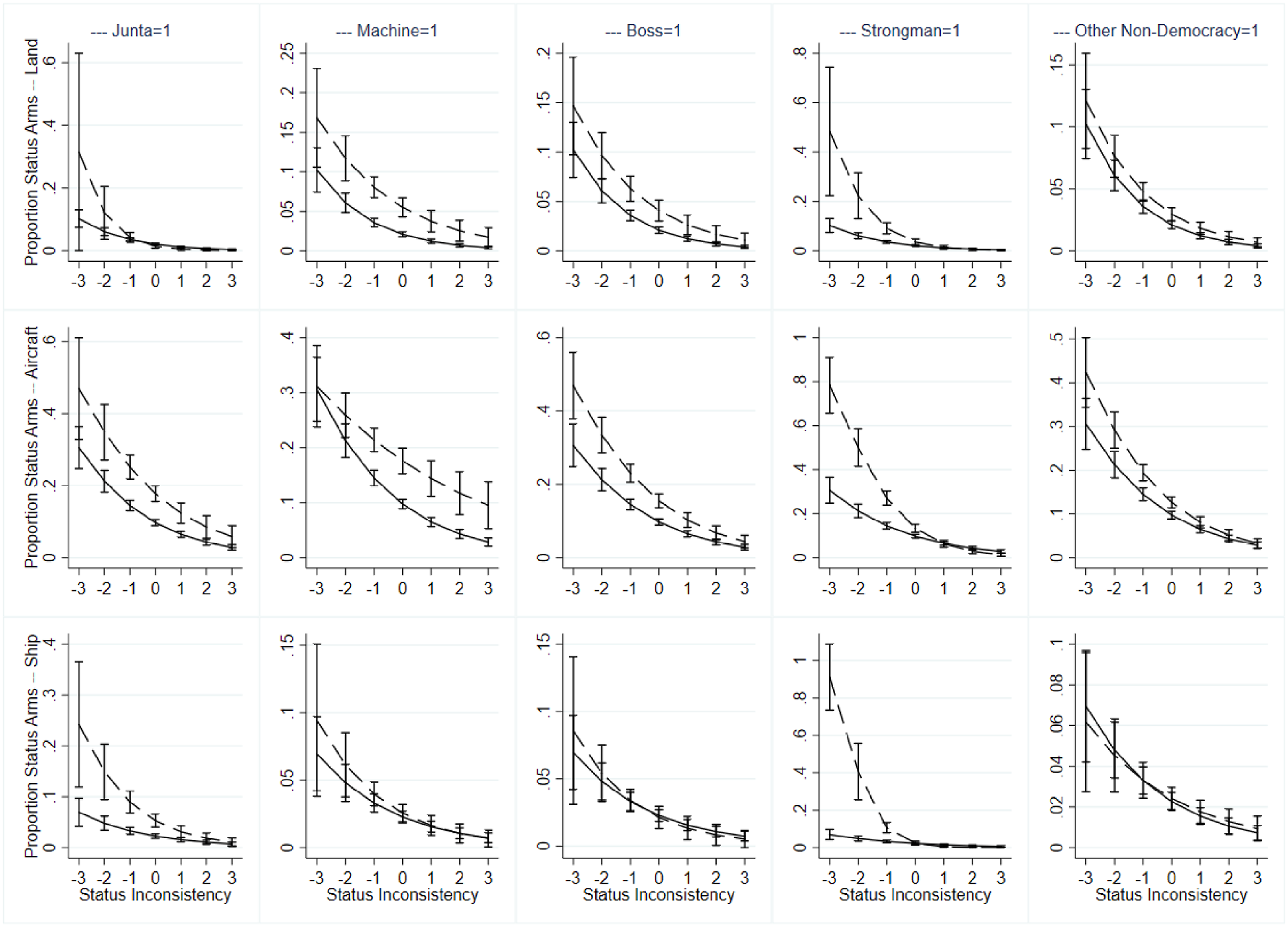
Figure 1 presents the graphs for the three personalist models and shows that personalist regimes with greater negative SI import a larger proportion of status symbol arms than other regimes. However, the substantive effects of personalist regimes vary in importance based on different status symbol weapon types. The dashed line and confidence intervals for personalist regimes are above the solid line over a majority of the range of SI for land weapons, partially in the aircraft graph, and only at the lowest SI in the ship graph. About 18 percent of land weapons, 50 percent of aircraft, and 18 percent of ships imported are status symbol types at the greatest levels of negative SI, which drops significantly when states become status consistent (when the x-axis is zero). Overall, Figure 1 supports Hypothesis 2 in the land weapon model. The other models show that negative SI impacts the proportion of status symbol weapon imports regardless of regime type, which again supports Hypothesis 1.
Figure 2 presents the SI graphs with the different non-democratic regime types. We note that the y-axis range varies across graphs. We organize the columns by regime type and rows by land, aircraft, and ships. We present all graphs in one figure as there are similarities across regime type and status symbol weapon categories. First, though the slopes vary, SI is an important factor in importing status symbol weapons across regime types, again supporting Hypothesis 1. Second, regime type is substantively significant in two of the three graphs for junta (aircraft and ships), machine (land and aircraft), boss (land and aircraft), and all three graphs for strongman. The other non-democracy graphs show significance for only aircraft. These differences, however, do not support Hypothesis 3: bosses do not import a greater proportion of status symbol weapons than strongmen, let alone other non-democratic regimes.
For land weapons in the top row, machine and boss regimes similarly import a higher proportion of status symbol weapons when SI ranges from moderately negative to slightly positive with similar levels on the y-axis. However, strongman regimes import a greater proportion of status symbol weapons. At greater levels of negative SI, the predicted proportion of status symbol land weapons is significantly higher than for other regimes. For status symbol aircraft, in the middle row, the predicted proportion of status symbol aircraft imports is quite similar across the non-democratic regime types except for strongman. These findings also occur with ships, except junta importing roughly double the amount of status ships and strongman regimes importing much more status symbol ships than the other regime types, including juntas.
It is noteworthy that Hypothesis 2, which compares personalist regimes, is supported, but Hypothesis 3, which also compares personalist regimes, is not supported. Strongman regimes import a greater proportion of status symbol weapons than boss regimes. However, negative SI boss regimes do not import more status symbol weapons than negative SI strongmen. One explanation is that strongman regimes are more concerned with international security than boss regimes. This explanation is supported by the fact that strongman regimes are more belligerent (Weeks 2012).
Discussion and Conclusion
The status literature suggests status-dissatisfied states, including negative status inconsistent states, are more likely to engage in conflict (East 1972; Galtung 1964; Lebow 2010; Maoz 2010; Midlarsky 1975; Renshon 2016, 2017; Volgy and Mayhall 1995; Wallace 1971, 1973; Wohlforth 2009). However, there are several reasons to believe negative SI states would take other actions besides or before conflict. For example, conflict is heavily resource-dependent and results are uncertain, which may reduce ascribed status. Also, other foreign policies may increase ascribed status (Bezerra et al. 2015). Our arguments and results suggest negative SI states engage in other behaviors besides conflict, which is significant because much of SI research has focused on conflict. Thus, negative SI affects foreign policy behavior beyond conflict.
We hypothesized that negative SI positively affects status symbol weapons imports, where personalist regimes import more status symbol arms than group regimes. Further, we hypothesized negatively status inconsistent Boss regimes import a greater proportion of status symbol weapons than Strongman regimes. Our results supported the former for land weapons and aircraft, but the results did not support the latter as both regime types import a similar proportion of status symbol arms.
Additionally, our results motivate additional research areas. First, does importing status symbol weapons increase ascribed status? Second, does more ascribed status come with these capabilities, or does the extended timeline necessary to set up an industry negate status considerations? Third, the linkages between importer-ascribed status and exporter choice may be important. Are there more status benefits from receiving weapons from a super-power, major power, or some other exporter? Does the underlying transaction – sale versus aid – influence status? Fourth, maybe other state behaviors, besides conflict and arms imports, affect SI. For example, it may be the case that SI states engage in cooperative behavior to balance SI. Fifth, do democracies also import status weapons? While personalist regimes import more status symbol weapons, it is still possible that some democracies import status weapons when negative status inconsistent. However, procurement patterns may lack transparency, or democracies may rely on different import processes than personalist regimes. 9 Finally, certain characteristics of SI could be more likely to lead to conflictual or cooperative behavior. For example, it could be the case that newly negative SI states are more likely to use cooperative behavior to assuage SI. In contrast, states that have long experienced negative SI may be more likely to engage in arms importation before conflict.
Supplemental Material
Supplemental Material - Boys and Their Toys: Status Inconsistency in Non-democratic Regimes and the Import of Major Weapon Systems
Supplemental Material for Boys and Their Toys: Status Inconsistency in Non-democratic Regimes and the Import of Major Weapon Systems by Richard Johnson and Aaron P. Shreve in Journal of Conflict Resolution
Supplemental Material
Supplemental Material - Boys and Their Toys: Status Inconsistency in Non-democratic Regimes and the Import of Major Weapon Systems
Supplemental Material for Boys and Their Toys: Status Inconsistency in Non-democratic Regimes and the Import of Major Weapon Systems by Richard Johnson and Aaron P. Shreve in Journal of Conflict Resolution
Footnotes
Data Availability Statement
All supplementary and replication material for this article are available online.
Acknowledgments
Earlier versions of this article were presented at the 2018 Annual Meeting of the ISA, the 2018 Annual Meeting of the EPSA, and the International Relations Reading Group at the University of Edinburgh. We thank all participants for helpful comments and suggestions. All errors remain our own.
Declaration of Conflicting Interests
The author(s) declared no potential conflicts of interest with respect to the research, authorship, and/or publication of this article.
Funding
The author(s) received no financial support for the research, authorship, and/or publication of this article.

Supplemental Material
Supplemental material for this article is available online
Notes
References
Supplementary Material
Please find the following supplemental material available below.
For Open Access articles published under a Creative Commons License, all supplemental material carries the same license as the article it is associated with.
For non-Open Access articles published, all supplemental material carries a non-exclusive license, and permission requests for re-use of supplemental material or any part of supplemental material shall be sent directly to the copyright owner as specified in the copyright notice associated with the article.
