




Abstract
How is the electoral behavior of minorities shaped by past violence? Recent studies found that displacement increases hostility between perpetrators and displaced individuals, but there has been paltry research on members of surviving communities. We argue that the latter exhibit the opposite pattern because of their different condition. Violence will cause cross-generational vulnerability, fear and risk-aversion—leading the surviving communities to seek protection and avoid conflict by signalling loyalty and rejecting nationalist movements. In their situation as an excluded minority in the perpetrators’ state, they will be more likely to vote for out-group parties. Exploiting exogenous battlefield dynamics that created inter-regional variation in the Palestinian exodus (1947–1949), microlevel measurements that capture the damage of violence, and an original longitudinal data set, we show that Palestinian villages in Israel more severely impacted by the 1948 war have a much higher vote share to Jewish parties even 70 years later. Survey evidence further supports our theory, revealing that this pattern exists only for members of the surviving communities, and not among displaced individuals. The findings shed new light on the complex social relations that guide political decision-making in post-war settings and divided societies that suffer from protracted conflicts.
Keywords
Introduction
Many studies on the legacies of violence and displacement have found that it leaves a lasting imprint on those involved. But what about the members of surviving communities who managed to avoid displacement? While previous studies focused on the displaced individuals, we contend that it is also important to look at the effect of violence on the communities of people who were ‘left behind’. 1 We argue that members of surviving communities exhibit a different political calculus than members of displaced communities due to their different circumstances. Hence, we posit that minority groups in post-conflict settings who were hurt more than others will be more likely to signal their rejection of ingroup ethnic movements and express their support for integration when they vote. Thus, they will vote for the parties affiliated with the majority, in contrast to prior expectations. As we will demonstrate in the next section, the legacies of survival 2 are a distinct political phenomena that has consequences for our understanding of various case studies.
What are the conditions that underline the effects of violence on behavior? Many factors may influence responses to violence, possibly creating members of surviving communities versus members of displaced communities, and posit that the experience of war alters their political calculus. We argue that exposure to violence leads to inter-generational vulnerability and shock that creates risk-aversive behavior and a tendency to signal loyalty in voting. Witnessing the violence may, as most studies suggest, lead members of surviving communities to resent the perpetrators and develop nationalist attitudes (Balcells 2012; Forster, Sheshkin, and Wald 2020; Hazdic, Carlson, and Tavits 2017; Lupu and Peiskin 2017). But while the members of displaced communities experiences the violence themselves will react to those emotions by translating them to behavior, we state that the members of surviving communities who were just exposed to the violence will not act on these feelings because they will instead be able to focus on reacting to their heightened fear in their electoral behavior.
In sum, our argument is populations that experience more violence exhibit more risk-aversion and therefore are more likely to support parties associated with the majority, when these populations are still in a subjugated state post-conflict. We will support our claim using the case study of Palestinian citizens of Israel (PCI), exploiting an instrumental variable that created inter-regional variation in exposure to displacement in the first Jewish–Arab war (1947–1949). We also use the wealth of untapped data on this war to measure the effect of violence in other ways.
Even with numerous controls, and for seven decades after the end of the war, we find that there is indeed a strong, significant, and robust inter-generational negative relationship between different measurements of exposure to violence and the vote share for ethnic parties among the PCI. In other words, there is the equivalent of a positive relationship between violence and the vote share for parties affiliated with the Jewish majority. We detail the dynamic nature of this relationship and changes over time in it, showing that it increased in strength after the politicization of national memory after 1995. Even as all PCI communities were swept away towards nationalist parties, a consistent gap existed between those who were exposed to violence and those who were not. We also provide a detailed discussion explaining why we think this result is not produced by selection bias at the regional, village or individual level. We then provide microlevel exploration of intra-community divergence, exploiting over a dozen nationally representative surveys of the PCIs. These reveal that our findings replicate in survey questions on voting, but that the relationship only exists among descendants of non-displaced individuals that were exposed to the violence but were not directly damaged by it.
Our findings have important implications for not only research into the legacies of violence but also the literature on minority–majority relations, ethnic minority politics, and the politics of ethnically plural societies. Many conflicts leave fragile minorities in fractured states, and we provide an original observation and explanation of the persistent effects of the violence in these conflicts on the electoral behavior of these surviving minorities. This study thus contributes to the literature on the legacies of violence by encompassing the targeted group’s vulnerabilities and their effects on decision-making. We develop new theoretical explanations for the impact of the legacies of survival by synthesizing previous approaches, and we offer a framework based on the logic of survival as a separate phenomenon with distinct legacies. We will explain the divergent effect of violence in settings where the targeted group is a minority and look at how the changing political and social circumstances alter the effects of violence over time. The case of the PCI is an understudied one that encompasses unique empirical opportunities that caused the recent resurgent interest in it (see Arnon, Mcalexander, and Rubin 2021; McAlexander 2021). We also contribute to the civil war literature by showing that the economic cleavages can actually restrain the mobilization of ethnic minorities when they are extreme and are accompanied with severe violence and repression. Our findings shed light on how ethnic kin networks will be weaker than familial and communal social networks, and will have a weaker impact on ethnic nationalism, due to the fracture that different experiences of violence create between the surviving and diaspora groups and among them. This challenges the view that sees these ethnic groups as homogeneous, revealing surprising cross-generational heterogeneity in preferences deeply rooted in historical experiences. This helps us understand the political complexities of post-war states and deeply divided societies, which is necessary for the successful termination of protracted conflicts.
The paper includes seven additional sections. The next section discusses the emerging literature on the legacies of violence and describes our approach and how it fits in with the literature before moving to explain the persistence of the expected effects and detail our hypotheses. We then review our case study and the reasons for its selection. The next section focuses on the operationalization and measurement of our main variables, including justifications for the exclusion restriction of the instrumental variable. Finally, we include our analysis and main results and reviews how they change over time. Finally, we discuss the results, their importance, and what we can learn from them for other case studies.
Theoretical Framework: The Survival and Sacrifice of Persecuted Minorities
How can we explain the effect of the war on on the political behavior of communities that survived displacement? We argue that the literature on the legacies of violence offers important insights but suffers from problems and gaps that prevent it from fully explaining such situations. Different conditions and wartime experiences will lead to different behaviors after violence. We will thus contend that a new theory is required that recognizes that the effect on members of surviving communities is different, based on the legacies of survival framework. Explaining the effects of violence in these situations is necessary to understand the behavior of many minorities, like the muslims in India and African Americans in the United States—groups that avoided displacement and are pushed toward less risky political choices because of the intergenerational risk-aversive behavior the violence creates (Jha and Wilkinson 2012; Williams 2021).
From the Legacies of Violence to the Legacies of Survival
One apparent area of research that might help explain the behavior of surviving minorities is the legacies of violence—an emerging body of research in peace science that explores the long-term political legacies of violence, particularly on political attitudes and behaviors. There is a long line of research about the effects of violence on political behavior in the immediate (Getmansky and Zeitoff 2014) and medium (Grossman, Manekin, and Miodownik 2015) length, as well as on economic behavior in the long-term (Nunn and Wantchekon 2011). But the most recent development is an explosion of new studies like those cited below into how violence can have persistent, intergenerational electoral and attitudinal effects. Studies found that even decades after it subsided, violence can alter the political decisions of the people involved. 3
Despite its promise, this body of literature is still at a fledgeling stage, and it suffers from problems that limit its generalizability and application to new cases. Studies on the legacies of violence have focused on its effect o violence on displaced people (Hazdic, Carlson, and Tavits 2017; Lupu and Peisakhin 2017; Nunn and Wantchekon 2011) or the involved perpetrators and profiteers (Acharya, Blackwell, and Sen 2016; Charnysh and Finkel 2017; Homola, Pereira, and Tavits 2020). In the case of the Palestinian exodus, for example, the displaced communities are clear: displaced Palestinians, including those who still live in refugee camps in the occupied territories, 4 in surrounding countries, and those that still live in Israel as internally displaced people. But the literature has mainly ignored the effects of violence on a third group—those who survived as a community and managed to avoid displacement. Such surviving minorities are in a distinct situation, and usually such bystanders are the largest group in wars. This raises the question of whether they follow the same patterns of increased ethnic voting?
Studies on ethnic violence and repression may offer some insight, but they cannot fully address this question. Hazdic, Carlson, and Tavits (2017) found that, in Bosnia, ethnic violence increased the vote share for ethnic parties among the different ethnic groups. They argued that wartime violence solidifies ethnic identities and fosters intra-ethnic cohesion, leading to an increase in ethnic parties vote shares (ibid: 345). But those Bosnian communities could express these attitudes in voting because their collective rights are protected in the nation-state that was created following the war. We contend that surviving minorities in fragile and vulnerable positions, will abstain from translating such effects into votes because they will want to protect themselves and avoid the risk of more violence. Displaced individuals that experience the violence themselves will not be able to do that, despite the fear that violence leaves, because their experience will lead to very high animosity—enough to trump any feelings of fear. Similarly, members of surviving communities that were just exposed to the violence will also feel both animosity and fear—but they will be able to choose, in their precarious position as a persecuted minority, to act pragmatically to increase their security—thus prioritizing a reduction in fear.
Lupu and Peisakhin’s (2017) insightful research is a rare example of a focus on such a minority group: the Tatars in Crimea. They were displaced by the Soviet Union, and as the study found, the violence increased resentment toward Russia across generations, despite the Russian control of Crimea (2014). However, this relationship was only measured in attitudes, not behavior, and they were the direct victims of the violence. Our explanation follows a theoretical idea briefly suggested by them—the underlying mechanism is a “defense mechanism to protect their social group” (ibid: 838–9). While attitudes that strengthen social cohesion by supporting collective remembrance and developing animosity toward the perpetrators may consolidate the social group, as they claim, we would contend that the group still needs material resources and protection from violence in order to continue to survive. We posit that the communities that were hurt most thus sacrifice this animosity when they go to the polls because of their need to appease the majority by voting to parties affiliated with it.
Studies of political repression in totalitarian regimes have found evidence supporting this expectation. Wang’s (2019) research on China found that violence increased hostile attitudes toward the perpetrator but decreased actual contentious behavior. Rozenas and Zhukov (2019) showed that Stalin’s terror regime increased loyalty to him until the threat of further repression diminished, after which hostility increased. But in the experience of minority members of surviving communities, there are facets that are not captured in the literature on political repression. Members of surviving communities were left vulnerable because of the shock caused by violence, and they experience effects because of exposure to it. This is due to their transition to a minority group, drastic political changes, and losses experienced from the violence. During the chaos of war, these individuals quickly find themselves in a completely different setting than previously or that they expected. Living as a minority group after violence is eventually and inherently dissimilar to living as a majority ruling group, even if they both experience repression. The violence that minorities experience is also not similar to governmental repression that uses economic and administrative tools, and minorities that reside in a democracy after the violence have different considerations than individuals in totalitarian regimes.
Communities that survived external displacement suffer from violence and the damages it encompasses, and were exposed to the violence in different levels of intensity. However, since they were not displaced but rather witnessed the displacement of their neighbours while becoming a persecuted minority, the impact of this violence can be different than the impact on other communities. That is why the most accurate description of the process experienced by surviving minorities diverges from past studies. The literature on the legacies of political repression or ethnic violence are insightful but do not provide an adequate explanation. We argue that it might be most fruitful to integrate ideas from these and see it as separate stream—the legacies of survival—that will help us explain modern minority politics in post-conflict settings.
Survival and Electoral Choice
We are that it is important to focus on the members of surviving communities who avoided displaced, and within them identify variation in the intensity of the violent experience and distinguish between two groups of communities: those who were exposed to and indirectly affected by the violence, but managed to avoid displacement, and those who were not exposed to the violence in the same way and remained. We argue that minority communities that survived violence in the form of displacement or cleansing, will vote in a different way than groups that were less effected by displacement. In particular, we expect them to vote less for ethnic parties and more for parties affiliated with the dominant majority. Our approach is that the impact of violence depends on the macrolevel context, and present a context in which it increases outgroup voting. Our argument is that populations that experience more violence exhibit more risk-aversion and therefore are more likely to support parties associated with the majority, when these populations are still in a subjugated state post-conflict.
We offer two intertwined mechanisms that could cause this relationship, which are based on explanations from economics and ethnic politics. Due to the limited scope of this study, we do not directly test if these mechanisms are supported empirically, but since these are the theoretical intuitions that led us to the hypotheses we will draw them out here. While they offer two different perspectives, the underlying logic is in both cases that violence induces risk aversion and a need to protect the social group (Kibris and Uler 2021).
Jha and Wilkinson (2012) found that violence creates long-term economic poverty and interdependence between groups. This puts the surviving communities that were most affected by violence in a vulnerable position, which can improve with the aid of governmental patronage. By voting for parties affiliated with the dominant majority and rejecting ingroup ethnic options, a minority signals its loyalty to the majority. It gains a voice that allows it to assure the existence of its rights and so protect itself (Hirschman 1970). Past violence will induce such a community to choose loyalty over exit because it will minimize the group’s aptitude for risk-taking. Despite the troubled past relationship these communities have had with the government, they are more likely to cooperate with it than communities that weren’t exposed to the violence. This is because surviving communities that were hurt need governmental assistance and patronage more, they will be more dependent, while the communities that were not exposed to displacement can withstand the need for assistance and survive more independently, giving them the privilege of voting for ingroup ethnic parties that are seen with contempt by the outgroup majority.
Additionally, members of surviving communities have seen the damage the outgroup can inflict on them in conflict, creating an increased sense of insecurity that transmits to future generations. Such a belief is not unreasonable; nationalist mobilization and the electoral choice of minorities have been found to predict violence against minorities (Kopstein and Wittenberg 2018: 22–42). If the members of surviving communities do support an exclusionary ethnic minority party, they risk initiating a process of ethnic outbidding that will put them at severe risk. Even a single ethnic-nationalist party can induce this process and so give rise to extreme ethnic divisions while at the same time undermining democratic stability (Chandra 2005: 235). This combination will be perilous for the surviving minority due to the increased risk of violence in such a setting. Non-displaced individuals exposed to violence, who are most insecure and risk averse, will thus be less likely to support such a party and instead support parties that encompass multidimensional moderate identities (ibid: 241). By voting for centrist parties affiliated with the majority, even if they recruit votes from the minority, the members of surviving communities gain achievements in issue areas that matter to them without changing the rules of the game. The classical ethnic outbidding model assumes that ethnic minorities will vote for ingroup ethnic parties because they have intense preferences on ethnic issues that “will make them risk-acceptant” (ibid: 237). Because the experience of past violence makes individuals risk averse (Kibris and Uler 2021), it will prevent them from voting for these parties.
From Survival to Legacy: Why Historical Effects Persist
Even if the effects of violence on surviving ethnic minorities suit this argument, why would it persist and transmit across generations? A central innovation in legacy studies is the focus on effects that span decades and even centuries. But such measurement necessitates a substantive theoretical basis that explains why these effects continue for decades. There are numerous mechanisms that could explain historical persistence (Walden and Zhukov 2020), some of which apply to our case study.
First, economic effects might be cross-generational. For example, during the war and immediately succeeding years, the state of Israel seized a large amount of land from Palestinians and used it to create new Jewish villages. In an agrarian society that places special meaning and relies economically on its land, losing it has a significant impact. Because wealth of land is mainly transmitted via cross-generational inheritance, new generations will continue to have different economic patterns that are associated with the violence. The Palestinian community in Israel was such a society, at least until modernization began. The war created a pattern of structural inequality and dependence that was institutionalized and thus persists. Members of surviving communities are those that did loose land themselves, unlike the displaced individuals, but they would be part of the same cohesive village community with those who experienced dispossession. The village as a unit would be left economically weaker in the long term and this will necessitate governmental support—which can be achieved through ruling party patronage.
A second mechanism is socialization. There is a wealth of studies examining how political attitudes transmit from parents to children. Scholars have found that traumatic experiences are among the most likely to be transmitted powerfully and effectively (Plagi, Shrira, and Ben-Ezra 2015: 95). The shock created by violence causes lasting anxiety among those who experienced it, and that induces attitudinal and behavioral shifts. These later impact descendants due to family discussions and parental instruction. Persuasion by members of the community and organized rituals that repeatedly recall the violence and its losses cause members of the community who were not directly exposed to the violence, like descendants of displaced individuals, to adopt its legacies (Checkel 2017: 592).
Theoretical Expectations
All of the hypotheses are focused on the PCI as an example of a group that survived displaced and became a minority in a hostile state. The general expectation, as we explained previously, is that in this situation, violence decreases the vote share of ethnic parties. But there is a lot of variation in violence, and it has many different effects, so this relationship can be tested in several ways. First and foremost, our empirical strategy exploits inter-regional qualitative and quantitative variation in violence used by the Jewish forces as a result of instrumental political dynamics during the war. We expect that residents of areas that experienced ethnic cleansing 5 or a stronger intensity of violence will be less likely to vote for ethnic parties.
There will be a higher vote share for parties affiliated with the ruling majority and a lower vote share for ethnic minority parties in areas that were exposed to ethnic cleansing.
There will be a higher vote share for parties affiliated with the ruling majority and a lower vote share for ethnic minority parties in areas that were exposed to more intense violence.
Our argument lies on the cross-generational vulnerability that violence and displacement create. This vulnerability has many different facets, like human and material loss. If there was greater vulnerability created by the violence, there will be a greater sense of insecurity that drives votes to the majority group’s parties. The damage of the exodus and exposure to violence manifest in various ways that all ultimately lead to this vulnerability. For example, there is a material loss from the lands taken during the exodus by the perpetrators’ governments and human loss from the displacement of many co-ethnics. Additionally, the surviving communities remain isolated and, due to depopulation, lose the security of support from neighboring villages. This is particularly important because communal isolation has been found to increase collective resistance to repression in the West Bank (Gade 2020), but the isolation created by the exodus could have a contrasting impact on PCI. This vulnerability could lead to votes in support of the ruling Jewish majority in return for state patronage, but such integration could paradoxically also enable civil resistance to the state (Zeira 2019), which further challenges our expectations.
More land lost by a village in the war will be associated with a greater vote share for parties affiliated with the ruling majority and a lower vote share for ethnic minority parties.
More people being externally displaced in an area will lead to a greater vote share for parties affiliated with the ruling majority and a lower vote share for ethnic minority parties.
The greater the share of villages entirely displaced in an area, the greater the vote share to parties affiliated with the ruling majority and the lower the vote share for ethnic minority parties.
Another way to measure exposure to violence is to observe the contact with displaced individuals. Group members who managed to avoid displacement did not experience it themselves but will be exposed to those who were internally displaced and resettled in another village. We expect that such an exposure will cause those individuals to more fully comprehend the fragility of their situation and the risk of future violence, leading to more moderate voting.
6
The more internally displaced persons (IDPs) in a village, the higher the vote share for parties affiliated with the ruling majority and the lower the vote share for ethnic minority parties.
Studies on political repression in totalitarian regimes found that past economic punishment caused less contentious voting only when the threat of further repression existed; when it subsided, past repression was actually correlated with increased hostile behavior (Rozenas and Zhukov 2019). We accordingly expect that the effects of violence will be more pronounced in times of increased government repression and expulsion. The threat will seem most real to members of surviving communities in those times. In the Israeli case, we consider the military rule over the PCI (1948—1966) as a time of increased repression and the time since the Oslo process (1992—1995) as a time of increased threat of expulsion.
The electoral legacy of violence will be stronger in times of increased governmental repression and threats of expulsion.
After Cleansing: The Palestinian Exodus and the Palestinian Citizens of Israel (PCI)
The PCI are tangled in a fascinating position and we focus on a puzzle in their behavior, based on the previous theoretical discussion. On the one hand, they are the co-ethnics of the Palestinians living in the occupied territories and diasporas, and most see themselves as belonging to the Palestinian nation; on the other hand, they are citizens of Israel who expect equal rights, and many desire better integration into Israeli society. This situation is further complicated by their history, particularly the 1947—1949 war that continues to affect interethnic relationships in Israel. These PCI are the descendants of those hurt during the war, but unlike their counterparts across the 1949 Armistice border, they managed to avoid external displacement. Since 1948, they have become an array of vulnerable communities that live in a state dominated by a Jewish majority who are, in their eyes, the perpetrators. They are thus a good example of the theoretical framework we outlined and can be used to test our hypotheses.
Arabs and Jews have lived in Israel/Palestine under Turkish and British rule for decades with varying degrees of coexistence and violence. But the growth of the Zionist movement in the late 19th and early 20th centuries has created increasing strain between the groups. The Jewish holocaust during World War Two and the waves of displacement it created gave a significant boost to the Jewish migration, until 1947, when the UN decided in Resolution 181 to end the British mandate and partition the land between the ethnic groups, creating two new states: Jewish and Arabic (see Figure 1). The resolution was followed by an immediate breakout of intergroup and state violence. During the war, the Jewish militias made significant territorial gains that eventually forced the Arab states supporting the Palestinians to end the war and allow the creation of a Jewish state on major portions of the land, including areas with large Palestinian populations and ones assigned to the Arab state according to the partition plan, as can be seen in Figure 2. UN proposal for the binational partition of Palestine (1947). The armistice borders after the first Jewish—Arab War (1949).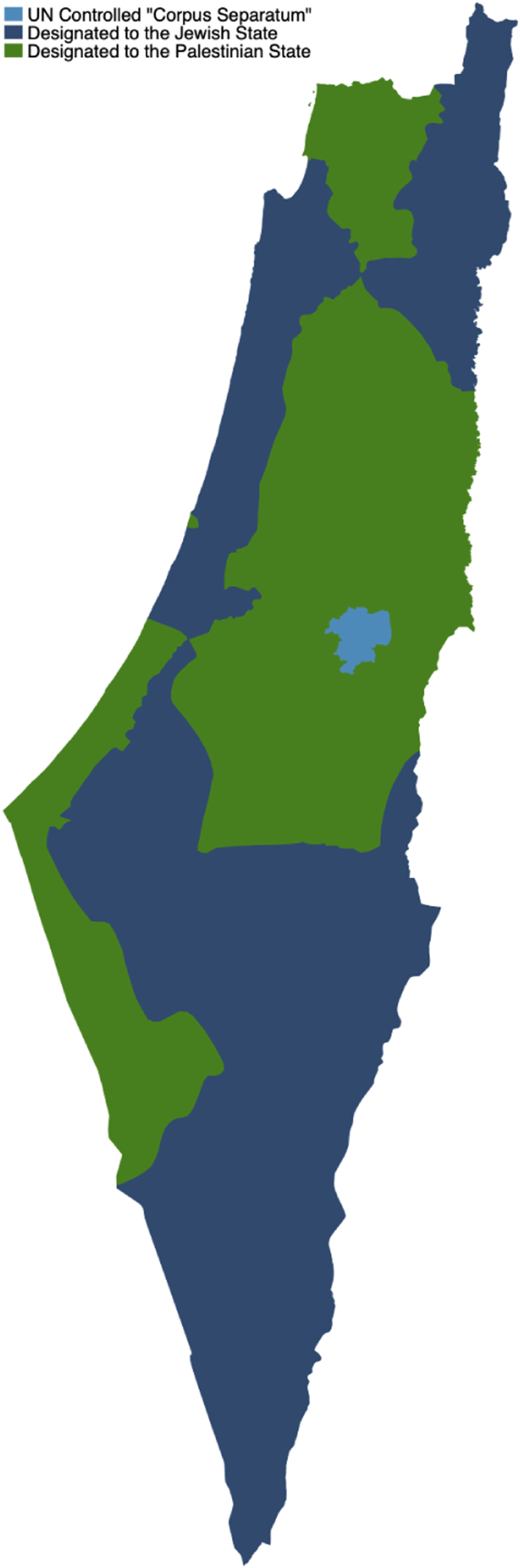
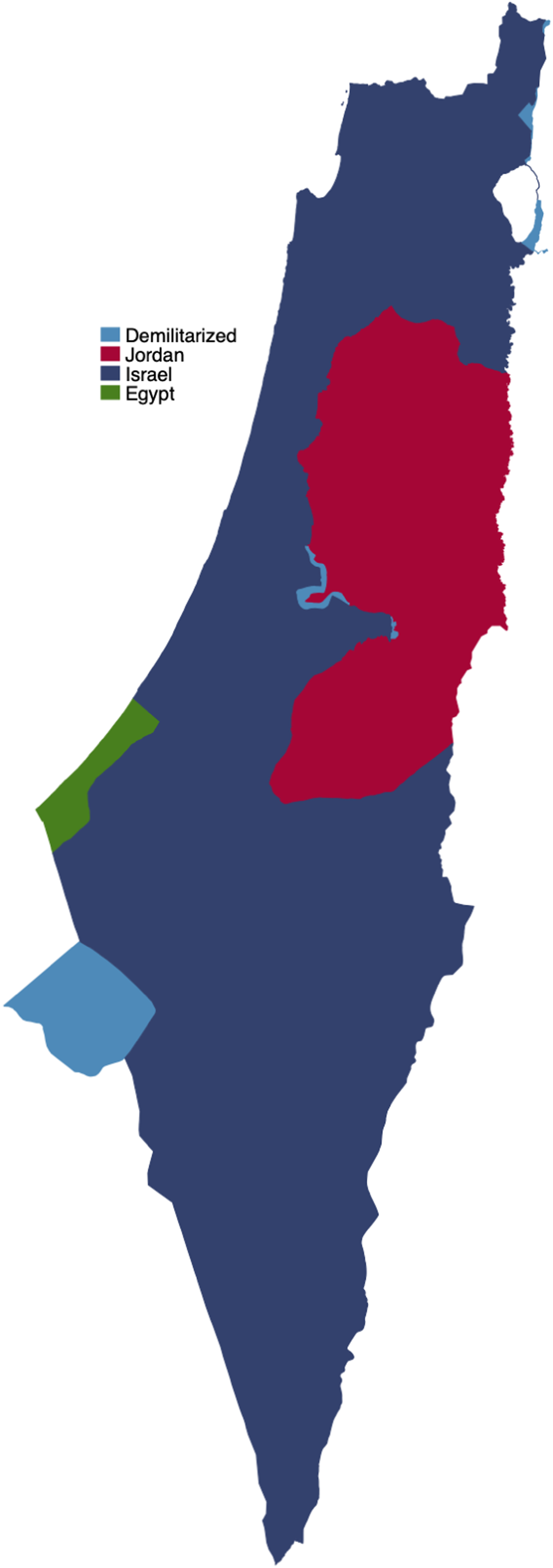
The wartime events stand at the center of a historical and political debate between the Palestinian and Israeli narratives. The common Israeli viewpoint is that while the Jewish leadership accepted the partition plan, the Arab leadership rejected it and started the war. It argues that the exodus was caused by a voluntary flight of citizens and places the responsibility for the exodus on the Arab leadership that took failed steps and then refused to accept their consequences (Avineri 2011). Over time, a more critical narrative, that recognized the forced displacement of some villages, began to appear. This was led by some Israeli historical research and since 2000, Israeli textbooks have begun to accept this critical narrative (Nets-Zehngut 2013: 41).
The narrative promoted by Palestinians, together with some Israeli historians, emphasizes the use of violence in the displacement and its importance to the overall intentional strategy of ensuring favorable demography to the new state of Israel. They argue that part of the military strategy of the Jewish forces was to methodically cleanse Palestinian villages after their capture by forcing their inhabitants to leave and in many times blowing up their houses, or by scaring Palestinian to flee by carrying out massacres (Arnon, Mcalexander, and Rubin 2021; Morris 2004; Pappe 2006; Raz 2021)
The Palestinians who managed to avoid displacement to external territories became members of a new minority in the newly created state of Israel. They experienced different relationships with the government and the majority group over time. Until 1966, they were under close supervision by a military regime that applied only to them and not to the Jewish residents of Israel (Lustick 1980). After this regime was abolished, they came closer to the state, becoming “Israelized” in a process of growing inclusion (Samooha and Peretz 1981). But by the end of the 20th century they were immersed in the development of a Palestinian identity, and their relationship with the government once again strained in 2000 after large demonstrations, as part of the Second Intifada uprising, were met with a violent response. In 2018, the parliament passed the Nation-State law that made clear the exclusionary approach of the government toward the PCI. It emphasized that Israel, while democratic, was the nation-state of only the Jews and formally strengthened the Jewish character of the state and decreased the status of the Arabic language.
There is an additional critical juncture in 1995. Several parallel processes came into effect then that may have exacerbated the difference between the cleansed. Firstly was the end of the First Intifada (1987—1993), during which Palestinians and PCI demonstrated and were met with a hardline approach from the government. Also, the threat that the PCI villages would be given over to a Palestinian state became realistic as the Oslo process gathered momentum and the Palestinian authority was created.
More importantly, the distinction between ethnic, ‘nationalist’ approaches and ‘moderate’, inclusion-driven approaches has grown, forcing all PCI to take a position. On the one hand, a wave of Palestinian nationalism emerged with the creation of the Palestinian Authority, the recognition of the Palestine Liberation Organization as the official representative of the Palestinian people, and the nation building process that ensued parallel to the Oslo process. This wave of nationalism included a process of Palestinization of the PCI and a the developments of a Palestinian national memory, increasing the awareness to the events of the Nakba—the Palestinian exodus. Also in those years, the Palestinian parties increasingly became a distinct and oppositional platform. In previous election cycles, the PCI had to choose between satellite ethnic parties that served the majority, Jewish parties, and communist parties. However, in 1988, the Arab Democratic Party (ADP) run as an independent Palestinian party after it split from the zionist Labour party, and in 1995 the National Democratic Assembly (Balad) ran as a party with a pan-nationalist ideology. Thus, the PCI had the option to vote directly for ethnic nationalist parties. Some of these parties also helped the dovish minority coalition that existed between 1992 and 1996, shading light on the utility of taking part in government. To summarize, in Hirschman’s (1970) framework, the choice between voice in the form of cooperating with the Jewish parties and exit in the form of secession became much clearer.
Data and Operationalization
Dependent Variable—Vote Share for Parties Affiliated with the Ethnic Minority
The data collection process that was used to obtain the voting records is described in section A1 of the appendix. Distinguishing the parties that are a (in the eyes of the ethnic majority) contentious choice of the minority and those that are moderate and majority-friendly is not always easy in a changing political sphere. In the first election cycles, the only options for a party to represent the PCI minority on an ethnic basis were lists of candidates formed by the ruling Jewish parties (e.g., these parties would cooperate with the government and be practically controlled by the Jewish majority parties). In contrast, the contentious choice would be the interethnic communist parties (Maki, and later, Racach), which fiercely opposed the ruling government and demanded equality. These parties were a combination of the Jewish and Palestinian communist parties, and they remained separate even with the united front. We thus coded the Israeli Communist Party as the ethnic-minority choice and Jewish parties, including the Arab lists affiliated with them, as the majority-affiliates parties (before “true” PCI parties were created).
7
. It is important to mention that in 1965, the PCI attempted forming a nationalist ethnic party, but it was barred from running in elections
8
In the same year, Racach broke from the communist party and formed a socialist party comprised mostly of Palestinians. In 1995, The National Democratic Alliance, Balad, was created as an ethnic party with a nationalist ideology. We calculated the share of votes cast for such ethnic parties versus the share cast for Jewish and affiliated parties. We are aware that a strong distinction between the nationalist ethnic parties of the minority and the others existed more clearly in the last 30 years, we take that into account in the next section’s analysis as we explain the difference in effect sizes over time. Figure 3
9
presents the district-level spatial dispersion of the votes in some and notable election cycles. In the 112 PCI villages in Israel, the all-time average vote share for parties affiliated with the PCI minority is 57.17% (standard deviation (SD) = 29.497). The largest such vote share was in 1969 in Nein, Tamra, and Uzeir, which are at the Nazareth subdistrict, where all the voters chose ethnic nationalist parties. Spatial dispersion of vote share for ethnic parties in notable election cycles (1951–2021).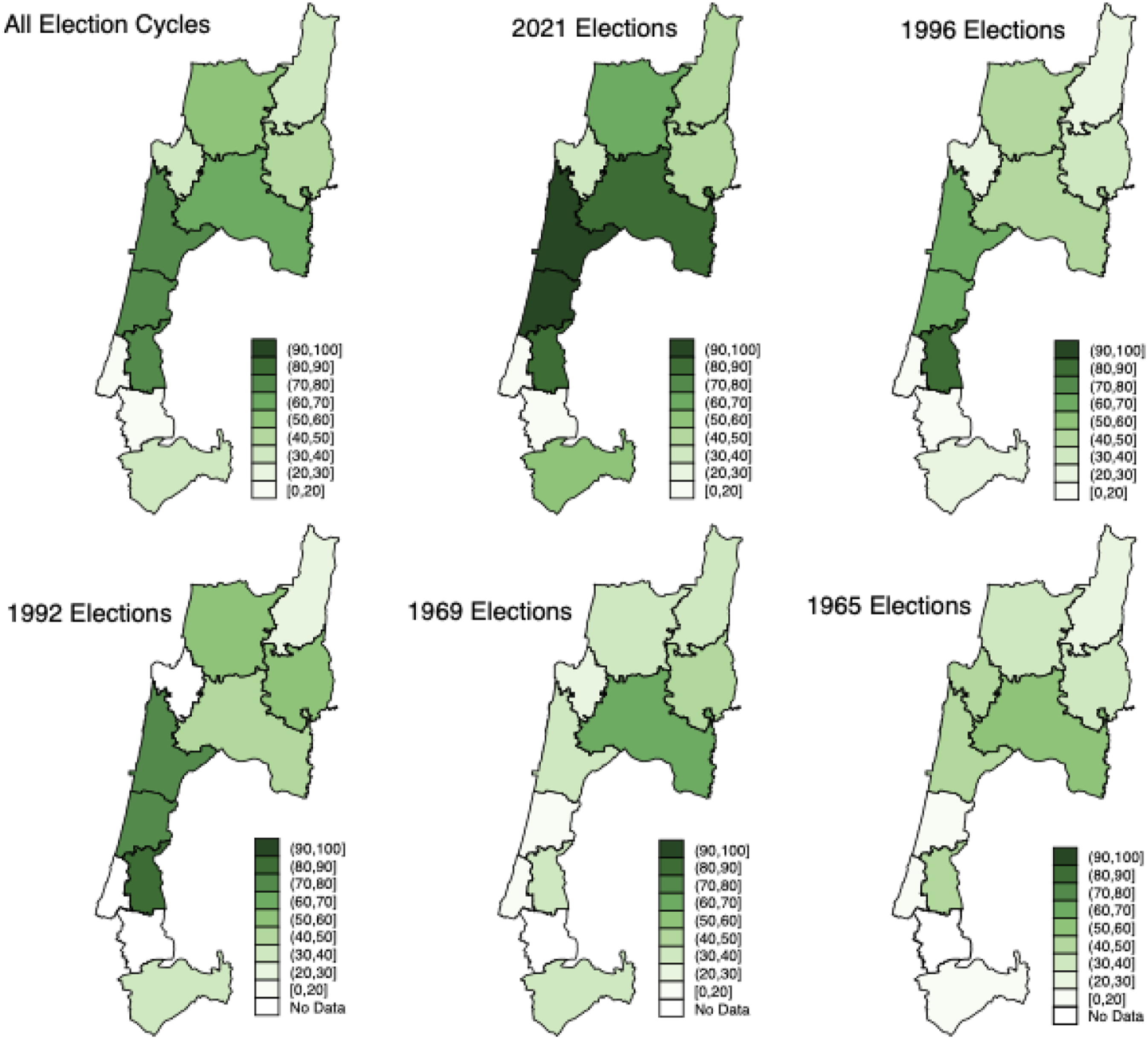
It is important to note that we focused only on voting in homogenous communities that are comprised entirely by the minority. It is obvious that, overall, in areas where members of the ethnic minority were systematically cleansed, there will be fewer votes for any minority party - because there will be fewer members of the minority there. We only observed the voting patterns of homogeneous minority villages and measure the proportion of votes for each party in these villages and so we looked at how the experience of cleansing affected electoral patterns by changing behavior, not merely by altering the area’s demographics. Palestinian villages in Israel have always been homogenous, as Jewish settlers mostly lived in separate, newly-created villages before and after 1948, if not in cities. These homogenous Palestinian villages significantly grew since the war, and some became cities, but they remained homogenous due to the high social segregation in Israel. About 25% of the Palestinian citizens of Israel live in large, mixed cities while the rest live in these homogenous communities, and post-war mobility between these is relatively low because of the strong family-based and geographically-tied structure of the Palestinian society. Future research needs to explore how the legacies we study play out in cities, and our results do not generalize to them.
Independent Variables
We focused on several independent variables that relate to the violence in the war in a few different ways, and thus, we capture more holistically the events of the war and ensure the robustness of our results. First, we directly examined inter-regional variation in the exodus using a direct and instrumental measurement. We then used four regional and village-level variables that capture the results of the violence. Figure 4 presents the spatial dispersion of some of the variables over different areas of Israel. Spatial dispersion for different exposures to violence (1947–1949).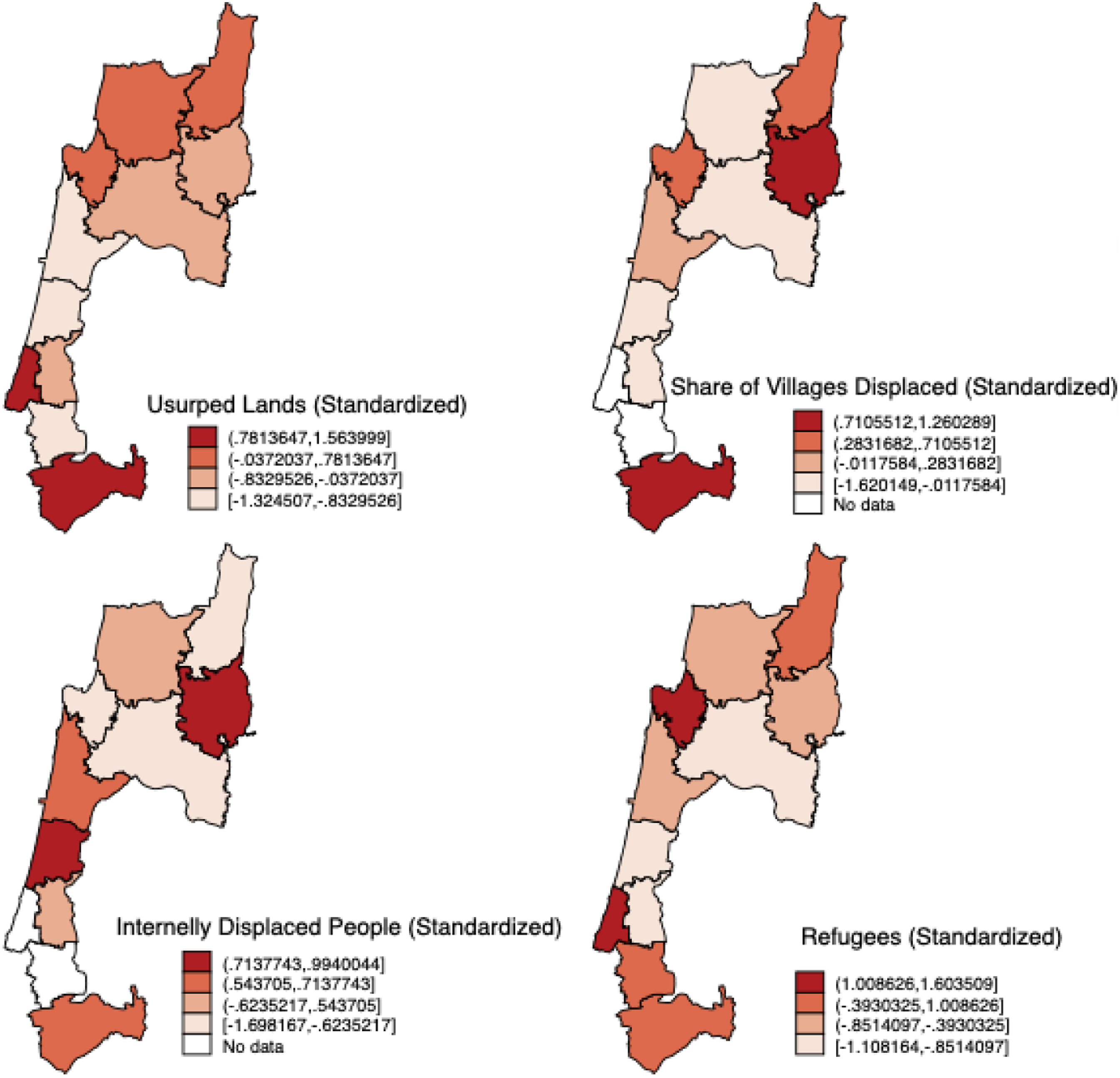
Cleansing
During the first Jewish-Arab war, both sides attempted to gain control over as much territory as possible. The Israeli forces were particularly successful, and they strove to make the areas as ethnically homogeneous as possible in order to ensure territorial control and the nation-building process, at least according to the more critical narratives. As a result, some areas were cleansed while others were not, as previously mentioned. All areas were hurt in one way or another in terms of population displacement and seized lands, and we captured that variance with the variables reviewed next, but there is also a difference in whether an area was actively cleansed. The reason some areas were not cleansed could be related to an Israeli decision, like in the Nazareth area in which expulsion was stopped by the prime minister over fears of an international response (Morris 2004: 419–421). In other places, it was out of Israeli control, like in the case of The Triangle 10 that was under Arab control in the war and never occupied but was transfered to Israel in the negotiations. We determined whether a subdistrict was cleansed based on the occurrence of an active cleansing operation, which resulted in widespread flight that is more pronounced than in areas without cleansing, where flight was less extensive. We rely on the definition of Lichtenheld (2020: 258) for ethnic cleansing as a collective and permeant displacement of civilians to areas outside the cleansed territory. The binary variable that we created separates villages in areas coded as cleansed, which were given the value of 1, and villages in non-cleansed areas, which were given the value of 0 (mean = 0.498, SD = 0.5). A total of 50.18% of PCI villages are in non-cleansed areas and the remainder are in cleansed areas.
Intensity of Violence
We also operationalized the regional exposure to violence using an instrumental variable design that aided our ability to causally infer a relationship between ethnic violence and voting. The regional variation created by this variable is not entirely similar to that of the cleansing variable because we did not differentiate here between areas that were cleansed; we focused on a more subtle variation in the intensity and timing of the violence created by our instrument, which is the designation of different areas to different nationalities by the UN.
This partition plan is a particularly good instrument for two reasons. First, it was not based on the facts on the ground; the British administration refused to share its demographic data. Thus, the UN’s committee that draw the lines of the map was blind to the actual dispersion of the population, and its lines were therefore arbitrary. The committee strove to create ethnically homogenous areas and also considered other strategical elements like access to the sea and territorial continuity. However, it found this challenging because of the British refusal to cooperate with it and the intermixed ethnic dispersion of the land. The proposed borders included substantial Arab population in the Jewish state, did not allow economic independence to any of the states, were not based on any pre-existing borders and were disputed by a large faction of the committee itself (Khalidi 1997; Tauber 1999).
Second, these borders were imaginary and quickly became irrelevant. They did not actually exist at any point in history and were not fully implemented beyond impacting the decisions of statesmen during the war. The partition plan was mainly forgotten and had no tangible effect after the new borders were agreed upon in the ceasefire negotiations. Thus, there is no reason to expect that the plan would have electoral effects after 1949, which is important because many instruments fail in studies of historical political economy due to the difficulty of justifying the exclusion restrictions over long periods of time. One potential violation of the exclusion restriction is proximity to the areas occupied by Israel in the 1967 war, as many areas designated to the Arab state are adjacent, and this proximity can affect political attitudes, particularly due to the higher likelihood of the Palestinian national movement affecting these areas. We thus controlled for adjacency to these occupied territories to address the concern, as we will explain.
This instrumental variable was already justified, tried, and tested by McAlexander (2021), and we build on his work. McAlexander used the 1947 UN partition plan as an instrument for the legitimacy of the use of force and found that Israeli forces avoided displacing villages in areas that did not belong to the future Jewish state, particularly before the state was founded, when they needed international legitimacy. Villages in the areas designated to the Arab state were less likely to experience violence, and when they did, it was mostly during later phases of the war, when the Israeli victory, and use of cleansing, was already rather clear. Therefore, preventive action that would help them avoid violence was more possible. Regions that were designated to the future Israeli state would thus experience more violence and damage from it in comparison to regions that were designated to the future Palestinian state.
Out of the villages in our dataset, 61.17% are in subdistricts that experienced less violence because they belong to what was the designated Palestinian state. The rest, 38.83%, are in areas assigned to the Israeli state, and so they were exposed to more violence earlier in the war, as McAlexander found. The mean is 0.3883 with a SD of 0.487 (see Figure 1). We can provide support for our contention that this instrument is orthogonal to village-level, pre-war characteristics by regressing this binary variable with key pre-treatment variables. Specifically, we show that the size of pre-war population, economic strength as measured by the size of the land, and distance from the urban concentration of Jewish villages are balanced across areas that were designated to the Jewish or Palestinian state (i.e., there are null results for such a regression).
11
Figure 5 details this ancillary evidence on covariate balance, in contrast to the imbalance in the direct measurement of cleansing. In other words, our variable that directly measured whether a cleansing operation took place in a sub-district is endogenous to the size, wealth and location of villages. However, our variable that is based on the partition plan is not correlated with these—which provides empirical reinforcement to our belief that the plan was practically detached from facts on the ground, due to the reasons outlined above, and supports our use of it as an instrument. Balance testing of the two main IDVs.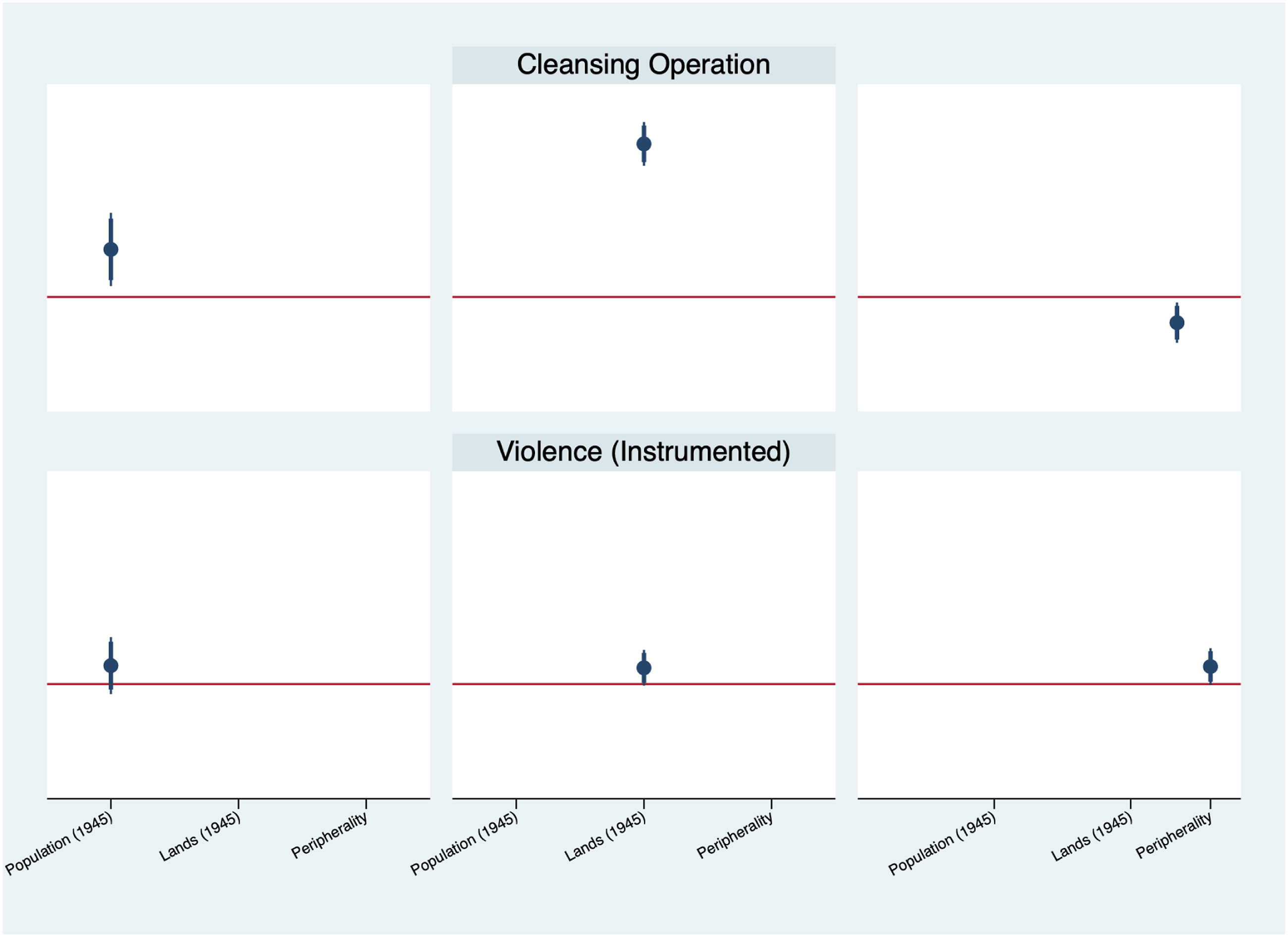
Other Regional Independent Variables
We also used several continues variables to measure the levels of violence in the regional and village level. We measured the region-level harm of the exodus by directly observing the losses associated with it in the region with two variables. First, we observed the number of refugees from the region using data from the Atlas of Palestine (Abu-Sitta 2010) in which the number of refugees in 1998 from all displaced villages was calculated. This includes the number of original refugees and their descendants, which suits the United Nations’s definition of Palestinian refugees and the data available to us. It also represents the modern-equivalence of the human loss by including the descendants, proxying in parallel the number of refugees during the war because the population growth remained unifrom. We totaled the number of refugees, in thousands, from each village in the region to create a variable that represents the demographic loss experienced by the surviving villages. This is the number of people the surviving minority lost the daily contact with. The mean, in thousands, of refugees from a district is 242.3473 with a SD of 240.1.
We also calculated the human loss by using the number of villages displaced. We used data from the British Mandate’s 1945 village survey, which recorded all the villages before the war, and compared it to our data on the PCI villages after the war. We then computed the relative share of villages that were displaced in the region. The highest share of displaced villages is in the Jerusalem area, where 97% of villages were displaced, while the lowest share is in Nazareth, where only 33% of villages were displaced (mean = 0.62, SD = 0.2194).
Village-Level Independent Variables
In order to also capture the difference between the villages in exposure to violence, we used two additional, village-level variables. First, after the war, the Israeli government passed laws that allowed it to seize any property vacated during the Palestinian exodus (Yazbak 2018: 51). Much land was also taken by the government from the surviving villages. These were mostly given to Jewish owners and new Jewish villages (ibid: 52), causing repeated tensions. We determined the amount of land that was usurped by the government until 1962 in each village and calculated its proportion to the size of the village before the war. The latter data were taken from the British village survey described earlier and the data on the usurped land was taken from the BADIL Resource Center, an independent non-profit that compiled this data from the works of Jiryis (1979). The village that lost the most land during and after the war was Kafar Bara, with 99.38% of the land, while the village that lost the least land relative to its previous size is Tayibe, with 2.48% of land taken (mean = 0.422, SD = 0.274).
Second, another village-level indicator of exposure to the violence in the war is the number of IDPs in the village. During the war, many villagers fled or were forcibly transferred with the intent of depopulating the villages. Some fled to surrounding countries and are mostly still there. Others fled to nearby villages or managed to return to surviving villages during the war. They were thus displaced from their homes but still remained in the state, making them IDPs. As we hypothesized, their presence will also lead to a decrease in ethnic voting because of their experience of displacement and their effect on the other villagers. We found only partial archival data on the amount of IDPs in every village in a survey of these in the archives of the Prime Minister’s office from 1950. We instead measured the entrance of IDPs by identifying the villages that increased in population from 1945 to 1961, when they were first censused by Israel, and calculated the increase in population. We argue that villages that experienced much larger population jumps are those that hosted refugees. When regressing the jump in population with the more precise but partial governmental data on the number of IDPs in each village, we found a significant and very strong correlation (standardized beta coefficient = 0.90, p < 0.000), which leads us to believe that this proxy captured the entrance of IDPs well. The village with the smallest population jump is Julis, which was only 1.00853 larger, while the largest was in Reine, where the population increased by 9.69 times (mean = 1.4, SD = 1.524).
Control Variables
We also include in our models a number of important controls. The sources and computation method for them appears in section A1 of the appendix and summary statistics appear in Table 1 there. First, we controlled for the socioeconomic wellbeing of every village using a standard index generated by the ICBS. We did so because it would be likely to affect voting, the relationship between the violence and the vote shares, and governmental approach to these villages despite the relatively similar, poor conditions of the PCI. Another control is a variable that distinguishes between regions that are adjacent to territories occupied by Israel in 1967. This is because proximity to these territories can affect voting; these regions are more likely to be affected by the Palestinian national movement and are more likely to be threatened with expulsion from the state (Weiss, Siegel, and Romney 2022) and they also correlate with designation in the UN proposal, so this is an essential control. We also included the peripherality index of the ICBS, which calculates the distance of each village to the population centers of economic activity. This allows as to account for the possibility of our findings being explained by spatial effects and dependence on nearby Jewish towns. We also included controls for the size of the village in population, although most of our variables are weighted, because there are important demographic and political differences between PCI cities and small PCI villages. Finally, we controlled for turnout to account for the possibility that our results are biased because we will capture only the votes of people who decided to vote and are thus already moderate and have a positive attitude toward the state. We found that turnout is not directly correlated with the violence in any of the proxies we used, but controlling for it can still mitigate such fears.
Analysis
Main Findings
For simplicity, we present results from a standard OLS regression, but we also tested the robustness of our results with several alternative methods, the results of which appear in the online appendix. In section A2 of the appendix we also included an extensive discussion of selection bias. Figure 6
12
presents the regression results for the two main independent variables with and without different configurations of the control variables. We first added the control for adjacency to occupied territories to model B in order to isolate the differences it causes, then added the rest of the controls in model C, except for population, which we added to model D to address fears of post-treatment bias. As is apparent from model A, ethnic cleansing has a strong and significant (p < 0.0001) negative association with the vote share for ethnic minority parties. This relationship is weakened but remains negative and significant with all the control variables in different configurations (p < 0.0001) and is distinct from the role of our instrument on the intensity of violence, as appears in model D. Wartime violence and its correlation with the vote share for ethnic minority parties.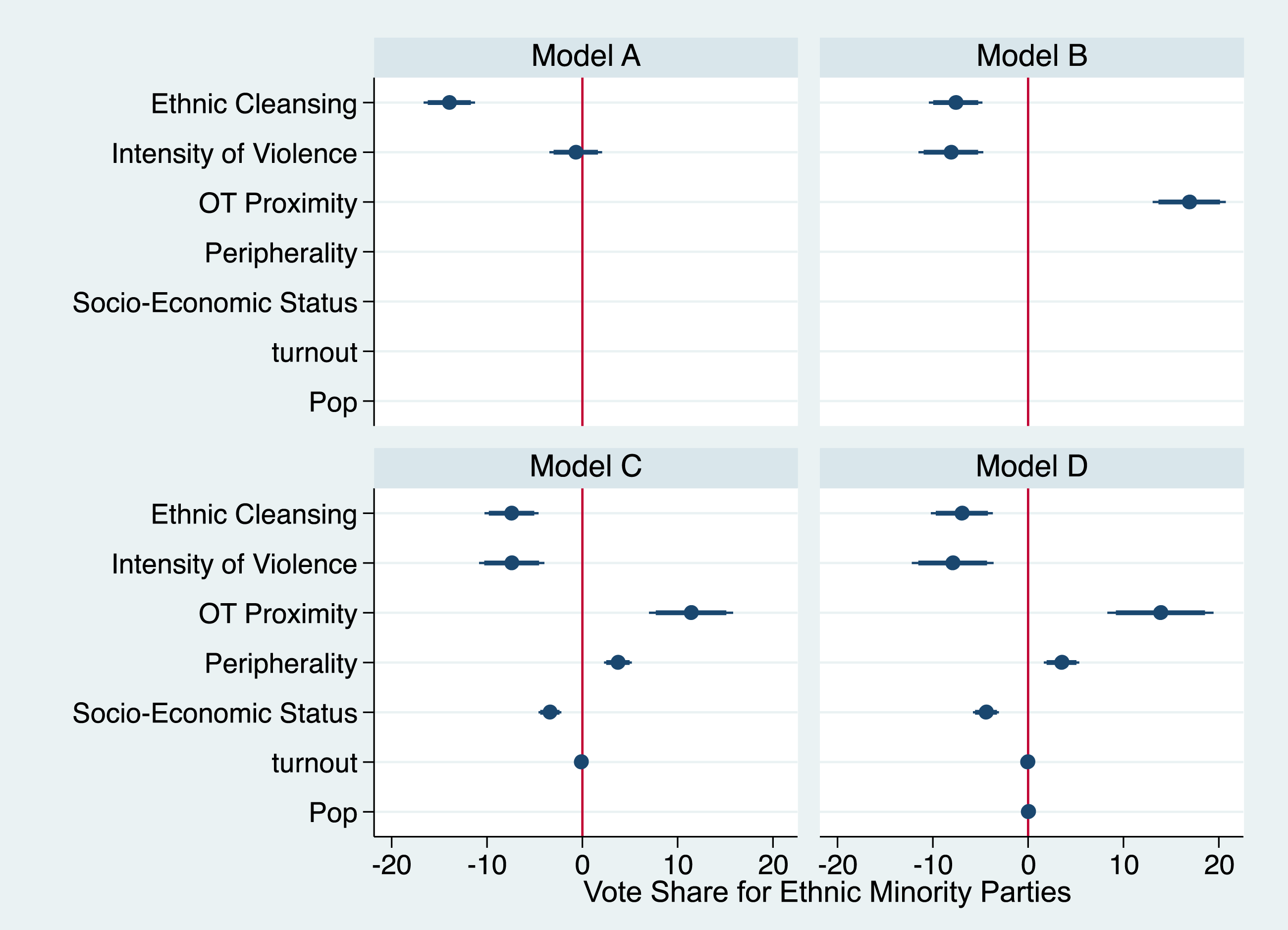
Our instrument for the intensity of violence is negatively and significantly associated with ethnic vote share (p < 0.0001) even with the controls, as shown in the same model. However, comparing models A and B shows that without the control for adjacency to occupied territories, this result is insignificant. This is because proximity to these territories is a confounding variable that is strongly associated with the vote share of ethnic parties and is also strongly associated with the decision of the UN about the territorial designation. It has to be included to deal with the exclusion restriction, as explained in the previous section. These results are also consistent when using fixed effects on the election cycle 13 or with coarsened exact matching on the year level 14 (Iacus, King, and Porro 2012) to control for unobserved temporal effects.
We also examined our instrumental variable in the appropriate two-stage least squares model (2SLS), which appears in Figure 16 in the appendix. There is a strong association between our instrument, the designation of a subdistrict to the Jewish state by the UN, and the share of villages displaced in the same sub-district 15 (p < 0.0001, beta = 0.68). When the UN designation is used as an instrument for the share of displacement in its relationship with ethnic vote share we can again observe a strong negative correlation, even with the control variables. 16 If the first stage of the instrument uses an interaction between the designation of the area in the partition plan and whether it is adjacent to the occupied territories, in order to avoid a violation of the exclusion restriction, the results stay the same - as can be seen from Figure 17 in the appendix.
The models in Figure 7
17
present the correlation of ethnic party vote share with each of the other alternative measures for exposure to violence - district-level measurements for the amount of villages and people displaced and village-level measurements for the amount of land taken and amount of IDPs hosted, including controls. The Refugees model shows that there is a significant (p < 0.0001) and strong negative correlation between the human loss associated with violence and ethnic party vote share, as measured by the number of refugees from a region, even with the control variables. Similarly, there is a significant (p < 0.05) and strong negative correlation between the share of villages that were forcibly displaced in their entirety and the share of votes to contentious minority parties in PCI villages, as evident in the Share Displaced model. The Lands model shows that there is a significant (p < 0.0001) and strong negative correlation between the share of land taken from a village and the vote share for ethnic parties. It is apparent that there is also a strong negative correlation between the number of IDPs who entered a village following the war and vote share for ethnic parties. This relationship is significant (p < 0.0001) without the controls, and with them it approaches conventional significance levels (p = 0.053), as shown in the IDPs model. The facets of violence and the vote share for ethnic minority parties.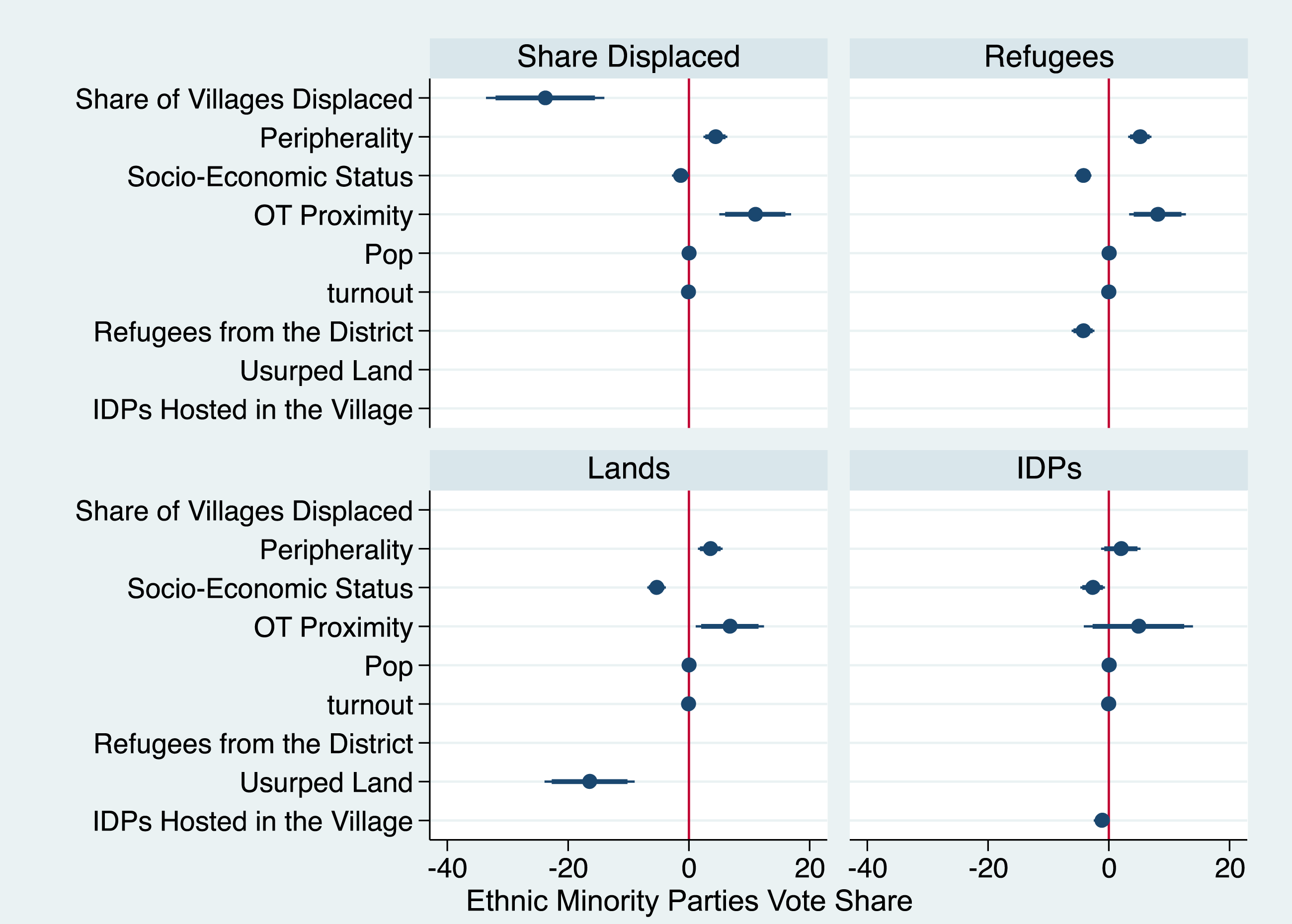
Experience of violence in the first Jewish-Arab war is strongly and significantly associated with a decreased vote share for ethnic minority parties, or accordingly, an increased vote share for parties affiliated with the Jewish majority. This finding is consistently supported by our data, even with different operationalization methods for the exposure to violence, the control variables, and different models. Thus, out expectations were mostly corroborated. However, it is important to look at the changes in the strength of the relationship over time, as we do next, in order to offer a more nuanced picture.
Differences Over Time
The difference in ethnic vote share between cleansed and non-cleansed areas over time is demonstrated in Figure 8. There has been a consistent and strong greater share of votes in all election cycles for these parties in areas that were cleansed, but it is clear that this effect became stronger after 1995, as we expected. The effect of lifting the military rule over the PCI is null in a difference-in-difference (DID) design that looks at the data from 1955 to 1981, as appears in Table 2 in the appendix. The Second Intifada, in 2001, also has no apparent effect on the difference between 1996 and 2021, as shown in Table 4 in the appendix. The increase in the effect of cleansing on behavior after the elections of 1996 raises an interesting finding: the effect of historic violence on risk-aversive voting behavior does not significantly calm when repression is eased (e.g., when military rule was lifted), but was reawakened when the threat of expulsion became clearer, due to the possibility of land or population swaps, and the historic violence was politicized (e.g., during the Oslo process of the mid-1990s).
18
The inter-regional difference in vote share for ethnic parties (1951–2021).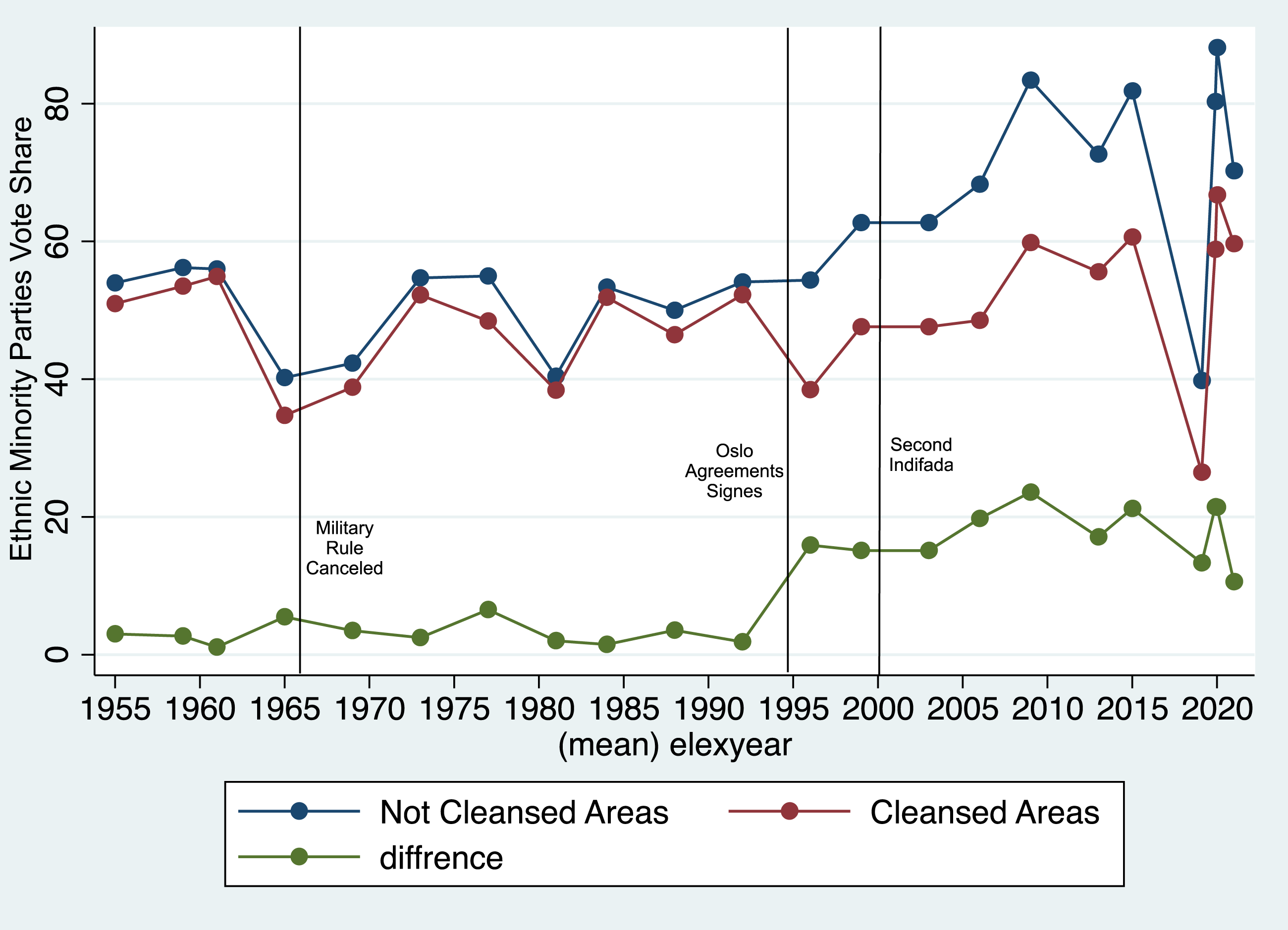
A DID analysis of the 1995 juncture is significant and shows a strong difference in the effect size, as appears in Table 3 in the appendix. Figure 8 shows that most of the DID originated with the rise in contentious voting in areas that were not cleansed. While the vote share for ethnic parties remained stable in all areas before 1996, varying between 40 and 60%, in non-cleansed areas, the vote share steadily rose to 80% after that election cycle. While the wave of Palestinian nationalism, exclusionism, and sectarianism swept away villages in non-cleansed areas, PCI villages in cleansed areas remained mostly resistant and immunized from it.
This aligns with prior studies on the long-term impact of victimization that found it only existed when memories were mobilized by political networks (Villamil 2020), which happened in Israel with the birth of the Palestinian national movement. Our findings may contradict these studies in their direction (i.e., decrease in ethnic or nationalist vote share) but not in the importance of this condition. It also aligns with the exceptions in the previous section about the importance of the Oslo process. It worth emphasizing that the correlation we found is also strong prior to the 1996 election, but the full impact of the war came into effect more strongly after that election, in accordance with our previous expectations, and because of the newly created nationalist Balad party. This finding also aligns with prior research on the impact of the Oslo accords on Palestinians, which was found to increase polarization and decrease collective resistance (El Kurd 2019).
This result sheds new light on our findings in the last section. It is clear the legacies are consistent in their direction but not always constant in their size and that it is important to broaden the temporal scope of legacy studies. While looking only at the last few election cycles, one could be convinced that the ethnic cleansing always had a large positive effect on risk-aversive voting and a negative effect on contentious voting, this historical analysis reveals a more nuanced picture. It also makes clear that nationalist mobilization is persuasive among all groups of PCIs, but that even when it rises across the board, a gap consistently exists between the groups that were or were not exposed to the violence.
Survey Evidence
Up until this point, we have shown that many variables that measure variation in violence in areas that later became Israel, and thus variation in exposure to violence among the members of surviving communities, robustly correlates with Jewish party vote share. Another way to enhance our confidence in the results is to see if they replicate when the analysis is executed on alternative data sources for the dependent variable. One of those is a series of nationally-representative surveys of PCIs carried out by Samooha (2019). 19 The surveys allow for the replications of the results, but furthermore, the questions in them have further potential: to distinguish between the descendants of those that experienced and were damaged by violence, and the descendants of those that were exposed to the violence but not directly harmed. This can provide a preliminary exploration that can shed light on who drives the results and heterogeneity in legacies, though further research is needed to investigate such dynamics.
Replication
We matched the village-level data on the exodus in our dataset, on changes in land and population as a result of violence in the war, with the villages of respondents in nine of the surveys in which there were matching villages (N = 4146). In the surveys, the respondents were asked about their political orientation - to which party or movement they feel close. This was then coded in the survey into a binary variable that indicates whether they associate themselves with a Jewish or a Palestinian party. We used this variable to estimate how it correlates with the damage that the respondents’ village suffered in the war. Figure 19 in the appendix presents the results from a multilevel model with fixed effects at the survey-year level and random effects at the village level, as well as a set of demographic controls. It shows that respondents from villages that hosted more IDPs, and respondents from villages that lost more lands as a result of the war, are more likely to express support for a Jewish party.
Preliminary Exploration
However, all of these results do not distinguish between members of surviving communities and displaced individuals that stayed in Israel — Palestinians that managed to avoid external displacement but were still internally displaced or damaged by the violence. Interestingly, the results persist even after individual-level controls are added on reported family histories of displacement and dispossession, as seen in Figure 9. Respondents were asked if they are descendants of internally displaced people (Descendents of IDPs) or if their family lost land due to governmental appropriation (Family lost land in the war). Those that answered yes are experiencing the legacies of violence in the most classic sense, since their relatives were directly targeted and damaged by the violence in the war, and often were displaced. Those that do not have this family history are experiencing the ‘legacies of survival’, since their family managed to avoid personal severe damage during the war—even if their relatives were exposed to is as bystanders. In other words, this covers the difference between displaced individuals and non-displaced individuals among members of surviving communities. Internally displaced persons hosting, land loss, and the likelihood of support for Jewish parties (with control for members displaced communities).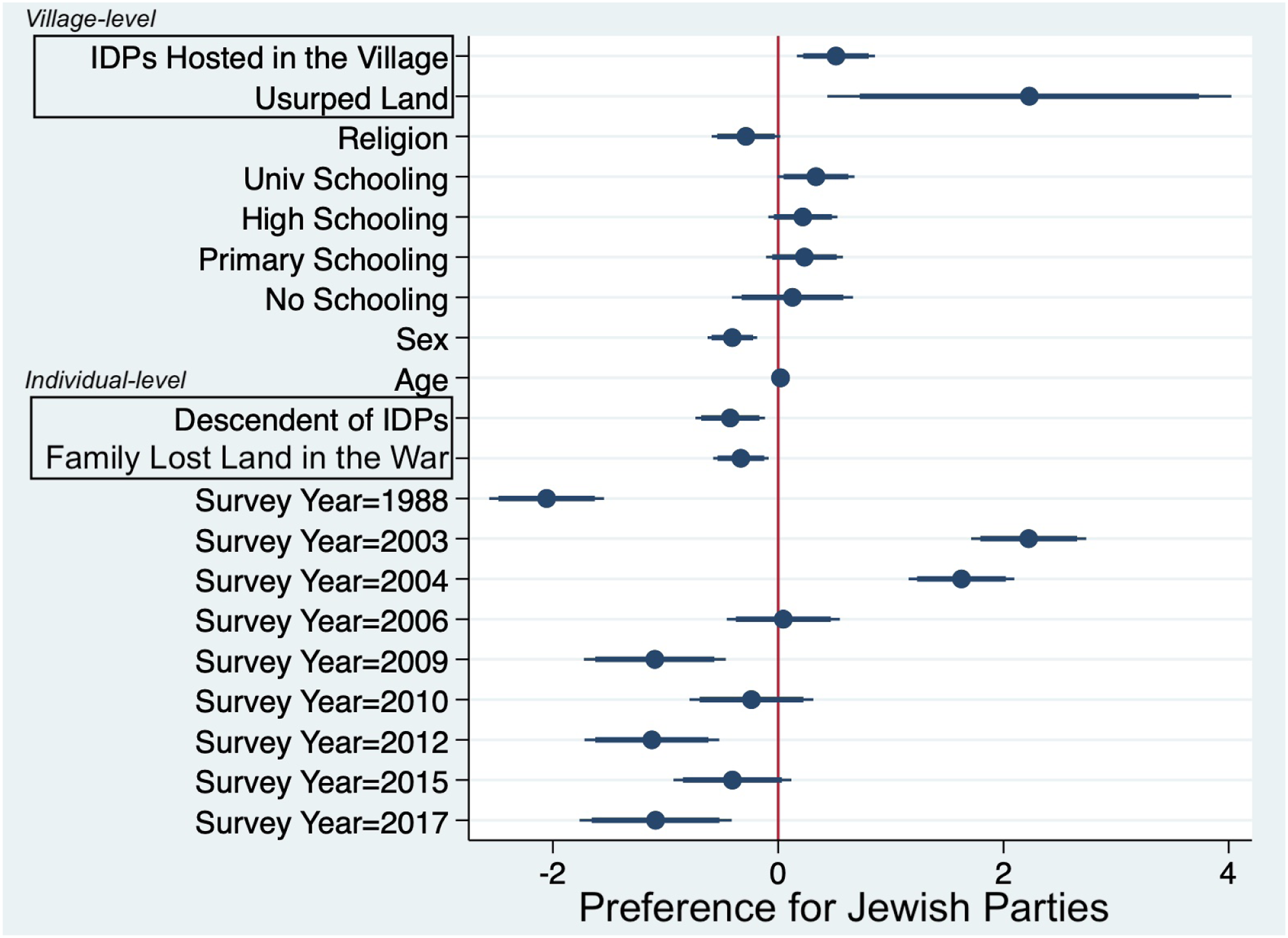
This result goes to show that the finding is not generated by displaced individuals themselves, but rather by the impact the war had on the community as a whole. From Figure 9 it is apparent that the displaced individuals are less likely overall to vote for Jewish parties, while non-displaced residents of villages in areas that suffered more from the violence—members of surviving communities—are more likely to vote for Jewish parties.
We can further explore this dynamic of how types of wartime experience shape legacies by delving deeper into the intra-village, micro-level differences between the groups. Figure 10 shows the different impact that the village-level exposure to the violence has on village members, depending on whether their ancestors were displaced and whether their community survived. In villages that were exposed to higher levels of violence, measured by the amount of IDPs they hosted and land that was taken from them, voting for Jewish parties is more likely among non-displaced individuals - but not among the descendants of the IDPs and the people that lost the land themselves. IDPs who settled in a village are unaffected by the village’s exposure to violence, while the locals are more likely to vote for Jewish parties. Similarly, village inhabitants whose families did not lose land as a result of the war are more likely to vote for Jewish parties if their village was exposed to and damaged by violence in the war, while the effect on descendants of families that did lose land is not statistically significant. There does seem to be some effect even among those that lost land, though there is more uncertainty around it; it is possible this effect size can be attributed to the economic impact of land loss; alternatively, the difference between IDPs and those that lost land could be a result of variation in attachment to the village. The different impact on displaced and non-displaced members of surviving communities.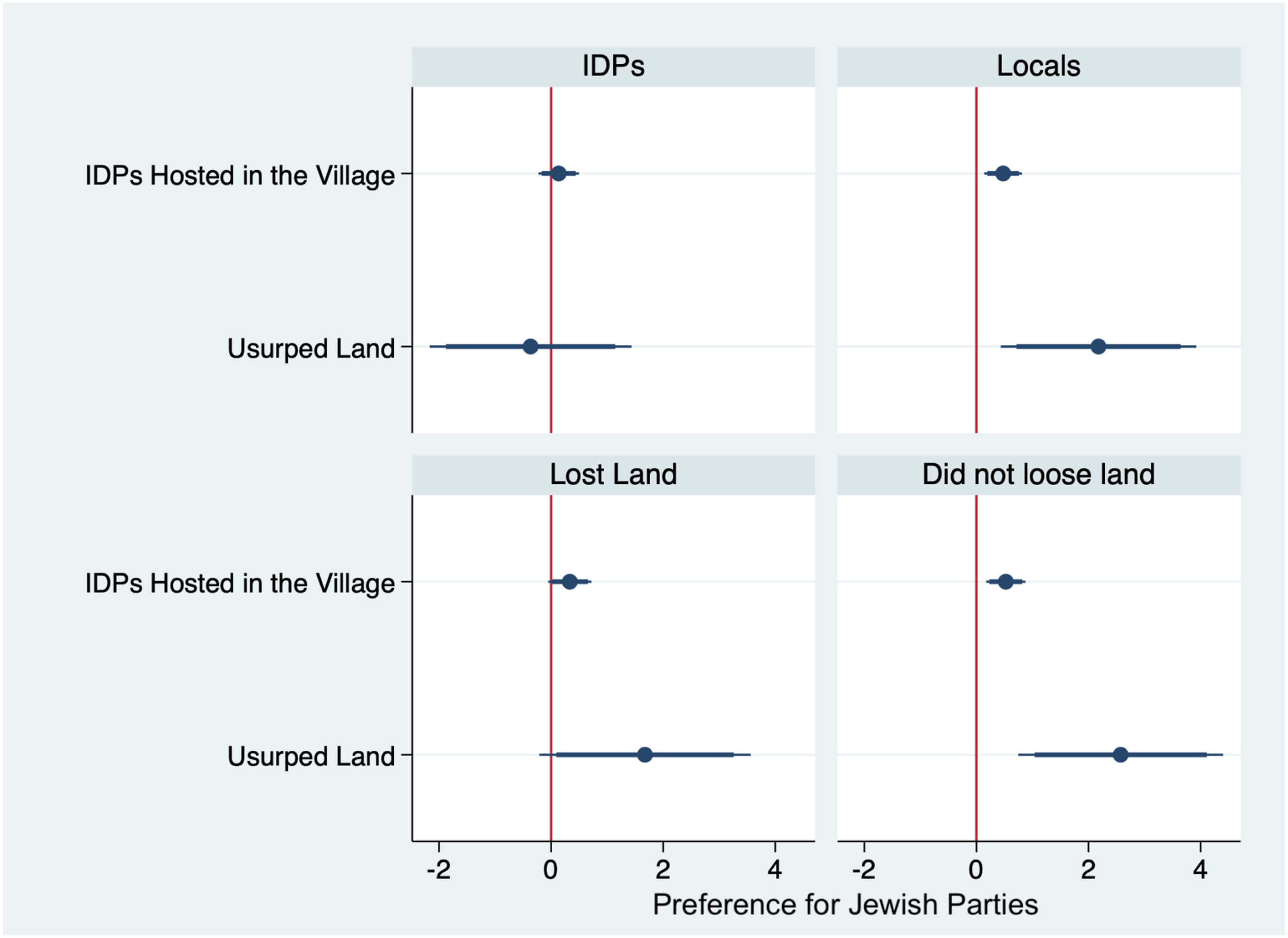
Thus, the empirical pattern we consistently observe, in which villages that were exposed to the violence are more likely to have a higher vote share to Jewish parties, is driven by the inhabitants of the villages that are the descendants of the wartime non-displaced individuals, not internally displaced individuals. There is heterogeneity in the effect within the Palestinian communities—between those whose family directly experienced and was harmed by the violence, and those whose family was exposed to but avoided displacement and dispossession. In other words, the inhabitants of villages that experienced a higher intensity of violence, but that were not displaced and did not lose land themselves, are those that are more likely to vote for Jewish parties; inhabitants in those villages that were displaced or did lose land were not significantly affected. All PCIs are have been affected by ethnic cleansing, but some were personally severely harmed and displaced, while others avoided displacement but witnessed the damage to the entire community; these two groups respond differently in post-war voting.
The survey data shows that even with a new data source, the correlation we found between the intensity of violence in a village and support for parties affiliated with the majority is robust. It also provides initial evidence of the source of this relationship—the inhabitants of war-affected villages that were not displaced themselves are those that are more likely to vote for Jewish parties, while internally displaced people are unaffected. A community-level impact lowers ethnic voting in the community, but only among non-displaced members of surviving communities, not displaced individuals. This divide is an initial finding, and its sources should be studied further in the future. These findings is particularly interesting because they can be seen as counter-intuitive: we first consistently find that Palestinian inhabitants of villages that suffered from more severe harm, or were exposed to violence more extensively, in the 1948 war, are more willing to vote to and prefer Jewish parties - a surprising finding by itself; we then find initial evidence suggesting that this community-level relationship is driven by those village inhabitants whose families were not personally harmed themselves, and so that the legacy is most pronounced among those less directly harmed in the village.
Discussion and Conclusion
Using longitudinal electoral data from Israel and a wealth of information on historic violence in the 1947—1949 war, we find that even 70 years after the war ended, the most severely impacted villages express more risk-aversion in their voting behavior and consistently vote less for ethnic or contentious minority parties. This relationship is robust and strong, despite being the opposite of previous expectations. We also showed that at the microlevel, individuals whose family avoided displacement but was exposed to the historical violence indeed are more likely to vote for Jewish parties - unlike descendants of displaced communities that experienced and suffered from the violence themselves or members of surviving communities that were not exposed to violence. Our study contributes first and foremost to the emerging field of the legacies of violence, showing that displacement and ethnic violence have the opposite effect on the electoral behavior of ethnic minorities than what previous studies found, building on the theoretical expectation that violence will induce risk-aversion and protection of the social group. We also highlighted the problem of generalizability of findings in historical political economy and legacy studies when context changes and the classification of the independent variable to previous findings is not clear.
This study can also contribute to other areas of political science, such as research on the political behavior of minorities or studies on ethnic wars. Our findings can help explain why some minorities will be deterred from rising up. Older members of a group that were persecuted in the past may be more likely to oppose election candidates who are considered radical or risky. Many minority groups around the world suffered from violence, repression, or ethnic cleansing, and many members of those groups remained under the rule of who they see as perpetrators—such as African Americans in the USA, Muslim population in India, Darfuri in Sudan, and Rohingya in Myanmar. Understanding the effect violence has on their political behavior is paramount in order to understand them. In the case of ethnic conflicts, our findings can shed new light on why so many of these escalate to violence (Toft 2014: 581)—the use of violence can create a large gap in the level of support the ethnic movement, deterring the targeted group from supporting it. So governments that fear ethnic and secessionist movements will have a strong incentive to use violence in such an effective way, because it will significantly reduce the strength of nationalist movements.
Many classical explanations of civil wars assume that ethnic groups are cohesive and homogeneous, tied by strong kin networks and sharing the same interests and preferences (Horowitz 2001); and that these ethnic groups will mobilize and go to war due to strong cleavages and grievances (Fearon and Laitin 2003; Collier and Hoeffler 2004). However, we show that the severe economic grievances caused by the violence in the Palestinian exodus had a different effect - it is associated with lesser nationalist mobilization. The differences in experiences of violence created a disparity in the amount of mobilization among the PCIs and possibly also between the PCIs and Palestinians elsewhere. The violence thus has an effect that was extreme enough to disrupt the traditional kin networks, and pushed some of the communities that were particularly devastated by it to pursue greed by cooperating with the perpetrator’s government, despite the risk of ethnic domination. This goes to show that the impact of vertical and horizontal inequality on contention (Cederman, Weidman, and Gleditsch 2011) may be moderated by a history of violence that is deterring enough to lead members of surviving communities towards inter-ethnic cooperation. Thus, the historical violence can alter the subjective perception of, and response to, the inequality in Israel (Miodownik and Nir 2016).
Our study does have limitations. We used an instrumental variable design to form a basis for causal identification. The correlation between violence and risk-averse voting behavior is indeed strong and is repeated with six different variables for violence, but we cannot fully ensure a causal relationship, and our design may suffer from post-instrument bias (Glynn and Rueda 2017) and post-treatment bias. Most importantly, it could be argued that the results are the product of selection bias; we provide an extensive discussion and rebuttal of such claims in section A2 of the online appendix. Balance testing that appears in this section may calm concerns of survivorship bias because it shows that previous peaceful behavior does not predict survival in the war.
Future research should test the application of the finding to the context of mixed cities since our results cannot be generalised to these at this point. Furthermore, the mechanism behind the legacies we detected is still not directly supported, and should be investigated further. Future microlevel research can examine the theory of insecurity and risk aversion and how they relate to voting in Israel. Alternative explanations might have merit—for example, it is possible that our findings are not driven solely by an attitudinal change but by changes in or mobilization among the elites of areas damaged by violence. Future research should test who drives legacies and who are the key agents behind the post-war impact of violence; whether they are the results of a core change among individuals or because of changes in the political structure.
Our study provides a theoretical basis and empirical evidence in support of our expectations, contradicting prior studies, but more work is needed to provide evidence of the underlying causal mechanisms. Future research should continue to address cases where expectations, based on prior studies, are not clear, by extending existing theoretical frameworks and providing evidence from new case studies. This will allow scholars to unpack the exact effects of conflict and allow the field of the legacies of violence to mature. Further research could also examine our theory using cross-national comparison, to improve its external validity, or using micro-level experiments to improve the reliability of the causal inference. More so, future studies could continue focusing on the PCIs and examine the mechanisms that lead to these effects or look at the Palestinians who were displaced, in order to examine if the exodus had a different impact on them.
At face value, the policy implications of our finding are pessimistic: it is possible that extensive cleansing campaigns against adamant or vocal minorities may qualm their activism, at least electorally. However, such a conclusion is misguided since it ignores the complex reality of conflict settings and the drawbacks of such an approach, even beyond normative concerns—such as the economic damage that is caused by the conflict and the creation of mobilized and animus groups of the minority outside the state’s borders. Additionally, the results and conclusion should not be read as indicating that the PCIs do not have agency in their situation. Voting is just one avenue out of many possible ways to express dissent, and indeed there was protest during eras of instability also in areas that were severally impacted by the exodus. Our data reveals that ethnic voting is common also in areas that were exposed to violence and that it also increased in these areas over time; it just remained lower than the areas that were less damaged by it.
Supplemental Material
Supplemental Material - Legacies of Survival: Historical Violence and Ethnic Minority Behavior
Supplemental Material for Legacies of Survival: Historical Violence and Ethnic Minority Behavior by Amiad Haran Diman and Dan Miodownik in Journal of Conflict Resolution
Supplemental Material
Supplemental Material - Legacies of Survival: Historical Violence and Ethnic Minority Behavior
Supplemental Material for Legacies of Survival: Historical Violence and Ethnic Minority Behavior by Amiad Haran Diman and Dan Miodownik in Journal of Conflict Resolution
Footnotes
Acknowledgements
The authors would like to thank Omer Yair, Michael Friedman, Raanan Sulitzeanu-Kenan, Devorah S. Manekin, Graig R. Klein, Thorin Wright, Andrea Ruggeri, as well as other participants of the 2022 21st NEPS Jan Tinbergen European Peace Science Conference, the 2022 International Studies Association Annual Conference in Nashville, and the 10th Euroasian Peace Science Conference for their help in improving this paper, Shaul Arieli for generously providing map layers, Sami Samooha for providing access to geolocated survey data, and the editor and two anonymous reviewers of the Journal of Conflict Resolution for their constructive suggestions and comments.
Declaration of Conflicting Interests
The author(s) declared no potential conflicts of interest with respect to the research, authorship, and/or publication of this article.
Funding
The author(s) received no financial support for the research, authorship, and/or publication of this article.
Data Availability Statement
All data replication code for this article can be found in  .
.
Supplemental Material
Notes
References
Supplementary Material
Please find the following supplemental material available below.
For Open Access articles published under a Creative Commons License, all supplemental material carries the same license as the article it is associated with.
For non-Open Access articles published, all supplemental material carries a non-exclusive license, and permission requests for re-use of supplemental material or any part of supplemental material shall be sent directly to the copyright owner as specified in the copyright notice associated with the article.
