




Abstract
We use a large quota-sampled online survey and data on Facebook connections among survey respondents in six successor states of former Yugoslavia to demonstrate that, even more than two decades after the violence had ended, online social connections in this region are substantially related to people’s war experiences of combat, victimhood, and forced migration, as well as to their views of the wars’ causes, conduct, and consequences. What is particularly important, the sizes of the effects of these war-related factors on respondents’ online social networks are substantively large and comparable to those of gender, ethnicity, education, or political ideology. Our findings are an important contribution to the understanding of the deeply pervasive and long-lasting effects of wars on societies. They also highlight the enduring relevance of wartime violence in postwar social networks that is likely to affect efforts at enduring conflict resolution and reconciliation.
Introduction
War violence often has long-lasting effects on individuals and communities that goes beyond physical destruction and loss of life. Wars are profoundly transformative events that alter social actors, their norms and practices, as well as the structures within which they operate (Wood 2008). Crucially, they can also alter the nature and shape of social actors’ relations. Armed conflicts can, for example, result either in the social segregation or new relations among different groups of people. Similarly, they can increase the social status and esteem of some segments of society, but also lead to the alienation and marginalization of others. In other words, wars and the ways they are remembered in postwar societies have a profound impact on people’s social networks.
While there have been many thoughtful and valuable contributions to our understanding of the various ways that wars affect postwar social relations in virtually all fields of social sciences and humanities, there has been a dearth of empirically rigorous studies on the impact wars have on social networks. The overarching research question this study aims to answer is: to which extent are social ties and relationships in post-conflict societies based on people’s war experiences or views and memories of the recent war past? A growing body of research has shown people to be politically homophilic, i.e. to seek company of the like-minded when it comes to politics (Huber and Malhotra 2017). Does this also hold true in post-conflict societies when it comes to people’s views of the wars’ causes, conduct, and consequences? Research has also shown people to be socio-demographically homophilic, i.e. to seek company of those who share their socio-demographic traits like gender, ethnicity, age, or education (Goodreau, Kitts, and Morris 2009). Can the same be said of people who have shared similar transformative experiences brought about by war violence? Are the war combatants, or those who experienced forced migration, or those suffering from war-related trauma more likely to be connected to others who have had the same experiences? Moreover, do war combatants experience a social dividend from their military service, as some have postulated, and as a result have wider social networks of connections? Have those with experiences of forced migration integrated either into their new communities or back into the communities from which they were at one point forced to leave? These questions are exceptionally important, as the enduring relevance of wartime violence in social networks is likely to contribute to the success or failure of peace settlements, and the degree to which postwar societies leave the war pasts behind them.
We answer these questions by analyzing the results of an innovatively designed and conducted quota-sampled online survey of almost 6000 respondents in six successor states of former Yugoslavia. The key original feature of our survey is that respondents were recruited to the survey’s dedicated mobile app and online platform using the marketing API of the social network platform Facebook. The process enabled us to gather information about the online network connections between respondents. Since respondents also provided answers to a number of questions related to their political attitudes, socio-demographic characteristics, as well as experiences, views, and memories of the Yugoslav conflicts of the 1990s and early 2000s, our research design enabled us to properly expose the relationship between war and people’s postwar online social networks.
The results of our analysis convincingly demonstrate that even more than two decades after the violence had ended in Southeast Europe, online social connections in this region are indeed substantially determined by people’s war experiences and views of the wars’ causes, conduct, and consequences. We show that there exists substantial polarization rooted in views of the recent war past among study participants, with those holding opposing opinions forming separate social networks. When it comes to actual war experiences, it is clear that respondents’ experiences of trauma, combat, and forced migration critically affect their online social networks. Even when controlling for a host of potential mediating variables, people suffering from war trauma are more likely to connect to others who are also suffering, presumably in an effort to process what they are experiencing. A similar dynamic is observed among combat veterans, who are more likely to be connected to other veterans. They are also, however, more inclined to have larger online social networks in general, likely reflecting their increased social standing and political activism in the local communities. Respondents with the experiences of being refugees, on the other hand, tend to have smaller online social networks, being more isolated from their host communities, as well as others with similar experiences. What is particularly important, the sizes of the effects of these war-related factors on respondents’ online social networks are substantively large and comparable to those of gender, ethnicity, education, or political ideology. All of this makes our findings an important contribution to the understanding of the deeply pervasive and long-lasting effects of wars on societies. Our findings also highlight the depth of the potential challenges homophily based on war past can pose to post-conflict societies reconciling and moving forward.
The Impact of War on Social Networks: Experiences of Violence and Views of the Past
Research on how people choose their friendships has consistently shown them to be homophilic: they form ties with those who are like them (Goodreau, Kitts, and Morris 2009). The characteristics that are valued in this regard can be social (e.g. gender, age, education), but also political. People who hold similar political worldviews are more likely to be friends (Cargnino and Neubaum 2021).
Two mechanisms, identified in earlier research albeit using different terminology (see Shalizi and Thomas 2011) are suggested to be driving this pattern. The first revolves around the tendency for similar individuals to share ties, i.e. the selection mechanism. Forming connections with similar others facilitates cooperation and the formation of stronger relationships (Tajfel and Turner 2004). In addition, people prefer similar others because they are likely to understand them as they understand themselves. Finally, in an attempt to maintain a psychological equilibrium and evade conflicting cognitions, people tend to avoid social relations with those who have different political values (Festinger 1957). The second mechanism centers on the tendency for individuals who have ties to become more similar, i.e. the convergence mechanism. Indeed, the imbalance caused by a friendship with someone with different political views can also be resolved by changing one’s opinion (Lazer et al. 2010).
In addition, once people find themselves in online information bubbles, this can result in a confirmation and validation of their existing views or even make them more extreme due to the lack of exposure to different viewpoints (Sunstein 2018), giving it a self-reinforcing dynamic. The creation of said bubbles is often exacerbated by so-called ‘algorithmic filtering’. In an effort to enhance user engagement, social media platforms try to connect users with ideas and people they are likely to agree with, creating echo chambers of like-minded users (Pariser 2012). Such bubbles are likely to make opinions more extreme through what is known as ‘risky shift’. Group members compare their own beliefs to that of the group and find it socially advantageous to adopt a position slightly more extreme than the group average, making connections with other-minded people ever more difficult (Bishop 2009).
The degree to which the congruence of political views and partisanship is related to social ties, via either of the two mechanisms, is likely to depend on their importance to those involved (Skitka, Bauman, and Sargis 2005). People are more likely to make relations conditional on the agreement on important issues, or seek convergence on such issues with people they already know. When we apply these insights to postwar Southeast Europe, it quickly becomes clear that people’s views of the conflicts of the 1990s and early 2000s are likely to affect whom they befriend. The traumatic social experiences of violent conflict often occupy an important part of collective memories that help define the groups’ meaning and identity (Zubrzycki and Woźny 2020). These collective memories are frequently reinforced by political parties, which increase and maintain the salience of certain war-related issues in order to gain an electoral advantage (Sartori and Mair 2005). Parties and political entrepreneurs do that by establishing and partaking in commemorative activities, by fueling public debates regarding issues connected to the war past, or by politicizing historiographies of these traumatic events (Mochtak, Glaurdić, and Lesschaeve 2020). It is thus not particularly surprising that parties’ views of the recent wars are one of the principal determinants of voter choice in the region (Glaurdić, Lesschaeve, and Mochtak 2021). This salience of the wars of the 1990s and early 2000s has extended to the online sphere (James 2013; Bošković 2014). A good example of this is the White Armband Day (Dan bijelih traka), which commemorates the atrocities committed in 1992 in the town of Prijedor in Bosnia (Fridman and Ristić 2020; also see James 2013), or the number of social network groups devoted to the commemoration of traumatic war events like the siege and fall of Vukovar in Croatia (bursting with activity especially around the anniversary of the town’s fall on 18 November) or the Srebrenica genocide (particularly active around the Srebrenica Memorial Day of 11 July).
Obviously, the most recent wars in Southeast Europe were nationalist conflicts fought along ethnic/national lines – in other words, they reflected socio-demographic and political/ideological divisions that likely had a large influence on people’s social networks even before the war. Moreover, these conflicts created segments of the population that were particularly affected by the violence, like victims, veterans or refugees (of which more below). However, we maintain that even when controlling for these alternative explanations of social networks rooted in socio-demographics, in larger ideological commitments, or in actual war experiences, people’s views and memories of the wars constitute an additional element in the structure of social ties in the region.
The nature of our data does not allow us to disentangle whether homophily based on views of the recent war past is driven by selection or by convergence. The purpose of this study, however, is to assess the importance of views of the recent war past in structuring social connections between people. In this endeavor, it is of secondary importance through which mechanism recent war past achieved this importance. The continued prominence of the memory of war is expected to result in political polarization in the postwar societies of Southeast Europe, leading to socially separate groups with different views of the conflicts. We therefore predict that social relations between individuals are more likely when they have similar views of the wars that accompanied the dissolution of Yugoslavia, even when controlling for respondents’ more general ideological commitments and sociodemographic characteristics that likely predated the wars.
Political views are obviously only one piece of the puzzle of how the Yugoslav wars are related to the pattern of social connections in the region. Wars not only affected different segments of the population differently – they also reordered social structures by creating social strata that simply did not exist prior to conflict. First and foremost, they created victims who continue to suffer long after the conflict has ended. Those who endure war often suffer traumatizing experiences and symptoms associated with PTSD (Goren and Neter 2016). There exist, however, diverging expectations in the literature on how psychological trauma affects social relationships. On the one hand, there are studies that find that having lived through traumatic events has detrimental effects on the ability to maintain interpersonal connections due to increased agitation and the loss of empathy, or due to the triggering of traumatic memories (e.g., Hirsch-Hoefler et al. 2016). This is supported by studies finding that people affected by war trauma experience more difficulties maintaining intimate relationships (Ray and Vanstone 2009), and that war experiences have a negative impact on social trust (Kijewski and Freitag 2018).
On the other hand, traumatic events have been found to result in posttraumatic growth or PTG, i.e., positive psychological change experienced as a result of the struggle with highly challenging life circumstances (Tedeschi and Calhoun 2004, 1). PTG flows from attempts at psychological survival, the cognitive rebuilding of the general set of beliefs and assumptions about the world, which have been shattered by the traumatic event (Janoff-Bulman 1992). PTG can lead to a greater appreciation of life in general, closer and more meaningful relationships with other people, a greater sense of compassion and empathy, an improved sense of personal strength, and a recognition of new paths for one’s life (Tedeschi, Park, and Calhoun 2014). In postwar societies, studies have found evidence of PTG in the greater community involvement of victims of violence (e.g., Blattman 2009).
To summarize, one strand in the literature suggests that trauma negatively affects the formation of social ties. This would result in the expectation that individuals showing signs of trauma have smaller social networks. The PTG strand, however, suggests the opposite, resulting in the expectation that trauma coincides with a larger social network. The literature, therefore, does not clearly guide us to one hypothesis. Consequently, we remain agnostic about the general effect of war trauma on the formation of social relations.
We do, however, argue that people with war trauma are more likely to connect to others who suffer from it as well. Research on how veterans cope with the traumatic events of the battlefield has found that they often remain “prisoners of a warrior’s identity, born on the battlefield” (Richard 2012, 119). Veterans suffering from trauma often report feeling alien to the civilian community they so eagerly wanted to return to and having difficulties connecting socially (Hoge 2010). These former combatants often feel misunderstood in terms of what they had to endure during the war. Such an appreciation of traumatic war experiences can often only be found among those who lived through it as well. Unsurprisingly, research on US veterans has shown that dramatic war events engender a lifelong bond between soldiers that can extend well into the postwar period (Elder and Clipp 1988). While primarily studied among traumatized former combatants, we believe these mechanisms apply more broadly to all individuals suffering from psychological trauma, whether it be veterans, civilians, or even those who did not suffer directly, but who react emotionally to harm done to other group members (Wayment 2004). In their efforts to be understood by their environment, they will value and pursue social ties with others who have had to endure similar psychological distress. This is why we hypothesize that:
The sharing of traumatic experiences from the battlefield is not the only reason why war veterans may remain connected to each other. Once the conflict ends, governments are faced with the huge challenge of demobilizing the enlisted men, and setting them on a course toward reintegration into society. The manner in which this is done has enormous ramifications for the social status former combatants enjoy and the prestige or symbolic capital they obtain. For instance, in Britain and Canada, the enlisted or conscripted soldiers of the First World War were promised a “home for heroes”, and assurances that they would get their old job back (Huddie 2020, 35; Richard 2012). However, and in spite of many ceremonies and commemorations, such promises failed to materialize, and many war veterans, especially those disabled, found themselves impoverished and having to rely on charity. Things were markedly different after the Second World War, when governments devoted much more attention to the development of a demobilization and rehabilitation policy, such as in the Veterans Charter in Canada (Richard 2012), and the Servicemen’s Readjustment Act in the United States better known as the GI Bill (Stouffer et al. 1949). Such efforts have led scholars to point toward a veteran advantage, whereby former combatants gain greater social status in their communities (Smith, Marsh, and Segal 2012).
In Southeast Europe, such developments can be found as well. In many of the countries involved in the conflicts of the 1990s and early 2000s, veterans were granted reintegration policies, which included medical, educational, and employment benefits (Žunec 2006, 31), though with varying degrees of success (Klepal 2018). These policies created a privileged social category based on the identity of the “citizen–soldier” (Berdak 2015). In addition, veterans became a part of the often carefully crafted narrative and memory of the wars. The conflicts following the dissolution of Yugoslavia were all of the nation-building variety, and their memory, shaped and filtered by the state, continues to serve that purpose (David 2015a). In this regard, war veterans are the personification of the sacrifice and the blood given for the homeland. In the official narratives, veterans are often referred to as defenders (branitelji), or religious martyrs (šehidi) (Bougarel 2007; Sokolić 2019), which can even result in war veterans becoming local elites in their communities (Tanner 2012).
Unsurprisingly, these privileges and veterans’ social status are not uncontested, and have led to some resentment among the civilian population (Jašarević and Leutar 2010). For instance, in Croatia, the registry of war veterans (combat and non-combat) contains roughly 500,000 names. Their benefits are a huge burden for a country with a total population of a little over 4 million in 2019 (also see Pupavac and Pupavac 2012). In Serbia, the recognition of war veterans seems to be split between those who view them as national heroes, and those who see them as war criminals or “losers” (David 2015a; also see 2015b). 1 Nevertheless, we argue that the mythmaking surrounding the war past and the created memory of war, together with benefits programs, have resulted in veterans occupying a privileged position in the postwar societies of Southeast Europe. The positive connotation associated with one’s status as a veteran in turn increases how socially connected war veterans are to others, by facilitating the forming of relationships and the ease with which they enter new social circles. Coupled with the fact that past research has shown war veterans to be more politically engaged (Blattman 2009), this forms the basis of our first veteran hypothesis, which expects that war veterans have a larger social network in general.
The aforementioned integration programs for war veterans and the struggle to force the government to commit to the promises made to soldiers prior to and during the conflict often forces former combatants to organize into veteran organizations, which have become a staple of postwar societies. Especially in Southeast Europe, these organizations, which function as interest groups, are pivotal drivers behind the social and economic benefits awarded to war veterans (Dolenec and Širinić 2020). Once social protection programs are in place, the goal of these groups shifts to defending them. This can turn veteran organizations into powerful political actors with the potential to influence the outcome of elections. This has been true in the United States (Skocpol 1995), but also in former Yugoslav republics like Croatia, where veteran organizations can be seen as a natural ally over the right-wing party Croatian Democratic Union (Hrvatska demokratska zajednica, HDZ) (Dolenec and Širinić 2020; Glaurdić and Vuković 2016; Mochtak, Glaurdić, and Lesschaeve 2020), and in Bosnia-Herzegovina (Kapidžić 2019). 2
To summarize, due to their status as defenders of the nation, veterans are imbued with greater social esteem, which facilitates the formation of social ties and results in larger social networks. In addition, the effort to obtain and maintain social benefits awarded to them for their service, and the organizational exponent of those efforts can be expected to foster social ties among veterans. This leads to the following two hypotheses regarding veterans’ social networks:
3
In addition to victims and veterans, wars can create social groups defined by their experiences of forced migration. This is particularly true of the wars of Yugoslavia’s dissolution, where political elites tried to establish ethnically homogenous nations. The occurrence of migrant streams fleeing the violence was not so much a byproduct of the wars, but part of their very purpose (Bobic 2021). Displaced people are sizeable groups in Southeast European countries, and play a role in the political competition of their host nations. For instance, displaced Serbs from Croatia and Bosnia-Herzegovina that fled to Serbia were a factor in the strong election results of the Serbian Radical Party in post-Milošević elections (Konitzer and Grujić 2009). This is in line with research that found that war refugees are more likely to be stuck in the violent past that led to their displacement (Hall 2016).
Scholarly work on how war migration impacts the social networks of those affected is, however, very limited. One of the rare works on the subject is a study of internally displaced persons in Georgia by Mitchneck, Mayorova, and Regulska (2009). 4 While the authors had expected friends and neighbors to be present in the social networks of those displaced by the 1992-93 War in Abkhazia almost 15 years later, they found that these networks consisted primarily and sometimes solely of family and extended family, suggesting an isolation from the wider community where displaced persons were relocated, but also from others who had to flee.
This is not surprising. War refugees flee to places where they think they will be safe, even welcomed. Yet regardless of an initial warm welcome and the sharing of an ethno-religious background, displaced persons are often quickly seen as uninvited immigrants who place a hefty burden on taxpayers (Gatrell 2008; Nikolic-Ristanovic 2003, 109). This inevitably makes the establishment of social ties with people from the host community more difficult. In addition, war refugees are torn from their old communities, with many of those ties often severed permanently and not reestablished even if the refugees get a chance to come back to their old communities. Family members are sometimes the only people they know from before the war and the ones they trust the most. While unquestionably impacted by the policies of the host countries, the findings from Georgia do suggest that displaced people tend to have a more limited social network. We rely on this previous research to inform our own expectation of the social networks of those displaced during the wars in Southeast Europe in the 1990s and early 2000s. Study participants with experiences of forced displacement are predicted to be more isolated, both from other persons with similar experiences, and from the wider community they reside in. We therefore hypothesize:
Data and Method
The literature on the formation of social ties among people can be roughly divided into three categories in terms of methodology. The first uses surveys to create a network (e.g., Morimoto and Yang 2013; Bond and Sweitzer 2018). The process involves respondents being asked first who their friends are, and then the characteristics of those friends. The downside of this approach is that it is cognitively demanding, often resulting in bias toward core friends and friends recently seen (Smith 2002). In addition, there is considerable variation in the correctness or bias of the reported characteristics of friends, especially concerning their political traits like party identification (Glynn et al. 2004). The second category of studies relies solely on network data, and usually examines the connections people make on social network sites (e.g., Goodreau, Kitts, and Morris 2009; Lazer et al. 2010). The downside here is that this makes it more difficult to gather information on the people making up the network, forcing studies to rely on proxies or the (limited) information made available by respondents on their profiles on the social network site (Wimmer and Lewis 2010). Finally, the third category consists of studies that analyze network and survey data separately (e.g., Huber and Malhotra 2017; Dehghani et al. 2016). The problem here is that researchers almost never have both network and survey data of the same respondents.
The novelty of this study is that we analyze social ties by observing the entire network rather than generating it through surveys (thus avoiding recall and perceptional errors), and we at the same time survey each respondent or node in the network, thus acquiring more reliable data with which to investigate the mechanisms behind the formation of social ties. More specifically, our analyses rely on a quota-sampled survey where respondents were recruited using the marketing API of the social network platform Facebook. Our survey was conducted in Bosnia-Herzegovina, Croatia, Kosovo, Montenegro, North Macedonia, and Serbia, where roughly half the countries’ populations are active on Facebook. All these countries experienced wars and conflicts between 1991 and 2001, which cost the lives of more than a hundred thousand people, and displaced millions (Ringdal and Simkus 2012). While it is difficult to estimate exactly how many combatants participated in the fighting, the fact that Croatia alone counts more than 300,000 combat veterans likely places this number at around a million across the region. While the wars of Yugoslavia’s dissolution were the bloodiest conflicts between WWII and the war in Ukraine in Europe, they share many characteristics with other wars of the period, such as secessionism, ethnic lines of conflict, war crimes and massacres, refugee streams, mass mobilization, long-lasting legacies of physical and psychological trauma, and a politicization of their place in collective memories. We believe all of this should make the results of our study generalizable beyond the Southeast-European context.
The Facebook marketing API enabled us to fine-tune ads to target specific demographic groups and subpopulations, increasing the effectiveness of the quota sampling process. To this end, we identified on average more than 180 social strata in each of the six countries according to gender, age, level of education, and region. After dropping respondents who were caught speeding through the survey, giving answers that were logically impossible, or who did not answer all necessary questions, we arrived at a sample of 5969 respondents, with 1353 coming from Bosnia-Herzegovina, 1117 from Croatia, 803 from Kosovo, 466 from Montenegro, 852 from North Macedonia, and 1378 from Serbia.
Using Facebook as a recruitment and login tool for our survey platform enabled us to gather information on whether survey respondents were Facebook friends or not. It is important to note that we did not have information on users’ whole networks of Facebook connections – only whether any two given survey respondents were connected on this social media platform. Crucially, the selection of respondents was in no way aimed at increasing the number of actual connections between respondents. Instead, Facebook users who fit the criteria set by the quota sampling process were chosen at random and invited to participate in the survey (more information on the survey methodology can be found in Online Appendix A). Facebook was given only the sociodemographic strata of interest (age, gender, education, and location). This means that there was never any reason for Facebook to recalibrate their selection algorithm in ways that would distort our sample in any potentially damaging way, i.e. to look for people with certain war experiences and/or views on the war past. This arguably reduced the likelihood of unobserved confounding variables driving the results shown in the next section.
The connections between respondents, therefore, can be considered as those naturally occurring in a randomly selected sample of individuals. This is why it should come as no surprise that out of the 17,811,496 possible unique connections between different respondents, only 790 actually materialized. Figure 1 shows the network of these connections visually, with the nodes represented by different symbols based on their country (and entity, in the case of Bosnia-Herzegovina) of origin. It is clear that country of residence plays a major role in network connections, though cross-country ties do exist. Unsurprisingly, Bosnia-Herzegovina has most ties with other former Yugoslav republics, mostly with respondents from Serbia and Croatia. The most insular countries are Kosovo and North-Macedonia. The occurrence of a Facebook friendship between respondents becomes the dependent variable of our analyses. Overview of the entire network of respondents.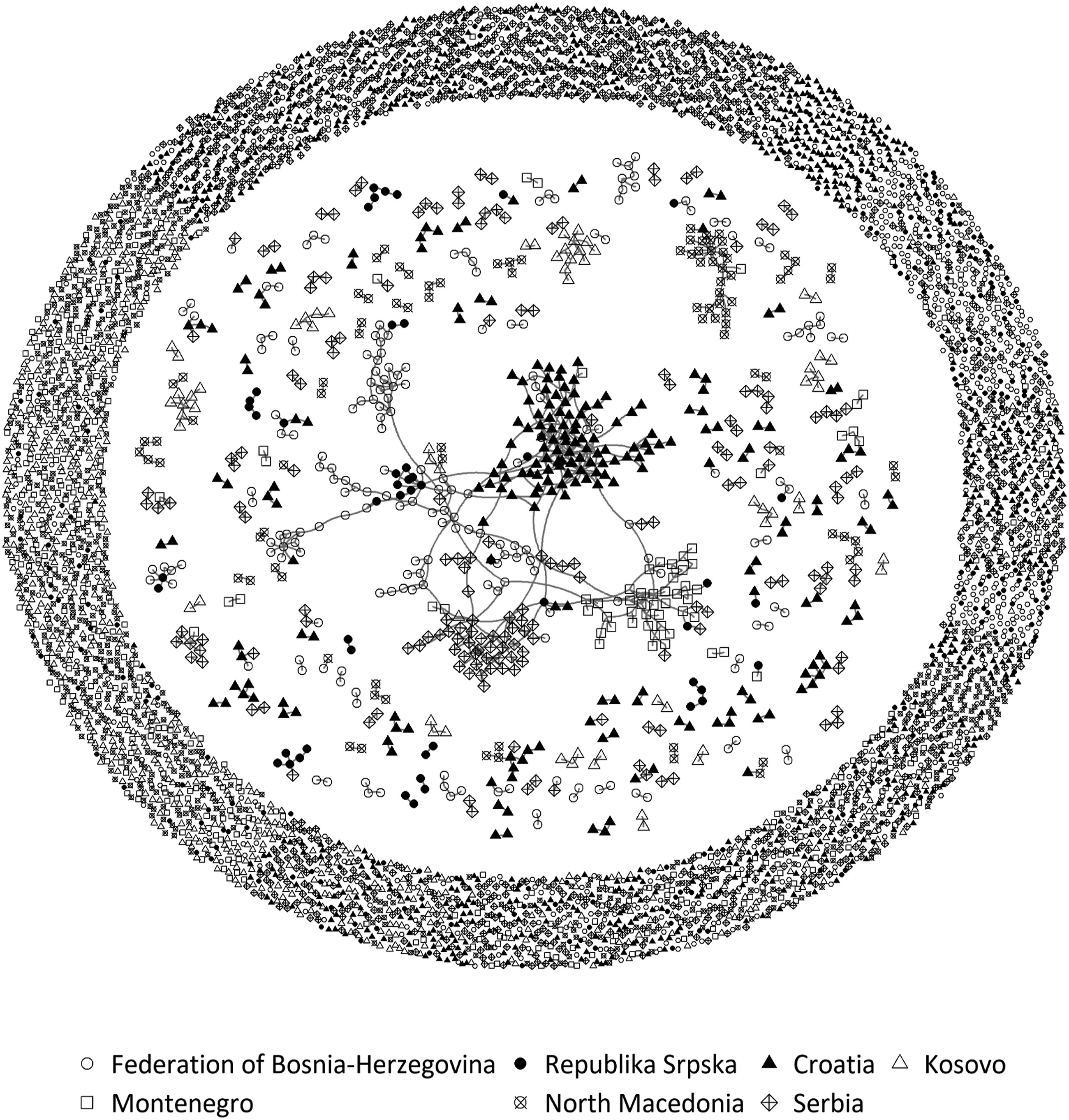
Here we would like to note three limitations of these data. First, the data only allow us to draw conclusions on the online connections between people. With the advent of the internet and social network sites in particular, these online connections have become increasingly important, and are a subject worth researching in itself (Mayer and Puller 2008; Wimmer and Lewis 2010). Furthermore, studies have found that offline and online connections overlap substantially (e.g., Reich, Subrahmanyam, and Espinoza 2012). Therefore, there is a good chance that the conclusions of this study will apply to real-life interactions as well, though such generalizations must be made with caution. Second, the data used here do not allow us to distinguish between various levels of closeness in friendships. Instead, only the presence or absence of a Facebook friendship is captured. There are various ways to tackle this problem. Wimmer and Lewis (2010), for example, restrict their definition of friendship to social ties between people who “tagged” each other in pictures uploaded on Facebook. This and similar approaches, however, are not without pitfalls, in addition to being unfeasible for a network spanning almost 6000 respondents. Moreover, when Wimmer and Lewis repeated their analyses using a similar definition of Facebook friendship as the one we use here, their results remained substantively the same.
The third limitation relates to the issue of causality. With these data, as rich as they may be, we cannot know for certain whether the social relations are due to war experiences and war views, or whether they would have occurred regardless. No data on social networks prior to the outbreak of hostilities exists that would allow us to verify this. This issue is arguably, however, of little relevance for the efforts at postwar reconciliation and better understanding among previously warring groups. What ultimately matters the most is that social relations today are defined by the violence that took place in the recent past. Moreover, we are convinced that the data we analyze is highly valuable and very informative when it comes to the relationship between war violence and social networks in postwar societies for two reasons. First, we control for all other major drivers behind social relations, as will be explained below. This likely prevents any effect of war experiences and views from being spurious. Second, given that the results in the next section show that social connections between individuals strongly and consistently coincide with views on the war past and people’s war experiences, we would be hard-pressed to dismiss these as being merely coincidental. In short, while the effect size of the war variables might be slightly exaggerated, their estimated role in structuring social network in our models is unlikely to be invalid.
Our models include four principal explanatory variables capturing respondents’ views and experiences of the conflicts in question. Views on the wars are captured by respondents’ answers on a five-point Likert scale to seven statements about the wars, ranging from the wars’ origins to their consequences. These statements are listed in Online Appendix A. For each one of the 17,811,496 possible unique connections between different respondents, we calculate the dissimilarity in the respondents’ answers to these seven questions, which becomes our variable War views dissimilarity. 5 For war victimhood, we follow the norms in the field stemming from research in the psychology of war trauma (Ringdal, Ringdal, and Strabac 2012) and rely on six yes-no questions measuring respondents’ various trauma symptoms. A respondent is considered to suffer from war-related trauma if s/he answered at least one question in the affirmative. Being a war veteran is measured by asking whether the respondent actively fought in the conflicts in question. War displacement is captured by a question on whether the respondent had to migrate because of the armed conflict. We do not distinguish here between the respondents who returned to their prewar communities and those who were forced to resettle elsewhere. We model closeness between any given two respondents on these three questions by noting whether they both suffered from war-related trauma, whether they were both war veterans, and whether they both experienced war-caused forced migration.
Our control variables can be split into two categories. The first category consists of political controls. Variables Nationalism and Socialism, capture people’s views on the two principal structuring policy dimensions in Southeast Europe that are rooted in the conflicts between the cosmopolitan and nationalist conceptions of society, and between the liberal and socialist conceptions of economy (Glaurdić, Lesschaeve and Mochtak 2021). Both variables are measured by averaging Likert scale responses to five policy statements. As the topic of the survey was politics, it arguably attracted more politically sophisticated respondents. For that reason, we also account for political interest measured on an 11-point scale. For all three of these variables, our models include the distance between the two given respondents. The second captures respondents’ sociodemographic characteristics. This category consists of gender, age, income (deciles), education level (lower, middle, or higher), ethnicity, civil society membership, and geographical location. Civil society membership represents the number of respondent’s memberships in various social organizations (cultural organizations, sports clubs, etc.). Geographical location is measured through self-reported zip code and country of residence. For all of these variables, except for Civil society membership, our models include measures of similarity between any two given survey respondents. While it is not possible to completely rule out the presence of an omitted third variable bias, the controls included in our models are arguably the most plausible sources of unobserved confounding factors.
We use exponential random graph modeling (ERGM) techniques to test our hypotheses regarding the structure online social networks in Southeast Europe. While scholars initially approached the formation of ties via a regular logit model, it quickly became apparent that the assumption of independent observations was untenable. For instance, it is likely that a friendship on Facebook is more likely to happen between two people if they have a mutual friend, often referred to as the transitivity-effect or triadic closure (Davis 1970). Another effect centers on popularity, in which certain individuals attract many ties. This can result in a core-periphery network structure with popular actors in the core, commonly referred to as the “stars”-effect (Snijders et al. 2006, 101; Wimmer and Lewis 2010, 612). These sorts of patterns are collectively referred to as the endogenous effects in a network, and ERG models were developed to properly model them (O. Frank and Strauss 1986). ERG models are designed to be analogous to classical generalized linear models, in the sense that they are capable of testing theoretically relevant hypotheses while simultaneously accounting for the dependence between observations. The models can be thought of as autoregressive (logit) models (Morris, Handcock, and Hunter 2008). Indeed, without endogenous dependencies in its specification, ERGMs are equivalent to logistic regression models (Cranmer et al. 2017).
However, there is no uniform way to develop an ERG model, and unlike standard regression analyses, it typically involves an extended trial-and-error process of iteratively adding terms, testing their contributions to the model fit, and using that as the starting point for the next iteration (Wimmer and Lewis 2010, see Online Appendix A). Applied to the data used here, this process led to an ERG model with, besides a term for the network density (comparable to the intercept), a term for the node popularity. Specifically, the models include an alternating k-star statistic, as proposed by Snijder et al. (2006). Other model specifications either resulted in degenerate models, did not converge on finite parameter values, or failed to substantially improve the fit with the data (see Goodreau 2007).
Results
Analyses of the Probability of a Friendship Tie on Facebook.
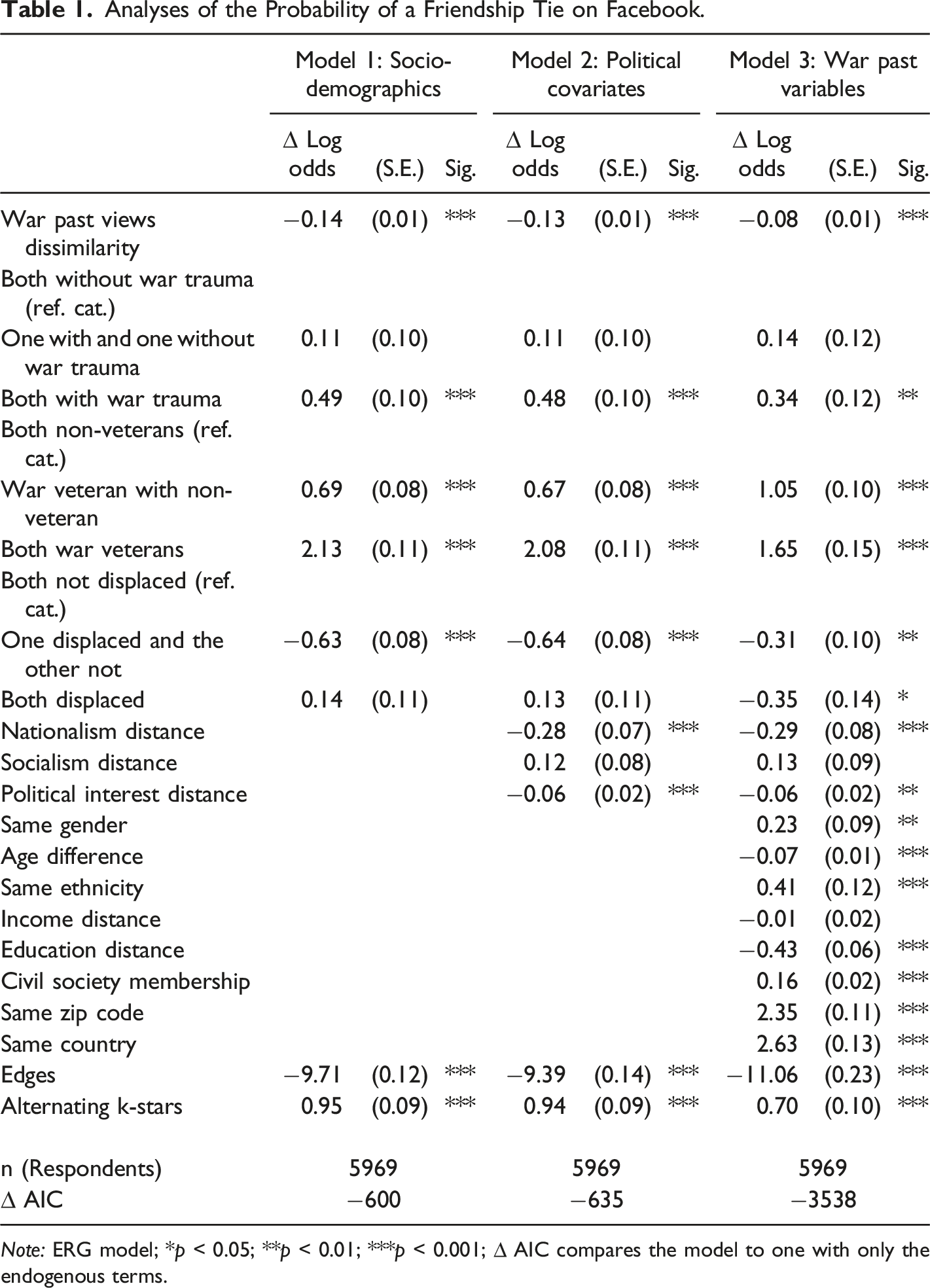
Note: ERG model; *p < 0.05; **p < 0.01; ***p < 0.001; ∆ AIC compares the model to one with only the endogenous terms.
As the results in Table 1 demonstrate, these more stringent tests of our hypotheses do not substantively alter the findings in Model 1 that show clear support for all five of our hypotheses. To make more sense of the log-odds reported in Table 1, we plot the predicted probabilities from the complete Model 3 in Figure 2. Our analysis shows that having dissimilar views about the wars – i.e. their onset, conduct, and consequences – has a statistically significant negative impact on the likelihood of a social tie between people. When we compare the probability of a friendship tie when two people have dissimilar views (mean War views dissimilarity plus one S.D.) with the probability when two people have similar views (mean War views dissimilarity minus one S.D.), we find that a social relation is 1.93 times more likely in the latter case than it is in the former case. This provides strong support for our first hypothesis: social connections in postwar Southeast Europe are significantly affected by people’s views of the recent past. Marginal effects of the main explanatory variables on the probability of a Facebook friendship.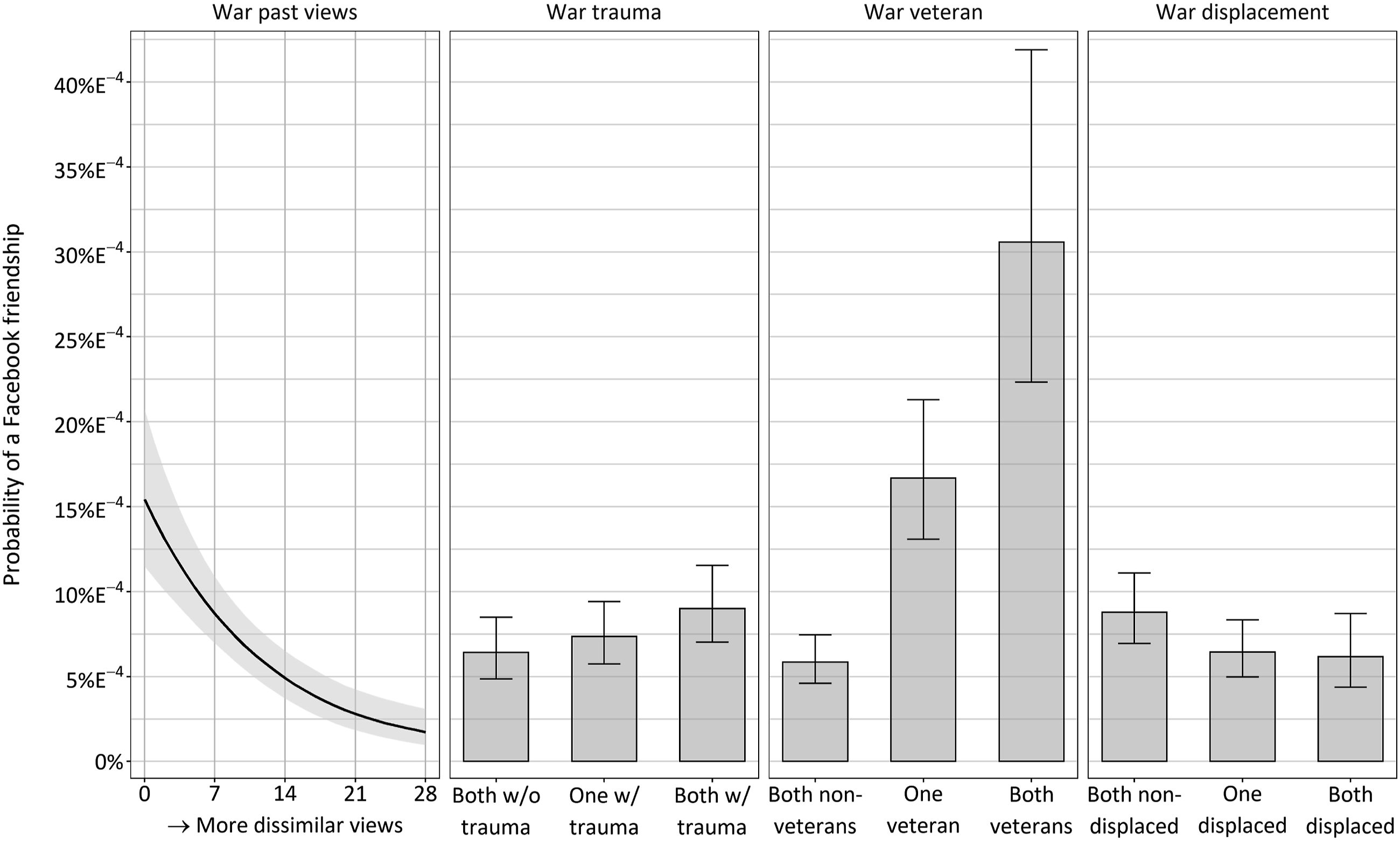
Views of the recent war past are, however, not the only significant influence on people’s online social networks. War experiences clearly matter as well. In line with our second hypothesis, Table 1 shows that suffering from war trauma affects the formation of friendships. Compared to a dyad consisting of two non-traumatized people, a social connection between two individuals suffering psychologically from the war is 1.40 times more likely. We do not find any evidence pointing to a larger or smaller online social network as the result of war trauma. The data, therefore, does not provide support for either the posttraumatic growth or distress theories. Considering the divergent propositions of these two theories, we remained agnostic on the issue and our results suggest that was a good choice.
The impact of being a war veteran on one’s online social network is also highly significant and in the expected direction. Compared to the social ties between non-veterans, a friendship between a veteran and a non-veteran is almost three times as likely to happen, and a tie between two veterans more than five times as likely. This strongly supports our assertions in hypotheses 3 and 4 that veterans were more socially engaged members of their communities and that the struggle for recognition and social policies aimed at supporting former combatants has resulted in veterans being more connected to one another. Finally, when it comes to the experiences of forced migration caused by war, Model 1 suggests that former refugees and those who did not have such experiences form separate online social networks, yet when the socio-demographics are added in Model 3, it becomes clear that displaced people also have smaller online networks in general, forming fewer social ties with either their host/returnee community or with other displaced persons. Specifically, a connection is only about 0.7 times as likely to happen if it involves a displaced person, as it is when it features two non-displaced individuals. Persons experiencing forced migration due to the war remain more isolated in their communities (whether new or old), even decades after the end of the hostilities. This is evidence clearly supporting our fifth hypothesis. The overall picture painted by our analysis is one of social connections in postwar societies in Southeast Europe being undoubtedly and strongly affected by people’s war experiences and views of the recent past.
Our analysis also reveals some interesting effects of the control variables. Regarding the political covariates, sharing the same nationalist views on society (mean Nationalism distance minus one S.D.) increases the likelihood of being friends by 1.44 when compared to having the opposite views (mean Nationalism distance plus one S.D.). The same cannot be said of Socialism, suggesting that views on economic policy have no impact on how social relations in Southeast Europe are formed. Having similar versus dissimilar levels of interest in politics (mean Political interest distance minus/plus one S.D.) increases the likelihood of a social connection by a factor of 1.34.
People are also more likely to be friends with others of the same gender, with a same-sex connection 1.26 times more likely to happen than a connection between a man and a woman. Social ties also depend on age difference. When the age gap is small (mean Age difference minus one S.D.), friendships are 4.80 times more likely to happen than when the age difference is large (mean Age difference plus one S.D.). Unsurprisingly, ethnicity plays a role in the region as well. Co-ethnics are 1.5 times more likely to be friends than two people belonging to different ethnic groups. There is no consistent evidence, however, for the existence of segregated online social networks based on socio-economic status. On the one hand, having similar instead of dissimilar levels of education increases the likelihood of a social connection by 1.85. On the other hand, income level has no bearing on the company that people keep. Being a member of civil society organizations increases the size of one’s online network, increasing the probability of being involved in a social tie by 1.52 when we compare no memberships with many memberships (mean plus one S.D. or 2.7 memberships). Furthermore, as was already clear from the network graph in Figure 1, geography has a large impact on whether two people will be connected. Sharing the same zip code increases the likelihood of being connected more than ten-fold. Country has an even greater effect, multiplying the odds of being part of each other’s online social network by a factor of almost 14. We present the marginal effects of the control variables on the probability of a Facebook friendship graphically in Figures A1-A3 in Online Appendix A. While we are confident these controls represent the most important alternative explanations behind the network patterns we observe, we can never be absolutely certain our models do not suffer from an omitted variable bias. To further test the robustness of our findings, we conducted a sensitivity analysis on the models by including simulated confounding variables (VanderWeele 2011). The results, shown in Online Appendix B, demonstrate the robustness of the effect reported in Model 3.
Conclusion
War legacies are often deeply pervasive and long-lasting. Wars do not only result in physical destruction and loss of life. They reorder social structures and relations. Circling back to the overarching research question posed in the introduction, we show that experiences, views, and memories of violent conflict permeate the very social fabric of the communities that have endured the violence. More than two decades after the wars of Yugoslavia’s dissolution ended, social relations between ordinary people in the region are still to a great extent determined by those wars. Of course, the precise effects of wars on postwar social relations are inherently difficult to assess, with limitations inherent in virtually every research design due to lack of prewar data. Nevertheless, the large-scale correspondence of social ties with the views of war violence and the group memberships created by different forms of exposure to that violence – all while controlling for virtually every other factor identified in previous studies as affecting social connections between people – makes us confident that we have found evidence of wars determining people’s social relations and social networks in postwar societies.
More specifically, our findings show that political homophily in the region is structured not only along conventional ideological cleavages, but also along differences in how people view and remember the Yugoslav wars. We also demonstrate that contemporary social relations are crucially determined by people’s real experiences of those wars. Study participants suffering frosister m war-induced psychological trauma, as well as combat veterans, are more likely to connect to others who shared their experiences. Combat veterans are also more socially connected in general, likely due to their greater social standing and political activism. Conversely, people with experiences of forced migration are more likely to face social isolation from their wider community. What is particularly important, all of these effects on participants’ online social networks are comparable in size to the effects of variables generally considered to have a critical impact on people’s social relations, such as gender, ethnicity, education, or political ideology.
Our study is not without its potential pitfalls, however. Most importantly, we rely on Facebook to measure people’s online social networks. Facebook as a platform actively seeks to promote content fitting users’ own profiles and interests, which may affect their networks of friendships by possibly encouraging homophilic connections. Nevertheless, the users are still the ones who choose to engage with what the platform offers them. In other words, Facebook allows people to more clearly pursue their desired online social networks. From a scholarly perspective, this can be considered an advantage, with the platform functioning as a Petri dish for the drivers and mechanisms behind the social connections between people. Finally, while it should be obvious, it is nevertheless important to note that the impact of Facebook, and that of social network platforms in general, on social connections is less an instrumental choice by researchers and more a fact of life in contemporary society. Social network sites exist, and their effects on people’s networks will be felt irrespective of how one chooses to collect the data. Regardless, future research must endeavor to corroborate the findings related to people’s online lives reported here in the offline world (if it is still possible to disentangle the two in many societies).
Another potential pitfall is possibility of omitted variable bias. No study can guarantee that it does not suffer from it, and ours is no exception. Nevertheless, we are confident in the results presented here and in their robustness. First, our models include all the usual confounding variable suspects, such as location, ideology, and sociodemographic characteristics. Second, the sensitivity analyses (see Online Appendix B) provide evidence of the consistent and enduring effects of war past views and war experiences on people’s social networks in postwar societies.
While we believe that the interconnectedness of those who are coping with war-related trauma may be a positive sign, we are less convinced of the normative merits of the other results. The separate online social networks structured alongside opposing war past views run the risk of amplifying group polarization, pushing people into ever more extreme opinions and possibly resulting in the impugnation of the motives and character of political opponents (Sunstein 2018). In addition, those benefiting from a war identity such as war veterans might be incentivized to maintain the relevance of those identities. The social disadvantage experienced by others such as displaced persons might fuel resentment against those perceived responsible for their predicament (Konitzer and Grujić 2009). Either way, our results clearly show that the wars in the ‘90s and early 2000s have a strong impact on social networks in the region. This in turn arguably contributes to postwar societies being stuck in the past and unable to leave the war behind – something that is so painfully obvious to all observers of social and political relations not only in Southeast Europe, but also in postwar societies in other geographic and temporal contexts.
Supplemental Material
Supplemental Material - The Ties that Bind: War Histories and Online Social Networks in Postwar Societies
Supplemental Material for The Ties that Bind: War Histories and Online Social Networks in Postwar Societies by Christophe Lesschaeve and Josip Glaurdić in Journal of Conflict Resolution
Supplemental Material
Supplemental Material - The Ties that Bind: War Histories and Online Social Networks in Postwar Societies
Supplemental Material for The Ties that Bind: War Histories and Online Social Networks in Postwar Societies by Christophe Lesschaeve and Josip Glaurdić in Journal of Conflict Resolution
Footnotes
Acknowledgements
The authors thank the anonymous reviewers for their useful comments and suggestions, the European Research Council and the Faculty of Humanities, Education and Social Sciences at the University of Luxembourg for providing the funding that made this research possible, and Oraclum Intelligence Systems (oraclum.co.uk) for collecting the data used in this article.
Declaration of Conflicting Interests
The author(s) declared no potential conflicts of interest with respect to the research, authorship, and/or publication of this article.
Funding
The author(s) disclosed receipt of the following financial support for the research, authorship, and/or publication of this article: This work was supported by the H2020 European Research Council (714589).

Data Availability Statement
Supplemental Material
Supplemental material for this article is available online.
Notes
References
Supplementary Material
Please find the following supplemental material available below.
For Open Access articles published under a Creative Commons License, all supplemental material carries the same license as the article it is associated with.
For non-Open Access articles published, all supplemental material carries a non-exclusive license, and permission requests for re-use of supplemental material or any part of supplemental material shall be sent directly to the copyright owner as specified in the copyright notice associated with the article.
