



Abstract
Secret police are generally viewed as key institutions in autocrats’ repression apparatus. However, we lack clear empirical evidence on the link between secret police and repression. Instead, recent studies indicate that the surveillance provided by secret police reduces physical human rights abuses. This paper re-examines the relationship between secret police and physical state repression. We identify four mechanisms linking these variables, deterrence, targeting, organizational practices, and institutional self-preservation. These mechanisms provide contrasting expectations for the overall relationship but also contextual expectations on when secret police may (not) increase repression. To test these expectations, we collect data on the global existence of secret police. Results indicate that secret police are associated with increased physical repression, particularly when they must develop a reputation to deter dissidents or when multiple rival security organizations exist. In contrast, older, more established secret police or ones without institutional rivals are not associated with physical repression.
Introduction
Secret police are among autocrats’ most prominent tools of repression. The Gestapo became notorious for its mass murder programs (Browder 1996). During Stalin’s reign of terror, “anti-Soviet elements” were either shot or sent to the Gulag camps by NKVD tribunals (Werth 2010). And more recently, the Sudanese National Security Service has been accused of regular torture, disappearances, and extrajudicial executions (Amnesty International 2010). Anecdotally, it thus seems clear that secret police organizations are connected with governmental violations of physical integrity rights, an idea that is echoed in large parts of the literature on state repression 1 (Plate and Darvi 1982; Berman and Waller 2006; Policzer 2009; Greitens 2016; Scharpf and Gläßel 2020).
However, recent studies on state security institutions actually offer only mixed support for this view. First, existing work shows that pro-government militias and paramilitaries, i.e. forces that are conceptually different from secret police as they are not explicitly tasked with intelligence operations, increase physical regime repression (Carey and González 2021; Mitchell, Carey, and Butler 2014; Koren 2014). In line with this, it was the paramilitary Rapid Support Forces which massacred peaceful protesters in Sudan’s capital Khartoum in June 2019, not the National Security Service (Burke and Salih 2019). And second, it has been shown that increased information on opposition activities allows rulers to engage in targeted repression of opponents, meaning that they have to rely less on the indiscriminate physical oppression of populations suspected of anti-regime convictions (Dimitrov and Sassoon 2014; Gohdes 2020; Xu 2021; Kalyvas 2006). Notoriously, the Soviet KGB had the country’s entire society under mass surveillance (Richelson 1986, 246–47; Shelley 1996, 19) while the east German Stasi established surveillance networks including up to one informant per 89 citizens (Müller-Enbergs 2012). As it is arguably the key function of secret police to find and gather information on opposition activities (Barros 2016; Greitens 2016; Plate and Darvi 1982), this presents a further challenge to the notion that these organizations are a source of more severe regime repression. As such, it is not clear that or in which contexts secret police organizations are indeed associated with increased physical repression.
We take this as a motivation to systematically examine both the overall and contextual effects of secret police organizations on state violations of physical integrity rights. To do so, we identify four mechanisms potentially linking these variables: deterrence, targeting, organizational practices, and institutional self-preservation. In short, secret police may decrease state repression by deterring opposition activities or, as outlined above, by providing the information on such activities necessary to selectively target political opponents. In contrast, they may increase repression due to acts such as abduction, unlawful detainment, and torture being a large part of their modus operandi or because of the necessity to identify and eliminate ever-growing numbers of opposition threats in order to justify their continued existence and institutional growth.
Given these competing expectations, we also develop mechanism-specific observable implications based on the institutional context of secret police to disentangle when particular pathways are at play. First, under the deterrence mechanism, newly formed secret police may have a different effect than older, more established ones as they must engage in violent repression to build up a reputation which can deter dissent. And second, the institutional survival mechanism suggests that secret police repressive activity increases with the number of rival security organizations with similar tasks that they have to compete with over a limited pool of resources and influence.
To test these expectations, we collect and make use of new global data measuring the existence of secret police in non-democratic countries after World War II. Our results offer support for the view that secret police organizations are associated with increased physical repression. In other words, even if secret police deter potential opponents from becoming active or provide the information to selectively target them, we do not find evidence that their existence translates into a reduction of overall repressive activities. That being said, additional results are in line with the logics of deterrence and institutional self-preservation, as we find that the effect of secret police on physical repression depends on their age as well as how many other security organizations with similar tasks are present.
Secret Police Organizations
Secret police are political police forces tasked with targeting dissidents and political opponents to preserve the status quo and the physical integrity of the government (Berman and Waller 2006). A conclusive definition of the secret police does not exist in the literature. According to Plate and Darvi (1982, 11), the umbrella term “secret police” encourages inclusivity and generality to cover numerous activities of (semi)-official government conduct. However, a more definitive interpretation of the institution is necessary to distinguish between secret police and other state security forces. We thus define the secret police as an internal security agency that uses violent policing practices and intelligence operations against political opponents or dissidents while being autonomous from the rest of the security apparatus. The violent policing practices of the secret police include “searches, arrests, interrogation, torture, and indefinite detention” (Plate and Darvi 1982, 11). Besides violence, secret police agents use intelligence operations, such as espionage or informant networks, to monitor the population while the identity of its agents and its operations are secret (Plate and Darvi 1982; Greitens 2016, 45). Therefore, secret police are internal security agencies that answer directly to the authoritarian leadership and employ intelligence operations and violent policing practices to preserve political order in an autocracy. Under this definition, the term “secret police” includes some of history’s most notorious internal security agencies, such as the Soviet NKVD/KGB, the Brazilian DOI, the Greek Special Investigative Unit-Military Police, the Iranian Savak, and more contemporary examples, like the Sudanese National Security Service or Venezuela’s Bolivarian National Intelligence Service.
Secret police forces are an integral organ of the authoritarian security apparatus. Authoritarian leaders rely on “intelligence agents within the state hierarchy to monitor subordinates” (Barros 2016, 962). Dictators avoid an agency problem by recruiting based on loyalty instead of competence since underachievers have few outside options (Egorov and Sonin 2011; Zakharov 2016). To that end, there is evidence that secret police are staffed with underachievers striving to prove their value to the regime (Scharpf and Gläßel 2020; Zakharov 2016). Since they have few outside options, “they must diligently work toward the autocrat’s interests to retain their career chances” (Scharpf and Gläßel 2020, 795). Evidence from Argentina and the Eastern Bloc illustrates the poor education and blue-collar background of secret police agents (Blažek and Žáček 2005, 106; Browder 1996, 67; Gregory 2009, 58; Scharpf and Gläßel 2020). Besides selective recruitment, corporate interests further re-enforce ties of loyalty since in case of regime collapse the agency will follow suit 2 (Berman and Waller 2006). To illustrate this point, secret police agents were excluded from the new security apparatus in post-communist Europe (Milosavljević and Pavićević 2002; Marx 2014; Berman and Waller 2006). Consequently, selective recruitment and corporate interests solidify secret police as a regime’s hardcore supporters. From this perspective, secret police may increase the prospects of autocratic regime survival if autocracies with secret police are less likely to experience a coup d’état compared to other autocracies.
Secret Police Organizations and State Repression
Secret police are at the forefront of regime efforts to minimize dissent and maintain political control. As authoritarian leaders seek to stay in power, they rely on a variety of tactics, including the creation and maintenance of parallel military institutions, political parties and parliaments, as well as providing rents to their inner circle (see Quinlivan 1999; Svolik 2012; Bueno de Mesquita et al. 2005). While these tactics are aimed at reducing regime insiders’ willingness and opportunity to challenge the ruler, the core approach to tackling such challenges from outside of the regime is repression (see e.g. Davenport 2007; Dragu and Przeworski 2019; Sullivan 2016). Specifically, preemptive repression serves to make opposition mobilization costly, to deter citizens from joining it, and to hence prevent threats before they have the chance to grow and require reactive repression. As such, secret police are established as one part of the ruler’s wider security apparatus, tasked with ensuring their security, and hence inextricably linked to repression. As a dedicated internal intelligence agency, secret police are tasked with the surveillance of domestic threats to the ruler and with detecting, identifying, and locating political dissenters. As a political police force, they also exist to neutralize these threats, employing violent policing practices in the process. Based on these tasks, we discuss four distinct mechanisms through which secret police may affect state repression. In the following, we discuss these mechanisms under the names deterrence, targeting, organizational practices, and institutional self-preservation.
In their role as domestic intelligence organizations, secret police increases the regime’s informational capabilities. The secret police gathers intelligence through large informant networks and professional spies that supply information on radical dissidents and other political opponents inside the state or society (Dragu and Przeworski 2019, 79). To this end, “secret police forces run extensive spying networks to surveil and detect conspiring enemies within the elite, the security apparatus, and society at large” (Scharpf and Gläßel 2020, 791). Those informant networks provide valuable political intelligence to the regime in order distinguish dissidents from the general public and punish them accordingly. As such, the NKVD had assembled a gargantuan espionage network of 500,000 informants by the mid-1930s (Gregory 2009, 39). The intelligence value of these networks is captured by their tremendous growth rate. For instance, the Romanian Securitate employed 42,187 informers in 1951 and approximately 450,000 in 1989 (Deletant 2005, 314-15). Besides sheer size, the secret police informant networks were also very intrusive. Case in point, Stasi informants penetrated the ministries, the military, and even the agency itself (Geddes, Wright, and Frantz 2018, 156). Additionally, secret police gather intelligence through extensive surveillance operations such as monitoring individuals or using bugged telephones and other communication devices to spy on people of interest (Dragu and Przeworski 2019, 79; Kramer 1985, 51). In summary, secret police employ a series of intelligence gathering operations that increase regimes’ knowledge about anti-government activities. How can this affect state repression?
First, such knowledge, and secret police ability to generate it, can result in the deterrence of anti-regime activities which, in turn, also reduces the necessity of physical human rights violations (Greitens 2016; Judt 2005; Steinert 2023). The more likely citizens perceive it to be that dissident actions will be uncovered and sanctioned by the regime, the less likely they are to engage in such actions in the first place (De Jaegher and Hoyer 2019; Pierskalla 2010). And where, as a result, there is less dissent, governments also have no need to respond by increased repression (see Davenport 2007). In this vein, Greitens (2016) indicates that secret police decrease citizens’ willingness to engage in anti-regime activities as their existence, and hence the increased probability of being detected, is common knowledge. For example, every single Soviet citizen knew who the KGB was and what it was capable of (Plate and Darvi 1982, 9). Likewise, the Stasi vetted all state personnel and a suspicion of dissent had catastrophic consequences for career advancement (Rosenzweig and Le Forestier 1992). Facing such intense surveillance, and hence high probability of detection, citizens become less willing to engage in anti-regime activity (Greitens 2016; Judt 2005). The idea that secret police deter citizens from anti-regime activity, resulting in turn in a decreased need of government repression, thus suggests a negative effect of such organizations on state violations of physical integrity rights.
Beyond deterrence, secret police and the information they generate may also affect state repression by allowing for its more selective targeting. As secret police increase the quantity and quality of regimes’ information on anti-government activities, they also allow regimes to better distinguish between dissidents and the public, increasing their ability to target the former group (see Dimitrov and Sassoon 2014; Kalyvas 2006; Steinert 2023). In contrast, a lack of information on who opposes the regime results in the indiscriminate targeting of groups suspected of anti-regime views based on broad heuristics such as demographic attributes. In this vein, recent studies show that digital surveillance results in more targeted repression whereas internet restrictions in contrast lead to more indiscriminate actions (Xu 2021; Gohdes 2020). McLauchlin and La Parra-Pérez (2019) argue that in provinces where information on political loyalties was low, Spanish republican officers’ age, career progress or corps affiliation were sufficient to brand them as defectors, resulting in their execution. Similarly, where information on civilians’ allegiances during periods of contention is low, this is associated with increased levels of violence against these same civilians (Kalyvas 2006; Pilster, Böhmelt, and Tago 2016; Siroky and Dzutsati 2015; Winward 2021). Ultimately, good intelligence allows the government to infiltrate and selectively repress opposition movements, stifling them before they reach a size as to make overt, wide-spread repression necessary (Dragu and Lupu 2021; Davenport 2014). As the information generated by secret police informant networks and surveillance operations allows regimes to identify and locate political opponents, selective instead of indiscriminate targeting thus becomes increasingly possible. Importantly, regimes also have a clear incentive to act on this possibility. In Chechnya, selectively targeted repression based on relevant intelligence has been shown to reduce anti-regime activity attacks whereas the indiscriminate targeting of entire villages decreases activity in the short but increases it in the medium- and long-term (Lyall 2009; 2010; Souleimanov and Siroky 2016). This suggests that selective targeting is more effective at quelling anti-regime activities whereas indiscriminate repression can be politically costly to incumbents by triggering domestic or international backlashes (see e.g. Curtice and Behlendorf 2021; Balcells, Dorsey, and Tellez 2021; Moore 1998; Nielsen 2013; Rozenas and Zhukov 2019). As such, regimes should, when possible, target their repressive activities selectively instead of indiscriminately. By providing intelligence on dissident activities, secret police do allow regimes to increasingly opt for selective repression.
While the deterrence mechanism thus suggests that secret police reduce dissident activity and hence the need for governmental repression, the targeting mechanism indicates that secret police decrease regimes’ reliance on indiscriminate repression, instead allowing for the targeting of selected individuals. Both mechanisms are based on the insight that secret police provide intelligence on anti-regime activities and imply the expectation that repression is lower in authoritarian regimes with secret police compared to other authoritarian regimes.
Beyond providing intelligence, however, secret police are also state institutions which use violent policing practices. At their core, secret police rely on an operational repertoire including “searches, arrests, interrogation, torture, and indefinite detention” (Plate and Darvi 1982, 11) to gather intelligence or to terrorize the public in order to establish political control. From this view, the organizational practices secret police use are thus characterized by their violent and repressive nature. As such, the methods secret police employ to gather intelligence on and neutralize opposition to the regime may already result in repression. For instance, the Greek Military Police-Special Investigative Unit operated under the dogma that “a friend or cripple comes out whoever comes in here” (Karanikas 2010). Secret police rely not only on passive surveillance to obtain information on dissident activities, but they also employ methods including arbitrary arrests, physical or psychological torture, and indefinite detention to extract this intelligence. According to one individual, the Argentinian secret police ultimately figured that “if they arrest 10 and one gives information, the odds are good enough” (Plate and Darvi 1982, 76).
What’s more, repression may also be employed to build up the informant networks used for state surveillance (see Fruhling 1983). In Romania, some informers were paid for their services while others joined involuntarily, through coercion or blackmail, as the secret police fabricated charges against people of interest which they would drop only after the targets had agreed to collaborate with the authorities (Deletant 2005, 314). The Cheka’s “empire-wide system of secret informants” was established through similar actions of coercion and blackmailing to eliminate dissent in the Soviet society (Waller 2006, 3; Ferdinand 1991, 135-36). And returning to the Greek Military Police, citizens suffered severe physical punishment for refusing to cooperate (Haritou-Fatourou 2003). These examples are in line with the observation that while some contemporary authoritarian security apparatuses use advanced digital technologies in their surveillance efforts, secret police to a large degree continue to recruit poorly educated, little-skilled individuals and rely upon less sophisticated, more violent methods (Browder 1996; Blažek and Žáček 2005; Gregory 2009; Scharpf and Gläßel 2020; Zakharov 2016). Together, these points suggest that secret police, due to their violent and repressive organizational practices, may stoke, not reduce, the extent of state repression, even if these practices result in increased state intelligence on opposition activities.
This view is also supported by the intuition that secret police want to ensure their institutional survival. Generally, institutions within a state compete over limited resources and influence as all aim to safeguard their continued existence and to extend their power (Allison and Halperin 1972; Halperin, Clapp, and Kanter 2006; Huntington 1961). As such, secret police compete with other branches of the security apparatus, e.g. the regular police, the armed forces, or paramilitaries, over funding and competences, and thus have the incentive to produce palpable results which demonstrate their usefulness to the regime (Greitens 2016). In other words, the corporate interests of the agency dictate the need to present a sufficient extent of task fulfilment, i.e. the tracking and neutralizing of anti-regime individuals, to justify its budget and personnel. Secret police are thus incentivized to identify a high number of citizens as holding subversive views, thus showing the extent of this threat, and to engage in repression against these citizens, further showing their efficiency at neutralizing the threat. This incentive to produce tangible results may even be particularly strong for secret police: As secret police usually operate autonomously, in secrecy, and are hard to supervise, they generally present an additional threat to the power of the regime (Plate and Darvi 1982; Dragu and Przeworski 2019). Depending on how rulers perceive the political climate and threats to their regime, secret police can thus appear as more of an inside threat rather than a necessary safeguard. If secret police do not show sufficient evidence of neutralized anti-regime activity, leaders may thus deem these organizations more threatening than security-enhancing and strive to dismantle them. 3 However, rulers’ knowledge regarding the political climate and threat landscape is reliant on their secret police. Being aware that they may be eliminated if the overall threat environment allows the ruler to do so, secret police should hence work to paint a picture of a threat environment justifying their own existence. In line with this intuition, agents of the Soviet KVD had to meet specific quotas of arrests, irrespective of their targets’ actual anti-regime activity, during Stalin’s reign of terror (Werth 2010). The institutional survival mechanism is thus, to a relevant degree, decoupled from actual threats against the regime. 4 A secret police’s incentive to ensure its continued existence and growth, especially in the face of the ruler’s persistent perception of threat emanating from the agency itself, pushes it to identify and repress as many alleged dissidents as possible, independent of actual opposition activities. Together, this institutional survival logic and the organizational practices mechanism thus result in the expectation that repression is higher in authoritarian regimes with secret police.
Additionally, the deterrence and institutional survival arguments enable us to develop two additional, context-specific expectations regarding the relationship between secret police and repression. Doing so allows us to adjudicate somewhat between the different mechanisms spelled out above. Specifically, in order for the secret police to build the necessary reputation to deter dissidents from engaging in anti-regime activities, they first need to signal to the population through violent repression that dissent will not go unsanctioned. Only then would citizens realize that dissent will be detected and punished by the regime, thus becoming less likely to engage in such actions. Hence, secret police’s reputation would deter citizens from engaging in anti-regime activity only after the secret police have given citizens palpable reasons to fear them. Put differently, every Soviet citizen knew what the KGB was capable of (Plate and Darvi 1982, 9), but this was due to the KGB having demonstrated this very clearly through its earlier repression campaigns. In order for deterrence to work, secret police thus first must repress, building up a reputation which then deters citizens from dissident activities (see Wu and Wolford 2018). While the deterrent effect of secret police hence reduces the amount of repression required in the present, this effect fundamentally rests on secret police having engaged in significant repression earlier. Newly founded secret police thus must first engage in repression in order to later benefit from a reputation for doing so. This also means that, if an institution was initially created as a standard police force and only later turned into a secret police, it will have neither a history of nor a reputation for detecting and neutralizing dissidents, meaning that it has to “showcase” these activities and hence engage in actual repression. The deterrence mechanism thus requires a reputation for, and hence history of repression. In other words, if a given secret police can, in the present, deter opposition activity based on its reputation, it must have actually engaged in the repression of such activity in the past. Based on this reasoning, the deterrence argument suggests that repression is higher in authoritarian regimes in the first years of secret police existence, but not afterwards. 5
Furthermore, the institutional survival logic suggests that repression by the secret police may vary based on the degree of competition within the security apparatus. To reiterate, state institutions compete over limited resources and work to ensure their continued existence and influence. Consequently, when secret police face fierce competition from other branches of the security apparatus with similar tasks and specialties, they are incentivized to produce better results to prove their usefulness to the regime (Greitens 2016). Specifically, secret police are tasked with guarding the regime against the domestic political opposition and defections from within the ruling coalition. In many countries, these tasks are also carried out by counterbalancing paramilitaries which similarly guard against challenges posed by regime insiders and the military (Böhmelt and Pilster 2015; De Bruin 2018; Quinlivan 1999), but can also be deployed against anti-regime protests as e.g. in Libya during the Arab Spring (Gaub 2013). This implies that when there is a larger number of such organizations with very similar tasks, secret police have a clear incentive to show their value by neutralizing threats. Hence, we expect repression to increase in authoritarian regimes when secret police compete with a higher number of counterbalancing paramilitaries.
Global Data on Secret Police in Non-Democratic Countries
While the literature on state security forces has expanded dramatically throughout the past decade, systematic data on secret police remains absent. Contrary to conventional paramilitary organizations, secret police are under-reported in the Military Balance (IISS 2020) which describes only a limited number of secret police organizations from former Communist states and for a limited number of years. Similarly, the State Security Forces dataset (De Bruin 2021) provides information on intelligence services and secret police in 22 states but predominantly reports intelligence services like the FBI. To empirically investigate the effect of secret police on state repression, we thus collect new data on the presence of secret police organizations in non-democracies over the period 1950-2018. 6 For an internal security agency to then be classified as secret police, it needs to meet the following criteria: a) it is a political police force denoting that it targets political opponents and dissidents to preserve the status quo b) it is not controlled by other security agencies and answers directly to the authoritarian leadership, c) the identity of its members and its operations are secret, d) it is an internal security organization that specializes on political intelligence and surveillance operations e) it carries out violent policing practices such as arbitrary searches, arrests, interrogations, torture, indefinite detention, and disappearances.
These criteria exclude regular police organizations, like anti-narcotics departments or anti-terrorism divisions, that may employ violent, clandestine operations but target criminal operations instead of political opponents. Internal security agencies in Western democracies may use some of the violent policing practices listed by Plate and Darvi but neither all five nor to the relevant degree or intensity (1982, 11). For instance, the FBI under J. Edgar Hoover used to run an intrusive surveillance program but did not resort to indefinite detention, disappearances, and torture. Military intelligence agencies like the Soviet GRU also cannot be categorized as secret police because they specialize in foreign intelligence instead of internal political intelligence, are part of the military apparatus, and as a result also a target of secret police operations. Case in point, the GRU was infiltrated by KGB spies to monitor its officers’ activities (Caron 1971, 67). Moreover, the regular police may employ violent policing practices but the identities of its agents and operations are not secret, it cannot monitor the activities of other internal security organizations, while its own activities are monitored by other security agencies, including by the secret police. To cite an instance, Stasi officers monitored the People’s Police and the National People’s Army for disloyal cadres (Gieseke 2005, 169; Herspring 1999, 565). Operational autonomy is thus a necessary feature of the secret police as they report only to the authoritarian ruler. The Chilean secret police briefed Pinochet daily while the rest of the Junta was apprised indirectly (Policzer 2009, 86) while DOI agents in Brazil enjoyed such operational autonomy that their operations “became illegal, even by the military’s own rules” (Stepan 1988, 27). Similarly, the Greek Junta’s military police and Saddam’s Mukhabarat qualify as secret police because they employed the full list of violent policing practices, were tasked with political intelligence and repression of dissidents, and answered directly to the authoritarian leadership.
Finally, we should note that the last component of this definition, the use of violent policing practices, itself already entails some level of repression. By this definition, all secret police are thus associated with at least a minimum amount of repression at some point during their existence as, otherwise, we would not code them as secret police. However, this is in line with both of our theoretical mechanisms linking secret police to reduced repression, deterrence and targeting, which feature some level of secret police repression as necessary components. While, by this definition, countries with a secret police thus always exhibit some level of repression, it does not address whether these organizations increase or reduce the intensity of repression.
The data collection effort itself is based on a list of candidate countries which includes all non-democracies, as identified by the Polity score (Marshall, Gurr, and Jaggers 2016). Based on the Polity score, countries with a score between +6 to +10 qualify as democracies, we thus investigate non-democracies, in other words, anocracies and autocracies with scores +5 to −5 and −6 to −10, respectively. Following a country-by-country approach, we then surveyed existing, often country-specific accounts of internal security organizations across the literatures on authoritarianism, security organizations, intelligence agencies, policing and coup-proofing as well as relevant datasets on paramilitary forces, e.g. the Military Balance (IISS 2020), in order to identify candidate organizations. Using both the collected literature and additional online sources, these organizations were then compared to the five criteria discussed above and those which did not fit one or more of them removed. We also cross-examined the literature with online sources to identify the accurate start year of each secret police organization. Ultimately, we assign a value of 1 if an organization meeting these criteria is present in an authoritarian state in a given year and 0 otherwise. Notably, some institutions, such as the Greek Military Police, were first set up as non-secret police but then, often after a regime change, repurposed to carry out secret police tasks. We register such cases based on their adoption of secret policing tasks, not their organizational start date. 7 Institutions coded as secret police, as well as the literature we consulted to do so, are listed in the appendix.
Collecting global data on secret police is not without challenges. One potential issue is that we primarily used English-language literature to find and investigate candidate organizations, potentially resulting in source bias as Western researchers may have had an affinity to study secret police in Europe or the Americas. That being said, some of the major studies on secret police we consulted, e.g. Plate and Darvi (1982) and Berman and Waller (2006), do explore cases outside of Europe and the Americas which helps reducing this issue. We also doubled down on country-specific case studies, e.g. Sirrs (2010) and Moore (2019), that examine non-European states in particular to fill gaps presented in the generalist studies. And second, secret police are largely covert organisations, meaning that knowledge, and hence reporting, of their activities will often be limited. That being said, and as we highlight above, secret police rely on citizens’ knowledge of their existence to instil fear and deter opposition activities (see also Greitens 2016). While information on secret police capabilities, operational procedures, or agent numbers is thus both rare and imprecise, this will be less so the case regarding their general existence. Accordingly, we limit ourselves to coding a binary variable capturing solely the existence of secret police, thus seeking to reduce the possibility of under-reporting as much as possible.
The resulting variable is mapped in Figure 1. It indicates that we record secret police as existing all over the world, with organizations fitting our criteria being present at some point in time in the Americas, sub-Saharan Africa, the Middle East, both western and eastern Europe, as well as across Asia. This suggests that, while a geographical bias and under-reporting due to mainly relying on English-language sources remain possible, it at least does not result in clear geographical patterns of omission. The Existence of Secret Police in Authoritarian Countries, 1950-2018. For countries which changed regime type during the period of observation, data only relates to non-democratic period. White-coloured countries were democratic during the period of observation. Map shows 2016 borders obtained from CShapes (Schvitz et al. 2022).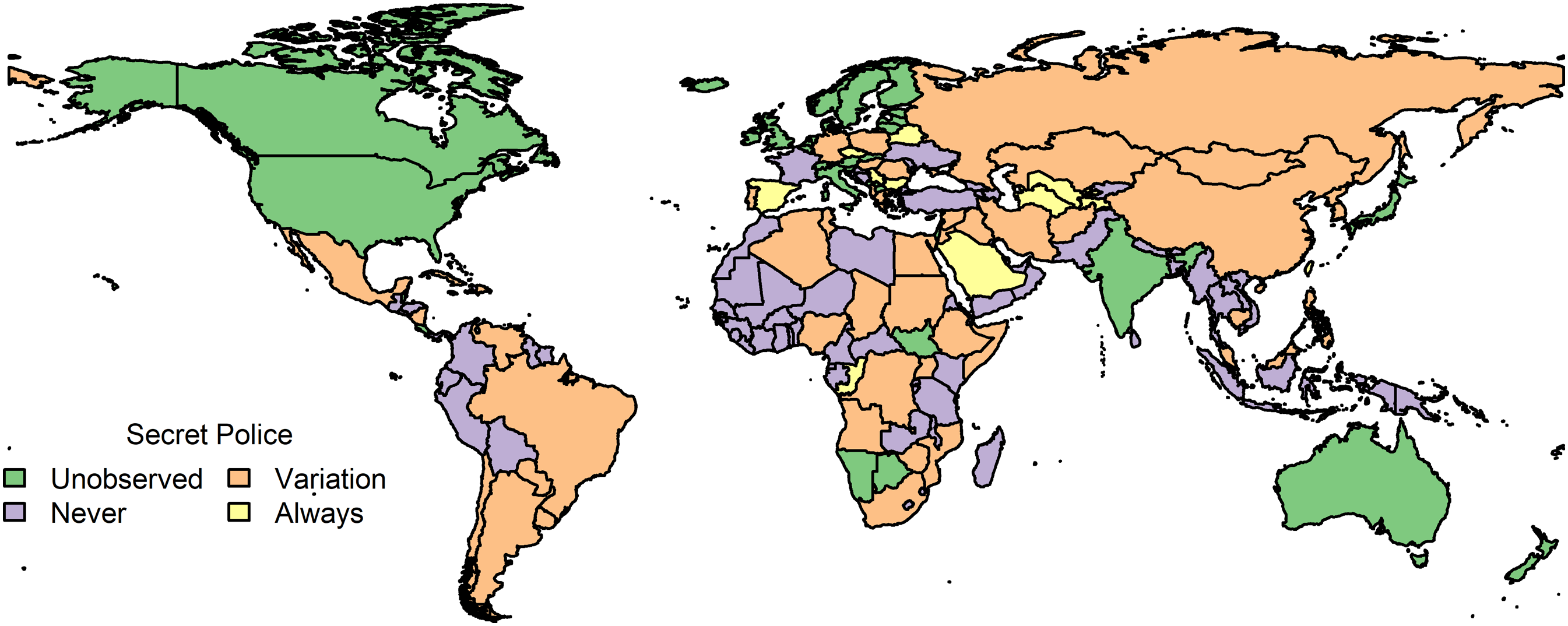
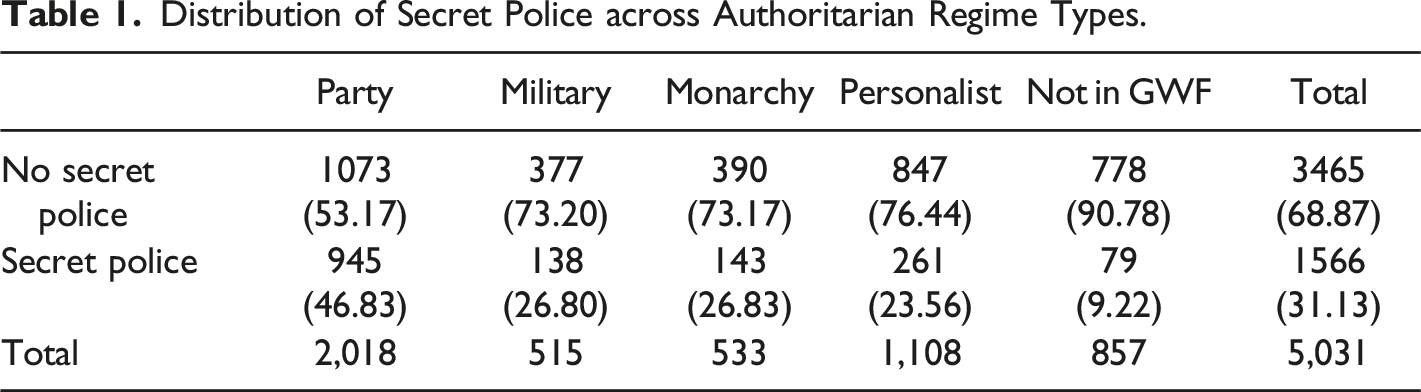
Distribution of Secret Police across Authoritarian Regime Types.
Research Design
Our key independent variable, as described in the preceding section, is a binary indicator of the existence of at least one secret police organization in a given country-year.
To measure the intensity of governmental repression, we rely on Fariss’ (2019) latent human rights protection scores, version 3.01, which indicates respect for physical integrity rights. A government’s higher respect for these rights goes hand-in-hand with less repression, and vice-versa. This data covers a longer temporal domain than alternative datasets while also taking into account a wide range of available information on physical integrity rights. Additionally, it guards against the potential concern that some instances of repression may not show up in the data.
For instance, less intense forms of repression may often be underreported when more appalling physical integrity rights violations are taking place at the same time (Brysk 1994; Cingranelli and Filippov 2018). Or in our specific case, it is possible that secret police, as they age, do not engage in less repression but instead shift to less visible forms of it. To tackle these potential issues, the model used to construct the latent human rights variable is “able to address variation in the underlying documentation processes that generates information” as its component variables “are each based on [a] set of different documents and are updated periodically” (Fariss 2019, 871).
8
The dependent variable, state repression, is thus continuous and ranges from −3.39 to 3.09 within the sample of non-democracies where lower values correspond to more repression. Figure 2 presents a first, bivariate comparison of governmental repression in countries with and without a secret police and indicates that it is more pronounced where a secret police is active. Secret police and repression – box plot. Boxes indicate 25th, 50th, and 75th percentile, whiskers adjacent values.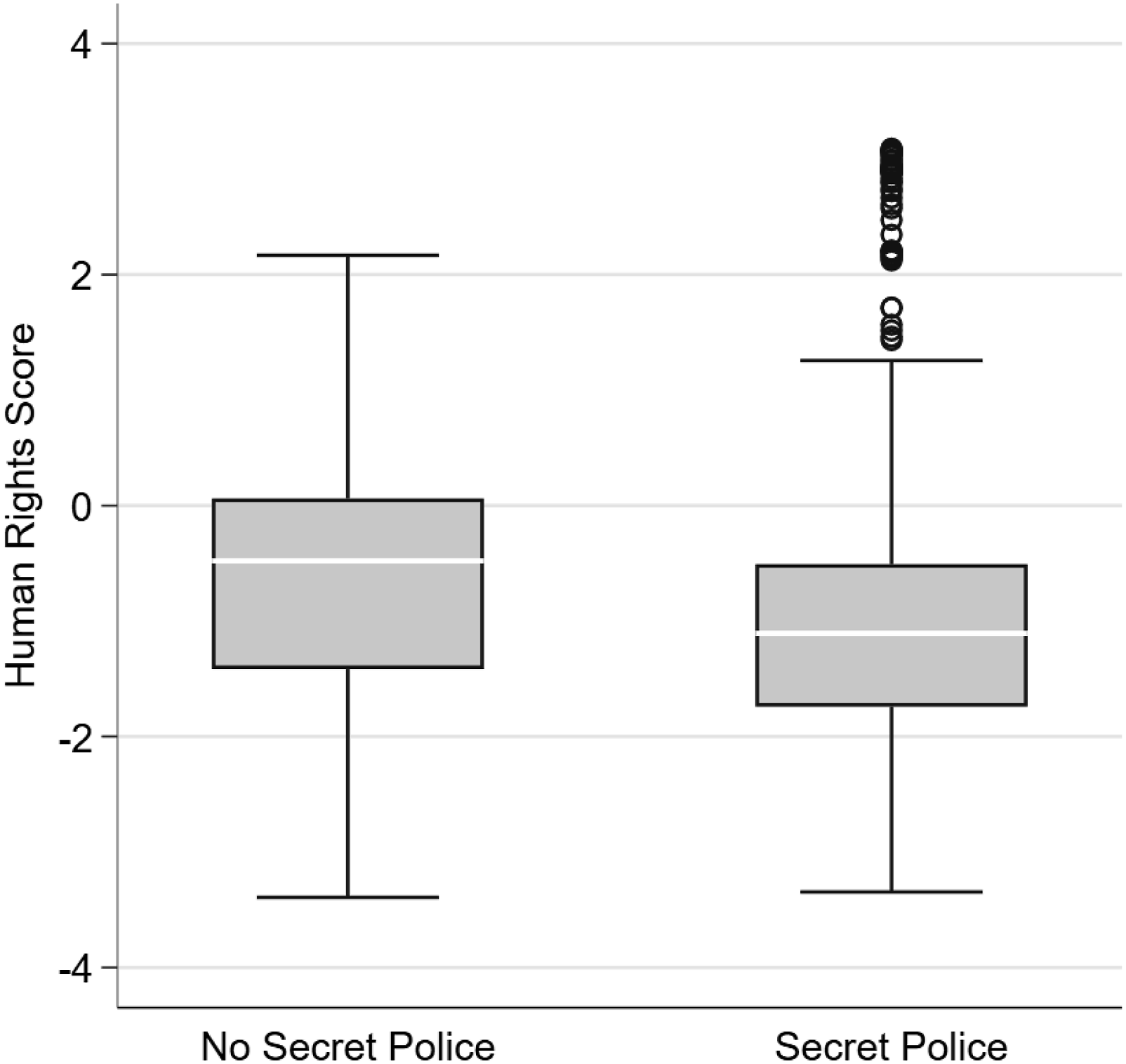
However, this relationship may also be due to confounding, i.e. variables that affect both a government’s use of secret police organizations and its repressive activities. To investigate this relationship further, we use OLS regression where, to account for confounders, we include country-fixed effects as well as theoretically motivated control variables. Specifically, we control for population size, economic development, regime type, the occurrence of inter- and intrastate conflicts, and coup attempts. These variables have been shown to affect state repression (Lachapelle 2020; Hill and Jones 2014; Poe and Tate 1994) and also plausibly affect the existence of secret police along the lines of willingness and opportunity. Given that secret police are an additional security institution which needs to be financed and organized separately from existing forces, their establishment may be easier in economically more developed countries or more institutionalized, full dictatorships. At the same time, their creation may be more pressing to governments already facing threats by coup attempts or armed conflict. Finally, a large population may require additional security organizations to keep tabs on dissidents but also allow for these organizations to be staffed easier.
To investigate our conditional expectations, we also make use of two further variables, secret police duration and the number of counterbalancing organizations, which we respectively interact with the secret police indicator. The former is simply constructed as the number of years the secret police variable has continuously had the value 1, indicating that such an organization is present. Given that the theorized moderating effect is nonlinear, we employ the cubic polynomials of this variable, thus allowing the effect of secret police to flexibly vary over time. The number of counterbalancing organizations is taken from De Bruin (2021), we employ both the linear and the square term of this variable following standard practice and because there should be diminishing returns to additional coup-proofing organizations at some point (Böhmelt and Pilster 2015). We present data sources and descriptive statistics for all these variables in the appendix.
Empirical Results
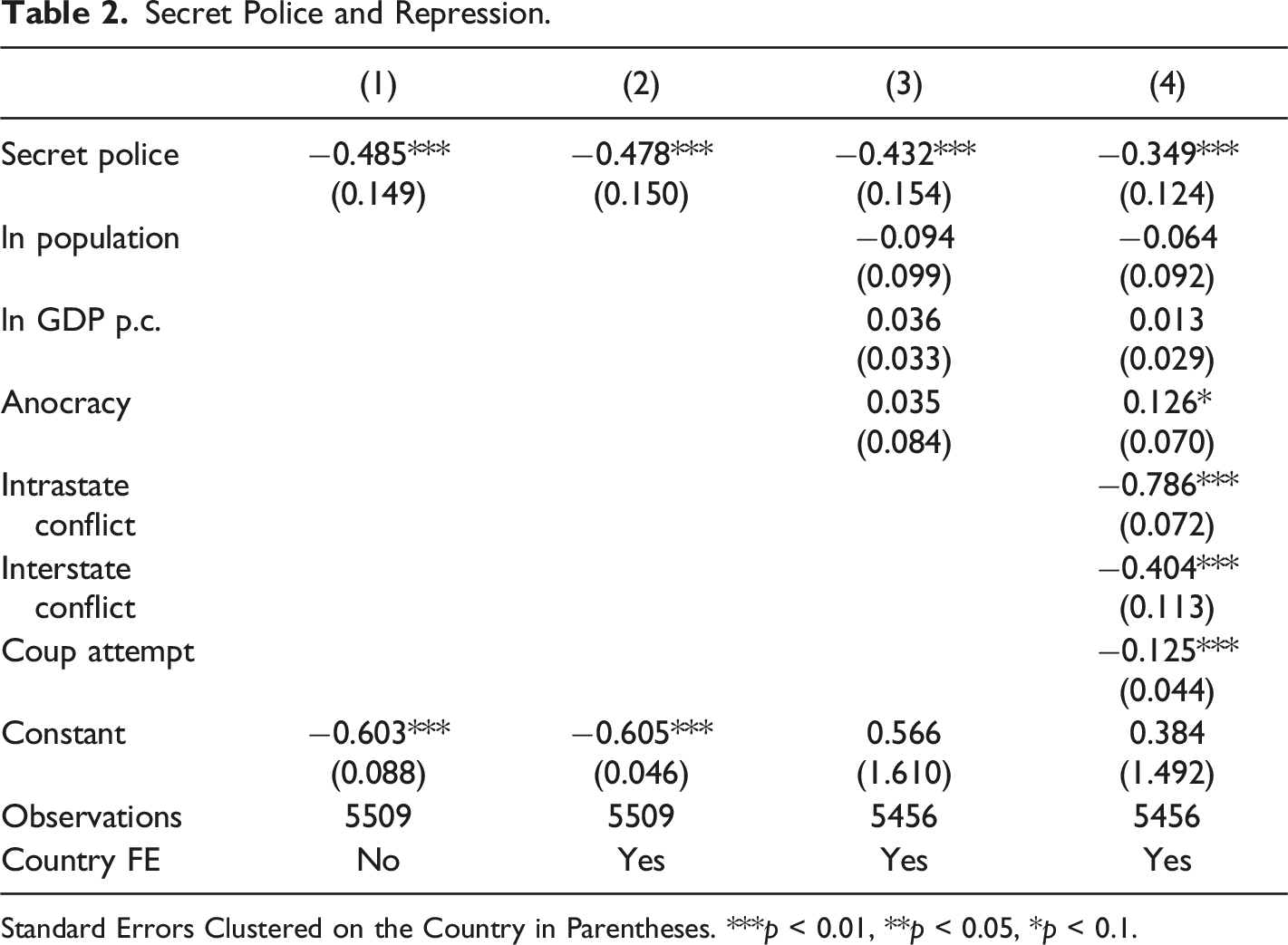
We present the results of four models testing the unconditional effect of secret police organizations on the violation of physical integrity rights in Table 2. Model one is a bivariate model mirroring Figure 2. Model two adds country-fixed effects while models three and four further include structural and conflict-related controls. Across these specifications, we find support for the proposition that countries with a secret police engage in more repressive activities.
Secret Police and Repression.
Standard Errors Clustered on the Country in Parentheses. ***p < 0.01, **p < 0.05, *p < 0.1.
Figure 3 presents the results of two models testing the conditional expectations that how secret police affect overall levels of repression depends on two contextual factors, namely their institutional age and how many other security organizations with similar tasks they have to compete against for power and resources.
9
The left panel of Figure 3 indicates that secret police are associated with increased repression only in the first 3 years of their existence whereas later, that relationship is statistically indistinguishable from zero and, at times, even found to be positive. This is in line with the idea that newly established secret police engage in high levels of repression at first but, once they have established a reputation for their ability and resolve to detect and sanction dissidents, do not (need to) do so anymore. Secret police and repression – interactions. Left panel: Change in effect across years of secret police existence. Right panel: Change in effect across number of coup-proofing paramilitaries. Whiskers represent 95% confidence intervals, dashed line indicates zero difference. Effects calculated while all other variables held at observed values.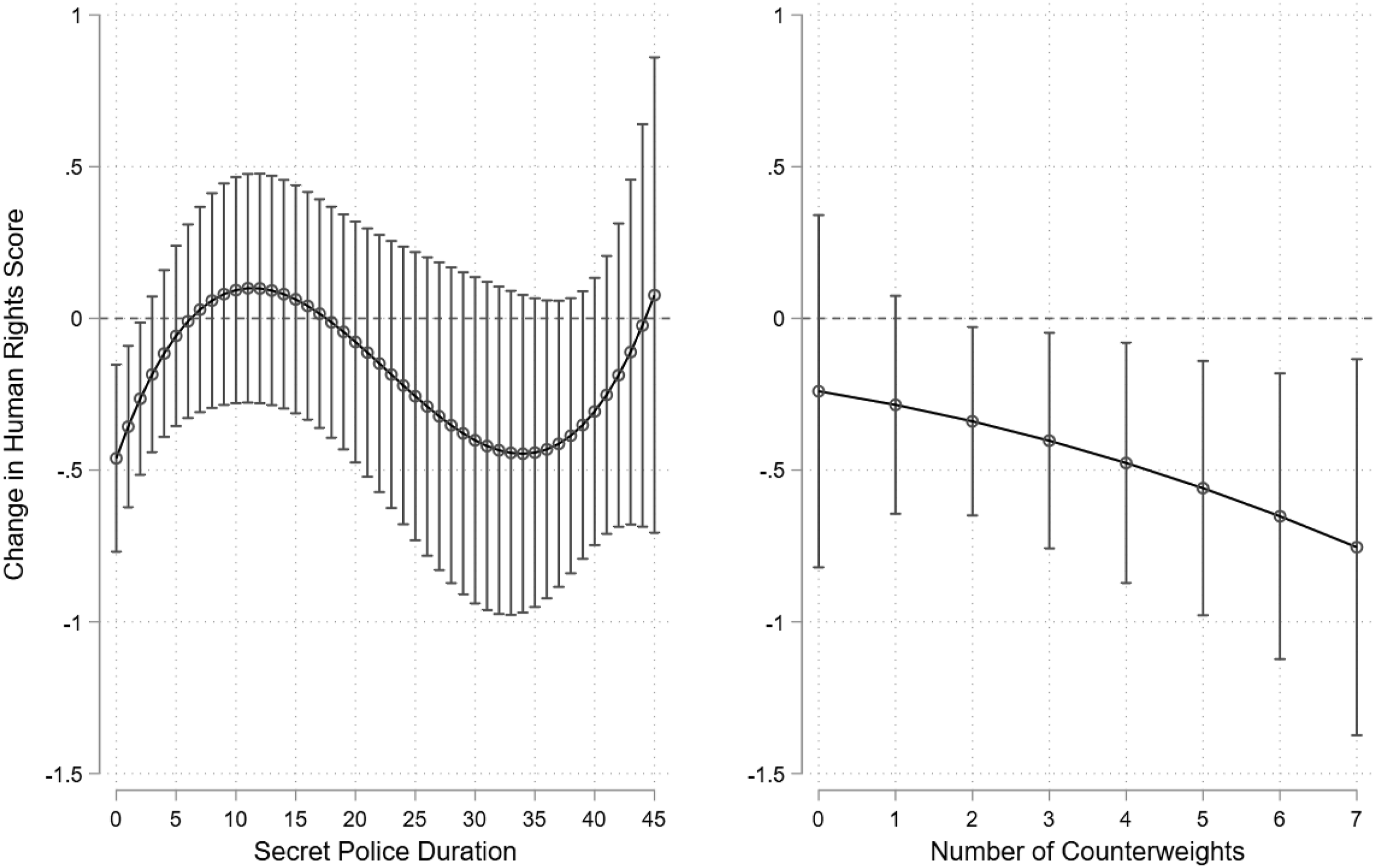
However, the right panel of Figure 3 shows that the relationship between secret police and human rights abuses is also moderated by the existence of direct rivals for power and resources, namely counterbalancing paramilitaries. If no or only one such counterweight exist, secret police are found to have no statistically significant effect on repression whereas this effect becomes significant and steadily grows in size when two or more such forces exist. This offers support for the notion that secret police repress when institutional survival pressures require them to. While overall, secret police are thus associated with increased state repression, this relationship crucially depends on their institutional context.
To further investigate the finding that secret police increase repression and to alleviate concerns that it is due to endogeneity, previously unaccounted for temporal dynamics and confounders, or a result of the human rights measure we employ, we present additional analyses in the appendix. Following the idea of security policy diffusion within peer groups (Böhmelt, Ruggeri, and Pilster 2017; Neumayer, Plümper, and Epifanio 2014), we instrument for a country’s use of secret police with the previous prevalence of such organizations in institutionally similar and geographically proximate countries. To account for temporal dynamics, we further estimate models that add year-fixed effects, a lagged dependent variable, or flexible, country-specific time-trends. We identify and control for further potential confounders such as a country’s specific type of authoritarianism, regime personalization, protest occurrence, ethnic demography, elections, and additional variables related to its security apparatus. In line with Cinelli and Hazlett (2020), we also conduct a sensitivity analysis estimating how strong confounders would need to be to cancel out the effect of secret police. We present results from random instead of country-fixed effects models and employ two alternative measures of repression, the Political Terror Scale (Gibney et al. 2020) and the CIRI Physical Integrity index (Cingranelli, Richards, and Clay 2014), to replicate our models. We also investigate whether our interactive results are due to excessive extrapolation or unwarranted linearity assumptions. Finally, we use a cross-validation exercise to assess the predictive significance of secret police. Taken together, the results of these additional specifications offer further support for the finding that secret police organizations are associated with a reduction in human rights, thus increasing our confidence in this being a robust, if not clearly causal, association.
Conclusion
Secret police organizations are a common tool autocrats use to remain in power. While recent work studies how these institutions are staffed (Egorov and Sonin 2011; Scharpf and Gläßel 2020; Zakharov 2016), surprisingly little systematic research exists on their effect on state repression. This is puzzling as a growing body of research suggests that security institutions such as paramilitaries and militias are often responsible for overt abuses of physical integrity rights (Carey and González 2021; Koren 2014; Mitchell, Carey, and Butler 2014) whereas the surveillance and information gathering activities usually carried out by secret police may instead reduce the need for such practices (Dragu and Lupu 2021; Dimitrov and Sassoon 2014; Kalyvas 2006; Xu 2021). In this paper, we build on these advances to develop competing hypotheses regarding the effect of secret police on state repression and test them using a newly collected global dataset on the existence of these security institutions. Two informational mechanisms indicate that secret police reduce repression by deterring opposition activity and allowing for the selective targeting of dissidents. However, secret police’s violent organizational practices and their institutional self-interest in identifying and neutralizing opposition activities instead suggest that they instead increase repression. Our statistical results offer consistent support for the second expectation as we find that physical integrity rights violations are higher in countries which have a secret police.
At the same time, we also report evidence that this overall effect is conditional upon a regime’s institutional context and that repression-reducing mechanisms are also at play. First, the repression-increasing effect of secret police is detectable only in their first years of existence and becomes statistically indistinguishable from zero afterwards. This suggests that new secret police, who cannot yet have a reputation for being able to detect and punish dissent, engage in extensive repression. In contrast, the existence of older secret police does not affect the extent of physical integrity rights violations, suggesting that these organizations can deter opposition activity instead of having to violently repress it. Second, the effect of secret police on repression increases with the number of rival security organizations and is close to zero when none exist. This implies that institutional survival interests affect repressive activity but also that, again, the existence of a secret police is not always linked with more human rights violations.
This research has important implications. Secret police play, in fact, the prominent role in the autocrat’s toolkit of repression suggested by infamous examples such as the Gestapo and the NKVD. This suggests that, even as they combine violent policing with domestic intelligence tasks, they have a similar negative effect on human rights abuses as security institutions which concentrate on the former. As such, secret police increase the suffering citizens receive under autocratic rule but allow autocrats to quell organized discontent or plots against their position in their infancy. These results thus also clarify why autocrats seeking to eliminate anti-regime activities will often establish secret police forces, even if these forces can themselves represent a substantial threat to autocratic rule.
Beyond the study of secret police, our findings present a challenge to the idea that better intelligence will result in the reduced repression of civilians, as armed actors switch from indiscriminate to targeted violence. Specifically, our theory and results imply that even if additional information allows such a switch, total levels of repression may ultimately remain unaffected or increase as the information is either itself the product of applying violence or because armed actors have an incentive to inflate the number of neutralized threats to the regime. What’s more, the findings indicate that fragmentation of the security apparatus not only affects the likelihood of coups, but may also incentivize increased repression as security organizations compete for resources and influence. This points to the importance of further studying the tasks of and interactions between different parts of the authoritarian security apparatus.
Ultimately, these implications point to a need for further research. Given that several mechanisms potentially link secret police to state repression, additional work is necessary to further disentangle them than we have done here. We were able to investigate the deterrence and institutional self-preservation mechanisms, but a lack of cross-national data on, for instance, how regime knowledge on the opposition changes over time or the operational procedures used by different secret police, precluded us from testing the information and organizational practices mechanisms. However, testing these additional mechanisms may be possible by focusing on single, well-documented cases such as the German Democratic Republic (see e.g. Steinert 2023; Steinert and Dworschak 2022) or once further data become available. Additionally, our results do not distinguish between preventive and reactive repression though recent theoretical results indicate that secret police, particularly due to their intelligence work, may shift state activity from the latter to the former type of human rights abuses. Along these lines, we also do not consider that security institutions may differ in their propensity towards certain forms of repression e.g. extrajudicial killings or arbitrary arrests. As such, future studies may e.g. also investigate the effect of secret police on the violent oppression of protests, extrajudicial killings, or disappearances. And finally, the results we present should be understood as correlational, that is non-causal, evidence as we could not fully account for the non-random existence of secret police institutions. This research thus presents a starting point for more work on the causes, as well as consequences, of the existence of secret police.
Supplemental Material
Supplemental Material - Secret Police Organizations and State Repression
Supplemental Material for Secret Police Organizations and State Repression by Marius Mehrl and Ioannis Choulis in Journal of Conflict Resolution
Supplemental Material
Supplemental Material - Secret Police Organizations and State Repression
Supplemental Material for Secret Police Organizations and State Repression by Marius Mehrl and Ioannis Choulis in Journal of Conflict Resolution
Footnotes
Acknowledgments
We thank the anonymous reviewers, the editor, Philip Nelson, Marina Petrova, Christoph Steinert, and audiences at Universitat Pompeu Fabra and the IPCRN workshop, University of Warwick, for helpful feedback on earlier versions of this paper.
Declaration of Conflicting Interests
The author(s) declared no potential conflicts of interest with respect to the research, authorship, and/or publication of this article.
Funding
The author(s) received no financial support for the research, authorship, and/or publication of this article.

Supplemental Material
Supplemental material for this article is available online.
Notes
References
Supplementary Material
Please find the following supplemental material available below.
For Open Access articles published under a Creative Commons License, all supplemental material carries the same license as the article it is associated with.
For non-Open Access articles published, all supplemental material carries a non-exclusive license, and permission requests for re-use of supplemental material or any part of supplemental material shall be sent directly to the copyright owner as specified in the copyright notice associated with the article.
