




Abstract
Kidnapping is a common tactic used by insurgent groups. However, why insurgents commit kidnappings remains insufficiently understood. Based on 1,386 group-year observations of 140 insurgents between 1998 and 2012, we analyze conditions driving the within-group temporal changes in their involvement (1 vs 0) versus event-frequency in kidnappings. We find that changes in specific quasi-state activities (i.e., extraction and provision of public services), which may rely on kidnappings for coercive enforcement and social control, predict kidnapping “involvement” only. Meanwhile, general resource and capacity conditions (i.e., territory-control, criminal networks and combat-lethality) influence changes in both kidnapping involvement and event-frequency.
Introduction
Kidnapping is one of the most common tactics employed by violent insurgent groups. Notable groups that developed a notoriety for kidnappings include the Islamic State in Iraq and Syria (ISIS), whose video-taped beheadings of foreign hostages shocked the international community; the Boko Haram for their abduction of Christian school-girls in masse; the Lord’s Resistance Army (LRA) for using kidnappings to recruit child soldiers (Dunn 2004; Kaplan 2009); the Revolutionary Armed Forces of Colombia (FARC) and the National Liberation Army (ELN) in Colombia; and the Abu Sayyaf in the southwestern part of the Philippines for generating ransom income and enforcing racketeering schemes (Gilbert 2020; O'Brien 2012; Otis 2014; Pauwels 2016).
Kidnapping yields ransom income, political concession, publicity, and intimidation, among other strategically appealing effects to violent political actors. Yet, notable insurgents differ significantly in how frequently they engage in kidnappings. Even avid kidnapping groups show episodes of particularly high numbers of kidnappings committed in particular years. Between 1970 and 2018, the Global Terrorism Database (GTD) documented 12,138 kidnapping events committed in the context of political violence, involving a total of 92,982 hostages (START 2021). The true magnitude of kidnappings in violent political campaigns can only be greater as kidnappings tend to be underreported, especially in areas experiencing armed conflicts (Forest 2012a; Gilbert 2020).
With the massive increase of literature on political violence and terrorism witnessed in recent decades, much research has been conducted on kidnappings by violent political actors. This body of research has focused on the experience of victimization in kidnapping events (Jameson 2010; Tade et al. 2020), event-outcomes and the fate of hostages (Oyewole 2016; Phillips 2015; Yun and Roth 2008), the appropriate negotiation strategies (Dolnik and Fitzegerald 2011; Foy 2015; Obamamoye 2018; Shortland and Keatinge 2017), and the effect of no-concession policy (Brandt and Sandler 2009; Brandt et al. 2016). These studies have significantly advanced our understanding of the event-dynamics of kidnappings, the consequences and immediate policy implications for government authorities. But much remains unknown as to what makes violent political actors engage in kidnappings in the first place.
Existing literature on kidnappings has mostly attributed motivations of kidnappings to either ransom income or political concessions (Akpan 2010; Briggs 2001; Ibrahim and Mukhtar 2017; O’Brien 2012; Turner 1998; Tzanelli 2006). This financial-political approach to understanding the motivations behind kidnappings reflects the practical challenge often faced by authorities and families with the torment of hostage negotiation. Yet, it fails to explain the vast number of kidnappings not followed by any negotiation demands. Despite the notoriety of some high-profile kidnappings involving foreign hostages, and understandably, the extensive debates on the no-concession policy (Brandt et al. 2016; Shortland and Keatinge 2017), evidence shows that the vast majority of kidnappings are committed locally against local residents (Forest 2012a). Moreover, among the 12,138 kidnappings recorded by the GTD between 1970 and 2019, only around 1,800 were followed by any demands, with approximately 1,200 being ransom requests. While these numbers are inevitably influenced by under-reporting of both negotiation attempts and kidnapping incidents, some of the reported kidnappings were clearly not oriented towards negotiation. For example, the GTD case summaries have documented many kidnappings committed in the context of pursuing and punishing suspected spies or the non-compliant. 1 An explanation of why insurgents commit kidnappings must consider possible motives other than negotiating with external parties.
There is growing evidence documenting the use of kidnappings by violent political actors for purposes unrelated to negotiation, such as to compel compliance with regular extortion-taxation schemes (Gilbert 2020, 2022; Koseli et al. 2021), to forcefully recruit soldiers – sometimes children (Cohen 2013; Dunn 2004; Smith 2015), or to exploit local women for sexual and labor against their will (Cetorelli et al. 2017; Kachynova 2015; Zenn and Pearson 2014). This body of evidence points to a possible link between insurgents’ kidnappings and their assertion of coercive control over the local population in a state-like status. In other words, kidnapping could serve as an illicit equivalent of policing/punishment – a coercive rule-enforcement mechanism – when insurgents perform quasi-state activities like extortion-taxation, compulsory drafting into military operations, regulating social and economic interactions like dressing code, marriages, supplies and trades of daily goods, religious practice and so on. However, this link has not been empirically examined with quantitative data.
Prior studies have examined predictors of kidnappings using a binary outcome, focusing on the variation or change in whether an insurgent/terrorist organization has “involved” in kidnappings (Asal et al. 2019; Forest 2012b). They found kidnapping-involvement is best predicted by group-capacity factors like group size and territory-control. However, existing studies highlighted possible differences in factors and mechanisms influencing involvement-decisions and event-decisions (Clark and Felson 1993; Horgan 2008; Taylor 2010). In what ways, if at all, do quasi-state activities of insurgents and group capacity/resource factors influence their kidnapping activities? In particular, are there any differences in their respective effects on kidnapping involvement-decisions versus kidnapping event-decisions? These are the questions we aim to examine in this paper by comparing results from fixed-effect prediction models of both changes in insurgents’ kidnapping involvement and their kidnapping event-frequency.
Developing a comprehensive understanding of the complex set of causes and mechanisms influencing kidnapping-decisions is important. Kidnapping is a breeding ground for various forms of exploitation and victimization. Once the perpetrators have taken physical control of the hostages, it opens the door for many other forms of criminal exploitation, such as rape, slavery, human trafficking, torture, and even murder. It not only threatens the physical and mental well-being of the individual hostages involved in the event but also tears apart families and traumatizes the wider communities. It allows the perpetrators to kill, to rape, to torture, to enslave, to extract intelligence, to disseminate propaganda, and to coerce other concerned parties to cooperate and comply with their requests and desires. Understanding why violent political actors engage in kidnappings lays the necessary groundwork in the development of effective prevention strategies by the international community.
Kidnapping by Insurgents: Definition and Scope
For the current study, kidnapping is defined as a forceful taking of human targets against their will, followed by transporting and holding the hostages in captivity at unknown locations. 2 This is to be differentiated from other hostage-taking situations like barricade sieges and hijackings, where both perpetrators and hostages would be cornered at known locations or identifiable vehicles, facing immediate risk of rescuing raids from the authorities (Brandt and Sandler 2009; Wilson 2000).
Existing studies have made negotiation an indispensable element in their definition of “kidnapping” or specifically focused on kidnappings for ransom (see for example, Asal et al. 2019; Gilbert 2020; Pires et al. 2014; Pires et al. 2017). For the current study, however, it is necessary not to narrow the scope based on specific motivations, as one of our key interests concerns the broad variety of possible motivations beyond ransom gains and political concessions. Apparent motives of kidnappings may also be difficult to ascertain and can change over time. For example, requests for political concessions may be a smokescreen to hide the real intention for money (Williams, 2009); the ISIS mass abduction of Yazidi women resulted in multiple forms of exploitation, including but not limited to sexual slavery, forced labor, trading for ransom (Cetorelli et al. 2017). In explaining why the initial abduction happened, one would be better off not excluding cases based on how specific individual hostages were later exploited.
In this article, we argue that kidnappings are best understood by their nature as acts of coercion that entail physical control of the hostages. The latter allows the perpetrators to achieve a broad range of desired outcomes that serve their strategic interests – beyond just bargaining for money or concessions. Kidnappings create an avenue to directly exert authority and power over people. It, therefore, allows the perpetrators to regulate the behaviors of the hostages, as well as those of any concerned parties, either by a direct imposition by force or a threat of physical harm to the hostages.
Why Insurgents Kidnap: Explaining Involvement versus Event-frequency
Rooted in the definition of kidnapping as a coercive control of human subjects, two strands of theoretical perspectives are of particular relevance in explaining when and why insurgents kidnap people. First, a stronger organizational capacity and more resources might influence the cost-benefit stimuli of kidnapping decisions. Coercion relies on relative strength and power. Kidnappings may be easier to accomplish when the insurgents are more capable and resourceful. Second, internal conflicts caused by insurgency can be understood as a process of “competitive state-making,” where insurgents assert to undertake many functions normally assumed by the state for social control and governance (Staniland 2012). In this process, insurgents would also need to develop their own coercive enforcement apparatus. Kidnappings – by taking coercive control of human subjects followed by ensuing captivity – can effectively serve as the illicit equivalent of “policing” and penal schemes in insurgents’ extra-legal governance schemes. As such, kidnappings might become a strategically more valuable tactic when insurgents perform quasi-state functions.
Empirical evidence on why insurgents commit kidnappings is sparse. A handful of studies have examined factors related to the distribution and frequency of kidnappings across countries and perpetrating groups (Asal et al. 2019; Forest 2012b; Gilbert 2020; Pires et al. 2017; Rasmussen 2017). They found that kidnappings tend to happen in weaker and less stable states (Pires et al. 2017; Rasmussen 2017) and are committed by more resourceful groups with a larger membership size, holding territories, and with more criminal connections (Asal et al. 2021; Forest 2012b). These results highlighted the impact of organizational capacity and resource on kidnapping decisions, directly supporting the first strand of theoretical explanation that insurgents engage in kidnappings when it is easier to accomplish. On the other hand, holding territories and having a bigger membership size are also known conditions allowing insurgents to perform quasi-state activities in their extra-legal governance schemes (Arjona et al. 2015; Mampilly 2011; Olson 1993). It may be the latter that creates the strategic need for kidnappings as a coercive enforcement tool in an extra-legal context, in line with the second strand of theoretical explanation. However, the potential link between insurgents’ performance of quasi-state activities and their kidnapping activities remains largely unexplored.
Moreover, existing studies have mainly examined cross-sectional variations among groups or countries. Insufficient empirical attention is given to within-group temporal changes, which is more proximal to an understanding of causal influences in insurgents’ decision-making (Cox 1992). Therefore, the present study aims to contribute to existing body of knowledge by specifically examining the dynamic changes in kidnapping activities by insurgents and testing the effect of quasi-state activities in addition to organizational capacity and resources.
In doing so, we differentiate two forms of “changes” – kidnapping involvement versus event-frequency. The distinction between “involvement-decisions” and “event-decisions” is well-established in the criminology literature, most famously by Clark and Felson (1993) in their routine activity theory differentiating an explanation of “criminal events” versus “criminal involvement.” Specifically, “criminal involvement” refers to the process of deciding to get involved in, or desist from, a form of criminal activities. In contrast “criminal event” refers to the commission or occurrence of a specific criminal incident. Drawing upon the relevant criminological thinking, Taylor and Horgan (2006, see also Horgan 2008; Taylor 2010) argued that studies of decision-making in political violence should also be mindful of the difference between involvement-decisions and event-decisions, as the two can be separated and influenced by different mechanisms. Specifically, event-decisions may be more influenced by the immediate circumstances and practical conditions with shorter calculus, whereas involvement-decisions may be better understood as shaped by evolving processes and long-term strategic visions. Hence, we analyze the yearly changes in insurgents’ kidnapping activities both in the forms of a dichotomous “yes or no” outcome (the “involvement” decision) and of a count-based outcome (the “event” decision). This allows us to compare how insurgents’ quasi-state activities and/or group capacity and resources may have influenced their kidnapping involvement and event decisions in different ways.
Insurgents’ Quasi-state Activities
A key theoretical interest of the current study is whether changes in insurgent groups’ quasi-state activities predict corresponding changes in their use of kidnappings as an extra-legal form of “policing” and/or “punishment” for internal social control. Charles Tilly argued in his seminal work, War Making and State Making as Organized Crime, and Coercion (1985), Capital and European States, AD 990-1990 (1992), that there were important links between war-making, state-making, protection and extraction activities, which have driven the formation of the contemporary nation-states we live in today. In particular, Tilly (1985, 181) defined state-making activities as those directed internally to produce “durable instruments of surveillance and control within the territory” and emphasized the role of monopolizing the means of coercion and violence in all four types of activities. Kidnapping can be described as a form of coercion by forcefully abducting and detaining human hostages to compel behavior compliance (Gilbert 2020; Koseli et al. 2021). These traits of kidnapping make it particularly useful in insurgents’ toolbox of “durable instruments of surveillance and control” – a quasi “state-making” process in Tilly’s terms. As such, we expect that changes in insurgent groups’ kidnappings will be positively linked to changes in their performance of different aspects of quasi-state activities.
First, extraction is a key aspect of insurgents’ quasi-state activities that may rely on kidnappings for consistent enforcement. Once insurgents have seized territories, they often try to set up some forms of security-taxation arrangement with the local communities (e.g., extortion rackets, regular taking of “protection” fees) for regular income as a first step in their extra-legal governance schemes (Gilbert 2020; Koseli et al. 2021; Mampilly 2015; Rodríguez-Franco 2016). The enforcement of extraction/taxation schemes, however, necessarily relies on coercion when non-compliance occurs. While nation-states monopolize and employ legitimized forms of coercion such as police-arrests, judicial detention and imprisonment to ensure the enforcement of taxation schemes to finance state activities (Weber 1946), similar coercive behaviors by insurgents (operating in an extra-legal world) would likely manifest themselves in forms of criminality like kidnappings. For example, the Kurdistan Workers' Party (PKK) in Turkey was found to kidnap those who did not voluntarily pay “money contribution” after requests were “nicely” made – sometimes on hand-written notes stamped with the official PKK seal (Koseli et al. 2021). Accordingly, we expect that changes in insurgents' extraction activities may influence their strategic need for using kidnappings. It is therefore hypothesized that:
Organizational Capacity and Resources
A second theoretical focus of our analyses is organizational capacity and resources, the “enabling factors” that influence insurgents’ ability to implement kidnapping operations (Cox et al. 2018). An increasing amount of evidence suggests that violent non-state actors, including insurgent groups, respond to cost-benefit stimuli in a strategically rational way (Crenshaw 1998; Gupta and Mundra 2005; Hoffman 2011; Kydd and Walter 2006). If so, a relative change in the cost of kidnappings should influence insurgents’ decision-making in both their involvement in the kidnapping practice and the frequency they engage in the practice.
Notably, kidnapping can incur a substantial cost for its perpetrators. The logistical complexity and the resource-intensive nature of the practice are well-noted in the existing literature (Gaibulloev and Sandler 2009; Sandler and Scott 1987; Santiford and Sandler 2013; Wilson 2000). Amongst others, running a successful kidnapping operation requires the ability to scout and monitor worthy targets, make the logistical and operational plans to secure access to targets, implement the abduction operations, transport and constantly guard the hostages, and, where applicable, negotiate with concerned parties to benefit from the conditional release of hostages. Thus, changes in the conditions of organizational capacity and resources that make kidnappings less costly to accomplish may predict insurgents’ involvement or a more frequent use of kidnappings.
Holding territories is a condition repeatedly identified in the existing literature that can make kidnappings easier and less risky in multiple ways (Asal et al. 2019; Elster 2004; Rasmussen 2017). Controlling territory allows insurgents to easily access and scout for potential targets, increasing the structural opportunities to engage in kidnappings. Controlling territories also means less risk of confrontations and disruptions from state authorities in the abducting, transporting, hiding and detaining of the hostages, and easier to guard against rescue-attempts. In this regard, the Irish Republican Army presents a revealing case, where they took a restrained attitude towards kidnapping operations, citing concerns over repercussive security checks and raids that would “paralyze the whole country,” “put all kinds of things at risk…[and] make it impossible to operate” (Rasmussen 2017, 546). Such repercussive costs would be substantially reduced when the perpetrators themselves control territories, making the latter an important cost-stimulus in insurgents’ kidnapping-involvement or event-decisions. It is therefore hypothesized that:
Data and Methodology
The questions examined in this study require reliable time-ordered measurements on both kidnapping-occurrence and the relevant organizational attributes of insurgents. To do so, we followed prior studies of a similar design combining kidnapping-incident records from the GTD with the organization-level data from the Big Allied and Dangerous Insurgency Dataset (BAAD-I) (Asal et al. 2018). A number of peer-reviewed studies have taken this approach, merging incident-level data from the GTD with the BAAD group-level attributes to conduct group-level analyses on violent political actors (see for example, Asal et al. 2021; Boyd 2016; Carter et al. 2021; Mierau 2015; Pilny and Proulx 2022). BAAD-I contains 1,386 group-year observations on 140 insurgent groups between 1998 to 2012, selected based on whether they had no less than 25 battlefield deaths as recorded in the Uppsala Conflict Data Program (UCDP) in any of the observed years. These insurgents account for 95% of all violent insurgents actively operating during those years, covering 49 countries (Asal et al. 2019).
The outcome variables – yearly observations on kidnapping involvement and kidnapping event-frequency – were generated from the GTD and attributed to the 140 BAAD-I insurgent groups. For kidnapping-involvement, we created a binary variable based on whether the GTD recorded any kidnappings attributed to an insurgent in a given year (M = 0.18, SD = 0.39, Min = 0, Max = 1). For kidnapping event-frequency outcome, we created a count-variable based on the number GTD kidnappings incidents attributable to a BAAD-I insurgent group in a given year (M = 1.00, SD = 4.72, Min = 0, Max = 90). A manual review of the two sources was conducted to ensure correct attribution, as the two sources may adopt different versions of group-names and define the continuation of a group with different standards. 4
Independent variables were drawn from group-level variables in BAAD-I. For insurgents’ quasi-state activities, we used the extortion variable in BAAD-I to measure “extraction,” coded based on whether the insurgent groups collected “revolutionary tax” or “donations” through “a threat of violence” against local businesses and individuals in a given year (1 = yes, 0 = no, BAAD-I Codebook: 8). Provision of public services was measured in BAAD-I as a binary variable based on whether an organization provides any healthcare, welfare, education, infrastructure or other services for the public in the local area in a given year (1 = yes, 0 = no, BAAD-I Codebook: 8).
For group capacity and resource conditions, territorial control was measured as a binary variable based on whether an organization could “control movement into, out of, or within a given territory” of a substantial area for an extended time, excluding situations where a violent political group took control of only a few blocks of buildings or temporary seizure of a town for less than a week (1 = yes, 0 = no, BAAD-I Codebook: 7). Membership size was measured as a categorical variable based on an ordinal scale of the approximate number of members in the organization (1 = unknown/0–100, 2 = 100–999, 3 = 1,000–9,999; 4 = 10,000 or more, BAAD-I Codebook: 6). Hierarchical command structure was also measured as a binary variable based on whether the insurgent group was organized in a vertical chain of command where the higher-level leader would have the superior power to make decisions (1 = hierarchical, 0 = not hierarchical, BAAD-I Codebook: 7). Network connectivity was measured by the number of allies the organization had that engaged in criminal activities in the previous year (Min = 0, Max = 10, BAAD-I Codebook: 9). For combat-lethality, we used the “battlefield death” variable in BAAD-I, coded as the “number of deaths the organization inflicted in battle” for a given year, derived from the UCDP data (Min = 0, Max = 14,716, BAAD-I Codebook: 8). For statistical analysis in the current study, we used the log-transformed values of the raw battlefield deaths numbers to reduce the skewness.
To control for external influence from sponsors on insurgents’ kidnapping decisions, we included the BAAD-I state sponsorship variable into our models, a binary measure that captures whether the insurgent was directly supported by a sovereign state a given year (1 = yes, 0 = no, BAAD-I Codebook: 8). We also included country-level control variables to account for possible changes in the macro-level political and economic context that may influence insurgents’ kidnapping activities. Specifically, we drew on data from the Quality of Government measures to control for whether the home-base country of the insurgent group is a democracy (1 = democracy, 0 = non democracy, Dahlberg et al. 2022; Wahman et al. 2013); and we used the United Nations GDP dataset to control for the GDP per capita in the home countries where the insurgents were based. 5
Descriptive Statistics for Independent Variables to Predict Within-Group Variation in Kidnapping Outcomes.
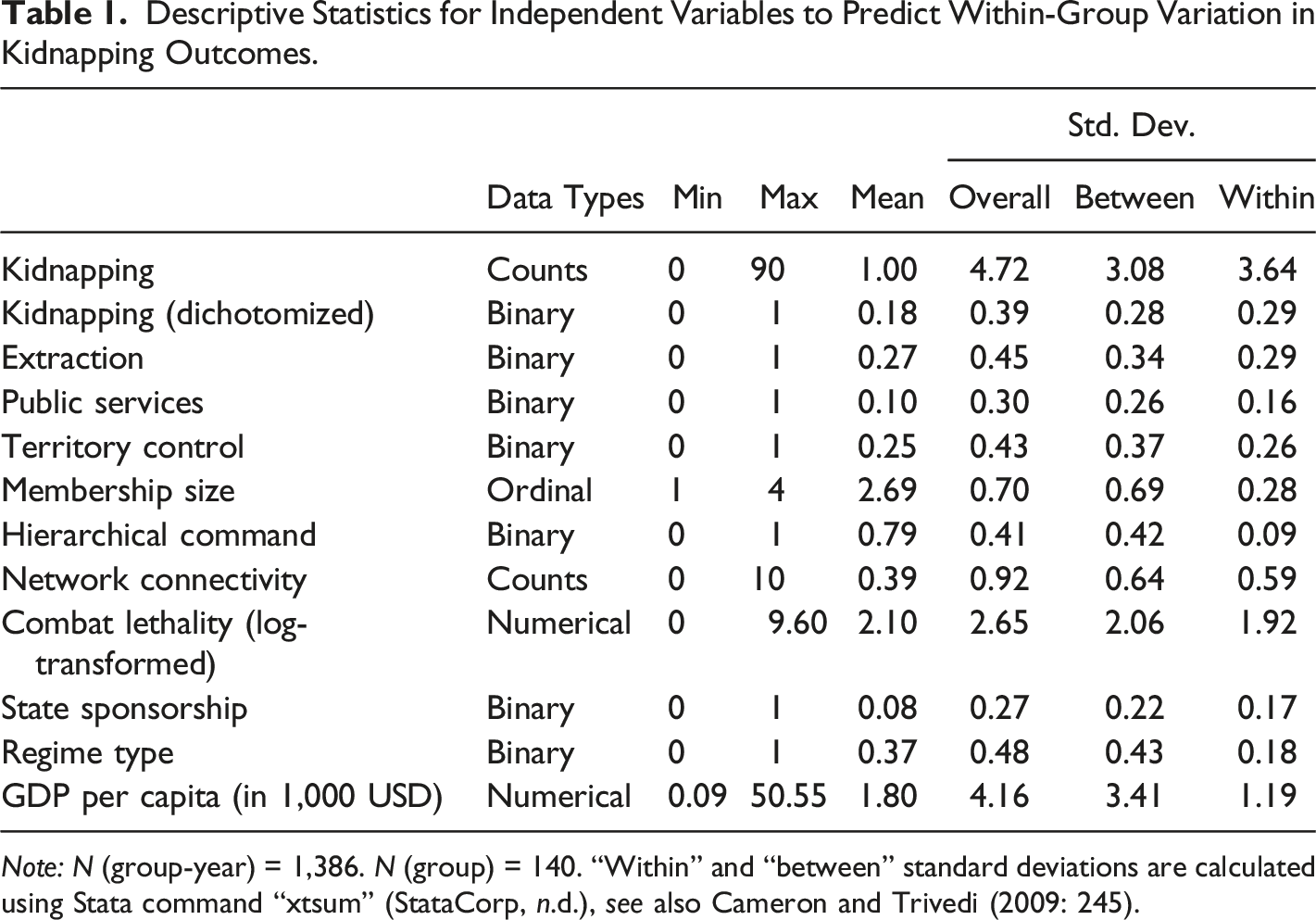
Note: N (group-year) = 1,386. N (group) = 140. “Within” and “between” standard deviations are calculated using Stata command “xtsum” (StataCorp, n.d.), see also Cameron and Trivedi (2009: 245).
Since the current study focuses on modelling changes in insurgents’ kidnapping behaviors, we used fixed-effect regressions for their known strength in analyzing “within-group” variation. Fixed-effect models use a special term that models all variance from time-invariant group-specific effects (Allison 2009; Cameron and Trivedi 2009). In this way, the models are more robust against misspecification as we have controlled for between-group differences unobserved in the data, such as group ideology and homebase-location. This can be most helpful for research relying on secondary data like the current one, where the analyses and control for confounders is limited by what is already available in existing datasets. Specifically, fixed-effect logistic regression was performed to model changes in kidnapping involvement, while fixed-effect Poisson regression was performed to model changes in kidnapping event-frequency. Group-clusters that did not observe any temporal changes in their kidnapping involvement or event-frequency were automatically dropped from the analyses, as fixed-effect regression focuses specifically on the “within-group” variance. This resulted in a reduced sample size (from the original 1,386 group-year observations) for both the involvement model and the event-frequency model. Both models used bootstrapping standard errors with 1,000 replications based on the group-clusters, a strategy known to produce more robust estimates when the underlying data is over-dispersed (Cameron and Trivedi 2009). Sensitivity analyses using robust standard errors and alternative statistical models (e.g., fixed-effect negative binomial regression) produced similar results. 6
Results
Predicting Changes in Insurgents’ Kidnappings: Fixed Effects Model Comparison.
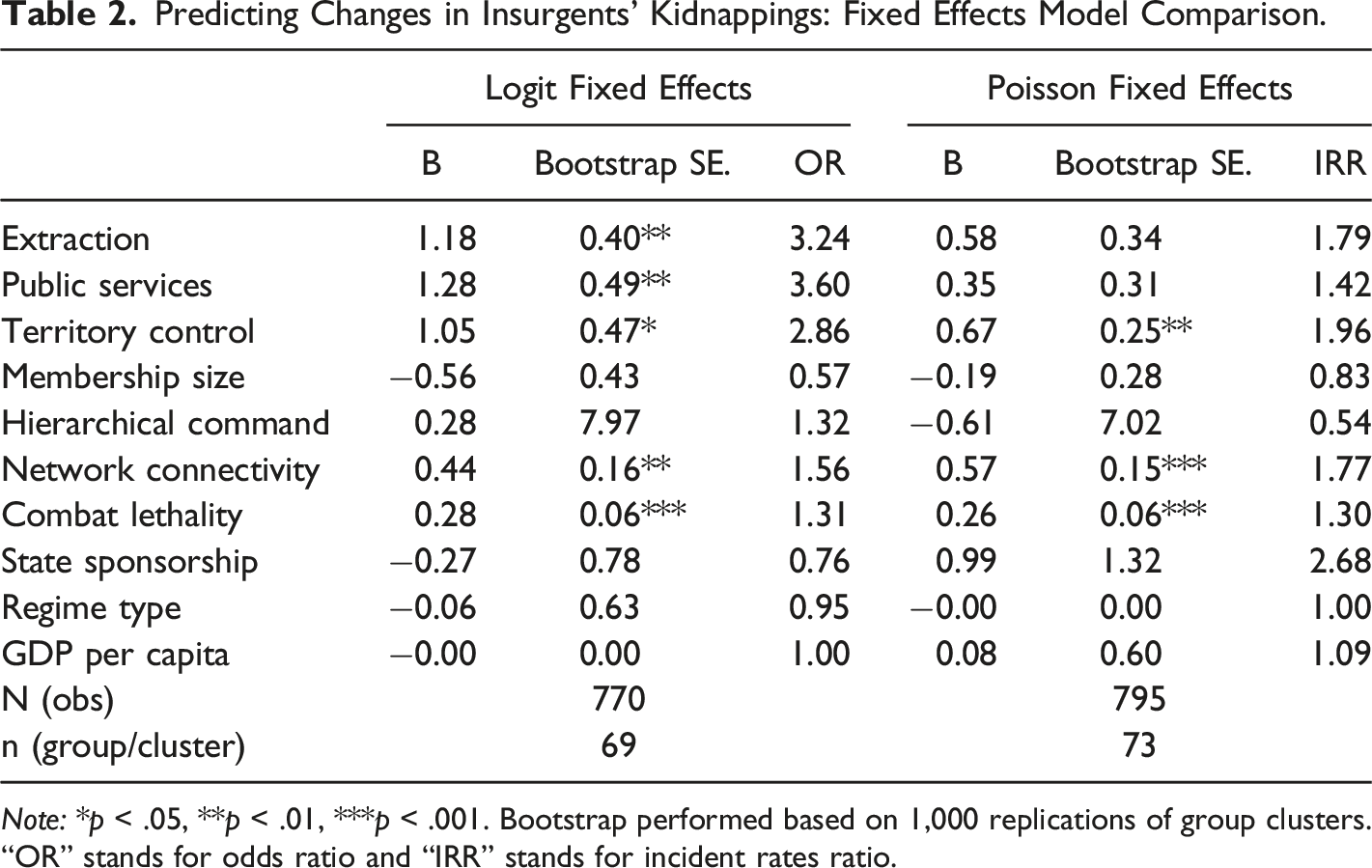
Note: *p < .05, **p < .01, ***p < .001. Bootstrap performed based on 1,000 replications of group clusters. “OR” stands for odds ratio and “IRR” stands for incident rates ratio.
In the kidnapping involvement model, fixed-effect logistic regression was performed on 69 group-clusters with 770 group-year observations (after dropping the time-invariant group-clusters). Changes in both quasi-state activities and conditions related to organizational capacity and resources are significant in predicting changes in insurgents’ kidnapping involvement. This includes extraction, provision of public services, territory-control, network connectivity and combat lethality. Engagement in extraction/quasi-taxation schemes increases the odds of an insurgent group engaging in any kidnappings in the year by 224% compared to the years when the group does not engage in extraction (OR = 3.24, B = 1.18, p = .003). Changing to provide public services increases the odds of a group committing any kidnappings in a year by 260% compared with years when the groups do not provide any public services (OR = 3.60, B = 1.28, p = .008). Changing to hold territories would increase the odds of a group committing any kidnappings by 186% compared to years without territory control (OR = 2.86, B = 1.05, p = .022). A one-unit increase in network connectivity (i.e., developing one more connection to criminal groups) – is estimated to increase the odds of a group committing any kidnappings in the year by 56% (OR = 1.56, B = 0.44, p = .005). A one-unit increase in the operation intensity measure would increase the odds of the group committing any kidnappings in the year by 31% (OR = 1.31, B = 0.28, p < .001).
In the kidnapping event-frequency model, fixed-effect Poisson regression was performed on 73 group-clusters, including 795 group-year observations (after dropping the time-invariant group-clusters). Unlike the kidnapping involvement model, only conditions relating to organizational capacity and resources are found to predict changes in kidnapping event-frequency in a statistically significant way. This includes territory-control, network connectivity and operation intensity. As Table 2 shows, territory control would make kidnapping-rates 1.96 times greater compared to those years without territory control (IRR = 1.96, B = 0.67, p = .006). For network connectivity, a one-unit change (an increase of one more ally connected to the group) would make kidnapping rates 1.77 times greater (IRR = 1.77, B = 0.57, p < .001). A one-unit increase in operation intensity (as measured by the log-transformed value of the number of battlefield deaths inflicted by the group in the year) would make kidnapping-rates 1.30 times greater (IRR = 1.30, B = 0.26, p < .001).
Discussion
Returning to this paper’s main research question, we sought to shed light on the dynamics of why insurgent groups commit kidnappings by examining predictors of change in their kidnapping activities: changes in kidnapping involvement versus changes in kidnapping event-frequency. Findings from our statistical analyses support the notion that involvement-decisions and event-decisions are, indeed, influenced by partly different factors and mechanisms.
One of our key theoretical interests concerns the link between insurgents’ performance of quasi-state functions and their use of kidnappings for coercive social control. We found that changes in the performance of quasi-state activities (i.e., extraction and provision of public services) predict change in kidnapping “involvement” only. Meanwhile, general resource and capacity conditions (i.e., territory-control, criminal networks and combat-lethality) predict changes in both kidnapping involvement and event-frequency. In other words, changes in quasi-state activities – the strategic need for kidnappings to realize coercive social control – have a more direct influence on whether an insurgent engages in kidnappings than how frequently they do it. Fluctuations in the specific numbers of kidnappings committed, however, are mainly driven by changes in organizational capacity and resources. These results align with prior observations in criminological literature that event-decisions are more sensitive to immediate circumscribed conditions and situations – for the current study, the practical conditions shaping the cost and structural opportunities of kidnappings (i.e., groups’ control of territories, combat lethality and criminal networks). Involvement decisions, on the other hand, are influenced by changes involving longer processes, such as the strategic relevance of kidnappings in insurgents’ “competitive state-making” (Staniland 2012). Our findings highlight the need to differentiate these two forms of decision-making in explaining kidnappings, as well as in explaining other forms of political violence in future research. As such, preventative policy should also be informed by the nuance of different conditions and mechanisms influencing kidnapping-involvement versus event-occurrence.
In the kidnapping involvement model, we found strong evidence supporting that insurgents’ engagement in the kidnapping practice may be due to their strategic need for coercive social control in performing quasi-state activities. Both changes in extraction/taxation activities and the provision of public services substantially increase the odds of insurgents’ involvement in kidnappings. This supports our argument that the underlying cause of the kidnapping phenomenon in violent political campaigns goes beyond the apparent gains from hostage-negotiations, but rather, is something likely rooted in the assertion of political authority and governance power via coercive control.
When it comes to explaining why kidnappings are committed, one must consider the fact that kidnapping involves a complex series of logistical operations, spanning possibly for years from abduction, transportation, captivity, and negotiation if applicable. The perceived value in holding the hostages does not stay static during this multi-stage process. Many sources documented how kidnappers responded to changing political situations and changed their minds regarding the intended use of the hostages (see East 2015; Williams 2009). A hostage initially kidnapped for financial motives might later become an opportunity for political propaganda or negotiation. Hostages abducted by one group could be later transferred or traded to another group with different strategic interests in the use of hostages (Napoleoni 2017). Many cases also witnessed multiple hostages taken in one abduction but later exploited for different purposes (Cetorelli et al. 2017). How kidnappings have benefited the perpetrators in the end does not necessarily reflects the initial motivation for abducting the hostages. They may be better described as “symptoms” of the kidnapping phenomenon rather than the underlying causes. Bargaining for the conditional release of the kidnapped victims causes dilemma and pain for state authorities and families – this has also undoubtedly motivated some incidents of kidnappings, especially those involving high-profile targets. However, this should not replace a systematic inquiry into the complex set of underlying causes and motives. Findings from this study – that kidnapping involvement-decisions might be a result of insurgents’ strategic needs for coercive control in their competitive state-making process – contribute to a much-needed alternative/supplementary explanation of why insurgents engage in kidnappings.
This approach of understanding kidnapping in its coercive nature rather than the end-result of gains warrants particular attention in the case of kidnapping for ransom. Prior studies on this subject had primarily considered it as a source of financing for violent political actors. Our findings suggest it is more than that. Kidnappings not only directly bring in financial income in instances of successful negotiations. More importantly, it may serve to enforce and regularize extortion/taxation schemes to ensure “voluntary compliance” in the future by intimidation. Running a violent political organization is highly risky, resource intensive and expensive. Insurgents often employ a mix of coercive and persuasive techniques to establish some forms of long-term governance arrangements with their own members and with the local populations. Under such governance schemes, violent non-state actors provide the local population with a degree of security and social order to continue with their lives in exchange for loyalty and contributions, such as money, supplies, and recruits. Findings from our analyses lend empirical support that kidnapping might be a vital piece in insurgents’ coercive toolbox to ensure enforcement of their governance arrangements. Reducing it to a mechanism to negotiate for ransom income may have underestimated its harm and long-term effect on the local communities.
Among the capacity and resource conditions examined in this study, territorial control, network connectivity and combat lethality are significant in predicting both changes in kidnapping involvement and event-frequency. These findings are largely consistent with existing literature on factors explaining variations in kidnappings among violent non-state actors (Asal et al. 2019; Forest 2012b). This is also consistent with our hypotheses that insurgents commit (more) kidnappings when they hold territories, are more well-connected to criminal allies, and are more intensely engaged in lethal violence in general. Contrary to our hypotheses, membership size and hierarchical command are nonsignificant in both the kidnapping involvement model and event-frequency model. Both membership size and hierarchical command structure represent important organizational capacity and resource features that would make kidnappings relatively easier to accomplish. The lack of their explanatory power for changes in insurgents’ kidnappings observed in the data may suggest that groups do not engage in kidnappings simply because it becomes less costly from a human resource and management perspective. However, this could also be a result of the low precision in their measurement. The membership size variable was measured on an ordinal scale of four categories (1 = unknown/0–100, 2 = 100–999, 3 = 1,000–9,999; 4 = 10,000 or more), and hierarchical command was measured as a binary variable (1 = hierarchical, 0 = not hierarchical). Future research could try measuring membership size and command-chain efficiency with more categories of “change” to enhance their observed variability.
On a related note, some of the more constant traits of insurgents may also benefit from more nuanced measures for future research into their temporal variance. For example, there is a long-standing academic interest and inquiry into how ideological orientations may influence behaviors and tactics of non-state political actors (Drake 1998; Crenshaw 1998; and see Forest 2012b specifically on kidnappings). In this study, we could not specifically examine its effect due to a lack of temporal variance observed at the current level of measurement (i.e., religious, nationalist versus leftwing). However, the same religious group may change its level of extremism or adapt its interpretation of how non-believers should be treated as their circumstances evolve. A more nuanced coding scheme would allow future research to examine this important aspect of changing dynamics and how it influences insurgents’ behaviors.
While the fixed-effect models have controlled for all time-invariant group differences, there could be unobserved time-variant effects not accounted for in our analyses. For example, changing policies from the state authorities may influence how non-state actors react to them and change their choice of tactics in important ways (Araj 2005; Dugan et al. 2005). By focusing on the dynamics of change in the insurgents themselves, the current study had not sufficiently examined the possible effects of insurgent-state interactions on their kidnapping decisions. Although we did not directly examine this issue, some of the group conditions we analyzed are proxy indications of how states have engaged with insurgents. For example, the strong association we found between the changes in combat-lethality and the changes in both kidnapping involvement and event-frequency suggests there might be an interactive effect that future research should look into.
In our models predicting “within-group changes” in insurgents’ kidnappings, we compared the results of two forms of outcomes using data aggregated at group-year level (binary vs count-based). The strength of our models lies in that we recognized the difference in behavioral changes in quality versus quantity, predicted by different sets of group-conditions and factors. However, we did not make any specific assumptions on how the respective underlying decision-making process that resulted in the observed outcome might be inter-linked or inter-twined. For example, an insurgent would first decide whether kidnapping is good for it and, if yes, then calculate how frequently it should engage in the practice for the next year. Alternatively, an insurgent could simultaneously decide that it wants to change from no-kidnapping in the previous year to conducting five high-profile kidnapping operations in each of the five villages they controlled – this would be an involvement decision and an event decision made at the same time. It would be practically challenging to disentangle the two in the way kidnappings are currently measured. By not making specific assumptions on how involvement-decisions and event-decision interact, this study positioned itself as an initial exploration of possible different influencing factors/mechanisms underlying observed changes in kidnapping involvement versus event outcomes. Findings from this study open the door to many interesting topics for future research that could further investigate the “involvement-event” dynamics in insurgent decision-making.
Conclusion Remarks
Why insurgents engage in kidnappings is a question that involves a complex set of factors and mechanisms. Based on fixed-effect analyses of within-group changes in insurgents’ kidnapping activities, findings from the current study suggest that kidnapping involvement-decisions and event-decisions may be influenced by different processes and conditions. Policymakers should be mindful of such differences and set their goals/priorities clearly. For example, in the design of future countering/intervention strategies in curbing kidnapping pandemics in conflict areas, one may wish to consider whether to target the more long-term processes of kidnapping involvement/desistance or the short-term processes involved in event-decisions.
By finding empirical support for the link between insurgents’ kidnapping-involvement with their need for coercive control in exercising quasi-state activities – in addition to their organizational capacity and resource – this study lends important support to our argument that kidnapping is best understood by its nature of coercive control. Viewing kidnappings only from the lens of “negotiation” (for financial or political gains) may portray an incomplete picture of the kidnapping phenomenon. Suppose kidnapping is also influenced by insurgents’ strategic need for coercive social control in an extra-legal context; in that case, kidnapping-prevention strategy may benefit from looking at ways to weaken the governance capacity of violent political groups in addition to the existing focal debates on non-concession policy.
Supplemental Material
Supplemental Material - Beyond Ransom and Political Concessions? Explaining Changes in Insurgents’ Kidnapping Involvement Versus Event-frequency
Supplemental Material for Beyond Ransom and Political Concessions? Explaining Changes in Insurgents’ Kidnapping Involvement Versus Event-frequency by Lu Liu and Manuel Eisner in Journal of Conflict Resolution
Footnotes
Acknowledgements
We thank the BAAD research team at the University at Albany - State University of New York, Victor Asal and Suzanne Weedon in particular, and the Global Terrorism Database team at the University of Maryland, who had gone out of their way to help us understand the underlying methodology of their data. We also thank Justice Tankebe, Amy Nivette, Derek Dong, and anonymous reviewers for their comments on earlier versions of this paper.
Declaration of Conflicting Interests
The author(s) declared no potential conflicts of interest with respect to the research, authorship, and/or publication of this article.
Funding
The author(s) disclosed receipt of financial support for the research, authorship, and/or publication of this article from the China Postdoctoral Science Foundation (no. YJ20220062) and Major Humanities and Social Science Project of Shanghai Education Commission (no. 2021-01-07-00-07-E00124).

Supplemental Material
Supplemental material for this article is available online at the JCR replication site.
Notes
References
Supplementary Material
Please find the following supplemental material available below.
For Open Access articles published under a Creative Commons License, all supplemental material carries the same license as the article it is associated with.
For non-Open Access articles published, all supplemental material carries a non-exclusive license, and permission requests for re-use of supplemental material or any part of supplemental material shall be sent directly to the copyright owner as specified in the copyright notice associated with the article.
