




Abstract
Quantitative research into the effectiveness of the UN human rights treaty bodies (UNTBs) in eliciting remedial responses from states is impeded by a lack of usable data on how states respond to their decisions. The new Treaty Body Views Dataset (TBVD) aims to fill this gap. It comprises details on all published decisions in individual complaints cases issued by the UNTBs between 1979 and 2019 and matches these with information on their state of compliance. The TBVD can be used for research on the activities of the treaty bodies, the nature of the decisions themselves, or state behavior following a decision. An empirical application illustrates how the TBVD can advance knowledge about the factors that correlate with compliance with adverse UNTB decisions. Results show that the likelihood of implementation hinges critically on decision-level characteristics, and reveal differences and similarities between compliance with UNTB decisions and regional human rights court judgments.
Keywords
Introduction
Research on compliance with states’ international human rights obligations, and the related aspect of their domestic implementation, has been a mainstay in the social sciences for over two decades (e.g. Cole 2012; Hafner-Burton 2008; Hafner-Burton and Tsutsui 2005; Hathaway 2002; Hill Jr 2010; Keith 1999; Neumayer 2005; Simmons 2009). Yet while scholars employ increasingly sophisticated methods to trace the effects of treaties on state behavior, most quantitative studies inquire into their effectiveness, rather than compliance with them strictu sensu, as the indicators typically used for the dependent variable capture levels/changes in overall human rights performance, but not the extent to which states abide by the specific, often detailed legal requirements of the provisions at issue (von Staden 2022a, 15–16). Rates of compliance, as Simmons (1998, 78) has noted, are in any event difficult to calculate with respect to first-order 1 compliance with treaty law. More recently, researchers have investigated the consequences of the output of the UN human rights treaty bodies (UNTBs), the compliance monitoring and dispute settlement institutions created under the treaties (Carraro 2019; Creamer and Simmons 2020; Krommendijk 2015; McQuigg 2011). In this area of second-order compliance conformity with the behavioral consequences of a decision can generally be more accurately assessed because both the number of adverse decisions (i.e., those finding at least one treaty violation) and the remedies required to comply with them are typically known.
Examining the impact of the UNTBs’ monitoring practices on state behavior through quantitative analysis, however, has been hampered by the non-availability of statistically usable datasets. While scholars have investigated compliance with the UNTBs’ self-reporting requirements (Creamer and Simmons 2019), a quantitative assessment of compliance with the output of their individual communications procedures (ICPs) remains outstanding. Although several contributions have examined specifically states’ engagement with ICPs (Fox Principi 2017; Gadda et al. 2019; Murray 2020; Shikhelman 2019; von Staden 2022b), they are either qualitative in character or employ only limited datasets on treaty body decisions (in most cases formally known as ‘views’) 2 and state reactions thereto. While several datasets on second-order compliance exist with respect to the Inter-American (IACtHR) and the European Court of Human Rights (ECtHR) (Grewal and Voeten 2015; Hillebrecht 2014b; von Staden 2018), similarly comprehensive data for the globally most encompassing human rights monitoring system, the one spawned by the nine core UN human rights treaties, remains a desideratum.
In this article, we introduce a new dataset that begins to fill this gap: The Treaty Body Views Dataset (TBVD) comprises all published decisions issued between 1979 and 2019 by the eight treaty bodies with an operational individual communications procedure and matches these with the available information on their compliance status over time. The dataset is, to our knowledge, the most comprehensive one available despite certain gaps due to unavailability of follow-up information. Other existing datasets are limited either by treaty body, years covered, or both: Shikhelman (2019) samples only a few years of ICP data for the Human Rights Committee (HRC); Haglund and Hillebrecht (2020) include in their Women’s Rights Recommendations Digital Database only the Committee on the Elimination of Discrimination against Women (CEDAW) between 2007 and 2016 and only for European countries; and von Staden (2022b), while comprehensive in coverage, addresses compliance only with the decisions of the Committee against Torture (CAT).
To enable sufficiently fine-grained analysis, the TBVD codes the degree of compliance at the level of each decision but also disaggregates the remedial measures required for compliance into the discrete types of (financial) compensation, individual measures in the applicant’s case, and general measures to end systemic violations and/or to prevent their recurrence. It can thus be used for a wide range of research questions concerning the activities of the treaty bodies, the content of their decisions, and state behavior in response to them.
To illustrate the utility of the TBVD, we investigate the extent to which select explanatory factors widely used in the literature on state compliance with international human rights judgments have traction also with respect to compliance with UNTB views. Among the results of our analysis is the surprising finding that the remedial measure with the highest compliance rate in the case of the regional courts—financial compensation—yields the lowest compliance rate in case of the UNTBs. Another discovery is that although country-level factors—such as the respect for physical integrity rights, government effectiveness, and an active civil society—seem to play a role, compliance with views is to a large extent determined by decision-level characteristics, with the quantitative and qualitative scope of remedial measures and the nature of the violation being robustly associated with compliance.
We describe the dataset in greater detail in the next section. We then describe general patterns in the data concerning the distribution of adverse views and state compliance using descriptive statistics before turning to inferential analysis. The discussion and conclusion point toward future research desiderata, including more fine-grained analysis per treaty body.
The Treaty Body Views Dataset
Background: The Treaty Bodies’ ICPs
Coverage of TBVD.
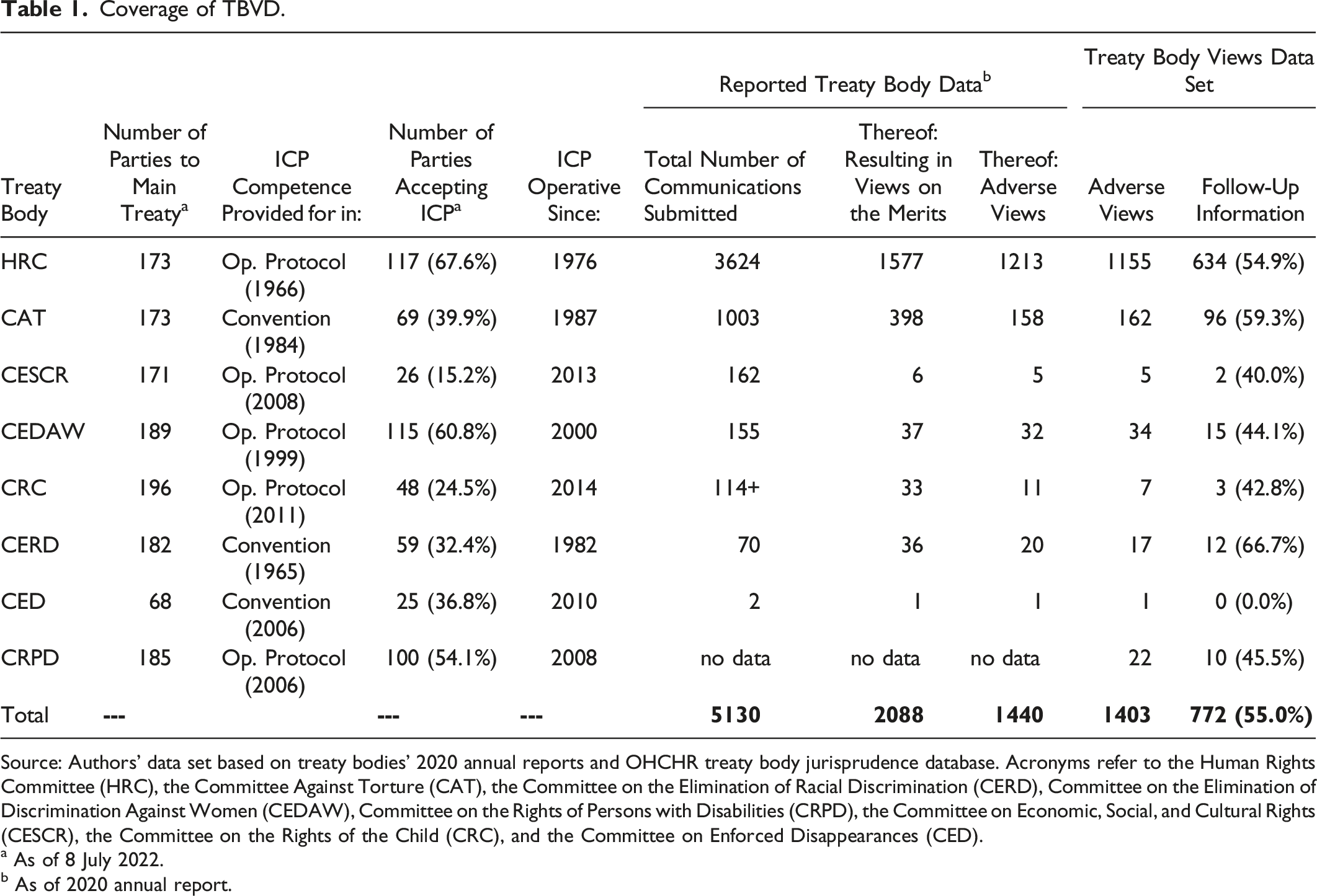
Source: Authors' data set based on treaty bodies’ 2020 annual reports and OHCHR treaty body jurisprudence database. Acronyms refer to the Human Rights Committee (HRC), the Committee Against Torture (CAT), the Committee on the Elimination of Racial Discrimination (CERD), Committee on the Elimination of Discrimination Against Women (CEDAW), Committee on the Rights of Persons with Disabilities (CRPD), the Committee on Economic, Social, and Cultural Rights (CESCR), the Committee on the Rights of the Child (CRC), and the Committee on Enforced Disappearances (CED).
a As of 8 July 2022.
b As of 2020 annual report.
Procedurally, ICPs are fairly similar. A complaint has to meet several admissibility criteria, including the exhaustion of domestic remedies, before a committee can examine it. If declared admissible, the respondent state is invited to provide its response to the alleged violation(s). Assessing the evidence and arguments presented by both sides the committee issues its ‘views’ (CERD: ‘opinion,’ CAT [since 2002]: ‘decision’) as to whether a violation of one or more treaty provision(s) has occurred. UNTB views, although legally non-binding, emulate in form and style judicial decisions and, when they find a violation of treaty provision, request the respondent state to report back on the measures it has taken to comply with them. All treaty bodies have by now instituted follow-up procedures through which they track and assess the implementation of the remedies indicated in their decisions as necessary for compliance. That information and the committees’ assessments are regularly published in the annual reports to the UN General Assembly and/or in separate follow-up reports that contain information on the views reviewed since the last report.
The treaty bodies’ ICPs may be less prominent than those of the regional human rights courts, 4 but the complaints they deal with involve violations that are comparable in scope and gravity, ranging from minor ones limited to individual applicants to systemic violations that require broader policy, legislative or administrative remedial measures. The issues of the complaints vary with the content of the applicable treaties, with the scope of the CCPR being the broadest and cases under the specialized treaties focusing on more specific sets of rights. 5 Several committees have become fora of choice for applicants seeking protection from impending violations of the non-refoulement norm where compliance with an adverse finding requires non-deportation of the applicant and the grant of some type of residence permit (Çalı, Costello, and Cunningham 2020; Ford 2022). Other remedies ordinarily limited to individuals concern release from detention/prison and the commutation of death sentences due to violations of procedural and/or fairness guarantees (Fox Principi 2017, 13–14). In cases of enforced disappearance, investigating and prosecuting those responsible is a typical remedy, but the removal of amnesty laws may also be necessary where these present legal obstacles to implementing individual measures (David 2014, 20). In general, where violations originate from legislation in force, such legislation needs to be reviewed and changed (Fox Principi 2017, 18–21). Some views, such as those on the French burqa/niqab ban, 6 have addressed strongly politicized domestic issues and have received a good deal of publicity.
The Dataset
The TBVD contains information on 1403 adverse views 7 issued between 1979 (the year of the HRC’s first adverse ICP decision) and the end of 2019. Our principal sources for the TBVD are the UNTB jurisprudence database 8 and the lists of decisions published in the treaty bodies' annual reports. A comparison of our numbers with the committees’ own summary statistics (as reported in their 2020 annual or biennial reports) shows that the TBVD covers nearly all adverse views that have been issued until 2019 (cf. Table 1). The delta of 37 views is likely due to differences in cut-off dates as well as inconsistencies in the UNTB source data. Because of its small size, it will not significantly skew analytical results.
Examples of Variables in the TBVD.
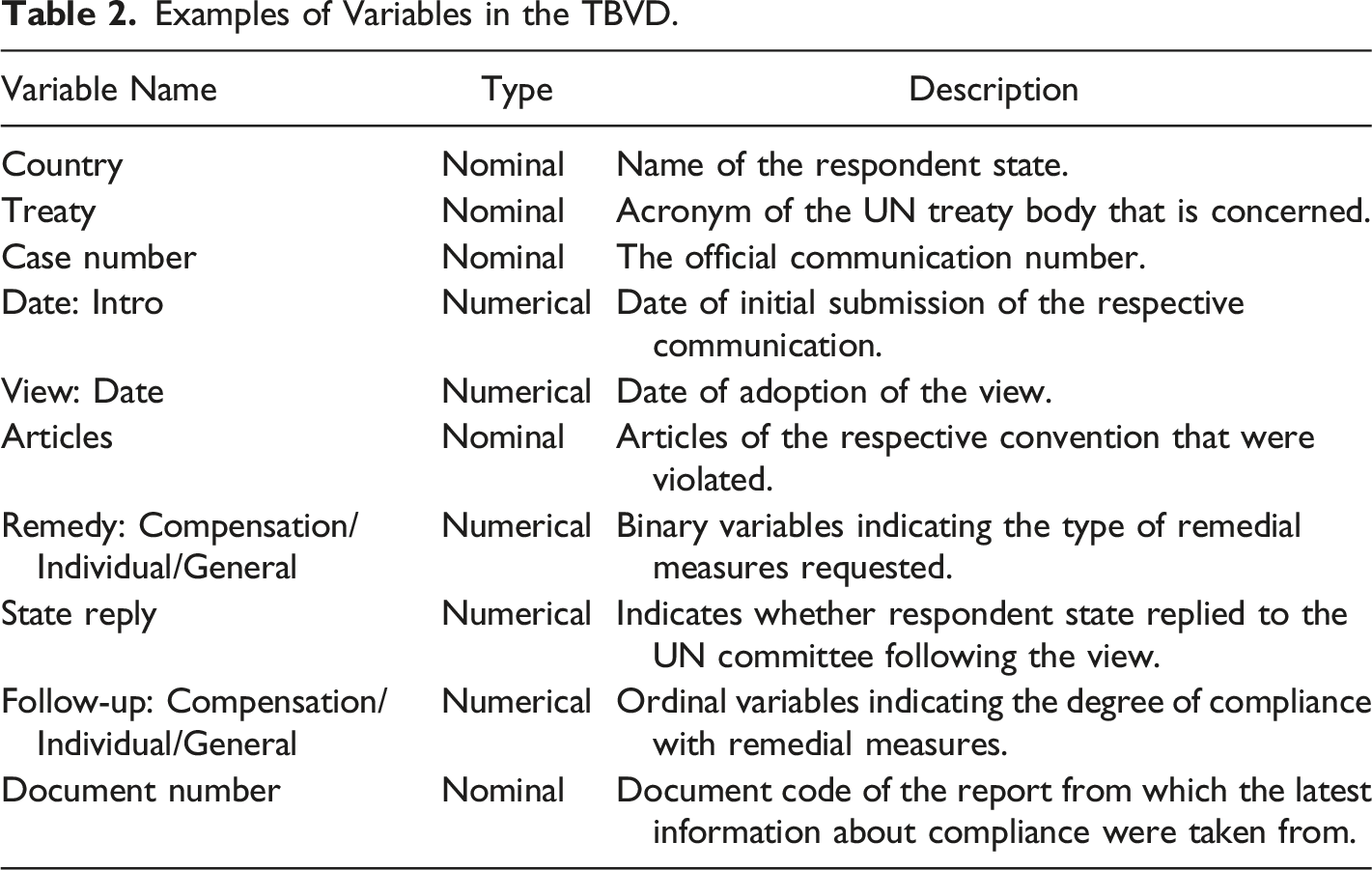
We mined the UNTBs’ follow-up reports on views for data on the respondent states' implementation activity and the committees' assessments of it. Although most committees include their own compliance ratings we did not uncritically adopt these uniformly for our coding because the committees' practices in giving grades are not consistent across time and treaty. Rather, we coded the compliance status of every measure mentioned in a view on a three-stage scale, with the values of 0, 0.5, and one indicating non-compliance, partial compliance, and full compliance, respectively. Coding occurred on the basis of the follow-up information provided by the respondent state, the author(s) of the communications, and/or the responsible committee and in light of comparable cases and assessments. The compliance status of each remedy was assessed and coded twice by two political science students. Inconsistent codes were reviewed by the authors with the aim to resolve conflicts due to misunderstandings or wrongly chosen precedents. 9 For the final set of codes, equally weighted Kappa values of 0.74, 0.81, and 0.78 indicate substantial inter-coder agreement (Landis and Koch 1977, 165) with respect to coding the status of compliance with financial, individual, and general measures, respectively. We are aware that reliance solely on the committees’ reports is not without issues, but the follow-up reports are the most comprehensive and most efficiently accessible source of information on compliance with views currently available for large-N quantitative analysis. 10
The committees typically specify the remedial measures they expect respondent states to take and we include data on the types of remedies thus indicated in the dataset. Compliance information is collected at the level of these types, namely financial compensation, individual measures in the applicant’s case, and general measures aimed at preventing the recurrence of a given violation. We here borrow from the supervisory practice of the Council of Europe’s Committee of Ministers with respect to the execution of ECtHR judgments. 11 This approach is informed by findings that states tend to deal with different types of remedies differently, depending on their complexity and the expected material, political, and sovereignty costs. With respect to the ECtHR and IACtHR states have been found to fulfill financial reparation obligations to a greater extent than those that require general measures, such as changing legislation (Hillebrecht 2014a, 49–50), and generally to seek to minimize the domestic impact of adverse findings (von Staden 2018, 208–10). Similarly, in the case of the Court of Justice of the European Union, a routine response by states is to ‘contain compliance’ by remedying the individual applicant’s violation but refraining from drawing any broader implications (Conant 2002).
Disaggregating compliance by remedy type also permits to give sharper contours to instances of partial compliance. Sometimes a committee identifies multiple measures that fall within the same type of remedy. An example is provided by the decision in Bozize v. Central African Republic (UN Human Rights Committee 2014a) in response to which the respondent state released the victim from detention but neither investigated the events nor convicted those responsible for the unlawful treatment. In such a case we coded state implementation of each measure separately and then generated an aggregate score for the remedy category by taking the mean of all separate assessments. In the above case, we assigned a ‘1’ (full compliance) to the first measure and a ‘0’ (non-compliance) to the other two which yields an overall score for the individual measures variable of 0.33. Aggregated values for compliance assessments also occur in the general measures category (see e.g. UN Committee on the Elimination of Discrimination against Women 2007) but not in the financial compensation category.
The follow-up reports' coverage is unfortunately not perfect. Compliance-relevant information exists for 772 adverse views, representing 55% of the views covered by our dataset; as Figure 1 and Table 1 show, that percentage varies between 0% and nearly 67% for different treaty bodies. With the figures for the five most active committees being at 40% or higher, although not ideal, there is sufficient empirical data to work with. The fact that states often fail to submit follow-up information is telling in itself. While managerial issues may sometimes prevent states from engaging with the UNTB follow-up process, states should generally have an interest in reporting compliance-relevant information. When they fail to provide it a more plausible assumption in most cases is that there is nothing to report. We come back to the consequences of this assumption for our compliance measures below. Coverage of the TBVD.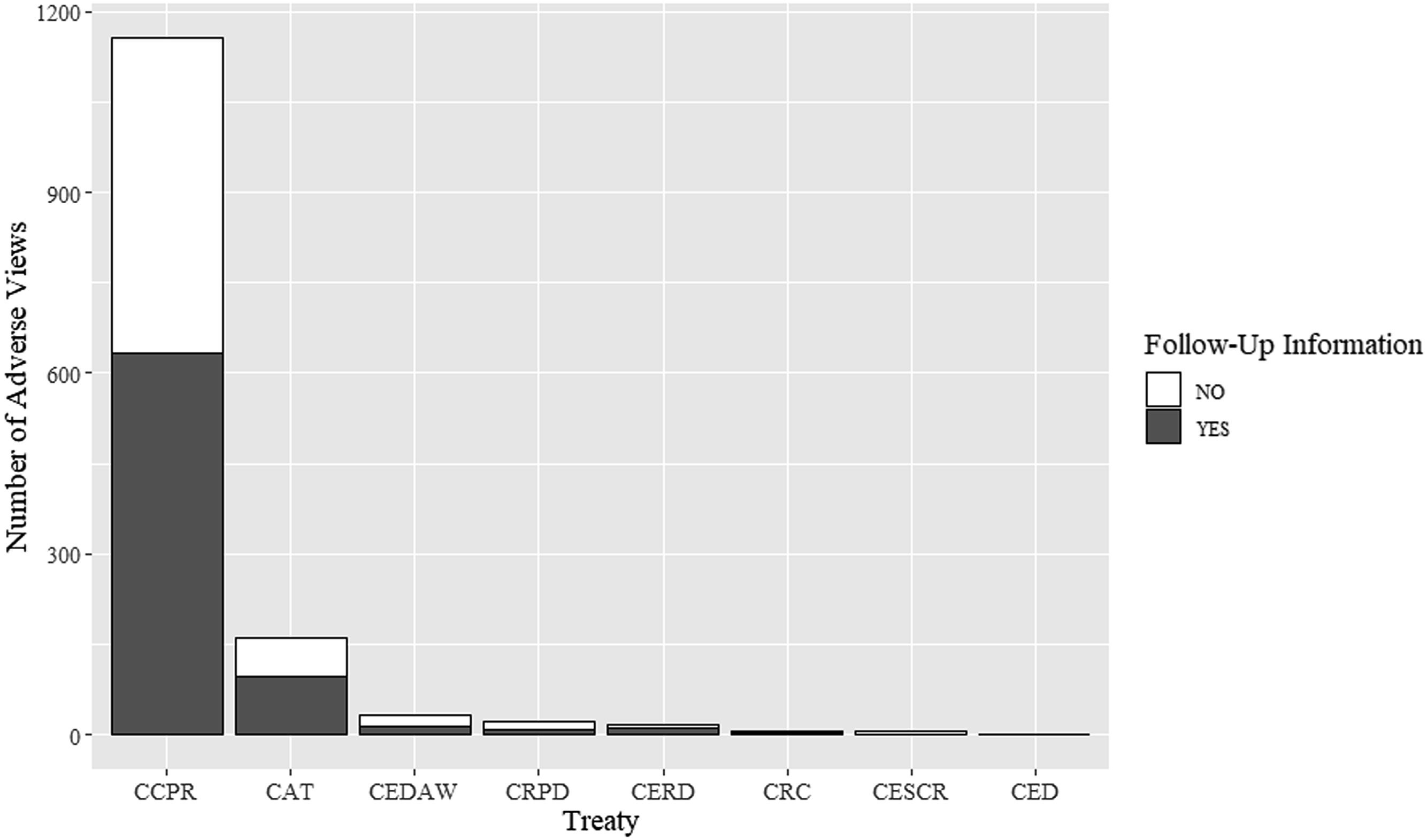
Descriptive Statistics
The adverse views in our dataset are not evenly distributed across treaty bodies, countries, or regions. The large majority (82%) of views in the TBVD comes from the HRC (the oldest and most active committee), followed by the Committee against Torture, with the other six committees significantly lagging behind in terms of ICP output (recall, though, that some of these only began deciding individual complaints less than a decade ago). The distribution of views across world regions is depicted in Figure 2. Europe is the region that has been subject to the largest number of adverse views (522), followed by Asia (336) and the Americas (315). Africa accounts for fewer than 200 views and Oceania for fewer than 100. Number of adverse views per region.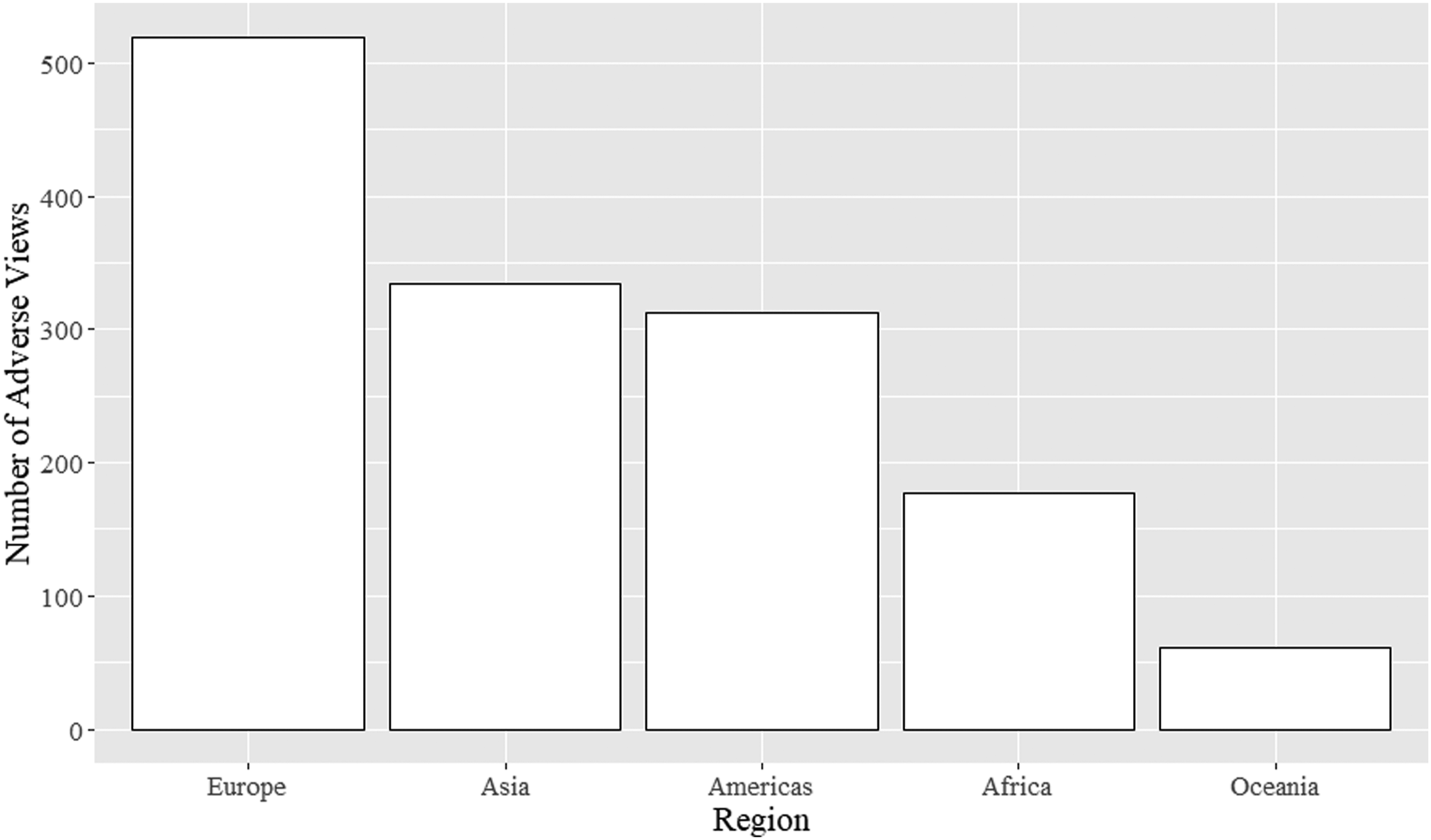
To determine the extent of compliance we draw on several distinct compliance scores in our dataset.
12
First, there are the three indicators for the implementation of the different remedy categories discussed earlier. Figure 3 reveals that the large majority of the financial compensation measures – pace Fox Principi (2017, 5) – are never implemented. In fact, among the three remedy categories, the compensation measure is the least complied with, as expressed by its mean of 0.179 compared with the means of non-financial individual measures (0.348) and general measures (0.278).
13
This is surprising because financial compensation is the most often implemented form of redress in the cases of the IACtHR and the ECtHR (Fikfak 2018; Gonzalez-Salzberg 2014; Hawkins and Jacoby 2010). One explanation for this finding may be the fact that the UNTBs typically do not specify the quantum of compensation to be paid to the victim of a violation, which allows respondent states to default on payments by claiming uncertainty as to the amounts to be disbursed. Distribution of views across compliance scores. Note: Plots depict histograms of the respective compliance scores, with an overlaid smooth line reporting Kernel density estimates.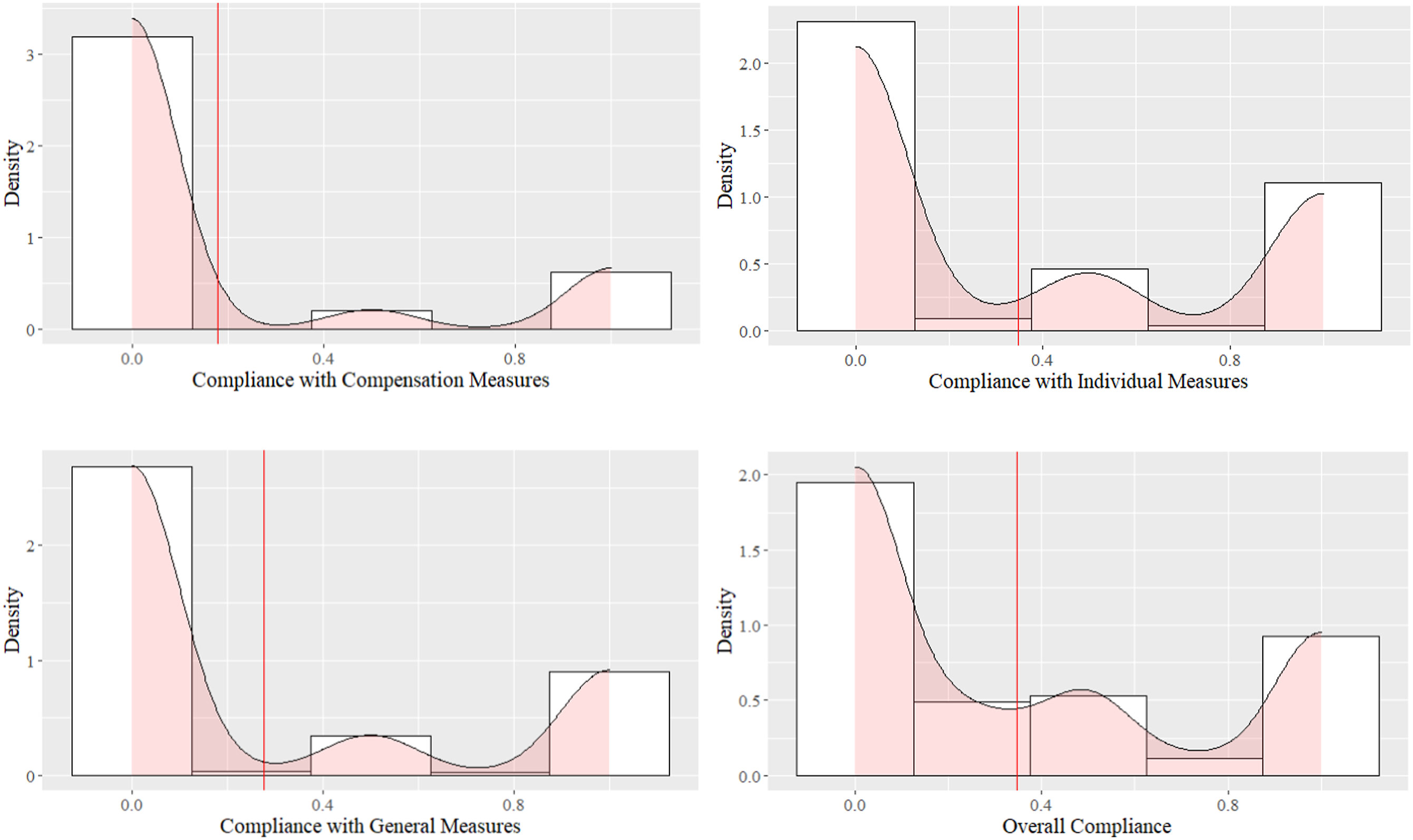
We further offer an aggregate compliance score that reflects the degree to which a respondent state has implemented the measures recommended by the committee in their entirety; it is obtained by calculating the mean of all three remedy scores. To estimate the average compliance of all countries with all views, we use two different approaches, depending on how the views for which we do not have any follow-up information are treated: First, the aggregate compliance score all uses the full set of 1403 adverse views and classifies all 631 communications for which we could not find any follow-up information as instances of non-compliance, 14 yielding a mean of 0.19. Second, the aggregate compliance score sample variable only uses the 772 views for which we have positive information on (non-)compliance and disregards all others. This compliance variable scores higher with a mean of 0.35. Next, we use the aggregate compliance score sample variable to create the dichotomous variable compliance dummy partial which indicates whether the communication was at least partially complied with (aggregate compliance score sample: 0.5–1) or not (aggregate compliance score sample: 0–0.49) and obtain a mean value of 0.39. For the compliance dummy full variable, we narrow our definition of compliance and assign a value of one only to those communications that also have an aggregate compliance score sample value of 1, i.e., where the state has fully implemented all required remedial measures. For this measure, we obtain a mean value of 0.23. In sum, we find that compliance rates for treaty body views range between 19% and 39%, depending on the assumptions concerning missing values and the underlying conception of compliance, that is, whether it is a dichotomous phenomenon and, if so, where the threshold between non-compliance and compliance is put. Perhaps not surprisingly, these numbers are noticeably lower than those found in research on compliance with regional human rights courts (Hillebrecht 2014a; von Staden 2018).
It has been widely argued that time is a key dimension when studying compliance with human rights decisions (Anagnostou and Mungiu-Pippidi 2014; Pérez-Liñán, Schenoni, and Morrison 2023; Stiansen 2019). Our dataset enables researchers to take into account the crucial time dimension of compliance by including the dates of issuance as well as of the closing of the follow-up process or of the last assessment of each view. To give an example, Figure 4 shows the frequency of the binary partial compliance outcome over time. It reveals that most views are implemented within 3 years of being issued, whereas the prospect of implementation decreases significantly for views that remain pending for more than 10 years, notwithstanding some temporal recoveries after 15 and 35 years. The shape of the curve of compliance over time is strikingly similar to the one Pérez-Liñán, Schenoni, and Morrison (2023, 14–18) describe for compliance with judgments by the IACtHR, suggesting that implementation processes in both systems follow a comparable pattern. Distribution of compliance and duration of follow-up process. Note: 0 = non-compliance, 1 = partial/full compliance, NA = no compliance information.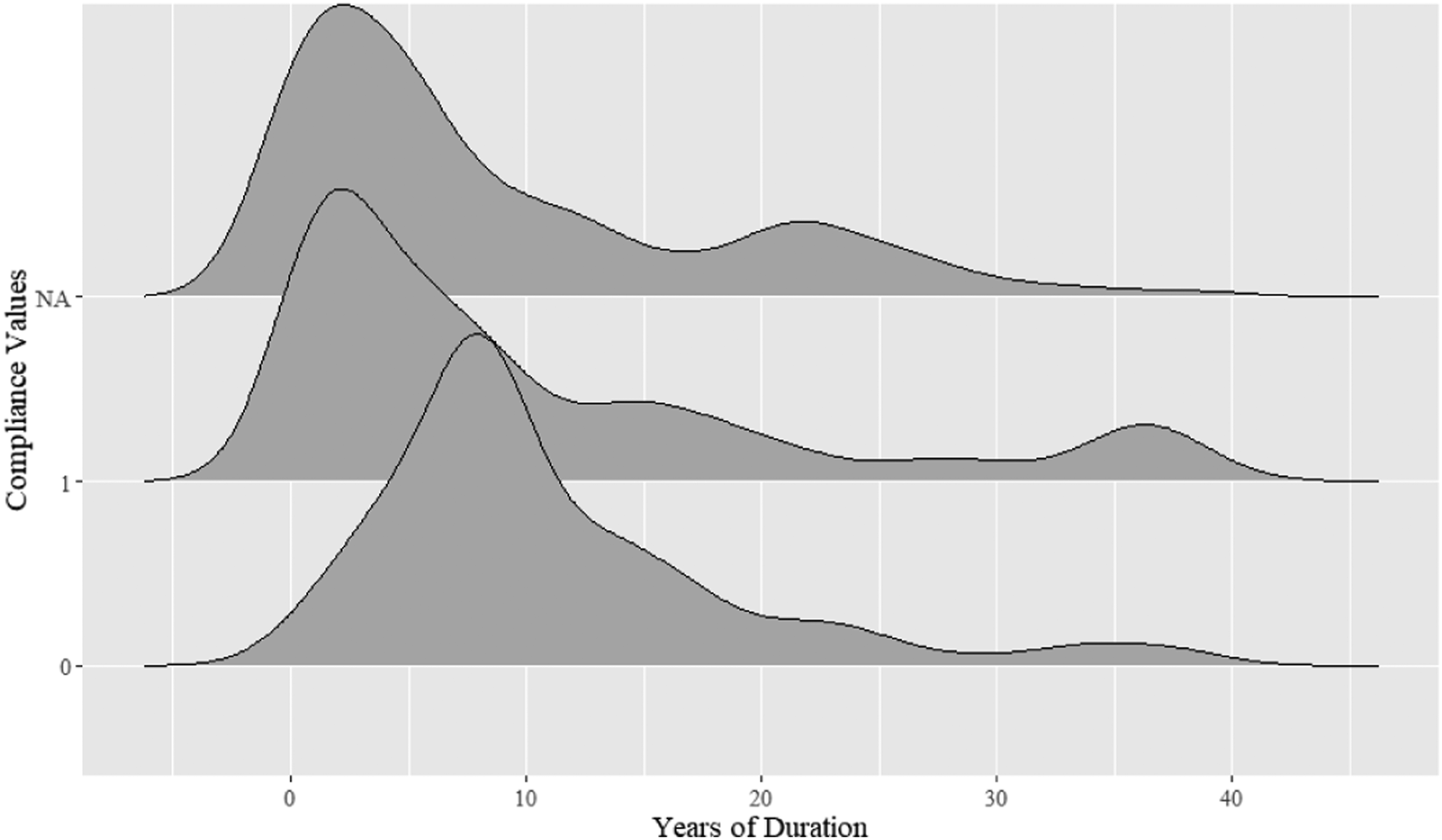
Determinants of Compliance With Views: An Application
To show how the TBVD can be put into practice we conduct an analysis that takes its cue from the question of the relative significance of different institutional characteristics for compliance. The TBVD enables us to test some of the theoretical expectations that have been articulated in the literature on compliance with international human rights courts (and treaties). We can thus assess in a quantitatively reliable manner the extent to which compliance with adverse views is subject to the same causal influences that research has discussed with respect to compliance with court judgments. Before turning to the empirical analysis, we present the assumptions and choices made in the process of data preparation and model specification and discuss possible shortcomings and limitations of our approach.
Method
We formulate a Cox regression model that allows us to assess the possible determinants of compliance over the whole lifetime of a decision while taking into account the special structure of our data.
15
The fact that we rely only on the UNTB follow-up reports to create our compliance variable raises the issue of potential sample selection bias. Our sample of 772 adverse views with follow-up information may not be randomly drawn from the full underlying population, which would result in non-informative parameter estimates (Boehmke, Morey, and Shannon 2006). To account for this possibility, we use a two-stage model strategy (Gagnon et al. 2009; Heckman 1979). In this approach, the problem of selection bias follows the logic of a misspecification error arising from the omission of an independent variable. We thus formulate a selection equation using a probit model with the following specification:

Dependent Variable
Since survival analysis requires a dichotomous measure of the outcome variable we use the partial compliance dummy variable from our dataset, which takes the value of 0 if the aggregate compliance score all of the corresponding communication year 17 is smaller than 0.5 and the value of one if the communication year has an aggregate score of 0.5 or higher. Thus, the variable measures whether and when a view was at least partially complied with. 18 While we acknowledge that this requires a generous understanding of compliance, we want to avoid discarding as inaction substantial efforts by states that have (hitherto) failed to meet the requirements for full compliance but that have adopted some relevant remedial measures. Note that this variable counts views for which we do not have follow-up information as cases of non-compliance. We also test whether a model which only uses cases with follow-up information yields different results. We assume that the compliance event took place within the same year it was reported in the follow-up report as we lack information—most of the time—on exactly when state action actually occurred. 19
Independent Variables
The independent variables that we present in this section reflect common choices in the literature on compliance with UN human rights treaties and with regional court judgments. Although we include a wide range of factors, we do not claim to cover all possible determinants of compliance. The aim of this study is not to test a specific theory of compliance but to provide an example of what can be done with the data by using factors that have been discussed in the related literature. (For summary statistics, see Table A2 [appendix]). 20
Decision-level characteristics
Certain properties of the views themselves may affect the probability of their implementation. Central among those is the nature of the remedy necessary to implement the decision. The literature on compliance with ECtHR and IACtHR judgments has shown that states appear more inclined to pay financial compensation than to provide individual remedies (Hawkins and Jacoby 2010) and are least likely to implement measures that require legislative or jurisprudential changes (Grewal and Voeten 2012; Stiansen 2021). However, the descriptive statistics show that compensation is the least implemented remedy category. To test the presence of an enhancing or an impeding effect of the remedies demanded by the view, we use a dummy variable, indicating whether a view demands financial compensation. 21
Another factor that might influence a view’s propensity to be complied with is the nature of the violation(s) established by it. Since it is not feasible to compare articles across all nine treaties, we identify two categories according to which violations can be differentiated: First, research on compliance with human rights court judgments has shown that violations of physical integrity rights are less likely to be remedied than other violations (Conrad and Ritter 2013; Stiansen 2019) because ‘such violations almost by definition strike at the heart of executive control over a society, and thereby are likely to elicit executive resistance’ (Grewal and Voeten 2012, 27). Hence, we include in our model a dummy variable that reflects whether a view concerns a physical integrity rights violation. 22 Second, views can deal either with violations that have already occurred or with violations that would likely occur if the respondent state were to carry out its planned action. The second ‘conditional’ type is particularly relevant in deportation/extradition cases subject to the non-refoulement prohibition. Remedying conditional violations is typically less costly than remedying actual ones because states mostly have to refrain from doing something and can avoid the opprobrium of being found to be in actual violation of human rights law at the same time. We expect states to prefer preventing a violation at low cost over providing likely more costly remedies later on once an actual violation has occurred (cp. von Staden 2022b). We, therefore, include a binary variable indicating whether a specific view includes a conditional violation.
Further, we conjecture that the task of compliance becomes more complex – and thus less likely to occur – the more remedial measures the state has to implement. The more actions are demanded by the respondent state the more difficult and costly it is for that state to reach full compliance. Thus, we add to our model the number of measures variable which is a count of all measures within the three remedy categories that the committees have identified as being necessary for full compliance.
Country-level characteristics
A straightforward expectation is that democratic regimes are more likely to comply with international human rights law. Scholars have offered various explanations for this relation. Typically, democratic systems impose few(er) restraints on civil society organizations and activism, which can result in political pressure on governments to fulfill their human rights obligations (Hafner-Burton 2008; Simmons 2009). Democracies are also associated with high respect for the rule of law and an independent judiciary that is more successful in compelling compliance by the government compared with autocratic systems (Hathaway 2002; Neumayer 2005). In our analysis, we use V-Dem’s liberal democracy index (Coppedge et al. 2020) to measure democracy because it captures most aspects of the concept that we deem important here, notably the openness of political institutions and the respect for the rule of law as well as for civil and political rights. 23
To account for the objection that it is not democracy per se that influences compliance but democracies' disposition to provide strong human rights protection (von Stein 2016), we integrate into our model a measure of a country’s human rights performance as expressed by its respect for physical integrity rights (Fariss 2019).
Studies focusing on the ECtHR have suggested that a successful implementation of the court’s judgments hinges critically on the bureaucratic effectiveness of the responding country, at least within the first years after issuance (Anagnostou and Mungiu-Pippidi 2014; Voeten 2014). Following Anagnostou and Mungiu-Pippidi (2014), we use the Worldwide Governance Indicators' government effectiveness index to measure the level of each country’s capacity to put the required remedies into practice.
Another potential factor affecting compliance is the probability of domestic legal enforcement which depends on judicial independence within a country (Hathaway 2005; Powell and Staton 2009). Simmons (2009) conjectures that countries with a common law tradition are less likely to ratify human rights treaties because these countries' governments fear the involvement of independent and powerful domestic courts in law-making in that particular area. As a result, once a country has ratified a treaty, we should see more engagement by domestic courts and thus more pressure on the government to comply with the treaty body’s views. We also follow Simmons (2009) and include a self-coded dichotomous variable that indicates whether the respondent country’s law system is a common law one. 24
Civil society organizations, such as non-governmental organizations (NGOs), play an important role in furthering state compliance with international human rights obligations (Risse, Ropp, and Sikkink 2013; Simmons 2009). If they are free from governmental interference, NGOs can put pressure on relevant state institutions to comply with international human rights decisions, including those of the UNTBs (Allendoerfer, Murdie, and Welch 2020; Schoner 2022). We use VDem’s indicator of civil society repression to measure the degree to which non-state actors are free to advocate for compliance with human rights decisions. 25
Results
Cox Regression Models.
Note: 95% confidence intervals in parentheses. Results for time-varying covariates and inverse mills ratio not shown.
*p < 0.1; **p < 0.05; ***p < 0.01.
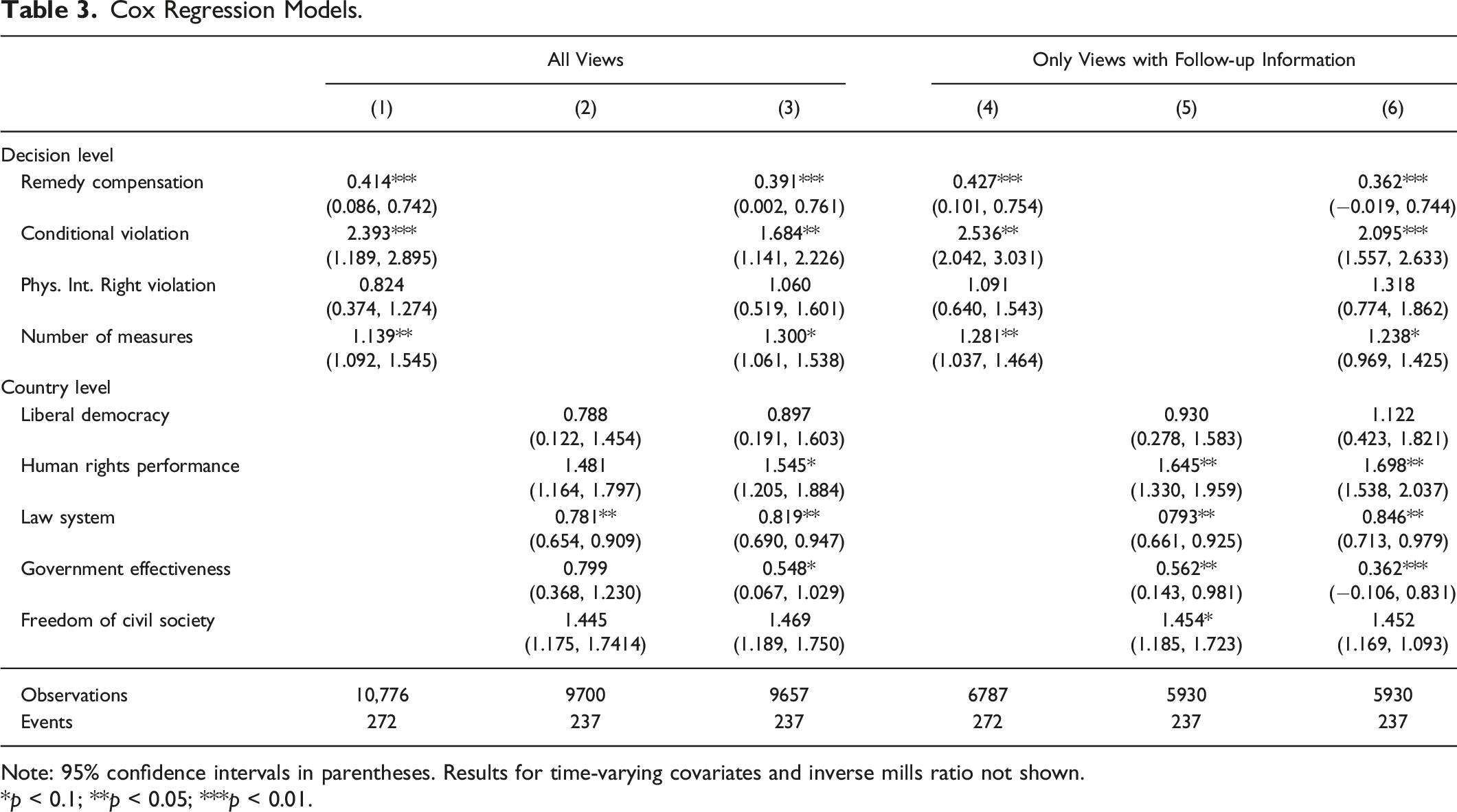
Contrary to findings for the regional courts but in line with the descriptive data above, the risk of compliance is reduced by around 60% when an adverse view requires financial compensation as a remedy. States' inability or unwillingness to compensate for pecuniary and non-pecuniary damages could be due to a lack of precision 27 as no view in our dataset—in contrast to the judgments by the IACtHR and the ECtHR—specifies the amount to be paid to the victim; instead, the committees typically merely call upon respondent states ‘to provide adequate compensation’ (see e.g., UN Human Rights Committee 2019, para. 10). Moreover, the payment of compensation requires the initiation of additional bureaucratic and judicial processes at the national level which creates obstacles to swift implementation (Huneeus 2011; Murray and De Vos 2020; Van Alebeek and Nollkaemper 2012).
We find support for our expectation that views concerning conditional violations have a higher risk of experiencing compliance. The hazard ratios for the variable have p-values below the 0.05 level and remain robust to model changes. We do not find support for the claim that views concerning physical integrity rights violations are less likely to be implemented.
Counterintuitively, the results indicate a significant positive association between the number of measures and compliance, suggesting that views demanding more remedial measures have a higher risk of compliance than views containing fewer measures. When changing the dependent variable to full compliance the coefficients for the number of measures variable change their signs, 28 suggesting that the positive effect in Table 3 is merely an artifact of the operationalization of the compliance variable. In other words, it is plausible that states have higher chances to achieve some or even considerable levels of compliance when they have more measures to choose from. However, the more remedial measures are required, the more costly and less likely it becomes that states implement all of them and reach full compliance.
As regards country-level variables, we do not find conclusive evidence for an increased compliance probability if the respondent state’s political system adheres to principles of liberal democracy. The hazard ratios for our liberal democracy variable hint at a positive association only in column 6 and fail to achieve statistical significance. Our alternative measurement for democracy, executive constraint, provides similar results. 29 Our expectations about a country’s human rights performance are confirmed by the results. The higher a country’s general respect for physical integrity rights is, the higher are the chances that it will implement adverse views.
The analysis suggests a 20% lower compliance risk for views that concern common law system countries which is at odds with our initial expectations. This is in line with findings that have questioned whether the domestic judiciary is an automatic compliance partner of international human rights institutions and has instead highlighted the significance of domestic judicial politics for compliance and non-compliance (Huneeus 2011). In the specific case of a treaty body’s output, the role of the latter’s legally non-binding status may additionally prevent institutions formally committed to the rule of law from giving it supremacy over legally binding legislation and decisions (Kanetake 2018).
At first glance, we do not find compelling evidence that would support managerial arguments about compliance. The hazard ratios for the government effectiveness variable suggest a counterintuitive negative association between government capacity and compliance. As can be seen in the relevant Schoenfeld residual plot (cf. Figure A1 [appendix]), however, the effect of government effectiveness is not uniform across time and is most strongly defined in the latter part of the observation period. Once we stratify the observation period at t = 4, we get a highly significant hazard ratio of 3.05 for the latter part (see Table A7 [appendix]). This suggests that within the first 3–4 years after view issuance, compliance does not depend on the quality and independence of the public services. Yet, views that remain pending for a longer period of time are more likely to be implemented by states with more effective governmental institutions. 30 We also find tentative evidence that more civil society freedom is positively correlated with compliance. The hazard ratios for the civil society variable remain consistent across all models but reach conventional levels of significance in only one of them.
Implementing individual measures can be expected to be subject to different domestic factors and processes than the adoption of general remedies which tend to involve more profound administrative, legal, or policy changes. The implementation of general remedies is thus typically a more complex task, often involving several governmental actors, possibly from different branches of government, and as a result, will usually take longer. The TBVD allows us to create variables for individual and general remedy compliance to test compliance with them separately. Figure 5 depicts the Cox regression model, where we change the outcome to compliance with individual remedies and thus only observe views that recommend remedies concerning the individual victim(s) of the violation(s).
31
The results are largely congruent with our findings from Table 3, with some minor deviations. The effects of the human rights performance variable and of the law system variable lose significance whereas the hazard ratios for government effectiveness reach high levels of statistical significance, suggesting that governmental and bureaucratic capacity are particularly important when it comes to the implementation of remedial measures in the individual case. The conditionality of the violation is the strongest predictor of compliance with individual remedies. Cox regression – compliance with individual remedies.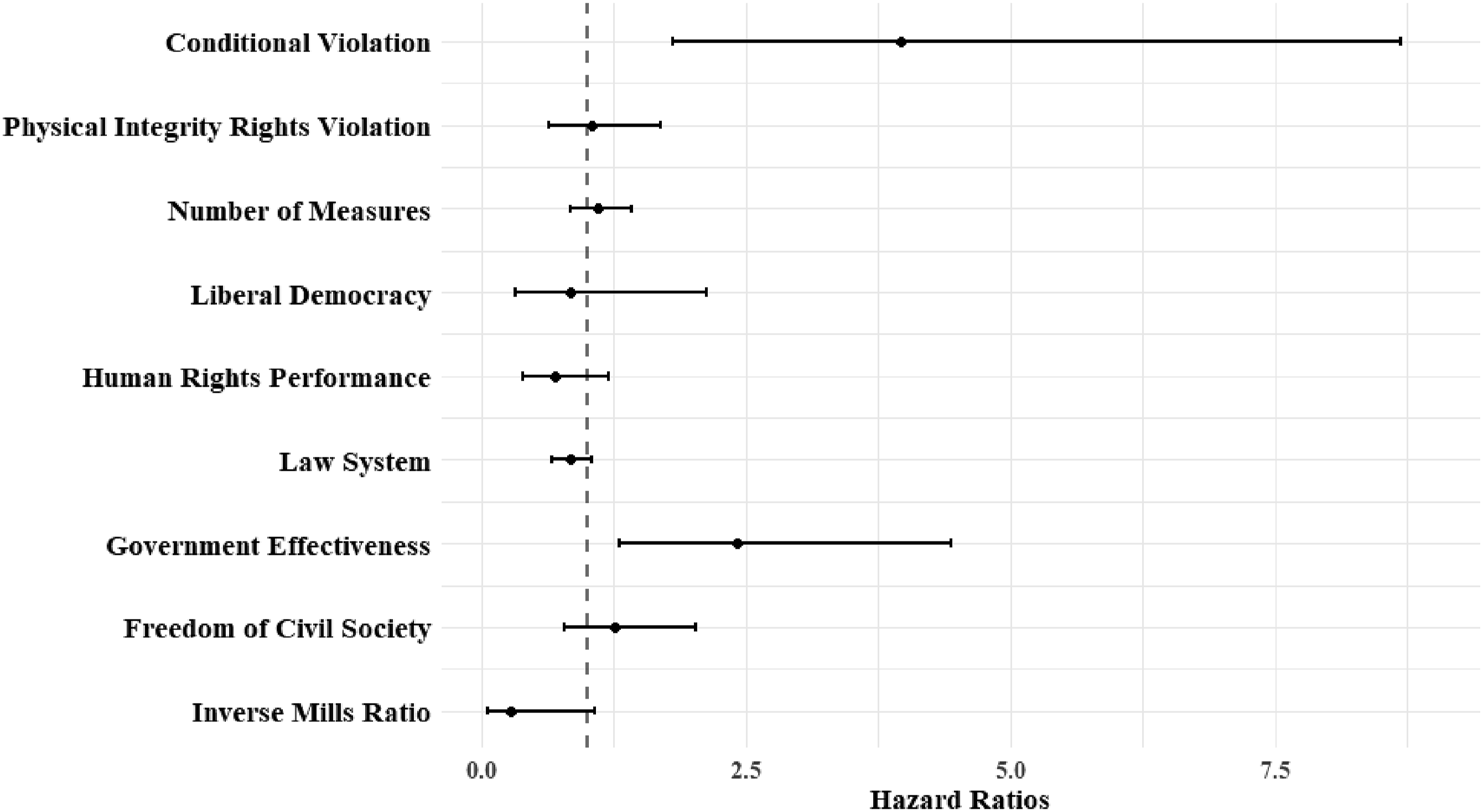
Discussion
To what extent do these findings mirror what we know from previous research on human rights courts? First, we find that the likelihood of remedy implementation hinges critically on the substance of the views themselves. Three of the most robust effects on compliance turn out to be those concerning the material nature and scope of the remedies, as well as the nature of the violation(s) identified. Although these findings constitute important preliminary insights, they could be complemented by additional decision-level determinants of compliance, such as the underlying issue, as expressed by the specific rights that have been violated and the legal reasoning behind and/or the precision of the remedies. A stronger focus on decision-level factors would address claims about the importance of decision characteristics for state compliance that have been made in the literature on legally binding judgments by international courts (Fikfak 2018; Haglund and Hillebrecht 2020; Staton and Romero 2019; Stiansen 2019).
Second, results for our country-level variables largely confirm previous knowledge about state compliance with regional human rights court judgments. The findings strongly suggest a positive effect of a higher respect for core human rights on a state’s inclination to comply with a view. Common law countries seem to be slower compliers than countries whose law systems follow other traditions. We also find indications that the state’s governmental and bureaucratic capabilities and resources can be a crucial determinant of compliance particularly when it comes to the implementation of individual remedies in the applicant’s case. Remarkably, we could not establish a correlation between a country’s degree of liberal democracy and compliance with adverse views. Although it seems surprising at first, this apparent lack of evidence from our study could be the result of our decision to include all eight treaty bodies in our analysis because the relation between democracy and human rights is not as clear-cut for all human rights as it is for civil and political rights (Hill Jr and Watson 2019). By including eight different treaties that represent a diverse set of rights and obligations, we may blur some of the relations that exist between country characteristics and compliance with the output of some treaty bodies but not of others. Therefore, we suggest that the way forward in research on second-order compliance with UNTB views is through more fine-grained examinations of views with respect to capturing the specific rights at issue and how they affect, or interact, with other decision, institutional, or country characteristics.
Conclusion
In this article, we have presented a new dataset, the TBVD, which represents the most comprehensive collection of data on the compliance status of all adverse views issued by eight treaty bodies over a 40-year period. The dataset compiles significant information that can be used by researchers interested in all aspects of the UNTB’s ICPs and in states’ engagement with them. The aim of this dataset is to contribute to the growing systematic research on compliance with human rights monitoring mechanisms by providing generalizable insights into state compliance with the legally non-binding views of the UNTBs. Juxtaposing our findings with research on compliance with the judgments of the regional human rights courts we have been able to point out indicatively differences and similarities in compliance patterns between decisions with different legal status. The TBVD fills a gap in the research landscape that can be utilized to shed more light on the political and the legal dynamics at play in giving domestic effect to rights affirmed at the global level by UN expert bodies. The TBVD can be paired with other datasets to enable comparative analysis across different institutions and has been set up specifically for survival/event history analysis in order to capture the temporal dimension of implementation and compliance. In this regard, we have only dipped our toes into the research possibilities afforded by this new dataset and look forward to exploring them more fully in future work and encourage other researchers to do the same.
Supplemental Material
Supplemental Material - A Room Full of ‘Views’: Introducing a New Dataset to Explore Compliance with the Decisions of the UN Human Rights Treaty Bodies’ Individual Complaints Procedures
Supplemental Material for A Room Full of ‘Views’: Introducing a New Dataset to Explore Compliance with the Decisions of the UN Human Rights Treaty Bodies’ Individual Complaints Procedures by Andreas J Ullmann and Andreas von Staden in Journal of Conflict Resolution
Supplemental Material
Supplemental Material - A Room Full of ‘Views’: Introducing a New Dataset to Explore Compliance with the Un Treaty Bodies’ Individual Complaint Procedure
Supplemental Material for A Room Full of ‘Views’: Introducing a New Dataset to Explore Compliance with the Un Treaty Bodies’ Individual Complaint Procedure by Andreas J Ullmann and Andreas von Staden in Journal of Conflict Resolution
Supplemental Material
Supplemental Material - A Room Full of ‘Views’: Introducing a New Dataset to Explore Compliance with the Un Treaty Bodies’ Individual Complaint Procedure
Supplemental Material for A Room Full of ‘Views’: Introducing a New Dataset to Explore Compliance with the Un Treaty Bodies’ Individual Complaint Procedure by Andreas J Ullmann and Andreas von Staden in Journal of Conflict Resolution
Supplemental Material
Supplemental Material - A Room Full of ‘Views’: Introducing a New Dataset to Explore Compliance with the Un Treaty Bodies’ Individual Complaint Procedure
Supplemental Material for A Room Full of ‘Views’: Introducing a New Dataset to Explore Compliance with the Un Treaty Bodies’ Individual Complaint Procedure by Andreas J Ullmann and Andreas von Staden in Journal of Conflict Resolution
Footnotes
Authors’ Note
We thank participants of the ‘Compliance with Soft Law’ workshop at Universität Hamburg (April 2021) and of the Hertie School’s Fundamental Rights Research Colloquium (November 2021) as well as Andrea Liese and two anonymous reviewers for valuable comments on earlier drafts of this article. We also gratefully acknowledge able research assistance by Claudia Abmeier, Aranka Bálint, Larissa Wehrle, and Laura Wutschik.
Declaration of Conflicting Interests
The author(s) declared no potential conflicts of interest with respect to the research, authorship, and/or publication of this article.
Funding
Research for this article was supported by Deutsche Forschungsgemeinschaft (DFG, German Research Foundation), project number 417704617.

Supplemental Material
Supplemental material for this article is available online.
Notes
References
Supplementary Material
Please find the following supplemental material available below.
For Open Access articles published under a Creative Commons License, all supplemental material carries the same license as the article it is associated with.
For non-Open Access articles published, all supplemental material carries a non-exclusive license, and permission requests for re-use of supplemental material or any part of supplemental material shall be sent directly to the copyright owner as specified in the copyright notice associated with the article.
