



Abstract
How do childhood experiences of wartime violence affect individuals’ preferences for nuclear proliferation? This paper argues that individuals who experienced severe war violence during childhood are more likely to value the security-enhancing aspects of nuclear weapons. These individuals are more concerned about being exposed to additional wartime violence, so they view nuclear weapons as a deterrent against large-scale invasions. By utilizing the geographic variation of violence intensity during the Korean War, this paper compares the pre-war and post-war cohorts who resided in severely damaged regions and relatively safe areas. Within the pre-war cohort, I find that individuals who resided in war-torn areas are more supportive of nuclear proliferation than those who were exposed to less violence. This regional difference, however, is not substantial in the post-war generation. The results suggest that direct exposure to wartime violence during childhood increases public demand for nuclear weapons when confronted with security threats.
Introduction
Does early exposure to wartime violence affect an individual’s preference for national security policies? During a war, military soldiers are not the only ones who face life-threatening situations; many civilians are also placed in harm’s way, experiencing traumatic violence and even death. Witnessing the deaths of neighbors, friends, and family members due to war violence at a young age is a highly traumatic experience for individuals. This destructive experience can have a long-run impact on one’s personality and value system. Extensive research in social science shows that childhood violent experiences affect individuals’ political attitudes and behaviors in both the short- and long-term. For example, early exposure to violence causes individuals to be less trusting in the government and more active in political participation (Blattman 2009; Carmil and Breznitz 1991; Conzo and Salustri 2019; Hong and Kang 2017; Punamaki, Qouta, and Sarraj 1997).
Surprisingly, however, the effect of childhood wartime violence on preferences for national security policies is a question that has received little attention in scholarship. War-related violence, in comparison with interpersonal, social, and state violence, is especially likely to shape individuals’ preferences and attitudes toward national security policy because it is closely related to the goal of preventing a similar type of violence in the future. This paper examines whether people who experienced wartime violence during childhood demonstrate a greater propensity for nuclear weapons acquisition.
I argue that individuals who were exposed to traumatic wartime violence during childhood are more likely to support nuclear proliferation. Violent experiences of this nature have a tendency to lead individuals to be more concerned about their safety and being exposed to additional wartime violence. The experience of the government’s inability to safely secure its national territory makes these individuals question whether or not the country will be able to protect them in the future. Therefore, when an external security threat arises, people who have experienced wartime violence perceive the threat as riskier than those who have not, and they hyperfocus on worst-case thinking of suffering from a catastrophic war. This leads them to prefer a national security policy that they believe can deter such large-scale conflict.
Scholars have shown that nuclear weapons can have both positive and negative security effects (Bell and Miller 2015; Fuhrmann and Kreps 2010; Jervis 1989; Lee et al. 2023; Monteiro and Debs 2014; Sagan 1994; Waltz 1981). Some studies show that nuclear weapons benefit national security by bolstering deterrence, while others demonstrate that possessing nuclear weapons does not lower the risk of conflict but rather increases it by inviting preventive strikes and low-level disputes. I argue that people exposed to violence early in life naturally favor the security-enhancing aspects of nuclear deterrence. Since they have suffered from traumatic wartime violence, they are more fearful of suffering from a disastrous war in the future. This will lead them to favor a nuclear arsenal that is effective in deterring major invasions on their home soil. Also, people with childhood war trauma who better understand the tragic nature of destructive weapons will focus on the defensive uses of nuclear weapons. They may oppose using nuclear weapons for offensive purposes, but they will support nuclear proliferation if they believe it can defend their country from high-level conflicts.
Using geographical variation in violence intensity during the Korean War, this paper compares the war and post-war generations in South Korea who lived in war-torn and safe regions during their childhood. The theory predicts that people who lived in areas more affected by the war demonstrate a greater propensity to favor nuclear weapons acquisition than those who lived in areas relatively untouched by military conflict. If wartime violence experiences influence preferences for nuclear weapons acquisition, the difference in preferences between people who experienced severe wartime violence and those who lived in safe areas should be significant in the war generation. In contrast, such a geographical difference between those who lived in the same regions after the war ended should not be substantial. Therefore, the theory expects that the regional difference only exists within the pre-war cohort and not in the post-war cohort.
There are substantive reasons to examine the Korean War case. The Korean War from 1950 to 1953 killed over a million civilians, which is about 5% of the total population of the country. The traumatic event might have shaped the survivors’ political attitudes. Yet, the effects of Korean War violence have rarely been systematically analyzed. 1 Moreover, South Koreans have recently been confronted with significant nuclear threats from their northern neighbor, North Korea. Nuclear proliferation has become a salient issue in South Korea since Pyongyang’s first nuclear test in 2006. While more than a majority of the South Korean public shows constant support for nuclear proliferation, there is a cross-sectional variation in the degree of support among the public. Public preferences for nuclear armament in South Korea serve as a relevant indicator for how much individuals perceive nuclear threats seriously and value an extreme but effective protection against nuclear attacks (Gaddis 1986; Waltz 1990). 2
The results provide strong support for the theory. Within the war generation, an experience of living in a war-torn region during childhood increases the individual’s level of support for nuclear proliferation by 5.6 percentage points. However, as predicted, this geographical difference is not present within the post-war generation. I also offer an explanation of potential mechanisms through which people with childhood experiences of wartime violence show greater preferences for nuclear proliferation. Empirical evidence suggests that they perceive external security threats as more threatening and are less likely to trust their security to external actors than those without such experiences.
This paper contributes to the emerging literature on the microfoundation of nuclear policy by showing that childhood wartime violence increases an individual’s preference for nuclear weapons. A growing number of scholars have begun to examine how individual-level preferences for nuclear proliferation vary in different external security situations. For example, recent articles find that a patron state’s nuclear security guarantees affect the client state’s domestic demand for nuclear weapons (Ko 2019; Sukin 2019). This paper examines the existing heterogeneous preferences among individuals: given the same external security condition, why are some people more supportive of nuclear proliferation than others? Existing studies suggest that individuals’ preferences for nuclear proliferation are shaped by their rebel experience (Fuhrmann and Horowitz 2015), political orientation (Press, Sagan, and Valentino 2013), age (Sagan and Valentino 2017), and psychological traits (Rathbun and Stein 2020). This paper contributes to the literature by showing that childhood exposure to wartime violence makes members of the general public favor nuclear proliferation in their later lives as a deterrent against foreign aggression.
Theory
Childhood Wartime Violence and Nuclear Proliferation Preference
Early exposure to military violence has lasting repercussions. Many scholars across a variety of academic fields have focused on the effect of wartime violence on individuals. Studies in psychology and the medical sciences have shown that traumatic childhood experiences of wartime violence can have an effect on future physical and mental disorders. For example, childhood exposure to war violence has long-lasting negative impacts on mental health, such as increased levels of fear and depression (Kesternich et al. 2014; Kim 2017). Also, school-aged children exposed to World War II violence experienced long-run detrimental effects on physical growth, educational attainment, and labor market participation (Akbulut-Yuksel 2014).
Scholars in economics highlight the relationship between early exposure to traumatic events and an individual’s preferences for risk-taking and trust. Several empirical investigations have found that violent experiences during one’s youth lead individuals to be more risk-averse later in life (Byder, Agudelo, and Castro 2015; Kim and Lee 2014). Bernile, Bhagwat, and Rau (2017) discover that CEOs who witnessed potentially traumatic events without suffering extremely negative consequences lead firms in a much more aggressive manner, whereas CEOs who experienced highly traumatizing events exhibited more conservative attitudes. Conzo and Salustri (2019) show that individuals exposed to World War II in the first six years of life display lower trust and social engagement levels during adulthood.
Political scientists, additionally, pay close attention to the residual effects of war violence on people’s political behaviors (see especially Walden and Zhukov 2020). For instance, Bellows and Miguel (2006, 2009) show that people who experienced civil war violence in Sierra Leone were more likely to participate in political activities, such as voting, attending community meetings, and joining local political groups. In addition, Hong and Kang (2017) find that South Koreans who experienced the Korean War during their youth are less supportive of the national government and, in particular, the administration and military.
Despite extensive literature on the residual impacts of wartime violence on domestic political behaviors and attitudes, we know less about the potential relationship between wartime violence and an individual’s preferences for national security policies. The first-hand experience of atrocities is likely to shape an individual’s perception of threats and the valuation of safety in general. The deep-rooted effects of exposure to wartime violence will impact a person’s future preferences for national security policies, especially if the decisions are directly related to war and peace. For example, Horowitz, Stam, and Ellis (2015, 155) argue that exposure to wartime violence at a young age leads to a desire for violent revenge. They find that leaders with childhood war exposure are more willing to start military interventions. As the authors also noted, however, the evidence is limited to preliminary correlation analysis, 3 and we do not fully understand how the legacies of childhood wartime violence shape people’s national security policy preferences decades later.
I argue that childhood exposure to wartime violence makes individuals support the development of an indigenous nuclear arsenal in their later lives. Those who have suffered traumatic violent events during their youth are more fearful of additional wartime violence. The violent experience will increase individuals’ sensitivity to security threats and cause them to overestimate the possibility of large-scale invasions of their home territories. They will view nuclear weapons as a means of deterrence against foreign aggression that can assure national security. The following sections explain in detail why wartime violence experiences during childhood increase people’s preferences for nuclear proliferation.
Why Wartime Violence?
Violent experiences can be divided into three categories: (1) interpersonal violence, (2) state violence, and (3) war violence. 4 Interpersonal violence is an individual experience of being physically abused by another person. State violence refers to the experience of physical repression by national governments. This type of violence is more common in totalitarian regimes where the government occasionally represses its citizens to discourage anti-regime behavior. The last type of violence is war violence, which includes both intrastate and interstate wars. The common aspect of war violence is the failure of the national government and military to protect its citizens from security threats, either rebel groups or another state.
Experience of violence from the first two cases does not necessarily affect national security preferences since these cases of violence, and a broader sense of threat within such violence, do not originate from outside the state. However, people who were directly exposed to war violence will demonstrate a strong proclivity for more capable national security protection. Therefore, this paper formulates the theory around the third category of violence, namely violent experiences from wars.
Early exposure to violence leads to higher anxiety about safety. In particular, the experience of interstate wartime violence, which originates from external threats, makes individuals fearful of additional wartime violence and skeptical about whether the government can protect its citizens if the security threat emerges again in the future. This will lead such individuals to have a deeper concern for safety and a higher valuation of extreme forms of national security assurances. They are likely to prefer a robust source of protection even when the actual chance of risk is low because they are more susceptible to potential risks (Byder, Agudelo, and Castro 2015; Kim and Lee 2014).
Why Childhood Wartime Violence?
Another important factor of the theory is focused on an individual’s early life, specifically childhood, experiences with war violence. It is distinguished from the conventional focus in political science scholarship on violence experienced by military soldiers. Extensive literature finds that military experiences influence individuals’ future attitudes towards the use of force (Feaver and Gelpi 2005; Gelpi and Feaver 2002; Horowitz and Stam 2014; Kertzer 2016). By contrast, this paper focuses on the effect of wartime experiences as children in shaping their preferences for security-related policies in the future.
Childhood experience of wartime violence is different from adulthood military combat experience in two ways. First, childhood is the period that is more prone to shaping brain development. Developmental psychology literature suggests a sensitive period for a living organism that is critical timing for development when brains are relatively more plastic (Bauer et al. 2014). Childhood is a sensitive period for human beings when certain parts of the adolescent brain fully develop. Thus, traumatic experiences during this period may have a greater impact on transformations of one’s personality, value systems, and worldviews.
Previous psychological and medical research shows that experiences during childhood are crucial for one’s developmental life cycle (Akbulut-Yuksel 2014; Kesternich et al. 2014; Kim 2017; Kim and Lee 2014). While there is no consensus about the exact cut-off years to define the sensitive period, empirical studies mostly focus on the age between 0 and 15 (Green et al. 1994; Hong and Kang 2017; Kim and Lee 2014). Experience of wartime violence, a highly traumatizing experience, during the period leading up to the age of 15 may have lasting impacts on shaping one’s personality and attitude.
Another unique feature of childhood war trauma is that children are a vulnerable subset of the population that needs help from protectors (e.g., parents) for survival. Developmental theory suggests that violence experiences that reduce human security have a higher impact on shaping worldviews (Masten and Osofsky 2010). Children who are not protected by effective caregivers at the time of a catastrophic event may be particularly vulnerable to the disaster’s effects (Chemtob et al. 2010). Disasters can also harm children via their effects on parents and parenting quality (Masten and Obradovic 2008; Masten and Osofsky 2010; Osofsky 2004; Osofsky, Osofsky, and Harris 2007; Pine, Costello and Masten 2005). These factors suggest that the role of childhood war trauma in shaping one’s value systems should be more substantial than violent experiences in later life.
Why Preference for Nuclear Proliferation?
Academic research on international politics points out that nuclear weapons can have both positive and negative security effects. Nuclear optimists argue that nuclear weapons are one of the most powerful instruments for enhancing national security (Jervis 1989; Waltz 1981). Nuclear weapons are the most destructive weapons in human history, which provides a unique military advantage for a country (Jervis 1984; Glaser 1990). Therefore, those who call for unparalleled deterrence benefits are more likely to support the development of an indigenous nuclear arsenal in order to ensure national and personal safety in future crises.
On the other hand, nuclear pessimists focus on the risks of pursuing nuclear weapons. They contend that nuclear weapons do not deter conflicts but actually increase the risk of conflicts by inviting preventive strikes and international backlash (Debs and Monteiro 2017; Sagan 1994). Nuclear weapons also bring systematic aggression because the strategic balance increases the chance of low-level conflicts (Geller 1990; Gibler, Rider, and Hutchison 2005; Krepon 2004; Rauchhaus 2009; Snyder 1960). This line of thinking suggests that individuals who seek reliable security protections might ultimately prefer not to pursue nuclear weapon development.
That being said, there are reasons why early exposure to wartime violence causes the overvaluation of nuclear deterrence. These people tend to be more anxious about safety and whether the government will be able to protect its citizens in future violent crises (Hong and Kang 2017). This will lead such individuals to overreact to security threats and be hyperfocused on the worst-case scenario of suffering from additional catastrophic war. They will desire extreme forms of military weapons that can protect the country and themselves from major conflict. There is much less debate among scholars and policymakers that a nuclear arsenal provides a critical degree of deterrence against wars at high levels of intensity, such as large-scale military invasions and nuclear use; Gaddis 1986; Waltz 1990). Even one of the most vocal critics of nuclear deterrence, a former U.S. Secretary of Defense McNamara (1983, 79), wrote that nuclear weapons are “totally useless – except only to deter one’s opponent from using them.” Citizens with a strong belief in a high risk of a major war will advocate for the domestic development of a nuclear arsenal to avoid such large-scale attacks on their homeland.
In addition, people with childhood wartime violence experiences will focus on the defensive nature of nuclear weapons because the first-hand experiences of atrocities lead people to better understand the tragic consequences of using destructive weapons. These individuals will be reluctant to use military weapons for offensive purposes; instead, they will pay more attention to the defensive nature of weapons. Individuals who think of nuclear weapons as defensive should view the nuclear arsenal as stabilizing. Even those who oppose the use of nuclear weapons can still support the proliferation if they believe the possession can deter foreign aggression and defend the country (Sukin 2019). Therefore, people exposed to wartime violence early in life are more likely to believe that the security-enhancing aspects of nuclear capability outweigh the security-diminishing ones.
Since building an independent nuclear weapons arsenal is not the only option for enhancing national security, especially amid increasing external security threats, one might question whether the theory can be extended to other security policies which could provide more reliable methods for national defense. For example, the public may prefer to form or strengthen a military alliance with an existing nuclear power in order to benefit from an extension of their nuclear umbrella. However, it is less likely to find similar results for people’s preference for military alliances. I argue that exposure to war violence as a child lowers trust and leads an individual to be skeptical about whether an ally will provide security assistance when needed. People who are reluctant to leave their security in the hands of another country will expect greater benefits from having an indigenous nuclear arsenal than relying on an ally to provide a nuclear umbrella. Fuhrmann and Horowitz (2015) argue that former rebel leaders value nuclear weapons because they are less willing to trust their security to external actors. For example, Charles de Gaulle maintained that France should build its own nuclear arsenal because he believed that the United States would not risk New York to save Paris. 5 Similarly, people with childhood war exposure who are less likely to be satisfied depending on military alliances to guarantee their safety will expect greater utility from nuclear proliferation.
Hypotheses
The theory argues that individuals who experienced war violence during childhood show a higher preference for nuclear proliferation. The theory expects that among the war generation, people who lived in severely damaged areas are more likely to advocate nuclear proliferation than those who lived in relatively safe zones. In contrast, such geographic variation will not exist in the post-war generation who were born after the war’s termination.
Regarding why people with childhood experiences of wartime violence are more likely to show greater preferences for nuclear proliferation, I argue that people exposed to more severe wartime violence are more concerned about being exposed to additional wartime violence than those who lived in safe regions during the war. These people believe that nuclear weapons unambiguously enhance security because they tend to focus on the defensive nature of nuclear weapons and do not prefer to rely on security guarantees for their defense. This hypothesis is a direct test of the mechanisms that explain why those exposed to severe wartime violence early in life naturally favor the security-enhancing aspect of nuclear deterrence. As with the first hypothesis, I do not expect the regional difference to be observed in the post-war cohort.
Alternative Hypotheses
Alternative explanations may explain the relationship between wartime violence experience and nuclear proliferation preferences. For instance, some scholars have demonstrated that nuclear weapons could be destabilizing by inviting preventive strikes and increasing the likelihood of low-level conflicts (Debs and Monteiro 2017; Geller 1990; Sagan 1994; Snyder 1960). Based on this view of nuclear weapons, individuals who seek reliable security protection might ultimately oppose the development of nuclear weapons. Prior research suggests that wartime violence experience led to decreased support for nuclear proliferation in the cases of Japan and Germany (Berger 1998, 2014). There is a deep-seated antimilitarist sentiment in both countries because the horrific experience of World War II made people remain unaggressive. As a result, both countries have decided not to manufacture or possess nuclear weapons.
This line of thinking suggests that people who experienced more severe wartime violence during childhood will show less support for nuclear proliferation than those who remained safe during the war because they are more scared of militarized conflict, which can be invited by nuclear armament. It is a prediction that is opposite to my first theoretical expectation, so I test whether this alternative hypothesis is correct by testing H1.
Another alternative logic could argue that people exposed to wartime violence may possess hawkish foreign policy inclinations. Exposure to violence could make people have a desire for retribution and become more risk-acceptant in potentially violent situations. They might prefer the aggressive use of militarized forces, even at the risk of war. According to this perspective, people exposed to wartime violence value nuclear proliferation because it allows the country to use military actions with greater freedom, not because of its deterrent effects. This leads to a prediction that is observationally equivalent to H1 that wartime violence experience leads to support for nuclear proliferation, so I use qualitative evidence to adjudicate this alternative argument.
Data and Research Design
Case Selection: South Korea
This paper features South Korea as a focused case study, examining the effect of early exposure to Korean War violence on South Koreans’ preferences for nuclear proliferation. Using cohorts born during the 10 years before and after the Korean War, I divide the pre-war cohort who experienced the war as children and the post-war cohort who were not exposed to wartime violence. Given the sub-national geographic variation in violence intensity, I compare the preferences for nuclear proliferation between individuals who lived in the regions that experienced severe wartime violence and those who lived in safe areas in both the pre-war and post-war cohorts.
South Korea is an exemplary case for examination for the two following reasons. First, South Koreans experienced a highly destructive war, the Korean War, which broke out on June 25, 1950, and lasted for 3 years, only concluding when both sides agreed on a ceasefire under the United Nations (UN) on July 27, 1953. During the war, South Korea received support from 16 countries, including the United States, while North Korea was backed by China and the Soviet Union. The war involved over two million soldiers in total, with the majority of the battles taking place on the Korean Peninsula. Additionally, over a million civilians died during the war. Most of the South Korean civilian casualties occurred in 1950 when the North Korean army, after the invasion, quickly occupied most of the South Korean territory with the exception of the most southeastern province.
While the majority of today’s South Korean citizens are from the post-war generation, a significant number of people who experienced the war are still alive. This allows comparison within each of these two generational groups and an examination of whether the pre-war generation shows a significantly different pattern of support for South Korea’s nuclear proliferation than the post-war generation. Given that war intensity substantially varied across South Korean territory during the war, this paper examines how wartime violence has affected the war generation differently. Some regions were more severely damaged, and other regions remained relatively safe during the conflict. Exploiting geographical variation of war violence intensity, this paper compares people within pre-war and post-war generations respectively based on where they lived during their childhood and their exposure to violent experiences during the Korean War.
Second, South Korea is currently facing an increasing external threat from its nuclear-armed neighbor, North Korea. Since 2006, when North Korea first conducted a nuclear test, nuclear proliferation has become a salient issue in South Korea. The agenda was initially raised by several rightist politicians. The most popular example is Chung Mong-joon, one of the key right-wing politicians in South Korea, who argued in 2013 in Washington D.C. that “the time had come for South Korea to withdraw from the Nuclear Non-Proliferation Treaty and match North Korea’s nuclear progress” (Sanger 2013). Until today, more than a majority of the South Korean public constantly support the development of indigenous nuclear weapons. 6 At the same time, there is variation in the degree of support for nuclear weapons within the South Korean public. In general, respondents’ political ideology, gender, and age influence their attitudes toward nuclear armament. The paper adds to existing knowledge that the level of violence experienced during the Korean War systematically explains the variation across South Koreans’ preferences for nuclear proliferation.
Variables and Measurement
Survey Data
This paper uses responses from the “Unification Perception Survey” conducted by the Institute for Peace and Unification Studies (IPUS) at Seoul National University, South Korea, to measure pre-war and post-war cohorts’ preferences for nuclear armament. 7 This research utilizes survey data from 2013 to 2019. This range was chosen due to the survey in 2013 including for the first time question on participants’ level of support for South Korea’s nuclear proliferation. In total, 8,400 individuals’ responses were used in this study’s analyses. 8 Of these 8,400, 1,014 people were born between 1941 and 1950 who were defined as a pre-war cohort, and 3,496 people were born between 1954 and 1963 who were defined as a post-war cohort.
The dependent variable of interest is the level of each individual’s preference for nuclear proliferation in South Korea. It is measured based on the answers to the survey question which asks how much the respondent agrees with the following statement: South Korea should also acquire nuclear weapons. 9 Respondents choose the answer on a 5-point Likert scale, from (1)“strongly disagree” to (5)“strongly agree.”
The primary explanatory variable of interest is exposure to wartime violence. As such, I generated a dummy variable,
Korean War Violence
I use calculations on Korean War casualties and injuries per population at the 16-province level following previous research (Kim 1996; Kim and Lee 2014). Figure 1 shows the geographic variation of war violence. The numbers within parentheses represent the ratio of civilian casualties and injuries to the regional population. These numbers range from 0.001 (Jejudo) to 0.115 (Gangwondo). The national average is approximately 0.05, which means that about 5% of total South Korean civilians were killed or injured during the war (Kim and Lee 2014). Civilian casualties and injuries from the Korean War per population by province. Note: The figure is generated via the grmap package in Stata. Data sources: Kim (1996); Kim and Lee (2014).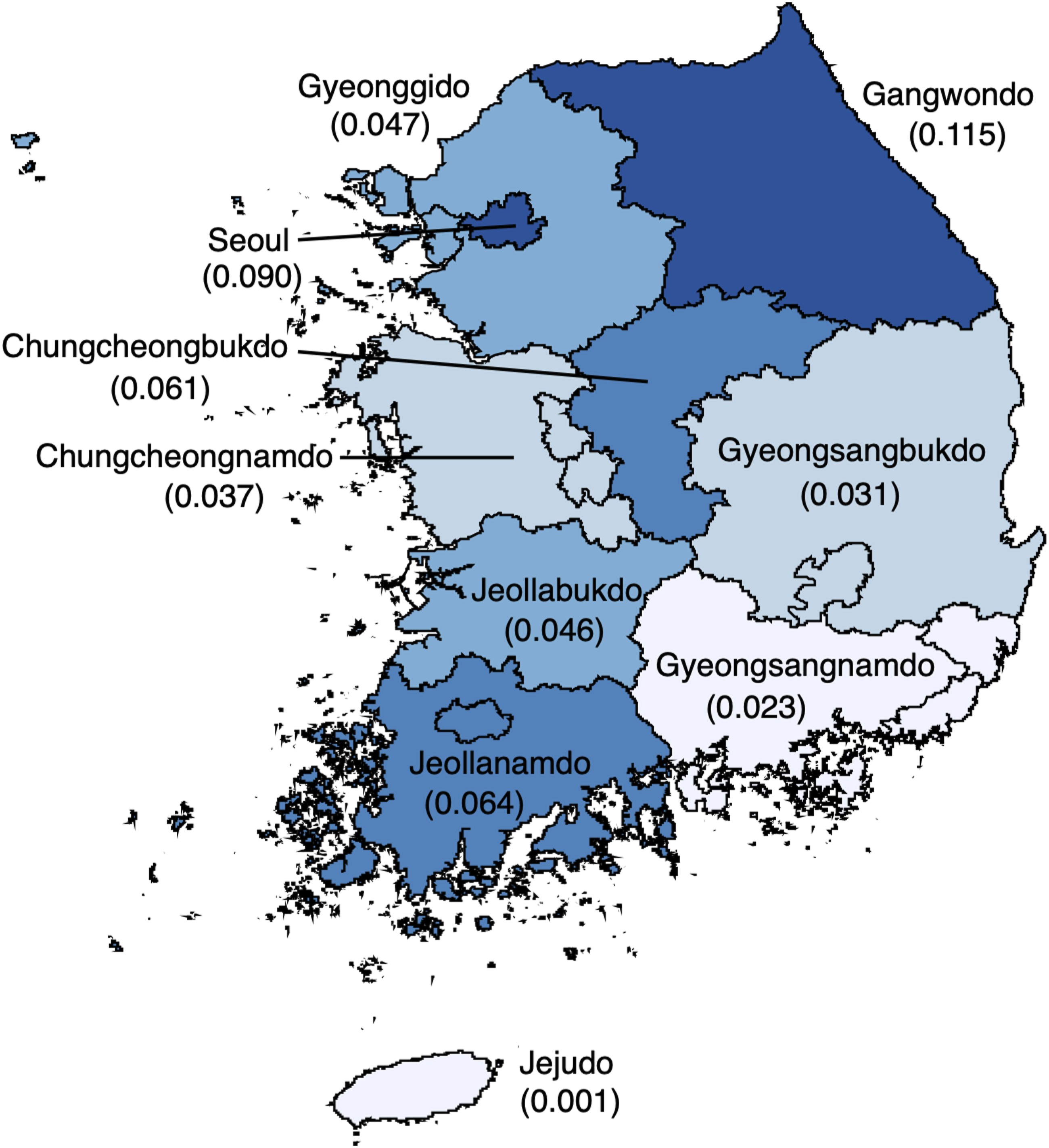
Additionally, the survey asks a question about the region where each respondent lived the longest before the age of 15. This paper uses these answers to determine where respondents resided during their childhood. Based on these data, I generated a dummy variable,
Utilizing data on the average violence intensity at the provincial level provides two advantages for testing the theory. First, even though there might exist a variation of violence within each province, it is theoretically plausible to analyze at the regional level considering the Korean War evidently generated the safest and riskiest provinces. The two southeastern provinces are the only areas that were not occupied by the North Korean army, leaving them the safest places during the war. In contrast, the northeastern province (Gangwondo), the southwestern province (Jeollanamdo), and the capital (Seoul) were the riskiest regions because they were the provinces that North Korean soldiers first attacked, advanced most quickly, and were strategically important, respectively. Therefore, the variation in violence intensity across provinces was much more significant than the within-province variation.
Moreover, using the casualty rate can control for the variation in the total regional population across the provinces. If the absolute number of casualties per region is used, then people who lived in the population-dense area are more likely to experience greater violence based on this calculation. However, the experience of 10 casualties in a region with 100 people might be as severe as experiencing 100 deaths in a region with 1,000 people. My measure can capture the level of violence experienced by people on average so that it can be compared across regions with greater relative nuance.
Control Variables
I include a set of covariates to control for relevant individual-level traits that might be related to both explanatory and outcome variables: political ideology, age, gender, income, education level, unemployment, and religiosity. First, the experience of war violence may affect the formation of political ideology. Political ideology also plays an important role in shaping preferences for nuclear proliferation because people with right-leaning political ideology tend to be in favor of hawkish foreign policies.
One might be concerned about the post-treatment bias when including all control variables since some of them might be driven by war experiences. For example, wartime violence experiences can lead people to be more hawkish, thus, resulting in a right-leaning political ideology. The only exogenous variables that are not affected by the war experience are age and gender, while other covariates are possibly post-treatment to some degree. Therefore, in the empirical analysis section, I report the results of both models with and without potential post-treatment variables.
Research Strategy and Estimation
To test the hypotheses, I construct the following equation

I also include individual characteristics
Findings
Regression Analysis of Childhood Wartime Violence and Nuclear Proliferation Preference.
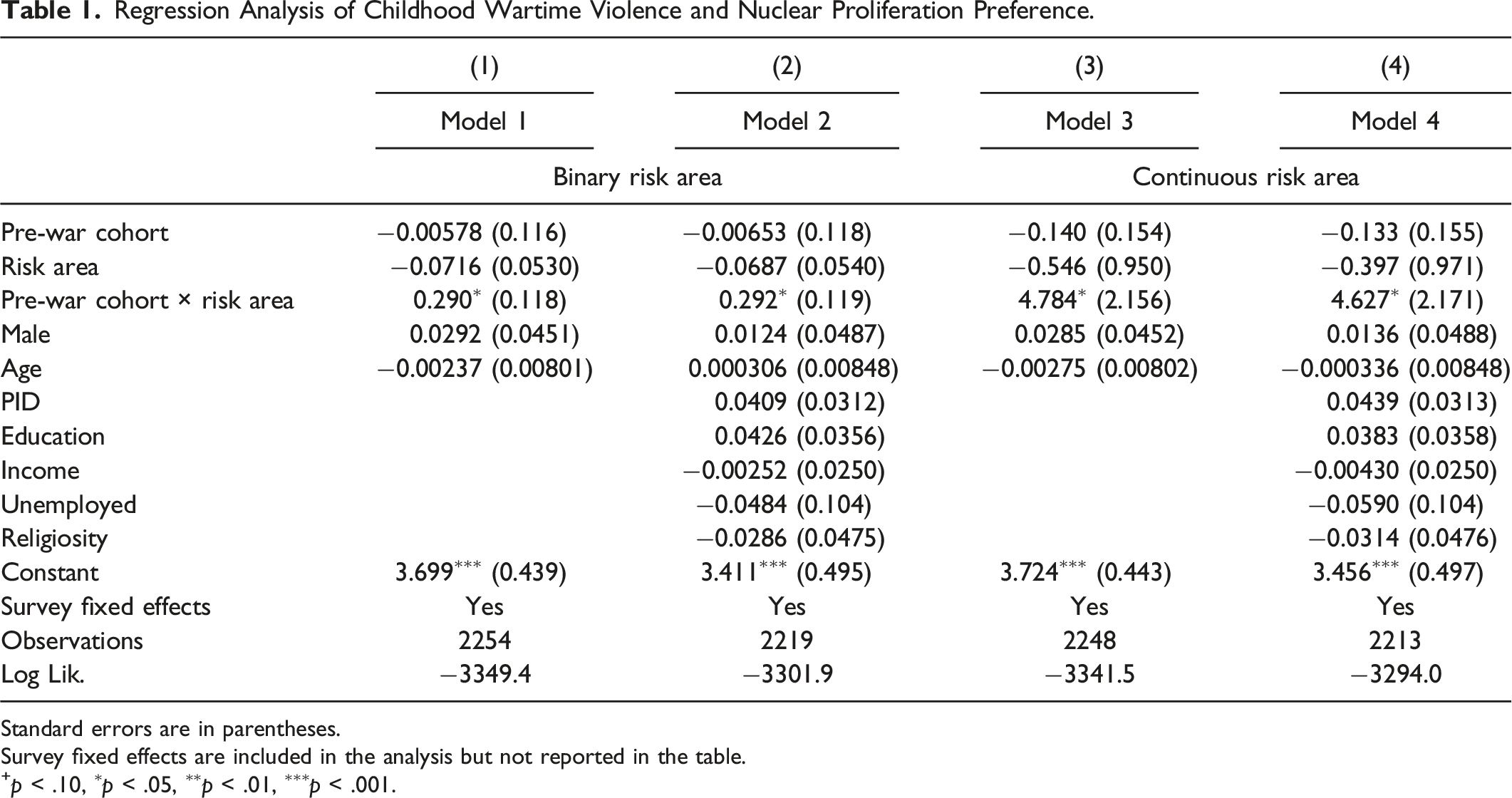
Standard errors are in parentheses.
Survey fixed effects are included in the analysis but not reported in the table.
+p < .10, ∗p < .05, ∗∗p < .01, ∗∗∗p < .001.
To move beyond the coefficients table, I visualize the marginal effect of living in risky areas across the pre-war and post-war cohorts based on Model 2. The graph in Figure 2 suggests supportive evidence for Hypothesis 1a that people who lived in the risky area during the Korean War demonstrate a 0.224 higher level of support for nuclear proliferation compared to people who lived in the non-risky area during the war. Considering the dependent variable was measured based on 5-point scale answers, the wartime violence experience leads the people to show 5.6 percentage points higher support for acquiring nuclear weapons. Within the post-war cohort, however, the difference in preferences for nuclear proliferation between people who lived in risky and non-risky areas is not statistically distinguishable from zero, confirming Hypothesis 1b. Marginal effect of wartime violence on nuclear proliferation preference.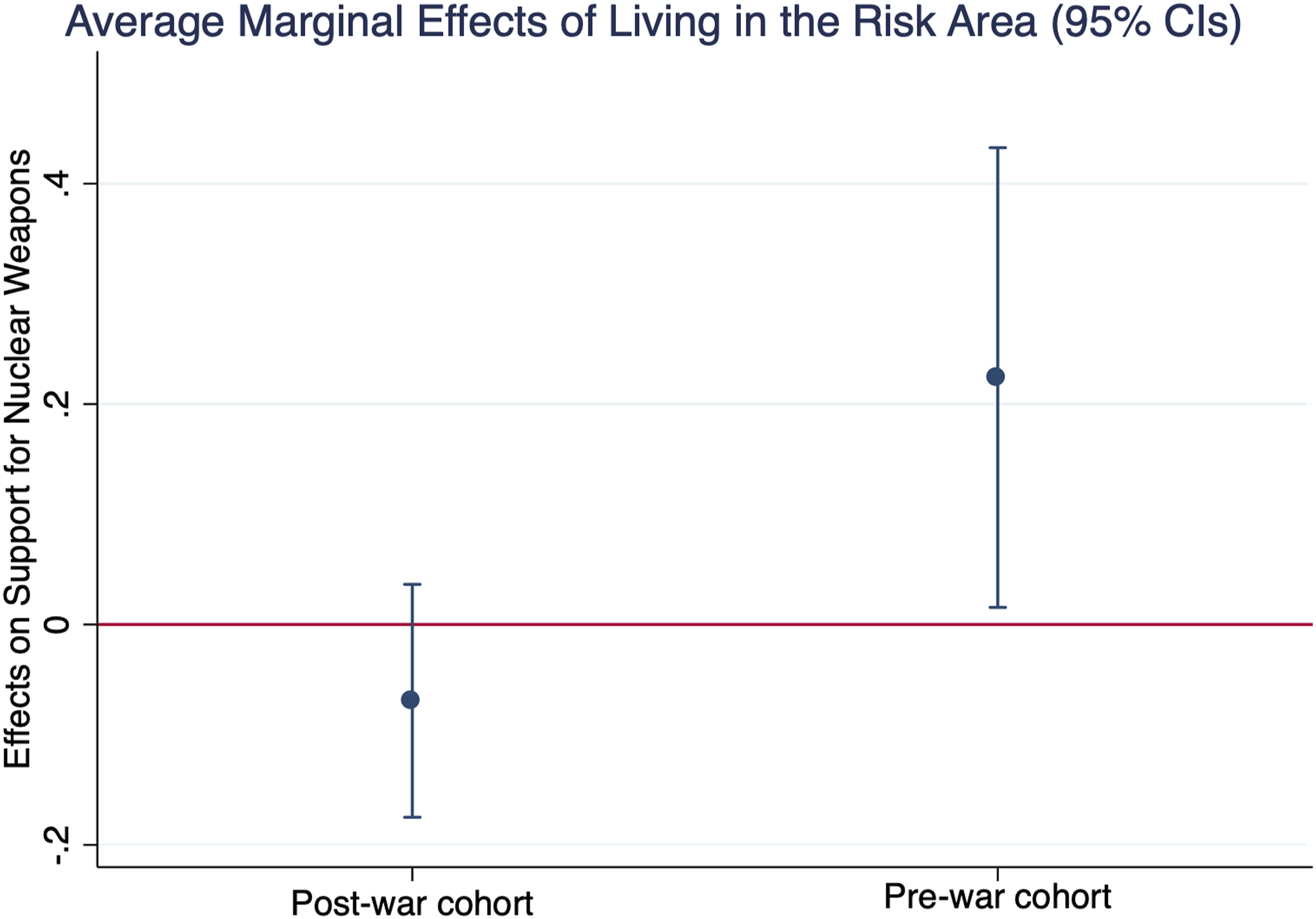
Mechanisms
In this section, I explore potential mechanisms through which people who were exposed to wartime violence during childhood show greater preferences for nuclear proliferation. I argued that people with childhood war experiences are more concerned about being exposed to wartime violence in the future, thus preferring nuclear proliferation as a tool for national deterrence.
To assess whether these people overreact to security threats, I would ideally want to examine the differences in the perceived threat of North Korean nuclear development between individuals from war-torn and war-safe areas. But the exact question does not exist in the survey, so I conduct an analysis with alternative data that is useful, though imperfect, to suggest this mechanism. I use answers to the following survey question: Do you think removing North Korea’s nuclear threat should be the top priority of South Korea’s North Korea policy?
11
Respondents who agreed with this statement can be considered as perceiving North Korea’s nuclear threats more seriously than others. The left panel of Figure 3 confirms Hypotheses 2a and 2b. The graph demonstrates that war generation exposed to severe wartime violence show greater concern for North Korea’s nuclear threat than those who remained safe during the war, and the difference is not found in the post-war cohort. (Left panel) Marginal effect of wartime violence on North Korean nuclear threat perception. (Right panel) Marginal effect of wartime violence on preference for cooperation with the United States.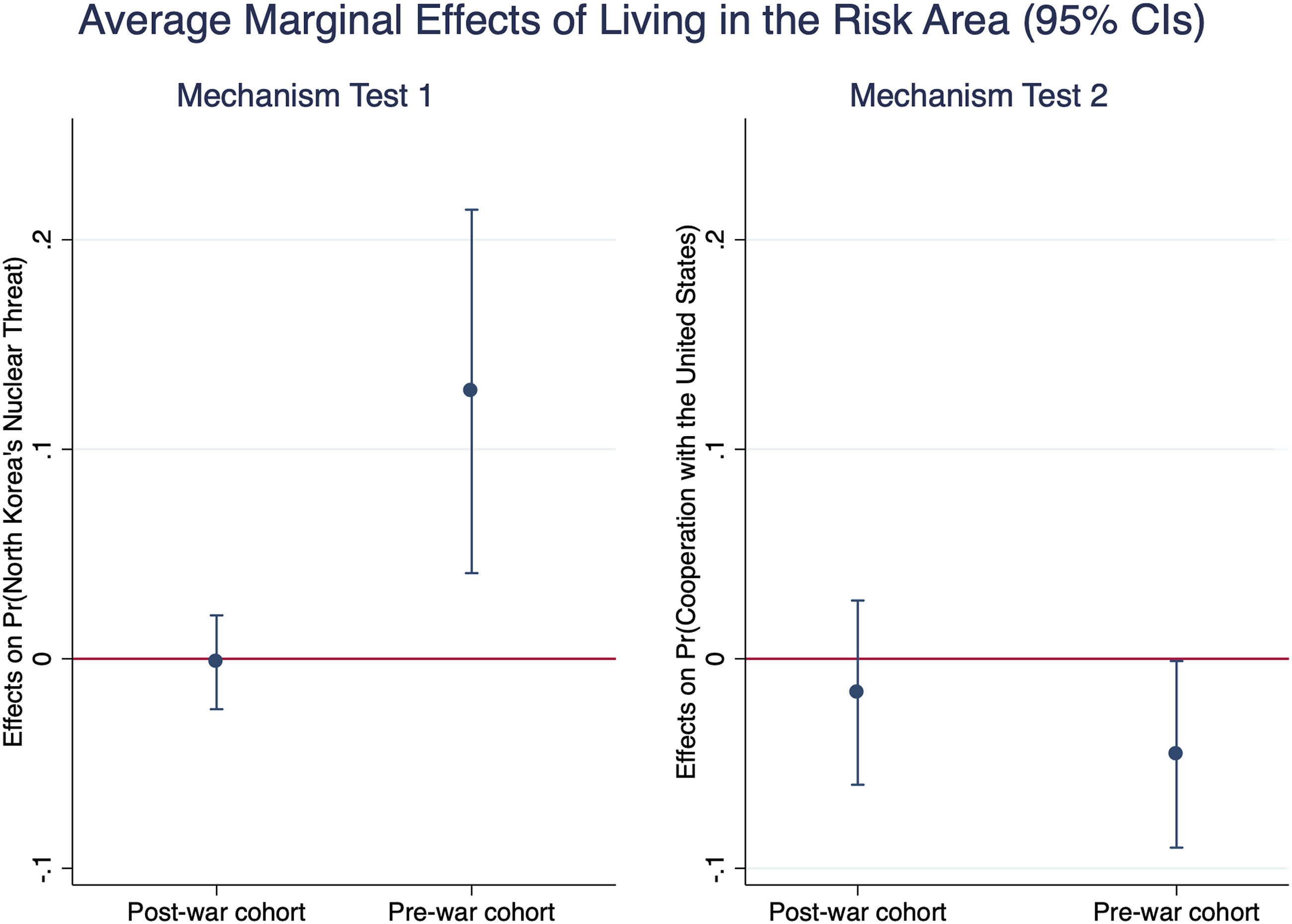
Why would these people prefer nuclear weapons to enhance security since it is not the only policy option for improving national defense? For example, why would these people not favor external security guarantees? I argued that people with war exposure do not prefer to rely on foreign countries for security because they are skeptical that foreign powers will help their nation when it needs security assistance. Past war experiences may have led them to believe that all countries act only in their own interests, so their country should be self-reliant for its defense rather than relying on others. To assess this mechanism, an ideal question should ask whether each respondent would like to rely on military alliances to enhance national security. Again, due to the lack of such data, I analyze how much emphasis respondents put on cooperation with the United States, a major ally of the country. I use answers to the following survey question: Do you think cooperation with the United States is more important than improving inter-Korean relations? The right panel of Figure 3 suggests that people who lived in war-torn areas are less likely to prefer to rely on cooperation with the United States than those who lived in war-safe zones. This geographical variation is substantial in the pre-war cohort but not in the post-war cohort.
Next, I explained why people with childhood war experience perceive nuclear weapons as security-enhancing rather than security-diminishing. They overvalue nuclear weapons because they are hyperfocused on worst-case thinking of suffering from a catastrophic war in the future. They perceive that the risk of a major war is significant, thus they expect greater costs of not being nuclear-armed. Also, they focus on the defensive use of nuclear weapons because they better understand the tragic consequences of destructive weapons.
Former South Korean presidents provide exemplary cases of how these mechanisms shape individual preferences for nuclear development. Among past presidents, Rho Moo-hyun (2003–2008) and Lee Myung-bak (2008–2013) fit the definition of this paper’s war generation. 12 Coming from opposite political parties, the two leaders pursued many contradictory foreign policies. However, both shared a positive stance on nuclearization, transcending their political partisanship. The case of Rho, coming from the liberal political party, is particularly surprising given that support for nuclear proliferation is more prevalent among conservative political elites. In his memoir, former South Korean Foreign Minister Song Min-soon recalls that Roh seriously contemplated pursuing independent nuclear armament in 2006. 13 Rho believed that “nuclear weapons are a means of deterrence to protect the country from external threats.” 14 Roh continuously emphasized self-reliance in national defense, and this tendency has been strengthened during his presidency. The experience of a failure of national protection that he suffered as a child influenced him to overreact to national security issues by emphasizing terms such as ‘self-defense’ and ‘survival of the nation’ after he became president.
It is also possible that exposure to violence might lead to preferences for aggressiveness. If so, these people’s support for nuclear weapons may stem from their preferences for attacks. However, qualitative evidence suggests that it is more plausible to believe that exposure to violence causes individuals to have preferences for defense over offense. Another former South Korean president, Lee Myung-bak, who lost family members at the age of 10 due to wartime violence, had expressed his “opposition to any military response to North Korea’s upcoming provocations.” He added, “the government’s primary responsibility is to protect its own citizens” and “an offensive strategy would be counterproductive to achieving the objective.” 15 This is also surprising given that conservative party leaders typically endorse offensive military strategies, such as preemptive strikes and military retaliation. In fact, his response was harshly criticized by conservative political figures, 16 and his successor from the same political party have expressed her support for the offensive use of military force. 17
A review of the current literature also provides supportive evidence that exposure to violence is likely to cause individuals to prioritize defensive over offensive uses of destructive weapons. Scholars have shown that leaders with combat experience are less likely to initiate militarized disputes than others (Horowitz and Stam 2014; Horowitz, Stam, and Ellis 2015), as direct exposure to violence leads to “intimate knowledge of the horrors of war” (Morris 1960, 230). Some micro-level data also suggests that people who have been exposed to violence are more reluctant to use force (Brunk, Secrest, and Tamashiro 1990; Feaver and Gelpi 2005). The current scholarly consensus supports my mechanism that those who have experienced violence are not aggressive and have a preference for defense, whereas it contradicts the second alternative argument.
Potential Counterarguments
One possible counterargument is based on the fact that people could have moved in response to the expected war intensity. For example, people with a greater preference for strengthened security protections could have moved to a safer province in an attempt to avoid military violence during the war. However, this seems unlikely to be true as most scholars and historians agree that the breakout of the Korean War was unanticipated. The well-established fact that approximately half of the South Korean soldiers were on vacation the day North Korea invaded (because it was Sunday) suggests that even military officials did not expect war to break out when it did. Therefore, it is not plausible to assume that people could have predicted the war or even specific military conflict zones and preemptively moved to safer regions based on this knowledge (Kim and Lee 2014). Moreover, even if we allow for the possibility of pre-war civilian migration, it will attenuate the expected effects because people with higher preferences for security protection should have moved to safer areas. If this is true, people who lived in safe areas are more likely to support nuclear weapons acquisition, which makes it more difficult to find the paper’s theoretical expectation.
It is also possible that citizens could have moved after an outbreak of the conflict when information about war intensity had been available. People with specific characteristics, for example, higher socioeconomic status or liberal ideology, could have migrated early in the war, and these factors can affect the preferences for nuclear proliferation. To address this concern, an empirical robustness check only including non-movers, whose current place of living and residence at the age of 15 remains the same, is considered. 18 In Appendix Table 2, the results are robust to the main analysis, which corroborates my findings. I also find that movers and non-movers show no significant difference in observable characteristics.
A secondary question is whether or not the geographical variation of war intensity is endogenous to the individual’s preference for safety guarantees and the resulting nuclear weapons proclivity. In other words, some could argue that individuals who lived in the province with a higher war intensity during the Korean War might already have an existing proclivity for strong national security protection. As shown in Kim and Lee (2014), however, variations in war intensity seem exogenous to any factor related to individual preference because the war proceeded rapidly. After the war broke out on June 25, 1950, North Korea occupied nearly all of South Korea, except for a small portion of the southeastern part of South Korea, within the first 2 months. Moreover, the intensity of violence seems to have been haphazard across provinces because it was determined by the respective countries’ battle strategies. For example, in September 1950, UN forces led by General McArthur decided to land directly in Incheon, the port city in the midwest of the Korean Peninsula, next to Seoul. Most North Korean soldiers were left behind in the middle eastern and southwestern parts of South Korea. Thus, civilian casualties remained higher in these provinces even when the major battlefield moved to Northern regions. As a result, provinces that experienced significant civilian casualties are dispersed across South Korea. Therefore, I believe that this potential concern regarding endogeneity is unlikely to be a factor.
Another concern might arise from my measure of exposure to wartime violence at the provincial level because it is limited in understanding whether an individual who lived in the region was really exposed to actual violence. While micro-level data on people’s exposure to violence would be beneficial, robustness tests using continuous indicators of casualty rate and various definitions of
One could also question why the effect of violence is not persistent. The literature on historical legacies of violence argues that political attitudes produced by exposure to violence are transmitted intergenerationally. For example, the effect of violence on general political attitudes, such as trust in the government, can be transmitted to future generations (Hong and Kang 2017). However, support for nuclear weapons stems from fear engendered by first-hand exposure to violence, making the war generation show distinct preferences for nuclear proliferation compared to the post-war generation. To assess the intergenerational transmission mechanism, I run a robustness test with people’s level of trust in the president. In Appendix Table 12, the results confirm that people who grew up in war-torn zones and war-safe areas show significantly different levels of trust in the president at the 90% confidence level in both war and post-war generations.
Those aware of the historical context of domestic politics in South Korea may be interested in the relationship between living in risky (or safe) regions during the war and political partisanship today. The regions that are defined as war-torn areas during the Korean War include the historically politically left-dominant region (Jeollanamdo), and war-safe areas include right-dominant regions (Gyeongsangbukdo and Gyeongsangnamdo). 20 Given this relationship, one can raise the question of whether or not the relationship between the experience of wartime violence and nuclear proliferation is driven by political ideology. However, the direction of the effect of partisanship on support for nuclear acquisition is the opposite of my theory, which makes it harder to find the relationship.
As previous South Korean public polls suggest, people who have a right-leaning political ideology are more supportive of nuclear weapons acquisition than left-leaning supporters on average. This means that people who lived in war-safe areas (right-dominant regions) during childhood are more likely to show a more intense aspiration for nuclear weapons, and those who lived in war-torn areas (left-dominant regions) are less likely to support nuclear proliferation, which is the opposite to my theoretical expectations. This geographical pattern of public preference for nuclear armament is observed in all of the post-war generations, however, it is absent only in the pre-war cohort. Within the war generation, people who lived in risky areas during childhood are more supportive of nuclear weapons despite their left-leaning political ideology, while those who lived in war-safe areas are less supportive of nuclear weapons despite their right-leaning partisanship. Exposure to wartime violence made the war generation have the exact opposite preference for nuclear proliferation compared to the younger generation of the same region. Thus, the impact of the experience of wartime violence on nuclear proliferation preferences would be more substantial, considering the counterfactual preference that people would have had if there had never been a war on the Korean Peninsula.
People can also raise a question about the effect of age on the relationship between war exposure and nuclear attitudes. As existing literature suggests, age could influence people’s attitudes toward nuclear weapons for reasons other than exposure to wartime violence (Press, Sagan, and Valentino 2013; Sagan and Valentino 2017). For example, older respondents might be more supportive of nuclear proliferation because they expect smaller economic impacts from international sanctions or because they are less informed about the costs. More complicatedly, age also interacts with political ideology; older individuals tend to be more conservative, which could impact preferences for nuclear weapons. The regression analysis using the entire sample of the South Korean public (Appendix Table 14) shows that age is a strong predictor of preferences for nuclear weapons. The positive coefficient confirms that older respondents are more supportive of nuclear proliferation on average.
Even though it is not possible to completely separate the effects of age and exposure to wartime violence, it is worth highlighting my empirical strategy of using the narrow bandwidth of ages: I compare people within the 10-year cohort born before and after the war. For example, the analysis rules out a comparison of 20-year-old respondents and 60-year-olds, minimizing concerns that my results are an artifact of differences associated with age. In addition, the analysis requires an interaction between age and geographic location. Thus, even if age predicts greater support for nuclear proliferation in general, it still will not be enough to explain the distinctive interaction I find with the geographical pattern of war violence intensity. In the placebo tests (Appendix Tables 8 and 9) where I replicate the main analysis with the arbitrary age cohorts of 10 years that are not based on the pre-war and post-war cohorts, I find that there is not the same geographic interaction for these random age groups. The non-relationship between geographic variation and random age cohorts enhances the plausibility of my findings about war and post-war generation.
Robustness Checks
I run several robustness tests to explore the sensitivity of the main analysis. First, I estimate the models with different year ranges to define the pre-war and post-war cohorts. First, I assume the pre-war cohort includes people who were born during the war. Since the war broke out in 1950 and ended in 1953, I define the pre-war cohort as people born between 1944–1953 and the post-war cohort as people born between 1954–1963. Second, I measure the pre-war cohort of people who were born between 1941–1953 and the post-war cohort of people who were born between 1954–1967. This is the broadest measure of the cohorts, which covers 13 years for the pre-war and post-war generations. Third, I include people born during the war as the post-war generation. The pre-war cohort includes people born between 1941–1950 and the post-war cohort includes people born between 1951–1960. Coding people born in 1951–1953 as the post-war generation might be another useful robustness test considering the war intensity was at a peak in 1950, and most of the South Korean casualties occurred in that single year. Lastly, I use the 8-year cohort born before and after the war: the pre-war cohort with people born between 1941–1948 and the post-war cohort with people born between 1953–1960. The results in Appendix Tables 3 and 4 confirm that my findings are robust to various definitions of pre-war and post-war cohorts.
For the second robustness check, I use two other thresholds other than the national average casualty rate to operationalize
I perform placebo tests by replacing the outcome variable with preferences for non-security policies. My theory predicts that exposure to wartime violence will only increase individuals’ preferences for stronger national security protection but not for other policy issues, such as social or economic-related preferences. Thus, I replicated the analysis with individuals’ preferences for cultural diversity and the unemployment problem. The null relationship between the wartime violence experience and non-security preferences would enhance the confidence in my finding. The coefficients on the interaction terms are statistically insignificant in all model specifications in Appendix Tables 6 and 7. Overall, the evidence from the placebo tests is consistent with my theoretical expectation that childhood wartime violence experiences only shape individuals’ preferences for security-related preferences but not for non-security policies.
Lastly, there could be a question of whether the estimates are disproportionately derived from populations residing in Seoul since 18.8% of the current population resides in the capital. If this is the case, the effects that I found cannot be distinguished from the effects of living in a city. However, around the time of the Korean War, the population ratio residing in the capital was not as high as today, which attenuates this concern. In my sample, only 12.2% of pre-war and post-war cohorts resided in Seoul before the age of 13. In Appendix Table 13, a robustness check excluding Seoul residents also shows that the results are similar to those of the main analysis.
Summary and Implications
This article introduces a theory of childhood experiences of wartime violence and aspirations for stronger national security in the form of nuclear weapons. People who experienced a higher level of wartime violence during childhood are more likely to support more extreme methods of security protection to ensure that external threats will not, once again, invade or control their country. The paper explores the effects of the Korean War experience on the South Korean public’s nuclear proliferation preferences by comparing a pre-war cohort of 10 years, citizens born in 1941–1950, with a post-war cohort of 10 years, those born in 1954–1963. Within the pre-war cohort, people who lived in provinces with a greater level of violence show 5.6 percentage points higher support for nuclear proliferation than those who did not live in these risky and life-threatening regions. However, such a geographical difference is not found in the post-war cohort who did not experience the treatment of wartime violence. Empirical evidence confirms the theoretical expectation that people who experienced severe wartime violence demonstrate a stronger proclivity for nuclear weapons.
This study contributes to the literature on the legacies of political violence by suggesting that it shapes people’s preferences for national security policy decades later. Scholars have shown that early exposure to wartime violence influences an individual’s risk-taking preferences and domestic political attitudes. This research shows that wartime violence can make members of the general public support the development of an indigenous nuclear arsenal in their later lives. They are more fearful of being exposed to additional wartime violence, but this tendency does not always lead to demilitarization. When confronted with significant external threats, they could demonstrate a greater demand for nuclear proliferation as a means of deterrence against foreign aggression and to keep their country safe.
While much of the political science scholarship has focused on the effects of violence experienced by military soldiers, this paper considers the impact of wartime violence on children. Armed conflicts affect people of all ranks and ages, but children are especially susceptible to their effects. In fact, there is a significantly greater number of children exposed to violence than soldiers. In 2019, two-thirds of the world’s children were living in conflict-affected countries, and more than 400 million children were living within 50 km of the actual fighting (Østby, Rustad, and Tollefsen 2020). However, the consequences of violence experienced by this vulnerable population have received less attention. The paper helps understand how early exposure to war affects an individual’s preferences for national security after they survive such violence.
One area for future research is the generalizability of the paper’s findings: whether the theory can be extended to other contexts. It is possible to suggest, here, two conditions which are necessary for the effects of experienced wartime violence to be able to influence the preference for nuclear weapons acquisition. First, the country would need to possess the technological capacity to develop nuclear weapons. Even though the theory expects that early exposure to wartime violence has the potential to promote aspirations for stronger security shielding of the nation, if pursuing nuclear weapons is not a viable option due to a lack of technology, it would not be logical nor feasible for these experiences to lead to a higher preference for nuclear weapons. Second, the country would have to face an immediate and significant security threat from abroad. This would cause people who seek reliable security protection to demonstrate a preference for nuclear proliferation. These conditions offer guidelines for how and when the theory could be applied to other countries. For example, the theory would hold for several World War II countries, such as Poland and Ukraine, that experienced enormous casualties. Some Asian countries, namely Vietnam and Taiwan, could also be good cases for analysis for the reason that these countries experienced destructive wars during the 1950s and 60s, and are currently facing international security uncertainty.
There might also be exceptions. Berger (2014) argues that exposure to wartime violence decreased support for nuclear proliferation in Japan and Germany. Japan might be a unique case in studying the effect of war experience on proliferation since it is the one and only victim of nuclear bombings in August 1945, which killed hundreds of thousands of Japanese people. This unique historical case might have caused a strong anti-nuclear sentiment prevalent in the Japanese public (Berger 1998). Germany and Italy could be exceptional countries as well because they were defeated together with Japan in World War II.
This paper provides implications for proliferation. As more citizens are exposed to fatal conflicts in a country, it may result in an unintended increase in domestic demand for nuclear weapons. For example, as the young Ukrainian generation, which has witnessed the fatal invasion, grows up, domestic voices calling for nuclear armament may become stronger because they are likely to believe that it can prevent the same tragedy by deterring foreign aggression. Public preferences for proliferation matter in a democracy because the strong voice of the public gives political elites incentives to consider nuclear armament as a policy option (Ko 2019; Sukin 2019).
The study’s results also help explain why some people in countries that have experienced destructive conflicts, such as Iran and North Korea, stick to nuclear weapons and believe their nuclear program is essential to regime survival. The research suggests that domestic variation in support for nuclear weapons is explained by one’s prior exposure to wartime violence. People who lived close to major battlefields at a young age will desperately demand nuclear proliferation at home, while those who went through war without witnessing severe violence will be less inclined to demand nuclear weapons.
Supplemental Material
Supplemental Material - The Long-run Impact of Childhood Wartime Violence on Preferences for Nuclear Proliferation
Supplemental Material for The Long-run Impact of Childhood Wartime Violence on Preferences for Nuclear Proliferation by James D. Kim in Journal of Conflict Resolution
Footnotes
Acknowledgements
I thank Matthew Fuhrmann, Hyeran Jo, Erik Peterson, Scott Cook, Florian Hollenbach, Jeehee Han, Joowon Yi, Jonghoon Lee, Joshua Kertzer, Benjamin Tkach, Paul Huth, and two anonymous reviewers for helpful feedback on this research.
Declaration of Conflicting Interests
The author(s) declared no potential conflicts of interest with respect to the research, authorship, and/or publication of this article.
Funding
The author(s) received no financial support for the research, authorship, and/or publication of this article.

Supplemental Material
Notes
References
Supplementary Material
Please find the following supplemental material available below.
For Open Access articles published under a Creative Commons License, all supplemental material carries the same license as the article it is associated with.
For non-Open Access articles published, all supplemental material carries a non-exclusive license, and permission requests for re-use of supplemental material or any part of supplemental material shall be sent directly to the copyright owner as specified in the copyright notice associated with the article.
