




Abstract
Does democracy heighten or lessen the incidence of terrorism? This question has eluded a definitive answer for over three decades. Some terrorism researchers find that democracy has dampened terrorism; others that democracy has encouraged it; still others that there is a curvilinear or more nuanced relationship between the two. In this article, we contend that democracy has differential effects on terrorism, depending on the goals of particular terrorist groups. We claim that efforts to restrict democracy, by decreasing political rights and civil liberties, will effectively constrain terrorist activity from “strategic” groups but will have the opposite effect on “universalist” groups. The reason for this variance, we argue, involves the scope of ambition and underlying motivation distinguishing these very different types of terrorist movements. Because universalist groups have abstract ambitions and non-negotiable goals, they are unlikely to be deterred by crackdowns on democracy. Alternatively, because strategic groups do not see their missions as all-or-nothing campaigns of good versus evil and instead seek limited and concrete goals, anti-democratic measures are more likely to succeed against them. Our analysis of 200 countries from 1972 to 2016 finds strong support for this claim.
Introduction
This article tackles one of the most important—and perplexing—issues in international security today: the connection between democracy and terrorism. The scholarly literature on the topic remains divided: some studies argue that democracy encourages terrorism; others that democracy quells it. As Gaibulloev, Piazza, and Sander (2017, 492) rightly note, “Despite myriad empirical studies on the impact of regime type on terrorism, findings are very mixed and inconclusive.” Convictions about the answer to this question have also motivated the policies of states. The administration of George W. Bush, for example, made democracy promotion the lodestar of its foreign policies in Iraq and Afghanistan. “The best antidote to radicalism and terror is the tolerance kindled in free societies,” the former president remarked (Bush 2005, 382). Other state leaders, especially those in the Muslim world, make the opposite claim, contending that successfully combatting terrorism sometimes requires policies that limit or suspend freedoms. In this view, there is a tradeoff between liberty and security. This judgment rests on the belief that contexts of freedom fetter governments from using all the tools in their arsenal to combat terrorism effectively.
How might these divergent scholarly findings and policy prescriptions be reconciled? We take the view that straightforward claims regarding the effect of “democracy” on “terrorism” are too simplistic. Instead, we argue that there are differential effects of democracy on terrorism depending on the goal structures of different terrorist groups. We theorize that imposing anti-democratic measures encourages attacks by terrorists pursuing universalist goals, even as it has the opposite effect on strategic terrorists seeking more concrete and limited objectives. Because universalist groups seek metaphysical goals and often claim to be acting on the basis of divine commands, they are less likely to succumb to autocratic state policies. Conversely, groups motivated by more terrestrial concerns like endemic poverty, ending foreign occupation, or secular nationalism will be more likely to acquiesce in the face of restricted democratic freedoms. Thus, democracy can embolden certain kinds of groups, while deterring others.
This article proceeds in five parts. In the next section, we summarize the democracy-terrorism debate, highlighting divergent scholarly findings. We then offer our theory on the differential effects of democracy on terrorism, which we believe can help explain part of the variance found in previous studies. The next two sections discuss the data and methods used in our analysis and present the results. A concluding section situates the findings in the context of policymaking.
The Democracy-Terrorism Debate
Does democracy heighten or lower the risk of terrorism? The studies on the relationship between democracy and terrorism can be grouped into three categories: (1) those finding an inverse relationship (greater freedom leads to less terrorism); (2) those finding a linear relationship (greater freedom generates more terrorism); and (3) those finding a non-linear relationship (both high and low levels of democracy spawn less terrorism) or more nuanced and complicated associations.
First, a minority of studies find that higher levels of democracy discourage terrorist attacks and that there is an inverse relationship between freedom and terrorism. The logic linking a lack of democracy to terrorism is as follows: restrictive environments that block access to political representation and thwart free expression alienate citizens, delegitimize the state, generate grievances among the population at large, and inspire terrorism because they do not provide legitimate, non-violent channels for dissent, making the turn to the gun more likely. Democracies, by contrast, provide a space for all viewpoints to be heard and, in this way, discourage political violence. In the same vein, a commitment to civil liberties prevents liberal states from cracking down on peaceful dissent and overreacting to terrorism with excessive force, engendering support from the population at large. Thus, democracies enjoy a robust advantage in preventing and combating terrorism by assuaging grievances through political inclusion and the protection of freedoms (Magen 2018; Saiya 2021a).
Consistent with this school of thought is the work of Hamilton and Hamilton (1983), Ross (1993), Sandler (1995), Eyerman (1998), Hafez (2003), Drakos and Gofas (2006), Abrahms (2007), and Walsh and Piazza (2010). Hamilton and Hamilton (1983) and Ross (1993) argued that democracies are less prone to transnational terrorism. Sandler (1995) argued that previous studies finding a positive relationship between democracy and terrorism may have been hampered by methodological issues. Eyerman (1998) found that established democracies experienced fewer terrorist attacks than non-democracies or newly-formed democracies because the former involves politically “accessible systems.” Using case studies of nine different Muslim-majority countries and territories, Hafez (2003) argued that institutional exclusion and indiscriminate repression part and parcel of Arab authoritarianism were major contributors to Islamist violence (including terrorism) in Algeria and Egypt. Drakos and Gofas (2006) suggest that nondemocratic countries may be more prone to terrorism than terrorism researchers believe, owing to their bias towards under-reporting terrorism incidents. Abrahms (2007) revealed that illiberal countries suffer from a disproportionate number of terrorist incidents and related casualties. Walsh and Piazza (2010) discovered that governments abusing physical integrity rights fueled terrorism by undermining support for counterterrorism operations and making it more costly for them to collect intelligence.
A second set of studies argues the opposite: that environments of liberty present easy targets for terrorists to attack. According to this line of reasoning, the freedom part and parcel of open societies enables terrorism by providing radicals with a free space to appeal to sympathizers, recruit members, communicate propaganda, and plan attacks. Conversely, the restriction of democratic freedoms can raise the costs of rebellion and deter potential terrorists. Furthermore, democracies are believed to be disadvantaged in their counterterrorism operations, owing to the presence of the rule of law, commitment to due process, freedoms of association and movement, and restrictions on administrative power, including policing and interrogation practices, all of which increase the marginal utility of terrorism. According to this view, rather than an asset, democratic freedoms are a liability in the struggle against terrorism; autocracies, on the other hand, make superior counterterrorists owing to their ability to coerce compliance.
Consistent with this school of thought is the work of Schmid (1992), Eubank and Weinberg (1994; 2001), Pape (2005), Drakos and Gofas (2006), Lai (2007), Piazza (2007), Piazza (2008), Savun and Phillips (2009), Chenoweth (2010), and Dalacoura (2011). Schmid (1992) argued that some characteristics that can accompany democracy—inequality, ease of group assembly, access to the media, etc.—encourage terrorism. Eubank and Weinberg (1994) found that democracies were more likely to give rise to terrorism than non-democracies. The same duo revealed a positive connection between democratic stability and terrorism (Eubank and Weinberg 2001). Pape (2005) noted that democracies are uniquely vulnerable to suicide terrorist attacks, owing to their low threshold for civilian casualties. Drakos and Gofas (2006) revealed a weak statistical link between democracy and terrorism. Lai (2007) found that the greater the ability of a state to impose significant costs on terrorists, the lower its level of international terrorist attacks. An empirical analysis of terrorism in the Middle East carried out by Piazza (2007) found that more politically liberal countries in the region were more prone to terrorism than dictatorships. In a subsequent article, he likewise failed to find a consistent or significant relationship between democracy and a lack of terrorism (Piazza 2008). Savun and Phillips (2009) unearthed evidence that democracies were more susceptible to international terrorism, owing to the kinds of foreign policies they tend to pursue. Chenoweth (2010) found a positive relationship between politically competitive systems and terrorism. She also discovered that political competition is related to the number of terrorist groups emerging in states. Finally, in research of both radical and moderate Muslim organizations in the Arab world, Dalacoura (2011) claimed that authoritarianism and political exclusion did not push Islamist entities to adopt terrorist tactics. She also found that political inclusion did not necessarily encourage moderation and ideological pragmatism and instead concluded that other factors were more important in inspiring extremism.
A third set of studies reveals a more nuanced picture. Some studies posit a non-linear relationship between democracy and terrorism: either that there is no association between the two or that terrorism tends to be concentrated in states characterized by hybrid regimes that are neither highly authoritarian (where the costs of terrorism are prohibitive) nor highly free (where peaceful means exist to change the status quo). In democracies, peaceful outlets exist for groups to express their grievances. In autocratic states, there are no outlets for the venting of grievances, but the state can also repress away any signs of discontent. In mixed regimes, the state attempts to restrict the expression of grievances, but they are unable to repress dissent effectively as in autocratic states, combining the worst of both worlds. Other studies contend that democracy and autocracy represent overly-aggregate categories insofar as different intra-regime institutional aspects of both authoritarian and free states can simultaneously suppress and stimulate terrorism (Piazza 2017).
Consistent with this school of thought is the work of Li (2005), Wade and Reiter (2007), Aksoy, Carter, and Wright (2012), Wilson and Piazza (2013), Daxecker and Hess (2013), Hamid (2014), Aksoy and Carter (2014), Conrad, Conrad, and Young (2014), and Gaibulloev, Piazza, and Sandler (2017). Li (2005) discovered that while constraints on the executive branch increase the frequency of terrorist attacks, political participation reduces terrorism. Thus, different aspects of democracy both stimulate and suppress the terrorist impulse. Wade and Reiter (2007) argued that mixed regimes are more likely to experience suicide terrorism. Aksoy, Carter, and Wright (2012) showed that dictatorships that allow for opposition parties witness the emergence of fewer terrorist groups than dictatorships that do not permit opposition parties in their legislatures. Piazza (2013) found that new democracies suffer from more terrorist attacks than either older democracies or dictatorships. Wilson and Piazza (2013) showed that dictatorships reliant on coercion were more prone to terrorism than dictatorships reliant on cooptation. Conrad, Conrad, and Young (2014) discovered that autocracies with greater audience costs experienced more terrorism than other kinds of autocracies. Daxecker and Hess (2013) argued that repression in democracies generated terrorism, while repression in autocracies deterred it. Hamid (2014) contended that low-to-moderate levels of repression in the Middle East had the effect of forcing Islamists to moderate their politics and work in coalitions. At the same time, democratic openings associated with the “Arab Spring” revolutions impelled Muslim groups towards illiberalism and extremism. He also argues, however, that high restrictions on political rights and civil liberties can induce terrorism, as in the case of Egypt. Aksoy and Carter (2014) determined that, among democracies, states with proportional representation systems were more likely to see the emergence of terrorist groups. Finally, Gaibulloev, Piazza, and Sandler (2017) unearthed evidence that regime type has a robust inverted U-shaped relationship to terrorism.
In sum, the studies outlined above have failed to reach a conclusive verdict on whether democracy breeds or combats terrorism (though a plurality concludes that democracies generally experience more terrorism than non-democracies). The existing literature provides valuable insights into how various components of autocratic or free societies—political competition, executive constraints, media freedom, physical integrity rights, etc.—can encourage or discourage terrorist attacks under certain conditions. To be sure, part of the explanation for these mixed findings stems from divergent country samples, different time periods surveyed, and varied methodologies. Absent from this work, though, is an appreciation for the fact that terrorism, like democracy, is not a monolithic phenomenon and that democracy can have differential effects on terrorism depending on the type of terrorist groups involved. In other words, while democracy is likely to stymie certain forms of terrorism, it is also likely to incite other forms. We explain why in the following section.
Theorizing the Differential Effects of Democracy on Terrorism
To their credit, many of the studies cited earlier probe the connection between democracy on terrorism by considering how different characteristics of democratic systems encourage or deter terrorism. While they helpfully show that regime type should not be treated as monolithic with respect to terrorism, they do not attempt to disaggregate terrorist attacks according to prevailing ideology in the same way. Aksoy and Carter (2014, 181) rightly note that “despite much discussion of the differences in terrorist groups’ goals in the literature, little quantitative work distinguishes among groups with different goals.” Similarly, Miller (2007, 332) laments the fact that “despite the awareness that terrorist groups are different, there are few systematic attempts to compare successful and failed state policies across group type.” In what follows, we argue that one of the key reasons for different findings on the relationship between democracy and terrorism concerns freedom’s ambivalent impact on terrorism: even as democracy encourages terrorism by certain groups, it also combats terrorism by others. Thus, an approach that disaggregates terrorism on the basis of ideology offers more potential for understanding the conditions that encourage or discourage different manifestations of terrorism (Gaibulloev and Sandler 2014; Piazza 2009).
Terrorism scholars have long argued against the “essentializing” of terrorist organizations. Terrorists, they contend, come in different varieties, have different undergirding ideologies, and use different tactics. The most important distinction between terrorist groups raised in the literature pertains to ideology, especially ideological differences between those groups motivated by religion and those that are not (Fox 2003; Hoffman 1995; Juergensmeyer 2003; Rapoport 1984; Saiya 2015a; Saiya 2018; Saiya and Scime 2019). Various studies have found that religious terrorists–because they hold non-negotiable demands and therefore regard violence as a divine duty–fight harder, last longer, and cause more destruction than their non-religious counterparts (Hassner 2003; Hassner 2009; Henne 2012; Hoffman 1995; Jasko et al. 2022; Svensson 2007; Svensson and Harding 2011; Toft 2007). Hoffman notes that “terrorism motivated either in whole or in part by a religious imperative, where violence is regarded by its practitioners as a divine duty or sacramental act, embraces markedly different means of legitimization and justification than that committed by secular terrorists, and these distinguishing features lead, in turn, to yet greater bloodshed and destruction” (Hoffman 2006, 83). As we argue below, however, the religious-secular terrorist dichotomy is itself in need of refinement, as it too risks essentializing terrorism.
That terrorism is not a monolithic phenomenon suggests that different types of terrorist groups may respond differently to structural contexts, including repression. Saiya (2016) found, for example, that while “religious terrorists” were more likely to attack authoritarian states, “non-religious terrorists” were more likely to target democratic ones. He did not, however, test the argument empirically. In other work, Saiya has argued that environments of religious liberty induce moderation among religious populations, while the opposite occurs in environments repressive of religion (Saiya 2014; Saiya and Scime 2015; Saiya 2017a; Saiya 2017b; Saiya 2018; Saiya and Fidler 2018; Saiya 2019a; Saiya 2019b; Saiya and Manchanda 2020a; Saiya and Manchanda 2020b; Saiya 2021a; Saiya 2021b). Yet it remains unclear if the same kind of logic would also apply to non-religious terrorists.
Thus, the question remains as to how the incentive structures that guide particular terrorist organizations encourage them to either succumb to crackdowns on civil liberties and political rights or fight against these efforts. We reason that environments with lower levels of democracy will be less effective against terrorist groups motivated by universalist ambitions, where terrorists understand their mission in global terms and fight for abstract and unachievable goals. Conversely, we argue that these same environments will be more successful against groups driven by strategic goals, which, by definition, are limited and concrete.
According to Piazza (2009, 65), universalist terrorist groups are distinguishable from other kinds of terrorist groups, owing to their “highly ambitious, abstract, complex, and nebulous goals that are driven primarily by ideology.” These groups also carry out attacks against “much larger, vague, frequently transnational and more ideologically-constructed communities” (65). Universalist terrorism comes in different forms. First, it can encompass Salafist groups like al Qaeda and its allies, which seek to rid Muslim societies of Western political and cultural influence, overthrow the institution of the nation-state, and unify Muslims around the world into a global caliphate ruled by sharia law. Second, universalist terrorism can also take the form of violence carried out by groups desiring nothing less than to hasten the end of the world (Gregg 2016). Terrorism rooted in both Salafism and apocalypticism constitute forms of what Juergensmeyer calls “cosmic war.” As he notes, “[w]hat makes religious violence particularly savage and relentless is that its perpetrators have placed such religious images of divine struggle–cosmic war–in the service of worldly political battles” (Juergensmeyer 2003, 146). These apocalyptic tendencies are exemplified by Aum Shinrikyo’s cult members, who believed they had a divinely ordained role to play in a final, cosmic confrontation between the forces of righteousness and wickedness (Hoffman 1995). A secular form of apocalypticism can be seen in the apocalyptic nihilism of some radical eco-terrorist groups like the Earth Liberation Front. Third, universalist terrorism can encompass non-religious groups. For example, secular Marxist organizations, like the Revolutionary Leninist Brigades or the Red Brigades, sought a worldwide revolution by the global proletariat against the forces of global capitalism. To be sure, universalist terrorists can also pursue more limited goals in addition to their more abstract ones. The point, nevertheless, is that these ancillary goals all work together toward much grander, transcendent, and global objectives. In short, in contrast to strategic groups (discussed below), universalist groups do not have concrete, temporal ultimate goals but rather otherworldly, abstract, or symbolic ones. These goals are often fringe and do not enjoy widespread support among the wider population.
Universalist versus Strategic Terrorist Groups.
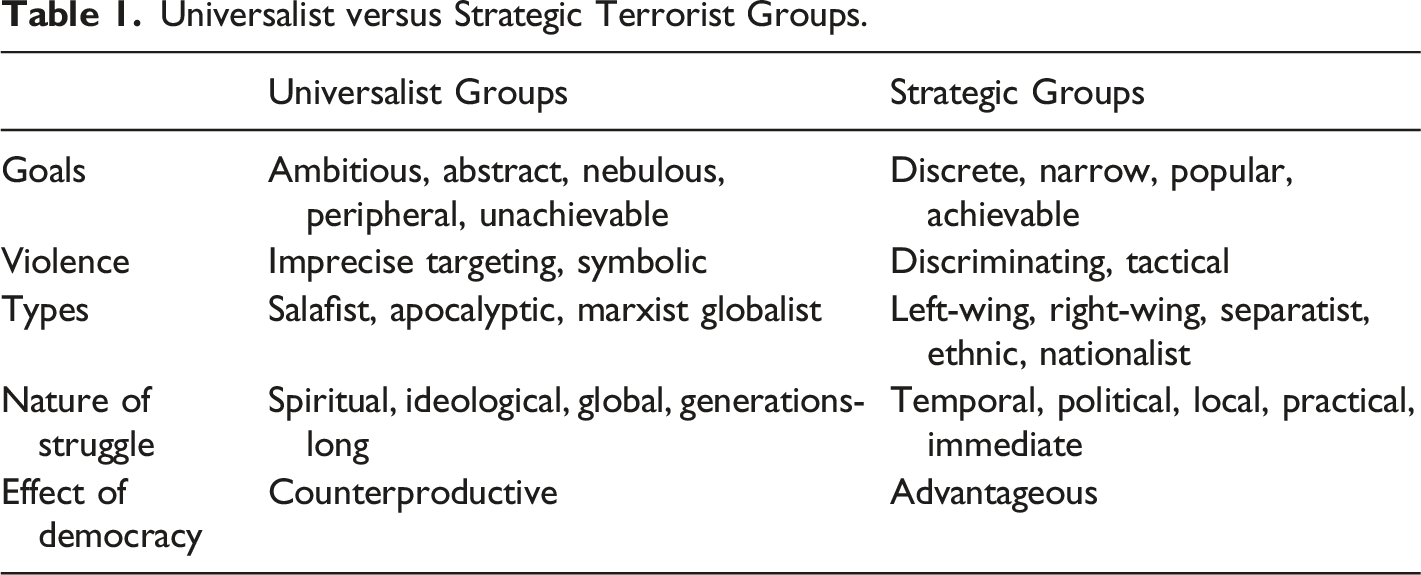
What kinds of environments give rise to these different forms of terrorism? We theorize that democracy has differential effects on terrorism. Scholars have long noted that democracy is comprised of two basic types of rights: civil and political. Civil liberties include legal protections for groups and individuals from oppression and discrimination on the basis of race, ethnicity, religion, and gender. They protect the rights to personal security and bodily integrity, and guarantee freedoms of speech, assembly, and expression. Civil liberties are essentially “negative” rights that function as bulwarks against infringements by the state or actors in society. Political rights, by contrast, encompass the rights of individuals and groups to freely participate in political processes. These rights include the freedom to form political parties, assemble peacefully, petition the state, and vote.
How do civil liberties and political rights encourage or discourage terrorism? First, civil and political rights increase the risk of strategic terrorism. To be sure, political rights can have a moderating effect on some strategic groups over time as they see the value of engaging in political processes (Schwedler 2006). Strategic groups seeking terrestrial and well-defined goals like national liberation, regime change, territorial change, policy change, social control, economic concessions, or status quo maintenance are not only open to but desirous of a seat at the negotiating table. But in cases where these groups do not believe that the political system will be responsive to their demands, a commitment to political rights can actually increase the risk of terrorism to the extent that the goals of terrorist groups have widespread acceptance in the broader population. One could reasonably argue that greater political rights should reduce grievances and hence the need for violence. However, the majority rule part and parcel of democracies can entrench discrimination against political minority groups making the turn to the gun among these groups more likely. Especially in winner-take-all electoral systems, groups seeking strategic change may arrive at the conclusion that said change cannot be achieved through legitimate, non-violent channels. Ironically, in these situations, open political systems are functionally similar to closed ones. Nevertheless, the marginal utility of strategic terrorism increases in the former owing to the presence of democratic freedoms. In short, greater political rights do not necessarily address the political grievances of certain groups in society; they can even generate higher levels of frustration, making terrorism more likely.
It can also be the case that political success can increase the risk of strategic terrorism. When a favored candidate or party captures political power, a terrorist constituency enjoys political privilege for a period of time (Henne, Saiya, and Hand 2020). If it then suddenly finds itself in a position where that privileged station is threatened, the turn to the gun becomes more likely. For example, the presidency of Donald Trump witnessed a dramatic increase in the number of white nationalist groups, including extremist outfits such as the Proud Boys (Jones 2018). These groups took comfort in a president who routinely used his bully pulpit to demonize minorities. But then, finding themselves in a position of losing the support they had enjoyed for four years after Trump’s loss in the 2020 presidential election, they stormed the seat of government in the hopes of overturning the election results.
Civil liberties like the freedoms of expression, association, and press can also encourage strategic terrorism by helping strategic terrorists advertise their legitimate and widely-held grievances—in contrast to the nebulous and peripheral goals of their universalist counterparts—among their constituencies. Here, the free marketplace of ideas part and parcel of democracy can help to generate support for the cause of strategic terrorist groups like the liberation of a piece of territory, the creation of a homeland for minority groups, or the overthrow of a local government—goals which enjoy a preexisting base of support. (On the other hand, if the goals of strategic groups do not enjoy a preexisting broad base of support within society, we would not expect these groups to have much success recruiting sympathizers and plotting attacks).
Returning to the example of the United States, the commitment to civil liberties has provided right-wing extremist groups with the opportunity to organize, propagandize, and recruit. This can be seen in the astonishing increase of in attacks committed by white supremacist groups over the past several years. Importantly, though, the United States has not suffered from a similar increase in universalist terrorism. For example, American Muslim communities remain remarkably resistant to the ideas of religious radicals promoting universalist violence like ISIS and al Qaeda (Brooks 2011; Kathwari, Martin, and Whitney 2007). Since the 9/11 attacks, al Qaeda has not been able to carry out even one successful attack on American soil. As argued by Saiya (2018, 147-52), an important reason for this outcome concerns the fact that an environment supportive of rights and liberties has induced moderation among American Muslims, in contrast to the radicalization of Muslim communities in countries repressive of rights and liberties. Put differently, the American commitment to civil liberties has deprived universally-minded militants of havens within supportive communities from which to recruit and plot attacks, while strengthening the opposing voices who challenge radical interpretations of Islam from within an Islamic discourse itself. In short, it is not at all the case that civil liberties necessarily address the grievances of all groups in society. They can even make strategic terrorism more likely by providing terrorists representing disaffected groups with a space to organize, propagandize, and recruit.
On the other hand, that strategic terrorists are less likely to see the world through transcendent lenses or fight on behalf of other-worldly powers means that they will be less enthusiastic about committing attacks in non-democratic environments that might otherwise embolden universalist terrorists. They are thus more prone to placing a higher value on their well-being in the here-and-now and more likely to succumb to non-democratic policies if their demands are not met. Examples include Russia’s Narodnaya Volya, Argentina’s Montoneros and People’s Revolutionary Party, Peru’s Shining Path, Uruguay’s Tupamaros, Brazil’s Popular Revolutionary Vanguard and National Liberation Action, and Sri Lanka’s Tamil Tigers–all of which were all eventually neutralized through illiberal measures. Such groups, however, did not hold universalist worldviews and instead worked toward earthly, concrete, and limited goals. For the strategic terrorist, martyrdom is generally something to be avoided.
However, it is not the case that all ideologies and group types benefit from being in an open society. While environments of openness encourage strategic terrorism, the curtailing of basic democratic rights increases the likelihood of universalist terrorism. Because terrorism rooted in universalist concerns does not seek immediate or practical goals but instead attempts to wage a trans-historical battle between good and evil, it is less concerned with gaining popular approval, nor does it pay heed to standards of morality more characteristic of strategic terrorists who do not fight for transcendent objectives (Juergensmeyer 2003; Hoffman 1995). That they do not think in terms of narrow self-interest or physical survival but instead see their cause as larger than life—and in many cases divinely inspired—means such groups also exhibit greater risk tolerances and employ more extended time horizons than do terrorists who fight for purely terrestrial goals, suggesting that they are prepared to disregard harm to themselves in exchange for the hope of a cause greater than themselves (Asal and Rethemeyer 2008; Hassner 2009; Horowitz 2009; Jones and Libicki 2008; Juergensmeyer 2003; Toft 2006; Toft 2007). Accordingly, this key difference also suggests that universalist terrorists will be more resilient in the face of illiberal policing and military operations—strategies that have proven successful in ending many campaigns of strategic terrorist groups.
Universalist groups welcome repression of civil liberties in that it feeds into the narrative of a showdown between amorphous forces. Martyrdom at the hands of the state in pursuit of non-material rewards is often embraced by universalist terrorists, “even if they have to pay the price of grief or death for their loyalty” (Hasenclever and Rittberger 2000, 656). Universalist terrorists understand their battles to be just one part of a generations-long struggle, and are therefore less amenable to peaceful compromise with their enemies in the here and now, making them more resilient in the face of brute force. That the narrative of universalist terrorism gains credence in the presence of illiberal state policies suggests that universalist groups will have an easier time recruiting and finding safe havens among sympathetic constituencies, making successful attacks more likely in non-democracies. In short, the natural reservations that undergird strategic terrorism do not apply to groups moved by universalist goals which emphasize the sanctity of their struggle and for whom commitment to their cause supersedes all other considerations. Thus, illiberal state policies will be less likely to succeed against these groups.
The presence of civil liberties works against universalist terrorism, however. In environments where civil liberties are respected, extremists holding universalist ideas will have to defend their claims in the free market of ideas (Saiya 2018, 55-56). Whereas non-democratic settings enable radical ideologies by smothering open discussion and debate, free environments empower those critical of the universalist narrative to challenge its claims. The freedom of the press in these contexts can play an important role by bringing attention to the carnage wrought by universal terrorism.
The restriction of political rights can also encourage universalist terrorism. To be sure, the absolutist objectives and unreasonable demands part and parcel of universalist terrorism mean that universalist terrorists will never be able to work through legitimate political channels to advance their goals. Nevertheless, the presence of political rights and the necessity of forming broad coalitions to attract support can drive a wedge between the ideological hardliners and the broader populace. Universalist terrorists may well exist and even commit attacks in these settings, but they will not enjoy the popular support needed to engage in sustained terrorist campaigns, or the groups themselves might end up imploding. On the other hand, the restriction of these rights provides credence for the claim of the terrorists that violence is the only way to change the status quo, leading more people to accept the means—if not all the claims—of universalist groups. Because political rights provide another avenue for the exposure of the cruelty, carnage, and unpopular goals of universalist terrorism, the restriction of these rights serves to encourage universalist terrorism. Civil liberties and political rights do not necessarily induce moderation on the part of universal terrorists, but they do make it harder for them to sell their narratives to the wider populace, attract sympathizers, and plot attacks.
To see how the repression of democratic rights can engender universalist terrorism, consider the case of the universalist terrorist group al Qaeda, which was incubated in contexts repressive of civil liberties and political rights throughout the Arab world. The political exclusion of the Muslim Brotherhood in Egypt—and especially the brutal treatment of its spiritual leader, Sayyid Qutb—contributed to the radicalization of conservative Islam and the appeal of universalist ideas holding that the Islamic and Western worlds were locked in a perpetual spiritual struggle. Simultaneously, the state’s crackdown on civil liberties among the broader population increased the credibility of these claims among terrorist constituencies. Eventually, these persecuted movements morphed into the world’s deadliest transnational terrorist organizations. In these cases, universalist groups see the overthrow of their own governments as part of an overarching struggle to remake the world.
Conversely, political openness and civil liberties can undermine and delegitimize the narrative universalist terrorists are trying to sell. The marketplace of ideas part and parcel of democracy thus poses a significant threat to universal terrorism. Consider the case of Japanese counterterrorism policy. In 1995, the universalist terrorist cult Aum Shinrikyo deployed sarin gas in the Tokyo subway system, poisoning 6000 people and killing twelve. In its counterterrorism operations, the Japanese government responded quickly, determinedly pursuing the leaders of Aum who had plotted the attack. It did so, however, in a manner respectful of civil liberties. Importantly, Tokyo did not prohibit membership in Aum, nor did it take anti-religious measures against other faith-based groups. True, Aum was able to execute a deadly terrorist attack in a strongly democratic state, but the restraint on the part of the Japanese government eventually led to Aum imploding on its own. It lost its base of support and committed no more attacks. Such a fortunate result would have been less likely had the Japanese government pursued a counterterrorism strategy restrictive of basic democratic rights.
Our theory leads to four hypotheses:
Lower levels of political rights are associated with higher levels of universalist attacks
Lower levels of civil liberties are associated with higher levels of universalist attacks
Higher levels of political rights are associated with higher levels of strategic attacks
Higher levels of civil liberties are associated with higher levels of strategic attacks
In summary, we have argued that, owing to the view that their campaigns constitute one facet of a grander universal, in some cases cosmic, struggle, universalist terrorists will be less likely than their strategic counterparts to succumb to crackdowns on political rights and civil liberties, making this form of terrorism more common in authoritarian settings. To clarify, our argument is not that strategic terrorism cannot result from the repression of political rights or civil liberties; neither is our argument that universalist terrorism cannot arise in environments where these rights are found in abundance. After all, the world’s most serious apocalyptic threat, Aum Shinrikyo, emerged in one of the world’s most liberal countries, Japan. Other apocalyptic groups like al Qaeda found sympathetic constituencies in long-standing democracies. Islamist extremists in many liberal democracies fought on behalf of ISIS. On the other hand, strategic groups have arisen in contexts of repression, as was the case with the strategic groups that formed during the civil wars in Afghanistan and Iraq. These groups had the primary goal of expelling foreign powers. We instead argue that, on balance, countries that do not respect political rights or civil liberties will be more likely to incubate universalist terrorists, while democratic contexts will be more likely to give rise to strategic terrorism. Repressive measures against universalist groups are likely to spawn narratives of martyrdom, attract like-minded individuals to the group’s cause, and further alienate terrorist constituencies. Strategic terrorists, by contrast, seek nothing beyond their immediate context and place a greater premium on their lives. For these reasons, authoritarianism will be more successful against these kinds of groups, making strategic terrorism more common in democratic settings. We also acknowledge that civil and political rights can vary within regime types as well as across them and that democracies are perfectly capable of restricting rights in the name of national security (Davenport and Armstrong 2004). We would also argue, nonetheless, that democracies generally continue to observe civil and political rights for the general population, even as they crack down on extremist groups. It is this broader context of democratic rights, both political and civil, with which the present analysis is concerned.
Data and Methodology
This study seeks to evaluate our theory on the differential effects of democracy on different types of terrorist groups. We hypothesize that strategic terrorism increases in democratic settings, even as it decreases in non-democratic contexts. The opposite is true for universalist terrorism. The following discusses the operationalization of our variables and our methodology.
Dependent Variables- Terrorist Activity
Our dependent variables are event counts of the number of identifiable strategic and universalist terrorist attacks in a country in a year. This paper uses Piazza’s (2009) categorization of terrorist groups by goal type: universalist and strategic. For terrorist activity taking place after his study, we rely on his coding conditions. For a group to be considered “universalist,” the following criteria had to be met: (1) the scope of mission is global (not confined to a particular geographic territory), (2) the rhetorical-targets 1 are nebulous, and (3) the group seeks expansion in scope and geographical presence (the goal is not constrained). It is also common for this type of terrorism to rely upon signaling strategies, where part of the goal is to send a larger message to the general enemy rather than to accomplish a specific military objective (Hoffman and McCormick 2004). Bound by an overarching, but often abstract ideology, these groups frequently claim responsibility for attacks committed by their transnational community (Piazza 2009). Due to the abstract nature and expansiveness of their goals, they are also less restrained in their attacks, often resulting in mass casualties. Al-Qaeda-affiliated groups typify the universalist group as they use brutal violence in the pursuit of a massive goal: the unification of the Muslim world and the establishment of a Caliphate ruled under a strict and repressive understanding of proper Sunni Islam.
Conversely, for a group to be considered “strategic,” it must (1) have a limited and achievable goal, (2) attack well-defined and restricted enemies that are directly related to the mission, and (3) concentrate its resources on a specific piece of territory. An example of this type of terrorism is the Popular Front for the Liberation of Palestine (PFLP), which seeks an independent state of Palestine. The PFLP does not have ambitions beyond its immediate context. Both strategic and universalist groups were coded according to their guiding ideologies, not by their actions.
We apply this categorization system to terrorist activity across the globe as recorded in the Global Terrorism Database (GTD) between 1972-2016 (National Consortium for the Study of Terrorism and Responses to Terrorism, 2018). The GTD is widely considered to be the gold standard in the quantitative study of terrorism. There is, understandably, some overlap between the goals of the two different types of terrorist groups. In order to simplify the coding process and remain as consistent as possible, when questions arose regarding the true nature of a terrorist group, we attempted to isolate groups as much as possible. If more extremist elements of a terrorist group broke off to create a new (and often more hostile) group, we treated the new offshoot as a separate entity (see Online Appendices A and B for a listing of terrorist groups in each category). We analyze group goals as articulated by the leaders of the organization rather than distilling the potential differences in motivation among individual members. Furthermore, since different aspects of autocracy and democracy may invite terrorism from abroad (for example terrorists moved by the political subjugation of those of their ethnic or religious group in another state) we include both domestic and international terrorist attacks in our analysis. Our analysis is worldwide and considers terrorism activity 2 and a country’s level of freedom in over 200 countries from 1972-2016, the period for which data are available. 3
Independent Variables
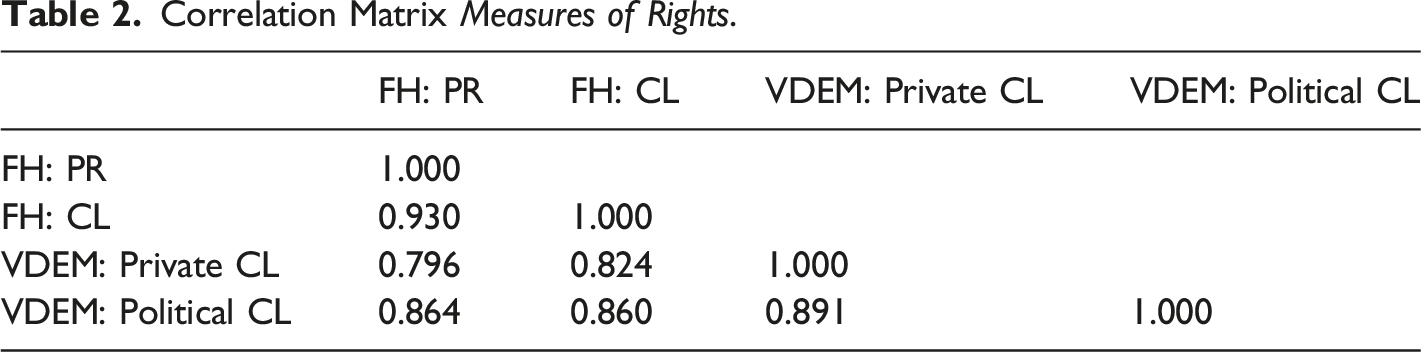
In order to test the relationship between political rights and civil liberties and rates of strategic and universalist terrorism, we use four measures from two democracy datasets. First, we use measures of “political rights” (FH- PR) and “civil liberties” (FH- CL) taken from Freedom House’s (2018) “freedom in the world” scores. Freedom House assigns each country a score of 1–7 (with one indicating a fully free state and seven indicating the least free of states) on each measure. For ease of interpretation, we inverted this scale so that higher scores correspond to greater levels of freedom in the country, aligning the direction of the scale with the rest of our independent variables. The political rights measure focuses on electoral processes, political participation, the allowance for pluralism, and government operational effectiveness. The civil liberties measure examines personal and individual rights, freedom of conscience, associational rights, and the rule of law. Freedom House takes a holistic approach to determining country ratings in an effort to better understand the conditions of everyday citizens. As such, it includes societal characteristics and the implementation of laws, rather than simply analyzing the legal codes in place, which may or may reflect the conditions on the ground. 4
Correlation Matrix Measures of Rights.
Control Variables
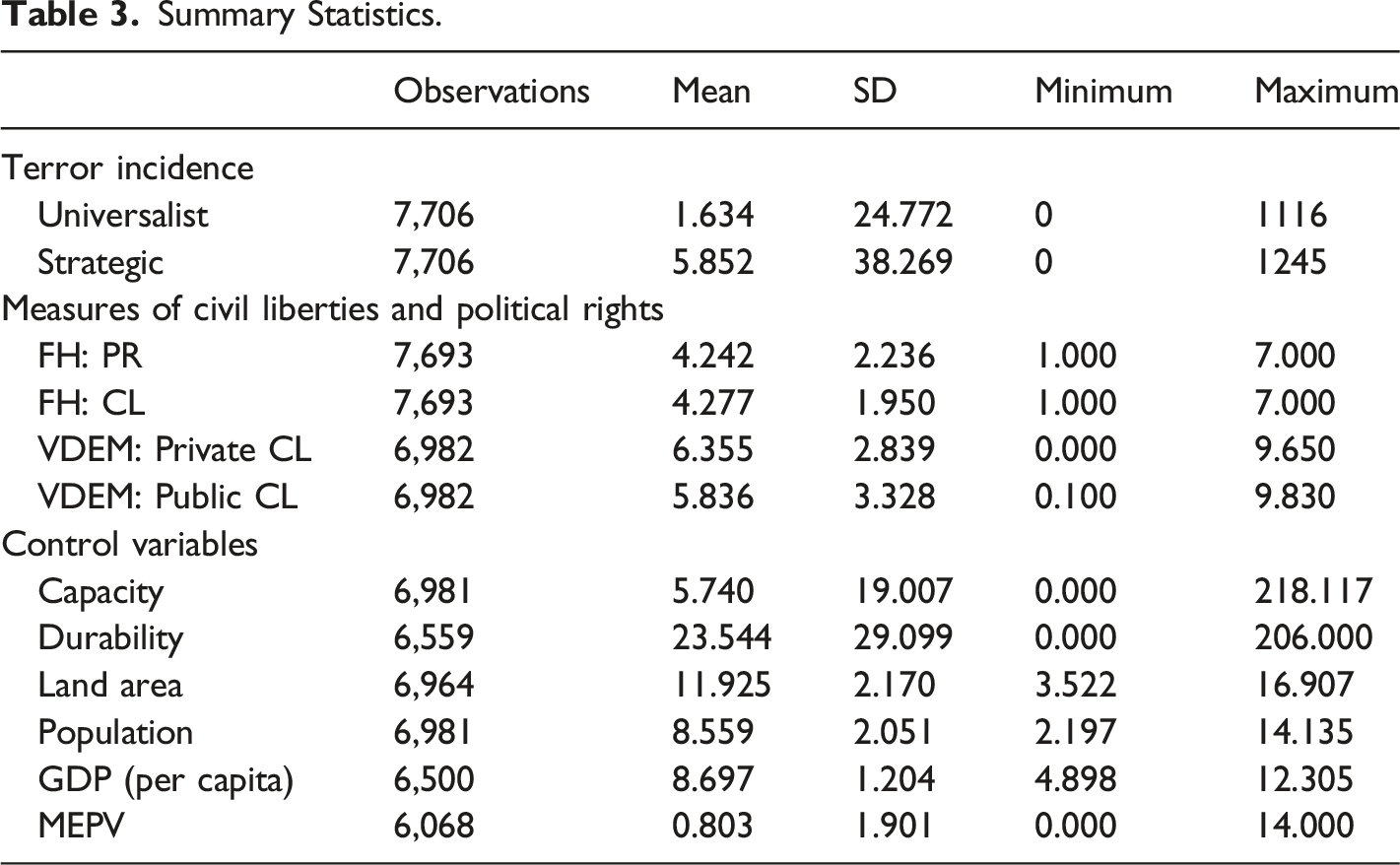
In addition, we control for other contributing variables that have been shown to affect terrorist incidence in previous studies. First, using data from the World Bank (2016), we control for basic differences between countries, including logs of the country’s land area (Land Area), gross domestic product per capita (GDP (Per Capita)) 5 and total population (Population). In addition, in order to account for expected increases in terrorism due to general societal conflict in country, we use an aggregated measure from the Major Episodes of Political Violence dataset (2019) which also includes civil wars and ethnic wars (Civil Violence). In order to capture differences in state capacity, we use a scaled version of the Index of National Capability dataset (Capability). While the literature is not unanimous on the effects of state capacity on terrorist incidence, studies generally show that terrorism is more likely to occur in weak states that provide safe havens for terrorist groups (Tikuisis 2009). Finally, we included a measure of “regime durability” (Durability) from the Integrated Network of Societal Conflict Research as part of the Polity V dataset (2020). Regime durability is measured by the number of years a government has been in power. We expect that terrorist incidence decreases as a state becomes more established (Eyerman 1998).
Method
Summary Statistics.
Results
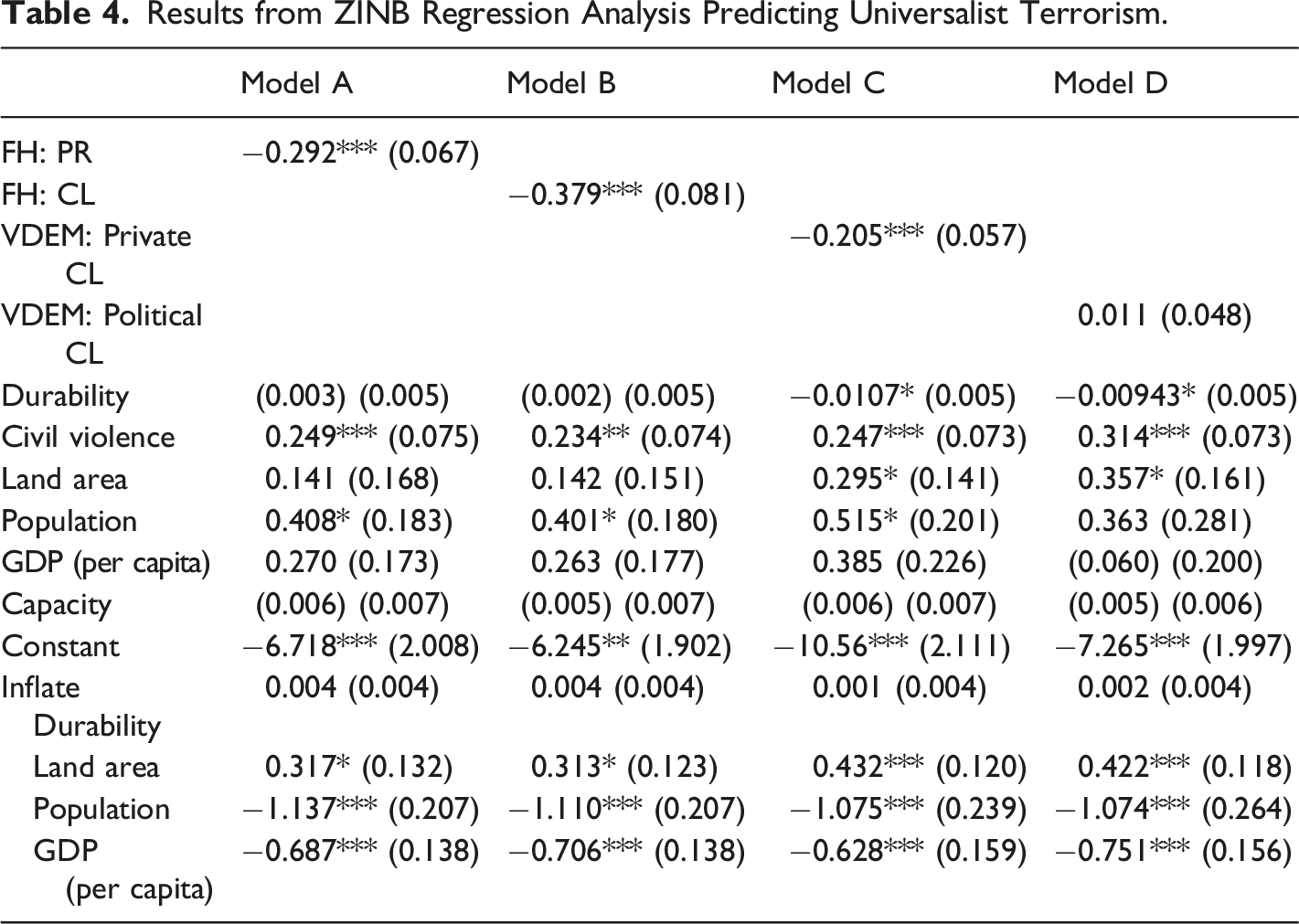
Results from ZINB Regression Analysis Predicting Universalist Terrorism.
Results from ZINB Regression Analysis Predicting Strategic Terrorism.
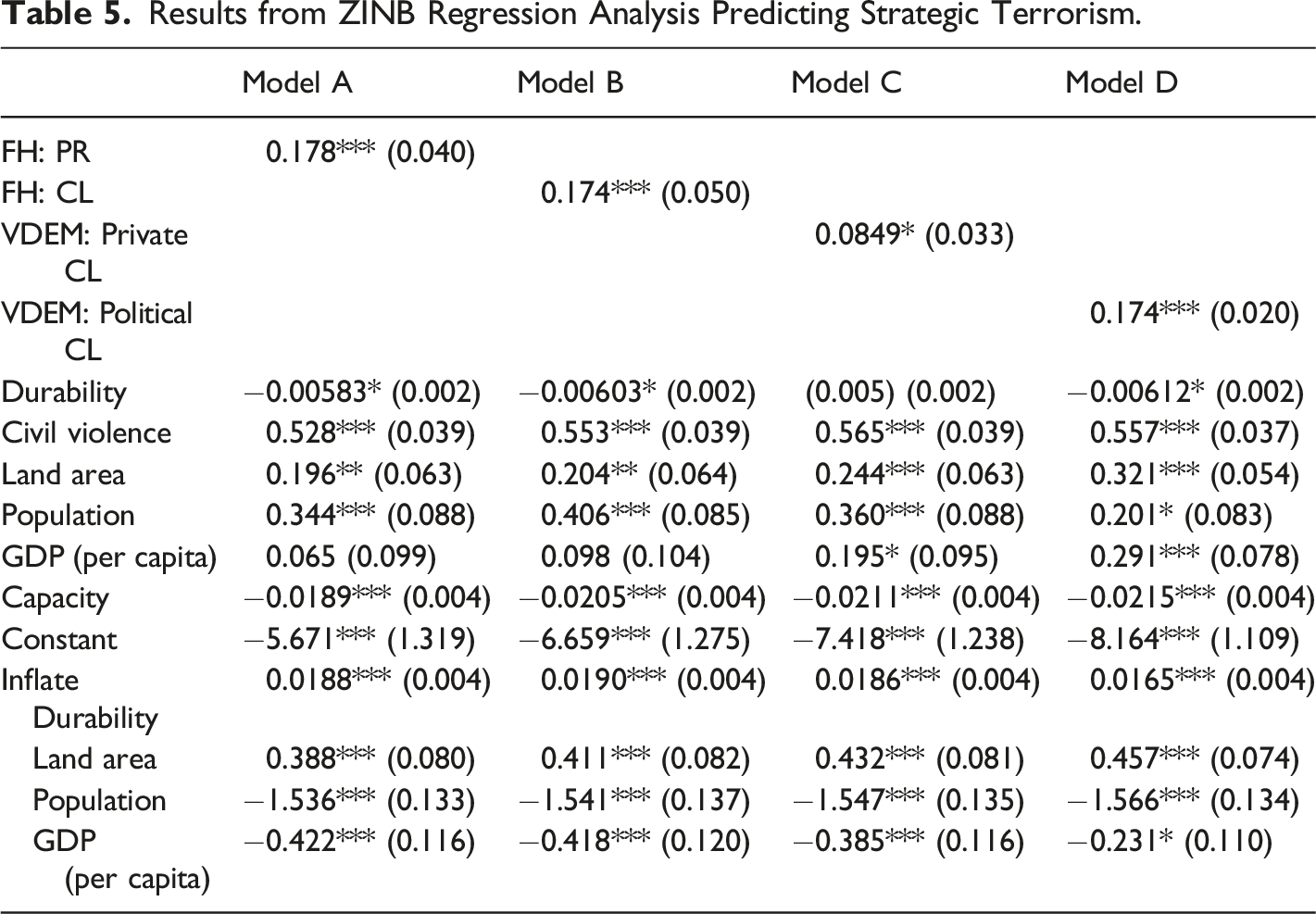
Figure 1 shows the substantive effects of changes in civil and political rights on both universalist and strategic terrorism using incidence rate ratios (IRR). For the statistically significant universalist models (Models 1–3), the IRRs are between 0.684 and 0.815. As rights increase, universalist attacks decrease. Conversely, the IRRs for strategic terrorism are above 1, ranging from 1.089 to 1.195. As rights increase, strategic terrorism increases as well. Figure 1 compares the universalist and strategic IRRs alongside the other variables in the models. Comparison of incidence rate ratios across universalist and strategic models.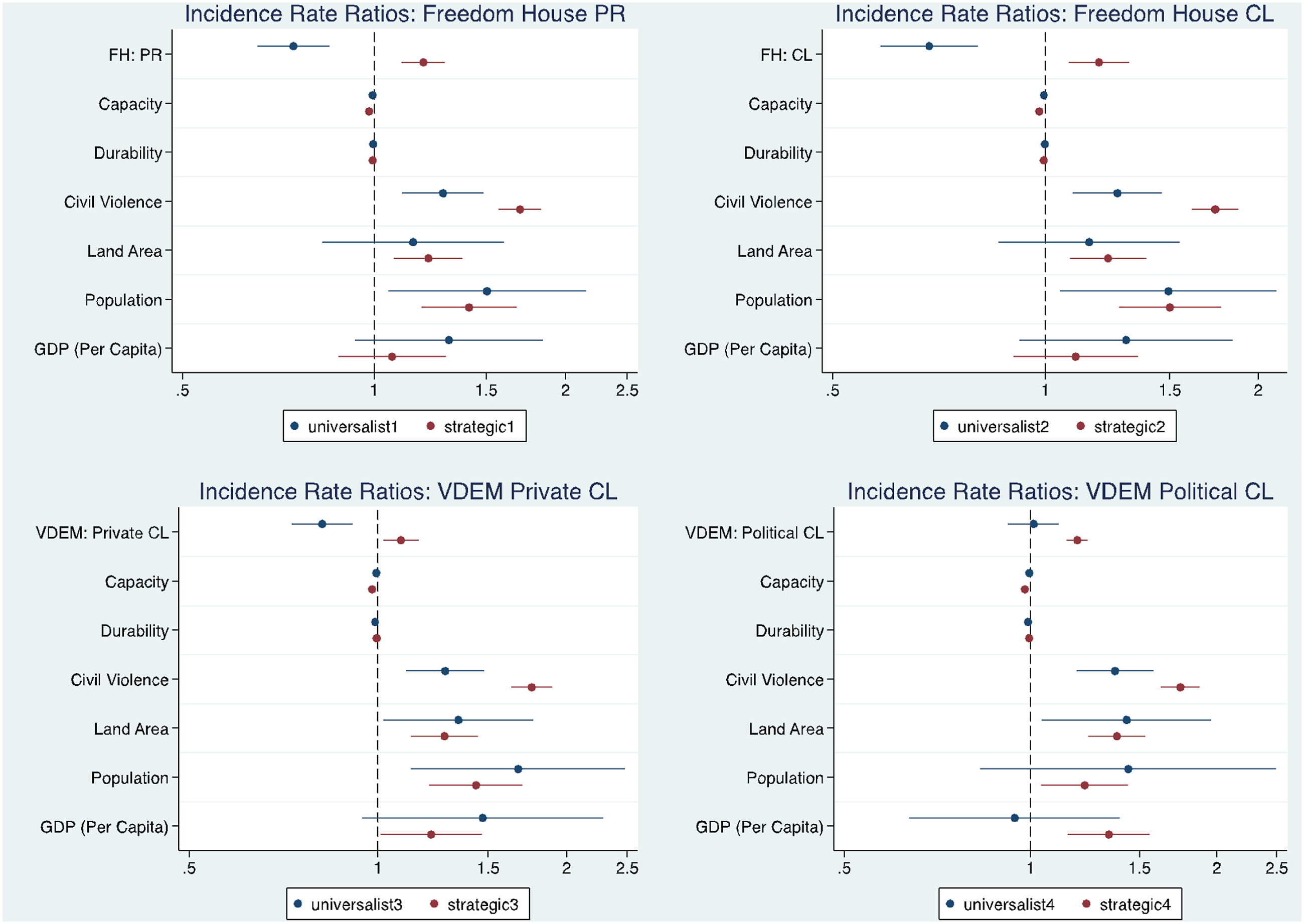
After running the initial sets of models, we ran tests to ensure that we used the most appropriate models. After a series of tests 7 , we confirmed that zero-inflated negative binomial is indeed the correct specification. Even still, we also ran a simple negative binomial regression to make sure our models were consistent across specifications. We also changed model specifications to include dummy variables to account for potential changes in terrorism patterns after the end of the Cold War and following the terror attacks on September 11, 2001. While these control variables were significant in most model iterations, the differential effects of democracy on universalist and strategic terrorism remained the same. Next, we changed the independent variables from the Freedom House measures of political rights and civil liberties to a general democracy measure found in the Polity V database. Our results remained the same. Finally, to account for potential outlier observations, we reran the models using the logs of terrorist attacks using OLS regression. Transforming the variables in this way did not alter our results.
Conclusion
The literature on the causes of terrorism considers regime type to be an important predictor, but, at the same time, it has failed to reach a conclusive verdict on whether democratic states simulate or suppress terrorism. As summarized earlier, while many studies examine how different institutional aspects or behaviors of democracies and dictatorships encourage or deter terrorism, most do not similarly disaggregate terrorism according to prevailing ideology. The empirical study of terrorism thus continues to combine radically different terrorist groups. This tendency mirrors a similar propensity among policymakers to treat terrorism as a monolithic phenomenon.
This study, however, argues that different contexts give rise to different kinds of terrorist groups. The heterogeneity of terrorism calls for a disaggregated approach in order to appreciate the different environments that simultaneously give rise to some terrorist movements and discourage others. The approach we have used here helps explain some of the observed variation in past studies. It might behoove terrorism scholars to think in terms of “terrorisms” rather than “terrorism” and to employ an approach which disaggregates terrorist attacks in future work (Miller 2007).
In this article, we argued that terrorist groups have different guiding ideologies and goals, and this reality shapes their response towards freedom and authoritarianism in different ways. Terrorist groups moved by universalist concerns are far less likely than groups motivated by a strategic rationale to succumb to anti-democratic pressures. Thus, ignoring the distinguishing characteristics of different terrorist organizations leads to ungeneralizable policy prescriptions like promoting democracy or restricting freedoms in the name of combating terrorism. Political structures that breed one form of terrorism may deter terrorism of a different variety. Thus, different forms of terrorism call for different policy responses. A monolithic approach to deterring terror is therefore unproductive. Instead, policymakers should consider the specific kind of threat they confront. That said, our findings indicate that undemocratic policies generally embolden the most dangerous kinds of terrorists who see their campaigns as larger-than-life missions, produce the most casualties, and attack other countries.
Future work can build upon this analysis in a number of ways. First, the terrorism framework we use here can be applied to study other contentious questions in the field of terrorism studies, including the effect of poverty and state capacity on terrorism. Second, case studies would be useful in demonstrating the causal mechanisms linking authoritarian practices to universalist terrorism and democratic practices to strategic terrorism. This work could also show how authoritarian countries have been successful in overcoming threats by strategic terrorists and how democratic countries have enjoyed similar success against universalist groups. Third, it is possible that our categories of universalist and strategic terrorism could be further broken down to appreciate differences even within these subgroups. For example, although al Qaeda and ISIS are both “universalist” in nature, it is also the case that the former represents a type of “strategic universalist” group while the latter represents a kind of “nihilist universalist” group. It might also be a good idea to separate “religious universalist” groups from “non-religious universalist” groups. Showing that the restriction of rights and liberties increases the likelihood of terrorism from both types of groups would add more weight to our argument.
Supplemental Material
Supplemental Material - Democracy’s Ambivalent Effect on Terrorism
Supplemental Material for Democracy’s Ambivalent Effect on Terrorism by Ashlyn Hand and Nilay Saiya in Journal of Conflict Resolution
Footnotes
Declaration of Conflicting Interests
The author(s) declared no potential conflicts of interest with respect to the research, authorship, and/or publication of this article.
Funding
The author(s) disclosed receipt of the following financial support for the research, authorship, and/or publication of this article: The authors received financial support from an AcRF Tier 1 Grant from the Singapore Ministry of Education.

Supplemental Material
Supplemental material for this article is available online.
Notes
References
Supplementary Material
Please find the following supplemental material available below.
For Open Access articles published under a Creative Commons License, all supplemental material carries the same license as the article it is associated with.
For non-Open Access articles published, all supplemental material carries a non-exclusive license, and permission requests for re-use of supplemental material or any part of supplemental material shall be sent directly to the copyright owner as specified in the copyright notice associated with the article.
