



Abstract
We present a new dataset of membership in informal international organizations—IOs founded with non-binding instruments—which constitute one-third of operating IOs. We introduce state-IO-year–level membership data for 195 countries that complements the dataset on formal IOs from the Correlates of War Project. We explain our conceptualization of an informal IO, contrast it with other approaches, and detail the data collection process. We illustrate similarities and differences across formal and informal IOs, and across states and regions. We explain how our data validate or challenge conjectures about informal cooperation that have been inaccessible for lack of data. We demonstrate that while formal and informal IOs are similar in size, the composition of informal memberships in informal IOs is more fragmented. While informal IOs are a growing part of the governance portfolios of most states, some countries and regions participate more. We conclude by outlining elements of the research program our dataset unlocks.
Introduction
International Relations (IR) scholars have recently highlighted two major shifts in global governance. First, there has been a move from governance through purely public, “traditional” arrangements, like treaties and formal international organizations (IOs), toward varieties of cooperation that increasingly include unconventional “non-state” actors, such as multinational corporations and non-governmental organizations (Avant, Finnemore, and Sell 2010; Westerwinter, Abbott, and Biersteker 2021). This shift has been the subject of an enormous literature that now documents, theorizes, and empirically evaluates the rise of transnational governance “beyond the state.” Second, many studies have also documented transformations in the public—that is, state-led—institutions of global governance. Numerous scholars have, for instance, observed the growth of soft law and informal IOs as important instruments of cooperation (Abbott and Snidal 2000; Roger 2020; Vabulas and Snidal 2013). In contrast, however, these institutions are still less visible in empirical research. Despite evidence of their growing prevalence and importance for global problem-solving, most IR studies continue to place treaties and formal IOs at the center of their analyses.
This disconnect has been driven, in part, by the fact that while many analysts have advanced conjectures about the differences between “old” and “new” forms of public governance—whether in terms of their basic features, drivers, dynamics, or impacts—these differences have not always been demonstrated systematically. Formal IOs and “binding” international agreements have long been a focus of IR scholarship and there have been several comprehensive data collection projects to support research (Koremenos 2013; Pevehouse et al. 2020). Accordingly, our understanding of this aspect of the governance landscape is quite advanced. Research on transnational governance has, similarly, grown in sophistication, shifting from theory-building case studies toward more systematic qualitative and quantitative analyses, facilitated by the creation of numerous datasets (Roger and Dauvergne 2016). However, analyses of informal IOs and soft law remain at an early stage. Several attempts have been made to collect more sophisticated data, which we describe. But, the limited scope of current datasets has meant that there is still little we can say about how informal institutions compare with, and operate differently from, more formal ones. Much of the informal order remains terra incognita.
In this article, we describe our effort to map a crucial aspect of this landscape: patterns of state membership in informal IOs. Specifically, we present a new dataset of state participation in 260 informal organizations established since 1925 that significantly extends current efforts to measure the world of informality. So far, the data that has been collected on informal IOs—especially by Vabulas and Snidal (2013) and Roger (2020)—has focused on “counting” institutions, measuring their frequency over time, or mapping the issues they are active in. This work has revealed the tremendous growth of informal bodies across a range of areas, as shown in Figure 1, and has helped to generate interest in the drivers and impacts of this trend. However, current datasets fall far short of comparable resources for formal IOs, like the Correlates of War (COW) Intergovernmental Organizations Dataset, which contain state membership data at the country-IO-year level that have enabled a much wider range of studies. Here, we move decisively beyond the basic datasets that currently exist by collecting the kind of information that has made the COW dataset so useful to researchers, creating a resource which can used independently or paired seamlessly with its data on formal bodies. In doing so, we “unlock” our ability to answer more complex questions about these institutions and about global governance more generally. The growth of informal international organizations.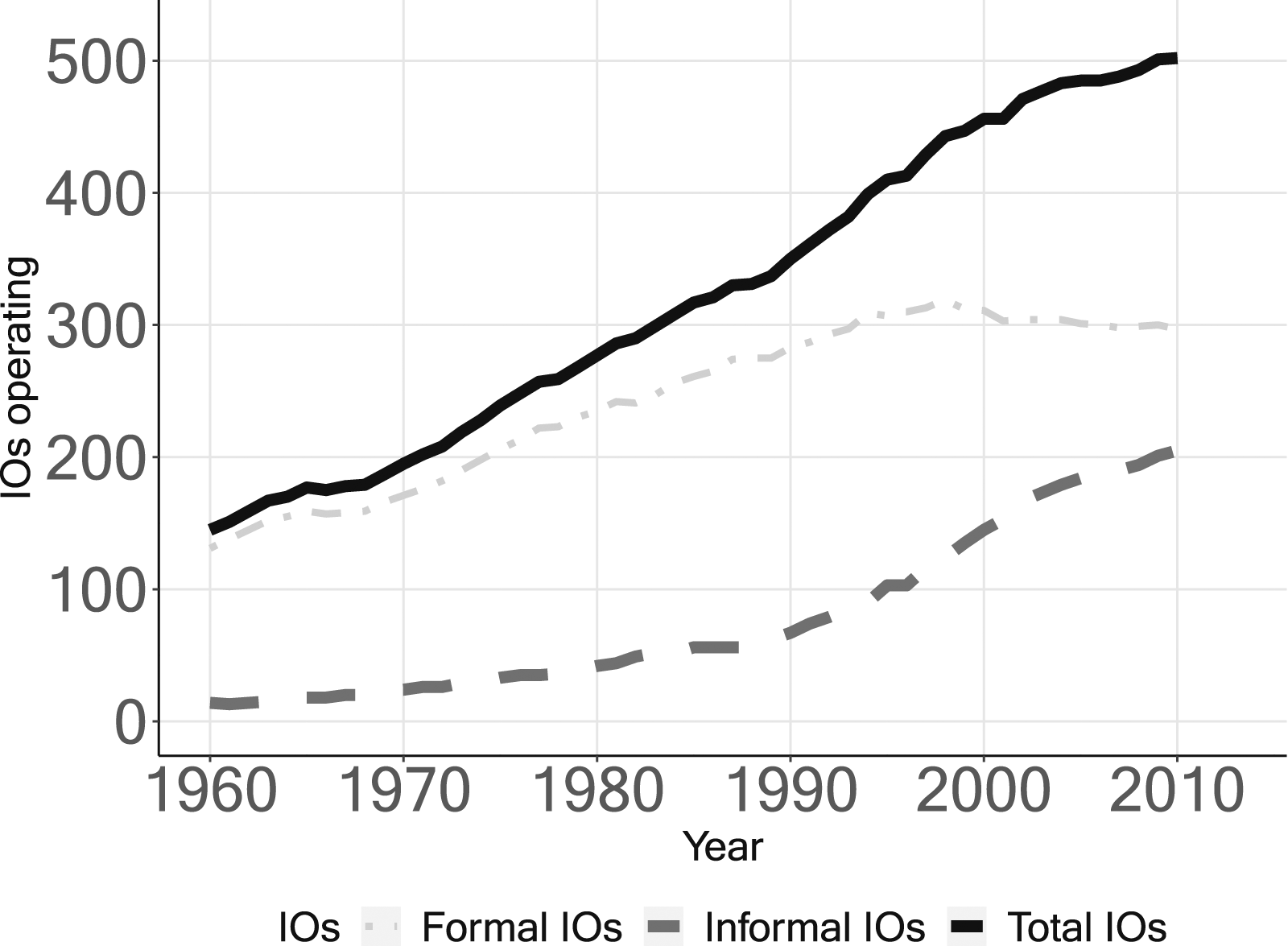
We begin in the next section by describing the concept of an informal IO that we rely on and situating our work within the broader IO literature. Compared to other approaches, like Vabulas and Snidal’s, we adopt a deliberately broad notion of an informal organization where the “non-binding” nature of a state-led institution constitutes the key distinguishing feature. This approach aligns with Roger’s (2020) related but contrasting conceptualization of an informal IOs and is especially valuable in this context because it: (a) increases the conceptual correspondence between our data and other key ideas and measures; and (b) avoids artificially constraining the kinds of organizational structures that informal bodies may possess, allowing researchers to ask a wider range of questions about these institutions than would otherwise be possible. Following this, we provide a detailed explanation of the way we measure state membership in these bodies. We discuss the data collection process and the underlying resources we rely upon, and we explain some of the strengths and weaknesses of the dataset that users should be aware of.
The rest of the article presents key empirical findings, demonstrating how the terrain of global governance looks different once we are attuned to informal institutions. Our investigation begins, from the vantage point of IOs—by examining variation across formal and informal bodies and evaluating several conjectures about their differences that have been advanced in the nascent literature. For instance, many have supposed that informal IOs are “minilateral” in nature—involving small groups—and differ systematically from larger, more formal organizations (Penttila 2009; Brummer 2014). We demonstrate, however, that both IO subtypes have similar membership profiles. While there are more “universal” formal IOs, overall, their differences are much less pronounced than earlier studies suggest. Furthermore, this basic similarity obscures a more important difference in the composition of membership. Specifically, we show that networks of membership within informal IOs are far more fragmented—involving more diverse groups of states—than those within formals. This finding speaks to the growing literature on regime complexity, and, we argue, validates Greenhill and Lupu’s (2017) claim that fragmentation has been taking place outside of the network of formal IOs rather than within it.
We then observe the governance landscape from the vantage point of states, examining their distinct membership patterns. Here, again, we find similarities and differences that both confirm and confound existing expectations. In particular, our data show that while all states have joined more IOs over time—both formal and informal—individual states have very different membership portfolios. In some cases, the composition of membership has become highly skewed toward informal institutions, comprising as much as 67% of total IO membership; in others, states’ portfolios remain heavily dominated by formal institutions, with informals comprising less than 10%. We also find important aggregate variation, as different regions have starkly contrasting membership patterns. In line with work by Miles Kahler (2000), for instance, we find that Asia-Pacific states participate less in formal IOs and relatively more in informals compared to global averages. Yet, other world regions, like Europe and North America, join many informals too. And, in places like the Middle East and Africa, membership in informal IOs is increasing but still uncommon overall.
Based on these findings, we argue that the centrality of formal IOs in much of the current literature on global governance can produce a misleading picture of international cooperation. While there are certainly similarities across IO subtypes, formal institutions often differ systematically from informal ones, and state participation across IOs reflects this. Equally, we argue that it is not always safe to draw inferences about informal IOs by observing a few prominent examples. Only by looking across the “universe” of informal bodies can we truly understand the nature of these institutions and the puzzles they raise. More research is therefore needed to bring prevailing patterns into focus and unpack the dynamics that underpin them. However, by pairing our data on informal organizations with existing datasets of formal IOs, we can speak to, and, in appropriate instances, validate hypotheses about these bodies that could not be tested before, including those related to the drivers of membership and their varying domestic and international effects. We can also, just as importantly, explore entirely new questions about the patterns our data reveal. Ultimately, we still have much to learn about the new terrain of global governance, yet the dataset we present offers a valuable tool for doing so.
Conceptualizing Informal IOs
While formal IOs loom large in IR’s imagination, the existence of “non-formal” organizations has long been recognized. References to such bodies can be found in IR scholarship from the 1930s to the present day. Pitman Potter’s early effort to classify IOs includes an extensive discussion of organizations created without recourse to international law (Potter 1935). In The Anatomy of Influence, Cox and Jacobson (1973, 5) also wrote that while most IOs are established by treaty this is “not always” so. More recently, in White’s (2005, 10-11) widely-used textbook on international institutional law, he explains that IOs are created by agreements that are “normally, but not exclusively” treaties. It is only relatively recently, though, that scholars have conceptualized these entities in a more rigorous fashion. Jan Klabbers (2001) may have been the first lawyer to do so. But, in IR, Vabulas and Snidal (2013) took the first major step. Their work is notable for developing the idea of an informal organization, operationalizing it, and offering initial estimates of their numbers, showing that they are more common than previously thought. This has spurred considerable interest in the phenomenon.
Indeed, in the wake of their pathbreaking studies, a lively debate has ensued, including one about how we should define and measure informal IOs. In previous work, for instance, we and others have made slightly different conceptual choices and produced somewhat different findings. 1 We begin, therefore, by situating our approach within this field. We explain our concept of an informal IO, highlighting how such bodies compare with the formal ones scholars have traditionally focused on and that the related COW dataset—the most commonly used resource on formal IOs—aims to measure. Following this, we discuss how our concept differs from others that have been advanced. Using several illustrative examples, we review key differences, point to several empirical advantages, and highlight how our approach enables a rich understanding of institutional variation, opening up a particular wide set of avenues for future research. In the next section, we then explain how our idea is operationalized and, more extensively, how membership data—the crucial addition beyond our past work—was collected.
At the heart of our definition are three features that match, but also contrast—to varying degrees—with elements of the concept of a formal IO underlying the COW dataset. The first relates to their mode of creation: informal IOs are primarily established by states. Formal and informal IOs share this trait, making them directly comparable entities. But, importantly, other varieties of cooperation do not. Public-private partnerships, like the Global Fund, may be similar in certain respects, yet, in these states govern alongside non-state actors, such as firms and non-governmental organizations (Andonova 2017). Private governance arrangements, like the Forest Stewardship Council, and transgovernmental networks that link public officials also diverge from informal IOs (Green 2013; Raustiala 2002). Much research has focused on these institutions, sometimes gathering them under the broader heading of “informal governance” (Westerwinter, Abbott, and Biersteker 2021). However, the extensive participation of non-state and sub-state actors make these entities qualitatively different. Since they cannot typically act on behalf of the state, we opt to exclude them.
Second, a body must exhibit signs of institutionalization sufficient for it to count as an organization. In the COW database, institutionalization is virtually synonymous with bureaucracy and the possession of a secretariat is used as a key indicator of “organization-hood.” However, many formal IOs, like the ANZUS Treaty Organization and the European Conference of Postal and Telecommunications Administrations (CEPT), were created with quite rudimentary structures. In recognition of this, the term “organization” usually has a wider meaning that includes but is not limited to bureaucratized institutions (Bromley and Meyer 2015). We focus, accordingly, on more general organizational traits: whether a body operates independently, whether it has members and hosts regular meetings, and whether there is a committee structure and common decision-making procedures. Together, these features constitute a minimum threshold. Bureaucratic institutions easily pass this bar, but so can those without secretariats, like the G20 and the BRICS. Other entities fall short in various ways, including: (a) one-off meetings, like the 1945 Potsdam Conference, which have committees and decision-making procedures but lack permanence; (b) agreements, like the Basel Accords, which are persistent but lack these structures; and (c) most transgovernmental networks, which link public officials but often lack independence, membership criteria, and decision-making rules (Raustiala 2002).
Finally—but crucially—a body meeting the first two criteria must be established through a non-binding agreement. This, we argue, is the central difference between formal and informal IOs. Whether large or small, formal institutions are all established through binding instruments—a fact signaled by the use of obligatory language in a constitutive agreement and related behavior providing evidence of opinio juris (Klabbers 2016; Pevehouse et al. 2020). Informal IOs, by contrast, are established by agreements that are precatory in nature (Roger 2020; Vabulas and Snidal 2021). This may sometimes be explicit. The charter of the International Energy Forum (IEF 2011) explains that membership “does not create any legally binding rights or obligations.” Because it is state-created and displays evidence of organization-hood but does not establish binding obligations, the IEF can safely be classified as an informal IO. Frequently, though, this is not so explicit. An agreement may, instead, refer to itself as an “understanding” or “arrangement” and it may use terms like “should” instead of “shall.” Often, as a result, the legal nature of an IO can only be determined through a holistic assessment of its founding document, surrounding state practices, and relevant legal opinion (Aust 2012).
How does our approach differ from the related effort by Vabulas and Snidal? Two differences are worth noting. 2 The first relates to how we conceptualize “states.” In their work, Vabulas and Snidal (2013, 2021) equate the state with heads of government and cabinet-level officials, and they limit the entities that can count as IOs to ones created by these actors. We do not. This is because, as a matter of international law, IOs have sometimes been created by other state-based actors. Bodies like the Bank for International Settlements and CEPT, for instance, are widely regarded as IOs but were not created by cabinet-level officials. Nor is this an especially rare occurrence. As the International Law Commission has observed, many “international organizations have been established by State organs other than governments or by those organs together with governments” (United Nations 2009, 43). And, equally important, this has been acknowledged by the creators of the COW database, which contains numerous IOs “whose delegations are appointed by governmental agencies or ministries” (Wallace and Singer 1970, 247). In keeping with these considerations, we define the state less restrictively, allowing a somewhat wider range of bodies. 3
Second, we think about “institutionalization” differently. Vabulas and Snidal define institutionalization with a minimum threshold, as we do, but also include an upper limit by excluding IOs with secretariats. Arguably, they even see this as the defining feature of informal bodies. We do not. We exclude this criterion because, in fact, many non-binding bodies do possess these. Just like formal IOs, informal bodies exhibit different levels of institutionalization. While some, like the G20, have very limited structures and simply pass a basic threshold, others are more bureaucratized. The Asia-Pacific Economic Cooperation (APEC), for example, was created in 1989 and its constitutive agreement is non-binding. Thus, the organization is regularly cited as a case of informal cooperation (Kahler 2000). Yet it has a secretariat and, through a headquarters agreement with Singapore, even enjoys many of the privileges and immunities that formal IOs typically possess. 4 Such arrangements are not uncommon either, and this means that many informals attain higher levels of institutionalization than Vabulas and Snidal admit. Again, therefore, we define informal IOs somewhat less restrictively.
We hasten to add that this does not mean Vabulas, Snidal, and others are “wrong.” Ultimately, conceptual choices are motivated by specific research questions, and we interpret their choices as reflecting an interest in IOs that are more insulated from principal-agent problems. The literature on IOs identifies bureaucratic drift and wayward agencies as major challenges for states attempting to cooperate (Hawkins et al. 2006). For example, many IO secretariats create their own organizations—often called “emanations”—without explicit endorsement from state principals (Johnson 2014). The Financial Action Task Force—an informal IO—has a secretariat that has facilitated the creation of numerous regional FATF-style “progeny.” This has expanded governance in key ways, but also creates complex trade-offs for officials seeking to solve cross-border problems while controlling the institutions they establish. Vabulas and Snidal’s (2013, 2021) approach highlights, however, that not all IOs are affected by these issues, and that the proliferation of new bodies and mandates may be part of the problem states want to manage when they create informal organizations. In doing so, states can achieve “organization without delegation” or “cooperation under autonomy.”
Our approach, in contrast, makes the legal nature of an IO the critical distinction. This move has important advantages for our project. On one hand, this feature sharply differentiates bodies and is particularly relevant to questions about the drivers and impacts of participation. Because formal IOs are based on treaties, creating them involves ratification processes and burdensome domestic funding and oversight requirements that come into play virtually regardless of a body’s level of institutionalization. With informals, however, the opposite is true: there are typically no such requirements and ratification is unnecessary. Existing work shows that this matters greatly for questions of institutional design, leading policymakers to embrace informality when they face domestic constraints, as was the case during negotiations over postwar multilateral trade institutions, which favored the non-binding General Agreement on Tariffs and Trade over a more formal International Trade Organization (Roger 2020). Levels of legality have been shown to be critical for understanding the effects of institutions as well (Linos and Pegram 2016; Roger and Rowan 2022). So, we expect that the difference between bodies created with and without treaties is one that has considerable theoretical import for many research questions. Our conceptual choices emphasize and heighten this key distinction.
On the other, our approach allows informal institutions to vary in their levels of institutionalization and does not foreclose opportunities to show how this matters. As with the IOs in the COW dataset, the bodies we focus on can be basic or more elaborate; they may involve heads of state or lower-level state organs; and they may focus on a variety of issues. For example, many bodies exist to coordinate auditing, finance, measurement, and other standards, which require some institutionalization—with secretariats, possessing a range of powers—but do not involve heads of states. In our dataset, we count dozens of such institutions as instances of informal cooperation, all of which are excluded from Vabulas and Snidal’s. By permitting this, our concept is certainly more expansive. But, equally, by adopting this approach to informal IOs—and collecting data on them, as we do—this allows scholars to ask a wider set of questions. In this article, we pool informal IOs together and focus on more general patterns, setting much of this variation aside. Yet researchers can easily subset bodies in future studies based on relevant institutional markers, as scholars have done with formal IOs. A large literature already extends COW’s baseline data to measure institutional variation across formal IOs and shows how this shapes their ability to promote economic linkages, peaceful relations, and so on (Boehmer, Gartzke, and Nordstrom 2004). Taking a similar approach to informal IOs may be equally rewarding, as we describe in the concluding sections.
Mapping Membership in Informal IOs
Having outlined and compared our concept of an informal IO, we now explain the construction of our dataset and provide an overview of its mechanics. The starting point for our effort is the dataset developed by Roger (2020), which operationalizes the notion of an informal organization described in the last section. Details about coding rules and the data-collection process used to create Roger’s dataset have been discussed extensively in already published sources. 5 However, several details are worth recapitulating. First, as in Vabulas and Snidal’s work (2013, 2021), Roger’s was built to complement the COW dataset of formal IOs (Pevehouse et al. 2020; Wallace and Singer 1970). It makes use of the same basic source material—the Yearbook of International Organizations, published by the Union of International Associations (UIA 2019)—and employs comparable coding rules. This means that the datasets can be easily combined in various ways—a major strength for conducting research. 6 One can toggle between measures of formal IOs, informal IOs, or a combined measure of “total” IOs, as necessary for a particular research question.
Second, the database was compiled by sifting through entities in the Yearbook to determine whether they meet the definition of an informal IO. To do this, more specific indicators were employed. For instance, to assess whether an entity passes a basic threshold of institutionalization one had to: (a) display evidence of a unique corporate identity, meaning that it is not a subcomponent of another IO; (b) have members who convene on a regular basis; (c) display signs of organizational structure, including at least two sub-bodies (like a plenary and executive committee) and individuals with distinct roles (presidents, chairs, secretaries, etc.); (d) offer evidence of stable decision-making procedures, such as rules about voting; and finally, (e) produce some kind of collective output, like resolutions, programs, or rules. A limited institution like the BRICS passes this bar, for instance, because it is self-standing, has members that meet at least once a year, includes a summit and issue-specific committees, establishes a chair and officers at each meeting, operates on the basis of stable decision-making rules, and has produced various collective statements and initiatives (Cooper 2016). Other bodies, like APEC, may be far more institutionalized—and may even look much like formal IOs.
Thus, in line with the concept discussed in the last section, we need to consider an institution’s legal basis to firmly determine its level of informality. This was determined, again, using specific indicators, like explicit statements explaining that an agreement is non-binding or extensive use of precatory language in a constitutive agreement, like “hope,” “may,” or “should” instead of “will,” “must,” or “shall.” Related behavior can also be important for evaluating an organization’s legal nature, either by offering clear evidence of opinio juris (for instance, if a charter has been ratified or is included in lists of binding agreements, like the UN Treaty Series) or evidence that an organization was not formally constituted, like legal opinions and statements explaining this is so. The Organization for Security and Cooperation in Europe, for example, looks like a formal IO—it is created by states and has a secretariat—but officials regularly underline that its charter is non-binding and a consensus among lawyers supports this assessment (Platise, Moser, and Peters 2019). 7
Roger’s basic dataset offers systematic information on informal IOs that meet these criteria, including their dates of creation and termination, where relevant. However, with other efforts to measure informal bodies, it has so far lacked information on membership comparable to COW, limiting its usefulness for answering many complex questions. Without this, for instance, it is challenging to study why states join informal IOs, how organizations evolve over time, and how membership in them affects public policymaking related to the global economy, environment, international security, and human rights. By collecting country-year membership data, therefore, we significantly expand our empirical understanding of these institutions and the range of studies that may be undertaken. To do so, we began by matching the COW project’s coding rules, ensuring that the two datasets remain as complementary as possible. COW lists six membership values: “no membership,” “full membership,” “associate membership,” “observer,” “missing data,” and “state not system member.” We use identical categories, and code a state as a particular type of IO member based on self-reported information from official IO documents and other sources reported below.
We use the COW state system membership dataset to determine whether states are “active” in the international system, and thus “eligible” for IO membership. Members are coded “1” in the year a government or state organ first shows up in records as having attained this status, and “0” if they are active in the state system but not members at a particular point in time. The same procedure is used to determine membership in other categories, and states may shift between these as their membership status evolves. Correspondingly, when a government or state organ ceases to show up in records, it returns to a score of 0 in the year after it last appears. 8 A relevant “state organ” could, of course, be a head of state or government, or an executive office. However, as in the COW dataset, it could also be a ministry or agency, provided that this formed part of a central government. In each case, this is counted as an instance of state membership. So, if the “State Department,” the “People’s Bank of China,” or the “Public Health Agency of Canada” was listed as a member, this was recorded as participation by the US, China, and Canada, respectively. Public institutions below this level and all non-state actors—including national public officials acting in an individual capacity—were not counted as relevant cases of participation.
Using this approach, we attained nearly complete information on membership for 244 of the 260 (94%) IOs in Roger’s dataset. This was generated from numerous sources: IO websites, annual reports, official histories, government documents, direct correspondence with IO secretariats and government offices, news reports, secondary sources, and existing datasets. IO websites, official histories, extant datasets, and secondary sources often provide specific entry and exit dates and we frequently relied on these to generate yearly data. Secretariats, naturally, keep records of this information too. In other instances, data were built up from yearly records, like annual reports or IO websites recorded by the Internet Archive’s Wayback Machine. Many websites and annual reports include membership lists that are regularly updated and these can be compared over time to track changes. Finally, the most demanding technique involved using news reports, direct inquires to individual governments and offices, and assorted public documents to reconstruct a historical record from multiple sources.
Our data on state membership in informal IOs substantially expands access to the new terrain of global governance, and is especially powerful when paired with COW data, as shown in the following sections. However, like all datasets, it has limitations. Several of these likely affect COW and our own effort equally: membership in the developing world and in bodies that do not conduct their activities in international languages is likely to be undercounted. Other biases may be specific to ours. Some informal organizations are highly secretive or opaque, for example, making membership difficult to track; and less “successful,” short-lived organizations leave a poorer documentary record. Such cases account for many of the “missing data” entries, so membership in them is likely to be under-estimated. Last, while the data collection techniques we used should be relatively accurate for distinguishing members and non-members, certain sources, like official histories and secondary sources, are not as comprehensive when it comes to other categories. As a result, data on observers and associate members may not be as reliable.
Examining Patterns Across IOs
What do our data reveal? In this section, we look at this question from an organizational perspective. We do so, specifically, by explaining how our data speak to two descriptive conjectures that have been advanced in the literature on informal IOs, but which have so far lacked a firm empirical basis—a first, very common one about the size of informal IOs and a second about the composition of membership groups. In recent years, scholars have made numerous such claims about membership in these bodies or about the nature of institutions “beyond” formal IOs. Some have even been accepted as “stylized facts,” providing the empirical backdrop for various studies. Actually, however, these have been based on a small set of cases, or an implied contrast with formal IOs, but without hard numbers. Now, our dataset allows us to explore these sorts of claims more systematically than has been possible thus far, and we show how doing so can both affirm and disrupt current thinking, putting earlier claims on a firmer empirical footing or, alternatively, inflecting extant ideas.
The first conjecture we examine is the common association between informal IOs and “minilateralism”—essentially, the idea that informal IOs typically consist of small groups of like-minded states. Relative to formal IOs, for instance, Penttila (2009, 3) has claimed that informal organizations are “selective and exclusive.” Brummer (2014) has asserted, too, that the larger multilateral organizations of the past have increasingly yielded to smaller, informal “coalitions of the willing.” And Fioretos (2019) has argued, similarly, that Western states developed a preference for “informal minilateralism” in the 1970s, partly as a means of skirting bargaining problems encountered in bigger formal IOs. Generally, these claims have been based on prominent cases, like the G7, the BRICS, and the Basel Committee—all of which are quite small—and they potentially indicate something important about the character of informal IOs that may matter for causal inferences about them. But are we right to link informal IOs to the related notion of minilateralism? Do informal IOs typically have fewer members than formal ones?
To answer this question, in Figure 2 we plot the number of members in formal and informal IOs in terms of deciles over time. Higher deciles necessarily stack, but are also indicated with darker lines, and the median is shown with points. The most striking difference is that there are more “universal” membership formal IOs. This is an important way in which subtypes vary: only a few informals come close in size to the biggest formal institutions. However, major differences only arise at the highest deciles, since most formal IOs are actually much smaller. In fact, nearly 80% have fewer than 50 members. And, from this perspective, they are more like informal IOs, where nearly 90% have fewer than 50. In 2000, for instance, the median formal IO had just 16 members—far fewer than the behemoths at the 90th percentile—and the median informal IO had 14 members. Overall, therefore, quantitative differences in membership are minor. Number of member states.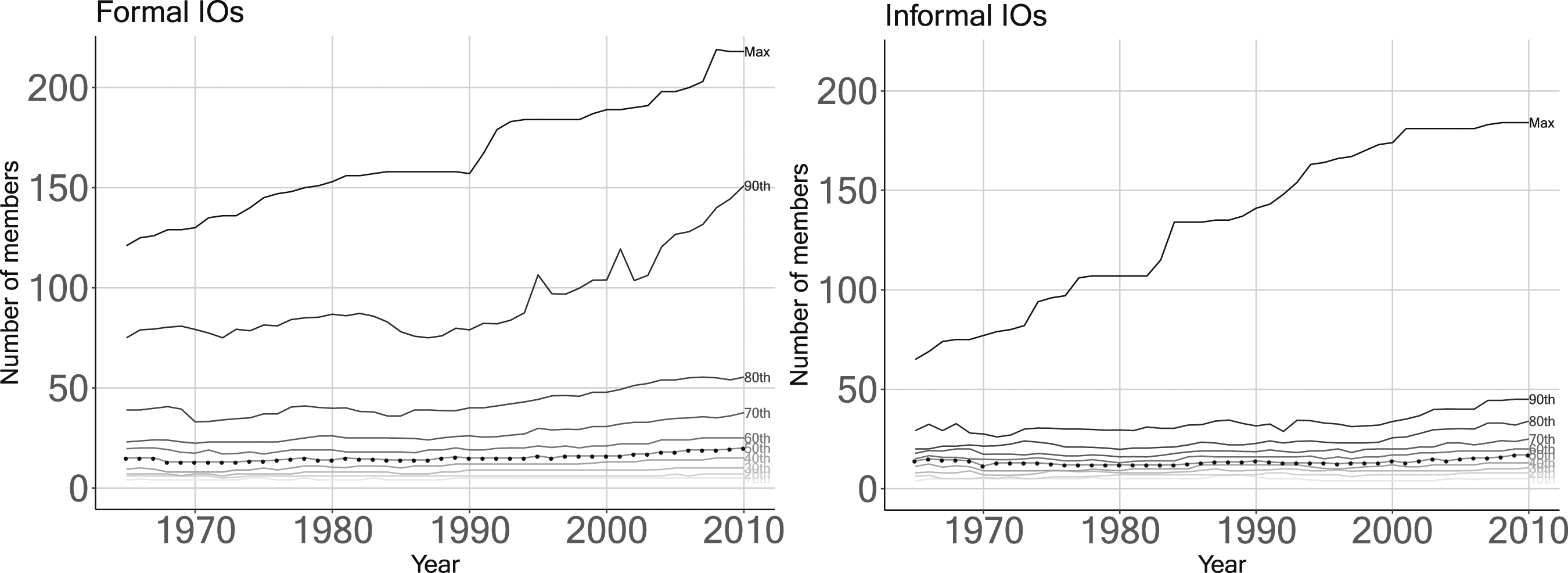
This indicates that some common conjectures about IO membership do not travel easily to the broader population. The frequent perception of formal IOs as especially large institutions—which has likely been shaped by the prominence of major bodies, like the UN, WTO, and IMF—does not reflect the membership structure of the “typical” formal IO. Similarly, emphasis on a few particularly small but well-known informal IOs, like the G7 and the BRICS, has led to a misleading picture of these institutions. In fact, most are somewhat larger and not that much different from formal IOs. Their significance therefore resides not in their small size but in other distinguishing features, like their different legal bases—or the composition of their members. Indeed, as we show next, this constitutes an important axis of variation across these bodies, and an instance where a key descriptive claim holds up.
The second conjecture we examine concerns differences in the degree to which membership is “fragmented” across IOs—essentially, involving states that do not typically have overlapping memberships in the same organizations. Recent research has often expressed concern about the increasing complexity of international regimes. As major postwar IOs appear to have declined in prominence, these accounts suggest that states have been sorting themselves into increasingly distinct clusters of institutions (Benvenisti and Downs 2008; Biermann et al. 2009). A fragmented system of this kind is concerning because if states share few common memberships, then it may be difficult to trade concessions across issues, to develop well-informed beliefs about others’ intentions, and to ensure that reputational effects hold across forums. Again, though, many of these accounts have been premised on anecdotal observations about membership patterns in particular cases, like the regime complexes for trade, climate change, or biodiversity, that may not extend to the broader population of institutions.
If this thesis is true, then the network of state-IO membership should exhibit increasing fragmentation over time. Yet, puzzlingly, some quantitative evidence has presented a picture at odds with qualitative accounts. Greenhill and Lupu (2017), for example, find that fragmentation appears to be stable or declining since the 1950s. They apply the network analytic technique of modularity maximization to measure the extent to which states sort themselves into separate IO clusters. Crucially, however, Greenhill and Lupu only consider formal IO membership, as measured by the COW dataset, and it may be that fragmentation is occurring in other domains. In fact, they acknowledge this possibility explicitly, speculating: “to the extent that fragmentation […] has increased, this has [likely] occurred via forms of cooperation other than formal [IOs], including informal institutions, ad hoc cooperation, and the fragmentation of norms” (Greenhill and Lupu’s (2017), p. 182).
Our dataset allows us to evaluate whether this is the case. To do so, we construct dyadic membership data for the same set of states as Greenhill and Lupu, and we use their approach to measure the modularity of three IO networks, as shown in Figure 3: formal IOs, informal IOs, and “total” IOs.
9
The key quantity of interest is the annual measured modularity of each IO network, which can vary over time, with higher values indicating greater fragmentation. Our updated results confirm that the modularity of the formal IO network is indeed very stable, and even decreases slightly in the 1990s. However, when we look beyond formal IOs, fragmentation is much greater, as they have hypothesized. The informal IO network modularity score is higher across all time periods and even rises slightly in the 1990s.
10
This sharply contrasts with formal IOs and causes the overall trend across all international organizations to shift upward over time. Fragmentation across international organizations.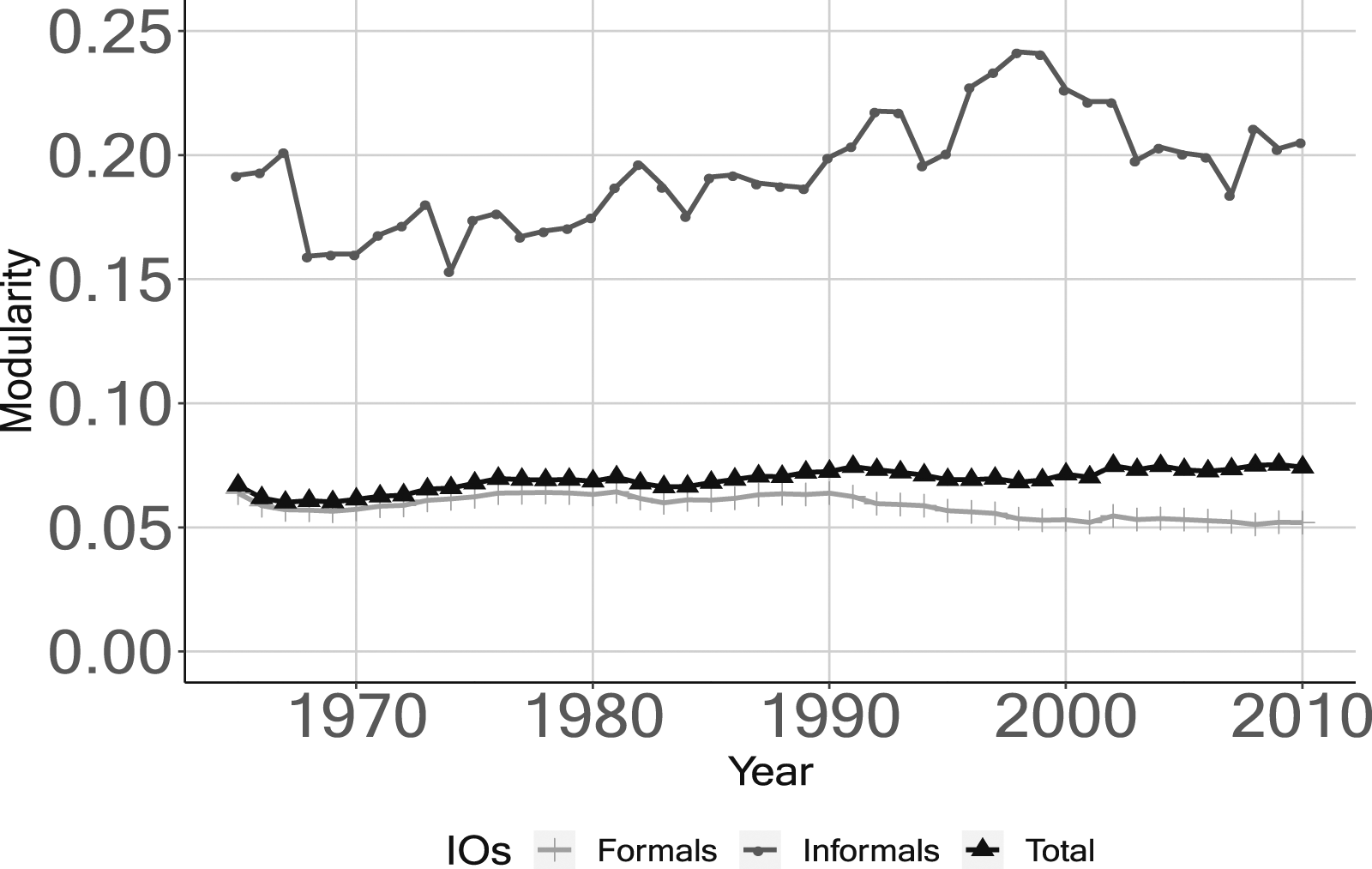
Together, these two findings show how our dataset can unlock novel insights into the world of informal IOs and lead us to ask important, new questions. We find that formal and informal IOs are roughly similar in size but that the composition of membership is very different. These results both confirm and unsettle earlier thinking in the field. However, the reasons for—and the effects of—fragmentation are unclear. It may stem from systematic changes in preferences when IOs are initially created. Researchers have already shown that states opt for informality when preferences diverge, so growing polarization in world politics could account for some of this fragmentation. However, the mechanisms underlying this remain under-specified. It could be that peer groups have drifted further apart and chosen to form new blocks that reflect their changing preferences; it could also be that more diverse states increasingly have to cooperate and opt for informality due to its lower costs and greater flexibility. These two possibilities have quite different implications, and, while we cannot resolve the debate here, our analysis suggests that unpacking these dynamics would be rewarding.
Examining Patterns Across States and Regions
In this section, we examine the new terrain of global governance from the perspective of states. Specifically, we consider how participation in formal and informal IOs varies across countries, and the extent to which states in similar geographic regions exhibit common membership behavior. Previous efforts to collect data on informal IOs have demonstrated their rise over time and which states have been involved in “founding” informal IOs. We also have some cross-sectional data on current membership patterns, providing a valuable snapshot of current country-level variation. But, ultimately, without country-year membership data, our understanding of—and ability to analyze—the drivers and impacts of membership patterns remained limited. We show how our dataset relieves this constraint, and how it can be used to address important theoretical questions about who participates in informal governance—and why.
What do the data say? First, our analysis reveals that membership in all IOs has increased over time. Since the early 1960s, virtually all states have become members of more formal and informal IOs, largely reflecting the growing number of institutions in world politics. This can be seen in Figure 4, which plots IO memberships for states across deciles for formal and informal IOs. Second, however, membership trends differ by subtype. For formal IOs, the relative difference between the most and least active states is constant or shrinks in percentage terms over time. For informal IOs, we see an increasing divergence between the most and least active states. Thus, while the growth rate at which states join formal IOs has been relatively constant since the 1960s, a minority of states have become particularly active “joiners” of informal IOs over this time. It may be the case that membership trends will converge in the future if the growth rate of informal IOs decreases, such that membership patterns will come to resemble those of formal IOs, but it also remains possible that there could be persistent gaps in the formality of states’ IO memberships, mirroring the patterns of fragmentation discussed above. States’ international organization memberships.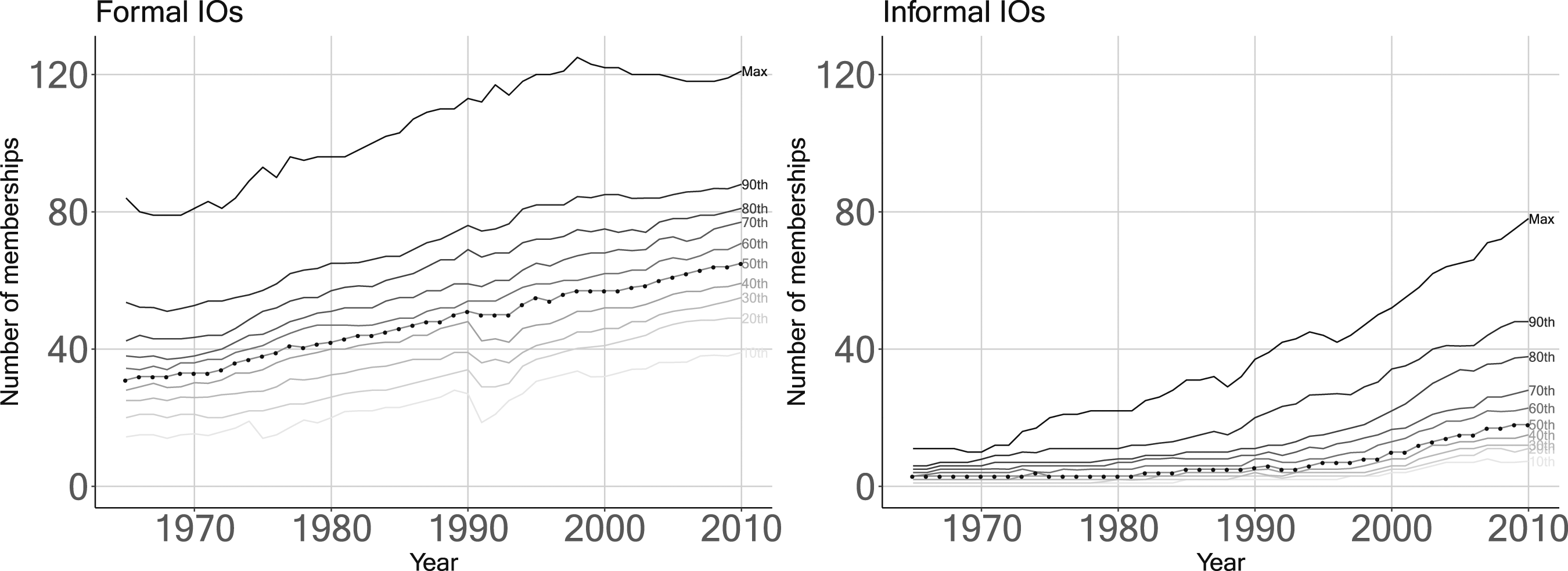
State Membership Portfolios (2010).
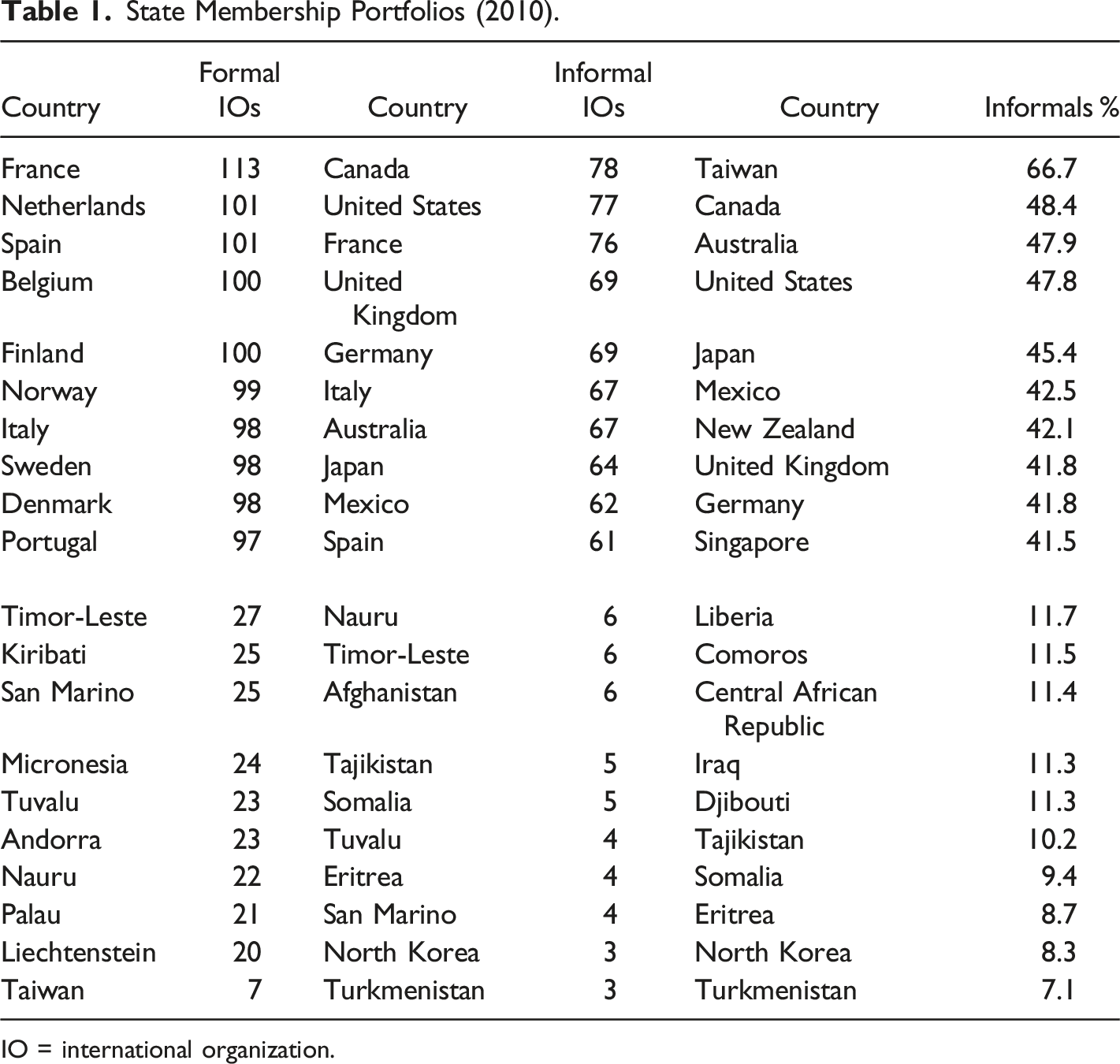
IO = international organization.
Looking at the other countries that appear at the top and bottom of the final column in Table 1, we observe strong involvement in informal IOs by a number of key Western European, North American, and East Asian states. We also see that several Sub-Saharan African and West Asian states are generally among those least involved in informal IOs. These suggestive regional differences can be seen in sharper detail in Figure 5, which maps countries’ informal IO memberships as a share of their total IO memberships in 2010. This confirms the leading role of Western European and North American countries in informal IOs as the largest joiners in both absolute and relative terms. African and West Asian states are much less involved by comparison, exhibiting some of the lowest rates of participation. And, finally, our data reveal that most Asian and Latin American states actually occupy a middle ground, with a mix of states that participate a great deal in informal IOs and others that participate somewhat less. Informal international organization membership shares (2010).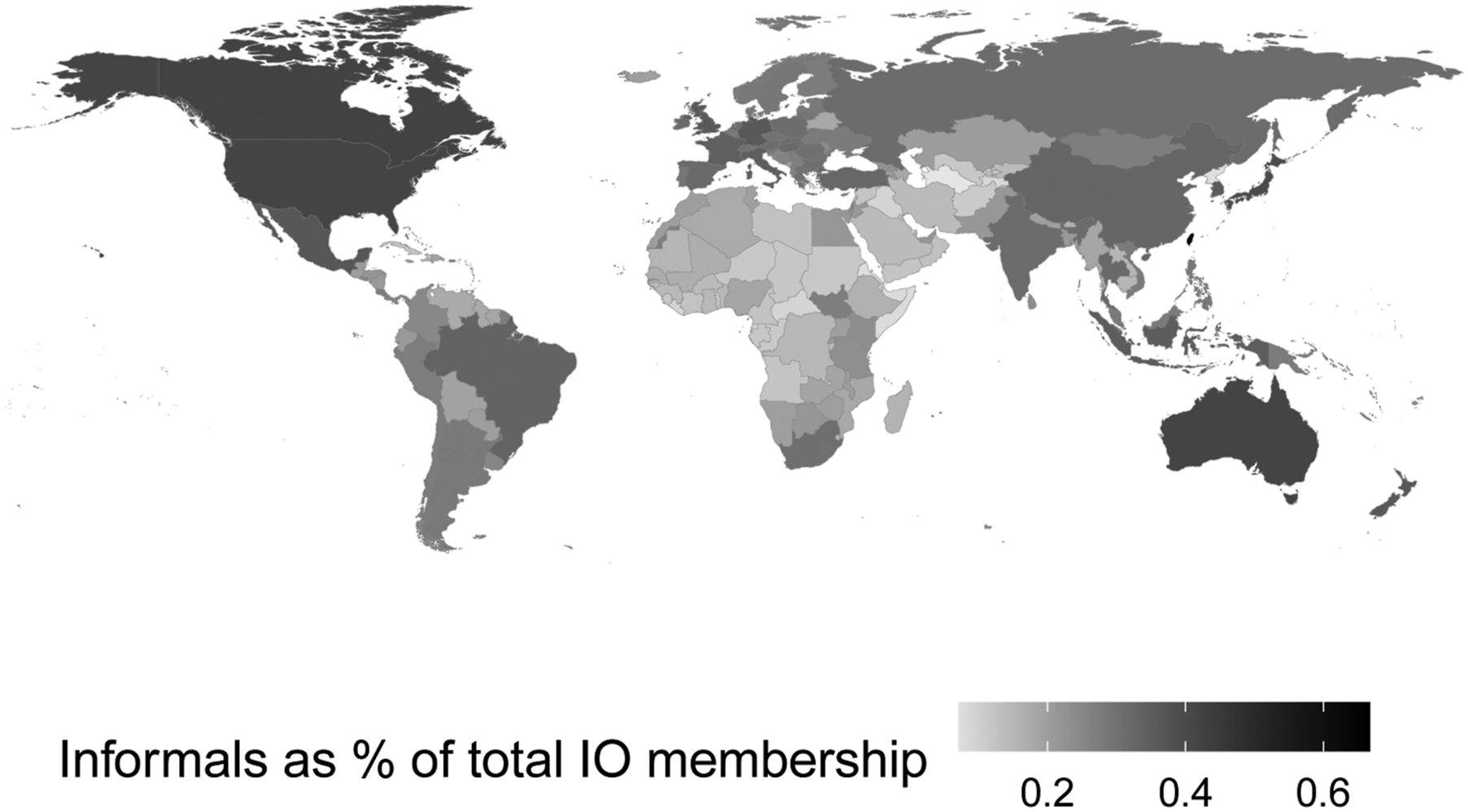
Overall, these figures provide support for Miles Kahler’s (2000) assertion that “legalization” has not played out in a uniform way around the world. Indeed, our data reveal a highly uneven governance landscape, with substantial variation in the degree to which states have become involved in informal bodies. 11 Evidently, the decisions made by individual states have also aggregated into distinct regional patterns. And the specific variation we see across regions adds important nuance to our understanding of legal trends. For instance, our data confirm the claim advanced by Kahler (2000), Pekkanen (2016), and others, that Asia-Pacific states have expressed a preference for informality, and, given the extent of their interdependence, are relatively “under-institutionalized” from the vantage point of formal IOs. At the same time, however, we find that states in other regions have been significant participants in informal institutions too. The mix of IOs varies quite considerably, and some, like European and North American countries, seem to have embraced informality to even greater extent than has previously been supposed.
These trends, too, raise important empirical and theoretical questions. A great deal of earlier research comparing regional integration trends has juxtaposed the “informal” Asia-Pacific with the more “legalized” Transatlantic area, seeking to explain why we see this variation. A range of explanations have accordingly been advanced, focused on contrasting cultures, domestic politics, and strategic imperatives (for a review, see Pekkanen 2016). Our work reveals, though, that membership patterns are far more complex than previously supposed, and that the central claim at the heart of these studies is at least partly mistaken. Certainly, Asia-Pacific states are relatively informal and Transatlantic states are the greater joiners—and creators— of formal IOs. But it is actually the latter which have been the most involved in the trend toward informality. Naturally, this raises questions about earlier explanations premised on this contrast, highlighting the risks associated with conjectures based on a few cases. Equally, it underlines the value of our data, demonstrating how it can illuminate the terrain of global governance in new ways.
Conclusion
Why do states join IOs? Why does membership vary across regions or within issue areas? And how does participation matter for cooperative outcomes? For some time, an important literature in IR has asked these questions. In doing so, it has offered valuable insights into the role of IOs in world politics, including their part in spreading and consolidating democracy, deepening economic interdependence, and reshaping political dynamics across various issue areas (Pevehouse and von Borzyskowski 2016). Over time, the sophistication of these studies has steadily increased, and many of the most important have only been possible because of the rich country-year data offered by the COW project. Yet, while COW data has expanded the horizons of the field, it also necessarily limits the scope of analyses, since the dataset only measures part of governance landscape. Crucially, informal IOs are excluded, and this exclusion has important consequences. Because they operate differently, this means that past results cannot simply be extended to the total population of IOs (Roger and Rowan 2022). The lack of data has also meant that our ability to study an increasingly prominent set of institutions has been constrained.
Our aim in this article has been to relieve this constraint and set the stage of a new generation of research on informal IOs. We have done so by significantly extending Roger’s (2020) database of informal IOs through the addition of information about state membership in 260 informal IOs from 1925 to 2010. We have described how this dataset was assembled and explained the important patterns it reveals. While we have not aimed to offer new explanations of these patterns, our effort sheds new light on many of the early conjectures that scholars have advanced. We found, for instance, that while both formal and informal organizations are relatively similar in size—a finding at odds with many earlier claims—the composition of membership appears to be substantially more fragmented, suggesting that membership dynamics may be very different. Similarly, nearly all states have increased the percentage of informal IOs in their portfolios of IO memberships. Yet state participation remains highly uneven, and there are major regional differences that upset existing accounts. Clearly, then, there is still much to learn about the informal order. However, our dataset provides a powerful tool for navigating the next set of research challenges.
In terms of the future research agenda our dataset unlocks, a first set of questions are likely to focus on unravelling the variation we have described: why do states “enter” informal bodies, when do they “exit,” and why have their decisions produced unique aggregate patterns across regions and issue areas? A second set are likely to focus on their effects: what are the impacts of involvement in informal IOs on security, the environment, the global economy, and human rights? When are their effects similar to formal IOs, when are they different, and why? A third set is likely to unpack how design matters. At present, our dataset comprises state-IO-year level data—pooling information across different bodies—but, as noted, there is also significant variation across informal IOs that influence the politics surrounding them (Rodriguez-Toribio 2022). Previous work on formal IOs has shown that this matters: how decision-rules, inter-institutional links, organizational structures, and more, can affect decisions to join IOs, shape how they evolve, and condition their effects on both domestic policymaking and interstate cooperation. The same is likely to be true for informal IOs. While this last set of questions will undoubtedly require additional data collection efforts, the dataset we have described in this article provides an important foundation for them.
Supplemental Material
Supplemental Material - The New Terrain of Global Governance: Mapping Membership in Informal International Organizations
Supplementary Material for The New Terrain of Global Governance: Mapping Membership in Informal International Organizations by Charles Roger and Sam Rowan in Journal of Conflict Resolution.
Footnotes
Declaration of Conflicting Interests
The author(s) declared no potential conflicts of interest with respect to the research, authorship, and/or publication of this article.
Funding
The author(s) disclosed receipt of the following financial support for the research, authorship, and/or publication of this article: This work was supported by the Social Sciences and Humanities Research Council of Canada (SSHRC ref: 756-2016-0574); the Beatriu de Pinós Programme, Agency for the Management of University and Research Grants (AGAUR), Generalitat de Catalunya (2018 BP 00276); and a research grant from the Spanish Ministry of Science and Innovation (PID2019-111467GA-I00).

Supplemental Material
Supplemental material for this article is available online.
Notes
References
Supplementary Material
Please find the following supplemental material available below.
For Open Access articles published under a Creative Commons License, all supplemental material carries the same license as the article it is associated with.
For non-Open Access articles published, all supplemental material carries a non-exclusive license, and permission requests for re-use of supplemental material or any part of supplemental material shall be sent directly to the copyright owner as specified in the copyright notice associated with the article.
