




Abstract
Ideology may directly provide motive and indirectly capacity for collective violence, thus making armed conflicts longer and bloodier. We investigate these propositions by drawing on an innovative global dataset which codes ideological claims by rebel groups and governments in intrastate armed conflicts since 1946. Results demonstrate that although ideology increases conflict duration, these effects vary by type and timing. Whereas secular ideological conflicts tended to be more protracted during the Cold War, religious ideology has become increasingly important since. We, however, find little evidence that ideology increases conflict intensity. Rather, rebel criminality best accounts for intensity. So, while immaterial resources like ideology sustain willingness to fight, ideology’s influence upon conflict intensity is limited, especially after the Cold War. Future studies need to take ideology seriously and need to investigate its characteristics more in-depth and in conjunction with material, identity related and international variables.
Introduction
Scholars disagree on the relevance of ideology for armed conflict (Leader Maynard 2019, 637-638). Some argue that ideology is often shallow or ubiquitous and hence does not make a difference. Yet, many theoretical reasons suggest that ideology does affect armed conflict, especially duration and intensity. Ideology may directly provide motive and indirectly increase capacity for violence: Ideological beliefs form “just causes” that can motivate actors to continue fighting even under adverse circumstances (Walter 2017). Ideology may increase readiness for mortal sacrifice and contribute to greater mutual hostility and distrust between ideologically incompatible groups (ibid.; Toft 2007). Ideology can also boost necessary capacity by attracting support from sympathetic outside actors (Sanin and Wood 2014; Keels and Wiegand 2020). Longstanding Communist insurgencies in Columbia and India provide anecdotal evidence that ideology drives conflict protraction, while bloody Jihadist insurgencies in Iraq, Syria, and Nigeria have been sustained and arguably intensified by external patronage (Toft 2021). During the Cold War, proxy wars in countries like Afghanistan and Vietnam were prolonged and intensified by the massive support for ideologically aligned armed groups by rival superpowers and their allies.
Despite theoretical reasons and anecdotal evidence, few global empirical studies have investigated whether ideological claims by rebels or ideological incompatibilities between warring factions increase the duration and intensity of armed conflicts. Most works focus on non-ideological factors such as ethnic identities or economic variables such as natural resource exploitation (Fearon 2004; Lacina 2006, Wucherpfennig et al. 2012; Conrad et al. 2019). While scholars have recently paid more attention to the topic (Leader Maynard 2019), cross-country studies are rare and tend to concentrate on religious armed conflict (Nilsson and Svensson 2021; Deitch 2020) or rather examine terrorism and protest (Asal and Rethemeyer 2008). A recent study finds that increasing levels of ideological incompatibility indeed prolong armed conflicts (Keels and Wiegand 2020), however, it does not specifically consider how historical eras have shaped these trends 1 nor whether ideology also influences conflict intensity.
This paper fills the gap by investigating the effects of ideology on intrastate armed conflict duration and intensity since the Second World War. Our study uses an innovative global dataset compatible with UCDP/PRIO data, coding global ideological claims by government and rebels and corresponding ideological incompatibilities from 1946 to 2017. Conceptualizing armed conflict as a special form of collective action, we expect ideology to directly create motive and indirectly provide material capacity. We hypothesize that illiberal ideologies like Communism and Jihadism are violence-prone and should increase both conflict duration and intensity. We argue that the end of the Cold War marks a significant shift, with conflict duration and intensity associated with secular ideological rebels giving way to more theologically motivated conflict in the current era.
Regression results confirm that ideology does matter but is not independent of material resources and historical periods. First, corroborating recent results (Keels and Wiegand 2020), we show that ideological claims by rebels and incompatibilities therein indeed increase conflict duration. Yet, whereas secular ideological claims and incompatibilities drove these trends during the Cold War, theological claims and incompatibilities are now more significant. By contrast, we find little evidence that ideology increases conflict intensity, whether secular or theological. Generally, material variables, especially foreign intervention and rebel group criminal activity, account for higher intensity.
We conclude that ideology plays a different role for duration and intensity. While an immaterial factor, like ideology, might be largely sufficient to sustain armed rebellion, conflict intensity is more strongly informed by material resources needed to effectively inflict higher casualties. Closely related, global ideological constellations seem crucial for the extent to which warring factions can attract immaterial and material support. Our results strongly suggest that conflict scholarship must dig deeper to explain the relationship between immaterial ideological and material or other factors in determining conflict duration and intensity.
The remainder of this paper proceeds as follows: In section two, we review the empirical literature on ideology as a driver of conflict duration and intensity. Section three then outlines our general theoretical understanding and develops a set of corresponding hypotheses. Section four outlines our empirical strategy, including information on the coding of ideological claims and incompatibilities. In section five, we present our results. The paper concludes by discussing theoretical implications and options for future research.
Literature Review
In the study of armed conflict, the definition of ideology, its measurement, and the mechanisms proposed by which it influences violence are disputed (Leader Maynard 2019, 637; Schubiger and Zelina 2017; Sanin and Wood 2014; Cunningham 2006). Some scholars argue that ideology is so ubiquitous that it does not meaningfully distinguish actors (as discussed in Leader Maynard 2019, 637-638). This proposition is usually informed by a broad understanding of ideology that comprises any set of ideas that may motivate actors, such as the desire to improve access to power and wealth. At the other end of the spectrum, ideology may refer to more abstract worldviews with an elaborate, value-based vision of an ideal political and/or economic order. Such political ideologies carry labels such as Communism, Jihadism, or Liberal Democracy (and have numerous sub-variants). This more demanding definition seems to better distinguish common and hence ubiquitous demands or grievances by conflict actors from elaborate ideology – and therefore informs our reasoning. In the following section, we summarize the quantitative literature on this emerging topic of ideology as it relates to armed conflict duration and intensity. Generally, we distinguish between religious or “theological” ideology, for which a largely independent and substantial literature exists (Fox 2004; Toft 2007; Svensson and Nilsson 2018), and secular ideologies, for which far fewer studies have been conducted (Keels and Weigand 2020), especially regarding their impact on armed conflict intensity.
Ideology and Conflict Duration
The duration of armed conflict 2 is commonly conceptualized as the number of years a conflict persists. Quantitative works, mostly building on bargaining theory, have identified a range of correlates that contribute to conflict duration, such as the number of rebel groups or veto actors (Cunningham 2006), the presence of natural resources, and other material factors (Conrad et al. 2019), as well as ethnic and religious identities (Fearon 2004; Wucherpfennig et al. 2012).
Relatively few empirical works focus on ideology as a cause of conflict duration. Those that do have identified religious ideology as increasing the duration of armed conflict or its recurrence (Svensson and Nilsson 2018; Deitch 2020; Nilsson and Svensson 2021), arguing that belief in supernatural rewards and punishments, the “othering” of “infidels”, and the indivisibility of religious claims sustain the will of religious armed actors to fight (Appleby 2000; Hassner 2003). These studies typically do not, however, compare religious with secular ideologies, the impact of which may be functionally equivalent in many respects. There is certainly evidence that secular ideologies like Communism provide a strong motivation to fight, have quasi-religious overtones, and promote mutual distrust and hostility against ideologically others (Kalyvas 2018). One notable exception is Keels and Wiegand (2020) who hypothesize that ideological differences create commitment problems which contribute to conflict duration, finding that religious ideology in particular hindered conflict termination in the period 1975 to 2011. Although somewhat temporally constrained, their evidence does suggest that ideology increases the duration of armed conflict. In historical perspective, the collapse of the Soviet Union reduced the legitimacy of Communist ideology and ended the global secular ideological struggle (Wallensteen and Axell 1994; Kalyvas and Bacells 2010, 416). However, some scholars argue that secular ideology continues to significantly influence conflict protraction after the Cold War, exemplified by longstanding Communist insurgencies in Colombia and elsewhere (Ugarriza and Craig 2013).
Ideology and the Intensity of Armed Conflict
The intensity of armed conflicts is usually measured by the number of battle-related deaths or related thresholds (e.g., 25 or 1000 victims of fighting in a calendar year). Regarding its drivers, ideology is not prominent in cross-country studies (Lacina 2006; Beardsley, Cunningham, and White 2019). Rather, most studies identify material and identity-related determinants of conflict intensity like low GDP per capita, coalition size and rebel strength, ethnic and religious affiliations as well as external factors such as foreign intervention and support or peacekeeping and mediation (ibid.; Heger and Salehyan 2007). A growing literature does exist, however, which specifically examines the influence of religious ideology on the intensity of armed conflict (Deitch 2020) and terrorism (Henne 2012). Yet, studies only find a weak influence of religious ideologies or demands on the intensity of armed conflicts (Toft 2007; Deitch 2020). Most studies look at a very limited number of years, usually going back to 1990 or 1975 at best.
Although little prior research has examined how secular rebel ideologies influence conflict lethality, multiple studies on violence intensity in terrorism and contentious politics suggest they matter. Asal, Schulzke, and Pate (2017) as well as Asal et al. (2013) show that gender ideology-driven actors were more likely to engage in nonviolent protests, while other leftist ideologies were significantly more likely to use violence. The relevance of ideology also changes over time (Rapoport 2004): Anarchist ideology was one of the leading motivators of (terrorist) violence in the 19th century. Marxist ideology was the premier motivator of violence during the middle of the 20th century. Religious terrorism has become particularly lethal since the end of the Cold War and the 20th century (Asal and Rethemeyer 2008; Robison, Crenshaw, and Jenkins 2006). To the best of our knowledge, cross-country studies on different ideologies’ effects on the intensity of armed conflicts are largely missing.
Summing up, previous work reveals several empirical gaps. First, regarding outcomes, few studies on the effects of intensity on armed conflict exist. Second and relatedly, studies are often confined to one type of ideology, frequently religion. Third, their timeframe is limited and does not enable the examination of long-term trends, including historical shifts in global ideological conflict. Owing partially to a lack of comprehensive data, no study investigates armed conflict duration and intensity nor the impact of differing types thereon in the long term. Before turning to our new dataset that can address these gaps, we elaborate on why and how we believe ideology matters.
Theory and Hypotheses
This section first outlines our basic theoretical assumptions on why violence in the form of intrastate armed conflict occurs. We then theorize what conditions can create motive and capacity for such violence, arguing that “grand ideology” can directly provide motive and at least indirectly capacity. We then specify a set of testable hypotheses on how ideology may inform a) duration and b) intensity.
Our conceptual starting point is that an armed rebellion forms a special form of collective action directed against the state (Gurr 1970; Lichbach 1998, Tilly 2003). Such collective interaction requires both the willingness (motive) and the ability (capacity or opportunity) to employ organized violence (Tilly 2003; Collier and Hoeffler 2004). Several conditions can provide such motive and opportunity, which – although intertwined – can be meaningfully distinguished.
Motive: Political actors are generally assumed to be motivated to maximize benefits, i.e., to see their demands met and “win”, and to minimize cost, i.e., not to suffer defeat and stay unharmed (Fearon 1995, 2004). Rebel violence may be motivated by relative deprivation (Gurr 1970). This usually stems from actual economic and political marginalization but can also result from distorted perceptions or unmet aspirations of dominance and enrichment, which are themselves often ideologically motivated (Collier and Hoeffler 2004).
Bargaining theory further provides a powerful explanation for why these aspirations contribute to violence (Fearon 1995; Keels and Wiegand 2020, 2024-2028). Fearon (1994, 1995, 2004) particularly names uncertainty, commitment problems, and issue indivisibility as key drivers of both interstate and intrastate violence. Informational asymmetries may lead actors to (falsely) assume they can easily overpower adversaries or offer rational incentives for preemptive violence. Some issues may simply be zero-sum, with one or both sides unwilling to cede ground despite the costs involved. We argue that ideology magnifies these dynamics, diminishing trust between armed actors (states and rebels) and significantly reducing their willingness to compromise over now “indivisible” issues (Hassner 2003; Keels and Wiegand 2020, 2028-2029). Such “grand” ideology in the sense theorized above – and related incompatibilities between adversaries – are therefore likely to contribute to violence. 3
Capacity: Organized violence is no trivial undertaking and requires substantial capacity and related resources to enable mobilization (Lichbach 1998; Collier and Hoeffler 2004; Tilly 2003). One may distinguish several types. First, fighting requires a minimum of material resources, and more violence might require more. Empirical studies have identified natural resources, criminal activity, or foreign support as such resources (Conrad et al. 2019). Second, group identities may enable organized violence (Wucherpfennig et al. 2012). Common ethnic or religious identities facilitate recruitment and real or perceived grievances regarding access to power and wealth (or other goods such as symbolic recognition) can be instigated and exploited by leaders. 4 Relatedly, institutional factors may help rebellion, not least organizational resources in the form of political organizations and parties. Finally, less tangible, immaterial resources such as levels of training, knowledge, and morale can increase capacity (Tilly 2003; Lichbach 1998). We argue that ideology forms such an immaterial resource (Leader Maynard 2019, 618). It can boost morale, increase confidence in being victorious, and helps winning support from domestic and international audiences. Ideological beliefs may thus indirectly attract more tangible resources. Such material resources often include finance, intelligence, weapons, and other equipment, or “military advisors” and mercenaries (Conrad et al. 2019) or outright military intervention, as often observed during proxy wars in the Cold War (Kalyvas and Bacells 2010).
To sum up our argument, we believe that “grand” ideology directly provides motivation and can at least indirectly create the capacity to use violence in armed conflict. However, the logic of why such violence persists (duration) or why it increases in scale (intensity) might differ (Lacina 2006). We hence theorize the effects of ideology on duration and intensity separately, starting with duration.
Duration
For rebels to sustain rebellion, ideology can work in two major ways. Regarding motive, ideology helps rebels to uphold their struggle, even when they are inferior militarily to government forces (Sanin and Wood 2014; Keels and Wiegand 2020). Rebels will continue fighting, either because they believe in the “just” cause or make others believe in the ideology, suggesting that even an instrumentalist use of ideology may be effective (Leader Maynard 2019). Relatedly, ideology can increase the capacity of rebels who will receive moral or material support from sympathizing (international) actors (ibid.). At the dyadic level, ideological differences might aggravate hostility, distrust, and the commitment problem between warring factions, thus hindering termination of conflict (Keels and Wiegand 2020):
(Ideology increases duration): Any ideological claim or incompatibility increases the duration of armed conflicts compared to conflicts without such ideological claims and incompatibilities. The content of ideologies differs, and some may be more successful at motivating violence than others. Drawing on the literature on religion and conflict as well as bargaining theory, theological ideology refers to indivisible divine values and fighters might expect to receive rewards for participating and even being killed in combat (Hassner 2003). Secular ideologies, such as Communism, also contain inherently revolutionary elements that often directly require the use of violence, with a tradition of guerrilla warfare that enables armed groups to continue fighting when confronted with superior government forces (Ugarriza and Craig 2013). Both Jihadism and Communism – to say nothing of Fascism and Racism – share deeply illiberal characteristics which may inherently reject compromise with ideological others. These revolutionary worldviews tend to cast opponents as implacable enemies with whom sustained peace is impossible (Svensson and Nilsson 2018):
(Particular ideologies increase duration more than others): Illiberal ideologies such as Jihadism and Communism increase the duration of armed conflicts compared to conflicts involving liberal democratic rebels or without ideological incompatibilities. As argued above, ideology can also increase levels of external support, which provides the capacity for rebel groups to fight longer. Patron-seeking was frequently observed during the Cold War era as insurgent groups tailored their external-facing ideological agendas to attract outside support, as cases of proxy wars such as the Vietnam war exemplify (Leader Maynard 2019, 641). However, such ideologically driven support will vary across historical periods and related ideological rivalries. The most remarkable change in such opportunities has been the end of the Cold War (Kalyvas and Bacells 2010), resulting in a sharp decrease in great power interest—at least initially—in supporting proxy warfare (Leader Maynard 2019, 641). Since then, rebel groups with theological claims, mostly Jihadist, have been on the rise (Walter 2017; Toft 2021).
5
Such theological claims also facilitate appeal for support from ideologically motivated states, such as Iran, or Saudi Arabia. We argue:
(Historical eras change ideologies’ effects for conflict duration): Whereas secular ideological incompatibilities and rebels are associated with greater conflict duration during the Cold War, theological incompatibilities and rebels are associated with greater conflict duration following the Cold War.
Intensity
Generally, ideology may have similar effects on intensity as on duration. Yet, differences should be considered (Lacina 2006). At a motivational level, a “just cause” can increase hostility towards ideological enemies and motivate greater moral sacrifice (Walter 2017; Toft 2007). Bargaining theory and social psychology may additionally expect that ideology may lead to over-confidence in winning, thereby increasing the ferocity of violence. In terms of (material) capacity, transnationally appealing ideologies attract the necessary material resources to inflict causalities, as discussed above (Sanin and Wood 2014; Keels and Wiegand 2020). Compared to the effects on duration, we however argue that these effects might be weaker, as intensity more than duration requires actual material resources on both sides to inflict damage. Still, ceteris paribus, we expect:
(Ideology increases intensity): Ideological claims or incompatibilities moderately increase the intensity of armed conflicts compared to conflicts without such ideological claims and incompatibilities. If the content of a rebel group’s ideology is particularly exclusionary and intolerant, or directly justifies or demands violence against ideological adversaries, motivation to escalate violence likely increases (Asal and Rethemeyer 2008). We hold that illiberal ideologies, promote such escalation-prone ideas. Jihadist groups like Boko Haram or the Islamic State (IS) are notorious for their brutality, massacring moderates, “infidels” and “apostates” (Leader Maynard 2019, 640; Walter 2017; Toft 2021). Communist revolution almost necessarily entails the use of violence, and Communist icons such as Ernesto Guevara emphatically promoted such views (Guevara 1961).
6
Right-wing authoritarianism frequently celebrates exclusion on an ethnic, national, or racial basis, dehumanizing excluded outgroups and was responsible for massive genocidal violence in the history of the 20th century (Leader Maynard 2019, 638). Yet again, we stress that compared to duration, higher intensity requires more material resources, which ideology only provides indirectly, Nonetheless, conflicts that involve violence-prone ideologies should result in more bloodshed:
(Particular ideologies increase intensity more than others): Illiberal ideologies such as Jihadism and Communism increase the intensity of armed conflicts compared to conflicts with liberal democratic rebels or without ideological incompatibilities. As for duration, the ability of armed groups to attract (foreign) support critically depends on global geopolitical constellations. We, therefore, expect that the end of the Cold War strongly reduced the ability of Communist and other secular rebels to gain support by the (former) USSR, the US, and their allies. Although less directly ideologically influenced by the end of the Cold War, even theologically motivated rebels are likely to have experienced sharp reductions in external state support following the collapse of the Soviet Union, e.g., the Afghan Mujahideen. As such, theologically motivated rebels after the Cold War are unlikely to command the same level of external support as secular rebels before the fall of the Berlin Wall. Our final hypothesis, therefore, asserts:
(Historical eras change ideologies’ effects for conflict intensity): Whereas ideological incompatibilities and rebels are associated with greater conflict intensity during the Cold War, these effects are generally weaker after the Cold War.
Methodology
Our statistical tests are based on a new and unique dataset, the Rebels and Religion dataset (R&R). We first describe the dataset and then briefly outline our measurement of our dependent variables: duration and intensity.
The Rebels and Religion Dataset
The R&R dataset (R&R) 7 codes ideological demands of rebel groups from 1946 to 2018 in intrastate armed conflicts. R&R is based upon and fully compatible with intrastate and internationalized conflicts recorded by the UCDP/PRIO Armed Conflict Dataset, version 19.1, with annual coverage of rebel-state armed conflict from 1946-2018 (Gleditsch et al. 2002; Pettersson, Högbladh, and Öberg 2019), adding both religious and secular ideological orientations of rebel groups as well as of opposing governments.
This dataset is distinct from other efforts to capture the influence of identity and ideological incompatibilities on intrastate conflict, notably ACD2EPR (Vogt et al. 2015) and RELAC (Svensson and Nilsson 2018). Although ACD2EPR covers an identical time range, its focus is upon identifying rebel group ethnic affiliations, ethnic-based claims (e.g., self-determination), and accordant rebel-versus-state ethnic incompatibilities. This does not capture “grand” political ideologies in our sense. We however incorporate major variables from this dataset in robustness checks to demonstrate the distinct influences of ideological claims from these aforementioned claim types. By contrast, although RELAC is similarly aimed at identifying theological and, to a much lesser degree, secular ideological incompatibilities between rebels and states, its temporal coverage is considerably narrower (1975-2015). Moreover, its categorization of ideological incompatibility types is entirely different, being focused upon whether Christian, Muslim, and secular rebels have revolutionary, separatist, or transnational goals contra R&R’s identification of theological claims associated with a particular religious denomination (e.g., Protestantism v. Catholicism, Shi’a v. Sunni Islam) or secular ideological programme (e.g., Communism v. Liberal Democracy). A fuller accounting of the differences and overlaps between these two datasets is provided in the online appendix (Tables C1-C3).
Religious “Theological” Ideology
For our purposes, we code religion as a set of ideas that try to explain the functioning of the world by centrally referring to supernatural forces such as gods, spirits, and the like (Toft 2007, 99). These ideas have numerous social consequences that matter for the analysis of conflict, namely in terms of ideology, identities, and institutions. The two basic religious dimensions collected for the dataset are religious affiliation and theological ideology. Religious affiliations exclusively refer to the (formal) religious social identity (e.g., Christian, Muslim) of the members of a rebel group or the members of the government, without presuming any ideological or theological orientation. For instance, the IS and Al-Qaida are nominally affiliated with Sunni Islam. This however does not mean that the ideology of the rebel group in question follows an “official” interpretation of said religion. Theological claims, in turn, are identified via statements by a rebel group or state representatives including demands to make a certain faith a state religion or to base lawmaking on religion, which follows our basic idea that ideology should refer to an abstract idea of the political order. Support by religious institutions for the warring faction or demands on economic or political participation of members of the faith do not constitute a theological claim.
We coded theological ideology by year and actor, i.e., rebels and governments (see online appendix, Overview A1, and A2). While ideological changes in one actor were in principle possible, they rarely occurred. Rather, ideological changes were observed between different rebel groups in a single conflict. One example is Chechnya where the second generation of rebels since 1998 adopted a Jihadist ideology, which was not observed in the first phase of the war until 1994. Other examples of how the role of ideology changed with new more theological rebel groups are Israel/Palestine and the Philippines.
Secular Ideologies
We took a similar approach for secular ideologies. Secular ideologies are generally those ideas and related demands that outline an abstract idea of the state. These (value-based) ideas considered secular if they do not refer to supernatural and thus religious ideas. 8 We first identified whether such ideological claims were made and then determined the type of secular ideology. The first distinction in this regard was between liberal democratic and authoritarian ideologies. We define liberal democratic as demands for free and fair elections and for accompanying freedoms, based on the value that government requires consent by the people. We did not distinguish further between left or right-wing liberalism. 9
Authoritarian ideologies can be distinguished into at least three different types. First, there are left-wing ideas that favor one-party rule and a state-controlled economy. This ideology is mostly Communist. Right-wing authoritarian ideologies do not have special economic preferences but regularly hold beliefs of inequality that can refer to ethnic exclusion that is racist, ultra-nationalist or outright fascist. 10 A third type is traditional authoritarianism in which the legitimacy of the ruler derives from a dynasty or other sources of traditional legitimacy (frequently combined with theological claims). We also allowed a fourth, residual type of ideology, when we clearly identified an ideological claim which does not fall under the aforementioned categories. An example is Pan-Arabism, a blend of socialism and Arab nationalism or Mobutism in then Zaire, which similarly mixed several ideologies. “Other” ideology proved to be rare, however. When we could not determine a distinct ideology, we decided to code no ideology. “Overview A1” in the Online Appendix provides a basic summary of these coding rules. Generally, we cannot rule out instrumentalist claims by rebel groups or governments. However, even instrumentalist claims may successfully attract domestic and international support, influencing both conflict duration and lethality.
Dependent Variables
Our first dependent variable is conflict duration (H1-3), measured as the number of years in which a particular rebel group was active in the sense of the UCDP/PRIO definition in a given dyad (Gleditsch et al. 2002). Armed conflicts may include recurrences. However, each new conflict outbreak is treated as initiating a new duration count. Following this model, 382 of 2576 conflict-dyads lasted no longer than a single year, while the longest conflict in this dataset, Iran versus the Democratic Party of Iranian Kurdistan (KDPI), has lasted 70 years. The average conflict duration is roughly nine and a half years with median conflict duration being 6 years (see Supplemental Table D2 in the online appendix).
Our second dependent variable, intensity (H4-6), was measured in two ways. The first followed the UCDP/PRIO convention of dichotomously coding conflict intensity, wherein a score of 1 indicates conflicts exceeding 25 battle-related deaths but less than 1000 fatalities in a calendar year and a score of 2 indicating 1000 or more such fatalities. The latter indicates the threshold for the higher intensity level, which is often used to describe civil wars, not just armed conflicts (Collier and Hoeffler 2004; Fearon and Laitin 2003). This data was available for the entire period of analysis. More fine-grained data on battle-related deaths was drawn from the UCDP Battle-Related Deaths, version 19.1, covering 1989-2018 (Pettersson, Högbladh, and Öberg 2019), relying upon the UCDP “best estimate”. This data was employed for testing our hypotheses specifically related to the post-Cold War period. Unfortunately, data for the exact number of battle death is not available for the prior period.
Explanatory and Control Variables
Our primary independent variables are drawn from the R&R dataset, coding multiple iterations of rebel-state ideological incompatibilities and rebel ideological claims from 1946 to 2017. Our first set of tests is therefore explicitly dyadic, examining whether rebels and states make incompatible ideological claims of any kind, whether secular or theological. We also determined whether rebels and states have incompatible religious affiliations, indicating that the membership of rebel groups and targeted states are primarily associated with different religions, including major subdivisions within the same religion (e.g., Sunni vs. Shia Muslim) or by substantial tendency (homogeneously Christian vs. mixed Christian/Muslim). As discussed above, this distinction makes no claim whatsoever regarding state or group ideological claims. In more fine-grained models, we measure specific types of rebel-state ideological incompatibilities with a four-level factor, wherein 0 indicates no observed incompatibilities, 1 indicates incompatible secular ideological claims, 2 indicates incompatible theological claims, and 3 indicates both secular and theological incompatibilities between the rebel group and targeted state. These incompatibility types are tested categorically rather than ordinally against cases lacking these incompatibilities. As such, a coding of 3 makes no assumption of “greater” incompatibility than a score of 2 or 1.
The second set of tests examines how rebel group attributes contribute to conflict duration and intensity regardless of state ideological orientations. Here we include general measures of whether rebels make ideological claims of any kind, secular or theological, and whether said theology is affiliated with a particular faith. In more fine-grained tests, we measure whether rebels make secular ideological claims or, employing a three-level factor variable, distinguishing between theological claims and/or religious affiliation or the absence thereof (as before, with no ordinal assumptions between these levels). Logically, our data offers no examples of rebel groups that make theological claims but are not religiously affiliated. Capturing the specific type of ideological claim for monadic tests, we measure whether rebel groups advance Communist or liberal democratic claims, as the most frequently observed subsets of secular ideological claims. 11 In turn, we measure whether rebel groups are religiously affiliated and/or advance theological claims for Christian and Muslim groups respectively, representing the most commonly observed theological rebels in the R&R data. For efficiency, we label Christian theological rebels as “Fundamentalists” and Muslim theological rebels as Jihadists. Again, the designation of rebel groups as “affiliated” to any given religion offers no indicator whatsoever regarding whether they make ideological claims of any kind. By testing the above-defined multi-level factor variable, we can demonstrate the extent to which conflict duration and intensity is driven by ideological claims rather than mere ascriptive group identities.
We employ various control variables commonly theorized to contribute to or diminish intrastate conflict duration and intensity, discussed in the literature review and the theory section. Given our hypotheses 3 and 6 that the influence of secular ideological versus theological claims upon both conflict duration and intensity should be mediated by larger geopolitical concerns, we include controls and interaction terms for the post-Cold War period for all models based on our data’s full temporal range. From the UCDP-PRIO Armed Conflict Dataset (Gleditsch et al. 2002; Pettersson, Högbladh, and Öberg 2019), we include annual measures of whether or not an external state militarily intervened on behalf of a given rebel group, whether the conflict included a territorial incompatibility, the dichotomous conflict intensity variable for conflict duration models, and the number of active state-rebel dyads for each state in each given year – as any rebel group might hinder a peaceful settlement (Cunningham 2006).
We also include controls for the targeted state’s annual logged-GDP, relying primarily on data from the World Bank (in 2010 US dollars) from 1960 forward, and filling in missing data for 1950-1960 via Gleditsch’s (2002, 712) estimates. As discussed in the theory section, these factors correlate with conflicts which are longer lasting and more intense, especially as affecting state and rebel capacity in conflicts.
We additionally control for targeted states’ level of democracy employing a rescaled version of the V-Dem Electoral Democracy Index (Coppedge et al. 2019), replacing the original 0-1 scale with the familiar PolityIV −10 to +10 scale (Marshall and Gurr 2020). This rescaling enables easy testing of common assertions that “anocratic” states or hybrid regimes at middling levels of democracy-autocracy are more prone to armed conflicts by introducing an additional “democracy-squared” variable (Hegre et al. 2001). Given alternatives to foreign support for capacity, we also include controls for whether rebel groups engage in natural resource looting and/or non-resource-related criminal activities via the Rebel Contraband Dataset (1990-2015) (Conrad et al. 2019). Finally, our intensity models also include a 1-year lagged measure for battle-related deaths to limit bias in our coefficient estimates (Wilkins 2018).
We also include a variety of additional control variables in robustness checks available in the online appendix (Tables A2A-A8E). The first set replicates all primary models, substituting the UCDP measure for foreign military intervention on behalf of rebel groups with a more flexible indicator of foreign state support drawn from the Non-State Armed Groups (NAGs) dataset. This measure includes whether a foreign state directly provided a safe haven for rebel leaders or fighters, allowed the group to open organizational headquarters or other offices on their soil, provided training or allowed training camps within their borders, or provided financial aid or military transport, in addition to troop support as coded by UCDP. While therefore likely a more robust measure of foreign military aid to rebel groups, data is limited to 2010. Nor do these results differ in any significant manner from those in our primary tests.
The second set of robustness checks replicates our models while supplementing them with data drawn from the ACD2EPR dataset (Vogt et al. 2015), identifying rebel group ethnic affiliation and ethnic group-related “ideological” demands and accordant rebel group versus state incompatibilities. These tests demonstrate that the influence of theological and secular ideological claims and incompatibilities (as identified by R&R) upon conflict duration and intensity are distinct from those of ethnic-based rebel demands (Wucherpfennig et al. 2012).
The third set examines how controlling for different temporal thresholds influences conflict duration and intensity, substituting our primary examination of the Cold War versus post-Cold War era for pre-and post-Iranian Revolution (1979) and pre-and post-September 11 (2001) on the common argument that ensuing events have impacted the salience and intensity of religious-based violence. As hypothesized, the end of the Cold War, rather than these alternative threshold events, indeed best captures modern shifts in the duration and intensity of ideological insurgencies (see Online Appendix, Tables A2C-A8C).
The fourth set of tests includes the Non-State Armed Groups dataset (Clayton 2013; Cunningham, Gleditsch, and Salehyan 2013) measure for the relative strength of rebel groups vis-a-vis their opponent states, on the argument that stronger rebel groups should be more capable of defeating state opponents thereby shortening conflict duration (Cunningham, Gleditsch, and Salehyan 2009), but that they may also be inclined to inflict fewer civilian casualties (thereby decreasing conflict intensity) (Hultman 2007). Although these propositions generally hold throughout our models, the inclusion of this variable has no substantive influence upon our primary variables of interest. Given this and the dataset’s reduced timeframe (to 2011 only), we chose not to include it in our primary models in the interest of increasing our temporal range.
Our final set of robustness checks includes an ordinal measure for state treatment of rebel groups’ primary religious affiliation, drawn from the Government Religious Preference (GRP) dataset (Brown 2017). This score ranges from 0 indicating highly restrictive policies against a given religion to 4 indicating highly preferential treatment to said religion. These tests address growing discussions in the religion and conflict literature regarding the role of religious repression in instigating religious violence (Henne, Saiya, and Hand 2020; Henne and Klocek 2019). Altogether we find that religious repression has no substantive influence on conflict duration and inconsistent effects regarding conflict intensity, depending upon how it is measured, offering little clarity on this front. Inclusion of this variable, however, in no way influences our primary findings (see Online Appendix, Tables A2E-A8E).
Descriptive Analysis
From 1946 through 2017, we identified a total of 514 rebel groups active over a combined 2576 years. Of these, 92 rebel groups (17.9% of all groups) expressed theological claims and were active in 532 years in total. The great majority of these theological rebels are Jihadists, especially Sunni Muslims (81.5% of groups, 83% of group-years). Secular ideological rebels, however, account for 169 groups, almost exactly one-third (32.9%). The distribution of subtypes is more diverse than for theological rebels. Two ideologies stand out. Communists (left-wing authoritarian) and liberal democratic rebels form 83 and 70 out of 169 rebel groups respectively. Other ideologies are rare. For the large plurality of rebel groups (49.6%), no ideological demands were identified (e.g., Liberians United for Reconciliation and Democracy, and the Revolutionary United Front in Sierra Leone). These 255 rebel groups were active in 1037 years (see Supplemental Table D1 and Table D2 in the supplemental appendix). They represent mainly three types of rebels: ethnic, separatist insurgents, warlord-driven groups, and military factions in bloody military coups. They are mainly found in sub-Saharan Africa (e.g., Central African Republic, DR Congo, Ethiopia, Liberia, Sierra Leone) and South and Southeast-Asia (e.g., India, Myanmar). 12
Figure 1 illustrates further trends. The number of all armed conflicts steadily increases until around 1990 and then slightly decreases. A different picture emerges for the ideologies. These trends can be connected to important historical dates. Armed conflicts with secular rebels equally peak at around 1990 but then almost monotonically decrease. We find the opposite for theological conflicts. Their number starts to rise in 1979, the year of the Afghanistan invasion; the Iranian revolution; and the siege of the Great Mosque in 1979. The number of theological rebels experiences a further jump in 1990, corresponding to the end of the Cold War. These numbers continue to grow, overtaking the number of secular ideological conflicts at around the year 2000/2001. As of now, theological conflicts, particularly Jihadist insurgencies, are the most frequent ideological conflict type (Walter 2017; Toft 2021). Frequencies and trends are similar for the government and especially the dyadic level. Details can be found in Supplemental Table D2 in the Online Appendix. Herein we also provide statistics regarding average conflict duration and intensity by rebel group type, showing higher duration and intensity of ideological rebels and conflicts, especially of theological insurgencies after the post-Cold War era (Figure 1). Trends in Religious and Secular Ideological Conflicts, 1946-2017.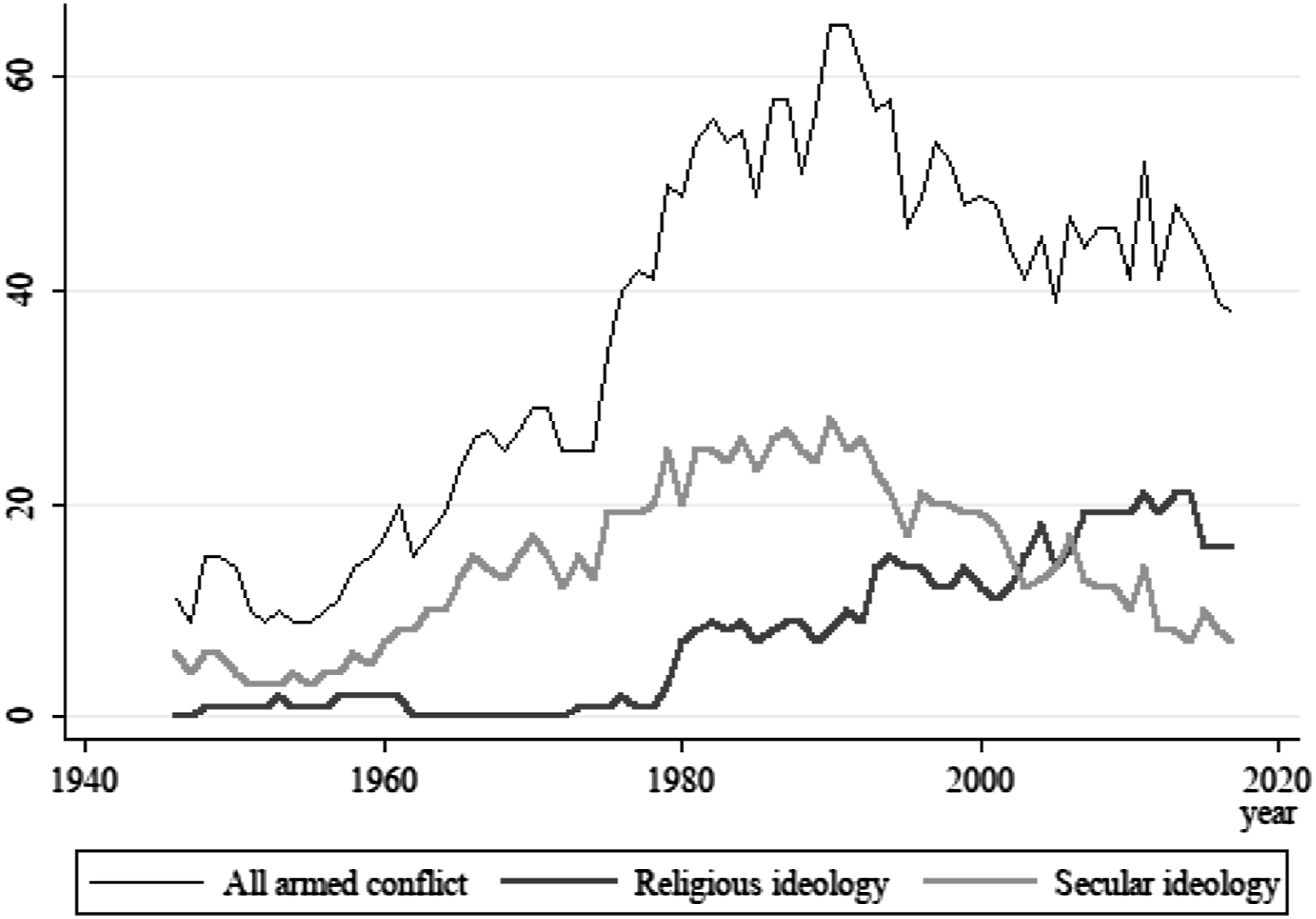
Multivariate Analysis
Our analyses for conflict duration employ Cox proportional hazard models to measure the “risk” of conflict termination over the course of each identified conflict event. As noted above, rebel group conflict-dyads frequently include recurrences, wherein groups that have previously suffered defeat or reached conflict-ending agreements with states return to violence. So, while we treat each new conflict outbreak as initiating a new conflict duration count, to properly capture the “risk” of conflict termination in such contexts requires stratifying our analyses by failure order, wherein each event is measured first from entry and then from the previous event (Prentice, Williams and Peterson 1981). This differs somewhat from more common approaches in the intrastate conflict literature utilizing Cox proportional hazard models which assume the baseline “risk” of conflict termination should not vary over time regardless of previously observed failures (Cunningham, Gleditsch, and Salehyan 2009; Keels and Wiegand 2020). Specific results for our dyadic and monadic duration models are presented in Supplemental Tables A2 and A3 respectively in the Online Appendix. Summary of major effects for each is presented in marginal effects point-estimate graphs in the primary text in Figures 2 and 3 respectively.
13
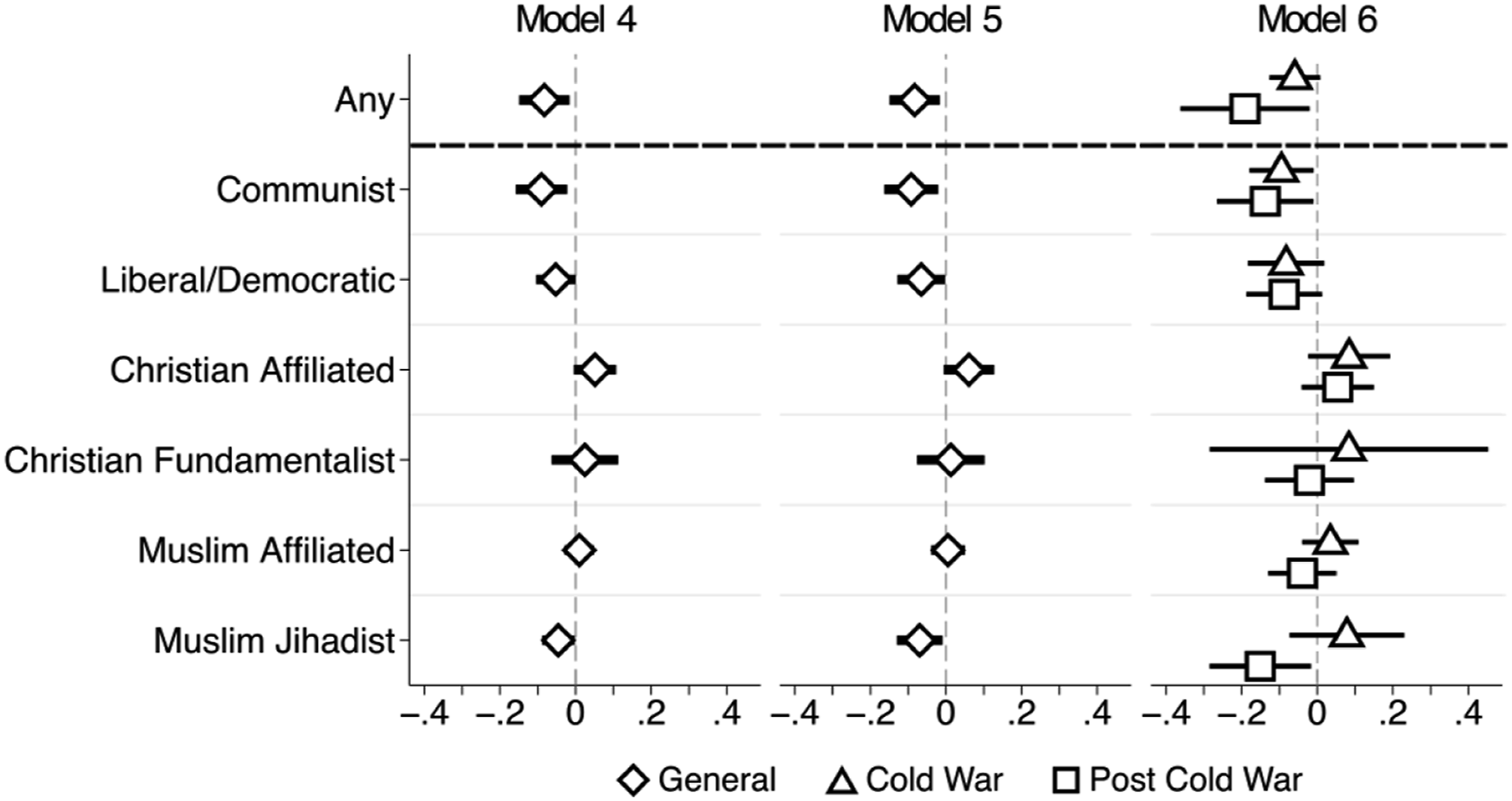
Marginal “Risk” of Armed Conflict Termination by Ideological Incompatibility, 1950-2017. Model 2 includes a post-cold war dummy. Marginal “Risk” of Armed Conflict Termination by Rebel Claim Type, 1950-2017. Model 5 includes a post-cold war dummy.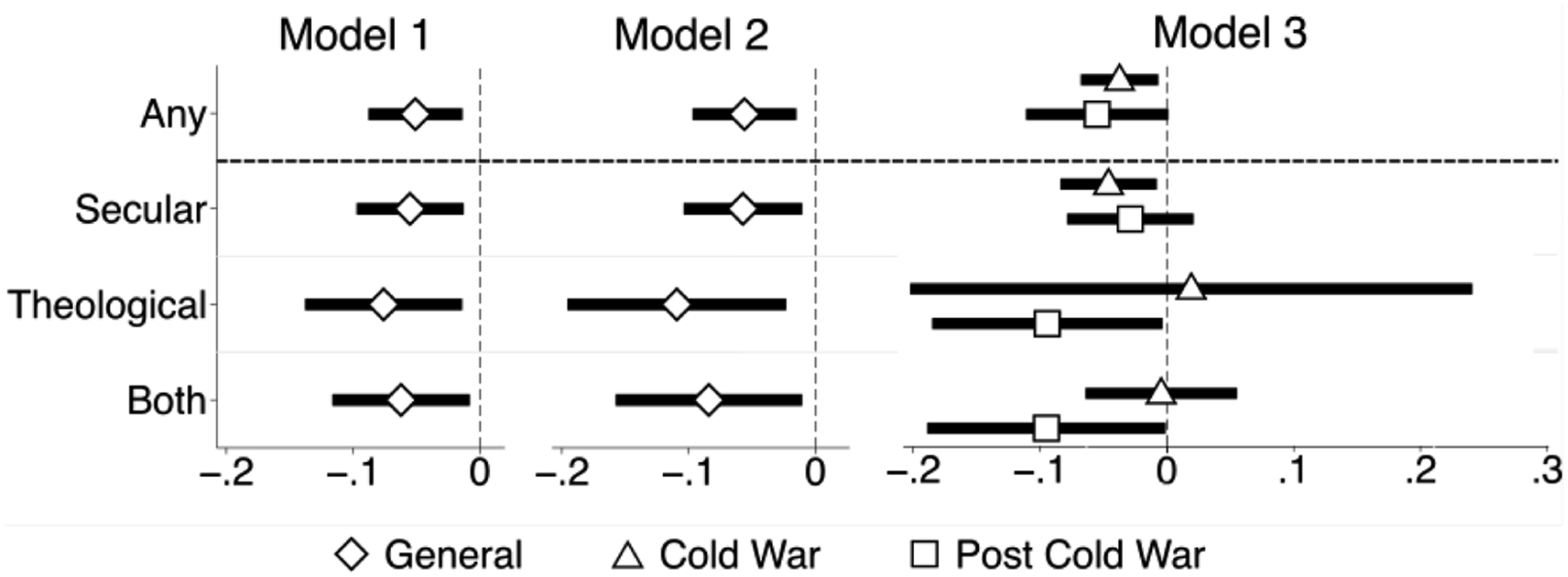
Our analyses of conflict intensity utilize two approaches. For models estimating the likelihood of low versus high-intensity conflict for the 1950-2017 period, we employ random effects logits clustered by armed conflict dyads. A fixed-effects approach may be preferable, given the possibility that unobserved variables may be correlated with included explanatory variables. However, as the dichotomous conflict intensity variable is typically invariant within each dispute dyad, any fixed-effects model would exclude nearly all relevant cases. For a more robust examination of conflict intensity in the post-Cold War era, 1989-2015 given the temporal coverage of our relevant variables, we employ Negative Binomial Regressions measuring battle-related deaths, using both random and fixed effects models. This estimation technique is ideal for modeling discrete, non-negative, overdispersed count data, where the standard deviation of said data is considerably larger than its average (King 1989). All conflict intensity models presented here also include year-level dummies to control for year-specific effects.
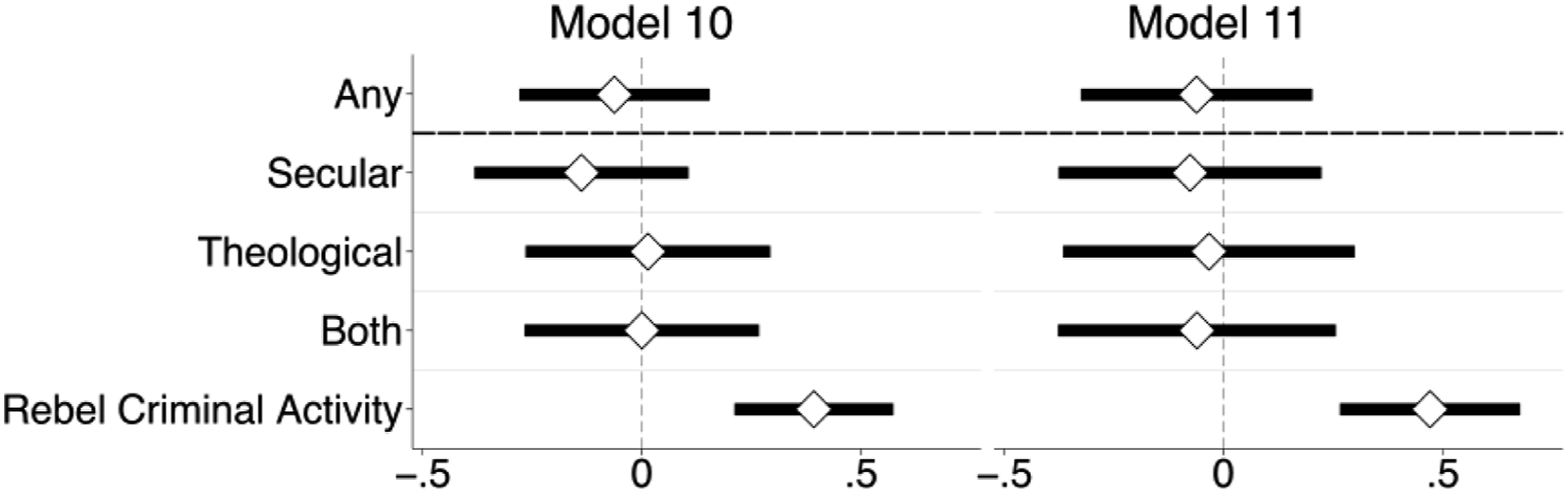
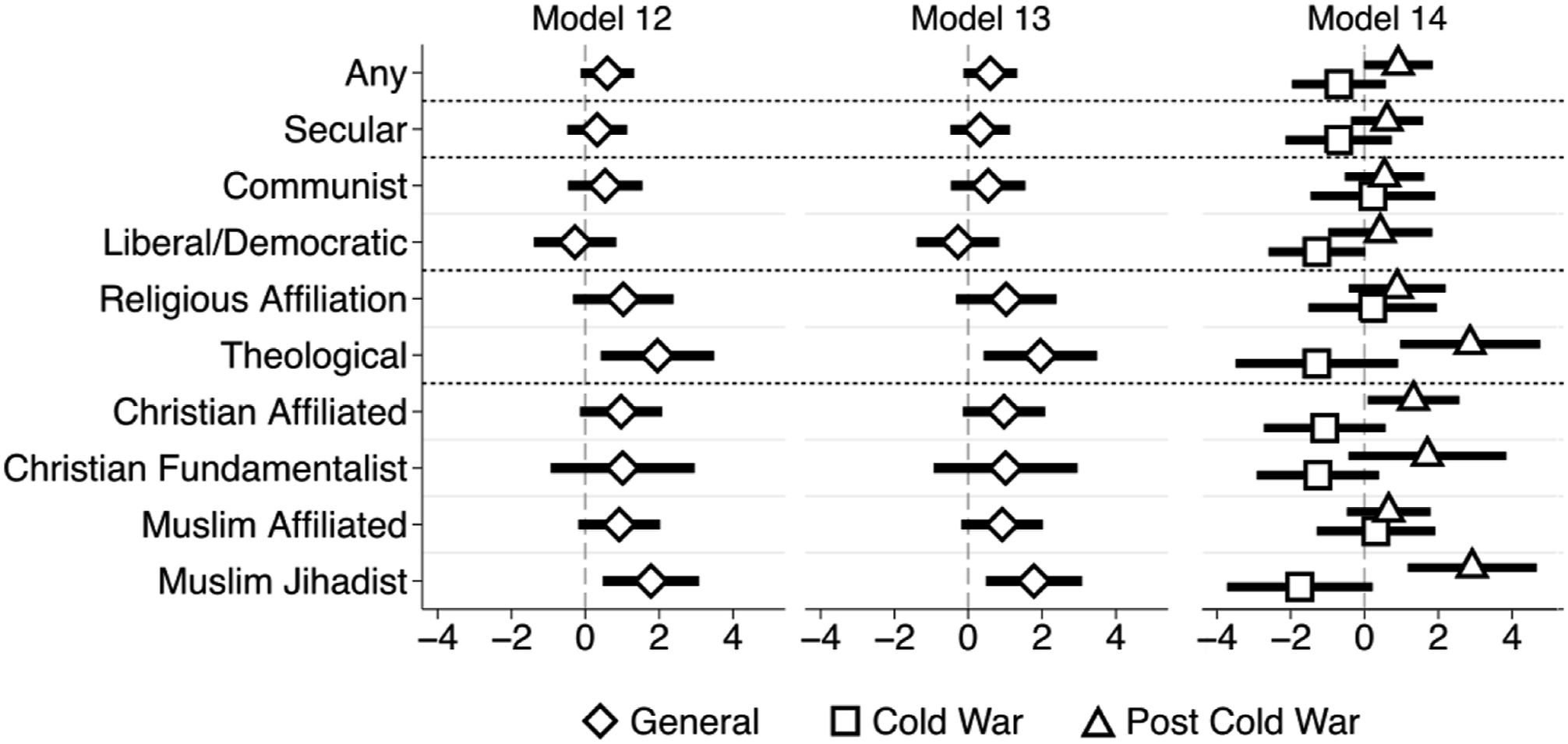
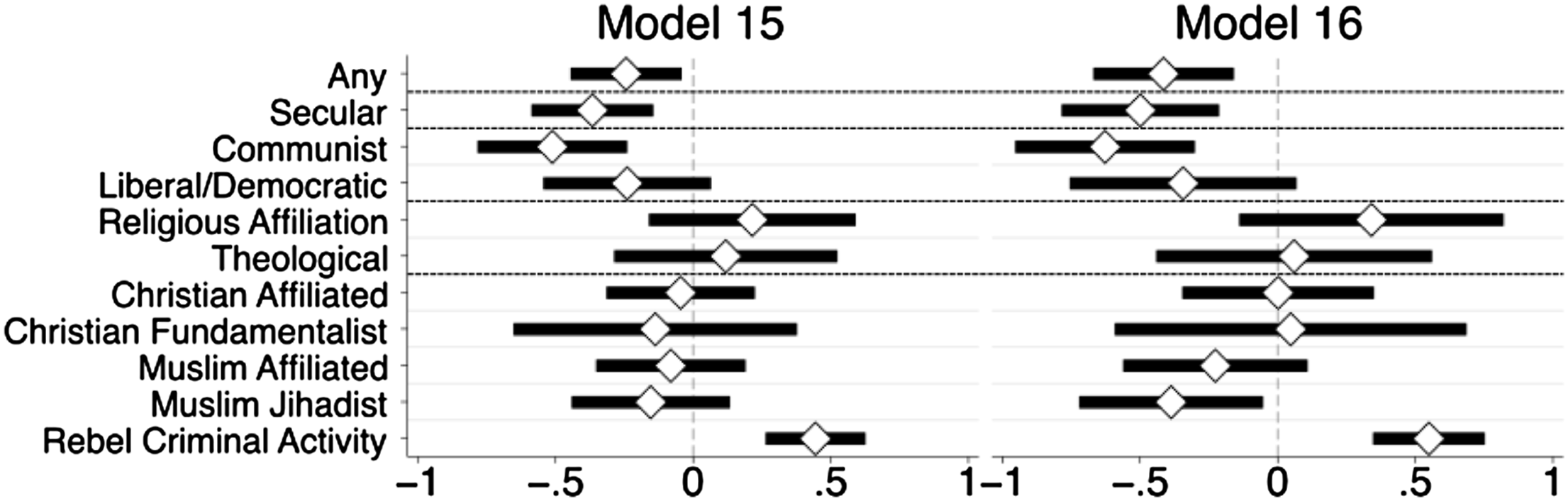
Full results for our dyadic intensity models are presented in Supplemental Tables A4 and A5, and full results for our monadic intensity models are presented in in the Online Appendix. Major effects for our dyadic intensity models based upon UCDP dichotomous intensity measures are summarized in Figure 4, while comparable effects based upon UCDP battle-related death measures are summarized in Figure 5. Major effects for our monadic intensity models based upon the UCDP intensity measure are summarized in Figure 6, with comparable effects based upon battle-related deaths are summarized in Figure 7. All figures appear in the primary text. Conflict Intensity by Incompatibility Type, UCDP Intensity, 1950-2017. Model 8 includes a post-cold war dummy. Conflict Intensity by Incompatibility Type, Battle Related Deaths, 1989-2015. Model 10 employs a random effect negative binomial panel model and Model 11 employs a fixed-effects model. Conflict Intensity by Rebel Claim Type, UCDP Intensity, 1950-2017. Model 13 includes a post-cold war dummy. Conflict Intensity by Rebel Claim Type, Battle Related Deaths, 1989-2015. Model 15 employs a random effect negative binomial panel model and Model 16 employs a fixed-effects model.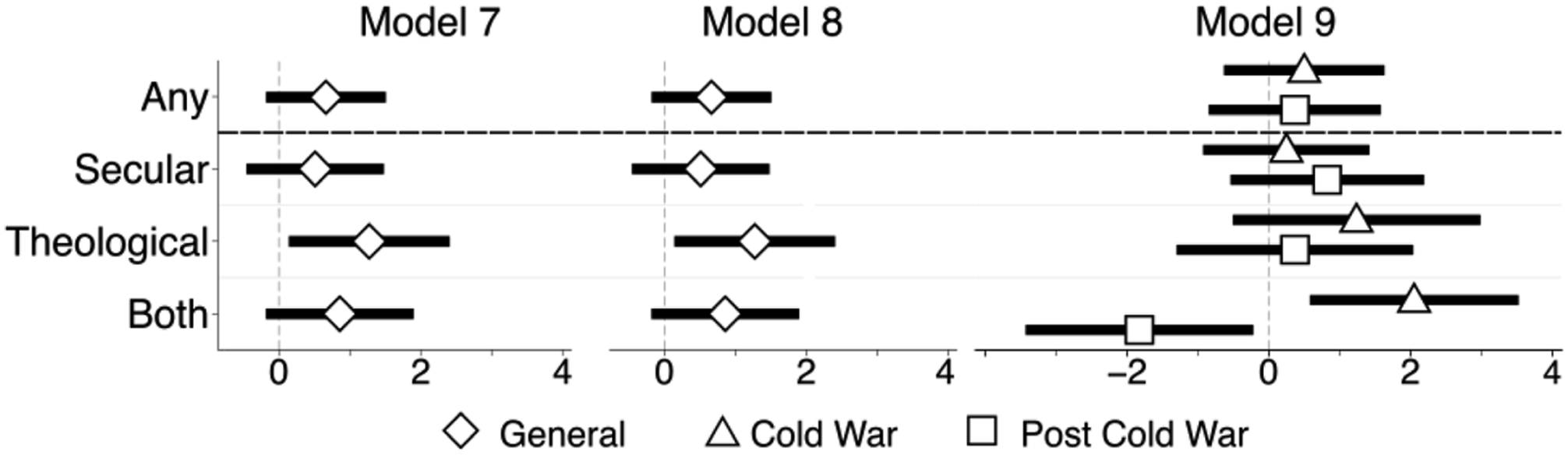
Conflict Duration
Results from our basic dyadic examination of intrastate conflict duration strongly confirm our first hypothesis (H1) that armed conflicts with any ideology, i.e., theological and secular ideological incompatibilities, are longer than those not involving such ideological incompatibilities. Both models 1a and 2a, testing the effect of “any” rebel-state ideological incompatibility, and models 1b and 2b, specifically gauging the influence of secular and theological incompatibilities, reveal their highly significant influence on conflict protraction, despite finding significantly reduced conflict duration in the post-Cold War era. These findings are clearly on display in Figure 2 as well as Supplemental Figures A1 and A2 in the Online Appendix, which suggest an overall strong conflict protracting influence of ideological incompatibilities. Alternatively framed via hazard ratios, the specific calculations of which we provide in the appendix (Supplemental Tables A2-HR and A3-HR), general ideological incompatibilities are associated with just over a 60% decrease in the risk of civil war termination relative to conflicts lacking an ideological incompatibility between rebels and states (Figure 2).
Distinguishing between secular and theological conflict seemingly reveals little differences (H2) between the two as their coefficients imply more or less equal durations (1b-2b). Examining hazard ratios for models 1b and 2b, however, offers more nuance. When not controlling for the post-Cold War period, secular ideological incompatibilities see a 34% decrease in the risk of civil war termination, whereas theological incompatibilities and conflicts with both ideological incompatibilities see a 50% or 59% decrease in the risk of civil war termination respectively. Yet controlling for the post-Cold War period sees secular incompatibilities jump to a 70% decrease in the risk of civil war termination, while theological incompatibilities and those associated with both are associated with only a 43% and 56% decrease respectively. These differential findings also foreshadow the importance of the end of the Cold War as a threshold event for ideological conflict duration.
The importance of considering the influence of distinct geopolitical eras, i.e., during and after the Cold War (H3), is readily apparent in models 3a and 3b. The more general model sustains the significant conflict protracting effect of ideological incompatibility during the Cold War but not after its conclusion. Hazard ratios for the non-interacted versus interacted terms in Model 3a reveal that although general ideological incompatibilities were associated with a 62% decrease in the risk of conflict termination during the Cold War, no such significantly differentiable effect is apparent post-Cold War. Model 3b however reveals critical nuance. Whereas secular ideological incompatibilities are strongly associated with conflict protraction during the Cold War, they are not necessarily so in the contemporary era. So too, although neither theological incompatibilities nor combined secular and theological incompatibilities are significantly related to conflict protraction during the Cold War, combined secular and theological incompatibilities are strongly associated with conflict protraction post-Cold War. Again, see Figure 2. These effects are even more apparent when examining hazard ratios. Namely, although secular incompatibilities were associated with a 59% decrease in the risk of conflict termination during the Cold War, no significant differentiable effect is apparent for the post-Cold War period. By contrast, whereas neither theological nor paired secular and theological incompatibilities are associated with conflict protraction during the Cold War, the combination of secular and theological incompatibilities is associated with a 44% decrease in the risk of conflict termination after the Cold War. This finding not only strongly confirms our basic assumption in H3 that secular incompatibilities’ conflict protracting effect are a product of the Cold War, but our theoretical reasoning that in the post-Cold War era, rebels have had to diversify their ideological appeals to draw suppor (Figure 3).
These results are largely replicated in our monadic analyses in Supplemental Appendix Table A3 as further illustrated in Figure 3. Any ideological claim increases duration, but we find little to no differences regarding the type of claim, be it Communist or liberal/democratic rebels or theological (especially Jihadist). As in our dyadic models, we find that rebels with ideological claims, undifferentiated between various secular and theological types, are significantly associated with conflict protraction both during and potentially following the Cold War. Yet again, we see this picture changes substantially when accounting for differential effects between the Cold War and post-Cold War eras. Model 6b shows that Communist and liberal democratic rebels are strongly associated with conflict protraction in the first period, but not significantly more or less so in the second. By contrast, Jihadist rebels are highly significantly associated with conflict protraction in the period after the Cold War. Hazard ratios demonstrating the magnitude of these effects are available in the online appendix (Tables A2-HR and A3-HR).
Taken together, the dyadic and monadic duration models confirm two out of three hypotheses: Ideological incompatibilities and rebel ideological claims are indeed increasing conflict duration (H1). On average, however, we find little difference regarding different types of ideology over the whole period (H2). Yet, we find that the impact of ideologies clearly differs between the Cold War and after (H3).
Conflict Intensity
While the above analyses largely confirm arguments that ideological conflicts tend to be more protracted, our analyses suggest a much more limited role of ideology for conflict intensity. As mentioned previously, the first three models employ the UCDP’s dichotomous conflict intensity measure, for which data is available for the entire temporal range. The latter two models employ UCDP’s best estimates for battle-related deaths, which although much more precise, only began measurement in 1989. Contra our first hypothesis on intensity (H4), armed conflicts with any ideological incompatibilities are not clearly more deadly than those without such apparent motivations. When considering the influence of “any” ideological incompatibility, not differentiating between secular ideological and theological claims, all models in Supplemental Table A4 suggest no significant effect whatsoever (see Figure 4). Both models 10a and 11a, examining specific battle-related deaths in the post-Cold War era find no effect whatsoever for ideological (nor religious affiliation) incompatibilities. Rather, increases in violence are most clearly associated with rebel criminal activity, wherein rebels so engaged are associated with an about 1.5- or 1.6-times greater battlefield casualty rate than non-criminally engaged rebels, for random- and fixed-effects models respectively. 14 See Figure 5. They may also be correlated with target state democracy, but this effect holds only in the fixed-effects model (Figure 4 and 5).
Dyadic models in Supplemental Table A5, which distinguish between various secular and theological incompatibilities tell a somewhat more nuanced story, only partially confirming H5. In the dichotomous conflict intensity models, we find that religious affiliation incompatibilities and theological incompatibilities are each associated with greater conflict intensity whereas secular ideological incompatibilities, i.e., Communism and liberal democracy are not. However once introducing the post-Cold War interaction term, we find that whereas conflicts involving both secular and theological incompatibilities are associated with greater conflict intensity in the first period, they are associated with significantly diminished conflict intensity in the second (Figure 4). Examining battle-related deaths in the post-Cold War era alone (Figure 5), we again find that only rebel criminality is clearly associated with increased violence—at a nearly identical rate as described above—while greater middling democracy is significant only in the fixed-effects model.
Our monadic models initially appear to partly confirm our hypothesis 5 (H5), insofar as armed conflicts with theological rebels appear deadlier than those with secular ideologies. In Supplemental Table A7, we see in all models based upon the dichotomous intensity variable that although secular ideological rebels are not associated with greater violence, theological rebels are significantly so. Upon introducing the post-Cold War interaction term in model 14b, theological rebels remain significantly associated with greater violence especially during the Cold War, while no such differentiable effects are found for secular ideological rebels (Figure 6).
In models 15b and 16b based upon battle-related deaths in the post-Cold War era, secular ideological rebels are associated with significantly fewer casualties whereas theological rebels have no apparent significant influence. By the same token, rebel criminality remains a strong predictor of violence—with nearly identical rates as reported above—as further apparent in Figure 6 and 7.
When differentiating between different kinds of secular and theological rebel claims in Supplemental Table A8, a more precise image is revealed. In the first set of monadic models, it seems that Jihadists are strongly associated with greater conflict intensity with less significant effects for Christian-affiliated rebels, whereas no such influence is apparent for secular ideological rebels. In other words, the previously observed effect of theological rebel violence is largely produced by Jihadists (Figure 6). The introduction of the post-Cold War interaction term however suggests that Jihadist insurgencies may be less intense in the second period. This result is confirmed in model 16c, where it is found that both Jihadist and Communist rebels are associated with significant reductions in violence whereas. Again, rebel criminality—1.6 and 1.7 times greater battlefield fatalities for random and fixed effects models respectively—and democracy (in the fixed-effects model only) are associated with significant increases in battle-related deaths (see Figure 7).
Altogether, our conflict intensity models substantially question common assertions that more ideological conflicts and rebels are necessarily more violent (contra H4 and H5). If anything, we find some evidence that religion increases the intensity of violence, but this only holds true for our dichotomous measure of conflict intensity and for the Cold War period (supporting H6). Our more fine-grained analysis of numbers of battle-related deaths, for which only data from after 1989 was available, shows no support whatsoever for an increasing role of ideology. Rather, we find that ideology decreases the intensity of violence after 1989. More importantly, we find other variables to be much more relevant. First, territorial conflicts and higher income apparently decrease the intensity of conflicts. However, this is not fully robust to all models, especially not after 1989 with more fine-grained data. Second, two variables stand out to explain why intensity may increase. Foreign military intervention and criminal activity of rebel groups, especially the latter after 1989, make conflicts bloodier – both speak to material aspects of violence rather than ideological ones.
As indicated in the empirical strategy section, we performed numerous robustness checks, including alternative measures for rebel foreign support; inclusion of ethnic affiliation and ethnic “ideological” claims in dyadic and monadic forms; and other geopolitically relevant watersheds (1979 and 2001). These additional analyses reveal no meaningful differences and are documented in the online appendix (Tables A2C1-A8C).
Conclusion
Our results can be summarized as follows: Confirming recent findings on conflict duration, we find that ideology indeed prolongs conflicts. There are few differences between various ideologies, but secular ideologies mostly account for duration before the end of the Cold War and theological ones after. In contrast, we find limited evidence that rebel ideology influences conflict intensity. Some evidence suggests that Jihadist violence is deadlier than other ideologies but – perhaps unexpectedly – we cannot uphold this claim for the post-Cold War period. Rather, ideological influences appear to decrease rather than increase conflict intensity in the contemporary era. In turn, foreign military support and criminal activity by rebel groups better account for increasing levels of intrastate violence. In short: Ideology matters for armed conflict, but effects vary according to various outcomes and conditions and work in conjunction with other factors, especially historical eras, and material factors.
Many questions persist: How can we make sense of ideology’s differential impact on conflict duration versus intensity? We propose the solution can be found in the variable functions of material and immaterial factors in conflict – and how they relate to motivation and capacity respectively. Ideology can boost morale and increase willingness to bear the costs of protracted armed struggle, especially when resorting to low-intensity warfare such as guerrilla tactics. However, rebel capacity to inflict high casualties is deeply dependent upon material resources, which are often acquired via criminal activity regardless of “grand” ideological commitments. Indeed, contemporary Jihadist and Communist groups like Columbia’s FARC are known for engaging in practices such as illicit trade of resources, money laundering, or hostage-taking (Conrad et al. 2019). This may also explain why ideological rebels' ability to inflict causalities has apparently decreased in the post-Cold War era. With sharply reduced superpower patronage, rebel groups have to seek alternative, but less effective means of finance.
We also have an important insight regarding religion. Theological ideology is often studied in isolation (or in relation to religious identity) rather than in comparison to other, potentially functionally equivalent ideologies. Our results suggest that religion is not so unique. Vice versa, “mainstream” conflict scholars should acknowledge that religion has not only an important identity dimension but frequently includes a substantial ideological element that affects outcomes such as duration, especially regarding the indivisibility of issues (Hassner 2003). The future study of armed conflict requires an integrated effort: Ideology and types thereof should be studied in conjunction with material and identity-related factors, both at the national and the international level and across historical periods.
Many additional challenges and opportunities for future research exist. First, studies need to better understand mechanisms why ideology helps rebels to sustain insurgency yet largely fail to increase their lethality. Second, conflict studies need to investigate ideology in a more fine-grained manner (Leader Maynard 2019): Our study does not really account for the depth of ideological convictions of warring factions and, in the dyadic logic, the ideological distance between them. Third, one may also look at the influence of ideology, and related values, on other outcomes such as the onset of conflict, although this will require comprehensive knowledge and data on ideological cleavages before the outbreak of violence. Fourth, greater efforts must be made to identify the extent to which ideological claims are genuine or merely instrumental, particularly in terms of attracting recruits and external patronage. “Truly” ideologically motivated rebels might be more violent, but this effect is being buried by rebels with instrumental ideological claims. A related avenue of research may investigate why rebels adopt ideologies and why others do not (Leader Maynard 2019, 640).
In terms of policy implications, we should caution against beliefs, often held by scholars and policymakers, that armed groups like Boko Haram, IS, or the Taliban as harbingers of massively violent conflict owing to their ideological demands, while perhaps underplaying the extent to which their violence may be driven by criminal activity. Corresponding strategies to reduce their lethality might therefore be informed by addressing sources of rebel capacity. In contrast, the ideological motives of “rebels with a cause” seem to strongly count for how to end conflicts.
Supplemental Material
Supplemental Material - Rebels with a Cause: Does Ideology Make Armed Conflicts Longer and Bloodier?
Supplemental Material for Rebels with a Cause: Does Ideology Make Armed Conflicts Longer and Bloodier? by Matthias Basedau, Mora Deitch, and Ariel Zellman in Journal of Conflict Resolution
Footnotes
Acknowledgments
The authors thank Ida Rudolfsen and an outstanding team of research assistants for their contribution to the development of the dataset. They also thank Jonathan Fox, Peter Henne, and the two anonymous reviewers for their insightful comments.
Declaration of Conflicting Interests
The author(s) declared no potential conflicts of interest with respect to the research, authorship, and/or publication of this article.
Funding
The author(s) received no financial support for the research, authorship, and/or publication of this article.

Supplemental Material
Supplemental Material for this article is available online.
Notes
References
Supplementary Material
Please find the following supplemental material available below.
For Open Access articles published under a Creative Commons License, all supplemental material carries the same license as the article it is associated with.
For non-Open Access articles published, all supplemental material carries a non-exclusive license, and permission requests for re-use of supplemental material or any part of supplemental material shall be sent directly to the copyright owner as specified in the copyright notice associated with the article.
