




Abstract
Research on postwar peace focuses primarily on how elites and institutions can prevent relapse into civil war. In line with this special issue’s focus on citizens’ experiences, we take a micro-level approach to explore peace beyond the absence of war. We investigate how members of opposing sides experience peace a decade after a decisive victory of the majority. Using original survey data from a representative sample of 2000 respondents in 2018 Sri Lanka, we find that even one decade after the conflict members of the Sinhalese winning majority are consistently more likely to report improvements in peace than Tamils, who were represented by the defeated minority. But the benefit of a “victor’s peace” does not seem to translate into an optimistic outlook of the victorious group, nor does it increase people’s endorsement for repressive state measures. Despite the drastically improved physical security for the defeated ethnic minority since the war, they experience a deterioration in other dimensions of peace. Our findings have important implications for a deeper understanding of variations in peace and reconciliation processes.
Civil wars that end with a decisive victory for one side often lead to durable peace (Licklider 1995; Toft 2010; Wagner 1993). Yet, the mere absence of war might overshadow a much darker reality. Clear victories can devolve into “enduring peace with tyranny” (Toft 2010, 49). Despite an increasingly comprehensive view of the dynamics that shape postwar politics, we know comparatively little about how the wider population subjectively assesses security and peace in postwar societies. We complement work that focuses on the role of elites and institutions in preventing a relapse into full-scale civil war (e.g., Brancati and Snyder 2013; Hartzell and Hoddie 2020; Sriram 2017) by investigating how civilians perceive the quality of peace after a clear government victory ended a long and bloody civil war.
The focus on institutions and elites, which dominates research on postwar peace, generally understands peace as the absence of war. But the absence of battle deaths does not automatically translate into meaningful peace. Postwar societies vary drastically in what their “peace” looks like (Höglund and Kovacs 2010). We contribute to recent studies that call for a more differentiated understanding of peace (Davenport, Melander and Regan 2018; Diehl 2016; Joshi and Wallensteen 2018; Regan 2014; Wallensteen 2015) by distinguishing between core components of post-conflict peace. Together, the components offer a complementary and multi-faceted depiction of peace, encompassing political and personal aspects, as well as government provisions that are essential for well-functioning post-conflict governance (Stevens and Vaughan-Williams 2016).
We apply a bottom-up, micro-level analysis of peace processes (Autesserre 2017; Firchow and Ginty 2017; Firchow 2018; Tellez 2019a) to reveal differences between societal groups’ perceptions of distinct aspects of post-conflict peace (Introduction this issue). We concentrate on four different facets of post-conflict peace to study the subjective assessment of peace quality. We analyze citizens’ perceptions of the relationship between former warring groups, of their personal security, of freedom of speech and fair political treatment. These retrospective evaluations of how conditions changed since the end of the war are contrasted with individual assessments of the prospects for future stability and peace.
We apply this micro-level approach to societies emerging from a unilateral victory. 1 Conditions after a decisive government victory are prone to facilitate an “uneven peace,” where parts of the population enjoy widespread security and human rights, while other parts see their slice of peace tainted due to unequal treatment by the government or fear of falling victim to criminal violence. How do citizens that were represented by formerly warring groups retrospectively and prospectively assess different dimensions of peace? We argue that citizens associated with the winning faction should retrospectively perceive the development of peace more positively than those of the losing side. 2 Looking towards the future, members of the victorious side should also be more optimistic about the prospects for peace due to their dominant position in politics and society.
We test our expectations using original and representative data from a face-to-face survey of over 2000 respondents carried out in Sri Lanka in 2018. Sri Lanka presents a classic case of a “victor’s peace” (Höglund and Orjuela 2011). In 2009, after a 26-years long brutal civil war, the Sinhalese government completely defeated the Liberation Tigers of Tamil Elan (LTTE), who claimed to represent the Sri Lankan Tamils living in the north and east of the country. Especially in the last months of the conflict, the military’s offensive was marked by war crimes against Tamil civilians, which caused tens of thousands of casualties (Reuters 2021). Throughout the postwar era, the victorious Sinhalese have dominated the country’s political life. Their numerical, political and economic superiority has not been at risk since the end of the civil war and this seems unlikely to change in the near future. 3 While this makes for a stable condition, it raises questions about the quality of peace as experienced by different groups.
We find that subjective evaluations of the quality of peace vary markedly between members of the victorious and of the defeated group a decade after the one-sided victory. 4 Individuals belonging to the Sinhalese ethnic group were indeed more likely than ethnic Tamils to report improvements across our four dimensions of peace, comprising aspects of inter-group relations, human security, civil liberties and views of the government. Ethnic Tamils do not experience such improvements, despite the drastically reduced threat of physical violence since the war. Our findings highlight that “lived security threats” (Nilsson and González Marín 2020, 243) do not depend on experiencing direct violence from armed actors.
However, the objectively advantageous position of Sinhalese and their positive assessment of security and human rights improvements since the end of the war do not translate into a positive outlook for the political stability of the country. Our results suggest that Sinhalese are substantially more concerned about future peace and stability than their Tamil counterparts, despite the Sinhalese having military completely devastated the LTTE in the war and despite the stable and comfortable position of power of the Sinhalese community due to their numerical dominance. Additional analyses into what might drive this puzzling result suggest that the more pessimistic outlook of Sinhalese respondents is not driven by fear of renewed conflict. Their concerns also do not translate into demanding a tougher stance towards minority groups. Instead, our results hint at a general level of weariness towards political activism and towards anything that might unsettle the political system. This uneasiness of the majority ethnic group towards political activities raises important questions about the quality and depth of both peace and democracy. If such activities are seen as threatening political stability, it weakens and possibly undermines a core element of a vibrant democracy.
Our study provides new insights into how individuals from opposing sides of a devastating and long-lasting war perceive changes in different dimensions of postwar peace and how they judge the future outlook for stability and peace. Analyzing how individuals interpret and evaluate change during a postwar period is crucial for understanding their attitudes, behavior and preferences today. Studying subjective perceptions of peace provides nuances on the legacy of armed conflict on an individual, personal level. A greater awareness of subjective perceptions is important because even objectively unfounded feelings of insecurity can heighten the risk of a renewed outbreak of violence. If citizens feel no substantial progress has been made since the end of the war, they might lose trust in the political process, disengage from politics or become radicalized to push for faster and more substantial change (Snyder 2000).
In an age where democratic elections dominate the political landscape, a better understanding of individuals’ subjective views is particularly important. Subjective feelings of physical security and political stability shape policy preferences, irrespective of the actual presence of threats. Feelings of insecurity towards a particular group can contribute to being more supportive of extreme measures against members of that group, including torture (Conrad et al. 2018). Long after the end of the war, sharp differences can continue to exist between warring communities' perceptions of peace agreements (Dyrstad et al. 2011, Dyrstad, Binningsbø and Bakke, this issue) and civil liberties (Kijewski and Rapp 2019). Irrespective of changes to the political system, to institutions, the security sector and bargains between the elites, it is crucial for successful reconciliation that all citizens experience the political system as inclusive and fair and are not concerned about their personal safety. If certain groups feel like they have been left behind, polarization cannot be overcome, and peace will remain little more than the absence of war.
In the next section we summarize related research on perceptions of security, primarily with the focus on respect for human rights. We outline why and how individual perceptions of peace and security matter before we develop our argument of why members of previously warring communities might have divergent views of these concepts years after the conflict came to an end. Next, we present the case of Sri Lanka and highlight why this is an interesting country to study as it provides a most likely scenario that one group should feel far more secure and more optimistic about the future than other groups. After introducing our survey, we present our results.
Perceptions of Peace and Security
Studies on public opinion and peace have largely focused on international conflict (e.g., Tomz and Weeks 2013; Stein 2013) or foreign policy (Kertzer and Zeitzoff 2017). Studies in this special issue investigate attitudes towards peace agreements. Loizides et al. (this issue) show that in ongoing civil wars, people have often divergent preferences about peace settlements (see also Tellez 2019b). Even long after the end of a civil war, citizens evaluate implemented peace agreements very differently (Dyrstad, Binningsbø and Bakke, this issue). To complement these studies on perceptions of formal peace agreements, we turn to how citizens evaluate improvements in experienced peace and the potential for renewed instability, since we know comparatively little about how citizens in postwar countries asses their own security and human rights. Focusing on human rights, some studies show that socio-economic indicators, such as education, economic development (Anderson et al. 2005; Carlson and Listhaug 2007) and the political ideology of the individual (Cohrs et al. 2007) influence how they evaluate human rights. Most research on public opinion and human rights assesses attitudes towards torture (e.g., Conrad et al. 2018; Piazza 2015) and the role of human rights in foreign aid allocation (Heinrich, Kobayashi and Long 2018).
Postwar societies pose a particularly interesting environment for assessing individual perceptions of peace, security and human rights. Wartime experiences can alter social processes, foster polarization of private and public loyalties (Wood 2008) and change individual attitudes and support for extremism (Canetti et al. 2013). Local loyalties can align with the cleavages dominating the war (Kalyvas 2003), they can harden prejudice and inter-group animosities. Hutchison (2014) shows that individual tolerance of nonconformist groups declines with conflict intensity. Warring groups might even perceive the nature of the conflict differently (Canetti et al. 2019). Dyrstad’s (2012) study on the successor countries of former Yugoslavia highlights that ethnic conflict does not always increase ethno-nationalism. War exposure itself does not systematically influence postwar ethnic prejudice (Strabac and Ringdal 2008) or support for peace agreements (Dyrstad et al. 2011). Analyzing support for the Macedonian Framework Agreement, Dyrstad et al. (2011) show that contextual factors, such as proximity to violent events and the ethnic composition of municipalities, had no clear impact on support for the peace agreement. Instead, preferences for the peace agreement diverged sharply between ethnic groups (see also Dyrstad, Binningsbø and Bakke in this issue).
We have little systematic evidence on how individual perceptions of peace and security vary and how they might differ between societal groups. This is particularly problematic from a policy perspective. For example, support for peace agreements and reconciliation might partly be driven by individual perceptions of improved security. Individuals who identify an improvement in security, stability and the relationship between previously warring groups might also be more willing to support reconciliation measures. For this reason, we need to better understand how members of formerly warring groups feel about their personal freedom and security in post-conflict societies. Before delving into differences between people’s perceptions of the quality of postwar peace, we provide a conceptual discussion of the multi-faceted nature of perceived peace (Firchow and Ginty 2017; Firchow 2018).
Different Dimensions of Peace
Peace is an inherently multi-dimensional concept (Davenport, Melander and Regan 2018; Wallensteen 2015). As Diehl (2016, 9) states, “[s]tudying peace requires, first and foremost, broader conceptions of peace. These include consideration of justice, human rights, and other aspects of human security.” To understand how these dimensions play into individuals’ perceptions of peace, we shift our conceptual focus towards a multi-faceted assessment of post-conflict peace based on a bottom-up, micro-level perspective. In doing so, we complement work within this special issue (Dyrstad, Binningsbø and Bakke; Loizides et al.) that analyzes citizens’ preferences for and assessments of institutional changes and formal peace agreements (see also Tellez 2019a, 2019b).
We concentrate on how individuals subjectively experience post-conflict peace. We unpack the concept of peace quality and disaggregate it into four dimensions with the goal of representing complementary aspects, including individual experiences of personal security, their perceptions of potential general sociotropic threats and of realistic opportunities for political engagement. To capture these different qualities of postwar peace, we evaluate perceived changes in (1) the relationship between formerly warring groups, (2) the overall security in the country, (3) freedom of speech and (4) fairness of the government. These dimensions allow for valuable insights into and a more rounded portrait of the varied experiences of postwar peace and stability. They cover a wide range of factors that not only pertain to the risk of relapse into war but also people’s subjective perception of quality of peace: the initial cleavage of the civil war, the state’s performance in providing physical security, the option for citizens to engage in politics and to express grievances by means other than violence, as well as the government’s role as an impartial actor working in the interest of all people. 5 We elaborate on each of them in turn.
The first dimension captures improvements along the key dividing line of the civil war. It concentrates on how the relationship between the groups that constituted the main opponents in the civil war has improved since the end of the conflict. Information on the relationship between societal groups commonly associated with formerly warring parties hints at the direction of peace. If they do not seem to have improved in the years after the conflict, postwar peace is unlikely to go far beyond the (temporary) absence of war. It suggests that grievances and perceived inequalities that drove the conflict persist, at least for some citizens. Successful reconciliation should result in an improved relationship between formerly warring groups—as experienced and expressed by the individual members of these groups.
The second dimension of peace captures the level of personally experienced security. Basic human security is a key element of the quality of peace (e.g., Diehl 2016). While the absence of peace is usually restricted to include aspects of political violence or instability, non-political violence and threats to one’s security have a large impact on everyday lives and, therefore, the quality of peace. Living in fear of crime reflects an important element of a “negative peace” (Galtung 1969, 183), yet it is often excluded because it is deemed non-political. Firchow and Ginty (2017) find that feeling safe to walk in the streets or to go to the shop appears most frequently in lists of how individuals experience peace, mirroring the importance of this dimension. If citizens feel that security has not improved, for example because they think they might fall victim to crime, then this might affect their attitudes towards and views of the state and its institutions, such as the police. In the extreme, it might push citizens to take their security into their own hands and organize or support self-defense groups, which can undermine the authority and stability of the government and contribute to escalating instability and violence (Carey and González 2021; Schneckener 2017). Whether individual citizens feel more or less safe relative to the end of the war is thus an important element in how people experience peace in their everyday lives.
The third dimension represents the basis of perceived possibility to engage in politics on a fundamental level by capturing a key element of civil liberties: freedom of speech. It gives insights into whether people feel they can actively participate in the political discourse beyond being able to vote in elections. If citizens are afraid to speak freely about political issues in public, the quality of political engagement is severely hampered, even in the context of free and fair elections. Feeling able to exercise their right to freedom of speech facilitates popular engagement in and contribution to the political process, the exchange of ideas and the voicing of preferences. It provides a political space to solve disputes by means other than violence. When people are worried about significant costs from voicing their opinions in public, then peace as the absence of war has not effectively translated into an environment where individuals feel they can safely engage in politics. Freedom of speech is therefore an important component for the quality of postwar peace.
Our final dimension reflects a basic assessment of the state by capturing individuals’ perception of whether the government treats all people fairly. In post-conflict societies, it is particularly important to assess whether people see the government and its representatives as favoring some (formerly opposing) groups or individuals over others. The perception of biased state behavior can significantly hinder individuals’ trust in the state, which may have direct implications for peace prospects. People who are under the impression that officials make unfair decisions and are partisan toward their own group are less likely to accept and possibly follow formal procedures and regulations. This can undermine the effectiveness of state institutions and its bureaucracy, especially when such distrust persists over time. In the context of a “victor’s peace,” members of the defeated minority group might have very different experiences with and views of how governments treat individuals. If substantial concerns of a minority group about the fairness of the government persist many years after the end of the war, it can foster polarization and inter-group animosities.
Each of these four dimensions captures a subjective retrospective evaluation of changes since the end of the war. People’s assessments of peace do not necessarily rest upon objective developments or an accurate recollection of the conditions at the end of the war. But they are key to understanding how individuals evaluate their current situation relative to how they remember it from the end of the war. People who are nostalgic about the past and have an optimistic picture of how it used to be should be more likely to conclude that they are worse off today. This captures a feeling of “relative deprivation of safety,” relative to one’s own situation at an earlier point in time, rather than relative to other individuals or groups. Those who perceive themselves to have lost out and are in a worse situation now are likely to show more discontent and might be more likely to develop feelings of resentment against a group whom they perceive to have enjoyed greater improvements in their lives. 6
The Impact of Winning the War on Perceptions of Peace
A clear victory of one combatant over another creates an uneven footing for members of the winning group compared to members of the defeated one. This could have extreme consequences of the postwar period. Licklider (1995, 686) suggests that “military victories in identity civil wars may be more likely to be followed by genocide than negotiated settlements.” Uneven respect for human rights might follow not only from identity wars, but from all one-sided victories. Toft (2010, 49) argues that a government victory in general might be followed by “enduring peace with tyranny.” This tyranny after a clear victory of one group over another likely afflicts only parts of the population—those belonging to the defeated group.
These conditions are prone to facilitate an “uneven peace,” where parts of the population enjoy widespread security and human rights, while other parts see their slice of peace tainted due to unequal treatment by the government. Wallensteen (2015, 5) pointedly asks: “Does the postwar situation include respect for the equal rights of the opponent, in commitment and in practice? Without a positive response to this question, the dynamics of insecurity continue to operate.”
This question is particularly relevant for countries where a civil war ended with a clear victory of one side over another. A typical case is the Sri Lankan civil war, which ended with the government victory over the Liberation Tigers of Tamil Elan (LTTE) in 2009. On the surface, a decade after the war, relations between formerly warring Sinhalese and Tamils have been stable and without major violent confrontations. However, under President Mahinda Rajapaksa (2005–2015), ethnic Tamils were still not being treated equally and enjoying the same level of security and human rights as Sinhalese (Mittal 2015), although conditions slightly improved with the election of President Sirisena in 2015 (Seoighe 2017).
Following the victory of the Sinhalese government over the LTTE, we expect that Sinhalese perceive their situation today as greatly improved compared to after the end of the war. As members of the victor’s side, they have little reason to be constrained by inter-ethnic relationships and they might appreciate the overall increased personal security they now enjoy. They also have little reason to believe that the government would treat them unfairly, as demonstrated, for example, by the state’s handling of violent clashes between Sinhalese Buddhists and Muslims in February 2018 (Devotta 2018). The violent attacks by mobs of Buddhist supremacists on Muslim communities, mosques and properties remained largely uninhibited by the security forces (e.g., see BBC News 2018). According to Human Rights Watch, “the government’s inaction has also sent a message to the majority Sinhalese that they need not worry about being reined in by the authorities” (Ganguly 2018). When such violence remains largely unchecked, it can contribute to feeling protected—even when one violates basic rights of other groups.
While Sinhalese enjoy a privileged status, Sri Lankan Tamils continue to wait for transitional justice and reparations. In March 2018, the United Nations Deputy High Commissioner for Human Rights noted the continued lack of progress in establishing transitional justice mechanisms, in returning land to the Tamil minority that the military continues to occupy and in addressing impunity for gross violations of international human rights. 7
Sinhalese, as members of the winning group that continue to dominate the political system, are likely to evaluate changes since the end of the war more positively than the defeated Tamils. This might not necessarily reflect the objective changes Sinhalese experienced compared to Tamils. The war was predominantly confined to the Northern and Eastern Province, where Sinhalese make up only a small percentage of the population. Outside of these regions, and outside of the capital Colombo, which was frequently targeted by LTTE terrorist attacks, most Sinhalese were not directly affected by the fighting. While the objective gap in their personal condition now compared to the end of the war is likely less stark than for Tamils, Sinhalese might still extrapolate from their relatively comfortable position today that things have significantly improved.
Members of the minority Tamil group associated with the LTTE, which was brutally defeated in 2009, might have more reason than Sinhalese to register and report improvements. They suffered far greater violence, including widespread killings and displacement, than Sinhalese. At the end of the war, most Tamils found themselves in precarious economic conditions and had lost family and friends during the war (United Nations 2011). Therefore, any changes might be seen as improvements compared to such desperate conditions.
Given the complete victory of the Sinhalese government over the LTTE and their continued political dominance, we expect members of this victorious group to perceive greater improvements than Sri Lankan Tamils in all four retrospective assessments of peace. Considering that large ethnic divisions still remain, Tamils are probably more pessimistic than Sinhalese about how inter-relationships have changed. Due to the continued strong military presence in the Northern Province (Human Rights Watch 2018), Tamils are likely still concerned about their personal safety, while Sinhalese should feel substantially safer now than in 2009. With well established democratic elections and two peaceful turnovers of power at the polls since the end of the war, Sinhalese as the majority ethnic group have little reason to be concerned about political participation, including freely voicing their opinions about politics. As their ethnic group dominates political life, they should also perceive the government as treating them fairly, which might lead them to judge the government treating everyone fairly. Our first hypothesis summarizes these expectations:
Members of the victorious majority (Sinhalese) ethnic group evaluate improvements in security and human rights since the end of the civil war more positively than members of the defeated minority (Sri Lankan Tamil) ethnic group.
Understanding the perceptions of peace in post-conflict countries may not only relate to retrospective assessments but also to what the future entails. An expected trajectory away from conflict enhances trust in the government and encourages individuals to invest in their social, economic and political life. A lack of positive prospects for the country’s trajectory could undermine the reconciliatory efforts achieved so far and signal individuals’ fears about the stability of the country. In post-conflict contexts that follow a clear victory, not all citizens might share the same optimistic outlook. We expect members of the winning group, who benefit from dictating the pace of post-conflict politics, to be more optimistic about the future stability of the country than those belonging to the defeated group. In the case of Sri Lanka, the comfortable Sinhalese political majority grants this group advantages on their personal security and protects their rights. A positive retrospective assessment, as formulated in H1, should also translate into a positive prospective assessment. Relative to citizens outside the winning group, Sinhalese should, on average, be more optimistic about their country’s continued journey towards peace and stability.
Members of the victorious majority (Sinhalese) ethnic group are more optimistic about the future stability of the country than members of the defeated minority (Sri Lankan Tamil) ethnic group.
Research Design
To systematically assess differences in individual perceptions of peace in post-conflict societies, we conducted a representative survey in Sri Lanka. The original survey focuses on topics of peace, security, social cohesion and institutional trust in post-conflict Sri Lanka. It was carried out between August and September 2018, using structured face-to-face interviews in both the Sinhala and Tamil languages. The survey has a total of 2000 responses.
The Sample
We conducted the survey in three of the nine provinces in Sri Lanka: Northern, Eastern and Southern. Figure 1 shows in blue the provinces from which we randomly drew our sample. We strategically selected these provinces to contrast security and peace perception from conflict afflicted regions with those dominated by the group of the winning government. The armed conflict between the government and the LTTE was predominantly confined to the Northern and Eastern provinces, although the LTTE also carried out terror attacks in other areas, such as the capital Colombo. The Northern province is dominated by the Tamil ethnic group, making up about 94% of the population in this region. In the Eastern province, the Tamils account for 39% of the population and the Sri Lankan Moors, who are almost exclusively Muslim, another 37%. The Southern province is the ethnically most homogeneous province with 95% of its population belonging to the Sinhalese ethnic group, who are almost exclusively Buddhist.
8
The ethnic cleavages are reinforced by religion and language. With this selection, our sample is drawn from the two ethnically most homogeneous areas, one dominated by the Sinhalese (Southern) and the other by the Tamil ethnic group (Northern), and from the ethnically most diverse province, where the Tamils have a small majority over the Moors, and with the Sinhalese making up just over 20% of the population (Eastern). Map of sampled provinces in Sri Lanka. Note: In blue the Northern (top), Eastern (right) and Southern (bottom) provinces, where the survey took place. Within these provinces, we randomly selected the respondents to be representative at the province level.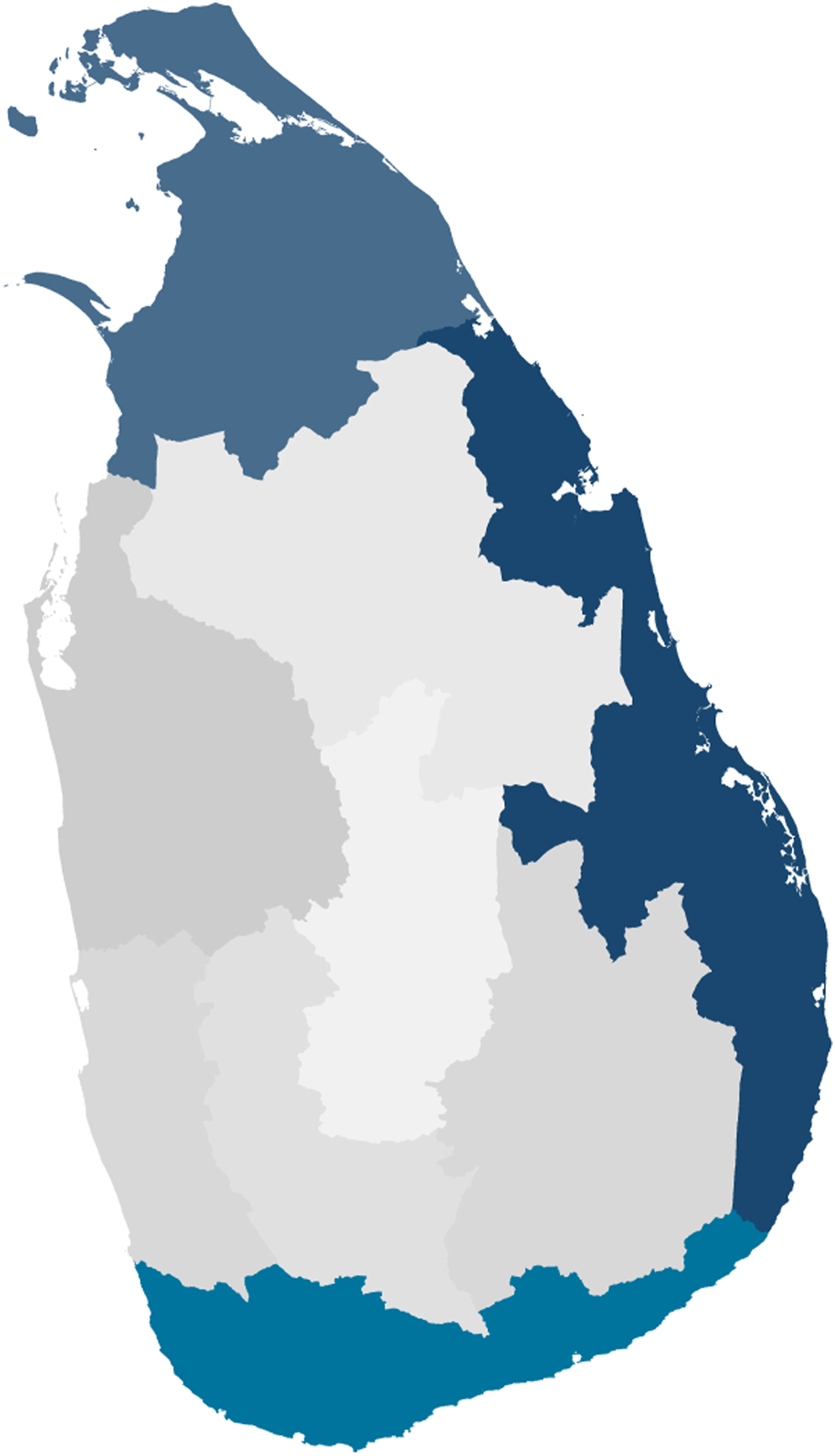
Within the strategically selected provinces, we used a multi-stage stratified random sample across all administrative levels within each province: District, District Secretariat (DS) and the Grama Niladhari (GN) divisions. To select individuals representative at the province level, we weighted the probability of a District being randomly selected based on the District’s share of the total province population. In each of the selected Districts, we followed the same weighted population procedure and randomly sampled one out of every three DS and again one out of every nine of GNs, the lower level administrative units. 9 The number of households within the selected GN was determined relative to the GN population. Enumerators followed a random walk procedure to identify the households, and the last birthday to identity the respondent. We selected 800 respondents in the Northern province, 700 in the Eastern and 500 in the Southern, arriving at a total of 2000 interviews. 10 Supplementary Table A1 shows the main characteristics of the population in the three provinces and Supplementary Table A2 provides the same information for our sampled population.
Survey Items and Analysis
To capture how individuals rate changes in peace quality, we asked respondents whether the following aspects had gotten worse, not changed, or gotten better since the end of the war in 2009 11 : (1) the relationship between different ethnic groups, (2) the overall security in Sri Lanka, (3) that people can say in public what they think about politics and (4) the right to be treated fairly by the government and its representatives. These survey items capture four critical, bottom-up dimensions of peace quality, comprising concerns about individual personal security as well as political injustices regarding the state’s respect for civil liberties and human rights.
Our key independent variable is a binary measure of ethnicity, quantifying whether a respondent self-identifies as belonging to the Sinhalese ethnic group. We control for belonging to the Tamil-Moors, using Sri Lankan Tamil as the reference category. We expect that the measure for being Sinhalese has a positive impact on our four perception indicators if individuals belonging to the winning group are more optimistic.
We control for basic socio-economic indicators on the individual level. We include gender, age and age squared in all models. We ask respondents for their highest level of education, coding no formal schooling and some primary schooling as Low education and completed secondary school or high school and higher as Higher education. The reference category is primary school completed or some intermediate, secondary or high school education. We measure economic well-being with two subjective assessments of the respondent’s own economic situation. We ask the respondent to assess her/his personal current economic condition. This variable Absolute economic condition is a five-point scale ranging from very bad to very good. The variable Relative economic condition asks the respondent to compare her/his own situation with that of the majority of people in Sri Lanka. This five-point scale variable ranges from much worse to much better. We also control for civil war exposure and ask whether they themselves or someone close to them was physically harmed during the war. We measure this with the binary indicator Harmed in war.
Finally, we control for media consumption as this may affect perception of security and peace. A negative view of the relationship between different ethnic groups and of the different dimensions peace can be re-enforced by the media. The media are more likely to report on bad news than on good news. Bad news are also seen as more credible than good news (Slovic 1993). Slovic (1993, 677) calls this the trust-asymmetry principle: “negative (trust-destroying) events are more visible or noticeable than positive (trust-building) events.” This bias towards trust-destroying events might be more pronounced for online media. Respondents who rely on online sources as a key information source might therefore have more negative perceptions of changes in inter-group relations and security. To evaluate whether individuals who rely on social media or online-only newspapers, radio or TV as a key source of information, we ask respondents to identify their two most important sources of information for news on current events in their country. The variable Use online media indicates reliance on social media or online-only newspapers, radio or TV. We control for reliance on traditional sources (TV, radio, newspapers) with the variable Use traditional media. The reference category is using family, friends or colleagues as main source of information. Summary statistics are shown in Supplementary Table A1 in the online supplement.
Divergent Perceptions of Peace
Perceived Changes in Ethnic Relations, Security, Freedom of Speech, and Political Fairness since 2009.
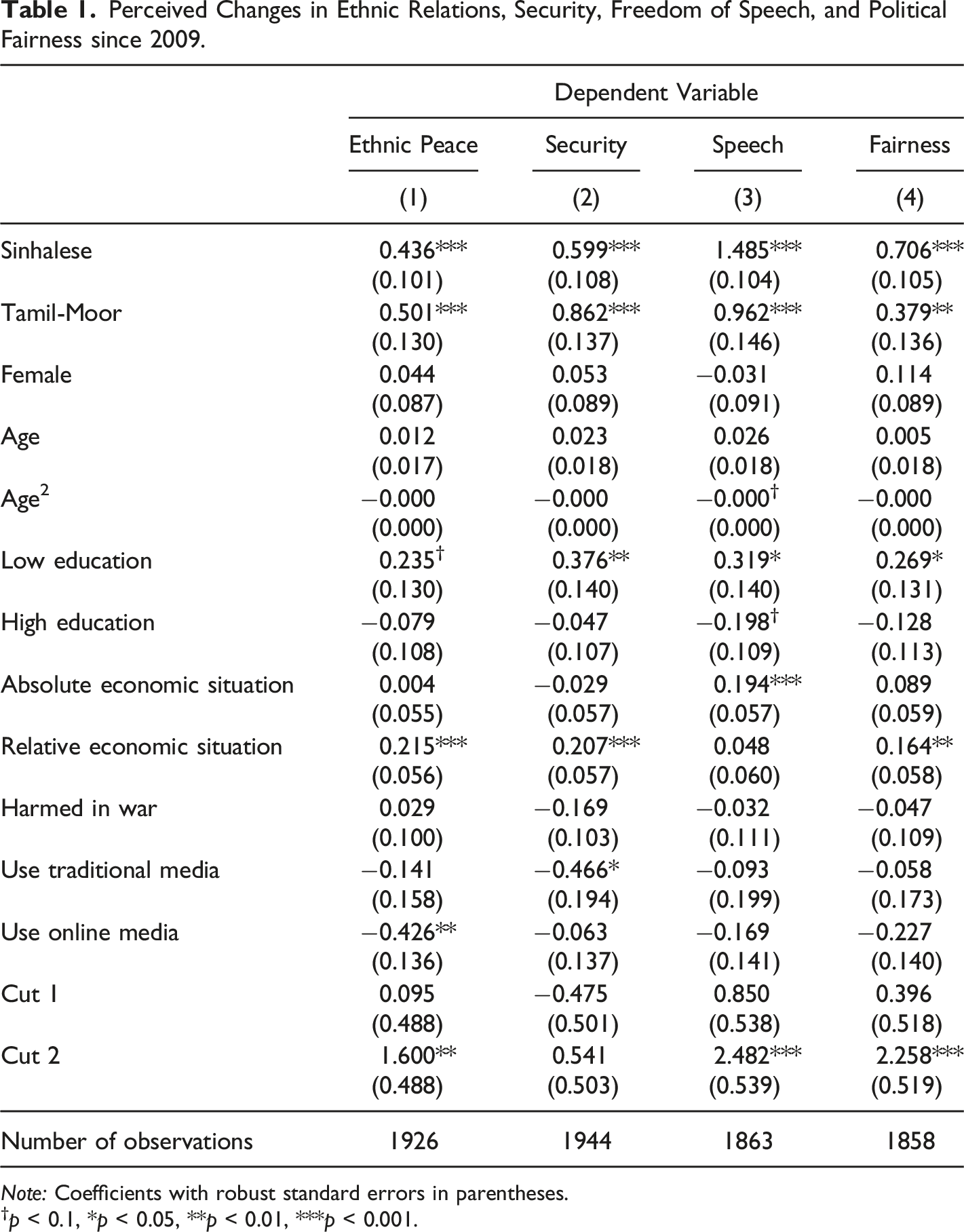
Note: Coefficients with robust standard errors in parentheses.
†p < 0.1, *p < 0.05, **p < 0.01, ***p < 0.001.
While Tamils might have objectively seen greater improvements given their extremely desolate situation at the end of the war, the comfortable position of the Sinhalese translates into a more positive evaluation compared to Tamils, lending further support for the label of a “victor’s peace.” 13
Figure 2 visualizes the substantive differences between the perceptions of peace by ethnic Sinhalese and Tamils. It presents the predicted probabilities that respondents from each ethnic group regard current inter-ethnic relations, security, freedom of speech and fairness of the government as worse, same or better than right after the end of the war. The plot in the top left corner shows that Sinhalese are substantively more likely than Tamils to report that inter-ethnic relations have improved, while Tamils are far more likely to report that they have deteriorated. Similarly, the top right panel demonstrates that Sinhalese are also more likely to perceive overall security as having improved compared to Tamil respondents. Substantive effect of ethnicity on perceived changes since the end of the war. Note: Simulations are based on Table 1. Graphs show the predicted probabilities of changes in ethnic relations (model 1), security (model 2), freedom of speech (model 3) and fairness of the government (model 4) for Sinhalese and Tamil ethnic respondents. Control variables are held at their mean or modal value. Vertical lines indicate 95% confidence intervals. The horizontal lines are displayed for easier visualisation of the differences between the answer categories and do not represent a time trend.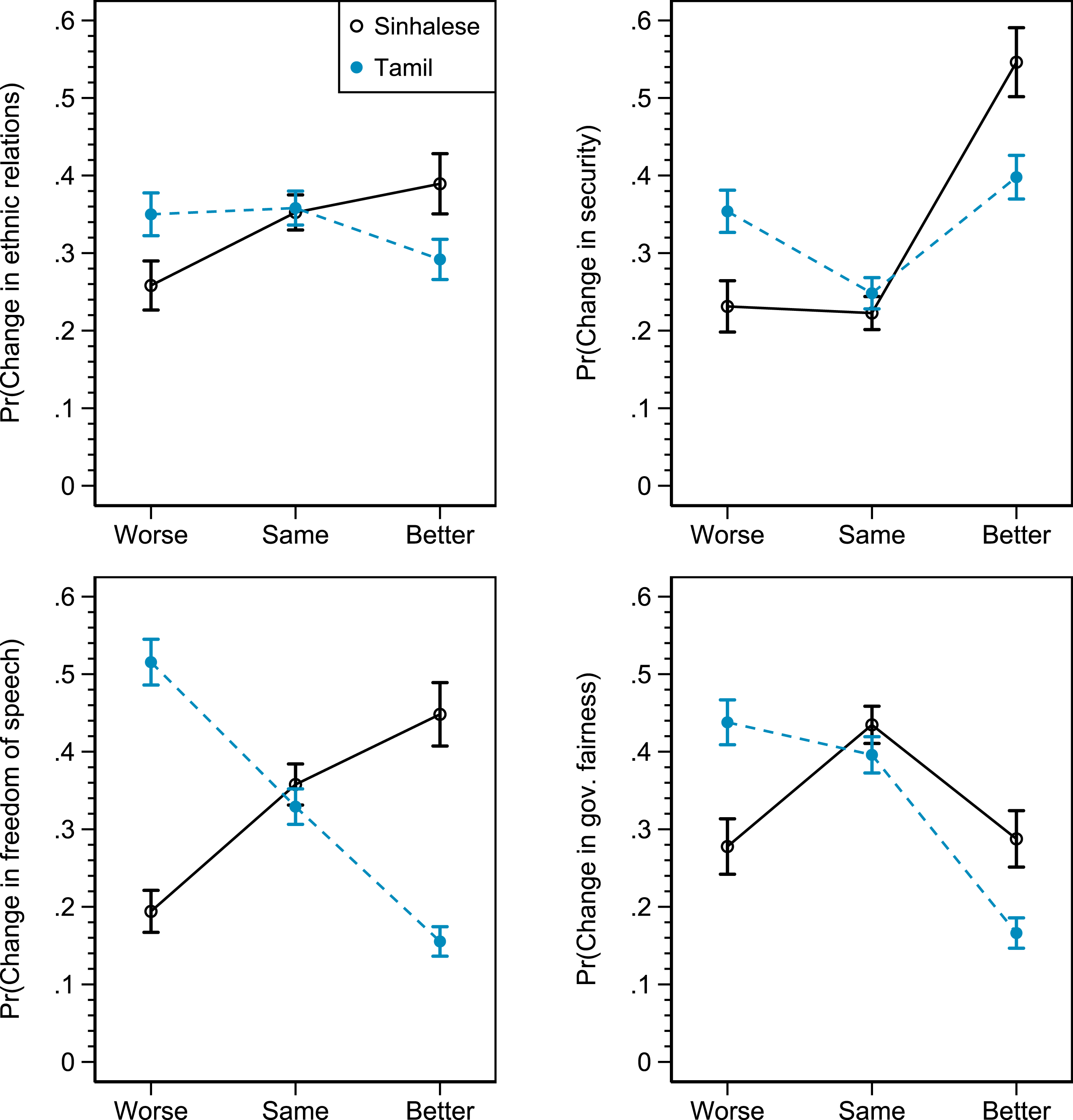
The contrast between both groups’ assessments of the development of freedom of speech is even starker, shown in the bottom left corner of Figure 2. Tamils are most likely to report that freedom of speech has deteriorated, while they are highly unlikely to report an improvement. The reverse is the case for Sinhalese respondents. These substantively very different responses should provoke further probing questions into subjective experiences of political life. If a disadvantaged minority group feels systematically unable to speak about politics in public, then this can hamper their active engagement in politics—which makes it more challenging to address existing inequalities.
Differences are also visible in people’s evaluations of the fairness of the government. The panel in the bottom right corner of the plot shows that, again, Sinhalese are on average fairly optimistic, whereas Tamils are more pessimistic about changes in that dimension since the end of the war. In sum, our empirical tests lend strong support for
Evaluating Prospective Peace and Stability
Next, we assess whether the advantageous position of the victor, and the positive retrospective assessment of changes, translates into a more optimistic outlook, as formulated in
Evaluation of Peace Prospects.
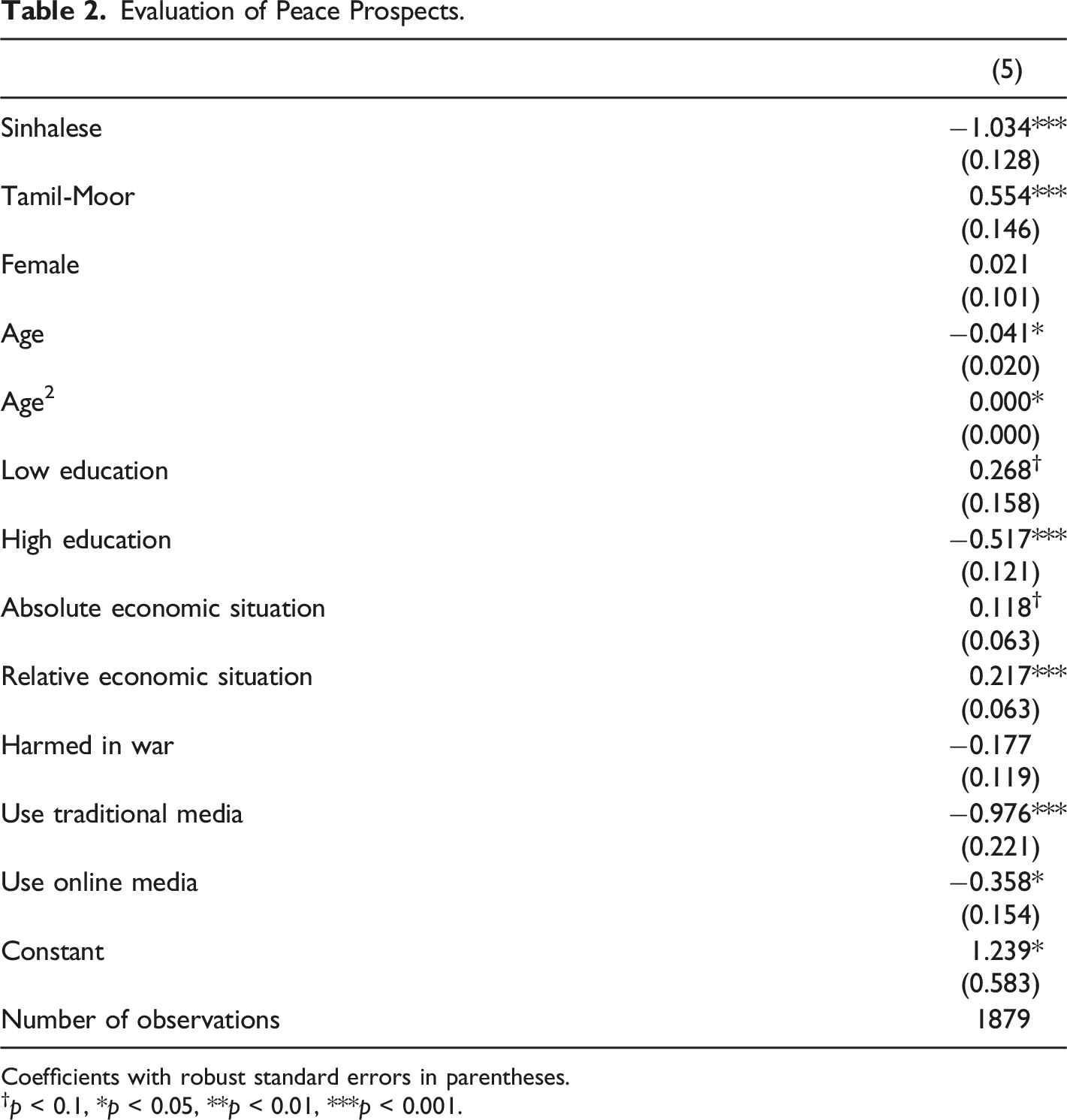
Coefficients with robust standard errors in parentheses.
†p < 0.1, *p < 0.05, **p < 0.01, ***p < 0.001.
One potential explanation for this pattern could be that individuals are more concerned about avoiding losses than about making gains (Kahneman and Tversky 1979). Sinhalese, as members of the victorious majority, likely have a different reference point for their future expectations than ethnic Tamils as members of the defeated minority group. Sinhalese have more to lose than Tamils, so they may be more concerned about what the future might bring. Analyzing attitudes towards prospective peace among Israeli and Palestinians shows a similar pattern in this ongoing asymmetric conflict, where Israeli are less optimistic about the possibility of peace than Palestinians (Leshem and Halperin 2020). Leshem and Halperin (2020, 192) suggest that “Jewish Israeli, who are currently living under more favorable circumstances, can afford to be more pessimistic about the possibility of peace.” In the following sections we examine potential sources for this victor’s pessimism about the future.
The Impact of the 2015 Change in Presidency
Why is the victorious majority ethnic group much more pessimistic about the prospects for peace than the numerically inferior and objectively disadvantaged Tamil population? To better understand this puzzle, we examine whether Sinhalese and Tamils evaluate recent political developments differently. Maybe recent developments triggered the relative pessimism of Sinhalese about the future.
In 2015, the presidential candidate Maithripala Sirisena won over war-time President Rajapaksa at the polls based on an unusual coalition of liberal Sinhalese, Tamils and Muslims (The Guardian 2015). According to Freedom House (2018), the country “experienced improvements in political rights and civil liberties [under] Sirisena, who reversed a number of repressive policies and has worked to repair government relations with the ethnic Tamil minority.” Are these objective improvements after the 2015 election reflected in the subjective observations of Sinhalese and Tamils? Or could it be that Sinhalese disapproved of the government’s steps towards transitional justice? To test this, we rerun our main analysis with the full set of control variables on a different dependent variable. The variable is based on a survey question of how the relationship between different ethnic groups had changed since the 2015 elections. The variable ranges from much worse (coded 1) to much better (coded 5).
Perceived Changes in Ethnic Relations Since 2015 and Preference for Government Harsh Responses.
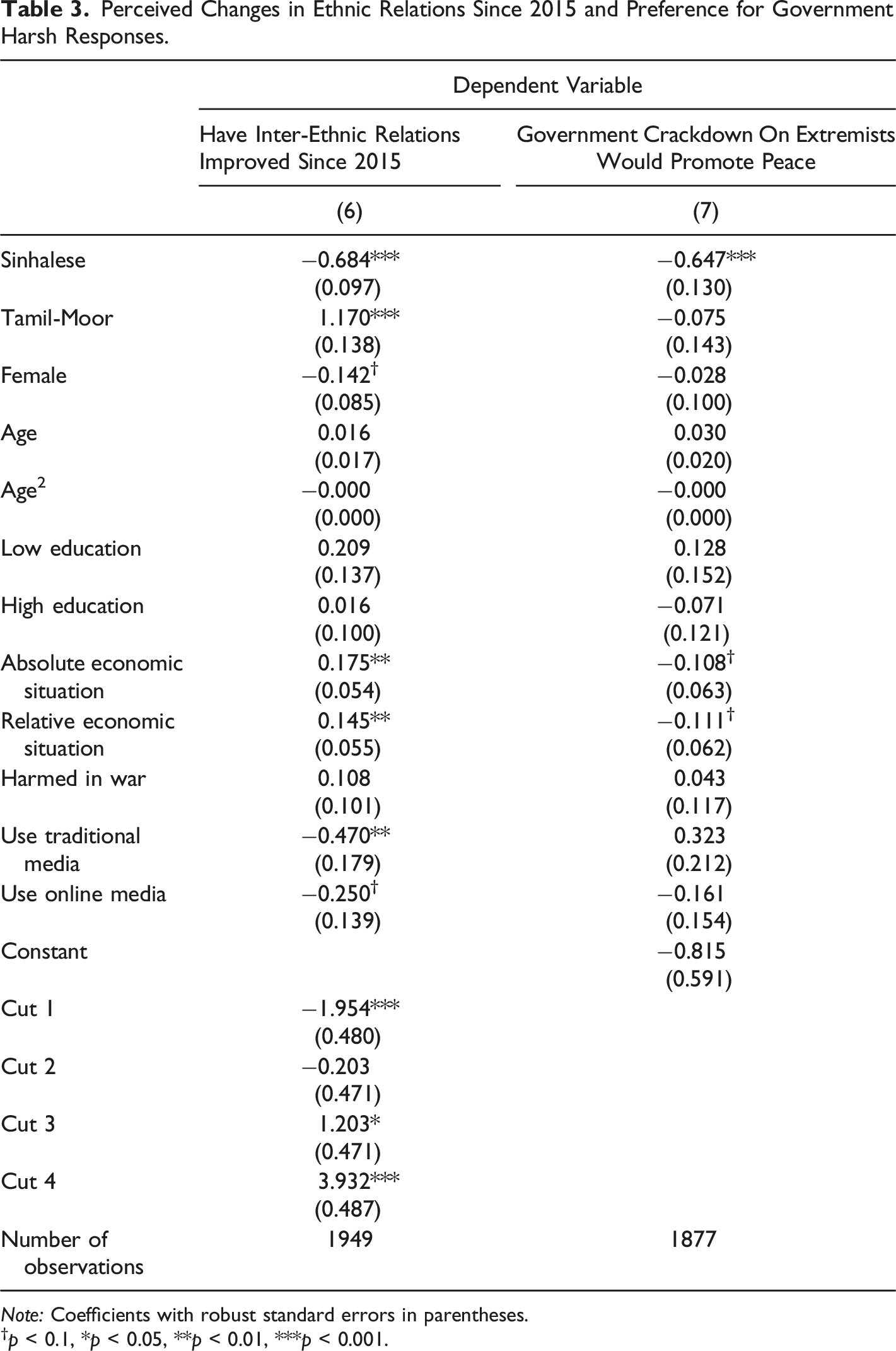
Note: Coefficients with robust standard errors in parentheses.
†p < 0.1, *p < 0.05, **p < 0.01, ***p < 0.001.
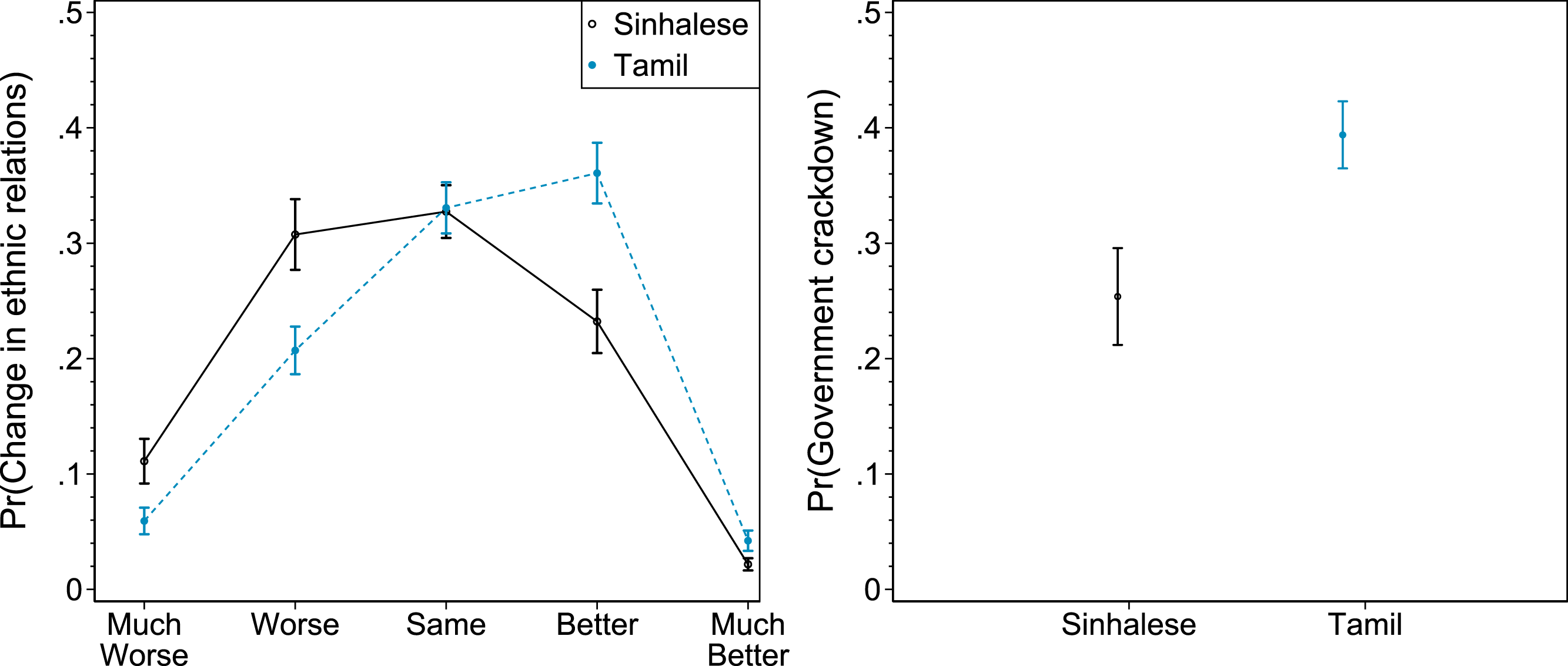
Substantive effect of ethnicity on changes in inter-ethnic relations since 2015 and government crackdown on extremists as tool to promote peace. Note: Simulations are based on models (6) and (7). Graphs show the predicted probabilities for Sinhalese and Tamil ethnic respondents respectively. Control variables are held at their mean or modal value. Vertical lines indicate 95% confidence intervals. The horizontal lines are displayed for easier visualisation of the differences between the answer categories and do not represent a time trend.
The Impact of the 2018 Riots
Another important event that might have contributed to the pessimistic outlook and the negative assessment of recent inter-ethnic relationships by the Sinhalese majority are clashes between Buddhist nationalist Sinhalese and Muslim Tamil-Moors a few months before the survey was fielded. These riots represented the first major eruption of inter-ethnic violence since the election of President Sirisena in 2015 (de Silva, Haniffa and Bastin 2019, 19).
In February 2018, following a traffic accident Muslim youths attacked a Buddhist truck driver, who later died in hospital. Calls for retribution by Buddhist supremacists triggered anti-Muslim violence in the Eastern district of Ampara and later spread to the central district of Kandy (Devotta 2018). Mobs of Sinhalese extremists attacked and burned down Muslim-owned businesses and mosques (Al Jazeera 2018; Reuters 2018). The violence was fuelled by online hate-speech and Buddhist extremists. The anti-Muslim riots were reportedly supported by some police (Reuters 2018). The widespread assaults, arson and looting provoked retaliatory acts from the Muslim side, which eventually induced the government to declare a ten-day state of emergency (BBC News 2018).
This outburst of violence reflects growing tension between the Buddhist and Muslim communities (Amnesty International 2020; Gunaratna 2018). According to Devotta (2018), anti-Tamil rhetoric was never as strong among the Sinhalese community as anti-Muslim rhetoric, even during the civil war with the LTTE. Based on our survey, about 40% of Sinhalese respondents reported that they would dislike having people of a different religion as neighbor, while another 40% reported to not care. 15
When faced with the 2018 riots, the “postwar intolerance towards religious minorities” (Devotta 2018, 282) might have fueled Sinhalese fears of a violent escalation. In this context, we investigate whether Sinhalese fears translate into political demands for tougher state measures to bring back stability. We asked respondents whether they think that it would have improved societal peace if the government had cracked down more forcefully on extremists during the recent tensions between Buddhists and Muslims. The variable is coded 1 if respondents reported to believe a more forceful state response would have been conducive to peace, and 0 otherwise.
Model 7 in Table 3 reports the results of the logistic regression. The coefficient for Sinhalese is negative and statistically significant. Sinhalese were even less likely than respondents of minority ethnic groups to consider a more forceful state response as conducive to peace. The substantive effects presented in Figure 3 show that Sinhalese have a probability of only 0.25 to be in favor of a firmer government intervention in response to the tensions between Sinhalese Buddhists and Muslims, whereas Sri Lanka Tamil respondents seem to have a much higher probability (about 0.4) of embracing a forceful state reaction.
Since the violence associated with the 2018 riots primarily emanated from Buddhist extremists, for Sinhalese, opting for more forceful state action might have meant cracking down on extremists among their own group. 16 Hence, the reluctance to call for a more aggressive state response to the riots could also be driven by a reluctance to punish one’s own community. Overall this finding suggests that the greater concern of Sinhalese about future stability compared to Tamils does not translate into demanding a harsher state response against extremists. The reason behind the more pessimistic outlook lies probably elsewhere.
The Prevalence of Political Divisions
The insights from Figure 3 suggest that the concerns of the Sinhalese majority about future stability are probably not about the relationships between different ethno-religious communities. We asked Sri Lankans about what they see as the most important division in society today. For most Sinhalese, divisions along political lines are the most salient, as shown in Figure 4. Religion and ethnicity come only at a distant second and third place. From the perspective of the civil war victors, the war-time divisions have become substantially less salient a decade later. This picture is different for members of the defeated group. About 46% of ethnic Tamil referred to ethnicity as the most important division, with political division at 27%. Unlike Tamils, most Sinhalese do not see ethnic characteristics as the main dividing line. They have moved on—and now seem to find drivers of societal divisions elsewhere, in politics. Survey item: “What is the most important division in Sri Lankan society today?”—Answers by ethnic Sinhalese. Note: Plot shows relative frequency of answers by ethnic Sinhalese respondents.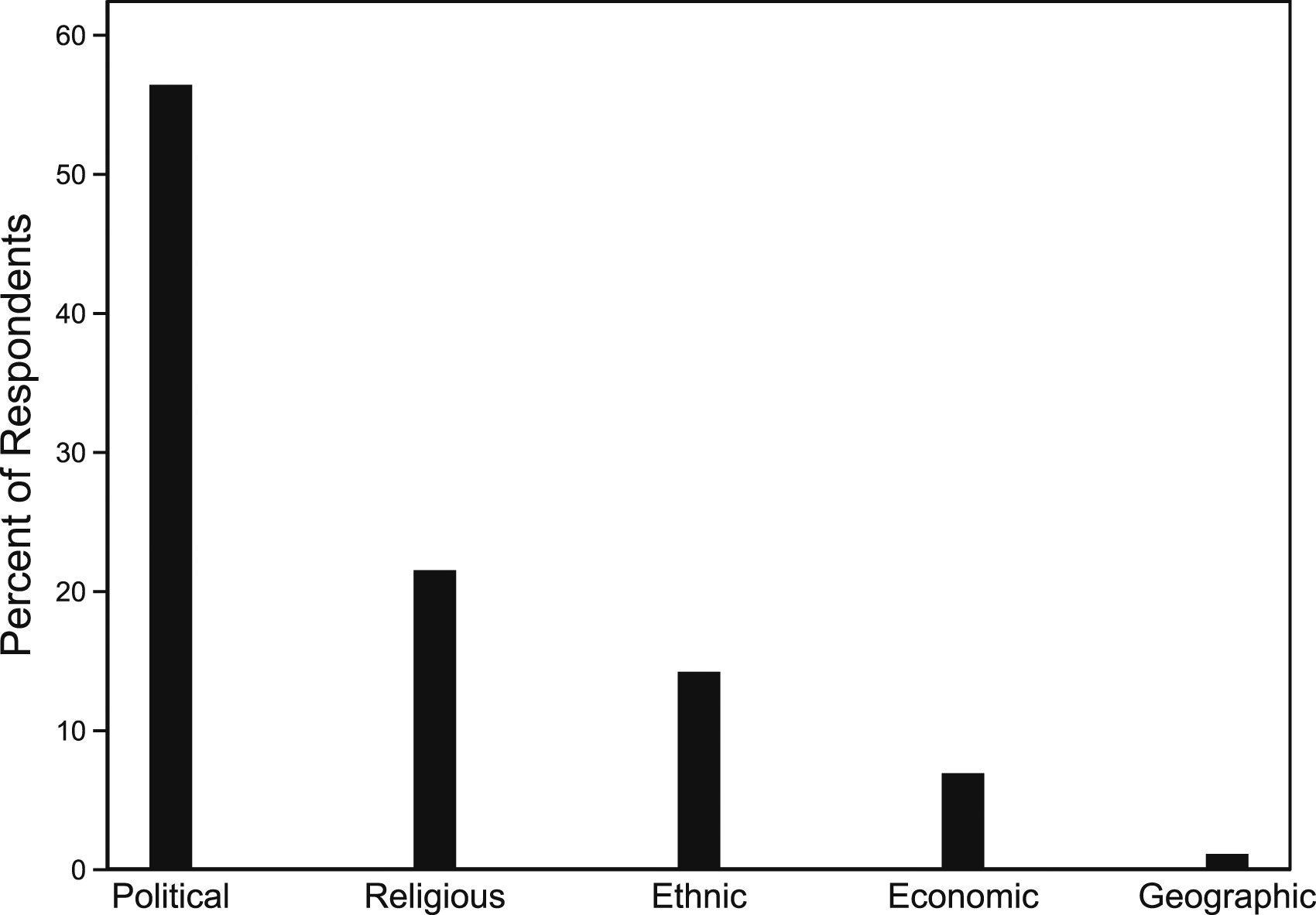
The uneasiness of the Sinhalese majority about political divisions might be influenced by the exacerbating competition between Sinhalese-dominated political parties. In February 2018, Sri Lanka held local elections. A new political party, the Sri Lanka Podujana Peramuna (SLPP, People’s Front) surprisingly garnered the most votes with a substantial margin of 45%. This party was created by supporters of Mahinda Rajapaksa, who was defeated in the 2015 presidential elections. It had split from the Sri Lanka Freedom Party (SLFP), led by incumbent President Maithripala Sirisena, which achieved only 9% of the overall vote. The United National Front (UNP), the party of Prime Minister Ranil Wickremasinghe, gained 33% of the votes. 17 Just how split the political system is became evident by the attempt to install Rajapaksa as Prime Minister during the institutional crisis in October 2018.
This finding highlights that for the winning majority, alternative concerns often overtake war-time cleavages. Focusing only or predominantly on changes in the relationships between formerly warring parties might miss the emergence of new grievances and sources of instability. In a country where one ethnic group has a clear majority, new challenges and divisions might arise from within their own group.
Sinhalese Sensitivity to Acts of Contentious Politics
As most ethnic Sinhalese see politics as the main dividing line in the country, how threatened do they feel by political, and genuinely contentious, actions? We asked respondents how likely they think it was that different political activities (ranging from distributing political leaflets to labor strikes) and acts of resistance (ranging from damage of property to physically harming political opponents) would threaten the political stability of the country. Figure 5 shows the answers by Sinhalese respondents.
18
Survey item: “How likely is it that the following acts of resistance would threaten political stability?”—Answers by ethnic Sinhalese. Note: Plot shows relative frequency of answers by ethnic Sinhalese (a) Legitimate action (b) Illegitimate action.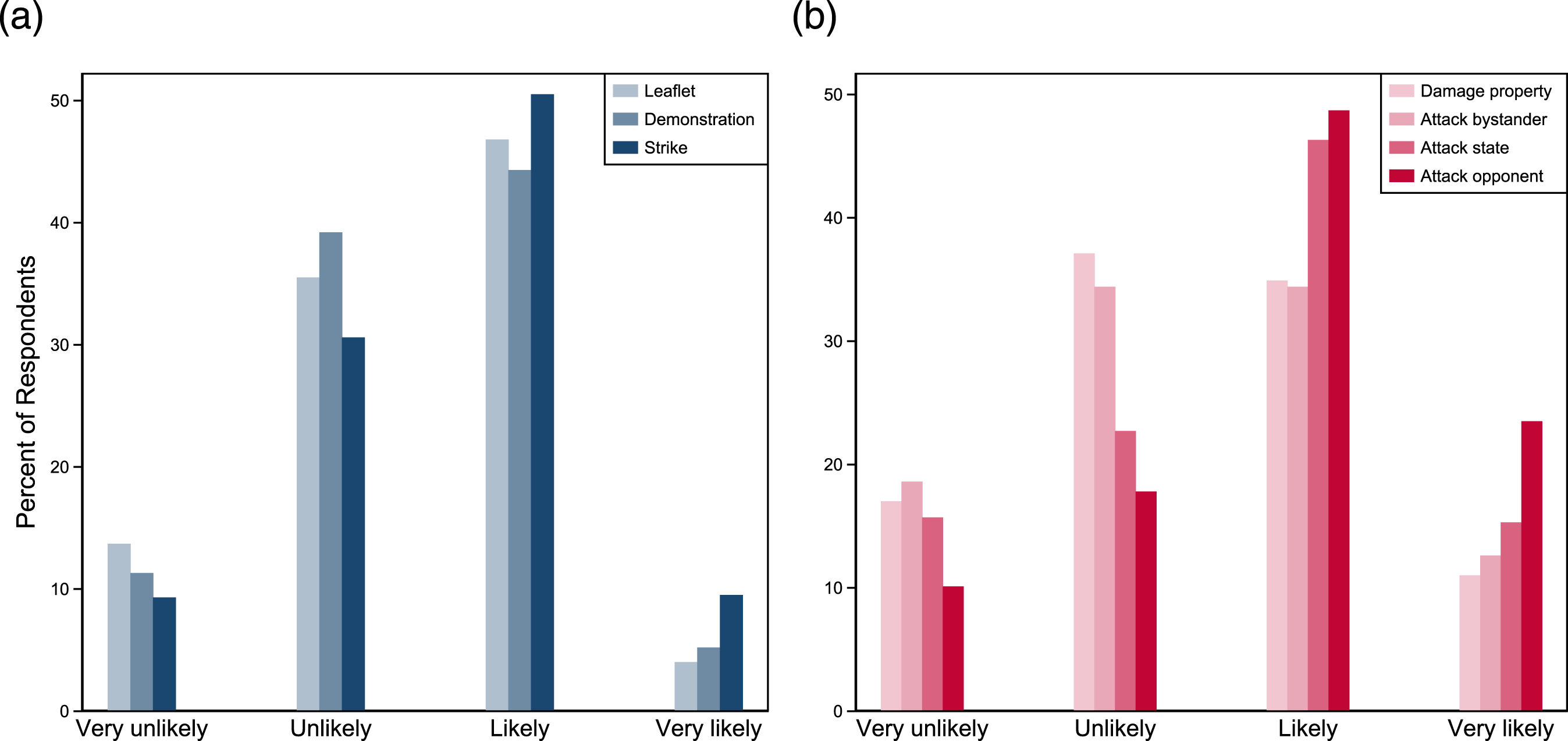
About half of Sinhalese respondents thought that any sort of political activity, even handing out leaflets, would likely or very likely threaten political stability. 19 The majority of respondents seems to think that the political system is not sufficiently strong or adequately institutionalized to handle even relatively limited and non-violent acts of political activism. Both legitimate and illegitimate political activities are perceived as similarly threatening to the country’s political stability. 20
If people are concerned that legitimate political activities such as peaceful demonstrations and labor strikes would unsettle the system, this raises important questions about the quality of post-conflict peace and the stability and resilience of the democratic regime. Being able to publicly demonstrate divergent opinions and preferences and to allow those conflicting preferences in a peaceful context is at the heart of a vibrant and healthy democracy. Viewing such activities with trepidation reflects a lack of trust in the ability of institutions and political actors to handle the display of divergent opinions. While such concerns might not necessarily point towards a looming armed conflict, it does raise questions about the nature and depths of the quality of peace and democracy.
Conclusion
Despite extensive research on postwar political institutions, we know little about how the population perceives the quality of peace and stability. To complement research on postwar institutions and elites, we set out to investigate how individuals perceive their personal situation and how they experience and assess changes in different aspects of peace, security and human rights (Introduction this issue).
Civil wars with a decisive victory are likely to lead to an uneven peace, where people should feel very differently about peace processes, depending on whether they belong to the group of the victors or the defeated. We analyze perceptions of peace in a postwar context characterized by ethnic and religious cleavages. While our argument and findings should travel to other postwar contexts that emerged from a clear military victory, more research is needed to assess whether these postwar developments only apply to identity-related conflicts. Using original survey data from Sri Lanka, we empirically show that one decade after the end of the country’s civil war, members of the victorious ethnic Sinhalese evaluate improvements in the quality of peace far more positively than the defeated Tamils. Differences in perceptions vary considerably between Sinhalese and Tamils and are consistent across different dimensions of peace.
However, the Sinhalese’ appreciation of past achievements does not translate into a more optimistic assessment of the country’s future stability. Sinhalese are far more likely than Tamils to state that the country is heading towards political instability. This is puzzling since the Sinhalese not only emerged as the victorious group from the war but also constitute the clear majority in the country on multiple dimensions. They should have no reason to be pessimistic about the future of the country. Yet our results suggest caution when inferring individual perceptions from objective measures of stability and peace.
To explore this puzzle we provide a number of additional tests. The majority of the Sinhalese group does not seem to be concerned about old war-time cleavages any more—and for good reasons, given their numerical and political dominance. Instead, new concerns seem to drive their pessimistic outlook. Despite their dominant position in political life, the Sinhalese majority sees almost any form of contentious political activity as a potential threat to stability. But this does not translate into demands for harsher government responses to extremists. This could indicate a general weariness of the population who are concerned that any unusual political activities or harsh government reactions might unsettle the situation. 21
Our study has three important implications. First, by conceptually unpacking the quality of postwar peace, future research might be better able to assess how individuals from different communities in post-conflict societies describe and understand their personal security and freedoms. By shifting the focus to a bottom-up micro-level perspective, we conceptually and empirically capture individual experiences regarding the quality of peace during the post-conflict period that reflect the reality of citizens on the ground. Our results suggest that in postwar societies dominated by a victorious group, street-level peace is limited to only parts of society. Further research is needed on the relationship between different types of conflict termination, citizen perceptions of peace and security and resulting dynamics of postwar reconciliatory policies.
Second, fears of political instability do not necessarily translate into an increased demand for limitations of minority political rights. This finding gives hope for other postwar contexts with decisive winners. Sinhalese do not embrace state repression against extremists despite recent unrest and their overwhelming dominance in numbers, politics and economics. Future research might examine whether this level of tolerance regardless of fears of future instability is a Sri Lankan exception or a general pattern that requires more systematic attention.
Third, variation in how individuals perceive the future political stability of the country originates from potential shifts into the political status quo of the victor’s side, rather than pre-existing cleavages or ethnic division that were rooted in the conflict. This result recalibrates our understanding of post-conflict peace under decisive victories and has implications for third-party assistance. The case of Sri Lanka shows that in order to effectively support countries exiting conflict, we need to assess the prospects of political stability in light of newly emerging grievances and cleavages. Efforts to aid these countries should concentrate on reconciliatory efforts while fostering an inclusive political system that proportionally balances the relationship between previously confronted groups. By promoting institutional arrangements that address distinct fears across societal groups, external support can help to reinforce the country’s path towards long-term, balanced and sustainable peace.
Supplemental Material
Supplemental Material - Divergent Perceptions of Peace in Post-Conflict Societies: Insights from Sri Lanka
Supplemental Material for Divergent Perceptions of Peace in Post-Conflict Societies: Insights from Sri Lanka by Sabine C. Carey, Belén González, and Christian Gläßel in Journal of Conflict Resolution
Footnotes
Acknowledgments
We thank Katharine Adeney, Kristin Bakke, Scott Gates, Caroline Hartzell, Carl Henrik Knutsen, Jana Krause and Matthew Nanes for their input on earlier versions.
Declaration of Conflicting Interests
The author(s) declared no potential conflicts of interest with respect to the research, authorship, and/or publication of this article.
Funding
The author(s) disclosed receipt of the following financial support for the research, authorship, and/or publication of this article: This work was supported by the European Research Council under the European Union’s Seventh Framework Programme (FP7/2007–2013)/ERC Grant Agreement no 336019 and the German Research Foundation (DFG) via the Collaborative Research Center 884 ‘Political Economy of Reforms’ at the University of Mannheim.

Supplemental Material
Supplemental material for this article is available online.
Notes
References
Supplementary Material
Please find the following supplemental material available below.
For Open Access articles published under a Creative Commons License, all supplemental material carries the same license as the article it is associated with.
For non-Open Access articles published, all supplemental material carries a non-exclusive license, and permission requests for re-use of supplemental material or any part of supplemental material shall be sent directly to the copyright owner as specified in the copyright notice associated with the article.
