




Abstract
“Hearts and minds” theory contends development aid strengthens community support for counterinsurgents by providing jobs and public goods. Based on field interviews in Kabul, we develop an alternative theoretical framework emphasizing instead the ideological preferences of civilians. In our model, some aid projects are ideologically contentious while others are benign. Given a mix of foreign aid, each civilian supports either the counterinsurgents or rebels, depending on his/her idiosyncratic preferences. In this setting, greater provisions of aid can actually erode community support. Donors therefore calibrate the mix of foreign aid to appease population groups with relatively strong ideological sensibilities. Individual-level analysis based on unique Afghan data substantiates key features of our theory. Benign projects lead to favorable opinions of development, while contentious aid has the opposite effect. Moreover, favorable opinions of development are associated with stronger support for government and counterinsurgents, and weaker support for rebels.
“We’re invariably going to get it wrong. Let’s be honest – it’s almost impossible to avoid unintended consequences of our work here.” (foreign donor, Kabul, 2013)
1. Introduction
For almost two decades, Western governments have been embroiled in protracted missions to rebuild Afghanistan and Iraq. To this end, the US government alone has spent over $200 billion on development aid in theater (SIGIR 2013; SIGAR 2018). Despite considerable financial outlays, it remains unclear whether post-conflict aid has been successful. A “hearts and minds” perspective was long espoused by American military forces (US Army 2006), and later formalized by Berman et al. (2011). That theory suggests development assistance builds popular support for counterinsurgents by providing jobs and public goods otherwise absent under rebel control. In exchange for aid, the community ostensibly shares intelligence with counterinsurgents regarding the plans, identities, and whereabouts of rebel forces.
Despite the tremendous amount of resources dedicated to leveraging community support for counterinsurgents, few empirical studies have validated the hearts and minds theory. Berman et al. (2011) provide evidence that the US Commander’s Emergency Response Program (CERP) mitigated violence in Iraq. But the combined findings of Chou (2012), Child (2014), and Adams (2015) imply CERP projects in Afghanistan were generally inconsequential. In a broader survey of the literature, Zürcher (2017) shows aid in conflict settings is actually more likely to exacerbate than alleviate violence.
Careful empirical studies have extended hearts and minds theory by identifying conditions surrounding counterproductive aid. Many attribute aid’s deleterious effects to strategic behavior by insurgents (e.g., Crost et al. 2014; Sexton 2016; Weintraub 2016; Khanna & Zimmerman 2017). Other studies acknowledge the important role of community-based grievances. In Afghanistan, Karell and Schutte (2018) show conflict increases in the wake of non-inclusive aid projects. Child (2019) suggests ideological sensitivities could explain heightened conflict following military-led education projects. These recent empirical strides add nuance to the hearts and minds perspective, but they remain unaccompanied by progress in formal theory.
Standard hearts and minds theory emphasizes practical and tangible interests of communities. Under this characterization, civilians support counterinsurgents to secure aid provisions and economic support. But in practice, we know local allegiances may rest instead on political or ideological views. Local perspectives may even be shaped through grievances induced by foreign intervention itself. In Afghanistan, for example, qualitative research has connected grievances to aid in general (Fishstein & Wilder 2012; Jackson & Giustozzi 2012), and to education projects in particular (Giustozzi 2010; Giustozzi & Franco 2011).
This paper contributes a formal theory of aid and conflict in which community-based grievances are pivotal. In our model, foreign aid generates an array of allegiances across community members, based on their underlying ideological preferences. Certain aid projects are controversial from the community’s perspective, and citizens are differentiated by their sensitivity to those projects. Given a bundle of foreign aid, some community members support the development effort, while others do not. Based on their assessments, each civilian casts their allegiance to either the counterinsurgents or rebels. Both combatant groups rely on community support for their success. The relative strength of (counter)insurgency therefore depends on how ideological preferences in the community interact with foreign aid disbursements.
Our theoretical perspective is premised on anecdotal evidence from field interviews conducted in Kabul, Afghanistan. In November 2013, the author carried out 21 unstructured on-site interviews with development stakeholders. Interviewees included foreign government donors (9), local and foreign NGOs (4), private companies (3), research organizations and journalists (4), and a special forces operative (1). The views expressed by our interlocutors are reflected in the core assumptions underpinning our theoretical framework. 1
We test key features of our model using unique data on public opinion, foreign aid, and conflict across Afghanistan. Public opinion data were secured by the author through a pilot data-sharing agreement providing access to ISAF and Resolute Support HQ’s Afghanistan Nationwide Quarterly Assessment Research (ANQAR) surveys. These data cover approximately 40,000 individuals surveyed across Afghanistan between September 2008 and September 2009. From ANQAR data, we obtain information on civilian attitudes toward aid efforts and combatant groups (including government, international, and anti-government forces). Aid data were acquired through a rare hardcopy of the now-defunct NATO C3 Agency’s Afghanistan Country Stability Picture (ACSP). Those data permit us to track foreign aid projects by sector at a fine level of spatiotemporal granularity. Conflict data are invoked from the U.S. Defense Department’s Significant Activities (SIGACTS) dataset containing events time-stamped and geolocated by ISAF units and local national security partners.
Two distinguishing features of our model are (i) both ideologically controversial and ideologically benign foreign aid projects exist; and (ii) a community member’s assessment of aid initiatives drives his/her allegiance in the conflict. Our analysis validates the first feature by demonstrating the impact of foreign aid projects on individual assessments of development initiatives. We operationalize education projects as contentious, while remaining projects are deemed benign. These priors are based on field interviews and qualitative research in section 3. Our findings suggest contentious aid degrades opinions of development, while benign projects lead to more favorable assessments. To validate the second feature, we then link individual assessments of aid to proxies of support for combatants. Individuals with poor assessments of aid exhibit weaker trust in their government and international forces, and stronger trust in anti-government elements.
Regression results are robust to controlling for a battery of characteristics associated with political opinions and foreign aid allocations. Moreover, we also invoke nearest-neighbor and propensity score matching estimators to strengthen identification. In doing so, we compare individuals matched along key demographic and environmental characteristics, but differing in terms of exposure to aid (or opinions of aid). All findings are robust to this alternative identification strategy, thereby lending credence to a more causal interpretation of results. Accordingly, we regard this empirical analysis as substantiating the abovementioned features of our model.
The remainder of our paper is structured as follows. Section 2 contextualizes our study within the broader literature examining ideology in conflict settings. Section 3 establishes our theoretical premise, and section 4 develops the formal model. Section 5 introduces our data, and section 6 presents our analysis. Finally, section 7 concludes.
2. Literature Context
Research exploring the role of ideology in conflict has grown considerably in recent years. 2 Implications of ideology adopted by state actors have been studied by Staniland (2015), Scharpf (2018), and Kim (2018). Ideology’s influence on patterns of violence by armed groups has been examined by Asal and Rethemeyer (2008), Thaler (2012), and Hoover-Green (2016). Ideology’s relationship to the organizational integrity (i.e., recruitment and defection) of rebel groups has been analyzed by Gates (2002), Ugarriza and Craig (2013), and Oppenheim et al. (2015). Still closer to our work is a group of papers contending state repression or victimization inflicts ideological grievances upon civilians, and thereby increases support for insurgency (see, e.g., Rosendorff & Sandler 2004; Bueno de Mesquita 2005; Bueno de Mesquita & Dickson 2007; Sánchez-Cuenca & De la Calle 2009; Tezcür 2015). Our paper similarly treats combatant support as an ideological response to policy action, but focuses on foreign aid provision rather than hard counterterrorism.
In studies of victimization, Condra and Shapiro (2012) and Lyall et al. (2013) stress the need to consider heterogeneous civilian preferences when analyzing combatant support. Accordingly, ideology is idiosyncratic in our model (as in, e.g., Rueda, 2017), which yields a range of civilian allegiances in response to a single policy action. Notably, Siqueira and Sandler (2006) and Berman et al. (2011) both offered formal theories of the relation between public goods and combatant support. Neither model addresses ideological preferences, other than to allow for an exogenous tendency of rebel support among the citizenry. Moreover, in both models government-provided goods are regarded as strictly beneficial to civilians. In our model, civilians with nuanced ideological preferences disagree on the underlying utility of aid projects. Consequently, greater public goods provision can actually erode community support, and thereby strengthen rebel capacity. By implication, donors calibrate the nature of development spending to appease population segments with relatively strong ideological sensibilities—a novel policy lever in this formal literature.
Notably, Sanín and Wood (2014) influentially call for a greater focus on the role of ideology in conflict research. They argue existing theories of conflict undermine the importance of ideology under the pretense that (a) it is a rhetorical device; or (b) it can be reduced to some structural variable (e.g., the pursuit of economic gains, or power over resources). Through careful consideration of ideology’s role in shaping civilian preferences towards aid, we effectively contribute to Sanín and Wood’s (2014) “strong program” exploring normative commitments to ideology among conflict stakeholders. In our model, ideological preferences are neither instrumental nor overridden by material considerations. By consequence, equilibrium policy outcomes genuinely interact with, and are informed by, the ideological preferences of community members.
Maynard (2019) builds on Sanín and Wood (2014) by offering a valuable conceptual framework for studying the complex role of ideology in conflict. Our study operationalizes therein labeled “internalized ideologies” among the citizenry. From this perspective, ideology constitutes individuals’ sincere values and preferences which influence perception and worldviews. Ideology provides a lens through which new information and experiences are interpreted. It shapes how individuals evaluate actions or policies as desirable, and thereby influences individual behavior and decision-making (Maynard, 2019, pp.637; 639; 645). In our application setting, ideology thus describes individual preferences over foreign aid, through utility value assigned to different projects. Ideology therefore determines how individuals interpret foreign aid disbursements, and evaluate the desirability of a given project bundle. Based on their ideological assessments, citizens then allocate support to either the rebels or counterinsurgents, thereby influencing the course of conflict. 3
3. Theoretical Premise
Our model regards community members as the support base upon which both rebellion and counterinsurgency rest. Each citizen decides which combatant group to support based on an idiosyncratic assessment of foreign aid activity. Not all projects are viewed similarly by the community—a foreign-built school may elicit ideological resistance while a road construction project wins hearts and minds. Community support for insurgency therefore depends on how contentious is the bundle of aid chosen by the donor. Through development the donor pursues overarching political-economic goals related only indirectly to security of the host nation. The degree of misalignment between donor and community preferences determines the distribution of community allegiances, and ultimately the capacity of rebels to conduct violence and extract rents. Implicit in this theoretical framework are some underlying assumptions regarding the nature of community and donor preferences. Here, we motivate those assumptions with material gleaned from field interviews conducted by the author in Kabul, and other piecemeal evidence.
3.1. Ideological Community Members
One critical notion underpinning our model is that certain aid projects are ideologically controversial. Intercepted Taliban and Al-Qaeda correspondence reflect sensitivity to foreign involvement in the sectors of oil (CTC 2006; 2007b), media (CTC 2007a), and education (CTC 1999; 2009). Among development stakeholders, education projects are regarded as particularly contentious (Afghan Company 2013; Afghan NGO J 2013; Donor E 2013; Journalist F 2013; Donor G 2013; Donor H 2013). Resistance from conservative communities to foreign involvement in education is documented by Giustozzi (2010) and Giustozzi and Franco (2011). Curriculum design has been a particular point of tension between local insurgents and the international community (Foreign NGO I 2013; Research Organization C 2013). To illustrate, Al-Qaeda’s Jihad magazine states “among the most dangerous things that the West introduced in order to put an end to Islam in the long-term are the curriculums that concentrated on demolishing the language, the religion, and Islamic history” (CTC 2007a). At the same time, most other aid projects are regarded as innocuous from an ideological standpoint (Journalist F 2013; Donor G 2013; Donor H 2013; Afghan NGO J 2013; Foreign NGO K 2013). Child (2019) provides evidence consistent with these reports, suggesting education projects exacerbate conflict in Afghanistan while the converse is true of health and security projects.
3.2. Self-Interested Donors
In our model, the donor’s development goals are shaped by domestic political-economic considerations. Donors face enormous pressure to expend resources as a metric for success, and local sensitivities are secondary concerns in that pursuit (Donor G 2013; Donor E 2013). The allocation of funds across program sectors is a political decision made in consultation with parliamentarians back home, and based more on national priorities (Donor L 2013; Donor H 2013) or global poverty solutions (Donor L 2013; Donor E 2013) than on local community preferences. The reconstruction and development effort is not a purely altruistic endeavor. This is well understood by private contractors (Afghan Company 2013; Foreign Company M 2013) and other development stakeholders (Afghan NGO J 2013; Journalist F 2013; Donor G 2013; Donor N 2013). As one foreign official in Kabul candidly remarked: “Every project here is hugely political. It’s all part of a big political process. There are many, many projects around the country which I’m sure have a strong economic justification for doing them. And maybe a strong social justification for doing them. But overriding all of that are strong political reasons for doing them.”(Donor H, 2013)
4. Model
Our model depicts a one-shot game between two decision-making agents—a single donor and a continuum of community members. 4 The donor maximizes utility by allocating aid across two “sectors”. Each community member either cooperates with counterinsurgents or supports the rebels, depending on his/her idiosyncratic (dis)taste for the mix of projects chosen by the donor. Cooperating with counterinsurgents involves sharing intelligence on the plans, identity, or whereabouts of rebels, thereby weakening the insurgency. Supporting the rebels, by contrast, involves providing them information or resources, effectively strengthening their capacity. Rebels sabotage and/or tax development projects, so their capacity ultimately determines the efficiency of aid provision. 5 The donor moves first with perfect foresight, and individual community members then decide which combatant group to support. The allocations of aid and community support determine final development output and payoffs, then the game ends.
4.1. Specifications
Donor utility, V (b, k), depends positively on the output of aid in sectors b and k, but exhibits decreasing marginal returns (hence
Community member utility exhibits decreasing marginal returns to both benign and contentious projects (hence The donor faces convex development costs C(B, K), such that C
B
> 0, C
K
> 0, C
BB
≥ 0, C
KK
≥ 0, and C
BK
≥ 0. B is sector b spending, and K is sector k spending—both of which ultimately translate into output. The output b(B, R) depends on B and rebel capacity for conflict and rent-seeking R, such that b
B
> 0 and b
R
< 0. We impose b
BB
≤ 0, implying a constant or decreasing marginal product; and b
RB
< 0, implying rebels inflict greater absolute damage and/or taxation in the presence of larger outlays. The conditions on output k(K, R) are analogous. From the hearts and minds perspective, community support determines the strength of (counter)insurgency. Let the binary indicator s
i
reflect citizen i’s support for insurgents, and let S be the share of community support for insurgency (hereafter—rebel support). Rebel capacity R depends on rebel support S, such that dR/dS > 0. Since rebels serve to sabotage or tax development initiatives, the individual decision s
i
depends on whether citizen i benefits from a reduction in aid output (to be shown below).
9
4.2. Equilibrium
The model’s equilibrium is characterized by an optimal spending bundle (B∗, K∗) chosen by the donor; and an optimal decision by each community member regarding which combatant group to support. Decisions in the community are summarized by a threshold value
4.2.1. Community Support
First, we substitute into the community member utility function: (i) the output functions; and (ii) the relation between rebel support and rebel capacity. From this, we express—U i (b(B, R(S)), k(K, R(S)); α i ) . We then determine the impact of rebel support on individual utility through the total derivative

The first term on the right-hand side of equation (1) is negative, and the second term is positive. The sign of dU
i
/dS indicates whether community member i would perceive his/herself to be better or worse off with a marginal increase in rebel support. By setting dU
i
/dS = 0, we can extract the identity of the marginal supporter (MS) described by
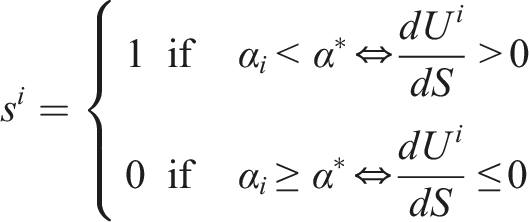
The total share of rebel support can be calculated by integrating the individual support decisions over the entire population distribution, where f (·) is the density function pertaining to the distribution of α
i
, and F (·) is the cumulative distribution function.
13
Next we examine how different types of aid projects influence support for (counter)insurgents at the community level. To understand this relationship, we first calculate the change in returns to rebel support when spending in sector k increases. Using equation (1) we evaluate From section 4.1, the first and second terms on the right-hand-side are positive, and the third term is non-negative. So individual returns to rebel support are higher when outlays to K are greater. Accordingly, it must be true that the MS faces strictly positive returns to rebel support with an incremental increase in K, and therefore individually contributes his/her support to the rebels. For the spending allocation with comparatively larger K, the new MS (α∗∗) lies somewhere further to the right on the distribution of α
i
(i.e., α∗∗ > α∗), and rebel support is stronger since F (α∗∗) > F (α∗). Thus, for a fixed level of benign development spending, and fixed community preferences, an increase in contentious aid programming will strengthen rebel support and weaken cooperation with counterinsurgents (ceteris paribus, dS/dK > 0). By comparison, the change in community member incentives following an injection of B takes the form The first term on the right-hand-side is negative, the second term is positive, and the third term is non-negative. The net result implies, surprisingly, that spending on benign aid projects does not necessarily boost citizens’ incentives to support counterinsurgents. In case the latter two terms dominate, a counterintuitive result emerges in which public goods provision actually fuels support for rebels. Ultimately, the direction of the total effect will depend on the valuation of benign projects, their diminishing returns, and the technology of rebel capacity. Based on our fieldwork (see section 3.1), we suspect B will have the intuitive countereffect to K. In that case, the MS would strictly prefer to support counterinsurgents following a marginal increase in B. On this basis, we can suggest—for a fixed level of contentious development activity, and fixed community preferences, an increase in benign aid programming will diminish rebel support and strengthen cooperation with counterinsurgents (ceteris paribus, dS/dB < 0).
14



4.2.2. Project Choice
We next consider the donor’s optimization problem which can be summarized as

This implies the following first-order conditions


The left-hand sides of equations (2) and (3) capture marginal benefits of outlays to K and B, respectively. The right-hand sides capture the associated marginal costs. The costs of investment in sector k are two-fold, consisting of a direct cost C K , and the indirect cost of greater rebel support (which strengthens rebel capacity and dampens output efficiency across both sectors). By contrast, the benefits of investment in sector b are two-fold, consisting of the direct benefit V b b B , and the indirect growth in output across sectors resulting from constrained rebel capacity for conflict and taxation. The donor accounts for these different within-sector tradeoffs through its optimal allocation. In equilibrium, the donor allocates less to sector k and more to sector b than would be optimal in the absence of a (counter)insurgency reliant on community support. This constitutes a form of political compromise by the foreign government entity—a novel policy lever in the conflict-aid literature which arises endogenously in our model.
Depending on donor and community preferences, an equilibrium is reached in which some combination of B∗, K∗, and R (S (α∗)) prevails. The donor’s utility is bounded from above by V (b(B, 0), k(K, 0)), which is concave in B and K. Because the cost function is convex, B offsets cannot endlessly compensate for damages incurred by K. If we impose the Inada conditions on V, the equilibrium is contained within a limited set of feasible allocation bundles.
4.3. Community Preferences
Given our focus on the role of ideology, we next explore how ideological preferences at the community level affect our model’s inferences. We begin by considering in greater depth the mechanics underlying our results of section 4.2.1. Given a change in sector K spending, the community response is determined by two factors: (i) the population density at the decision margin (f(α∗)); and (ii) the breadth of the adverse reaction (∂α∗/∂K). Hence we can calculate dS/dK = f(α∗) Community preferences and sensitivity of combatant support. Notes: This figure depicts a probability density function for ideological preferences (f (α
i
)) of a conservative community (denoted by c, in black), and of a moderate community (denoted by m, in gray). An injection of controversial reconstruction K shifts the marginal supporter (α∗) to the right, leading to an expansion of rebel support. In this example, the size of the effect is much larger for conservative communities than for moderate ones.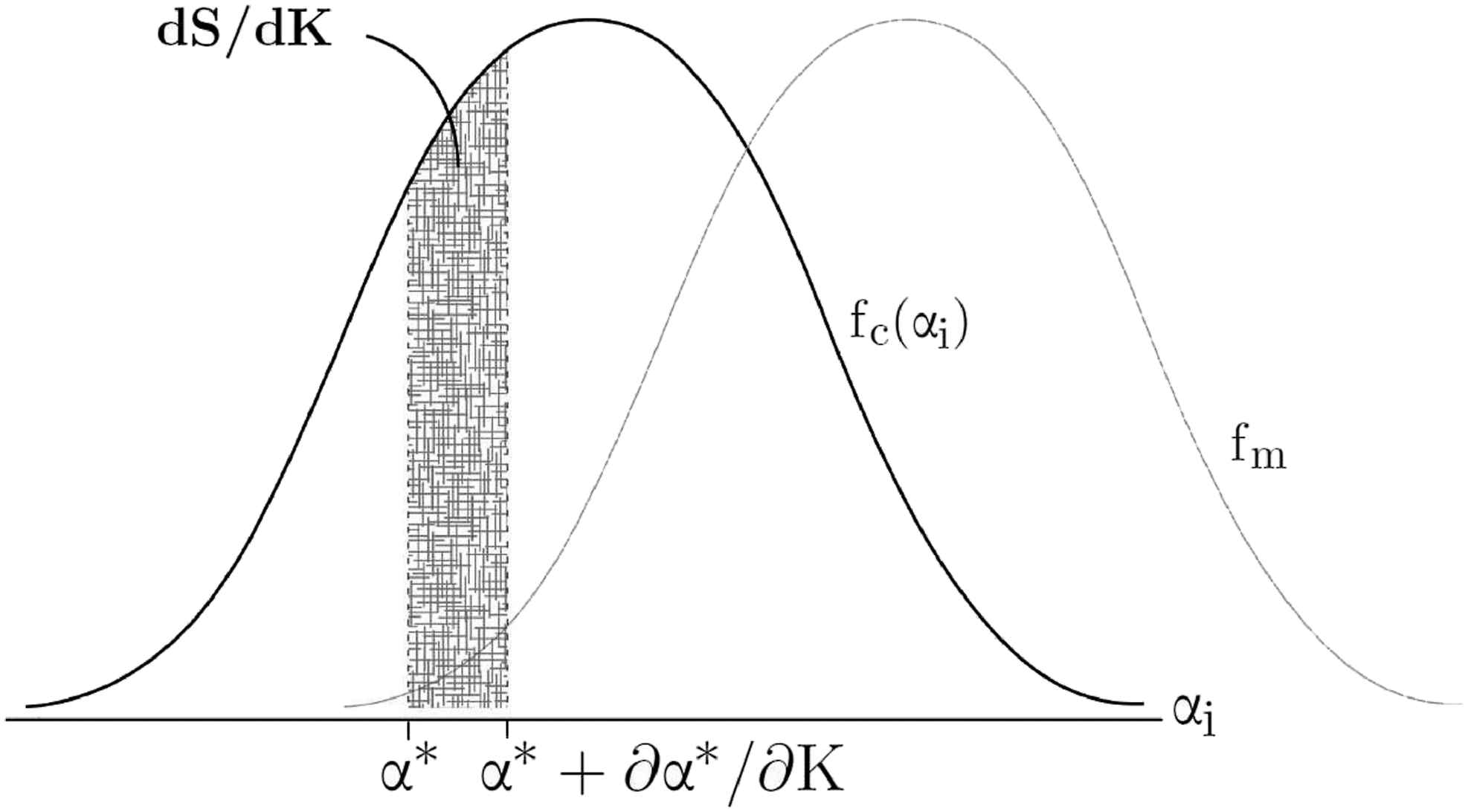
In Figure 1, we consider two communities which differ only according to ideological preferences. The preference distribution (f(·)) in the hypothetically conservative community c constitutes a leftward shift of the distribution in moderate community m (with first-order stochastic dominance). This implies for community c, on average, a relatively low appreciation of benign foreign aid projects, and a greater distaste of controversial projects. In this example, ideological preferences are normally distributed, and rebel supporters comprise a minority in both communities. Under these conditions, rebel support will be more sensitive to controversial projects in the relatively more conservative community (this can be seen by comparing the areas dS/dK under the corresponding curves). Under these same conditions, however, our model also predicts that support for counterinsurgents will grow relatively stronger in response to benign aid provision.
The above thought experiment highlights an interesting result from our model. Sensitivity of rebel support to foreign aid programming depends on where the marginal supporter (MS) fits on the community’s ideological spectrum. If the MS is characterized by fringe ideological preferences, then marginal adjustments to aid bundle composition will affect the support (s i ) of relatively few community members. In that case, overall rebel support (S) will be less sensitive to controversial spending (K), and so donors will compromise less on their most preferred aid agenda (ceteris paribus). If we consider a temporal change in the community’s ideological preference distribution (f(·)), the donor’s optimal aid allocation (B∗, K∗) will also adjust accordingly. For example, if normal preferences become polarized and are distributed bimodally, a MS with previously extreme preferences may newly represent a concentration of likeminded citizens. Under those conditions, the donor’s optimal level of controversial spending may be revised downward to regain allegiance among a swathe of community members adjacent the MS. The particular shape of the ideological preference distribution within a community therefore bears heavily on the (in)effectiveness of foreign aid at leveraging community support. Moreover, because the distribution of ideological preferences is likely to vary between and within communities, the relevance of foreign aid to conflict outcomes will also vary accordingly. 15
5. Data
5.1. Foreign Aid
Aid data in our study comes from NATO C3 Agency’s Afghanistan Country Stability Picture (ACSP). This database covers aid projects from January 2002 to September 2009, funded by USAID, UN agencies, and a host of other donors. Individual project data include information on implementation dates (beginning/end of project), location, and sector. The ACSP contains over 30,000 foreign-led development projects, accounting for at least $28.2 billion spent across 398 districts.
16
Aid volumes are expressed as the daily average number of projects being implemented (per capita) in a district-quarter.
17
Projects span a number of sectors, including agriculture, commerce, education, energy, health, security, transportation, and water. For the purpose of our analysis, we isolate education projects from other aid (explained overleaf). The spatial distribution (by quartile) of general aid project volumes across Afghanistan is depicted in Figure 2A. The distribution of education projects in Figure 2B is highly correlated with general aid, but offers residual variation crucial for the identification of aid’s ideologically-contingent relationship with public opinion. Spatial distributions of aid and public opinion. (a) aid (general); (b) aid (education); (c) opinion R&D (Afg). Notes: This figure depicts cross-sectional spatial variation in (a) the volume of general aid project implementation, (b) the volume of education projects, and (c) public perceptions of development efforts. Each shade on the legend corresponds to a different quartile rank for the corresponding variable’s cross-sectional distribution. For example, the darkest shade indicates districts with average values greater than 75% of other districts. Construction of variables is discussed in sections 5.1/5.2 and Table 1. Aid project data are from NATO C3 Agency’s Afghanistan Country Stability Picture (ACSP). Public opinion data are from Afghanistan Nationwide Quarterly Assessment Research (ANQAR) sponsored by ISAF and Resolute Support HQ. Sample period runs from July 2008 until September 2009.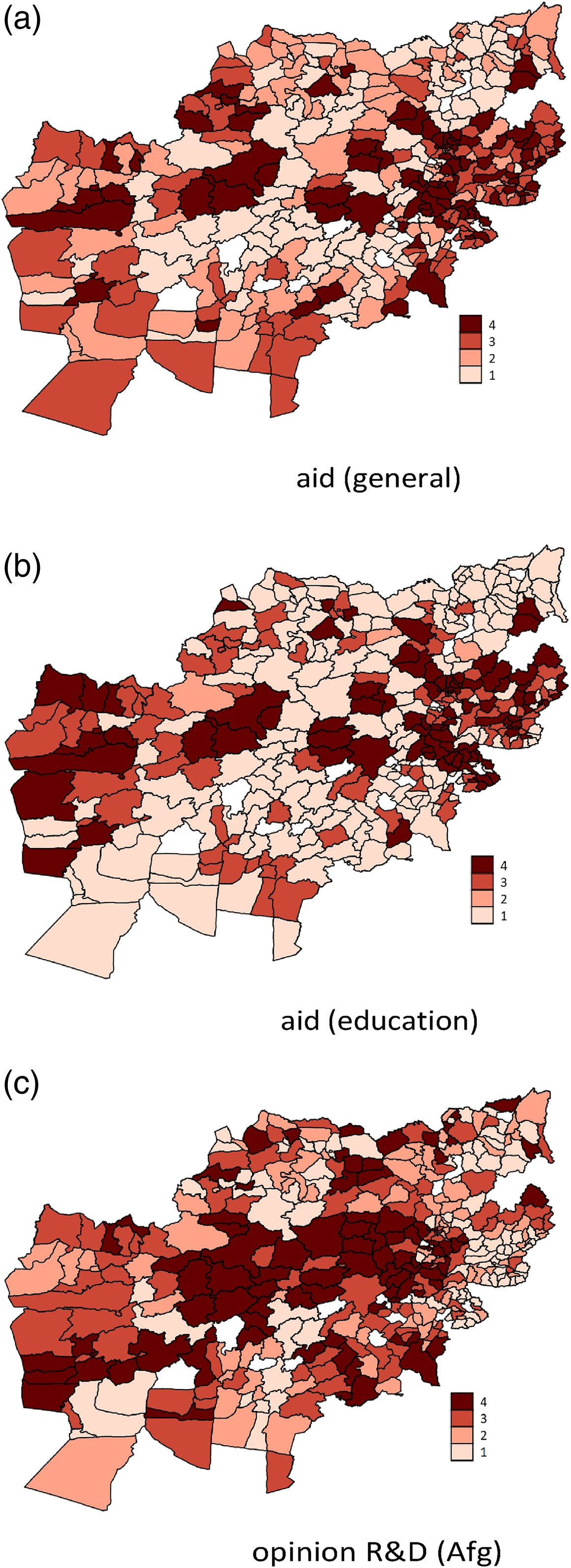
5.2. Public Opinion
Public opinion and control variables.
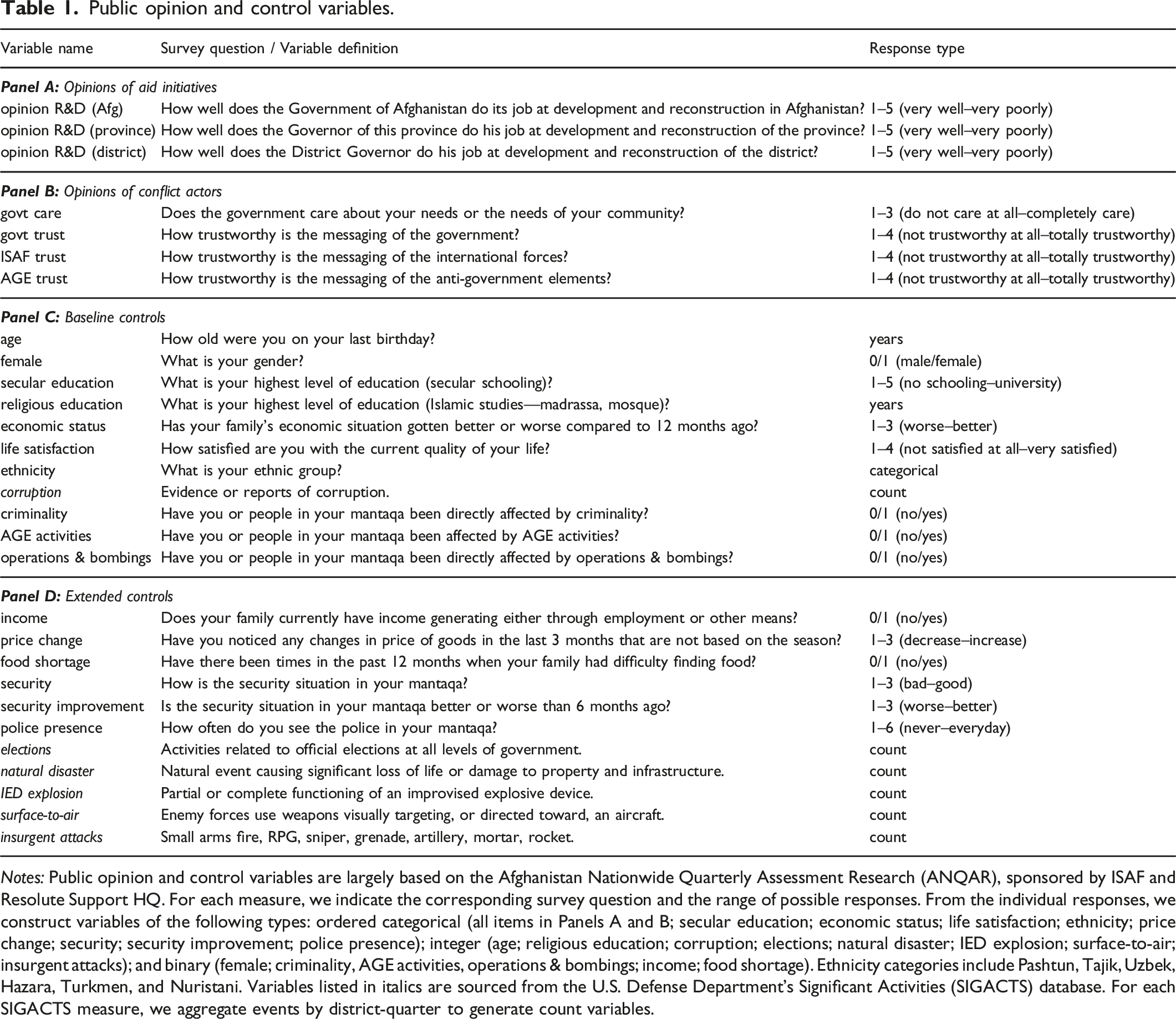
Notes: Public opinion and control variables are largely based on the Afghanistan Nationwide Quarterly Assessment Research (ANQAR), sponsored by ISAF and Resolute Support HQ. For each measure, we indicate the corresponding survey question and the range of possible responses. From the individual responses, we construct variables of the following types: ordered categorical (all items in Panels A and B; secular education; economic status; life satisfaction; ethnicity; price change; security; security improvement; police presence); integer (age; religious education; corruption; elections; natural disaster; IED explosion; surface-to-air; insurgent attacks); and binary (female; criminality, AGE activities, operations & bombings; income; food shortage). Ethnicity categories include Pashtun, Tajik, Uzbek, Hazara, Turkmen, and Nuristani. Variables listed in italics are sourced from the U.S. Defense Department’s Significant Activities (SIGACTS) database. For each SIGACTS measure, we aggregate events by district-quarter to generate count variables.
5.3. Significant Events
Descriptive statistics.
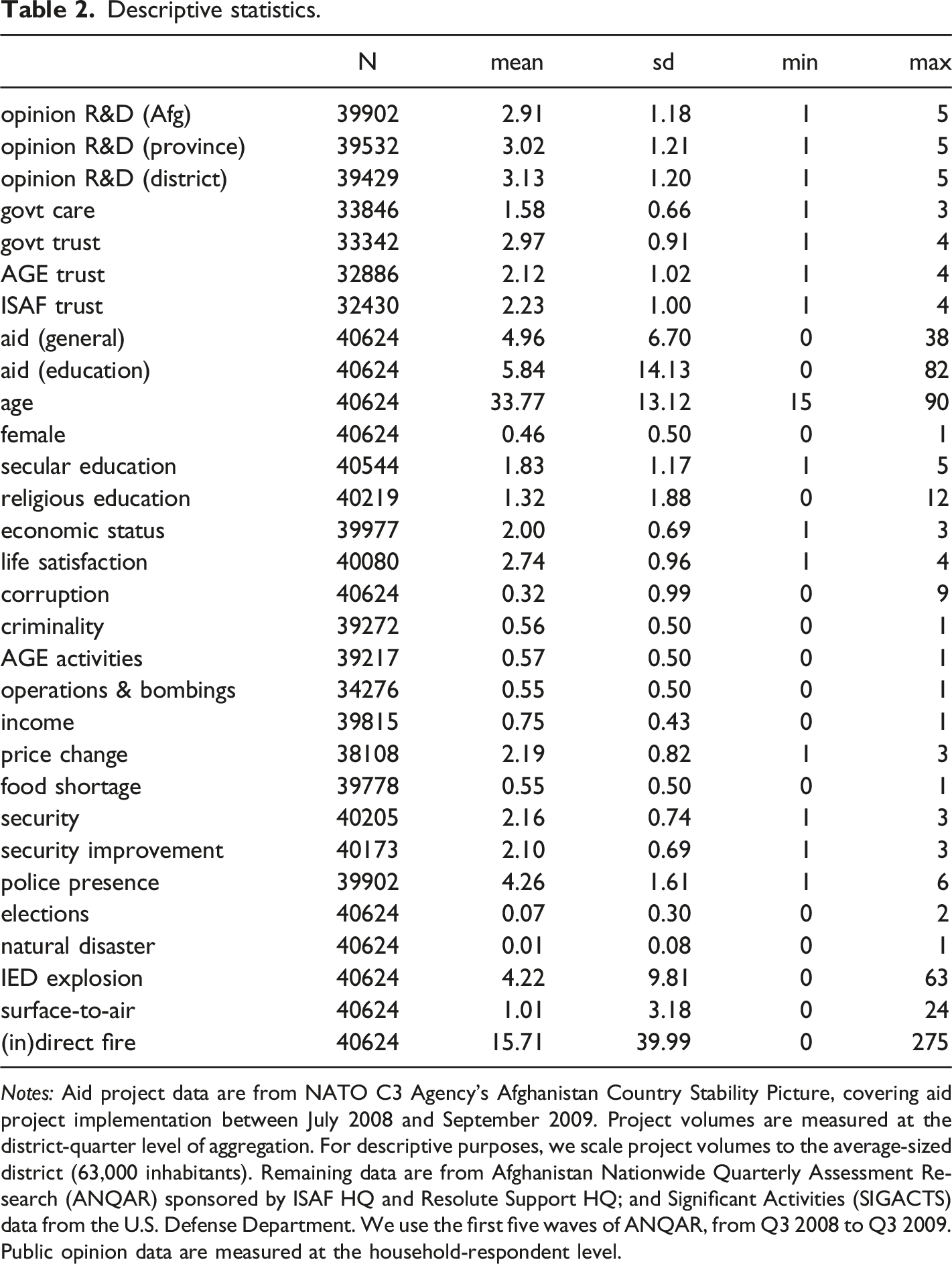
Notes: Aid project data are from NATO C3 Agency’s Afghanistan Country Stability Picture, covering aid project implementation between July 2008 and September 2009. Project volumes are measured at the district-quarter level of aggregation. For descriptive purposes, we scale project volumes to the average-sized district (63,000 inhabitants). Remaining data are from Afghanistan Nationwide Quarterly Assessment Research (ANQAR) sponsored by ISAF HQ and Resolute Support HQ; and Significant Activities (SIGACTS) data from the U.S. Defense Department. We use the first five waves of ANQAR, from Q3 2008 to Q3 2009. Public opinion data are measured at the household-respondent level.
6. Analysis
6.1. Controversial and Benign Aid Projects
We begin our analysis by testing hypotheses H1a and H1b from section 4.1. Respectively, these state that individual utility from foreign aid depends positively on the level of benign projects, and negatively on controversial projects (i.e., U b i > 0 and U k i < 0). Through qualitative research and fieldwork, we identify education projects as being particularly contentious. We thus operationalize education projects as comprising our controversial sector (k) in this analysis. 20 Because we have no empirical foundation upon which to label other sectors as controversial, we consolidate remaining sectors into the residual benign category (b). This is not to suggest this variegated group of projects do not differ in terms of both ideological and economic impact. But to the extent that we include controversial projects in this benign grouping, any beneficial impact of benign projects on public opinion should be understated. Next, we operationalize “individual utility from aid” with the variables listed in Panel A of Table 1. Specifically, individuals express how well their government representatives (at various administrative levels) are performing with respect to development and reconstruction. We interpret these responses as a reflection of utility derived from aid provisions.
Project volumes and aid assessments.
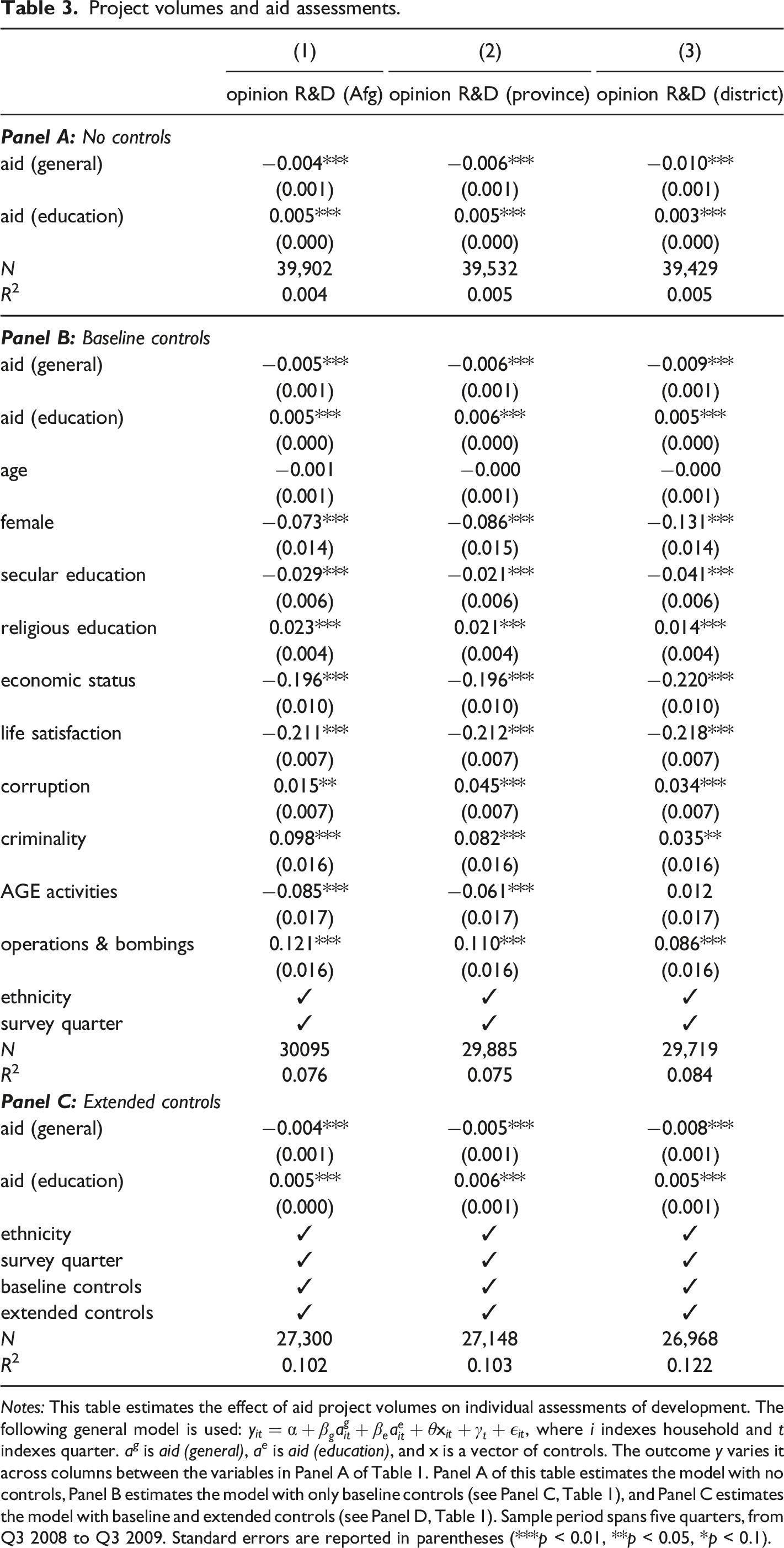
Notes: This table estimates the effect of aid project volumes on individual assessments of development. The following general model is used:
Panel A of Table 3 demonstrates that general aid correlates negatively with adverse opinions of development initiatives. In other words, public opinion is more favorable under higher provisions of general aid. 22 The effect of education aid, however, runs contrary to this pattern. When individuals are exposed to higher volumes of education projects, favourability of development tends to be lower. These patterns persist across all administrative levels in columns 1–3. 23
Because the above correlations are possibly driven by omitted factors, in Panel B of Table 3 we add a number of baseline controls to our regression model. We introduce survey quarter fixed effects to account for trends in aid or public opinion. We include demographic characteristics of age, gender, ethnicity, education, and economic status, as these may be correlated with household opinion and local aid disbursements. Also included are measures of the institutional and security context of survey respondents, as these can affect both aid allocations and public opinion. All baseline controls are listed and defined in Panel C of Table 1. When including baseline controls in Panel B of Table 3, effect sizes and significance levels remain similar for both aid measures. Of note, we find more favorable assessments of development among those with higher secular education, economic status, and life satisfaction. Religious education is correlated with poorer assessments of aid initiatives. Local corruption, criminality, and military operations are also negatively correlated with public opinion outcomes. Exposure to anti-government activities, however, tends to increase support for development initiatives.
To further sharpen identification, we include still more controls in Panel C of Table 3. These include additional measures of economic status and security conditions, as well as other events potentially correlated with aid disbursements and public opinion (i.e., elections and natural disasters). These extended controls are cataloged in Panel D of Table 1. In Panel C of Table 3, the impact of aid (both general and education) remains largely robust to this more flexible regression model. 24 As such, we suggest the data support our hypotheses (H1a and H1b) stating that benign projects positively affect utility from aid, while controversial projects have the opposite effect.
6.2. Aid Assessments and Community Support
Aid assessments and combatant support.
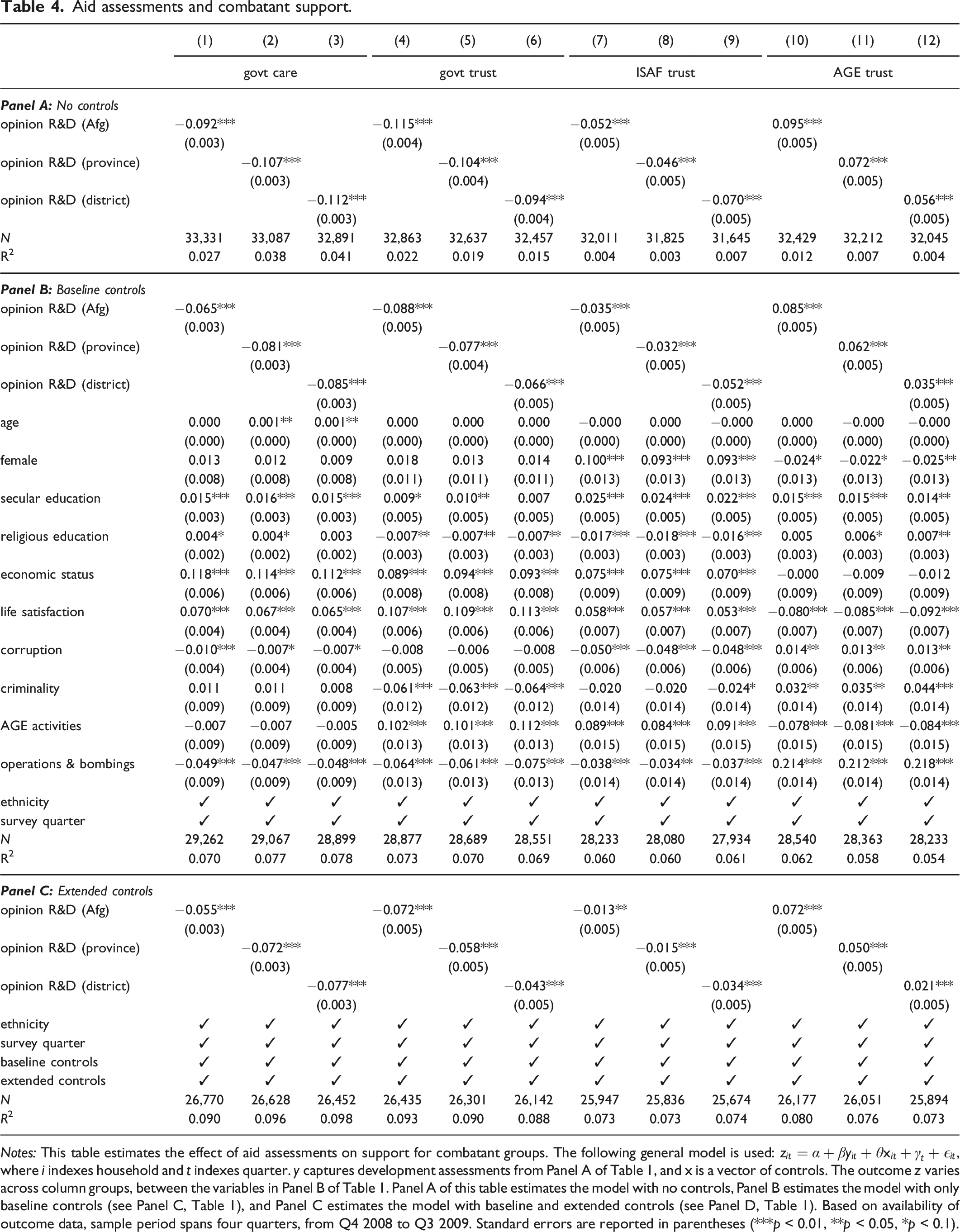
Notes: This table estimates the effect of aid assessments on support for combatant groups. The following general model is used:
The structure of Table 4 mirrors that of Table 3. Panel A of Table 4 reports bivariate correlations between individual opinions of aid and perceptions of combatants. Columns 1–3 show that households with low appraisals of development efforts do not believe the government cares about community needs. Columns 4-6 and 7-9 show that households with poor assessments of aid also have lower trust in government and international forces, respectively. Finally, columns 10–12 demonstrate that poor assessments of development initiatives are associated with greater trust in anti-government combatants. In summary, these correlations suggest when citizens approve of aid initiatives, they are more likely to trust government and counterinsurgents. When community members disapprove of development efforts, they hold greater trust in rebel forces.
In Panel B of Table 4, we add baseline controls and find our effects are generally robust to accounting for omitted variable bias stemming from key demographic and institutional characteristics. 25 Because baseline controls correlate with both aid assessments and combatant support, Panel B of Table 4 constitutes an important check on whether omitted variable bias is driving our results. In Panel C of Table 4, we further extend our control set, yet our results remain robust. Accordingly, we contend the data substantiate our second hypothesis (H2) suggesting a community member’s assessment of aid bears on their allegiance in the conflict. Taken together, our analysis adds nuance to earlier empirical work demonstrating a beneficial impact of aid on support for the Afghan government (Bohnke & Zürcher 2013; Beath et al. 2016). The results also substantiate key features of our novel theory on aid and allegiances in which ideological preferences are crucial.
6.3. Matching with Baseline Controls
It is possible that individuals exposed to high volumes of aid are inherently different from those subject to low levels of project implementation. If, for example, education projects were disproportionately channeled towards those with unfavorable views of government, this would constitute a selection effect contaminating our identification. In sections 6.1-6.2, we address selection concerns by including a vector of controls conceptually linked to aid volumes and public opinion. Our controls enter the regression model linearly, however, imposing a parametric relation which may not hold in practice. As such, we next implement the nearest-neighbor matching procedure of Abadie et al. (2004) to more precisely identify counterfactuals when estimating average treatment effects (ATEs). Conceptually, for each treated (non-treated) individual we find their closest counterpart in the non-treated (treated) set of survey respondents. After identifying matched pairs of individuals across the sample, the ATE is estimated as the average difference in outcomes between treated and control units sharing the same baseline characteristics. 26 Because treatment and control individuals are very similar by construction, this estimation of the ATE permits stronger causal inference than the preceding OLS results. In effect, differences in outcomes between treated and control units can be more confidently attributed to the difference in aid exposure, rather than to other underlying characteristics.
One stipulation under this approach is that our aid treatment variables were thus far continuous. We discretize both measures (education and general aid) by assigning a value of one (zero) to individuals whose exposure to project volumes is greater (lower) than the sample average. In Figure 3, we chart OLS estimates (in gray) corresponding to Panel B of Table 3 when using binary measures of aid. Directly adjacent (in red) we present ATE estimates based on nearest-neighbor matching. In general, effect sizes remain relatively stable under this stronger identification strategy. Compared to an otherwise similar individual with below-average exposure to general (education) aid, individuals with above-average exposure rate district-level development initiatives 0.13-points higher (0.11-points lower) on a 5-point scale. These effect sizes are equal to approximately one-tenth of the observed standard deviation in the outcome. Given the preponderance of other factors driving variation in individual assessments of district-level development initiatives, we contend these effect sizes (albeit small) are not unreasonable. Project volumes and aid assessments (matching). Notes: This figure presents average treatment effect (ATE) estimates from matching procedures (nearest-neighbor and propensity score), alongside reference OLS results. Each triple of estimates corresponds to a separate model estimated. When aid (general) is regarded as the treatment, aid (education) is included as a baseline control in the matching procedure (and vice versa). Each panel corresponds to a different outcome variable from Panel A of Table 1. Treatment variables are indicated along the x -axis. Effect sizes are plotted with 95% confidence intervals. OLS results appear in gray, nearest-neighbor matching (NNM) results are in red, and propensity score matching (PSM) results are in blue.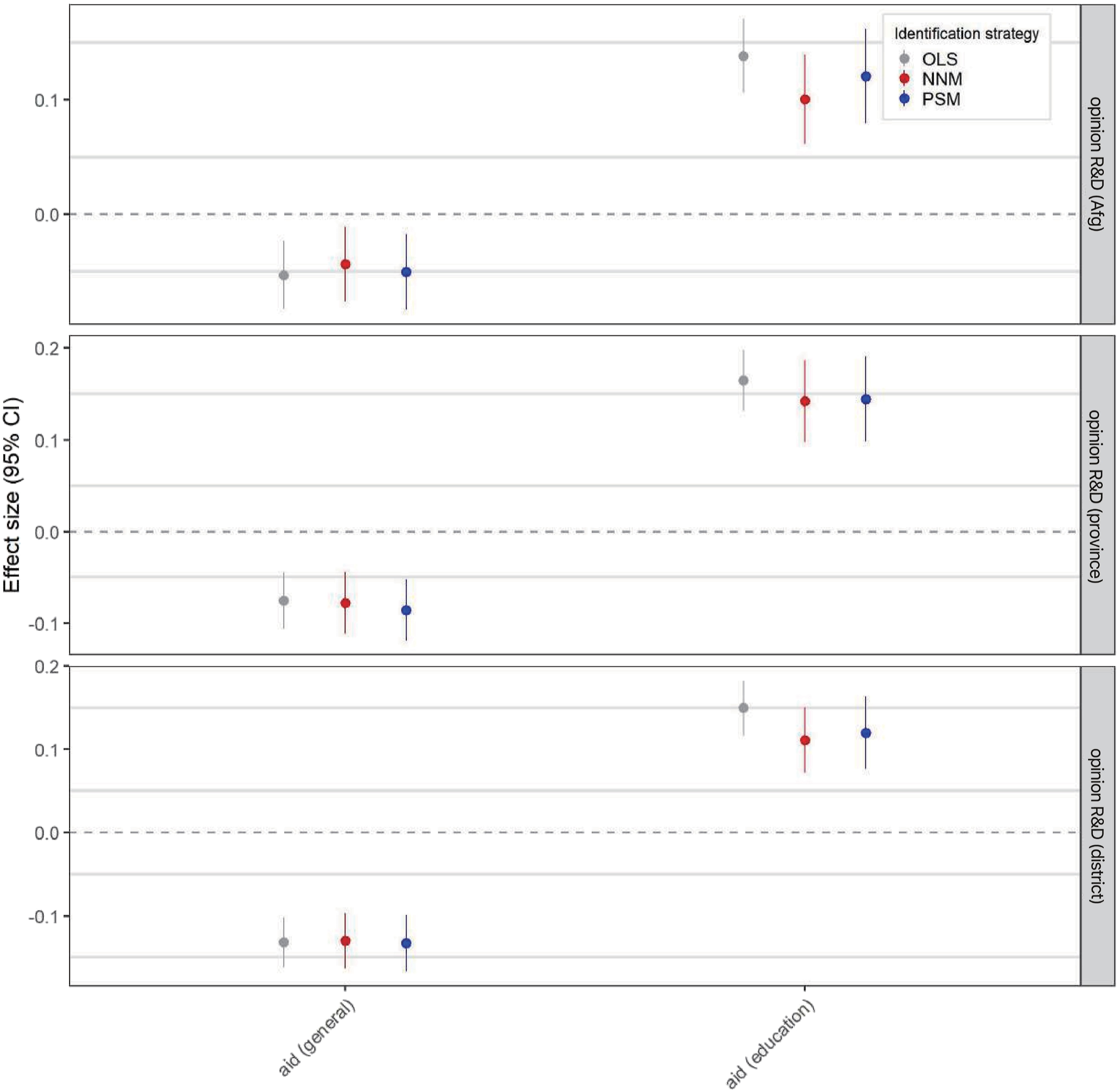
One potential concern with nearest-neighbor matching is that all covariates carry equal weight when calculating similarity between individuals. However, selection effects may be concentrated in a small number of characteristics. Accordingly, we next calculate each individual’s propensity score reflecting their likelihood of treatment (i.e., above-average aid), conditional on baseline characteristics. We then match individuals using only the propensity score, and recalculate the ATE. 27 Resulting estimates (in blue) are charted alongside their nearest-neighbor counterparts in Figure 3. We find matching on propensity scores (rather than directly on baseline controls) does not meaningfully affect inferences.
In Figure 4, we conduct the exact same matching exercise to estimate the effect of aid assessments on proxies of combatant support. Effectively we compare individuals who are similar along a range of baseline characteristics, but possess differing views regarding development. Ceteris paribus, those with above-average aid assessments tend to trust government and international forces more, and trust rebels less.
28
Granted, we cannot regard subjective aid assessments as exogenous “treatments” in this framework. Nevertheless, stability of results from Table 4 under the stricter identification strategy of Figure 4 certainly contributes further to model validation. Aid assessments and combatant support (matching). Notes: This figure presents average treatment effect (ATE) estimates from matching procedures (nearest-neighbor and propensity score), alongside reference OLS results. Each triple of estimates corresponds to a separate model estimated. Each panel corresponds to a different outcome variable from Panel B of Table 1. Treatment variables are indicated along the x -axis. Effect sizes are plotted with 95% confidence intervals. OLS results appear in gray, nearest-neighbor matching (NNM) results are in red, and propensity score matching (PSM) results are in blue.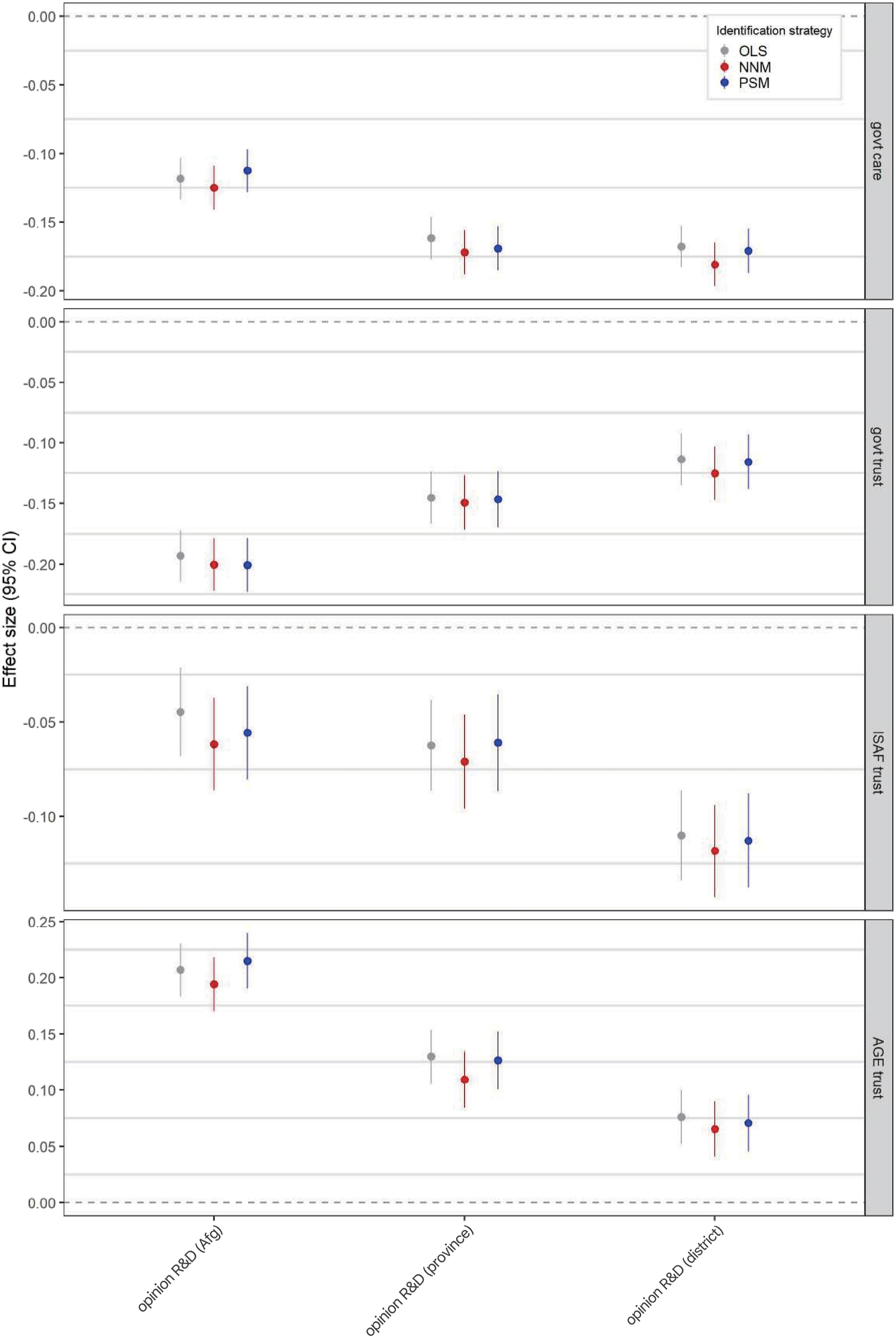
7. Conclusion
We extend the standard hearts and minds theory by emphasizing heterogeneous political preferences among civilians. Based on field interviews in Kabul, we develop a formal model in which some aid projects are ideologically contentious while others are benign. A given bundle of foreign aid chosen by the donor elicits a range of support towards combatants, based on the community’s underlying distribution of ideological preferences. Accordingly, increases in aid disbursements can lead to a degradation of support for counterinsurgents and a strengthening of rebel capacity. Donors therefore calibrate the nature of development spending to appease population segments with relatively strong ideological sensibilities. This constitutes an ideologically-informed policy lever which arises endogenously in our model.
In this paper, we treat the sector (education in particular) as an ideological fault line. This emphasis follows from related research and field interviews conducted in Afghanistan. But importantly, there exists many other dimensions along which projects may inflict grievances. Karell and Schutte’s (2018) focus on the exclusivity of aid projects is one such example. Child, Wright, and Xiao (2021) offer another example, suggesting fragmented aid facilitates corruption and thereby erodes community support. Two features of our theoretical framework apply equally to alternative accounts of aid-related grievances. First, donors are self-interested. Second, citizens are strategic actors with distinct political preferences. Together these imply for policymakers that winning hearts and minds involves a trade-off between the political interests of aid providers and those of aid recipients. The extent to which donors sacrifice their own goals therefore influences the level of community support for counterinsurgents and rebels. Our model suggests donors’ willingness to compromise will depend on the sensitivity of community support to foreign aid provisions. Interestingly, we find that sensitivity depends crucially on the distribution of ideological preferences within a community and, in particular, the relative position of the marginal supporter on that ideological spectrum.
Our model constitutes a rare contribution of formal theory to a burgeoning discussion around the impact of aid in conflict zones. We substantiate key features of our model with unique data from Afghanistan. Accordingly, our theoretical perspective and empirical results contribute to a broader understanding of the complicated relationship between foreign aid, ideological preferences, and community support for combatants.
Footnotes
Acknowledgement
I would like to acknowledge exceptional guidance from Remco Oostendorp, Chris Elbers, and Peter Lanjouw. Outstanding research assistance was provided by Lauren Cahalan, Isabela Campos, Valentin Flietner, Yulin Hao, and Lingxiao Liu. Helpful comments and advice were received at various stages of work on this project. For this I thank Eric Bartelsman, Anke Hoeffler, Mansoob Murshed, Yishay Yafeh, Yiming Cao, Raul Caruso, Ibrahim Cikrikcioglu, Esther Duflo, Pascaline Dupas, Philip Eles, Ruben Enikolopov, Joel Hillison, Stephan Jagau, Simas Kucinskas, Maria Petrova, Paolo Pinotti, Martin Ravallion, Marta Reynal-Querol, David Scoones, Alessandro Tarozzi, and Nan Tian. I also thank seminar participants at NATO Communications and Information Agency, European Bank for Reconstruction and Development, Universitat Pompeu Fabra, University of Victoria, Vrije Universiteit Amsterdam, Tinbergen Institute, NEUDC at MIT, BREAD-CEPR-PODER Conference at Bocconi University, HiCN Workshop at Universite Libre de Bruxelles, PODER Summer School at the University of Cape Town, CSAE Conference at University of Oxford, Jan Tinbergen European Peace Science Conference, Peace Science Society (International), Western Economic Association International, and Midwest Political Science Association. Finally, I thank two anonymous reviewers and Paul Huth for careful and constructive feedback during the review process. Moral/logistical and data support in Afghanistan were generously offered from Bette Dam and Mohammad Afzal, respectively. This work was supported financially by the Marie Curie Actions Initial Training Network - PODER; the Netherlands Organisation for Scientific Research (NWO); and the CEIBS Faculty Research Grant. Conference travel support was provided by the Network of European Peace Scientists. Conclusions reached from ANQAR data are not attributable to NATO/RS nor to US Forces Afghanistan (USFOR-A); interpretations offered are not necessarily shared by RS/NATO/USFOR-A. Partial replication material for this article has been released on the JCR SAGE website. Interested scholars may contact the author at
Declaration of Conflicting Interests
The author(s) declared no potential conflicts of interest with respect to the research, authorship, and/or publication of this article.
Funding
The author(s) disclosed receipt of the following financial support for the research, authorship, and/or publication of this article: This article was supported by Nederlandse Organisatie voor Wetenschappelijk Onderzoek; Marie Curie Actions Initial Training Network - PODER; and China Europe International Business School (CEIBS).

Notes
Appendix A
To visually demonstrate our model’s results, in this section we adopt a concrete parameterization. For ease of exposition, we choose the following
Given the parameterization above, we can calculate the level of rebel support for each allocation bundle, and also map the corresponding value function for the donor. Figure A1a depicts a surface reflecting levels of rebel support (S) resulting from various spending allocations (B, K) by the donor. As expected under the result dS/dK > 0 (from section 4.2.1), rebel support is increasing in outlays to the contentious sector K. In line with the result dS/dB > 0, rebel support is decreasing in outlays to the benign sector B. Intuitively, there is no support for resistance when K = 0, and maximal support when B = 0. Next in Figure A1b we depict the donor’s value function (Π). The function takes a negative slope as spending extends in a single direction from the origin, reflecting the constant cost of outlays. In equilibrium, we see greater devotion to B than to K, despite the donor’s direct preference for the latter (see i above). Because spending on K generates a negative externality on the efficiency of both sectors by increasing rebel capacity, its output is relatively constrained in the optimum allocation. Rebel support and donor payoffs. (a) Rebel support; (b) Donor payoffs. Notes: Panel (a) depicts level curves of rebel support (S) for various sectoral allocations of foreign aid. Panel (b) depicts level curves of donor payoffs (Π) for the same allocations. Simulations are based on the model parameterization described in Appendix A.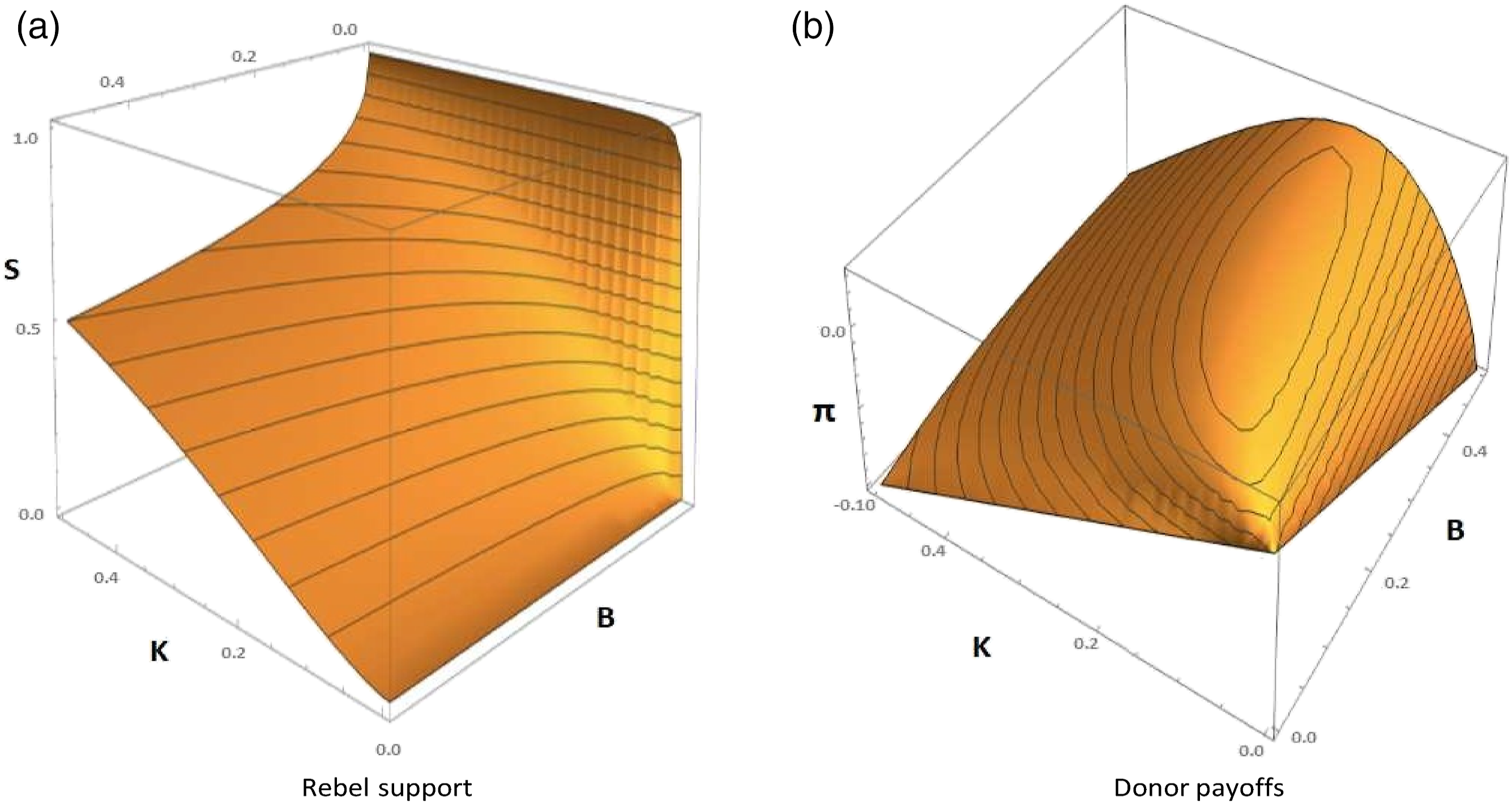
Appendix B
In this appendix, we impose additional properties to prove uniqueness and existence of the equilibrium, and to formally derive dS/dK > 0 and dS/dB < 0.
Property 1: Separability and symmetry of the output functions.
Property 2: Linear homogeneity of the community member utility function.
Property 3: Limit conditions on marginal utilities of extreme community members.