




Abstract
Despite the omnipresence of inter-group conflicts, little is known about the heterogeneity and stability of individuals’ social preferences toward in-group and out-group members. To identify the prevalence and stability of social preferences in inter-group conflict, we gather quota-representative, incentivized data from a lab-in-the-field study during the heated 2016 Austrian presidential election. We assess social preferences toward in-group and out-group members one week before, one week after, and three months after the election. We find considerable heterogeneity in individuals’ group-(in)dependent social preferences. Utilizing various econometric strategies, we find largely stable social preferences over the course of conflict. Yet, there is some indication of variation, particularly when the conflict becomes less salient. Variation is larger in social preferences toward in-group members and among specific preference types. We discuss the theoretical implications of our findings and outline potential avenues for future research.
Keywords
Introduction
Inter-group conflicts are omnipresent and can be observed between various types of groups, e.g., nations and ethnic, religious, or political groups, but also within and between companies or universities. Inter-group conflict may take different forms and use different means, ranging from subtle discrimination against out-group members in everyday life to large-scale disputes between political groups and even violent encounters in wars. Hence, inter-group conflicts are part and parcel of human interactions, having important impact on our psychological, physical, and economic welfare (Böhm, Rusch, and Baron 2020; Kimbrough, Laughren, and Sheremeta 2020).
Participation in inter-group conflict is individually costly (e.g., time, effort, risk of injury or death), whereas the outcomes—either gains or losses (e.g., power, territory)—are often shared equally among all in-group members, largely independent of their individual contributions. Hence, inter-group conflict is well described as a social dilemma (e.g., Bornstein 2003; Boyd and Richerson 2009; Henrich 2004; Darwin [1871] 2009). As a consequence, individuals’ conflict engagement should be at least partly related to their social preferences: it benefits the in-group but harms the out-group at personal cost. Therefore, contributors should have different preferences for the welfare of in-group vs. out-group members. Indeed, the theory of parochial altruism (Bowles 2009; Choi and Bowles 2007; Garca and van den Bergh 2011; for reviews, see Rusch 2014; Böhm, Rusch, and Baron 2020) claims that adaptations to the high levels of conflict exposure in ancestral societies may have favored the joint development of positive social preferences toward in-group members (i.e., altruism, fairness) and negative social preferences toward out-group members (i.e., competitiveness, aggression). Consequently, inter-individual differences in conflict engagement should be explained by differences in individuals’ (group-dependent) social preferences, i.e., how they are concerned about the welfare of in-group members vs. out-group members.
Here, we address a related yet largely unexplored issue: the stability vs. variation of social preferences over the course of inter-group conflict. Social preferences are theoretically assumed “not to change substantially over time” (Becker 1976, 5). Although this assumption is core to theories of individual economic behaviors (see Loewenstein and Angner 2003, for an in-depth theoretical discussion), it is ultimately an empirical question. We contribute to answering this research question by investigating social preferences toward in-group and out-group members in a lab-in-the-field panel study with three measurement points over a period of more than three months. Our data consists of a quota-representative population sample in a heated inter-group conflict setting: the Austrian presidential election of 2016. The intense conflict between the opposing camps allows us to identify even extreme preferences, ranging from altruism to competitiveness, and potential differences regarding these preferences toward in-group members (i.e., those individuals who support the same candidate) and out-group members (i.e., those individuals who support opposing candidates). We assess individual preferences toward in-group and out-group members shortly before, shortly after, and three months after the election. Due to our panel design, we are able to determine the stability vs. variation of social preferences over the course of conflict both on the individual and on the aggregated level.
In a nutshell, our results are the following: In line with previous research, we find substantial discrimination against out-group members. Yet, we also find considerable heterogeneity in individuals’ social preferences toward in-group and out-group members. Although these social preferences appear to be largely stable over the course of conflict, group dependency somewhat decreases with decreasing salience of the conflict (i.e., three months after the conflict), that is, universal egoism increases. Yet, variation in social preferences is larger toward in-group members and weakly parochial altruists are more likely to change.
Related Literature
Our study contributes to the growing literature on social preferences in inter-group conflict. Group identity may be responsible for differences in social preferences toward in-group and out-group members, as suggested by social identity theory (Tajfel and Turner 1979) and as formulated in economics by Akerlof and Kranton (2000). Supporting this perspective, Chen and Li (2009) observed that individuals are willing to forego more of their own payoff for the benefit of an in-group member as compared to an out-group member. These findings have been replicated in different variations in the lab (e.g., Ockenfels and Werner 2014; Kranton et al. 2016) and in the field, investigating various natural groups, e.g., neighborhoods (Falk and Zehnder 2013), army battalions (Goette et al. 2012), ethnic groups (Fershtman and Gneezy 2001; Burns 2012; Chuah, Fahoum, and Hoffmann 2013; Schubert and Lambsdorff 2014), different cultural (Chuah et al. 2007) and also political groups (Balliet et al. 2018). Taken together, there is consistent evidence for group-dependent social preferences, i.e., that people on average are more willing to benefit in-group members than out-group members at personal cost (for a meta-analytical review, see Balliet, Wu, and De Dreu 2014).
However, previous research is silent regarding the stability vs. variation of group-dependent social preferences over time. There is some work on the stability of standard, that is, unconditional social preferences: Brocklebank, Lewis, and Bates (2011) find a large correlation of
Although preferences are often assumed to be stable, changes may appear due to framing effects (Tversky and Kahneman 1981) or environmental shocks (Stigler and Becker 1977; see also Dasgupta et al. 2017). Framing can be seen as part of the problem that decisions rarely are made with perfect information but that a selection has to be performed. That is, some information about a situation is more salient and thus more likely to be considered (Jou, Shanteau, and Harris 1996). Salience may change due to differences in framing in the public and political discourse during the course of conflict (issue framing; see Druckman 2004). In fact, political parties may have an interest to frame the conflict as more fierce and zero-sum prior to an election, which may, in turn, change decision makers’ (perception of) information on which they base their social preferences. For instance, one could expect a stronger salience of inter-group conflict before (i.e., more group dependency in social preferences) than after (i.e., less group dependency in social preferences) the election.
Over and above such differences in the conflict salience due to framing, environmental shocks have also been proposed as a potential reason for changes in preferences. An obvious candidate in the context of inter-group conflict is the process and outcome of a particular and intensive conflict setting. As an example, for violent inter-group conflicts, there is evidence that both costly rewarding of in-group members’ cooperation and costly punishing of in-group members’ non-cooperation is increased during wartime compared to times of peace (A. Gneezy and Fessler 2012). Furthermore, meta-analytic evidence from several field studies suggests that group dependency of social preferences may prevail and even increase—mainly due to increasing in-group prosociality—after extreme forms of inter-group conflict, i.e., war violence (Bauer et al. 2016). Clearly, violent inter-group conflict is a special case in the sense that it induces strong institutional or social norms, and it is associated to psychopathological processes (e.g., post-traumatic stress disorder), both having the potential to affect social preferences. However, there is a lack of experimental (field) research on the stability vs. variation of social preferences in conflicts not involving violent encounters (e.g., organizational or political conflicts), either due to framing effects and/or environmental shocks. We aim to close this gap.
When determining the stability vs. variation of group-(in)dependent social preferences, it may be of additional interest whether this depends on the type of preference an individual possesses. Yet, little is known about the inter-individual heterogeneity in group-(in)dependent social preferences. There are some notable exceptions. Kranton et al. (2016) show that group-dependent social preferences are only present for a certain proportion of individuals (“groupy” participants), while others have group-independent social preferences by showing equal levels of prosocial behavior toward in-group and out-group members (“non-groupy” participants). Furthermore, Kranton and Sanders (2017) show that group-dependent preferences are predicted by political party affiliation and hypothesize that group dependency of social preferences is contingent on political contestation. Moreover, Böhm (2016) proposes a theoretical distinction between individuals who engage in inter-group conflict motivated by the concern to benefit in-group members (but without a spiteful preference toward out-group members; i.e., weakly parochial altruists) and those who do so motivated by spite toward out-group members (i.e., strongly parochial altruists). In an experimental game setting devised to distinguish between these preference types, Aaldering and Böhm (2019) indeed find support for both types. Additionally, they show that a considerable amount of their participants is well described as universal altruists, that is, they benefit both in-group and out-group members equally at personal cost. However, due to the strategic nature of their game setting, it remains an open question whether those types emerge due to individuals’ differences in preferences or differences in beliefs. We address this issue and assess mere (group-dependent) social preferences in a non-strategic setting, and investigate their stability vs. variation over the course of conflict.
Method
The Conflict Setting
In 2016 and 2017, a series of elections worldwide divided various countries’ populations into opposing camps. Those countries were deeply divided in two groups with extreme contrapositions regarding the political mindset (Smale 2016, May 23; Tisdall 2016, December 4; Detruy 2016, December 5) and the atmosphere was characterized by aggression and tension, not only between the contesting parties and candidates but also within the population (Das Gupta 2016, May 16; Walsh 2016, May 24). Examples include the presidential race in the US, the Brexit referendum in the UK, as well as the presidential elections in France and in Austria—the location of our study.
The Austrian president is directly elected every six years by the Austrian citizens over the age of sixteen. If no candidate receives an absolute majority in the first vote, a run-off election with the two leading candidates takes place. The Austrian constitution entrusts the president as head of the state with great power. However, presidents utilize these rights primarily in situations of crisis as, for example, recently in the year 2019, when the president terminated the whole cabinet after a successful motion of no confidence before then autonomously selecting and appointing an interim government to run government affairs until the upcoming election.
The situation in 2016 differed in various dimensions from previous presidential elections. International media extensively reported about the presidential race as a “sign of how well populist candidates might do elsewhere in Europe” (BBC 2016, December 5) and candidates further exaggerated the already heated situation by threatening to extensively exercise their constitutional power when elected (Noll 2016, December 3). They participated in a very “dirty” election race (Allen 2016, May 17; Das Gupta 2016, May 16) and the atmosphere rapidly transferred via social media and TV debates to the voters, who engaged in heavy arguments on- and offline. As a result, voters became aware that the stakes were higher than usual and many became worried about the real consequences of their vote. Back then, a representative survey about the importance of the election and the Austrian president showed, for example, that the majority of voters was of the opinion that the presidential election will decide in which direction the country will develop in the future and even 60 percent of voters agreed that Austria needs a strong president who should instruct the government what to do (ISA/SORA 2016).
In the first round of the presidential election in April 2016, there were six candidates. Left-wing candidate Alexander Van der Bellen and right-wing candidate Norbert Hofer received the highest shares of votes (21 percent and 35 percent, respectively), closely followed by a third independent candidate, Irmgard Griss (19 percent). The two candidates of the traditional major Austrian parties, social democrat Rudolf Hundstorfer and people party candidate Andreas Kohl, both only received 11 percent of the votes; finally, businessman Richard Lugner received 2 percent of the votes. Subsequently, there was a run-off ballot in May 2016 between Van der Bellen and Hofer. However, the results were declared as invalid by the Austrian Constitutional Court, which was discussed controversially and further increased the tension between the opposing camps. Finally, on December 4, 2016, there was the final run-off election. On this day, Van der Bellen won with 53.8 percent of the votes and Hofer accepted his defeat. Our study took place around this repeated run-off election. In line with the political orientation of the candidates, we refer to voters of Norbert Hofer as “right-wing voters” and to voters of Alexander Van der Bellen as “left-wing voters.” 1
Participants and Procedure
We conducted an incentivized lab-in-the-field study (U. Gneezy and Imas 2017) with a quota-representative sample of the Austrian electorate (i.e., Austrian citizens over the age of sixteen; data on quota representativeness of gender, age, and education and voting decision for all stages are presented in Table S2 in the online supplementary material). We used a panel design, repeatedly surveying the same participants online at what we refer to as three stages of the conflict. At stage 1, we collected data in the week before election day, when the conflict was heated and the outcome uncertain. At stage 2, participants were surveyed again in the week after election day, when the “winner” and the “loser” had been determined and it was clear that the outcome would not be contested in court. Finally, at stage 3, we surveyed participants again three months after election day. Data were collected by the survey company Norstat using an ISO 26362 certified online panel. 2 Figure 1 displays both the structure of the panel design and of the surveys administered at each stage of the conflict.
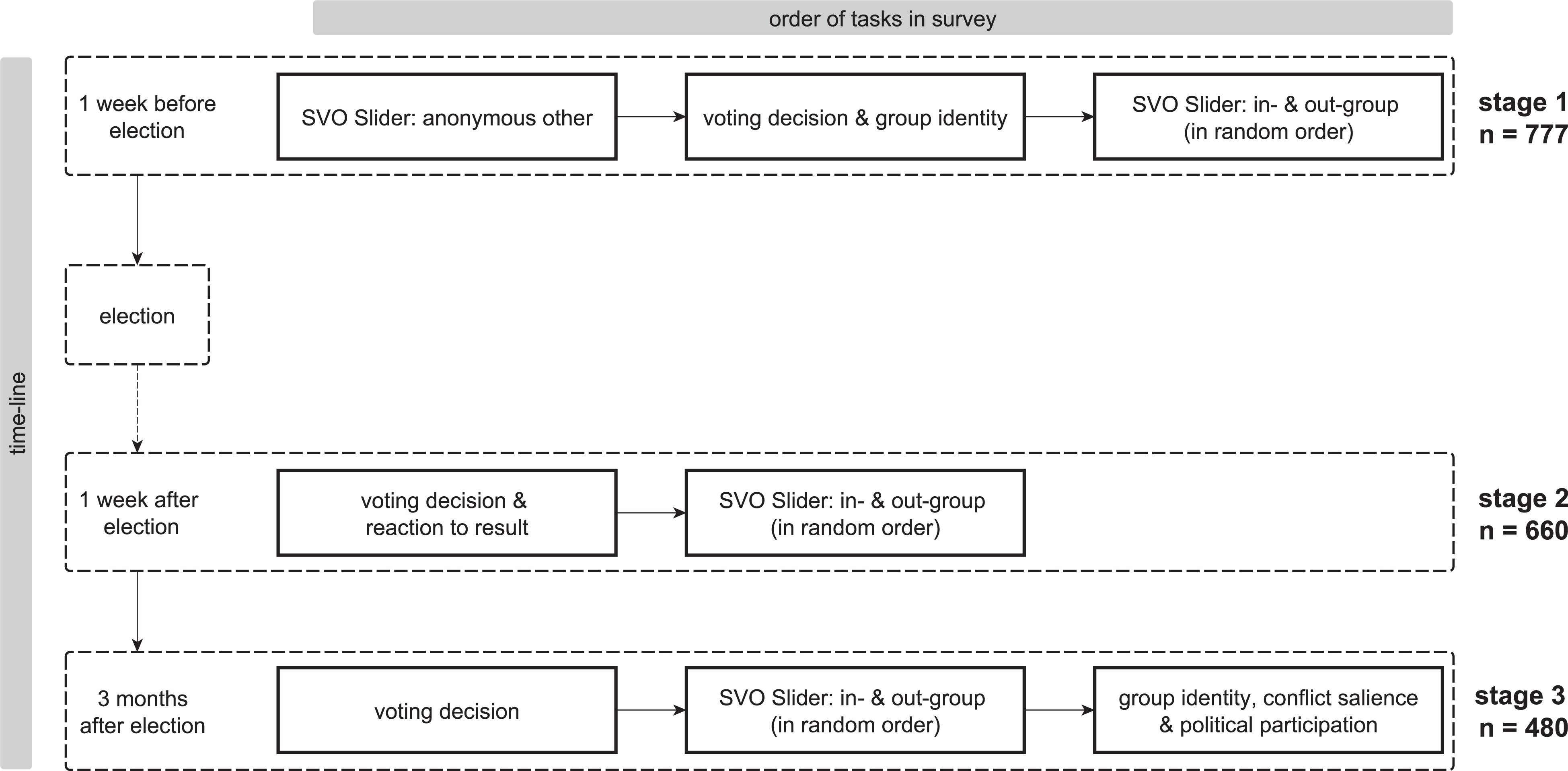
Experimental design.
From 777 participants who completed the study at stage 1, 660 participants (84.9 percent) completed the study at stage 2, and 482 participants (62.0 percent) also completed the study at stage 3. We exclude two observations with the same ID, indicating that one participant had been able to complete the survey twice due to a technical error. Our sample therefore contains 480 participants for stage 3, resulting in a panel mortality of 38.2 percent after three months. We exclude thirty-nine further participants who inconsistently reported their voting decision at the second and third stages. All of our analyses—regardless of the stages they refer to—are based on those 441 participants who completed the survey at all three stages and showed no inconsistency in reporting their voting decision. The sample includes 207 women (46.9 percent), and participants are between sixteen and ninety-four years old (mean = 50.1, SD = 15.0). Sixty-five participants stated that they did not vote for either of the two candidates (14.7 percent). 188 participants each stated that they voted for either Hofer or Van der Bellen (42.6 percent, respectively). Of those, we exclude an additional forty-one participants who changed their planned voting decision at stage 1 in a later stage or did not yet know how they would vote, so that all analyses employing in-group and out-group-dependent social preferences and the group identity measure described below are based on those 335 participants who stated that they voted for the same of the two candidates at all three stages and could therefore be assigned to an in-group with the corresponding out-group at all three stages of the conflict. 3
Using a random-lottery incentive scheme, in each stage we selected one in five participants for payment (conversion rate: 100 points = 3 Euro). Participants selected for payment were paid for one decision each of the social preference measures with an in-group and out-group interaction partner. At stage 1 only, the selected participants were also paid for one randomly selected decision of the social preference measure with an anonymous interaction partner. Therefore, participants had four opportunities to be chosen for payoff, given that they participated in all three stages. To qualify for payment at stages 1 and 2, participants had to participate in the survey both at stage 1 and at stage 2 and were informed of this requirement at the beginning of the first survey. If a participant was (at least once) selected, he or she was paid as either allocator or recipient in the respective social preference measure. An allocator was paid according to the points he or she had allocated to him- or herself in one randomly selected decision (for details, see below). For a recipient, one decision of a randomly chosen allocator was selected, determining the corresponding recipient’s payoff. On average, participants who completed both stage 1 and stage 2 and were selected for payment received 2.46 Euro (min = 0.45 Euro, max = 5.55 Euro; 0.89 Euro expected payoff for all participants; average duration = 9 min, 2 sec.) for stage 1 and 2.26 Euro (min = 0.45 Euro, max = 3.00 Euro; 0.45 Euro expected payoff for all participants; average duration = 6 min. 41 sec.) for stage 2. For stage 3, participants selected for payment received on average 2.17 Euro (min = 0.45 Euro, max = 3.00 Euro; 0.43 Euro expected payoff for all participants completing stage 3; average duration = 5 min. 39 sec.). Payment information was sent to the panel provider, who then, to ensure anonymity, paid the selected participants. In addition, all participants received a fixed remuneration from the panel provider of 1.00, 0.70, and 0.50 Euro for completing stages 1, 2, and 3, respectively.
Measures
Social preferences
Social preferences can be defined as preferences containing arguments that go beyond the own material self-interest of the actor, i.e. beyond pure egoism. There are different subclasses, focusing, for example, on the material well-being of others, or others’ behaviors and intentions (Kerschbamer 2015). Concern for the material well-being of others may take different forms, including altruism, equality and social welfare concerns, and spitefulness. Importantly, in standard allocation tasks aimed to measure participants’ social preferences, an allocator decides how to distribute resources between herself and an unknown recipient. Given that the recipient has no veto power, the allocation task is non-strategic and constitutes a measure of pure material preferences for the own vs. the recipient’s welfare.
To measure our participants’ group-(in)dependent social preferences, we follow the approach of Chen and Li (2009) to use a preference measure twice, pairing a participant once with an in-group and once with an out-group recipient. We deviate from their approach, however, by using not the set of games originally developed by Charness and Rabin (2002), but the Social Value Orientation Slider measure (Murphy, Ackermann, and Handgraaf 2011). 4 We chose the SVO Slider measure instead of the set of games used by Chen and Li (2009) because of its brevity and the identical instructions and choice type for all of its six distribution decisions, as we report on a general population sample and not a student sample, the latter of which can be assumed to be able to complete complex tasks more easily. 5
In detail, the SVO Slider measure is based on a multiple within-subject measurement approach using dictator game distributions with different marginal rates of substitution (see Figure S1 in the online supplementary material for all six distribution decisions). The participant’s allocations can be used to calculate the parameter
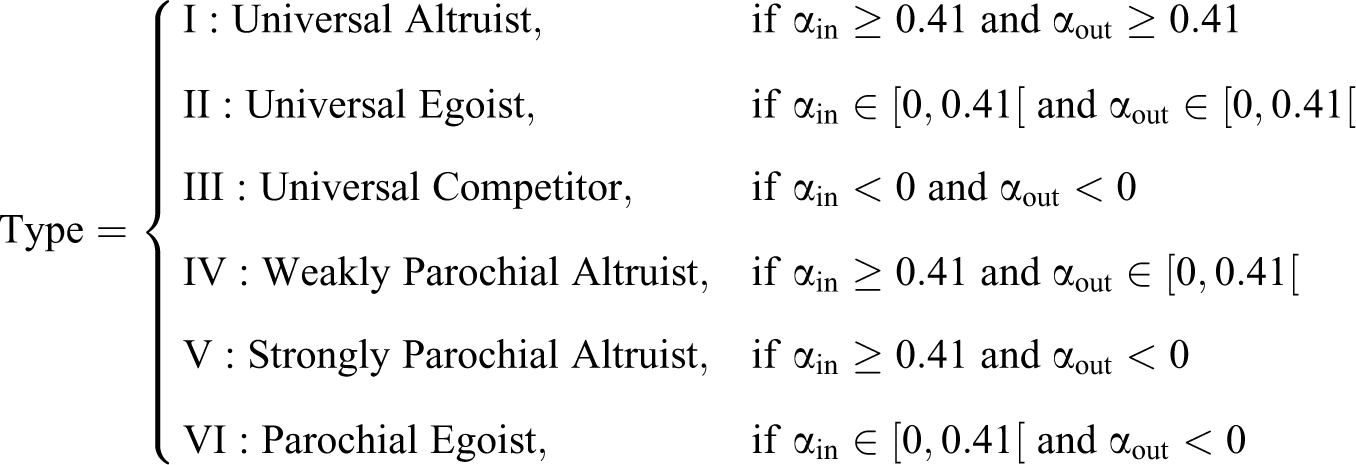
By combining the distinct utility function parameters
Yet, a more fine-grained differentiation allows identifying several types of universal vs. parochial preferences based on the categorization of their (absolute) social preferences: (i.) Universal Altruists, (ii.) Universal Egoists, and (iii.) Universal Competitors are altruistic, egoistic, or spiteful, respectively, irrespective of others’ group membership. In contrast, we distinguish between three types who have group-dependent preferences: (iv.) Weakly Parochial Altruists are prosocial toward in-group members and less so toward out-group members, but they do not have negative social preferences (i.e., competitiveness, spite) toward the latter. (v.) Strongly Parochial Altruists are prosocial toward in-group members coupled with negative social preferences toward out-group members. Lastly, (vi.) Parochial Egoists are egoistic toward in-group members but are willing to forego some of their own gain to reduce the payoff of out-group members, i.e., they display out-group spitefulness.
We measured social preferences independently for in-group and out-group members at all three stages of the conflict, as displayed in Figure 1. That is, participants completed the SVO Slider measure both with an in-group and an out-group member recipient at all three stages of the conflict, such that we are able to identify the stability (vs. variation) of group-(in)dependent social preferences during the course of the conflict (see section 3 in the online supplementary material for the instructions of the SVO Slider measure used in our study). In addition, we measured participants’ social preferences in interaction with an anonymous interaction partner at stage 1, using the standard SVO Slider measure (Murphy, Ackermann, and Handgraaf 2011). This allows the comparison of social preferences toward in-group and out-group members with generic social preferences toward unknown others.
Additional measures
We assessed a number of additional measures. Group identity was measured at stages 1 and 3 with an adapted German version of the four items devised by Doosje, Ellemers, and Spears (1995), covering cognitive, evaluative, and affective aspects of group identification. Participants had to rate the applicability of these statements (“I identify with other members of [name of in-group],” “I see myself as a [name of in-group],” “I am glad to be a member of [name of in-group],” “I feel strong ties with the [name of in-group]”) on nine-point scales, with the groups termed “voters of” the respective candidate. Cronbach’s
Additionally, we assessed how satisfied, surprised, disappointed, and happy participants were with the election outcome and whether they had expected this result at stage 2. We used five-point scales, with higher values indicating greater dissatisfaction with the election outcome. A Cronbach’s
The salience of the conflict was measured at stage 3 by asking participants to rate if the relationship between voters of Hofer and van der Bellen was (i.) hostile, (ii.) friendly, (iii.) tense and (iv.) peaceful compared to December before the election on five-point scales ranging from “a lot less” to “a lot more.” The resulting scale of all four ratings, with higher values indicating more conflict salience, has a Cronbach’s
Finally, the participants’ political participation was measured at stage 3, i.e., whether a person reads the political section of a newspaper, how often a person engages in political discussions, amount of time spent actively supporting a candidate in the elections (Barnes and Kaase 2014). Cronbach’s
In addition to these measures, we also included a number of socio-demographic variables, such as age, education, gender, and hometown population. We also included some additional questions, e.g., on voting behavior (such as voting decision in the first round of the presidential election or whether a participant has cast an absentee vote), candidate preference, and voting motives, which we do not report in the present paper.
Results
Prevalence and Determinants of Social Preferences
We begin our analyses by investigating the prevalence and determinants of group-(in)dependent social preferences at the aggregate level. This serves our main purpose of investigating the temporal stability of social preferences in inter-group conflict by comparing the prevalence of different social preferences in our real-world conflict setting with other studies as an instrument check.
Aggregate results for participants’ social preference parameters when matched with an in-group member, an out-group member, or an anonymous recipient are presented in Table 1. For participants matched with an in-group member, we find a mean
Descriptive Statistics.
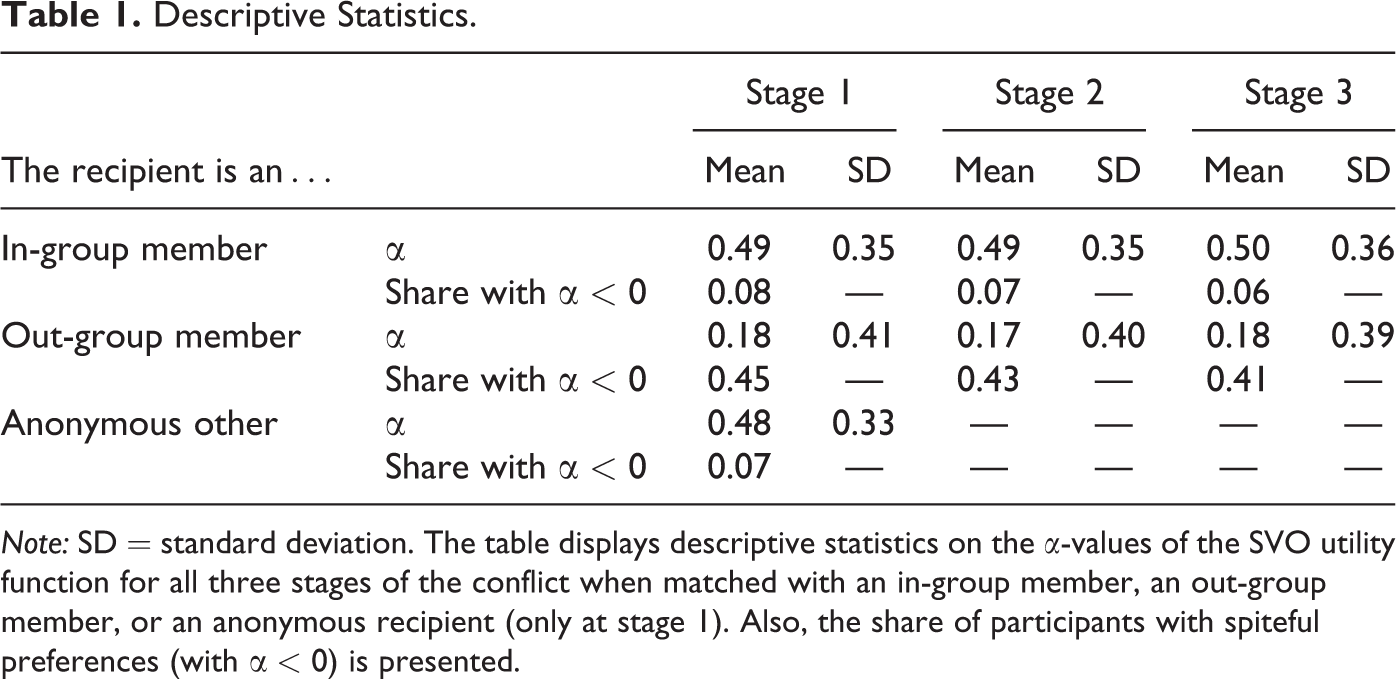
Note: SD = standard deviation. The table displays descriptive statistics on the α-values of the SVO utility function for all three stages of the conflict when matched with an in-group member, an out-group member, or an anonymous recipient (only at stage 1). Also, the share of participants with spiteful preferences (with
To predict out-group spitefulness (1 = out-group spiteful, i.e.
Logit Regression on Out-Group Spitefulness.
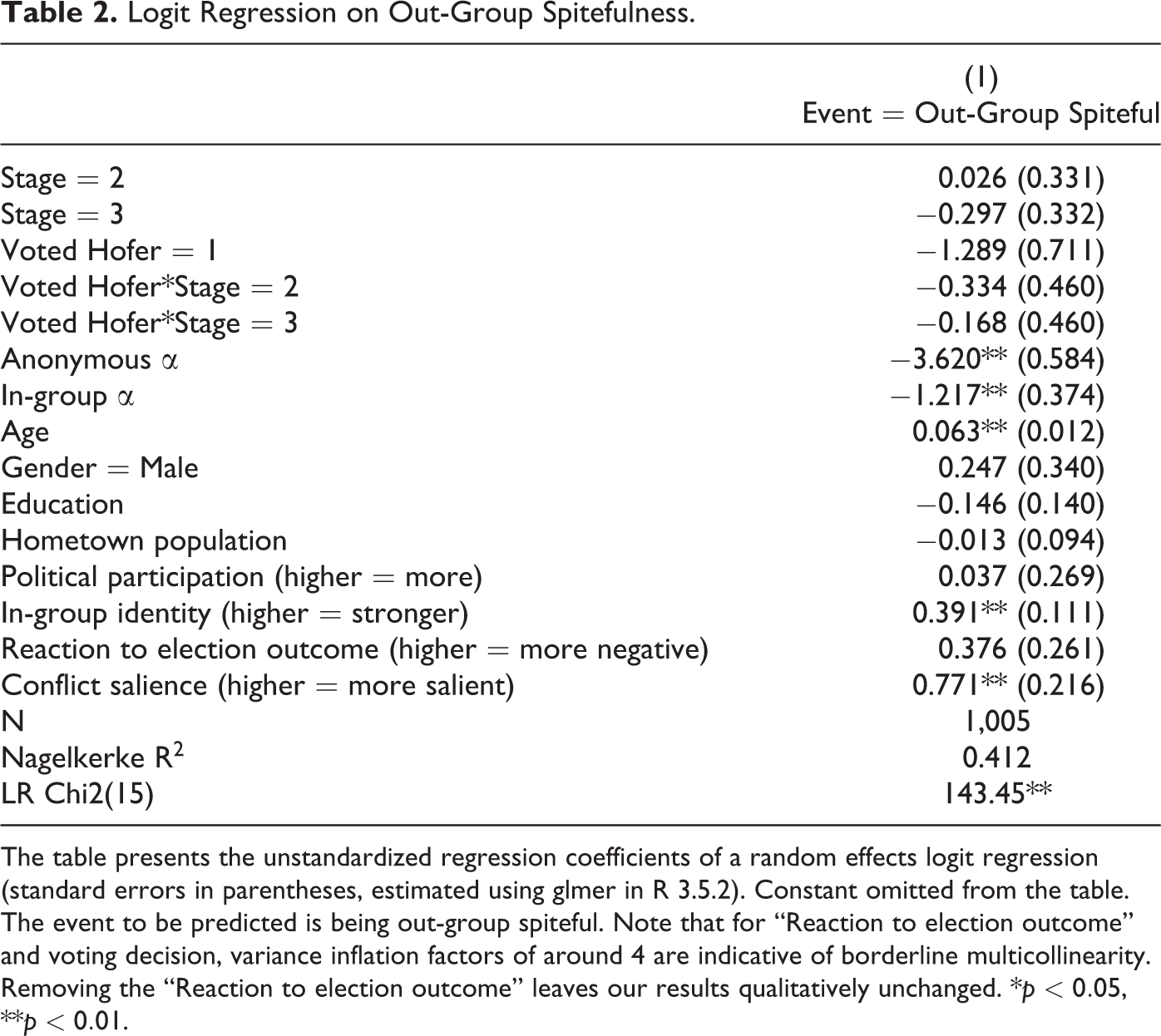
The table presents the unstandardized regression coefficients of a random effects logit regression (standard errors in parentheses, estimated using glmer in R 3.5.2). Constant omitted from the table. The event to be predicted is being out-group spiteful. Note that for “Reaction to election outcome” and voting decision, variance inflation factors of around 4 are indicative of borderline multicollinearity. Removing the “Reaction to election outcome” leaves our results qualitatively unchanged. *
Most notably, we find no effects of the stage dummies and the voting decision dummy. Thus, there is no evidence that Hofer voters are more likely to be out-group spiteful in general, and the insignificant interaction terms further indicate that Hofer voters do not become more out-group spiteful in later stages of the conflict. We do find that with both an increase in positive social preferences toward in-group members and anonymous others, the probability of being spiteful toward out-group members decreases significantly. From the socio-demographic predictors, we find that the probability to be spiteful toward an out-group member increases with age. Out-group spitefulness also becomes more likely the higher an individual’s identification with the in-group. In addition, there is a positive effect of conflict salience: Those voters who perceive the conflict to be more salient are more likely to be spiteful when matched with an out-group member.
As a last step, we investigate the association of social preferences toward in-group and out-group members in general by regressing out-group social preferences on in-group social preferences. For the pooled data of all three conflict stages, we observe a significant regression coefficient for in-group social preferences of 0.27 (
Stability of Social Preferences Over the Course of Conflict
We proceed with an in-depth analysis of the temporal stability of group-(in)dependent social preferences by comparing individuals’ initial social preferences in the week before the election (i.e., at stage 1) with their social preferences both in the week after the election (i.e., at stage 2) and three months after the election (i.e., at stage 3), respectively. We begin by looking at the aggregate mean values for both the pooled sample and left- and right-wing voters separately. The overall mean
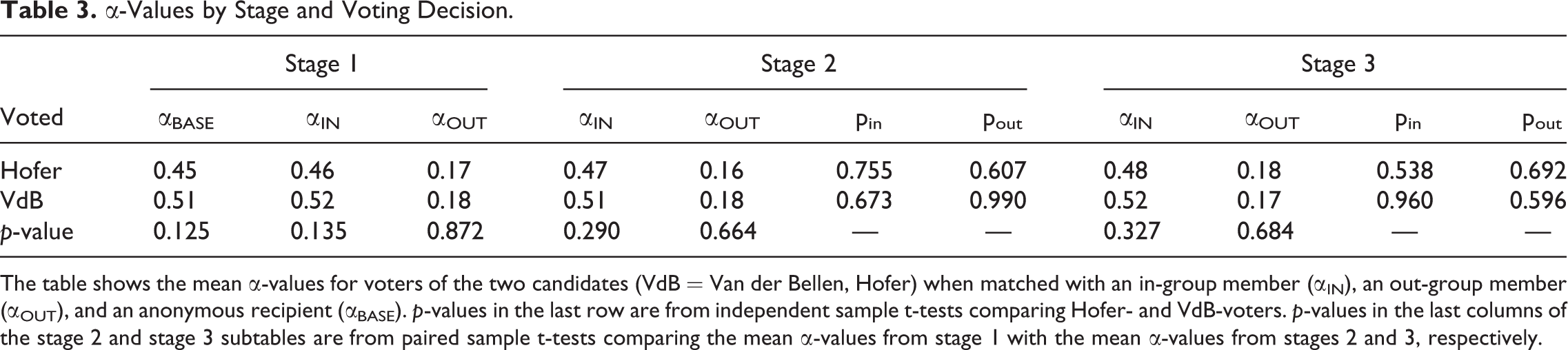
The table shows the mean α-values for voters of the two candidates (VdB = Van der Bellen, Hofer) when matched with an in-group member (αIN), an out-group member (αOUT), and an anonymous recipient (αBASE). p-values in the last row are from independent sample t-tests comparing Hofer- and VdB-voters. p-values in the last columns of the stage 2 and stage 3 subtables are from paired sample t-tests comparing the mean
However, the absence of differences in mean
We first (i.) calculate the differences of individuals’ social preferences between stages 1 and 2 and stages 1 and 3, respectively, for each voter. Table 4 displays the mean and absolute mean change for the differences in
Mean Change and Mean Absolute Change of the
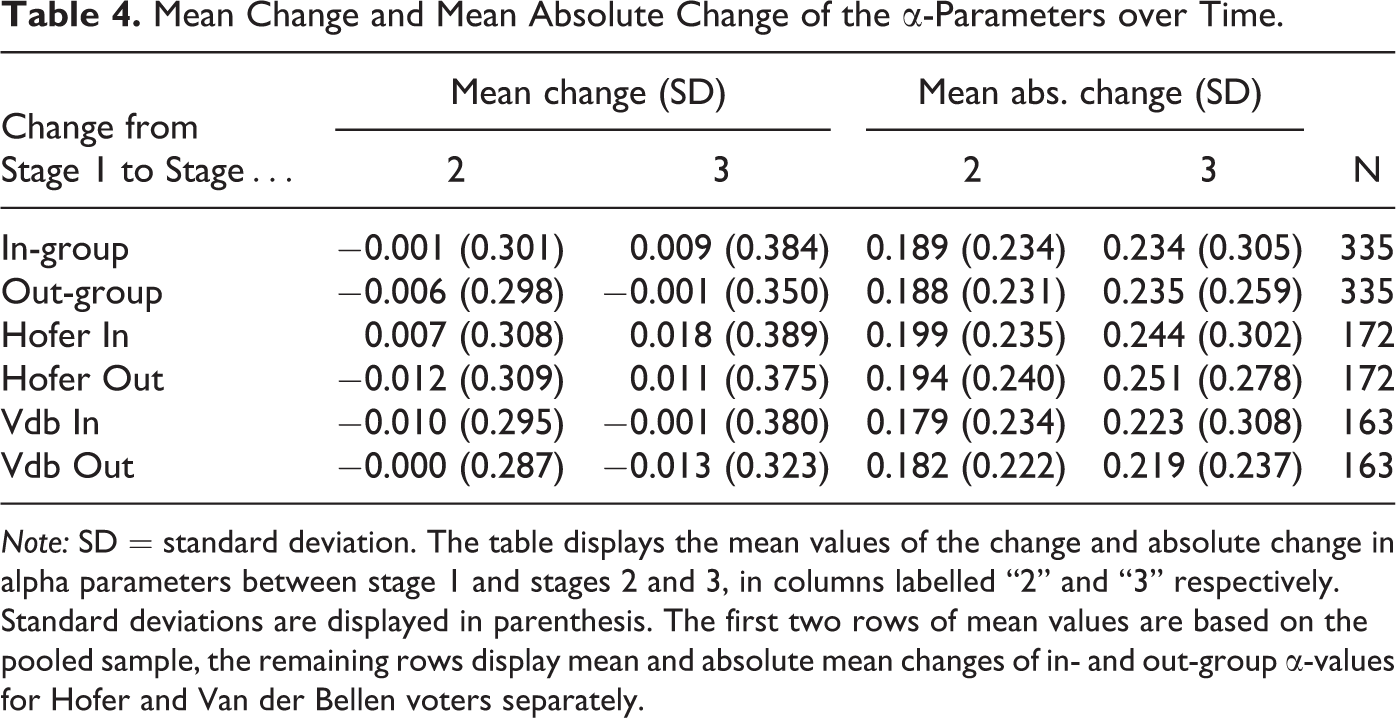
Note: SD = standard deviation. The table displays the mean values of the change and absolute change in alpha parameters between stage 1 and stages 2 and 3, in columns labelled “2” and “3” respectively. Standard deviations are displayed in parenthesis. The first two rows of mean values are based on the pooled sample, the remaining rows display mean and absolute mean changes of in- and out-group
Some variation in preferences can be expected without necessarily arriving at the conclusion of preference instability. One approach would be to set a certain threshold above which differences are considered as meaningful. Yet, such a threshold would always be arbitrary to some extent (see e.g., Seebauer, Fleiß, and Schweighart 2017). Another approach can be found in the economic literature on temporal stability of preferences, where the presence of (some) variation over time is also not equated with preference change, but such a conclusion is made based on the unimodality and symmetry of the distribution of the differences between the two points in time (Andersen et al. 2008; Dasgupta et al. 2017). We thus (ii.) look at the corresponding histograms displayed in Figure 2 next. We see a clear modal value of zero and a symmetrical distribution, thus, no trend toward negative or positive deviations, both for the pooled sample and for Van der Bellen and Hofer voters separately. This is indicative of temporal stability of group-(in)dependent social preferences (Dasgupta et al. 2017).
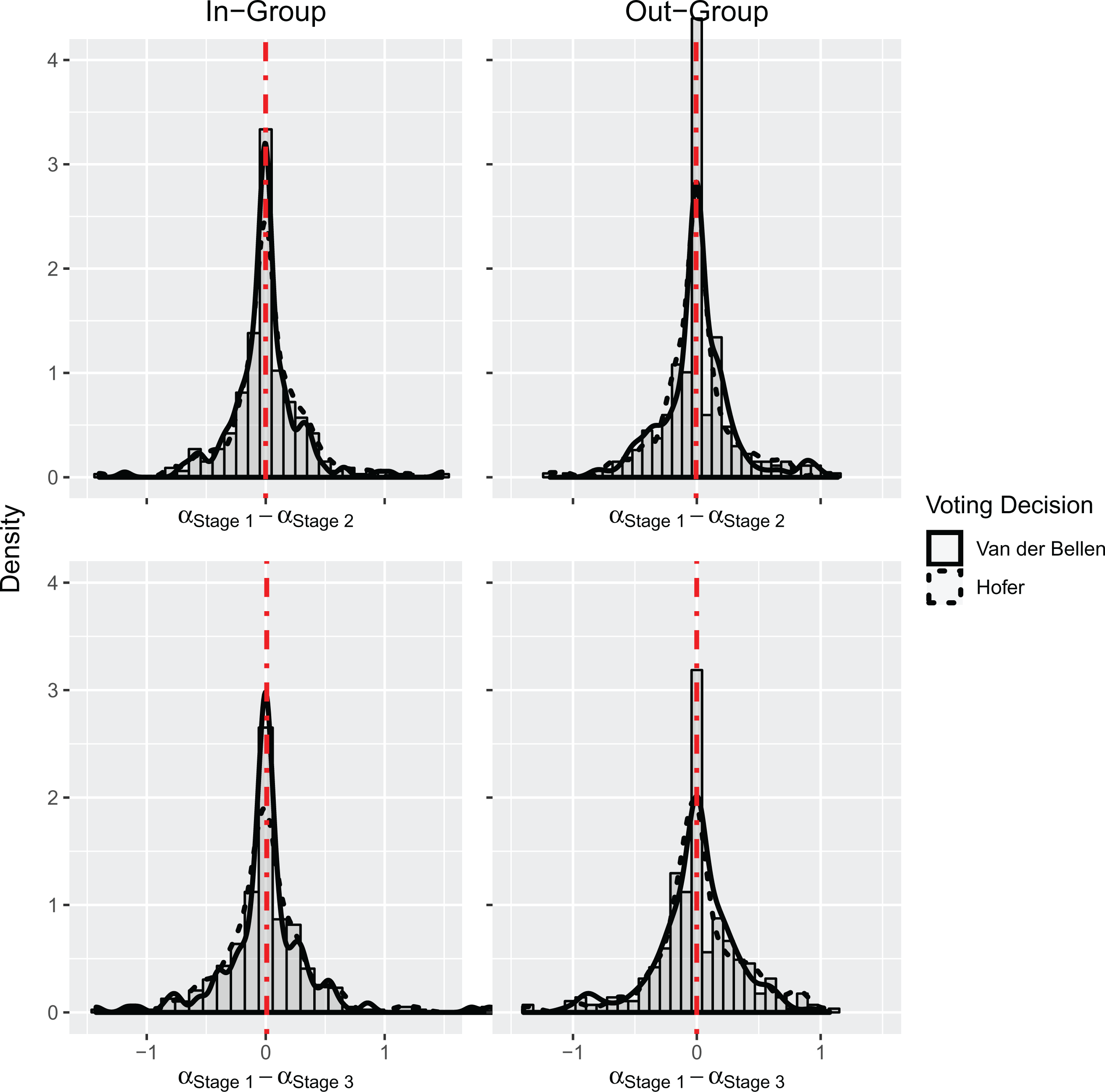
Individual-level changes of
Another approach to estimate stability vs. variation of social preferences is by (iii.) looking at test-retest correlations. For the SVO Slider measure used to assess social preferences in our study, the paper initially introducing the measure reported an exceptionally high test-retest reliability of
As our final indicator of temporal stability of group-(in)dependent social preferences, we (iv.) compare the within- and between-subjects variance (Table 5). In this case, a within-subjects variance smaller then the between-subjects variance is seen as evidence for temporal stability (Dasgupta et al. 2017). This is the case for out-group
Intertemporal Correlations and Variance Decomposition Group-Dependent Social Preferences.
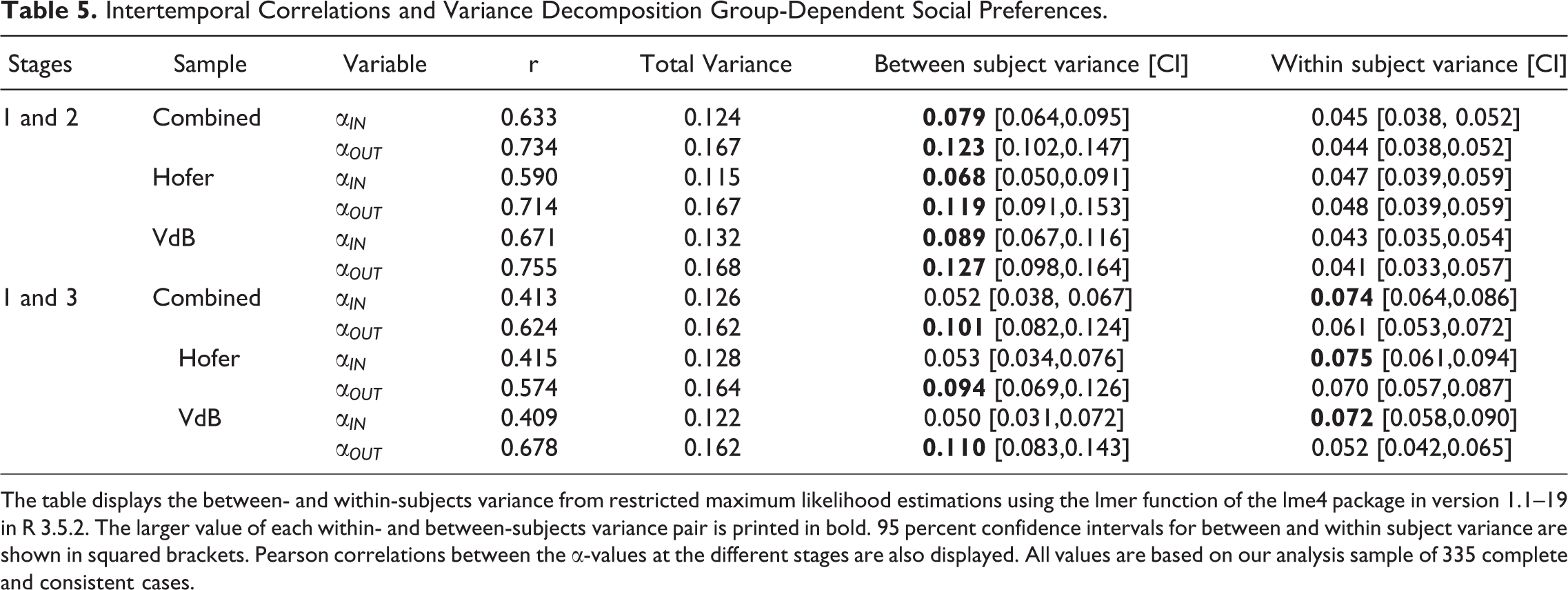
The table displays the between- and within-subjects variance from restricted maximum likelihood estimations using the lmer function of the lme4 package in version 1.1–19 in R 3.5.2. The larger value of each within- and between-subjects variance pair is printed in bold. 95 percent confidence intervals for between and within subject variance are shown in squared brackets. Pearson correlations between the
Prevalence of Preference Types Over the Course of Conflict
We now investigate whether the individual variation of social preferences also affects the prevalence of the theoretically-derived preference types—defined by the combination in-group and out-group social preferences (see section “Social Preferences”)—over the course of conflict. The distribution of the preference types for all three stages of the conflict is displayed in Table 6 and Figure 3. For stage 1, we observe that more than 60 percent of voters are classified as altruistic toward in-group members. Half of those are also altruistic toward out-group members, hence, their altruism is group-independent (I: Universal altruists). The other half of in-group altruists is less prosocial toward out-group members than toward in-group members. That is, 20 percent of voters are strongly parochial altruists (V) with an
Distribution of Types and Transition Matrices by Stage.
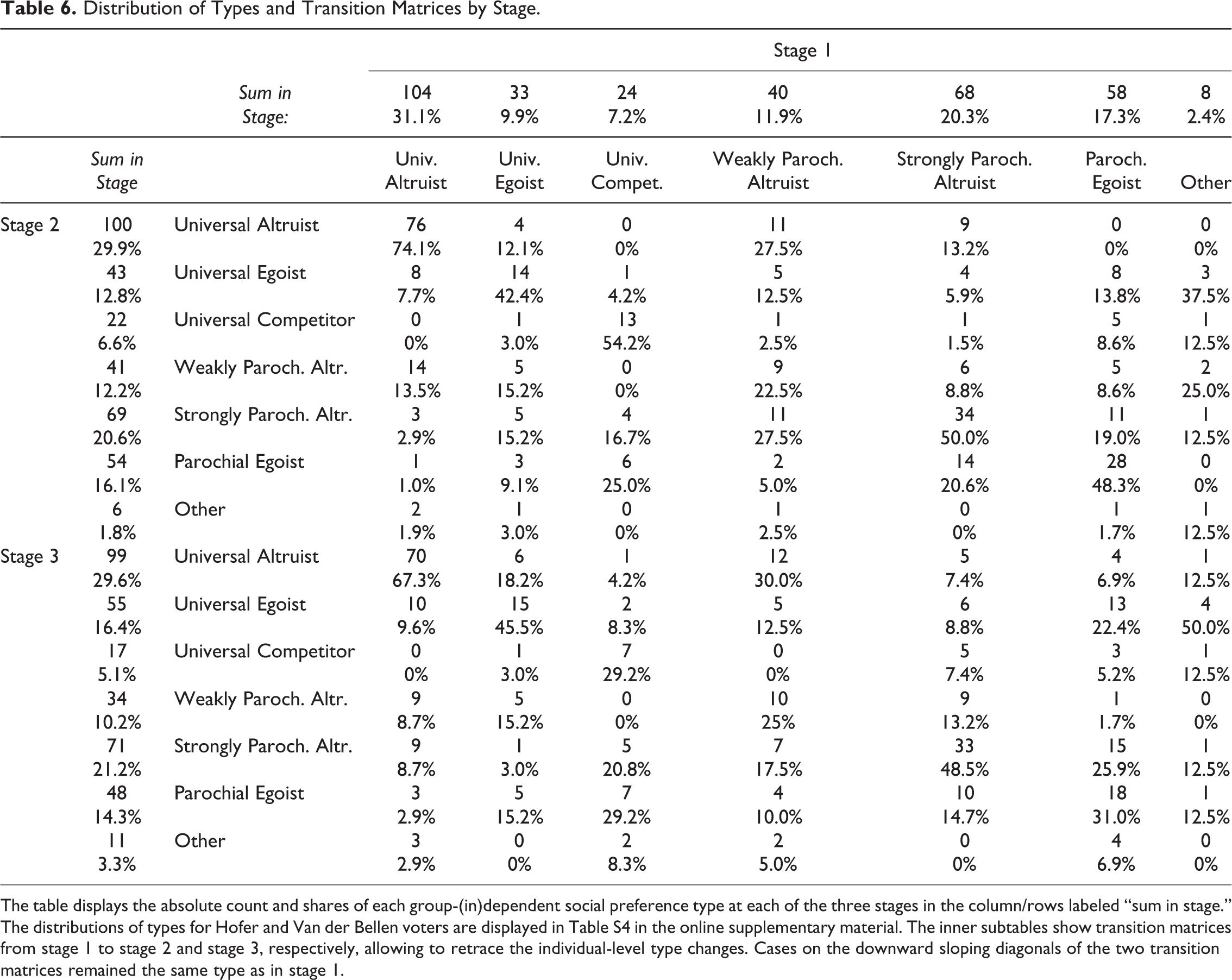
The table displays the absolute count and shares of each group-(in)dependent social preference type at each of the three stages in the column/rows labeled “sum in stage.” The distributions of types for Hofer and Van der Bellen voters are displayed in Table S4 in the online supplementary material. The inner subtables show transition matrices from stage 1 to stage 2 and stage 3, respectively, allowing to retrace the individual-level type changes. Cases on the downward sloping diagonals of the two transition matrices remained the same type as in stage 1.
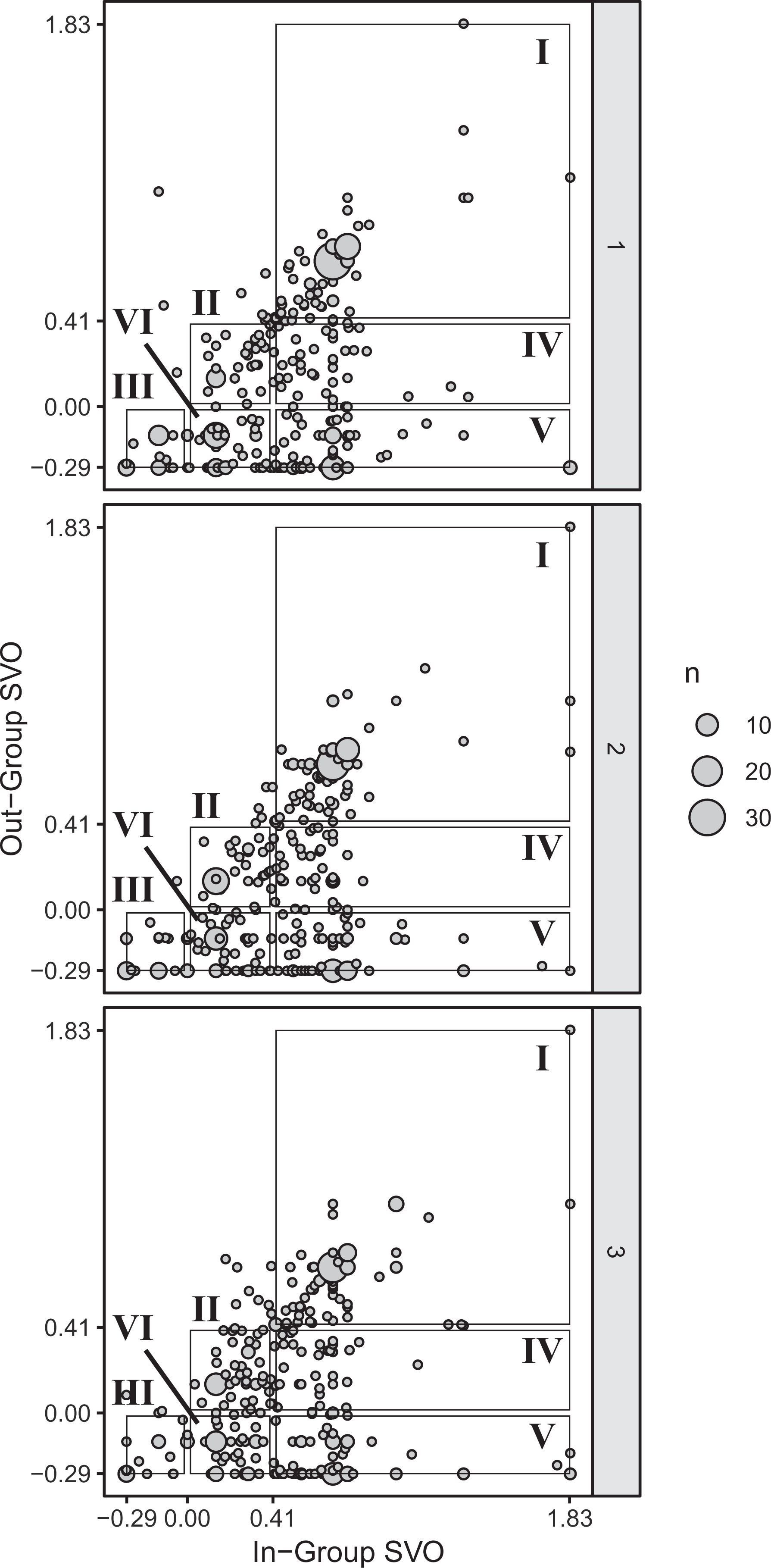
Types of group-dependent social preferences.
Regarding the stability of the distribution of the different group-(in)dependent preference types, we find neither significant changes from stage 1 to stage 2, nor from stage 2 to stage 3 (Chi2 goodness of fit tests,
To further explore individual-level stability of social preference types, we follow the approach of Bruhin, Fehr, and Schunk (2019) and compare the classification at stage 1 vs. stage 2 and at stage 1 vs. stage 3, respectively, in transition matrices (Table 6). This helps to illuminate which preference type is most likely to switch to another type. Similar to the correlations discussed in section “Stability of Social Preferences Over the Course of Conflict,” however, we would not expect a share of 100 percent to remain the same type due to imperfect test-retest reliability, but need some benchmark level to indicate preference type stability. In their initial paper introducing the SVO measure used in our study, Murphy, Ackermann, and Handgraaf (2011) found that 89 percent of the students that participated in the study remained the same type over a one week period, while for a diverse online sample Höglinger and Wehrli (2017) found a slightly lower share of 86 percent remaining the same type. Most recently, Bruhin, Fehr, and Schunk (2019) found that 76 percent of their subjects were classified into the same type in two experimental sessions three months apart. Note, however, that our types are constructed based on two
From stage 1 to stage 2 (stage 3), 52 percent (46 percent) of voters were classified as the same type. Both of those shares miss our threshold range for stability, even if only slightly so. Importantly, the probability to stay the same type varies between types, with universal altruists being the most likely to remain the same type (74 percent of the universal altruists stayed the same type). In contrast, only 22.5 percent of the weakly parochial altruists were classified into the same type. 9 As we can see in Table S4 in the online supplementary material, which displays the transition matrices for Van der Bellen and Hofer voters separately, this does not differ for the “winners” and “losers” of the election.
Taken together, the results suggest that the prevalence of different types of group-(in)dependent social preferences may be at least partly adaptive to the salience of the conflict situation. First, universal egoism increases from stage 1 to stage 3. Second, the transition from one type to another is most likely among weakly parochial altruists.
Discussion
Understanding individual motivations to participate in inter-group conflict is an essential step toward the mitigation of conflict. We investigate social preferences toward in-group and out-group members in a heated political conflict. Moreover, our study pioneers in determining the stability vs. variation of these group-(in)dependent social preferences over the course of such an ideological but largely non-violent inter-group conflict.
We provide a number of different tests to estimate the level of stability of social preferences. Although aggregated individual preferences as well as intra-individual differences appear largely stable, test-retest correlations and comparisons between within- and between-subjects variances suggest some variation of social preferences throughout the conflict. There is greater variation in social preferences—exceeding the level of imperfect measurement reliability—in interaction with in-group members compared with out-group members, as well as with an increasing temporal gap between the conflict’s outcome (i.e., the election result) and the subsequent measurement; in our study setting: three months after the election. This is further supported by an increased prevalence of universal egoism three months after the conflict, which is partly explained by a decreasing preference of individuals who show only weak differentiation between social preferences toward in-group vs. out-group members during the conflict, i.e., weakly parochial altruists. We interpret this finding such that during the threat of inter-group conflict, cohesion among in-group members increases (e.g., Bornstein and Ben-Yossef 1994). Our results suggest that such amplified levels of in-group cohesion, which may in turn increase in-group prosociality, are likely to fade away when the conflict is not salient anymore.
Yet, we find that the largely negative social preferences toward out-group members are very stable over the course of conflict. This could hinder cooperative interactions among the supporters of former opponents. In the long run, such deep political divides among the citizens of a country could do severe harm to social welfare. Therefore, country officials should consider to actively promote positive attitudes among the supporters of former political opponents. This might be difficult if the political positions are related to differences in moral values (Emler, Renwick, and Malone 1983), such as attitudes toward helping refugees (Böhm et al. 2018). One potential intervention could be to increase the salience of (moral) agreements rather than disagreements among the opposing parties.
Outlook
Our study provides several insights but also opens new questions for future theoretical and empirical research. First, let us return to the SVO utility function
Furthermore, considering a simple model based this SVO utility function
Additionally, our study contributes to the increasing research field on the inter-individual heterogeneity of social preferences toward in-group and out-group members. The six theoretically-derived preference types—each with a unique constellation of in-group and out-group preferences, i.e., altruism, egoism, and spitefulness—extend recent studies that introduced a differentiation between “groupy” and “non-groupy” individuals (Kranton et al. 2016; Kranton and Sanders 2017). Our results support the value of the more fine-grained classification by showing meaningful proportions of each of the types in our general-population sample. We believe that measuring social preferences toward in-group and out-group members separately, and classifying them accordingly, has both theoretical and practical value. It may allow a better prediction of individuals’ conflict participation in different conflict settings. In fact, conflict participation may result from a positive social preference toward the in-group or a negative social preference toward the out-group, and is perhaps most likely in presence if both of these preferences are present (e.g., Brewer 1999). For instance, a well-established finding is the so-called positive-negative asymmetry in inter-group discrimination (e.g., Mummendey and Otten 1998; Mummendey et al. 2000), indicating that inter-group discrimination is larger in the allocation of resources with a positive valence (gains) than in the allocation of resources with a negative valence (losses). Inter-individual differences as classified and identified in the present contribution are likely to moderate this effect. Specifically, we would predict that strongly parochial altruists are more likely than weakly parochial altruists and parochial egoists to discriminate against out-group members if this implies harming them. Future research could also investigate the development of different preference types in human ontogeny. For instance, do more “extreme” differences in social preferences toward in-group and out-group members increase or decrease with age? Our results provide some indication that age relates to such preferences, which calls for further investigation.
Our findings leave interesting questions for future research on the stability vs. variation of group-(in)dependent social preferences. Whereas we investigated the stability of preferences over time with regard to the same social category (i.e., supporters of political candidates), a related topic is the stability across different social categories. Assuming that group-(in)dependent social preferences have a trait-like character, there should be some stability across social categories. For example, is a strongly parochial altruist with regard to supporters of political candidates also a strongly parochial altruist with regard to sports groups, gender groups, or other groups that allow a clear distinction into in-group and out-group? The stability (vs. variation) of preferences toward in-group and out-group members could be moderated by other variables, for instance, the level of group identification. It is a fruitful area for future research to further investigate the stability of group-(in)dependent social preferences within and between group categories.
Limitations
Our study has some limitations. One could argue that waiting for only three months after the election results is not sufficient to substantially change voters’ social preferences. However, we were limited to this time-lag because the Austrian elections to the National Council took place in October 2017, which may have additionally affected social preferences, making causal inferences impossible. In addition, employing a within-subjects panel design has obvious advantages but also comes with some drawbacks: We cannot exclude that participants wanted to appear consistent in their responses, which may have undermined variation in social preferences. However, it seems unlikely that participants remembered their responses to all the allocation items over a period of three months. Finally, we study natural groups instead of relying on a minimal-group paradigm mechanism to create randomized groups. Given the different political views expressed trough the voting decisions, those groups are not comparable with regard to some (demographic) aspects. However, this approach is what made studying the dynamics of group-dependent social preferences over the course of a real-world political conflict possible in the first place.
Conclusion
To conclude, we propose and empirically identify large individual heterogeneity in social preferences toward in-group and out-group members. These preferences are largely stable over the course of conflict. There is, however, some indication of variation in social preferences. In particular, group dependency decreases and (universal) egoism increases when the conflict becomes less salient. Despite its methodological challenges, we consider the stability (vs. variation) of group-(in)dependent social preferences an important field for future research. This may help to better understand the different motivations why people are (not) willing to participate in inter-group conflict and facilitate the development of targeted interventions aimed at reducing inter-group conflict and discrimination.
Supplemental Material
Supplemental Material, sj-pdf-1-jcr-10.1177_0022002721994080 - On the Stability of Social Preferences in Inter-Group Conflict: A Lab-in-the-Field Panel Study
Supplemental Material, sj-pdf-1-jcr-10.1177_0022002721994080 for On the Stability of Social Preferences in Inter-Group Conflict: A Lab-in-the-Field Panel Study by Robert Böhm, Jürgen Fleiß and Robert Rybnicek in Journal of Conflict Resolution
Supplemental Material
Supplemental Material, sj-zip-1-jcr-10.1177_0022002721994080 - On the Stability of Social Preferences in Inter-Group Conflict: A Lab-in-the-Field Panel Study
Supplemental Material, sj-zip-1-jcr-10.1177_0022002721994080 for On the Stability of Social Preferences in Inter-Group Conflict: A Lab-in-the-Field Panel Study by Robert Böhm, Jürgen Fleiß and Robert Rybnicek in Journal of Conflict Resolution
Footnotes
Authors’ Note
Order of authors is alphabetical.
Declaration of Conflicting Interests
The author(s) declared no potential conflicts of interest with respect to the research, authorship, and/or publication of this article.
Funding
The author(s) disclosed receipt of the following financial support for the research, authorship, and/or publication of this article: The authors acknowledge the financial support by the University of Graz.
Supplemental Material
Supplemental material for this article is available online.
Notes
References
Supplementary Material
Please find the following supplemental material available below.
For Open Access articles published under a Creative Commons License, all supplemental material carries the same license as the article it is associated with.
For non-Open Access articles published, all supplemental material carries a non-exclusive license, and permission requests for re-use of supplemental material or any part of supplemental material shall be sent directly to the copyright owner as specified in the copyright notice associated with the article.
