



Abstract
Research on UN peacekeeping operations has established that operations' size and composition affect peacekeeping success. However, we lack systematic data for evaluating whether variation in tasks assigned to UN peacekeeping mandates matters and what explains different configurations of mandated tasks in the first place. Drawing on UN Security Council resolutions that establish, extend, or revise mandates of 27 UN peacekeeping operations in Africa in the 1991–2017 period, the Peacekeeping Mandates (PEMA) dataset fills this gap. It records 41 distinct tasks, ranging from disarmament to reconciliation and electoral support. For each task, the PEMA dataset also distinguishes between three modalities of engagement (monitoring, assisting, and securing) and whether the task is requested or merely encouraged. To illustrate the usefulness of our data, we re-examine Hultman, Kathman, and Shannon’s (2013) analysis of operations’ ability to protect civilians. Our results show that host governments and rebel groups respond differently to civilian protection mandates.
Introduction
UN peacekeeping has become a central instrument of international conflict resolution. From its Cold War focus on ceasefire monitoring in interstate conflicts, peacekeeping has evolved to become increasingly ambitious. Contemporary peacekeeping operations are asked to undertake a wide variety of different tasks, such as establishing security, supervising elections, reforming security sector institutions, and reconciling communities. While the growing importance of peacekeeping is usually highlighted using the number of deployed troops (87,572 in 2021), costs ($6.37 billion in 2021–2022), or fatalities (135 in 2021), the role of peacekeeping operations is ultimately defined by their mandates.
Since mandates regulate what peacekeepers are expected to do, they shape the ability of UN operations to manage conflict and assist governments and populations of conflict-affected countries. For example, in line with their mandate to protect civilians, peacekeepers in South Sudan guarded several sites sheltering those displaced by violence, the largest of which equaled the Swiss capital Bern in population. The mandate of the operation in Mali, among other tasks, included strong gender mainstreaming language, and the mission worked on issues ranging from sexual and gender-based violence to women’s participation in civil society.
Moreover, peacekeeping mandates not only affect what peacekeepers can achieve but also reflect the evolution of international norms. Peacekeeping mandates are the result of a complex decision-making process involving the members of the UN Security Council (UNSC), the UN Secretariat, and the parties to the conflict. Debates on concrete peacekeeping tasks often reveal deep-seated disagreements about the international community’s normative priorities. For instance, by the end of the 1990s, only one operation had a mandate to protect civilians (the peacekeeping operation in Sierra Leone). Over the past two decades, the mandates of almost all UN peacekeeping operations have included civilian protection, which is a manifestation of international norms of human security.
Beyond these examples, however, comprehensive cross-national and time-varying data on tasks in UN peacekeeping mandates are not yet available. As a result, researchers have made assumptions about mandate homogeneity, relied on simplified proxy measures, or overlooked mandates completely. To rectify this situation, this article introduces the Peacekeeping Mandates (PEMA) dataset covering all UN peacekeeping operations in Africa in the 1991–2017 period. 1 The PEMA dataset provides systematic, human-coded data on a comprehensive set of peacekeeping tasks that are mandated by UNSC resolutions.
The PEMA dataset extends existing data collections on peacekeeping mandates in three important ways. First, the PEMA dataset captures the evolution of mandated tasks over the full lifespan of a peacekeeping operation. Almost all existing datasets focus on initial mandates and do not cover mandate modifications once peacekeepers deploy (Mullenbach 2017; Diehl and Druckman 2018; Benson and Tucker 2019; Clayton, Dorussen, and Böhmelt 2021; for an exception see Lloyd 2021).
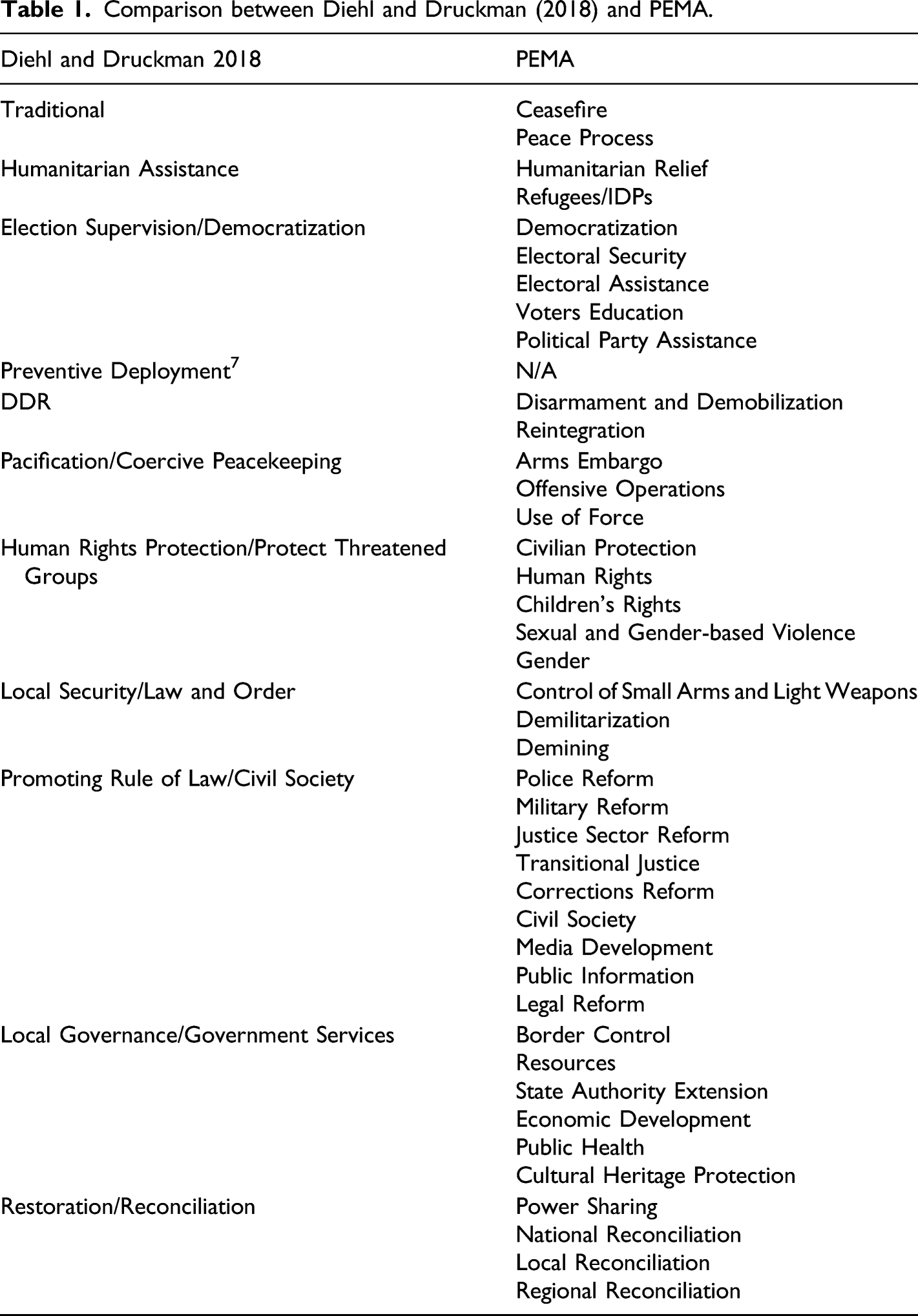
Second, it records a more complete set of mandated tasks than existing data collections. For instance, the dataset by Diehl and Druckman (2018) records 11 distinct peacekeeping-specific tasks. 2 The PEMA dataset is more disaggregated: for instance, it splits the task of “promoting rule of law/civil society” recorded by Diehl and Druckman into 7 tasks, namely (i) police reform, (ii) military reform, (iii) justice sector reform, (iv) transitional justice, (v) prison reform, (vi) civil society, and (vii) media.
Finally, the PEMA dataset captures the modality of peacekeepers’ engagement (monitoring, assisting, or providing security) for each task. For example, PEMA documents whether peacekeepers are mandated to merely monitor elections, assist with their organization, or provide electoral security. It also records whether each task is required or merely encouraged. This provides 116 unique configurations of task-modality-strength combinations. This distinguishes PEMA from Lloyd’s (2021) Tasks Assigned to Missions in their Mandates (TAMM) dataset, which records 50 tasks, although some of them are, in fact, modalities of the same task. 3
The PEMA dataset will help advance scholarship on UN peacekeeping and international politics in two principal ways. First, the PEMA dataset allows analyzing how mandates affect peacekeeping and peacebuilding outcomes. Studies in this tradition have so far focused on the number of uniformed personnel, such as troops and police (e.g., Hultman, Kathman, and Shannon 2013, 2019), mission composition (e.g., Karim and Beardsley 2017; Bove, Ruggeri, and Ruffa 2020; Belgioioso, Di Salvatore, and Pinckney 2021), and subnational geographic deployment of peacekeepers (e.g., Ruggeri, Dorussen, and Gizelis 2017; Fjelde, Hultman, and Nilsson 2019; Phayal and Prins 2020). However, whether and how mandate configurations affect stability, human rights, reconciliation, economic recovery and other outcomes remain open questions. Thus, scholars interested in answering these questions may find our data valuable for their work. Indeed, we argue and show in our replication of the analysis by Hultman, Kathman, and Shannon (2013) that, beyond personnel numbers, mandated tasks also influence the effectiveness of peacekeeping operations in protecting civilians in important ways.
Second, the PEMA dataset sets the stage for several new research avenues on peacekeeping mandates as a product of UNSC decision-making. This research will be relevant beyond the study of UN peacekeeping and of interests to scholars of international organizations (IOs) and foreign policy. Moreover, since UNSC members negotiate over each task that is included in new and revised mandates, with input by the UN Secretariat and sometimes civil society, the PEMA dataset will be of interest to those who study multilateral negotiations from a variety of perspectives.
The rest of this article has five parts. In the first section, we explain why peacekeeping mandates are important by describing how they are negotiated and connected to global political processes. In the second section, we review existing qualitative and quantitative research on peacekeeping mandates, establishing the need for a comprehensive and disaggregated dataset of mandated tasks like ours. In the third section, we present the PEMA dataset, including the variables, sources, and main coding procedures. In the fourth section, we provide an overview of descriptive patterns in the data. In the fifth section, we discuss two major research avenues that the PEMA dataset opens: as briefly mentioned above, the first one treats mandates as an independent variable that influences peacekeeping outcomes, while the second one treats mandates as a dependent variable that is influenced by institutional dynamics at the UN. In the sixth section, to illustrate the usefulness of PEMA, we replicate and extend Hultman, Kathman, and Shannon’s (2013) study of UN peacekeepers’ ability to reduce violence against civilians, showing that mandates matter and have different implications for governments and rebels perpetrating violence against civilians. We conclude by discussing how ongoing and future research can further benefit from the PEMA dataset.
Why Study UN Peacekeeping Mandates?
The UNSC negotiates peacekeeping mandates, which specify the size, duration, and tasks of peacekeeping operations. In addition to the initial mandate, the Council regularly issues resolutions either to extend a peacekeeping operation or to withdraw it. Extensions are frequently accompanied by mandate revisions to include new tasks and discontinue old ones. The mandate serves as a framework for peacekeepers’ activities on the ground. Although UN officials and commanders have some scope for interpreting their mandates (Karlsrud 2013), Security Council resolutions serve as the legal and political basis for their actions.
Mandates also serve as an important source of legitimation for peacekeepers’ activities internally within the UN bureaucracy, in the eyes of host state counterparts, and among member states who support peacekeeping politically or materially. 4 The UN Capstone Doctrine (UN 2008, 39, emphasis added) attests to the importance of peacekeeping mandates:
“The nature and scale of a particular United Nations peacekeeping operation’s role will depend on its mandate, the gravity of the situation on the ground, the resources the international community is willing to invest and an assessment of the availability of capable, credible and legitimate partners within the host nation.”
The mandate is listed as the primary factor that determines a peacekeeping operation’s role, next to two other important elements—the resources made available by the international community and the partnership with actors in the host country 5 —which are also strongly influenced by the content of the mandate.
The three decades of post-Cold War peacekeeping witnessed several cycles of expansion and contraction. Presently, peacekeeping mandates are so complex that they have been compared to “Christmas trees,” which various actors seek to “adorn” with their preferred provisions (Oksamytna and Lundgren 2021). 6 In parallel, negotiations on both revised and new mandates became increasingly contentious in the late 2010s. Russia and China started questioning liberal provisions in peacekeeping resolutions, for example, by resisting aspects of the women, peace and security agenda (Security Council Report 2017). Western states also downscaled peacekeeping ambitions from nation-building, democratization, and reconciliation to focus on narrower priorities, such as stabilization (Karlsrud 2019). Peacekeeping mandate negotiations offer a window into the normative priorities of the international society as well as power dynamics within it.
The substantive content of peacekeeping mandates has crucial implications for a wide variety of stakeholders. First, mandates affect UN peacekeeping operations themselves and particularly their resources. Although their budgets are decided in the UN General Assembly’s committees, the tasks outlined in UNSC mandates broadly shape the size and composition of their uniformed and civilian components. For example, the inclusion of a mandated task on protection of civilians (POC) has implications for the force generation process, which in this case should prioritize personnel trained and equipped to patrol, liaise with the local population, and use force, if necessary, to prevent, preempt, or stop civilian victimization. Mandates also affect countries’ willingness to contribute troops to specific operations. For example, Brazil prefers participating in operations with tasks that focus on reconstruction and development (Da Fontoura and Uziel 2017).
Second, peacekeeping mandates affect countries where operations are deployed. They determine the types of assurance and assistance that peacekeepers can offer to the host government, rebel groups, neighboring countries, and the local population. Mandates are consequential for peacekeeping success. For instance, research shows that traditional and monitoring operations are less effective in reducing the risk of war recurrence than those with a multidimensional mandate (Doyle and Sambanis 2006; Fortna 2008). Mandates are an important factor to consider when evaluating the effectiveness of multidimensional operations, and we need more research into the links between specific tasks in mandates and success or failure in peacekeeping.
Third, operations’ mandates affect UN’s partners. For example, humanitarian and development NGOs have expressed concerns that peacekeepers who are tasked to assist refugees or protect children encroach on the formers’ policy domain and threaten the independence of humanitarian action (Marín 2017). As such, what peacekeepers are mandated to do influences relationships between the various international actors engaged in conflict-affected countries.
Overall, systematic, empirical analysis of mandates is necessary and timely. The PEMA dataset allows researchers to investigate (1) how variation in mandates comes about and affects peacekeeping outcomes; and (2) how mandates are negotiated, illuminating changes in peacekeeping politics caused by normative and power shifts in the Security Council. In the following section, we review steps that have already been taken in the direction of studying mandates and their variation.
Existing Data on Peacekeeping Mandates
While scholars have begun collecting information on UN peacekeeping mandates, we show below that the existing datasets leave important gaps in our knowledge: (i) they are incomplete in terms of the increasing variety of mandated tasks; (ii) they do not systematically capture whether peacekeepers are requested to monitor these tasks or provide assistance and security; and (iii) they mostly cover only initial mandates and thus fail to capture the evolution of tasks over the lifespan of a peacekeeping operation.
Several qualitative studies, situated within the research tradition that looks at factors shaping mandates, have focused on in-depth single-mission analyses of intergovernmental negotiations on the tasks of specific operations, such as the UN transitional administration in East Timor (Weinlich 2014) or the UN operation in South Sudan (Dijkstra 2015). Some projects have endeavored to map at all peacekeeping mandates: the Oxford Handbook of United Nations Peacekeeping Operations (Koops et al. 2015) reproduces the texts of all peacekeeping resolutions on new operations. There have been attempts at classification, too: Franke and Warnecke (2009) suggest four broad categories of peacekeeping tasks, such as security and public order, socio-economic well-being, governance and participation, and justice and reconciliation. However, while these studies have collected valuable information on mandates, they have not turned this information into data that can be used in quantitative, comparative studies. Moreover, they give a “snapshot” view of peacekeeping mandates, focusing on the initial resolutions.
Early quantitative studies have categorized peacekeeping operations into broad types, such as traditional, monitoring, enforcement, and multidimensional ones (Doyle and Sambanis 2006; Fortna 2008). However, these categories are ambiguous. For example, the difference between traditional and monitoring operations has more to do with their equipment and posture than actual tasks: monitoring operations are “typically less well armed (or unarmed) and focused on monitoring and reporting,” but traditional operations also “monitor a truce” (Doyle and Sambanis 2006, 13-14). At the same time, there is a considerable variation in tasks of multidimensional operations, which may include electoral support, reconciliation, ex-combatant reintegration, and justice reform (Doyle and Sambanis 2006, 16). The “multidimensional” category calls for additional disaggregation.
More recent quantitative studies have taken further steps to classify peacekeeping mandates into more specific functions. Yet, none of these efforts captures the breadth of peacekeepers’ tasks as detailed in UNSC resolutions. Clayton, Dorussen, and Böhmelt (2021) provide a classification of UN peace initiatives (UNPI), including peacekeeping operations but also sanctions committees, mediators, tribunals, and investigative bodies. The UNPI dataset covers some functions that peacekeepers may perform, (e.g., election support or security sector reform) but also includes those that they do not apply to them (e.g., intergovernmental decision-making, fact finding, and decolonization). Moreover, all functions remain at a high level of aggregation. For instance, for security sector reform, the UNPI data does not tell us whether peacekeepers only assist military reform or also engage with police personnel, the justice sector, and the penitentiary system. It should be noted that UNPI focuses on all UN peace initiatives, hence its categories are inevitably broad. While it is a valuable source to understand the UN’s wider approach to conflict resolution, it does not provide fine-grained information on peacekeeping mandates.
Benson and Tucker (2019) code seven categories of tasks in initial peacekeeping mandates. These tasks are security for civilians or aid operations; the protection of women and children; implementation of peace agreements; disarmament, demobilization, and reintegration (DDR); implementation of ceasefires; implementation of elections; and army and police training. While these broad categories fulfill the purpose of their analysis, there are crucial differences within each task category. For example, peace agreements usually contain a series of complex provisions. Therefore, the fact that peacekeepers support the implementation of peace agreements does not tell us much about what peacekeepers are actually requested to do.
Mullenbach (2017) provides an overview of peacekeeping responsibilities in the Third Party Peacekeeping Missions dataset, coding six “purposes” of initial mandates of UN and non-UN operations: maintaining law and order; monitoring or verifying ceasefires; monitoring or verifying DDR; protecting or delivering humanitarian assistance; providing security for refugee camps, airports, elections, government buildings, and UN facilities; and maintaining buffer zones. While this dataset is valuable for understanding the tasks of uniformed personnel, it does not capture the peace- and state-building responsibilities of civilian personnel in contemporary operations. Moreover, important tasks that researchers may want to analyze separately are grouped together in broad categories. For example, the category “providing security” includes security for UN facilities, which implies protecting the operation itself, and security for elections or government buildings, which entails a much more substantial contribution to the restoration of state authority.
Comparison between Diehl and Druckman (2018) and PEMA.
Finally, Lloyd’s (2021) TAMM dataset records 50 tasks based on initial mandates and those that extend an operation. The advantage of PEMA over the TAMM dataset is that PEMA distinguishes between three modalities of engagement (monitoring, assisting, and securing) and whether the task is requested or merely encouraged. By contrast, for the majority of TAMM tasks, modalities are not recorded. For instance, TAMM does not distinguish between assisting, monitoring, and providing security for civilian protection, although there are significant differences between UNSC requests for: (i) “identify[ing] threats to civilians…and accelerat[ing] the coordinated implementation of relevant monitoring, analysis and reporting arrangements” (MINUSMA S/RES/2295, coded as monitoring civilian protection in PEMA); (ii) “[a]dvising and assisting the Government…in fulfilling its responsibility to protect civilians” (UNMISS S/RES/1996, coded as assisting civilian protection in PEMA); and (iii) “ensur[ing] effective, timely, dynamic and integrated protection of civilians under threat of physical violence” (MONUSCO S/RES/2556, coded as providing security for civilian protection in PEMA). The coding of modalities of engagement is described in detail in the following section.
In summary, the PEMA dataset can make three key contributions. First, many existing studies opt for a high degree of aggregation of peacekeeping tasks. This conceals important variation between operations and has led to a proliferation of classification schemes that are not easily comparable. The PEMA dataset offers highly granular data on specific tasks in peacekeeping mandates. Second, the PEMA dataset unpacks tasks not only in relation to a specific policy domain (e.g., police reform and military reform rather than aggregate security sector reforms) but also their level of engagement: for each task, we code whether peacekeepers assist, monitor, or provide security. Third, the PEMA dataset records not only tasks that appear in initial mandates but also whether and how they change over the operation’s lifespan. Most operations go through several stages, often starting with an initial monitoring role, expanding into an ambitious program of support to the political transition, and switching to a capacity-building and advisory mode closer to drawdown. Understanding these changes is essential, as we demonstrate using the example of the operation in the Democratic Republic of the Congo (DRC) below.
In short, existing data sources are, to different extents, incomplete in terms of mandated tasks, do not differentiate between modalities of engagement, or cover only initial mandates. They do not provide a solid basis for answering questions about the effects of mandates on peacekeeping outcomes or the politics of mandate negotiations.
The PEMA Dataset: Selection, Variables, and Coding
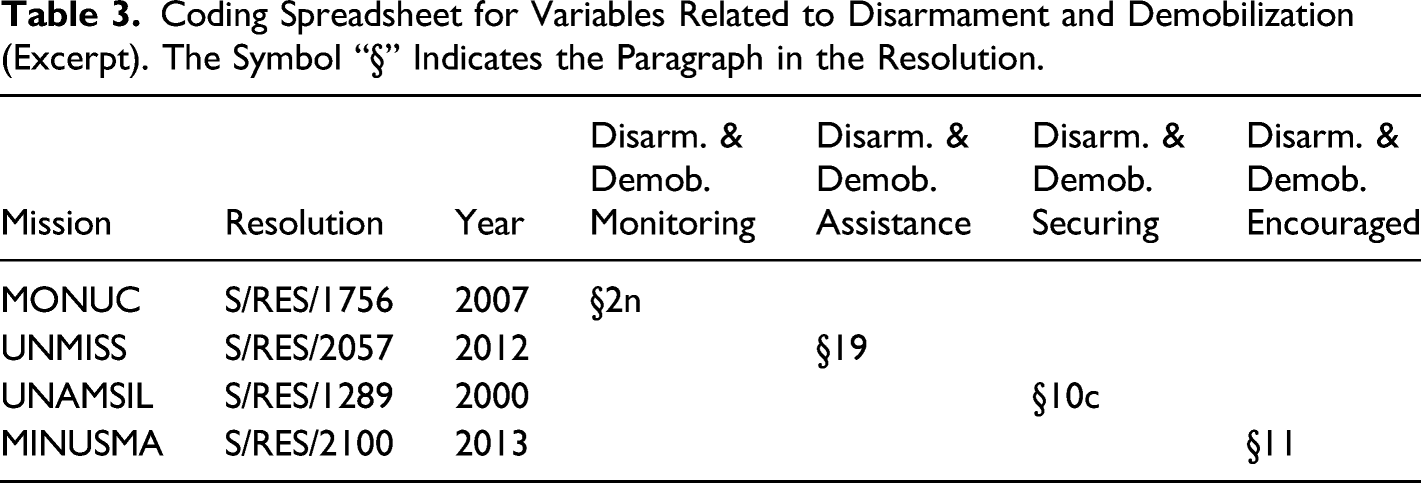
The current version of the PEMA dataset codes UN Security Council resolutions on peacekeeping operations in Africa authorized from 1991 to 2017. This temporal and geographical scope covers all recent multidimensional peacekeeping operations and makes the PEMA dataset compatible with other existing data collection efforts, which often focus on post-Cold War peacekeeping in Sub-Saharan Africa (Bromley 2018; Cil et al. 2020, Hunnicutt and Nomikos 2020). To create the data, we downloaded UNSC resolutions on peacekeeping operations from the Council’s website 8 and coded 365 resolutions in total, covering 27 peacekeeping operations over time. 9 Each document has been coded twice independently by two authors and then each discrepancy has been discussed to agree on the final coding. The Codebook 10 discusses the coding rules and decisions in detail and with examples. The dataset includes the resolution and exact paragraph number on which each coding decision is based, allowing users to check and replicate the data collection.
The PEMA dataset records information on mandated tasks at the operation-resolution level. In PEMA, each row of data thus corresponds to a new Security Council resolution. The tasks of peacekeeping operations are governed by a single resolution at a time. A change in the tasks or an extension of the same mandate requires a new resolution. For instance, Resolution 2100 (2013) specified the initial mandate of the UN Multidimensional Integrated Stabilization Mission in Mali (MINUSMA), while the subsequent Resolution 2164 (2014) was the first revision of the mandate. This resolution extended some existing tasks, such as assisting disarmament and demobilization, but also added new tasks, such as securing the elections, disseminating public information, and assisting ceasefire implementation. Subsequent resolutions in 2015 and 2016 made further adjustments to MINUSMA’s mandated tasks.
Beyond a set of identification variables, including the acronym of the operation, the host country, the number of the resolution, and its publication date, the PEMA dataset includes two main sets of substantive variables.
The first set of variables indicates whether the resolution stipulates a complete adjustment of the mandate, a minor adjustment, or a simple extension of the operation. We code a complete adjustment when a new peacekeeping operation is first authorized or when at least one new task is added or dropped. Often, the resolution makes this change explicit by stating that “from the resolution onwards, [the peacekeeping operation] shall have the following mandate.” We code a minor adjustment when there is a change in the requested modality of engagement or the strength of the mandate provision, but no new tasks are added.
The second set of variables relates to the content of the mandate. We code 41 different types of tasks. We arrived at this list inductively by reading a sample of all new and revised UN resolutions on peacekeeping operations and recording the tasks listed in these resolutions in our coding scheme. If we encountered a new task in one of the resolutions, we added it to our coding scheme. In this way, we arrived at the most complete list of tasks requested by the UN resolutions in the sample. An operation can potentially have all tasks assigned. The tasks include stability-related tasks such as disarmament and demobilization or the use of force, peacebuilding-related tasks such as electoral assistance or legal reform, and rights-based tasks such as human rights and child rights. The Codebook provides the full list of tasks (also in Table 1) and examples from UNSC resolutions that illustrate the differences between them.
We can demonstrate the need for this fine-grained disaggregation of peacekeeping tasks using two examples. The first example is disarmament, demobilization and reintegration, often analyzed as one category, DDR. In the PEMA dataset, disarmament and demobilization are coded separately from reintegration. Disarmament and demobilization have been established features of peacekeeping mandates since the early 1990s. Reintegration has been more contested: it requires additional funding in peacekeeping budgets, and member states have proven reluctant to spend money on ex-combatants who might have committed war crimes. UN officials have managed to secure the addition of this task to some peacekeeping mandates by reframing it as “reinsertion” and requesting funds only in the operation’s first year (Benner, Mergenthaler, and Rotmann 2011). Disaggregating DDR into two categories allows us to capture such nuanced differences.
The second example is reconciliation. Only few studies list it as a separate category and none differentiate between national, local, and regional reconciliation. However, as noted by Autesserre (2010), peacekeeping operations tend to be ineffective because of their focus on national-level reconciliation and ignorance of local conflicts. In the late 2010s, however, the UNSC instructed an increasing number of peacekeeping operations to engage in local reconciliation. For example, the operation in the DRC was tasked “to engage and facilitate mediation efforts at local level to advance sustainable peace” (S/RES/2348 (2017)). By including categories for different types of reconciliation, the PEMA dataset enables research into its differential effects.
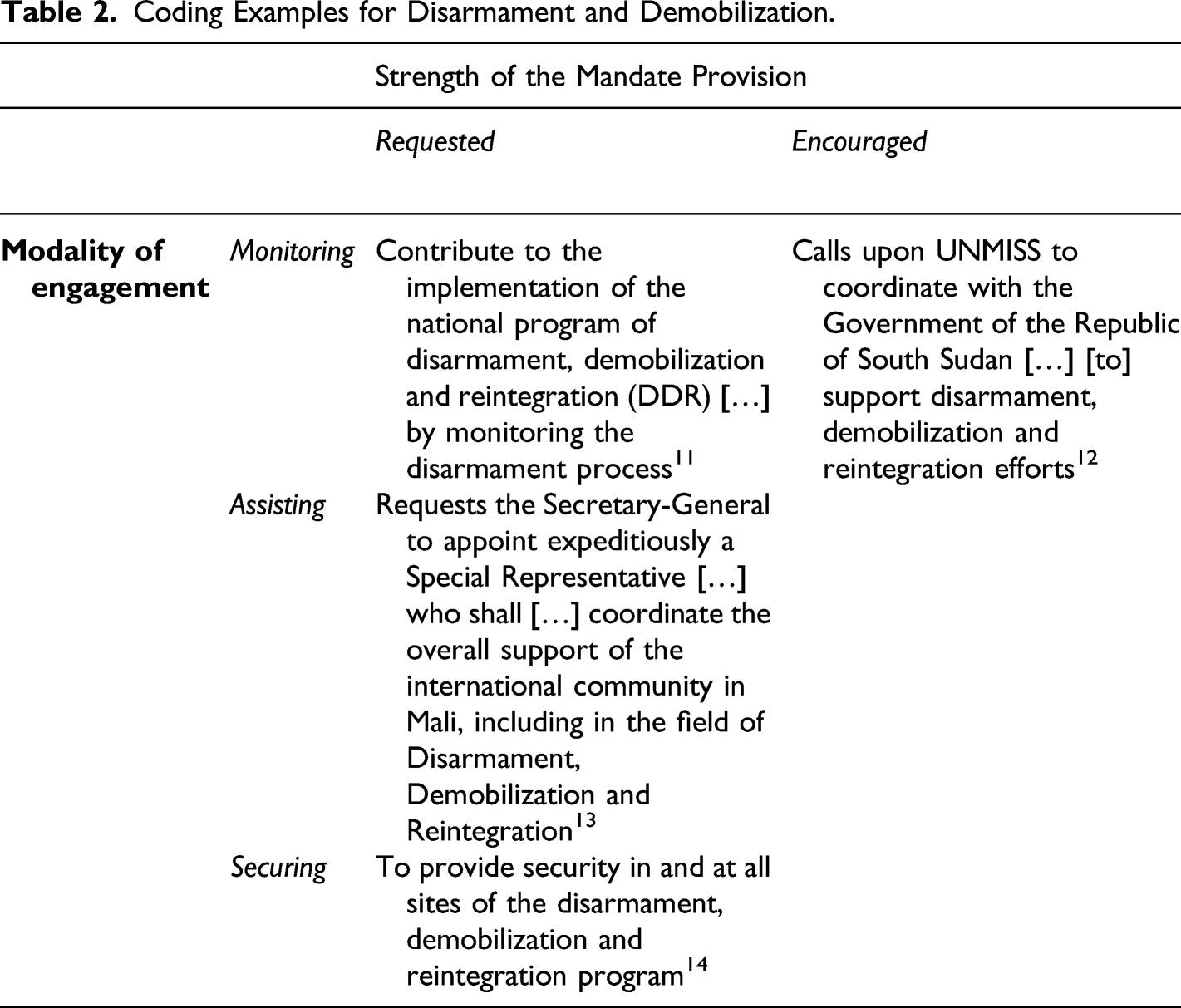
For each of the 41 tasks, the PEMA dataset also records the modality of engagement expected from the operation. Modality refers to the form of peacekeepers’ involvement in a policy field. We code three different modalities: monitoring, assisting, and securing. We code a task as monitoring if it engages peacekeeping personnel as observers and there is no direct involvement in implementation. We code a task as assisting if peacekeepers are requested to help implement a task, for example, by providing support to electoral management bodies. Assistance includes coordinating activities and supporting their implementation, including by offering good offices, technical assistance, or logistical support. Finally, we code a task as securing if it involves peacekeepers providing security (relying on the direct or indirect use of military or police means), such as establishing humanitarian corridors or guarding polling stations. It should be noted that PEMA codes the authorization to use force (or “all necessary means”) separately; the “securing” modality should not be considered as an explicit authorization for the use of force because security can also be achieved through non-coercive means, like de-escalation or deterrence.
Moreover, we record the strength of the mandate provision by specifying whether the UNSC requests a task or merely encourages it. For example, the Council can request an operation to use public information campaigns to increase awareness of the operation’s activities, but oftentimes this task is only encouraged. For requested tasks, we code whether the Council asks peacekeepers to monitor, assist, or secure the activities. By contrast, for encouraged tasks, resolutions normally do not explicitly refer to the modality of engagement, and we thus do not record it.
Coding Examples for Disarmament and Demobilization.
Coding Spreadsheet for Variables Related to Disarmament and Demobilization (Excerpt). The Symbol “§” Indicates the Paragraph in the Resolution.
Security Council resolutions commonly include provisions that are not directly related to peacekeepers’ tasks. Three types of such provisions are excluded from our data. First, we do not code tasks that the Council requests from entities other than the peacekeeping operation. For example, the Council may request the UN Secretary-General rather than a peacekeeping operation to support an arms embargo, which we do not record in PEMA. Second, we do not code tasks based on the expected outcome. For example, if a resolution requests an operation to assist with the re-establishment of state authority in order to enable economic recovery, we code only assistance to state authority extension and not economic recovery, unless the resolution requests peacekeepers to assist with economic recovery elsewhere. Third, we exclude vague references that lack clearly identifiable tasks, the “welcoming” of progress and ongoing tasks, and references to capacities needed to carry out certain tasks.
Patterns in the Data: Variation in Mandates Across and Within Operations
This section provides a descriptive overview of peacekeeping mandates using the PEMA data. It introduces some key patterns of variation and illustrates the heterogeneity that exists in UN peacekeeping mandates, both across and within operations. Despite the frequent criticism that peacekeeping mandates are very similar and follow a template approach (UN 2015; Ruggeri, Gizelis, and Dorussen 2013; Howard and Dayal 2018), a closer inspection reveals considerable variation.
Figure 1 exhibits the mandated tasks of the operations in the sample, as coded at the outset of each operation. Mandated tasks are marked as present (dark grey) if the relevant resolution included any modality of engagement in these tasks. Even this fairly simple overview allows us to corroborate three key patterns discussed in the literature on peacekeeping. First, there has been considerable growth in the scope of UN mandates. The five oldest operations in the sample, established in the early 1990s, included an average of 5.8 tasks per mandate, considerably fewer than the average of 20.8 tasks for the five operations established in the 2010s. This trend reflects the widening expectations placed on UN operations by the Security Council. Mandate specification at operation’s establishment. Operations ordered chronologically.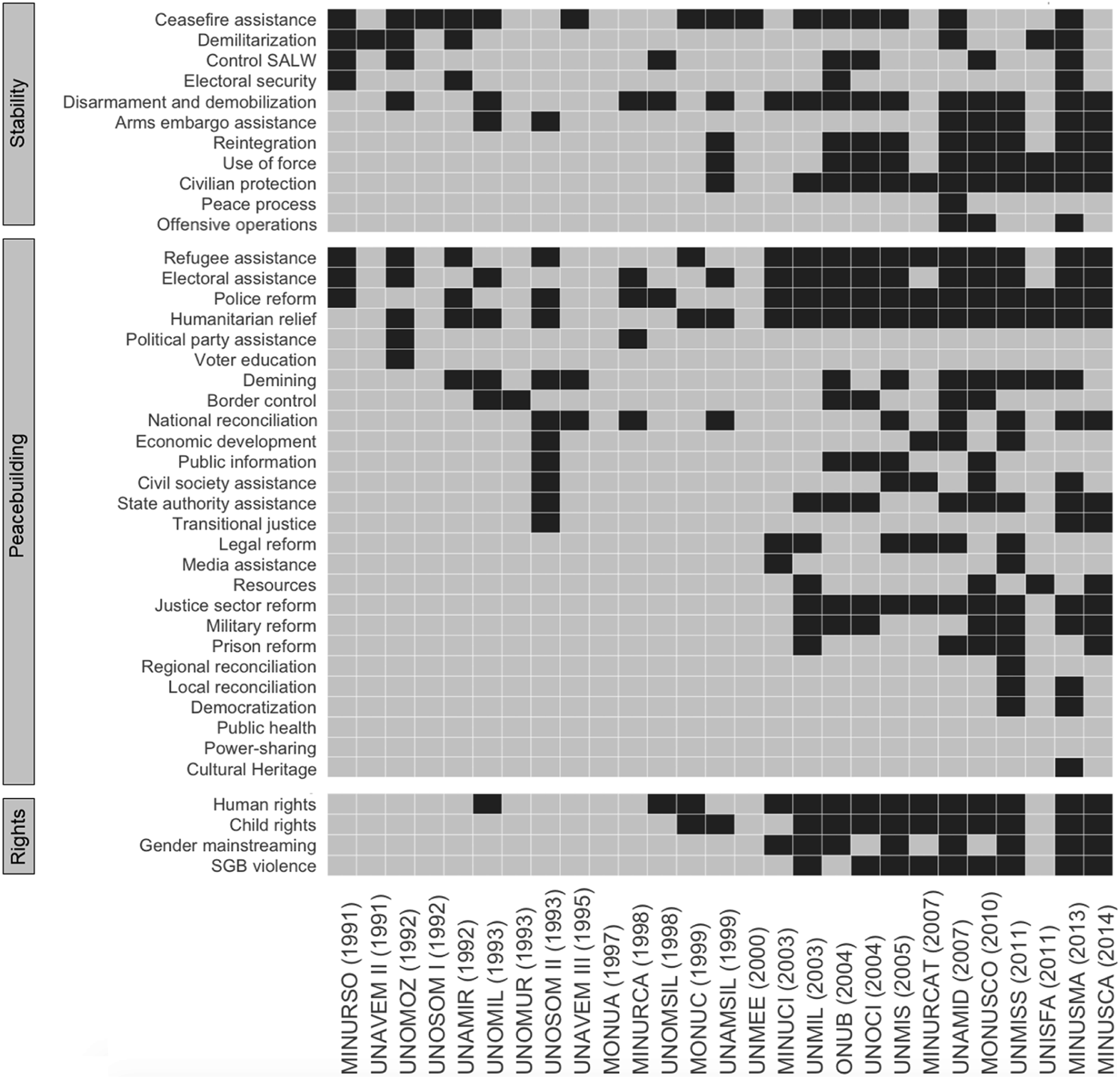
Second, we observe an expansion of mandates into new areas. Most clearly, this is reflected in the growth of tasks related to enhancing state capacity, reconciliation, and economic development. None of the earlier operations in the sample were requested to carry out these activities, but in the 2000s and the 2010s, such tasks were present in the majority of newly launched operations. While researchers have already noted the expansion of mandates into new areas (Gizelis, Dorussen, and Petrova 2016; Oksamytna and Lundgren 2021), our data present a systematic picture of how it has evolved, across specific missions and tasks, resolution by resolution.
Third, we observe a trend towards the disaggregation of tasks within broader policy areas. For example, what was previously described as “security sector reform” has become divided into a series of more specified tasks, such as “military reform” and “police reform,” which are not always mandated simultaneously. 15 Furthermore, security sector reform has been coupled with related tasks like “justice reform” and “prison reform” in some recent resolutions. Importantly, our data allow us to identify whether the much-discussed expansion of peacekeeping mandates is mostly attributable to the disaggregation of older tasks or the addition of completely new tasks.
Since the PEMA dataset is structured as panel data, with multiple observations on each operation over time, it allows us to track the evolution of specific mandates. This may be particularly relevant for researchers carrying out single-mission case studies or investigating mission-specific patterns, but it may also be useful for researchers considering variation in the longitudinal impact of operations.
As an illustration of how the PEMA dataset incorporates mission-specific data, Figure 2 shows the mandate of the peacekeeping operation in the DRC, established in 1999 as the UN Organization Mission in the DRC (MONUC) and since 2010 known as the UN Organization Stabilization Mission in the DRC (MONUSCO). Resolution S/RES/1925 marks the beginning of MONUSCO. Mandate of MONUC/MONUSCO (1999–2017).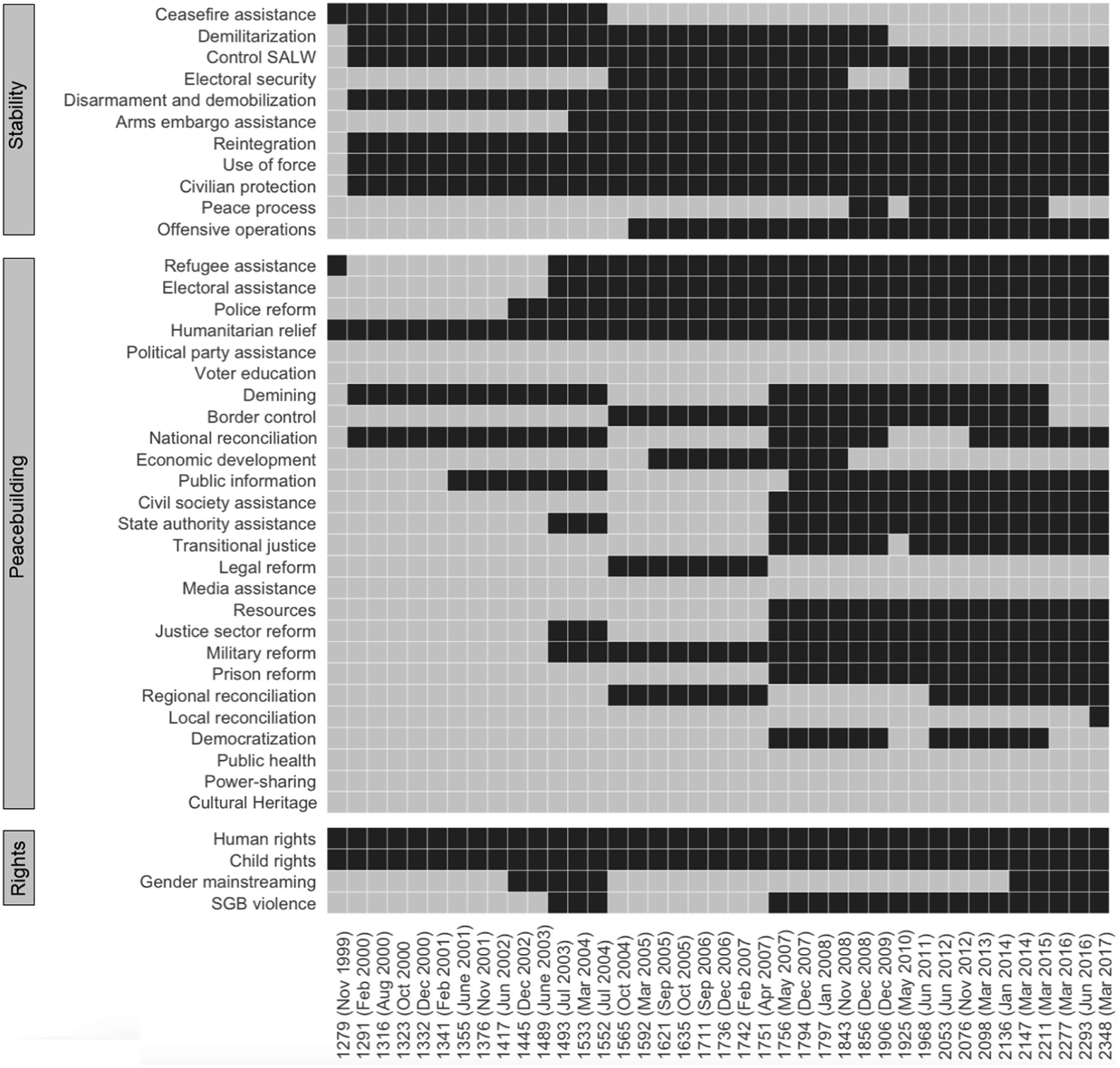
We observe the nuanced picture of peacekeeping mandate evolution that the PEMA data make possible. In the case of MONUC/MONUSCO, the mandate has evolved over six phases. In the first short phase, it was a small liaison operation with a few core tasks, most centrally assistance with ceasefire observation. The second phase, starting in early 2000, saw the establishment of a larger operation with a wider mandate, including reconciliation and disarmament. With some smaller modifications, this mandate remained the same until 2003, which ushered in the third phase. Following the signing of the Sun City Agreement and the beginning of the political transition period, MONUC saw its mandate expanded to include yet more tasks, such as support to the electoral process, state capacity, and arms embargo monitoring.
In 2004, the fourth phase saw another widening of the mandate, now crucially also including offensive operations. After the 2006 elections, the fifth phase that began in 2007 implied that some previous tasks, such as assistance for legal reform, were discontinued, whereas tasks relating to reconciliation, public information, and civil society were added, reflecting the operation’s increasingly multidimensional profile. 16 The sixth and final phase saw the initiation of a reduction of the operation’s mandate, starting in 2016.
This brief description underlines the importance of having mandate data that can be temporally disaggregated. It is clear that MONUC, as established in 1999, was a very different operation from MONUC of 2004 or MONUSCO of 2017. These changes reflect the Security Council’s evaluation of the operation’s changing political and military environment, as well as the general evolution of UN peacekeeping doctrine and practice. Thus, the MONUC/MONUSCO example clearly illustrates the potential pitfalls of overlooking the dynamic nature of peacekeeping operations and using simplified measures of mandates or, even more problematically, overlooking them entirely.
Research Avenues Opened by the PEMA Dataset
The PEMA dataset opens two principal avenues for research. The first avenue looks at peacekeeping as an instrument used by the international community to stop violence and promote peace, human rights, reconciliation, and development. Studies have started evaluating whether specific mandated tasks affect peacekeepers’ performance. Murdie (2017) argues that mandates that focus on humanitarian assistance or civilian protection improve human rights situation in the host country. Heldt (2011) contends that mandates with democracy-related provisions enable peacekeepers to contribute to democratization. PEMA can help expand this research into other policy areas.
Thus, the PEMA data can serve as a basis for nuanced assessments of peacekeeping outcomes, which can become a contribution to the growing literature on the effects (for an overview, see Di Salvatore and Ruggeri 2017) and legacies (Gledhill 2020) of peacekeeping operations. While studies have focused on important yet externally derived criteria, such as peacekeeping operations’ ability to stop violence (e.g., Fjelde, Hultman, and Nilsson 2019; Hultman, Kathman, and Shannon 2013, 2014, 2019), a more accurate evaluation of their success needs to look at whether they achieve the objectives set in their mandates. While the findings on the violence-reducing effects of peacekeeping are generally positive, this does not appear to be the case for other tasks: for instance, von Billerbeck and Tansey (2019) argue that UN peacekeeping operations might enable authoritarian forms of governance. An assessment of peacekeeping operations’ ability to achieve their mandated objectives would greatly enhance our understanding of peacekeeping as an instrument of the international community.
Of course, only when mandates get implemented by peacekeepers can they have maximum effect. It is an important question in itself whether and when peacekeeping operations carry out all of their tasks, and investigations into this issue built on PEMA (Blair, Di Salvatore, and Smidt 2021). 17 We encourage scholars to use the PEMA data in conjunction with data on actual activities of peacekeeping operations. Studies already exist that use data on peacekeeping activities, as reported by the UN (Dorussen and Gizelis 2013; Smidt 2020a; Smidt 2020b; Smidt 2020c).
The second avenue looks at peacekeeping as an international institution (for this approach to UN peacekeeping, see, for example, contributions to Oksamytna and Karlsrud 2020). Peacekeeping mandate negotiations are a site of global power struggles, with the five permanent members of the Security Council, the elected members, and non-state actors vying for influence (Oksamytna 2017). Since the UNSC is the embodiment of a great power concert, studying its approach to mandates can reveal the international society’s normative priorities. Howard and Dayal (2018) used the persistence of the use of force provisions in initial peacekeeping mandates to develop a psychological theory of UNSC functioning and called for investigations into similar dynamics around other mandate elements, like as rule-of-law programs.
Scholars who study the evolution of specific mandate provisions, such as human rights (Månsson 2006), security sector reform (Hänggi and Scherrer 2008), protection of civilians (Mamiya 2016), protection of children (Bode 2018), gender mainstreaming (Karim and Beardsley 2017), public information and strategic communications (Oksamytna 2018), or economic development (Gledhill, Caplan, and Meiske 2021), could benefit from a comprehensive overview of their evolution across and within peacekeeping operations. Studies could also investigate how internal factors (UNSC composition and power differentials or members’ foreign policies and relations with the host government) and external pressures (civil society activism or media attention) shape the Council’s approach to mandated tasks. Kreft (2017) discovered that action against sexual violence, a salient conflict characteristic that attracts media attention and civil society activism, makes peacekeeping mandates more likely to mention gender. By differentiating action against sexual and gender-based violence from other gender-related tasks, PEMA opens the door for more nuanced studies of different aspects of the women, peace and security agenda. More generally, scholars can use the PEMA dataset to explain the choice and the timing of sets of mandated tasks throughout the lifespan of the mission. 18
In addition, Otto (2019) notes that multidimensional mandates include numerous tasks that are performed by civilian rather than military or police peacekeepers, and investigations are ongoing into how mandates are matched with civilian staff resources (Coleman et al. 2021). Studies of how mandates influence the type and number of uniformed personnel deployed also represent a promising avenue for future research, especially considering that PEMA records task modalities: troop and police requirements will naturally depend on whether peacekeepers, for example, have full responsibility for electoral security, assist the host government with it, or merely monitor the situation. 19 Scholars could also investigate the UN Secretariat’s reactions to the expansion and disaggregation of mandates to complement recent research on UN officials’ role at the mandate formulation stage (Oksamytna and Lundgren 2021): there are indications that UN peacekeeping officials dislike UNSC micromanagement (von Billerbeck 2020), which in other IOs has been shown to have a negative effect on performance (Honig 2019).
While these two avenues for further research are our suggestions on how the PEMA data can be used, they are not exhaustive. We can also imagine that the data can be useful for comparative research on IOs. Many IOs have also experienced an expansion of their tasks. For example, the International Monetary Fund has been tasked with monitoring a growing list of conditions in its agreements with borrowers, which currently include almost two dozen policy areas, such as central bank reform or privatization (e.g., Dreher, Sturm, and Vreeland 2015). Some scholars (e.g., Reinsberg, Stubbs, and Kentikelenis 2021) have suggested that the amount of conditions in IMF programs makes them “unimplementable by design.” Considering how persistent the problem of task complexity appears to be across different IOs beyond the case of UN peacekeeping, the PEMA dataset can serve as a basis for comparative studies of several IOs.
Re-Examination of Hultman, Kathman, and Shannon (2013)
To further illustrate the value of the PEMA data, we replicate the study by Hultman, Kathman, and Shannon (2013; henceforth HKS) on the effects of peacekeeping deployments on civilian victimization, using the exact same model specifications, data sources, and sample as HKS and then adding measures of civilian protection mandates from our PEMA dataset. As one of the first studies to systematically assess the UN’s ability to deliver on a headline ambition, the HKS article has been influential in the peacekeeping literature. HKS argue that peacekeepers can mitigate violence against civilians by altering belligerents’ incentives and by physically shielding civilians from attack. Peacekeepers’ ability to do so, HKS argue, depends on the size and composition of the force across the categories of troops, police, and military observers.
The key contribution of HKS concerns the importance of operations’ size and composition. While HKS mention the potential relevance of mandates, the lack of available data limited their ability to provide a detailed test of how mandates affect protection of civilians. Instead, they use two dummy variables, one coding robust mandates and another one coding Protection of Civilians (POC) mandates. HKS are not explicit about which resolutions they code, but comparing their coding of POC mandates to PEMA’s coding of civilian protection provisions in mandates, it seems that only the initial resolutions authorizing an operation were coded to identify POC mandates. This means that, for example, the UN operations in Burundi or Rwanda are not coded as operations with POC mandates, even though they had such mandates during considerable portions of their lifetimes but not at the outset.
To evaluate the impact of mandates and demonstrate the utility of our data, we re-evaluate and extend HKS. We use an identical, multivariate research design to examine variation in the count of civilians killed in a conflict month as a function of a set of independent variables. 20 Like HKS, we use a negative binomial model on their sample of all intrastate armed conflicts in sub-Saharan Africa from 1991 to 2008 (Gleditsch et al. 2002; Harbom and Wallensteen 2009; Melander and Sundberg 2013). We replicate the main specification without fixed-effects, as in the original HKS article, but like the authors, we also provide robustness models including conflict fixed-effects in the Appendix (Tables A.4-A.6). The HKS data covers 20 peacekeeping operations, 18 of which are included in our dataset. 21
Beyond the HKS variables, which are exactly as in the original study, we enter three POC mandate variables based on the PEMA dataset. The first, POC mandate, has the same logic as the POC mandate measure provided by HKS—it is a dummy variable that equals 1 when a mandate includes POC tasks where peacekeepers either help the government in protecting civilians or are requested to carry out POC without any reference to the government’s support. As mentioned above, our POC mandates variable is slightly different because we account for the fact that mandates can change after initial authorization of the PKO. Second, we disaggregate our POC mandate dummy into POC active and POC passive types. HKS only record the former active type, where the operation is requested to actively protect civilians alone or in coordination with the government. PEMA also records POC mandates of the passive type, which requests the monitoring of protection or merely encourages the protection of civilians. This distinction between a passive and active POC mandate (compared to the baseline of no POC mandate at all) is our extension to the model specification of HKS. Whether a PKO can reduce civilian victimization, after all, depends not only on its size and composition, but also on whether and how the operation is specifically mandated to pursue this objective.
To facilitate comparison, we report coefficient plots with estimates across different models; full tables are available in the Appendix. We begin with negative binomial models of the sum of civilian killings in a given conflict-month. Coefficients in Figure 3 largely confirm the HKS finding that both the size of the operations and a civilian protection mandate matter. Indeed, the estimated coefficient of HKS’s POC mandate variable and our POC mandate variable are virtually identical and associated with fewer civilian deaths. Interestingly, when disaggregating passive and active POC mandates, the violence-reduction effect is largely due to active POC provisions. Coefficient plot from Table A.1 (Appendix).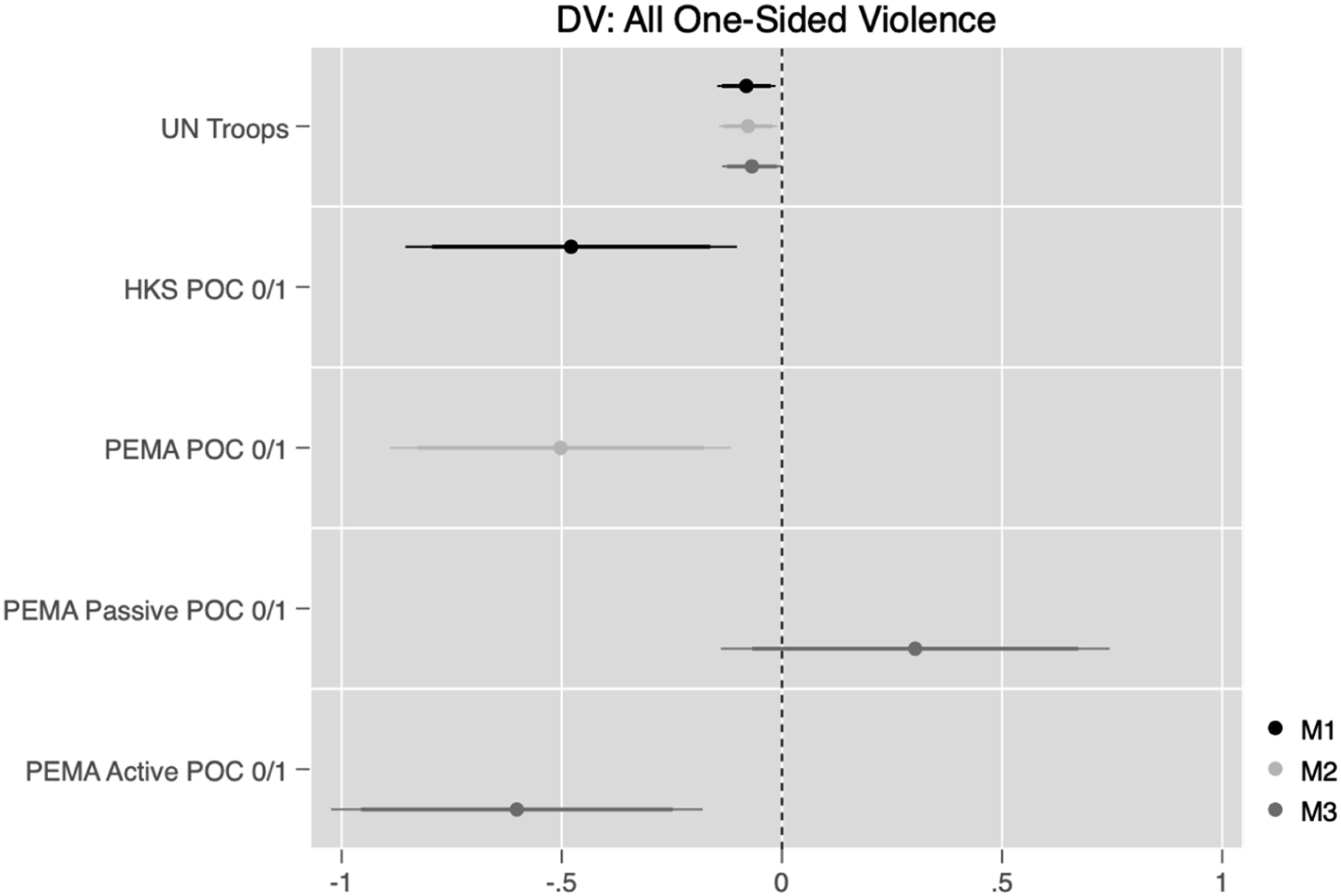
In Figure 4, we follow HKS in disaggregating violence against civilians as perpetrated by either rebels or the government. When focusing on rebels (top panel, Figure 4), we see that mandates are largely irrelevant in explaining peacekeepers’ capacity to protect civilians. Except for active POC that is weakly associated with less one-sided violence (p < 0.1), peacekeeping operations seem to effectively deter rebel violence only via large military deployments. The literature on peacekeeping effectiveness has proposed deterrence and signalling as key mechanisms of operations’ success (e.g., Ruggeri, Dorussen, and Gizelis 2017; Fjelde, Hultman, and Nilsson 2019). It is possible that rebels are more likely to be deterred and refrain from using violence when they are confronted with a large military deployment, regardless of the specificities of its mandate. Indeed, rebels may be undeterred even by strong POC mandates if they do not understand the subtleties of the legal formulas in UNSC resolutions or are unaware of the mandate altogether, especially at lower levels of the chain of command. Conversely, a visible presence of a sizeable military contingent sends a clear and unambiguous message. Governments, on the other hand, may behave differently, not the least because they, as operations’ hosts, are aware of the mandate specificities.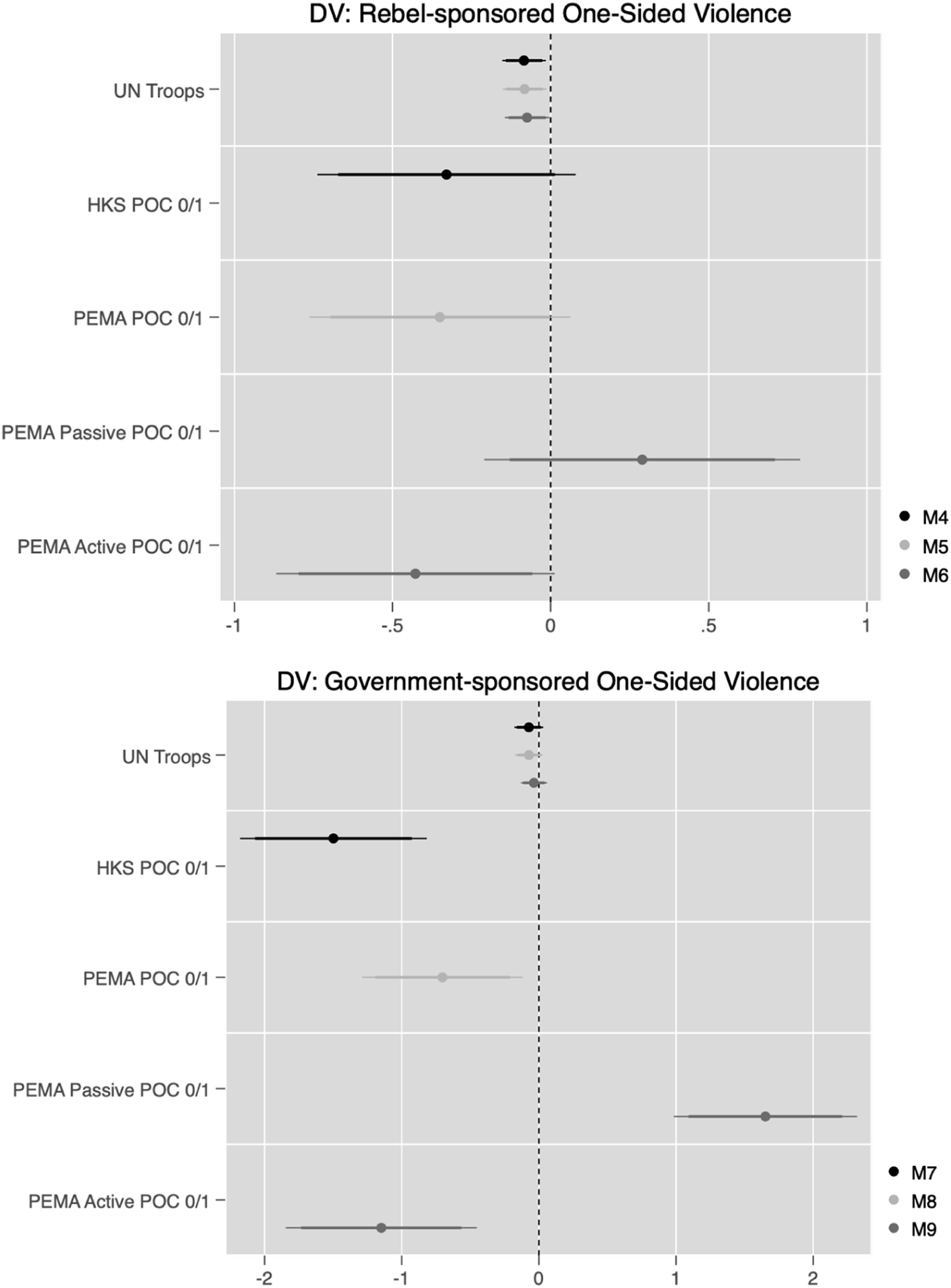
The centrality of mandates in the UN-host state relation is mirrored in the findings in the bottom panel in Figure 4, where we focus on government-sponsored violence against civilians. First, we find that the size of the deployment is irrelevant to operations’ ability to protect civilians against violence perpetrated by the government. Second, POC provisions in mandates now largely explain the violence-curbing effect of peacekeeping. In particular, POC mandates decrease violence against civilians perpetrated by the government, but only in cases of active POC. This means there are two scenarios under which a peacekeeping operation is effective at preventing civilian victimization by the government forces: when it has the authorization to act alone to stop it or when it is instructed to assist the host government in protecting civilians, which implies a cooperative relationship with the national army and police. This relationship can both increase the capacity of national security actors and allow peacekeepers to advocate against abusive behavior. By contrast, passive POC mandates that involve monitoring others’ protection activities or simply encourage the operation to engage in POC are likely to exacerbate violence against civilians perpetrated by the government. It is plausible that the mechanism linking passive POC to increases in civilian victimization is similar to the HKS’s finding showing that UN observers, who lack military capacity, are associated with more civilian deaths. This is because the deployment of observers, probably like passive POC provisions, signals the possibility that more robust actions will be implemented soon, hence pushing parties to escalate and consolidate their advantage.
In their extended tests, HKS use matching to improve covariate balance between cases of conflict years with peacekeeping operations (treated) and without them (untreated). Their post-matching results align with their main findings. We do not replicate the matching procedure because our “treatment” is whether the operation has a POC mandate rather than whether peacekeeping personnel is present. If we matched on peacekeeping operations' presence as HKS do, resulting matching weights would distort the distribution of our main variable of interest, that is, whether a peacekeeping operation with a POC mandate is present. This is because the matching would discard this and assign matching weights to reduce differences between cases with and without a peacekeeping operation independent of the content of its mandate. This distortion would consequently preclude any interpretation of the effect coefficient on POC mandates. Furthermore, developing a matching model for whether a peacekeeping operation is assigned a POC mandate would go far beyond this replication exercise.
Our results do not undermine the general validity of HKS findings but clearly illustrate how the nature of peacekeeping mandates shapes the UN’s ability to diminish civilian victimization, depending on who perpetrates the violence. Governments and rebels engage with peacekeeping operations in different ways, and their incentives to cooperate with peacekeepers differ. For rebels, size matters more than the mandate, but this is not the case for host governments. Our re-evaluation and extension of HKS thus demonstrate that the ability to incorporate nuanced data on mandates is an important development in peacekeeping research not only for empirical reasons, but also for our understanding of how peacekeeping works. This is especially valuable in light of the recent interest in the nuanced mechanism through which peacekeeping operations produce effects (Howard 2019; Hultman, Kathman, and Shannon 2019; Bove, Ruggeri, and Ruffa 2020). Absent disaggregated mandate data, scholars run the risk of exaggerating the effects of variables or underplaying the importance of different actors with whom peacekeepers deal.
Viewed independently, the finding that mandates matter underlines the importance of the UNSC thinking carefully about mandate design. If POC is part of the Council’s ambition, it must ensure that this is reflected in clearly formulated mandates, and that POC is requested at the most demanding modality of engagement, that is, assisting local security actors or providing security for protection of civilians.
Conclusion
The Peacekeeping Mandates (PEMA) dataset covers initial and revised mandates of 27 peacekeeping operations in Africa in the 1991–2017 period. It codes 41 tasks at three modalities of engagement, specifying whether an operation is instructed to monitor, assist, or secure the task. The data also record whether the mandate requests or merely encourages engagement in a given task. It therefore goes beyond any of the existing efforts to classify or code peacekeeping tasks in terms of its detail and coverage.
The descriptive patterns in the data clearly show the expansion, diversification, and increasing granularity of peacekeeping tasks. They demonstrate heterogeneity in UN peacekeeping mandates across and within operations, which challenges the widely held assumption that mandate design follows a template approach. They also point to the importance of analyzing not only initial but also revised mandates, considering that some operations last for decades and experience significant alterations of their role and purpose.
Our re-evaluation and extension of Hultman, Kathman, and Shannon (2013) illustrates the research utility that flows from having highly disaggregated mandate data. We show that mandate design has important implications for the UN’s ability to decrease violence against civilians. While the peacekeeping force’s size and composition do matter, as Hultman, Kathman, and Shannon (2013) argue, the addition of finely disaggregated mandate data reveals two new findings. First, peacekeepers’ ability to minimize violence against the local population is strengthened only when they are mandated to engage in active protection of civilians, as opposed to passive modalities of engagement. Second, the effect of such mandates varies across potential perpetrators. Whereas violence against civilians by rebel groups appears to be unaffected by strong mandates, civilian victimization by the government is more sensitive to nuances in the mandate language. These results indicate that disaggregated mandate data can help identify the conditions under which peacekeepers can prevent and mitigate violence against civilians as well as address other problems they are deployed to ameliorate.
We have identified two major research avenues based on the PEMA dataset. The first avenue is the analysis of peacekeeping as an instrument used by the international community to achieve specific outcomes. It entails focusing on how mandates translate into peacekeeping activities on the ground. The second avenue is the study of UN peacekeeping as an international institution. It entails analyzing how peacekeeping resolutions reflect the priorities of, and frictions within, the international community. The Peacekeeping Mandates (PEMA) dataset will be useful to scholars of international security, peace studies, IOs, and foreign policy.
Supplemental Material
Supplemental Material – Introducing the Peacekeeping Mandates (PEMA) Dataset
Supplemental Material for Introducing the Peacekeeping Mandates (PEMA) Dataset by Jessica Di Salvatore, Magnus Lundgren, Kseniya Oksamytna, and Hannah M. Smidt in Journal of Conflict Resolution
Footnotes
Declaration of Conflicting Interests
The author(s) declared no potential conflicts of interest with respect to the research, authorship, and/or publication of this article.
Funding
The author(s) received no financial support for the research, authorship, and/or publication of this article.

Supplemental Material
Supplemental material for this article is available online.
Notes
References
Supplementary Material
Please find the following supplemental material available below.
For Open Access articles published under a Creative Commons License, all supplemental material carries the same license as the article it is associated with.
For non-Open Access articles published, all supplemental material carries a non-exclusive license, and permission requests for re-use of supplemental material or any part of supplemental material shall be sent directly to the copyright owner as specified in the copyright notice associated with the article.
