




Abstract
How do policing institutions affect the prospects for peace in post-conflict settings? We present a principal-agent theoretical framework to explain how the institutional design of policing affects the recurrence of civil conflict. We argue that the fragmentation of police forces can reignite conflict dynamics by impeding coordinated action, undermining information sharing, and enabling agents to pursue their own interests. We test these expectations with the Police Force Organization Dataset (PFOD) on police forces in over 100 developing states. Our empirical analyses show that increasing the number of distinct police forces is systematically associated with an increased risk of conflict recurrence in post-conflict states. We also find that a larger number of police forces is associated with more abuse against civilian populations in post-conflict states, setting the stage for new grievances that may undermine peace.
The state’s coercive capacity is widely understood to be a key factor in managing civil conflict. Seminal work on the occurrence of civil strife suggests that the state’s ability to deploy coercive resources (e.g., personnel, arms, and equipment) across its territory conditions the choices that rebels make in everything from taking up arms to sustaining insurgency over the longer term (Tilly 1978; Fearon and Laitin 2003). To provide evidence for the negative relationship between capacity and conflict, researchers conventionally examine the military as the principal manifestation of the state’s repressive potential (Jones et al. 1996; Mason and Fett 1996; DeRouen and Sobek 2004; Quinn, Mason, and Gurses 2007; Hendrix 2010), suggesting that higher military spending or larger armies are more likely to deter the onset of rebellion or prevent its recurrence.
By focusing on the role of the military to analyze the capacity-conflict relationship, however, researchers have overlooked a primary coercive institution for states: the police. In nearly all states, the police are the main actors officially entrusted with exercising the legitimate use of force to safeguard internal security (Bittner 1972; Bayley 1985; Reiner 2000). The police are “the first line of defense against subversion and insurgency” (Lefever 1970, 202), performing critical security services that range from collecting intelligence to apprehending those who threaten public safety. Furthermore, while militaries play a primary role in security provision during civil conflicts, transitioning to peace often requires the demilitarization of politics (e.g. Lyons 2005) and, accordingly, the restoration of civilian police as the main providers of internal security.
The role of the police in managing civil conflict and its aftermath remains largely overlooked in academic studies—recent exceptions include Bayley and Perito (2010), McCormick (2013), Fair and Ganguly (2014), Ansorg, Haass, and Strasheim (2016), and Eck (2018)—despite the fact that policymakers increasingly stress civilian policing in ending insurgency and preventing its recurrence. When the U.S. military updated its counterinsurgency field manual for the first time in over two decades to guide operations in Afghanistan and Iraq, the new manual included a section devoted to policing with the explicit recognition that “[t]he primary frontline COIN force is often the police—not the military” (U.S. Army/Marine Corps 2006, 6-19-6-20). The broader U.S. government similarly recognized the role of policing when it issued a multi-agency counterinsurgency guide acknowledging that “COIN situations often arise because the police are incapable of maintaining order” (U.S. Government 2009, 23). 1 From this policymaking perspective, the restoration of order requires enhancing the police’s capacity to conduct law-and-order functions.
Policing becomes particularly important during the war-to-peace transition, as civilian authority progressively replaces military operations in the provision of security. Yet, researchers remain unable to offer evidence-based assessments of how policing’s organization ultimately affects whether the state can maintain the peace. What is clear is that peace is unlikely to be re-established unless a state’s police can adequately respond to the violence, whether political or criminal, that often characterizes the aftermath of civil war (Steenkamp 2011). In Iraq, for example, the police largely proved incapable of fulfilling their law-and-order mandate as part of the country’s post-conflict reconstruction (Wozniak 2017). The lack of resources hindered the proper training and equipping of personnel, but more problematic was the fact that the fragmentation of the security sector enabled competing political factions to pursue their own agendas through the police, including recruitment of officers into gangs and militias (Looney 2008). In Russia, competition between national and local security forces slowed the re-establishment of order in Chechnya. Even after much of the war was considered over, insurgents were able to continue operating across the region because the Interior Ministry’s paramilitary would not coordinate with local Chechen police (Kramer 2005).
We contribute to the study of policing by presenting a theoretical framework that examines how the institutional design of a state’s policing apparatus can influence the recurrence of violence in post-conflict settings. We offer new insights on how the fragmentation of policing, in particular, results in the under-provision of peace-enhancing security. While historical and operational factors can influence how leaders set up policing institutions (Gurr 1988; Eck 2018), they often choose to create multiple police forces to address political concerns. Leaders can seek to minimize threats to their regimes or their own tenure through fragmentation (Brown, Fariss, and McMahon 2016; Greitens 2016; De Bruin 2018), inducing civilian and military forces to compete and monitor one other (Kiewiet and McCubbins 1991; Ting 2003). But such institutional fragmentation affects the way policing is provided to the population as a whole. The delegation of policing authority to multiple forces results in classic principal-agent problems, diminishing the ability or willingness of any individual force to preserve peace either because their own interests diverge from those of state leaders or they have private information that allows shirking (Byman and Kreps 2010; Salehyan, Siroky, and Wood 2014). Police forces are especially vulnerable to these types of problems due to the nature of their job, namely, activities such as patrolling that entail using significant discretion in making decisions that affect overall agency behavior (Lipsky 1980; Brehm and Gates 1993).
Applying this logic to post-conflict settings suggests that the institutional fragmentation of the police increases the risk that peace will break down. Not only does fragmentation decrease the coordinated action and information sharing required for effectively dealing with emerging security threats, but having multiple forces also increases the likelihood that police officers act in ways that can undermine peace through indiscriminate use of force or human rights abuses. Police who are able to repurpose the coercive power of the state for their own ends are unlikely to exercise the restraint needed to use violence selectively under tense post-conflict conditions. Such autonomy of action—facilitated by fragmentation—can exacerbate pre-existing tensions or create new grievances. Most post-conflict states simply lack the capacity to hold such abusive police agents to account, whether they have the political will to do so or not, and this task is further complicated when policing activities involve several distinct organizations.
But a corollary to this argument suggests that police behavior may be reined in by limiting their scope for discretion. Leaders can delegate policing authority in ways that more precisely define jurisdictions on the basis of geography or operations. In this respect, the creation of specialized police forces, such as a gendarmerie that receives enhanced training and operates under specific conditions, may reduce the risk of conflict recurrence by enabling the state to better target repression against identified threats to order, while insulating the regular police from the increased violence that might otherwise undermine their basic law-and-order operations.
We assess these theoretical expectations through original data on the institutional design of police forces in over 100 developing states around the world between 2000 and 2014. Through the systematic coding of qualitative information from various encyclopedic sources (Das 2006; Kurian 2006; Stamatel et al. 2011), our Police Force Organization Dataset (PFOD) provides measures for police fragmentation, including separate measures for local police forces and special police forces (e.g., gendarmerie). We employ these measures to examine how the institutional fragmentation of policing affects the duration of peace in post-conflict countries. To corroborate the mechanism underpinning the relationship between policing fragmentation and violence recurrence, we also examine the impact of fragmentation on the incidence of human rights abuses and state violence against civilians.
Our empirical analyses suggest that the institutional design of policing shapes post-conflict dynamics in predictable ways. Greater police fragmentation significantly increases the risk of peace failing. We estimate that there is an 88 percent increase in the risk of peace failure for every additional police force in a state. However, we nuance this finding by showing that neither local nor special policing (e.g., gendarmerie) are associated with a higher risk of peace failure. In addition, corroborating our expectation that fragmented policing increases the use of violence by the state, we further find that fragmented police are consistently associated with worse human rights outcomes and greater government violence against civilians.
This paper makes two contributions, theoretical and empirical, to the study of policing. When the police are examined in the extant literature, they tend to be studied through factors such as the number of personnel and the level of professionalization, or through the behavior of specific forces, as in the other articles in this special volume. But the institutions of policing—the structures that determine how the police are organized and how they operate—remain under-theorized in studies of political violence generally and following civil conflict specifically, even as a central problem for the state is reasserting control and restoring order. By tracing the institutional mechanisms by which policing can affect security provision, we propose an argument to derive and assess hypotheses regarding the state’s capacity to maintain peace and security. Moreover, although the organization of policing varies widely across states (Andrade 1985; Hills 2000; Reiner 2000; Lutterbeck 2004; Baker 2008), there is currently no empirical basis for assessing how police institutions influence the dynamics of post-conflict violence. On this front, this paper is among the first to provide empirical evidence showing how the varied organization of police forces can result in systematic differences in the resumption of political violence.
We proceed in this paper by first presenting the framework that delineates the logics and hypotheses associated with police fragmentation. We then turn to the research design, describing the operationalization of key police variables and the main outcomes of interest. The empirical analysis then presents statistical findings for peace duration in post-conflict countries. We conclude by discussing how future research might corroborate or extend these findings.
Police Fragmentation and Diminished Security Provision in Post-Conflict Settings
States recovering from conflict face severe policing challenges in maintaining security during the turbulent war-to-peace transition. While military force is often central during conflict, policing becomes a critical instrument for reasserting control, restoring order, and, ultimately, cultivating peace in post-conflict states. Due to their visibility, police actions and uses of violence have been important for the development of state legitimacy (Tyler 2004). Citizens form expectations about the state based on the performance of the police in their communities (see contributions in this issue by Curtice, Blair and Morse, and Liu and Sullivan). Policing therefore shapes the extent of state control and civilian cooperation in post-conflict contexts.
But violence can surge in post-conflict settings due to the weakness of police or their style of policing. In some states recovering from conflict, the police are simply unable to prevent the use of violence by other actors. Vigilantes and criminals can exploit incomplete post-conflict disarmament to overwhelm police forces that lack the resources to hire sufficient personnel, provide them with necessary training, or adequately equip them (Baker 2009; Steenkamp 2011). Violence also escalates because the antagonisms between former combatants persist beyond the end of formal conflict and spill over into everyday dynamics (Schuld 2013). Or, the police themselves may become implicated in fomenting violence, particularly if state leaders continue to rely on the police’s coercive capacities against their opponents (Rauch and van der Spuy 2006).
To prevent the escalation of post-conflict violence, states must be able to identify and separate innocent civilians from those willing to use violence for criminal or political purposes, since they need to increase cooperation of the former but deter or punish the latter (Kalyvas 2006; Lyall 2010; Lyall, Shiraito, and Imai 2015; Berman and Matanock 2015; Berman, Felter, and Shapiro 2018; U.S. Army/Marine Corps 2006). Policing is challenging because it requires complex actions backed by the restrained use of coercion and a degree of discretion (Lipsky 1980; Brehm and Gates 1993). In order to bring about such effective policing, states must reorient from using their forces as an instrument of control to serving the entire civilian population in an impartial manner, as discussed by Liu and Sullivan in this volume. In Guatemala, for instance, homicide statistics worsened after the 1996 peace accords, in part, because those in power strategically used the police for private ends (McNeish and López Rivera 2012).
We argue that a central feature distinguishing effective from ineffective post-conflict policing stems from the way states have chosen to institutionally organize their forces. Effective policing requires different actors to work together to fairly enforce laws, gain cooperation from the population, and achieve common security goals. But such unity of action can be undermined by the very number of actors involved. In many states, policing is a function performed by several different independent agencies, including national police, provincial police, border police, transport police, gendarmeries, among others. These forces are at times administratively autonomous with authority limited to discrete jurisdictions, but, more often, they are bureaucratically intertwined with overlapping jurisdictions. In either scenario, preserving post-conflict security becomes complicated with each additional police force that is involved in deploying personnel, conducting investigations, and detaining individuals.
The institutional fragmentation of the police can arise as leaders seek to cope with various challenges to their power (Gurr 1988; Eck 2018). Many leaders undertake coup-proofing to prevent extraconstitutional challenges to their tenure through military or palace coups. To lower the risk that any single force is capable of independently removing them from office, leaders can divide existing security agencies or create entirely new ones (Brown, Fariss, and McMahon 2016; Greitens 2016; De Bruin 2018). A force may be purposefully set up to duplicate the work of another, either to ensure that no single security force controls intelligence flows or access to weapons or to maintain a force entirely loyal to a leader. This organizational redundancy is intended to create a counterbalancing dynamic in which forces act as a check on one another: none is strong enough to act solely in toppling a government, and none has an incentive to coordinate with others to do so.
By creating multiple forces responsible for policing, leaders are able to induce inter-agency competition and monitoring (Kiewiet and McCubbins 1991; Ting 2003). Doing so reduces their dependence on any single force. If one security force were to move against the government, or fail to offer support, leaders could call upon another force—often a loyal force created during their rule. In Chad, successive leaders have expanded the number of police forces, and they report to different government ministries, so the government is able to strategically lean on select forces. In 2006, for example, President Idriss Déby deployed the national police to reinforce the army in fighting an insurgency due to uncertainty over the loyalty of other security forces (Debos 2016).
Police fragmentation, while providing leaders with political insurance, undermines the coordination required for post-conflict stability (Bayley and Perito 2010; U.S. Army/Marine Corps 2014). Just like the fragmentation of military forces can complicate combat operations during wartime, police fragmentation can cause problems for securing the peace once military forces complete offensive operations in a conflict area. The negative effects of military force fragmentation are well understood. Militaries are more successful on the battlefield when interbranch communication and coordination allows the actions of one branch to complement others (Biddle 2004). The creation of multiple forces has been shown to reduce effectiveness in interstate war (Pilster and Böhmelt 2011; Brown, Fariss, and McMahon 2016) as well as the capacity to deter intrastate war (Roessler 2011). In a similar manner, police fragmentation should be expected to undercut the ability of the police to fight emerging threats. Fragmentation of police forces impedes the regular flow of information and the police’s ability to mount synchronized operations against resurgent or new rebels, terrorists, or criminals.
Furthermore, police force fragmentation might not only prevent an effective response to violent domestic challenges, but it might indeed produce additional violence. As Greitens (2016) explains, a fragmented coercive apparatus can create organizational incentives for security forces to engage in more violence. Forces that perceive each other to be in competition for policy influence and state resources will be less inclined to share intelligence that can lead to better targeted repression, thus increasing the overall use of violence in the process.
The negative impacts of police fragmentation on counterinsurgency can be seen in the case of Pakistan, where insurgencies have repeatedly erupted over decades in several parts of the country. Pakistan’s counterinsurgency efforts are conducted by a large number of distinct police forces, including provincial police and numerous federal police forces that include specialized paramilitaries such as the Frontiers Corps and the Rangers. Naseemullah (2014, 192) points out that the police in Pakistan are “the only agency whose powers of legal investigation and arrest could undercut insurgent strength through civilian means rather than open warfare,” but their impact tends to be limited by inter-agency processes that often place various forces at cross-purposes. As a result, Pakistan’s multiple police forces end up being less effective than they could be in preventing the outbreak of insurgent violence or reestablishing security in areas where insurgents have already been dispersed.
Police fragmentation impedes post-conflict peace and security by inducing well-known principal-agent problems (Byman and Kreps 2010; Salehyan, Siroky, and Wood 2014). When multiple police forces have overlapping jurisdictions and thus expect duplication in their activities, each force can engage in shirking by simply choosing to exert less effort than they would otherwise—or less than what would be socially optimal. Shirking by the police usually cannot be directly observed in such a scenario, especially due to the patrol-based nature of policing work which relies on complex action by so-called street-level bureaucrats. Leaders would then most likely attribute mounting violence to structural factors rather than strategically induced shirking by any individual force. One straightforward aspect of the moral hazard generated by the proliferation of police forces is the under-provision of security, which exacerbates the weakness that often characterize policing in conflict-affected states.
The organizational fragmentation of the police can empower individual officers or forces to opportunistically pursue their own interests. Here, moral hazard occurs because delegation allows agents to behave in ways that are contrary to, or subvert, the state’s preferred course of action (Feaver 2005; Salehyan 2010). The street-level bureaucrats pursuing complex actions are provided discretion that can allow for bias or even exploitation. The creation of parallel forces accountable to different government ministries can allow agents to erect barriers to information sharing or personnel coordination precisely so that they can implement their own agendas (Fair and Ganguly 2014). In Pakistan, for example, the splintered nature of policing allows factions within government to pursue their own political and economic interests through different police forces, hindering the ability of federal and provincial forces to work in concert against insurgent and terrorist threats (Perito and Parvez 2013). In this respect, fragmentation results in higher levels of violence by creating institutional conditions that permit agents to repurpose the coercive power of the state for their own ends. These agents, whether acting for themselves or on behalf of other interests, are afforded greater discretion in the use violence. And such discretion can result in greater abuses against the civilian population, reigniting old grievances against the state or creating new ones.
Policing by multiple forces will magnify the problem of adverse selection inherent in recruitment. A state that empowers multiple police forces to recruit their own personnel is unlikely to impose a common screening mechanism to ensure the quality of officers across forces (Salehyan 2010). Inconsistent screening across forces can result in the recruitment of officers who are incapable of carrying out their duties due to incompetence. This problem is compounded if economies of scale are required for a police force to cultivate professionalism among its officers. Additionally, in some instances, police forces may seek to derive benefits from purposefully choosing to recruit officers with a penchant for the use of violence (Mitchell, Carey, and Butler 2014). If police fragmentation facilitates such adverse selection, either of inferior or violent officers, then the state will be less able to strictly control the use of violence by its agents, particularly under tense post-conflict conditions.
A corollary to the argument presented thus far suggests that the challenges created by fragmentation can be overcome through formal coordinating mechanisms designed to promote unity of action among different forces. Since having multiple forces with separate commands can make it more difficult to implement a coherent policing or counterinsurgency strategy, states can put in place organizational structures to approximate a unified command-and-control system. These coordinating organizational structures might ensure that policymaking and operations are synchronized across all forces, aligning the actions of police officers on the street with the decisions of ministers in government offices.
But the case of the Philippines shows how challenging it can be to rein in fragmentation through coordinating mechanisms. Historically affected by multiple insurgencies in different locations, the Philippines has tended repeatedly toward fragmentation through a system of policing aimed at preserving central control while responding to local conditions. The Philippine National Police (PNP) is the state’s primary police force, mandated to respond to internal security threats, but policing is still structured at the regional, provincial, city, and local levels. At the same time, the PNP must collaborate with the Armed Forces of the Philippines (AFP), which undertakes offensive operations in counterinsurgency, before the police take over once an area has been stabilized (Lambert, Lewis, and Sewall 2012). To overcome the dysfunctions that would otherwise be caused by institutional fragmentation, the Philippines has adopted several coordinating devices. The Department of Interior and Local Government (DILG), which oversees the PNP, was empowered by statute in 2006 to coordinate counterinsurgency responses in conflict-affected areas and to assist local officials in developing public safety programs in line with national security plans, all while working in partnership with the PNP and the AFP (Peña 2007). Additionally, the government enacted the Revised Joint Implementing Rules and Regulations in 2015 to enhance coordination between the AFP and the PNP by specifying a division of responsibilities and geographic jurisdiction. 2 The AFP and PNP are also expected to work together at the local level through joint peace and security coordinating councils. 3 It remains uncertain, however, to what extent such coordinating mechanisms have offset the negative effects of policing fragmentation in the Philippines.
A second corollary to the main argument suggests that, instead of adopting explicit and potentially costly coordinating devices, states can limit principal-agent problems among multiple police forces by limiting their scope of authority (Byman and Kreps 2010). To constrain the ability of any given force to abuse the discretion afforded by delegation, the state can more strictly define its jurisdiction. For example, certain police forces can be designed to take on specialized functions that are restricted on the basis of geography or operations. Special police forces, such as gendarmeries or paramilitaries, can be tasked with patrolling only rural areas, engaging in crowd control during periods of popular unrest, or confronting armed insurgents or terrorists wherever they may emerge (Bayley and Perito 2010; Fidler 2014). While there are some downsides to special police forces, such as being perceived as an elite arm of the state’s coercive apparatus or increasing levels of militarization, they do provide some advantages. A benefit to force specialization is that it insulates the police from having to take on militarized tasks, so the military units can “clear” an area of combatants or extend government control geographically, and then turn control to special police forces to dismantle the structures that support fighters, before bringing in the regular police (U.S. Army/Marine Corps 2006). The police can therefore fulfill their basic security role (McCormick 2013), focusing on patrolling after conflict and forming productive relationships with local communities (Friesendorf 2011). Another advantage is that each force has its tasks and so does not need to coordinate during an active stage of conflict. Clearly defined jurisdictions thus make specialization different from fractionalization.
In the case of India, for example, Verma (2014) explains how the creation of a specialized police force allowed the government to implement innovative strategies to counter Maoist insurgents. The federal government and individual states initially found it difficult to respond to the growing threat of Maoist insurgents who managed to extend the territory under their control over several years. However, the state of Andhra Pradesh developed a special force, the Greyhounds, as an elite force specifically trained to pursue insurgents into difficult terrain. Recruited through strict criteria and endowed with enhanced training, the Greyhounds became “a formidable force” capable of limiting the insurgent threat (Verma 2014, 314).
Research Design
We draw on newly compiled data—the Police Force Organization Dataset (PFOD)—to assess the central theoretical argument presented in the previous section. We hypothesize that police fragmentation will increase the risk that peace breaks down in post-conflict states. The PFOD provides the necessary data for the independent variable by systematically coding qualitative information on distinct police institutions and their features for 110 developing states (i.e., states classified as low- or medium-income by the World Bank) from 2000 to 2014.
To construct the PFOD, we used several sources of information on multiple police forces within each state. We began by coding the name, type (local, national, gendarmerie), and ministry of oversight for each autonomous police force using a set of three encyclopedias on policing around the world (Das 2006; Kurian 2006; Stamatel et al. 2011). In cases where the encyclopedias were missing information for a country’s police forces, or when the information was contradictory, we consulted additional secondary sources such as government documents, human rights reports, and scholarly articles. We used the information contained in these documents to construct three variables: police fragmentation, local police control, and special forces police presence. We focus on these institutional variables rather than measures of police personnel or police spending for two reasons: (1) we believe they capture the nature of policing in ways that have important implications for policing quality, and (2) the data on police personnel and expenditures is sparse for developing countries. 4
The encyclopedias we consulted provide information about each country’s police forces at the time of publication (2006 and 2011) and historical background on the development of policing over time (usually since independence). We used supplementary information from country-specific searches of newspapers and scholarly articles for the years 2000 to 2014. Given the limited availability of information to pinpoint the date of changes in our sources, we code our main independent variables as constant values between 2000 and 2014. We argue that this is an appropriate way to approach these variables because we find that the organizational features of analytical interest hardly changed at all during this time period for our sample. Many countries organize their police in ways that bear remarkable resemblance to their organization decades ago. When the encyclopedias do identify changes, they usually only occur a few times per country over several decades. Our consultation of additional sources on policing further verifies that these institutional features change slowly. Our measures therefore should capture the primary variation of interest with limited measurement error.
We define an autonomous police force to be a force that maintains its own command structure with a commander who reports directly to either a national or local government body. This definition differentiates between autonomous police forces and their constituent parts, which we refer to as police units. Police units are those that remain subordinate to a commander within the police force itself rather than a government minister or elected official. 5 Given this definition we operationalize three key measures of police organization as follows:
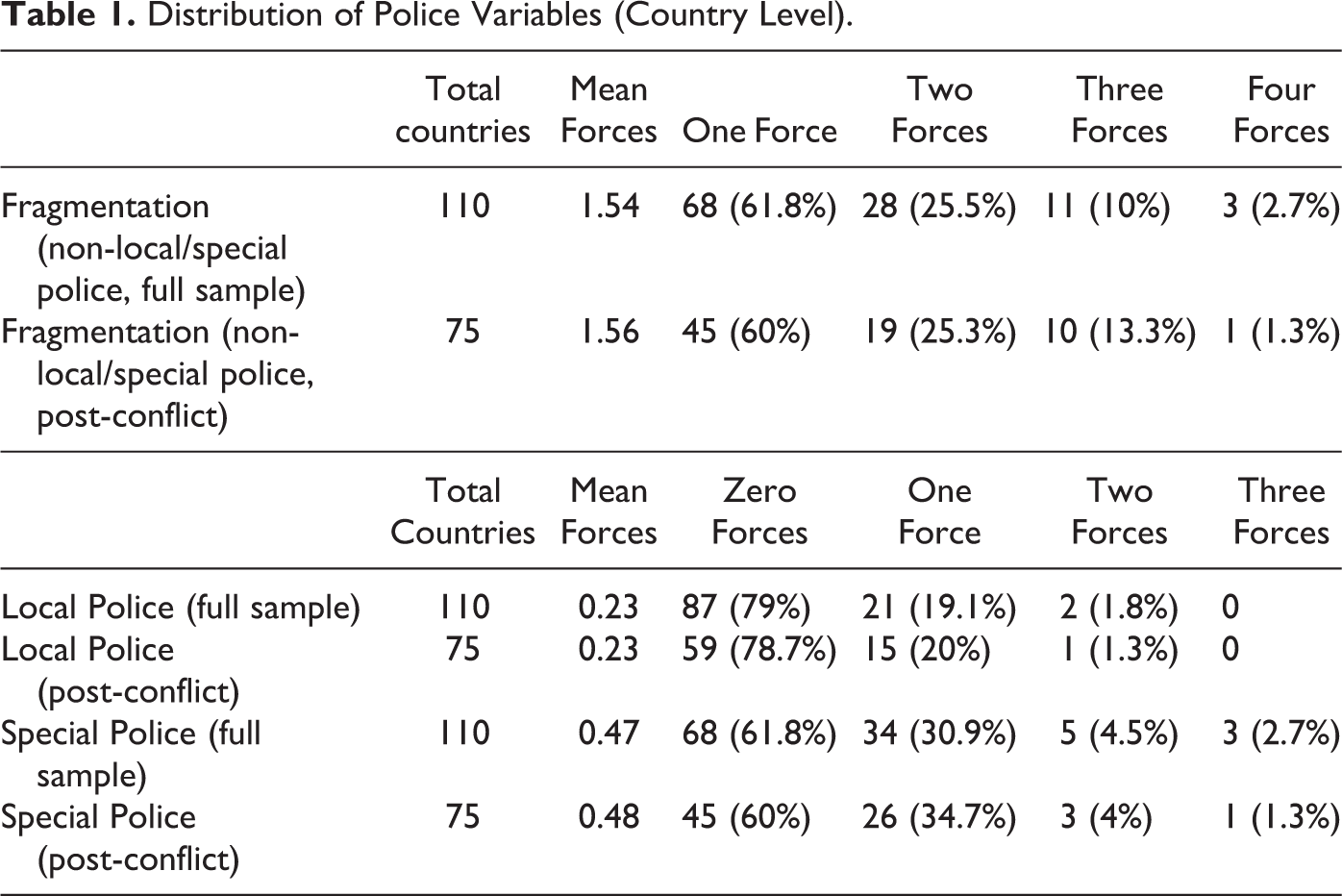
Table 1 shows the distributions of the three police variables for two samples: our full developing country sample of 110 countries and a post-conflict sample of 75 countries. The post-conflict sample includes country cases where there has been at least one conflict of twenty-five or more conflict related casualties since 1980. At the top of Table 1, we present the fragmentation variable without the local and special police counts. We list the number and percentage of countries that exhibit each level of police force fragmentation ranging between one and a maximum of four forces. The distribution of the fragmentation variable is largely similar between the two samples. There is very little difference between the two samples at either the mean number of forces or across the distribution. A similar pattern holds for the local and special police variables between the two samples. This is suggestive that civil conflict history does not drive the organization of police forces with respect to our variables of interest.
Distribution of Police Variables (Country Level).
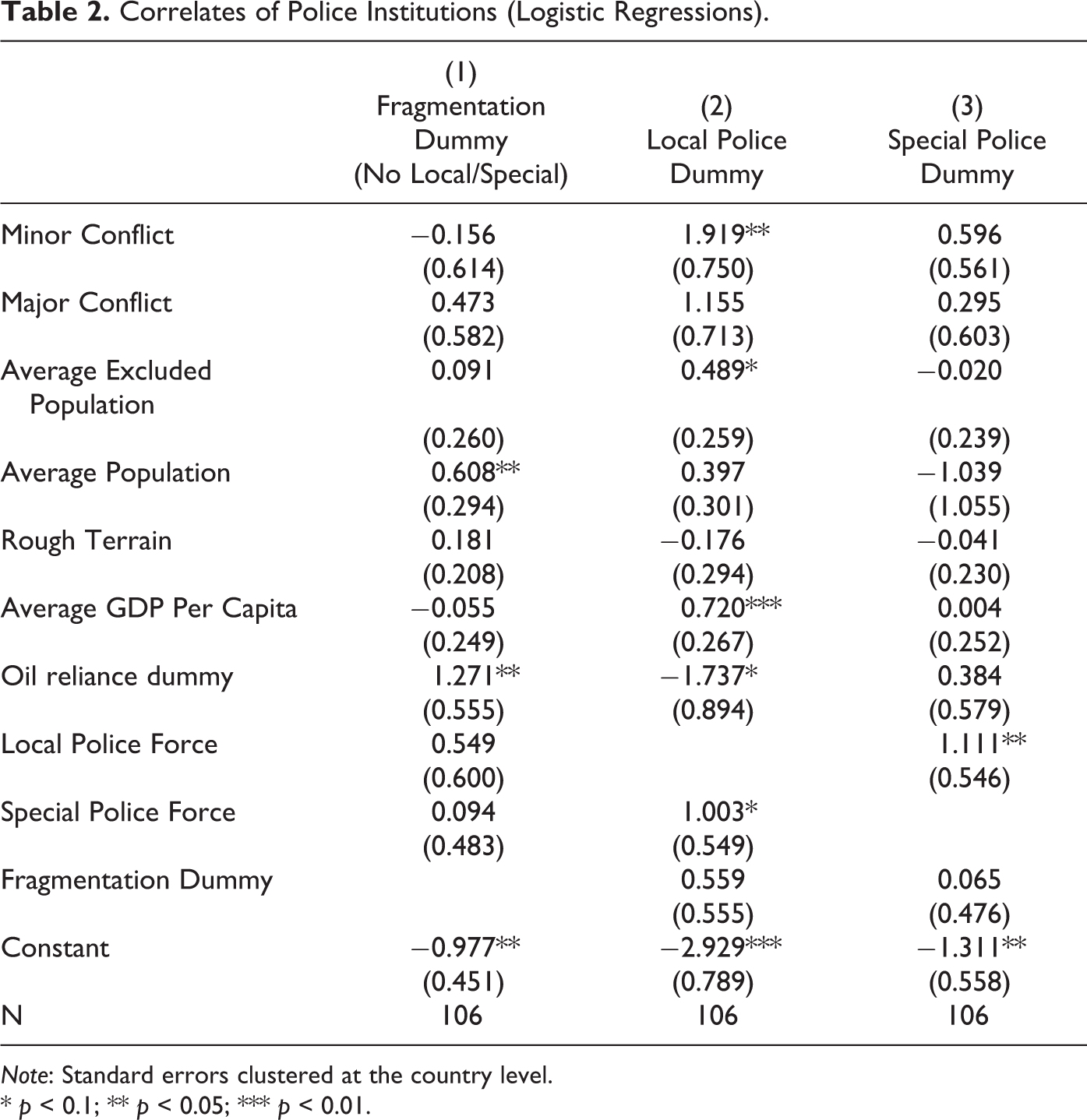
As a first step toward empirical analysis, we regress each of our police variables on relevant country-level covariates to get a descriptive sense of their relationship and further address potential endogeneity concerns. Since we do not have panel data on police institutions going back in time to independence, we use variables that are either relatively fixed or capture historical conditions up to the year 2000, when our systematic police data collection begins. We therefore include whether a country had a minor (25+ battle fatalities) or major (1,000+) civil conflict between 1945 and 1999, ethnic fractionalization, mountainous terrain, and a dummy variable for oil reliance. The sources and operationalization for all variables are presented in the Online Appendix. We also include country averages of both population and GDP per capita through the year 1999. Finally, we include the other two police institutions variables in each regression in order to examine whether these institutional dynamics appear to be independent or not.
Table 2 presents the results of logistic regressions. In the first model, we use a binary indicator for fragmentation excluding local and special police forces. The fragmentation variable is coded as 1 when there are at least two police forces that are not local or special forces in a country (38 percent of the full sample). We also present results using ordered logit and OLS for the fragmentation measure in the Online Appendix. The results remain similar. Model 1 shows that conflict history is not significantly correlated with the fragmentation of police forces. Instead, more populous and oil reliant countries are more likely to have fragmented police. Neither local police nor special police are directly related to the fragmentation of a country’s police force. Thus, the proliferation of other forces appears to occur somewhat independently from the development of local control or specialized paramilitary policing. Overall, these results suggest that the fragmentation of police is not endogenous to civil conflicts occurring before the turn of the century.
Correlates of Police Institutions (Logistic Regressions).
Note: Standard errors clustered at the country level.
* p < 0.1; ** p < 0.05; *** p < 0.01.
In model 2, we turn to examine the local police indicator. Both conflict experience and ethnic fractionalization are positively correlated with the presence of a local police force. One interpretation of these relationships is that local police force creation has perhaps historically been an adaptation to conflict and ethnic groups’ demands for local control of security forces. Richer countries are also significantly more likely to have a local police force. Oil reliant countries, on the other hand, are less likely to have one. Finally, in model 3, we examine the correlates of special police force presence. Interestingly, we find that none of these factors are significantly related to the presence of special police forces except for the local police variable, suggesting that there may be some institutional dependence between local and special police. While overall these results reduce our concerns about endogeneity with respect to special police presence in our current study, future research should explore in more detail how locally controlled policing co-exists with militarized policing within the same countries.
We address one final threat to inference before turning to the main empirical analysis. Since our key dependent variable is the length of peace spells, it is possible that police institutions might shape the duration of conflict and systematically censor which cases appear in a post-conflict sample. There are reasons to believe that the effect of fragmentation could be either positive or negative on conflict duration. On the one hand, countries with unified police forces could experience prolonged conflicts if rebels continue fighting out of fear that, once a peace agreement is struck, they will be eliminated by a unified force. On the other hand, highly fragmented policing could contribute to longer conflicts if they are less effective at counterinsurgency than unified police.
We therefore turn to an empirical test of this question to examine whether police fragmentation is systematically related to the duration of conflicts. We employ a Cox proportional hazards model 6 and estimate the relationship between our police institutions and conflict year duration between 2000 and 2014, while controlling for other important factors. 7 First, we estimate a model with all country conflict spells beginning since 1980 and a threshold of twenty-five or more casualties in a year. Second, to include very long running conflicts, we estimate a model with all conflict spells since 1945. We use robust standard errors clustered at the country level. As reported in Table A3 in the Online Appendix, we find that the police institutions variables, particularly fragmentation, are not systematically related to the probability of conflicts ending. We therefore do not believe that the main findings presented in the next section are driven by selection bias in the kinds of cases that appear in the post-conflict sample.
Empirical Analysis
We now turn to the empirical analysis testing the impact of police fragmentation on the duration of peace in post-conflict countries. Peace duration provides an especially clear and observable measure of post-conflict failure in security provision, particularly when security responsibilities are being transferred from militaries to police forces. The structure of policing is likely to be an important factor in explaining the recurrence of civil conflict during this time. To specify the model for peace durability, we build on standard empirical models of post-conflict peace (e.g., Walter 2015). In addition to the police variables, we include a set of core covariates from the literature: GDP per capita, ethnic exclusion, previous conflict intensity, oil dependence, regime type, political instability, mountainous terrain, population size, conflict termination type, and peacekeeping presence.
In assessing the durability of peace, we analyze the duration of peace spells since the last conflict, defined as a conflict with at least twenty-five battle deaths. Our unit of analysis is the country-year. 8 Since the dependent variable is a period of duration, we rely on a Cox proportional hazards model to analyze the relationship between the organization of the police and the hazard of conflict recurrence between 2000 and 2014. 9 It is widely used in existing work on the duration of peace. 10 The Cox model offers a flexible semiparametric model and features that make it preferable to other parametric duration models (Box-Steffensmeier and Zorn 2001; Box-Steffensmeier and Jones 2004). It makes no assumption about the shape of the distribution of the hazard rate but requires an assumption that hazard ratios are proportional to one another and remain so over time. Each of the Cox models we estimate below consistently meets the proportional hazards assumption. 11 We provide additional results using alternative Weibull models in the Online Appendix.
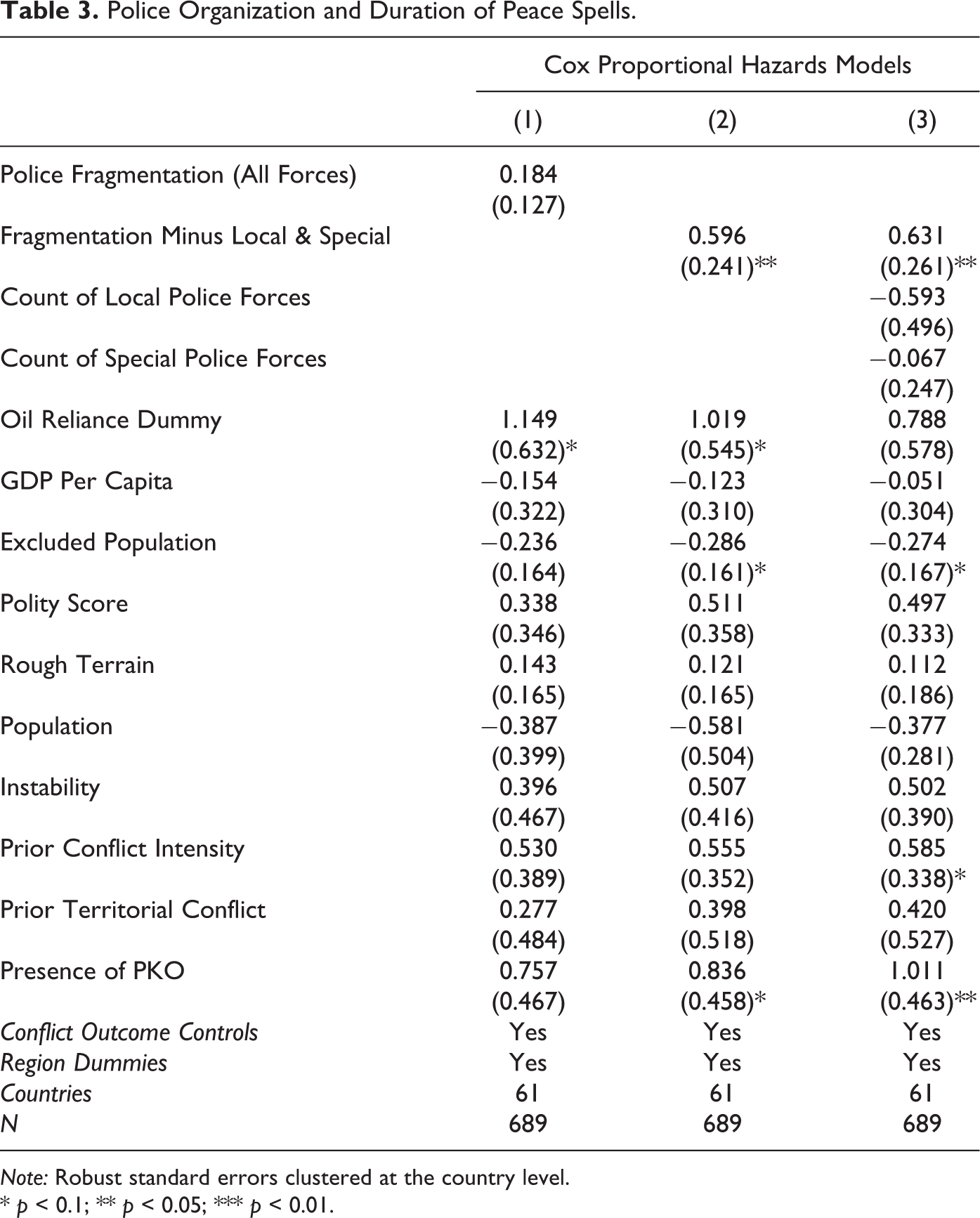
Table 3 presents the main results for the analysis of the duration of peace. We estimate a series of models in which we vary the included police institutions measures. In all models, we use robust standard errors clustered at the level of the country. Model 1 begins with the forces fragmentation measure that includes counts of both local and special police. Model 2 then substitutes the fragmentation measure that excludes local and special police and therefore reflects the kinds of fragmentation that are theoretically expected to be most likely to lead to post-conflict peace failure. We should therefore expect the coefficient size for fragmentation in model 2 to be larger than the coefficient in model 1. In model 3, we add separate variables for local and special police forces to assess their independent relationship with post-conflict peace duration.
Police Organization and Duration of Peace Spells.
Note: Robust standard errors clustered at the country level.
* p < 0.1; ** p < 0.05; *** p < 0.01.
Consistent with our police fragmentation hypothesis, we find in model 1 that an increase in the number of all police forces (fragmentation) is associated with an increase in the risk of peace failing, though it is not statistically significant at conventional levels (p < 0.148). 12 Converting model 1’s coefficient to the hazard ratio indicates that every one-unit increase in fragmentation (i.e., adding one additional police force) is associated with a 20 percent increase in the risk of peace failure. In model 2, we use the fragmentation variable without including local and special police. We find that the estimate for this variable is significant and is approximately 3.2 times larger than the coefficient for model 1. In terms of the hazard rate, a one-unit increase of non-local or special police forces is associated with an 82 percent increase in the risk of peace failure. In model 3, we introduce the count variables for both local police and special police forces. The fragmentation coefficient remains positive, significant and substantively large. In contrast, the local police and special police force variables are negatively associated with the risk of peace failure, although they are not statistically significant.
To put the substantive effect of fragmentation in perspective, we compare it to another important estimate from the model: prior conflict intensity and political instability. In model 3, the hazard ratio for fragmentation implies that every additional police force is associated with an 88 percent increase in the risk of peace failure. This is one of the largest significant relationships in the model. Similarly, peace spells that occur after major conflicts (over 1,000 cumulative battle deaths) are 79 percent more likely to fail than peace spells that occur after smaller conflicts.
To help visualize these effects over time, we plot Kaplan-Meier survival estimates for both police fragmentation and conflict intensity. To ease visualization of the fragmentation plot, we use the estimate produced using a dummy variable in Table A5, model 3 (Online Appendix). Again, the fragmentation variable is 0 when there is only a single non-local/special force (usually the national police force) and equal to 1 when there is more than one force (ranging from two to four forces). The plot in the left panel of Figure 1 shows an almost immediate large reduction in survival rate for fragmented police forces that persists steadily across the analysis time. Finally, this relationship between fragmentation and peace failure is quite robust as well. The effects persist when analyzing major conflict risks (Online Appendix Table A4), using a dummy measure for fragmentation (Online Appendix Table A5), examining a broader group of post-conflict countries going back to 1945 (Online Appendix Table A6), studying a shorter analysis time period between 2004 and 2012 (Online Appendix Table A7), 13 using alternative Weibull models (Online Appendix Table A8), and controlling for military expenditures (Online Appendix Table A9).
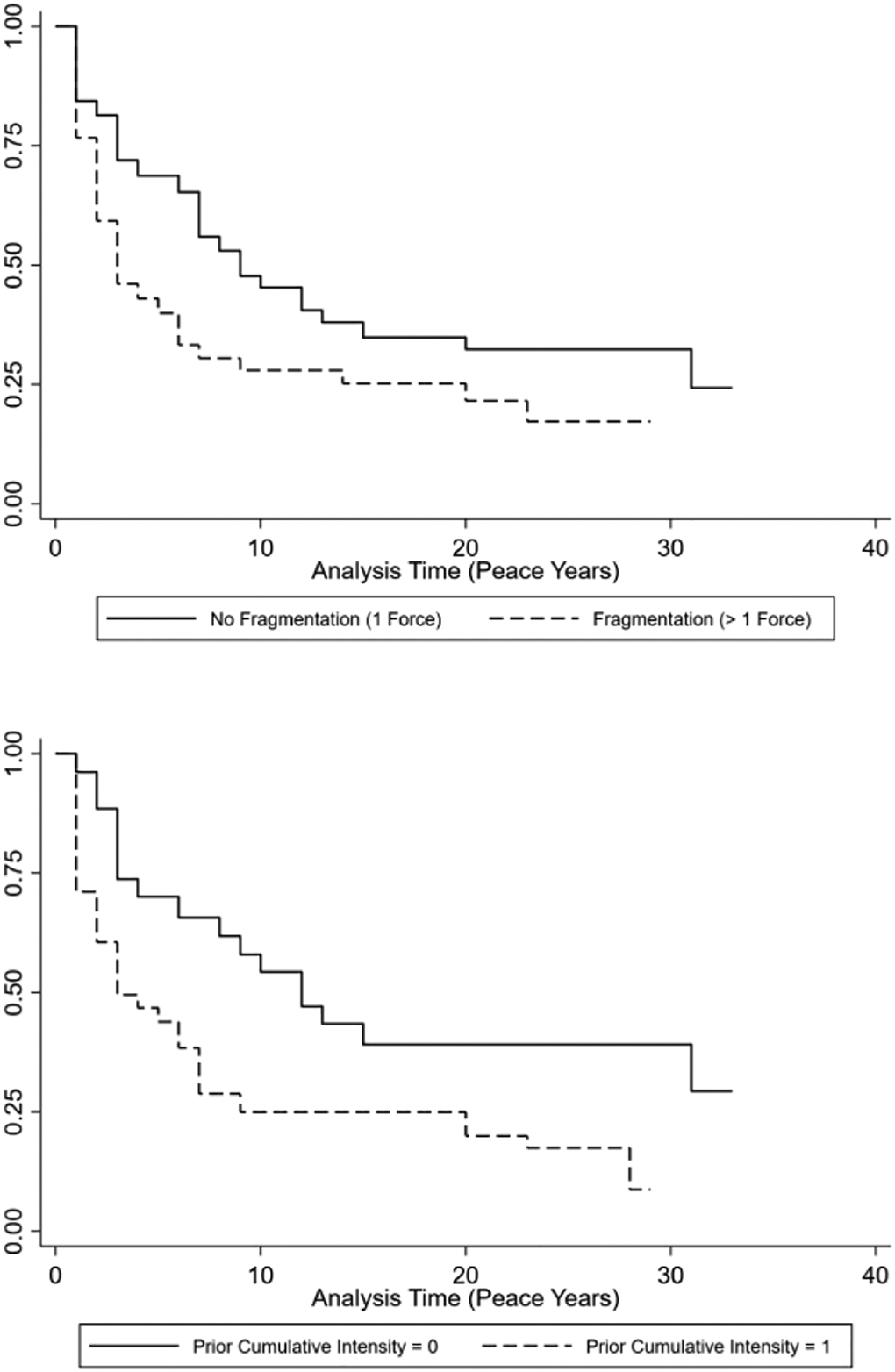
Kaplan-Meier survival curves.
Mechanisms
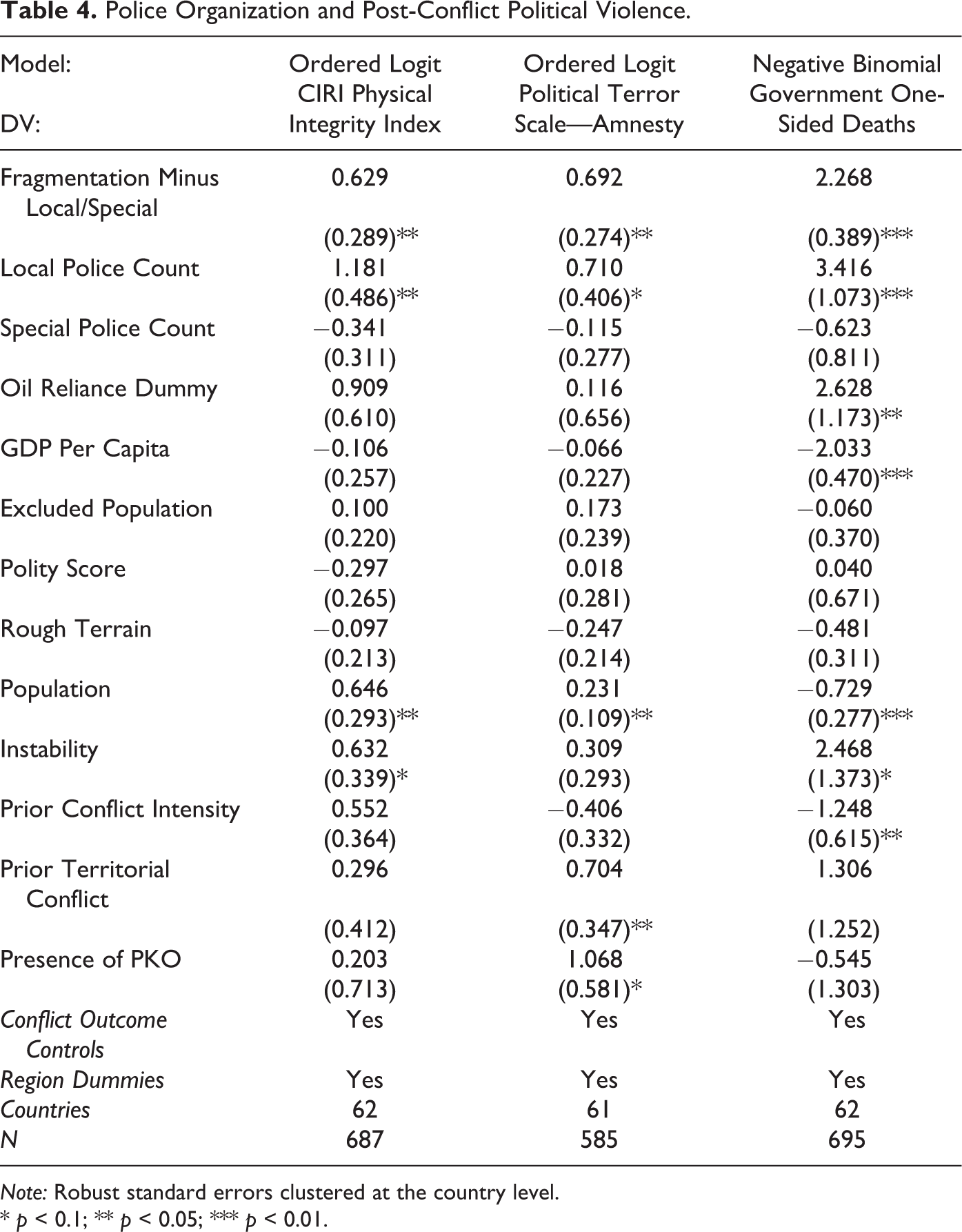
We further investigate the role that police fragmentation may play in post-conflict peace by examining several additional dependent variables for political violence and human rights abuses during post-conflict peace years. The institutional dysfunctions associated with fragmentation suggest that police are more likely to engage in violence against civilians and human rights abuses, thus undermining peace in the post-conflict period. We draw on three different data sources to measure political violence and human rights abuses: (1) CIRI’s physical integrity rights index, (2) the Political Terror Scale and (3) civilian deaths from one-sided government violence. 14 We rescale the physical integrity index so that higher values are associated with worse human rights abuses. We then estimate ordered logit models for the human rights scales (Table 4, columns 1 and 2) and a negative binomial model for the count of civilian deaths stemming from government violence (column 3). We include the same controls as in the peace duration models and restrict the sample to post-conflict peace years for the same time period and set of countries (2000-2014).
Police Organization and Post-Conflict Political Violence.
Note: Robust standard errors clustered at the country level.
* p < 0.1; ** p < 0.05; *** p < 0.01.
Table 4 shows that greater police fragmentation is consistently associated with worse human rights outcomes and more government violence against civilians. Increasing fragmentation is associated with significantly worse scores in both the physical integrity and political terror scales, as well as a higher count of civilian deaths attributed to government forces. However, somewhat surprisingly, the presence of local police in a country is also associated with worse human rights outcomes and greater government violence.
We speculate that the positive association between local policing and political violence could come from two distinct issues. First, theoretically, local police quality and behavior may suffer from a lack of oversight and control by the national government. These principal-agent problems are commonly thought to contribute to levels of government violence. Second, as seen in Table 2, local police control is associated with prior levels of conflict. As mentioned earlier, it is quite possible that the devolution of policing to local government occurs when countries are trying to avoid the renewal of conflict. Local police forces therefore may face more difficult circumstances. These local policing findings require greater in-depth analysis in future work.
Conclusion
This paper contributes to research on civilian policing in post-conflict management, a subject that remains underexplored by social scientists. A noteworthy aspect of our study is that we specifically analyze how the institutional design of policing affects a state’s ability to respond to violent threats. A focus on the observable aspects of institutional design not only allows us to derive falsifiable propositions; it also enables us to generate objective metrics for assessing the impact of policing. Our empirical analysis thus provides new findings regarding policing’s role in post conflict dynamics among developing states, where institutions are otherwise expected to be weak and inconsequential. Instead, we show that policing institutions can be designed, in certain circumstances, to reduce the potential for civil conflict recurrence. We find that increasing police fragmentation by an additional force is associated with an 88 percent higher risk of a country experiencing conflict recurrence between 2000 and 2014.
This paper cannot adequately capture how reforms in the broader security sector would affect conflict dynamics in post-conflict states, but this is an important area of policy-relevant research (Hartzell and Hoddie 2003; Bryden and Hänggi 2004) to which we can provide theoretical and empirical contributions. In terms of theory, we have identified specific mechanisms by which the organization of policing hinders governments in undertaking post-conflict pacification and stabilization operations. Institutions designed to coordinate policing may be particularly important on this front. Empirically, we present evidence that the fragmentation of policing can increase the risk of violence breaking out as well as the lethality of policing. These findings merit intensive scrutiny precisely because they have the potential to affect policy and lives.
Supplemental Material
Supplemental Material, sj-do-1-jcr-10.1177_00220027211013088 - Policing Institutions and Post-Conflict Peace
Supplemental Material, sj-do-1-jcr-10.1177_00220027211013088 for Policing Institutions and Post-Conflict Peace by Leonardo R. Arriola, David A. Dow, Aila M. Matanock and Michaela Mattes in Journal of Conflict Resolution
Supplemental Material
Supplemental Material, sj-dta-1-jcr-10.1177_00220027211013088 - Policing Institutions and Post-Conflict Peace
Supplemental Material, sj-dta-1-jcr-10.1177_00220027211013088 for Policing Institutions and Post-Conflict Peace by Leonardo R. Arriola, David A. Dow, Aila M. Matanock and Michaela Mattes in Journal of Conflict Resolution
Footnotes
Authors’ Note
The views and conclusions contained in this document are those of the authors and should not be interpreted as representing the official policies, either expressed or implied, of the Army Research Office or the U.S. Government. The U.S. Government is authorized to reproduce and distribute reprints for Government purposes notwithstanding any copyright notation herein.
Acknowledgments
We are grateful for excellent research supervision by Justine Davis and Melanie Thompson and research assistance by Omeed Askary, Ani Boyadjian, Christopher Cooper, Christopher Corona, Lina Craighill, Andrea Garcia-Ochoa Lee, Ali Hasan, John Huson, Gabrielle Lamont-Dobbin, Katie Lee, Ethan Morales, Megan Morris, Farah Nanji, Paola Perez Curiel, Joseph Rodriguez, Heath Rushing, Nicholas Shafer, Riddhi Suva, Ilianna Talamantes, Tanya Tandon, and Aleksei Zimnitca. We are also grateful to Kristine Eck, Courtenay Conrad, and Charles Crabtree for organizing this special issue and their feedback, as well as Paul Huth and two anonymous reviewers for their feedback.
Declaration of Conflicting Interests
The author(s) declared no potential conflicts of interest with respect to the research, authorship, and/or publication of this article.
Funding
The author(s) disclosed receipt of the following financial support for the research, authorship, and/or publication of this article: This research was sponsored by the Army Research Office and was accomplished under Grant Number W911NF-17-1-0086.

Supplemental Material
Supplemental material for this article is available online.
Notes
References
Supplementary Material
Please find the following supplemental material available below.
For Open Access articles published under a Creative Commons License, all supplemental material carries the same license as the article it is associated with.
For non-Open Access articles published, all supplemental material carries a non-exclusive license, and permission requests for re-use of supplemental material or any part of supplemental material shall be sent directly to the copyright owner as specified in the copyright notice associated with the article.
