




Abstract
Who punishes leaders via coups during civil war? By distinguishing between different types of internal audiences within the government and their attempts to remove a leader forcefully, I illuminate the mechanisms that explain variation in who punishes the leader during wartime. I claim that whether leaders are culpable for the initiation of the war has an important implication for whether they are punished by members of the ruling coalition (i.e., those with access to decision-making and political power), or by those outside the ruling coalition. Empirical evidence supports my hypotheses: (i) culpable leaders are more likely to experience coup attempts led by those outside the leaders’ ruling coalition, should the war go poorly; and (ii) nonculpable leaders are more likely to experience coups executed by members of their ruling coalition. The findings have important implications for how leaders respond to audience pressures as they consider whether to fight or settle.
Introduction
Who punishes leaders via coups during civil war? State leaders face dual threats to their political power during civil war. They face threats not only from rebels outside the regime, but also from within the regime. As the military is the institution of violence capable of defeating rebellions, leaders need to invest enough resources in strengthening their militaries, and yet if they do so they confront the problem that these stronger military institutions will be better able to overthrow them (e.g. Huntington 1957; Feaver 1999; Svolik 2012; Acemoglu, Ticchi, and Vindigni 2010). 1 How leaders cope with coup threats when they confront threats coming from outside the regime has been a long-standing theme in studies of civil-military relations (e.g. Desch 1999; McMahon and Slantchev 2015). Indeed, empirical evidence shows that the likelihood of coup attempts increases by about 82 percent during an ongoing civil war, relative to peace-time, and, globally, nearly one in four of the coups attempted since 1950 occurred in the context of civil war (Bell and Sudduth 2017). Leaders are also vulnerable to coup risks immediately after a civil war (White 2020). Though existing research has highlighted an increased threat of coups during civil war and improved our understanding of the linkages between coups and civil war (e.g. Roessler 2016; Aksoy, Carter, and Wright 2015; Powell 2015; Thyne 2015), we know very little about the variations within wartime coups. More generally, though the notion that variations in the anticipation of punishment in the form of losing office shape state leaders’ wartime decisions underpins many prominent theories of both civil war (Prorok 2016, 2018) and interstate war (e.g. Bueno de Mesquita et al. 2003; Chiozza and Goemans 2004), we know very little about leader punishment during ongoing wars.
In this article, I propose a theoretical mechanism that explains the variations in who punishes wartime leaders via coups, by introducing a new distinction between different types of internal audiences (i.e., individuals and groups within the state apparatus). 2 I explain why some wartime leaders experience coup attempts led by members of the leaders’ ruling coalition with access to the decision-making body and political power of the regime (i.e., coalition insiders), while others are challenged by those outside the ruling coalition (i.e., coalition outsiders). Sierra Leone, for example, experienced wartime coups both in 1992 and in 1996 during the war with the Revolutionary United Front. Though these coups occurred only a few years apart during the same war, the types of plotters greatly differed. The 1992 coup was led by a group of young junior officers and soldiers, while the 1996 coup was led by a group of high-ranking members of the military junta, including the Chief of Defense Staff. My proposed theory can explain such variations. Focusing on the question of who punishes leaders is important because the types of new leaders, rather than a leader change itself, matter in predicting how the new leaders make decisions on whether to continue a costly war or settle (e.g. Prorok 2016). As I discuss further below, my findings have important implications for the process and outcome of civil war. Moreover, as a growing body of coup literature demonstrates, coups led by different types of plotters are fundamentally different in terms of their causes and consequences (e.g. Albrecht and Eibl 2018; Aksoy, Carter, and Wright 2015; Bruin 2019). Lumping together these different types of coups would prevent us from fully understanding the causal mechanism behind wartime coups as well as their impacts on the trajectory of civil war.
My central claim is that whether leaders are considered culpable for the initiation of or involvement in the war is the key determinant in why some wartime leaders experience coup attempts led by those inside the ruling coalition (e.g., elite officers who have positions in the ruling body of the military junta, or civilian elites who have key positions such as cabinet memberships), whereas others are challenged by coalition outsiders (e.g., middle- and low-ranked officers). When leaders are culpable for involvement in the war because they were in power at the conflict’s start, or because they had political connections to the culpable predecessors, I argue that they are more likely to experience coups led by coalition outsiders should they perform poorly. 3 As coalition outsiders such as middle- and low-ranked officers are the ones to fight rebels on the battlefield, they have strong incentives to remove incompetent leaders who they think have mismanaged the war. On the other hand, coalition insiders would hesitate to replace culpable leaders, because their political connections to the leaders and their decisions to fight make them viewed as culpable, and the costs of inheriting culpability are too high when the war is going poorly. Second, when leaders are not culpable for the initiation of the war, I expect that the leaders are more likely to be punished by coalition insiders. Nonculpable leaders’ willingness to pursue a negotiated settlement with rebels would cause disagreements among members of the ruling coalition regarding specific procedures and outcomes of the negotiations. The members of the ruling coalition who currently enjoy privileged access to political power have a greater capability than coalition outsiders to organize a coup and are more sensitive to the outcomes of the negotiation process. Coalition insiders thus are more likely to lead a coup against nonculpable leaders. The empirical results using a newly coded dataset of wartime coup attempts covering the period between 1989-2015 provide strong evidence for my hypotheses: (i) culpable leaders are more likely to experience coups led by those outside the leaders’ ruling coalition, should the war go poorly, while (ii) nonculpable leaders are more likely to face coup attempts led by members of their ruling coalition.
This paper offers important contributions to several literatures. First, by focusing on the question of who punishes wartime leaders, this article improves our understanding of the civil war process and outcomes. Crucially, this article’s finding suggests that the regime has a self-sufficient mechanism to remove culpable leaders who have incentives to continue a costly war and put nonculpable leaders in power who have no such incentives. At the same time, however, my findings reveal that nonculpable leaders’ initiatives to terminate the war through negotiations are not punishment-free, challenging the literature’s view (e.g. Prorok 2016). Culpability impacts who punishes leaders, but not the likelihood of punishment itself. Second, this paper is the first to analyze leader punishment during ongoing war systematically. Despite the central role that leader accountability plays in studies of war and political violence, we know very little about when and how leaders are held accountable during wartime. Though some researchers have examined whether leaders are punished in the context of interstate war (e.g. Bueno de Mesquita and Siverson 1995; Chiozza and Goemans 2004; Croco and Weeks 2016), their analyses primarily focus on how leaders fare in the aftermath of a war. Yet, understanding the mechanisms behind wartime punishment is important, because leaders’ decision calculus during wartime should depend not only on the expected likelihood of post-war punishment but also on the anticipation of wartime punishment.
This article proceeds as follows. First, it defines key concepts and briefly examines existing research on coups and leader punishment during civil war. Second, I develop a theory on how leader culpability affects who punishes the leader. Third, I provide information on the data and models, and discuss the empirical results. Finally, I conclude by examining the article’s implications.
Coups and Leader Punishment during Civil War
This article studies internal audiences’ attempts to forcefully remove a state leader, which I will refer to as coups, during civil war. Internal audiences are defined here as “individuals and groups within the government who can coordinate to hold leaders accountable” (Prorok 2018, 5). Though leaders are held accountable in various manners (Sudduth and Bell 2018), I focus on nonconstitutional leader removals because, as Svolik (2012, 4) emphasizes, leader punishment in these cases “most plausibly occurred nonconsensually—against the will of the incumbent leader.” Moreover, the principal threat most wartime leaders face stems from internal audiences, including the military. Existing research shows that political leaders are more likely to experience coups during an ongoing civil war (Bell and Sudduth 2017) as well as immediately after the war (White 2020). Furthermore, the consequences of coups are severe. Coup attempts often result in the imprisonment, death, or exile of the former leader (Goemans 2008) as well as more general violence with a significant number of deaths (Bruin 2019), and are known to have long-term effects on a country’s political stability and economy even in the case of failed coups (Harkness 2018; Roessler 2016; Powell and Chacha 2016).
What explains the variation in leader punishment inflicted by internal audiences during civil war? Existing research maintains that whether leaders are perceived as responsible for the initiation of war has an important consequence for leader punishment (Prorok 2016, 2018). Culpable leaders, who have clear ties to the decisions to initiate the war either by (1) being in power at the conflict’s start (first leaders), or (2) coming to power during the war and having political connections to the decision to fight (replacement culpable leaders), will face a high risk of punishment if they accept any outcome less than a victory. In contrast, nonculpable leaders face little risk of punishment even in the case of defeat because internal audiences will be more forgiving of leaders whom they perceive to be unconnected to the choice to initiate the war (Croco 2011; Croco and Weeks 2016).
The logic behind this argument is that the leader’s connection to the original decision to go to war shapes the internal audiences’ assessment of leader competence. Internal audiences are more likely to label culpable leaders “incompetent” when wars go poorly, because they are deemed to lack sound judgment in decision making since they started a war which has been difficult to win, or they could not prevent opposition groups from starting the war (Croco 2011). Not only first leaders who directly preside over the transition from peace to war, but those replacement leaders who share political and familial connections with the first leader are also considered incompetent in the case of poor war outcomes because such connections imply their knowledge of and influence over the decision-making process that led to war (Prorok 2018, 6). On the other hand, nonculpable leaders who come to power during war and share no ties with the first leader can dodge the accusations of poor judgment and mismanagement by distancing themselves from the original decision to go to war.
Though the literature has greatly improved our understanding of wartime accountability, it does not illuminate who–which parts of internal audiences—will punish leaders. This is an important issue because if a leader’s culpability has a decisive impact on the trajectory of a civil war and the culpability itself transfers from one leader to others who are politically connected to the decision to fight, who will attempt to replace a culpable leader during the war will also have an important implication for the outcome of the war. Second, scholarship has focused on a leader’s competence in executing a war as the criterion by which internal audiences evaluate the leader. Though removing incompetent leaders from office certainly captures an essential aspect of wartime punishment, the exclusive focus on competence can obscure other important reasons why internal audiences might punish wartime leaders. By ignoring other reasons why internal audiences would punish leaders, the existing literature might underestimate the likelihood of punishment for nonculpable leaders. In the following sections, I explain a causal mechanism that accounts for who punishes wartime leaders by focusing on leaders’ culpability.
Theory
There are two types of internal audiences that might forcefully remove leaders. The first group are members of the ruling coalition who have influence over policy decisions within the regime and access to political power (i.e., coalition insiders), and the second type are those individuals who are outside the ruling coalition and so have no access to the decision-making process nor substantive political power (i.e., coalition outsiders). For instance, high-ranking military officers who are members of the ruling body of military juntas, members of royal families in monarchy systems, and members of the politburo and the central committee of the ruling party are ruling elites who control the decision-making process and have privileged access to political power in these regimes. Individuals who hold cabinet positions or key governmental positions are also considered coalition insiders in many authoritarian countries. When political power is highly concentrated around a single individual (i.e., personalist regimes), the decision-making process is limited to the dictator and his very small inner circle (e.g. Svolik 2009). For democracies, I consider individuals who have cabinet positions, high-ranking government positions, and memberships in the incumbent leader’s party as coalition insiders because of their knowledge of and influence over the decision-making process. Coalition outsiders, on the other hand, are typically middle- or lower-ranked military officers who do not have access to the key decision-making body or political power. 4
Culpable Leader and Punishment
When culpable leaders perform poorly in a war, I expect that they will face a higher likelihood of coups inflicted by coalition outsiders, but not by coalition insiders. Coalition outsiders have strong incentives to remove culpable leaders for two reasons. First, they want to improve performance in the war by replacing an incompetent leader who has mismanaged the war with a more competent leader. Internal audiences assess leader competence using information on battlefield performances and leader culpability. Because they started a war that was difficult to win, or because they could not prevent opposition groups from starting a costly war, culpable leaders will be increasingly seen as incompetent as the war goes poorly. 5 Middle- and lower-ranked officers and soldiers are the ones who fight rebel groups on the battlefield and suffer most from the increased costs of the war and the leader’s mishandling of the war. Keeping an incompetent leader in power a little longer will greatly increase the chance of the military officers themselves being killed on the battlefield. As their physical survival is on the line, those middle- and lower-ranked officers and soldiers have no time to be forgiving of a culpable leader who performs poorly in the war.
As an example, consider the 1992 Sierra Leonean coup. In March 1991, Sierra Leone, under Joseph Momoh’s one-party government was plunged into civil war when it was invaded by the Revolutionary United Front (RUF). The RUF immediately took control of large swathes of territory in eastern and southern Sierra Leone, while the government side could not effectively fight back, as the army did not have sufficient weapons, communication equipment, ground transportation, nor air strike capability. Further, culpable leader Momoh did not properly provide soldiers with training and salaries, which resulted in low morale and poor performance (Mutwol 2008). After witnessing such battlefield situations firsthand, Captain Valentine Strasser and other disgruntled junior officers organized a coup, deposed President Momoh in April 1992, and established a military junta to improve battlefield performance.
Second, coalition outsiders will attempt to remove culpable leaders so that they can end a costly or losing war. Culpable leaders have strong incentives to continue fighting in the face of hardship and “gamble for resurrection” even when the costs of war are high, and the victory is unlikely. Culpability makes compromise costly, as adopting a conciliatory strategy involves reneging on promises made at the war’s start, and thus internal audiences will judge them incompetent when they settle for anything less than a victory. Continuing a war provides the opportunity to turn the tide and forestall punishment while terminating a war by settling on compromise terms leads to certain punishment for culpable leaders. Military officers and soldiers deployed to the war zones are most vulnerable to leaders’ strategies to gamble for resurrection and thus have strong incentives to remove culpable leaders to end the war. 6 Though some culpable leaders might participate in a peace process with rebels, their incentives to avoid compromise make it very difficult for the negotiating parties to make progress and commit to terminate the war. Moreover, some culpable leaders might feign an interest in a peace process so that they can have time to regroup and gain a stronger military position (Beardsley 2018, 318-19). Thus, even when the peace process starts, coalition outsiders still have incentives to replace a leader with someone who could commit to ending the war. Crucially, coalition outsiders, who by definition have no access to the regime’s decision-making body, can distance themselves from the leader’s decision to go to war. The lack of political connections to their culpable predecessors allows coalition outsiders to escape from the “incompetent” designation even when they end the war by settling for less than a victory.
The above reasoning, however, does not apply to members of the culpable leader’s ruling coalition. Coalition insiders who would be seen as politically connected to the decision to fight would hesitate to replace their leader, as the costs of inheriting culpability are too high when the war is going poorly. Culpability transfers from first leaders to replacement leaders when the latter have political or familial connections with the former, and thus are viewed as having knowledge of and influence over the decision-making that led to war (e.g. Croco 2011). Coalition insiders of culpable leaders would thus inherit culpability should they replace the leaders. Members of the first leader’s ruling coalition will be viewed as culpable precisely because they were in positions that could directly influence the first leaders’ decisions to start a war. 7 Members of replacement culpable leaders’ ruling coalitions would also be viewed as politically connected to the first leader’s decisions to fight. The transition from first leaders to replacement culpable leaders is achieved by reshuffling leaders but keeping intact the group of ruling elites with power to influence decisions (Aksoy, Carter, and Wright 2015).
The costs of inheriting culpability are high for coalition insiders when the war is going poorly. Replacement culpable leaders will face a high risk of punishment if they terminate the war for anything less than victory. Though members of the ruling elite might want to replace an incumbent culpable leader in the hope of improving prospects for success in the war, the likelihood of turning the tide and achieving victory at this point might be minimal. In the event of defeat or settlement with concessions, leaders deemed culpable for the war face a heightened risk of punishment by internal audiences. They will also face punishment by opponents and international organizations such as the International Criminal Court (ICC). Recognizing that culpable leaders are unable to commit to ending the war, rebels will have strong incentives to remove them from power in the hope that a nonculpable leader takes over who can commit to ending the war or implementing peace agreements. The ICC also targets heads of state who are culpable for atrocity crimes during civil war (Krcmaric 2018). Of course, coalition insiders may face post-war punishment even if they do not replace a culpable predecessor. However, taking the position of the head of state will significantly increase both the magnitude and the chances of punishment. While members of the ruling coalition could potentially distance themselves from their leader and attribute poor war outcomes to the leader’s choice of tactics, once they take the position of a state leader, they will face, with certainty, punishment in the case of poor war outcomes. Given that the costs of inheriting culpability are too high, coalition insiders have no incentives to replace culpable leaders when the war is going badly.
The above discussion leads to the following hypothesis.
Nonculpable Leader and Punishment
When leaders are not culpable, sharing no political ties with the first leader and no influence over the decision-making process that led to war, they lack incentives to continue fighting a costly and losing war. Even if they terminate a war short of victory, nonculpable leaders can avoid blame for the outcome, and internal audiences are more forgiving of leaders whom they perceive to be unconnected to the choice to start the war. If, on the other hand, nonculpable leaders decide to continue a costly war, they need to invest additional resources in the war that they could instead allocate to other important policy agendas. Given the risk of ultimately losing the war, continuing to pour resources into the war is not a good strategy for nonculpable leaders (Croco 2011, 462). Therefore, if the war goes poorly, these leaders will increasingly pursue the peace process with rebels and termination through settlement.
Nonculpable leaders’ incentives to pursue a negotiated settlement, however, would lead to conflict between the leaders and their internal audiences regarding specific procedures and outcomes of the negotiations. As the costs of war increase, nonculpable leaders will have stronger incentives to terminate the war and thus will be more willing to make substantial concessions that will satisfy rebels. Concessions to end costly civil wars typically entail the expansion of political, economic, and military power for rebel groups in the post-war environment (Joshi, Melander, and Quinn 2017, 20-21). 8 Power-sharing arrangements allow the former rebels to have access to the state resources through membership of the cabinet or military organizations, or the formation of political parties. They also redefine the distribution of economic resources controlled by the state (Hartzell and Hoddie 2003). The power-sharing arrangements thus will diminish the power of members of internal audiences.
Crucially, though, how each individual member of the audiences will be impacted by the settlement depends on the exact designs and the details of negotiated outcomes. For example, which aspects of state power and resources will be shared by rebels, or the timing and sequencing of the implementation of negotiated provisions, will shape the post-war power dynamics (Joshi, Melander, and Quinn 2017). When internal audiences find that nonculpable leaders do not represent their interests in the negotiation process and will diminish their post-war power, they will attempt to overthrow the leaders hoping that a new leader would bring them a better negotiation outcome. For example, a civilian leader might be more willing to agree on the rebel-military integration than military members of the ruling elite whose post-war power would be considerably compromised under such military power-sharing arrangements (White 2020). In this case, the audiences would try to overthrow the leader whose preference is divergent from theirs. 9
As the costs of continuing to fight increase, a nonculpable leader becomes more willing to make sufficient and substantial concessions to rebels so that she can terminate the war. This, in turn, leads to disagreements between the leader and internal audiences over the exact nature of concessions and negotiation outcomes. The audiences would try to oust the leader and replace her with a new leader who could better represent their interests in the negotiation processes and achieve a better negotiation outcome.
I claim that punishment of a nonculpable leader resulting from the disagreement over the peace process will be inflicted by coalition insiders, not outsiders. First, the process and outcomes of the peace settlement would most affect high-ranked officers and top elites who hold the regime’s key positions and thus currently enjoy exclusive access to political power. As Albrecht and Eibl (2018) explain, members of the ruling coalition attempt a coup primarily when their position within the elite coalition is threatened by a power shift within the regime. Given the high stakes of losing their power, members of the ruling coalitions want to impose their preferences on the process and outcomes of the peace negotiation so that they maximize their share of state power in the post-war environment. When they anticipate that nonculpable leaders will promote settlement deals with rebels that could substantially diminish their share of power, they will attempt to prevent it from happening by removing the leaders. In comparison, those outside the ruling coalition, such as middle- or lower-ranked officers, have less of a stake in the negotiation process precisely because they do not have access to political power in the current system. Albrecht and Eibl (2018) maintain that middle- or lower-ranked officers primarily look at military service as a job that provides them with a regular income. Therefore, their concerns are primarily about their own salaries and the provision of suitable equipment and infrastructure, rather than their share of political power.
Second, and more fundamentally, coalition insiders have a greater capacity to organize a coup than coalition outsiders. Coalition insiders have better access to key facilities and information about the regime or the inclinations of fellow officers, which are crucial to the successful execution of a coup. They also have more experience in planning and executing complex military operations and, thus, have a greater capacity to develop plans to launch a coup (Bruin 2019, 5-6). Therefore, if the military as an organization disagrees with the directions pursued by a political leader and is concerned about the military’s shares of power in the post-war arrangement, elite officers who have a greater coup-making capacity will lead a coup (Thompson 1976; Aksoy, Carter, and Wright 2015). For instance, leaders’ concessions to increase rebels’ power by integrating rebel forces into the military will directly affect coalition outsiders’ job security. Crucially, though, precisely because their preferences are aligned with those of the ruling elites, coalition outsiders need not to take independent actions by plotting a coup in these circumstances. This scenario is in stark contrast to when leaders are culpable. As I maintained above, coalition insiders would hesitate to replace culpable leaders as the costs of inheriting culpability is too high when the war is going poorly. Coalition outsiders’ interests to oust culpable leaders will not be represented by coalition insiders.
To illustrate the above logic, consider the dynamics behind the coup removal of Sierra Leone’s Valentine Strasser. As it became clear that defeating rebels of the Revolutionary United Front (RUF) was difficult and the cost of the war had increased, nonculpable Strasser and the NPRC started the process of making peace with the RUF. In this context, Brigadier General Julius Maada Bio, who was a deputy to Strasser and the chief of defense staff, ousted Strasser in January 1996 due to their disagreement about the handling of the peace process, such as the sequences of the peace negotiations with the RUF and the election that would allow a transition to a democratically elected civilian government (
Captain Strasser Is Ousted From Office n.d.). The coup was supported by many high-ranked NPRC members, including Colonel Tom Nyuma, Lieutenant Colonel Komba Mondeh, and Lieutenant Colonel Reginald Glover, who had helped Strasser gain power (Mutwol 2008, 232). It is important to emphasize that nonculpable Strasser was not punished because he decided to settle with rebels short of victory. Plotters punished Strasser because they suspected that the way Strasser handled the peace negotiation would have significantly weakened their positions in the post-war setting and wanted to take control of the negotiation process. Indeed, immediately after he took power, Bio restarted peace negotiations with the RUF (Mutwol 2008, 232).
We can think of some alternative mechanisms that might potentially challenge my explanations. First, the entry manner of leaders, rather than leader culpability, might explain the type of coups during civil war. According to my theory, culpable leaders tend to experience outsider coups that would put in power nonculpable leaders who lack political connections with the first leaders. This logic might imply that nonculpable leaders tend to come to power via a coup, as in the case of Sierra Leone’s Strasser. A potential issue here is that if nonculpable leaders come to power primarily via a coup, they might be more vulnerable to coup threats as these coup-born military regimes are less stable than other types of regimes (coup trap). 10 Another possibility is that state leaders’ efforts to coup-proof the regime might shape both battlefield performances and the type of coups. For example, recruitment and promotion of elite officers based on political loyalty rather than merit and competence would undermine the regime’s military capabilities to fight rebels (e.g. Powell 2015; Talmadge 2013). At the same time, the incompetence of the ruling coalition might mean that the regime will experience more coups attempted by middle- and lower-ranked officers because the ruling elite cannot detect nor contain such threats posed by the middle- and lower-ranked officers. I will address these potential endogeneity issues when I test my theoretical implications in the empirical section and the Online Appendix.
Data
My dataset consists of leader-month panels for the 311 wartime leaders who were in power during a civil war in 79 countries between 1989 and 2015. 11 Our unit of analysis is leader-month. The leader-month observation is included in the analysis as long as there are at least 25 battle-related deaths in the previous 12 months or in a calendar year as defined in the UCDP/PRIO conflict dataset. I generate the leader list by using the Archigos version 4.1 (Goemans, Gleditsch, and Chiozza 2009) for democracies and the dataset used by Sudduth and Bell (2018) for autocracies. To identify civil war, I use the UCDP/PRIO Armed Conflict Dataset v.1-2016 (Gleditsch et al. 2002; Harbom, Melander, and Wallensteen 2008). Crucially, the UCDP/PRIO dataset does not distinguish conflict between the government and rebel groups (civil war) from violent conflict between an incumbent leader and regime elites (coups). Following Bell and Sudduth (2017), I exclude from the list of civil wars those dyads that are identified as coups by Powell and Thyne (2011) and their updated dataset (Powell 2018) to avoid any biases in the results. 12
Dependent Variable
I use the dataset on coups created by Powell and Thyne (2011) to identify wartime coup attempts. The use of their dataset is appropriate for my study because it captures attempts to forcefully overthrow an incumbent leader led not only by military officers but also by civilian elites, as defined as “illegal and overt attempts by the military or other elites within the state apparatus to unseat the sitting executive” (Powell and Thyne 2011, 12). 13 For all the wartime coup attempts, I have coded whether key plotters are members of an incumbent leader’s ruling coalition by paying careful attention to whether they have access to the regime’s decision-making body and political power. For this coding task, I consulted various sources, including Keesing’s world news archives, Lexis-Nexis and case descriptions used by Aksoy, Carter, and Wright (2015). I then created two binary variables that measure when and who punishes a leader. Outsider Coup is coded as one if a leader experiences a coup attempt carried out by those outside the ruling coalition in that month and zero otherwise. Insider Coup identifies whether a leader experiences a coup organized by members of the ruling coalition in that month (1) or not (0).
The data include 20 insider coups and 20 outsider coups (see Table 1). The positions of key plotters for insider coups include, for example, Defense Minister, Interior Minister, Prime Minister, Vice President, and members of the ruling body of a military junta (e.g., Mali July 1991, Chad April 1989, Sierra Leone January 1996, and Azerbaijan October 1994). Outsider coups are organized by middle or lower-ranked officers who have no direct access to the regime’s decision-making and political power (e.g., Mali March 2012, Sierra Leone April 1992 and Burundi April 2001). More detailed descriptions of plotters’ positions coded in my data are available in the Online Appendix. As reported in Table 1, both types of coups occur in democracies as well as in autocracies. 14
Insider v.s. Outsider Coups.
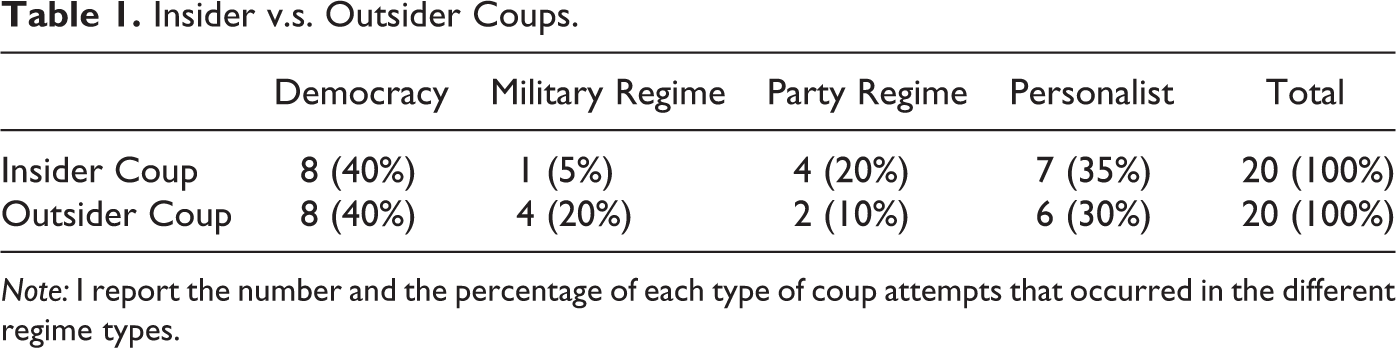
Note: I report the number and the percentage of each type of coup attempts that occurred in the different regime types.
There are several steps that require further discussion regarding the coding process. First, testing Hypothesis 1 requires coding whether coups are led by individuals who are members of the leader’s ruling coalition at the beginning of the war such that they would inherit culpability should they replace the culpable leader (Prorok 2016), rather than at the event of punishment. On this point, I checked and confirmed that plotters who were members of the leader’s ruling coalition when they attempted a coup had also been members of the leader’s ruling coalition at the war’s start in all of the cases in the data. Second, some civil wars are fought between former military officers (rebels) and the regime. As we should not conflate these civil war cases as coup attempts (e.g., Guinea-Bissau June 1998 or Chad April 2006), I follow Aksoy, Carter, and Wright (2015) and exclude from the list of coups these cases where none of the key plotters are current members of the regime apparatus. Third, though the idea of different types of coup agents introduced by Albrecht and Eibl (2018) is equivalent to what this article examines, their dataset only covers North Africa and the Middle-East and does not match the list of coups coded by Powell and Thyne (2011). Note, though, that my coding decisions regarding Insider Coup and Outsider Coup agree with their codings for all of the overlapping cases.
Independent Variables
My key independent variable is a leader’s war performance (i) when the leader is culpable for a war, and (ii) when the leader is not culpable for a war. To properly code the variable, it is important to keep in mind that a leader may face multiple ongoing conflicts simultaneously in each month, and, crucially, the status of leader culpability for these conflicts might differ from each other. That is, in each leader-month, it is possible that a leader is culpable for some of the wars, as these started during his/her tenure, while s/he is not culpable for other conflicts, as s/he came to power during these wars and has no political connections to the first leader. Because of the existence of multiple wars with different culpability statuses for the same leader-month, we can not simply make a binary variable that indicates whether a leader is culpable or not, and then use the interaction terms between culpability and war performance variables.
I therefore create two variables—(i) War Performance for Culpable Conflict and (ii) War Performance for Nonculpable Conflict—for each leader-month. The former measures the war performance of dyads (i.e. two conflicting primary parties of the government and an organized opposition/rebel group) in which a leader is culpable, and the latter captures the war situation of dyads in which a leader is nonculpable. Following the literature (Prorok 2016, 29: Appendix), I use the number of battle deaths on the government side as an indicator of battlefield performance. 15 The battle deaths information is the most objective criterion to evaluate the battlefield situation and directly capture the costs of war that internal audiences suffer. An increase in this measure will increasingly make internal audiences consider culpable leaders incompetent, while it will motivate nonculpable leaders to terminate the war by making sufficient concessions to rebels, which might lead to a disagreement within the ruling coalition. Specifically, I calculate the number of government-side battlefield deaths observed in the previous twelve months, and divide it by 12 to capture the average monthly value for each leader-month. 16 It is logged to reduce the influence of outliers. The information on battle deaths comes from the UCDP Georeferenced Event Dataset (GED) Version 5.0 (Sundberg and Melander 2013; Croicu and Sundberg 2016). When there is no dyad where a leader is culpable (or not culpable), these variables take a value of zero. Also, because we want to capture the number of battle deaths that occurred during a leader’s tenure, the observations where the leader has been in power less than 12 months are excluded from the analyses.
As to the coding of culpability, I build on the list of culpable leaders coded by Prorok (2016) and expand it up to 2015 by incorporating more recent information on dyads using the more recent version of the UCDP data. First leaders are in power at the conflict’s start and thus are considered responsible for the original decision to go to war. Even “non-initiator” first leaders are considered culpable because they failed to prevent war. In identifying first leaders, I follow Prorok (2016, 77) and use the date of the first battle death as identified by the UCDP dyadic dataset (Themner 2016). Further, when the same dyad fights multiple times (i.e., multiple episodes), I code culpability in the following way. If the previous episode ended in a low-activity outcome with no clear terminating event such as the signing of a ceasefire or military victory, the dyad’s original start date was used to code leader culpability. Meanwhile, if a clear terminating event occurred in the previous episode, the start date of the new episode was used to code culpability. To identify the manner of conflict termination, I used the UCDP Conflict Termination Dataset v2.2015 (Kreutz 2010, 2016). 17
A replacement leader who has a political connection to the first leader of the dyad is also coded as culpable. Culpability transfers if a replacement leader is a member of the first leader’s ruling coalition such that s/he had access to the decision-making body of the regime at the beginning of the war. Specifically, replacement leaders are coded as culpable if, at the war’s start, they have key government positions such as cabinet memberships, or are members of the ruling body of a military junta, members of the politburo or central committees of the ruling party, family members (monarchy) or inner-circle members (personalist regimes) of the first leader. In democracies, replacement leaders are culpable if they are members of the first leader’s party, or have positions in the first leader’s cabinet at the war’s start (Croco 2011; Prorok 2016). All other leaders who come to power during each dyad are coded as nonculpable. The above coding criteria are consistent with the codings of outsider coup and insider coup regarding how culpability transfers.
Control Variables
I include several control variables that might systematically impact each type of coup as well as the independent variables. I control the number of battlefield deaths sustained by the opposition side in the previous twelve months, which is divided by 12 and logged (Rebel Casualty). This information comes from UCDP GED Version 5.0 (Sundberg and Melander 2013). Distance to Capital captures the claim that wartime coups are more likely to occur when a war zone is closer to the state capital (Bell and Sudduth 2017), and measures the logged mean distance in kilometers between the capital city and the ongoing war events observed in the previous twelve months. I obtained the geographical information on war zones from UCDP GED Version 5.0. Rebel Fighting Capacity captures a rebel group’s ability to “effectively engage the army militarily and win major battles, posing a credible challenge to the government” (Cunningham, Gleditsch, and Salehyan 2009). I include this variable as rebel fighting capacity might not only shape plotters’ willingness to attempt a coup (Bell and Sudduth 2017), but also influence government-side battlefield deaths. It is measured on a 1 to 3 scale, with 1 indicating the Rebel Fighting Capacity is much less than the government’s fighting capacity and 3 meaning that the rebel capacity is much greater. I calculate the mean of rebel fighting capacity when a leader faces multiple rebels. ln(Soldier Payment) is calculated as the log of the total military budget divided by the total number of military personnel. I include this variable to address the possibility that levels of military spending per soldier might shape the risk of coups led by combat officers as well as a government’s war performance. The information comes from the Correlates of War capability (CINC) components, Version 3.02 (Singer, Bremer, and Stuckey 1972).
Negotiation captures the presence of peace negotiations between the government and rebels. The information comes from the data on civil war negotiation coded originally by Thomas (2014) and updated by Ryckman and Brathwaite (2020). This is a binary variable and is coded as one if a civil war state experiences formal bargaining where both the government and a rebel are present at the meeting. Number of Rebels measures the number of opposition groups each leader faces. ln(GDP/capita) measures an economic performance of each country in the previous year. Data come from the Penn World Tables, version 9.0 (Feenstra, Inklaar, and Timmer 2015). ln(Population) measures the logged size of population and the data are obtained from the Correlates of War capability components, Version 3.02 (Singer, Bremer, and Stuckey 1972). Democracy is a binary variable to indicate whether a leader-month relates to a democratic political system. Military Regime indicates whether a leader-month is a military regime. The information comes from Geddes, Wright, and Frantz (2014). Finally, I control the logged number of how many months have passed since the last coup the country experienced (Months Since Last Coup).
Results
Coup attempts during civil war are “rare events.” In my dataset, only 0.185 percent (twenty observations) of all leader-months experience a coup led by coalition outsiders. Similarly, 0.185 percent (twenty observations) experience a coup led by coalition insiders. As maximum likelihood estimations of logistic regression are known to be biased and to sharply underestimate the probability of rare events as the number of events diminishes, I use the rare events logistic regression proposed by King and Zeng (2001a, 2001b). In Table 2, Models 1, 3, and 5 use Outsider Coup as the dependent variable, while Models 2, 4, and 6 have Insider Coup as the dependent variable. Models 1, 2, 3, and 4 use the entire sample, which includes wartime leader-month observations as defined above. Models 5 and 6 use the sub-sample that includes leader-month observations where formal negotiations between the government and rebels are present.
Hypothesis 1 anticipates that a culpable leader with a poor war performance is more likely to be punished by coalition outsiders. The results of Models 1, 2, 3, and 4 are consistent with Hypothesis 1. As predicted by Hypothesis 1, as the number of government-side casualties increases for conflicts for which a leader is culpable, the likelihood that the leader experiences a coup carried out by coalition outsiders significantly increases (i.e., the coefficient for Government Casualty for Culpable Conflict is positive and significant in Model 1), while a change in the government-side casualties for culpable conflict does not affect insider coup (i.e. the coefficient for Government Casualty for Culpable Conflict is not statistically significant in Model 2). The results hold when we control whether a negotiation between the government and rebels is present (Models 3 and 4).
Hypothesis 2 expects that when a nonculpable leader performs poorly, s/he is more likely to experience coups led by coalition insiders. As the costs of war increase, a nonculpable leader becomes more willing to make sufficient and substantial concessions to rebels so that s/he can terminate the costly war. This in turn increases the likelihood of conflict between the leader and internal audiences over the exact nature of concessions and negotiation procedures. Hypothesis 2 thus more directly speaks to the circumstances where negotiations between the government and rebels are present. 18 Models 5 and 6 use the sample that includes observations with ongoing negotiations. Specifically, I include all the leader-month observations where a peace negotiation is present, but exclude observations that (i) have both culpable and nonculpable conflicts and (ii) have a negotiation only for one type of conflict (i.e. a negotiation process is present only for either culpable or nonculpable conflicts). The problem of including these cases in the analyses is that we might count, for example, the cases of insider coups where the government has performed poorly in nonculpable conflicts, but the insider coup happens in the context of peace process for culpable conflicts, as evidence for Hypothesis 2. 19
The results of rare event models with the sample of ongoing negotiation are provided in Models 5 and 6 in Table 2. Consistent with Hypothesis 2, an increase in the number of government-side casualties for conflicts for which a leader is not culpable significantly increases the probability that the leader experiences a coup conducted by coalition insiders. The coefficient for Government Casualty for Nonculpable Conflict is positive and significant in Model 6. On the other hand, government-side casualties for nonculpable conflicts does not impact outsider coups—i.e. the coefficient for Government Casualty for Nonculpable Conflict is not statistically significant in Model 5. These findings are consistent with Hypothesis 2. I should emphasize that what we need to evaluate in testing Hypothesis 2 is the effect of war performance for nonculpable conflicts on leader punishment during negotiations, rather than the effect of negotiations. Even after nonculpable leaders start negotiations with rebels, their willingness to terminate the war by making substantial concessions should greatly differ, depending on how costly it is to continue fighting a war. The war performance variable captures such variations in the costs that nonculpable leaders suffer by continuing to fight a war instead of ending the war. It thus measures the variations in their willingness to make substantial concessions that would satisfy the rebels, which in turn captures the possibility of conflict between nonculpable leaders and internal audiences over the details of concessions and negotiation procedures.
The results of Models 5 and 6 are also consistent with Hypothesis 1. An increase in the Government Casualty for Culpable Conflict will significantly increase the probability of outsider coups, but does not affect the probability of insider coups. As I maintain in the theory section, even when culpable leaders participate in peace processes with rebels, their strong incentives to avoid compromise make it difficult for the negotiating parties to make progress. In these situations, coalition outsiders want to replace the culpable leaders with someone who could credibly commit to ending the costly war.
Rare-Events Logit Models.
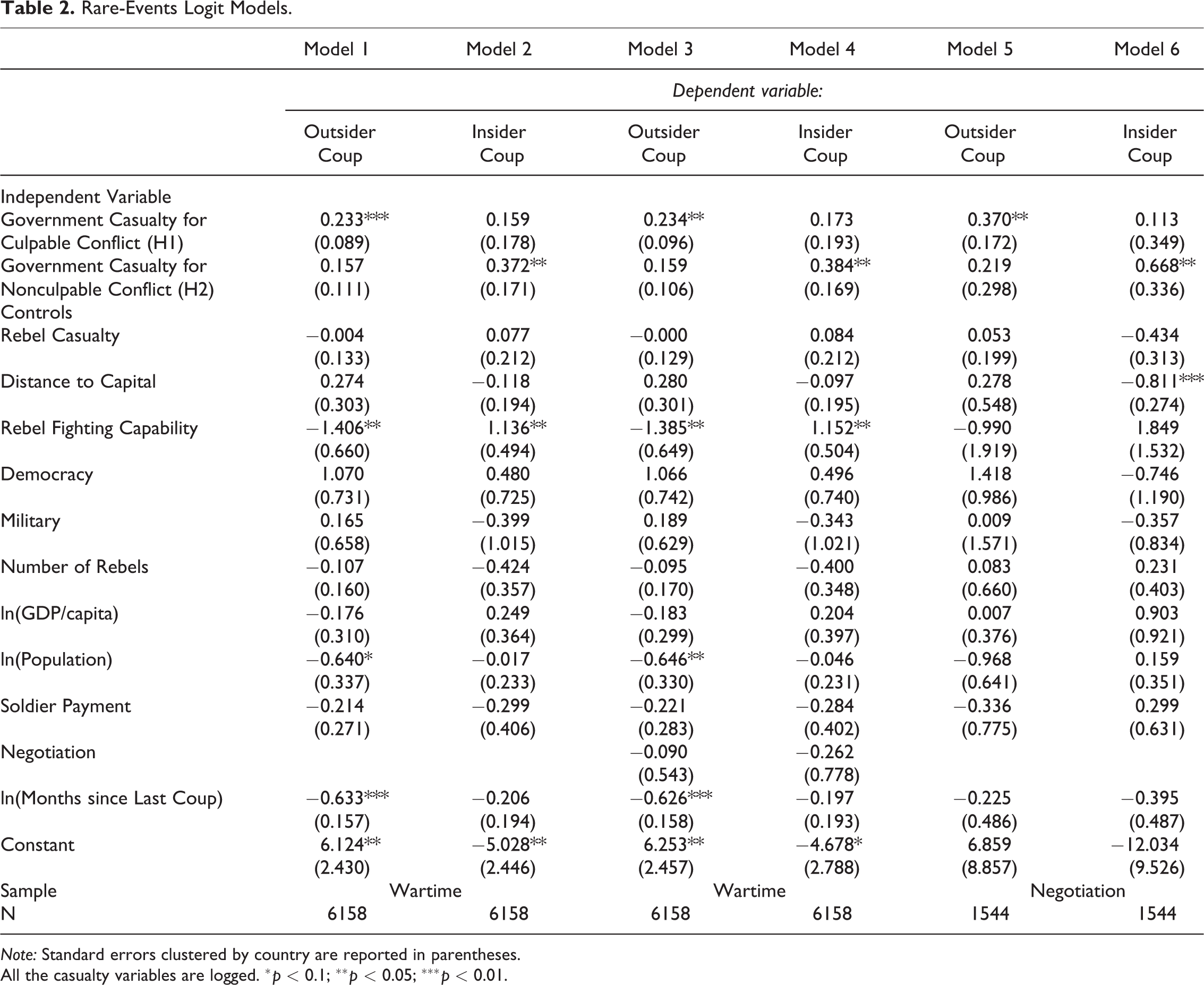
Note: Standard errors clustered by country are reported in parentheses.
All the casualty variables are logged.
Table 3 presents the predicted probabilities and first differences of the two types of coups when we change the number of government-side casualties from its 25th percentile to its 75th percentile. I set all controls at the mean or median values. It demonstrates that when a leader is culpable, a rise in the government-side casualties from its 25th percentile to 75th percentile increases the probability of outsider coups by 56.14
Predicted Probability and First Difference.
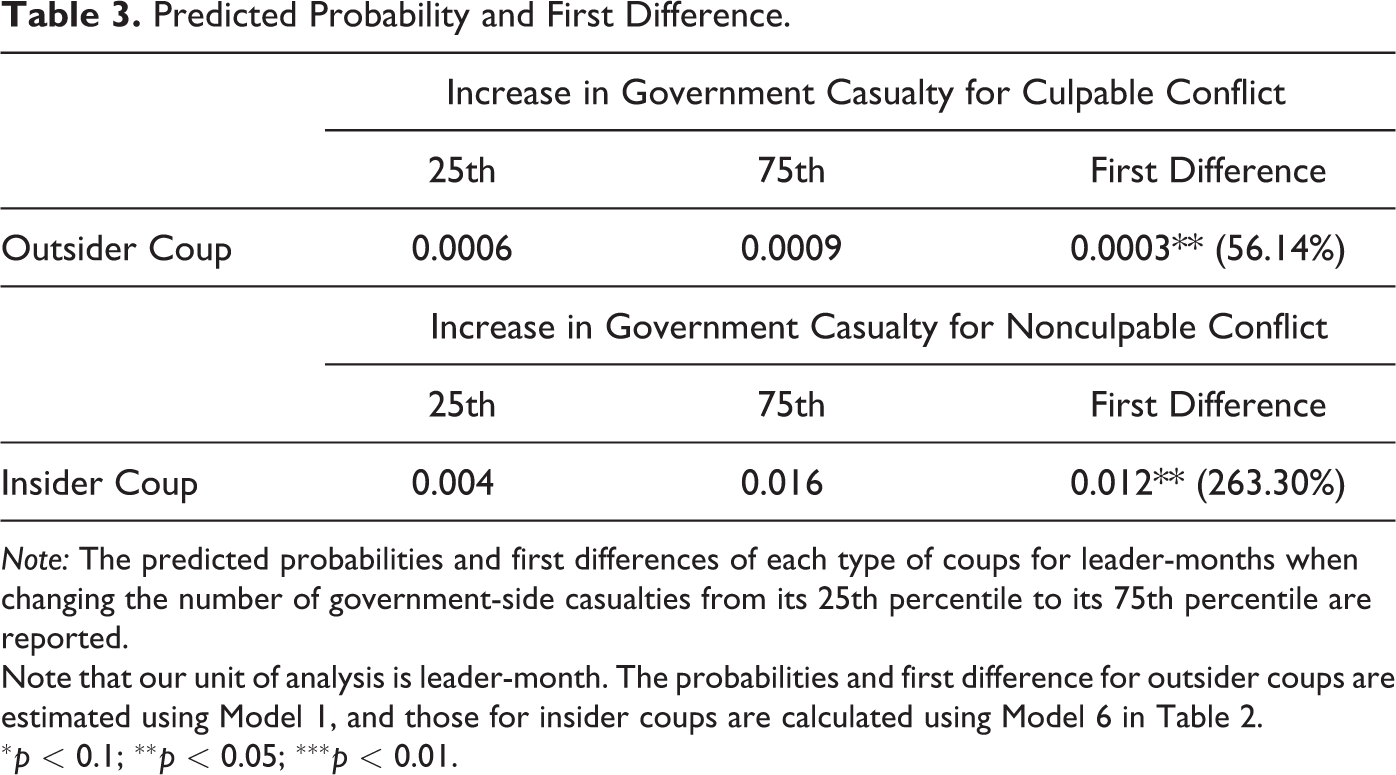
Note: The predicted probabilities and first differences of each type of coups for leader-months when changing the number of government-side casualties from its 25th percentile to its 75th percentile are reported.
Note that our unit of analysis is leader-month. The probabilities and first difference for outsider coups are estimated using Model 1, and those for insider coups are calculated using Model 6 in Table 2.
The results for the control variables also reveal the importance of distinguishing between different types of coups. Some of the variables that the literature uses to explain the variation in coups influence only either outsider coups or insider coups. For example, how recently a country experienced a coup only affects outsider punishments, suggesting that coup-trap arguments widely mentioned in the literature might only explain the patterns of coups executed by lower-ranked officers during wartime. Similarly, a country’s population has a negative and statistically significant effect on outsider coups, but not on insider coups. The findings demonstrate that the literature’s claim that coups organized by different plotters involve fundamentally different processes (Albrecht and Eibl 2018) also applies to wartime coups.
Discussion and Robustness Tests
Several additional robustness tests provide further evidence for my hypotheses. Due to space constraints, the results of these robustness checks are discussed here briefly and presented fully in the supporting appendix.
First, the entry manner of leaders, rather than culpability, might explain the above empirical tendencies. If nonculpable leaders come to power primarily via a coup, they might be more vulnerable to coup threats. The manner of leader entry may affect both my key independent variable (nonculpability) and a dependent variable (insider coup). To address this issue, I show descriptive statistics of how nonculpable leaders come to power, and then run models that control variations in leader entry manner. The descriptive statistics in the Online Appendix show that most nonculpable leaders come to power in a non-coup manner. Thus the claim that a coup trap mechanism is the key driving force behind my finding is not supported by the data. Further, the results are robust to the inclusion of additional entry manner variables and support my hypotheses.
Second, the results also hold when we control additional variables that might affect both a government’s war performance and the type of coups. These include whether a regime is a personalist dictatorship, the level of coup-proofing, ethnic exclusion, and military expenditure. In the Online Appendix, I provide theoretical discussions on how these factors would affect both war performances and the type of coups, and empirical results that control these factors.
Another point for discussion is the results on the punishment of nonculpable leaders when negotiations are not present (Models 1, 2, 3, and 4). As the costs of war in terms of battle deaths increase, nonculpable leaders will be increasingly inclined to end the war via negotiated settlement (Prorok 2016). Thus, Government Casualty for Nonculpable Conflict captures nonculpable leaders’ incentives to settle by making sufficient concessions, and identify whether nonculpable leaders and their ruling coalition start discussing the details of negotiation procedures and outcomes, where conflict between them over these issues could arise. In other words, it can identify the political contexts where (a) the theoretical logics behind Hypothesis 2 expect leader punishment to happen, though (b) negotiations between governments and rebels are not present. 20 Consistent with Hypothesis 2, as the costs of war increase and nonculpable leaders pursue a negotiated settlement, they are more likely to face coups led by coalition insiders (Models 2 and 4), but not by coalition outsiders (Models 1 and 3). These results thus provide additional evidence for Hypothesis 2 and complement the results in Models 5 and 6.
Fourth, the results are consistent when we use the number of government-side casualties relative to the sum of the government and rebel casualties as the war performance indicator. The results are also robust to inclusion of additional controls, such as the duration of conflict and leader tenure. Finally, the results hold when I use a sample of observations where at least fifty (rather than tweny five) battle-related deaths, or at least one battle-related death, are observed in the previous twelve months. These additional results are provided in the Online Appendix.
Conclusion
To properly understand wartime accountability mechanisms, it is essential to disaggregate internal audiences into two groups—i.e. (i) individuals who are members of a political leaders’ ruling coalition with access to the decision-making body and political power, and (ii) those outside the ruling coalition—as they have different cost-benefit calculations in punishing their leaders. Because it shapes the leader’s wartime behavior and transfers only to those successors who are politically connected to culpable predecessors, leader culpability has important implications for the types of internal audiences who have incentives to replace the leader.
This article’s findings have important implications for studies on war and political violence. First, by focusing on the question of who punishes leaders, this article sheds light on how wartime leader changes affect the war trajectory. The findings that coalition outsiders are more likely to punish culpable leaders when the war is going poorly suggest that there is a self-sufficient mechanism within the regime to attempt to remove culpable leaders who have incentives to gamble for resurrection and to terminate the war by putting nonculpable leaders in power. This is certainly positive news given that shortening the war would save many lives and resources. My findings also illuminate the causal mechanisms behind the literature’s finding that successful coups during civil war shorten the duration of a civil war (Thyne 2015). Because coups that take place during a civil war tend to put nonculpable leaders in power who have no incentives to keep fighting, the war is more likely to end quickly after the successful coup.
At the same time, this article’s findings reveal that terminating war through a negotiation process is not punishment-free for nonculpable leaders. Settling a war with rebels could lead to disagreements among members of the ruling coalition over the details of concessions and negotiation procedures. As coalition insiders with access to political power are sensitive to the potential loss of their share of power in the post-war setting, they want to remove their leader if s/he seems to have a different opinion about the negotiation process.
The promising next steps would be to investigate whether this article’s expectations about leader culpability and punishment are applicable to (a) non-coup leader punishment, (b) leader punishment in post-war phases rather than during ongoing wars, (c) the manner of rebel leader punishment, and (d) leader punishment within the context of international wars. Finally, this article contributes to the literature on coups by demonstrating the importance of distinguishing different plotters and coding different types of plotters for all the wartime coups during the period 1989 to 2015. Despite the clear and strong relationships between coups and civil wars, the academic literatures on coups and civil wars have developed independently without much consideration of the other. By accounting for the variation in the types of coups during civil war, this paper contributes to the efforts to unite these literatures.
Supplemental Material
Supplemental Material, sj-do-1-jcr-10.1177_0022002720950429 - Who Punishes the Leader? Leader Culpability and Coups during Civil War
Supplemental Material, sj-do-1-jcr-10.1177_0022002720950429 for Who Punishes the Leader? Leader Culpability and Coups during Civil War by Jun Koga Sudduth in Journal of Conflict Resolution
Supplemental Material
Supplemental Material, sj-pdf-1-jcr-10.1177_0022002720950429 - Who Punishes the Leader? Leader Culpability and Coups during Civil War
Supplemental Material, sj-pdf-1-jcr-10.1177_0022002720950429 for Who Punishes the Leader? Leader Culpability and Coups during Civil War by Jun Koga Sudduth in Journal of Conflict Resolution
Supplemental Material
Supplemental Material, sj-r-1-jcr-10.1177_0022002720950429 - Who Punishes the Leader? Leader Culpability and Coups during Civil War
Supplemental Material, sj-r-1-jcr-10.1177_0022002720950429 for Who Punishes the Leader? Leader Culpability and Coups during Civil War by Jun Koga Sudduth in Journal of Conflict Resolution
Supplemental Material
Supplemental Material, sj-zip-1-jcr-10.1177_0022002720950429 - Who Punishes the Leader? Leader Culpability and Coups during Civil War
Supplemental Material, sj-zip-1-jcr-10.1177_0022002720950429 for Who Punishes the Leader? Leader Culpability and Coups during Civil War by Jun Koga Sudduth in Journal of Conflict Resolution
Footnotes
Acknowledgments
The data and all computer code necessary to replicate the results and figures in this analysis will be made publicly available at the authors' homepage on publication. R and Stata were used for all statistical analyses. I thank Kyle Beardsley, Andrew Boutton, Erica De Bruin, Sarah Croco, Abel Escriba-Folch, Thomas E. Flores, Virginia Page Fortna, Alexander Taaning Grundholm, Kara Kingma Neu, Max Margulies, Jack Paine, Jakana Thomas, and Joe Wright for helpful comments.
Declaration of Conflicting Interests
The author(s) declared no potential conflicts of interest with respect to the research, authorship, and/or publication of this article.
Funding
The author(s) received no financial support for the research, authorship, and/or publication of this article.

Supplemental Material
Supplemental material for this article is available online.
Notes
References
Supplementary Material
Please find the following supplemental material available below.
For Open Access articles published under a Creative Commons License, all supplemental material carries the same license as the article it is associated with.
For non-Open Access articles published, all supplemental material carries a non-exclusive license, and permission requests for re-use of supplemental material or any part of supplemental material shall be sent directly to the copyright owner as specified in the copyright notice associated with the article.
