




Abstract
Previous research on the causes of domestic terrorism has tended to focus on domestic determinants. Although this approach can be helpful to understand many causes of terrorism, it implicitly disregards how the tactical choices made by similar nonstate actors elsewhere influence a group’s decision to resort to terrorist tactics. This study argues that the adoption of terrorism among ethnic and ethnoreligious groups results from a process of conditional emulation. Groups are more likely to emulate the terrorist choice of others with whom they are connected by shared political grievances and spatial networks. The theory is tested on a new and original group-level data set of ethnic and ethnoreligious terrorism (1970 to 2009) using geospatial analysis and spatial econometric models. The results provide strong support for the hypothesized mechanism leading to the diffusion of terrorism and suggest that emulation—more than domestic and contextual factors—substantially influences dissidents’ tactic choice.
Recent terrorist attacks in Paris (2015) and Brussels (2016), carried out by returning fighters from the war in Syria, have sparked fears of a spread of terrorism. Those attacks showed how disenfranchised individuals could get inspired by the terrorist activities of similar groups elsewhere, travel to conflict zones, receive training in terrorist tactics, and conduct major attacks upon their return home (Schmidt 2016). Indeed, terrorism has become an increasingly popular tactic among dissident groups. Terrorist attacks have surged, globally, from an average of 1,523 attacks in the 1970s to over 13,000 attacks in 2016 (Global Terrorism Database [GTD]). Moreover, ethnic and ethnoreligious terrorism has become the most common: in 2016, four of the five most active terrorist organizations were linked to ethnic and ethnoreligious groups (i.e., Pashtun, Iraqi Sunni, Zaydi, and Kurds) killing an estimated 7,283 civilians. Despite the growing popularity of terrorism, however, not all groups engage in this tactic. The tactical choices of the above groups stand in contrast with those of other ethnic groups fighting conflicts in Chad, Myanmar, Liberia, and Ethiopia, who largely avoided resorting to terrorism. Why has terrorism become a dominant tactic among some groups and not others? To what extent are the Paris and Brussels attacks illustrative of a broader phenomenon, whereby a group’s choice to adopt (or reject) terrorism is influenced by the tactical choices of similar groups elsewhere?
Despite a wealth of research on the causes of terrorism, existing work has not yet adequately addressed the choice of terrorism by specific subnational groups and organizations. Quantitative studies of domestic terrorism 1 typically focus on the attributes of states where terrorism emerges. Yet, this approach does not explain why countries that are similar in many aspects (e.g., regime type, institutions, economic wealth, instability) experience very different levels of terrorism by ethnic and ethnoreligious groups, or why such terrorism has become so widespread. While it may be tempting to explain domestic terrorism based solely on attributes of the domestic context, this approach is incomplete as it disregards strategic interdependence in nonstate actors’ decision-making; that is, how the tactical choices by one group affect the choices of other groups elsewhere. To date, only a handful of studies have examined the diffusion of terrorism, but focusing only on transnational terrorism and on the country-level incidence of attacks (e.g., Braithwaite and Li 2007; Neumayer and Plümper 2010). Domestic terrorism, however, is not a countrywide phenomenon but typically emerges from specific subnational communities (Nemeth, Mauslein, and Stapley 2014). Thus, we still know little about why terrorism is chosen by some substate groups and not others and under what conditions domestic groups respond to external incentives and “copy” the terrorist choice of others.
This article aims to fill this gap. I present a novel argument focusing on domestic terrorism as the product of a diffusion process whereby groups observe and emulate the tactical choice of others whom they perceive as similar to them and as an example for their own behavior. The tactical choices and experiences of similar ethnic groups are perceived to (and in fact may) contain relevant information on the appropriateness of a tactical innovation in a specific political context (Simmons and Elkins 2004). Terrorist choices are therefore, in some sense, interdependent. But terrorism does not spread everywhere and observing other groups’ terrorism does not automatically lead to adoption. Political similarity between groups, especially shared political marginalization, facilitates mutual identification and creates a feeling of common grievances. This makes a group more willing to emulate the terrorist choice of similar groups elsewhere. Yet, for successful emulation to occur, groups also need to be capable to adopt terrorism. Geographic or network proximity to groups who already engage in terrorism lowers the resource and skills constraints for the adoption of terrorist tactics, provides logistical advantages for their use, and increases a group’s overall perception of (terrorist) efficacy. Together, shared grievances and direct ties between potential adopters and transmitters determine the optimal conditions for the emulation of terrorism.
Group-level analyses of terrorism and diffusion have so far been hampered by the lack of available data. In this article, I introduce a new and original data set of ethnic and ethnoreligious terrorism, linking organizations in the GTD to ethnic groups in the Ethnic Power Relations (EPR) database (Cederman, Min, and Wimmer 2010). This is the first actor-based global data set on the use of terrorist tactics which identifies the specific subnational ethnic communities from which terrorist organizations have emerged. Using geospatial data on the geographic distance between ethnic group settlements and nonspatial data on groups’ political status, I generate measures of connectivity between all politically relevant ethnic groups between 1970 and 2009 based on their degree of political similarity and spatial proximity. I then examine the effect of previous adoption of terrorism by an ethnic group on the likelihood that other connected ethnic groups in the same and other countries resort to terrorism and find a strong positive effect. Results from a Bayesian spatial probit further suggest that indirect effects, or spatial feedbacks, reflecting tactical diffusion are often more important than the direct effect of domestic attributes for explaining the adoption of terrorist tactics. Moreover, while spatial proximity alone is insufficient to account for diffusion and operates in conjunction with identification via shared grievances, some degree of proximity to “transmitters” gives organizations a competitive advantage for the adoption of terrorist tactics relative to purely nonrelational mechanisms based on media effects. The findings are robust across different model specifications and estimations, when taking into account alternative diffusion mechanisms such as spillover or competition, and while controlling for a number of exogenous external conditions and spatially clustered group-level factors as well as common shocks, which increase confidence that the results are not driven by a simple common exposure.
This study contributes to research on terrorism, diffusion, and ethnic conflicts in several important ways. By conducting the first systematic group-level analysis of the diffusion of domestic terrorism, it shows that this very common type of terrorism is often a product of strategic emulation between groups. This contributes an alternative explanation of domestic terrorism focused on the interdependence of groups’ tactical choices.
Second, moving beyond the conventional focus on states as relevant spatial units in conflict diffusion, I provide a novel, unified framework for understanding the diffusion of violent tactics between nonstate actors, both within and across national boundaries. This framework identifies specific sender and receiver groups involved in diffusion dynamics and explains why some ethnic groups engage in terrorism while others, even those in the same state or with similar domestic circumstances, do not.
Third, the new data set of terrorist tactics of ethnic and ethnoreligious groups, combined with advanced spatial econometric techniques, allows testing the mechanisms of terrorism diffusion in ways not possible before, and to identify key channels through which intergroup diffusion occurs. This approach further improves upon existing research on conflict diffusion as it demonstrates that nonrelational and relational mechanisms of diffusion, based, respectively, on ideas and direct ties, are not necessarily mutually exclusive but complement to each other in very specific ways. Finally, this research has important implications for policy-making. Identifying the external causes of domestic terrorism, the groups more likely to choose terrorism, and the mechanisms through which terrorist tactics diffuse can inform more effective policies for countering and preventing terrorism.
The Spatial Dimension of Domestic Terrorism
Terrorism can be defined as the threat or use of violence by substate actors in order to obtain a political or social goal through the intimidation of a wider audience beyond the immediate victims (Enders and Sandler 2012). It is clear from mapping the distribution of domestic terrorism that incidents of terrorism cluster in certain areas and are relatively rare in others (see Online Appendix C). The existence of such spatiotemporal clusters raises questions about the relative effect of domestic versus external factors as determinants of terrorism (Galton 1889). To date, however, it remains unclear whether, and under what conditions, strategic interdependence and diffusion can lead to the adoption of domestic (as opposed to transnational) terrorism.
Existing studies on the causes of domestic terrorism tend to focus on individual-level or state-level factors and their influence on willingness and/or opportunities to engage in terrorism (e.g., Krueger 2007; Asal, Brown, and Schulzke 2015; Choi and Piazza 2014; Findley and Young 2011). While very insightful, this approach is incomplete for two main reasons. First, it generally assumes that the motivating factors for terrorism are a function of the domestic environment. However, if we look specifically at subnational groups, such as ethnic groups, many of these have not resorted to terrorism even when the environment was conducive to collective mobilization. In South America, for instance, there are many politically and economically marginalized ethnic groups (e.g., indigenous groups in Colombia, Venezuela, Ecuador, Peru, and Chile), but despite the numerous civil wars and high levels of terrorism in the region, no organization acting on behalf of these groups has resorted to terrorist tactics. In contrast, marginalized ethnic groups elsewhere have resorted to terrorism, as in the case of the Kurds, Balochs, African Americans, Bretons, Corsicans, Moro, and Acehnese.
Second, grievances and opportunities correlate not only with terrorism but with many different forms of violent (and nonviolent) collective action (Cederman, Gleditsch, and Buhaug 2013). Put differently, terrorism is only one option from a broader menu of dissent tactics and strategies. Yet, so far, there has been little attention to how decisions about specific tactics are made in the context of alternatives. Why do groups’ tactical choices converge on terrorism? The domestic (or closed-polity) approach de facto disregards how other actors’ choice of terrorism informs decisions about appropriate tactics through learning and emulation effects. It also fails to address the timing of adoption. Why have some groups—such as the French Basques, Corsicans, Baloch, and Kurds—started to use terrorism only at a specific point in time? 2 To answer these questions, it is necessary to explicitly take into account the interdependence of groups’ tactical choices and diffusion effects.
Unfortunately, there is a daunting gap in research on the actor-level diffusion of domestic terrorism. While the civil war literature has long recognized diffusion dynamics, little systematic evidence exists regarding the diffusion of terrorism (Braithwaite and Chu 2018). The few existing studies of terrorism diffusion do not examine domestic terrorism 3 but focus primarily on less common international terrorist events (Bove and Böhmelt 2016; Braithwaite and Li 2007; Midlarsky, Crenshaw, and Yoshida 1980; Neumayer and Plümper 2010). Moreover, although these studies have pioneered research on the topic, their dominant focus on country linkages as possible channels of diffusion 4 masks the fact that only some groups within a country choose terrorism and others, usually the majority, do not. Put differently, there are specific sender and receiver groups in diffusion processes. Hence, analyzing the spread of terrorism across countries does little to clarify who are the specific groups that use terrorism and why or what makes some groups ostensibly unresponsive to demonstration effects.
Existing studies have not gone far enough to unpack the subnational and transnational dynamics of terrorism diffusion partly because of a lack of actor-level data. My actor-based data set allows addressing this gap in ways not possible before. Moreover, by modeling linkages between substate groups, it is possible to analyze specific mechanisms though which actor-level diffusion occurs. Several mechanisms have been suggested, such as emulation and competition, but these are largely left untested. As a consequence, we still lack a theoretical and empirical framework for understanding intergroup diffusion and how the terrorist choices by one group (or lack thereof) affect choices of other groups, in the same country and elsewhere.
The Diffusion of Ethnic and Ethnoreligious Terrorism
Before turning to the analysis of terrorism diffusion, it is important to clarify what constitutes ethnic and ethnoreligious terrorism and why this type of terrorism warrants specific attention. Organizations that adopt terrorism as a tactic to advance their political objectives have often emerged from specific subnational communities. Ethnic groups are cultural communities based on the belief in a common ancestry and shared culture (Cederman, Gleditsch, and Buhaug 2013, 23). Some ethnic groups, such as Sunni and Shia groups in Iraq and Lebanon, define their ethnic identity also in relation to a particular religion; I define these groups as ethnoreligious. 5 Historically, the most common type of terrorism has been ethnic and ethnoreligious terrorism, that is, terrorism perpetrated by organizations which make claims on behalf of a specific ethnic or ethnoreligious group. Notable examples of such terrorist organizations include, among others, the Irish Republican Army, the Corsican National Liberation Front, Basque Fatherland and Freedom, the Kurdistan Workers Party, Hezbollah, Hamas, al-Aqsa Martyrs Brigades, Lashkar-e-Jhangvi, al-Qaida in Iraq/Islamic State of Iraq, Ansar al Sunna, and the Taliban. Figure 1 illustrates the adoption of terrorism by ethnic and ethnoreligious groups between 1970 and 2009. The blue areas are spatial polygons representing the geographic settlements of the groups that have adopted terrorist tactics based on the Geo-EPR data (Wucherpfennig et al. 2011). Data on the terrorist activities of organizations claiming to represent specific ethnic and ethnoreligious groups come from a new data set described in the Data section. It is clear from Figure 1 that the adoption of terrorism is not random but is concentrated in some geographic areas while absent in others. In the next sections, I develop an argument for why and how groups choose terrorist tactics which accounts for these patterns. 6
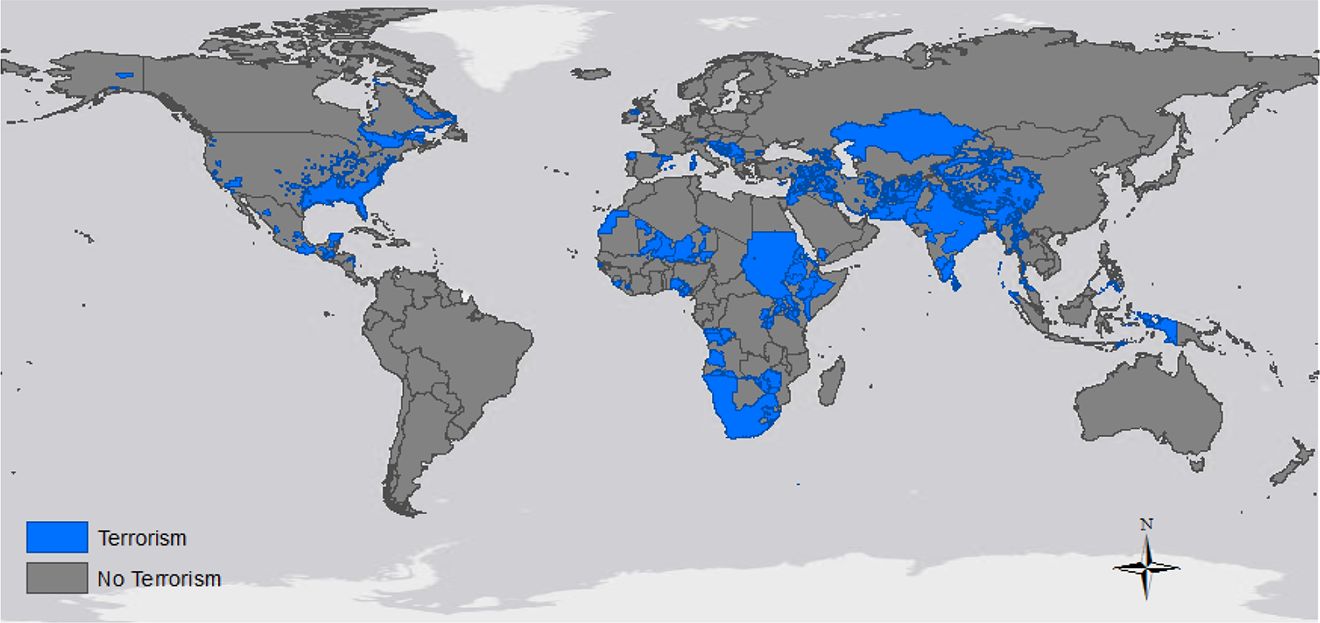
Ethnic terrorism 1970 to 2009.
How Decisions about Tactics and Strategies Are Made
I begin by assuming that ethnic groups, and their leaders, operate in the context of uncertainty about courses of action and of constraints on both rationality and resources for mobilization (Checkel 2013; Lake and Rothchild 1998; Simmons, Dobbin, and Garrett 2008). Specifically, when deciding whether and how to mobilize collectively, groups often face uncertainty regarding which tactics to use and which tactics are most appropriate and effective. Even in the presence of political or economic grievances, ethnic groups can choose, at least in principle, among several courses of actions. For instance, they can keep the status quo, resort to nonviolent resistance, or adopt violent tactics. In addition, actors are constrained in their ability to process information about specific tactics (Tversky and Kahneman 1974). Gathering, elaborating, and evaluating such information can be daunting and groups may still not be able to determine the appropriateness of a given tactic to their specific circumstances.
To overcome such uncertainty and constraints on information processing, ethnic groups often look for examples (Simmons and Elkins 2004). Relying on the experience of others constitutes a useful cognitive heuristic to resolve the dilemma of tactic choice. Ethnic group leaders can infer from the prevalence of a particular tactic within the repertoire of other groups, or by the sheer number of adopters, that this may be the best thing to do. This process applies also to the choice of terrorist tactics. When terrorist tactics appear to be gaining attention and attracting participants, groups may have an incentive to copy that tactic and capitalize on its perceived success (see also Cunningham, Dahl, and Frugé 2018, 594). From a bounded rationality perspective, emulation of others’ behavior is thus a very simple but useful focal point for choosing dissent tactics. 7
Yet, observing other groups’ adoption of terrorism is a necessary but not sufficient condition for actual emulation. Increasing the availability of information about, and the visibility of, terrorist tactics only increases the potential audience for such tactics; it does not necessarily elicit a response from that audience (Hill, Rothchild, and Cameron 1998). The spread of terrorism can stall in the face of inattention, if others’ actions do not resonate with the group members, or if a group perceives too high a risk. The diffusion of terrorism through emulation is not automatic and differs from the simple spread of ideas. Terrorism is a conflict tactic, subject to specific incentives and constraints. In particular, not all groups that employ terrorism are regarded as relevant or compelling examples to emulate. And not always does the behavior of other groups positively influences a group’s own calculations of benefits to be gained and opportunities for effective terrorist action. To understand the conditions under which terrorist emulation actually occurs, it is necessary to consider specific linkages between sender and (potential) receiver groups and how the senders’ behavior influences recipient groups’ willingness and capability to initiate and sustain terrorist activities.
Identification through Shared Grievances
As previously argued, exposure to other groups’ terrorist behavior by itself does not lead to emulation. Information about other groups’ tactical choices fosters emulation only when the other group is perceived as a reference, hence as a model for a group’s own behavior. In other words, emulation is dependent upon identification with an actor (Simmons and Elkins 2004; Simmons, Dobbin, and Garrett 2008). The policy diffusion literature has emphasized the importance of similarity between potential adopters and transmitters (Shipan and Volden 2008). Among ethnic groups, the sharing of a similar political status is a key feature that fosters mutual identification. A group’s political status is determined by the level of group access to state power, that is, the degree to which a group is politically included or excluded (e.g., Cederman, Gleditsch, and Buhaug 2013). By defining the position of an ethnic group within the polity, political status creates visible identification points between groups who share similar political circumstances and status, even when they live in different states.
At the same time, not all forms of shared political status are equally conducive to emulation. Groups excluded from political power, rather than groups in power, are more likely to respond positively to the mobilization of other groups facing similar circumstances (see also Metternich, Minhas, and Ward 2017). Observing the terrorist choice of other politically excluded groups increases the domestic salience of existing structural inequalities and contributes to transforming these into actual grievances. Following the mobilization of similar groups elsewhere, politically excluded groups become more aware of their own disadvantage in relation to the groups in power, realize the injustice of such a condition, and are spurred to change the status quo based on the example of others (e.g., Kuran 1998). An increase in the use of terrorism by excluded groups elsewhere has a two-fold effect. First, it makes group-level grievances more salient in the domestic discourse. Second, and more importantly, it activates those grievances by providing a model for a specific tactic and mobilization trajectory to redress them. Put differently, as terrorism becomes prevalent within the repertoire of marginalized reference groups, members of a politically excluded ethnic group become more likely to infer that such a tactic might be the most appropriate to adopt. Ethnic entrepreneurs play an important role in this process. As Tilly (2003, 34-35) notes, ethnic entrepreneurs specialize in activating group identities, connecting distinct groups and networks, and coordinating collective action. As a result, they can leverage the terrorist momentum produced by marginalized ethnic groups elsewhere to activate emotions and gut responses within their own group. These gut responses are often more effective at spurring support for terrorism than complex calculations of costs and benefits (see also Tversky and Kahneman 1974).
I have argued that the process of mutual identification and perception of shared grievances, which is necessary for the emulation of terrorism, is stronger when both sender and receiver groups are disadvantaged and excluded from access to political power. This does not mean that politically advantaged groups do not have grievances or cannot identify with others. However, these groups’ high stakes in the status quo and the availability for them of alternative, legal means to address potential grievances make these groups less responsive to terrorism cascades elsewhere. This leads to heterogeneous responses among (potential) recipients of diffusion effects. To illustrate, consider the case of ethnic groups in Iran. While Iran is located in a so-called terrorism hot spot, only the Kurds, Baluchis, and Arabs have resorted to terrorism while the Persians and the Azeri have not. Similarly, in France, only the Corsicans, Bretons, and Basques have adopted terrorism following the example of other marginalized groups in Spain, Italy, and United Kingdom, while no organization claiming to represent the French has resorted to terrorism.
Adoption Capacity and Expected Efficacy
The emulation of terrorism is not just influenced by identification between groups based on shared political exclusion. Marginalized groups are not able to plan and execute terrorist attack at will even when inspired to do so by similar groups elsewhere (Braithwaite and Chu 2018). The choice of terrorism is constrained by access to resources such as weapons, personnel, training, and experience; yet, these resources are crucial for orchestrating effective terrorist campaigns. If group leaders want to impose significant pressure on the government and attract attention, they need to maintain a certain level of activity through organized campaigns. Failure to recruit enough members to the terrorist organization and to carry out successful attacks signals group weakness and generates high audience costs for the leadership. In what follows, I argue that the location of reference groups who already engage in terrorism is a very important factor that allows a group to overcome the organizational and resource constraints surrounding the adoption of terrorism and increases expected efficacy. Thus, for successful terrorist emulation to occur, it matters not only who the other groups are but also where they are.
Unlike peaceful protests and demonstrations, terrorism is a more costly and risky tactic which requires specific skills and resources. The start-up costs of initiating a terrorist campaign in complete isolation can be extremely high. Recently, individual incompetence and lack of adequate training have led to the failure of several attempted terrorist attacks in Europe and the Unite States (see Burke, The Guardian, September 15, 2017). Although such terrorist incompetence saved many lives, it represented a major setback for those who planned the attacks. In contrast, some of the most severe and damaging attacks recently occurred in Europe, such as the Paris and Brussels attacks, were characterized by very high levels of sophistication and required the work of munition specialists who trained in conflict zones, especially Syria (see Callimachi, The New York Times, March 29, 2016). The terrorists themselves had previously traveled to Syria, where they joined the Islamic State and received training in terrorist tactics.
The above examples illustrate the importance of resources, capabilities, and training for conducting successful attacks. Establishing direct ties with more experienced groups that already engage in terrorism lowers the barriers to initiating and sustaining terrorist attacks and increases a group’s expectation of efficacy. Creating, or joining, local networks of terrorist organizations facilitates knowledge transfer and learning; allows for joint training and planning of attacks; and increases the availability, supply, and exchange of weapons, personnel, and other terrorism-specific capital; it even allows groups to forge alliances, make common cause, and launch coordinated campaigns against the state (see also Buhaug and Gleditsch 2008). Terror networks therefore operate as a crucial force multiplier by bolstering groups’ adoption potential, capabilities, efficacy, and lethality (Asal and Rethemeyer 2008). Geographic proximity is a critical component of such networks that tend to be spatially delimited (Asal et al. 2016; Perliger and Milton 2016; Sageman 2004). These networks, and the consequent opportunities for successful terrorist actions, are much more difficult to create and maintain among groups that live very far away, and the material advantages of these networks are less likely to accrue to groups that are relatively isolated from the other members.
Moreover, groups’ tactical choice-set is usually limited to those tactics that are immediately accessible to them (Tilly 1978). This is especially true for nonstate actors, who do not have the same capabilities of governments and face more severe constraints on the adoption of tactical innovations (Horowitz 2010). Some degree of geographic proximity to politically similar groups who already engage in terrorism makes the latter a more accessible tactic, by mitigating resource- and skills-constraints and providing means for effective terrorist emulation. 8
It may be argued that groups should be less likely to emulate terrorism if this does not lead them to achieve their ultimate goals. The success of terrorism, however, is difficult to define in practice. On the one hand, governments rarely make major concessions to terrorists due to reputational concerns (Pape 2003). Terrorists, on the other hand, tend to push alternative narratives which portray them as unyielding fighters and true believers that cannot be defeated or intimidated by a display of government military power. Moreover, groups not only have long-term goals but also proximate goals which include attracting public attention, recruiting members, demonstrating mobilization potential, and imposing political costs on the government. These goals are a necessary precondition for the achievement of most other goals, and studies have shown that terrorism can be effective at achieving such proximate goals (Bapat and Zeigler 2016).
The expectation of government repression is also unlikely to deter emulation. Groups often use terrorism precisely to provoke repression (Bueno de Mesquita and Dickson 2007). Moreover, ethnic entrepreneurs can leverage repression to exacerbate out-group antagonism and persuade members of their constituency to support extreme terrorist actions. Hence, there are benefits to be gained from terrorism provided that groups are inspired by the example of others they identify with and able to organize effective campaigns. But effective action depends also on the availability of resources, skills, and membership which are facilitated by proximity to terrorist groups and local networks.
Figure 2 summarizes the general mechanism of diffusion discussed so far. Although exposure to other groups’ terrorism is a necessary condition, it is insufficient, on its own, to generate emulation. The diffusion of terrorism through emulation requires, first, a process of mutual identification between groups based on the sharing of similar grievances. As Figure 2 illustrates, this is more likely when both sender and receiver groups are politically excluded. Second, groups need to be optimistic about the availability of terrorism-specific resources and skills, which boost their capacity to effectively carry out attacks. This condition is influenced by the degree of geographic proximity to groups that already adopt terrorist tactics. However, a generic proximity to terrorism (such as the presence of a terrorism hot spot in the neighborhood) will be insufficient to spur emulation. Proximity to terrorism operates in conjunction with identification between groups through shared political exclusion. In the absence of the latter, groups will be less likely to collectively emulate terrorist violence despite the available opportunities. 9 To illustrate, consider the case of the indigenous groups of South America (e.g., Quechua, Indigenous People of the Amazon, Aymara, Tupi-Guarani). This region experienced several civil wars and some of the highest levels of terrorism ever recorded, mainly inspired by leftist ideologies. Yet, marginalized indigenous groups did not respond positively to such violence and no organization claiming to represent these groups has resorted to terrorism. Instead, nonviolent tactics have rapidly spread among these groups to become one of their primary methods of resistance (Cunningham and Sawyer 2017).
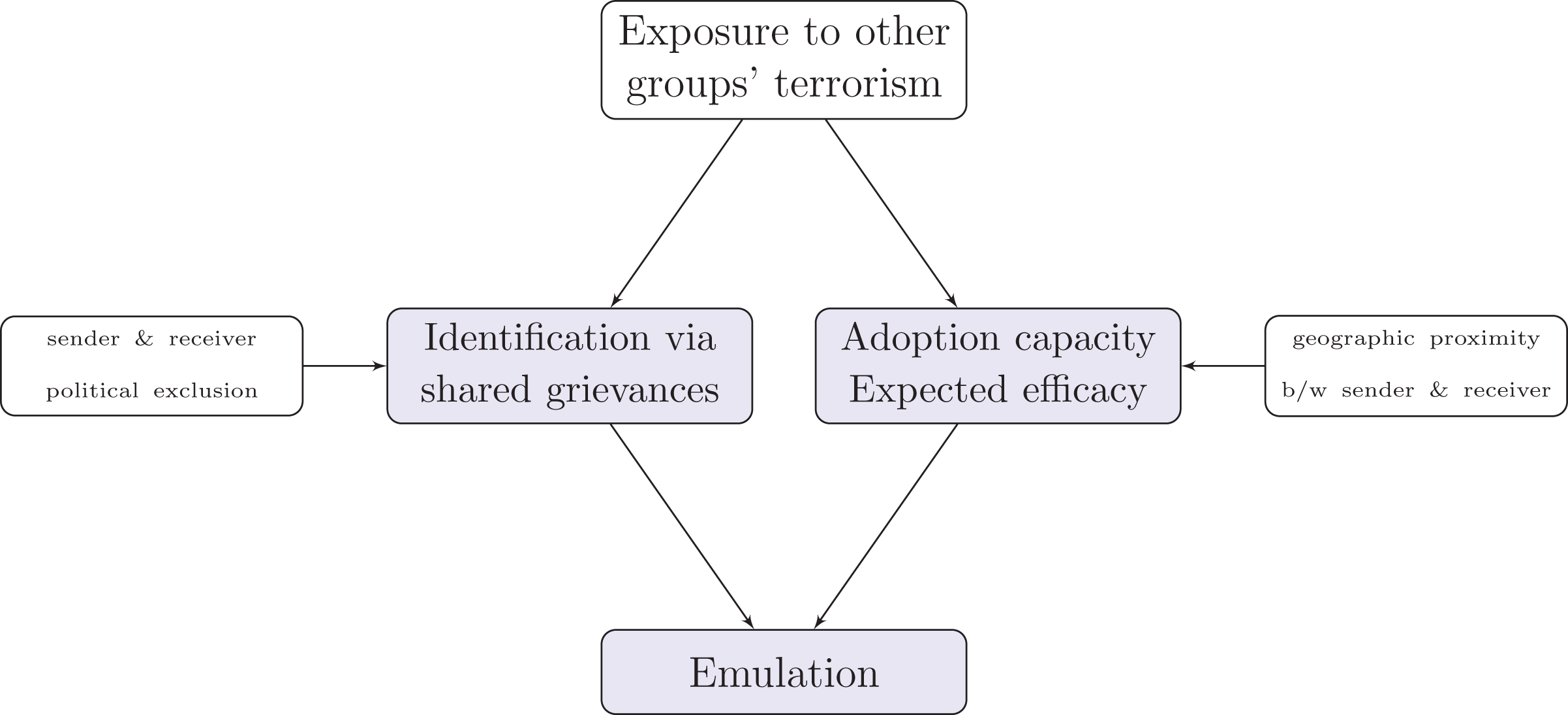
Mechanism of diffusion.
Based on the above discussion, I formulate the following hypothesis: An ethnic group is more likely to adopt terrorism when it shares a status of political exclusion with other ethnic groups who engage in terrorism and the latter are geographically proximate.
Data and Research Design
To test the hypothesis on the diffusion of terrorism, I compile a new data set, the GTD2EPR, of ethnic and ethnoreligious terrorism from 1970 to 2009. This data set links terrorist organizations in the GTD with politically relevant ethnic groups in the EPR data set (EPR-ETH; Cederman, Min, and Wimmer 2010). To link terrorist organizations with corresponding ethnic groups, I collected information on whether organizations claim to represent a specific ethnic group, complementing the information in the Armed Conflict to EPR data set (Wucherpfennig et al. 2012) with additional research on organizations not involved in a civil war. 10 This data set allows me to identify the specific ethnic and ethnoreligious communities from which terrorist organizations have emerged.
The dependent variable is a group-level binary indicator of terrorism, based on one or more attacks perpetrated by organizations linked to an ethnic group per year. 11 Only domestic terrorist attacks are considered, and I exclude attacks perpetrated by ethnic organizations in other countries.
To estimate terrorist diffusion between groups, I rely on spatial regression models where a connectivity matrix
For each year, the two matrices are multiplied element by element (i.e., Hadamard product) so that each element (or weight) wijt of the final matrix represents the product of elements wijt of the original two matrices. This interaction produces a matrix,
To test the hypothesis that ethnic groups are more likely to adopt terrorism when similarly excluded groups in the region also adopt terrorism, I rely on a two-pronged research design focusing on multilevel and spatial econometric models. First, given the clustered nature of the data, with group-years nested in groups nested in countries, I employ a series of multilevel spatial logit models in which the intercepts vary as a function of clustered group- and country-level variables. These models account for different forms of spatial dependence between observations and for the variance among groups’ in terms of their susceptibility to adopting terrorism (i.e., unit heterogeneity). Empirically, this is modeled by including a spatial lag and by allowing the group intercepts to vary according to specific group-level attributes conducive to terrorism.
In the multilevel models, the spatial lag is obtained as the product of the weights matrix
The multilevel model described above provides an important first test of terrorist diffusion. However, it does not allow to fully estimate the strength of interdependence between groups’ tactical choices and how spatial effects propagate through the groups in the system (see also Franzese, Hays, and Cook 2016). Therefore, to provide a more complete analysis of terrorism diffusion that incorporates these important aspects, I rely on a more sophisticated spatial probit model, estimated by Bayesian Markov Chain Monte Carlo (MCMC; Wilhelm and Godinho de Matos 2013; LeSage and Pace 2009) on a subset of the data set.
The estimation of a spatial probit model represents a more complex approach. Suppose we have the following spatial autoregressive model: 15

where y* is the continuous latent outcome variable,
The reduced form of equation (1) is:

where
The Bayesian MCMC approach is a simulation-based method. The basic idea in Bayesian estimation is to sample from the posterior distribution of the model parameters
The Bayesian estimator of the spatial probit introduced by Wilhelm and Godinho de Matos (2013) follows the Bayesian Gibbs sampling approach proposed by LeSage (2013) and LeSage and Pace (2009) with some modifications to facilitate implementation. For computational efficiency, the spatial probit is estimated on a subset of the main data set, that is, two cross sections of all ethnic groups from 1991 to 1999 and from 2000 to 2009, where values of the dependent variable are averaged over each time period. To avoid posttreatment bias, the average values of the group-level covariates are calculated using only the years up to the first observed terrorist attack for each ethnic group. An additional step would be to estimate the models considering values of the dependent and independent variables in each year. The size of data set, which has more than 22,000 observations, makes it very computationally intensive to estimate a Bayesian spatial probit over the full data set.
In both the multilevel and spatial probit models, I consider a number of additional influences on groups’ incentives for terrorism. In particular, I control for the nonspatial effect of political exclusion, that is, the effect of political exclusion in the absence of diffusion (i.e., predynamic effects; Franzese, Hays, and Cook 2016). While the theory posits that political grievances are more likely to lead to terrorism when they are activated by the terrorist choices of similar groups elsewhere, it is important to test whether exclusion by itself is sufficient to induce terrorism. Therefore, all models include dummy variables for the political status of ethnic groups which reflect the type and degree of political exclusion, with included groups as reference category. I also control for the relative size of the ethnic group, to account for latent mobilization potential. Data on political status and group size are taken from the EPR-ETH data set. Even though the analysis is at the group-level, contextual factor may still affect groups’ choice of terrorism. I therefore control for a country’s level of democracy (Vreeland 2005) and its gross domestic product per capita (Gleditsch 2002). In addition, since civil war is frequently associated with higher levels of domestic terrorism (Findley and Young 2012; Smith and Zeigler 2017), I include a variable for the presence of civil war to account for possible domestic spillover effect. Civil war data are culled from the Uppsala Conflict Data Program using a threshold of twenty-five battle-related deaths. Finally, I include a cubic polynomial of time since the last terrorist attack to control for temporal dependence (Carter and Signorino 2010). 16
Empirical Analysis and Discussion
The empirical results for the multilevel models are reported in Table 1. The results are consistent with the theoretical expectation that an ethnic group is more likely to adopt terrorist tactics if other politically marginalized and geographically proximate ethnic groups also use similar tactics. More specifically, the coefficient for the spatial lag of terrorism from excluded groups in neighboring regions, regardless of country, is positive and highly significant. The coefficient for the spatial lag of terrorism from excluded groups in neighboring countries is also positive and significant.
Probability of Terrorism for Ethnic Groups (Full Sample 1970 to 2009).
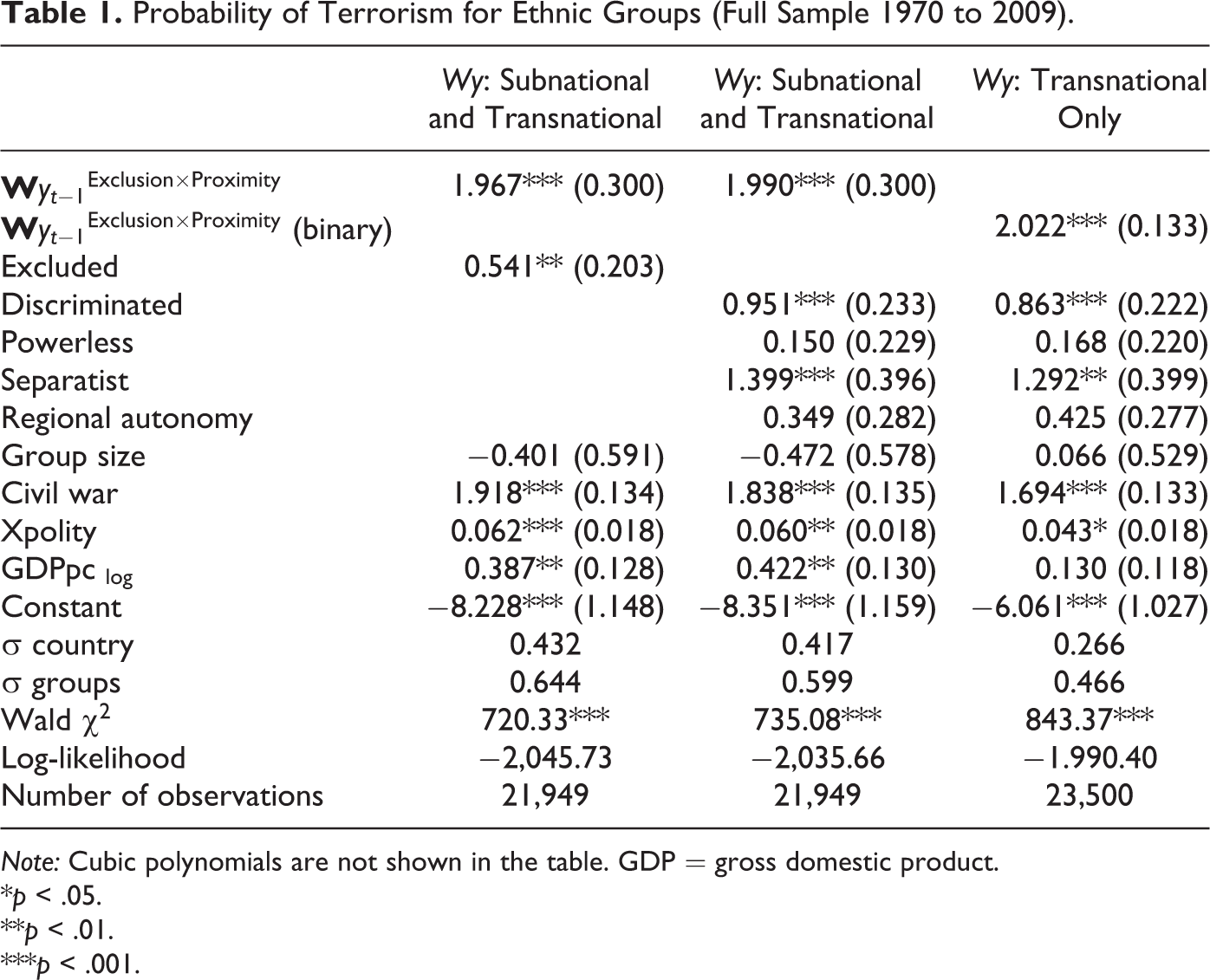
Note: Cubic polynomials are not shown in the table. GDP = gross domestic product.
*p < .05.
**p < .01.
***p < .001.
The results from the Bayesian spatial probit are reported in Table 2. 17 Again, the results provide strong support for the hypothesis. The coefficient for ρ, the spatial autocorrelation parameter, is positive and highly significant. This indicates interdependence in ethnic groups’ decision to adopt terrorist tactics based on shared political exclusion and degree of geographic proximity.
MCMC Spatial Autoregressive Probit (20,000 Iterations, Burn-in = 2,000, Diffuse Priors for β Parameters and Uniform Prior for ρ).
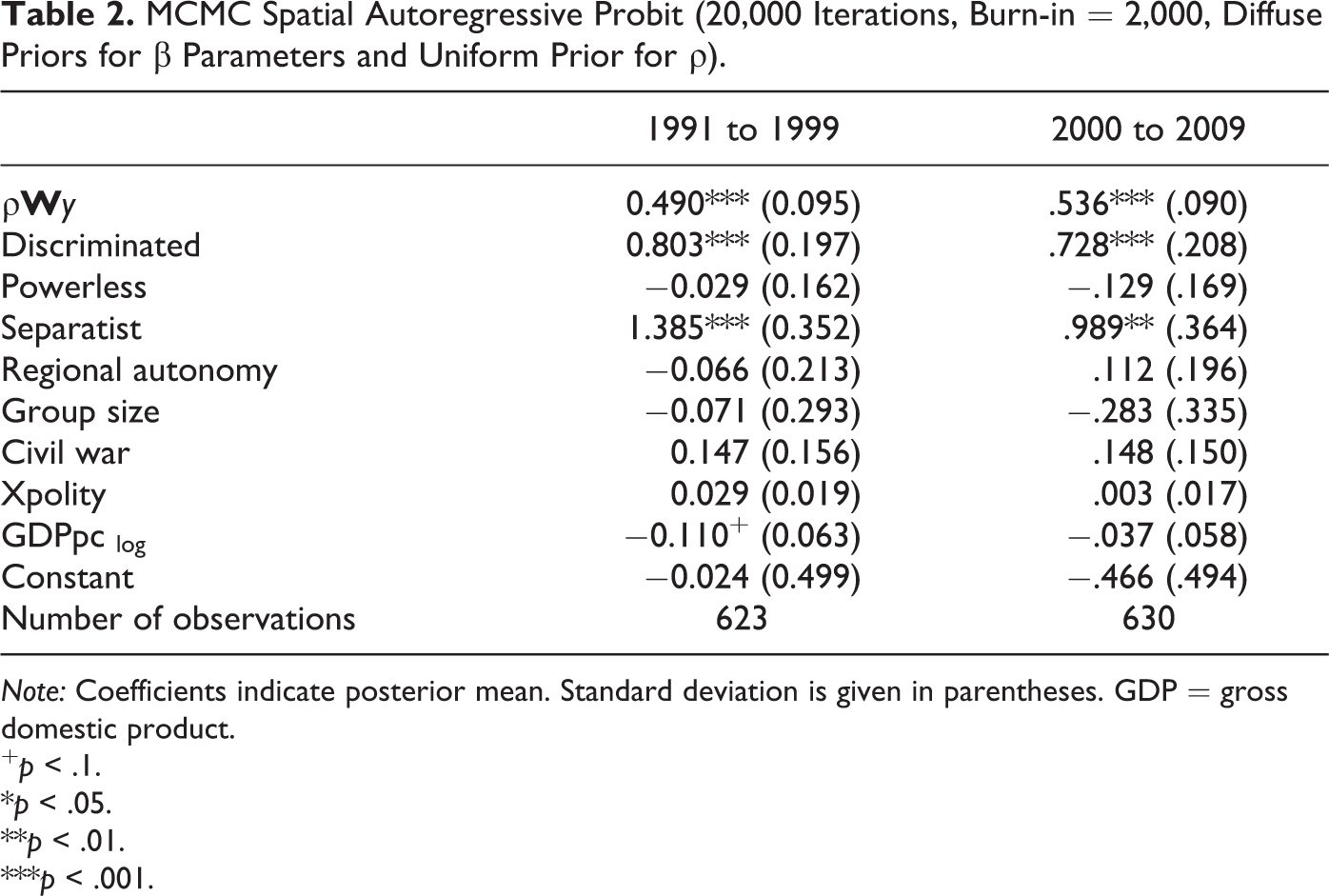
Note: Coefficients indicate posterior mean. Standard deviation is given in parentheses. GDP = gross domestic product.
+ p < .1.
*p < .05.
**p < .01.
***p < .001.
Turning to the nonspatial effects of political exclusion, while excluded groups are generally more likely to resort to terrorism than included ones, when disaggregating exclusion only discriminated and separatist groups are likely to adopt terrorism in the absence of diffusion. In contrast, in all the models, powerless and regional autonomy status have no significant independent effect on the choice of terrorism. These results support the theoretical argument that while domestic grievances are important they are often insufficient on their own to motivate terrorism. In order to spur terrorism, such grievances need to be activated by the terrorist choice of similar groups elsewhere. Interestingly, these results on the exclusion variables differ from the findings in the civil war literature, where different forms of exclusion are all strong predictors of civil war onset independent of diffusion effects (Cederman, Gleditsch, and Buhaug 2013).
I now turn to examine the substantive implications of the models. Figure 3 depicts the substantive effects from the multilevel model based on estimates from Table 1. Panel A illustrates the effect of terrorism from geographically proximate excluded groups on the probability that an excluded group also adopts terrorism. The results are shown for discriminated groups, which face the highest level of political exclusion and are likely to have very strong domestic motives for violence even in the absence of terrorism from other groups. The presence of at least one politically excluded ethnic group which used terrorism in the previous year increases the likelihood of adoption for a discriminated group by a factor of 5. Conversely, in the absence of diffusion, the probability that a discriminated group adopts terrorism is much lower and close to zero. Panel B shows how an increase in the proportion of politically excluded and geographically proximate terrorism adopters affects the likelihood of terrorism for a discriminated group. As the spatial lag increases from 0 to 0.75, indicating 75 percent terrorism adopters among the reference groups, the predicted probability of terrorism for a discriminated group increases by a factor of 3. Taken together, these results reveal a substantial diffusion effect between politically excluded and geographically proximate ethnic groups.
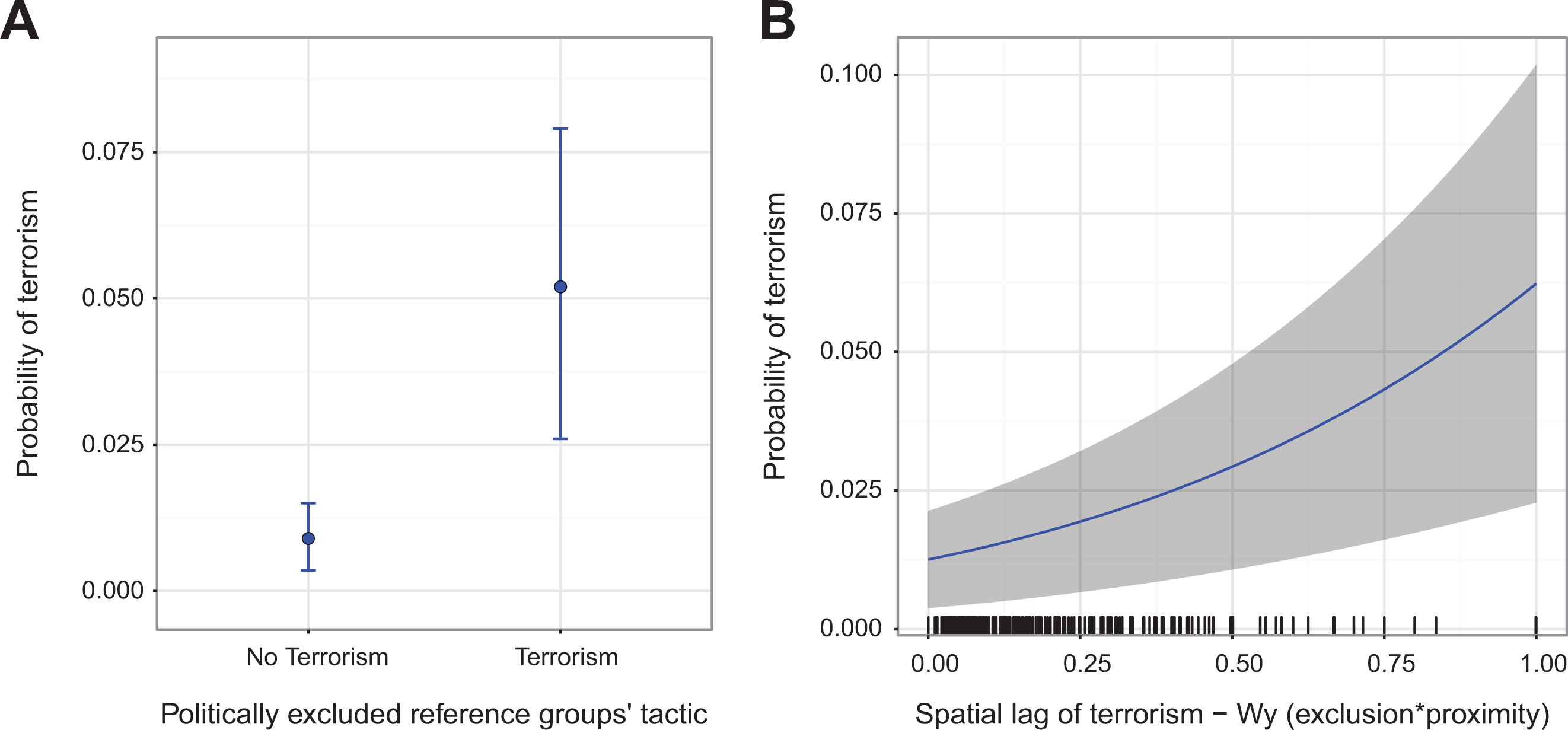
Predicted probability of terrorism as a function of reference groups’ terrorism with 95 percent confidence intervals.
Marginal effects for the Bayesian spatial probit require more complex calculations but allow us to directly estimate the magnitude of terrorism spillovers, or spatial feedbacks, between groups. Following LeSage and Pace (2009) and LeSage (2013), scalar summary measures of direct, indirect (i.e., spillover/diffusion), and total effects are presented in Table 3. As before, I focus specifically on discriminated groups. Marginal effects reflect changes in the probability of terrorism following an exogenous shock in an independent variable, in this case discrimination. However, in the spatial probit, a shock toward political discrimination in ethnic group i will not only increase the probability that this group adopts terrorist tactics but will also affect the probability that other, excluded neighboring groups j resort to terrorism. The magnitude of this effect depends on the degree of connectivity between i and j (as defined in the
Average Direct, Indirect, and Total Effects from Spatial Probit 1991 to 1999 and 2000 to 2009 (95 Percent Credible Intervals).
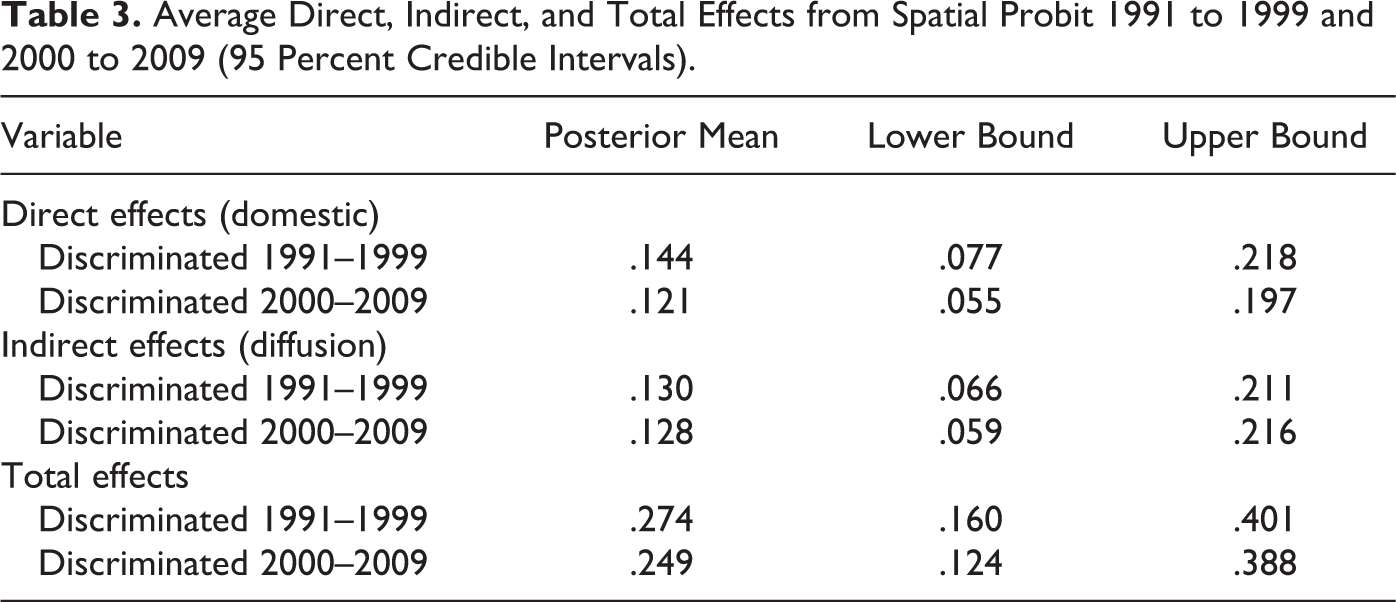
Moreover, in all the estimated models, two types of exclusion, regional autonomy and powerless, do not have a significant direct effect on terrorism (i.e., independent of diffusion). As I further illustrate below, groups in similar circumstances are still subject to diffusion from other excluded groups and will therefore emulate terrorist tactics even when domestic incentives alone are insufficient. All in all, these results provide additional, strong evidence in support of the theory.
The spatial probit allows us to estimate spatial effects for individual groups. Since every group has a different network of connections, spatial effects vary for each individual group. Figure 4, panel A, and Figure 5 present disaggregated spatial effects for two ethnic groups, namely, the Kurds in Turkey and the Sunni in Iraq, and their respective neighborhoods. 18 They show how an increase in the probability of terrorism for these groups positively influences other groups’ adoption of terrorist tactics, with different colors indicating different probabilities of terrorism, based on the model estimates. Moreover, while panel A in Figure 4 presents the predicted probability of terrorism for the Kurds and their neighborhood based on the model, panel B reports the ethnic groups who actually adopted terrorist tactics in the region during the same time period. Several of the ethnic groups associated with an increased probability of diffusion-related terrorism based on the model have in fact adopted terrorist tactics.
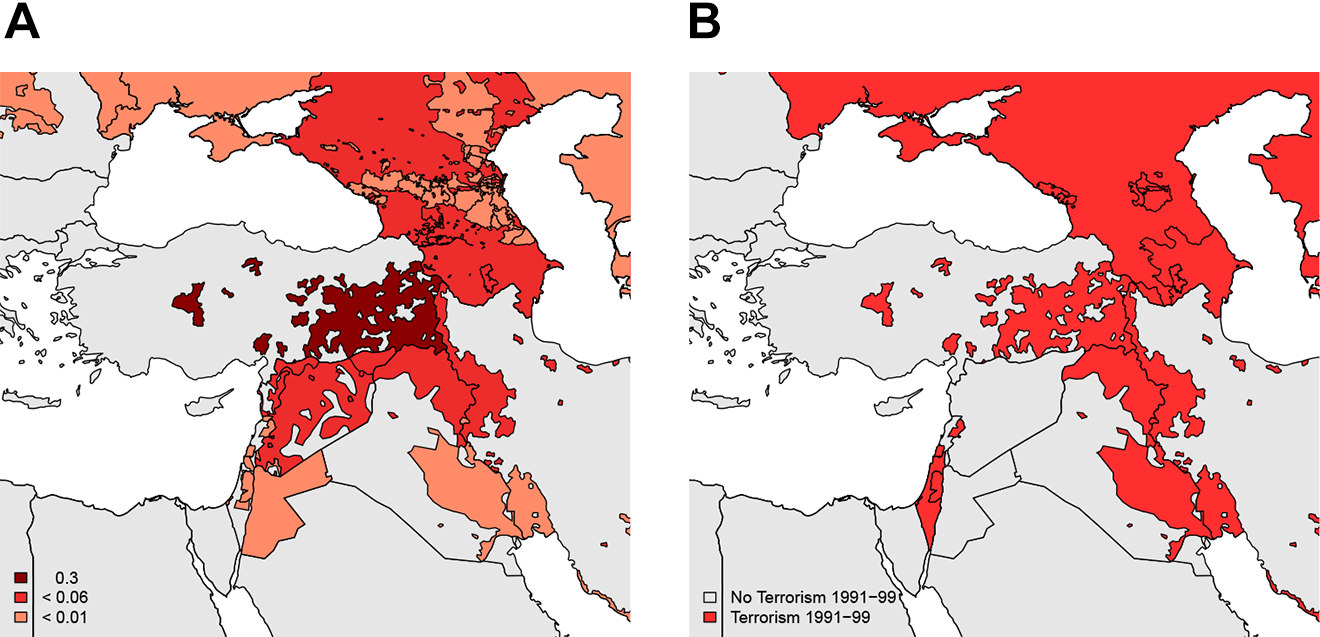
Spatial effects. (A) Spatial diffusion of the probability of terrorism following a shock to the political status of the Kurds (Turkey) toward discrimination (model predictions 1991 to 1999). (B) Ethnic groups that actually adopted terrorist tactics between 1991 and 1999 in the same region (for comparison with the model predictions).
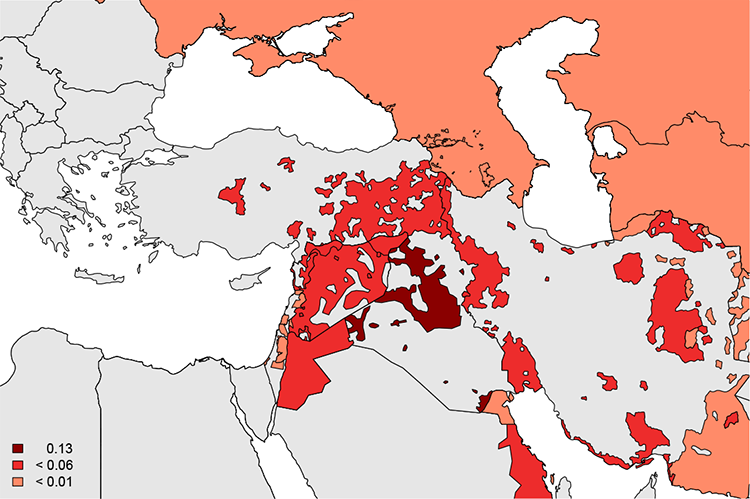
Spatial diffusion of the probability of terrorism following a shock to the political status of the Sunni (Iraq) toward discrimination (model predictions 2000 to 2009).
I also examine the probability of terrorism for an ethnic group conditional on the actual adoption of terrorist tactics by another excluded group in the region using the parametric simulation approach introduced by Franzese, Hays, and Cook (2016). 19 Focusing specifically on Sunni groups in Iraq and Syria, I find that the actual use of terrorism by Sunni organizations in Iraq increases the probability of terrorism for Sunni in Syria by 28 percent. This finding is remarkable also because the political status of the Sunni in Syria is powerless and all models suggest that a powerless status by itself (i.e., in the absence of diffusion) is insufficient for spurring the choice of terrorism. Yet, as I argued above, powerless groups are responsive to, and emulate, the terrorist choice of other, proximate excluded groups.
Alternative Mechanisms and Robustness
To probe the diffusion mechanism and check the robustness of the results, I conduct several additional tests. These tests are summarized in this section and discussed in greater detail in the Online Appendix.
First, I have considered a series of competing mechanisms of diffusion. For instance, terrorist diffusion may be the product of purely nonrelational (i.e., nonspatial) channels, particularly those related with the media. To examine this, I rely on a placebo test and reestimate the spatial probit using a connectivity matrix of political exclusion between groups in the absence of geographic proximity. In this model, the spatial autocorrelation coefficient ρ is negative and not significant. There is therefore no empirical support for a global terrorism bandwagon among ethnic groups. This provides further support for the combined effect of shared exclusion and geographic proximity in fostering emulation.
To further probe the theorized mechanism, I conduct additional tests which examine the role of political status in shaping groups’ responses to terrorism from geographically proximate groups. Specifically, I interact a spatial lag of terrorism from proximate ethnic groups with several variables indicating a recipient group’s type and degree of political exclusion/inclusion. In line with the expectations, as groups become more excluded, they also become increasingly responsive to proximate terrorist examples and thus more likely to adopt terrorist tactics. In contrast, terrorism from proximate groups that are politically included has no significant effect on the likelihood that excluded groups emulate this tactic. Taken together, these results help us rule out the possibility that terrorism arises from unobserved characteristics shared by geographically proximate groups. This provides additional evidence that mere geographic proximity is insufficient to generate emulation. Instead, mutual identification through shared political exclusion is a critical condition for the diffusion of terrorism between groups. 20
The apparent diffusion of terrorism may also result from generic spillover effects from geographically proximate groups or conflicts, or from some omitted, spatially clustered determinants of terrorism. To control for this, I include a spatial lag of all terrorism in a group’s neighborhood. Consistent with the theory, this spatial lag is not a significant predictor of an ethnic group’s adoption of terrorism. To further demonstrate that geographic proximity is insufficient, on its own, to generate emulation, I introduce two alternative spatial lags of terrorism by geographically proximate nonethnic organizations, namely, leftist and purely religious groups. Arguably, mutual identification between these organizations and ethnic ones should be relatively low. In line with the theory, terrorism by geographically proximate leftist and religious groups is not systematically associated with an ethic group’s decision to adopt terrorism.
Another mechanism of diffusion, alternative to emulation, is represented by competition between groups. To control for this, I employ a spatial lag which excludes from the neighbors’ list all groups within the same country and only includes groups in neighboring countries. If group competition does occur, it should only affect ethnic groups fighting against the same government, who may compete to obtain concessions, rather than groups in different countries which fight against different governments and have different domestic audiences. The main results hold also with this alternative spatial lag; therefore, we can be confident that the results are not capturing just a competition logic.
Second, I examine the robustness of the results to several alternative specifications of the spatial lag. Groups may be more likely to adopt terrorism if the number of other terrorism adopters, rather than their weighted average, increases, or if the reference groups conduct a greater number of attacks. Therefore, I reestimate the models with spatial lags capturing the weighted sum of terrorism from politically excluded and geographically proximate groups. I also construct an alternative spatial lag which takes into account the magnitude of terrorist activity from other groups by using a threshold of at least ten attacks carried out by each connected group in the previous year and treating lower terrorist activity in the neighborhood as no activity at all (i.e., 0). All substantive conclusions remain unchanged.
Third, it is possible that common exposure to observed or unobserved factors that cluster geographically may drive the results. In this regard, the main results already account for unobserved, time-invariant group-specific and country-specific factors which may correlate with terrorism as well as many strong predictors of terrorism such as civil war. Moreover, to capture any residual, time-invariant, and unobserved factors that may influence terrorism and potentially also correlate with the spatial lags, I reestimate the models including fixed effects. The coefficients for all the main spatial lag variables remain positive and statistically significant.
Given the prominence of civil war as an explanation for terrorism, I conduct analyses with additional controls for the clustering of civil war in a group’s neighborhood and for the simultaneous presence of domestic and neighboring civil war. I also reestimate the models dropping civil war cases. Substantive conclusions remain unchanged and this indicates that the results are not driven by civil war in the sending or receiving group or by common exposure to civil war in the broader neighborhood. Moreover, if excluded groups are spatially clustered, then terrorism may result from the simple clustering of conditions reflecting domestic motives for terrorism, hence another form of common exposure. To control for this, I construct a spatially weighted measure of the number of excluded groups surrounding each ethnic group. The effect of terrorism diffusion remains unchanged and this helps rule out the possibility of confounding due to spatially correlated group-level factors.
Fourth, I reestimate the multilevel models accounting for possible changes in technology and communication habits over time, which may influence patterns of diffusion. I include a media density index (Warren 2014) as additional covariate and interact this with the spatial lag of terrorism. The results provide no evidence of an interactive effect with diffusion patterns. This is consistent with recent research by Weidmann et al. (2016) which shows that governments often engage in digital discrimination by depriving of Internet access politically excluded ethnic groups in order to limit their mobilization potential. Finally, common shocks may produce clusters of terrorism even in the absence of diffusion; hence, I include year-specific intercepts to control for temporal shocks that are common to all groups in a given year (Neumayer and Plümper 2010). Substantive conclusions remain unchanged.
Conclusion
This article shows the importance of considering interdependence between terrorist organizations and strategic emulation as a crucial mechanism leading to the adoption of terrorist tactics. Despite a burgeoning literature on the causes of domestic terrorism, the vast majority of existing studies regards terrorist organizations as independent of each other and the adoption of terrorist tactics as a purely “domestic” decision, rooted in country-specific or individual-level attributes. Common accounts of domestic terrorism, based on grievances and/or opportunities for violent mobilization, have mainly assumed these to be domestically determined. This study focuses instead on how the behavior of other groups can make group grievances politically salient and shape a group’s perceptions of efficacy by mitigating the resource, skills, and logistical constraints on the adoption of terrorist tactics. Rather than simply testing for interdependence of terrorist activities between ethnic groups, I introduce a specific mechanism of diffusion, based on emulation. Such emulation is conditional on mutual identification based on shared grievances and on perceptions of terrorist efficacy. These are more likely to occur when sender and receiver groups share a status of political exclusion and are geographically proximate. All models provide strong support for the theoretical argument based on diffusion and for the specified conditions under which terrorist emulation is more likely to occur.
The new data set introduced in this study has allowed to identify the specific ethnic and ethnoreligious communities from which terrorist organizations could emerge and to provide the first quantitative evidence for the diffusion of domestic terrorism through emulation. At this point, it is difficult to study explicitly religious terrorism because of the lack of cross-national data on the religious affiliations of terrorist organizations and on societal groups other than politically relevant ethnic groups. At the same time, this study, and its mechanism of diffusion, have important implications also for the recent phenomenon of Jihadist radicalization in Western Europe. A recent study by the Combating Terrorism Center at West Point—which analyzed the profiles of nearly 2,000 European jihadist foreign fighters who traveled to Iraq and Syria—highlights that “despite the growing attention to the role of virtual recruitment, the majority of foreign fighters still relied on some form of interpersonal connection to make the decision to leave their home country and join the jihadi movement” (Perliger and Milton 2016, 26-27). The study adds that “while virtual propaganda can provide the initial cognitive opening for adopting the jihadi narrative, a human connection is necessary to push the individual to actual activism, as well as for logistical reasons for traveling to a war zone” (p. 31). Interestingly, while the individual backgrounds of European foreign fighters vary considerably, their places of origin are highly clustered geographically, which further suggests the importance of more traditional forms of recruitment, local recruitment hubs, and in-person facilitators. This is in line with what argued in this article regarding the specific role of direct ties in fostering the adoption of terrorism. All in all, the role of spatial proximity—in combination with shared grievances—cannot be discounted, even for jihadist terrorism.
There are also a number of fruitful avenues for future research. For example, understanding how new technologies such as social media reinforce and interact with more traditional organizational recruitment processes in sparking diffusion is an important topic for future research. Future studies could also better integrate the role of the government, especially state repression. Finally, terrorism comes in different forms. This study and its methodology can be a stepping stone for future efforts to understand the adoption and diffusion mechanisms of specific terror tactics, such as improvised explosive devices (IED) bombings, vehicle ramming, and suicide attacks.
Supplemental Material
Supplemental Material, sj-pdf-1-jcr-10.1177_0022002720930811 - How Terrorism Spreads: Emulation and the Diffusion of Ethnic and Ethnoreligious Terrorism
Supplemental Material, sj-pdf-1-jcr-10.1177_0022002720930811 for How Terrorism Spreads: Emulation and the Diffusion of Ethnic and Ethnoreligious Terrorism by Sara M. T. Polo in Journal of Conflict Resolution
Supplemental Material
Supplemental Material, sj-zip-1-jcr-10.1177_0022002720930811 - How Terrorism Spreads: Emulation and the Diffusion of Ethnic and Ethnoreligious Terrorism
Supplemental Material, sj-zip-1-jcr-10.1177_0022002720930811 for How Terrorism Spreads: Emulation and the Diffusion of Ethnic and Ethnoreligious Terrorism by Sara M. T. Polo in Journal of Conflict Resolution
Footnotes
Author’s Note

Acknowledgments
I am deeply grateful to Victor Asal, Navin Bapat, Jessica Maves Braithwaite, Chad Clay, Xun Cao, Songying Fang, Federica Genovese, Kristian Gleditsch, Imke Harbers, Ryan Kennedy, Ashley Leeds, Quan Li, Cliff Morgan, David Siegel, Hugh Ward, and the anonymous reviewers for their helpful comments and suggestions and also grateful for support from the Economic and Social Research Council (grant number ES/J500045/1).
Declaration of Conflicting Interests
The author(s) declared no potential conflicts of interest with respect to the research, authorship, and/or publication of this article.
Funding
The author(s) disclosed receipt of the following financial support for the research, authorship, and/or publication of this article: This work was supported by Economic and Social Research Council (grant number ES/J500045/1).
Supplemental Material
Supplemental material for this article is available online.
Notes
References
Supplementary Material
Please find the following supplemental material available below.
For Open Access articles published under a Creative Commons License, all supplemental material carries the same license as the article it is associated with.
For non-Open Access articles published, all supplemental material carries a non-exclusive license, and permission requests for re-use of supplemental material or any part of supplemental material shall be sent directly to the copyright owner as specified in the copyright notice associated with the article.
