




Abstract
Female combatants play a central role in rebel efforts to cultivate and disseminate positive narratives regarding the movement and its political goals. Yet, the effectiveness of such strategies in shaping audience attitudes or generating tangible benefits for the group remains unclear. We propose and test a theory regarding the channels through which female fighters advance rebel goals. We argue that female fighters positively influence audience attitudes toward rebel groups by strengthening observers’ beliefs about their legitimacy and their decision to use armed tactics. We further contend that these effects directly help them secure support from transnational nonstate actors and indirectly promote state support. We assess our arguments by combining a novel survey experiment in two countries with analyses of new cross-national data on female combatants and information about transnational support for rebels. The empirical results support our arguments and demonstrate the impact of gender framing on rebel efforts to secure support.
Women represent a small proportion of armed combatants in contemporary rebellions. Indeed, recent cross-national studies suggest that female combatants are present in only about one-third of armed resistance movements (Henshaw 2017; Thomas and Bond 2015; Wood and Thomas 2017). 1 Nonetheless, gender framing and images of female combatants are prevalent in rebel propaganda and public outreach efforts. This appears to be true among rebel groups that recruit large numbers of female fighters as well those in which women constitute only a small proportion of the combatants. In El Salvador, for example, the large-scale participation of female fighters in the Frente Farabundo Martí para la Liberación Nacional (FMLN) were central to the group’s efforts to cultivate a positive and sympathetic image (Viterna 2014). Similarly, the leadership of Gerakan Aceh Merdeka (GAM) coordinated with Western journalists to emphasize the contributions of its (comparatively few) female participants in order to draw attention to its independence struggle against the Indonesian government (Barter 2014, 70). Numerous other rebel movements with diverse political goals and ideologies, including anti-colonial rebellions in Southern Africa, armed separatist movements in the Middle East, and sectarian insurgencies in Western Europe have likewise incorporated images or narratives of female fighters into their propaganda materials, suggesting that they are aware of their symbolic power.
In this article, we explore the intentional use of gender frames by rebel groups as well as the consequences of such efforts. We argue that rebel efforts to emphasize women’s contribution to the movement assist them in garnering support from transnational nonstate actors (TNSAs), such as solidarity networks, nongovernmental organizations (NGOs), and activist communities based in foreign states. Securing support from such groups can generate both direct benefits, such as the provision of material and economic resources to the group, and indirect benefits, including advocacy and lobbying efforts aimed at shaping the position of governments toward the conflict. Our argument therefore builds on existing literature that critically analyzes the symbolic power of gender during wartime (e.g., Bayard de Volo 2001; Viterna 2014) and extends the arguments and findings from the very small number of recent studies that considers the potential strategic implications of women’s participation in armed political organizations (e.g., Karim 2019; Wood 2019).
We rely on a diverse set of empirical strategies to assess the validity of our arguments. First, we draw on original survey experiments in the United States and Indonesia to examine the impact of female combatants on audience attitudes. The results provide direct evidence that audiences in distinct sociocultural contexts are more likely to view a group’s goals and their use of violence to attain those goals as legitimate when they are aware of the presence of female combatants in the group. In addition, we empirically identify a potential mechanism for this effect: audiences perceive female fighters as comparatively less motivated by self-interest than their male counterparts. We then assess the broader implications of these findings for conflict dynamics. Using a cross-national sample of contemporary armed rebellions, we analyze the relationship between the presence of female combatants and rebel success in acquiring external support. Consistent with our argument (and our experimental results), we find that rebel groups that include female combatants are more likely to receive external support from TNSAs, such as NGOs, solidarity organizations, and diaspora groups than those without women in the combat force. Our results further suggest that the presence of female combatants may exert some influence on state sponsorship decisions, but this effect is indirect and occurs predominantly through its influence on TNSA support.
Our study contributes to the existing literature in several key ways. Most directly, it advances scholarship on the use and impact of gender frames in armed conflict (e.g., Bayard de Volo 2001; Loken 2018; Viterna 2014) by articulating a theory that explicitly links the use of these frames to observable strategic benefits and by empirically evaluating their effects on their intended audiences. Our analyses also address important theoretical and empirical gaps by elucidating the microfoundations of the relationship between the presence of female combatants and the accrual of tangible strategic benefits. In particular, they demonstrate an important direct connection between the presence of female combatants and TNSA support, and it identifies a previously overlooked indirect link between these fighters and external state support for the rebel’s cause. Finally, our study is among the first to empirically validate the claims that female fighters can influence audience attitudes and deliver strategic benefits to the armed groups that employ them and the only study to examine these effects across diverse sociopolitical contexts and at different levels of analysis.
We first discuss the important role of nonstate external support for armed rebellion, focusing particularly on the ways in which rebels employ strategic frames and narratives to solicit foreign support. In the subsequent section, we draw on prior literature examining the use of gender frames by rebel groups to develop testable hypotheses regarding the impact of these frames on external audience attitudes. We then connect the arguments outlined in the previous two sections by describing how the positive influence of female combatants translates into support from TNSAs. Next, we describe our multimethod research design and present the results of the survey experiments followed by the cross-national analyses. We then briefly consider whether the presence of female fighters might generate backlash or undermine support in some contexts. We conclude by summarizing the primary contributions of the findings and offering suggestion for how they might inform future research on this topic.
External Support for Armed Rebellions
Resources provided by foreign sponsors and allies are essential to the survival and success of many contemporary armed resistance movements. In order to secure such support, rebel groups routinely undertake concerted diplomatic and public outreach efforts (e.g., Huang 2016; Jo 2015; Jones and Mattiacci 2019). To date, the scholarship on foreign support for rebels has focused almost exclusively on the factors motivating government support and the consequences of this patronage (Bapat 2012; Salehyan 2009; Salehyan, Gleditsch, and Cunningham 2011; San-Akca 2016). Though typically overlooked by existing scholarship, rebel groups routinely solicit assistance from external nonstate actors as well. TNSAs represent an important source of external assistance for many rebellions, and there is at least some evidence that their support can influence the dynamics of the conflict (Petrova 2019).
Despite the limited attention given to TNSA support for rebellions, numerous existing studies have demonstrated the importance of their support for dissident movements more broadly. Most notably, Keck and Sikkink’s (1998) research on transnational activism illustrates how support from sympathetic constituencies and organizations in influential foreign countries can assist dissenting groups in achieving their political objectives. TNSAs can disseminate information about the group and its cause, mobilize public support in third-party states, and shape opinions of relevant external political actors (e.g., states and inter-governmental organizations (IGOs). Ultimately, the actions of TNSAs increase the odds that these actors undertake diplomatic or even military intervention on behalf of the dissident movement (e.g., Murdie and Peksen 2013).
The core features of this model readily extend to the context of violent rebellions. Rebel movements have often solicited support from external nonstate actors, including social movements, NGOs, foreign political parties, international organizations, global religious movements, and diaspora communities (Bob 2005; Jo 2015). In many cases, rebel movements—or the political organizations of which they are a part—successfully attain support from TNSA. Most TNSAs engage in nonviolent advocacy efforts; yet, even those advancing human rights and social justice causes are willing to extend support to armed groups if they perceive their violence as legitimate or view armed resistance as the only effective means of challenging a repressive government. For example, the Southwest African People’s Organization (SWAPO) in Namibia, People’s Movement for the Liberation of Angola, the Ejército Zapitista de Liberación Nacional (EZLN) in Mexico, and the FMLN each enjoyed support from progressive NGOs and political solidarity movements in the United States and Western Europe despite their decision to use armed struggle to advance their goals.
The benefits TNSAs provide to armed resistance movements are broadly similar to those they extend to nonviolent activist groups and include both direct and indirect forms of support (Bob 2005; Saleyhan 2009, 32-34). Direct support takes the form of material or economic resources provide to the armed group, most commonly to its political wing. For instance, in addition to its efforts to raise public awareness about anti-colonial struggles in sub-Saharan Africa, the US-based African Liberation Support Committee also provided financial support to various armed movements (Johnson 2003, 490-91). Indirect assistance to rebel groups is more common and often takes the form of public information campaigns and lobbying efforts targeting the governments of the states in which the TNSAs and its membership are located. For instance, the Namibia Support Committee, a London-based NGO, worked to raise public awareness of SWAPO’s armed resistance to South African occupation of Namibia, lobbied the British government to support the group’s cause, and organized boycotts of South African companies (Saunders 2009). Similarly, during the 1970s and 1980s numerous transnational solidarity movements in Western Europe and the United States mobilized public support for revolutionary organizations in Central America and in some cases developed explicit connections to armed groups such as the FMLN (Christiaens 2014; Perla 2008). TNSAs can also pressure their governments to adopt policies that benefit rebel movements, including diplomatic efforts to resolve the conflict, provision of humanitarian assistance to the rebel group’s civilian constituency, or punitive policies directed toward incumbent regime. These indirect efforts may be particularly useful where the states’ strategic interests alone would be insufficient for inducing support for the rebels. In these circumstances, attaining TNSA support can provide a conduit for soliciting state support.
To solicit the support of TNSAs, rebel movements must appeal to foreign audiences who typically have no personal connection to the movement or its cause and who are geographically removed from the conflict. Rebel groups therefore adopt a variety of strategies for raising external audience awareness increasing the salience of the conflict (Bob 2005, 22-24). First, they can make explicit appeals to target audiences and cultivate direct relationships with (potentially) sympathetic NGOs or other activist groups. They might also rely on international media (and increasingly social media) to distribute important information about the group’s cause, motivations, and goals (Jones and Mattiacci 2019; Trisko-Darden, Henshaw, and Szekely 2019). For example, the EZLN in Mexico, YPG in Syria, and the Fuerzas Armadas Revolucionarias de Colombia in Colombia have adeptly utilized these channels to disseminate information and garner international attention.
In addition, rebels soliciting support must successfully convince potential sponsors and advocates to devote a portion of their (often scarce) resources to the group’s cause. They therefore strive to package and promote their movement in ways that demonstrate the legitimacy of the group’s goals, garner sympathy for the movement and its members, and delegitimize their opposition. Strategic frames that appeal to the target audience are key tools for doing so (Benford and Snow 2000). For example, dissident groups often seek to juxtapose the repression and violence perpetrated by the incumbent regime with their own commitment to human rights and democratic norms. Such frames allow the group to demonstrate that its values align with those of the potential sponsor and help it to engage the sympathies of a wide range of international audiences, particularly in developed countries (Bob 2005; Jo 2015). However, the prevalence of strategic frames focused on injustice and abuse can make it difficult for observers to assess the legitimacy of such claims or to differentiate among claimants, thereby limiting their effectiveness.
Strategic frames that concisely but vividly signal the group’s legitimacy can help distinguish it from the many other causes competing for attention in a crowded global marketplace, and compelling narratives generate attention and sympathy from potential supporters. Effective frames not only highlight the injustice of the conditions that an opposition group seeks to remedy but also clearly differentiate its values from those of its antagonist (e.g., the state) and highlight characteristics of the movement that engage target audiences on a visceral or emotional level (Benford and Snow 2000). As we discuss in the following section, gender frames—particularly rebel efforts to emphasize women’s participation—represent an effective tool for attracting audience attention, garnering observer sympathy, and signaling the virtue of the group (Loken 2018; Viterna 2014). Ultimately, we expect that such frames, and the visible presence of female fighters in a group more generally, increase the likelihood that it successfully acquires support from transnational activist movements and NGOs.
Gender Frames and Imagery in Armed Conflict
The use of gender frames is common during periods of armed conflict. Governments, national militaries, armed resistance movements, and NGOs all routinely employ gendered imagery and narratives in an effort to manipulate the beliefs, attitudes, and actions of target audiences (Carpenter 2005; Elshtain 1987; Goldstein 2001). Unlike those used by many other actors, which tend to portray women as innocent victims of war, the gender frames rebels adopt often depict women as active participants in political violence. Most visibly perhaps, rebel propaganda materials in a diverse array of conflicts have included the image of a young female guerrilla carrying a rifle over her shoulder (and often a baby in her arms; Goldstein 2001; Loken 2018). 2 The propaganda value of such imagery is rarely a key motivation for women’s recruitment; rather, the use of images and narratives highlighting women’s contributions as fighters represent an effort to garner attention, sympathy, and support from specific audiences.
The success rate of these efforts is understudied and therefore remains unclear. Nonetheless, existing research provides theoretical insights into the potential influence of these frames on observer perceptions. Such studies contend that the symbolic power of rebel efforts to showcase women’s participation stems from the challenge it presents to observers’ expectations about armed conflict and the motivations of its participants. Deeply entrenched gender norms and stereotypes in most societies implicitly associate women with peacefulness, vulnerability, and innocence and men with aggression and violence (Elshtain 1987; Sjoberg 2010). Images that juxtapose women’s assumed roles as pacifistic mothers and caregivers with their observed roles as fighters therefore become a potent propaganda instrument and a powerful strategy through which rebel groups can shape their public image (Bayard de Volo 2001, 42-43; Viterna 2014, 192).
The presence of women in combat roles—as opposed to their simple presence in the organization—is central to these efforts. The roles women undertake in rebel movements vary substantially across groups (Trisko-Darden, Henshaw, and Szekely 2019). Yet, in most groups, the allocation of these roles (and their perceived prestige) is highly gendered. While women are often willing to take up arms, the roles to which they are assigned routinely reflect the gender-based divisions of labor prevalent in broader society (Thomas and Wood 2018; Viterna 2013). Thus, female rebels typically assume noncombat roles such as cooks, nurses, porters, and recruiters. The relative scarcity of female combatants and their marked deviation from the societal status quo makes their presence notable and renders them symbolically meaningful to observers. By contrast, because the noncombat roles women assume largely mirror their traditional roles in society, they are comparatively less noticeable and less salient to observers. This observation may help explain why the overwhelming majority of rebel propaganda materials featuring women catalogued in recent studies depict them carrying firearms (Loken 2018; Wood 2019).
Women’s contributions to the rebellion can influence audience perceptions of the group through several interrelated mechanisms. Prior studies suggest that the presence of female combatants signal both the severity of the conflict and the moral necessity of the rebel’s cause by implying that even society’s “most pacifistic” members have been forced to take up arms (Sjoberg 2010; Viterna 2014). Additionally, media reports frequently frame female fighters as selfless defenders of their families and their communities who have resorted to violence only as a last resort (Toivanen and Baser 2016). Such framing may incline observers to believe that female combatants are motivated less by ideology or self-interest and more by altruistic goals such as the defense of their children or other vulnerable segments of society (Cunningham 2009).
For similar reasons, audiences may view female combatants as emblematic of the sacrifices made by the group’s members and a signal of their resolve for achieving the goals. An inherent tension exists between motherhood and political violence, and women who join armed groups are often viewed as having foregone their “natural” maternal roles in the service of the group’s goals (Åhäil 2012; Bayard de Volo 2001). Audiences are therefore likely to perceive female fighters as heroic, sympathetic figures, precisely because of the sacrifices they are believed to have made on the group’s behalf (Stack-O’Connor 2007; Viterna 2014). In this sense, their presence in the ranks may also serve as a form of costly signal of the membership’s commitment to the group’s goals.
Rebels’ leaders are often cognizant of these potential benefits. For example, the LTTE’s relied on female fighters to help challenge the government’s claim that it was a narrow, violent extremist group and to promote the alternative narrative that it was a legitimate, broad-based social movement (Alison 2009, 125). Likewise, the FMLN used the (perceived) innocence and vulnerability of its female fighters to frame its rebellion as righteous while simultaneously linking the brutality of the Salvadoran government to women’s support for the rebels (Viterna 2014). Media coverage of female combatants, which tends to focus on the circumstances that motivated women’s participation and frames their involvement in violence as exceptional (e.g., Toivanen and Baser 2016; Yarchi 2014), reinforces these perceptions among observers. Consequently, efforts to highlight female fighters, whether advanced intentionally by rebels or inadvertently by journalists, may humanize the movement and its fighters and positively influence observer perceptions of its goals.
Female Combatants and Audience Attitudes
The studies summarized above have adeptly critiqued the role of gender imagery in rebel propaganda and described how rebels use it to construct and propagate a positive narrative. However, the hypothesized effects of female fighters on audiences have largely been assumed and rarely evaluated empirically. In addition, existing works rarely identify the target audiences for these efforts or explain how their attitudes might transform into actions that benefit the rebel group. Addressing these theoretical and empirical gaps, we focus on the attitudes of external audiences, which are often important targets of rebel propaganda efforts. Moreover, as we show in the following section, the opinions of external audiences can sometimes translate into strategic benefits for the rebels. While not the focus of our study, we touch briefly on the question of domestic audience attitudes in the conclusion.
Few studies have explicitly examined how audiences construct attitudes toward armed groups in foreign countries. However, recent experimental evidence suggests that group-level characteristics and behaviors can shape international audience perceptions (Arves, Cunningham, and McCulloch 2019; Flynn and Stewart 2018). In particular, Western audiences appear to hold a more positive view of rebels that engage in nonviolent resistance campaigns, avoid violence against civilians, provide social services, and demonstrate a commitment to democracy. We contend the presence of female fighters represents an additional characteristic that positively influences external audience perceptions.
According to the literature surveyed in the previous section, the relative rarity of female combatants and embedded beliefs about women’s reasons for participating in organized violence may render female combatants salient, easily identifiable, and sympathetic figures. Importantly, audiences do not observe female combatants in isolation. Rather, through their propaganda efforts rebels seek to link the women its ranks to the group and the cause for which they fight. As noted above, media coverage of female combatants tends to focus on the context that motivated their participation. Consequently, we contend that observers transfer their beliefs about women’s motivations for joining the rebellion and their intuitive impressions of female fighters to the group as a whole. Existing evidence of such transference is sparse; however, one recent study found that individuals in a postconflict society who encountered female security agents expressed greater confidence in the country’s security forces (Karim 2019). We expect a similar effect in the context of external observers. In essence, external audiences use the presence of female fighters as a heuristic for making inferences about the legitimacy of the group’s cause and the justification of its use of violence to achieve its goals.
From these arguments, we derive a set of empirical expectations regarding the relationship between female fighters and external audience evaluations of armed resistance movements. First, we expect the presence of female combatants to attract observer attention and pique interest in the conflict. Second, we anticipate that the presence of female combatants will incline observers toward perceiving the group’s cause and its decision to resort to violence as legitimate. Finally, we derive a hypothesis related to a primary mechanism by which female fighters shape observer attitudes. Specifically, we anticipate observers attribute different, “purer” motivations to female fighters than to their male counterparts. We formalize these expectations as follows:
Audience Attitudes and Transnational Support
Above we built on the existing literature to postulate identifiable links between the presence of female combatants and foreign audience perception of the group for which they fight. What remains unexplained is how the influence of female combatants on audience attitudes translates into observable behaviors that can potentially benefit armed groups. We argue that the presence of female combatants is most likely to influence the actions of TNSAs such as solidarity movements and NGOs, increasing both their direct support to rebel movements and the likelihood that they will pressure their governments to provide support as well.
Rebel movements solicit support from a variety of external audiences. State governments possess the most abundant resources to commit to foreign conflicts, thus incentivizing armed groups to engage in direct diplomacy with them (Huang 2016). Yet, state decisions regarding foreign intervention and sponsorship are typically dominated by geostrategic interests rather than normative concerns (e.g., Bapat 2012; San-Akca 2016). While ideological affinity with a foreign rebel groups and sympathy for its goals plays a role in sponsorship decisions (San-Akca 2016), these decisions are typically filtered through a strategic lens. Rebel efforts to highlight the presence of female combatants are therefore unlikely to have a direct influence on state support. Nonetheless, because transnational support often influences state sponsorship (e.g., Salehyan, Gelditsch, and Cunningham 2011), female combatants may exert an indirect influence on these decisions.
Rebel movements also engage in outreach to foreign publics more broadly (Flynn and Stewart 2018). This may occur indirectly via international media coverage or when rebels disseminate propaganda directly via traditional or social media. Consistent with the discussion in the previous section, various armed groups, including the FMLN, GAM, Liberation Tigers of Tamil Eelam (LTTE), and Yekîneyên Parastina Jin/Yekîneyên Parastina Gel (YPJ/YPG), have adeptly used these platforms to emphasize the presence of female fighters. Yet, even where these efforts succeed in garnering the attention and sympathy of foreign citizens, public sentiment is often difficult to transform into concrete action. NGOs and solidarity organizations can help overcome these challenges by harnessing audience sentiment and channeling it toward a specific cause or organization. TNSAs therefore represent an important conduit for the expression of public attitudes and a meaningful way for citizens to coordinate support for distant causes.
The use of gendered narrative and propaganda featuring images of female combatants advances these efforts in several important ways. First, the presence of female fighters piques observer interest and helps differentiate those rebellions from exclusively male rebel groups, which are more likely to conform to observers’ preexisting beliefs. Second, to the extent that gendered symbolism resonates with a diverse array of audiences, we expect that the leadership and members of many TNSAs are also likely to react positively to the presence of female combatants. Third, the presence of female combatants—and their potential resonance with the public—may appeal to rationally self-interested TNSAs. TNSA leaders are eager to expand their resource base and thus devote substantial time to fundraising and membership drives (Carpenter 2005). These strategic considerations partly determine the specific actors that these groups choose to support. Given a set of foreign groups with similar causes, resource constrained TNSAs are likely to advocate on behalf of those groups they are most marketable to members and potential donors. Activist networks frequently employ gender frames because they have a powerful impact on audience awareness and attitudes and can help increase their willingness to donate time and financial resources in support of the cause (Carpenter 2005). Consequently, we anticipate that NGOs and other activist groups will be more likely to advocate on behalf of rebel movements that include female combatants because, compared to other similar armed groups, they represent the causes perceived as most sympathetic and appealing.
Based on this discussion, we expect TNSAs to support causes that resonate with the wider public. Given our previous arguments linking female fighters to audience beliefs about armed group legitimacy, we posit that female fighters increase the likelihood that the group receives support from transnational activist groups. We propose a direct relationship between female combatant and TNSA support. However, we contend that any relationship between female combatants and state support will be indirect. More specifically, the effect on state support depends on the role of female combatants in mobilizing support from TNSAs. Formally, we hypothesize:
Research Method
We adopt a multimethod approach that leverages experimental and observational data to evaluate our hypotheses. We first conduct survey experiments in two different settings, allowing us to test our claims regarding the effects of female combatants on audience interest and perceptions of the legitimacy of the group’s goals and tactics (H1, H2, and H3). To explore the broader implications of these findings, we then use a recently constructed data set on women’s participation in armed rebellions as well as data on external support for rebel movements to analyze the direct relationship between female combat participation and support provided by TNSAs (H4a) and the indirect linkage between female combatants and state support (H4b). For clarity, we discuss each empirical approach as well as the relevant results in separate sections.
Survey Experiments
Case selection: The United States and Indonesia
In order to examine the validity of our first three hypotheses, we fielded online survey experiments in the United States and Indonesia using Qualtrics panels. 3 We deployed the survey to the US sample (n = 792) in July 2018 and to the Indonesian sample in September 2018 (n = 754). 4 The treatment and outcome measures are identical across the two samples. Questions were translated into Indonesian for the Indonesia sample. 5 Summary statistics of the samples are reported in the second section of the supporting information. 6
We deployed our survey in these diverse contexts in order to enhance external validity and to guard against the influence of country-specific characteristics that might bias our results. The argument we develop is general and assumes that the association between men and violence/aggression and women and peacefulness/innocence are observed cross-nationally. Nevertheless, we recognize that the strength and influence of gender stereotypes vary across social and cultural contexts (Wood and Eagly 2002). Consequently, female fighters may potentially provoke backlash among some audiences. We empirically investigate this possibility later in the article.
Beyond differences in gender stereotypes, audiences may react differently to the presence of female fighters depending on their prior exposure to political violence. It is perhaps one thing to take interest in female participation in distant conflicts, and quite another to support such participation close to home. To account for these possibilities, we choose a relatively hard case on which to test whether our argument travels beyond the United States, which differs both in gender norms and in prior experience with internal conflict.
The United States is a high-income, highly educated, secular Western country; Indonesia, by contrast, is a lower middle-income, non-Western country with a generally less educated and more religiously devout Muslim-majority population. We therefore anticipate that the strength of traditional gender stereotypes would be greater in the latter than in the former. This assumption is generally supported by ethnographic evidence on the strength of traditionalist values in Indonesian society (e.g., Noerdin 2002). Indonesia also differs markedly from the United States in its experience of violent civil conflict. While the United States has a long history of civilian democratic rule and only a distant history of internal armed conflict, Indonesia only recently emerged from autocratic rule by a military dictator and has recently experienced two large-scale separatist conflicts: Aceh (1999–2005) and East Timor (1999–2002). 7
Experimental design
Our experiment consisted of a simulated news article describing a fictional separatist rebel group and its conflict with the government of the country to which the independence-seeking region was stated to belong.
8
Participants were randomly assigned to an article that described a mixed-gender rebel group or to one including references to male combatants only.
9
A similar photo of a male or female fighter accompanied the articles. The vignette states: For the past several months, a rebel group with a fighting force of several thousand [ A recent Newsweek article profiling the conflict interviewed [
We examine three dependent variables. The first, interest, is based on responses to the following question: “How likely would you be to read an article about a conflict like this if you came across it in the news?” Second, we asked respondents to what extent they believed that the group’s goal of an independent homeland was legitimate (legitimacy: goals). Third, we asked to what extent respondents believed the group’s tactic of armed struggle to attain its goals was legitimate (legitimacy: tactics). All three questions were measured on a five-point scale.
Results from survey experiments
We present the mean levels of interest, support for group goals, and support for group tactics across treatment groups in Table 1. 11 We find that in both samples the presence of female fighters has a small positive effect on respondent interest. This effect approaches conventional levels of statistical significance (p = .09), providing some (albeit weak) support for H1. Turning to effect of the treatment on respondent perceptions of the legitimacy of the group’s separatist goals, the results in Table 1 reveal some differences between the US and Indonesia samples. In the US sample, the presence of female fighters leads to significantly stronger support for the rebel group’s goals. In the Indonesia sample, however, we do not find differences in support for the goal of independence. More generally, we find considerably lower levels of support for the insurgency among respondents in the Indonesia sample compared to the American sample. This difference is perhaps not surprising the experience of violent separatist conflicts in East Timor and Aceh may diminish Indonesian respondents’ sympathy for such demands regardless of the narrative a group advances. Similarly, Indonesian respondents are generally less likely to view armed rebellion as a legitimate method for the group to pursue its goals. Nonetheless, the presence of female fighters significantly increases support for armed tactics in both samples. This result likewise supports H2.
Attitudes toward Rebel Groups.
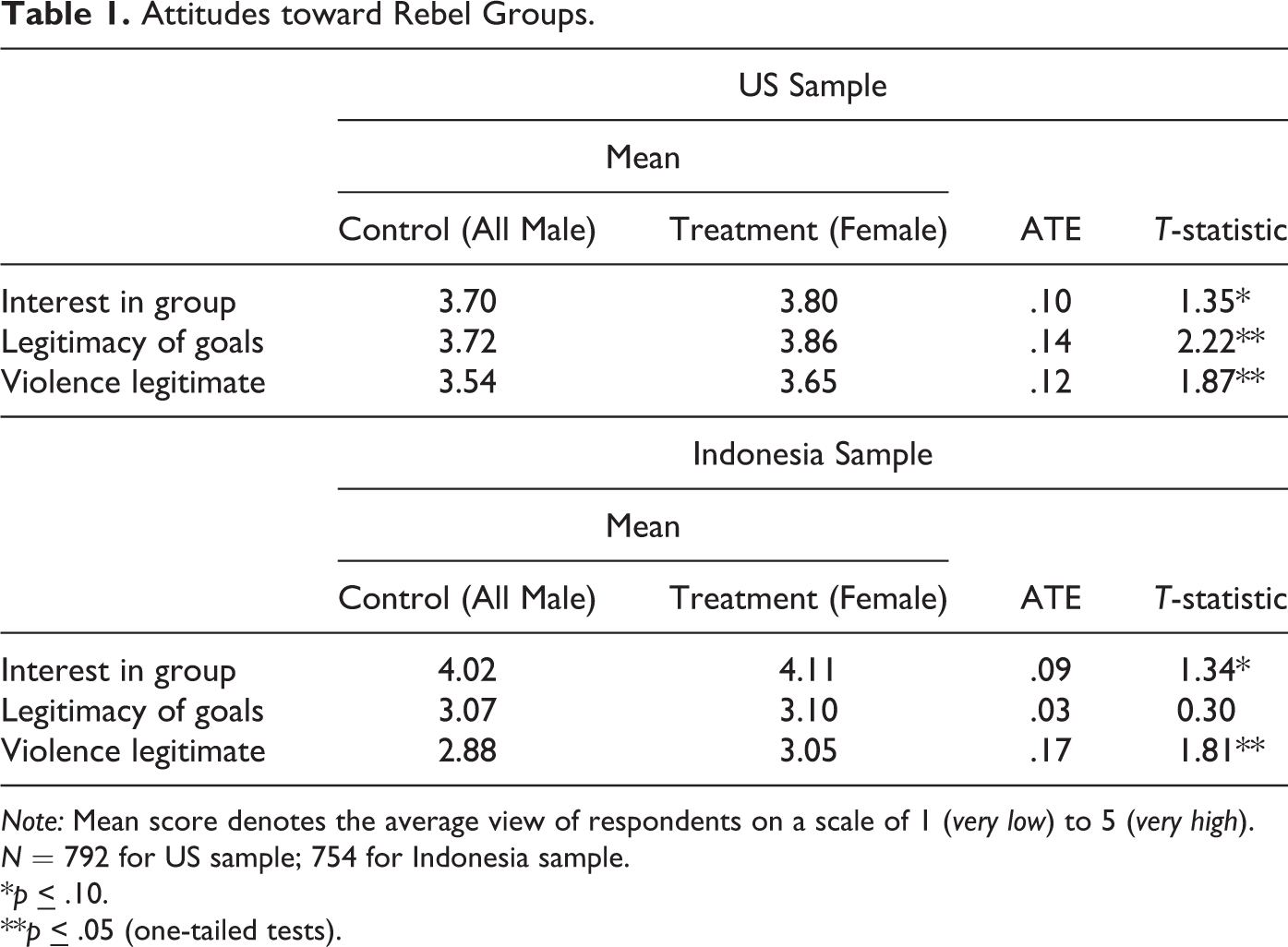
Note: Mean score denotes the average view of respondents on a scale of 1 (very low) to 5 (very high). N = 792 for US sample; 754 for Indonesia sample.
*p
**p
Our experimental results suggest that, across diverse empirical contexts, the visible presence of female fighters exerts a positive influence on external observer attitudes toward an armed group. We believe these results underestimate the effect size of exposure to female combatants outside the experimental setting for two reasons. First, to isolate the causal effects of female fighters, we manipulate biological sex only, which is a subtler treatment compared to the stylized gendered imagery often employed in real-life propaganda materials and media coverage. Second, our experiment provides only a single exposure, whereas in reality an observer might encounter repeated stories or images of female combatants in news reports due to their novel presence in the conflict. That we nevertheless find significant treatment effects underscores the potency of gendered symbols in conflict.
While the results presented above demonstrate that female combatants can exert a positive influence on external audience attitudes toward rebel groups, they do not explain why observers’ attitudes vary depending on fighter gender. Existing literature generally contends that observers tend to view female combatants as motivated less by self-interest and more by personal circumstance compared to their male counterparts. We investigate the plausibility of this contention by asking respondents to infer the motivations of the fighter profiled in the vignette. Specifically, respondents were asked to evaluate (on a five-point scale) how likely it was that the fighter joined the group for each of the following reasons: (1) she or he is strongly committed to the group’s ideology; (2) she or he has a desire for thrill and adventure; and (3) she or he is interested in profiting from the conflict.
As shown in Table 2, we find evidence that observers perceive that self-interest is less likely to motivate women to take up arms than men. In both samples, respondents perceived the female fighter as less motivated by greed. Moreover, Indonesian respondents perceived that men are significantly more likely than females to join armed groups out of a desire for thrill and adventure. These results provide support for H3 by suggesting that observers view female fighters’ motivations as “purer” and less opportunistic than men’s motivations.
Beliefs about Fighter’s Motivations.
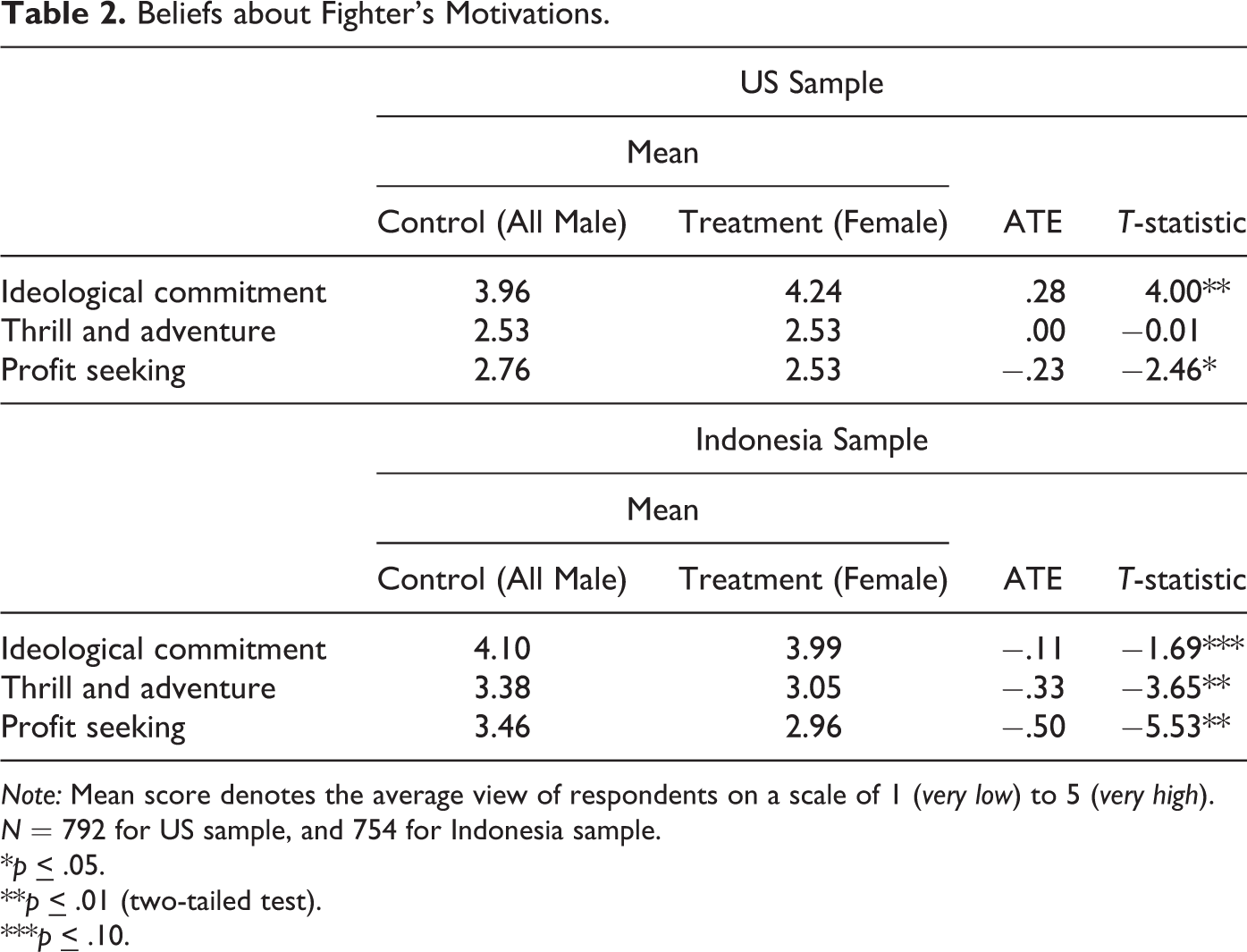
Note: Mean score denotes the average view of respondents on a scale of 1 (very low) to 5 (very high). N = 792 for US sample, and 754 for Indonesia sample.
*p
**p
***p
Interestingly, across the samples, we find opposite effects for observers’ beliefs about ideological motivations. Among Indonesian respondents, women are perceived as less likely to have joined the rebel group for ideological reasons. This is consistent with literature on gendered framing of conflict, which tends to portray female fighters as more motivated by personal experiences and hardship than as a result of ideological extremism. US respondents, however, perceived female rebels as significantly more likely to have joined for ideological reasons than men. This difference may be due to the prevalence of more traditional gender norms in Indonesia, which might lead respondents to believe that women participated in organized violence only under extreme conditions rather than become they are motivated by their beliefs. Still, the results are intriguing as they suggest that observers may believe that women’s motives are nobler and less self-interested than male combatants, as implied by traditional gender stereotypes. Further research could shed additional light on cross-cultural variation in these norms.
Overall, these results provide causal evidence for the positive impact of female fighters on audience interest and support, and they suggest that these effects are driven, at least in part, by gender stereotypes about women’s motivations to participate in political violence. 12 Yet, like all experiments, they are limited in their external validity. Moreover, evidence of impact on audience attitudes, on its own, does not show that rebel groups gain strategic advantages from highlighting female combatants. In the next section, we therefore turn to observational analysis, to examine whether, cross-nationally, female fighters are associated with gains to rebel groups in terms of external support.
Female Combatants and External Support
Data and models
Based on the arguments presented above, we anticipate that the factors that lead TNSAs to extend support to foreign rebel movements will differ from those that contribute to state support for foreign rebels. More specifically, we expect the presence of female combatants to increase the likelihood of support from transnational actors because it legitimizes and humanizes the group, thereby increasing audiences’ affinity for it. By contrast, we expect female combatants to have little direct effect on the group’s success at securing support from a state actor because we assume that state actions are more likely to be driven by strategic interests than by sentiment or affinity. Instead, we hypothesized that female combatants have an indirect effect on state support by mobilizing TNSAs.
In order to evaluate the influence of female fighters on state and TNSA support for rebel groups, we employ data from the recently constructed Women in Armed Rebellion Dataset (WARD; Wood and Thomas 2017). WARD includes a series of related measures that account for the presence and estimated prevalence of female fighters within a sample of contemporary rebel movements drawn from the Uppsala Conflict Data Program (UCDP) Dyadic Dataset (Harbom, Melander, and Walensteen 2008). WARD bases its conceptualization of female combatants on definitions commonly employed by the United Nations and defines female combatants as “women and girls who participated in armed conflicts as active combatants using arms.” 13 Female members of armed groups that occupy support roles (e.g., cooks, nurses, couriers, porters) are therefore excluded from the WARD measures.
We employ the binary measure of female combatants included in WARD. 14 We chose this measure over the categorical indicator because a relatively small number of female fighters should suffice to attract support from an external audience. The variable female combatant therefore indicates whether or not a given group included any number of female fighters at any point during its rebellion against the state. The measures included in the WARD are time-invariant and thus contain only a single observation for each rebel group included in the data set.
Information on TNSA support comes from the Nonstate Actor (NSA) Dataset (Cunningham, Gleditsch and Salehyan 2013). This variable captures both tacit and explicit forms of support provided by actors such as global religious organizations, international solidarity networks and NGOs, and diaspora organizations (Salehyan, Gleditsch, and Cunningham 2011). Tacit support includes public statements of sympathy or solidarity and may also include lobbying, protests, and solidarity statements while explicit support indicates that a transnational actor provided financial or material support to the rebels (e.g., food, medical supplies). Groups that received either form of support from such actors are coded as 1 and groups that received no such support are coded as 0. State support reflects all cases in which a foreign state provided military or nonmilitary support to a rebel group. Groups that received such support from an external state are coded as 1 and groups that received no such support are coded as 0. This variable is taken from the NSA Dataset. 15 Combining the WARD with the NSA Dataset produces a sample consisting of 280 group-level observations active between 1964 and 2009.
We include a number of other potentially relevant confounders in our models. We first account for rebel group political ideology. We include this control both because previous studies have found that group ideology is a principal predictor of the presence of female fighters and because TNSAs are more likely to support rebels that espouse similar ideologies to their own. We specifically account for nationalist, leftist, or religious ideologies using data from Wood and Thomas (2017). 16 We also control for the presence of Transborder Ethnic Kinship because the presence of ethnic kin groups in neighboring countries creates opportunities and incentives for rebel support. This binary variable is taken from the Transborder Ethnic Kin Dataset (Vogt et al. 2015). It is coded 1 if the rebel organization in question fought on behalf of a specific ethnic group whose settlement area was split by one or more international borders and 0 otherwise.
We also control for several factors that may be strategically relevant to potential external sponsors, particularly foreign states. The binary measure weak rebels, taken from the NSA Dataset, indicates whether the aggregate military capabilities of the organization were “much weaker” than those of the state. We control for international rivalry because a history of conflict or militarized competition creates incentives for foreign states to sponsor rebellions inside an adversary’s borders as a way to achieve policy goals. This indicator is based on data from Thompson and Dreyer (2011) and reflects whether or not the state in which the rebellion occurred was involved in a militarized international rivalry at any point during the window of time the rebel group was active. Separatist conflict reflects whether or not the armed group’s objectives included territorial autonomy or independence from the central state. 17 We also control for the presence of other factions in the conflict state that might compete or external support. Rebel factions represents the maximum number of armed factions active within the conflict state during the life span of the rebel group under observation. Duration represents the natural log of the number years since the onset of the group’s challenge to the state. Information on separatism, rebel factions, and conflict duration are constructed from information in the UCDP Dyadic Dataset.
Finally, we control for three state-level characteristics that might influence a rebel group’s ability to establish connections with external actors. The variable democratic is based on information in the Polity IV Dataset (Marshall, Gurr, and Jaggers 2017). We code this indicator 1 if the modal value of the conflict country’s Polity2 score during the years in which the group was active was 6 or higher and 0 otherwise. Population size and GDPpc reflect the natural log of the average population size and per capita GDP of the country during the years of the conflict. Data for both variables come from Gleditsch (2002).
Cross-national results
We estimate logit models to evaluate our hypotheses and present average marginal effects based on those results in Figure 1. 18 We illustrate the results for TNSA support in the left-hand panel and the results for external state support in the right-hand panel. The results suggest that the presence of female combatants increases the probability that the group receives support from a TNSA by approximately 21 percent. The effect is statistically significant, providing support for H4a. The results further indicate that the presence of female fighters exerts only an indirect influence on the probability that rebels receive state support. The variable female combatants is not a significant predictor of external state support. However, the presence of TNSA support is significant and is associated with a 25 percent increase in the likelihood that a rebel group receives support from a foreign state. This result is consistent with H4b. To the extent that female fighters increase the odds that rebels secure support from TNSAs, they may therefore exert an indirect effect on state support.
We explore this relationship in greater depth by following recent efforts to investigate empirical relationships among the interrelated steps of the “boomerang model” (e.g., Allendoerfer, Murdie, and Welch 2020). The results from a mediation analysis using the method described by Hicks and Tingley (2011) provide further support for H4b. Principally, we find that female combatants does not directly affect external state support. However, the positive and statistically significant average mediation effect implies an indirect link to state support: more than 30 percent of the relationship between female combatants and external state support is mediated by the presence of TNSA support. 19
Consistent with our expectations, the results in Figure 1 also reveal that the factors associated with the presence of transnational support differ from those associated with external state support. For example, the presence of female combatants, ideological orientation, the presence of a co-ethnic population in a neighboring state, and the pursuit of separatist goals are significant predictors of a group’s likelihood of securing support from TNSAs. Yet, none of these variables significantly predict state support. Conversely, rivalries exert a large and significant influence on state support but apparently have no bearing on TNSA support. Interestingly, the variable accounting for the political institutions of the conflict state appears to exert opposite effects, with democracy increasing the odds of TNSA support but reducing state support. These results partly support our claims that governments are more likely to be motivated by strategic interests (e.g., rivalries), while TNSAs are more likely to be motivated by nonstrategic ideational factors (e.g., shared kinship, group ideology).
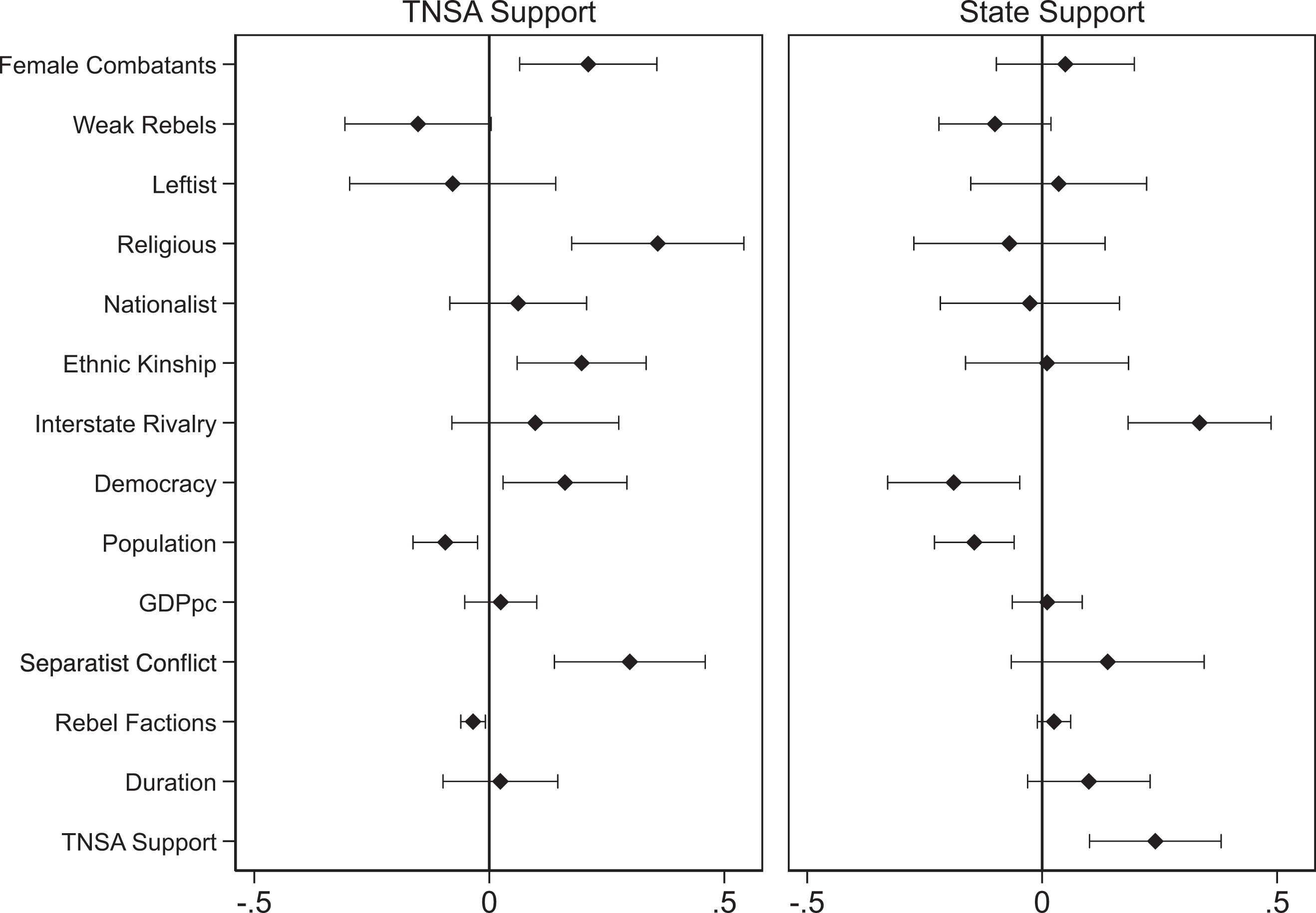
Effects of female combatants on external support for rebellion. Average marginal effects with 90 percent confidence intervals. N = 268.
These results are based on observational data and therefore subject to limitations on the ability to infer causality. Nonetheless, that they are consistent with our experimental results increases our confidence in our interpretation of the findings and in our broader arguments about the relationship between the presence of female combatants and external nonstate actor support for armed groups.
Heterogeneous effects by belief in traditional gender norms
While we find evidence from diverse empirical contexts to support our hypotheses, we acknowledge that these effects may not extend to all settings. In particular, audiences that embrace traditional gender norms, such as conservative religious communities, may perceive mixed-gender rebel groups as less legitimate or view female combatants as a threat to traditional norms. Indeed, groups that espouse such ideologies are often already negatively disposed to deploying women in combat (e.g., Thomas and Bond 2015). Large-scale recruitment of female combatants can lead to backlash from local constituencies in some cases. 20 This suggests that the effects of female combatants may vary across contexts.
To investigate these propositions, we conduct a series of supplementary analyses. We first consider how the existing values or beliefs of individual observers might influence their attitudes toward female fighters. In our Indonesia sample, we asked respondents to indicate (on a four-point scale) the extent to which they believed Islamic law should serve as the basis for national law. 21 While an imperfect proxy for traditionalist or conservative gender attitudes, this variable should provide some indication of respondent preferences for traditionalist social norms. If individuals who hold extremely conservative views are offended or threatened by the presence of female fighters, we should observe significantly lower levels of support for the group that includes female combatants among the subset of respondents that most strongly believe that Indonesia should be governed by Islamic law.
To assess the possibility of a heterogeneous treatment effect, we interact the variable support for Islamic law with the treatment in a series of linear regression models. The marginal effects plots of the interaction presented in Figure 2 suggest that the mixed gender treatment significantly increased interest and perceptions of the legitimacy of the group’s goals/tactics among respondents who expressed the least support for Islamic law (categories 1 and 2). For respondents that expressed the highest level of support (category 4), which we expect to possess the most traditional gender attitudes, the effect was not significant. However, there is no strong evidence for a backlash effect. Given the small sample size and the crudeness of the measure we use to account for traditionalist gender attitudes, these results should be viewed as preliminary. However, they potentially demonstrate the limits of the argument and highlight the conditions under which female combatants might exert a greater or weaker influence on observer attitudes.
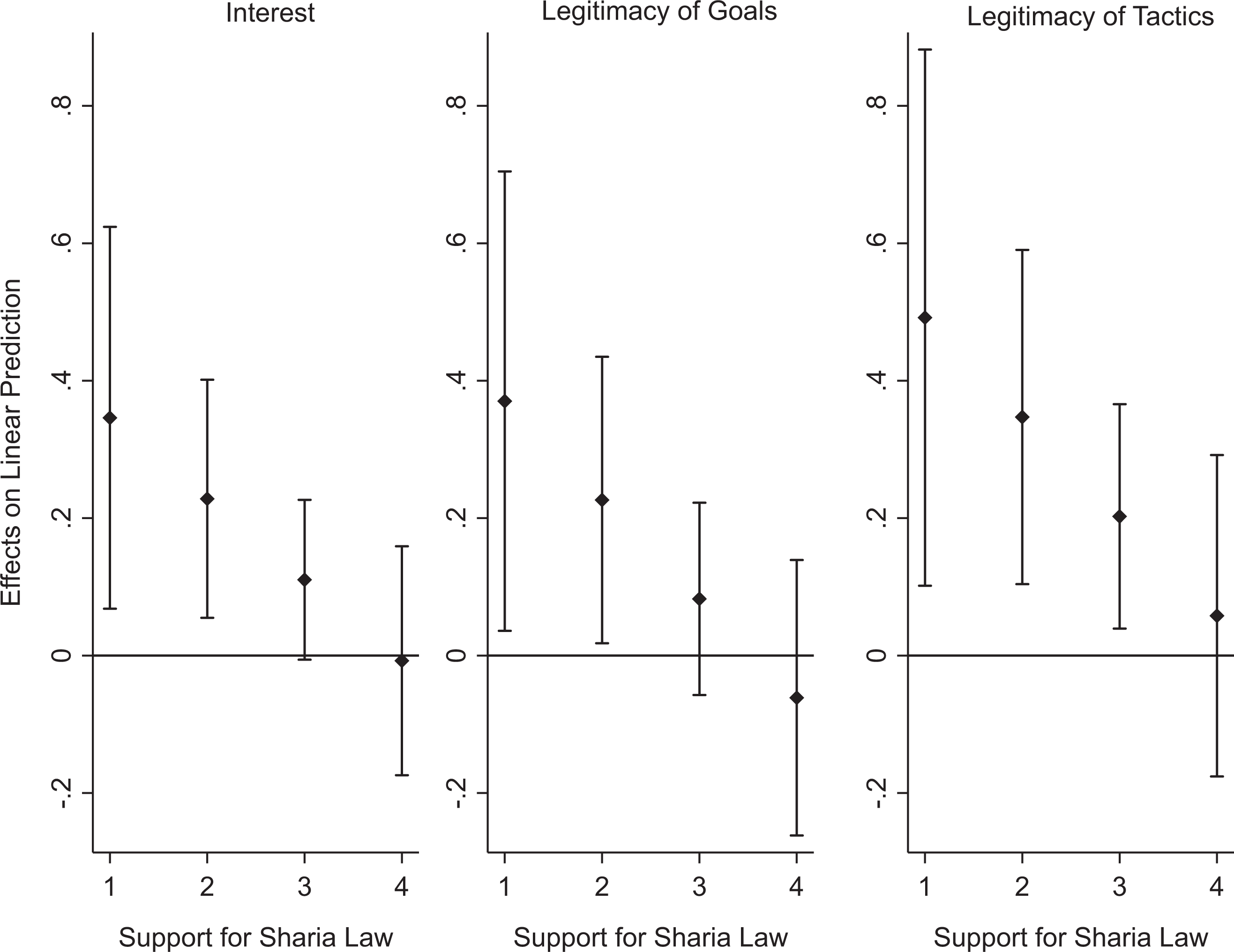
Effect of treatment by support for Islamic law. Average marginal effects with 90 percent confidence intervals. N = 609.
We also leverage our observational data to investigate possible variation in the effect of female combatants across different types of nonstate sponsors. As with individual attitudes, organizations are likely to vary in terms of their willingness to extend support to armed groups that include female fighters. Particularly, highly conservative or traditionalist groups might be less inclined to support a rebel movement if they include female fighters in their ranks. To examine this possibility, we disaggregate the TNSA support variable into four nonmutually exclusive categories using information provided in the case narratives accompanying the NSA Dataset. 22 Using this information, we identify whether a given rebel group received support from the following types of transnational actors: Islamist movements, Diaspora/co-ethnic communities, NGOs, and other actors (e.g., international institutions and foreign political parties). While these categories are quite coarse, they should allow us to evaluate the extent to which the influence of female combatants on external support varies across actors of different types, and particularly, whether female combatants produce a backlash among extremely conservative populations (e.g., transnational Islamist movements).
The results of these exploratory analyses are presented in Figure 3. 23 Each model uses the same controls included in the main model presented above. As with the individual level model, we observe no evidence of backlash. The effect of female combatants on the odds of securing support from a transnational Islamist movements is negative but insignificant. In the case of Diaspora/co-ethnic communities, we observe a positive relationship that falls just short of statistical significance. By contrast, the presence of female combatants appears to be positively and significantly related to the odds that a group attains external support from NGOs and other types of transnational actors. Though preliminary, these results suggest that while there is no backlash effect among conservative activist communities, female combatants are most likely to help rebel movements achieve support from less conservative, Western-oriented NGOs and solidarity movements.
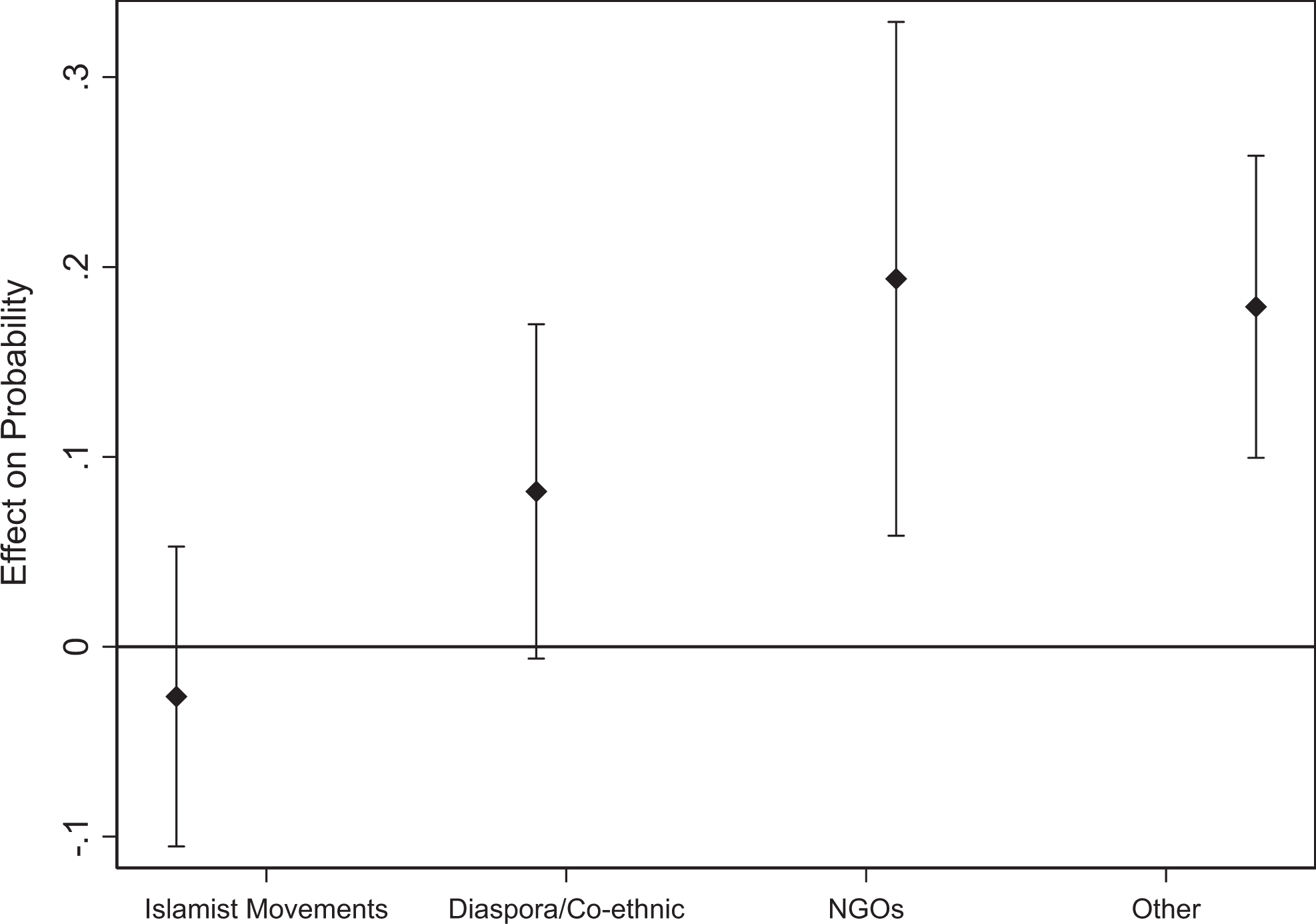
Effect of female combatants on sources of transnational support. Average marginal effects with 90 percent confidence intervals. N (by model) = 208, 266, 212, and 265.
Discussion and Conclusion
This article makes two notable contributions to the emerging literature on the roles and implications of female combatants in armed intrastate conflicts. First, we present systematic empirical evidence to support the argument that female combatants can improve audience perceptions of the legitimacy of an armed group and its goals. While this claim is common in the existing literature, there has been little effort to directly evaluate the influence of female combatants or gendered imagery on target audiences. Second, we extend this argument to explicitly link the proposed influence of gendered images and symbols on audience attitudes to willingness of external actors to extend tacit or explicit support to armed groups. Through their ability to influence audience attitudes about the groups for which they fight, the visible presence of female fighters increases the likelihood that the group receive support from TNSAs such as transnational activist movements and foreign NGOs.
To evaluate the validity of the theoretical relationships discussed above, we employed a combination of experimental and observational data, drawing on the respective advantages of each to bolster our findings. Results from two survey experiments conducted in culturally and geographically distinct regions of the world provide support for our argument linking the presence of female combatants to increased perceptions of group legitimacy among foreign audiences. Moreover, we find evidence for a causal mechanism we believe underlies this relationship: observers attribute different motivations to women and men who participate in political violence. Particularly, respondents were more likely to believe that men are motivated by self-interest while women exhibited comparatively “purer” motives. Moving beyond our experimental settings, we analyze the substantive impact that female combatants can have on armed conflicts. We found a strong relationship between the presence of female combatants and the likelihood that an armed group successfully secured support from a nonstate transnational actor. Consistent with our overall expectations, we find no evidence that female combatants directly influence rebel success in acquiring support from foreign governments. However, they can solicit government support indirectly through their effects on nonstate actors.
While our study focused on the effects of female fighters on external audiences, the effect on domestic audiences represents an interesting related question. On the one hand, existing research suggests that stereotypes of women as peaceful are deeply entrenched across most societies, and there is some evidence to suggest that the presence of female fighters increases sympathy for the group among domestic audiences (e.g., Alison 2009; Viterna 2014). On the other hand, there may be some audiences for whom women in combat are anathema to basic beliefs. Our exploratory analysis suggests that female fighters do not increase sympathy for a rebel group among highly conservative audiences in Indonesia and are not associated with support from Islamist movements. However, we find no evidence for a backlash effect in either instance. Beyond differences in gender stereotypes, domestic audiences may view the integration of female fighters differently based on their attitudes toward the conflict itself. For example, audiences that have been exposed to conflict-related violence may react differently to gender frames. The question of how gender affects domestic audiences is thus likely to vary by context and is a fruitful topic for future research.
Most importantly, these results provide strong evidence of the substantive impact of female combatants on armed conflicts, demonstrating that groups’ decisions to recruit, train, and deploy women in combat may affect the conflict space and the fortunes of armed groups in important ways. Our study suggests that female combatants can assist rebel groups in securing external support. Such support is critically important to rebel movements because the ability to garner support and attract allies has direct bearing on the odds that the group survives and achieves its political objectives. Examining the implications of female combatants represents a theoretically interesting and substantively important area of inquiry that has thus far been largely ignored by conflict scholars.
Supplemental Material
Supplemental Material, sj-do-1-jcr-10.1177_0022002720912823 - Framing the Narrative: Female Fighters, External Audience Attitudes, and Transnational Support for Armed Rebellions
Supplemental Material, sj-do-1-jcr-10.1177_0022002720912823 for Framing the Narrative: Female Fighters, External Audience Attitudes, and Transnational Support for Armed Rebellions by Devorah Manekin and Reed M. Wood in Journal of Conflict Resolution
Supplemental Material
Supplemental Material, sj-do-2-jcr-10.1177_0022002720912823 - Framing the Narrative: Female Fighters, External Audience Attitudes, and Transnational Support for Armed Rebellions
Supplemental Material, sj-do-2-jcr-10.1177_0022002720912823 for Framing the Narrative: Female Fighters, External Audience Attitudes, and Transnational Support for Armed Rebellions by Devorah Manekin and Reed M. Wood in Journal of Conflict Resolution
Supplemental Material
Supplemental Material, sj-do-3-jcr-10.1177_0022002720912823 - Framing the Narrative: Female Fighters, External Audience Attitudes, and Transnational Support for Armed Rebellions
Supplemental Material, sj-do-3-jcr-10.1177_0022002720912823 for Framing the Narrative: Female Fighters, External Audience Attitudes, and Transnational Support for Armed Rebellions by Devorah Manekin and Reed M. Wood in Journal of Conflict Resolution
Supplemental Material
Supplemental Material, sj-do-4-jcr-10.1177_0022002720912823 - Framing the Narrative: Female Fighters, External Audience Attitudes, and Transnational Support for Armed Rebellions
Supplemental Material, sj-do-4-jcr-10.1177_0022002720912823 for Framing the Narrative: Female Fighters, External Audience Attitudes, and Transnational Support for Armed Rebellions by Devorah Manekin and Reed M. Wood in Journal of Conflict Resolution
Supplemental Material
Supplemental Material, sj-dta-1-jcr-10.1177_0022002720912823 - Framing the Narrative: Female Fighters, External Audience Attitudes, and Transnational Support for Armed Rebellions
Supplemental Material, sj-dta-1-jcr-10.1177_0022002720912823 for Framing the Narrative: Female Fighters, External Audience Attitudes, and Transnational Support for Armed Rebellions by Devorah Manekin and Reed M. Wood in Journal of Conflict Resolution
Supplemental Material
Supplemental Material, sj-dta-2-jcr-10.1177_0022002720912823 - Framing the Narrative: Female Fighters, External Audience Attitudes, and Transnational Support for Armed Rebellions
Supplemental Material, sj-dta-2-jcr-10.1177_0022002720912823 for Framing the Narrative: Female Fighters, External Audience Attitudes, and Transnational Support for Armed Rebellions by Devorah Manekin and Reed M. Wood in Journal of Conflict Resolution
Supplemental Material
Supplemental Material, sj-pdf-1-jcr-10.1177_0022002720912823 - Framing the Narrative: Female Fighters, External Audience Attitudes, and Transnational Support for Armed Rebellions
Supplemental Material, sj-pdf-1-jcr-10.1177_0022002720912823 for Framing the Narrative: Female Fighters, External Audience Attitudes, and Transnational Support for Armed Rebellions by Devorah Manekin and Reed M. Wood in Journal of Conflict Resolution
Footnotes
Acknowledgments
The authors wish to thank Reyko Huang, Zaryab Iqbal, Sabrina Karim, Meghan Stewart, and Jakana Thomas for their helpful comments, suggestions, and contributions to earlier drafts of this article. Previous versions of this article were presented at the 2018 annual meeting of the American Political Science Association and the 2019 Eurasian Peace Science Conference.
Declaration of Conflicting Interests
The author(s) declared no potential conflicts of interest with respect to the research, authorship, and/or publication of this article.
Funding
The author(s) received no financial support for the research, authorship, and/or publication of this article.

Supplemental Material
Supplemental material for this article is available online.
Notes
References
Supplementary Material
Please find the following supplemental material available below.
For Open Access articles published under a Creative Commons License, all supplemental material carries the same license as the article it is associated with.
For non-Open Access articles published, all supplemental material carries a non-exclusive license, and permission requests for re-use of supplemental material or any part of supplemental material shall be sent directly to the copyright owner as specified in the copyright notice associated with the article.
