




Abstract
What explains support for violence against the state? The surge in survey-based studies in (former) conflict areas has improved our understanding of the determinants of armed conflict. Yet, the potential interaction between grievances and political opportunity structure has received little attention in microlevel studies. Integrating common arguments from the civil war literature with the political behavior tradition, this article argues that perceived political efficacy, a central component of the political opportunity structure, moderates the association between individual and group grievance and people’s support for political violence. It represents a first individual-level test of the argument that perceived political opportunity structure and grievances combine to explain internal armed conflict. Using original survey data from Guatemala, Nepal, and Northern Ireland (2016), we find robust empirical evidence that support for violence increases with perceived grievance and decreases with political efficacy; and some evidence of an interaction between the two.
Many armed groups depend on the local population for their survival. In conflict and postconflict situations, the local population represents a resource that political entrepreneurs and spoilers can draw on. They can support armed actors tacitly, by tolerating their presence; through the provision of shelter, supplies, or information; or through active participation in insurgency. Whether people are willing to provide support depends in part on a predisposition toward politically motivated violence. Latent support for political violence may therefore be an important risk factor for conflict.
The recent surge in survey-based research on internal armed conflict has improved our understanding of political violence (Balcells and Justino 2014). Central propositions from the macro-oriented literature are being been put to the test on the individual level, where they conceptually belong. Importantly, scholars have shown that inequality and grievance increase support for violence (Rustad 2016; Hillesund 2015; Miodownik and Nir 2016; Koos 2018).
This article takes microlevel investigations of support for violence a step further. Recent macrolevel studies posit a joint effect of motivation and opportunity structure (D. E. Cunningham et al. 2017; White et al. 2015; Bormann and Hammond 2016; Bara 2014). Yet, its individual-level corollary, that people’s perceptions of the political system condition the relationship between grievances and support for violence, has received little attention.
To examine the interaction proposition on the microlevel, this article combines insights from the conflict literature and studies of contentious political participation. We argue that dissatisfaction (grievances) with the material and political situation and evaluations of the effectiveness of ordinary political channels for peaceful opposition work together to shape individual support for political violence. Individuals who want to influence politics face a choice between conventional and contentious participation, between rejecting and supporting violence. We expect that support for political violence depends on a combination of motivation and perceived efficacy of conventional political participation. Those who believe that they can have a say in politics, or are satisfied with society and their position in it, should be least likely to support violent political action. Vice versa, dissatisfied individuals who find existing channels of political influence flawed or blocked should be particularly prone to thinking that it is legitimate to take up arms against the government—whether they do so themselves or support someone else doing it.
To test the propositions, we adopt a most different cases comparative design, employing original survey data (2016) from Guatemala, Nepal, and Northern Ireland. The restriction to electoral democracies with a history of armed conflict is partly due to pragmatic concerns of data availability. However, the cases offer a theoretically interesting point of departure for investigation of motivation, opportunity, and support for political violence. In electoral democracies, individual political participation can generally be expected to matter, making political efficacy more relevant than in autocracies. Compared to more peaceful societies, the risk of (renewed) political violence is higher in postconflict societies, but people are also more aware of its costs.
In line with previous microlevel studies, we find robust evidence that perceived grievance (dissatisfaction) is associated with higher levels of support for violence against the state. This is the case for both group-centered and more general grievances, in the economic and political realm. Certain types of grievance matter more in certain countries, however. This comprehensive test of grievance-based explanations adds some nuance to previous findings.
We also find some evidence that the grievance—support relationship is conditional on political efficacy. Grievances are particularly conducive to support for violence among people who believe the political system offers them little chance to redress their discontent. The interaction between grievance and political efficacy has implications for our understanding of conflict escalation, civil war onset and recurrence, and the dynamics of violent social movements.
Before we proceed, a caveat about causality is in order. It is hard to establish causality between different attitudes, and survey data are ill-suited for identifying causal relationships. Still, given the long-standing academic debate between adherents of motivation and opportunity-based arguments at the country level (Bara 2014), it is useful to know more about the interaction between individual-level dissatisfaction, perceived opportunities, and support for political violence.
An additional caveat relates to the relationship between support for political violence and actual participation. While it is true that rebel groups sometimes depend on forced recruitment (Eck 2014), militant groups also rely on volunteers (Weinstein 2005; Hegghammer 2013). Perhaps equally important, guerrilla forces depend on various forms of civilian cooperation, famously recognized by Mao, who wrote that “the guerrilla should move among people as the fish swim in the sea” (Zedong 2000). The question addressed in this article is not the choice of active participation in armed conflict but latent support for political violence as a legitimate strategy for social change. We do not argue that support for political violence necessarily translates into a willingness to enroll, should an armed conflict (re)ignite. Rather, we posit that people who view political violence as potentially legitimate may be more likely to provide other types of support that insurgent groups rely on to sustain an insurgency. In sum, we see support for political violence as a potential for civilian tolerance of and voluntary cooperation with as much as active participation in an insurgency. 1
This article is structured as follows. First, we review the relevant literature and make predictions about support for the use of political violence. Second, we discuss case selection, followed by a description of data and methods. The final sections present empirical analysis and findings and discuss their implications for theory and future research.
Grievance-based Explanations
Explanations of intrastate political violence and internal armed conflict can be roughly classified as motive (greed and grievance) or opportunity based (Collier and Hoeffler 2004). 2 Around the turn of the century, many scholars considered grievance explanations obsolete. Two decades later, most agree that widespread grievance is associated with higher risk of armed conflict, at least when it stems from inequalities between strong identity groups (horizontal inequalities). A multitude of studies have established this for socioeconomic inequalities (Stewart 2002; Østby 2008) and ethnic political exclusion (Cederman, Wimmer, and Min 2010; Buhaug, Cederman, and Gleditsch 2014) on the country, region, and group level. The assumed mechanism is that that intergroup inequalities motivate people to challenge the status quo and increase the opportunity to do so because grievances that are linked to strong identity groups facilitate leadership, successful collective action frames, group solidarity and anger, and the activation of preexisting social networks and organizations (Østby 2013; Cederman, Gleditsch, and Buhaug 2013).
A recent wave of microlevel studies significantly improves our understanding of the nexus between inequality, grievance, and conflict. They remind conflict scholars that the link between inequality and grievance cannot be taken for granted. Conflict behavior is affected by the perceptions of grievance, which do not always mirror objective conditions, due to misperceptions and manipulation (Rustad 2016; Miodownik and Nir 2016; Langer and Smedts 2013; Langer and Ukiwo 2008).
Most of the survey-based studies of support for violence include measures of group-centered grievance, rooted in horizontal inequality theory. Overall, they find a positive association. In the Niger Delta, support for political violence is highest in the districts and ethnic groups where people’s self-reported living conditions compare least favorably to the richest district or largest group in their state (Rustad 2016) and for individuals who think their community gets an unfair share of oil revenues (Koos 2018). Across the African countries covered in various rounds of the Afrobarometer survey, the perception that one’s ethnic group is often treated unfairly by the government consistently increases support for political violence (Detges 2017; Miodownik and Nir 2016). The perception that one’s group is politically worse off than other groups also increases support, but only among politically excluded groups. More surprisingly, the perception that one’s group is economically worse off than others has the same effect, but only among the economically advantaged; and the effect of unfair treatment is driven primarily by the politically included (Miodownik and Nir 2016). 3
In contrast to the macro literature on conflict onset, microlevel studies suggest that support for violence is determined by individual- as well as group-centered grievances. The evidence comes primarily from the Niger Delta, measuring socioeconomic grievance with asset ownership and self-reported living standards (Rustad 2016), community livelihood destruction from oil spills (Koos 2018), and self-expressed personal grievance against the state (p < .10; Oyefusi 2008). 4 Lacking access to water, electricity, education, and employment does not increase the support (Oyefusi 2008). With regard to political grievance, Palestinians in the West Bank and Gaza are more likely to support violent over nonviolent resistance the worse they consider the status of political rights and freedoms in the occupied territories (Hillesund 2015). 5 The contrast to the macroliterature, which suggests that only group-centered, not individual, grievances increase actual armed conflict, is likely due to the fact that the former is more likely to increase the internal opportunity to overcome the collective action dilemma, in addition to providing motive. Expressing support for political violence, however, does not require overcoming the collective action problem. Also underscoring the need to account for individual- (general) as well as group-centered forms of grievance, the distinction between group-centered and individual grievances becomes blurred when people mobilize around class ideologies. To the extent that socioeconomically disadvantaged individuals come to identify strongly with their class, most of the mobilization-facilitating mechanisms of horizontal inequality apply.
In sum, the microliterature demonstrates that a broad set of grievances—economic and political, group- and individual-centered—can affect support for political violence. This underpins our first hypothesis.
To our knowledge, no previous study has tested all types of grievance together. This study thus contributes to the microliterature by investigating a particularly broad selection of grievances. Because the microliterature suggests, in line with horizontal inequality theory, that measures that let respondents evaluate the unfairness of the situation (such as the unfair treatment variable) are particularly potent determinants of support, we device empirical measures of grievance that include an explicit evaluation of injustice or dissatisfaction.
Moving beyond the African context, we test various types of grievance across a more diverse set of countries than previous studies, namely, Guatemala, Nepal, and Northern Ireland. Important conditions could differ across countries. First, in the early years of the horizontal inequality literature, Stewart (2002) argued that different grievances will matter in different contexts. Inequality in certain realms—economic, social, or political—will matter more in certain countries at certain points in time, depending on what resources are considered central to people’s well-being (Stewart 2002). Recent microstudies indicate some support for this. For example, Koos (2018) does not find an effect of the perceptions that one’s group is treated unfairly in the Niger Delta, even if this variable is a central predictor in the Afrobarometer analyses.
Second, different kinds of groups will be salient in different countries. In the empirical literature, horizontal inequality is often measured along linguistic, religious, or racial lines, but the concept encompasses a wide range of identity markers. Both points tend to get lost in the global coverage cross-national literature, but they are amenable to investigation in studies of a few selected countries.
Third, previous political mobilization, including violence, can affect the salience of different types of inequality and identity markers for conflict. Individuals’ preferences for violence, perception of grievance, and ideas about whether the former is a suitable way to remedy the latter could all be affected by opposition leaders’ framing and choice of tactics and government (repressive) responses. Previous studies have control for conflict history. Yet, it could also act as a moderator; affecting whether and how various forms of grievance become and remain associated with conflict. Unlike previous studies of support for violence, this study accounts for these potential country differences both by (i) using country dummies and (ii) by repeating all analyses by country.
Political Efficacy: A Potential Moderator
A key challenge for democracies is to ensure that contention is resolved peacefully within the political system (Powell 1982). The political structures that facilitate or impede peaceful resolution make up the political opportunity structure, a set of “consistent—but not necessarily formal or permanent—dimensions of the political environment or of change in that environment that provide incentives for collective action by affecting [opponents’] expectations for success or failure” (Gamson and Meyer 1996; paraphrased in Tarrow 2011, 163). Democratic institutions in and of themselves are not sufficient to ensure peaceful contention, as democracies are no less likely than autocracies to experience internal armed conflict. Yet, political institutions can be central for the form political contention takes. Partially democratic regimes (anocracies) face the highest risk of violent conflict (Regan and Bell 2010). More generally, good governance reduces the risk of civil war onset as well as its recurrence (Hegre and Nygård 2015; Walter 2014).
On the microlevel, survey-based studies of support for violence suggest that it increases with several factors that proxy opportunity (cost) explanations, such as oil endowments, distance to the capital, not owning immobile assets, low income and education, and previous violence (Rustad 2016; Oyefusi 2008; Koos 2018; Miodownik and Nir 2016). However, the political opportunity structure and people’s perceptions of it have received little attention.
The central contribution of this article is to bring the interaction between grievance and perceived political opportunity to the fore in the microliterature. The interaction between grievance and opportunity has been highlighted in macro-oriented studies, which show that motivation and opportunity structures are complementary, rather than competing, explanations of armed conflict. The onset (and recurrence) of armed conflict requires a combination of motivation and opportunity (D. E. Cunningham et al. 2017; White et al. 2015; Bormann and Hammond 2016; Bara 2014). While grievances provide the motivation, the economic and political opportunity structure determines the shape of the contention (K. G. Cunningham 2013) and thus the risk of conflict. When anocracies are found to have a higher onset of civil war, this is arguably because the most repressive regimes are able to contain rebellion, whereas in full democracies, people can work to produce change through regular political channels (Gates et al. 2006; Hegre 2014).
This argument has a microlevel corollary, which has received little attention in the conflict literature: for people motivated by grievance, their perceptions of the political opportunity structure could help determine what form of contention they support. Presumably, violence will be considered more legitimate if peaceful means of influencing politics are seen as inefficient or nonexistent. The idea is not new. As early as the 1970s, scholars made similar arguments in studies of individual protest behavior, mostly in the United States (Eisinger 1973; Muller 1972, 1977; Oberschall 1973; Tilly 1978). Gurr (1970, 317), for example, acknowledged that “if discontented people have or get constructive means to attain their social and material goals, few will resort to violence.” In an early empirical example, Ransford (1968) found dissatisfaction among black people to be associated with a higher willingness to use violence in race riots when coupled with a “belief that all channels for social redress are closed” (p. 583).
Subsequent studies coined the term political efficacy (Balch 1974), defined as “the expectation that one’s political activity will be successful” (Shingles 1981, 80). External political efficacy, in turn, is the part of political efficacy that stems from an individual’s evaluation of how the political environment facilitates or hinders successful political action (Shingles 1981), that is, the perceived political opportunity structure. 6 A key finding in a series of survey-based studies of the effect of relative deprivation and political efficacy on protest participation and political violence (Muller 1972, 1977; Muller and Jukam 1983; Finkel, Muller, and Opp 1989; Muller and Opp 1986) was that people resort to contentious participation when other forms of political participation appear blocked, that is, they have low political efficacy.
While theoretically rich, these early empirical studies were mostly based on crosstabulations or very basic regression models. This study therefore represents a better empirical test of the interaction these earlier studies propose. Moreover, to our knowledge, the interaction between grievance and perceived political efficacy has not been tested outside the Western context, nor for group-oriented grievances, nor with recent microlevel data. Our survey data allow us to make these extensions, measuring external political efficacy as the extent to which people think that politicians care about their opinion rather than just their vote. We expect the core hypothesis—that aggrieved people tend to reject political violence if they believe their discontent can be redressed through regular political channels—to travel across these extensions. More specifically, for all our grievance indicators, and across the three contexts, we expect grievances to increase support for violence more among those who believe that politicians do not care much about their opinions.
Arguably, opportunity structures may matter more for participation in violence than for support for it. This objection is particularly relevant for individual-level opportunity explanations, like the opportunity cost of participation. Our concern here is with political efficacy, however, or perceived political opportunity structure, which we believe should play into support for as well as participation in violence. Assuming that most people are instrumentalist in a minimal sense, it makes little sense to support forms of action they do not think can succeed.
Emotions also matter for support; indeed, anger provides a central link between grievances and violent action tendencies (Claassen 2014). Yet, we do not think it overrides all strategic concerns, leading aggrieved people to support violence regardless of their opportunity to redress their grievances peacefully. In line with Halperin et al. (2011), we hold that anger can be channeled into (support for) either violent or peaceful participation, depending on, for example, whether people believe that regular political channels can be used to address their demands.
The Cases
The cases of Guatemala, Nepal, and Northern Ireland were selected from a population of postconflict electoral democracies that have experienced an internal armed conflict ending through a comprehensive peace agreement. The selection strategy within this population was a most different cases approach (Seawright and Gerring 2008). The three cases differ on conflict characteristics as well as characteristics of the peace agreement and the ensuing peace. They also represent different geographical regions, levels of income, and institutional quality. The logic of the design implies that if a similar pattern is found across the three cases, this pattern should not be contingent on any of these characteristics.
Starting with conflict characteristics, the conflicts differed in intensity, duration, ideology, and incompatibility. The Guatemalan civil war (1960–1996) was the most protracted and bloody, with more than 200,000 civilians killed or disappeared (The Commission for Historical Clarification [CEH] 1999). In particular, the mainly indigenous, rural poor was heavily targeted by the state (CEH 1999). The insurgent group, the Guatemalan National Revolutionary Unit, was a coalition composed by four groups that all drew on Marxist ideology. In comparison, the armed conflict in Nepal lasted ten years (1996–2006) with about 13,000 fatalities (Do and Iyer 2010). It can be classified as an ideological civil war, but the Maoist insurgency recruited mainly among the rural poor and poor castes (Subedi 2013). The armed conflict in Northern Ireland lasted from 1968 to 1998 as a relatively low-intensity conflict with about 3,700 fatalities (McKittrick et al. 1999). Unlike the other two, this conflict was fought along explicitly ethnic lines over a territorial incompatibility.
Objective material grievances are more widespread in Guatemala and Nepal than in Northern Ireland. United Nations Development Program (UNDP) ranks Nepal number 144, Guatemala number 125, and United Kingdom number 16 in on the human development index. 7 Income inequality (the Gini coefficient) is 48.7 in Guatemala, 32.8 in Nepal, and 32.6 in the United Kingdom. 8 Thus, while overall poverty is somewhat higher in Nepal than in Guatemala, the distribution of wealth is much more unequal in Guatemala, and the marginalization follows a clear ethnic pattern (UNDP 2016).
With regard to objective political grievance, the peace agreements in Nepal and Northern Ireland introduced formal systems of power sharing to make the political systems more inclusive, while the peace agreement in Guatemala called for the formal recognition of the rights of the indigenous population, but did not include measures to improve indigenous representation in politics.
The quality of government, an important component of the political opportunity structure, is better in Northern Ireland than in the other two countries. Looking at the V-Dem data from the last decade, United Kingdom is consistently ranked above the other two countries across a range of indicators. The difference between Nepal and Guatemala is small and not consistent across time and different indicators (Coppedge et al. 2017). This means that in theory, people who want to influence the development of their society would have a greater possibility of doing so, peacefully, in Northern Ireland.
The selection of postconflict electoral democracies has implications for the scope of the analysis. On the one hand, a relationship between grievances and support for violence could be more likely in postconflict countries than elsewhere because we expect their repertoires of contention to be more violent, and we know their probability of (renewed) conflict to be higher. On the other hand, people in postconflict settings should have more realistic expectations about the costs of political violence than people in countries with no recent armed conflict. This could serve to weaken the link between grievance and support for violence among them. Thus, it is not obvious whether the net effect of grievance on support for violence should differ between pre- and postconflict countries.
In addition, pre- and postconflict are relative terms. Most countries have experienced organized violence sometime in their history. Deciding when countries move in or out of the postconflict category always entails some arbitrariness. The countries under study have all been at peace for more than a decade. The conflicts ended in comprehensive peace agreements, but there is substantial variation between the three in the time since conflict, as well as its duration and severity. Because of this variation in conflict history (and the other characteristics outlined above), we argue that if we find the same pattern across cases, this pattern can be reasonably expected to generalize to other postconflict settings, at least where conflicts ended in comprehensive peace agreements. Because pre- and postconflict categorization is so relative, we think that findings that hold across our cases are likely to extend beyond the postconflict category as well, but our case selection strategy only allows us to speculate on this point. If we find different patterns across cases, on the other hand, this would provide an initial indication as to how the larger context can moderate the relationship between motivation, opportunity, and support for violence.
Data and Methods
To test the arguments outlined above, we use the Post-Conflict Attitudes for Peace (PAP) survey, a set of comparative, nationally representative surveys conducted in 2016 (Guatemala: January; Nepal: March–April; Northern Ireland: May–July). The sample comprises 3,229 respondents (Guatemala: 1,216; Nepal: 1,200; Northern Ireland: 813). For details about the survey, see Dyrstad and Binningsbø (2019) and the Online Supplemental Material.
Our measure of support for political violence is based on four subquestions, which were asked as follows: “Now, I want you to think of different scenarios or things that could possibly happen. For each of the situations, I want you to think of whether it could be justified to use violence to defend oneself. Please answer “yes” or “no.” Violence would be justified if (1) the state treats some groups (Northern Ireland: ‘or regions’) more favorably than others, (2) the government turns repressive or violent, (3) the economic inequality increases, and (4) the military 9 becomes too powerful.” The term “to defend oneself” was included to make the question less sensitive and reduce social desirability bias, at the expense of somewhat lower content validity. The distribution of each item is shown by country in the Online Supplemental Material (Figure A1).
A majority of respondents reject violence, but with important variation. In the scenario of increased economic inequality, about two-thirds reject the use of violence, while about one out of two rejects violence in the case of increased government repression. Overall, about 40 percent answer that violence cannot be justified in any case. The nonresponse rate (refusal and “don’t know”) varies from less than 3 percent to about 4.5 percent. The share of “don’t know” is substantially higher in Northern Ireland, potentially indicating a stronger social desirability bias. In Guatemala, about 70 percent of the respondents are willing to justify the use of political violence in at least one scenario, compared to 63 percent in Nepal and 37 percent in Northern Ireland. Only in Nepal, a majority (54 percent) is willing to justify violence given one particular scenario, namely, if the government becomes repressive. 10 In Northern Ireland and Nepal, the support is highest for the government repression question and lowest for violence in response to increasing inequality. In Guatemala, the level of support is equally high across items.
To assess whether the four items measure aspects of the same underlying concept and can be meaningfully combined into a scale, we use exploratory factor analysis (Spector 1992) and item response theory (IRT; van Schuur 2011). The factor analysis shows support for a one-factor solution (eigenvalue = 1.8; Kaiser-Meyer-Olkin [KMO] = .76; Cronbach’s α = .79), with factor loadings ranging from .61 to .72. IRT accounts not only for the possibility that some of the support for violence items predict respondents’ latent (underlying) support for political violence better than others but also that a given level of latent support is associated with different probabilities of expressing support for violence across the different scenarios (items) presented (DeVellis 2017). When we use the results from IRT analysis to predict latent support for violence, the resulting scale gives more weight to the items that predict latent support for violence better and lets each item contribute to the segment of the latent support variable that it corresponds to. Thus, if it takes more to express support for violence in response to increasing inequality than for the other scenarios, this item will contribute to predictions in the higher end of the predicted scale.
To ease the interpretation of coefficient size, we normalize the scale, so the lowest level of support gets the value 0 and the highest level the value 1. Figure 1 shows the distribution by country. The latent support for violence is highest in Guatemala and lowest in Northern Ireland.
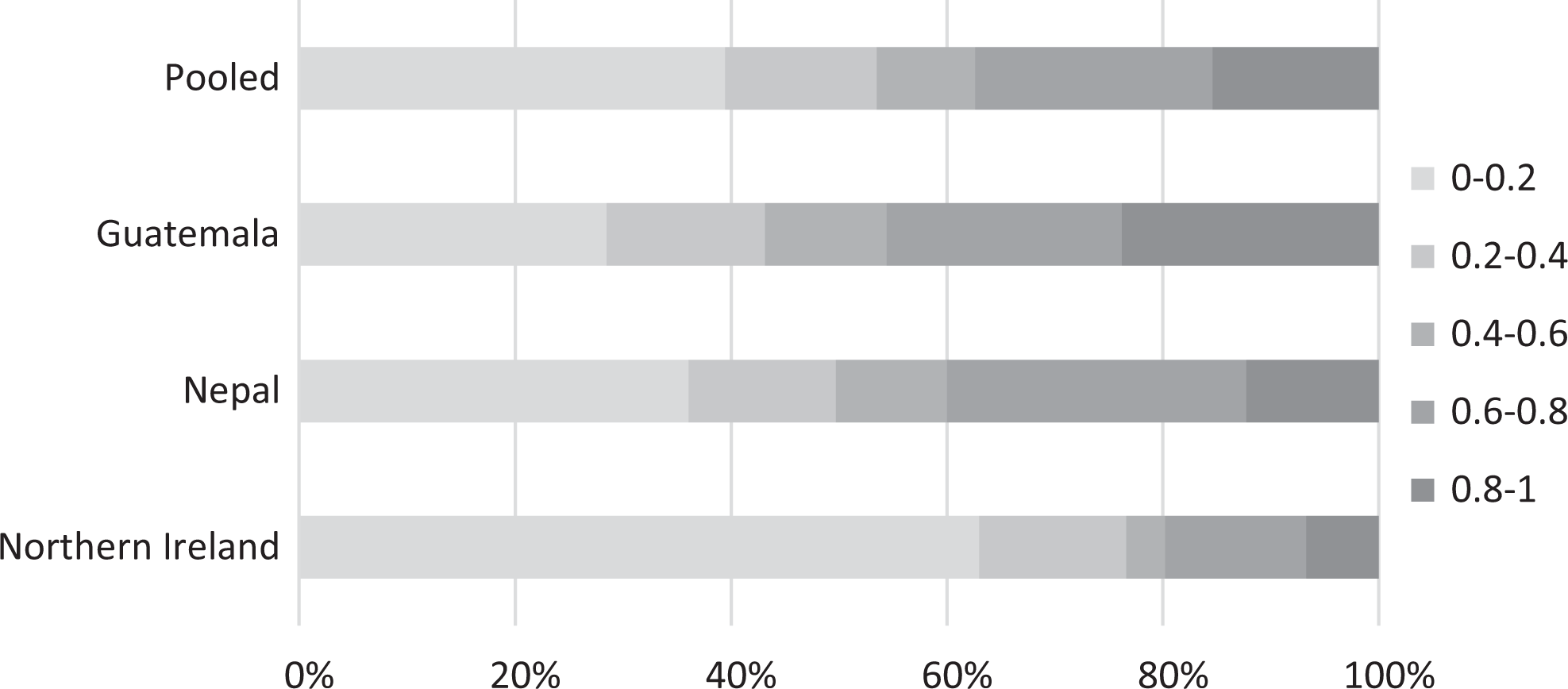
Support for violence, by country.
The PAP data include a variety of measures of grievance: individual- and group-based, economic and political. General (individual) material grievance is measured with a question asking whether respondents consider unemployment and poverty to be “not a problem,” a “minor problem,” a “big problem,” or a “severe problem” in their country (economic dissatisfaction) and with a variable averaging respondents’ answers to corresponding questions about access to good health care and education opportunities (social dissatisfaction). General political grievance is measured with an index that averages responses to corresponding questions about the lack of democracy, restrictions on freedom of expression, and corruption or corrupt authorities (political dissatisfaction). 11 Figure 2 shows the distribution of the dissatisfaction variables by country. On all variables, the dissatisfaction is lowest in Northern Ireland. On the social and political indices, it is also higher in Guatemala than in Nepal. The pattern matches the objective country-level indicators (income, inequality, and quality of democracy) discussed above.
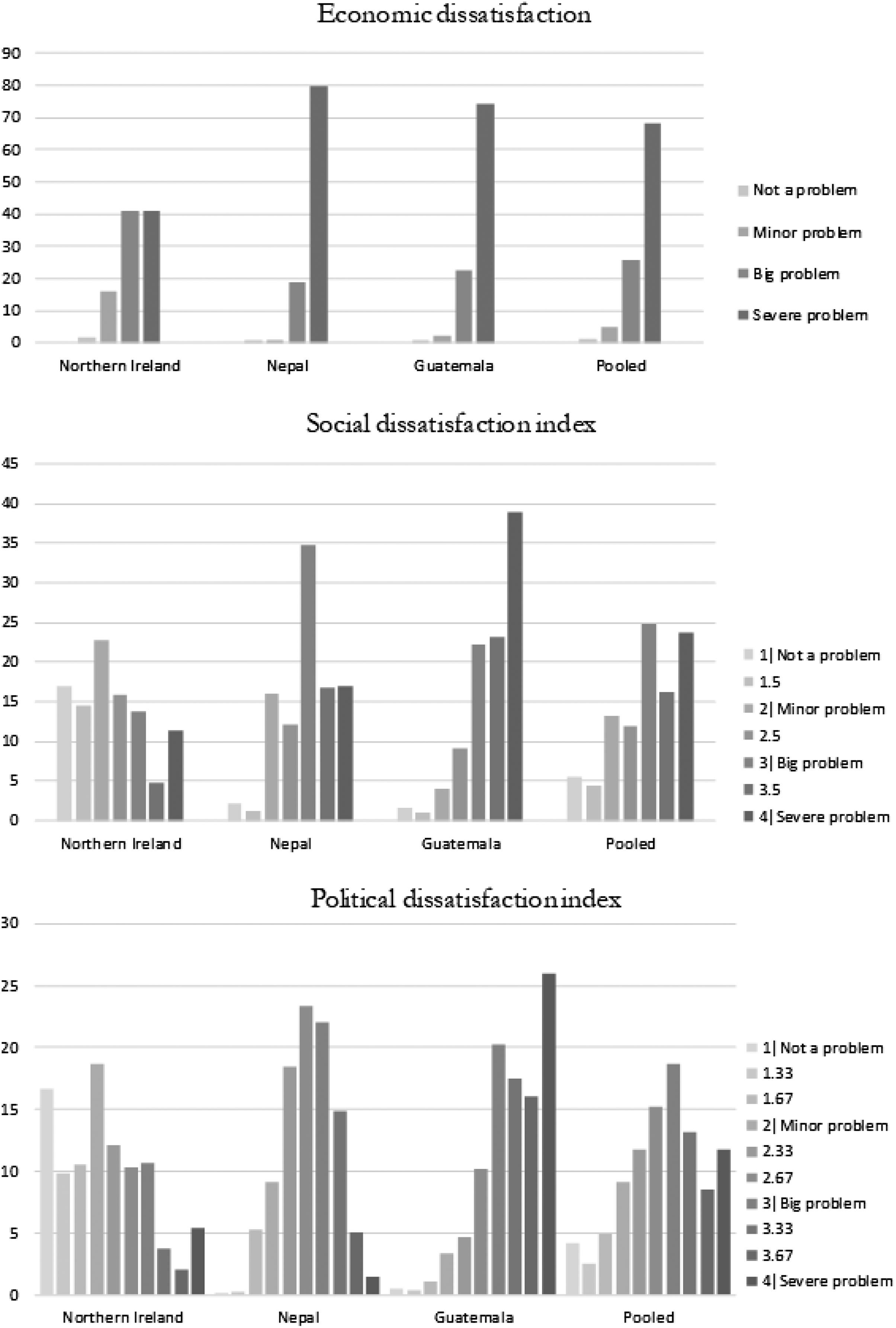
Dissatisfaction, by country.
We measure group-centered political grievance with a question that had respondents choose between two statements: “Political power today is fairly shared between people of different groups” and “Some groups have been unfairly excluded” (political exclusion). We construct a dummy variable flagging respondents who chose the latter to capture subjective evaluations of political exclusion. On the macrolevel, objective political exclusion is among the most consistent motive-based predictors of internal armed conflict, and there is some microlevel evidence that perceptions of low political status compared to other groups increases support for violence. Our question does not ask directly about the political status of the respondents’ own group, however. This conceptual slippage should be reduced by the word “unfairly,” which forces the respondent to evaluate the (un)fairness of the ethnopolitical power balance. Still, this means the variable does not measure the effect of experienced exclusion, but the more general perception that certain groups are unfairly excluded regardless of the respondents’ own experiences. Importantly, members of politically included and excluded groups may interpret the question differently. Our expectation that perceived exclusion increases support for violence is more clear-cut among respondents who experience exclusion themselves. We therefore run the analyses separately for objectively included and excluded groups as a robustness test.
Finally, we include a dummy variable that captures the perception that one’s own group is discriminated (discriminated group). The variable is based on a question on whether the respondent would describe herself as member of a group that is currently discriminated against or being treated unfairly, and denotes respondents who say yes and report discrimination due to religion (Northern Ireland: “or community background”), color, language, or ethnicity (Nepal: “or caste”). This variable closely resembles the “unfair treatment” variables that predict support for violence in previous microlevel studies of perceived inequality. Figure 3 shows the distribution on the group-centered grievance measures.
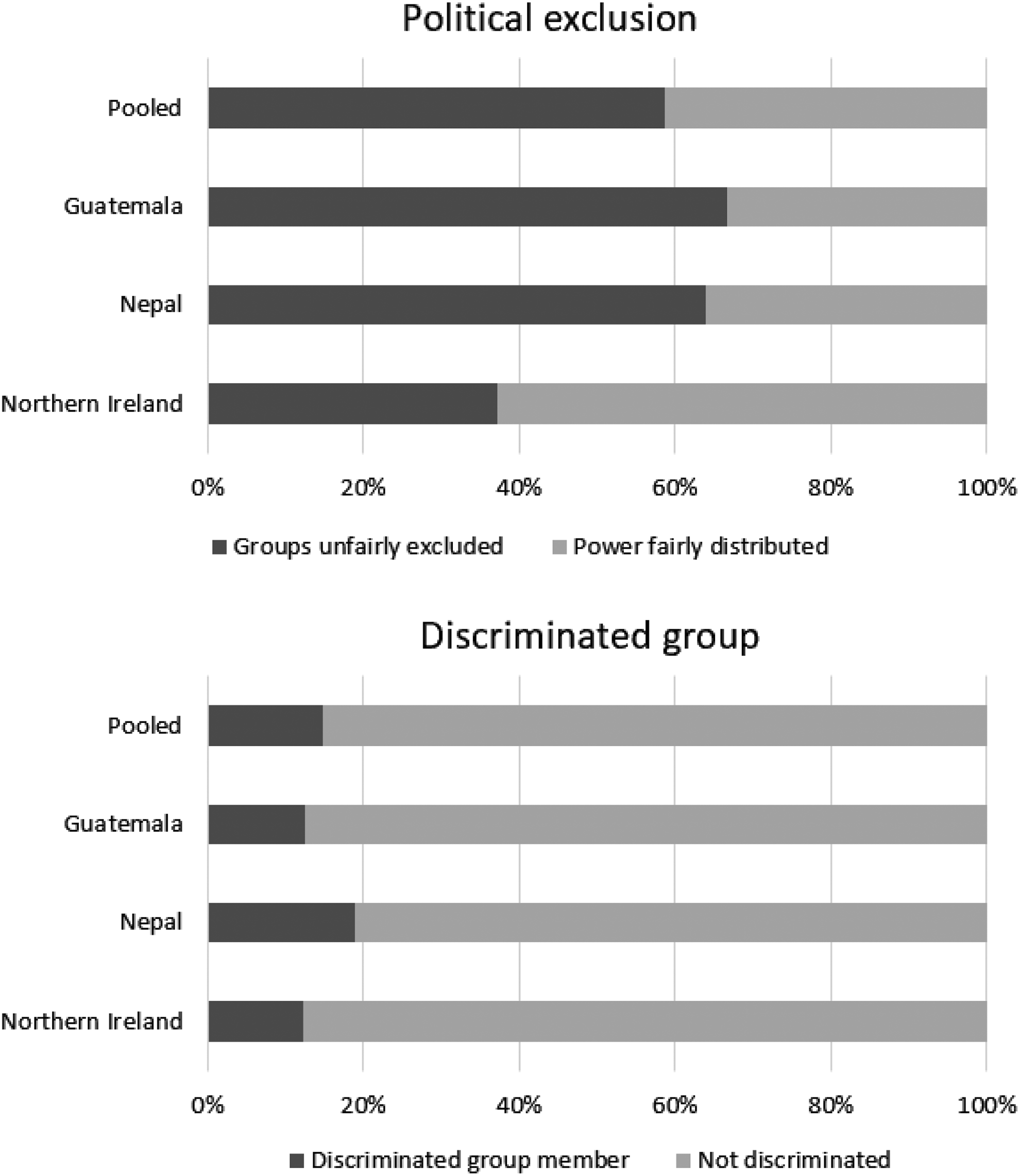
Group grievances, by country.
Perceived (external) political efficacy is measured with a question about whether politicians are interested in getting people’s opinions or just their votes, with the alternatives “Nearly all just interested in votes,” “Some are interested in both votes and opinions,” and “Nearly all are interested in opinions.” There may be aspects of people and groups’ ability to get their grievances redressed within the political system that are not captured by this variable, like their potential influence through labor unions and interest groups, but we argue that it captures the most important dimension of external political efficacy. If people think that all politicians care about is getting elected rather than truly representing the people, the chance of political change within the system seems dismal. The question is based on the European Social Survey question pltinvt, a common approach to measuring external political efficacy (e.g., Sulitzeanu-Kenan and Halperin 2012). Figure 4 shows the distribution of the variable by country. Political efficacy is generally low, with a large majority in all countries responding that politicians are mainly interested in their votes. It is particularly low in Nepal, however, and somewhat less pessimistic in Northern Ireland. Intuitively, one might think the efficacy indicator overlaps conceptually with political grievance. The correlation between these variables is weak, however, and the regression analysis show that their effects overlap very little.
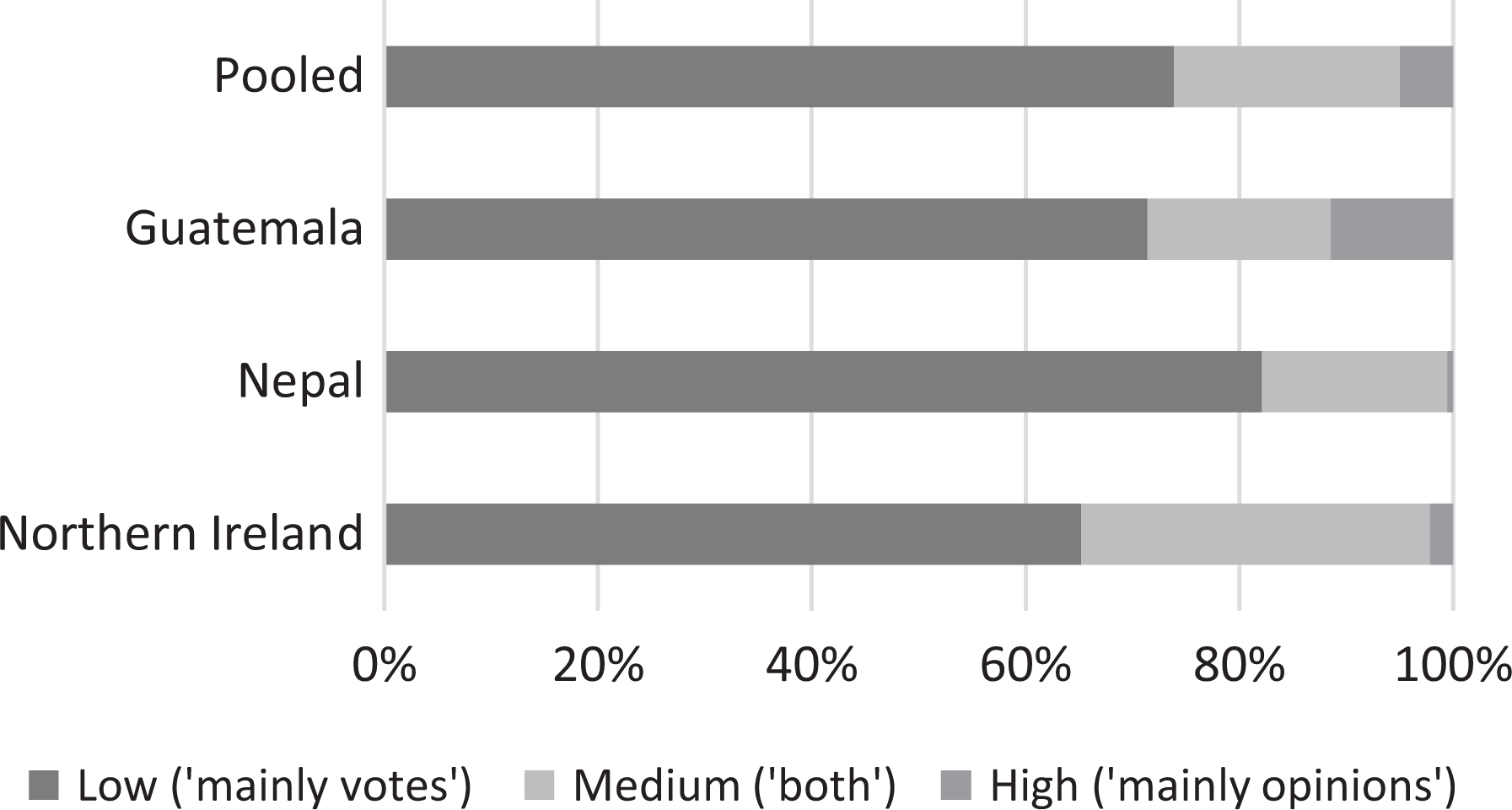
External political efficacy, by country.
The main models are estimated using ordinary least squares regression (OLS), with standard errors adjusted to account for complex sampling designs in Guatemala and Nepal. 12 We adopt a parsimonious control strategy, controlling for age, gender, self-reported poverty, 13 and education. Since the composition of individual characteristics varies between the three samples, and differences between countries could confound the relationships under study, we add country dummy variables, with Guatemala as reference category. Thus, the results in the pooled analyses are driven by within-country variation. In addition, we run country-specific models. Robustness checks include several different model specifications, such as different control variables, and logistic regressions using binary dependent variables.
Analysis
The analysis section is structured as follows. We first present and discuss results for the pooled regression analyses, testing one hypothesis at a time. We then proceed to disaggregate between countries, different justifications for political violence, and run a series of robustness checks and alternative model specifications.
Table 1 reports results for the pooled regression analyses. Model 1 reports results for a regression model including all the grievance variables plus controls (Hypothesis 1), model 2 adds political efficacy, while models 3 to 5 present interactions with different grievance variables (Hypothesis 2).
According to the table, the willingness to justify violence is consistently lowest in Northern Ireland and highest in Guatemala. The other control variables follow the expected pattern: support for violence increases with self-reported poverty, decreases with education and age, and is higher for men than for women.
Model 1 shows, in line with Hypothesis 1, that both material and political grievances, individual- as well as group-centered, are associated with an increase in the latent support for political violence. Social dissatisfaction (concerning access to health care and education opportunities) and the perception that one’s ethnic group is discriminated do not reach statistical significance. Economic dissatisfaction (concerning levels of poverty and unemployment), political dissatisfaction, and political exclusion are all positively and significantly associated with support for violence.
The pooled analysis conceals important differences between countries. Figure 5 shows that the results for economic dissatisfaction and political exclusion are driven mainly by Nepal. The findings for political dissatisfaction are driven by Northern Ireland and Nepal, with similar coefficient sizes (p = .07 in Nepal). Two findings stand out. First, the pooled analysis conceals considerable heterogeneity in the effect of discrimination. Its coefficient is negative for Nepal but positive and significant for Northern Ireland. The latter association is strong in substantial terms: the expected support for violence among respondents in Northern Ireland is 19 percentage points higher among respondents who report belonging to a discriminated group. Second, none of our grievance indicators are associated with support for violence in Guatemala. We discuss these country differences in more detail below. The estimated independent effect of perceived political efficacy is negative and does not overlap much with the effects of grievance (model 2).
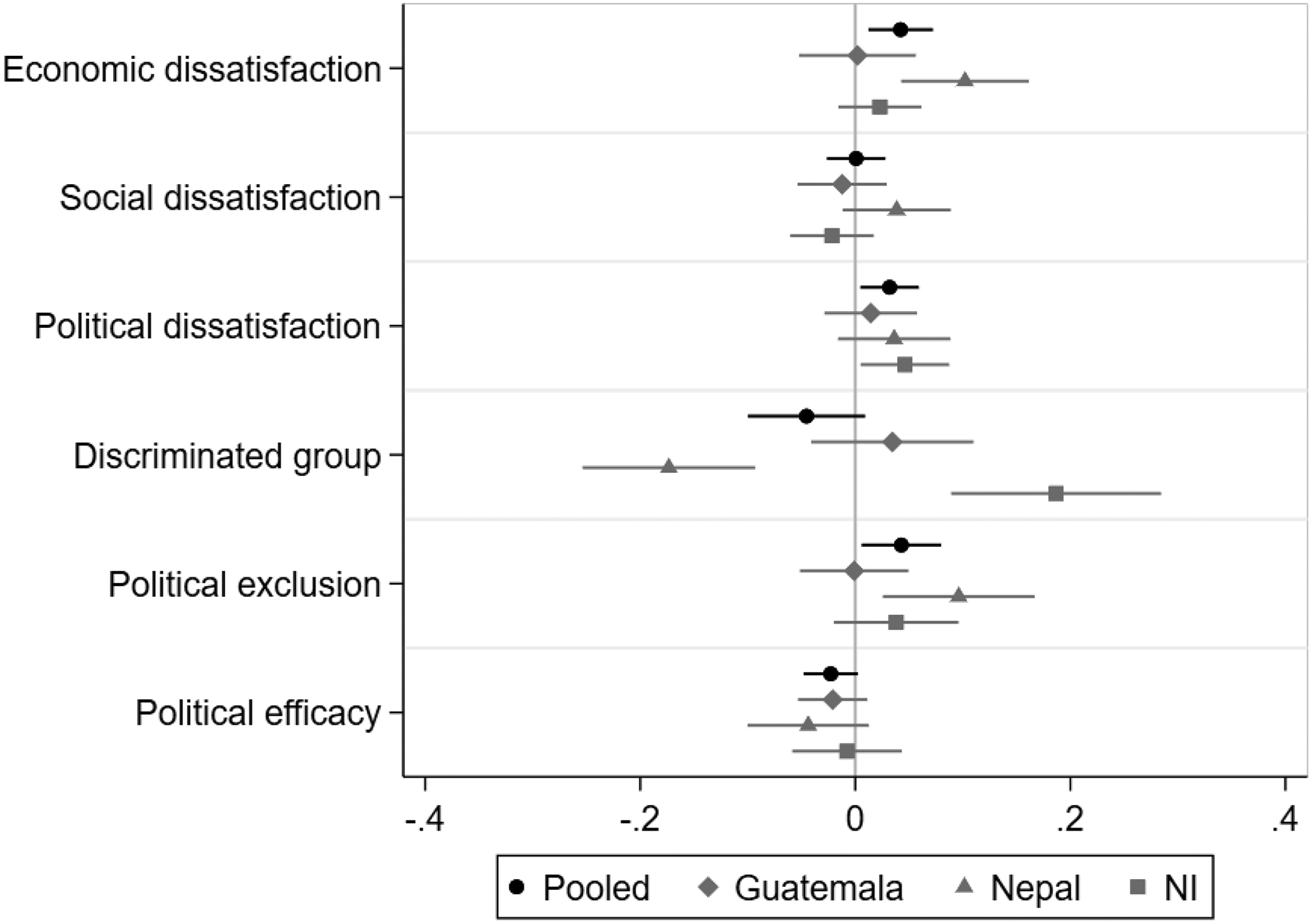
Estimated effects of grievance and efficacy on support for political violence, by country, 95 percent confidence intervals. Corresponds to model 2, Table 1. Results for control variables not reported.
Ordinary Least Squares Regressions of Support for Political Violence.
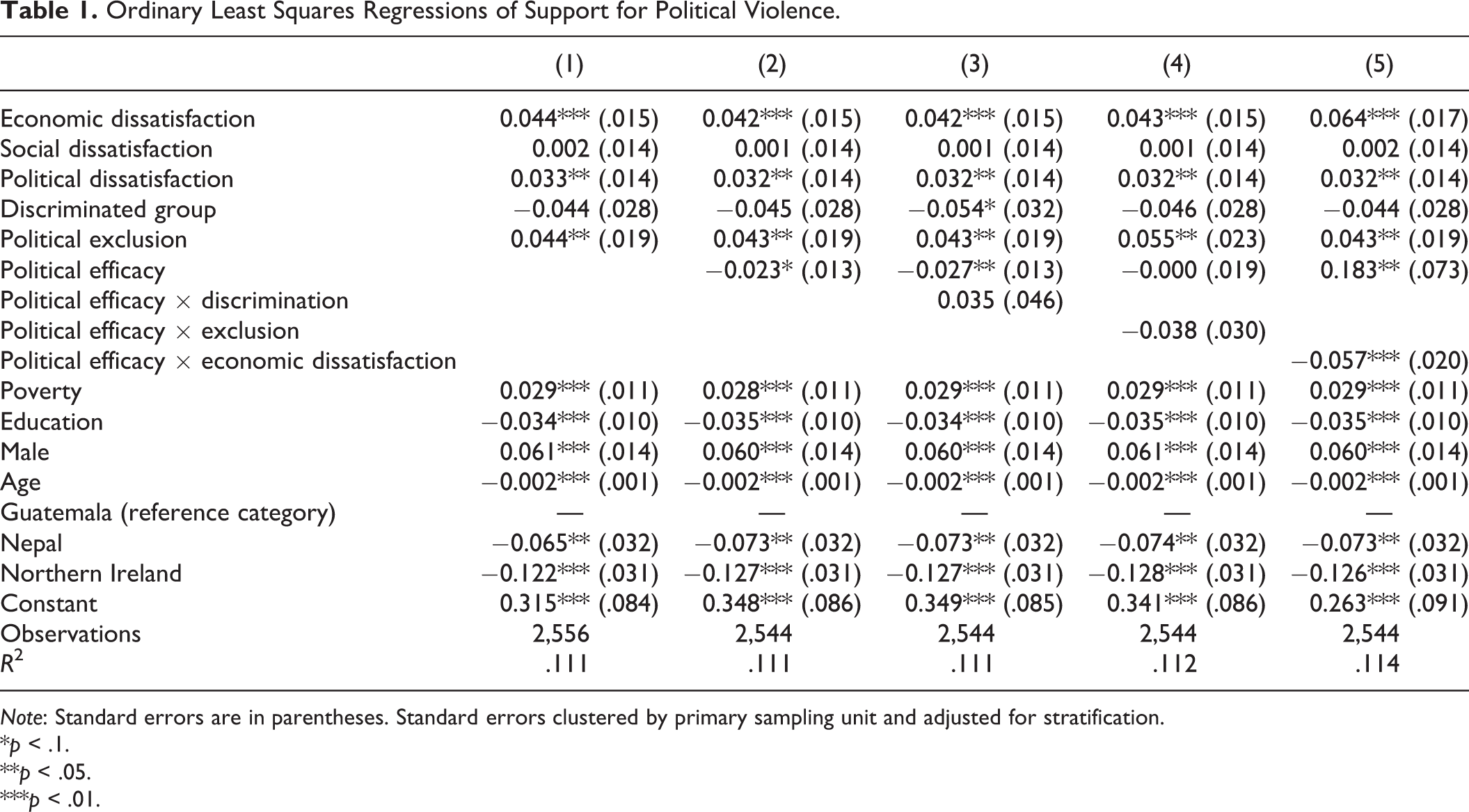
Note: Standard errors are in parentheses. Standard errors clustered by primary sampling unit and adjusted for stratification.
*p < .1.
**p < .05.
***p < .01.
Hypothesis 2 posits that the association between grievance and support for violence is particularly strong among people with low political efficacy. Models 3 to 5 provide some evidence in support of this proposition. The interaction term is negative for political exclusion and economic and political dissatisfaction. It reaches statistical significance for the latter two. As expected, the estimated effect of grievance is strongest among the respondents with lowest efficacy. Disaggregating by country, the interaction terms are negative, but not always significant, in Nepal and Northern Ireland, and practically nonexistent in Guatemala (Online Supplemental Material, Figures A3–A7). Figures 6 to 8 shows how the estimated effect of grievance varies for the different levels of political efficacy. For political exclusion and economic and political dissatisfaction in Nepal and Northern Ireland, the positive relationship between grievance and support for violence reaches statistical significance only among respondents who believe that politicians are interested in their votes rather than opinions (low efficacy). This is consistent with Hypothesis 2. For respondents with higher political efficacy, who think politicians care about their opinions, the estimated effect is smaller or even negative. The latter estimates are less certain than the former because fewer respondents believe politicians care about what they think. Together, these findings add nuance to the conclusion that the salience of different grievances is context-dependent. When comparing Nepal and Northern Ireland, at least, much of the initial difference in the effect of different grievances is explained by differences in political efficacy and its moderating effect on the relationship between grievance and support for violence.
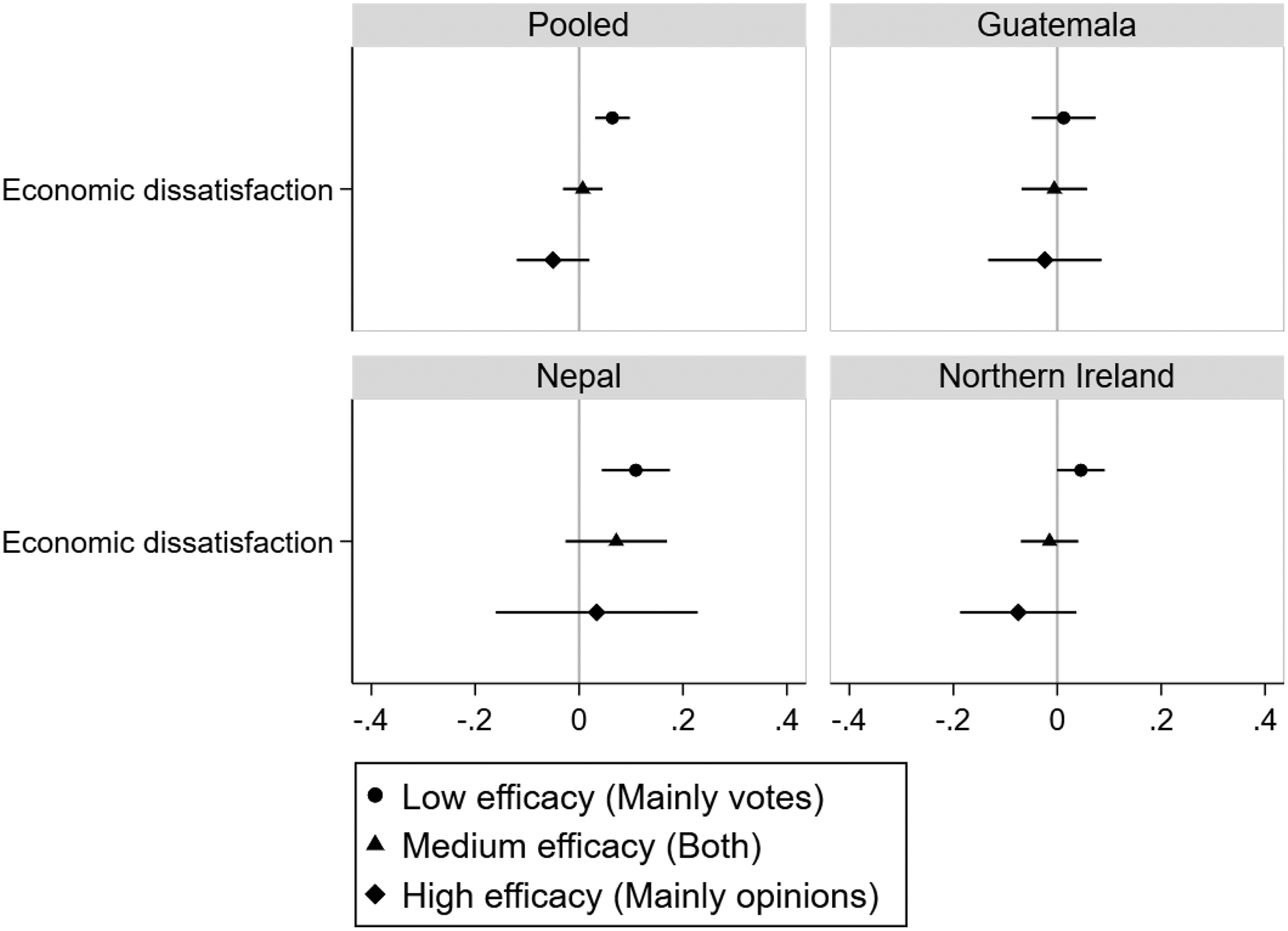
Estimated effects of economic dissatisfaction on support for political violence, by level of political efficacy and country. 95 percent confidence intervals. Corresponds to model 5, Table 1. Results for controls not reported.
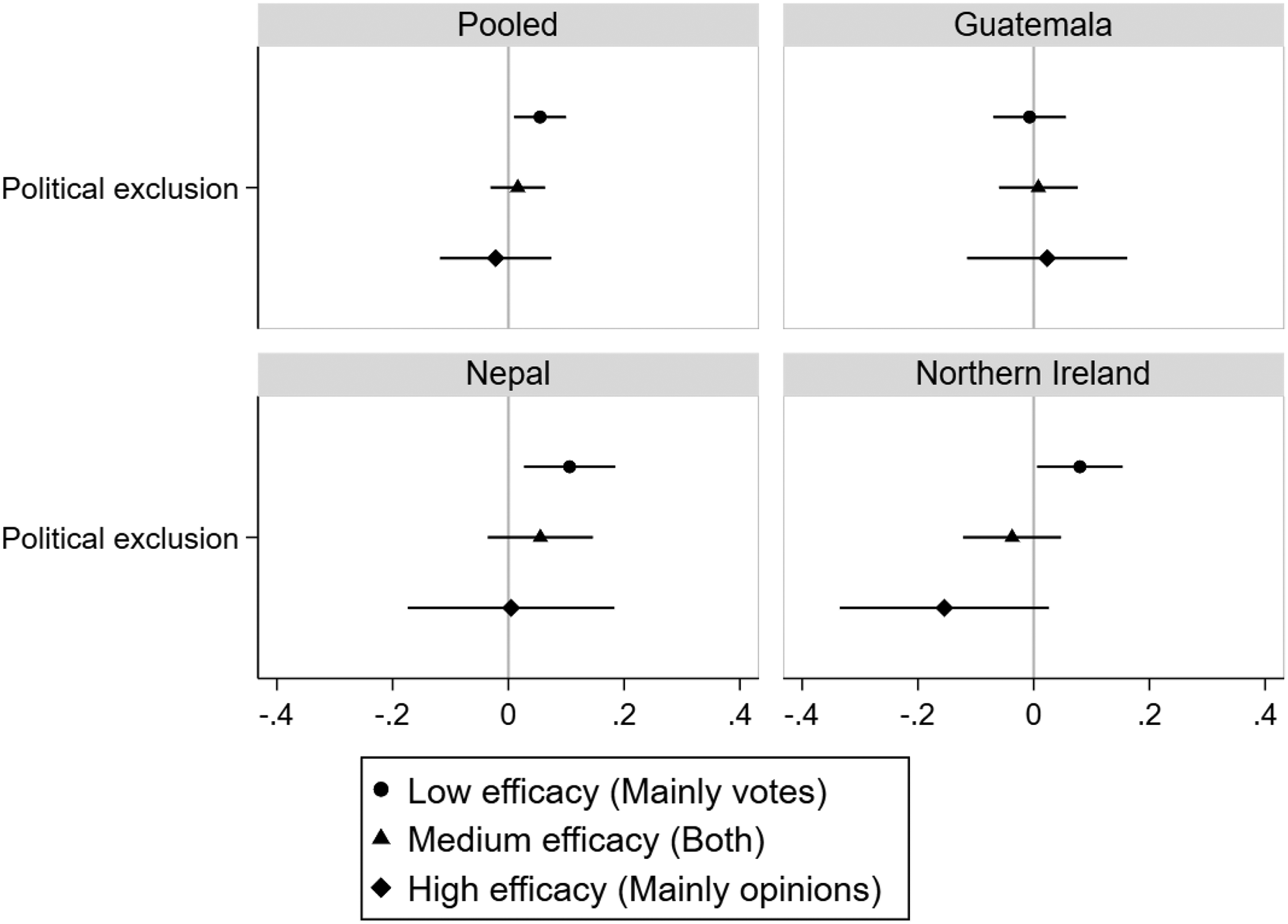
Estimated effects of political exclusion on support for political violence, by level of political efficacy and country. 95 percent confidence intervals. Corresponds to model 4, Table 1. Results for controls not reported.
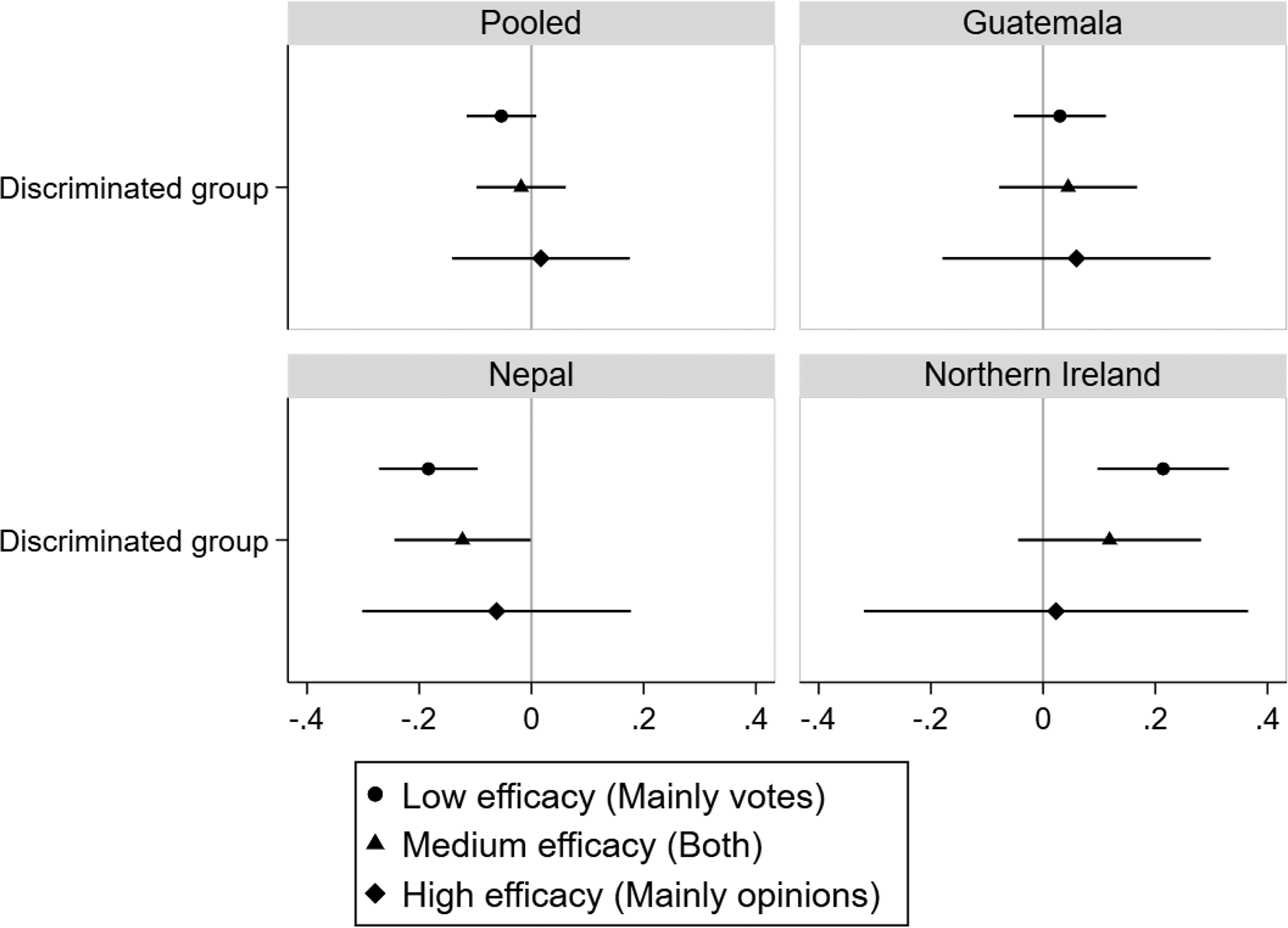
Estimated effects of discriminated group on support for political violence, by level of political efficacy and country. 95 percent confidence intervals. Corresponds to model 3, Table 1. Results for controls not reported.
The political exclusion question asks respondents to evaluate whether unfair political exclusion exists in their country rather than the exclusion of their own groups. It could therefore capture different mechanisms among members of objectively included and excluded groups. To account for this, we rerun the interaction analyses for politically included and excluded groups (as recorded in the Ethnic Power Relations Dataset, v.ETH-2018) in turn (Figures A28 and A29).The analyses show that in Nepal, the effect of perceived exclusion on support for violence is driven mainly by members of objectively excluded groups, as the horizontal inequality literature leads us to expect. Closer inspection reveals that the result in Northern Ireland is driven not by Catholics, however, who have the longest history of exclusion, but by Protestants and respondents who do not belong to either of the two main groups. To some extent, this mirrors the argument of microlevel studies that objective and perceived grievances need not overlap, and the finding from Miodownik and Nir (2016) that the effect of perceived grievance can be driven by groups that are not deprived in objective terms.
Once again, the findings for discrimination stand out (Figure 8). In Northern Ireland, we find the expected pattern, with a negative but not quite significant interaction, and a positive and particularly strong relationship between grievance and support for violence among respondents with low political efficacy. In Nepal, however, the relationship between discrimination and support for violence, while driven by respondents with low external political efficacy, is in fact negative. We believe this has to do with a third strategy for dissent that we do not capture in this analysis: nonviolent protest and contentious action. Nepal has seen an extensive use of nonviolent collective action outside conventional political channels, and such action has been relatively successful. Indeed, the peaceful movements known as Jan Andolan I and II were crucial in the 1990 regime change as well as the reinstitution of parliament in 2006 (Thapa and Sharma 2009). Thus, members of disadvantaged groups in Nepal who perceive conventional political channels as flawed may see nonviolent contentious action as a less costly and perhaps equally effective alternative to political violence and therefore opt to support nonviolent protest at the expense of support for violence. While we are not able to test this explanation with our data, we think it provides an impetus for data collection on support for nonviolent as well as violent contentious action, and perceptions about their relative effectiveness.
The consistent nonfindings in Guatemala are puzzling. None of our grievance indicators are associated with support for violence, no matter which level of political efficacy we investigate. The implications for generalizability are not clear-cut. Most forms of grievance, as measured here, matter less for support for violence in Guatemala than in Nepal and Northern Ireland. This could either suggest that characteristics of the Guatemalan context, like the severity of the conflict experiences, have served to sever the link between grievance and support for violence or that our general grievance measures do not capture the right variation in grievance. Given the generally high level of support for violence in the Guatemalan population, and the suggested link between political dissatisfaction and such support, we find the second explanation plausible. Moreover, we suspect ceiling effects may obscure our results in Guatemala, meaning we are unable to observe the expected relationship because our variables do not capture sufficient variation among respondents who report very high levels of dissatisfaction and support. Future studies of support for violence in Guatemala should aim to measure (political) grievance in a more nuanced and context-specific fashion. More generally, the nonfindings support the notion that different aspects of grievance matter in different contexts. They also shed some doubt on the ability of large cross-country studies to capture grievance reliably across contexts.
Regression diagnostics indicate heteroscedasticity and residuals with a nonnormal distribution (Figures A10–A12). We therefore rerun the models using logistic regression models where the dependent variable is coded 1 if the respondent is willing to justify violence in at least one of the scenarios presented to them as survey items. Logistic regressions generally confirm the findings from the OLS models (Figures A13–A18). The estimated effect of grievance among respondents with low efficacy loses significance for economic dissatisfaction in Northern Ireland and for political dissatisfaction in Nepal.
To understand these differences better, we disaggregate the dependent variable into its specific subcomponents. This gets us closer to the theorized causal relationships. First, we expect support for violence as a response to increasing inequality to be driven by material dissatisfaction, as measured by economic and social dissatisfaction, and to some extent the discriminated group variable. We find little support for this proposition, however (Figure A19). The only significant finding for the socioeconomic variables is for economic dissatisfaction in Northern Ireland. In addition, discrimination loses statistical significance there. Political dissatisfaction, on the other hand, is positive and significant in both Northern Ireland and Nepal, and in the pooled analysis.
Second, we expect support for violence in response to state favoritism toward certain regions or groups to be driven by group grievances, as picked up by the political exclusion and discriminated group variables, more than by general grievances. We find some support for this (Figure A20). But while discrimination is significant in both Nepal and Northern Ireland, political exclusion is not. In addition, more general grievance drives this component of support for violence: social dissatisfaction becomes significant in Nepal and political dissatisfaction in Guatemala. This could suggest that the dissatisfaction variables pick up dissatisfaction with regional differences in service provision and political representation, which we do not measure directly here. Finally, one might expect support for violence when the military becomes too powerful or the government turns repressive and violent to be driven by political forms of grievance. In line with this, political dissatisfaction and exclusion are significant in most of the pooled analyses for these support items (Figures A21 and A22). Yet, each of these results is driven either by Nepal, where economic dissatisfaction comes across as equally important, or by Northern Ireland, where discrimination is the strongest predictor. Overall, the results align closely with the results from the nondisaggregated models.
Attempting to get around the possible ceiling effect in support for violence in Guatemala, we construct a dependent variable that flags only respondents who report support for violence in all four scenarios (Figures A23 and A24). Logistic regressions reveal an association between political grievances and support for violence in Guatemala. The interaction does not run in the expected direction, however. Political exclusion and dissatisfaction return positive and significant effects, but only among people with medium and high political efficacy.
Respondents who refused to respond (or answered “don’t know”) to at least one of the questions we used to construct our variables fall out of the analyses (21 percent). Because questions about grievance and support for violence are sensitive questions, the pattern of item nonresponse is unlikely to be random. Initial analyses of missing values confirm this suspicion (Tables A7 and A8). To gauge the extent of bias this could be introducing into our results, we impute strategically selected values for the missing responses before rerunning the analyses (Figures A30–A44). Most results hold up to both analyses where we impute the value combinations most likely to work in the direction of our hypotheses and, more importantly, the combinations most likely to work against them (details in Online Supplemental Material). The results for political dissatisfaction are sensitive to this rather conservative test for item nonresponse bias and should be treated with some caution. On the other hand, certain relationships could be underestimated in our analysis because of item nonresponse. This includes the effect of social dissatisfaction in Nepal and of economic and political dissatisfaction in Guatemala.
The results are not sensitive to the choice of control variables. They hold up when we remove the education and poverty variables (Table A4), add dummy variables for unemployment and student status (Table A5), or include control variables for conflict experience (Table A6). 14
Interestingly, results hold up when controlling for identity groups (instead of countries) as well (Figures A25 and A26). Thus, the associations are not driven by potential group-level confounders such as peripheral location, group size, or group concentration. They result from within-group variation in perceived grievance, not from objective differences between groups. This variation within identity groups is underexplored in the macroliterature on horizontal inequality and conflict, which tends to assume that subjective grievances correspond well to objective inequality.
Conclusions
The starting point for this article was an argument implicit in much of the civil war literature: aggrieved people should be particularly prone to consider political violence legitimate “if they also consider peaceful means of influence ineffective.” While plausible, this interaction has not been examined at the individual level. In a first empirical test of the argument, we provide some evidence in support of the proposed mechanism. According to our findings, grievances and low external political efficacy are both associated with a higher propensity to support violence, and the combination of the two is particularly powerful. In line with previous research (e.g., Detges 2017; Koos 2018; Hillesund 2015; Rustad 2016; Miodownik and Nir 2016), we find that a wide range of grievances matter for support for violence. Different forms of grievance do not matter equally much for support in all contexts, however. The weaker findings in Guatemala could suggest either that country characteristics sever the link; that context-specific grievances are hard to capture across countries; or that high levels of dissatisfaction and support for violence produce a ceiling effect. Cross-country research across more cases is required to get a better understanding of how context may moderate the effect of grievance. At the same time, our findings somewhat temper our faith that (perceived) grievances can reliably be reliably measured in cross-country studies.
The evidence that the effect of grievance is moderated by the opportunity structure is not very strong in terms of statistical significance, but it is remarkably consistent across grievance measures and contexts (except in Guatemala). The statistical uncertainly stems from the fact that few people report high political efficacy. Future research would benefit from adopting more nuanced measures, which could capture more variation among people with low efficacy.
The interaction between grievance and opportunity structure suggests that support for violence is not driven by anger alone. Rather it is conditional on instrumental considerations, like the perceived ability to succeed with nonviolent means. This underlines the importance of institutions in conflict prevention. If people believe they can have their grievances addressed through regular political channels, their anger can be funneled into peaceful opposition, which helps undermine the ability of violent insurgency to take root. Future research should investigate whether the relationships hold for conflict participation. For participation, we expect the interaction with opportunity structure to be stronger. Because it is costlier to participate in than to support violence, participation in violence should be a particularly unlikely response to grievance among people who believe they can achieve change peacefully. Because of the higher personal risk and cost of participation, we also expect group grievances to become more important, compared to more general grievances, because the former facilitates overcoming the collective action dilemma. Finally, we expect other elements of the opportunity structure to come to the fore and condition the grievance–violence relationship, like individual opportunity cost.
The findings have several other implications. First, we provide microlevel evidence for the notion that opportunities and motivation should be seen as complementary rather than competing explanations for political violence and civil war (Bara 2014). The findings are also consistent with arguments about the importance of accountable institutions to break the conflict trap (Walter 2014; Hegre and Nygård 2015).
Second, the joint effect of efficacy and motivation lends some individual-level support to anocracy arguments about civil war: In democracies, dissatisfied individuals tend to refrain from violence because they recognize that regular channels of expression and participation are open and relatively functional. In anocracies, the combination of relatively low external efficacy and widespread grievance may lead to a greater risk of political violence. At the country level, the empirical pattern is in line with the theoretical argument. Obviously, data from three cases can only be indicative. We find that there is less willingness to justify political violence in Northern Ireland than in Guatemala and Nepal, where the political systems offer less opportunity for meaningful political participation, and where ethnic exclusion and widespread poverty provide ample motivation for political change. Consistent with this, we find that compared to citizens in Guatemala and Nepal, people in Northern Ireland overall report of higher political efficacy and are generally more satisfied.
The findings could also have implications for the scholarly understanding of conflict escalation, as escalation should be more likely where there is latent acceptance of political violence. Several authors note an interdependence between repression and protest (Carey 2006; Chenoweth and Lewis 2013; Asal et al. 2013). This article provides a plausible microlevel mechanism for how government repression may radicalize a movement. Notably, of the different justifications of political violence provided in this study, government repression was the most widely accepted. This may help explain how initially peaceful protests turn violent in the face of a violent response. Importantly, repression could shift people’s perceptions of available means of channeling their grievance and increase their willingness to support violence against the regime.
Several suggestions for future research emerge. Empirical investigations of support for violence and the grievance–opportunity interaction should move beyond the postconflict context and beyond electoral democracies. More work is also needed to ensure that measures of grievances adequately capture different dimensions and levels of grievance, balancing the need for context-sensitivity with the need for comparativeness. Future studies should also be designed to better address the issue of causality.
Finally, the increase in protest behavior in Latin America during the last decades (Justino and Martorano 2019) points to a final avenue for future research. The last wave of democratization probably increased overall external political efficacy but failed to redress a range of grievances. In addition, a series of costly civil wars with limited results may have reduced the overall perception of the effectiveness of political violence, however. If aggrieved people lose faith in political violence, but believe nonviolent protest can generate change, an upsurge in protests is exactly what we should expect, as discussed for Nepal above. More research on how people evaluate the relative effectiveness of violent and nonviolent forms of dissent and contentious action is needed to bolster these speculations. It should be coupled with data collection on individual-level support for, and participation in, both modes of collective action.
Supplemental Material
Supplemental Material, sj-pdf-1-jcr-10.1177_0022002720909886 - Explaining Support for Political Violence: Grievance and Perceived Opportunity
Supplemental Material, sj-pdf-1-jcr-10.1177_0022002720909886 for Explaining Support for Political Violence: Grievance and Perceived Opportunity by Karin Dyrstad and Solveig Hillesund in Journal of Conflict Resolution
Footnotes
Authors’ Note
Equal authorship. Complete replication files can be found along with the online supplemental material on the JCR SAGE webpage.
Acknowledgments
We would also like to thank the editor and three anonymous reviewers for their valuable suggestions.
Declaration of Conflicting Interests
The author(s) declared no potential conflicts of interest with respect to the research, authorship, and/or publication of this article.
Funding
The author(s) disclosed receipt of the following financial support for the research, authorship, and/or publication of this article: We gratefully acknowledge financial support by the Research Council Norway (Grant No. 240446).

Supplemental Material
Supplemental material for this article is available online.
Notes
References
Supplementary Material
Please find the following supplemental material available below.
For Open Access articles published under a Creative Commons License, all supplemental material carries the same license as the article it is associated with.
For non-Open Access articles published, all supplemental material carries a non-exclusive license, and permission requests for re-use of supplemental material or any part of supplemental material shall be sent directly to the copyright owner as specified in the copyright notice associated with the article.
