




Abstract
Why do fraudulent elections encourage protesting? Scholars suggest that information about fraud shapes individuals’ beliefs and propensity to protest. Yet these accounts neglect the complexity of opinion formation and have not been tested at the individual level. We distinguish between the mobilizing effects of actual incidents of election fraud and individuals’ subjective perceptions of fraud. While rational updating models would imply that both measures similarly affect mobilization, we argue that subjective fraud perceptions are more consistent predictors of protesting, also being shaped by attitudes, information, and community networks. Our empirical analysis uses geo-referenced individual-level data on fraud events, fraud perception, and protesting from the 2007 Nigerian elections. Our analysis yields two main findings: proximity to reported fraud has no effect on protesting and citizens perceiving elections as fraudulent are consistently more likely to protest, and more so if embedded in community networks.
Contrary to expectations of major irregularities and mass violence voiced in the run-up to the 2015 general elections in Nigeria, the vote took place without centralized systematic fraud and proceeded largely peacefully (European Union Election Observation Mission [EU EOM] 2015, 4, 6, 31). Opposition party candidate Muhammadu Buhari won the presidential election, and results were quickly accepted by incumbent President Goodluck Jonathan, bringing about the first peaceful hand over of power by an incumbent president in Nigerian history. In comparison, massive irregularities and violence in earlier elections in 2007 and 2011 had triggered widespread protests and rioting during and after the vote (EU EOM 2007, 1-3, 6, 27; EU EOM 2011, 3, 27). At face value, this evidence suggests a link between the incidence of election fraud and popular mobilization where elections marred by irregularities are followed by contention, whereas the absence of large-scale manipulation produces more stable and peaceful outcomes. The political science literature largely confirms such a link between electoral manipulation, on the one hand, and nonviolent and violent collective protest, on the other, suggesting that election fraud induces grievances and reveals information to citizens that combine to facilitate various types of collective action (Kuntz and Thompson 2009; Tucker 2007). Yet, while theoretical arguments focus on individual-level motivations, systematic empirical assessments have evaluated them at more aggregate levels (Daxecker 2012; Hyde and Marinov 2014). An aggregate analysis, though useful for highlighting general patterns, is limited in evaluating whether those engaging in postelection collective action are motivated by objective (i.e., experience or information) or subjective (i.e., perception) evaluations of electoral problems. If citizens protest because they perceive elections as fraudulent rather than because they have received information about fraud in their vicinity, the relationship between election fraud and protesting could be subject to a variety of confounding factors such as partisanship or other biases. While knowing whether fraud perceptions, actual events, or both motivate citizens’ decision to protest is crucial for scholarship and policy, these issues remain largely unexplored.
Figure 1 shows correlations in citizens’ protest participation, perceived electoral fraud, and fraud reported by international observers in recent African elections. 1 To create the figure, we aggregate data on fraud perceptions and protesting for all countries surveyed in Afrobarometer rounds 1 (1999 to 2001), 3 (2005), and 4 (2008) and combine them with information on fraud reported in most recent elections by monitoring organizations from the National Elections in Democracy and Authoritarianism data (Hyde and Marinov 2012) and the Quality of Elections data (Kelley and Kolev 2010). 2 The resulting data set includes fifty country-year observations with information on whether organizations reported election fraud, the percentage of respondents perceiving elections as fraudulent, and the percentage participating in protests.
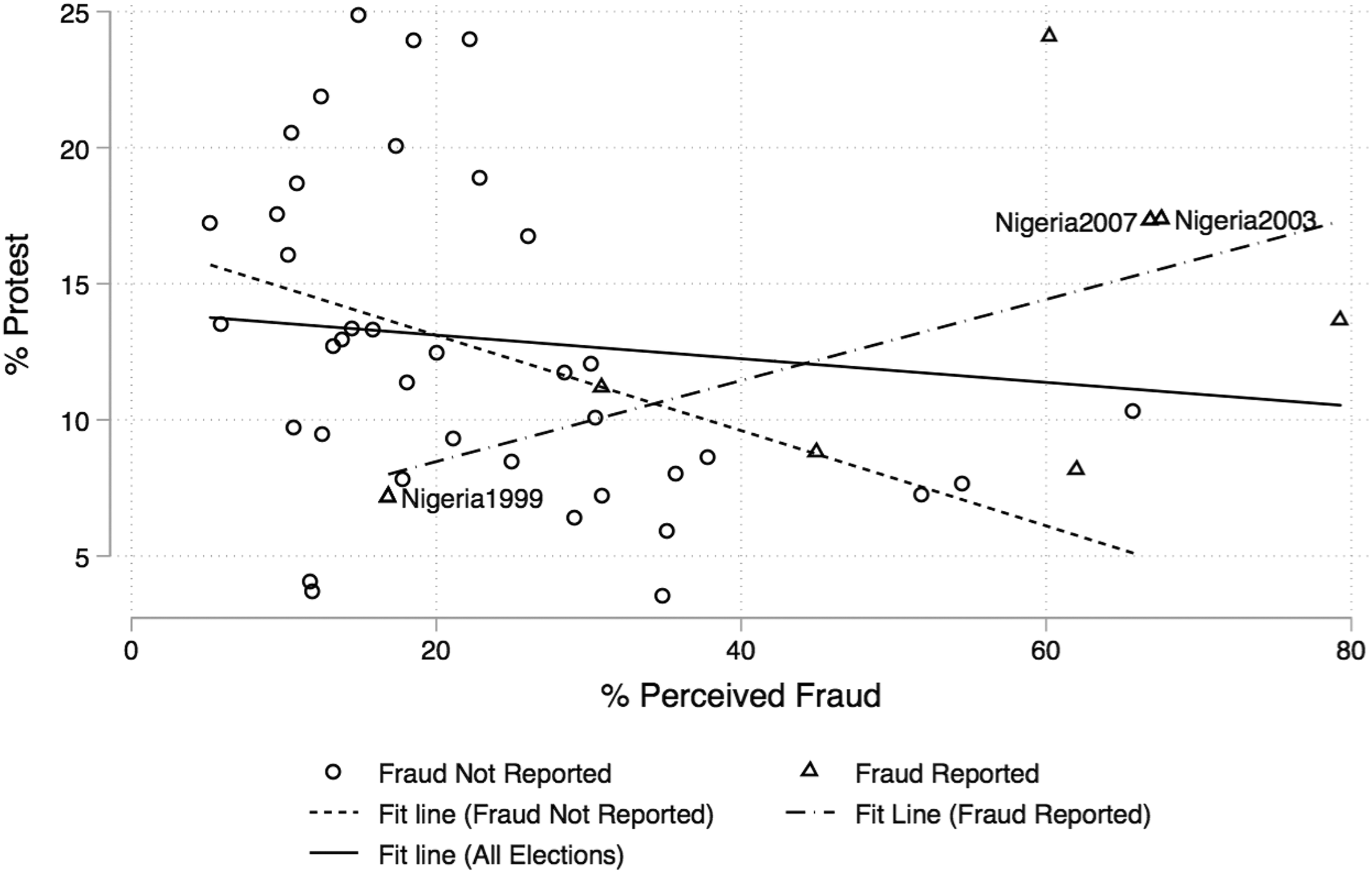
Perceived fraud, reported electoral fraud, and protest participation in African elections 1999 to 2010.
Figure 1 plots the association between fraud perception and protesting, distinguishing between elections with fraud reported by monitors (triangle markers) and those without (circle markers). The dashed fitted lines show linear predictions for cases with and without observed fraud, whereas the solid line shows linear predictions for all observations. The solid line indicates no clear association between fraud perception and protesting overall (r = −.14) and a weak negative correlation in cases where monitors did not detect fraud or did not observe elections (r = −.41). There is a moderate positive correlation between perception and protesting in observed elections (r = .54), which is consistent with research showing that actual fraud, in particular if reported by international monitors, increases postelection protest (Hyde and Marinov 2014). Interestingly, the Nigerian elections in 1999 reveal a third, albeit empirically rare scenario. In these elections, fraud was reported by international monitors, but elections were not perceived as fraudulent by a large percentage of the population. We note that low fraud perceptions were accompanied by low protesting in the 1999 elections, but hesitate to draw broader inferences, considering the lack of other cases in this category. Overall, Figure 1 suggests diverging relationships for fraud perceptions, reported fraud, and protesting, supporting our call for disaggregated assessments.
Our article makes four contributions. First, we introduce the distinction between reported incidents of electoral fraud, and hence more objective, and individual perception of electoral fraud, which is more subjective in comparison. The study of protest after electoral fraud has mostly assumed fraud to be an objective element of the rational calculus of mobilization, suggesting that individuals update their beliefs about fraud as a function of experiences with, or information about, actual fraud events. We argue that subjective perceptions are complex and are not simply reflections of factual information, suggesting a more consistent relationship between fraud perception and mobilization than between reported fraud and mobilization. We purposely select the Nigerian 2007 elections as a case that fits macro-level patterns on reported fraud and protesting (see Figure 1) because it allows us to establish more convincingly whether aggregate patterns reflect causal pathways at the microlevel. In particular, we can trace and compare the effect of observational and perception-based measures of fraud on decisions to protest. Using disaggregated data on reported fraud by the European Union (EU) and domestic observers (among others), perceived fraud by citizens, and protesting from the 2007 Nigerian elections, our empirical findings support the importance of individual perceptions, confirming recent research linking individual fraud perceptions and protesting (Norris 2014). Yet we find no clear evidence that protest is directly motivated by reports of fraud incidents in citizens’ proximity, which contradicts theoretical claims made in the existing literature. Validations of our fraud measure show that it has expected effects on other attitudinal indicators including decreasing citizens’ trust in the electoral commission. We also show that our findings are not a result of measurement error or systematic bias (See Online Appendix A2). In contrast, our study finds consistent effects of fraud perceptions on protesting, suggesting that people’s beliefs about whether fraud occurred may be subject to partisan or other biases rather than information about factual events. Scholars of US politics are increasingly exploring the causes and consequences of people’s divergent beliefs about their political environment, including the integrity of elections, but these issues have rarely been examined in developing countries, despite the fact that information scarcity and politicization may figure even more prominently.
Second, we explore potential reasons for the disparate findings for reported fraud and citizens’ fraud perception by examining a variety of confounding factors. We include support for losing candidates, citizens’ information levels, and individuals’ connections in the community to examine whether the effect of perceived fraud is conditional on these confounders. In contrast to other work (Robertson 2015), we do not find evidence consistent with a prominent alternative to the rational updating model of opinion formation, the motivated reasoning model. Political attitudes such as the winner–loser gap do not condition the effect of fraud perceptions on protesting. Similarly, we find no conditional effect for information levels, contradicting claims that fraud primarily mobilizes informed citizens (Norris 2014, 12). We find some evidence for a conditional effect of community networks. Individuals active in community organizations are more likely to mobilize if they perceived elections as fraudulent or were in the proximity of a reported fraud incidence (although the effect is weak for reported fraud). These findings support ample work on the importance of social embeddedness for mobilization (Granovetter 1985; Putnam 1994; Trejo 2012).
Third, our findings on reported fraud and fraud perceptions are important for policy. Our results call into question whether reporting on election fraud by international or domestic election observers affects individuals’ perceptions of election integrity—and in consequence their actions such as willingness to protest—in ways these organizations seem to assume. Practitioners suggest that observer reports influence citizens’ fraud perceptions (Merloe 2015), but we would then expect that fraud perceptions and information about fraud affect protesting similarly. Our findings are in line with recent work showing only limited effects of observers on perceptions of integrity (Bush and Prather 2017).
Fourth, our article shows that the choice of observation-based versus perception-based measures is not trivial. Recent trends toward disaggregation in the study of protest and conflict reflect an interest in testing theoretical mechanisms at appropriate levels of analysis. Yet existing literature relies primarily on subnational observational data cataloguing contentious events, ignoring that citizens may hold widely divergent beliefs about these events (Silverman 2018). In our study, only perception-based fraud measures produce findings consistent with theoretical expectations about the mobilizing effect of election fraud, whereas observation-based measures with high subnational disaggregation do not show any significant results. Citizens’ decision to protest in response to fraud hence seems shaped by their subjective perceptions of what is happening rather than neutral assessments of fraud events.
Elections and Collective Action
The literature on collective action has often noted the importance of elections as triggers of nonviolent and violent mobilization. Elections can function as focal points that help create an occasion for participation in collective action (Oliver 1989; Schedler 2009; Tucker 2007). While elections have provoked reactive electoral mobilization in advanced, industrialized democracies, research has mainly focused on nondemocratic states holding elections because the disconnect between the principles and practice of participation appears crucial in motivating mobilization (McAdam and Tarrow 2010; Schedler 2009). Factors argued to contribute to electoral contention are elections in which intimidation and election fraud are widespread (Daxecker 2012; Fjelde and Höglund 2016; Hyde and Marinov 2014; Kuntz and Thompson 2009; Trejo 2014; Tucker 2007), poor economic performance that induces voters to publicly express a desire for greater democracy (Brancati 2013), strong and effective opposition parties that help coordinate antiregime action (Beaulieu 2014a; Bunce and Wolchik 2010), and antiregime protests in neighboring states inspiring protests (Beissinger 2007).
While existing work thus suggests several plausible pathways linking elections to collective action, the mechanisms linking electoral processes to individuals’ decisions to participate in potentially risky and costly nonviolent or violent mobilization are often undertheorized. We highlight two major understudied aspects. First, how individuals perceive the conduct of elections influences protest dynamics, but whether participation is affected primarily by subjective perception of fraud or instead proximity to actual reported fraud is ignored in the literature. Second, we assess how fraud (real or perceived) can affect mechanisms of mobilization at the microlevel. Since large-scale protests or violence cannot occur without the participation of many individuals, a focus on opposition parties, for example, relies on the implicit assumption that parties can mobilize voters at will and fails to consider whether, and how, individuals’ responses to elite behavior vary. Work that more clearly considers individual incentives to participate, such as arguments on how fraud aggrieves voters or how individuals’ desire for democracy is shaped by economic conditions, is better able to theorize individual motivations. Yet systematic empirical analyses of individual-level explanations assess the incidence of collective action in the aggregate by examining the yearly number of protests during elections or the level of violence per election (von Borzyskowski 2013; Brancati 2013; Daxecker 2012; Hyde and Marinov 2014; Trejo 2014). This “center-centered” focus of scholarship on electoral protest neglects significant subnational variation in the incidence of election fraud and protesting (Lankina 2015). Importantly, an analysis aggregated to the election country-year cannot tell us whether people turning out to protest are motivated by fraud events, fraud perceptions, or both. Explicit theorizing on fraud as a motivation for protesting and systematic empirical tests at the individual level is thus missing in the literature on electoral mobilization.
From Election Fraud to Protesting: Explaining Individual Incentives
Why do elections, and particularly fraudulent elections, affect citizens’ decisions to protest? 3 Scholars have noted that the introduction of elections produces a desire for the expressive benefits of voting even in nondemocratic regimes (Gandhi and Lust-Okar 2009). As Schedler (2009) puts it, electoral authoritarian regimes “institute the principle of popular consent, even as they subvert it in practice,” yet thereby endowing “citizens with normative as well as institutional resources” (p. 388) that can be utilized to engage in collective protest. Fraudulent elections can thus function as focal points for collective action, facilitating coordination and allowing discontent with the system to crystallize into electoral mobilization (Schedler 2009; Tucker 2007).
Proximity to Fraud and Mobilization
Election fraud represents one moment in which the tension between the principle and practice of popular consent in electoral regimes should be most apparent to citizens. The gap between what is institutionally and practically possible is arguably greatest when voters’ consent is violated blatantly, widely, and openly, as in elections where intimidation and fraud run rampant. It is thus intuitively plausible to expect that those in the immediate vicinity of election fraud would be more likely to express their discontent by protesting and participating in collective action. 4 Being close to actual fraud events may capture two dynamics: first, a higher risk of actual individual experience with election irregularities, and second, a higher probability of acquiring information about fraud through acquaintances or the local media. With regard to individual experience, voters who suffer from threats or acts of intimidation, who are prevented from voting, who are pressured to sell their vote, or who observe ballot stuffing should experience more grievances and thus be more likely to mobilize (Kuntz and Thompson 2009). 5 With regard to information, those close to actual fraud should be more likely to find out about it, whether through acquaintances or the media. Increasingly certain beliefs about fraud subsequently alter individuals’ cost–benefit calculation, increasing their confidence in the likelihood of a protest being successful (Little 2012; Tucker 2007). 6 Moreover, information about fraud can spread to other communities once evidence on fraud is reported in the local media. 7
Proximity to fraud events, then, should be linked to a greater propensity for protesting because it means citizens may have experienced fraud firsthand or because they receive information about its incidence. The first hypothesis thus posits that proximity to observed fraud leads to collective protest. Below, we also examine possible conditional effects.
Fraud Perception and Mobilization
We proceed to discussing how citizens’ subjective perception of election fraud affects mobilization. On the one hand, prominent models of opinion updating expect that new information affects individual perceptions in unbiased and efficient ways (Gerber and Green 1999). For election fraud, this model suggests that individuals rationally update their beliefs when information about irregularities—whether through personal experience or the media—becomes available. Existing arguments on fraud and mobilization indeed imply that individuals update their perception of elections in response to credible information about fraud (Hyde and Marinov 2014; Tucker 2007), but these effects have not been established at the individual level (Bush 2015). 8 Practitioners similarly suggest that information about election fraud from journalists, citizen monitors, and domestic and international observers affects citizens’ perceptions of elections, although recent experimental work establishes only modest individual-level effects (Bush and Prather 2017). Hence, according to the rational updating model, individuals’ subjective perception of elections as fraudulent should primarily be a function of knowing about fraud and affect mobilization in ways similar to proximity of fraud discussed above: citizens mobilize when information about fraud incidents becomes available. 9
On the other hand, subjective fraud perceptions may be more complex than simply being a function of actual fraud. They could be shaped by preexisting expectations of fraud, political attitudes on democracy more broadly, support for the losing party, among others. For example, the motivated reasoning model suggests that individuals systematically disregard information that is inconsistent with preexisting conceptions (Gaines et al. 2007; Lodge and Taber 2013), suggesting that only those supporting the opposition would form fraud perceptions and protest. Below, we develop some of these possible conditional effects, but we first examine whether fraud perceptions have a direct effect on protesting. Since we examine the effect of proximity to fraud separately in Hypothesis 1, empirical results for the hypotheses will help determine the relative importance of actual versus perceived fraud in mobilizing individuals.
Conditional Effects
We have outlined direct effects of proximity to fraud and fraud perceptions in Hypotheses 1 and 2. However, a host of confounding relationships could also shape fraud perceptions or the effect of reported fraud on protesting, including the winner–loser gap, citizens’ information levels, and individuals’ connections in the community.
First, in contrast to rational updating, work on motivated reasoning finds that citizens’ political orientation influences how information is acquired and processed, with the result that reports of election fraud increase fraud perception only for those already opposed to incumbents (Robertson 2015). Others have shown that those supporting losing candidates generally assess elections more critically (Beaulieu 2014b; Birch 2008; Cantú and García-Ponce 2015), suggesting that a winner–loser gap shapes fraud perceptions. This gap implies that fraud perceptions mobilize only those who supported losing candidates. Similarly, for proximity of fraud, those supporting the winning candidate may not mobilize in response to fraud.
Second, since citizens have varying access to credible information about the incidence of fraud, the effect of fraud events but also fraud perceptions should be more pronounced in individuals with frequent media access or those most informed about politics (Kerr 2013, 828; Norris 2014, 14). The effect of fraud on protesting might thus be conditional on access to quality information about its incidence.
Finally, whether citizens mobilize when experiencing or perceiving fraud may also depend on whether they are active in civil society organizations (Boulding 2014; Trejo 2012). Such networks can lower the risk of mobilization and facilitate coordination, which would suggest that fraud perceptions have a stronger mobilizing effect on individuals with close ties to community organizations. Hence, our third hypothesis examines conditional effects of proximity to fraud and fraud perceptions on mobilization.
Research Design
Case Selection: Elections and Fraud in Nigeria
In Figure 1, we provided a first-cut analysis of reported fraud, fraud perception, and protesting at the election country-year level in Africa. While we argue that theoretical mechanisms need to be assessed at the microlevel, we aim to select a case that fits existing arguments and macro-level evidence. The 2007 elections in Nigeria are very close to the regression line in Figure 1 and thus represent the most likely scenario for findings on fraud and protesting in the existing literature (Hyde and Marinov 2014). Hence, if we are facing an inferential fallacy due to data over-aggregation (Cederman and Gleditsch 2009), selecting a case on the regression line of the aggregate data allows us to test quantitatively the assumed theoretical mechanisms, distinguishing perceived and reported fraud at the individual level.
In addition, Nigeria is a useful test case because it is not a consolidated democracy: it frequently experiences electoral manipulation and contention over electoral outcomes. In 2007, Nigerian citizens voted in state assembly elections on April 14 and general assembly and presidential elections on April 21. The two largest parties were the ruling People’s Democratic Party (PDP) and the opposition party All Nigeria Peoples Party (ANPP). The PDP won in most states and its presidential candidate Umaru Yar’Adua received 69.8 percent of votes compared to 18.7 percent for ANPP candidate Muhammadu Buhari. Election fraud was widespread in both elections and involved both parties, as described in the EU report (EU EOM 2007). Incidents ranged from problems with the voter registration process, violence and intimidation of voters during the campaign, the theft and stuffing of ballot boxes in many areas, the intimidation of voters on election day, and extensive vote buying (Kerr 2013; Osumah and Aghemelo 2010; Rawlence and Albin-Lackey 2007).
Acts of intimidation and fraud were furthermore spread across different social strata, rural and urban areas, and gender (Bratton 2008). This widespread incidence of fraud ensures that we can empirically examine how individuals’ exposure to fraud affected their propensity to engage in collective action. 10 Nigerians mobilized in significant numbers in response to the flawed electoral process. Protests and riots were reported in many villages and towns as result of the national elections’ outcome 11 but also in large cities such as Lagos, Kano, Abuja, Port Harcourt; across entire states (Ekiti, Kano, Delta, Bayelsa, Rivers); or even regions, in particular the Southwest (Omotola 2010). Postelectoral mobilization involved a variety of actors including regular citizens, civil society organizations such as women’s and labor groups, and opposition parties (EU EOM 2007; Omotola 2010).
To show the generalizability of our findings beyond Nigeria, the Online Appendix presents models of fraud perception and protesting for all African countries using data on respondents in Afrobarometer rounds 1, 3, and 4 (Table A7). We show that the positive effect of fraud perception on individual mobilization holds for all countries surveyed in Afrobarometer.
Data and Variables
We create a data set with all respondents from the fourth round of the Afrobarometer survey in Nigeria (Akinremi et al. 2008). Using respondents as the unit of analysis makes it possible to empirically test the mechanisms linking fraudulent elections to protest at the individual level. The survey was conducted in May 2008, that is, just over a year after the elections took place in April 2007. The sample consists of 2,325 individuals. 12 The survey includes information about the state, district, and town or village of each respondent. We used this information to assign geographical coordinates to respondents at the lowest level of aggregation, that is, the town or village. Approximately half of the towns were correctly identified using automated geocoding, while others were manually geocoded using sources such as gazetteers, interactive maps, or online depositories of geographic coordinates. 13 Town or village coordinates were retrieved for 2,225 respondents, but the remaining 100 respondents could not be coded and are thus not included in the analyses. These respondents are located in 230 of 775 local government areas (LGAs), the second-order administrative unit, in Nigeria. 14
Data from the survey were used to create the dependent variable and several covariates. The dependent variable is a dummy measuring individuals’ participation in protests and/or demonstrations over the past year. 15 The variable is coded 1 if respondents attended one or more protests over the past year, 0 otherwise; 17.12 percent of respondents in our sample attended at least one protest. A limitation of this measure is that we cannot establish whether protests related to elections or other issues. Unfortunately, there are no alternative individual-level data on electoral protesting, which is why we validate the protest measure with observational data on electoral protests from Daxecker, Amicarelli, and Jung (2018) in the Online Appendix A1. Results establish a positive correlation between election-related protests from observational data and individual-level protesting. Further, the validation shows a positive correlation between fraud perception and electoral protests reported in the news, which is consistent with our individual-level findings. In the Online Appendix A6.5, we also present an extended baseline model with additional controls for education and income, which generally correlate with protesting. A second concern regarding our protesting variable (and survey data more generally) relates to social desirability, meaning that respondents might report protest participation and/or fraud perception to avoid interviewer disapproval. We do not think that our protesting measure should suffer from such bias since respondents were allowed to say that they did not participate but would have liked to if they would have had the chance. Respondents are less likely to give socially desirable but incorrect answers when surveys offer face-saving alternatives (Persson and Solevid 2014). In additional analyses (available on request), we reran our analyses on male, younger, and less-educated subsamples, that is, respondents who have been shown to respond more truthfully (Preisendörfer and Wolter 2014). We do not find patterns consistent with social desirability bias.
We create two independent variables to test the hypotheses linking election fraud to protest. Our main explanatory variables for election fraud are (1) respondents’ proximity to fraud incidents reported in the EU EOM 2007 election observation final report and (2) respondents’ perceptions of election fraud. Hypothesis 1 expects that proximity to fraud incidents induces mobilization because individuals may have experienced fraud directly or obtained information about fraud occurring close to them. We provide several measures of reported fraud using information on election-day fraud from the detailed list of incidents reported in the EU EOM final report for the 2007 elections. The EU mission monitored both the state elections (April 14) and presidential elections (April 21), hence the EU final report contains fraud incidents occurring in both elections. The report contains 651 fraud incidents that occurred on election day, providing the source, location, and type (procedural breaches, violence, and classic election fraud) for each incident. In terms of source, the report includes events directly observed by the EU (54 percent of all incidents), but the remaining 46 percent relies on information from EU observer interviews with witnesses, informants whose identity was known to EU observers, election officials, journalists, and domestic observer organizations such as the Transition Monitoring Group or the Justice, Development, and Peace Commission. This variety in reporting from international and domestic monitoring organizations but also journalists and eyewitnesses should help reduce the risk of selection bias and reporting bias. There is one exception: the EU EOM report indicates that for security reasons, observers could not be deployed in the states of Bayelsa, Delta, and Rivers, and no incidents were reported for those states. We include a dummy variable coded 1 for these three states in all empirical models to account for this omission. In robustness tests (section A4 in Online Appendix), we further examine potential selection bias in the reporting of fraud incidents in more detail but find no support for the most worrisome types of bias.
To identify the precise location of each incident, we geocode the incidents using codes referring to state, LGAs, wards, and polling stations contained in the EU report, which we match with the same codes and coordinates of each polling station provided by Nigeria’s Independent National Electoral Commission (INEC). 16 Precise location information is not available for all incidents, for two reasons. First, thirty-seven events do not include the code or name of the polling stations but only provide more aggregate location information, namely, the LGA. To geocode these incidents, we use the coordinate of the centroid of the LGA. Second, several incidents affect large areas, including entire LGAs or states, in which case we code a fraud incident for the closest polling station for each Afrobarometer respondent in those LGAs or states. Hence, events affecting larger areas result in reported fraud in the closest polling station for each respondent. This procedure results in 651 geocoded incidents, of which 215 are breaches of electoral procedures (type 1), 256 are violent events (type 2), and 180 are fraud events such as ballot stuffing (type 3). 17 We use ArcGIS Version 10.3 to calculate several measures of Afrobarometer respondents’ proximity to fraud. Our main measure is a dummy coded 1 if a fraud incident was reported within five kilometer of a respondent in Afrobarometer, 0 otherwise; 22 percent of respondents are located within five kilometers of an incident (see Table A8 for summary statistics). We selected the five kilometer threshold because it is proximate enough to plausibly expect that respondents received information about fraud. Furthermore, considering the distribution of polling stations in Nigeria, this threshold would on average encompass 50 polling stations per respondent. 18 In the Online Appendix (section A6.4), we examine heterogeneous effects across different types of fraud. More blatant or easily observable types of fraud, such as violence, may have stronger or more direct effects on protesting than other, less visible kinds such as procedural breaches or ballot stuffing. In models distinguishing fraud type, however, we do not find evidence of meaningful differences.
There are two concerns regarding our measure of proximity to fraud. First, it expects homogenous effects on mobilization, regardless of respondent’s settlement type. Yet proximity to fraud events in sparsely populated rural areas could imply that information about fraud is shared more rapidly across a smaller group of people. A second concern is that we do not have precise location information for Afrobarometer respondents and instead rely on the centroids of respondents’ villages, towns, or cities. 19 In large cities, this could be problematic because it might mean that respondents are further from fraud (or closer to it) than our measure indicates. In robustness tests, we also experimented with shorter distance thresholds and interacted proximity measures and respondent settlement type (see Online Appendix A2.4). Our main findings on perceived fraud remain robust.
We create several additional operationalizations of proximity to reported fraud. We create additional dummies for fraud incidents within ten and twenty kilometers from a respondent. We also calculate three distance-based measures. First, we calculate individuals’ average distance to the three incidents closest to them. Second, we do the same for the five closest fraud incidents. Third, we measure individuals’ distance from fraud (in kilometer). Distance varies from several meters to more than 190 km, but more than 94 percent of respondents are within 100 km of an incident.
A crucial point is to show the validity of our operationalization based on proximity to fraud. We validate our measure by establishing other observable implications before utilizing it in empirical models. If proximity to fraud indeed captures individuals’ experience with, or knowledge of, events of election fraud, we would expect that those close to incidents have less trust in the Nigerian electoral commission (INEC), which was broadly condemned for its failure to provide a free and fair electoral process in 2007. Afrobarometer includes a question asking respondents about their trust in INEC. We create a dummy coded 1 if a respondent trusts INEC “somewhat” or “a lot,” 0 otherwise.
We include the same controls as in models of protesting, except for the temporal and spatial lag of protesting. The coefficient plot below (Figure 2; full results in Table A2.1 in Online Appendix) reports the results and shows that individuals within five, ten, or twenty kilometers of reported fraud are less likely to trust INEC. Similarly, the positive coefficients of distance-based measures suggest that the further away respondents are from fraud incidents, the more likely they are to trust INEC. This evidence shows that proximity to fraud does affect perceptions, robustly and in ways we would expect. If proximity to fraud was capturing a variety of factors unrelated to fraud, we would not observe these meaningful reductions in trust for electoral institutions. Hence, this exercise strengthens the validity of our reported fraud measures by confirming their expected effects on respondents’ trust in electoral institutions as captured in the Afrobarometer survey. The Online Appendix (section A2) provides additional validations of the proximity to fraud measure.
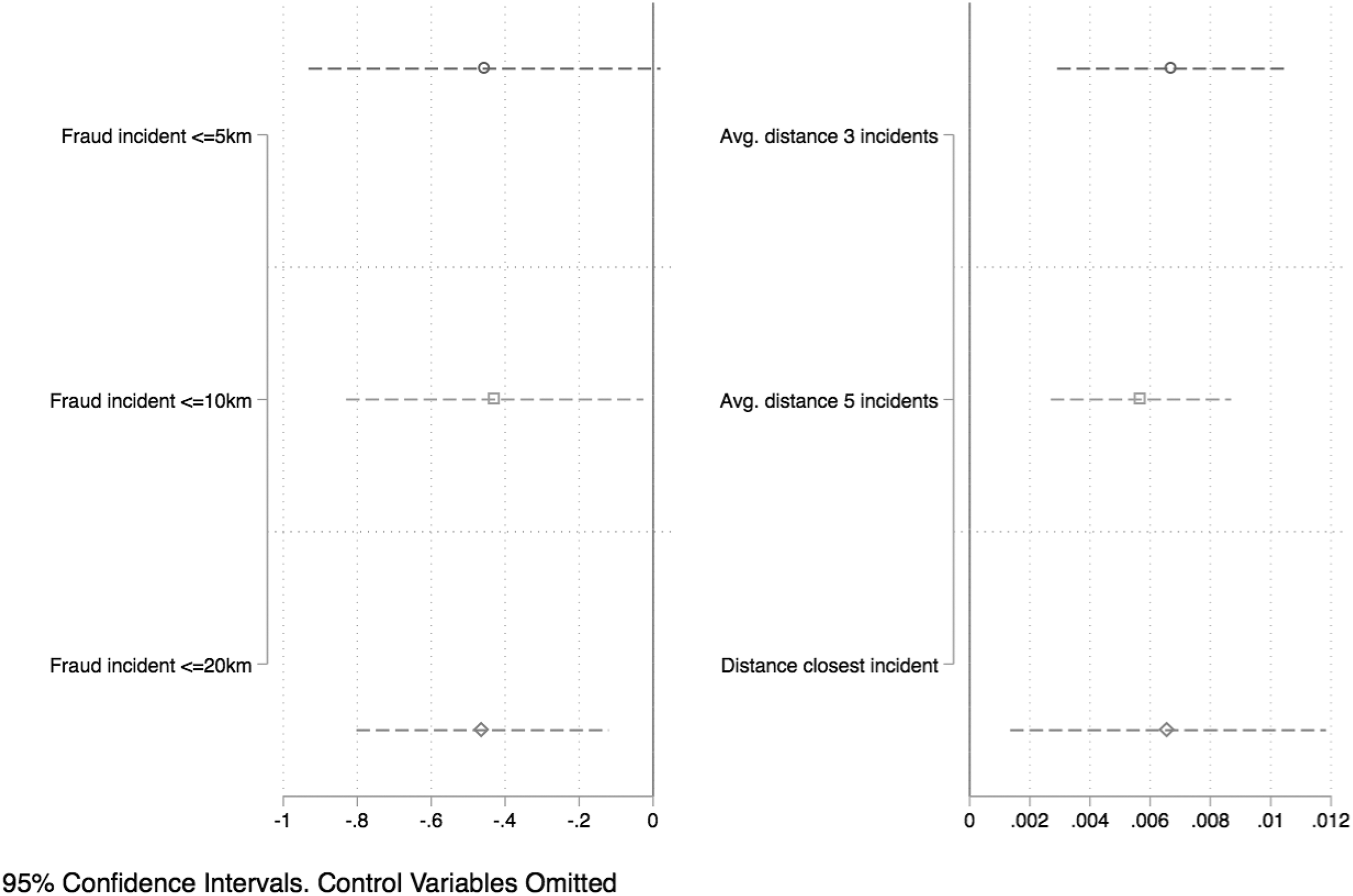
Coefficient plot, trust for Independent National Electoral Commission as dependent variable (Table A2.1).
We proceed to discussing fraud perceptions, the second main independent variable. Hypothesis 2 expects that citizens’ perceptions of election fraud motivates protests. We code perceptions with a dummy using respondents’ answers to the following question (Q71): “On the whole, how would you rate the freeness and fairness of the last national election, held in 2007?” We code fraud perception as 1 if respondents say elections have been “not free and fair” or “free and fair, but with major problems.” More than 67 percent of the respondents in the sample evaluated the election as fraudulent, while 32 percent thought they were free and fair or had only minor problems (see Table A8 in Online Appendix for descriptive statistics). In robustness tests, we control for additional grievances to ensure that fraud perceptions do not simply reflect other economic, ethnic, or other political grievances (Table A6.2). 20
Figure 3 depicts the geographical distribution of fraud perception and fraud incidents across LGAs in Nigeria. For fraud perception, LGAs with darker shades represent a higher percentage of respondents perceiving fraud. For fraud incidents, we show the number of all types of fraud incidents for each LGA. Note that LGAs in the lightest shade of gray are those without respondents in round 4 of the Afrobarometer survey.
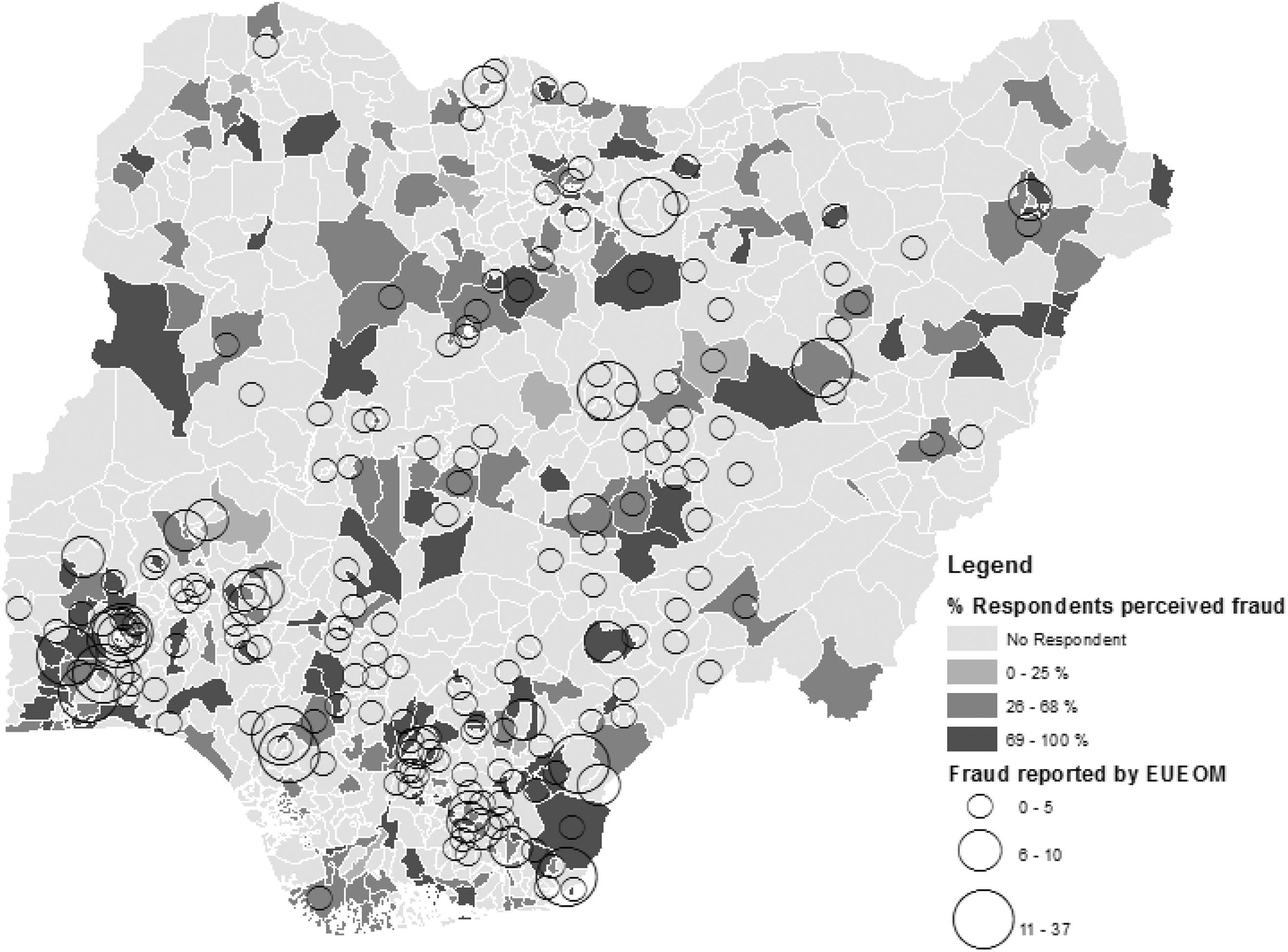
Relative frequency of respondents perceiving fraud and number of fraud incidents reported by European Union Election Observation Mission by local government area.
Our third hypothesis argues that the effect of fraud (real or perceived) could be conditional on other factors. Partisan biases, access to information, and community networks could affect whether people perceive elections as fraudulent, and an effect of perception could thus be conditional on these attitudes. Similarly, those close to fraud events might mobilize only if they supported losers, are informed, or are active in their community. To examine whether these confounders affect the estimated effect of fraud, we code three additional variables from the Afrobarometer survey that we include as controls in all models but also interact them with proximity to fraud and fraud perception (Figure 4; Table 3). First, we use information on vote choice to capture the “win–loss status” identified as influential in shaping fraud perceptions (Robertson 2015). 21 Unfortunately, Afrobarometer did not ask respondents about their vote choice in 2007 but asked which party they would vote for “if presidential elections were held tomorrow.” 22 We use respondents’ answers to this question to code whether they did or did not vote for the incumbent, the PDP. Only 43 percent of the respondents declared they would vote for the PDP. 23
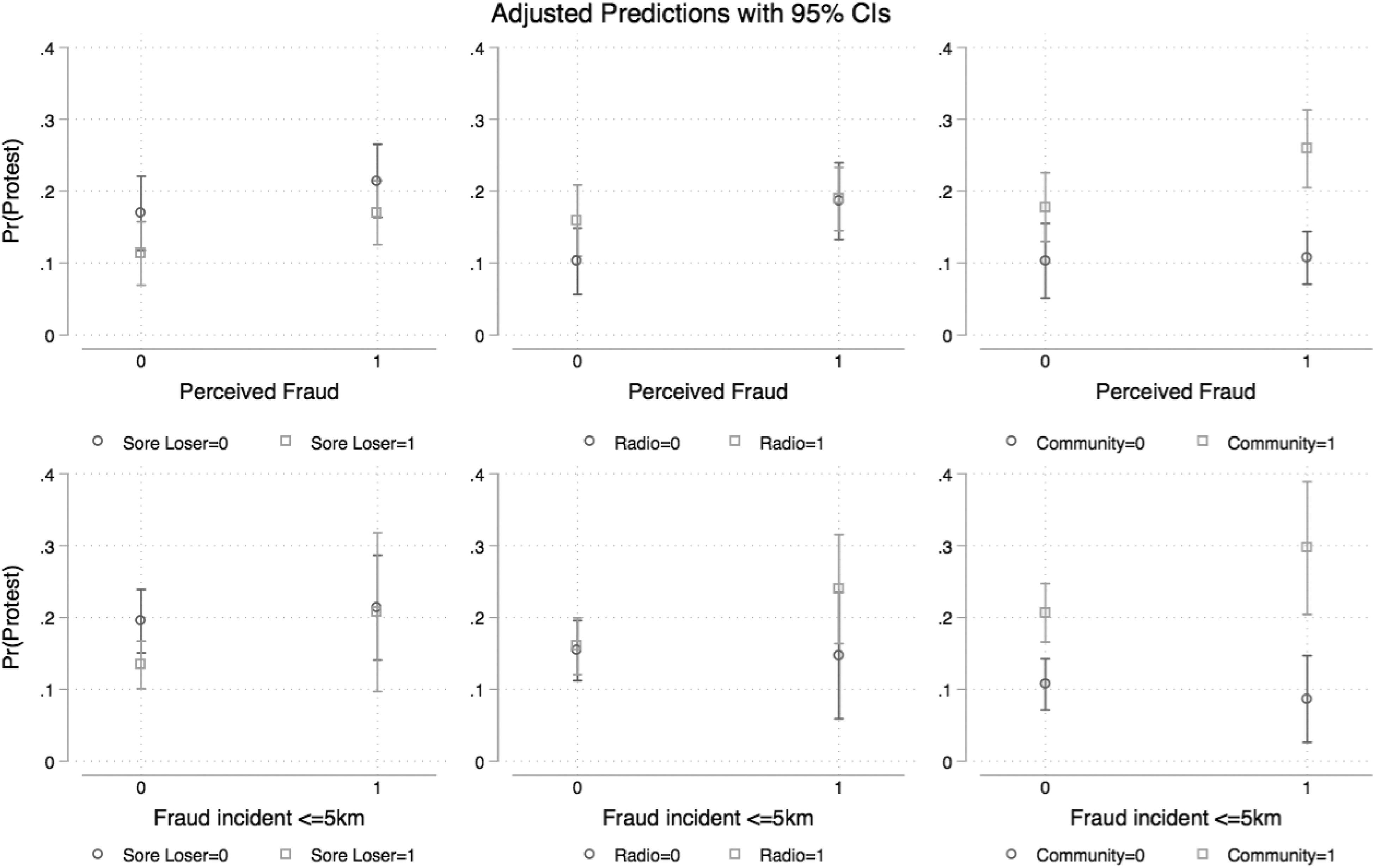
Predicted probabilities of conditional effects (Table 1).
The variable is coded 1 if respondents indicate that they would not vote for the PDP, since that implies they likely supported a losing party in 2007. Second, not all individuals have equal access to information or interest in political processes, meaning the effect of fraud as a coordination device may be conditional on individuals’ access to information. In the survey, 78 percent of respondents owned a radio, while only 58 percent has a television (55 percent has both). We thus create a dummy for individuals who listen to radio news every day (58.6 percent). Third, citizens with strong ties in the community may be more likely to act on fraud since these communities will mobilize them to contest the electoral outcome. A dichotomous variable is used to identify individuals who are active members of religious groups or other community-based associations. Active community members amount to 58 percent of the sample.
We control for several other factors that could affect mobilization, fraud perception, and/or proximity to fraud. Using round 4 of Afrobarometer, we begin with individual characteristics, controlling for the age of respondents, whether they are from urban areas, and whether they voted in the 2007 elections. We then control for an indicator at the census enumerator area (EA) level (the smallest administrative unit used by the national census), namely, whether most houses in an EA have access to electricity. We also control for the (logged) number of polling stations within a respondent’s LGA since the number of stations close by could affect both individuals’ propensity to find out about fraud and the likelihood of mobilization. There were more than 118,000 polling stations in Nigeria for 2007 elections, with a mean of 232 per LGA. The map in the Online Appendix shows the distribution and density of the polling booths (Figure A3). We also include a dummy variable for the three states that were not visited by EU observers for security reasons (Bayelsa, Delta, and Rivers).
Additional controls for government coercive capacity, living conditions, expectations of election fraud, previous protesting, and spatial diffusion of protesting are created with historical measures from the Afrobarometer round 3.5 conducted in January to February 2007 (Gyimah-Boadi et al. 2007). A major challenge for creating these historical variables is that the sample of respondents changes in Afrobarometer with each round. We therefore aggregate information for respondents in round 3.5 to the LGA level and assign values to round 4 respondents for the same LGA for all LGAs surveyed in both rounds. Because Afrobarometer uses clustered sampling, an additional challenge is that the LGAs included in the two rounds are not identical. When a respondent’s LGA in round 4 was not surveyed in round 3.5, we calculated the spatial lag of the abovementioned variables, hence to have geographically similar values, from round 3.5, and used it to replace unmatched LGAs in 4. A detailed discussion of the construction of these variables is provided in section A4 in the Online Appendix. From round 3.5, we thus include a dummy variable for LGAs experiencing protests, a dummy for police presence, two ordinal measures of past living conditions and individuals’ expectations of fraud in the 2007 election, and the spatial lag of protesting to account for spatial interdependencies. 24 Table A8 in Online Appendix presents descriptive statistics for all variables. We use logistic regression with LGA clustered standard errors to estimate the effect of perceived and actual electoral fraud on the likelihood of protests. While not all of our variables are measured at the individual level, we cannot specify multilevel models because Afrobarometer only oversamples the South-South region of Nigeria and the number of respondents within LGAs is strongly unbalanced, varying from 1 (Karaye, in the North) to 46 (Port Harcourt, in the South). We include respondents’ survey weights in the logistic regression to account for selection probabilities and oversampling.
Results
We proceed to testing Hypotheses 1 and 2 and present results in Table 1. We estimate three baseline models. In the first two models, we include perceived fraud and reported fraud separately; in model 3, both are included in the specification. Table 1 shows that perceived fraud positively affects individuals’ odds of mobilization (models 1 and 3), while reported fraud has a positive but insignificant effect (models 2 and 3).
Logistic Regression of Protesting, Baseline Models.
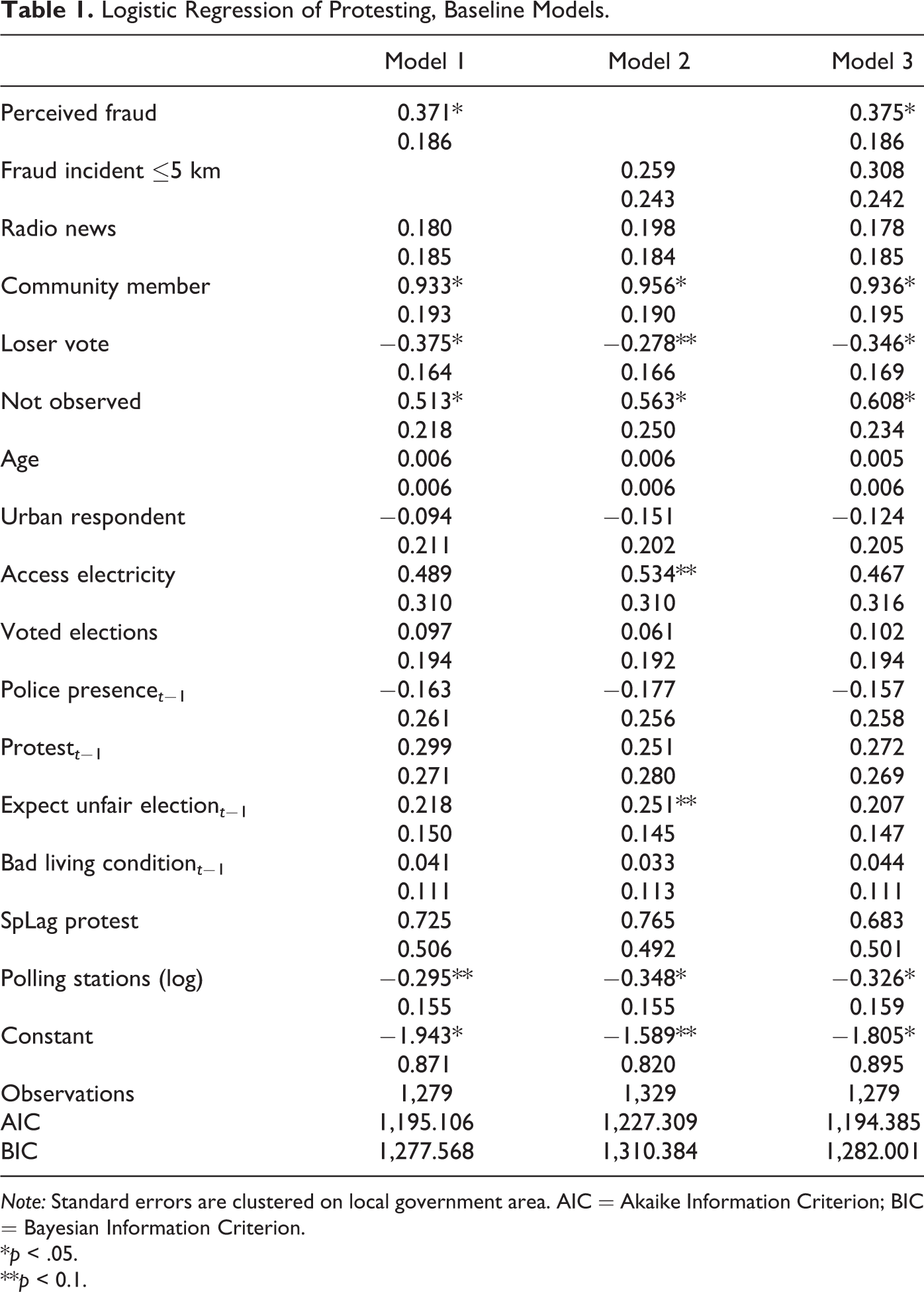
Note: Standard errors are clustered on local government area. AIC = Akaike Information Criterion; BIC = Bayesian Information Criterion.
*p < .05.
**p < 0.1.
We next explore Hypothesis 1 on reported fraud in more detail. In the baseline models, reported fraud is measured with a dummy coded 1 if a respondent was within five kilometers of a fraud incident. To make sure this insignificant result is not a result of this particular operationalization, we estimate a set of models with other measures of reported fraud. Coefficients for models 4 to 8 are shown in Table 2 and show that regardless of the operationalization—fraud incidents within ten or twenty kilometers, average distance from three or five closest incidents, or kilometer distance from closest fraud—we find no significant coefficients for reported fraud. Even when distinguishing among fraud types (e.g., breaches of electoral procedures, violence, and ballot stuffing), there is no significant effect of reported fraud (see Table A6.4 in Online Appendix). Since other work has shown that violence, for example, is used primarily to deter turnout from opponents (Bratton 2008), it is unlikely that fraud has an insignificant effect on protesting because it was used primarily in incumbent strongholds. 25 Only distance from closest fraud event reports a statistically significant, positive coefficient, counterintuitively suggesting that those further away from fraud become more mobilized, but this result is driven by outliers. Only 8 percent of respondents are more than 100 km away from a fraud incident; when these are removed from the estimation (results not shown), the coefficient for distance is insignificant. We thus find no empirical support for Hypothesis 1 across different possible operationalizations. In contrast, fraud perception has a positive and significant effect across all models in Table 2. In substantive terms, the odds of mobilization increase between 37 percent and 42 percent for respondents perceiving elections as fraudulent.
Reported Fraud Operationalizations.
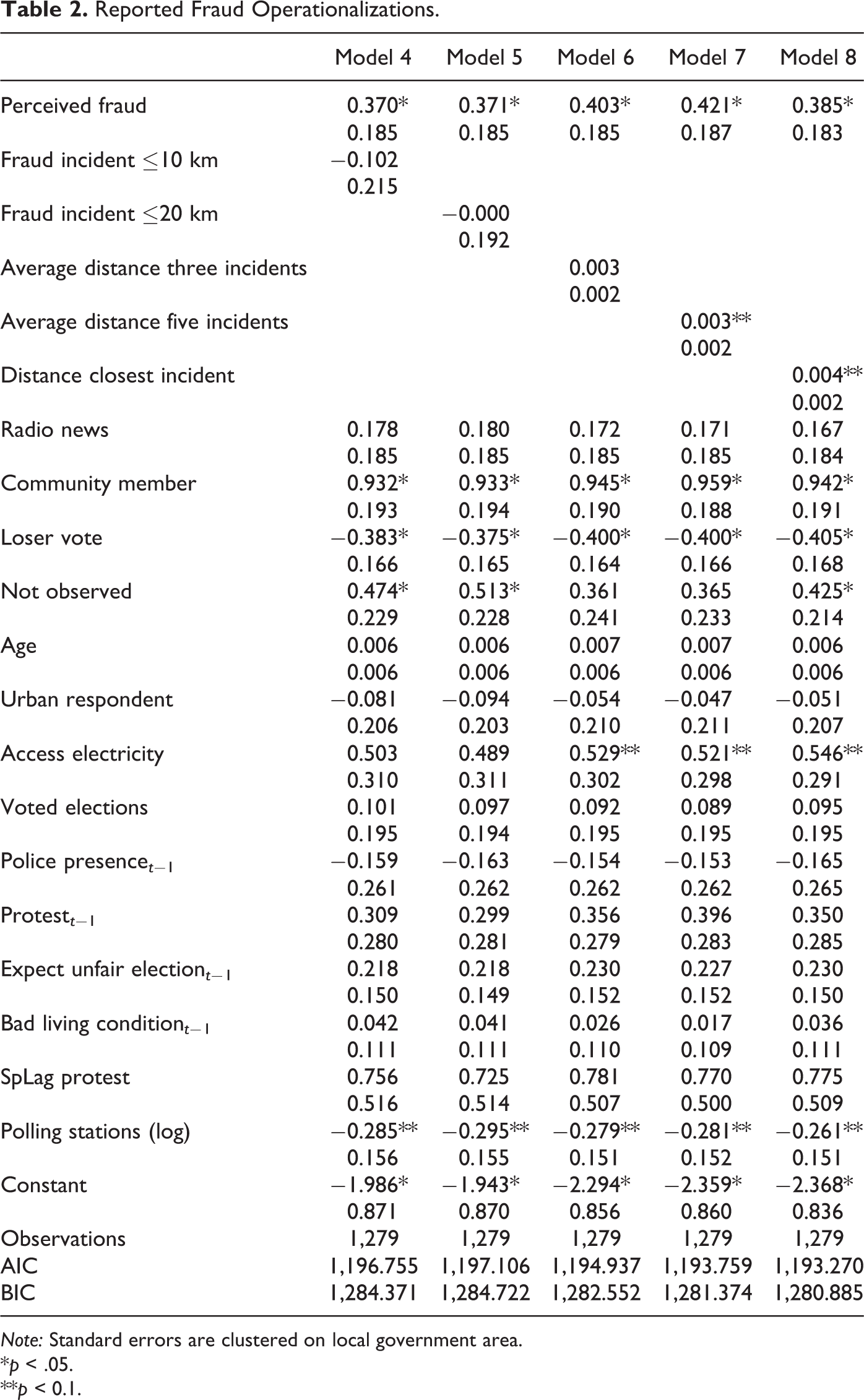
Note: Standard errors are clustered on local government area.
*p < .05.
**p < 0.1.
The results in Tables 1 and 2 show robust evidence for the mobilizing effect of perception, but no evidence that proximity to fraud affects protesting. We proceed to examining Hypothesis 3, which examines important conditional effects. As discussed, potential political grievances resulting from having voted for losing party, information available to respondents, or citizen links within local community could condition how fraud perceptions affect mobilization. Moreover, these confounders could also explain why reported fraud alone does not affect individuals’ participation to protests.
Table 3 presents models where we interact variables for loser vote, information, and community links with both fraud perception and reported fraud measures, testing the third hypothesis. For ease of interpretation, Figure 4 plots marginal effects for interactions between fraud perception, reported fraud, and confounders. For fraud perceptions (top panel), we find support only for the conditional effect of community networks (Hypothesis 3c). As Figure 4 shows, community membership does not increase protest propensities for individuals who do not perceive fraud. Yet individuals perceiving elections as fraudulent are more likely to protest if they are also active within their local communities. There is no evidence of similar effects on fraud perceptions for win–loss status or informed individuals. We find similar results for reported fraud (Figure 4, bottom panel). Having voted for electoral losers and paying attention to the media do not alter the effect of reported fraud on mobilization. 26 We find weak evidence of a conditional effect for community membership. While the interaction term is not significant, Figure 4 shows that respondents active in communities have higher odds of mobilization when fraud is reported in their proximity, weakly supporting Hypothesis 3c. Reported fraud and community membership are mutually reinforcing and increase respondents’ likelihood to protest. This interaction effect, however, seems to be driven by community membership more than proximity to fraud, since those active in communities mobilize more even in the absence of proximate fraud events. Findings from interactions also question claims prioritizing aggregate over local effects of fraud. If fraud perceptions or reported fraud are diffused nationally through media or opposition parties, we would expect support for these conditional effects.
Interactions with Loser Vote, Information, and Community.
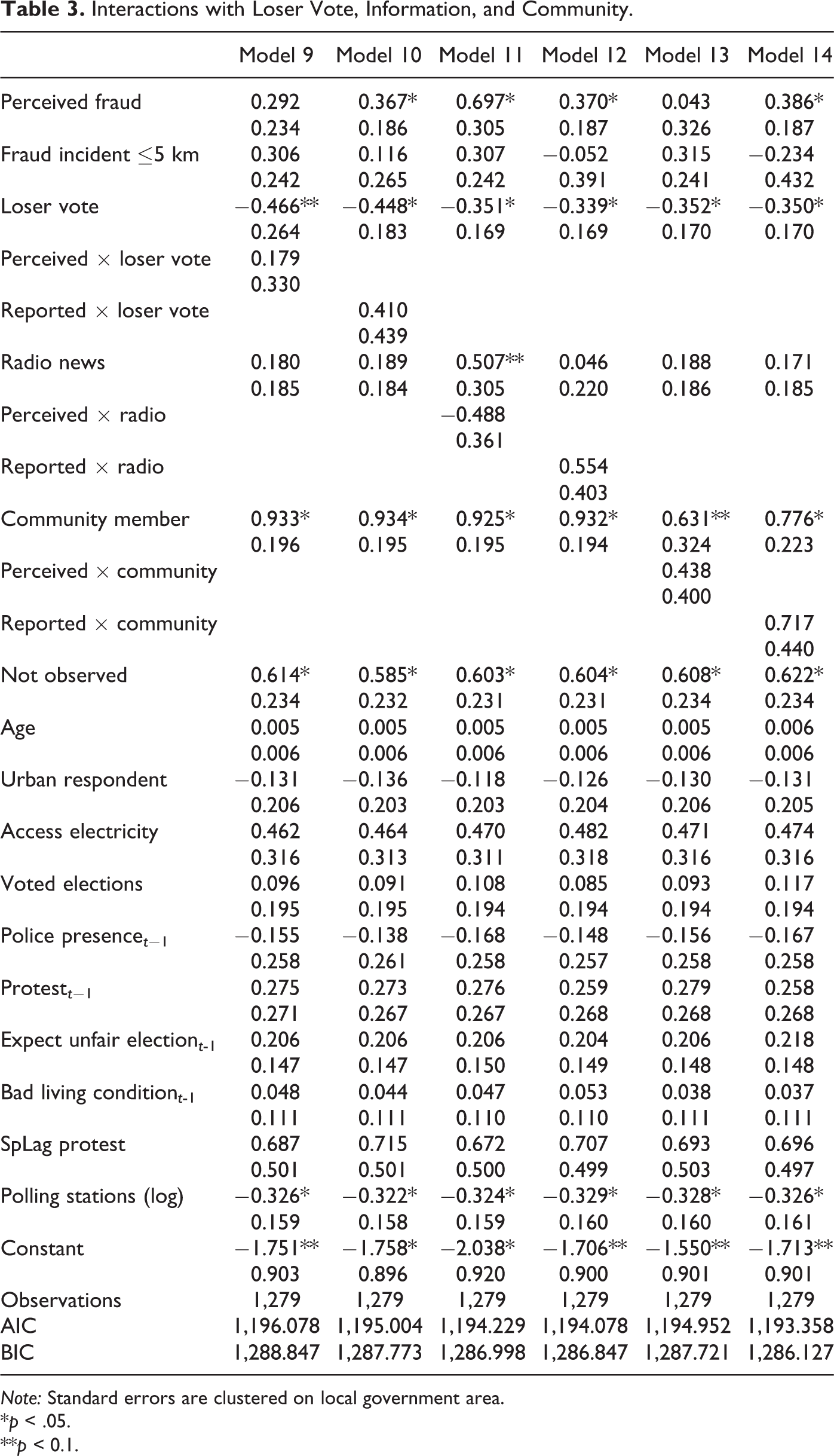
Note: Standard errors are clustered on local government area.
*p < .05.
**p < 0.1.
Additional Robustness Tests
In additional robustness tests discussed in detail in the Online Appendix, we validate our dependent variable with observational data on electoral protest (A1), present additional validations of reported fraud (section A2), show a map of polling station locations and densities (A3), discuss the possibility of selection bias in the reporting of fraud events in the EU report (A4), and outline the construction of lagged variables from Afrobarometer round 3.5 (A5). The Online Appendix also presents additional models of protesting to examine interaction effects between observed and perceived fraud (A6, Table A6.1); control for economic, ethnic, or political grievances (A6, Table A6.2); show models at the LGA rather than the individual level (A6, Table A6.3); explore different fraud types (A6, Table A6.4); and present an extended baseline model that controls for individuals’ education level and income (A6, Table A6.5). Finally, to assess generalizability, we report the effect of perceptions and reported fraud using Afrobarometer surveys for all African countries (A7). Robustness tests confirm our main findings while addressing concerns regarding our inferences.
Conclusion
The mobilizing potential of fraudulent elections is the subject of a growing literature. We depart from existing studies by examining the effects of election fraud on protest participation at the individual level. This emphasis on individuals addresses a mismatch between disaggregated theory and overaggregated empirical evidence in previous work. While theories focus on how election fraud provides information crucial for citizen coordination or produces grievances in voters that function as mobilizing shocks, empirical studies examine the effect of aggregate, election-level fraud assessments rather than individual assessments. For our individual-level analysis, we purposely select a case that fits aggregate patterns established in the literature. As Figure 1 at the beginning of the article shows, the 2007 Nigerian elections are close to the regression line, having been assessed as fraudulent by international and domestic observers and experiencing substantial postelection mobilization. Choosing such a case allows us to quantitatively assess two distinct pathways linking election fraud to mobilization. We distinguish between the mobilizing effects of reported and observational (and perhaps relatively more objective) measures of election fraud and individuals’ perception (and hence relatively more subjective) measures of fraud. Our results from the 2007 elections in Nigeria show that only fraud perceptions have a positive and consistent effect on protesting, whereas proximity to fraud documented by observers does not affect mobilization. Fraud perception thus has strong and consistent effects on mobilization at the individual level in Nigeria, yet this pattern cannot be identified with aggregate data. Conversely, fraud reported by observers weakly correlates with protesting in the aggregate, yet we cannot identify individual-level effects.
We highlight three implications of our findings. First, inferring citizens’ perceptions of the electoral process from macro-level assessments is problematic. While scholars and organizations active in election monitoring have suggested that the documentation of electoral problems affects citizens’ perceptions, our evidence shows that being close to documented fraud incidents has no effect on protesting. In contrast, we find strong and consistent effects of fraud perceptions on protesting at the individual level. These findings are potentially worrisome for policy makers but also for normative reasons, since they could imply that people’s fraud perceptions are shaped by a variety of biases or preexisting beliefs rather than stemming from objective interpretations of events. Fraud documented by observers could still affect protesting through the behavior of elites, such as convincing opposition parties of international support when deciding whether to protest fraudulent elections, but these are alternative causal pathways. Second, the lack of congruence between aggregate and individual-level patterns supports the call for disaggregation and a better match between theory and empirics in the literature on contention (Cederman and Gleditsch 2009). However, our results indicate that even highly disaggregated indicators from observational data can produce quite different results than perception-based measures of the same concept. Inferring citizens’ beliefs from observational indicators alone could thus be quite problematic. Third, our findings fail to support the rational updating model of opinion formation but also its primary competitor, the motivated reasoning model. We find no evidence that information about fraud events leads to the updating of individuals’ beliefs, nor do our results show that partisan attitudes condition individuals’ fraud perceptions and mobilization. We thus need to develop models of opinion formation in unconsolidated democracies.
Supplemental Material
Supplemental Material, Appendix_DDR - Fraud Is What People Make of It: Election Fraud, Perceived Fraud, and Protesting in Nigeria
Supplemental Material, Appendix_DDR for Fraud Is What People Make of It: Election Fraud, Perceived Fraud, and Protesting in Nigeria by Ursula Daxecker, Jessica Di Salvatore and Andrea Ruggeri in Journal of Conflict Resolution
Supplemental Material
Supplemental Material, Replication_DDR - Fraud Is What People Make of It: Election Fraud, Perceived Fraud, and Protesting in Nigeria
Supplemental Material, Replication_DDR for Fraud Is What People Make of It: Election Fraud, Perceived Fraud, and Protesting in Nigeria by Ursula Daxecker, Jessica Di Salvatore and Andrea Ruggeri in Journal of Conflict Resolution
Footnotes
Acknowledgments
Earlier versions were presented at the 2015 International Studies Association Annual Conference in New Orleans, LA, the 2015 European Network for Conflict Research in Bonn, Germany, the 2018 Folke Bernadotte Academy Workshop on Elections in Emerging Democracies in Stockholm, Sweden, and the 2018 Mannheim Centre for European Research seminar series in Mannheim, Germany. We thank Sarah Bush, John Campbell, Hanne Fjelde, Thomas Flores, Mascha Rauschenbach, conference and workshop participants, the JCR editors, and anonymous referees for their helpful comments. We also thank Sarah Birch, Sarah Bush, and Thomas Flores for their helpful comments on earlier versions of the manuscript. Elio Amicarelli provided excellent research assistance. Equal authorship implied, all remaining errors are our own.
Declaration of Conflicting Interests
The author(s) declared no potential conflicts of interest with respect to the research, authorship, and/or publication of this article.
Funding
The author(s) disclosed receipt of the following financial support for the research, authorship, and/or publication of this article: Daxecker received funding from the Netherlands Organization for Scientific Research (NWO), Innovational Research Incentives Scheme Veni No. 451-13-030 and the European Commission, Marie Curie Career Integration Grant (CIG) No. 618422.
Supplemental Material
Supplemental material for this article is available online.
Notes
References
Supplementary Material
Please find the following supplemental material available below.
For Open Access articles published under a Creative Commons License, all supplemental material carries the same license as the article it is associated with.
For non-Open Access articles published, all supplemental material carries a non-exclusive license, and permission requests for re-use of supplemental material or any part of supplemental material shall be sent directly to the copyright owner as specified in the copyright notice associated with the article.
