




Abstract
This article introduces the Religion and Armed Conflict (RELAC) data, 1975 to 2015, which is a new data set suitable for analyzing the causes, dynamics, and resolution of religious conflicts. It contains information about key religious dimensions of conflicts: whether the issue at stake is religious, the actors’ religious identity, and fine-grained data about the type and salience of religious claims. The article presents the major features of the data set and describes patterns and trends that shed new light on religious conflicts, for example, by demonstrating that conflicts over Islamist claims have become more prevalent. We also illustrate the utility of the data. For instance, we show that there is great variation in lethality across conflicts with different types of Islamist claims, thereby offering a more nuanced understanding of the deadliness of religious conflicts. RELAC should be a valuable resource for scholars, examining religious dimensions of intrastate armed conflicts.
The emergence of the Islamic State (IS) in Syria, Iraq, and elsewhere epitomizes the importance of religiously defined conflicts in today’s world. Previous research has made important contributions to the research field on religion and conflict (e.g., Gleditsch and Rudolfsen 2016; Svensson 2007; Toft 2006; Vüllers, Pfeiffer, and Basedau 2015), but data limitations have also hampered the analysis of various dimensions of religious conflicts. This article presents new and unique data on religiously defined conflicts in general, and Islamist conflicts in particular, during the time period 1975 to 2015. We introduce the Religion and Armed Conflict (RELAC) data, which is the most updated and comprehensive data set on religious identities and incompatibilities of the warring actors in armed conflicts currently available. A key advancement in relation to existing data sets is to provide more fine-grained data about religious issues as stated by the warring parties, which also is compatible with armed conflict data provided by the Uppsala Conflict Data Program (UCDP). This data set can thus be utilized to push the research agenda forward in important ways by further expanding our knowledge about the causes, dynamics, and resolution of religious conflicts.
This article begins by describing the previous data collection efforts on religious conflicts and then goes on to outline the specific contributions of the RELAC data and why a new data set is needed. Subsequently, we describe the data set, providing information about key definitions and the scope of our data. Next, we present some trends and patterns in the data, which help shed new light on various religious dimensions of conflicts. Having described these patterns, we illustrate the usefulness of the data in three different ways. We are able to show, for example, that religious identity conflicts where religious actors from different faith traditions are standing against each other are becoming less common, whereas conflicts fought over religious issues display the opposite pattern. Through the use of the RELAC data, we can also show that different types of claims come with different empirical trajectories over time; for instance, conflicts where Islamist rebel groups harbor transnational aspirations are becoming more prevalent. Furthermore, our data also provide a more nuanced understanding of the deadliness of religiously defined conflicts, as the analysis reveals that there is great variation in lethality across conflicts with different types of Islamist claims. We conclude by offering some suggestions for how the RELAC data can be used to expand our knowledge on religious conflicts.
Why a New Data Set?
There are five related publicly available data sets on religious conflicts, which have made significant contributions to the research field on religious conflicts. First, Toft’s (2007) influential study reports important trends when it comes to religious civil wars in general and the role of Islamist conflicts in particular. Yet, her data are limited to armed conflicts with the highest level of battle deaths, that is, more than 1,000 per year, which represents a minority of all armed conflicts. Moreover, whereas Toft distinguishes between identity-based (peripheral) and issue-based (central) religious conflicts, her data do not make any further distinction between different types of religious issues or their salience. 1 In addition, by defining “central” in terms of issues and “peripheral” only in terms of identity formation, Toft’s data set does not sufficiently take into account interactions between issues and identities; for example, civil wars over a central religious issue could be fought between parties from the same—or different—religious traditions. Second, Vüllers, Pfeiffer, and Basedau (2015) contribute by adding the peace dimension to the study of religious conflicts and by using a broader conceptualization of religious violence. The comparative strength of their data is therefore a deeper level of nuance and recognition of the positive, peace-building potential of religious dimensions. Yet, their data set is restricted geographically and temporally, as it is only available for developing countries and for the time period 1990 to 2010. In addition, since this data set focuses on the country-year level, it is well suited for analyses pertaining to the country level, but it cannot in the same way be used to explore variations in religious dimensions across different rebel groups. Third, the data by Gleditsch and Rudolfsen (2016) identify insurgent groups with Islamist ideologies in armed conflicts over a long time period, utilizing conflict data from the UCDP. Thus, its main strength lies in its broad reach, yet a limitation of the data is that it is thematically constrained in the sense that it focuses on Islamist groups, and not other types of religiously defined conflicts, and does not provide disaggregated data on religious issues. Fourth, Isaacs’s (2016) data set focuses on the relationship between violence and religious rhetoric over time at the level of the ethnic group. It has the advantage of building on time-varying measurement of religious claims and rhetoric, an important aspect that we will discuss later in the article. An additional strength lies in utilizing a disaggregated level of analysis by examining religious dimensions on the organizational level. 2 However, it only includes religious organizations representing ethnic groups. Fifth and last, the data set by Svensson (2007) has global coverage and includes information about some of the religious dimensions that we include but is limited in temporal coverage, as it is available only for the 1989 to 2004 period. In sum, while all of these data sets are valuable to the systematic scrutiny of religion and conflict, they also suffer from a number of limitations and restrictions. 3
RELAC has a number of important features that makes it the most comprehensive data set on religious armed conflicts to date, which should help to advance the systematic study of religious dimensions of armed conflicts. First, it captures the two most common ways of conceptualizing religious conflicts by including information on both whether the conflict is fought over a religious issue and whether the other conflict party is from a different religious identity. These dimensions are coded separately and can therefore be examined in isolation, or as we shall see later in this article, in interaction, thereby shedding new light on religious conflicts. The RELAC data set builds on the Svensson (2007) data but has a wider scope both in terms of the religious dimensions covered and its temporal reach. Second, the data set also provides more fine-grained information about several religious dimensions of conflict: it codes the salience of the religious claim and also provides details about the type of claim that is made; that is, specifying in what way the insurgents are demanding a greater or different role for religion in the society or in the state. Third, the data set spans over forty years of armed conflict, 1975 to 2015, and is coded at the dyadic level, capturing conflict between a government and each rebel group, which for instance, allows for an exploration of religious dimensions across rebel groups. Lastly, the fact that our data are based on information from the UCDP—one of the most widely used conflict data sets—and compatible with the same, should help facilitate further research on this important topic.
Presenting the Data
Scope and Data Collection
Our data set has as its starting point–armed conflict data from the UCDP, relying on the UCDP Dyadic Data Set, version 1-2016. The data focus on all 420 dyads—consisting of a government and a rebel group—that are involved in an armed conflict over government or territory that has resulted in at least twenty-five battle-related deaths in a calendar year, during the time period 1975 to 2015 (Harbom, Melander, and Wallensteen 2008; Melander, Pettersson, and Themnér 2016). Our focus on the armed conflict between the government and the rebels means that we are not studying other forms of organized violence that may have religious motivations, for example, interstate conflicts, attacks by different types of militias, violence between communal groups, or one-sided attacks against civilians. We are thus directing our attention at the armed conflict between the government and each rebel group. Since the RELAC data depart from the UCDP data and are based on the dyad level, it also has the advantage that it can be used together with many other conflict-related data sets, such as the Non-State Actors in Armed Conflict Dataset (NSA) (Cunningham, Gleditsch, and Salehyan 2009, 2013) or the Sexual Violence in Armed Conflict (SVAC) data set (Cohen and Nordås 2014), and should make it possible to explore a wide range of questions that hitherto have received limited attention in quantitative analyses. To illustrate, by combining our disaggregated data on religious claims with the SVAC data, scholars can explore if rebel groups fighting over a certain type of religious issue are more or less likely to commit sexual violence.
In terms of the data collection procedures, we primarily rely on data from the UCDP Encyclopedia, which includes information about the armed conflicts such as conflict narratives, descriptions of the warring actors, and information about the first stated goal of incompatibility. Since we use this source to code religious dimensions of the armed conflicts, it becomes important to clearly lay out UCDP’s data collection procedures. The UCDP collects the data on armed conflicts in four stages. First, the online database Factiva is consulted, which contains information from various newswires and newspapers, and for each country, a specific set of sources are selected. This includes BBC monitoring, which in turn contains information from local newspapers and broadcasts, and at least one of the more general sources, that is, AFP, Reuters, Xinhua, or Agencia EFE. For each calendar year, a specific search string related to violence is entered, an exercise that results in around 50,000 to 80,000 news items that are analyzed by trained coders following preset coding criteria developed by the UCDP. Second, in order to complement this material, where feasible, a number of more country-specific sources are employed including books and journals such as Africa Research Bulletin and various NGO reports, for instance, from Human Rights Watch. Third, if there are any uncertainties regarding any of the information, the coders turn to region experts. Fourth, in the final stage of the data collection, the project managers of the UCDP review the data collected to make sure that it is consistent with the coding procedures set forth. In sum, the UCDP thus collects their data based on a wide range of sources; carefully and systematically codes this wide range of information, while employing a stringent set of definitions. 4 Given that the UCDP follows such a stringent coding protocol and since the warring actors and the nature of the incompatibility are of central importance in the data collection on armed conflicts, we are confident in relying on this information for our coding. In cases where further evidence has been deemed necessary to code the religious dimensions, additional case-specific information, such as books, reports, and journal articles, have been consulted.
Definitions and Dimensions of Religious Conflict
There are basically two ways of conceptualizing religious conflict, either in terms of identities or in terms of issues. An identity-based conceptualization entails that conflict is seen as religious if the opposing groups come from different religious affiliations (e.g., Fox 2004b; Pearce 2005). In contrast, an issue-based conceptualization centers on whether the incompatibility of the armed conflict is focusing on religious issues (e.g., Hassner 2009; Svensson 2007; Toft 2007). RELAC is organized around these two basic parameters and thus codes both whether the armed conflict is (1) fought over religious issues and (2) whether the main belligerents come from different religious identities.
Religious issue captures whether there is a religious dimension in the original incompatibility as explicitly stated at the onset of the conflict by the representatives of the primary parties. The category of religious issue needs to be broad enough to capture claims made in various religious traditions and with different emphasis and magnitude. For example, MILF in the Philippines and the IS both took up arms in the name of religion, but they have clearly very different ideological bases. Thus, there is a great diversity in the types of religious conflicts that are considered here. This variable is based on the stated aspirations of the parties, originating in the coding of the original claims of the parties in conflict. The basis for this data is UCDP’s coding of “first stated incompatibility,” which describes the nature of the incompatibility (see www.ucdp.uu.se). An example is Al-Shabaab’s stated goal from 2008 to overthrow the Somali government, expel foreign troops from the country, and install a system of governance based on Sharia law. In internal armed conflicts, it is commonly the rebel side (the insurgents) that challenges the status-quo power (the government) and who explicitly formulates the rationale for taking up arms. It is important to emphasize that the stated positions by the conflict actors often are different from the parties’ underlying interests (Fisher and Ury 1981; Rubin, Pruitt, and Kim 1994). A religious dimension in the incompatibility tells us something about how the parties in conflict have decided to state their explicit goals and demands (e.g., a religious state) but not about their underlying interests (why they seek this particular goal). Yet, in line with major data collection efforts, such as UCDP (e.g., distinguishing between claims over territory or government), we focus on the stated positions of the actors and whether these concern religion. Utilizing the stated positions of the parties at the onset of the conflict, one should recognize that the parties in conflicts might strategically mislead or omit information about their true preferences or they can exaggerate or downplay religious aspirations in regard to the contested issue in conflict. 5 They may also change their demands over time, something that RELAC data cannot currently capture. Yet, even if belligerents would not be honest about their true preferences in regard to religious aspirations, religiously framed conflicts may follow different empirical trajectories than others, for example, religious framing may decrease the scope for effective conflict resolution processes. Therefore, conflict incompatibilities remain a key interest for research on onset, dynamics, and outcomes of conflicts. Moreover, focusing on the issue at stake also has a number of benefits. 6 First, we avoid making any inferences about the aspirations of the parties, derived from other sides (e.g., a government-based perception of the insurgency) or possibly biased outside sources. By utilizing the self-proclaimed aspirations of the parties, we circumvent making any detached scholarly judgment that may have little bearing in reality. Instead, we rely on the explicit positions of the parties themselves. Furthermore, we avoid problems of postrationalization by going back to the originally stated positions.
RELAC allows for exploration of escalation (or shifts) of demands, albeit only through one empirical process. Whereas our data set does not capture changes in claims over time by one and the same group, which some previous data collections do (e.g., Isaacs 2016, allows for temporal variation across groups), it is nevertheless possible to examine the type of escalation that occurs when new groups are established within the same insurgency. For example, Fatah and Palestine Liberation Organization (PLO) in the conflict against Israel were secular-leaning organizations that did not state any religious aspirations at the onset of the conflict. By contrast, the Hamas movement, through its charter in 1988, demanded an Islamic character of a liberated Palestine, and the conflict between the government of Israel and Hamas is an example of a religiously defined conflict. Thus, the rhetoric can shift over time within a larger insurgency movement. Commonly, this type of escalation is made by a new organization that emerges and states new positions. The RELAC data facilitate an analysis of such dynamics.
We also disaggregate the religious incompatibility by distinguishing between four different types of demands with the basis in the claims of the insurgencies (see Table 1). The reason for utilizing the rebel group’s claim as the basis is that it is the nonstate side that is challenging the status-quo power and in doing so provides a rationale for their challenge. Islamist claims refer to stated positions that advocate an increased role of Islam in the society or the state. Groups that express Secularist claims fight for a political agenda that outlines a decreased role of religious laws, parties, or constitutions in the state. In addition, we code Evangelist claims, meaning the groups that would like to see an increased role of Christianity in the society or the state. 7 Lastly, in the category Other religious claims, we include those claims that are of religious nature but which do not correspond to any of the three categories mentioned above, that is, the claims made by the Sikh insurgents in the Punjab/Khalistan conflict in India.
Different Types of Religious Claims.
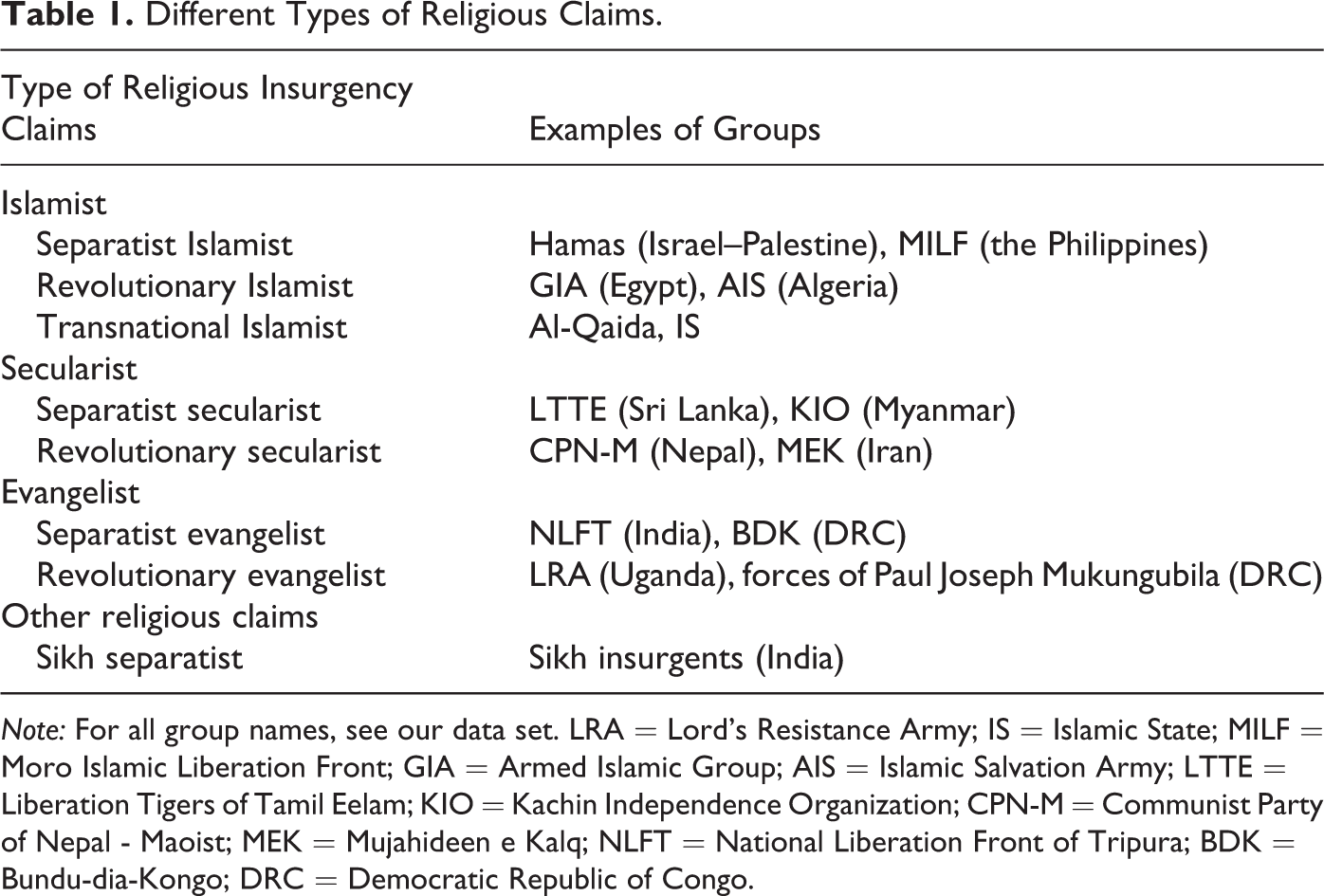
Note: For all group names, see our data set. LRA = Lord’s Resistance Army; IS = Islamic State; MILF = Moro Islamic Liberation Front; GIA = Armed Islamic Group; AIS = Islamic Salvation Army; LTTE = Liberation Tigers of Tamil Eelam; KIO = Kachin Independence Organization; CPN-M = Communist Party of Nepal - Maoist; MEK = Mujahideen e Kalq; NLFT = National Liberation Front of Tripura; BDK = Bundu-dia-Kongo; DRC = Democratic Republic of Congo.
Since there is important variation within these categories, we provide a further disaggregation of these claims into territorial, revolutionary, and where applicable, transnational claims. Our categorization primarily draws on Wallensteen’s (2015) distinction between armed conflicts that concern the government as a whole and claims regarding a specific piece of territory—a distinction that underlies the two categories of armed conflict coded by the UCDP. We refer to these as territorial or revolutionary claims, and as we will show below, we also draw on other work (e.g., Piazza 2009; Melander, Pettersson, and Themnér 2016) to develop a third category—transnational claims, which we observe empirically for the Islamist claims.
The Islamist claims can thus be divided into three categories. First, Revolutionary Islamist claims are insurgency positions aspiring to change the nature and character of the state, without necessarily changing its territorial borders. This entails demands for a greater role for Sharia-based legislation over particular issue areas, or a redefinition of the foundational basis for the state, in a way that makes the character of the state Islamic. For example, GIA in Algeria has made such claims. Second, we capture Separatist Islamist claims, where the insurgents also have stated explicit Islamist aspirations, but where the claims are territorially confined and thus concern how a specific territory should be governed, rather than the rule of the whole state. Examples include the Kashmir insurgents in India as well as the Pattani insurgents in Southern Thailand. The third category is Transnational Islamist claims, where the rebel group’s Islamist aspirations go beyond the national boundaries and the group seeks to establish a transnational caliphate. Cases in point are the armed conflicts involving Al-Qaida and the IS. This conceptualization is similar to Melander, Pettersson, and Themnér (2016, 731) who define “transnational jihadism” as “the immediate or future aim of a non-state group to establish a caliphate across internationally recognized borders, using violence.” It should be noted, however, that whereas Melander, Pettersson, and Themnér (2016) operationalize transnational jihadism through organizational association (whether armed groups belong or are associated to the IS or Al-Qaida), we use the term “transnational Islamist” to signify the claim: whether the demands of the insurgencies go beyond the confines of the nation state. Here, we draw on and develop Piazza’s (2009) categorization of ideologies of Islamist terrorist groups and in particular his distinction between goal structures of the so-called strategic groups (including national-liberation and regime-change movements), which resonates with our categories of separatist Islamist and revolutionary Islamist claims and “abstract universal groups” that resonates with our category transnational Islamist.
As regards secularist claims, we distinguish between two types. Separatist secularist claims refer to challenges concerning the present state formation of an existing state and aspirations to establish control over a territory, either through increased autonomy or outright separation. The claims are secularist in the sense that they aspire to establish an explicitly secular state or autonomy, in contrast to a religiously defined government that they are challenging. An example is the conflict between LTTE and the government of Sri Lanka, in which LTTE (defeated in 2009) originally demanded an explicitly secular state, and this demand was one of the contentious issues in the conflict with the Sinhala-dominated government. The goals of the insurgencies can be classified as Revolutionary secularist if the claims refer to demands for a new government or underlying ideology of the whole national territory, in which the religious character of the state would decrease. The challenge by MEK against the theocratic regime of Iran is an example of this type of conflict.
Furthermore, the evangelist claims can be divided into two types. Separatist evangelist demands entail aspirations for an increased role of Christianity in a specific territory, whereas Revolutionary evangelist claims, by contrast, refer to aspirations that concern an increased role of Christianity in the government of the whole state, rather than being bound to a specific piece of territory within the national territorial borders. An example is the Lord’s Resistance Army (LRA)—an armed group that stated explicit Christian demands at the onset of conflict (including that the Ten Commandments should govern the country).
In the coding of religious issues, we consider all cases where there is an explicit reference to religious aspirations and demands, without the religious issue necessarily being the most important of the demands. To capture diversity in the importance of the religious claims, we also created a measure of the salience of the claims. There is, for example, a marked difference in the salience of the religious issues in the conflicts with IS (high salience), compared to the Free Aceh Movement (GAM) in Indonesia (low salience). We use two key criteria in order to code the salience of the religious claim. Firstly, we distinguish between religious claims where the religious issue represents the main question at stake for the rebel group and claims where the religious issue is only one among several key issues at stake. Secondly, we make a distinction between those cases where the claim is made by one organization or a unified alliance and cases where the rebel organization is represented by an alliance where only a few of the groups view the religious issues as the main question. In order to consider a claim to be of high salience, both these criteria need to be fulfilled; thus, a religious claim is of high salience when it represents the main issue at stake and when the rebel actor making this claim is not part of a broader alliance including at least one secular rebel actor. 8 For example, the Islamist party in Tajikistan was making religious claims that were the main issue of contention, but since this group was member of a broader antigovernment coalition, where not all groups shared this claim, we consider this to be a case of low salience. By introducing these new data on religious issues, we are able to capture important variations within the category of religious conflict. As we will show later, there is substantial diversity within the category of religious conflicts both in terms of the type of claims that are made and the salience of the religious issues.
Religious identity is the second main variable of the RELAC data. This variable captures whether the religious majority of the constituencies of the conflict actors—the government and the rebel group—are separated in terms of their religious identities. Hence, religious identity conflicts are those in which the constituencies of each of the conflict actors come from different faith traditions, and here, we consider all the major world religions: Judaism, Islam, Christianity, Hinduism, Buddhism, and Sikhism. In addition, for those cases where both sides are culturally part of a major world faith tradition, we also provide information on whether they belong to different subtraditions, specifically Shia and Sunni Islam, for the Muslim tradition, and Orthodox, Roman-Catholic and Protestant for the Christian tradition. For example, in the conflict in Northern Ireland, the warring actors mobilized along such religious dividing lines—Protestants and Catholics (although the issues at stake did not concern religion). Thus, this variable measures whether the conflict is fought between or within religious traditions, and the basis for this data is UCDP’s “conflict descriptions” and “warring party name” in the Encyclopedia, which includes information about the warring actors (see www.ucdp.uu.se). In unclear cases, this has been complemented with additional conflict-specific material.
Trends and Patterns: Mapping the Empirical Landscape of Religious Conflicts
We now introduce descriptive statistics utilizing the RELAC data set. We begin by focusing on the patterns over time when considering whether armed conflicts were fought over a religious issue or not. Our data show that such conflicts are showing a dramatic increase both in substantive and proportional terms. Pinker (2011), Svensson (2012), and Gleditsch and Rudolfsen (2016) report that there is an increase in relative, not absolute, numbers of religiously defined conflicts. In line with earlier findings, we can here show (see Figure 1) that the share of active conflict dyads engaged in violent conflict over a religious issue has risen dramatically over time from only 3 percent in 1975 to 55 percent in 2015. This represents a dramatic shift in the character of intrastate armed conflicts, in terms of shifting proportions. Yet, if we consider the last number of years, we can see that religious issue conflicts are not only representing a larger share of the world’s armed conflicts but are actually increasing in absolute numbers. For example, the number of government-rebel dyads fighting over religious issues increased from 25 in 2013 to 32 in 2015.
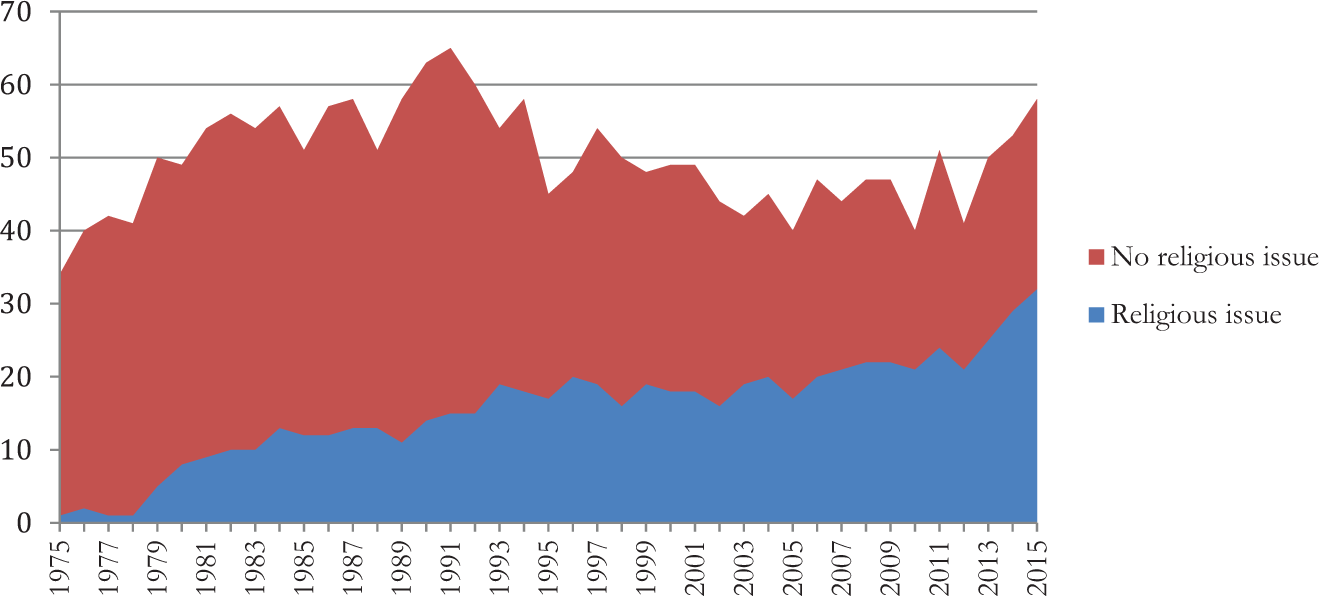
Religious issue conflicts 1975–2015: Number of conflict dyads per year.
Of the religious issue conflicts, a majority, 75 percent, is fought between governments and groups with Islamist claims, whereas a minority of the conflicts, 8 percent, is over evangelist claims, 16 percent of the rebel groups have a secular agenda, and 1 percent is over other claims (i.e., with a Sikh claim).
We now turn to the geographical distribution of the conflicts fought over religious incompatibilities (see Figure 2). Africa and Asia stand out as the regions of the world in which most religious issue conflicts have occurred. Of all religious issue conflicts, 41 percent have occurred in Africa, whereas 38 percent can be found in Asia. The African continent has seen rebel groups with evangelist aspirations, such as the LRA in Uganda or the Forces of Paul Joseph Mukungubila in DRC, as well as actors having Islamist claims, for instance, Boko Haram in Nigeria. In Asia, there have been many insurgencies with self-proclaimed Islamist aspirations: Pakistan, but also India and Sri Lanka, have all had religiously defined conflicts. Whereas many associate religious conflict with the Middle East, in fact, it is only the third most frequent region in terms of the distribution of conflicts fought over a religious issue. Yet, this needs to be seen in light of the number of armed conflicts active in each region, and many of the conflicts fought in the Middle East are over a religious issue. In addition, it should be noted that this captures the basic incompatibility, not necessarily where the fighting actually takes place. For example, the few conflicts dyads in the Americas concern the conflict between the US government and Al-Qaida.
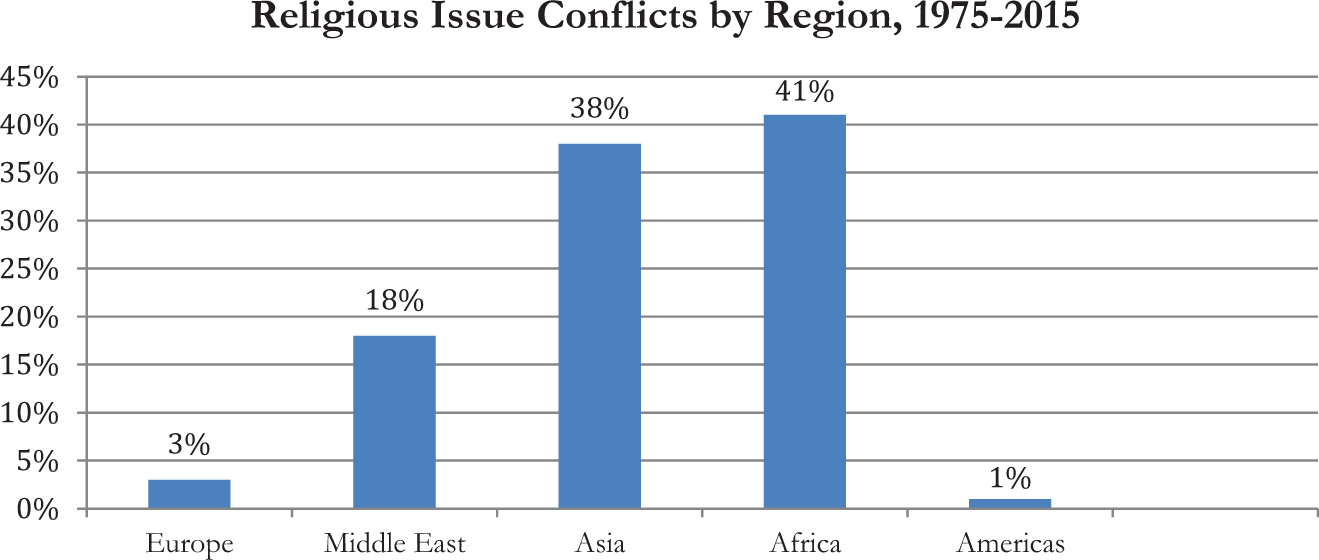
Geographical distribution of religious issue conflicts: Percentage of conflict dyads by region.
In addition to the type of religious claims on the side of the insurgents, RELAC provides information about the salience of the claims (see Figure 3). This is coded only for cases in which there has been an original stated claim referring to religion—the religious issue conflicts. We can note that in total during this period, there have been eighty-one conflict dyads where the claim has high salience, whereas only twenty-seven conflict dyads are over low salience. Over time, the distribution is relatively stable with somewhat of an increase in conflicts fought over high salience issues over the last ten years.
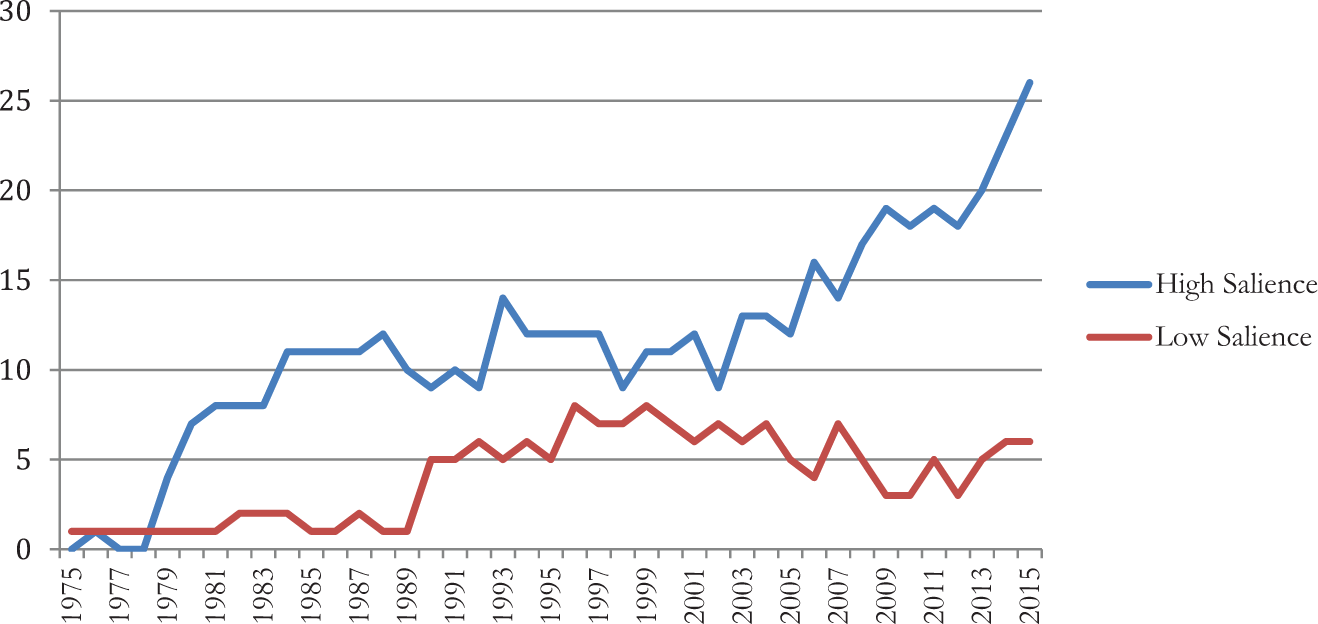
Salience of religious claims 1975–2015: Number of conflict dyads per year.
Having considered several patterns pertaining to the religious issue, we can also note some trends concerning religious identity conflicts. Exploring trends over time, conflicts where the belligerents on each side of the fault lines come from different religious faith traditions experience a slight increase after the end of the Cold War, as shown in Figure 4. Huntington (1993, 1996) predicted such an increase, but that prediction has not borne out after the beginning of the 1990s. In fact, the overall distribution of religious identity conflicts is quite stable in frequency over time. Hence, there is little in the empirical data that can support the notion that we are gradually moving toward a “clash of civilizations.”
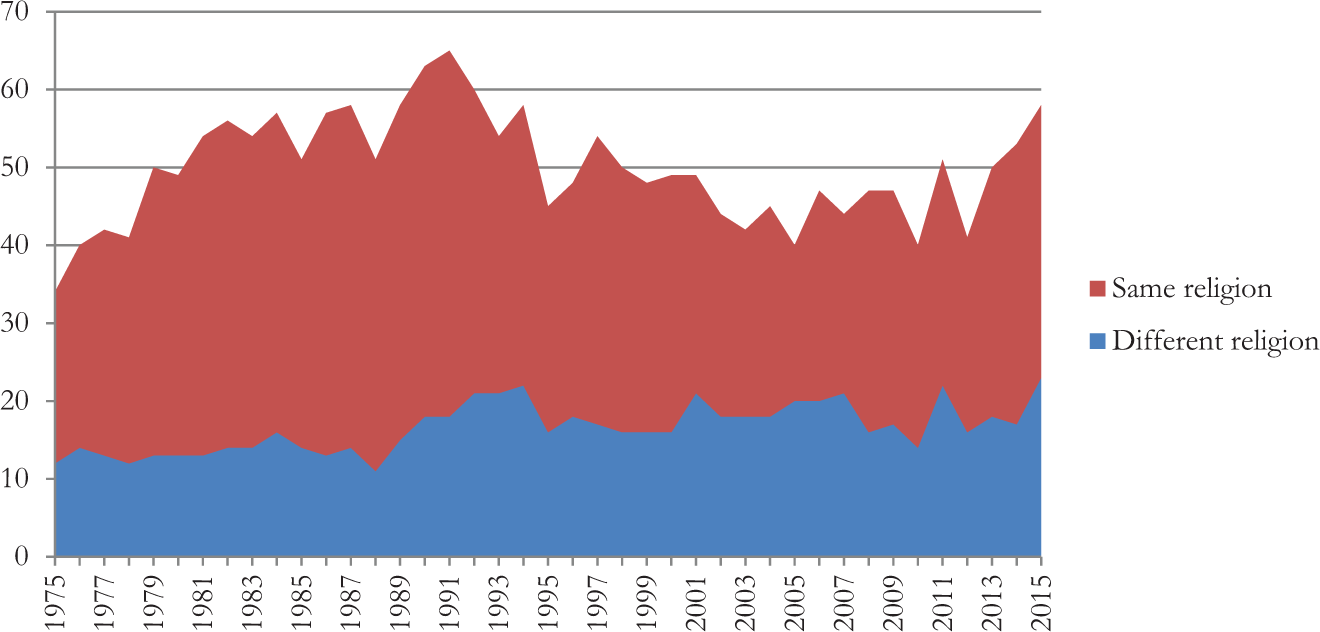
Religious identity conflicts 1975–2015: Number of conflict dyads per year.
Illustrating How RELAC Can Be Used
Next, we seek to illustrate how the RELAC data may be used in future research. We do this in three different ways: (1) we show how conceptualizations focusing on identities and incompatibilities, as well as the combination thereof, can shed light on how religious conflicts have shifted in character over time, (2) we illustrate how the disaggregation of claims, here focusing on Islamist claims, can facilitate a more nuanced understanding of religious conflict, and (3) we revisit the relationship between religious issues and the deadliness of conflict and find that there is great variation within the category of groups fighting over Islamist claims concerning the lethality of such conflicts.
Combining Religious Dimensions of Conflicts
By combining the religious incompatibility variable with the religious identity variable, we can provide a more comprehensive and refined picture of religious conflicts. Combining the two basic variables Issue and Identity yields three categories: (1) religious issue conflicts, (2) religious identity conflicts, and (3) religious identity–issue conflicts. Overall, there are no substantial differences in numbers: of 420 conflict dyads, 15 percent were religious incompatibility conflicts between parties within the same religious tradition, 18 percent were conflicts fought between parties from different religious traditions but not over religious issues, and 11 percent were conflicts fought over religious issues between parties from different religious traditions (see Appendix Table A1). However, there are differences in how these three types of religious conflicts have evolved over time (see Figure 5). First, conflicts in which parties come from the same religious traditions and where there is a religious incompatibility have increased over time. Second, religious identity conflicts in which the religious identities differ but the issues themselves are not religious are actually decreasing in frequency. Thus, conflicts between actors from different religious traditions but without any religious issues being contentious—such as the Irish Republican Army (IRA) (predominately Catholics) and unionists (predominately Protestants) of Northern Ireland conflicts and the Greeks (Christian Orthodox) and Turks (Sunni Muslims) of Cyprus—are becoming less common. 9 This means that armed conflicts in which religion functions solely as an identity marker are decreasing over time. Third and finally, conflicts fought over both religious issues and with different religious identities have become more common, in particular during the last couple of years. Note that there was a nontrivial drop in these conflicts 2008 to 2010, but that they have increased again after that, especially in the last few years. The year 2015 saw the highest number of such conflicts during the whole time period.
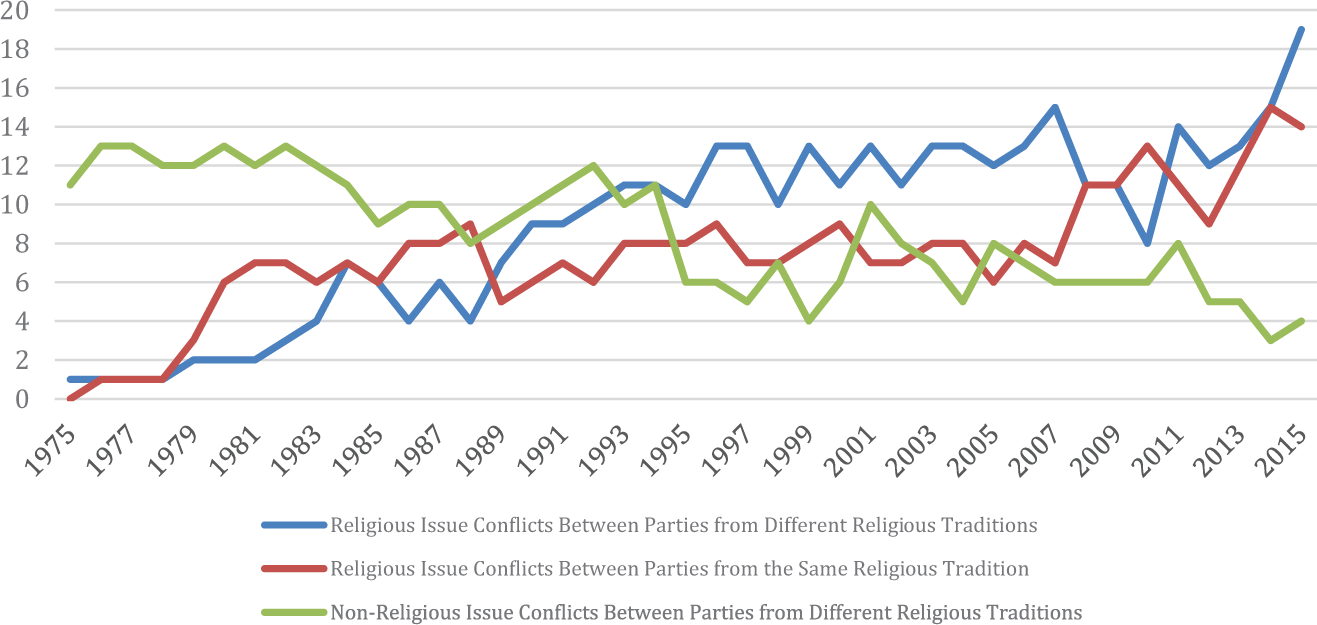
Combinations of religious dimensions of armed conflicts, 1975–2015.
Taken together, religious identity conflicts go in totally different directions depending on whether we are examining the religious issue or not. One reason that we may see a decrease in the frequency of religious identity conflicts (when the issue is not over religion) could be that we are getting better at resolving or terminating these types of conflicts but less so when it comes to conflicts where the issue at stake has a religious dimension. 10 Many of our conflict resolution tools speak to the identity-based features of conflicts by providing for power-sharing arrangements for ethnic groups, constitutional freedom of religion and the establishment of a secular state, and minority-protection institutions. Our new data that separate between religious identities and issues make possible for future research to explore these patterns in more depth.
Disaggregating Islamist Conflicts
As we have seen, the category of armed conflicts including actors with Islamist claims represents an overwhelming majority of all religiously defined conflicts. There are also important shifts over time when we examine the trajectories of revolutionary Islamist, separatist Islamist, and transnational Islamist claims, separately from each other (see Figure 6). In particular, we can see that conflicts fought over transnational Islamist aspirations have increased dramatically over the last decade, whereas conflicts over revolutionary Islamist claims have decreased somewhat, and conflicts over separatist Islamist demands have been more or less constant in overall frequency over the last decade. Thus, this helps to nuance the empirical picture on trends of Islamist conflicts (Fish, Jensenius, and Michel 2010; Gleditsch and Rudolfsen 2016). There is important variation within the category of Islamist conflicts.
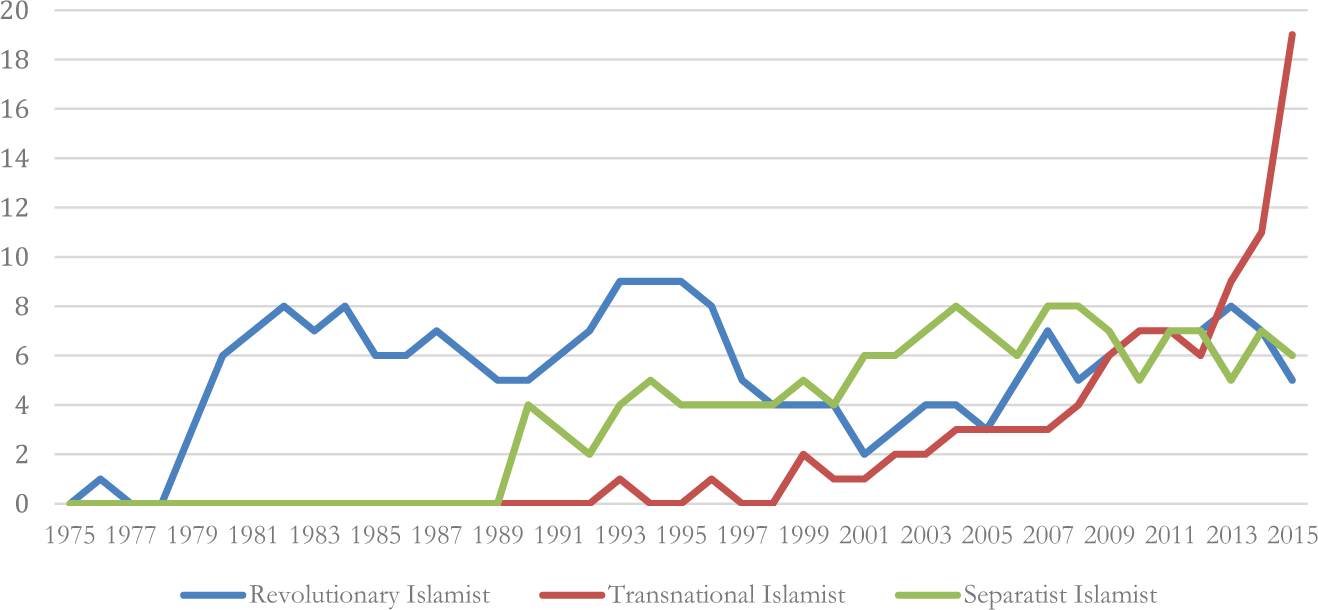
Types of Islamist claims: Trends over time, 1975–2015.
Examining the Deadliness of Religious Conflicts
Next, we illustrate the use of our data by reexamining a common claim in previous research that conflicts over religious issues are more deadly than other types of conflicts (Nordås 2007; Pearce 2005; Piazza 2009; Toft 2007). More specifically, we show that our data can provide a more refined picture of the association between different types of religious claims and the deadliness of armed conflicts. Based on previous studies, we can expect some differences across different types of claims. For example, Toft and Zhukov (2015, 224–25) argue that some Islamist groups, due to the scope of their Salafi-Jihadi goals and support structures—both transcending state boundaries—are less sensitive to coercion and have greater incentives to escalate violence than nationalist groups. Similarly, focusing exclusively on terrorist organizations, Piazza (2009) shows that there is no association between Islamist groups and the lethality of terrorist attacks after controlling for Al-Qaida groups, whereas groups with linkages to Al-Qaida are found to be more likely to commit such attacks. This raises the question if certain types of Islamist rebel groups, that is, those with goals transcending state boundaries (e.g., Al-Qaida and IS), are more likely to engage in high-intensity armed conflicts than other actors. To explore this issue, we take advantage of our disaggregation of the types of claims made, in particular, the distinction between revolutionary Islamist, separatist Islamist, and transnational Islamist claims. The focus is on all government-rebel dyads in armed conflicts above the twenty-five battle-related deaths threshold during the period 1975 to 2015. As our dependent variable, we created the dummy variable War, which is coded 1 if the armed conflict is active at a high-intensity level, that is, above 1,000 battle deaths in a calendar year, and 0 otherwise. We rely on a logit model for our statistical analysis and control for conflict duration, whether the conflict is fought over territory or government, and we also account for temporal dependence in our data by introducing a measure since the conflict reached 1,000 deaths if at all, along with squared and cubed terms. The results are presented in Table 2.
Logit Analysis: Types of Religious Claims and the Intensity of Conflict.
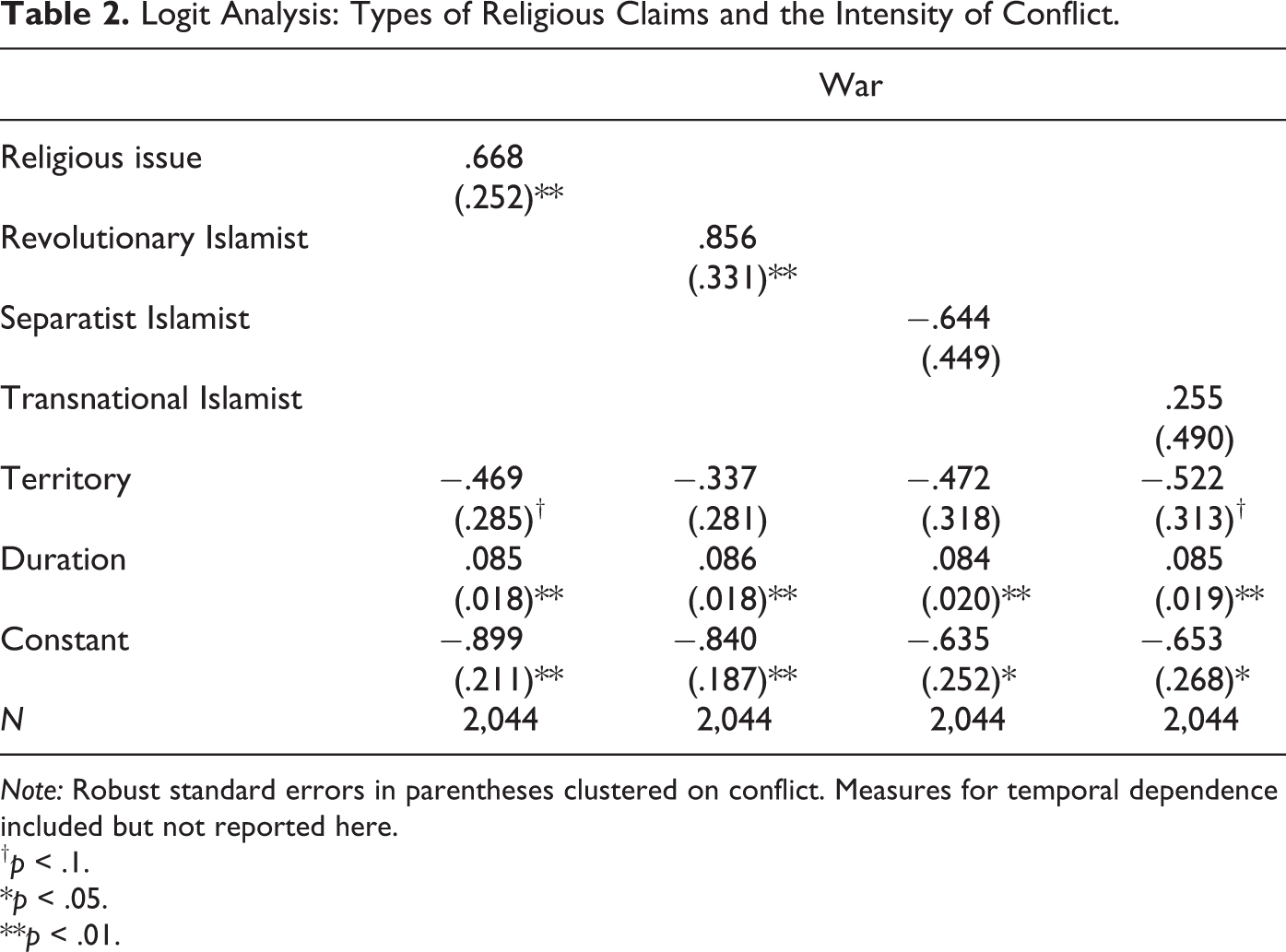
Note: Robust standard errors in parentheses clustered on conflict. Measures for temporal dependence included but not reported here.
† p < .1.
*p < .05.
**p < .01.
As a point of comparison, we begin by looking at the relationship between conflicts fought over a religious claim and conflict intensity. In line with previous research, we find that conflicts fought over a religious issue are more likely to reach above the threshold of 1,000 battle-related deaths in a year (see model 1, Table 2). Yet, such an analysis does not provide any information about the type of claims, beyond these being of religious nature. We therefore use our newly collected data on the different types of Islamist claims to explore if armed conflicts where groups are making transnational claims, such as Al-Qaida and IS, are more likely to escalate to high-intensity war. The analysis shows that there is important variation across the different types of claims. In contrast to expectations, we find no significant effect for either transnational Islamist or separatist Islamist claims, whereas the results show that conflicts over revolutionary Islamist claims are significantly more likely to manifest themselves as high-intensity conflicts rather than minor armed conflicts (see models 2–4, Table 2). In terms of a substantive effect, we can see that setting the dichotomous variable at its median value and the continuous variables at their mean value, conflicts over revolutionary Islamist claims have a 23.4 percent risk of being of high intensity, compared to a risk of 11.5 percent when the rebels are basing their struggle on other claims. 11 This means that the risk of high-intensity conflict more than doubles in conflicts where the rebel group has revolutionary Islamist aspirations. Yet, at the same time, our results also highlight that the trajectory for Islamist armed actors with a separatist base looks different in this respect. If anything, the analysis seems to suggest the opposite pattern. Hence, by introducing these disaggregated data on claims, we are able to move beyond previous findings in the literature, as well as assessing the applicability of findings in related fields such as terrorism studies. While our analysis is not conclusive and has focused on the escalation from low-intensity to high-intensity conflicts, it demonstrates the usefulness of studying these different types of Islamist claims separately, which the RELAC data allow for. Future research should further probe how these different types of claims are related to, for example, the level of battle deaths in armed conflicts, as well as conflict intensity in the form of attacks against civilians. Thus, while we here provide some initial evidence for which types of claims that are associated with low- and high-intensity conflicts, many important questions remain to be examined using these new disaggregated data on claims.
Concluding Discussion
There is a growing scholarly interest in religion and conflict. RELAC provides a basis for systematic examination of religious dimensions of armed conflicts and helps facilitate analysis of a set of important questions that the research field has yet to find answers to. Let us end by briefly pointing to a number of such important research endeavors, which may now be possible to pursue with the help of RELAC. The data set opens up for important research usages of the data, and we here want to point to some implications for future research on this topic.
First, by focusing on the incompatibility—the stated original positions of the conflict parties—we avoid analytical overlaps with potential religious causes of conflicts, which can be examined independently. It is still an open empirical question whether conflicts fought over religious claims are driven by the same, or different, causes: religiously defined conflicts may, or may not, have religious causes. For example, previous research examines the effects of factors such as crosscutting religious identities (Basedau, Pfeiffer, and Vüllers 2016; Bormann, Cederman, and Vogt 2015; Selway 2011), as well as the effect of extensive religion–state ties (Fox, James, and Li 2009; Henne 2012; Saiya and Scime 2015), on various forms of political violence and armed conflict. Yet, so far, we do not know whether religious explanations of violence and conflicts can explain specifically conflicts fought over religious claims. RELAC lends itself to such an analysis. Overall, it remains an important avenue for future research to examine whether religious incompatibility conflicts are driven by particular causal processes (Basedau and Rudolfsen 2016).
Second, there is a large body of scholarly work that has focused primarily on—provoked or inspired by—Huntington’s (1993, 1996) predictions, examining whether conflicts following religious–civilizational cleavages are indeed different than other types of conflicts, for example, in terms of propensity for escalation, or frequency in onset (Chiozza 2002; Fox 2001, 2004a; Huntington 1993, 1996; Roeder 2003; Russett, Oneal, and Cox 2000). By providing a conceptualization of religious differences in conflicts based on identity, it is possible to utilize RELAC to study dynamics of civilizational conflicts (since religious traditions are structurally identical to Huntington’s conceptualization of civilizations).
Third, previous research has pointed out that Islamist conflicts are increasing over time—proportionally to other types of conflicts. However, we still do not know why that is the case. In particular, when addressing the explanations behind the asymmetrical distribution of Islamist conflicts, research is likely to benefit from the disaggregated nature of the RELAC data.
Moreover, future research can take the RELAC data on religious issues and identities as a starting point for collecting additional information on temporal variations over time. It is worth examining escalations and deescalations of religious demands beyond escalation occurring through new rebel formations. Indeed, recent research on religion and conflict including Isaacs (2016) and Meserole (2015) are promising endeavors in this regard.
On a final note, the RELAC project represents an attempt to bring ideational factors, albeit limited to only religious claims, into the analysis of armed conflicts. While there are important exceptions, previous conflict research predominantly focuses on material factors, such as institutions, the capabilities of actors in conflict, the number and size of groups, and the political or economic structure of the state, when analyzing civil wars. RELAC is a resource that can help facilitate research that takes into account ideological factors. By taking the primary parties’ explicit positions as the basis for analysis, this yields a way of including dimensions of what the parties aspire for, when studying the causes, dynamics, and resolution of conflicts.
Supplemental Material
Supplemental Material, Relac-JCRrep - Disputes over the Divine: Introducing the Religion and Armed Conflict (RELAC) Data, 1975 to 2015
Supplemental Material, Relac-JCRrep for Disputes over the Divine: Introducing the Religion and Armed Conflict (RELAC) Data, 1975 to 2015 by Isak Svensson, and Desirée Nilsson in Journal of Conflict Resolution
Footnotes
Appendix
Three Different Types of Religious Conflict.
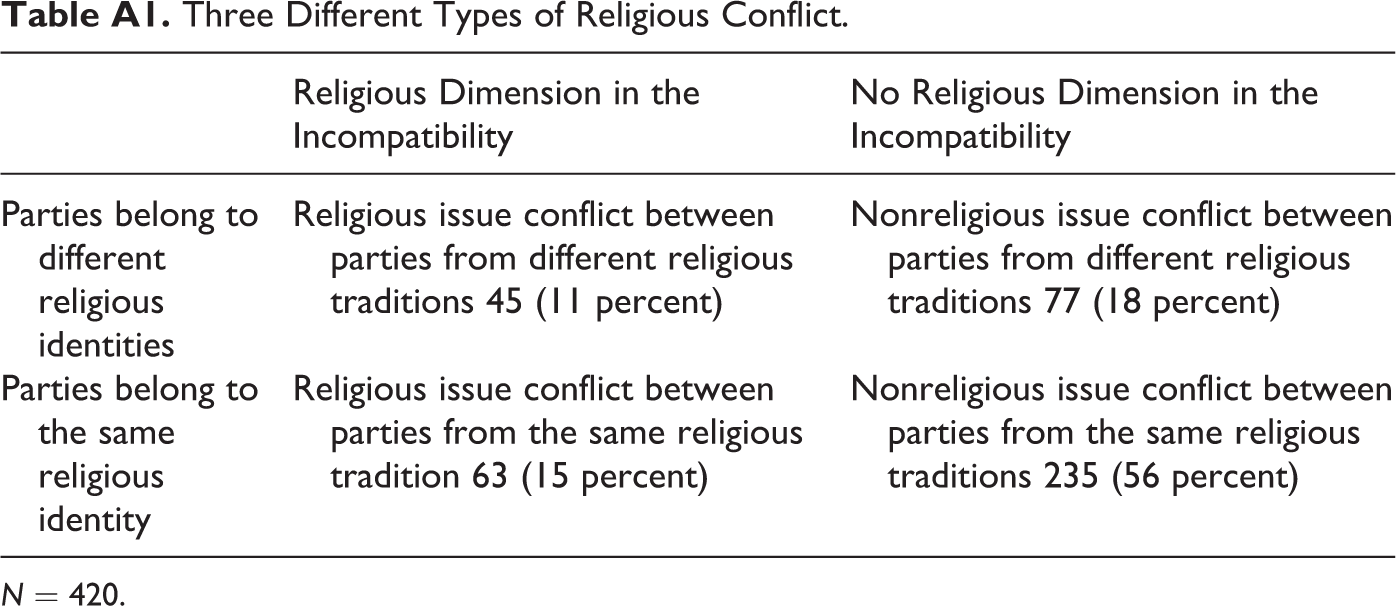
| Religious Dimension in the Incompatibility | No Religious Dimension in the Incompatibility | |
|---|---|---|
| Parties belong to different religious identities | Religious issue conflict between parties from different religious traditions 45 (11 percent) | Nonreligious issue conflict between parties from different religious traditions 77 (18 percent) |
| Parties belong to the same religious identity | Religious issue conflict between parties from the same religious tradition 63 (15 percent) | Nonreligious issue conflict between parties from the same religious traditions 235 (56 percent) |
N = 420.
Authors’ Note
This study was conducted within the project Resolving Jihadist Conflicts? Religion, Civil War, and Prospects for Peace.
Acknowledgments
We are grateful to Daniel Finnbogason for excellent comments and research assistance, and we also thank Mimmi Söderberg Kovacs for important insights and feedback. In addition, we wish to thank Monica Toft and the other participants at the Working Group Conference, “Defining and Analyzing Jihadist Conflict,” Uppsala, September 5–8, 2016, for very valuable comments and insights on an earlier draft of this article. We also extend our thanks to the Editor and two anonymous reviewers for their excellent suggestions and feedback.
Declaration of Conflicting Interests
The author(s) declared no potential conflicts of interest with respect to the research, authorship, and/or publication of this article.
Funding
The author(s) disclosed receipt of the following financial support for the research, authorship, and/or publication of this article: We gratefully acknowledge financial support for this research project by the Riksbankens Jubileumsfond through grant NHS14-1701:1.
Supplemental Material
Supplemental material for this article is available online.
Notes
References
Supplementary Material
Please find the following supplemental material available below.
For Open Access articles published under a Creative Commons License, all supplemental material carries the same license as the article it is associated with.
For non-Open Access articles published, all supplemental material carries a non-exclusive license, and permission requests for re-use of supplemental material or any part of supplemental material shall be sent directly to the copyright owner as specified in the copyright notice associated with the article.
