




Abstract
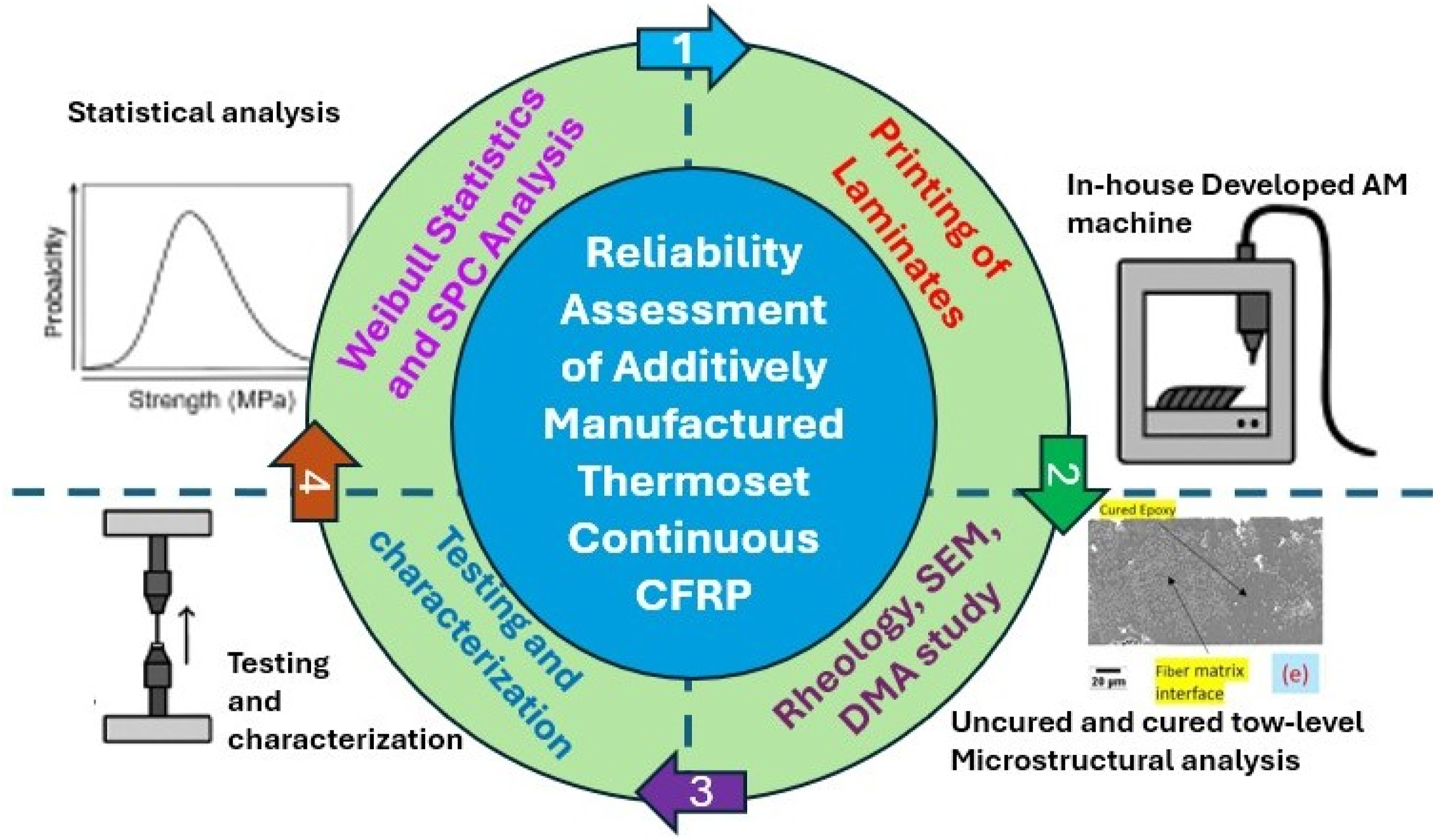
Additive manufacturing (AM) of thermoset continuous carbon fiber-reinforced polymer (CFRP) composites offers significant potential for aerospace and defense applications; however, their statistical reliability characteristics remain insufficiently explored. In this study, ten unidirectional laminates were fabricated using an in-house-developed automatic fiber placement-based additive manufacturing (AFP-AM) system under controlled processing parameters. Rheological analysis was conducted to optimize tow-infusion temperature, while scanning electron microscopy confirmed strong fiber–matrix interfacial bonding. Non-destructive ultrasonic C-scan inspection revealed minimal defects, with void content consistently below 1%. Tensile testing of 40 specimens yielded an average strength of 1985.8 MPa. A dual statistical validation framework integrating Weibull analysis and statistical process control (SPC) was developed to assess reliability and repeatability. Weibull analysis produced a characteristic strength of 2022 MPa and an R2 = 0.93, indicating low strength scatter and strong statistical adequacy. SPC charts and Cp/Cpk indices confirmed that subgroup averages remained within control limits, demonstrating process stability. Strength variability was primarily attributed to tow-width fluctuations during processing, which led to overlaps, gaps, and localized matrix-rich regions that served as stress-concentration sites. The proposed dual statistical framework provides a robust methodology for quantifying reliability, repeatability, and process capability in additively manufactured thermoset CFRP composites for high-performance structural applications.
Keywords
Get full access to this article
View all access options for this article.
References
Supplementary Material
Please find the following supplemental material available below.
For Open Access articles published under a Creative Commons License, all supplemental material carries the same license as the article it is associated with.
For non-Open Access articles published, all supplemental material carries a non-exclusive license, and permission requests for re-use of supplemental material or any part of supplemental material shall be sent directly to the copyright owner as specified in the copyright notice associated with the article.
