




Abstract
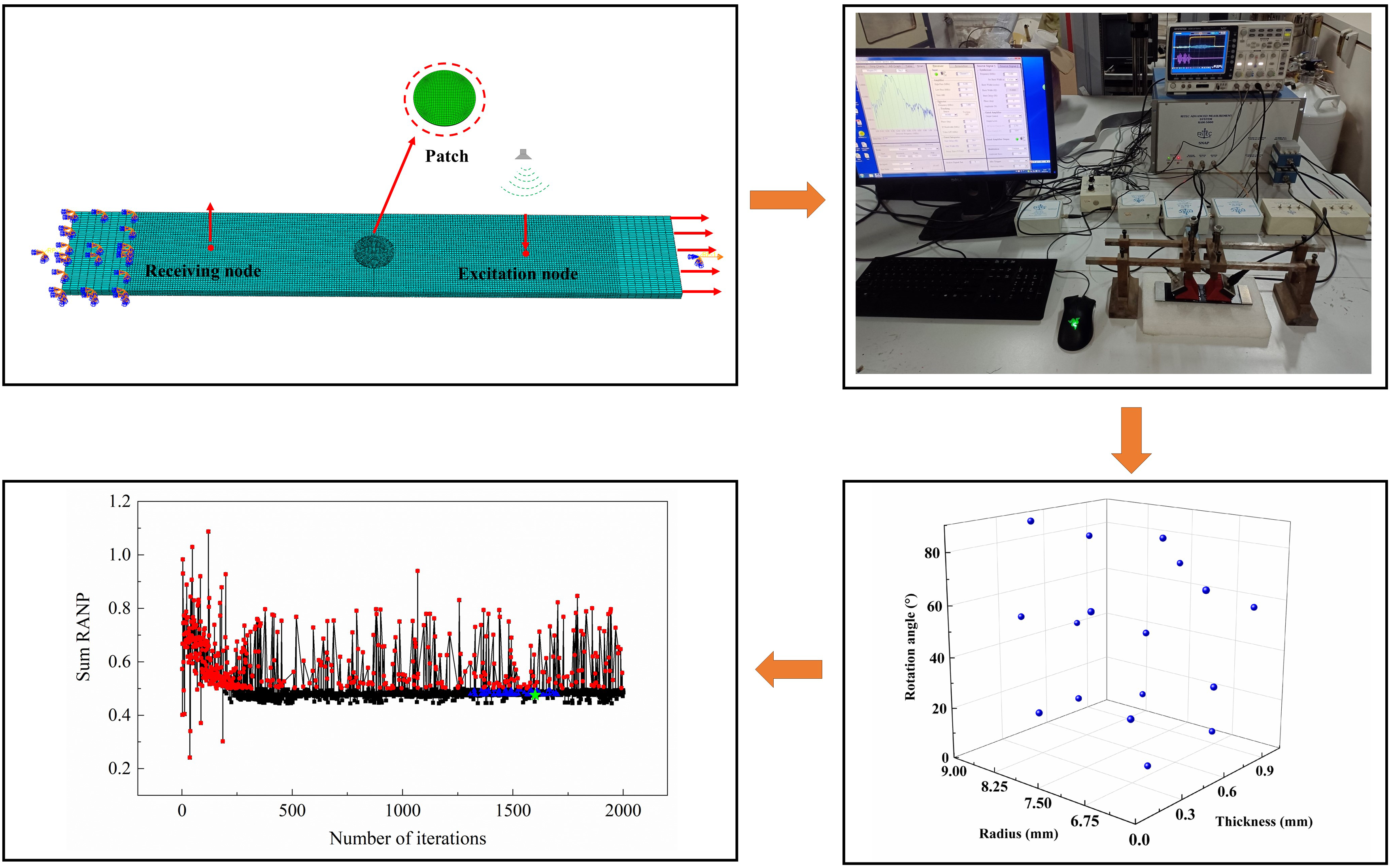
Microcrack damage was detected in orthotropic carbon fiber-reinforced polymers (CFRPs) repaired with a single-sided patch during the tensile process via nonlinear mixing Lamb wave detection technology. An integrated numerical model of tensile displacement–devibration–nonlinear mixing Lamb wave detection was established to explore the relationship between the patch parameters and the nonlinear mixing Lamb wave response. A static tensile test and nonlinear mixing Lamb wave detection were designed to verify the exactness of the simulation model. On the basis of the optimal Latin hypercube design, a response surface mathematical model with the patch radius, patch thickness and patch rotation angle as independent variables and mixing relative acoustic nonlinearity parameters (MRANPs) as the response value was constructed. An archiving microgenetic algorithm was used to identify the optimal combination of patch design parameters. The results revealed that under the same tensile displacement conditions, the tensile load on the patch-repaired CFRP plate was significantly greater than that on the unrepaired sample, indicating a greater bearing capacity. The MRANPs initially decreased but then increased with increasing patch radius and patch thickness; they first increased but then decreased with increasing patch rotation angle. After multiobjective optimization, the sum RANP and difference RANP were 0.4754 and 0.2434, respectively, representing reductions of 8.29% and 30.75%, respectively, compared with the single–factor simulation results. This significant optimization effect provides reference value for CFRP structural health monitoring in aircraft safety engineering.
Keywords
Get full access to this article
View all access options for this article.
References
Supplementary Material
Please find the following supplemental material available below.
For Open Access articles published under a Creative Commons License, all supplemental material carries the same license as the article it is associated with.
For non-Open Access articles published, all supplemental material carries a non-exclusive license, and permission requests for re-use of supplemental material or any part of supplemental material shall be sent directly to the copyright owner as specified in the copyright notice associated with the article.
