




Abstract
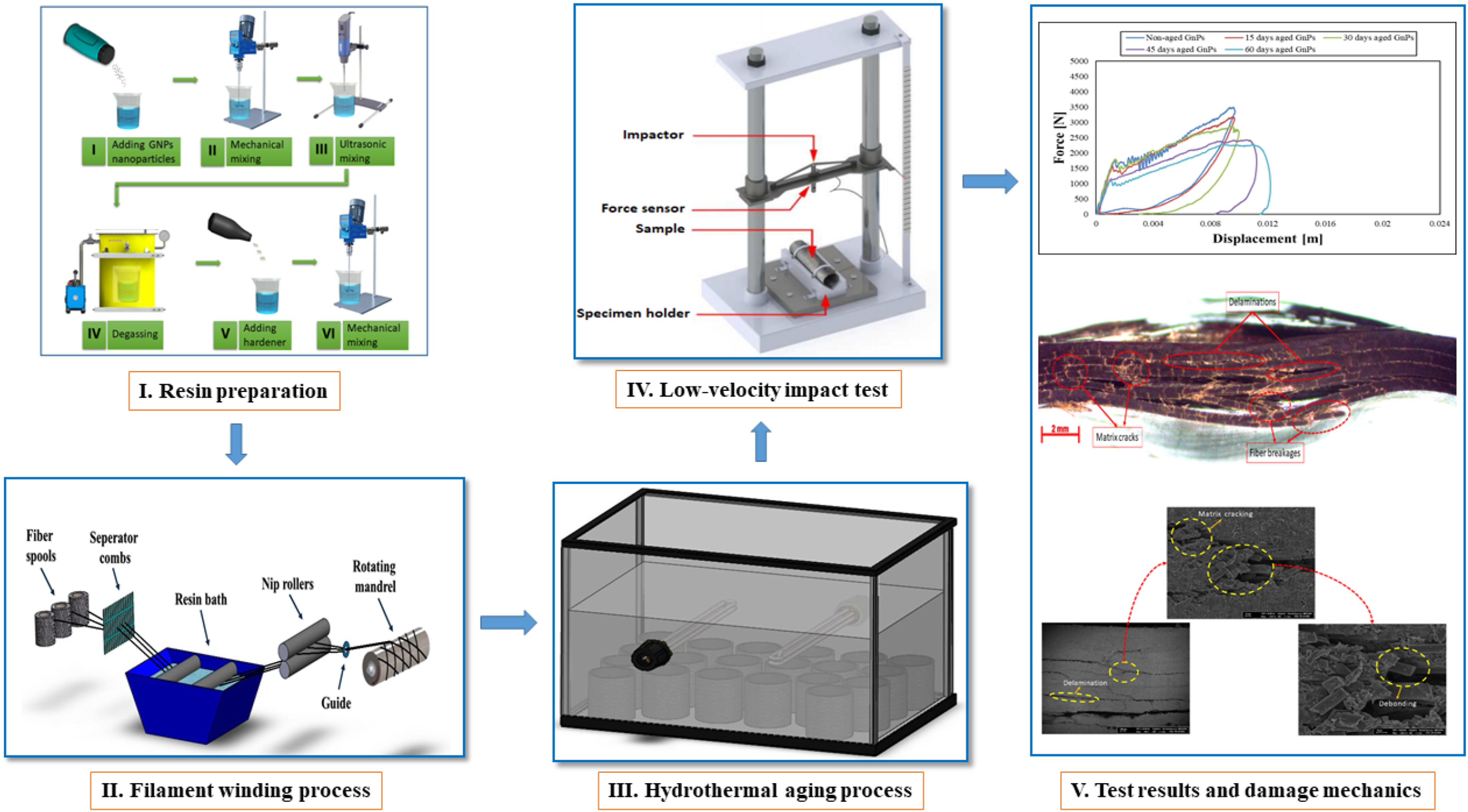
Composite pipes, widely employed in the transport of natural gas, petroleum, and chemical fluids, are often exposed to low-velocity impact loads compromising structural integrity. Such impacts, coupled with prolonged exposure to environmental factors like water and elevated temperatures, accelerate material degradation. This study aims to evaluate the effectiveness of graphene nanoplatelets (GnPs) in enhancing the impact resistance and long-term durability of basalt fiber reinforced polymer (BFRP) composite pipes under hydrothermal aging conditions. Neat and 0.25 wt.% GnPs reinforced BFRP composite pipes were fabricated via filament winding with a ±55° winding angle. The pipes were hydrothermally aged in water at 80°C for 15, 30, 45, and 60 days, followed by low-velocity impact tests at 20 and 40 J. The results revealed that increasing the energy from 20 to 40 J led to an increase in the maximum contact force by approximately 22% in neat samples and about 35% in GnPs reinforced samples, reflecting the enhanced rigidity and impact resistance provided by GnPs. Hydrothermal aging reduced the maximum contact force in all samples, with the most pronounced reduction after 60 days: neat samples decreased by approximately 57%, whereas GnPs reinforced samples about 21% at 40 J. These results indicate that GnPs mitigate aging-induced loss in impact performance by limiting rigidity reduction and damage propagation. Damage analysis further confirms the beneficial role of GnPs in preserving structural integrity under long-term aging. Overall, these findings highlight the potential of GnPs reinforced BFRP pipes for enhanced durability and impact resistance in industrial applications.
Get full access to this article
View all access options for this article.