




Abstract
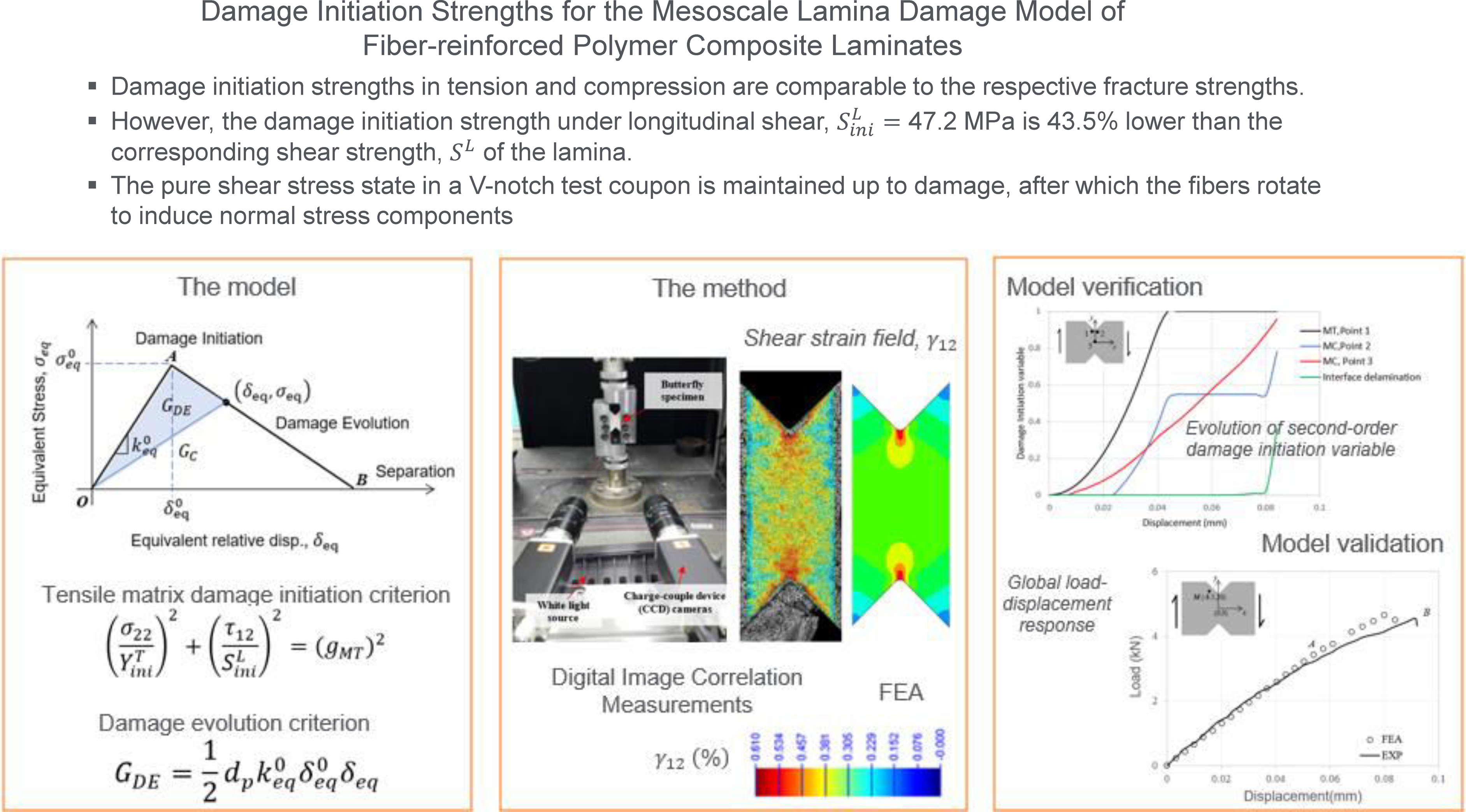
The damage initiation criteria based on Hashin’s theory for fiber-reinforced composite lamina are refined by replacing the fracture strengths with the respective damage initiation strengths. The damage initiation strengths of the carbon fiber-reinforced (CFRP) composite lamina under tension and compression are comparable to the respective fracture strength. Thus, emphasis is placed on the measured nonlinear longitudinal shear response of the lamina. Results show that the damage initiation strength for longitudinal shear at 47.2 MPa is 43.5% lower than the lamina shear strength. The pure shear stress state at the mid-length gage region of the V-notch test coupon is maintained up to damage initiation, after which the fibers rotate and induce the normal strain components. The outcomes of the computational model fit the second-order description of the lamina damage initiation criteria and the expected post-damage stiffness reduction of the laminate coupon. The damage model is validated by the comparable measured and finite element (FE)-predicted load-displacement curves to fracture of the laminate coupon. The FE-computed and measured shear strain field using the digital image correlation (DIC) method is similar. In addition, the FE-calculated anti-symmetric matrix tensile damage distribution at the notches in the observed locations of the initial matrix cracks is consistent.
Keywords
Get full access to this article
View all access options for this article.