




Abstract
Polymer composite materials are widely used in marine applications where an understanding of the long-term performance is essential for economic, safety and durability requirements. Although moisture absorption in composites has been studied for many years, the relationship between the mechanisms of moisture absorption and consequent changes in material behaviour has received much less attention. Understanding degradation is necessary for developing lifetime assessments. In this work, long-term exposure of a unidirectional carbon fibre epoxy composite material in water has been investigated in relation to mechanical property changes and moisture uptake. Using diffusion modelling and microscopy of the fracture surfaces, it is possible to correlate water absorption to experimental data showing how the position of water in the material causes changes to flexural properties (modulus decreased by 14% and strength by 20%) and in the glass transition temperature, Tg reduced by 18%. Flexural modulus has been shown to be most affected by water interaction with the fibre interface; Tg by water interaction within the resin; and flexural strength equally by water interaction with both fibre interface and resin.
Introduction
The use of polymer composite materials, such as glass or carbon fibre reinforced epoxy resin, for both critical marine and offshore applications is increasing. This includes subsea oil and gas platforms, wind and tidal turbines, shipping, and civil engineering applications such as coastal structures and bridges.1–3 These require long lifetimes (i.e. up to 25 years), or even longer for larger infrastructures and related components. 4 Many of these marine applications are difficult to access and maintain.
Understanding the long-term durability of polymer composite components, where durability refers to the long-term integrity of material performance over the design lifetime, is a significant challenge, requiring a focus on the relationship between the material and the environmental exposure conditions. In marine and offshore conditions there is significant concern about the negative impact of moisture absorption on the mechanical properties of marine structures over time.2,3,4–11,12,13 Elevated moisture content has been shown to reduce the tensile strength,14–16 flexural properties,17,18 interlaminar shear strength, 19 fatigue properties,9,12,15 and the glass transition temperature, Tg,11,20–22 of various polymer and polymer composite materials. The interaction of water with the composite material is important in understanding how the material properties degrade, and currently, while the reduction in properties with increased water content has been established, the correlation between the actual diffusion mechanisms, the way water interacts with the material and resultant property reduction, such as mechanical performance or Tg, is not clear. It is essential to understand the long-term behaviour of polymer composites with respect to environmental exposure to ensure the capability for accurate design, adequate safety and economic viability.
The data gathered from accelerated ageing tests can be used in models and extrapolation procedures to both model the degradation and to try to predict the material lifetime.3,5,13,20,23,24 Fick’s laws are often used to model diffusion of moisture into polymeric materials,3,10,11,13,20,25–29 but the anisotropic nature of the material, and the presence of interfaces complicates the diffusion processes. As a consequence, non-Fickian diffusion models such as the Langmuir model of diffusion have been employed to try to describe the diffusion process.25,29–31 The characterisation of the diffusion kinetics enables moisture absorption parameters to be derived from the experimental data.
As part of an effort to evaluate the durability of these materials in a marine environment, this work aims to correlate the changes in mechanical properties of polymer composites with diffusion of water into the material, using elevated temperature tests to accelerate moisture uptake. The changes in glass transition temperature and flexural strength have been used as measures of degradation, and microscopy has been used to understand failure mechanisms in relation to these changes. Both Fickian and Langmuir models have been used to simulate the diffusion process and relate type of moisture absorption to degradation of the composite material and subsequent property reductions.
Moisture absorption theory
Fickian model
In a simple, one-dimensional Fickian diffusion process, the diffusivity, D, and the saturation moisture content of the polymer, M∞, characterise the absorption kinetics.20,27 Through the diffusivity, D, for a material at different temperatures the moisture absorption can be predicted using an Arrhenius relationship.3,13,24
Fickian modelling for a 1D diffusion case, such as a neat resin, allows derivation of an expression for the moisture content as a function of time from the following equation11,13,20,25–27,29,32,33 i.e.
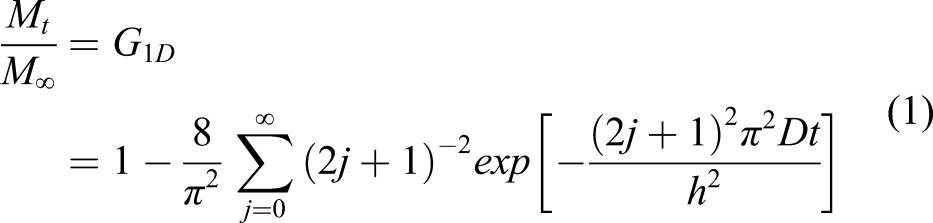
Here, M
t
is the moisture content at time t, M
∞
is the saturation moisture content, and h is the thickness of the specimen and D the diffusion coefficient. This expression may be simplified to:

This equation is generally valid over a range given approximately by 0 < Mt < 0.6M∞ 13 ; a plot of M t vs. √t allows the diffusion coefficient, D, to be derived.
In the Fickian model, the diffusion of moisture into the material is considered as entirely driven by the concentration gradient. The moisture content of the material increases linearly with the square root of time in the initial stages, and gradually slows down as saturation is reached. Many materials; however, have been reported to show non-Fickian behaviour and therefore require alternate models to account for this, such as the Langmuir style hindered diffusion model.
Langmuir style hindered diffusion model
A Langmuir style hindered diffusion (LSHD) model can also be used to describe the diffusion of water into a composite material and deal with non-Fickian behaviour. This multi-mechanism model of diffusion, as proposed by Carter and Kibler, 31 is referred to as Langmuir style as it is analogous to the Langmuir theory of adsorption. This model considers both the interaction of water with the polymer network, and the storage of moisture at the fibre-matrix interface,31,34,35 and assumes that water molecules can exist in two different states. These states are either (a) a mobile state, where water is free to diffuse due to the concentration gradient, or (b) a bound state, where water is not free to diffuse through the polymer network. The presence of bound water in the material contributes to the hindrance effect during the diffusion mechanism.
The number of bound and free water molecules varies over time until the system reaches equilibrium. If only the free, mobile water phase is considered then this model is equivalent to the Fickian model system. This approach has been successfully used to describe the diffusion behaviour of various polymeric materials31,36,37 and composite systems.25,30,36,37
Two parameters are included in the LSHD model: β, which represent the probability of a bound water molecule becoming free and mobile; and γ, which represents the probability of a free water molecule becoming bound. The equations are as follows:


Here,

Here,

This value indicates the affinity of the material system for water. A hindrance coefficient of zero defines the system as exhibiting a single mechanism of diffusion and is analogous to the Fickian model. Guloglu et al. 35 have shown an increase of the hindrance coefficient value with a greater hydrophilicity of the polymer, and also with increased volume fraction of reinforcement (which provide more bonding sites for water and more potential for interfacial storage of water).
Experimental methods
Material
The epoxy resin and CF epoxy composite materials used in this experimental work were obtained commercially and were selected as representative of material used in marine and offshore components and structures. In this paper, the focus is on the results from a commercial epoxy resin and carbon fibre epoxy pultruded strip; the results for other systems can be found in (38). For the resin, a commercial Easycomposites EL2 epoxy laminating resin was used with an AT30 amine hardener. These epoxy resin specimens were moulded in preformed silicone moulds to a size of 200 mm x 12 mm x 2 mm, according to manufacturer guidelines. The resin was mixed in 100:30 ratio by weight and left to cure at room temperature for 48 h. Specimens were then post-cured for 2 days at 50oC in an oven.
The Easycomposites carbon fibre epoxy pultruded strips were purchased as formed from the manufacturer. These strips were unidirectional (UD) pultrusions, with dimensions 2000 mm x 12 mm x 2 mm and a fibre volume fraction of 55%. All test specimens were cut to size 200 mm x 12 mm x 2 mm from this strip using a CompCut diamond saw prior to conditioning. The material was then tested in the as received state as well as the conditioned state following accelerated ageing procedures.
Accelerated ageing
Both resin and composite specimens were immersed in distilled water

Here, m w is the mass of the aged specimens and m d is the mass of the unaged specimens prior to any testing. After immersion, samples were wiped to remove any surface water prior to weighing. All specimens were stored at room temperature in distilled water.
Characterisation of degradation
Four-point bend flexure
Four-point bend flexure tests were performed following BS EN ISO 14,125. 40 Tests were carried out on an Instron 4507/5570R machine with a 20 kN load cell. The crosshead speed was 2 mm/min and specimens for this test were cut to dimensions 2 mm x 12 mm x 100 mm as per the standard recommendations. Specimens were placed on the four-point bend fixture with a linear variable differential transformer (LVDT) mounted underneath the central span to measure the deflection in the centre of the bending beam enabling the flexural strength and flexural modulus of the unaged and aged composite specimens to be determined. All specimens were tested until failure which was defined as a drop in the load in the load-displacement curve of greater than 20%.
Dynamic mechanical analysis
Dynamic mechanical analysis (DMA) measurements were performed to determine the glass transition temperature, Tg, of the composite materials. These measurements were performed in flexure on a TA instruments Q800 dynamic mechanical analyser, with a heating rate of 3oC/min, and the Tg
Scanning electron microscopy
Failed specimens from the four-point bend flexural tests were examined using scanning electron microscopy (SEM). Images were taken using a Zeiss Supra SEM of cross-sections of the failed specimens.
Data analysis
Analysis of the SEM fracture surfaces of the polymer composite material were completed using the software ImageJ. The ratio of the proportional length of the tensile to compressive fracture surface was calculated as the average of at least five measurements using the line measurement tool.
For the LSHD modelling it was assumed that the water diffusing through the resin is mostly unbound, or mobile, such that the hindrance coefficient, µ, for the resin is zero, that is, there is no affinity of the water to bind to the resin. The diffusion coefficients for the LSHD were obtained as described in the literature 37 using the experimental moisture absorption data. The saturation moisture content value, M ∞ , was selected to produce the best fit for the model in relation to the experimental water uptake data. Values for M 1 , β, γ, and subsequently the hindrance coefficient, µ, were calculated also as in. 37
Results and discussion
Moisture absorption, property retention and fracture surface
Figure 1 shows the decrease in glass transition temperature, Tg, flexural modulus and flexural strength, of specimens relative to the initial pre-aged values as a function of moisture content (Figure1(a)) and time1/2 (Figure1(b)). The flexural modulus of the unaged composite was 91 (± 4) GPa, the flexural strength 1180 (± 22) MPa, and the Tg 100 (± 0.4)oC. The change in properties is plotted as a percentage retention of these unaged values. Composite with (a) increased exposure time and (b) increasing moisture content normalised by pre-aged value. The flexural modulus has been normalised by its post cure value.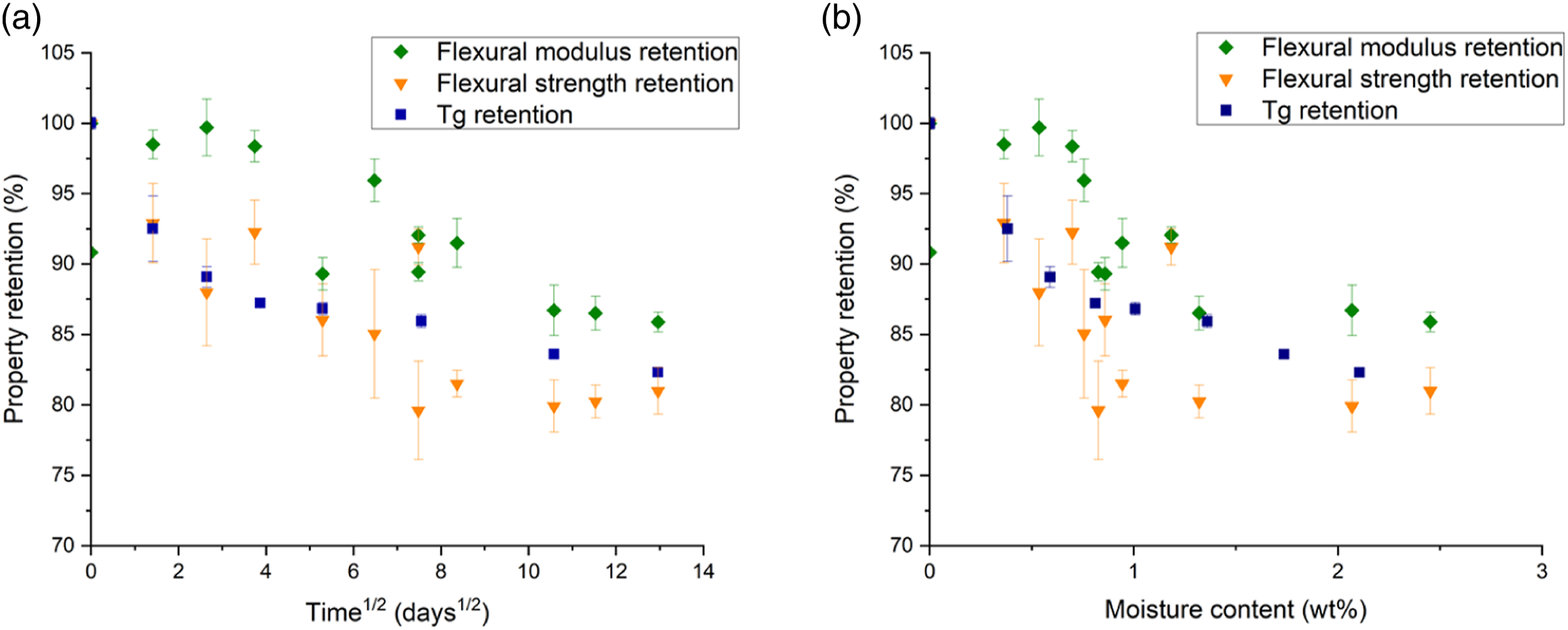
The T g was found to decrease with longer exposure times and elevated moisture content of the material, agreeing with trends reported in literature13,42,43 The trend in reduction of T g is not linear; there is a sharper drop in T g initially, between 0 – 0.5% moisture content, after which the T g continues to fall but at a lower rate.
Specimens were tested in 4-point bend flexure after exposure in water. This provided a test scenario where the stress was concentrated on the outer layers of the specimens, where the water concentration is also likely to be greatest. Under these conditions the testing is a ‘worst case’ and therefore also accelerates conditions.
With regard to the flexural modulus, there was an initial increase of about 10% due to the post curing effects of exposure of the composite at the elevated temperature of the accelerated ageing. This was confirmed by flexural testing of separate composite specimens that were simply aged in an oven at 60oC over the same timescale which also produced a 10% increase in flexural modulus. The data presented in Figure 1 has been normalised with respect to its post cure value. The original (unaged) value (about 0.91 of the post cure value) has also been shown for completeness. Continued exposure of composite specimens to water caused the flexural modulus to decrease.
Changes in flexural strength exhibited a similar behaviour to that of the T
g
characterised by an initial rapid decrease followed by a more gradual decrease. After 7 days exposure, the flexural strength had fallen to about 90% of its original value and after 56 days exposure, the flexural strength had fallen to about 80% of its original value (see Figure 1). The decreases in flexural strength correlated well with fracture surface observations. Figure 2(g) shows a typical SEM micrograph of the tensile region of the fracture surface of a specimen which had not been exposed to moisture. The fracture surface shows that the matrix remains adhered to the fibres and clumps of fibres appear to pull out. This is in contrast to the fracture surfaces of specimens tested after a 7-day exposure to the moisture absorption regime (Figure 2(h)) where there is significant pull out of individual fibres, with some matrix adhering to the pulled-out fibres. After a 56-day exposure (Figure 2(i)), there is again evidence of significant individual fibre pull out, although now the fibre surfaces have no matrix attached. The reduction in the quantity of matrix adhering to the fibre suggests that the interface has been degraded, presumably due to moisture accumulating at the interface,
35
with increased moisture leading to lower strengths. Fracture surfaces of the composite, both unaged and aged in water at 60oC.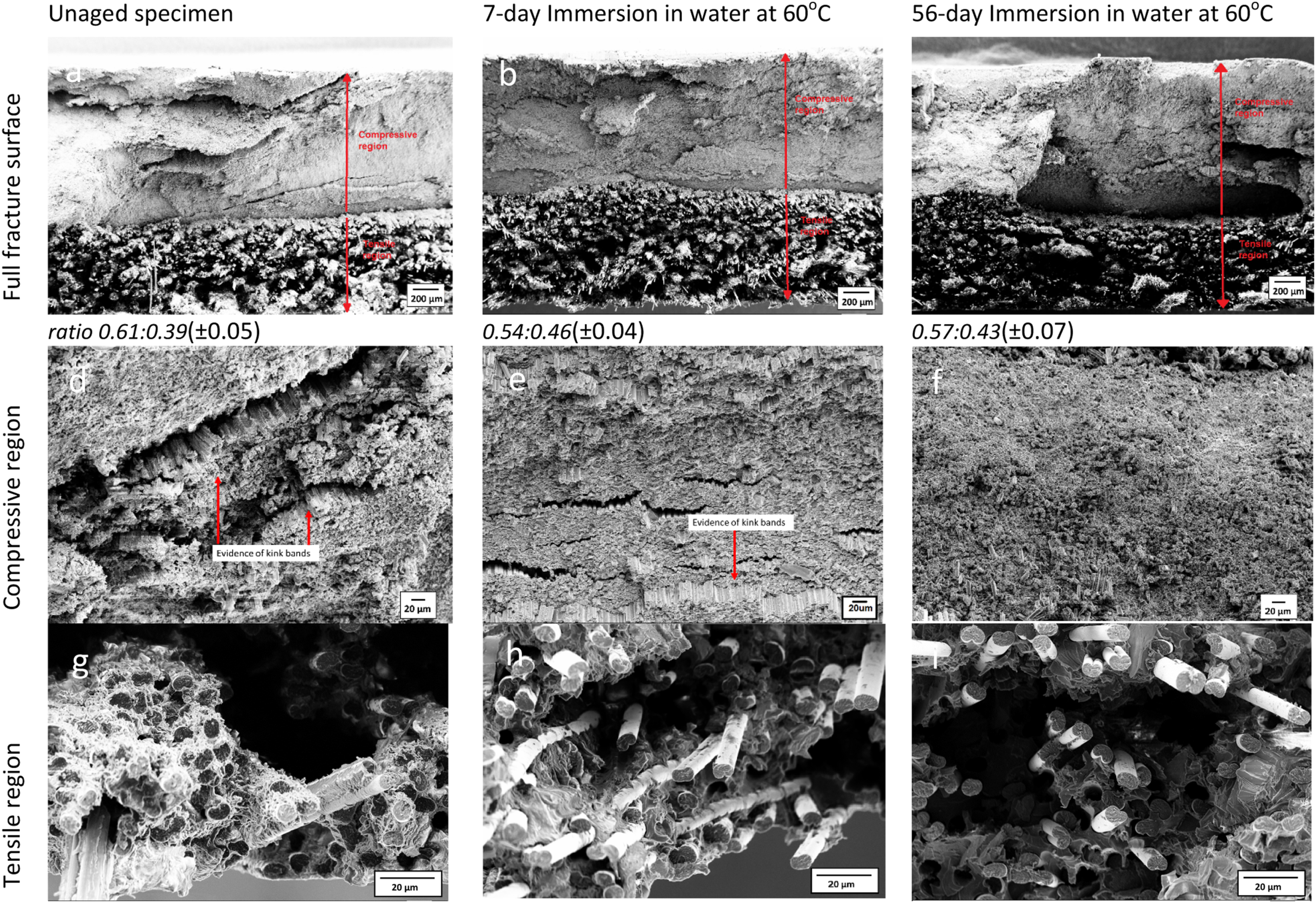
By contrast, the flexural modulus fell by only about 2% after 7 days, and then to about 90% of its (post-cured) value after 56 days. At 7 days, the partial degradation (Figure 2(h)) has had a significant effect on the flexural strength, but the retention of some bonding between the fibres and the matrix means the flexural modulus has not been substantially affected. After 56 days, the fibre/matrix bonding has been sufficiently disrupted that both the modulus and the strength are both affected to a large extent (Figure 2(i)).
This correlation of fibre-resin interface degradation with reduction in mechanical properties as a function of water exposure indicates that it may be possible to predict mechanical degradation from an understanding of how, and at what rate, water is absorbed by the composite.
The CF epoxy specimens failed under 4-point bend load fractured at a load point of the inner span of the test. Further examination of the fracture surfaces using the scanning electron microscope allowed comparison of unaged specimens and those exposed in water. Figure 2 shows the full fracture surface, compressive surface, and tensile surface of unaged specimens, and those aged for 7 days or for 56 days in water at 60oC. The compressive and tensile failure regions are indicated. These images show evidence for the kinking and the buckling of fibres in the compressive region, shown by the terraces of failed fibres, 44 and the pull out of fibres in the tensile region of the surface.
Interestingly, although the flexural strength of the CF epoxy composite falls by about 15% over the 56-day exposure, there is no significant change in the ratio of compressive/tensile fracture surface areas after exposure and subsequent flexural tests. The ratio of compressive to tensile fracture surface for the unaged specimen is 0.61:0.39 (error ±0.05), whereas for 7-day ageing it is 0.54:0.46 (error ±0.04), and for 56-day ageing it is 0.57:0.43 (error ±0.07). It might be expected that the weakening of the fibre/matrix interface with enhanced exposure to moisture would produce a greater proportion of compression fracture surface, but it would appear that the proportion of tensile fracture surface increases. These results are in agreement with Hong et al. 45 who also found that the area fraction of tensile fracture surface increased with increasing moisture exposure.
For all specimens, the distinction in tensile to compressive region can be distinguished. The compressive region shows evidence of kink bands in the form of terraces of failed fibres, and the tensile region shows fibre pull out. These fibres in the unaged specimens appear coated in resin, whereas with ageing and the increased moisture content of the specimens there is no resin coating on the fibres.
Moisture diffusion – fickian modelling and langmuir style hindered diffusion modelling
Figure 3 shows experimental data for moisture uptake as a function of time for the epoxy resin material and for the carbon fibre composite exposed to water at 60oC, together with both Fickian and Langmuir modelling of the moisture uptake. For the neat resin, the moisture content increased linearly with time1/2 until saturation was reached and the moisture content then remained constant at saturation. This behaviour is well represented by the Fickian diffusion model and suggests a single diffusion mechanism where there is isotropic diffusion of free water through the material.
29
The diffusion coefficient was calculated from the linear region of the graph to be 15.2 x 10⁻¹³ m2s−1 which is in good agreement with data for similar resins in the literature.25,35,37,46 The predicted moisture uptake, based on the Fickian model, is shown in Figure 3. Experimental and predicted moisture uptake of the neat epoxy resin and, composite for 60oC exposure in water.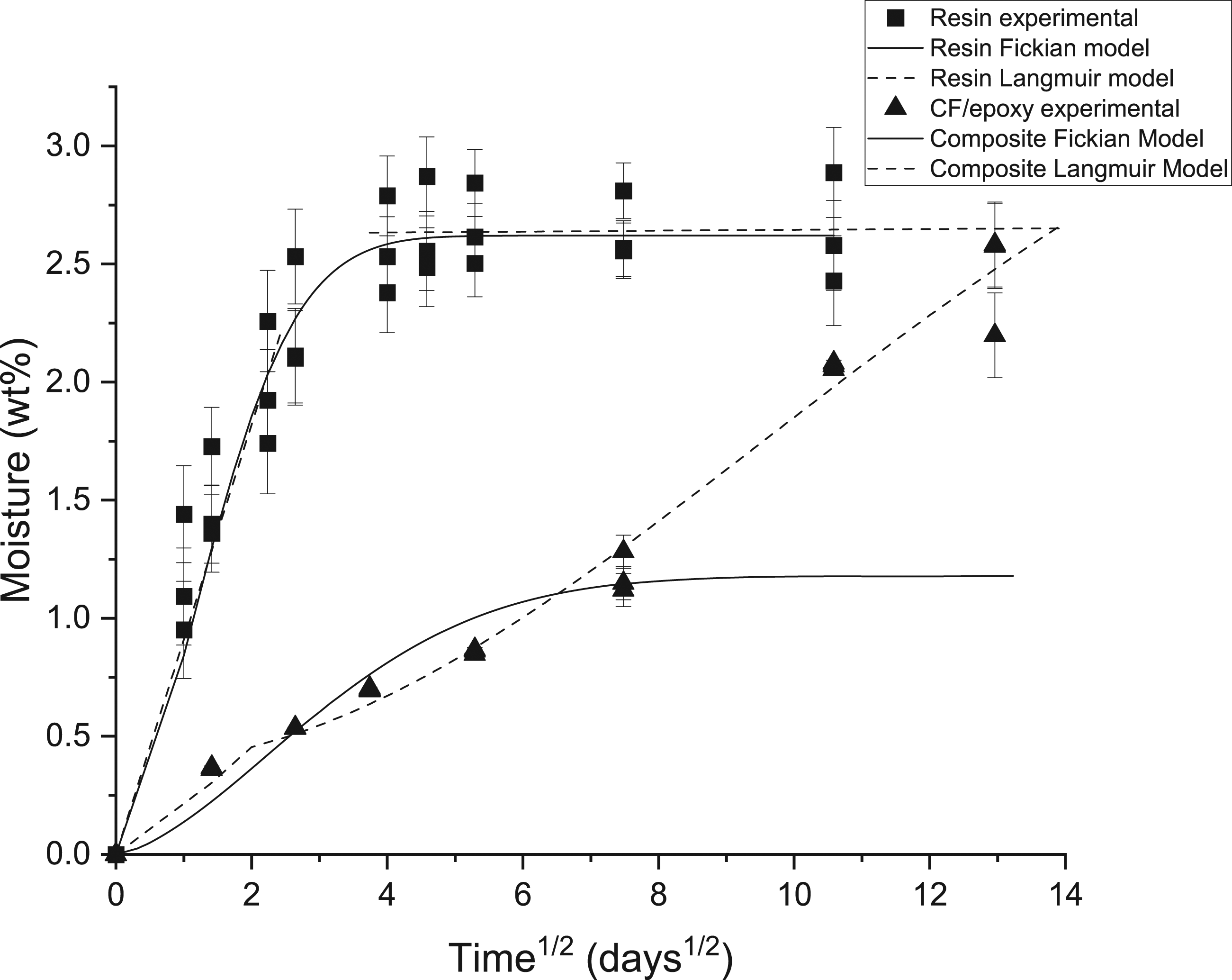
For the carbon fibre epoxy composite material, it is clear that a Fickian diffusion model is likely to be inadequate. Nonetheless, a Fickian diffusion coefficient can be calculated from the experimental moisture uptake data, and this was found to be 3.0 x 10⁻¹³ m2s−1. Using this value, the diffusion coefficient of the resin in the CF epoxy specimens can be estimated by correcting for the volume fraction and specimen dimensions,which gives a diffusion coefficient value of 12.8 x 10⁻¹³ m2s−1. This value falls well within the range found for epoxies in the literature (i.e. 8–40 x10−13 m2s−1) and is similar to the value for the neat resin tested here separately (i.e. 15.2 x 10⁻¹³ m2s−1).
The prediction of water uptake in the composite using the Fickian model is a reasonable fit to the experimental data at exposure times up to about 56 days, but for longer exposure times the experimental data shows an increasing moisture content and the Fickian model incorrectly predicts a plateau. Assuming that the moisture content of the resin has saturated, this excess moisture must be held elsewhere in the composite material such as at the interface or in voids or cracks, and hence the single mechanism Fickian model is inadequate for describing the diffusion of water in composites, as has also been concluded by other authors.25,36,37,47 Consequently, an alternative model (Langmuir Style Hindered Diffusion model; LSHD) has been used to model moisture uptake.
Diffusion parameters of both the neat epoxy resin and the composite material used in both Fickian and Langmuir style models.
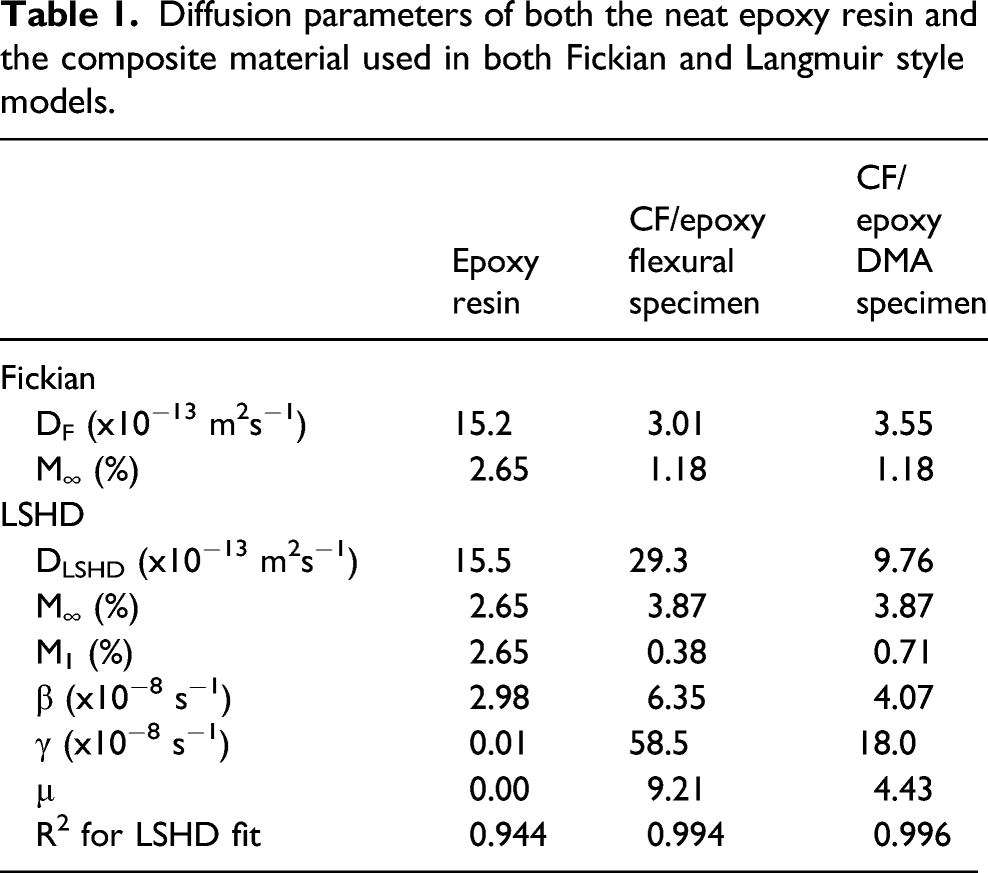
For the carbon fibre epoxy composite, there is a large difference in the Fickian and LSHD diffusion coefficients and saturation moisture contents (Table 1). It is clear from Figure 3 that the Langmuir style diffusion model is a much better fit to the experimental data for the composite material than the Fickian model, describing both the initial and latter stages more closely. This supports the hypothesis that there are multiple diffusion mechanisms involving both free water through the resin, and water bound in other places such as in the interfacial region, or possibly excess free water accumulating in cracks and voids.
The very nature of the modified Fickian model for the composite means that the saturation moisture content must be lower than that of the resin. The LSHD; however, allows for additional moisture reservoirs meaning that the saturation moisture content may be higher than that of the resin. Here, the hindrance coefficient for the composite is greater than zero, indicating an affinity for water and therefore an expected binding of water to the resin and accumulation around the fibre/matrix interface. The presence of fibres should also reduce the diffusion coefficient due to lengthening of diffusion paths. However, not only is the LSHD model diffusion coefficient of the composite greater than the Fickian diffusion coefficient, but it is also greater than the diffusion coefficient of the pure resin. This suggests an accompanying acceleration of the diffusion of water due to the presence of fibres as could be attributed to capillary action (i.e. wicking water along the fibres).
Comparison of the different geometry composite specimens shows that the change in length (width and thickness remaining the same) has only a small effect on the value of the Fickian diffusion coefficient. For the Fickian model, a decrease in length for the DMA size specimens compared to the longer flexural specimens slightly increased the diffusion coefficient value, whereas for the LSHD model this value is decreased. The LSHD model required an input of the same value of moisture saturation, M ∞ , assuming that the total moisture content for the same material under the same exposure conditions (immersion in water at 60oC) was the same (in this case 3.87 wt%). This gave a good fit by linear regression for both sets of experimental water uptake data. However, the other diffusion parameters for the 35 mm and 100 mm specimens in the LSHD model did not remain consistent. Forcing a fit with consistent M ∞ , M 1 , β and γ produced a poorer fit for both sets of data. In fact, combining the experimental data sets and fitting the LSHD model to the combined data, and fitting the individual data sets with the combined fit parameters also produced a poorer fit curve. These changes demonstrated the sensitivity of the fit to the saturation value. Therefore, it was concluded that the fit to the same values of M ∞ = 3.87 wt% was most appropriate to model the diffusion curve in the polymer composite. This shows that if β and γ are different for the two geometry specimens there may be some longitudinal and transverse dependence. Other researchers have found that the parameters µ, β and γ are dependent on temperature, diffusion medium and penetrant, as well as thickness.34,35 On the other hand, the experimental data sets do not reach full saturation and so it is only assumed that the moisture saturation values are equal.
Relation of diffusion mechanism to changes in mechanical properties
The results suggest, and in agreement with previous work,25,30,34,35,37,46 that the moisture diffusion mechanism in the UD carbon fibre epoxy composite material is not a single mechanism and can be modelled using a Langmuir style hindered diffusion model, with three broad regions identified (Figure 4); a diffusion dependent region (region I), a transition region (region II), and a diffusion independent region where the diffusivity has less effect as water transport is not rate limiting (region III). The transition region II lies between the end of linear moisture uptake at earlier time intervals and where the moisture content exceeds the mass fraction weighted resin saturation. These regions appear to correlate with the appearance of the different morphologies of fracture surfaces and to the changes in the mechanical properties (Figure 4). In region I, it can be seen that there is good bonding evident on the fracture surface between the fibres and the matrix; in region II, there is evidence of increasing degradation of the fibre/matrix interface; and in region III, debonding of fibres from the matrix is widespread. Comparison of experimental moisture uptake and the modelling with the three regions of diffusion mechanism indicated.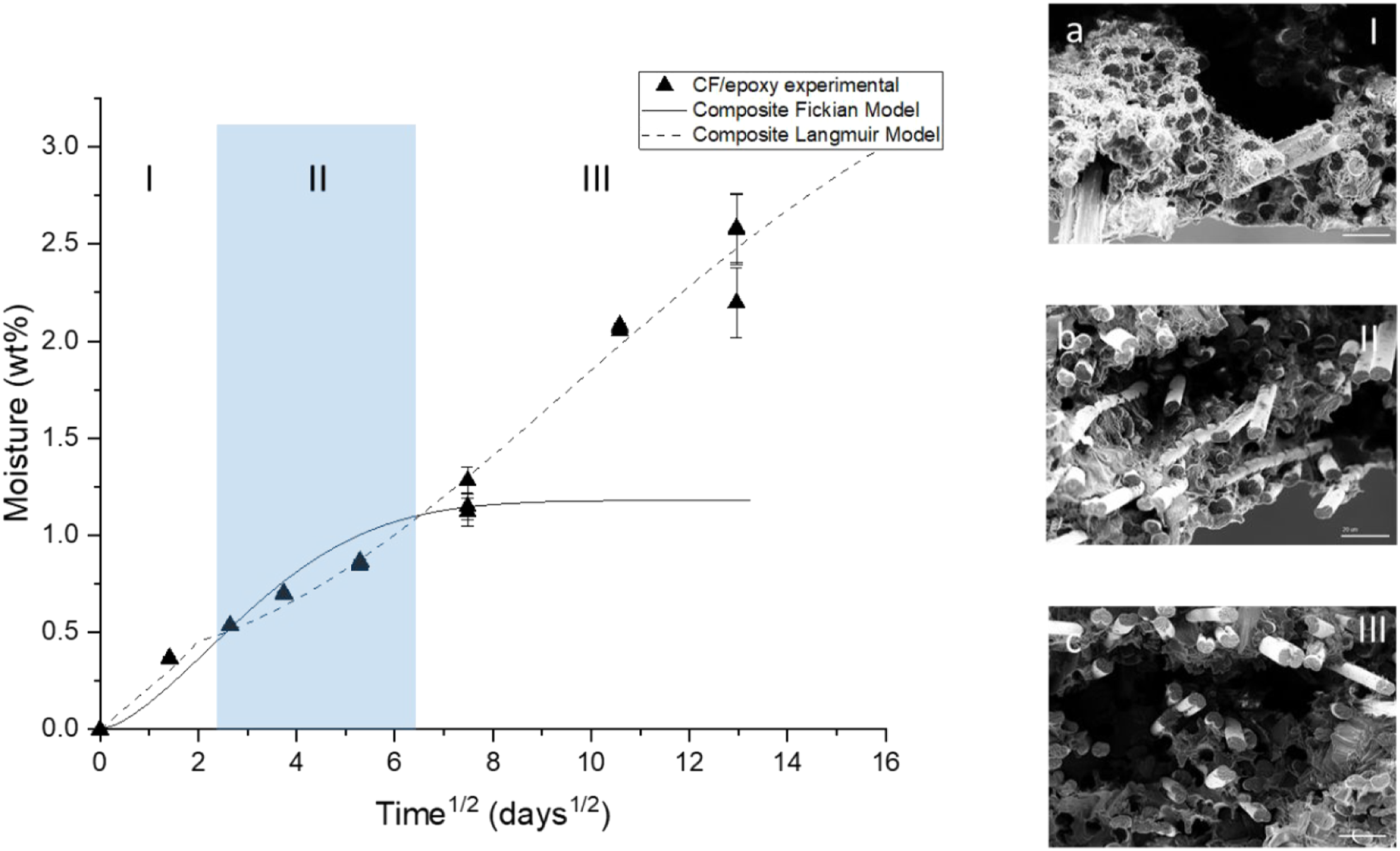
Changes in mechanical properties and moisture absorption as a function of the square root of time can be presented together, as shown in Figure 5, to highlight their alignment with the three regions of the LSHD model. Relation between changes in (a) flexural modulus, flexural strength and (b) the glass transition temperature in regions I, II and III.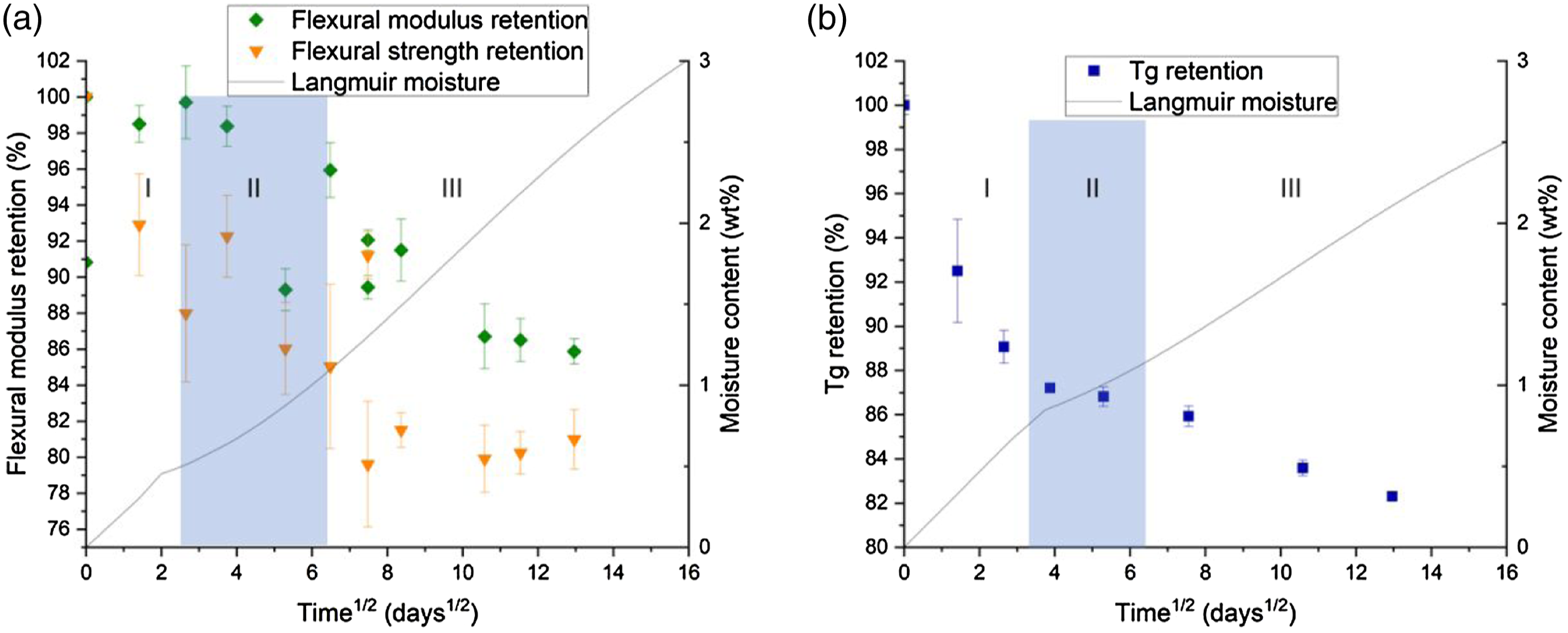
The initial uptake of water (diffusion dominated) in region I does not appear to affect the flexural modulus of the composite (Figure 5(a)). In the transition region II, the flexural modulus decreases, suggesting the presence of water is beginning to affect the interface. The assumption of interfacial storage of water agrees with Guloglu et al. 35 where it is concluded that water accumulates around the fibres at the interface. In region III where water accumulating at the interface dominates water uptake, degradation of the interface continues causing a further decrease in the flexural modulus. This is in contrast to results found for a glass fibre epoxy system, where no significant change in flexural modulus after ageing was observed; possibly longer timescales would have elicited further degradation. 49 Prolonged exposure and moisture uptake, leading to irreversible damage such as hydrolysis or stress induced breakdown, has long been discussed.50,51 Ashbee and Wyatt 50 found that swelling of the resin due to moisture absorption induces internal stresses, which leads to nucleation and growth of microcracks at the interface and degradation of mechanical properties. Here, it is possible to link the degree of water absorption and its probable location to the resultant degradation in mechanical properties.
In the case of flexural strength there appears to be a continual decrease in strength with moisture uptake irrespective of which water transport mechanism dominates (Figure 5(a)). There is some evidence to indicate that the reduction in strength is fastest when diffusion dominates in region I (though any water at the fibre/matrix interface at this stage appears to be insufficient to decrease the modulus). Strength would be expected to depend on both the matrix and interface strengths and therefore, a continual degradation is not unexpected.
With regard to the Tg, increasing moisture content causes a decrease in Tg (Figure 5(b)). In region I of the moisture uptake curve, there is a sharp decrease in Tg where free water diffusion in the resin dominates. This decrease in Tg continues in regions II and III but at a slower rate. Free water in the resin causes plasticisation13,42,43 and a reduction in Tg; however, the water bound at the interface or free water accumulating in cracks or voids does not therefore appear to lead to the same extent of reduction in Tg of the material.
From this correlation of moisture uptake with the decrease in properties, the progression of interface degradation is demonstrated through regions I to III. Understanding that flexural modulus is most affected by water interaction with the fibres, Tg is most affected by water interaction in the resin and that flexural strength is affected by both types of water interaction allows ability to begin to predict the changes in mechanical properties based on an understanding of how water interacts with the composite. This is essential for material selection in the design process and ensuring viability and durability of composite marine structures. The model also allows the time to saturation, and potentially steady state mechanical properties, to be predicted. Based on the parameters obtained through fitting the LSHD model to experimental data a moisture uptake equivalent to M ∞ is expected to be reached after 300 days. For such an extended time period, it is possible that the degradation of material properties would also reach a plateau, assuming that the fibres are not degraded, and the resin and fibre-matrix interface only are degraded by elevated moisture content as shown for earlier time intervals in this work. This is therefore an essential consideration in designing accelerated tests.
Conclusions
Accelerated ageing tests, involving measurements of moisture uptake and property degradation, have been combined with a Langmuir style (LSHD) modelling approach to correlate moisture uptake with property degradation.
A multi-mechanism Langmuir style model has been shown to be more appropriate to describe experimental data and suggests that there are different stages of the moisture involving both free and bound water. The initial stage of the diffusion mechanism is primarily free water diffusion through the resin, and the second stage is a transition region where water increasingly becomes bound at the fibre-resin interface. The final region shows excess free water accumulating at the interface. The modelling also suggests that water diffusion is accelerated by wicking along fibres, cracks or voids.
Correlating the different stages of diffusion with changes in properties it has been found that free water diffusion through the resin dominates the reduction in Tg, whereas the bound water phase causes significant reductions in flexural strength as a consequence of fibre/matrix interface degradation, with little effect on the flexural modulus initially. This suggests that the initial accumulation of water around the interface partially disrupts the bonding, leading to a reduction in flexural strength, although sufficient bonding remains that the flexural modulus is unaffected. In the final phase, the accumulation of moisture disrupts the fibre/matrix bonding to the extent both the flexural modulus and flexural strength are reduced. This furthered understanding of how moisture diffuses into a composite and how it causes degradation and; therefore, property reductions is essential for future development of degradation modelling.
Footnotes
Declaration of conflicting interests
The author(s) declared no potential conflicts of interest with respect to the research, authorship, and/or publication of this article.
Funding
The author(s) disclosed receipt of the following financial support for the research, authorship, and/or publication of this article: This work was supported by the Engineering and Physical Sciences Research Council UK [EPSRC Centre for Doctoral Training in Micro- and NanoMaterials and Technologies (MiNMaT - EP/L016788/1), University of Surrey, Element Materials Technology and the National Measurement System (NMS) of the UK Department for Business, Energy and Industrial Strategy (BEIS).
Data availability
Details of the data and how to request access are available from the University of Surrey: DOI: 10.15126/surreydata.900311
