




Abstract
While the key role that migration plays in the economies of countries like India is widely recognized, subtler affective and cultural circuits are both less easily discerned, and perhaps as a consequence, less explored in scholarly literature. The transnational relation over the past several decades of India to West Asia has produced sophisticated and complex heterogenous forms — both traditional literary novelistic genres, as well as newer forms such as the graphic memoir. Through a close and attentive reading of one such memoir, Priya Kuriyan’s “Ebony and Ivory” (2017), this article seeks to articulate the fraught weight of migration. It probes the construction of migrant identities as they unfold over several generations within a single family. The memoir deconstructs the successful economic migrant as in reality bearing the scars of decades of secrecy and shame. Through the use of several refined visual strategies, Kuriyan tells us another tale of the migrant — one that, even as it seeks to carve a special narrative of courage and success in distant lands, must nevertheless also own up to a dismantling of the entrenched narrative of the happy, hardworking immigrant family.
Keywords
The fact of migration in all its diversity — sanctioned, coerced, willed — is one of the most prevalent features of the contemporary world. Yet, to capture the fullness of migration is not only to look at the actors as they are in the target country, exploring a new geographical anchoring; it is to also examine the undeniable linkage that still keeps them close to family who continue to live in the country of origin. For indeed, those “left behind” still play their role in helping continually formulate, as well as participate in, the experiences of those who travel. Further, those who travel may well return, and the circle is then consolidated in new ways, magnifying or diminishing over the unpredictable course of unfolding time. In all these experiences of distance and the contingency of return, migration acts as a screen. The migrant is away, and in the anonymity of that displacement, can cultivate a sense of distance, privacy, selectivity, projection, legacy. Migration, in its achieved distancing from the family, thus helps cultivate both sides — a loquacious self-making, as well as the silent negotiation of the painful (shame). It is this productive strain, indissociably bringing together both selfhood and shame, that is captured by Priya Kuriyan’s graphic memoir “Ebony and Ivory” (2017). 1
As studied by E. Dawson Varughese, contemporary Indian graphic narratives “revere a plurality of voice and experience, but also, and importantly, they revere an acceptance of a less idealist, indeed realist, critique of ‘modernity’” (2018: 104). The present study is thus an exploration of the modes in which the pluralist migration narrative in “Ebony and Ivory” operates as the screen between affects that are continuous and contradictory in turns: on the one hand, the agentiality of privacy and nonconformist personal choices, and on the other hand, the realist weight of secrecy, shame, and emotional dissonance with older traditions. This article argues that these continuities and contradictions of migration are embodied pre-eminently through the visual form of “Ebony and Ivory”. The rich repertoire of techniques include a sepia tone, the depiction of artifacts and props, the use of biblical imagery, the fantastical extra-realism of dreams and illness, memories, and the tense intersection of varied family lore as it unspools over time.
“Ebony and Ivory” is a slim text (about 20 pages) and is the culminating narrative of a collection titled The Elephant in the Room (2017) that emerged from a collaboration between women artists from Germany and India. The compactness of Kuriyan’s text works as a distilled photo album of an older era, where a meagre single image might have to stand for a whole decade of imagination and yearning. The ebony and ivory of the title references contrasts in skin tones, and indeed of personalities, of the narrator’s grandparents — Rosalind and Mathews — and the memoir (the narrator’s experience of intergenerational family dynamics) soon turns into a biography of her grandparents, indeed, a biography of the family unit. Rosalind and Mathews, from a traditional Christian community in Kerala, India, had migrated to Kuwait in the 1940s (the first reference to geography is in the opening panels of the text as the more generic “middle east”) and had four children; all were sent back to India to be raised by an aunt. Mathews moved to England and died there (when the narrator-granddaughter was two years old) while Rosalind returned from Kuwait to Kerala, and became the grandparent whose old age and death finally brings to the fore the secrets she had kept to protect her family. The many migratory trajectories in the narrative — a couple to Kuwait, their children back to India, the husband’s move to England, and then the wife’s later definitive return to the homeland — are slowly deconstructed from the success stories perceived by the public gaze to the more truthful exposure of the suppressed pain and shame of the family’s psyche.
Migration can be understood in the manner of the philosopher Paul Ricoeur, as an experience and practice that grows in complexity over time, and as involving a descending movement that captures the evolving sense of meaning, ideals, and coherence of one’s life: the practical field is not constituted from the ground up, starting from the simplest and moving to more elaborate constructions; rather it is formed in accordance with a twofold moment of ascending complexification starting from basic actions and from practices, and of descending specification starting from the vague and mobile horizons of ideals and projects in light of which a human life apprehends itself in its oneness. (Ricoeur, 1994: 158)
Migration thus needs to be comprehended in its fullness, in terms of the movement both from the universal to the particular, and from the particular to the universal. Such actions and practices in “Ebony and Ivory” are visually represented in two realities at the start of the narrative: first, in coupledom (conventional photographic portraits attest to this); and second, in migration, depicted by an outline of the Indian subcontinent with an airplane headed towards the Gulf peninsula. The affective charge of the text, however, redolent of Ricoeur’s “horizons of ideals and projects”, is located, in the visuality of this opening sequence, as much in the hope of a better future promised by the choice of migration as in the three children who are added to the family portrait. The children are born in the country of migration (Kuwait) but are sent back to the country of origin (their faces placed within a row of airplane windows) and this becomes our first clue that this aspirational “oneness” is a fraught fragmentary experience to the migrant, as the rest of the narrative will reiterate in words and images. As the editors of Transnational Perspectives on Graphic Narratives, remind us, “the particular is thus rendered internally multiple as the traces of exchange are discovered within, and not merely between, national cultures, traditions and identities (Denson, Meyer and Stein, 2013: 3). In “Ebony and Ivory” one must pay attention simultaneously to these approaches of within-ness (families) and between-ness (transnational circuits), and it is to these exchanges that the analysis will now turn.
Photo albums and the migration of secrets
The interlinkages between the south Indian state of Kerala, and the “Gulf” is deep, central to both economies and cultures, and has been the subject of much scholarship (Osella and Osella, 2000; Rajan and Zachariah, 2012). I will retain the scholarly use of the word Gulf here with the awareness of this also being common parlance in Kerala. Further, the term appositely captures the semantic resonances in “Ebony and Ivory” of the widening viewpoints and situations of its protagonists in the experience of migration. According to the World Bank, the migration from Kerala to the Gulf countries involves over two million people and the remittances to the state approximate about 15 billion dollars (Ghosh, 2020). At one level, this is mutually beneficial — the Gulf needs labour, and India (and Kerala in particular with its population density being above the all-India-average) needs its people to find gainful employment, and provide remittances. Thus, while the links between the Gulf and Kerala are millennia old, dating from at least the late Roman Empire and preceding the birth of Islam, there is an added valence to the relationship from the 1970s onward, owing to the oil boom (Rajan, 2016). The Gulf connection is thus a constant of everyday conversation and identity in Kerala. It is often said that every single family in Kerala has at least one member in the Gulf. This staple has inflected Kerala’s culture at every level, including literature and film, as well as a broader, everyday domestic visual culture (Karinkurayil, 2020).
This multinational public culture is often spoken of in terms of economic value, emblematized by the narrative of pride and the hardworking immigrant. Since citizenship laws in the Gulf countries do not allow Indians to settle after retirement, the typical story is of the immigrant who returns after several decades of working in a foreign land. When the immigrant/their family return, the expected scenario is one where the family has saved enough money to finally be able to build one of the larger houses in the natal village or town. This narrative underlines the economic fact of the gain to Kerala. However, the subject of this article is the underside of this narrative. The prioritization of economic gain is often at the cost of a whole range of difficult affects: loneliness, secrecy, shame, deep-seated rage (which eventually triggers a stroke in the narrator’s grandmother), a terrorized uncertainty and humiliation, and the added burden of having to wear the mask of success and control. Far from a utopic and open, public sphere of engaged and constructive action, there is the underbelly of negative affect — a murky, underground miasma of what is equally unspoken in both high policy discourse and in the intimate bedrooms and inner courtyards of families.
It is this alternate narrative of the immigrant Keralaite experience of the Gulf that is distinct to “Ebony and Ivory”. The memoir demonstrates the overturning of the migrant narrative through the figures of the grandparents, wherein the family upholds the heroic story of the successful male migrant. However, what is revealed slowly as the true success, and indeed the reason for the survival of the family, is the resourcefulness of the matriarch Rosalind. It was indeed Rosalind who first went to Kuwait as a trained nurse, and decades later, it is Rosalind who takes the initiative to return to Kerala and build a house for her family. As Sreelekha Nair explains, “Malayali nurses’ lives are intertwined with those of their extended families at home in Kerala wherever they go” and thus their status anxiety is “relative and inevitable and is part of the manner in which professions negotiate their jurisdictional boundaries and social division of labour” (2012: 3, 6–7). Such daily negotiations of status are central to the experience of Rosalind as the female migrant nurse in “Ebony and Ivory”, and have to be channelled to help the family survive her abusive husband. This also has to done in a manner that keeps the truth secret, such that the veneer of male success remains intact and unquestioned.
One of the explicit manners in which this overturning of narratives is accomplished in Kuriyan’s graphic mode is through the trope of shading and contrast. In the opening panel, the ebony and ivory of the title are transposed on a dual-tone striped wallpaper alongside the portrait of a couple who mirror and evoke contrasts: the foreign and the native, the familiar and the uncertain, the dangerous exotic and the domestic mundane, the fair and the dark. The couple are dressed in the fashion of an older time, but what is most striking are the contrasting skin tones. The people of Kerala do have a range of skin tones, yet it is arresting to see such a contrast, one that is especially highlighted when it is observed that their four children seem to be equally distributed through the colour spectrum. Lightness and darkness, in terms of colourism/lookism, is of significant social concern in Kerala and India, and the burden of darkness is not weightless (Jha, 2016). Later in the memoir, Kuriyan as a teenager is shown to be acutely aware of her colour (as too of her weight). In the initial image of the text, it is the grandfather who is dark, and the grandmother who is lighter-skinned. This image is thickly framed (using the photograph frame as the frame of the panel) and centred — thus, it unmistakably reads like a family tree-line, with the featured couple as the source of the children, their children, and so on.
The memoir continues to work with both conventional images, such as the marriage photograph, as well as the tree-line that is likely to reinforce predictable social narratives. Kuriyan remarks that it was the staged quality of these photographs that triggered her interest in crafting the memoir: Apart from pictures of his [grandfather’s] funeral in the UK, all I saw of my grandparents were those clicked in a studio in artificial settings. In retrospect, it was almost as though everything was staged for the progeny to see. I think this “staged” aspect is something I consciously used as a recurring visual style in the initial parts of the story. (Kuriyan, 2020)
Such visual presentation of respectability and credibility by the older generation is depicted by Kuriyan to be especially fragile in foreign lands. After that initial photograph-image there follows a smaller image of the grandparents at the hour of the wedding itself — they stand in stiff formality on either side of the cross on the wall. There is a contrast between the traditional marriage-image of them, and the one that prominently begins the narrative: in the latter, they are indeed newly married, but comfortably closer, the grandfather posing in a dapper bow-tie. The vague date given in the text, “from the 1940s”, seems deliberately casual regarding India’s most important decade; 1947 was the year of independence from the United Kingdom. The disregard also perhaps hints at India’s continued dependencies on newer transnational networks, in this case, the newly emergent oil-endowed Gulf economies. Indians again appear as skilled labour — the grandmother Rosalind as a nurse in Kuwait (depicted with medical implements), and the grandfather Mathews (shown smoking a pipe at a desk) as a vaguely defined “banker of some sort” (199).
Thus many themes are established in a few sepia-toned panels: a historical moment (marked pre-eminently by clothes, with the men flaunting bow-ties even as the British leave); a contemporary memoir that originates in a marriage in the 1940s; the emergence of new diasporic lands (an ancient Indic tie to the Gulf now newly concretized by a petrochemical boom); frictions within familial and gender roles (though the couple look like “any other married couple”, the mother is atypically working even if in the expected service role); the children growing up away from parents; and finally, questions of colour that mediate the sense of the foreign and exotic, both between India and the Gulf, and within India, or the family itself (199). The lapidary distribution of colour tones is laid out on the ebony and ivory schema, all the way down to the varied skin tones of the grandchildren.
There is thus the use of the traditional photographic representation in the graphic format — sanguine faces in the fraught moment of the early years of the marriage as the children arrive and grow. Such photographs are a key moment of diasporic nostalgia, and are amenable to specific modes of self-narrativization in diasporic contexts (Karinkurayil 2021). Kuriyan’s first-person voice accompanies the photograph: “I think a lot of my assumptions about their marriage were based on that picture” (199). The photograph thus has more than documentary use — it cements an unspoken narrative that soon consolidates itself in family memory, even unto the generation of the grandchildren. Bespectacled faces with clipped moustaches were common enough, but that detail of the stylish bow-tie allowed for Kuriyan’s childhood imagination of her grandfather as “a cool guy I would have gotten along with” (200). After all there were a few trinkets he gave Kuriyan’s mother, and he was a well-travelled stamp-collector. More importantly, what made this sentiment possible was precisely his absence: through death (when she was aged two) and distance (he was always in another country, Kuwait and then England). There was thus a keenly felt paucity of keepsakes — a lone photograph would only grow in the imagination of children who were being badgered about their inherited appearance.
There was much that seemed happily dashing and exotic in the figure of the grandfather. The narrator, who is depicted in darker skin tones, may have identified with the grandfather. Kuriyan writes, “I had inherited his complexion it seemed, and I hoped I had some of his personality as well” (203). For a woman famously tight-fisted, Rosalind gives pocket money to her granddaughter to buy the infamous Fair and Lovely skin lightening cream. The skin lightening cream is not unconnected to the theme of secrets, deceptions, and the slow reveal of the inner intrigues of family life. This is even as Rosalind’s marriage and financial status appear ideal to the granddaughter: “A decent man [husband], a good job in a foreign country” (203). It is easy to idealize the pipe-smoking, stamp-collecting grandfather: the child-narrator visually depicts him as statuesque, on a pedestal, a legendary and infallible dashing figure surrounded by voices that proclaim him to be “the best” (201). The same child-narrator projects the all-too-familiar grandmother in more cramped panels, working, worrying, miserly, judgemental, and anxious (202). Since her mother returns from Kuwait as a child, the narrator is twice removed from any association or memory of the grandparents’ migration. These expanding and contracting distances of experience, remembrance, and imagination lend themselves to a binaristic framework that the visual language continues to explore, such as the projecting of the grandparents in a stylized yin-yang symbol (203, Figure 1).
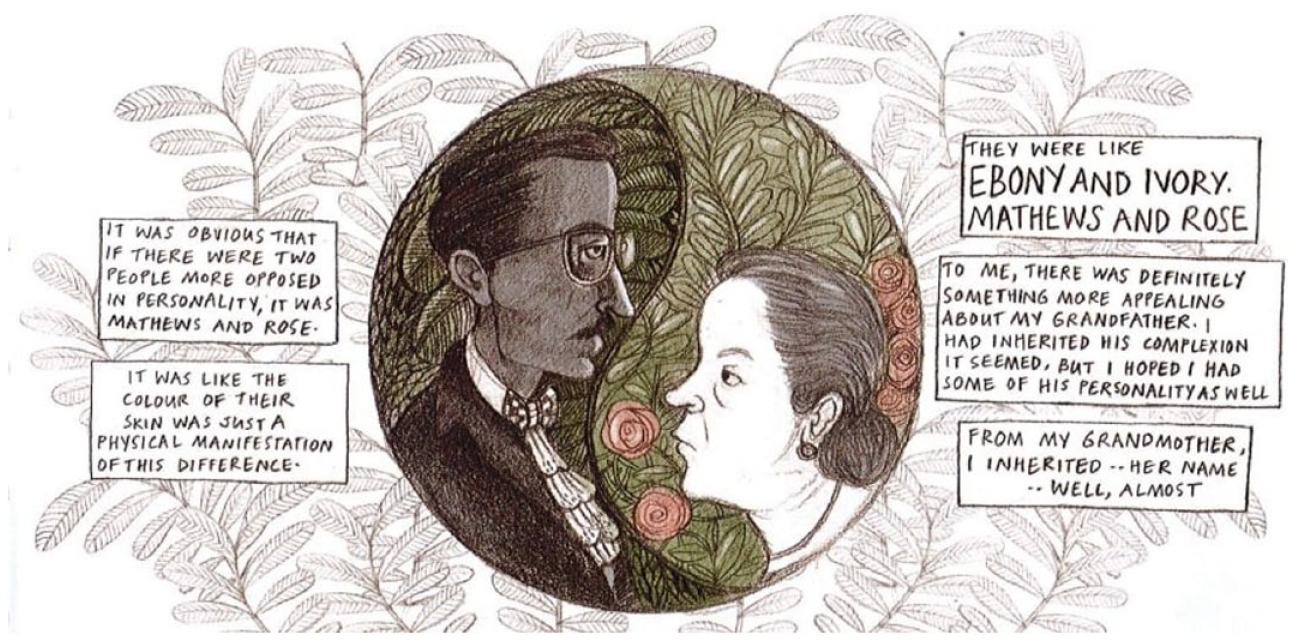
Mathews and Rosalind depicted as yin and yang.
The graphic narrative is an excellent genre for working with two levels that facilitate dramatic irony — the visual and the text create layers of concealment and revelation. The text follows a classic pattern; one makes meaning of what is the immediately visual, especially if the visual is sparse, absent, and hence extra susceptible to fantasy and idealization. This is the figure of the grandfather — one who died young in a foreign land, always well dressed with a few stylistic props, and one who seemed to invite luck and fortune as he has indeed come from a much wealthier family than his wife. In contrast, the story unfolds in its middle pages to the messiness of the body — Rosalind in the natal village as an aging, ill-tempered, labouring, and stingy presence. There is also a mention of bad luck, for Rosalind does not want her granddaughter’s middle name to be Rosalind, as was convention, and they settle on Rosemary instead. Further, even in the matter of child-rearing it is simply assumed that an uncaring Rosalind has decided to send the children back to India. Mathews, on the other hand, is appealing because he has been active in his courtship and has followed Rosalind from Kerala to Bombay (as it was then called), and then to Kuwait, thus appearing romantic and inspired in the family’s recollections.
The photograph referent in the memoir is evocative of the old, frontal, posed black and white studio photography, as all photographs of the period are indeed black and white. There is thus a continuity of the palette of the historical moment and that of the contemporary artist. Kuriyan uses the child’s crayon palette, mostly pastel, judiciously, and the overall effect is of sepia monochromes. For Kuriyan, photographs represent a certain plenitude of the visual, although as visuals they are also the unsaid narrative that she will have to revisit and unpack. The staged photograph is the narrative of respectability, but it is also the narrative of a distanced and separated family. Beyond the instrumental use of the photo (to show how children grow, how parents age), there is a sense of the “old photograph”, that which has exceeded its documentary use, nevertheless clinging to a spectral life, a remembering and haunting of a past that has not quite been surmounted. This is what happens when the grandmother’s body starts emoting her memories. The old photographs are re-conjured, but now as lies, and as part of a larger network of deception.
The memoir here offers a more complex relation of secrecy to a strategic and thus more agential privacy. The skill lies in how the baring of the string of facts (which are only opened fortuitously by Rosalind’s illness) allows a shared empathetic catharsis, one that moves in concentric circles from the three generations of family, to include the reader. It is revealed in due course that far from being a dandy, Mathews struggled with alcoholism and gambling. Rosalind has tried hard to hide all this from her children, and from her relatives back in India. That she was in Kuwait made this possible but one can see how much more lonely this must have made her. And she does not break this silence even after she returns to India. It is only after a stroke that she begins to speak. It would be impossible to gauge with certainty the level of self-conscious agency and reclamation a stroke patient may summon. Yet, there is little doubt that some communication is intended with her children. This is a final truth-telling, surely partly healing to her (and to some of the family, like Kuriyan), but also perhaps only annoying and embarrassing to others in the family. Such complex access is made possible in graphic narratives due to the genre’s “propensity for expressing notions of remembering alongside the multilayered and often complex aspects of trauma narratives”, as explicated by Varughese (2020: 112). In “Ebony and Ivory” the suggestion of trauma begins with “strange visions” that have Rosalind begging an unseen presence to leave (211). While the baffled family wonders if she is seeing the devil, the reader has access to what Rosalind visualizes, and it is the spectral presence of Mathews (211, Figure 2).
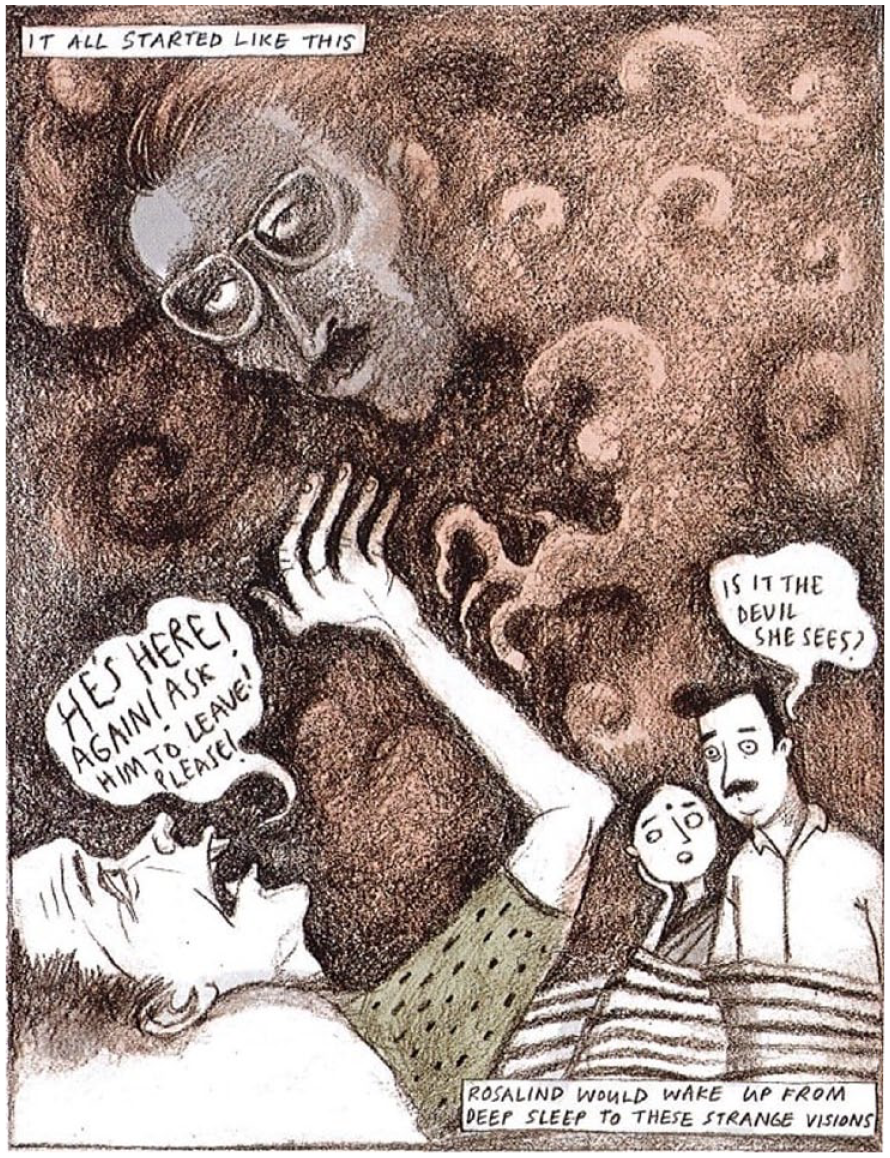
Rosalind’s visions of Mathews during her illness.
The migrant narrative insists on a certain tunnel-vision work ethic: traumas are only distractions. The migrant is supposed to return only with the visual props of wealth: Osella and Osella particularly mention consumer goods as an “important means through which a household gets a sense of and evaluates its own progress” (2000: 139; emphasis in original). Nevertheless, there is a doubled loneliness, a doubled secrecy — one is far away, and one cannot speak of that feeling of remoteness. The script back home is the gratitude of reuniting, and of patriotism. There are allowable feelings of homesickness, but these cannot exceed a certain threshold, nor can they take away from the income being brought home. In addition, too much complaining of the difficulties of the foreign land would only aggravate the larger family, and the migrant cannot share experiences with transparency. This opacity is also intergenerational. Hence the overall silence and unquestioning nature of Rosalind’s children is evidenced by the visual representation of the grandfather’s face deconstructed into grey incomplete pieces of a jigsaw puzzle (210).
The specific transnational trajectory (that includes the milieu of both the foreign, as well as the natal town that Rosalind returns to as a respectable, wealthy woman) allows that odd mix of secrecy, isolation, and speech. The final cathartic “speech of the body” becomes a code that not all can decipher, and that many in the family or the natal community may not appreciate as it explodes the myth of the successful migrant family. The return to the village and to the eventuality of dying is a return to origins and truth, of a body unburdening itself of the tasks and masks of migration. Indeed, it is a dropping of this very mask. Perhaps secrets allow for respectability, even a kind of delicate privacy, and must be seen as a kind of tense agency. On returning, one can imaginatively present one’s life — it is easier to fool people including the family, especially if one takes care to bring those simple visual markers of success which include luxury objects such as cosmetics and gourmet food (200). In this deception, where luxury camouflages inner injury and thwarted notions of self, Rosalind is not dissimilar to her husband Mathews. The body ravaged by illness now begins to speak a truth supressed too long due to social norms, and it is to the explication of this denouement that this article now turns.
The body articulated in illness
Nothing, it appears, can breach the wall of secrecy erected by the migrant who did return to the home country, except the urgent medical emergency that might finally rewrite set narratives. Rosalind has a stroke and starts to finally smile and look happy, reaching out for pleasures (constantly wondering if the biryani is ready). The narrator notes the transformation: Rosalind “was slowly shedding her old self” (207). There is the symbolic cutting of her hair by the narrator, the granddaughter seen as the “artistic “one” (207). This marks a transfer from the narrator’s previous identification with the grandfather to a new and more expressive affiliation with the grandmother, who finally begins to reveal a disinhibited self.
Kuriyan reflects on the grandmother’s revelation and the shift in style in the text: “In comparison, the latter half where my grandmother narrates her story, the attempt is to have a more fluid and more poetic visual style that uses strong visual metaphors that can really evoke a stronger emotion” (Kuriyan, 2020). A wider panel depicts an anatomical heart, as three-dimensional and visually separated from the rest of the body (205). It would seem as if this newly foregrounded heart starts to reveal Rosalind’s ancient sorrows as she begins to relax, drifting easily between dream and sleep. One of the daughters remarks that she had never seen Rosalind this happy before (206). Rosalind is drawn as being more toothy, winking, and insisting suddenly on hair and nail treatments. And out of that clearing-up and shedding of self, “finally, Rosalind spoke” (211). The complete story now unspools: Rosalind was in an abusive relationship with Mathews. He was an excessive drinker, a gambler, a violent man, and had possibly committed adultery. Rosalind’s final walking out of the marriage is depicted visually as a door that is slightly ajar and then closed — hesitancy, and finally, after many cumulative years, the desperate finality of separation. The separation is not legal (there is no formal divorce, so the social and familial deception continues unhindered), and is understood in terms of migrant movement: Rosalind returns to India, and Mathews goes to England. Return may be the need to forcefully confront one’s aging body and the truths of the family (for Rosalind), and travel may be the keeping and multiplying of secrets and denials, even at the cost of early death (for Mathews).
The narrator quizzes her mother on how she (Rosalind’s daughter) had not seen her father (Mathews) between the ages of ten and 24 (her age when her father died). The narrator’s mother remarks that she was happy with her family in India, and the father wrote regular letters — the naturalization of a father in a distant land, especially when the mother is non-committal about the arrangement, did not seem unusual to her (209). After all, this was an era where parents were often distant and uncommunicative, or, as the narrator’s mother explains, “It never really occurred to us to ask…And […] she isn’t one to talk” (209). The first panels have already depicted this relationship of separateness and geography. A gulf, both in terms of a body of water and an affective distance, is established between India and Kuwait. There is a precise imagination of this separateness: a country where one’s parents lived was separate from that of one’s birth. There is the required elaboration of aeroplanes and passports. There is an imagined seamlessness — dots on a map seem to make it child’s play to take a plane back and forth. Yet, the three children sit one behind the other, looking out through three airplane windows. This may not have been their likely seating arrangement, but it is evocative of the separateness within the family in this shared moment of distant, non-touristic travel that had been routine from a very young age (199). Is their home with their aunts in India where they grew up, or in Kuwait where their parents worked? Did the arrangement have to be necessarily thus? These are unanswerable questions that never get asked.
Following the grandmother’s stroke, the narrator wonders aloud: “What flummoxed me the most was how little my mother and her siblings had thought about these things over the years” (209). There was a definite, willed “looking away” by the family. Beyond the traumatic event itself, what really festers and eventually multiplies the trauma, is its secrecy and taboo nature. While this may be true of all families, the relationship between secrecy and trauma is particularly abetted in a migrant context. More than elsewhere, there is the prefabrication narrative of migrant success, and a concomitant refusal to allow family laundry to be aired back in the natal town. This is confirmed by the visual depiction of the migrant’s identity and silence as a looming jigsaw puzzle with separate pieces yet to come together. Subsequent panels show the unravelling face of Mathews, his eye turning into a surveilling eye, the mouth and clipped moustache now inexpressively drawn, and the bow-tie obscured by text (210).
The visual as well as linguistic tone of the memoir shifts after the stroke episode and when Rosalind begins to speak in her new register. Now it is a different story, and there is more menace and even a sense of “stalking” in Mathews’s courtship of Rosalind, as the narrrator explicitly mentions (209). In Rosalind’s voice, the shifted framing is depicted by a re-presentation. The courtship/stalking (from their time in Kerala to Kuwait, via Bombay) seems like a photo album — nine evenly sized square panels cover the whole page (208). From this specific composition, one gets a much clearer sense of the longer trajectory of Rosalind’s struggle for identity and livelihood as she decides to migrate “on her own steam” (208) even as she reluctantly accepts a pestering suitor. The foot of the page has a prone Rosalind holding up the entirety of the page as an extended speech/memory bubble (208). There is a clearer sense of the long, solitary, and unmarked path that Rosalind has travelled.
Imaginations of passage and safety
The Kerala–Gulf relationship is one of both separation and linkage by the Indian Ocean. This water imagery of migration, alongside notions of passage and safety, is pushed even further in one of the text’s most striking images where a recumbent Rosalind is shown in the altered consciousness of illness against a watery background (218, Figure 3). Her figure is multiplied in four, as though to suggest a bed-ridden person’s recurrent effort at getting up. The visual treatment of the background suggests a sinking/floating/rising in a green sea (green like her dress) for the bund (of lies and secrecy) has broken. Her children have been saved by the ark she built for them, but at great psychological cost. The children (all adults now) are also doubled in the panel, but in a different manner than Rosalind’s multiplication. They are miniaturized inside the wooden ark, as well as enlarged and looking over their mother in the foreground. On the edge of this slimy/mossy green sea of memories, and inside the water, there remain little reminders of Mathews, such as a bow-tie and stamps.
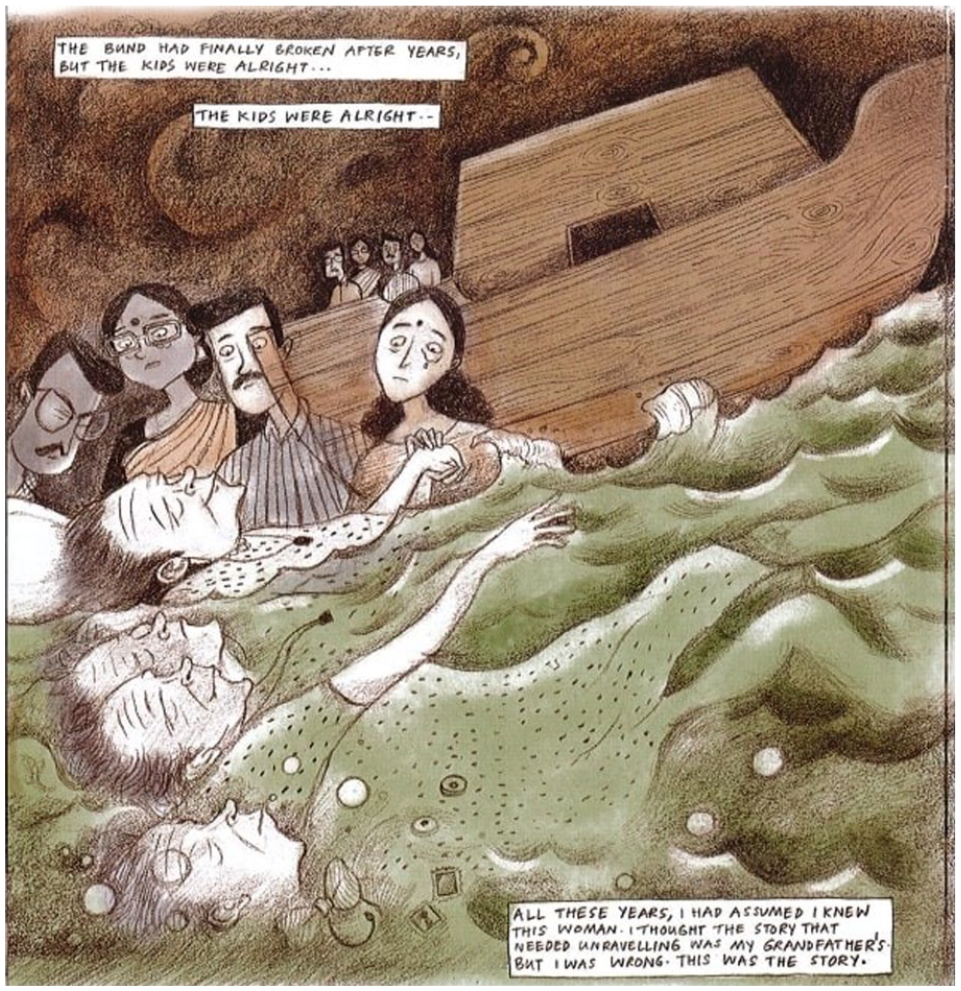
The water imagery of Rosalind’s altered consciousness.
“Ebony and Ivory” is particularly adept at signalling such passages in perspectives and responsibilities. One such instance is of a pleasurable child-masculinity enabled by the secrecy of the diaspora. As Kuriyan notes, “Posterity often has a way of conveniently spinning a kinder narrative, that often veers on glorification, for its child-men” (219). It was clearly not difficult even in Islamicate Kuwait to get alcohol, and the granddaughter imagines this to be a risky world of horse racing and fast cars, almost the opposite of the charming masculinism of vintage cigars and cuff-links and tasteful curios that she had fondly imagined as a child. And yet what makes this harmless fantasy of a grandfather different and troubling in this case is that such a “child-man” is amply validated by his peers both in Kuwait and in India. Stories are retold of the adorable Mathews who is charismatically social (to account for his drinking), an intrepid risk-taker (to account for his gambling), and maverick “mad guy” (to account for his crashing of his expensive, new car). The narrator wonders, though all know the answer, if any of that tolerance, let alone validation and celebration, would be offered to a woman who dared to drink or gamble or crash a car. It is almost as if only Rosalind’s working (and sexually/maritally available) body was in Kuwait, even as her mind, with all its anxieties, was with her children in her natal country. Further, and in contrast to many other migrant narratives, the marriage itself takes place in Kuwait, not Kerala. Thus from the beginning, marriage partakes of the remoteness of the foreign, of the distance from home. Like the uneasy inhabitation in a foreign land, the marriage too is uneasy, even if not quite as temporary as the immigrant’s residency status. Migration carries an inner migration — the story of a marriage in a faraway land, pregnant with a trauma that cannot be shared with the family at home. There are no real peers in Kuwait, no close friends to confide in. Despite the numerous Keralites working in Kuwait, the fact that they likely brought their conservative values to Kuwait pre-empts the possibility of Rosalind sharing her private life with peers. The cosmopolitan veneer is not only superficial, but false, and actively misleading. Indeed, the location of the few faces in the panel that depict the praise of Mathews is unclear, and they may equally be in India or in Kuwait (219). What is instead clear is that the values of these “child-men” are the same; persistently interpreting irresponsibility and unsafe behaviour as happy male joviality.
In contrast and in light of the new information let slip by Rosalind, the narrator offers a dominating metaphoric image to represent the many years of her grandmother’s difficult marriage. This illustration takes up a whole page: Rosalind holding in place the dark waters of a bund while her children escape into the surrounding tall grass (215, Figure 4). While the serpentine waters suggest the turmoil of marriage, the visual depiction can also be read as geographical demarcations and displacements. The migrant’s life is seen as being on two sides of a wall — that which is kept contained and hidden, and that which is escape and constructed flight. The thick, curving, jagged wall is one that is built of the fragile, self-constructed narratives of family and migratory distance.
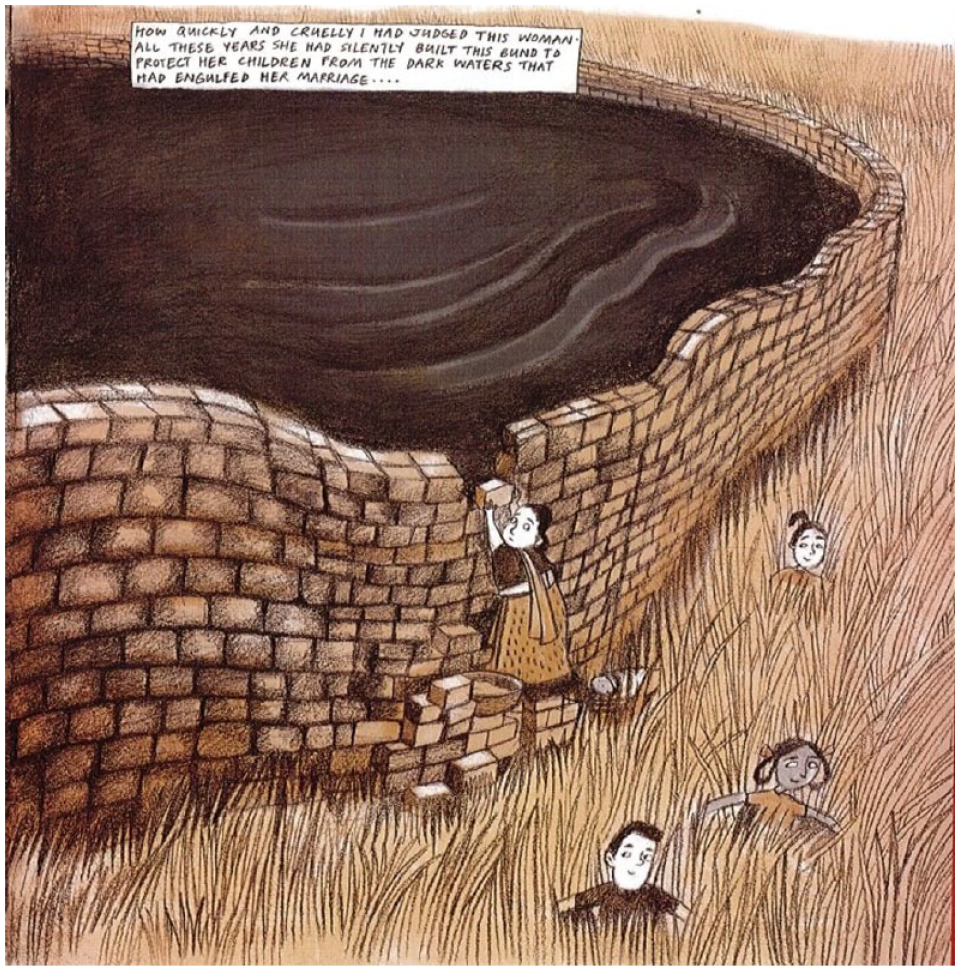
Containment and escape for Rosalind and her children.
Indeed, the imagery gets more biblical in the largest illustration of the text that bleeds across two pages and depicts Rosalind sending her children downstream in wicker baskets while sinister eyes (recognizable as belonging to Mathews) watch from the reeds (216–217). At the far end of the stream (top right corner of the two-page spread) is the person/place of safety who receives the children. Thus, waters are used in both contexts: viscous waters of family affect and history that have to be contained and hidden, and the waters that will transport a migrant to safety, escape, and the hope for new beginnings.
The memoir aptly ends with a family portrait. The narrative has opened with the portrait of a newly wedded couple — a “staged” photo of them unsmiling and with pursed lips, composed most likely in a photography studio — and it ends with a more candid family portrait during Rosalind’s burial. The first image is the story of the migrant couple soon after their marriage, but its full resolution is seen in the funeral back in the hometown with two generations standing in relaxed and comfortable proximity. This revised family imagery suggests new knowledge, an equilibrium that the family now accepts. The expressions in the gathering are varied: one daughter cries more openly, offering a family catharsis, while a son suggests a joke as a graveside offering. The concluding panel thus seeks to honour Rosalind in a manner that is warm and affectionate. It evokes a young, laughing woman that her children had not known in their childhoods but have managed to glimpse in Rosalind’s last days. All the travails of migration do not entirely annul the past — something of their mother’s youthful hopes is still available for them to occasionally linger over, savour, and reflect on. A graphic memoir such as “Ebony and Ivory” thus affirms the possibilities of complex intergenerational experiences of migration being captured as both future hope as well as intimate family souvenir.
Footnotes
Funding
The author received no financial support for the research, authorship, and/or publication of this article.