




Abstract
Ulli Beier was a hugely influential figure in Nigerian and Papua New Guinean literature from the 1950s to the 1970s. He founded and edited numerous literary magazines, including Black Orpheus and Kovave, fostered unappreciated talent, and provided publication opportunities when few were available. The story of his dedication to nascent literary scenes in Africa and the Pacific is, however, marred by appropriation, as Beier wrote fraud into the literature of both countries. Writing under various Nigerian and Niuginian names, Beier conducted a series of literary hoaxes whose racial and cultural deceptions smuggle a white author into Indigenous literary histories, and exemplify the permissibility that even anticolonial white men granted themselves. In this article I explore Beier’s main racial alter egos – Obotunde Ijimere and M. Lovori – with an emphasis on his position as a lecturer and magazine editor at the University of Papua New Guinea.
Keywords
In 1969 three Papuan plays were performed in Canberra — The Unexpected Hawk by John Waiko, and Alive and They Never Return by M. Lovori. 1 At the time of performance, Waiko was a promising writing student at the University of Papua New Guinea (UPNG), and Lovori was described in Don Laycock’s review of the production as “another student” (Laycock, 1970: 55). The team performing Waiko’s and Lovori’s works were not from Papua New Guinea, however: their “bodies brown with cake make-up”, and fitted with “various scrounged artefacts, grass skirts, shorts, and sheepskin wigs” (Laycock, 1970: 54, 55), white Australian actors performed the plays in brownface. The racial mimicry that took place on stage is deeply distressing, but it is also unfortunately apt, as it mirrors the ventriloquizing that took place on the page. M. Lovori was not a student in the writing classes at UPNG, but the teacher, a white German man named Ulli Beier, who had left the University of Ibadan, Nigeria, to join the faculty at UPNG.
Lovori was not the first of Beier’s racial appropriations. In 1966, The Imprisonment of Obatala and Other Plays by a Yoruba playwright named Obotunde Ijimere was published by Heinemann. Wole Soyinka was impressed by Ijimere’s work, and in Myth, Literature and the African World offered Ijimere’s The Imprisonment of Obatala as an excellent example of authentic Yoruba perspectives and language-use (Soyinka, 1990/1976: 16–25). The biographical notes to the Heinemann edition said that Ijimere began writing plays while attending Beier’s writers’ workshop in Osogbo, but far from Beier simply influencing or encouraging Ijimere, Beier was Ijimere. Between 1965 and 1967 Beier wrote The Fall of Man, The Bed: A Farce, The Suitcase, and Born with a Fire in his Head as Ijimere, as well as the three plays in the Heinemann edition: The Imprisonment of Obatala, Woyengi, and Everyman. Nor were these plays the first time Beier had impersonated a Nigerian writer: the critical articles and reviews in the early issues of Black Orpheus, a hugely influential literary magazine founded and edited by Beier, were dominated by his writings under names such as Sangodare Akanji. He also reviewed cultural activities in Nigerian newspapers under a variety of different names (Ogundele, 2003: 112).
As a teacher, editor, reviewer, and publisher, Beier is a hugely important figure in the literary histories of Papua New Guinea and Nigeria. He recognized talent where it had been ignored and provided publication opportunities when few were available. He insisted on the aesthetic value of Indigenous forms, and advocated loudly and repeatedly for authenticity in the voices of emerging literary traditions. And yet he is also responsible for writing fraud into the early literature of both countries. How can we respond to Beier’s introduction of counterfeit texts into the literatures he was nurturing? There are hints that Beier saw his aliases as impishly transgressive of Western categories of identity and authorship, as “Obotunde” translates as “monkey has returned”, and “Ijimere” is the name of a specific type of monkey. There are also intimations that he excused these false identities as swelling the body of work arising from local communities. It is difficult, however, and particularly in light of growing research on cultural appropriation and racial hoaxes, not to see Beier’s pseudonymous excursions as predicated on the arrogant adoption of identities Beier felt entitled to possess (Ruthven, 2004; Vice, 2014). It is especially hard to deny egotistical involvement on Beier’s part, as Beier centres himself even in his displacements — both Lovori and Ijimere are presented as students he was instrumental in encouraging.
Creative writing is always embroiled in ventriloquizing, and the theatre is always about impersonation. The history of pseudonymous writing is as long as the history of literature. A hoax, however, is not designed simply to bring a new character to life, nor purely to conceal the identity of the writer, but to deceive, and to deceive about the deception. As Christopher Miller writes, a hoax is
a metafiction, a fiction about a fiction. It is designed not merely to tell a story, but to weave a lie around that story: a lie about the status of the story, its origins, its authenticity, and mostly, its authorship. It is the lie that constitutes the hoax. (Miller, 2018: 1–2)
As imprecise as the lines between pseudonym and hoax might be, there is an important difference between an alias that conceals the author’s name and that which deliberately impersonates a wholly different identity. There is a further difference between impersonations born of necessity — women needing to write as men, for example — and of desire. In both instances we find Ulli Beier embroiled in the latter.
In his essays on Papua New Guinea, Beier repeatedly outlines local writers’ desires to wrest control of their representation away from European pens, and yet through Lovori he conceals Westerner-authored texts in their midst. In both the African and Pacific contexts what appeared to be works by local playwrights were by a European, and what seemed to be analysis by Indigenous critics was in fact the guiding and shaping of tastes by an expatriate perspective. External conversations masqueraded as internal ones, as a disguised hand was shaping form, tastes, and responses. At the time when writers were trying to construct a national identity through literature, Beier’s Western interference concealed itself behind a local name. In this article I present Ijimere and Lovori as literary hoaxes whose racial and cultural deceptions smuggle white authors into Indigenous literary histories, and as masks that exemplify the permissibility that even anticolonial white men granted themselves. A scholarly analysis that connects Beier’s Yoruba camouflage to his Papua New Guinean mask is long overdue, and here I consider both in relation to Beier’s position as teacher and editor, with an emphasis on Beier’s role in Papua New Guinea.
***
An analysis of Beier’s appropriations cannot overlook his sustained service to the communities he impersonated. Beier was a major figure in the 1960s modernist scene in Nigeria, and since the 1950s had been a strong advocate for the inclusion of African literature in Nigerian universities’ English courses. From the Extramural Studies programme at the University of Ibadan he founded and edited Odu: Journal of Yoruba and Related Studies, and an associated children’s magazine called Ewe (Youth). He founded and from 1957 to 1967 edited 22 issues of Black Orpheus: A Journal of African and African American Literature, whose pages gave early recognition to writers such as Wole Soyinka, Ama Ata Aidoo, and John Pepper Clark, and presented francophone writers such as Aimé Césaire and Leopold Sedar Senghor in translation, often for the first time. Beier’s energy and output during his time in Nigeria is impressive. He organized conferences and wrote numerous books and papers on African art and literature; edited the first anthology of modern African poetry in English; edited collections of oral poetry, mythology, plays, and short stories; and translated Yoruba plays into German and German plays into Yoruba (Benson, 1986; Pemberton, 2002). In 1961 Chinua Achebe, Soyinka, Beier and others founded the Mbari Writers and Artists’ Club, and a year later Duro Ladipo and Beier opened the Mbari Mbayo club in Osogbo. Wole Ogundele offers a glowing portrait of Beier in Omoluabi: Ulli Beier, Yoruba Society and Culture, seeing his “ability to make things happen, to discover fertile soil where others have seen only stony ground” as arising from Beier’s deep commitment to the communities in which he lived and worked (2003: 29). It is important to remember that Beier was, at the start,
almost alone in his passionate belief in the value, beauty, and integrity of (precolonial) African cultural practices and artistic productions. He not only assumed the continuing relevance of their ethos in the modern era, he was also confident that they were capable of self-renewal and self-transformation in order to meet the new challenges. (Ogundele, 2003: 29)
In 1967 Beier and his wife Georgina moved to Papua New Guinea, where Beier taught literature and creative writing at UPNG and became, in Steven Winduo’s words, “the patron of creative literature in Papua New Guinea” (1991: 3). There he galvanized the literary, dramatic, and, alongside Georgina, artistic scenes with the same enthusiasm he showed in Nigeria. He founded the Papua Pocket Poets series, which published 25 volumes between 1968 and 1970, as well as Kovave, Papua New Guinea’s first literary magazine, and he later established and edited Gigibori: A Magazine of Papua New Guinea Cultures. He worked with Albert Maori Kiki on Kiki: Ten Thousand Years in a Lifetime and with Vincent Eri on The Crocodile, Papua New Guinea’s first novel by an Indigenous author. He helped organize and judge writers’ awards, and later became the first director of the Institute of Papua New Guinea Studies. As Rabbie Namaliu, one of Beier’s students, describes him, Beier was an empowering “pioneer” who “shattered the old shibboleth that Niuginians can only be evoked as objects, but that they can’t write”. Beier saw “potential, he encouraged our talents, and over a period of four years, Niugini had its own literature written by its own artists” (Powell, 1975: 42). For many who worked with him in Papua New Guinea and Nigeria Beier was, as Soyinka expresses it, a “wanderer who came, saw, and was conquered, whose approach to life rescued the word “expatriate” from its usual negative connotations — privileged, alienated, presumptuous and condescending” (Soyinka, 2003: 9).
In his reflections on his time at UPNG Beier presents himself as strongly invested in anticolonial ideologies, and with a deep commitment to a literary education not bound by an anxious adherence to the Western canon. He had felt constrained by the University of Ibadan’s emphasis on British literary traditions and standards, and when he saw that UPNG was looking for someone to teach a course on “New English Literature from Developing Countries”, he eagerly applied (Beier, 2000: 2; 1993: 14). Elton Brash argues that prior to Beier’s arrival, the major features of the literary scene were bleak, as they emphasized the “disruption and decay of Traditional forms of Oral Literature”, mourned the “understandable reluctance of New Guineans to express themselves through English or English Literary forms”, and lamented the “exploitation of the New Guinea scene by foreign writers in search of romantic and exotic material for popular literature” (Brash, 1972: 35). For Brash the “most significant direct encouragement of creative writing in New Guinea” came from Beier, as he quickly discovered potential writers and artists, opened channels for the publications of their works, and established creative writing courses (1972: 36–37).
As a teacher Beier encouraged his students to recognize and respect the literary value of local forms. He had decided early in his time in Nigeria that he needed to know the literature his students had grown up with, and asked them: “What kind of songs did they sing as children? What forms of poetry were they acquainted with and who had recited it? What stories were they told by their grandmothers? Who were their heroes?” (1993: 17). During the break between the students’ preliminary and first year, Beier asked his students at UPNG to record orature from their villages, and on returning to university translate and analyse it, thereby exploring the literary devices employed in Papua New Guinean tales. He connected these forms with oral traditions from around the world, with a strong emphasis on Africa and India. When the students had gained an understanding of the function of oral literature in their own cultures, they conducted comparative work on African literature from the 1950s and 1960s, reading works by Soyinka, Achebe, Ngũgĩ wa Thiong’o, and Gabriel Okara, as well as francophone African authors and Caribbean writers such as V. S. Naipaul (Ellerman, 2008/2009: 8). It was not until they had engaged with world literatures that students could enrol in courses on European authors, and then Beier emphasized modernists whose texts were frequently formally or politically disruptive: T. S. Eliot, Albert Camus, Jean-Paul Sartre, Bertolt Brecht, Joseph Conrad, William Golding, George Orwell, Fyodor Dostoevsky, D. H. Lawrence, Eugène Ionesco, James Baldwin, Arthur Miller, and Eugene O’Neill (Ellerman, 2008/2009: 8; Powell, 1975: 37–38).
In a review of a book on Yirawala, an Aboriginal artist, Beier emphasizes the importance of giving artists the personal freedom to create (1973: 55). He appears to have acted on this belief in the classroom, as the playwrights and authors who worked with him said that he had a light editorial touch, and did not impose ideas of form or structure on them (Powell, 1975: 41). Russell Soaba found his importance to lie in “the spirit in African art and literature that he tried to convey”, although Soaba did express concern that Beier’s commitment to the rapid creation of a Papua New Guinean literature gave writers insufficient time to invent a Niuginian literature on their own terms (Powell, 1975: 39, 47n1). In an intriguing aside in an interview he gave with Chris Tiffin, Soaba says that he “secretly feared that he [Beier] was a mean politician”, and he complained elsewhere that Beier’s classes were frequently a little too focused on the anti-colonial (Soaba, 1979: 15; Powell, 1975: 44). There is little doubt that Beier was deeply invested in nurturing nascent literary scenes, and that he was committed to decolonization. And yet, even a teacher opposed to the teaching of “Beowulf, Chaucer, Dryden, Milton and Wordsworth — daffodils and all!” (Beier, 1993: 13) retains a position of authority within the classroom. As relatively light as Beier’s editorial touch might have been, Beier had already moulded the literary situation in Papua New Guinea by retaining the right to hand-pick a small group of talented students for his creative writing classes (Powell, 1975: 41; Beier, 2000: 52). As Evelyn Ellerman notes, “by instituting privileged access to creative writing classes, Beier acted from the outset as a gatekeeper to the development of literature at UPNG” (2008/2009: 10). And his gatekeeping within the private pedagogic space extended to the public literary space: he created an echo chamber that magnified his impact on the early shape of Niuginian writing. In Black Writing from New Guinea we find, as Paul Sharrad puts it, “Beier selecting from Beier [The Night Warrior] selecting from Beier [Kovave] selecting from source material” (1984: 5–6), with that source material being most commonly his students’ texts. One impact was the exclusion of women: none of the Papuan Pocket Poets volumes is by a woman, and despite the growing body of female students at UPNG, Beier did not have a single woman in his select classes (Ellerman, 2008/2009: 10).
How can we relate M. Lovori to Beier’s pedagogy? In Decolonising the Mind, Beier describes Alive and They Never Return as educational tools. He claims that he hoped to broaden his students’ repertoire beyond anticolonial protest by showing that their communities’ oral traditions could provide fertile ground for dramatic works (Beier, 2000: 66). He explains that he thus wrote two plays based on the folklore students brought back from their villages — John Waiko collected the plot for Alive, and Moeka Helai that for They Never Return. When Powell interviewed Beier about the plays in the 1970s, he denied solo authorship, and presented Lovori as a composite comprising himself, Waiko, and Helai. Waiko confirmed that Beier had asked him if he wanted co-authorship, but he refused as Beier had written the script for Alive, and he did not want to take credit for words that were not his (Powell, 1975: 239). In its publication in Five New Guinea Plays the play is subtitled “A Fantasy in Eight Scenes by M. Lovori, based on a folk tale collected by John Waiko”. For Powell, Beier was “at one and the same time creator and amanuensis: he both expressed his own original creativity in writing the plays and wrote down the original creative contributions of others” (Powell, 1975: 241). And, for her, the pedagogic aim was fulfilled; even if the students continued to be focused on anticolonial themes, they did absorb the idea of bringing vernaculars into their English texts. However, while Beier might have presented Lovori as a hybrid figure in the 1970s, by the time he wrote Decolonising the Mind Lovori was a pseudonym for him alone, and he brushes past his appropriation: “I actually wrote two plays based on Papuan myths, which the students had collected for our literature class” (Beier, 2000: 66). A similar oscillation between the collaborative and the egoistical can be found in Beier’s descriptions of Ijimere. In The Return of Shango Beier writes that his early plays were inspired by the oral poetry he had been sourcing, translating, and transcribing with the help of Yoruba scholars and poets, and that to use his own name would have implied that the plays were the work of one man (1994: 67). Yet his descriptions of the alias and of Ijimere’s writing processes repeatedly centre Beier and the pedagogic inspiration he supposedly provided: he may deny that the plays were the work of one person, but he nonetheless insists that they were the result of one teacher.
Alive and They Never Return are stories of the forbidden movement across the boundaries between life and death. In Alive, the protagonist Ada murders her husband, but overcome with regret she follows him into the world of the dead. There, in an intriguing parallel with Beier’s racial pretences, Ada covers herself in lime to make her skin look pale and death-like. As Beier presents himself as a living author of colour, his character pretends to be fatally white. Boundary crossing, surreptitious or otherwise, was a habit of Beier’s. Despite his clear desire to exonerate Beier from all wrong-doing, Ogundele describes Beier’s tendency to move between academic, creative, and community settings as a skill in “raid[ing] territories that do not belong to him, disregard[ing] the border set up between them” (2003: 255). He quotes Donald Denoon, whose unpublished biography of Beier presents him as “a Vandal occupying Rome”, and who was “deaf to venerated traditions, pillaging accumulated treasure to create new forms” (2003: 256). It seems fitting that a man seemingly assured of his right to go where and be who he chose would write, under an assumed name, tales of disregarding the ultimate barrier. Perhaps Beier’s students understood the irony, but it is unclear how aware of the extent of Beier’s other identities they were. Beier had set Ijimere’s The Imprisonment of Obatala on the oral tradition course he taught, and Ijimere’s work appears again in the new literatures courses. Did he teach these as texts by an Indigenous or expatriate author, and how were they approached by the students? Most intriguingly, Camara Laye also featured in the English courses, but both his L’Enfant noir/The Dark Child and Le Regard du roi/The Radiance of the King have been beset with speculation regarding their true author. It is been suggested by some, including Mongo Beti, that the first was written by a team of ghostwriters who were part of the French colonial propaganda machine, and the second possibly by a white Belgian man called Francis Soulié (Miller, 2018: 90–104). Even more appropriately, in Black Orpheus Beier reviewed The Dark Child as Sangodare Akanji.
If, as Miller writes, a hoax is constituted by a lie about the origins, authenticity, and authorship of a story, who was Beier deluding? Beier’s creative writing classes of 1968/1969 knew the identity of Lovori, as Beier says: “I wrote it [They Never Return] while students looked over my shoulder” (2000: 25). When Beier accompanied Kiki to a sing-sing held by his clan, people there likened Beier to Kiki’s deceased uncle Lovori, and referred to Beier by that name. Kiki made this information available to readers beyond his village when he published the anecdote in his autobiography (1968: 164–165). Similarly, Sangodare Akanji, the name under which Beier wrote many reviews in the early issues of Black Orpheus, was a name that devotees of Shango, the Yoruba spirit of thunder, had given Beier (Ogundele, 2003: 240). Ogundele argues that within the Nigerian context Ijimere’s identity was hardly a secret, as “Primary and secondary school kids in and around Osogbo in those days knew who the bearer of such an implausible name was” (2003: 239–240). Beier himself explains that “Ijimere” was the name of his favourite monkey, one that “enjoyed a reputation of wisdom” among the Yoruba. It was also, he writes, “an obvious pseudonym. Every Yoruba knew that nobody could be called Obotunde Ijimere and it was therefore not very difficult for them to guess who the author might be” (Beier, 1994: 67). Were the hoaxes, then, perpetrated only on those outside of Beier’s communities? Charles Larson writes that Heinemann were understandably upset by the deception (1972: 395), and it is tempting to presume that the joke was being played on audiences and publishers outside of Africa and the Pacific, who had a romanticized notion of exotic writers. Interpreted along these lines, Lovori and Ijimere comfortably become in-jokes between Beier and the communities in which he worked; pranks that put those communities in positions of knowledge and discernment. Foreigners are deceived because their unfamiliarity with local forms means that they need the illusion of a local name, whereas locals are free to judge the work on its own terms.
And yet, less immediate audiences within Nigeria and Papua New Guinea could hardly be thought to be in on the joke, especially as Ijimere was given a printed backstory. The Imprisonment of Obatala and Other Plays featured a photograph of Ijimere — not Beier, but a Nigerian man — as well as a biography that gave details of Ijimere’s year and place of birth, his schooling, and his relationship with Beier (see Figure 1). In Three Nigerian Plays Beier describes Ijimere as “the pen-name of the author”, but doesn’t specify that the author in question is himself (1967: xiv). In his introduction to Five New Guinea Plays, which include Lovori’s Alive, Beier writes that the “plays in this volume were produced by students in the creative writing class of the University of Papua and New Guinea”, although he notes that “the theme of Alive was suggested by the teacher” (1971a: viii). When schools in PNG staged Lovori’s plays, did they do so thinking they were the works of a German or Niuginian playwright? The names Beier used might have contained clues to his identity, but they nonetheless appeared to have fooled many, including academics: Beier himself notes that “the information about Ijimere was not passed on to a younger generation of scholars” (1994: 67). In the Pacific context, while most histories of Pacific literature present Beier as a major player, few authors apart from Powell and Ellerman refer to his use of cultural masks. Excusing his deception as one designed only to trick the colonizers simply does not convince.
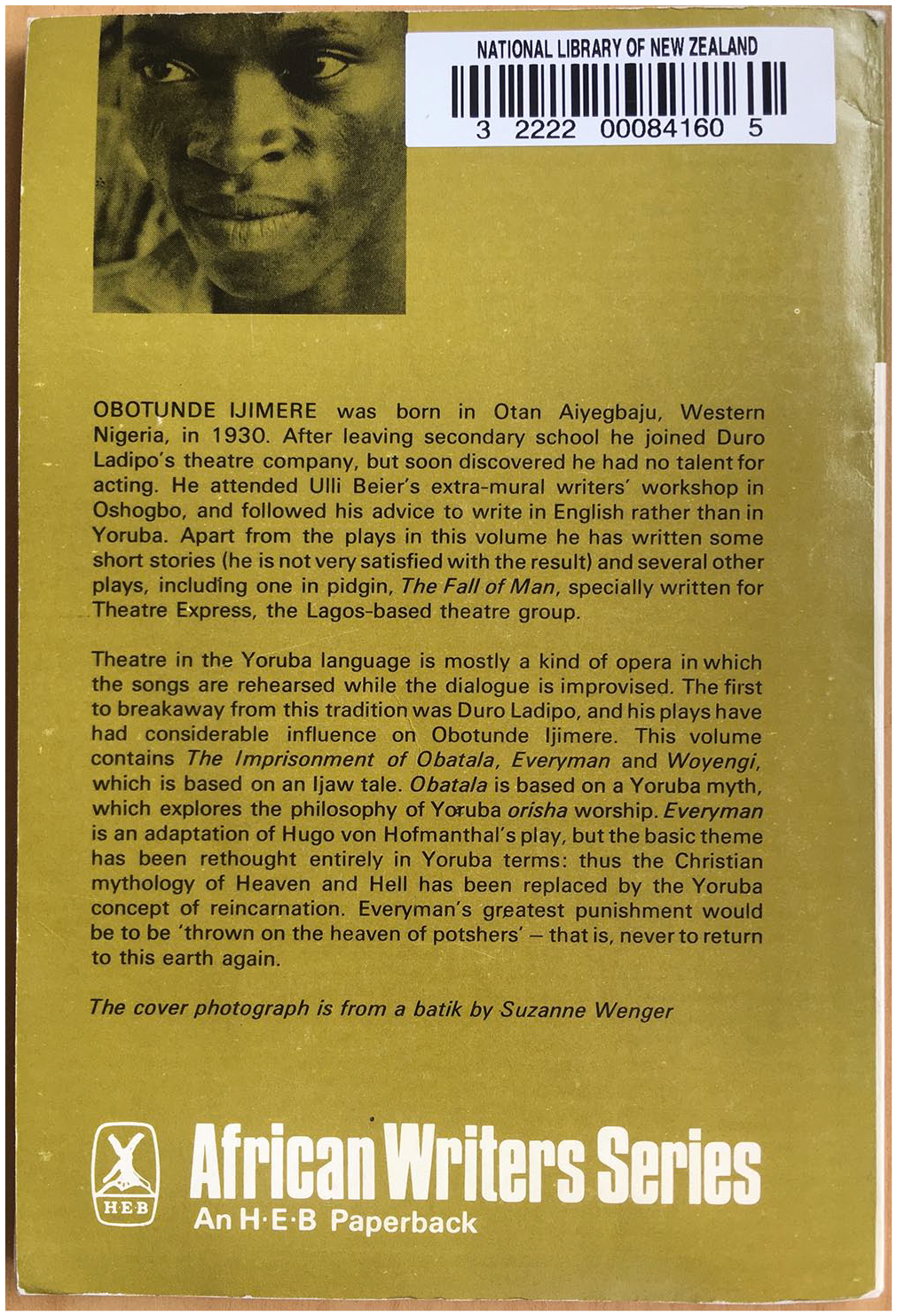
Back cover of The Imprisonment of Obatala by Obotunde Ijimere
For those students who did know the identity of Lovori, Beier’s Indigenous alter ego did more than demonstrate the dramatization of mythology. Beier-as-Lovori modelled the appropriation of identity, and continued the normalization of half-concealed white authority and interference in decolonizing spaces. In 1971 John Kasaipwalova, one of Beier’s students, wrote Reluctant Flame, which presents an extended diatribe against white people’s duplicity and their “cold bloodless masks” (Kasaipwalova, 1971: 1). Did a perceived lack of authenticity in the pedagogic space feed into his narrative? Ellerman suggests otherwise, and presents Beier’s masking as part of the overthrowing of colonial structures:
the practice sometimes occurs during decolonization, when European mentors try to transfer the institutions and values of western literature to colonized peoples who have no previous literary tradition. Beier was not alone in adopting a “native” mask in order to persuade student writers and others that the “native” could write. (2008/2009: 7)
However, it was precisely the knowledge of such masking that fed racist narratives about Indigenous communities’ inability to write without white assistance. Lovori’s plays were written at a time when Australians in PNG were deeply sceptical of the authenticity and autonomy of Niuginian writers’ work, and Beier’s students must have made some connections between expatriate doubts and Beier’s actions. Beier had Alive and They Never Return performed in Canberra in 1969, with “Lovori” listed as the author. His students did not travel to Australia to the see the performance — what was the pedagogic purpose on that occasion, and was it worth the risk that biased audiences would discover the truth?
An article in Nilaidat, UPNG’s student magazine, in 1969 offers a powerful statement about the prejudice Niuginian authors encountered:
A native can’t write anything intellectual, he must always have been influenced by whites. If ever he writes anything radical it must be communist-inspired or negro-inspired. If ever he hates he must be under the influence of evil white men. If ever he writes anything thoughtful it must have been thought out by others. (Buluna, 1970: 309)
Beier recounts that when Kiki was published, members of the expatriate community insisted that Kiki “had been ‘instigated’ to write it by a left-wing rabble-rouser called Ulli Beier, and others doubted that a Bush Kanaka could have conceived a book at all”. As Beier continues: “They claimed it was a kind of forgery on my part” (2000: 27). Should these accusations not have given Beier pause? Such racist assumptions are unambiguously offensive, but equally objectionable is the fact that a year after this Beier decided to continue the practices he had started in Nigeria, and committed a real act of literary forgery in Papua New Guinea.
When Peter Livingston reviewed Beier’s edited collection The Night Warrior and Other Stories, he argued that Beier wrote himself into all of his students’ texts, thereby turning Nigerian and Niuginian writers into mouthpieces for his own agendas:
[I] wonder why a man of his experience in Africa as well as New Guinea still makes it seem as though he had not edited it but written it from beginning to end. […] The extraordinary thing about Ulli Beier is that he is so efficiently able to express his point of view, his literary style, and the chips on his shoulder through the pens of others both in Africa and in New Guinea. (1973: 78)
In the following issue of Pacific Islands Monthly Powell took Livingston to task, criticizing his inability to recognize the collection’s varied and individualistic styles, and describing Livingston as “a deaf man who hears only the confusion of sounds, or of the white man who complains that all black men look the same” (1973: 23). Powell’s accusation of narrow-mindedness and prejudice is accurate, as Livingston’s accusation is a racist refusal to locate innovation in Indigenous authors, but our knowledge of Beier’s use of cultural pseudonyms makes Livingston’s insistence on the presence of a white man directing Pacific pens even more uncomfortable. Livingston ends his review by asking Beier to remember that “art lies in concealing the artist”: in this instance he feels that Beier has too transparently used real writers to express his own views (1973: 78). How would he react if he knew that Beier had earlier cut out the middleman, and had written them directly?
Perhaps Beier’s Indigenous alter egos would seem less problematic were his writings not replete with insistences upon authenticity and individuality. In “Literature in New Guinea” Beier repeatedly dismisses as “pathetic” writers whose style and content emulate Western tastes (1971b: 119, 123). Across his critical essays, Beier tends to admire, first, engagements with Indigenous forms that produce work that is seemingly untouched by Western influences. Second, he encourages original, personal responses to Indigenous practices that draw inspiration from an innovative blend of local and international sources. In the first instance, then, he respects purity, and in the second, a knowing hybridity. In Decolonising the Mind Beier robustly condemns the influence of the colonial education system on the Papua New Guinean poet Allan Natachee, as its grip turned him into a man “hopelessly confused between two irreconcilable worlds and trying to express himself in a language whose music, rhythm, and subtler meanings he did not understand” (2000: 16–17). It was, Beier writes, only when he asked Natachee to translate songs from his village that he “shed the pompous diction of his Tennyson-inspired poetry and […] captured the simplicity and dignity of this ancient chant” (2000: 17). It should be noted here, however, that despite Beier’s argument that he inspired Natachee’s move from imitation to thoughtful interpretation, Natachee had published translations of Mekeo sing-sings in Oceania in 1951, some 16 years before Beier arrived in Papua New Guinea. It should further be noted that Allan Natachee is a pseudonym: as Beier explains, Avaisa Pinongo “was nicknamed Natachee after the hero of a cowboy-and-Indian story that was the young boy’s first introduction to fiction” (1969: 40). This use of a pen name, Beier implies, is additional indication of the poet’s sad loss of identity and his desire to embrace the values taught to him by the nuns — Natachee is allowed no playful in-joke here, nor any of the agency that Beier affords his own movement between cultures.
In an article published in a Meanjin special issue on Papua New Guinea, Beier criticizes the Cathedral in Port Moresby as it “sports a mock haus tambaran, a crude imitation of a Maprik initiation house, the traditional designs copied onto the concrete walls by a European hand” (1975: 307–308). In what ways are the plays of M. Lovori any different from the mock haus tambaran created by European hands? In writing, staging, and publishing plays as Lovori, Beier worked under false pretences. Under the brown paint were white actors, and behind the Niuginian name was a German man. Does Beier presume that his plays are not “crude”, and are therefore authentic pieces rather than mock works? Ijimere’s works were praised by Soyinka, and his plays were well received nationally and internationally (Owomoyela, 1979: 46). “Some supposed outsiders”, insists Ogundele, “are really insiders”, and he considers Beier’s The Imprisonment of Obatala to be “a personal act of worship and homage” that arose from Beier’s “long familiarity with Yoruba history, myths, rituals and ceremonies; and especially with Yoruba religion” (2003: 170). Far from being deceptive, Ogundele writes, the pseudonym was a “deliberate, provocative act of disclosure”, since if “a mask it was, then it functioned like a typical Yoruba mask: it revealed more than it hid” (2003: 242, 239–240). In Papua New Guinea Beier wrote his plays as a relatively recent arrival, with far less cultural knowledge and investment. Nonetheless, Beier had Lovori’s plays performed in Australia, Papua New Guinea, and Nigeria, and they were generally well received. Don Laycock’s review of the 1969 performance criticized Lovori’s attempts “at a poetic style, with a result that sometimes sounds a little odd to an English audience”. However, Judith McDowell’s early article on “The embryonic literature of New Guinea” described Lovori’s Alive as the best play in Five New Guinea Plays. Abiola Irele’s review in Transition concurred: the “other pieces in the volume are on the whole amateurish, but Lovori’s work redeems the volume” (Laycock, 1970: 55; McDowell, 1973: 300; Irele, 1974: 51).
If the works, then, appear to have been valued by both local and global audiences, we arrive at the old question caused by the uncovered hoax: does the true identity of the author really matter, or should the works stand alone? In 1988 a white, male, middle-class English vicar named Toby Forward wrote a collection of short stories about the lives of young Asian people in Britain, and submitted them to Virago Press as a young woman called Rahila Khan. When the hoax was revealed, Forward’s response called indignantly to the freedoms of fiction:
The unspoken assumption behind most of this [criticism] was that all imaginative literature, all fiction, is autobiographical. Later I was to be accused of pretending to occupy a position I didn’t hold, to speak with a voice that wasn’t mine. I had thought that that was the purpose of art. (1988: n.p.)
Phillipe Lejeune has described the “autobiographical pact” as the implicit understanding between author and reader that the protagonist within an autobiographical work is the person named on the book’s cover (Lejeune, 1989). We tend to extend this pact beyond pure autobiography into works of fiction, and we do this most consistently with writers from marginalized communities. Works of “minority” literature are, Jaime Hanneken argues, commonly “construed by producers, marketers or consumers to be somehow representative of a marginalized group, whether or not their content or the conditions of their production bear out such interpretations” (2011: 49). To an extent this means, as Spivak might put it, that the subaltern — or those impersonating them — cannot write a novel, as only those privileged with normalized positions of power have the luxury of authorial remove from their fictions. The autobiographical imperative can place a grave burden of representation on writers outside of the white, male, Western preserve, but while it infuriated Forward when his perceived right to fiction was interrupted, the inextricability of a voice from its community is a burden that many Pacific authors gladly, or by necessity, assumed. For most Pacific writers during this period the primary function of writing was not art for art’s sake, but art, as Albert Wendt put it, “for man’s sake” (1973: 47). For authors who see the value of art in its ability to speak intimately to and about a community, and enable that community to understand and conceptualize the changes it is undergoing, the countersignature of one who is from within the community is extremely important.
Beier was not of Lovori’s or Ijimere’s communities, despite his connections with them. The autobiography he brings to the texts is a wholly different one: he did not suffer the same insecurities or anxieties about who could write and about what. In The Return of Shango Beier justifies his use of Ijimere by claiming that “the plays had just ‘happened’; a specific set of circumstances had led to their creation, but that hardly made me into a playwright” (1994: 67). This rather disingenuous distancing is belied by that fact that Beier did write the plays. As invested in the communities as he was, he had opportunities, connections, and freedoms not available to them. Privileged authors cannot pretend to be from minority groups even in order to bolster that community’s body of work, as the deception simply extends the platform held by those with power. A fake that fools is still a fake, and it still has the potential to harm, to enable the privileged to benefit, and to shape, distort, or interrupt the development of a literary tradition. Ogundele defends Beier-as-Ijimere with the argument that a misguided political correctness could have robbed the literary world of important plays, “for had they arrived on the publisher’s desk in London under the very well-known name Ulli, they surely would have been rejected” (2003: 240). Yet Peter Benson notes that in the early days of Nigerian literature, Beier’s “real power as a critic” was his ability “to open or shut the door to international critical attention” (1983: 468). Beier had numerous avenues of publication open to him, and his deception was under no circumstances one of necessity. A publisher’s desire to provide opportunities for Indigenous writers should not be met with the simulation of Indigenous identity.
This does not mean that Beier’s, Ijimere’s, or Lovori’s works should be written out of literary histories. Instead, they should be recognized for what they are: works of colonial mimicry written from a position of power, as Beier was a white, Western educator miming Indigenous identity, secure in his right and ability to do so. His adoption of Indigenous names performs a fantasy of intellectual ownership and assimilation — of knowing another culture so well as to appear from it. There is an arrogance and paternalism to Beier’s acts that is exacerbated by the innovative aspects of his mimicry: in many instances he was not copying a pre-established body of Indigenous work, but demonstrating new paths to be taken. What Beier presented was another white version of local identity and its literary future. Beier’s reviews and essays repeatedly condemn racism and imperialism, but his Lovori and Ijimere avatars are acts of colonization: of mapping, leading, controlling, owning. If Beier decided to be Lovori on the seemingly positive grounds that “you cannot be what you cannot see”, what the people saw was counterfeit.
Beier is a troubling representation of the white lecturer involved in decolonizing academic spaces — one whose apparently genuine ideological commitments to Indigenous independence is counterbalanced by his belief in his position of intellectual leadership and his right to speak knowledgably on behalf of Indigenous communities. His writings and his classes show that he wanted no part in daffodils and Shakespeare, and he worked hard to encourage African and Pacific voices of protest and sovereignty, but he also saw this position as permitting him to appropriate, impersonate, and direct. I take no issue with a man that Ogundele repeatedly describes as a “German-born Yoruba” writing creatively or academically about a community of which he is part. Nevertheless, identity matters, and names matter. Beier was Jewish; in the 1930s his father’s money was confiscated by the Nazis, and in the 1940s Beier was interned by the British as an enemy alien. His privilege is mitigated by his experiences of persecution; when home is rendered precarious, it is easy to understand why one would seek belonging elsewhere. However, one can belong without impersonating.
Embedded in processes of transition from colonization to reacquired independence across the world are liminal figures who straddle the old colonial ideologies and new self-governing ideals. One such figure is Ulli Beier. In a letter critiquing a review of The Night Warrior in Pacific Islands Monthly, Powell asks us to reflect on Beier’s place within the history of Niuginian and Melanesian literature: “Should that role be seen as catalytic or determinative; as a phenomenon of the last days of colonialism, or of the first days of independence?” (1973: 23). Beier’s role lies precisely in the difficult progression between these periods: he is a white anticolonial retaining a colonial-inspired position of authority, a European promoting Indigenous literature by concealing himself behind Indigenous masks.
