



Abstract
This article seeks to situate certain works of Singaporean science fiction within their historical circumstances, demonstrating that Singaporean science fiction has historically served as social criticism, challenging both state narratives and foreign readings of the city state along the axis of East and West and “new” and “old”. The argument centres upon four texts: the anonymously-authored series “The Travels of Chang Ching Chong” (1989), Jahan Loh’s Basic Instructions Before Leaving Earth (2013), and two texts by Sonny Liew, namely Malinky Robot (2011) and The Art of Charlie Chan Hock Chye (2015). These texts, I believe, share certain thematic connections: each is interested in the relationship between new and old and foreign and familiar, and each seeks, in different ways, to counter dominant narratives of the time. Accordingly, this article is divided into two imbricated sections. The first examines science fiction responses to popular and state narratives of the West as a source of technological capital both under British rule and after independence. “The Travels of Chang Ching Chong” and the “Ah Huat’s Giant Robot” sections of The Art of Charlie Chan Hock Chye, I demonstrate, trouble this narrative, offering stories in which Asia provides a source of technological advancement. In the second section I explore popular depictions of hypermodernity in Singapore and the enduring myth of the destruction of “traditional” Asian cultures in the wake of the post-independence industrial turn. Both Basic Instructions Before Leaving Earth and Malinky Robot, I argue, complicate this narrative, presenting both hypermodernity and “old Singapore” as fantasy.
[I]t is pointless trying to decide whether Zenobia is to be classified among happy cities or among the unhappy. It makes no sense to divide cities into these two species, but rather into another two: those that through the years and the changes continue to give form to desires, and those in which desires either erase the city or are erased by it.
We are living through a moment when science fiction beyond the Western canon and minority writing within the Western canon is subject to an unprecedented level of attention. While the Hugo and Nebula awards are not the sole means to take the pulse, as it were, of science fiction publishing and fandom, it is noteworthy that the second decade of the twenty-first century has seen an unprecedented number of awards go to writers of colour. Among the most celebrated, and bestselling, writers of contemporary science fiction are African American author N. K. Jemisin, Nigerian American author Nnedi Okorafor, and Chinese author Hao Jingfang. This is also true beyond literature — the top-grossing film of 2018 was Black Panther, which featured a majority-black cast, was the work of a black director, and was set, in part, in a hyper-futuristic African nation.
A key development in the increased interest in writing by and about people of colour is the increased scholarly and popular use of the term “Afrofuturism”, used to describe works which, in the words of Mark Dery, comprise “speculative fiction that treats African-American themes and addresses African-American concerns in the context of 20th century technoculture — and more generally, African-American signification that appropriates images of technology and a prosthetically enhanced future” (1994: 136). 1 In retrospect one might wonder why it took us so long to get here. Science fiction seems an ideal site to deconstruct and test assumptions around race, culture, and identity. Patrick Parrinder (1979) asserts that science fiction is always social criticism and Liza Yaszek, similarly, argues that, as a fundamental characteristic science fiction estranges “readers from their assumptions about the past, present, and future of their own world” (2006: 50).
This article takes the current surge of interest in science fiction beyond the Western canon and minority writing within the Western canon as its impetus in exploring a largely under-examined body of science fiction prose, art, and graphic narratives, namely those from Singapore. It is interested, particularly, in the works of Malaysian-born creator Sonny Liew, a figure who has been widely celebrated in the field of comics, winning three Eisner awards, but is rarely positioned as a science fiction writer. 2 This article seeks to situate certain works of Singaporean science fiction within their historical circumstances, demonstrating that Singaporean science fiction has historically served as social criticism, challenging both state narratives and foreign readings of the city state along the axis of East and West and “new” and “old”. While I would not wish to posit a transparent or uncomplicated equivalence between Singaporean and Afrofuturist writing, I believe that an understanding of science fiction as potentially disruptive of cultural assumptions, and in particular assumptions concerning race, can allow us to unpick the science fiction thread from the Singaporean literary canon. The argument that follows centres upon four texts: the anonymously-authored series “The Travels of Chang Ching Chong” (1989), Jahan Loh’s Basic Instructions Before Leaving Earth (2013), and two texts by Sonny Liew, namely Malinky Robot (2011) and The Art of Charlie Chan Hock Chye (2015). These texts, I believe, share certain thematic connections. Each is interested in the relationship between new and old and foreign and familiar, and each seeks, in different ways, to counter dominant narratives of the time.
Accordingly, this article is divided into two imbricated sections. The first examines science fiction responses to popular and state narratives of the West as a source of technological capital both under British rule and after independence. Both “The Travels of Chang Ching Chong” and the “Ah Huat’s Giant Robot” sections of The Art of Charlie Chan Hock Chye, I seek to demonstrate, disrupt this narrative, by presenting Asian signs within a hypertechnological environment and thus problematizing narratives of racial and cultural essentialism. In the second section I explore popular depictions of hypermodernity in Singapore and the enduring myth of the destruction of “traditional” Asian cultures in the wake of the post-independence industrial turn. Both Basic Instructions Before Leaving Earth and Malinky Robot, I argue, complicate this narrative, presenting both hypermodernity and “old Singapore” as fantasy.
Science fiction in Singapore: An overview
The Straits region of British Malaya developed a body of English-language writing during the early twentieth century but this did not, in the words of Rajeev Patke and Philip Holden, “consolidate into a recognizable local tradition” until the post-Second World War era (2010: 43). The dominant prose literary form to emerge from Singapore post-independence has been the pioneer narrative, which offers a semi-mythic history of the city state and its people (Patke and Holden, 2010: 158). While these narratives have been largely grounded in historical events, there has also been a more overtly speculative thread which has run throughout Singaporean literature. The science fiction tradition in Singapore has included some of the earliest writing by graduates of English-medium schools. The genre became firmly established in 1980 with the publication of the anthology Singapore Science Fiction, edited by R. S. Bhathal, Dudley de Souza, and Kirpal Singh. In 1985 Joan Hom, under the pseudonym Han May, published Star Sapphire, a text which was highly commended in the National Book Council awards a year later (Ong, 1986: 3). The book was followed, in 1989, by the formation of the Science Fiction Association, Singapore. The Association launched its own magazine, Tesseract, in 1990, edited by Glen Low. The magazine ran for a total of ten issues between 1990 and 1992. It featured original fiction, reviews, interviews, and essays (Ashley, 2016).
Singapore has experienced a surge in science fiction publications in recent years, including Jahan Loh’s street art collected in Basic Instructions Before Leaving Earth (2013), Jason Erik Lundberg’s Embracing the Strange (2013), and the Lontar journal (2013–present) from Epigram books. Lontar seeks to publish Southeast Asian speculative fiction which moves “beyond the touristy exoticism that frequently pervades the minds of those unfamiliar with the region” (qtd. in “SF Signal”, 2012: n.p.). The launch of Lontar was accompanied, in the same year, by multiple science fiction anthologies including Happiness at the End of the World, This Is How You Walk on The Moon, and Eastern Heathens. Perhaps most famously, Sonny Liew’s The Art of Charlie Chan Hock Chye (2015) reconstructs Singaporean history through multiple comic book genres including a “Science Fiction Epic” which reimagines the Singaporean journey to independence in the style of Dan Dare-era 1950s comics, with the British reimagined as extra-terrestrial conquerors (Liew, 2015: 115). Science fiction, it seems, has provided an appropriate medium to understand the Singaporean experience through the twentieth and into the twenty-first century.
Asian technology in “The Travels of Chang Ching Chong” and The Art of Charlie Chan Hock Chye
The Anglophone literary tradition arrived late in Singapore. For much of the nineteenth century the Straits settlement served as a temporary residence for workers, traders, and colonial officers. Sports were abundant and theatre, in both English and Chinese, was sporadically available, but little recorded creative writing took place. Some of the earliest known examples of prose in English to emerge from the Straits settlement were periodicals such as the Straits Eurasian Advocate (1888–1889) and Straits Chinese Magazine (1897–1907). They were written, for the most part, by a handful of Chinese graduates from English-medium schools. The Peranakan or Baba Chinese who wrote for these publications belonged to a segment of society who were Anglophilic in their tastes, speech, and manners. The short stories to appear around this time generally mimic the moralistic tone of the pulpit. They have been characterized by Patke and Holden as “didactic, urging young Straits Chinese men against the temptations of gambling and moral dissipation” (2010: 45).
Few of the stories published in these magazines fall within even the broadest definitions of science fiction — the majority concern life in British Malaya or (in the case of Ruth Huang) the past. We nonetheless see in these early works a fictionalized encounter with a technologically and culturally superior other.
3
“The Travels of Chang Ching Chong”, published serially in the Straits Chinese Magazine in 1898, is one such example. Patke and Holden (2010) compare the story to Gulliver’s Travels (1726) in that it uses satire and describes a fictional migrant experience. Much of the action occurs in the land of “Ganiserop” (an anagram of Singapore) where women beat their husbands and men are sold as slaves.
4
This theme of inversion extends to the racial hierarchies which were central to the British colonial ideology: Not very long after the white men had established themselves as masters in Ganiserop, there arrived in the harbor a fleet of strange ships, the bows of which carried two painted eyes. The sails also were unlike anything known to the natives. The men were mostly young or middle aged, but there were a few old men. Of women and children there were none. These men speak a language so strange that they are not understood in their own tongue to this day. They began to exchange commodities and carried on a brisk business. When the fleet left after four months stay, about twenty men remained to establish a depot for the sale of the rare products of their land. For many years these people came and went: and every time a fleet of ships came they brought with them a new band of adventurers. No one knew how this nation had been able to produce the wares which everybody so much admired. It transpired afterwards that these men came from the wonderful land of Tasugan, where gods walked among men, and mortals possessed the wisdom of the gods. (1898: 139)
In this passage the writer reimagines a burgeoning global network of commerce which includes traders (Holden (2011) reads these figures as Southern Chinese businessmen) endowed with abilities and technology so powerful as to be god-like. The text proposes an inversion of colonialist narratives: the Europeans, in this scenario, have become the “natives” — the awestruck inhabitants of a small island who encounter a more advanced civilization.
Understood in these terms, the story can be read as a counter-narrative to the ideology of the British regime. As a graduate of the English-medium education system, the author of “The Travels of Chang Ching Chong” was a member of a class of what Thomas Babington Macaulay described as “interpreters between us and the millions whom we govern” (1952: 729–730). Just ten years before the publication of the story the Colonial Office had described the purpose of English-medium schools as “to teach [students] our system and our language and with it, to instil an admiration for most of what belongs to us” (qtd. in Choo, 2013: 10). The author of the story belonged to a group of individuals who were taught British history, British literature, and modes of conduct consistent with idealized models of British civility. In 1989, Seah Chiang Nee described his school days under British rule as follows: I grew up studying British history, speaking, thinking and dreaming in English. My idea of a luxurious breakfast was bacon and eggs (not that I could afford it), not Teo-chew porridge. I knew more about the British East India Company and Christopher Columbus than I did about Confucius. My reading materials were Enid Blyton and Shakespeare, not Water Margin or The Three Kingdoms. In short, I felt more comfortable around people who were English-educated and who lived a largely Western lifestyle, with cocktail parties, barbeques, and so on. (Seah Chiang Nee, 1989: 10)
In this sense the English-medium school served, to borrow Frantz Fanon’s words, to “distort […], disfigure […], and destroy” the culture and historical memory of the colonized (1995: 154).
In this sense the text can be read as embodying a similar mechanism to Afrofuturist narratives in that it reverses hegemonic models of cultural hierarchies, proposing an encounter between white Europeans and a technologically and culturally superior Asian culture. The invocation of “gods” here serves to undermine the religious rhetoric of British cultural imperialism. Singapore’s director of education, Dr (later Sir) Richard O. Winstedt, considered the life of Christ be one of the three great gifts that the British had given to the Empire (“Anglo Chinese School”, 1928: 10). 5 The polytheistic world of Tasugan, which is peopled by materially observable deities and produces goods no white man can replicate, makes such a gift pale by comparison. Just as Afrofuturist narratives seek to, as Yaszek asserts, provide a narrative of Western history from a black perspective, the text not only projects an alternative present but seeks to reclaim cultural history, proposing a pseudo-Taoist belief system which is superior to the religion of the colonizer (Yaszek, 2006: 46).
“The Travels of Chang Ching Chong” stands somewhat apart for its time. Not only was it a rare example of science fiction in Singapore at the close of the nineteenth century, but it challenges the racial hierarchy which informed the cultural and education policies of the British colonial regime. It is more remarkable for having been written at a time before the earliest period of organized resistance. While it is convenient to imagine that colonial indoctrination produced widespread discontent even in the nineteenth century, many British collaborators considered themselves beneficiaries of the imperialist system and were genuine in their desire to embody the values taught in English-medium schools. Just two years before the story was published, the Peranakan community had built a statue of Queen Victoria using private donations and many had campaigned to be recognized as full British citizens rather than British subjects. The process of cultural indoctrination and economic exploitation certainly produced dissatisfaction with the colonial enterprise as made manifest in, for example, the short comedies of the Bangsawan stage but it was not until the 1930s that British Malaya saw its first sustained anti-colonial movement (see Nurul Farhana Low bt Abdullah, 2009).
The state narrative of the dynamic between Asian and European cultures and technologies underwent something of a shift after independence. During the 1980s government ministers sought to promote a somewhat flattened idea of “Asian values” (most central among them being loyalty and duty to the state) combined with Western economics and technology. Lo describes the state rhetoric of the time as being that “two cultural systems can coexist provided that the ‘foreign’ is externalised and intellectualised, while the native is internalised and instinctual” (2004: 25). 6 In 1978 Prime Minister, Lee Kuan Yew asserted, “I may speak the English language better than the Chinese language because I learnt English early in life. But I will never be an Englishman in a thousand generations and I have not got the Western value system inside; mine is an Eastern value system” (qtd. in Lo, 2004: 25). Where the British state had held European technology and culture to be superior to that of Asia, the government rhetoric positioned Asia as a source of intellectual capital and the West as a source of material capital. This state narrative thus developed but did not abandon the colonial-era rhetoric which imagined Western cultures as dynamic and Asian cultures as static. As Patke and Holden assert, “Singaporeans were now encouraged to make affiliation to racialized pasts from China, the Malay Archipelago or the Indian subcontinent [while] English [was] conceived as a language of technology and development” (2010: 93). In literary terms, Asia was to be the source of historical fiction, and the West the source of science fiction.
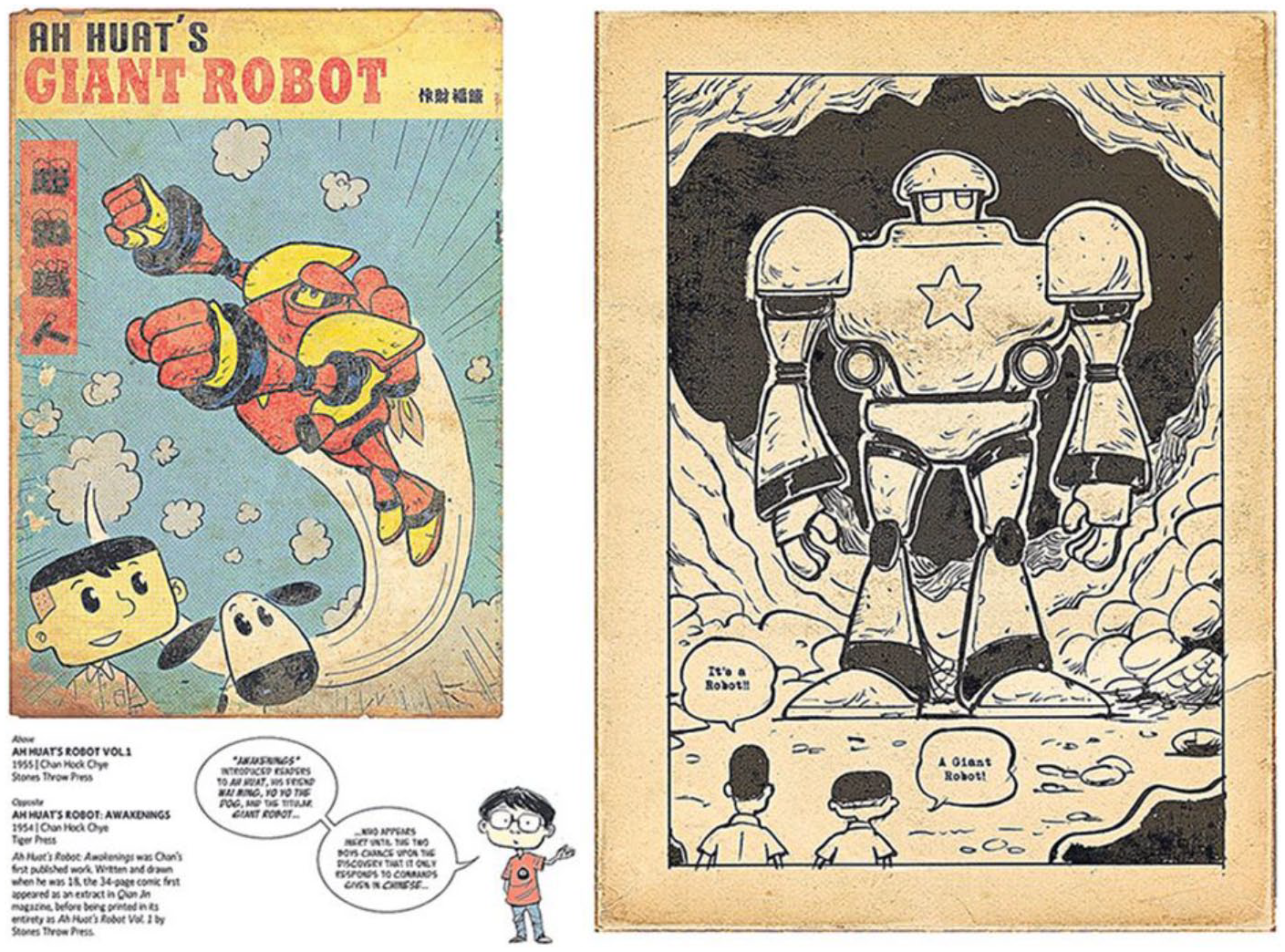
“Ah Huat’s Giant Robot” from Sonny Liew’s The Art of Charlie Chan Hock Chye (2015).
Sonny Liew’s graphic novel The Art of Charlie Chan Hock Chye (2015) seeks to challenge the state-led dichotomy between Eastern and Western influences. In it, Liew documents the life of a fictional Singaporean comic book creator. In one cartoon (authored, within a diegesis by the fictional Charlie Chan in 1956) two boys discovers a powerful robot. The boys attempt to make it work by shouting out commands such as “Wake up! Sit! Jump! Speak! Fight!” and finally a muted “hello” (2015: 11). None of these injunctions have any effect and it is only when one of the boys offers a saying in Mandarin (“留得青山在,不怕没柴烧” — “Where there is life there is hope”) that the robot’s eyes open. Here, then, spoken Mandarin provides access to technological capital. Liew’s story, as with “The Travels of Chang Ching Chong”, offers a fictional reversal of the Orientalist dichotomy between a technologically superior West and a culturally-arrested East. The image of a British officer leaping in surprise as he sees the robot exclaiming “Crikey!” recalls the shock of the “natives” who are faced with technology they cannot comprehend (2015: 35). Later in the comic, the robot intervenes in a fantasy version of the National Service Riots of May 13, 1954, when police attacked student protestors. In Liew’s reimagining of these events the robot repels the police and forces the British administration to enter into peaceful talks with leaders of the protest.
It would be too simple to read these narratives as no more than a reversal of colonial and neocolonial ideologies; instead, they serve to highlight the problems with such a worldview. “Ah Huat’s Giant Robot” is an embedded work of fiction within a larger narrative. Elsewhere in The Art of Charlie Chan Hock Chye the in-text creator of the comic comments upon his process, noting, for example, the use of imperilled animals to evoke audience sympathy. This act of narrative framing defamiliarizes the text, presenting it as fantasy. It is not a thesis on the superiority of Asian technology but a commentary on the irreducibility of cultural and material transactions between different cultural and economic centres. The text highlights the artificiality of essentialist claims concerning Western and Asian cultures, offering instead an invitation to readers to re-examine their own underlying assumptions concerning geography, culture, and capital.
The relationship between Eastern history and Western technology plays out elsewhere in Singaporean fiction, with various writers, most notably William Gibson, arguing that the process of industrialization after independence has destroyed and suppressed indigenous Asian practices. As with the question of European technology versus Asian wisdom, science fiction writers in Singapore have sought to challenge this narrative.
The modern city state
Singapore gained independence from Britain in 1959 and became a self-governing city state independent from Malaysia in 1965. The majority of academic works and anthologies thus mark the beginning of a Singaporean English-language writing tradition proper at 1965, with Goh Poh Seng’s If We Dream Too Long (1972) as the first major Singaporean novel. 7 During the early independence era Singapore saw rapid industrialization and considerable economic growth. This period saw longer working hours, fewer holidays, and fewer benefits to middle-class workers. These measures, supported by a favourable economic environment, changed Singapore’s identity on the world stage; while Singapore’s landscape also changed as the city state transformed into a modern manufacturing base. This transformation has often been understood using the language and imagery of science fiction. Novelist Nuraliah Norasid, for example, describes the buildings of modern Singapore as evocative of “hibernating robots, ready to roll out the moment the Government pushes a button” (Ho, 2017: n.p.). The rapid development of Singaporean industry and infrastructure informed fiction at the time. Lim Thean Soo’s Ricky Star (1978), for example, adopts many trappings of science fiction in order to describe the Singaporean subject after independence. The novel’s events play out in modernized, air-conditioned environments peopled by salarymen working for multinational corporations and replete with “modern décor, dimmed lighting, soft music, pretty waitresses” (2012/1978: 214). If Singaporean novelists of the 1970s imagined themselves living in a future dreamed of in science fiction, then that world was resoundingly cast as a dystopia. Goh Poh Seng’s If We Dream Too Long, set in the newly-independent Singapore, depicts a man, in Patke and Holden’s words, attempting “without success to escape the growing bureaucratization and surveillance that modernity thrusts upon him” (2010: 93). The prevailing mood of these early novels, then, is one of ambivalence toward modernization.
Singaporean novelists were not alone in documenting the costs of modernization. Tourist and cyberpunk author William Gibson (1993) famously described Singapore as “Disneyland with a Death Penalty”, arguing that signs of more “traditional” cultural and religious beliefs (however problematic such terms may be) have been either swept away or repackaged to create a globalized and modernized tourist trap. Singapore, in Gibson’s eyes, had become a real-life approximation of the worlds he described in fiction; a world of consumerism, widely available technology, megacorporations, and cultural amnesia. He reads the city state as simulacrum of all that its immigrant and native populations once were, underwritten by an autocratic government and corporal punishment. Like the Singaporean authors described above, Gibson is interested in the discourse (or lack thereof) between past and present in Singapore. His image of Asia, however, is somewhat reductive. In his imagining of Singapore’s history Gibson calls forth a mythical Asian past born more of Western Orientalism than Malaysian history or migrant experience. He recognizes the problems being discussed widely by many Singaporean writers — namely concerns over rapid modernization and a sense of alienation from one’s cultural history — but his analysis is framed by neocolonial assumptions. Gibson is not the only foreign visitor to read science fiction into Singapore’s landscape. 8
Several Singaporean science fiction creators have, following on from early Singaporean novelists as well as others such as William Gibson, taken on the themes of modernization and cultural history in their depictions of modern Singapore. Jahan Loh, whose artwork spans street art and illustrations offers one such example. His book Basic Instructions Before Leaving Earth (2013) features the image of a cartoonish robot raising its arms as if in celebration, lit behind by what appears to be, in the language of the icon, an explosion of electricity. The image appears on a board covering one wall of a derelict building. The building itself, situated on Club Street, is an example of the colourful 1950s shop-houses still found in, for example, the Katong and Joo Chiat areas. The ironic contrast between cartoonish science fiction and the decay of Singapore’s distinctive architectural landscape does not imply a victory of the new over the old, but of the unreal over the real, complicating narratives of the “traditional” Singapore imagined by Gibson and attesting to the impossibility of meaningful memorialization.
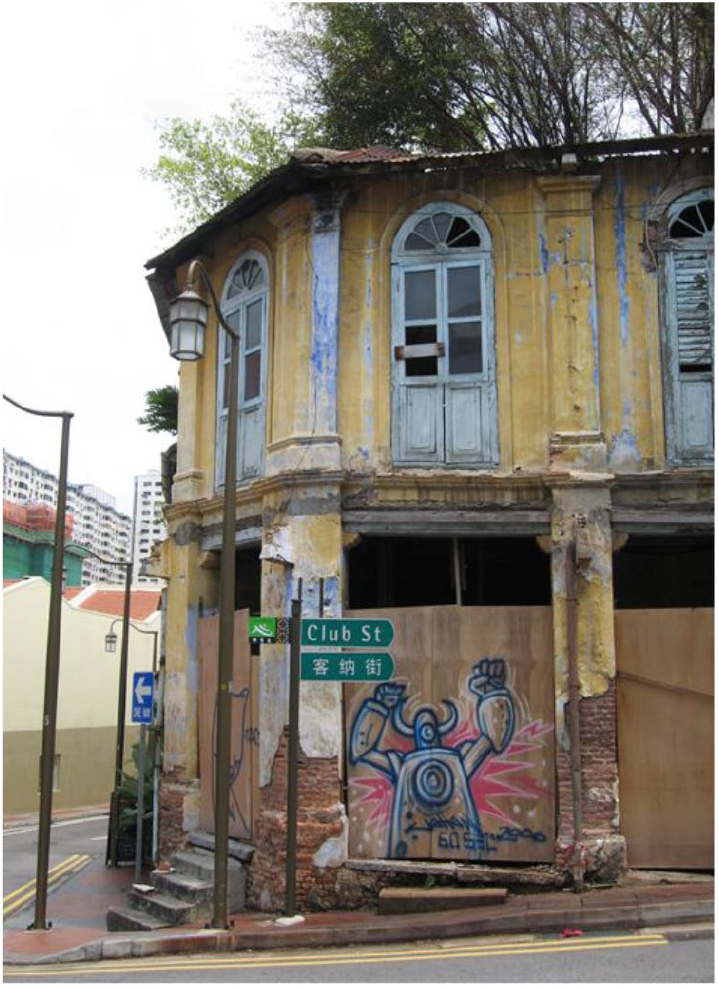
Jahan Loh’s street art in Basic Instructions Before Leaving Earth.
Loh’s reading of the modern cityscape can be understood as a response to both early representations of modernization in Singaporean fiction and the amateur cultural criticism of William Gibson. Here the other — the cartoonish robot — occupies and redefines a space tied to Singaporean history, and yet the self-reflexive unreality of this technological marvel makes it an ironic symbol for the more earnest critiques of the erasure of the Singapore of old. The architecture which appears in the image plays with the concept of “tradition” — Singapore’s colourful shopfronts have been adopted by its tourist board and now signify the face which Singapore presents to the world as much as an artefact of a culture washed away by modernity (see, for example “10 Best Things to Do in Clarke Quay”, 2018). The decay here suggests that popular imaginings of old Singapore are as unreal as the cartoon robot spraypainted in the image. Multiple layers of meaning have been painted onto the building, none of them more “true” than any other. Loh’s image challenges assumptions around the relationship between the “modern” and “traditional”, suggesting that both are, at least in part, invention.
Sonny Liew’s Malinky Robot, similarly, seeks to negotiate the gap between the promise of modernization and the day-to-day experiences of the Singaporean resident. The characteristics of the Malinky Robot stories are, in Liew’s words “over-saturated, crumbling cityscapes from cyberpunk movies and comics […] robots, small epiphanies, manic fun” (2011: n.p.). One recurring character is a tin can robot built by one Mr. Nabisco for the purpose of “sweeping the floor … making hot beverages … doing the laundry … recording TV shows on time … feeding the cat … and most of all, simulating the sounds of rainswept days on tin roof awnings in the nighttime” (2011: n.p.). In the comic in which it is introduced, the robot utters a single phrase as it goes about these duties: “I am a robot”. The recurring child protagonists of the comic series are unconvinced that this machine counts as a robot. Robots, they insist, “shoot lasers from hidden compartments” (2011: n.p.). They offer a long description of the various activities in which robots, in their imagination, engage, the most crucial being that they “fight other robots while flying high over the city” (2011: n.p.). The comic closes with a series of panels in which the robot cleans the house, switches off the television, walks onto the balcony and, looking out over the cityscape reassures itself that, despite its lack of lasers or fighting prowess, “I am a robot”.
Malinky Robot thus posits a science fiction world the denizens of which dream of even grander science fiction fantasies. As with Loh’s work described above, images of science fiction fantasy clash comically with the mundane. The characters are not, to borrow an overworked phrase, “cultural orphans” who crave contact with an erstwhile precolonial Asian culture, but disenfranchised (hyper)modern subjects whose fantasies are drawn from the メカ (Mecha) genre of Japanese anime — the Asian culture with which they crave contact is not a source of ancient wisdom but the high technology we encounter in “Ah Huat’s Giant Robot” and similar stories.
In the subsequent comic “New Year’s Day”, Mr. Nabisco goes drinking with friends and leaves his robot at a sushi bar. The remainder of the comic concerns the robot’s journey home through streets lit by red lanterns, through parks, and past school children. It passes through culturally coded neighbourhoods — one has signs in Chinese, for example, and another in English. The image of the robot of childlike proportions, lost in a large city, is rather poignant, and yet the city itself is unthreatening. People offer directions and one passer-by pays for the robot’s fuel. As the robot makes its way home it goes sightseeing, plays football, is chased by a dog, and falls momentarily in love with another robot. When it rediscovers its friends, it repeats the words it heard Mr. Nabisco use the night before in the bar: “I made it through another winter! Cheers!” (2011: n.p.).
In this comic Liew not only avoids the Orientalism of Gibson’s essay but also writes against the alienation expressed by 1970s novelists. His vision of the modern cityscape is an affectionate one — the metallic flaneur’s journey is one of discovery and neighbourliness. The modernized, partially decayed city that he inhabits is not a hostile place, but one of gentle wonder. The most noteworthy aspect of the comic, then, is not the city’s otherness but its familiarity. The Singapore Liew’s characters inhabit is not the modernized city viewed through the eyes of Gibson (1993) and Square Enix (2011) or the alienating world of the hypermodern envisaged by the novelists of the 1970s, but a lived-in space, where the technological other cohabits, peacefully and without remark, with the everyday.
Conclusion
This selection of texts presented in this essay in no sense cover the entirety of the Singaporean science fiction canon (indeed, none are from the twentieth century). I selected them not because I believe they form a chronology but because they share a thematic interest in complicating popular and imbricated distinctions between East and West and old and new. As I have suggested here, state rhetoric from both the colonial era and the modern period of self-governance have looked to the West for technological capital, positioning Asia as (at best) a source of ancient wisdom and (at worst) culturally bankrupt. William Gibson and other foreign visitors have presented Singapore as a place where over-reliance on Western technology has caused an evacuation of whatever remnants of Asian “tradition” once existed, replacing it with a depersonalized and authoritarian hypermodern city.
The four texts examined here challenge these narratives. The “Ah Huat’s Giant Robot” section of The Art of Charlie Chan Hock Chye and “The Travels of Chan Ching Chong” both present worlds in which Asian technology offers an invitation to question the presumed superiority of Western material capital. Jahan Loh’s street art in Basic Instructions Before Leaving Earth and Liew’s Malinky Robot similarly complicate popular narratives which view Asia as a source of tradition — both texts present the modernized city as a site where simplistic models of “traditional culture” and science fiction are tested, demonstrating that both are, at least in part, the stuff of fantasy. Among all of these texts perhaps the most enduring image is that of Sonny Liew’s squat tin can robot wandering through an (only slightly) strange city asking the way home and realizing, over the course of his journey, that he has been home all along.
This article addressed four works of science fiction by Singaporean writers but, as mentioned in the introduction, they are only a small selection from a larger canon. There is, I believe, much more work to be done in exploring the relationship between East and West and “new” and “old” as it emerges in Singaporean science fiction from the earliest anthology to the works appearing in Lontar today. The present work, I hope, may serve as a point of departure for future debate.
