




Abstract
This article focuses on the literary productions in prose and verse by or related to Muslim Guantánamo detainees. They are redacted documents directly written or translated into English. The purpose of this essay is to read “terrorist” literature para-doxically and argue that US authorities may be right in claiming that it represents a “national security threat”, but not in the meaning initially purveyed. Indeed, marked by the black bars of redaction, the literature eloquently displays the “terror” of state violence. Integrating redactions into the narrating process and exposing what happens in black sites give detainees’ texts the power, albeit precarious, to break the hegemonic discourse of the state and undermine its monopoly over representations of “terrorism”. The article also discusses the danger of interpreting these texts as mere responses to state violence, to failing justice systems, and democracies. It shows how their subjection to official redaction, editorial rewriting, and to the “forensic” imperative is real but it also delves into the literariness of these texts and their literary interventions. It is precisely by reactivating literary connections and intervening in existing Arabic and Pashto poetic traditions that they escape the physical and imaginary confines of Guantánamo and achieve liberation.
Keywords
Since 9/11 the figure of the terrorist has recurrently occupied the screen and its power of fascination has been exploited by the mainstream media to produce an ambivalent object of desire, both conspicuous and obscure. This terrorist figure is often interchangeably identified in the West with other minority figures, such as the Arab, the Muslim, the immigrant, or the refugee. Literary representations of the terrorist are not new to English literature either, 1 but they have lately re-emerged in novels in English, demonstrating how fictional inspirations may repeat the worst stereotypes or oppose them. 2 Thus, the interrelations between terror, violence, and fiction are figured differently depending on the novel and the author. In Salman Rushdie’s Two Years, Eight Months, and Twenty-Eight Nights (2015), for instance, the identification of terrorist-djinns with bigoted Muslims is evident and quite problematic. In other works of fiction, the root causes of terrorism and destruction of Middle Eastern societies are directly addressed, as in Hassan Blasim’s Arabic-language collections The Madman of Freedom Square (2009) and The Iraqi Christ (2013), or the very terms “terrorism” and “terrorist” are called into question, as in Mohsin Hamid’s The Reluctant Fundamentalist (2007).
The fields of philosophy, discourse analysis, and cultural studies have produced significant evaluations of the question of “terrorism”. 3 There is also a body of literary criticism which addresses the representations of terrorists in fictions marketed in the West. 4 My essay first considers a different corpus, namely the prose and poetry produced by the so-called terrorists detained in US military camps and in “black sites”. I limit my analysis to the close examination of the collection Poems from Guantánamo: The Detainees Speak (Falkoff, 2007), the life writing of Mohamedou Ould Slahi in his Guantánamo Diary (2015), and an artistic project by the writer and professor at the University of Chicago Joshua Craze. This project, entitled “How to Do Things With(out) Words” (Craze, 2016), deals with official redacted reports that came out of Guantánamo. I choose Craze not only because his corpus is issued from the same place as the literature of “terrorists” but also because his artistic intension in this project reflects on the illocutionary force and violence of redaction. As such, the project is illuminating for my own attempt to think through the violence of redaction and obliteration of the “terrorist” voice inflicted on the corpus placed under scrutiny here.
To be more specific, “How to Do Things With(out) Words” is composed of a novel, Redacted Mind; a phrasebook, which is a selection of primary sources from Guantánamo, including OPR (Office of Professional Responsibility) and CIA (Central Intelligence Agency) reports, special reviews, and memoranda; and the essay “A Grammar of Redaction” that accompanies it and comments on the types of redaction and their functions. In particular, “A Grammar of Redaction” provides doors of entry into the “terrorist” prose and verse I study here. Guantánamo Diary is Mauritanian Mohamedou Ould Slahi’s first-hand account of his time in detention at Guantánamo (referred to in the book as GTMO). The memoir, which Ould Slahi started to write in 2005 — three years after he was sent to US detention camps in Cuba — opens with the story of his transfer from Jordan to Afghanistan and then GTMO, which is followed by a flashback to 2000 and his first detentions in Senegal, Mauritania, and Jordan. It then moves forward to his time at GTMO from February 2003 to 2005, where he describes the atrocious conditions that detainees suffer there, including torture and rape. Poems from Guantánamo: The Detainees Speak brings together 22 poems written by 17 alleged terrorists in a collection prepared by their lawyers with an introduction by the editor Mark Falkoff (2007), a preface by Flagg Miller (2007) addressing the genre of prison literature in Arabic, and an afterword by Argentine-Chilean-American novelist and activist Ariel Dorfman. Each poet is introduced with a short biographical note calling to attention some elements of the lives of these individuals before their detentions. All three texts were published after 9/11 and the beginning of the US “War on Terror”. They are written by or refer to persons suspected to have committed terrorist acts or to have claimed allegiance with what the US administration lists as terrorist groups. They all refer directly or indirectly to Muslim detainees at US Guantánamo Bay detention camps and therefore their texts may also be grouped together under the generic label of prison literature. Finally, their prose and verse have all been redacted.
While state-sanctioned redaction and translation are supposed, according to US officials, to neutralize the “enhanced national security threat” contained in the texts, I suggest that the black bars of redaction highlight more than they remove violence. Indeed, quite ironically, the bars, which are supposed to protect the state from the revelation of compromising material, are traces of the violence it needs to exert and that it inflicts on the voices and bodies of those who disturb its normal course.
I build my argument concerning state violence on the distinction elaborated by Slavoj Žižek between “subjective” and “objective” violence. Subjective violence is visible and perceived as a “perturbation of the ‘normal’, peaceful state of things” (2008: 2). On the other hand, objective violence remains unperceived and stays unrecorded in institutional archives and the media precisely because it represents the violence required for the system to function normally and to “sustain the very zero-level standard [of violence] against which we perceive something like […] the ‘irrational’ explosions of subjective violence” (2008: 2). I would further argue that in the normal course of things, objective violence does remain invisible. But as witnessed time and again in moments when civil societies rise up to contest the legitimacy of power, objective violence becomes embodied and very visible indeed in the presence of riot police and of the military.
I read the black bars of redaction as another instance of embodied objective violence. The purpose of the first part of this article is to parse the levels of redaction imposed on the literature of terrorists, from official redaction to editorial rewriting, and show how the voices of “terrorists” are obliterated. The second part of my article focuses on the strategies deployed by editors and by writers marked as “terrorists” to regain the voice that was excised. I reveal how their literature breaks stereotypes, seeks poetic justice through the exposition of truth, and reclaims a share of the public space from which they were carefully removed. I also demonstrate how the act of reclaiming is always a precarious and limited gesture, since these texts go through a series of redactions, from CIA review teams, to translators, and editors, over which writers have little to no control. Furthermore, if understood as a form of writing in line with imperatives of testimony and justice, then the authors’ prose and poetry hardly moves beyond the constrictions of the camp. In this respect, Ould Slahi’s diary underlines the paradox of reclaiming a voice, and therefore an identity outside the category of the terrorist, while writing an autobiography which de facto revolves around Guantánamo — the series of events which led to detention and the living conditions in the camp. In a third part, I move from the notion of regaining a voice to that of finding one. My research demonstrates that, without losing sight of the context in which the prose and poetry are written and the intention of authors to confront the hypocrisy of Western democracies, there is a need to recognize the literary interventions of these texts and highlight the politics of their poetics.
1. Obliterating a voice: What happens in the black of redaction
The images presented below (see Figures 1–4) are selected from the book Guantánamo Diary by Mohamedou Ould Slahi (2015) and from the “The Torture Database” (n.d.), which provides free access to unclassified documents (including reports, letters, interviews, emails) kept by the CIA and other US official administrations in relation to Guantánamo and other US secret jails abroad, also known as “black sites”. On these pages, black bars obliterate words, lines, and sometimes entire paragraphs.
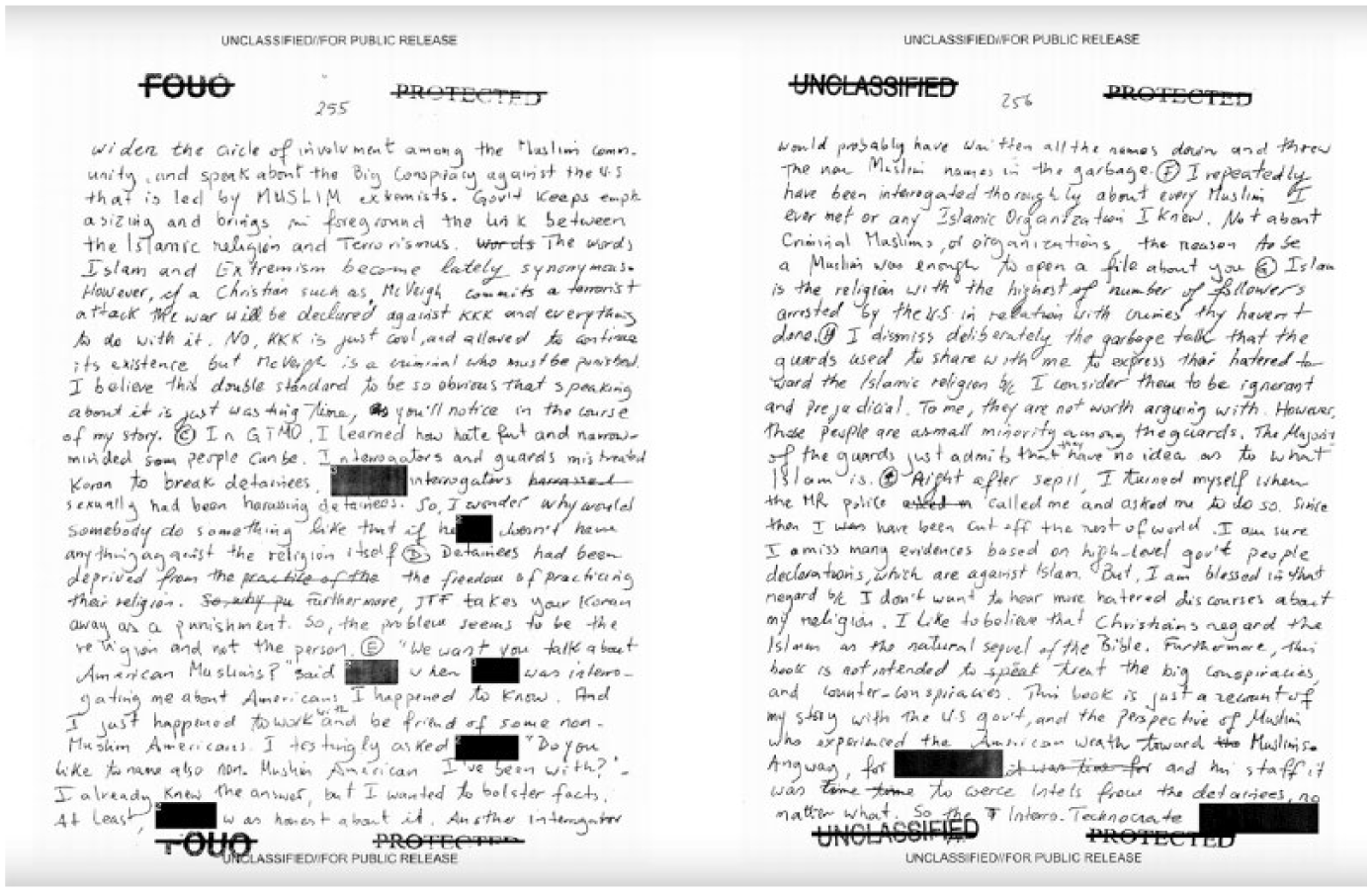
From Guantánamo Diary (Ould Slahi, 2015: 255–56), manuscript.
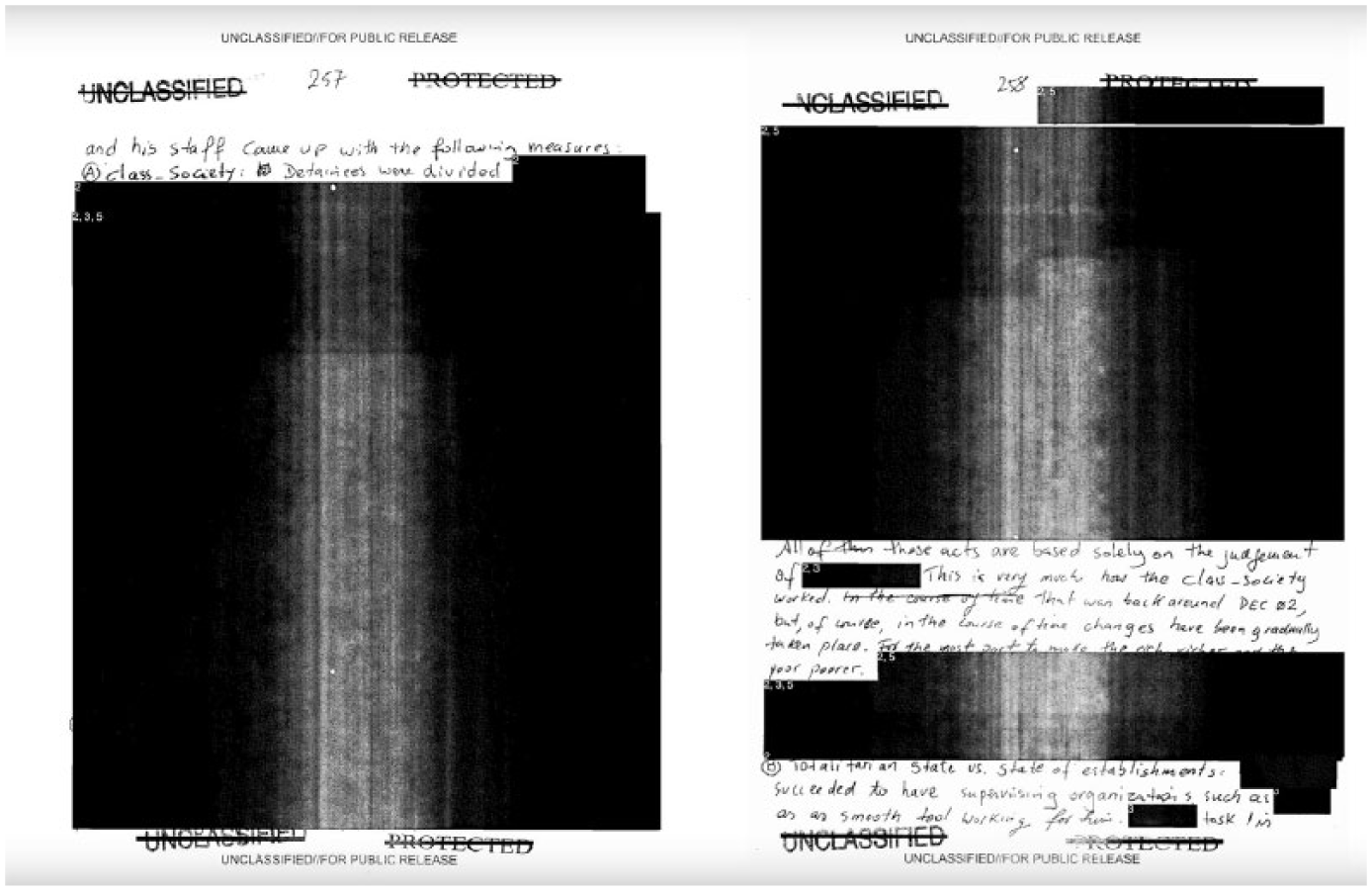
From Guantánamo Diary (Ould Slahi, 2015: 257–58), manuscript.
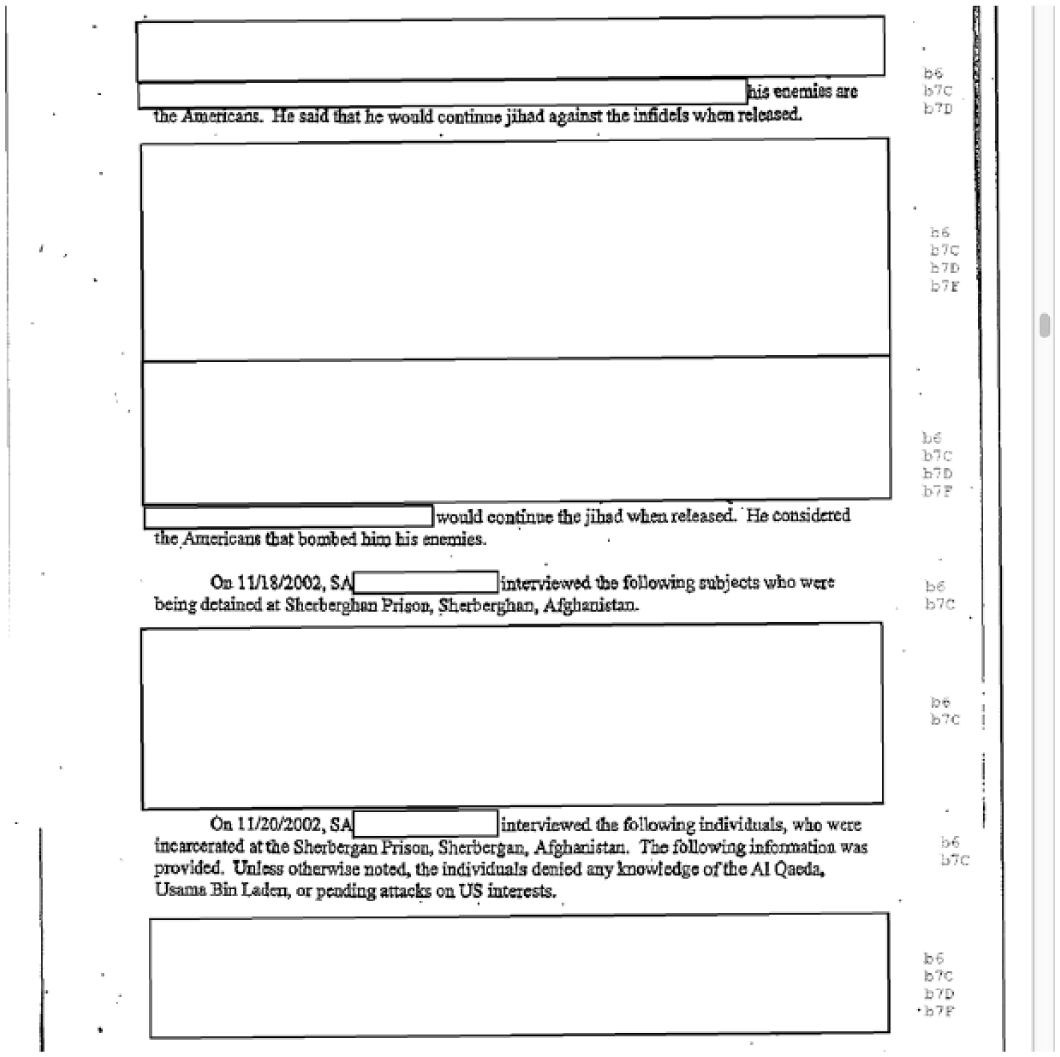
From Summary of FBI work with detainees held by the Northern Alliance in Sheberghan, Afghanistan (16 December, 2010), p. 13 (The Torture Database, n.d.).
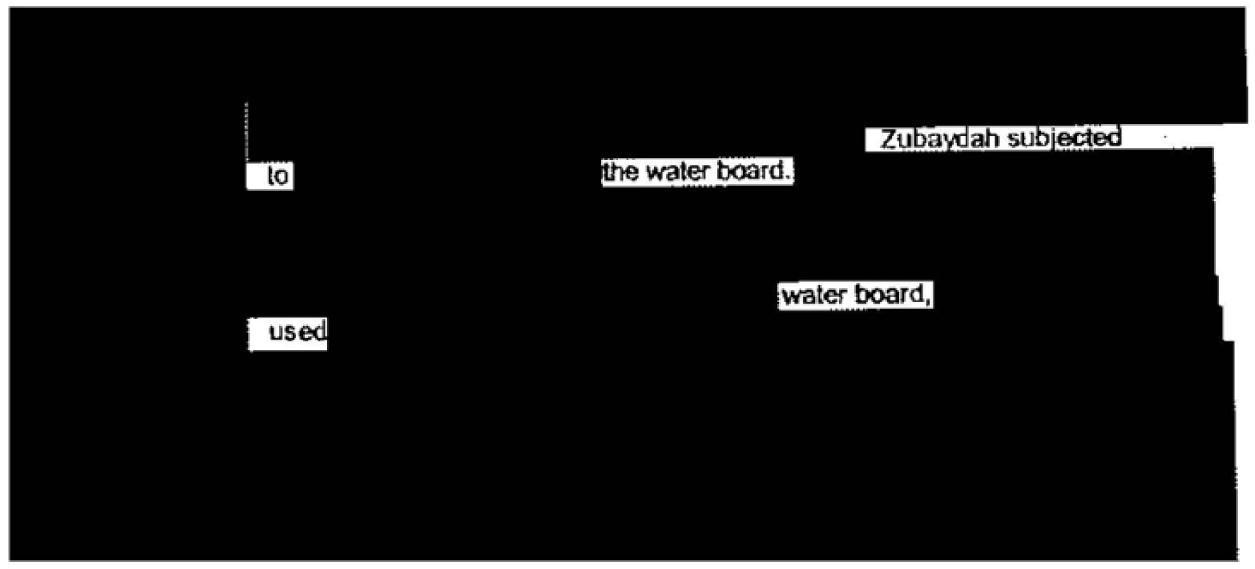
From Joshua Craze’s Phrasebook (2014), front cover, second image from top. Itself an excerpt from Other Document #131 (heavily redacted CIA report on the raid, capture, and waterboarding of Abu Zubaydah), p. 6 (The Torture Database, n.d.).
In the US, the Freedom of Information Act (1966) allows for the disclosure of previously unreleased information and documents controlled by the government. The documents are reviewed, translated if necessary, and redacted before being cleared for public disclosure. Redaction, which is the term used to refer to the censoring of part of a text for legal or security purposes, was applied to all documents coming out of Guantánamo, including the literary production of the detainees, because they were regarded by the state as sensitive data. Mohamedou Ould Slahi’s diary was written in 2005 but was only unclassified in 2012 and published in 2015. Mark Falkoff, who was the editor and the attorney for 17 Guantánamo detainees, expounds in the introduction to Poems from Guantánamo on the difficulties encountered in bringing these poems out of prison. Attorneys were granted access to the detainees’ manuscripts only after years of legal battles against US governments. Nevertheless, Falkoff also underlines that in the case of the poems, most of them were confiscated, destroyed, or left as classified and thus impossible to access: [T]he Pentagon refuses to allow most of the detainees’ poems to be made public, arguing that poetry “presents a special risk” to national security because of its “content and format”. The fear appears to be that the detainees will smuggle coded messages out of the prison camp. (2007: 4)
The editor here highlights something crucial in relation to form. Poetry makes use of the sound quality of a language and organizes lines in rhythmic patterns not only to please the ear and eye but also to produce emphasis or contrasts in meaning. The threat posed by prosody and the supplementary textmeaning of metaphorical language accounts for the authorities’ distrust and explains why “[h]undreds of poems […] remain suppressed by the military and will likely never be seen by the public” (Falkoff, 2007: 4). In this context, Falkoff presents the publication of this collection of poems from Guantánamo as a “miracle” (2007: 2).
Poems from Guantánamo (2007) contain no marks of redaction, but the original poems written in Arabic, Pashto, or Persian have disappeared into black holes, with no hope of recovery. The disappearance of the originals into black holes resonates with the erasure of texts behind black bars of redaction, and with the disappearance of bodies in the secret prisons or “black sites” administered by the CIA. Indeed, the poems are translated into English by linguist “experts” with secret-level security clearance, before being handed over to lawyers and editors. According to the editor of Poems from Guantánamo, these non-literary translations preserved none or very little of the semantic, stylistic, and rhythmic richness of the originals. 5 The damage is both material, with alterations to the text, and symbolic, with a denial of access to grace and subtlety.
In the case of redacted documents, the first instinct of readers is to try to read past the bars in order to discover the names of places and individuals as well as the acts of torture inflicted on them. This corresponds to a form of “investigative reading” whereby readers become journalists searching for clues in order to produce a full storyline. The editors publishing the literature considered in this article are inclined towards this form of reading too. For instance, Larry Siems, who was the director of the “Freedom to Write and International Programs” for the American PEN Center until 2013 and who edited Ould Slahi’s diary, adds footnotes for the following reasons: I have tried my best to present information that most plausibly corresponds to the redactions when that information is a matter of public record or evident from a careful reading of the manuscript, and when I believe it is important for the overall readability and impact of the text. (Siems, 2015: xiii)
This endeavour to read past the black is frustrated when entire paragraphs are blotted out. Yet, the frustration triggers a fundamental question which relates to the act of reading. Indeed, it seems there are two ways of reading the redactions — first analogically, as standing in place of (or, in this case, hiding) other signs (toponyms, names, verbs), and second literally, as signs in and of themselves that have a place and a function in the sentences. Indeed, by perforating the text and reordering language and grammar, they bear witness to and symbolically repeat the violence perpetrated by the state against the ones it designates as “terrorists” or “enemy combatants”.
Even though Joshua Craze is not a detainee of US military camps, I incorporate his book project “How to Do Things With(out) Words” into the discussion because he deploys a poetic reading of redaction that goes against the grain of the instinctively investigative mode of reading. Craze (2014) mentions his frustration as a journalist when he tried but failed to decipher redacted passages and reconstruct a full story hidden behind the bars. He was looking for names, places, and actions they concealed, rather than at the bars themselves, and feels that this would have indefinitely postponed the moment of final comprehension: The redacted page is an image. To understand it, I realized I couldn’t discount the redactions as if they were non-sense: the annoying suppressions that get in the way of significance. I couldn’t look for words, as if the redactions did not exist. I didn’t want to hunt for significance — it is already there, in the black. I just didn’t know how to see it. (2014: 4)
In order to learn how to read redaction, Craze moves from a mimetic approach — one that is based on referentiality and that tries to uncover reality (names, places, actions) behind the bars — to a poetic approach, focusing instead on the illocutionary force (or “effective meaning”) 6 of the black bar. By switching to a poetic mode of reading, one that requires no prior knowledge or expertise, Craze reminds us of the power of literature and the danger texts pose for authorities as they unmask state violence.
To move a step further into this poetic approach to the black bar of redaction, it is helpful to examine Jean-Luc Nancy’s (2001) disquisition on the meaning of the trace. For Nancy the trace indicates both something and its disappearance: it is not that which remains of the thing (here Nancy gives the example of the trace of lipstick on a cigarette butt) but it is “the presence of an absence indicated as such: as absence, and most often also as an absence which remains incompletely determined and still to be imagined or reconstituted” (2001: 110–11). The bars of redaction are particularly interesting in that regard and as traces. It we interpret the bar as a trace then the question is not so much what reality is referred to behind the bar (the lips) but rather what gesture, what presence, the bar left on the page is the trace of (like marks of lipstick on a cigarette butt). The black bars then become the traces left by a hand empowered to erase a text. They cover portions of text which are absented but they are not the traces of that text; rather, they are the traces of the action of deleting. What remains in the trace is not the text which has been redacted but the act of redaction itself. Hence, redaction bars, while protecting a legal structure established by power, represent a very visible sign of its violence. Quite ironically, bars of redaction are always already caught in a double-bind — while covering up and blackening out, they highlight. They are meant to hide violence or more specifically to delete the details that would put the militarized state apparatus and its administrators at risk, but the hiding of something exposes the forces that control, withhold, and redact. I contend that the violence of the state, which physically and psychologically tortures detainees, spills into these textual excisions.
The force of Craze’s artistic work is that it reverses our perceptions. The text is re-articulated by what Craze calls a “grammar of redaction” and takes new shape and meaning. For instance, the second document chosen for the cover of the phrasebook contains the image of a page which has been almost entirely redacted, with only a couple of words etched out of the black that surrounds them. Craze strings the words together so that they read “Zubaydah subjected to the water board” (2014: front cover; see Figure 4). This sentence is not in the original text but it appears when the text is read with the redactions.
Craze’s powerful artistic gesture reverses our whole approach to redaction. Instead of trying to read past it, he issues an invitation to stay in the black, read with it, and understand what it does to language, meaning, and our relation to reality. For one thing, reading Guantánamo literature with the black means to acknowledge that reality and its representations through language are controlled and organized by those placed in positions of power. CIA agents are the ones applying the bars, orchestrating narration, drawing the contours of what can and what cannot be said, and defining the limits between speech and silence. Second, the bars destabilize power at the moment it is exercised through them. Indeed, redaction, by embodying the objective violence of the state, reveals this violence and fundamentally calls into question its legitimacy as an alleged agent of peace and security. Nevertheless, Craze’s formal approach to censorship raises ethical issues because it does not allow for a distinction between obliterating an official report and obliterating the writing of a victim of state power.
2. Regaining a voice: Can the terrorist speak?
The objective in publishing Guantánamo narratives and poems is to let those who have been deprived of a voice and even of a name regain a sense of presence and identity. For Kristina R. Reardon (2015), voice in Poems from Guantánamo must be understood in its political sense (as opposed to silence) and in its literary sense (as style and diction). In a world where justice has lamentably failed them, detainees resort to literature and poetic justice in order to be heard. Reardon cogently argues that these unusual writers “create a literary forum which replaces the traditional courtroom” and that this multi-voiced collection interweaves various registers together, namely testimony, ethics, and aesthetics (2015: 44).
The question of recovering a voice is central not only in poetry but also in prose. The so-called terrorists resort to the autobiographical genre and to the form of diaries and memoirs, which indicates a return to subjectivity and individuality for persons casually subsumed under categories, numbers, or epithets (such as “sand niggers”). 7 It also allows for the direct interpellation of readers, through the use of the personal pronoun “you” and through other vocatives, when inmates are kept in isolation. The use of the autobiographical genre allows the silenced voices of the detainees to reclaim a public space and visibility. However, contrary to what the autobiographical genre normally implies, these accounts are not turned towards self-reflection and self-knowledge, but rather fulfil the functions of literary testimonies — self-liberation, moral intentions, and pedagogical objectives for readers who have little to no access concerning what is happening inside the camps. Mohamedou Ould Slahi and the other writers and poets of Guantánamo write with the hope of being heard and out of the knowledge that their voices are bound once again to be erased through partial or complete redaction or destruction.
Detainee literature produces “incendiary” revisions of our understanding of the world by acting as a means through which the voices and identities of invisibilized and ungrievable people may be recorded again. Thus, when discussing the specific case of Guantánamo poets in her series of essays entitled Frames of War: When is Life Grievable?, Judith Butler (2009) reminds us that precisely because of its dissemination prison literature is capable of breaking with context all the time, by which she means breaking the ideological frames that receive it. By their very circulation, the diaries and the poems of “terrorists” put receiving frames in a state of “perpetual breakage”, asserting their “vulnerability to reversal, to subversion, even to critical instrumentalization” (2009: 9). Poetry and life writing have never freed anyone from prison or reversed the course of a war, but “they nevertheless do provide the conditions for breaking out of the quotidian acceptance of war and for a more generalized horror and outrage that will support and impel calls for justice and an end to violence” (2009: 11).
The poems and diaries of Guantánamo constitute literary records that have not been disposed of and have reached editors in a state that allowed for their publication, thereby permitting detainee voices to be recovered. Once published, they may indeed break and subvert the hegemonic discourse of the “War on Terror”. Yet these successful cases of circulation, the discursive disruption that they cause, and the redress in the dispensation of grievability that they offer should not encourage us to presume that the question of the integrity and durability of these voices is settled once and for all. The black bars are here to remind us of the fact that the texts have long ceased to be the possession of those detained. Not a single line of writing leaves Guantánamo before being checked and transferred to a security site in Washington, D.C. Once they have left prison the texts never return to their authors, who have no say in the editing and publishing processes, and nor can they attend public readings or read them in person. 8 For instance, in the case of the poet Shaikh Abdurraheem Muslim Dost, Falkoff (2007: 4) indicates that the military confiscated nearly all of the 25,000 lines of poetry he composed, returning only a handful upon his release. For the poems that remained, the procedure is that they are handed over to the Pentagon privilege review team, which has them translated by linguists contracted by security-cleared companies such as Booz Allen Hamilton. Then the review team redacts and declassifies them. Therefore, the poems reach Anglophone readers in a state that escapes the oversight of the detainees and to a certain extent of the lawyers and editors themselves. These creative practitioners do not have access to the originals and cannot retranslate with the help of professional literary translators. 9
Furthermore, in spite of the fact that the editors uphold the best intentions towards detainees and that their efforts to publish their works are unparalleled, they are nevertheless also engaged in a process of redaction. For instance, Larry Siems underlines that Guantánamo Diary “is an edited version of the 466-page manuscript Mohamedou Ould Slahi wrote by hand in his Guantánamo prison cell in the summer and fall of 2005”, and that “it has been edited twice: first by the United States government, which added more than 2,500 black-bar redactions censoring Mohamedou’s text, and then by me” (Siems, 2015: xi). In a regretful tone, Siems highlights that “Mohamedou was not able to participate in, or respond to, either one of these edits” (2015: xi). Siems later specifies that he received from Ould Slahi an “incomplete” and “fragmentary draft” which had inconsistencies in narrative approach and in the overall shape of the work (2015: xii). For instance, the diegesis became less and less linear as the events recounted came closer to the author’s present. The editor questions a series of flashbacks referring to events that occurred prior to incarceration and that were placed at the end of the manuscript, and confesses to having cut 20,000 words in total (2015: xii).
Editorial tampering and paratextual framing (in the form of introductions, biographies, and footnotes for instance) direct these texts so that they can speak to a Western audience. This idea of catering to a market is of course nothing new in the publishing world. Yet, crucially this time, the writers and poets are not allowed to see any revised copy of their works and agree to the changes made. This specific situation places editors and translators in a problematic position of modifying a text that is not theirs without the agreement of the author. Yet, what distinguishes the lawyer–editors and translators from CIA redactors or contracted translators is the moral bond that unites them with the detainees, whom they often personally know as their clients. That ethical pledge ensures that they will not use their positions of authority to the detriment of the writers but it does not save them from assuming a position of power either, and therefore it does not fundamentally overturn existing power relations.
Dispossession is both material and formal. As autobiography, the diary of Ould Slahi is supposed to reconstruct the intellectual, spiritual, ethical, physical, and psychological development of its author as he circulates in specific social and historical environments. Autobiographies have a dual mode of address — the “you” of the reader and the “I” of the narrator caught in a movement of self-reflection — and entertain an ambiguous relationship to the truth. While claiming to be factual, at least in the classic version of the genre, their authors are engaged wittingly or not in imaginative acts of (re)creation of their past and present conditions. In the case of Guantánamo Diary, little room is left for self-exploration and the narration is directed towards the exposition of the violence and horrors of detention, as well as the hypocrisies, damages, injustices, and atrocities perpetrated in the name of a War on Terror. Reading the diary is not so much an experience of reading into a character as reading about a history of violence told from the point of view of its victims and for the writer to seek poetic justice. These imperatives reduce the potentialities of the genre by eliminating what does not directly serve the purposes of testimony and poetic justice. Therefore, life writing for Mohamedou Ould Slahi revolves around and stops at Guantánamo. Building on what Nouri Gana and Heike Härting conceptualize as the “narrativizing imperative”, namely “the ethical and testimonial obligation to make the violent event speak, and speak coherently in order to be witnessable, understandable, and credible” (2008: 2), I contend that Ould Slahi’s diary and the poems of the Guantánamo detainees are to a large extent determined by a “forensic imperative”, which aims to engage with consensual falsehoods and establish dissensual truths.
3. Finding a voice: Writing beyond the imperative and reconnecting with tradition
One instance of consensual falsehood that the Guantánamo narratives unmask would be Governor Ridge’s homeland security briefing delivered on 3 December 2001 in which he confirmed that terrorist threats were everywhere and “very generic” (“Homeland security briefing”, 2001: n.p.). The undefined nature of the terror threat is a means through which the state propagates fear in order to vindicate civil repression inside its own borders and military retaliation outside, placing the nation in a state of indefinite war. General statements, distortions, and outright lies pronounced by the US government and the media have created a form of paranoia against Arabs and Muslims in the West. As early as 2001, in an interview for PEN, Edward Said warned against this racial and religious profiling and described the US as state manipulating terror for political ends. 10 This is clearly the case in Governor Ridge’s declaration and it is also true of the claim made by former Secretary of Defense Donald Rumsfeld that Guantánamo detainees are “among the most dangerous, best-trained, vicious killers on the face of the earth” (qtd. in Seelye, 2002: n.p.). In reality, only five per cent of Guantánamo detainees were picked up on the battlefields and eight per cent had links with al-Qaida. 11
In an attempt to move away from these stereotypical (mis-)representations and recover some of the literary richness of the poems, Falkoff (2007) provides short biographies for each of the poets whose work is showcased in Poems from Guantánamo, and includes an essay by the religious studies scholar Flagg Miller (2007). In this essay, Miller disassociates detainee poetry from the propagandist and militant poetry of jihadists, and reconnects it with the habsiyya 12 (prison literature) tradition, both in its classical and its modern forms. The paratext enables a form of reading of Guantánamo poetry that goes against the grain of popular opinion as shaped by mass media and governments. Beyond the immediate context and limits of the camps, Miller reconnects their poetry with at least two literary traditions. Indeed, the nostalgic and elegiac tones of the poems recall on the one hand topoi found in the qasida tradition with the lamentations on the ruins and on the passing of time, and on the other hand the concept of tawakul (reliance on God) and spiritual deliverance found in Sufi literature and which is also present here in Abdulaziz’s poems “O Prison Darkness” and “I Shall Not Complain”, “Humiliated In the Shackles” by Sami al-Haj, and “Is It True?” by Osama Abu Kabir.
Their voices reach Western readers (as in “They Fight for Peace” by Shaker Abdurraheem Aamer and in “Death Poem” by Jumah al-Dossari and “Hunger Strike Poem” by Adnan Farhan Abdul Latif), their families (as in “To My Father” by Andullah Thani Faris al-Azani and Abdulla Majid al-Noaimi’s “My Heart was Wounded by the Strangeness”, which is dedicated to his brother), but also include other victims of repression and oppression. For instance, the poem “Ode to the Sea” by Ibrahim al-Rubaish expands in a concentric way to reach different levels of interlocution. As the title suggests, it is first an ode to the sea, representing what lies beyond Guantánamo but also what encircles it and shuts out any horizon of escape: “O Sea, you taunt us in our captivity. You have colluded with our enemies and you cruelly guard us”. The sea metaphorically represents the outside “free” world: “O Sea, do our chains offend you? | It is only under compulsion that we daily come and go” and “Don’t the rocks tell you of the crimes committed in their midst? Doesn’t Cuba, the vanquished, translate its stories for you?” (al-Rubaish in Falkoff, 2007: 65–66). Similarly, the singular voice of the poet contains the voices of all detainees: You have been beside us for three years, and what have you gained? Boats of poetry on the sea; a buried flame in a burning heart. The poet’s words are the font of our power; His verse is the salve for our pained hearts. (2007: 66)
The same type of expansion occurs in “To My Father”. The detainee addresses his father first, then his jailors, and eventually the whole US public, condoning their apathy, blindness, and support for what the government is doing in their name. The poem closes with a direct address to God and shifts towards the form of a duaa (supplication): O God — who governs creation with providence, Who is one, singular and self-subsisting, Who brings comfort and happy tidings, Whom we worship — Grant serenity to a heart that beats with oppression, And release this prisoner from the tight bonds of confinement. (al-Azani in Falkoff, 2007: 26)
At this point, the poet is not only lamenting Guantánamo detention but also drawing from a convention in Sufi literature of calling for the rising of the enlightened heart above the shackles of worldly distractions. Similarly, echoes of epic poetry are present in “Lions in the Cage” by Ustad Badruzzaman Badr, who draws his inspiration from the maghazi/seerah of the Prophet Mohammed and compares the detainees to the first Muslims who were part of the “Caravan of Badr”, fought a decisive battle there, and were victorious against their Meccan opponents.
Defiance and irony are what characterizes “The Truth” by Emad Abdullah Hassan, “They Cannot Help” by Shaikh Abdurraheem Muslim Dost, and Jumah al-Dossari’s “Death Poem”. The latter is both directed at al-Dossari’s jailors and at “the people of conscience”, “the principled men”, and “the fair-minded” across the globe who have lamentably failed justice: And let them bear the guilty burden, before the world, Of this innocent soul. Let them bear the burden, before the children and before history, Of this wasted, sinless soul, Of this soul which has suffered at the hands of the “protectors of peace”. (al-Dossari in Falkoff, 2007: 32)
The poem “First Poem of My Life” by Mohammed el-Gharani is also interesting in that it partakes in the literature of resistance in Arabic, particularly Palestinian resistance, in order to accuse the US detention system. This literary trajectory is lost in English translation, which reduces the poem to its immediate context. But by accessing the original poem, the translator for this edition was able to situate the poem within its larger literary and political contexts in Arabic. For instance, in the following lines: All of us threw the cards away, Intent that our spirits be redeemed in sacrifice. They carried us, afterwards to Cuba, Because it is an afflicted isle — (el-Gharani in Falkfoff, 2007: 39)
The words fida (“redeemed in sacrifice”) and mankuba (“afflicted”) are two references to the Palestinian resistance struggle, and more specifically to the figure of the fida’iyun and to the Nakba, which is the name given by Arab people to the 1948 defeat against Israel and the mass displacement and killing of the Palestinian population.
The tone and the length of the poems vary. When resources in paper are scarce, Shaikh Abdurraheem Muslim Dost (2007) used Styrofoam cups handed out at mealtimes in order to write verses down and circulate them amongst inmates: CUP POEM 1 What kind of spring is this, Where there are no flowers and The air is filled with a miserable smell? CUP POEM 2 Handcuffs befit brave young men, Bangles are for spinsters or pretty young ladies. TWO FRAGMENTS 1. Eid has come, but my father has not. He is not come from Cuba. I am eating the bread of Eid with my tears. I have nothing. Why am I deprived of the love of my father? Why am I oppressed? 2. Just as the heart beats in the darkness of the body, So I, despite this cage, continue to beat with life. Those who have no courage or honor consider themselves free. But they are slaves. I am flying on the wings of thought, And so, even in this cage, I know of greater freedom. (Dost in Falkoff, 2007: 35–36)
The brevity of the format depends on the material conditions in which the poets are writing and also signals the threatening environment of detention. Yet, there is more to these poems than just external factors imposed by the system. Indeed, Dost’s poems were written in Pashto and the language has a very rich oral tradition in folk poetry and proverbs (matalūna). 13 It is obviously difficult to reconstruct the syllabic and rhyme patterns of poems such as “They Cannot Help”, given that no one had access to the original in Pashto except the contracted translators. Yet, what can be deduced from the translation in English is that it has no refrain at the opening of the poem nor other refrains after each stanza, ruling out it being written in the loba form or the châr-beyta form. Folk robâ’i (couplets with the rhyming scheme mm-am-bm-cm, and so on) and folk ghazal (couplets written in a variety of rhyme schemes) are particular in that they both include the poet’s name in the final couplet. The final lines in “They Cannot Help” also include the name of the poet: “Those who foolishly dispute with Dost the Poet | Cannot help but surrender, or else run away” (Dost in Falkfoff, 2007: 34).
The fact that the poem is written in couplets and includes the poet’s name at the end is a clear indication that Dost was composing in line with folk poetry tradition in Pashto. I further contend that both the fragments and the cup poems also refer to this tradition. Poems in the mesrâ’ form (also sometimes referred to as tapa or landay) usually constitute independent units of just one unrhymed couplet (with a first hemistich of nine syllables and a second of 13) and are typically anonymous. Again, the English translation cannot help us with the syllable counts but it is clearly demarcating the couplets as independent units (fragment 1, fragment 2… etc.) and these are anonymous. The mesrâ’ poems are particularly appreciated for their brevity, wit, and the range of subject matters they address, just like Dost’s fragment-poems which range from the vindictive, to the descriptive and the elegiac. In other words, Dost may have been crafting fragments on Styrofoam cups because of the material conditions of detention but while doing so he was also reconnecting with a longer literary tradition with roots in Afghanistan and Pakistan.
Conclusion
This article started with a fascination for what it means to publish the redacted literature of Muslims designated by the US as “terrorists” and placed in indefinite detention without fair trial in US secret sites and military camps. I felt fascination, too, for the phrase repeated by US officials that poetry constitutes an “enhanced national security threat”. If this expression seemed at first slightly comical — I had been reading Judith Butler carefully and already knew that a novel never got one out of prison or stopped the course of a war, 14 let alone dropped a bomb — I was also curious to see what would happen if I were to take Governor Ridge’s and other US officials’ comments seriously and consider literature as a threat — only not to civil societies but to the state and the military apparatus that supposedly protect them. Based on this premise, I began to look for violence in the prose and poetry written at Guantánamo, and I indeed found it not in the literature of the Muslim detainees but in the redaction bars that obliterate their voices. I therefore delved into what Craze calls the “grammar of redaction” to excavate the violence of the Western democratic state as inscribed in the literary production of those it designates as “terrorists” and treats as “subhumans”. I also unpacked the various strategies put in place by the editors so as to enable the publication of the poems and diaries of Muslim detainees with the aim of contradicting the official narrative of the War on Terror as sold by the US military state and mainstream media, to seek poetic justice, and reclaim a voice and identity that had been taken away from them. However, I continued to be perplexed and perturbed by the way I and other readers would casually read these texts and by the types of default reading we would impose on them. Indeed, reading “terrorist” prose and poetry as a type of committed literature that responds to imperatives — testimonial, juridical, and even ethical — appeared as a restriction imposed on the corpus and a limitation of the power of literature to move beyond immediate contexts and be something else than just an immediate response. I used this unease to investigate further into the literariness of these texts and argued in the case studies of poems written by Mohammed el-Gharani and Shaikh Abdurraheem Muslim Dost that their interventions were not only directly political but also literary and that they were also in conversation with Arabic and Pashto literary traditions. The point on which I want to end this essay is that the politics of these texts lie not only in their capacity to respond to and resist power but also in their very literariness. It is precisely by reactivating literary connections and intervening in existing traditions that these writings achieve liberation and become political.
Footnotes
Funding
This research received no specific grant from any funding agency in the public, commercial, or not-for-profit sectors.