




Abstract
In “Falling”, a short story from Henrietta Rose-Innes’s 2010 collection Homing, there is a productively unresolved tension between the aesthetic demands of spatial form and the spatially segregated nation of post-apartheid South Africa. I track why spatial politics remain central to understanding contemporary South Africa and its literature, and set this against W. J. T. Mitchell’s expanded conception of Joseph Frank’s theory of spatial form, in which divergent understandings of literary spatiality are combined. Using “Falling” as an example, I then analyse how different modes of space operate in Rose-Innes’s fiction, and discuss how her formal concerns intersect with the politically charged space of Cape Town, where the story takes place. In particular, I argue that her characteristic use of spatial means to imperfectly resolve narrative material can be read as a literary negotiation of the unresolved issue of post-apartheid spatial distribution. These cadences offer partial catharsis, but also reveal where formal resolution and lived reality come into conflict.
When planning her novel, Green Lion (2015), Henrietta Rose-Innes decided that it would “involve somebody going to the top of the mountain and then coming back down, and that would be the entire plot arc: simple” (Rose-Innes and Reid, 2013: n.p.). She goes on to remark that although the finished book “didn’t turn out simple at all”, it “still has that movement at its heart” (Rose-Innes and Reid, 2013: n.p.). Many of Rose-Innes’s short stories and novels use spatial means — a climb up and then down, or a voyage out and back — to resolve narrative material, but the seeming resolution of these gestures is rarely as conclusive as it might at first appear. These closures can be thought of, to use a musical metaphor, as “spatial cadences”, and common to them all is their “imperfect” character. Such cadences do not resolve fully, and this is at once their strength and their weakness. Imperfect spatial cadences are suggestive for readers trained to appreciate ambiguity and open-endedness, but they also reveal the points at which formal solutions buckle under the weight of societal complexity they try to resolve. Through an analysis of Rose-Innes’s short story “Falling”, I offer an example of how she uses the imperfect spatial cadence as a means of sustaining tension between aesthetic and political resolution. This story, like several others in her collection Homing (see Rose-Innes, 2010a, 2010d), bears the marks of a productive struggle between formal and extra-formal concerns, the most interesting of which lies in the conflict between a performance of spatial closure and what this reveals about the unequal spatial politics of post-apartheid South Africa.
“Falling”, like Green Lion, is structured around a simple movement: a climb up and down. At the beginning of the story, protagonist Victor climbs to the top of the glass dome of a shopping mall, from where he looks down into the space below. Doing so triggers a traumatic childhood memory of being at the mall’s construction site with his father, the building’s architect. While sitting above the exposed central shaft, young Victor accidentally kicked a brick over the edge and may have hit a black site worker on a lower floor. As the brick falls, the story switches back to the present, as a security guard in the mall spots Victor on the roof and climbs the dome to bring him down. The guard begins to feel dizzy with vertigo, so Victor helps him down. They walk towards the exit together, but eventually the guard is left behind and Victor walks out of the mall, and into the light, alone. The spatial core of the story may be simple, but the text maintains a sophisticated internal dynamic between place and memory, while refracting broader societal concerns about space and place in South Africa. The story is also in dialogue with South African literature’s history of discursive engagements with the land, and its form is situated in a genealogy of literary conventions.
To address the last of these first, the story’s mode of composition tends towards what Joseph Frank calls “spatial form”, in short, a way of organizing texts that abandons sequential narrative in favour of a totality formed through an aggregate of parts, and that builds meaning through a web of patterned imagery, recounted in fragmented prose (Frank, 1945). While “Falling” is not disjunctive to the extent of the modernist texts which Frank uses to illustrate his argument — particularly James Joyce’s Ulysses and Djuna Barnes’s Nightwood — it does share with them a tendency towards non-linearity and a disinclination for causal explanation. Spatial form tends to produce a feeling of “mythic simultaneity” (Mitchell, 1980: 541) in a text, with the work abstracted from the world in which it was produced. Short stories are frequently singled out in criticism for their tendency towards such formal “spatiality”: Nadine Gordimer says a short story is like “an egg; it’s all there” (Gordimer and Walters, 1990: 287); A. L. Kennedy declares that writing a short story is like “casting a bell, […] sometimes it doesn’t work, sometimes it’s cracked and the note is wrong” (Kennedy, 2008: 4).
Arguments over the suitability of such spatial metaphors to describe literature, and the temporal experience of reading it, are far from settled (Head, 2009: 12; Lane, 1984; Mitchell, 1980, 1981; Surette, 1981). A full engagement with this debate is not the focus of this article, but one strand that has emerged from the debate is useful when reading Rose-Innes’s fiction. W. J. T. Mitchell, in his essay “Spatial Form in Literature: Toward a General Theory” (1980), expands on Frank’s earlier essay, offering a four-part model that serves as a “heuristic device for discriminating varieties of spatial form in literature” (Mitchell, 1980: 550). Or, perhaps more accurately, he attempts to gain a “precise understanding of the ways in which spatiality occurs” in literature (Mitchell, 1980: 547). I make this distinction to minimize confusion between Frank’s conception of spatial form, and Mitchell’s much broader conception of “spatiality”. The four levels of “spatiality” Mitchell identifies are: 1) the physical space of the text on the page; 2) the spatial configuration of the world of the text; 3) the spatial conception we have of a text’s temporal movement; 4) a spatial “apprehension of the work as a system for generating meanings”, or a map of the possible hypotheses for the structures of meaning a text might contain (Mitchell, 1980: 550–54). Only the last of these fully accords with Frank’s idea of “spatial form”, but all four offer productive ways of understanding how Rose-Innes’s “Falling” operates. Further, it is helpful to introduce one more kind of space, namely the external world to which her texts, with varying degrees of fidelity, refer. All of the stories in Homing are set in or around Cape Town, and this brings with it a legacy of spatial relations that surfaces at different points. For Rose-Innes’s fiction, it is essential to understand Frankian spatial form as operating in counterpoint, first, with the topography of literary space and its overlaid temporality — the “spatial configuration of the world of the text” and the spatial conception of a text’s temporal movement — and, second, with the lived reality of actual spaces and places.
The need to insist on the continuing importance of the world outside the text arises because the uneven distribution of land and discriminatory access to space remain two of South Africa’s most visible markers of societal inequality, and the country’s literature has been strongly marked by these conditions. As Rita Barnard observes in Apartheid and Beyond: South African Writers and the Politics of Place, “Apartheid […] clearly represent[ed] an extreme […] instance of the territorialisation of power” (2007: 5), and authors responded imaginatively to its topographical myths and spatial segregations. Although the post-apartheid period has brought with it new spatial freedoms, the country’s distribution of space is still clearly unequal. By force of poverty, many continue to live in the areas previously designated to them by apartheid, and spaces that were once “landscapes of oppression […] sites of deprivation” are being transformed into equally exclusionary “mediascapes of leisure and tourism” — shopping malls, hotels, gated communities, safari parks, and so on — as the grip of privatization tightens (Barnard, 2007: 150). Although, since apartheid ended in 1994, there have been legal means in place by which land can be regained, actual ownership of the land has remained largely unaffected. In 1994, close to 90 per cent of the land was owned by white South Africans, who make up less than 10 per cent of the population. In 2010, under 7 per cent of that land had been redistributed, a rate of change far below even the most conservative estimates (Lahiff, 2010: n.p.). What holds true for the land is equally true for the built environment. Ivan Vladislavić observes that “the actual physical structures of apartheid South Africa are difficult if not impossible to erase, and […] we’re going to be living within those structures for a very long time” (Vladislavić and Warnes, 2000: 278). These structures are physically extended in space, but have encoded in them a temporality that joins the past to the present. Apartheid’s spatial politics are built into the country’s architecture and infrastructure, and this continues to determine post-apartheid life. The effects of this uneven spatial distribution continue to shape South African fiction, with authors capturing something of the lived experience of these inequities.
Annie Gagiano sees in Rose-Innes’s work a broader tendency in South African writing post-1994 that engages in a “process of extending our sense of the local rather than the national imaginary” (Gagiano, 2002: 71). The short story is an apt form in which to do this; as Barnard observes, while the novel, and particularly the postcolonial novel, is often “interpreted as national allegory (or at least, state-of-the-nation report)”, the short story allows “attention to smaller, more local ways of meaning — to region, interiority, the single encounter” (Barnard, 2012: 666). Rose-Innes thinks that the short story collection in particular can allow such local attention without losing sight of a larger whole: These brief, eclectic contributions also feel like a natural and appropriate way to consider South Africa now, or perhaps any fractured, various, rapidly changing milieu — particularly for someone who is wary of sweeping statements. It’s hard for anyone to have a good overview of what’s happening with our country, to the extent that it can feel artificial and hubristic to try. Rather than a magisterial narrative, it may be that a mosaic of stories, its overall form undefined and with the capacity for new elements to be added quickly to the mix, might be the best and most honest commentary on our condition. (Riach, 2020: 113; interview with Rose-Innes in this special issue)
Her preference for the petits récits of the short story collection does not, however, imply an eschewal of critique, and she recognizes a “certain responsibility to look at the complexities of where I am, and respond in as nuanced a way as I’m able”, with one of the most important ways to do this being by “[e]xploring specific land- and cityscapes” (Rose-Innes and Reid, 2013: n.p.).
To write space and place is, to Rose-Innes’s mind, to delve into the human psyche as much as it is to examine the outside world. “I am interested”, she says, “in the interactions — physical and psychological — between human beings and the landscapes they inhabit” (Rose-Innes and Kiconco Barya, 2009: n.p.). Rose-Innes uses the spatial plot-arcs I describe above to explore how her characters’ surroundings inform and respond to their inner landscapes. As Devi Sarinjeive observes about Rose-Innes’s first book, Shark’s Egg (2000), “the main character’s inner being, inscapes as it were, [are] reflected in a way in the landscapes” (Sarinjeive, 2001: 166). Using space and place to depict human states may not seem particularly innovative at first glance — setting functioning as a projection of the inner life is a staple of realist fiction — but Rose-Innes is doing something more here. Not only do landscapes and built environments serve as projections of inner states, these exterior features are also reflected in the characters that people them. People and places shape one another, and Rose-Innes is particularly “interested in the intimate ways in which the changing city alters, and is altered by, its inhabitants” (Rose-Innes and Awerbuck, 2010: n.p.). As Barnard argues is the case in Nadine Gordimer’s writing, Rose-Innes’s places are “not just metaphorically expressive […] but are also […] ideologically productive: the ordinary enclosures in which we live shape, as much as they represent, dominant social relations” (Barnard, 2007: 44). The physical spaces in which actions take place both determine and express what happens in them. These stories, then, participate in a tradition in the liberal South African short story, in which “setting […] [functions] as an agent in the production of character and plot” (Driver, 2012: 391). 1
In Rose-Innes’s work, the interaction between landscape and inscape takes on its most compelling form in the repeated staging of homecomings and home-leavings, a concern signalled by the collection’s title, Homing. Susan Lohafer proposes that tropes of homecoming and home-leaving are true to the mythic substructure that underlies much short fiction (see May, 2002), as they “rest on a very fundamental binary human experience of security and insecurity […] As a metaphor for this primal, binary relationship to the world, homecoming and home-leaving […] combine both the spatial and linear elements” (Lohafer qtd. in Trussler, 1998: 20). When Lohafer describes “the spatial and linear” elements, she is referring to the tension between fiction’s “spatial”, paradigmatic aspect — what Frank might call its “spatial form” — and its syntagmatic, “linear” narrative progression. To her mind, figures of homecoming and home-leaving fulfil the demands of both linearity and spatiality, in that they provide plot movement by allowing a progression from one space to another, while establishing a structural binary between safety and danger.
In Rose-Innes’s stories, these movements appear as literal journeys out and back, up and down, but they come to take on the character of a recurring Freudian fort-da, moving from safety to danger and back, or from a position of comfort to discomfort and then returning (Freud, 1920). These deep-rooted dynamics between safety and threat are central to understanding Rose-Innes’s work, and take on a particular urgency when understood in the context of a South African literary imaginary, which has long been shaped by competing claims to the land. Questions of space, place, and security in South Africa resist transposition into Lohafer’s mythical categories, and come loaded with an unwieldy political cargo that tethers such abstraction to the ground. Literary representations of space, and the right to own or occupy it, bring with them questions of historical injustice, and the legal right to land ownership. As Malvern van Wyk Smith observes, Just as the history of South Africa essentially becomes the history of the struggle for the land and its resources, so its serious literature would turn out to be a record of the mythology developed by its people to justify or resist that process. Thus every subject treated, […] has turned out to be another act, another aspect, of an endless drama of domicile and challenge. (van Wyk Smith, 1990: 3)
The spatial awareness this “endless drama” necessitates has been described by Michael Titlestad as “key to understanding what it means to live and write as a South African” (2010: 191).
Not only is the question of place important in the short story, but the place of the short story also warrants attention. Mitchell’s discussion of the “physical space of the text on the page” focuses on elements such as “style of type, size of page, locations of glosses, presence or absence of illustrations, even texture of paper” (Mitchell, 1980: 550). However, he does not point out that in different editions the words on the page can also change, and that the physical recontextualization of texts can alter how we understand them. Short stories are often published in one, or even several magazine forms, as well as in anthologies and single-author volumes, and not only do these settings bring with them different readerly expectations — perceived ephemerality, differing cultural capital, and the somatic experience of reading differently sized books being but three examples — but authors also regularly take advantage of reprints to edit their texts. “Falling” was first published in Willesden Herald: New Short Stories 4 (Rose-Innes, 2010b), and there are some important differences between it and the printing in Homing. Rose-Innes is a committed reworker of her stories; in her words, she “won’t let go of the text, right up until [her] fingers are being nipped by the actual rollers of the printing press” (Rose-Innes and McGrane, 2006: n.p.). Editor Helen Moffett describes Rose-Innes as “the best rewriter of fiction in this country”, noting that her self-editing proceeds in “cuts and cuts — not in great swathes, but in nibbling increments” (Moffett, 2010). Such piecemeal changes, however, can dramatically alter a short story, and reworked passages reveal points of hesitation or fracture in an author’s imaginative process. When these changes are revealing I signal them in the endnotes.
To think through the various operations of spatiality in Rose-Innes’s fiction, I now offer a reading of “Falling”, in which I test Mitchell’s four-part heuristic — the space of the page, the spatial world of the text, time’s spatialization, and Frankian “spatial form” — against the geography of what David Attwell calls the “ethically and politically fraught arena of South Africa” (1993: 20). “Falling” opens with Victor high above the ground: Victor selects a square of glass and touches it with his palms. He’s very high up: from where he stands, he can see the whole long flank of the mountain and, on the other side, the Cape Town suburbs fanning out to the sea. At his feet is a stained concrete surface never meant to be seen, and before him rises a shining dome, three times his height. It reflects the soft pink sunrise and his own lean figure. His face is severe, deeply lined for a man still in his thirties, and determined. Only Victor himself can see something daunted in the eyes. (Rose-Innes, 2010c: 74)
2
The location is quickly established as Cape Town, and its depiction in the nervy suspension of the present tense establishes a troubled relationship with place that runs through the story, and the collection as a whole. The protagonist’s name implies a sense of dominance, and his elevation seems to put him in what Mary Louise Pratt calls the “monarch-of-all-I-survey” position, a common trope in imperial travel writing in which a traveller surveys the land from altitude and so lays claim to it (Pratt, 1992: 201). Pratt pinpoints the “standard elements” of this trope as being “mastery of the landscape, […] estheticizing adjectives, [and a] broad panorama anchored in the seer” (Pratt, 1992: 209). While Victor’s view from on high opens the possibility for such a visual appropriation of the land around him, this is troubled by the story’s title. If this is a story about falling, height signals danger, not power.
The precarity of his position is further brought out by the unusual presentation of his surroundings. Rather than describing a scene “anchored in the seer” that then extends outwards, with Victor as the phenomenological subject intuiting his environs and rendering them intelligible, this description of landscape contracts towards the eye, or “I”, of the seer. It begins in the distance with the mountain, sea, and suburbs, before sharply drawing in to the “stained concrete” under Victor’s feet, and then panning up to a “shining dome, three times his height”, with the unit of measurement emphasizing his smallness before it. The “soft pink sunrise” and “long flank of the mountain” connote a feminized corporeal generosity in the landscape that risks slipping into colonial tropes of fecundity and virgin land, but Victor’s “lean figure” stands ill at ease amongst it. 3 The view is then restricted to Victor’s “deeply lined” face, before a further cinematic crop shows only his eyes. Pratt’s book may be titled Imperial Eyes, but Victor’s eyes are “daunted”, with the “monarch-of-all-I-survey” perspective unavailable to him. Far from having a mastery over his surroundings, he is rather shown as belittled before them. 4
Victor begins to climb the dome, and the beams, which from “street level […] seem[ed] as delicate as lines of latitude and longitude on a model globe”, now reveal gaps “wide enough to admit fingers” (87). The world is, in effect, reduced to a scale on which the “daunted” Victor can once more gain purchase, and so his climb up represents both a physical displacement and an exploration of psychological difficulty. 5 Finally, the “gradient eases out to almost horizontal” (87) and he lies face down against the glass. Victor’s climb is not, however, reducible to just a psychological projection of his “inscape” (Sarinjeive, 2001: 166). As the clock turns nine, the “interior lights snap on” (87) in a harsh parody of the sun’s soft rise, and the building is revealed as a mall, introducing a socioeconomic dimension. The mall in South Africa is a contradictory space: in a city such as Cape Town, which is short on public space, the mall perhaps comes closest to serving this function, in that it is one of the few spaces in which strangers mingle. However, it differs greatly from actual public space, most obviously in that it is private and is policed by security guards who restrict access to it. Moreover, the function of the mall is to facilitate consumerism, which both determines the kind of behaviour the space allows, and controls who is welcome to access it. The mall’s exclusionary politics are effectively conducted on the grounds of class, and in South Africa this distinction is unavoidably racial. The setting of “Falling” is then physical, psychological, and also socioeconomic, and these three strata interpenetrate one another.
When Victor reaches the top, his elevated position offers less stability than he might have wished. Looking down into the mall, the trajectory of his perception moves in the reverse direction to the story’s opening, his gaze shifting “in increments from near to far” (88) as the mall’s interior is revealed to him. Although this movement might suggest a recentring of the subject, this is quickly undermined as Victor looks down, imagining the dome below him giving way: a soft, percussive popping as glass and metal shifted, trying to adjust to a balance of forces fatally skewed […] each failure in the structure triggering the next until tiny cracks infested the dome. And then the collapse; and a million fragments debouching into the waiting vault, losing their brilliance all at once, like a swarm of bees dropping from sunlight into shadow. (88)
Given the layered meaning of the space he occupies, his projected anxiety might then be thought to stem at once from his physical position, high above the ground, his apprehensive psychological state, and, as the economic vocabulary — “vault”, “forces fatally skewed”, “failure in the structure” 6 — suggests, from the paranoia that accompanies his elevated position as a white South African, at the top of the societal hierarchy of wealth. Above the mall, Victor experiences a kind of fiscal vertigo, in which the world spins while he remains immobile at the top.
Shane Graham identifies such “distrust of the solidity of built environments” as a recurring trope of South African “post-millennial anxiety” (Graham, 2015: 64). His diagnosis of this phenomenon is socioeconomic, citing narratives that “strip away the surface layers” to “deconstruct the urban spaces that are [late capitalism’s] primary vector for propagation (Graham, 2015: 67). This is certainly true for “Falling”, but it must be supplemented by a psychological stripping back, when it transpires that Victor’s fear is a “specific and unique” one from his childhood, a “heavier dread” that is attached to a fear of falling “like an anchor at the end of a weed-slimed chain” (89), and that demands the plumbing of his past to bring back to the surface. 7 If, for Graham, the distrust of the built environment is to be understood as an analogon for South African post-millennial anxiety, then the fictional excavation of an individual’s past might be thought to index South Africa’s ongoing negotiation of its troubled history. As David Attwell and Barbara Harlow wryly note, “[i]n postapartheid literature, the future has little future, whereas the future of the past is reasonably secure” (Attwell and Harlow, 2000: 4). In “Falling”, the temporal movement of revisiting the past is spatialized, substantiating Mitchell’s theory that readers generate a spatial “outline of our temporal movement through the text” (Mitchell, 1980: 552). As Victor’s gaze penetrates further into the mall, it is accompanied by a shift to the past tense and a backwards movement in time, as we see Victor at ten years old, visiting the mall’s construction site with his father, the building’s architect.
This sudden and unexpected analepsis disturbs the linear progression of the story with a temporal telescoping into the past that tracks the spatial extension of Victor’s gaze down into the mall. 8 The non-linearity of the plot draws attention to the story’s “spatial form”, in that, as John Gerlach argues, “[w]hen there is a significant […] disjunction between the chronological sequence of events and the actual telling […] emplotment generates a more paradigmatic perception” (Gerlach, 2004: 50). The story’s jumbled chronology begins to make different demands on the reader from those of linear narratives, asking of them to perceive meaning in patterning, and in the juxtaposition of what are, on first reading, only obscurely related events. Spatial form attempts, in William Holtz’s words, to “negate the temporal principle inherent in language and to force the apprehension of his work as a total ‘thing’ in a moment of time rather than as a sequence of things” (Holtz, 1977: 273). Yet, in Rose-Innes’s short stories, this bid towards spatial form is resisted by the press of worldly causality and consequence. The depiction of physical space, which in this story bears psychological and socioeconomic weight, is overlaid on the demands of spatial form, meaning the text is torn between its state as a temporally experienced chain of narrative development and that of a single synchronous structure.
As the narrative continues, now in the past tense, it begins to form patterns of imagery with events in the story’s present. Victor wanders away from his father, and in an echo of the story’s elevated opening, he moves to a spot where he can look down into the site’s central shaft, the area that will eventually become the space under the dome. The patterning across the story of looking below the surface creates a seam of imagery implying the excavatory retrieval of the repressed, another trope Graham identifies as recurrent across post-apartheid literature (2009: 135–78). Victor watches two labourers at work, “engaged in a vertical dance” (91), as one throws bricks upwards into another’s waiting hands. They are at first described in entirely bodily terms, as “sinews pull in the man’s arm, the pads of muscle in his dark chest shifting”, and their movements are mechanical: “Tireless: bend, hoist, release… […] They were pushing, parts of a machine worked past its limits, strained to breaking” (91). It is only when Victor thinks his eyes have met those of the worker that he “looked away, strangely shamed” (91). 9
If, in the spatiotemporal economy of the story, a descent into the mall constitutes a delving into the past, resurfacing signals a return to the present. With a rush back into the present tense, the story cuts to the roof of the mall, as Victor is startled by a shape that has appeared at the top of the domed vault, a “gleaming face […], eyeless, avenging” (91). This “face” floating up, a suppressed remnant from the past that has re-emerged on the surface, would seem to represent what Lars Engle, discussing Nadine Gordimer’s July’s People, calls the “‘political uncanny’: the return of the repressed, of the discarded, of those who ‘have been thrown away’” (Engle, 1989: 101, cited in Barnard, 2007, 74). Victor feels a “wash of vertigo” (91), and the world reels, before he identifies the object as a helium balloon. This bathetic realization nevertheless destabilizes him, and suddenly the “building seems unstable, bricks quivering in their courses — all those old, unruly bricks, still trying to fly” (92). 10 The link between this structural instability and Victor’s obsessive returns to the mall becomes more explicit in the next scene, when the reason for his trauma is revealed.
The tension between physical space and narrative spatiality reaches its climax as the action shifts back to the young Victor, “caught in the rhythm of the brick dance” (92). He does not notice his foot catch a loose half-brick sitting on the edge of the shaft above which he sits, and the passage that describes this scene is remarkable, firstly for its horror, and secondly for the way in which that horror is represented, a tonally ambiguous moment of lyric intensification that seems to halt narrative time: He only saw it hanging mid-air — a cartoon brick — before it was plucked down straight, as if pulled on a string. A line in a drawing, connecting the tip of his running shoe to the forehead of the man at the bottom. That face far below, turned up to meet the blow. One quick step backwards, and the scene was concealed, the men erased, as if they’d never been. If there was a cry, it was lost in the noise of construction. (92)
This passage is highly worked: the odd syntax of “plucked down straight”, creates three consecutive stressed syllables that whisk the brick down; “That face far below, turned up to meet the blow” sets up a disturbing contrast between the comic tone, the jingling rhythm, alliteration and rhyme, and the violence of the scene. 11 This leads into the chiasmic verse-like patterning of: “[o]ne quick step backwards, and the scene was concealed, the men erased, as if they’d never been”. The assonant “e” sounds of “concealed” and “been” rhyme with “scene”, emphasizing the theatrical closure of the sentence as the men are made to disappear from view.
These effects add to the emotional intensity of the scene, but also raise the question of whether the man’s cry, lost in the bustle of the building site, might also be “lost in the noise of [literary] construction”, with the representation of actual physical harm sublated into well-crafted lyric intensity. While on the one hand the temporal suspension that comes about through this intensification focuses the scene — in Frank’s words, “[f]or the duration of the scene […] the time-flow of the narrative is halted: attention is fixed on the interplay of relationships within the limited time-area. These relationships are juxtaposed independently of the progress of the narrative; and the full significance of the scene is given only by the reflexive relations among the units of meaning” (Frank, 1945: 231) — and provokes a strong affective response, it also risks a shift in attention from the content of what is described to the means of its description. The text turns at this point from the space described in the story, the mall’s building site, to the story’s spatial form, its network of formal relations. And yet, it is at the very moment of the brick’s drop that the story’s depiction of societal inequality is at its most urgent and vivid. Rose-Innes puts the reader in an impossible position, torn between the pleasure of the text, and the shock of the world.
It is clear that Victor’s childhood experience affected him deeply. He runs to his father, saying nothing of what happened. As the two descend the spiral parking ramp together, Victor wets himself, and “all the way down, [he] did not turn to look back, nor did he release his father’s hand” (93). 12 Victor’s childhood encounter with the worker finds a structural parallel in the story’s present, when a security guard spots Victor from inside the mall, and makes his way up to where Victor lies. The guard looks down through the glass dome, and his “body stiffen[s]” (96). Victor “sees something enter him, some kind of crushing weight […] as if his personal gravity has just increased fourfold” (96). Victor helps the guard down, placing his trembling feet one by one in the gaps between the glass panes, and supporting him as they walk. This tender act is tinged with paternalism — Victor effectively takes on the position his father occupied in the childhood scene — but it at least constitutes some attempt to forge a connection. Victor holds the guard’s hand as they make their way down the spiral ramp to the parking garage below, and the further down they go, the less tightly the guard holds Victor’s hand, until finally he lets go. In contrast with the previous descent and the moment above the shaft, however, this time Victor looks back to check the guard is still there, resisting the urge to turn away.
The spatial cadence that concludes the story offers formal closure, but its implications in terms of post-apartheid spatial politics are provocatively unresolved. At the bottom of the ramp Victor and the guard have one last exchange, in which Victor can see in the guard’s twitching eye that “a tremor has entered the world for him. What was stable has been shaken loose” (98). Victor feels a desire to “press his thumb, gently, onto the corner of that eye, to still the twitch” (98). This moment is charged with the healing possibilities of touch, desire even, in which his action might lead to a more personal link between the two, [b]ut instead [Victor] turns and goes on through the dark of the parking garage, heading for its mouth. His walk is steady. As he exits past the ticket machines and into the sunlight and the air, he feels something shatter, some shell as light and transparent as blown glass. And then he is through. (98)
This spatially enacted epiphanic closure has Victor walking out of the mall a changed man. It creates an aesthetically cohesive final cadence to the story, as verticality shifts to horizontality, and the constriction of the mall dilates into the openness of the world. If Victor’s ascent of the mall is to be understood as a psychological exploration of unfamiliar territory, a home-leaving that constitutes a testing of the self, then his antithetical descent suggests homecoming, and the return of the subject. However, this moment is troubled, firstly by the multivalent image of a shattering shell of glass, and secondly by the exclusionary nature of the spatial closure. The breaking glass recalls the image of the splintering dome from the story’s opening, and so helps weave together the story’s patterning of imagery. Glass becomes increasingly weighted with symbolic resonance as the story progresses, through its association with reflection, vision, separation, danger, and here, the sloughing of a past self. Taken together, these factors generate some ungraspable, yet uneasy meaning that exceeds the sum of its parts.
The formal spatiality of the patterned imagery, its “spatial form”, must, however, be understood in counterpoint with both the spatial “configuration of the world of the text” (Mitchell, 1980: 551) and the actual physical space of Cape Town that the story describes. To begin with the former, while Victor may walk into the light in a moment of self-liberating and ephemeral epiphany, the black security guard is left inside. While it is well and good for Victor’s guilty conscience to be assuaged through his encounter, as Benita Parry has argued discussing the Truth and Reconciliation Commission, it is difficult to see how the “demands of reconciliation can be met without a radical restructuring of those economic, social, political and cultural circumstances which would render the wrongs of the past as properly transcended, thus enabling new modes of consciousness, new psychic dispositions to grow” (Parry, 2004: 183). Victor leaves the guard behind, and the societal inequality that underlay his original unease remains in place. Victor’s childhood gesture of turning away is, in effect, performed structurally by the story, as the narrative turns away from the security guard, making him disappear from view.
These exclusionary spatial politics take on an added resonance in that the fictional mall Rose-Innes describes in “Falling” seems to be inspired by an actual mall: the Clocktower Shopping Centre at the V&A Waterfront in Cape Town. Both have a glass dome with a concrete lip, both have a compass rose on the floor, and the Centre boasts a statue that I believe could have inspired the “vertical dance” of the labourers that Rose-Innes describes, in which “sinews pull in the man’s arm, the pads of muscle in his dark chest shifting” (91) (see Figure 1). The statue in the mall is of a miner, while Rose-Innes’s character is a construction site labourer, but both carry out the underground, and so symbolically repressed, labour that is necessary to maintain a surface stratum of wealth. The statue’s tone-deaf inscription, “From mine to yours”, unwittingly points to the accumulative greed of the homophonic “mine”, while revealing the structural proximity of exploited labour to a site like the mall.
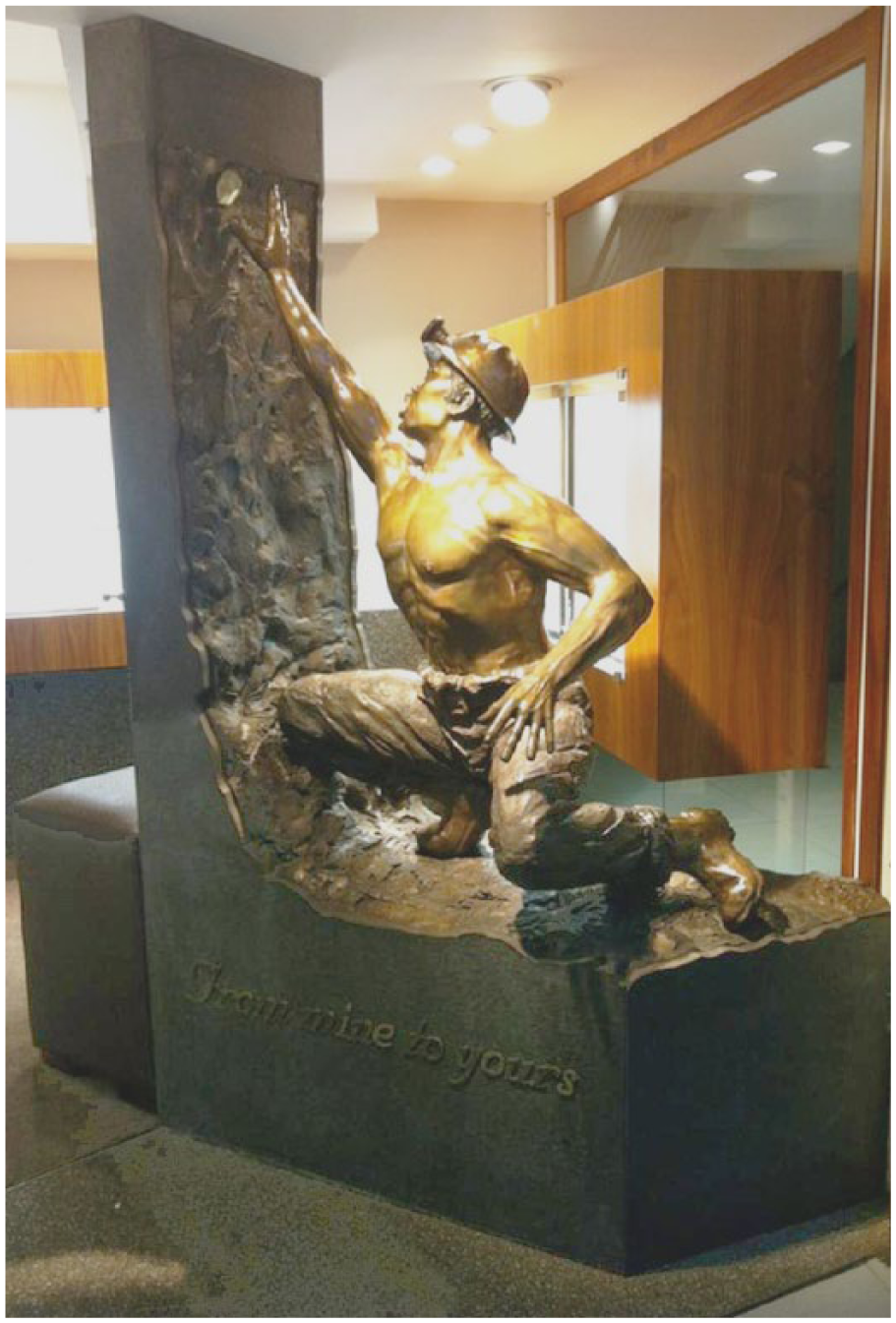
Graham Riach.
The Clocktower Mall sits on the site of the Chavonnes Battery, one of the oldest European structures in South Africa, which dates from the early 1700s, and is cemented with a mixture made by burning sea-shells on Robben Island. As Victor leaves the car park at the story’s close, he would arrive on Fish Quay, where tourists wait to be ferried to the island to see Nelson Mandela’s former cell. This makes it a fitting site to show the stubbornness of South Africa’s spatial politics, and the tenacity of their historical roots. The links between the battery, site of early settlement, the prison island, epitome of spatialized exclusion, and the shopping centre, the post-apartheid manifestation of spatial segregation, are already striking, but the links between these sites do not end there. Designer Charmaine Taylor has begun transforming the wire fence that once surrounded Block D, the maximum security prison on Robben Island, into pieces of bespoke jewellery that are for sale at Cape Town’s V&A Waterfront, where the Clocktower Mall stands. One piece, the so-called “Liberty Bangle”, is made from chopped-up sections of the fence which are coated in gold or silver and sold for up to R12,000 [$875] (Taylor, 2016). Depending on one’s attitude towards Taylor’s project, it could be understood as an initiative that salvaged the fence — an important part of South Africa’s history that was bound for landfill — and converted it into pieces of art. In the process, 10 per cent of all sales are donated to sustainable development projects such as Abalimi Bezekhaya (The Planters) and Harvest of Hope. A more critical reading would understand Taylor’s work, and that of the Robben Island Arts Company and Trust (RIACT) from whom she acquired the fence, as an opportunistic seizure of part of South Africa’s history, which aestheticizes and commodifies past suffering for a wealthy audience, while handing out scraps of the profits to good causes. The physical fence that demarcated apartheid spatiality has been removed, but its transformation into luxury jewellery on sale in a securitized mall is a complicated symbol of how apartheid-era spatial politics continue to be reproduced in the decades that have followed.
The issues raised by Taylor’s project reveal how South Africa’s troubled past continues to occupy a place in the present through its material remains and spatial legacies. These concerns also saturate Rose-Innes’s “Falling”, firstly through its projection of childhood trauma onto the country’s built environment, and secondly in the guise of formal spatiality’s struggle with the messy, fluxional reality from which her works emerge. Rose-Innes makes productive use of this tension by overlaying personal, social, metaphorical, literary, and political registers of space, and so draws our attention to how they inform and contradict one another. This creates a richly textured fiction, but the story’s spatial closure, although formally satisfying, is politically fraught. This imperfect spatial cadence shows Rose-Innes negotiating South Africa’s spatial politics and discursive codes by adapting the short story’s genealogy of spatial form to the conditions in which she writes. In so doing, her work takes on an important role in the post-apartheid act of South African literature’s “endless drama of domicile and challenge” (van Wyk Smith, 1990: 3), in which the catharsis of liberation is taking form, but has not yet fully taken place.
Footnotes
Funding
The research for this was completed while receiving AHRC doctoral funding.