



Abstract
This article compares the reception and categorization of the work of Doris Lessing and V. S. Naipaul, two well-known writers who grew up in the colonies and arrived in Britain in 1949 and 1950, respectively. After her childhood and young adulthood in Southern Rhodesia (now Zimbabwe), Doris Lessing settled in London at the age of 30, where she was immediately included as a British writer, despite her own self-identification as African. Naipaul, who arrived from his native Trinidad on a scholarship to Oxford at the age of 18, also settled permanently in Britain (despite frequent travels), and yet his Britishness has always been much more qualified and contested. This essay interrogates the assumptions about national and cultural affiliations underlying the critical reception of Naipaul and Lessing. It argues that despite the obviously cosmopolitan nature of both writers and their works, the readier inclusion of Lessing as a “British” writer and the concomitant “othering” of Naipaul is explained less by the content of their writing than by two other key factors. The first is the racialized contrast between their backgrounds as settler and colonial subject, respectively. The second is the role of both writers in constructing their own authorial persona, and, from this perspective, the article interrogates Naipaul’s motives for insistently claiming an “outsider” status for himself.
Keywords
Looking at the early lives of Doris Lessing (1919–2013) and V. S. Naipaul (b. 1932), it might be easy to conclude that in terms of family background, they do not share much in common beyond their colonial upbringing. Even conceding this superficial commonality, many would be quick to point out that Lessing was in a much more privileged position, being part of the white settler community in what was then colonial Rhodesia (now Zimbabwe). Naipaul, by contrast, was the grandson of indentured labourers brought from India to work on the sugar plantations in colonial Trinidad after the abolition of slavery throughout the British Empire. However, I would argue that even a brief comparison of the lives and writings of these two major authors suggests that we need to approach the issue of privilege, as well as the issue of postcolonial inclusions and exclusions, in a more nuanced way than has sometimes been done in the past. As Dennis Walder (2011: 4) has suggested, colonizers and colonized are “overlapping categories too often set against each other in a frozen binary”.
This essay begins by interrogating assumptions about “privilege” as applied to Lessing and Naipaul, and then goes on to investigate the ways in which assumptions about their respective national/cultural identities have informed — and continue to inform, often in limiting ways — the reception and categorization of their work by literary scholars. Finally, it examines what the authors themselves have written about their respective cultural identities, concluding that there is still significant debate about the nature and implications of their cosmopolitan affiliations, particularly in the case of Naipaul.
Traditionally considered a position available only to the elite, cosmopolitanism has taken on new connotations and implications in the era of postcolonial globalization. Globalization, too, has been conceptualized in various ways, all of which emphasize the increasing interconnectedness of peoples, cultures, and economies. Paul Jay (2010: 3) has argued persuasively that although globalization is often viewed as a recent phenomenon, it should be seen as a longer-term process that “includes the long histories of imperialism, colonization, decolonization, and postcolonialism”. From this perspective, cosmopolitanism can be been described as an attitude, cultivated partly in response to the process of increasing globalization. Various definitions of cosmopolitanism have been proposed: For some contemporary writers on the topic, cosmopolitanism refers to a vision of global democracy and world citizenship; for others it points to the possibilities of shaping new transnational networks for making links between social movements. Yet others evoke cosmopolitanism to advocate a non-communitarian, post-identity politics of overlapping interests and heterogeneous or hybrid publics in order to challenge conventional notions of belonging, identity and citizenship. And still others use cosmopolitanism descriptively to address certain socio-cultural processes or individual behaviours, values or dispositions manifesting a capacity to engage cultural multiplicity. (Vertovec and Cohen, 2002: 1)
My own working definition of cosmopolitanism is that it is an attitude of looking beyond traditional categories of identity based on nationality, ethnicity, cultural origins, and other social divisions without erasing local differences. In other words, it is a flexible approach to identity which more accurately reflects the lived experience of an increasing number of people in a world characterized by mass migration and mobility.
Critics of cosmopolitan approaches point to their utopian nature and argue that they underestimate the power of nation-states to shape cultural identities (Sabo, 2012). Timothy Brennan has further contended that “cosmopolitanism is the way in which a kind of American patriotism is today being expressed” (2002: 682). He sees cosmopolitanism as a homogenizing imposition of American cultural forms all over the world, gradually replacing (implicitly pure) forms of indigenous cultural expression. Other scholars have countered these arguments by pointing to the heterogeneous and dynamic nature of all cultures (Jay, 2010: 3), as well as the increasingly reciprocal nature of cultural influence, with mass migration producing significant cultural changes in host nations (Jackson, 2012: 111). They have also emphasized the ethical implications of cosmopolitanism, suggesting that “ideally, it encourages people to transcend narrow loyalties and sympathetically incorporate people from other parts of the world into a vision of shared humanity while maintaining cultural diversity” (Jackson, 2016: 30).
Despite these idealistic sentiments, there is no denying that what is now called “white privilege” continues to operate in the contemporary world. Indeed, one of the central arguments of this essay is that despite the obviously cosmopolitan nature of both writers and their works, the readier inclusion of Lessing as a British writer and the “othering” of Naipaul is explained less by the content of their writing than by the racialized contrast between their backgrounds as settler and colonial subject, respectively. On the other hand, as we shall see, some critics have also suggested that it has suited Naipaul to claim an outsider peripheral status in his writing.
Doris Lessing arrived in Britain in 1949 at the age of 30 and Vidia Naipaul arrived in 1950 at the age of 18, both settled there permanently, both have British citizenship, and yet Naipaul’s Britishness has always been much more qualified and contested. He has been more frequently described as a postcolonial writer, a West Indian writer, a Trinidadian writer, a writer of the Indian diaspora — anything except a British writer, or simply a writer. Lessing, on the other hand, has been more easily assimilated as British, although it is important to note that both writers have always explicitly resisted this geographical categorization and labelling. And yet Naipaul’s resistance has been fiercely criticized by those who want to appropriate him as part of their group. In particular, many people in the Caribbean and elsewhere have been affronted by his rejection of the term West Indian writer. Ironically, Lessing’s resistance to cultural nationalism has been more readily accepted than Naipaul’s. On the face of it, this might suggest that one aspect of white privilege is greater freedom to opt out of cultural categories, but in the case of Naipaul, critics like Rob Nixon (1992) would argue that such a conclusion underestimates the extent to which he himself has actively constructed a distinctly “outsider” persona in his writing.
From this perspective, I would like to begin by pointing to the ways in which Naipaul has been more privileged than Lessing. The son of a prominent family in Trinidad, he was educated at one of the top schools in Port of Spain, followed by Oxford University. Lessing’s family, by contrast, were poor white farmers in Southern Rhodesia, and she was largely self-educated, having left school at the age of 14. Most obviously, Naipaul had the advantage of being male at a time when male privilege was virtually unquestioned. Even in the twenty-first century, we can see gendered assumptions reflected in the language of their respective Nobel awards. The Nobel Prize in Literature 2001 was awarded to V. S. Naipaul “for having united perceptive narrative and incorruptible scrutiny in works that compel us to see the presence of suppressed histories”. 1 The Nobel Prize in Literature 2007 was awarded to Doris Lessing, “that epicist of the female experience, who with scepticism, fire and visionary power has subjected a divided civilisation to scrutiny”. 2 It should not be necessary to point out that all of Naipaul’s protagonists are male, and yet it would seem absurd to describe him as “that epicist of the male experience”. Is male experience still assumed to be the norm, and is that other half of the world’s population still assumed to be a special interest group?
Naipaul and Lessing both write about colonialism, decolonization, race, nation, and empire, but Lessing also connects these ideas with concepts of gender and social class. Susan Watkins (2010: 172) has pointed out that despite Lessing’s personal history and her lifelong imaginative interest in Southern Africa, as well as in issues of “race” and nation, it is only recently that her work has been studied in relation to postcolonial theory and criticism. Even so, when she was awarded the Nobel Prize for literature in 2007, very few commentators noted her personal history and its impact on her perspectives and narrative concerns. On the other hand, Naipaul, as I have already suggested, has always been discussed in ways that render him — for lack of a better word — “exotic”: as a Trinidadian and West Indian writer, as a writer of the Indian or South Asian diaspora, as a writer in the context of the postcolonial tradition, as a Third World writer, and much more rarely than Lessing as a British writer.
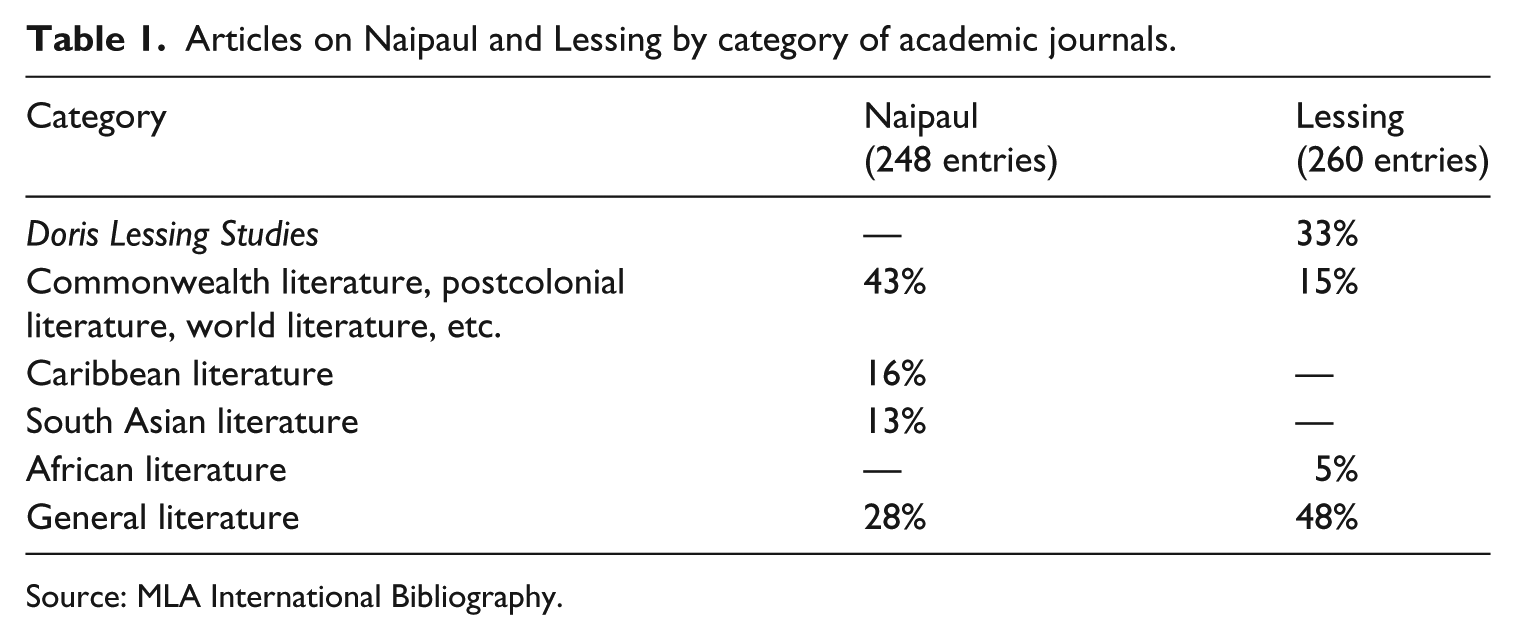
These differences can be clearly seen, for instance, in some statistics I have compiled from the cumulative MLA listings of articles in peer-reviewed academic journals (Table 1):
Articles on Naipaul and Lessing by category of academic journals.
Source: MLA International Bibliography.
Out of 248 entries for Naipaul and 260 for Lessing, 33 per cent of the articles on Lessing are in a journal called Doris Lessing Studies, but the really significant comparison is between the other categories of journals. 43 per cent of the articles on Naipaul are in journals specializing in Commonwealth literature, postcolonial literature, or world literature, as against 15 per cent of the articles on Lessing. For Naipaul, a further 16 per cent are in journals specializing in Caribbean literature and 13 per cent in South Asian literature. Compare this with the five per cent of articles on Lessing which appear in journals on African literature, and the picture becomes clear.
In books too, Lessing’s Britishness has often been more unqualified than Naipaul’s, and her preference for a more cosmopolitan affiliation has certainly been less controversial than his. Perhaps the most instructive early example is the title of Elaine Showalter’s (1977) ground-breaking study, A Literature of Their Own: British Women Novelists from Bronte to Lessing. Now a classic of feminist literary scholarship, this book’s only fleeting (and inaccurate) reference to Lessing’s non-British origins is the brief identification of Olive Schreiner as “another South African novelist” (1977: 308). Michael Thorpe’s (1978) Doris Lessing’s Africa, published the following year, is similarly ambivalent about Lessing’s cultural identity. Although Thorpe notes that Lessing “comes from Southern Rhodesia” (1978: 2), Gerald Moore in his foreword implicitly assumes that white people like her cannot be African: “Africans in her work are instrumental to self-discovery in her white characters” (1978: ix). Subsequently, several books during the 1980s and 1990s explicitly acknowledged the ambiguous nature of Lessing’s identity. These include Judith Kegan Gardiner’s (1989) Rhys, Stead, Lessing, and the Politics of Empathy and Louise Yelin’s (1998) From the Margins of Empire: Christina Stead, Doris Lessing, Nadine Gordimer, both of which examine Lessing’s work in relation to that of other white female writers from the former colonies. Yelin argues convincingly that: The unstable, invented, hybrid character of nationality is especially marked in writers such as Stead, Lessing, and Gordimer, for whom no single set of identity categories can take priority. We cannot, for example, assign them a nationality, nor do they define their own national identities on the basis of race, ethnicity, language, or citizenship. (1998: 2)
Contrast this with Fawzia Mustafa’s (1995) strikingly defensive justification for categorizing Naipaul, against his wishes, as a Caribbean writer: Tension still surrounds Naipaul’s antipathy about being called a West Indian, Trinidadian, Caribbean, or Third-World writer. While never denying his Trinidadian beginnings — indeed, quite the contrary — he has long objected to being called anything but a Writer […] To include a study of Naipaul’s work in a series on Caribbean or African writers may well appear to some to be provocative at best, or obstinate at worst, but what must be kept in mind nonetheless are the historical and, in this case, discursive circumstances at play. (1995: 8–9)
Rob Nixon (1992: 14, 18) has taken this argument further, contending that Naipaul has encouraged an interpretation of himself as “truly uncompromised by national and political attachments” in order to bolster “the myth of his detachment” as a critic of postcolonial societies. In London Calling: V. S. Naipaul, Postcolonial Mandarin, Nixon argued that Naipaul was more highly regarded in the United States and Britain than in “the Third World”, about which he was “unstintingly derisory” (1992: 28): Because he derives from the so-called Third World, Naipaul can be invoked, with the help of bold generalizations, as someone with a personal knowledge of “these kinds” of places and peoples, a knowledge that only an insider can hope to command; at other times, the appeal of his authority focuses on his apparent ability to be an uninvolved outsider everywhere. (1992: 18)
Emphasizing Naipaul’s long residence in Britain, Nixon disputes the myth of his unique placement as an unattached observer, arguing that “his life and work can be accommodated — more than he ordinarily admits — to a broader but historically specific pattern of former subjects of the British Empire gravitating toward metropolitan London during the overlapping eras of decolonization and postcolonialism” (1992: 40). However, as we shall see, Naipaul explicitly thematizes his immigrant background and experience in his quasi-autobiographical The Enigma of Arrival (1987).
Finally, I refer to two edited collections which are particularly interesting in terms of “identity politics” in the reception of Lessing and Naipaul respectively: In Pursuit of Doris Lessing: Nine Nations Reading (Sprague, 1990a) and Created in the West Indies: Caribbean Perspectives on V. S. Naipaul (Rahim and Lalla, 2011). As its subtitle indicates, In Pursuit of Doris Lessing presents perspectives from literary scholars of nine different nations on the work of Doris Lessing. Published in 1990, these perspectives might now be viewed as outdated, but the introduction by the editor, Claire Sprague, offers perceptive insights into the variety of ways in which “particular cultural nationalisms have appropriated Lessing”, noting that “Lessing’s international, transcultural qualities are differently situated” in different contexts (1990b: 14). She observes, for instance, that “the American Lessing, born in response to The Golden Notebook, tends not to be African at all but cosmopolitan, urban, professional and woman-centred” (1990b: 9). Lessing’s reception in Africa at that time is perhaps even more interesting because the collection was published towards the end of the apartheid era in South Africa, and eight years after Zimbabwe (formerly Rhodesia, in which Lessing had grown up) had gained its independence from British colonial rule. Sprague wrote at the time that in South Africa “Lessing is wholly African, a writer praised for her African subject-matter and ignored or criticized when she leaves it” (1990b: 13). On the other hand, Anthony Chennells suggested in an essay significantly entitled “Reading Doris Lessing’s Rhodesian Stories in Zimbabwe” that Lessing had already become a peripheral writer in the Zimbabwean literary tradition because of her race and her distance from black nationalism (1990: 18).
Published well into the twenty-first century, the substance of Jennifer Rahim’s and Barbara Lalla’s (2011) edited collection Created in the West Indies is indicated in the subtitle: Caribbean Perspectives on V. S. Naipaul. The title itself is an ironic commentary on Naipaul’s (1962: 29) notorious remark that “history was built around achievement and creation; and nothing was created in the West Indies”. The irony in the title is that of course Naipaul himself was “created in the West Indies”, but to put Naipaul’s quote into context, he was explaining why “the history of the islands can never be satisfactorily told” (1962: 29), which was in effect a criticism of colonial society.
In her introduction to the collection, Jennifer Rahim (2011) writes in a conciliatory vein that: Rather than the accusation of abandoning his origins, or being a man without allegiances to his community, it is possibly truer to say that for most of his writing life he has lived in the gap of a nervous accommodation between his natal home and his chosen place of residence. (2011: xii)
However, considering his famous resistance to territorial categorization, it is likely that Naipaul himself would find this statement too limiting. His life experiences, his literary vision, and his narrative concerns are, after all, cosmopolitan and not confined to just “his natal home and his chosen place of residence”. In the same collection, Edward Baugh considers a slightly different (but related) aspect of identity construction, arguing that: The idea that people fashion identities for themselves has run through Naipaul’s work from the beginning […]. It has also and increasingly been presented as an inevitable mode of the assertion of individuality. One performs one’s idea of one’s best self. Alternatively, one may collude in the violation of one’s self by performing the degraded self which others more powerful impose on one. (2011: 11)
Although Baugh is referring here to colonial hierarchies, the gendered implications of this statement are difficult to ignore. Not only does Naipaul restrict his ideas about construction of identity and assertion of individuality to males only, but female characters “performing the degraded self” imposed by gender hierarchies abound in his fiction. Examples include Leela in The Mystic Masseur (1957), Laura and Mrs Hereira in Miguel Street (1959), Linda in In a Free State (1971), Yvette in A Bend in the River (1979), and many others.
Consistent throughout the Created in the West Indies collection is the idea that Naipaul’s literary personality is not only the product of self-invention but also “the product of historical circumstances, including, crucially, the time and place of his birth and his early life” (Baugh, 2011: 4). However, I would suggest that the identity issues connected with “birth and early life” are often more complex than this, and the case of Doris Lessing is just one illustrative example from among the many possible variations in individual life situations. Born in Persia (now Iran), Lessing’s family moved to Rhodesia (now Zimbabwe) when she was two years old. Arriving in Britain at the age of 30, she had spent her childhood and young adulthood in a situation which produced profound ambivalence around the concept of “home”. In her autobiography Under My Skin (1994), she contrasts her parents’ notions of her British “home” with her own lived experiences in Southern Africa. Lessing’s case is by no means unique, and Alice Ridout (2009: 116) has argued that “for a child [in this situation], the country they live in and physically experience daily is home. Their parents’ stories, however, try to teach them that this is not the case, that ‘home’ is elsewhere”. As we shall see, Lessing’s other nonfictional writings make it clear that she did not experience her move to Britain in 1949 as a homecoming.
The younger Naipaul arrived the following year, and Gillian Dooley (2003: 78) has intriguingly suggested that his colonial upbringing had rendered “home” equally as ambiguous for his family in Trinidad as it had been for Lessing’s family in Rhodesia: “His whole education had taught him that the ‘real’ world was not to be found in his Trinidad home”. In The Enigma of Arrival, he himself describes his past and continuing feeling of home as an elusive concept: The older people in our Asian-Indian community in Trinidad — especially the poor ones, who could never manage English or get used to the strange races — looked back to an India that became more and more golden in their memory. They were living in Trinidad and were going to die there; but for them it was the wrong place. Something of that feeling was passed down to me. I didn’t look back to India, couldn’t do so; my ambition caused me to look ahead and outwards, to England; but it led to a similar feeling of wrongness. (Naipaul, 1987: 120)
At that time Naipaul would also have been less easily assimilated as British because of his race. As Louise Yelin has pointed out: In part in response to immigration from New Commonwealth nations, British nationality was redefined in increasingly restrictive and exclusionary ways. […] The 1962 Commonwealth Immigrants Bill restricted immigration on the part of black Africans, West Indians, and South Asians but not on the part of white former colonials. (1998: 59)
The implications of this are clear and simple: white people from the colonies (like Lessing) were automatically considered British, while non-white people like Naipaul were considered foreign.
While conceding that race has been a factor in the contrasting ways in which Lessing and Naipaul have been received, some might also locate this difference in the content of their writing, but a comparison of the development of their writing careers would not fully support this explanation. Suman Gupta (1999) has offered a useful summary of the ways in which Naipaul’s writing gradually but steadily broadened in scope. Naipaul’s first four books from the mid-1950s to 1961 (Miguel Street, The Mystic Masseur, The Suffrage of Elvira (1958), and A House for Mr Biswas) are all set in Trinidad, presenting it as an unsatisfactory culture: narrow, passive, conservative, and inauthentic. Subsequently during the 1960s Naipaul produced non-fictional books in which “the insularity of the Trinidad […] described in his first four books gives way to an apprehension of Trinidad within broader cultural and historical horizons” (Gupta, 1999: 19). Among his fictional works of the 1960s, Mr Stone and the Knights Companion (1963) is a novel set entirely in Britain, and both The Mimic Men (1967b) and the short stories in A Flag on the Island (1967a) move back and forth between Britain and the Caribbean. During the 1970s Naipaul was reaching toward a much more cosmopolitan arena, and from that time onwards he has produced an astonishing quantity and variety of fictional and nonfictional works set all over the world, including Britain, India, a number of West Indian and South American countries, Iran, Indonesia, Malaysia, Pakistan, several African countries, and the United States. As Gupta observes, “all his books present an apprehension of his place in the world and an assessment of the world he inhabits (and Naipaul finds himself in a remarkably cosmopolitan world)” (1999: 1).
Looking at Naipaul’s oeuvre as a whole, there is no denying the increasingly cosmopolitan nature of his chosen settings. However, it is interesting to compare Naipaul and Lessing in terms of critical attitudes — and indeed their own attitudes — toward the idea of a cosmopolitan vision. With regard to Naipaul, Rahim (2011: xiii) insists that the “background” of the author to a large extent shapes “his particular attitude to or perception of reality, regardless of the geography or culture on which his literary eye is trained”. Interestingly, Lessing herself evidently agrees with this idea. Asked how she felt about being regarded as an African writer, she answered: Well, I think it’s perfectly right that I should be, because I did after all spend twenty-five years growing up there and that’s what makes people — this is what forms people. Certainly everything that’s made me a writer happened to me in Southern Rhodesia — the old Rhodesia. (qtd. in Watkins, 2010: 183)
Several points are worth noting here. The first is that Lessing insists on the central influence of her colonial African upbringing, despite her categorization by others as British. Second, she indicates the inherently changeable nature of all political entities and all societies, referring to “the old Rhodesia” which no longer exists. Most importantly, she both affirms her local roots and goes on to emphasize the flexible nature and global interconnectedness of all cultural identities: Recently in Germany they gave me the Austrian State Prize for Literature for European Writing, because they regard me as a European writer, and that’s fine too. The whole of Europe has been involved in the colonial influence for two or three hundred years. You can’t separate Europe from what is now called the Third World. (qtd. in Watkins, 2010: 184)
This is in keeping with Kwame Anthony Appiah’s notion of “rooted cosmopolitanism”, entailing “a simultaneous commitment to local particularities and to a global conception of humanity” (Trousdale, 2010: 8).
Like Naipaul’s early fiction, Lessing’s early fiction is sharply critical of the colonial society in which she grew up. Her first novel, The Grass Is Singing (1950), her early short stories, and four of the five novels in the Children of Violence series from the 1950s and 1960s (Martha Quest (1952), A Proper Marriage (1954), A Ripple from the Storm (1958), and Landlocked (1965)) are all set in fictionalized Southern African countries. So too are the “Mashopi” sections of her most famous novel The Golden Notebook (1962), as well as the last third of her novel The Sweetest Dream (2001). True, much of her fiction from the 1970s onwards has been set in England, but there is the exception of the five books in the Canopus in Argos series, which imagine their own universe, and there is also her nonfictional and “quasifictional” works, in which Southern Africa has figured prominently. Like Naipaul, she has made her nonfiction and what I call “quasifiction” an important part of her corpus. In particular, I would like to point out the parallels between Naipaul’s The Enigma of Arrival (1987) and Lessing’s In Pursuit of the English (1960). Both recount the writers’ experiences of arriving in England from the colonies, but unlike official autobiography or fiction, these two texts are generically rather indeterminate, being part memoir, part autobiographical essay, and part fiction. Both express, among many other ideas, a strong sense of the immigrant’s disillusionment and disappointment with England. Crucially, Lessing does not self-identify as English or British; on the contrary, she explicitly affirms her African identity in this text and in others, observing Britain from the perspective of an outsider. In her 1957 essay “The Small Personal Voice” she describes it as “a country so profoundly parochial that people like myself, coming in from outside, never cease to marvel” (1994/1957: 20–21). In contrast to Naipaul, who was always conscious of Britain as an imperial centre, Lessing commented in a 1963 interview that “it’s not an exciting place to live, it is not one of the hubs of the world, like America, or Russia, or China. England is a backwater, and it doesn’t make much difference what happens here, or what decisions are made here” (Newquist, 1994/1963: 51–52).
If Lessing experienced Britain as narrow and insignificant, she consistently characterized colonial society in Southern Africa as even more so. Her protagonists in the colonies, like Naipaul’s, feel themselves to be outsiders in their own society, desperate to escape to a place with greater opportunities for personal freedom and creative growth. As Evelyn O’Callaghan (2011: 23) has put it, “[r]eal life lies elsewhere for such colonial subjects. Schooled in mimicry, steeped in colonial insecurity and alienation, Naipaul’s characters seek to find themselves elsewhere”. In particular, Naipaul’s Miguel Street (1959) and A House for Mr Biswas (1961), along with Lessing’s first four Martha Quest novels, focus on the claustrophobic nature of life in a colonial society of limited options, basically concluding that escape is the only viable alternative for a person with talent, ambition, or independent ideas.
This theme of alienation famously persists throughout their writing careers, as the authors, like their protagonists, feel themselves to be outsiders wherever they are in the world. Claire Sprague (1990b: 7) notes that “in Africa Lessing felt herself an outsider as white, female and Red [Communist]. In England Lessing added colonial to her outsider inscriptions”. However, at least two decades before Benedict Anderson (1983) famously articulated his conception of the nation as an “imagined community”, Lessing revealed an understanding of the fluid, unstable, and essentially invented nature of national identity. Her reflections on this issue from In Pursuit of the English (1960) are worth quoting at some length because they deftly combine humour with sharp insight. Never self-identifying as English or British, she begins by observing that: “I came into contact with the English very early in life, because as it turns out, my father was an Englishman. […] It was not until I had been in England for some time that I understood my father” (Lessing, 1960: 7).
3
The case of her mother was slightly more complex, being “not English so much as British. […] She would refer to herself as Scotch or Irish according to what mood she was in, but not, as far as I can remember, as English” (7–9). Wryly commenting that “it was all rather academic, living as we did in the middle of the backveld” (8), the young Doris Lessing presents her immigrant experience as decidedly unenlightening on the topic of cultural or national identity: I had been in London two years when I was rung up by a friend newly-arrived from Cape Town. “Hey, Doris, man”, she says, “how are you getting on with the English?” “Well”, I say, “the thing is I don’t think I’ve met any. London is full of foreigners”. (9)
When they finally meet what they think is an authentic Englishman, he says with “a blunt but basically forgiving hauteur […] ‘I am not […] English. I have a Welsh grandmother’” (9).
Lessing’s textured views of cultural identity are in marked contrast with dominant ideas about Englishness during this period, which Susan Watkins (2010: 2) has described as “ethnic nationalism, in which race, culture and ethnicity play a primary role”. Again, Lessing gives us an illustration of her encounter with these attitudes in In Pursuit of the English. Searching for accommodation, the newly arrived Doris is told that a particular landlady “won’t take foreigners” (37). Asked what is meant by a foreigner and told that Doris is from Africa, the woman nervously asks, “‘You’re not a black?’” (37) The conversation continues: “Do I look like one?” “One never knows. You’d be surprised what people try to get away with these days. We’re not having blacks. Across the road a black took to the bottle on the first floor. Such trouble they had. We don’t take Jews either.” (38)
Encounters with such overt racism are surprisingly absent from Naipaul’s account of his narrator’s arrival in London in The Enigma of Arrival (1987), loosely based on the author’s own experiences. Instead, the narrator emphasizes the greyness, the shabbiness, the unaesthetic aspects, and the overall disillusionment of the immigrant encounter with 1950s London.
Naipaul and Lessing both bring sharply critical perspectives to each society they write about, and this has brought them some notoriety. As a critic of racist political regimes, Lessing was banned from entering the Union of South Africa from 1956 until 1995, and also her homeland of Southern Rhodesia from 1956 to 1980. As my previous quotations from Lessing would suggest, she has not always endeared herself to the British either. In contrast to Sir Vidia Naipaul, who happily accepted a knighthood, Doris Lessing refused the title of Dame, wanting nothing to do with the Order of the British Empire. As she explained in a 2001 interview, “I spent a good part of my youth trying to undo the British Empire. And there are few more unimpressive sights than some old person licking the hand it used to bite” (qtd. in Watkins, 2010: 164).
Unlike Lessing, Naipaul has never been officially exiled from his homeland, but in the West Indies there has been what the Jamaican scholar Edward Baugh (2011: 5) has described, with charming understatement, as “a certain touchiness about West Indian umbrage at Naipaul’s derogatory remarks on the region”. Baugh goes on to remark that this touchiness “may be a sign of the insecurity inherited by the ex-colonised”. He notes that “by contrast, Naipaul’s sneering comments on contemporary English society […] have raised no more than a ripple of amusement, perhaps a patronising ripple, in the British. There is no evidence that they feel threatened” (2011: 5). Threatened or not, Naipaul might be right in feeling himself to be an outsider in British society, despite his British citizenship, his knighthood, and all his literary prizes. As suggested earlier, this might also be partly a matter of choice; Naipaul, after all, has always been fiercely individualistic. He writes in A Way in the World (1994: 18), “I wished to belong to myself. I couldn’t support the idea of being part of a group”. To some extent, this can be explained by the (understandable) objection of the ex-colonial “subject” to having his identity defined by others. As Dagmar Barnouw puts it, he fears “an imposed, alien cultural identity” (1999: 151).
Naipaul’s anxiety about his identity pervades his writing, and like his protagonist in A House for Mr Biswas, he persistently expresses a strong desire to resist group affiliation and assert his individuality. Searingly honest about his feelings and experiences, he offers an extraordinary account in An Area of Darkness of his sense of melting into an Indian street: And for the first time in my life I was one of the crowd. There was nothing in my appearance or dress to distinguish me from the crowd eternally hurrying into Churchgate Station. In Trinidad to be an Indian was to be distinctive. To be anything there was to be distinctive; difference was each man’s attribute. To be an Indian in England was distinctive; in Egypt it was more so. Now in Bombay I entered a shop or a restaurant and awaited a special quality of response. And there was nothing. It was like being denied part of my reality. […] I might sink without a trace into that Indian crowd. I had been made in Trinidad and England; recognition of my difference was necessary to me. I felt the need to impose myself, and didn’t know how. (Naipaul, 1964: 45–46; emphasis added)
Cynics might interpret this as Naipaul’s expression of his egotistical desire to be “distinctive”, as he was in Trinidad — a place where distinctiveness was not necessarily the attribute of each “man” but of each elite male like himself. Recognized as elite in Britain too because of his Oxford education and other class markers such as his speech, manner, and bearing, Naipaul feels merely “faceless” in Bombay. Such an unsympathetic interpretation of Naipaul’s perspective might be partially valid as far as it goes, but the expression of fear in this passage is difficult to ignore. It is a fear of annihilation of the self — of sinking “without a trace” into an amorphous group. Again, in Finding the Centre (1984: 72), he attributes his “vocation” of writing to his “fear of extinction”. In an interview, he partly attributes his own fear of “being reduced to nothing, of feeling crushed” to “the old colonial anxiety of having one’s individuality destroyed” but to a greater degree to his “typically Indian extended family […] a microcosm of the authoritarian state, where power is all-important” (Michener, 1997/1981: 66).
Lessing, too, has expressed antipathy toward group identity, but for different reasons. Aware of the ways in which group identity has been manipulated for political ends, her resistance to territoriality is the overriding concern of her 1987 collection of four short essays, Prisons We Choose to Live Inside. In this volume Lessing writes about the relationship between the individual and the group, suggesting that those in power understand and manipulate the human need to feel part of a group. Writing about nationalism, she argues that “passionate loyalty and subjection to group pressure is what every state relies on” (1987: 60). In this same volume she expresses her conception of the writer as part of a transnational evolving organism whose function is to examine and criticize the world (1987: 7–8). This is not far from Naipaul’s conception of himself as a writer who looks at the world in his own way, regardless of the labels, categories, inclusions, and exclusions which other people wish to impose upon him. In his foreword to Finding the Centre, Naipaul writes that through travelling, he had learned to be content “to be what I had always been, a looker. And I learned to look in my own way” (1984: 11).
Each looking at the world uncompromisingly in his or her own way, Naipaul and Lessing have always seen themselves as outsiders, even in the communities in which they grew up. Admired by some and repudiated by others for their critical vision of each society they write about in their fiction and nonfiction, it is interesting to compare the ways in which these fiercely individualistic writers have been claimed and “othered” by particular groups. As we have seen, many West Indian scholars and readers have seemed threatened by Naipaul’s cosmopolitanism, insisting on the formative nature of his early years in Trinidad. Lessing, by contrast, has had to insist on the formative nature of her own early years in Africa. Particularly in the case of “postcolonial” writers like Naipaul and Lessing, cultural identity is too complex for rigid inclusions and exclusions. Instead, we might think about what it means for them to identify with particular transnational or cosmopolitan affiliations, and why they choose these particular affiliations.
