




Abstract
The proliferation of images of “oppressed” and “downtrodden” Muslim women circulating via media discourses and popular memoirs leading up to and after 9/11 has led a number of British Muslim women to “write back” to such representations. However, these writers face a challenging politics of reception, aided by marketing tactics that attempt to reinscribe their voices within limited binaries of East and West, traditional and modern, Islamic and secular. Implicit in such binaries is the assumption of an inherent incompatibility between Islam and the “Western values” deemed necessary for fully-fledged citizenship in modern Britain, especially when it comes to gender equality. Leila Aboulela and Shelina Zahra Janmohamed are two writers who have been successful in negotiating this difficult terrain. Through their manipulation of secular romantic forms, they present readers with more nuanced articulations of Muslim womanhood that fuse feminist and religious concerns. Aboulela’s novel The Translator (1999) and Janmohamed’s memoir Love in a Headscarf (2009) appropriate the domestic novel and chick lit genres, respectively, and recast them within an Islamic signification system. In the shifting space between convention and innovation, their works enact a resistant aesthetic that draws attention to the sexism found in both traditional cultural mores and consumer-driven neoliberal gender regimes, offering personal faith and spirituality as a model for more equitable gender relations. In making a clear distinction between culture and religious belief, their works advocate for a form of Islam that coexists with other values and identities, including British, and clear discursive space for a more complex understanding of the intersection between gender and faith.
Keywords
In recent years, there has been a steady stream of scholarly work on how media discourses on “oppressed” and “downtrodden” Muslim women have been mobilized as boundary markers between “us” and “them” in the global “War on Terror” and a convenient justification of its policies, both foreign and domestic (Abu-Lughod, 2013; Morey and Yaqin, 2011; Whitlock, 2010). This kind of rhetoric functions through its use of embodied gender identity as the ground on which modernity is tested, where practices such as veiling become loaded signifiers for Islam’s failure to measure up. As Morey and Yaqin articulate it: “Time and again, behaviour, the body and dress are treated not as cultural markers but as a kind of moral index, confirming non-Muslim viewers in their sense of superiority and cementing the threatening strangeness of the Muslim Other” (2011: 3). Within the logic of this index, it is not education or political agency but revealing clothes and uncovered hair that denote Muslim women’s level of freedom and emancipation, as well as their (and their community’s) commitment to “our” values.
The power of this rhetoric has been helped along by some forms of feminist scholarship and activism that purport to “free” the Muslim/Eastern/“Third World” woman from her patriarchal culture. 1 Such discourses also function to reinforce the notion that gender equality in “the West” is a fait accompli. This idea of an already “freed” Western woman has found expression in so-called “postfeminist” discourses, in which women’s agency is measured by their buying power in the consumer-driven capitalist marketplace and fashionable designer clothes and shoes are presented as the essence of female empowerment. Within this logic, one of the central pillars of feminism, a woman’s right to free choice, is collapsed into the ability to select what brand of perfume to wear, or which celebrity fashion icon to emulate (Harzewski, 2011). 2
The implied opposite to this postfeminist image of female “liberation” flickers across the covers of popular auto/biographical texts by and about Muslim women as they are filtered through the lens of Western publishing houses. What Gillian Whitlock (2010) refers to as the “veiled bestseller” is characterized by the enduring image of a Muslim woman fully or semi-veiled, eyes downcast or looking blankly past the camera. Books like Jean Sasson’s Princess trilogy (2001a/1992, 2001b/1994, 2002/2000), Latifa’s My Forbidden Face (2002/1985), and Betty Mahmoody’s Not Without My Daughter (2004/1987) recount harrowing tales of women kidnapped, forced to marry, or imprisoned in the name of Islam. The increased circulation of such works in the post-9/11 years has contributed to the perception of a homogeneous world of veiled and oppressed Muslim women in need of saving, so that they may come out the other side conforming to a narrow set of visual signifiers we have come to associate with female emancipation. As Whitlock puts it
The exotic display of dozens of copies of Muslim life narrative together […] is haunting. How can the reader resist interpellation as a liberal Western consumer who desires to liberate and recognise Latifa by lifting the burka and bringing her alongside us, barefaced, in the West? (2010: 47)
Underpinning this narrative is an either/or proposition in which recognition of agency is only granted to those who give up the visible signs of their religious belief, especially any form of veiling or hijab. Such binary logic rehearses a notion of Islam as inherently oppressive to women, such that the only option is to reject it in favour of secular consumer-driven gender regimes.
Against this difficult backdrop, there are nevertheless growing numbers of British Muslim women writers whose works actively destabilize this perceived dichotomy between adherence to Islam and female agency, reasserting faith as integral to gender equality rather than its obstacle. Through their manipulation of genre and form, such works function as textual “translations” between Islam and the liberal values deemed necessary for fully-fledged citizenship of modern Britain. Leila Aboulela’s The Translator (1999) and Shelina Zahra Janmohamed’s Love in a Headscarf (2009) are two texts which fall in this category. These works, I argue, should be read as pioneering examples that clear discursive space for new articulations of Muslim womanhood that question the terms of neoliberal consumer-driven gender regimes as well as those dictated by traditional cultural mores.
From culture to faith
This emerging body of literature forms part of a broader shift in the cultural and political landscape away from the use of secular ethnic identifiers like “Asian” toward more religious identifications (Modood, 2005), which is reflected in the recent proliferation of literary studies oriented around “British Muslim” writers (Ahmed, 2015; Ahmed et al., 2012; Chambers, 2011, 2015; Morey and Yaqin, 2011). Some scholars cite 9/11 as the primary turning point in reshaping this literary and cultural terrain, motivating Muslim writers and cultural producers to address the negative images of themselves circulating in the media, sidelining (though not wholly replacing) the urgency to intervene into older forms of ethnicity-based racism. Morey and Yaqin, for example, structure their analysis of the “frames” through which Muslims are read around the 9/11 attacks. While acknowledging that the tropes they point to are not new, they argue that the scale of the attacks “thrust them back onto our cinema and TV screens, into our news media and into the mouths of politicians” (2011: 3).
It is the renewed ubiquity of these tropes, especially the emotive issue of the oppression of women, with which this article is most directly concerned. At the same time, the publication of Aboulela’s novel in 1999, prior to the attacks, also problematizes 9/11 as the moment “when everything changed” for Muslims in Britain. Like many of the works published after the attacks, such as Monica Ali’s Brick Lane (2003) and Mohsin Hamid’s The Reluctant Fundamentalist (2007), The Translator deals with themes of the rise of Islamic terrorist movements internationally and increasing suspicion directed towards domestic Muslims as a direct result of world events. 3 In this way, Aboulela’s text is evidence that, while these issues may not yet have been in the minds of the majority of Britons, they were certainly a matter of concern for the Muslim communities living among them. 4
As well as blurring the line between pre- and post-9/11 realities, one of the ways that both The Translator and Love in a Headscarf resist the homogenizing of Muslims via these familiar tropes is precisely by emphasizing religious belief as distinct from the development of localized customs and practices. By separating these out, Aboulela and Janmohamed create possibilities for articulations of Muslim femininity that move beyond the binary set out above. In addition to their insistence on a form of Islam that exists both alongside and outside of ethnic and national identifications (including British), Aboulela and Janmohamed actively challenge readerly expectations of Muslims through their use of rhetorical strategies available to them as artists of the written word. Such textual resistance, as I refer to it, encompasses a range of discursive strategies that destabilize the binaries of West/East, modern/religious, which recur in both media representations of Muslims and the “veiled bestsellers” described above. In particular, it is their ability to infuse Western secular literary forms with an Islamic worldview that enables such texts to function as “translations” that open out the current frameworks through which Muslim women are “read”.
Genre as social code
In Genres in Discourse (1990), Tzvetan Todorov describes literature as having functional and structural properties, both of which contribute to how we understand and categorize literary texts. While function refers to what a literary text does in the world (for example, to imitate, to please, to instruct), structure comes down to an internal matter of form, marked by particular applications of character, plot, and style. Both functional and structural considerations, he argues, feed into our notions of bounded literary genres. Todorov goes on to state that:
In a given society, the recurrence of certain discursive properties is institutionalised, and individual texts are produced and perceived in relation to the norm constituted by that codification. A genre, whether literary or not, is nothing other than the codification of discursive properties. (1990: 17−18, emphasis added)
Literary genres, along with all classification systems, are therefore political constructs that represent as well as impose a particular view of the world in a particular context.
Todorov later adds that, “it is because genres exist as an institution that they function as ‘horizons of expectations’ for readers and as ‘models of writing’ for authors” (1990: 18). For structuralist critics like Todorov, genre is a kind of implied contract between writer and reader (Abrams, 1999). However, this also means that the contract can be broken, or at least renegotiated, as a way of troubling the terms of the institution itself. If genre works to give the reader a particular “horizon of expectations” when approaching a given text, then these expectations can be harnessed in order to push the boundaries of the genre and its place within broader societal structures. It is by doing this, I argue, that Aboulela and Janmohamed challenge readerly expectations of their respective genres as well as those of the “veiled bestseller”, with its recognizable image of the “oppressed Muslim woman”.
Romantic narrative forms are particularly fertile ground for challenging dominant ideas about Muslim women, as stories of love and courtship have been central arenas within which the gender norms of any given society are represented and challenged. Leila Aboulela’s novel The Translator is an example of one such work which manipulates the conventions of a canonical romantic form, namely the nineteenth-century domestic novel, in order to challenge the dominant gendered framing of encounters between “West” and “East”, secular and Islamic. In a more recent example, Shelina Zahra Janmohamed opts to channel more popular forms in her autobiographical love-story Love in a Headscarf, which is part memoir, part self-help book, and bears strong resemblance to the ubiquitous “chick lit” genre that has been thriving in recent years. Importantly, despite their relationship to secular romantic forms, both of these works are directed by an Islamic worldview that prioritizes faith over worldly desires and where romance and courtship operate under very different parameters than in their “source” genres. However, it is precisely by playing on these differences that both texts enact a resistant textuality.
Although there are clear differences between the two texts, most obviously that The Translator is a novel while Love in a Headscarf is a memoir, they each draws on and repurposes the conventions of its respective “source” genre in ways that invite comparison. There is also a strong relationship between the “source” genres themselves, as scholars of chick lit frequently cite the genre as the contemporary incarnation of nineteenth-century women’s fiction (Ferriss and Young, 2006; Harzewski, 2011). Most importantly, both genres have also been credited with establishing new forms of literary expression for women that had not existed before, while also receiving frequent derision (in their respective eras) for their apparent frivolity. 5 If we think of genre as a politically inflected set of conventions which are constantly shifting and changing rather than a bounded category, then we can examine how Aboulela and Janmohamed oscillate between staying true enough to their “source” genres that they remain identifiable, and renegotiating them for their own purposes. As I will argue below, it is in this shifting space between convention and innovation that a truly resistant aesthetic can take shape.
Domestic fiction rewritten: Leila Aboulela’s The Translator
As mentioned above, we can read Leila Aboulela’s The Translator as channelling the form of the nineteenth-century novel of manners, or what Nancy Armstrong (1987) refers to as the domestic novel. While this may at first seem like an unexpected comparison since Aboulela’s novel departs from this genre in important ways, there are several reasons why it is appropriate to analyse it using this frame. Aboulela herself makes this comparison, drawing similarities between the dilemma of her protagonist Sammar and the protagonist of Charlotte Brontë’s (1847) canonical domestic novel Jane Eyre (qtd. in Stotesbury, 2004: 81). If we push this parallel further, we can see that the plot structures of the two novels are also relatively similar, leading one critic to declare The Translator “an updated Jane Eyre scenario” (Nash, 2002: 30). They both revolve around female protagonists whose object of affection is unobtainable, not because of unrequited affection, but because obtaining what they desire (Rochester in the case of Jane, Rae in the case of Sammar) would violate religious or moral principles. Both protagonists go through a period of separation from their respective love objects, during which the central problem is resolved through a deus ex machina which makes possible the hitherto unlikely resolution of a happy marriage. In Jane Eyre, this comes in the form of the sudden death of Rochester’s first wife, Bertha Mason, and Jane’s unexpected inheritance, while in The Translator, it comes about through Rae’s narratively abrupt conversion to Islam.
Both novels also require their protagonists to cross lines of social difference as part of their narrative development. While Brontë’s novel is preoccupied with traversing class boundaries, Aboulela’s is concerned with movement between cultures. This is achieved through Sammar’s multiple migrations between Scotland and Sudan, which in turn get encoded as the crossing between “West” and “East”, secular and Islamic. This sense of crossing also applies to their respective audiences. While Brontë must compel her middle-class readership to identify with the trials faced by an orphan with no money and no connections, Aboulela’s primarily secular British audience is challenging ground for a narrative driven by Islamic religious principles.
In her rereading of the emergence of the novel form in Europe, Desire and Domestic Fiction (1987), Nancy Armstrong places the domestic novel at the centre of this new literary culture. Her primary thesis is that women’s writing at the time, which appeared to be wholly concerned with courtship and domestic life, actually succeeded in carving out a space for women’s voices within the literary and cultural mainstream. Central to this process, she argues, is a rhetorical operation, the sexual contract, that genders social difference, which at this time was defined by class, and contains it within a feminized discourse. In Jane Eyre and other domestic novels of the time, class conflict is resolved through the institution of companionate marriage, in which the female heroine relinquishes political and economic power to her husband in exchange for “exclusive authority over domestic life, emotions, taste and morality” (1987: 41). Although Armstrong concedes that women were socially handicapped by the sexual contract, she argues that its discursive form actually cleared space for female forms of writing that would not have been possible before because women’s writing up to this point was viewed as “unsavory” or was not even counted as literature (1987: 37, f.n. 9).
In addition to the plot similarities between The Translator and domestic novels like Jane Eyre, we can also draw comparisons between the constraining aspects of their reception politics. To be heard, Muslim women’s voices must conform to one side or the other of the loaded binary: either the unveiled emancipated secular woman or the religiously subjugated figure we are called upon to “save” on the cover of the veiled bestsellers. In The Translator, Aboulela navigates the horizon of expectations produced by this backdrop, opening up a world in which female agency and adherence to religious belief are not mutually exclusive. 6 In order to do so, Aboulela draws on the rhetorical operation of the domestic novel but uses it to translate a story-world driven by Islamic principles.
Returning to Armstrong briefly, central to the domestic novel’s newfound respectability was its employment of a new kind of virtuous female heroine who served as a “moral guide” for her male counterpart (for instance, Jane for Rochester), as well as for readers. However, it is impossible to speak of the emergence of this figure without accounting for her opposite — the amoral and sometimes monstrous “other”, represented in Jane Eyre by the character of Rochester’s first wife Bertha. In her book Home and Harem (1996), Inderpal Grewal charts how in the nineteenth-century European imagination these qualities were projected onto “the Oriental woman”, forming the basis for many of the tropes about Muslim women that are with us today. In Grewal’s account, which I read as a corrective to the imperialist blindspots of Armstrong’s analysis, she charts the progression of this particular trope as the alter ego to the virtuous and moral middle-class Englishwoman who appears at the same discursive moment. Through her analysis of European travel literature, Grewal draws out the binaries implicit in the construction of these female figures and their respective domains. Where the bourgeois Englishwoman is associated with morality, transparency, and openness, the Oriental woman is cast as immoral, sexually promiscuous, and opaque in nature (Grewal, 1996: 27). By extension, the domestic spaces they each of them occupies are also understood through this binary logic — the middle-class English “home” set against the Oriental “harem”. While the first is a space of familiarity and comfort, where women exert moral power through the institution of companionate marriage, the second is “despotism in the domestic space”, associated with secrecy, opacity, and subjugation, a place where women have no power at all (Grewal, 1996: 45).
On the one hand, we can see Aboulela’s protagonist Sammar in the guise of the virtuous heroine Jane, whose refusal to compromise her beliefs for love sets the example for Rae’s spiritual epiphany. However, on the other, her brown skin and hijab put her in danger of being read through the lens of “the Oriental woman”. She is at once the modern domestic woman, exerting control over the moral and emotional realm, and the Oriental woman, cast in European discourse as entirely constrained by her “culture”, with no power and no voice whatsoever: in other words, the figure we now encounter on the covers of the veiled bestseller. The Translator, I argue, both draws on and resists these Orientalist binaries through a second rhetorical operation, which is akin to Grewal’s account of how Indian nationalists challenged the home/harem hierarchy described above. 7 This operation functioned by reversing the binaries of this Orientalist discourse. It achieved this in such a way that the Indian home became the “moral and spiritual realm” as an extension of the middle-class Indian woman, who was cast as the “moral and spiritual opposite” of the British memsahib (Grewal, 1996: 25).
Although the context is of course very different, we can see an analogous reversal in The Translator, where Sammar’s feminine morality is framed as a particular non-Western spiritual variety and, by complement, her Muslim identity is represented as distinctively “female”. In contrast to the political variety promoted by the Islamist militants, whose writings Sammar translates, Sammar’s Islam is one rooted in the emotions, a deeply personal and subjective connection with God (2005/1999: 93−94). 8 Sammar’s Islam introduces a form of religious knowledge, which is about private engagement with sacred texts, as opposed to a theological engagement, often with political ends. Importantly, it is Sammar’s personal, spiritual argument for converting to Islam (“it will make you stronger” [2005/1999: 90]) which eventually wins out over other more theological ones and convinces Rae to convert.
As a result of this double discursive turn, we as readers (even secular readers) come to see Rae’s conversion as a happy ending not only because it resolves the marriage problem, but also as the “true” and “right” path. Sammar realizes that she must pray for this “for his own good”, and not simply out of her selfish desire to be his wife, underlining her own spiritual growth. In this domestic novel, Sammar exerts a form of moral power that is not only implicitly female but also inscribed in a non-Western value system. Therefore, it is in fact the “Oriental woman” who “saves” the Western man from his own culture of secular materialism by showing him the path to spirituality. This sits in sharp contrast to the narrative evoked by the jacket images of veiled women waiting to be saved by Western readers.
By drawing on the rhetorical operation found within the domestic novel and then repurposing it, The Translator transforms social difference, which in this case is the “clash” between secular and Islamic values, into companionate marriage. Furthermore, by anticipating the Orientalist tropes through which her work is likely to be read, Aboulela also negotiates the ideological difference between story-world and reader. Like the female writers that Armstrong analyses, by diverting attention away from the political implications of her novel’s worldview and enclosing it within the familiar romantic plot of the domestic novel, Aboulela effects a “translation” between the two signification systems. While the domestic domain produced by the love match between Rae and Sammar is not the secular space of the British “home”, it maintains the “companionate” aspects of the sexual contract, preventing it from being read through the Orientalist tropes of the harem. Rather, it becomes a spiritual space where women exert a uniquely Islamic form of moral/emotional power.
The domestic novel functioned as a way for women, albeit middle-class European women, to carve out space for “respectable” feminine discourse in the nineteenth-century literary landscape. Armstrong asserts that this fictional tradition not only represented, but actually brought about female forms of subjectivity that did not exist before. By mobilizing this form, Aboulela’s novel clears discursive space for alternative female Muslim subjectivities outside of the liberated/oppressed binary. In the next section, I read Shelina Zahra Janmohamed’s memoir Love in a Headscarf through the lens of chick lit, drawing attention to the ways that it similarly draws on, and then subverts, its source genre in order to assert more nuanced ways of being Muslim and female in the contemporary world.
Muslim chick lit: Shelina Zahra Janmohammed’s Love in a Headscarf
The most striking announcement of Love in a Headscarf’s genre positioning is its cover art: a cartoon figure of a woman in a flowing pink hijab, wearing Jackie-O style sunglasses and driving a convertible in front of a background of pinks and purples or turquoise blues with a silhouette of the London skyline etched into the design. The 2009 Aurum Press edition proclaims its title in loopy cursive script, alongside its subtitle, “Muslim woman seeks the one”, in a more understated font (see Figure 1). Under this sits a blurb from The Daily Mail calling it “A wonderfully funny romantic adventure” (Janmohamed, 2014b/2009).
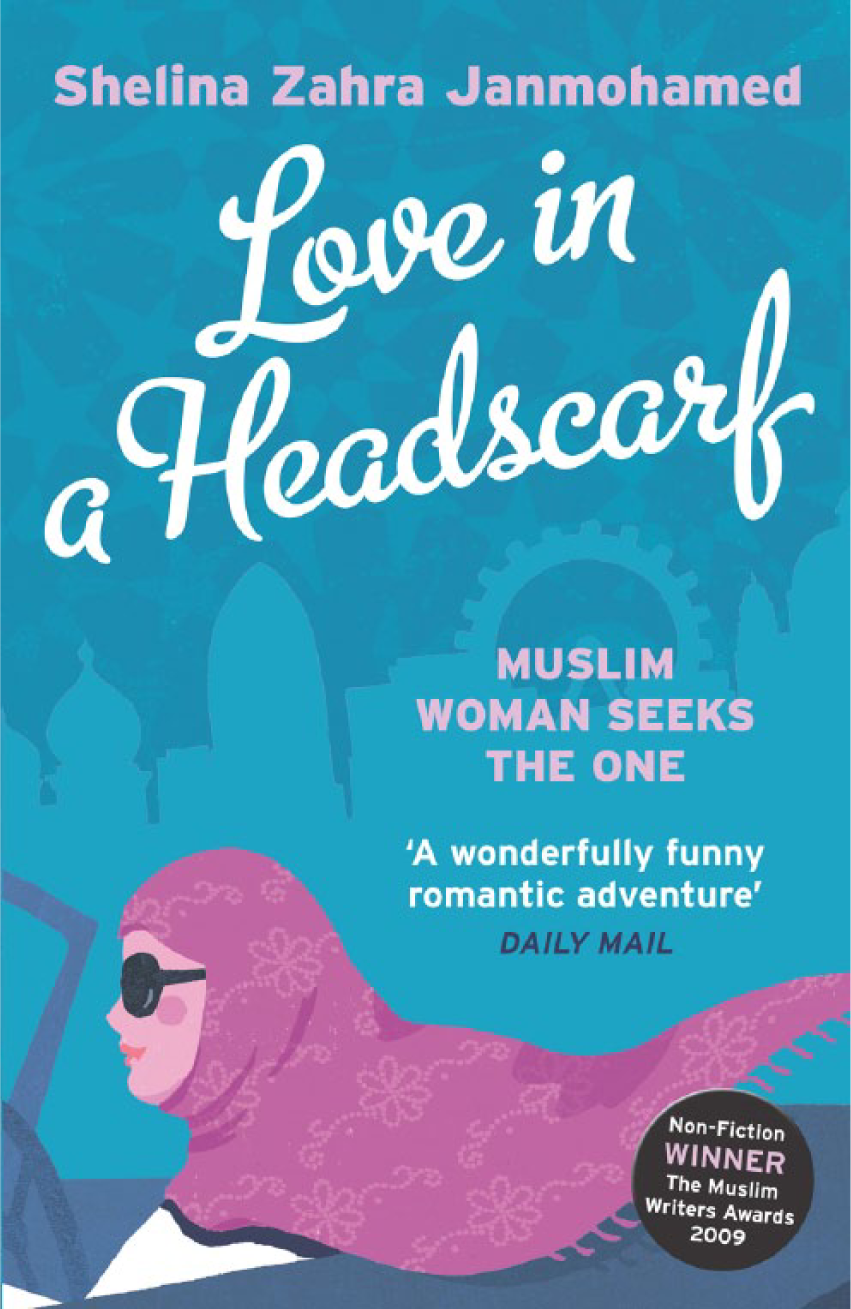
Front cover of Love in a Headscarf: Muslim Woman Seeks The One by Shelina Zahra Janmohamed (Aurum Press, £7.99).
One of the key markers unifying chick lit as a distinct “genre” has been its cover imagery (Montoro, 2012), which has been described as “identikit” (Harzewski, 2011: 2). The frequent application of pink, loopy script, and cartoon figuration in chick lit functions to announce the works as feminine and light-hearted, and is, in the eyes of its critics, emblematic of the genre’s superficiality. In addition, frequent images of shoes, bags, cosmetics, or, in the case of the Aurum Press edition of Janmohamed’s book, a car, provide the all-important visual link to consumer culture, which is also a defining characteristic of the genre (Harzewski, 2011; Montoro, 2012; Smith, 2008). As Harzewski articulates through a comparison with the older genre of Harlequin romance novels:
Chick lit’s packaging aims to attract and bring back readers through visuals women gravitate to as consumers. […] This marketing tactic seeks to attract the urban young professional demographic who may be reluctant to purchase a romance paperback with a clinch cover. The cover makeover brought about by chick lit […] draws on women’s penchant for designer commodities and works synergistically with the retail. (2011: 47)
However problematic we might find these assumptions about what “women” gravitate towards, in terms of its cover art, most editions of Janmohamed’s text fit seamlessly into this characterization of the chick lit genre, inscribing it into a world of fashionable female consumption. 9 However, as I will show below, Love in a Headscarf plots a somewhat more uneasy relationship with this world than is apparent from its paratext.
As Gerard Genette notes, cover art is part of a book’s “official” paratext, in other words something which the author or “one of his [sic] associates” has accepted responsibility for (in contrast to something like a review, which is outside of their control) (1997: 9). However, Genette’s analysis does not take into account the fact that authors tend not to have much control over the presentation of their works, complicating the extent to which cover art can be understood as “official” in the same sense as the text itself. This issue is even more salient in the case of the veiled bestsellers described above, many of which are ghostwritten (Latifa) or told second-hand (Sasson’s Princess works) to Western journalists, creating an extra layer of distance between the world of the storyteller and that of the writer and publisher. In such cases, the original “author” has even less control over how her voice is “packaged”. By contrast, Janmohamed, as a member of the “urban young professional demographic”, is both economically and socially close to her publishers, affording her greater power to intervene in her book’s physical appearance. In an interview, she recalls her dismay at seeing the artwork her publisher had originally planned to use for Love in a Headscarf:
a preliminary sketch of a faceless woman, wearing a very long purple cloak, and a billowing headscarf, against a pale, soapy green background. I felt scared of this woman, who was outside my experience. Eventually, they gave her an austere face, and in the background put a domed mosque with peace doves flying over the minarets, which was the wrong image for the book, which is friendly, light-hearted, and British. (qtd. in Chambers, 2013: 10)
Adamant that this was not the right way to present her story, Janmohamed used her skills as a marketing executive to make an alternative case, pitching images of young, fashionable Muslim women. Here, it is precisely Janmohamed’s position as an educated, urban, media-proficient young woman that allows her to exert much more control over her text than would be the case with the veiled bestsellers, while also further affirming her book’s place in the chick lit universe.
Janmohamed’s intentional use of chick lit imagery for Love in a Headscarf immediately positions it in readers’ minds and beckons a particular kind of reader to pick it up off the bookstore shelf or click “add to basket” on a website. By placing a book about a Muslim woman within this familiar symbolic system, Janmohamed is asking us to read it as we would a work of chick lit and, more importantly, that we do not read it as we would one of the many veiled memoirs circulating in the marketplace. With this move, Janmohamed shifts the horizon of expectations: rather than reading Love in a Headscarf through a jumble of Orientalist tropes, we are instructed to read it through the feminine and fashionable “cool” of chick lit, with its message of liberal consumerism and female empowerment.
However, it is not only the book’s paratext that links it to chick lit, as there are key generic conventions that Janmohamed also employs, if only to subvert them. As in iconic chick lit works like Helen Fielding’s Bridget Jones’s Diary (1996) or Candace Bushnell’s Sex and the City (1997/1996), the female protagonist’s search for “the one” is foregrounded in the plot. As Harzewski explains: “Chick lit is both a commentary on and a product of the singles market, which expanded in the late 1990s from matchmaking services and Club Med to a large-scale commercial sector and e-business niche” (2011: 3). Indeed, Janmohamed’s search for love in Love in a Headscarf takes her through a tour of contemporary matchmaking practices, from introductions via family and friends to “speed-dating” events and internet sites. It also follows a familiar trajectory that goes from the frustration and humiliation of a series of bad matches, to the protagonist’s realization that she first needs to “find herself” before she is able to finally find the successful love match and happy ending.
Janmohamed’s memoir also includes some clearly signposted chick lit moments, which any reader of the genre would instantly recognize. One of the most marked of these is her account of the discussions she has with her single female friends, which function as a kind of informal support group on their journey towards finding love. Janmohamed writes of these sessions with a playfulness that borders on parody, as she details the standard “agenda” of such meetings:
(MUSLIM) WOMEN ARE AMAZING
WHERE ARE ALL THE DECENT MEN?
MAYBE THERE ARE NO DECENT MEN LEFT
MAYBE WE ARE THE WRONG KIND OF WOMEN
OH MY GOD, WE ARE NEVER GOING TO GET MARRIED
THE PERFECT MAN IS OUT THERE JUST WAITING FOR US (2014b/2009: 120−28) 10
Here, Janmohamed is channelling the ubiquity of this convention within the genre, which is reminiscent of the regular brunch scenes with Carrie and her friends in the television adaptation of Sex and the City, during which they also exchange stories and advice on their paths to love. Other chick lit elements are deployed with varying degrees of irony, such as her childhood crush on John Travolta (her perfect mate, once he falls in love with her and converts to Islam) and proclamations that she is having a “good headscarf day” (4), which serve to ground the text in the same glossy magazine culture that pervades chick lit works.
However, despite the text’s clearly labelled chick lit credentials, it maintains an uneasy relationship with the genre. One of the defining and often criticized features of chick lit is its demographic uniformity, not only in terms of its protagonists, but across authorship and readership as well. They are predominantly “young, single, white, heterosexual, British and American women in their late twenties and thirties living in metropolitan areas” and, I would add, secular (Smith, 2008: 2). So, while Janmohamed (as both writer and protagonist) fulfils most of these criteria, her ethnicity, cultural background, and, most importantly, her religious faith set her apart from the chick lit “type”. As in Aboulela’s text, there is an incongruence between protagonist and genre, as well as between author/protagonist and their implied reader. While both The Translator and Love in a Headscarf may be (and are) read by many Muslim readers, 11 the pedagogical qualities of both texts, which make a point of explaining basic tenets of the faith, are clearly intended to be (also) read by a non-Muslim readership. In contrast to chick lit, there is a distance between the worldview of the text and the worldview of the implied reader, which must be constantly bridged. As indicated above, this is partly accomplished by inscribing the work within recognizable discursive structures.
As in Aboulela’s novel, though, Janmohamed vacillates between working within the conventions of her “source” genre and reshaping them for her own purposes. In both texts, there is a drive not only to represent an Islamic worldview within a Western secular discursive system, but also to problematize some of the assumptions of that system from the inside. As in the wider chick lit genre, there is an ongoing tension in Love in a Headscarf between the improvements in gender parity brought about by feminism and the enduring nature of traditional gender norms. However, instead of engaging in a tussle between sexual freedom and a nostalgic return to conservative mores of female sexuality (best exemplified by Ellen Fein and Sherrie Schneider’s controversial but highly popular 1995 self-help book, The Rules), Janmohamed endeavours to fashion an approach to finding love that fits with the principles of her Islamic faith. Rather than a nihilistic turning towards the self, in Love in a Headscarf, the chick lit convention of “finding yourself” is reframed as a spiritual journey towards God. Importantly, the parameters of this journey are set against both the culturally-embedded advice of the “Buxom aunties” and what Janmohamed sees as a superficial and sexually exploitative secular courtship culture. In expressing her frustration that only women seemed to be subjected to the “Buxom aunties”’ rules, Janmohamed explains,
The Qu’ran told me that men and women are a pair, designed to complete each other, equal and balanced. But the aunties were quite clear in their views that the success of any marriage was in the hands of the woman. I was uneasy with this burden, as it clashed with my sense of fairness and my understanding of Islam. (57)
Later, however, she also laments the pressures placed on women in order to be seen as desirable in British society:
There was a cultural insistence that everything, especially women, had to be constantly and utterly sexy. You had to be sexy in the public domain to be accepted. If you were interested in love, then it had to be a beautiful, glamorous, sexy kind of love. That was difficult to reconcile as a practising Muslim wearing hijab. (252)
Here, both sets of norms are shown to be lacking in gender equality, placing a greater burden upon women, whether to maintain the marriage or to be sexually attractive to potential mates. For Janmohamed, and to a certain extent for Aboulela’s protagonist, the Qur’an and the life of the Prophet prove a much more convincing “feminist” text than the gender regimes championed by contemporary media culture. 12 In Janmohamed, however, this critique is also accompanied by a rejection of traditional cultural mores, which are seen as antithetical to Islam’s principles of (gender) equality and fairness.
While Janmohamed modifies the conventions described above by recasting them within an Islamic framework, where the text departs from secular romantic forms most drastically is in the challenge it poses to the plot of the sexual contract itself. As she writes in Love in a Headscarf:
The media culture around me had its own strong views about love and romance. […] Love would lead to marriage. And marriage would lead to happily ever after. This was the myth of romance at its most powerful. […] The love story from within the parameters of Islam started at the opposite end. Two people got married. This would then complete their faith. They would be blessed with love, all the while remembering to work at creating a relationship of love themselves. (60−61)
Here, Jahmohamed not only asks her readers to appreciate the religious values driving her own personal journey towards love, she calls for a reassessment of the Western romance plot altogether. Rather than the familiar narrative of love and then marriage, Janmohamed changes the plot around and asks us to consider the unrealistic expectations it generates. “What was the reality of the After, when they said Happily Ever After?” she asks. “Was it endless summer breezes and dreamy flushed gazes? Or was it a negotiation around dirty dishes, unfinished DIY projects and unpaid bills?” (53).
Therefore, in some ways, Janmohamed’s text is more revisionist than Aboulela’s, which infuses the Western secular love-plot with an Islamic worldview but otherwise leaves the framework of the sexual contract intact. At the same time, the doubt that Janmohamed’s text casts on this well-known narrative is not as radical a departure from the chick lit universe as it might at first appear. According to Harzewski, chick lit is representative of an era she refers to as “late heterosexuality”:
One of chick lit’s contributions as a genre is the production of what we might call a sexual theory of late capitalism or a reflection of how the latter has filtered into and commercialised the most intimate arenas of everyday life. […] Late heterosexuality ushers in a new stage of straight relations […] in which women are less gullible toward romantic myths and often remain celibate. (2011: 11)
Indeed, self-help books (which both influence and are often read alongside the chick lit genre) like How to Shop for a Husband: A Consumer Guide to Getting a Great Buy on a Guy (Lieberman, 2009), in which courtship is de-romanticized and reframed within the idiom of business, seem to point to a broader movement away from the mythic world of the “happily ever after” story. Speaking of the ubiquity of commodities in chick lit, Harzewski argues that, “they mask a postlapsarian moment for romance in a world where networking trumps courtship […] and they mitigate an anxiety-based restlessness, if not a deeper emotional frustration and malaise” (2011: 13). In other words, Janmohamed’s Muslim chick lit memoir actually wrestles with many of the same questions and anxieties as its secular counterparts. However, Love in a Headscarf offers faith and spirituality, rather than media-driven consumption, as an alternative “solution” to the malaise left behind once the romantic myths can no longer hold water.
Conclusion: Pioneering texts
Shakir Mustafa describes Muslim writing in the post-9/11 era as “a mission with identifiable objectives” (2009: 283), which broadly cluster around the need to provide alternatives to the negative imagery of Muslims and Islam circulating in the Western media. In their appropriation of generic forms, Aboulela and Janmohamed’s works function as textual performances in the service of this mission. They enact alternatives to the perceived binary between Islam and the liberal values that have come to be associated with “the West”, especially when it comes to women’s agency. Even though these alternative articulations of Muslim womanhood are represented in the discursive world of the novel and memoir, respectively, there is the potential for them to have material effects. In Desire and Domestic Fiction, Armstrong argues that in negotiating a space for “respectable” female-authored literature, domestic fiction provided women with a louder voice in the social sphere. Similarly, by framing their social commentary within the familiar romantic forms of the domestic novel and chick lit genres, respectively, Aboulela and Janmohamed negotiate a path for a discourse on gender in Islam that is able to cut through the limiting frameworks currently on offer.
There is a clear intention in both works to make an Islamic worldview intelligible to a non-Muslim reader, but without recourse to any of the recognizable tropes that circulate in the mainstream media. It is the varying closeness and distance between the values and codes of the genres they inhabit and those of their protagonists that challenges readerly expectations about “the Muslim woman”, while also providing opportunities to shift the gaze back onto “Western values” themselves. Importantly, both Aboulela and Janmohamed present their protagonists as playing an active role in shaping the codes that govern their lifestyle choices, as they measure inherited norms (from multiple cultural traditions) against a version of Islam that is both universal and egalitarian. Both The Translator and Love in a Headscarf tellingly position women at the forefront of this new brand of Islam,
13
framing them as active mediators between the different value systems on offer. As Janmohamed asserts in Love in a Headscarf:
Muslim women were pushing forward the debate about our community’s understanding of Islam. We were questioning “how things were” in the way that our faith was practised. […] We were confident that we would be the ones who could create real and positive change in the Muslim community and in extricating the faith of Islam from the cultures that had taken root in its practice. (122)
Here, Janmohamed allocates to Muslim women living in non-Muslim societies the task of changing (what counts as) religious practice from the inside, particularly when it comes to gender norms and codes. At the same time, by insisting that her text is “British”, Janmohamed is also contesting the current terms on offer for full citizenship of the nation. By engaging with genres that are deeply embedded in the British literary landscape, both Love in a Headscarf and The Translator assert a place for their Islamic worldviews within the British cultural milieu, rather than in opposition to it.
As textual performances, however, there is also the sense that the ideological imperative is given as justification for the at times instrumental (as well as instructional) deployment of their respective forms. Because the primary objective is to probe the perceived incompatibility between Islam and “the West”, other binaries sometimes become re-encoded in the process, including that of gender. While both texts are contesting the mobilization of “the oppressed Muslim woman” as the ground on which the East/West dichotomy is staged, they too mobilize gender codes in order to formulate their alternatives. In this way, gender continues to be the arena in which culture is debated. This may in part be down to the respective genres they draw on, each of which comes with its own limitations for women’s subjectivity: the sexual contract of domestic fiction only permits women to have power within the private sphere and chick lit presents “finding a man” as necessary for female completeness, neither of which are problematized within the texts. Therefore, The Translator and Love in a Headscarf should be thought of as pioneering texts that do the necessary work of space clearing, laying the discursive groundwork for potentially more nuanced explorations of the intersection between gender and faith.
Footnotes
Declaration of Conflicting Interests
The author(s) declared no potential conflicts of interest with respect to the research, authorship, and/or publication of this article.
Funding
The author(s) received no financial support for the research, authorship, and/or publication of this article.