




Abstract
This article considers the significance of artist Philip Gurrey’s 2008 series of portraits of members of multicultural working-class communities in Beeston, Leeds, in the social, political, and cultural context of the aftermath of the 7/7 bombings. Reflecting on the impetus for making these works, Gurrey has observed that “the predominant rhetoric [in 2007] was almost as if this place was generating extremism” (2014a: n.p.). In his opinion, “the artist’s prerogative is to look at the aesthetic generated; the feel and mood of the place as portrayed by the media was completely wrong” (2014b). This essay focuses on The Beeston Series (2008–2009) of paintings, which Gurrey composed by merging and splicing together the features and skin-tones of the suburb’s community members, and subsequently exhibited to local audiences at the BasementArtsProject in south Leeds, a space removed from the metropolitan centres that appeared either to dismiss or to demonize them. Drawing on Jill Bennett’s explorations of art as the “critical, self-conscious manipulation of media” (2012: 6), this article goes on to explore how such mundane and unsensational, though striking, portraits presented an aesthetic that ran counter to contemporaneous representations of such communities as the breeding grounds of Islamic terrorism. It argues that through such critical, aesthetic approaches, artists in twenty-first-century Britain contest still-dominant discourses around the failure of multiculturalist policies and supposed alienness to indigenous British culture of Muslim identities, and fears about the harbouring of an “enemy within”. In doing so, it draws comparisons between Gurrey’s regionally-specific paintings and other more metropolitan attempts to depict the aesthetic realities of 7/7, the perpetrators of such attacks, and the multicultural, working-class identities scrutinized in their wake. Works discussed in relation to The Beeston Series include Mark Sinckler’s controversial drawing Age of Shiva (2008), and Faiza Butt’s Is This the Man (2010) portrait series.
Keywords
Introduction
In the days, weeks, and months following the 7 July 2005 terror attacks on the London transport network — an event quickly cast as “London’s 9/11” and conceived as all the more sinister following the revelation that the perpetrators were British — the media became saturated with images first of the wreckage and the victims, and subsequently of the bombers and their homes in the West Yorkshire city of Leeds and its suburb, Beeston. Photographs of the crime scene and ensuing investigation, reproduced on television screens, billboards, newspapers, and blog sites, typically featured the now eerily iconic red number 30 double-decker bus ripped apart in Tavistock Square; white-masked victims shielded by emergency services and shepherded to safety; mug-shots and CCTV stills of the bearded and backpacked suspects; and the deserted, depopulated streets of the bombers’ red-bricked neighbourhoods, their fish and chip shops and Islamic bookstores closed and cordoned off by police tape. 1 The popular discussions which came to frame understandings of the northern, working-class, and substantially Muslim communities from which the Yorkshire-born bombers Shehzad Tanweer, Mohammad Sidique Khan, and Hasib Hussain had hailed, and of the young Muslim men’s mentality, fell into predominantly simplistic (and alarmist) categories.
On the one hand, commentators like Melanie Phillips launched sustained and scathing attacks on the multiculturalist policies and equality agendas of “white liberals” for having enabled segregation and permitted the fostering of an internal enemy (2006: 110). 2 In her estimation, bombers like “this Leeds boy”, Sidique Khan, raised in a “nihilistic” late-twentieth-century secular, liberal context, “had no allegiance to, nor identification with, the Britain where [they were] born and brought up” (2006: 125, 133). Following her (somewhat skewed) logic, Phillips concluded that despite their adoption of “the habits of other slum-dwellers”, such young Asian men were able to live lives in multicultural Britain that ran “parallel” to those of their “white” counterparts, and — as the inheritors of an “Islamic culture” inherently “vulnerable to […] extremism” — proved “easy prey for the puppet masters of terror” (2006: 125, 133, 145). Mosques, community organizations, and institutions (such as universities) harboured by a decadent state, also contributed — as “conduits for hatred” — to the alienation of the London bombers (2006: 149). Such ideas only served to reinforce the notion, conveyed by photographs still in circulation of Leeds’ Iqra Learning Centre swathed in protective sheeting and Thornville Road Mosque juxtaposed with terraced town houses, that a “nest of [Islamic] terrorists” had been nurtured in Yorkshire’s “spiritual capital” (Seton, 2005: n.p.).
Where polemicists like Melanie Phillips were keen to link New Labour’s multicultural policies to the growth of contemporary Islamic extremism, thereby co-opting concerns about segregation voiced by more moderate “figures close to the political regime” such as Trevor Phillips, leftist writers such as Tariq Ali attempted to critique government policy on a different front (Sharma, 2009: 120). Ali aimed to counter Tony Blair’s attempts to decouple homegrown terrorism from Britain’s foreign policy, specifically its pursuit of the “war against terror” in Afghanistan and Iraq. He reminded his readers that whereas Blair had suggested “that ‘poverty was the cause of terrorism’” immediately prior to the 7/7 attacks, the “principal cause” was in fact “the violence […] inflicted on the people of the Muslim world” (Ali, 2005: 48). For Ali, the assertions Sidique Khan made on his “ghoulish video tape” before the bombings provided “direct evidence of […] political motives” (2005: 52–53). Discussions of religion, deprivation, and disaffection as causal factors only distracted, in his opinion, from a recognition of the connection between these attacks and “the savage chaos in Baghdad” (2005: 50). In Blair’s later reflections on the events of 7/7, the “local circumstances in West Yorkshire” (2005: n.p.) were also sidelined, although for reasons politically opposed to those of Ali. Rather than entertaining the British-born bombers’ actions as a protest against their government’s heavy bombing campaigns, the Prime Minister sought to emphasize the alienness of their “barbaric” and “evil ideology” to the land in which they were raised. As Blair pitted “their [al-Qaeda-informed] terrorism […] politics and […] perversion of religious faith” against a strong, diverse Britain united by “our common values”, the spotlight fell on “the Muslim community” within British borders, who must help “pull [extremism] up by its roots” and so “take the common fight forward” (Blair, 2005: n.p.; emphasis added).
Circumspect columnists later attempted to insist that “the image so eagerly touted after the bombings, of an oasis of tolerant diversity exploited by Islamic fundamentalists who hail from a community determined to voluntarily segregate, simply does not square with the facts” (Younge, 2005: n.p.) of racism and social and economic exclusion. Yet, mainstream discourse after 7/7 continued to marginalize nuanced discussions. Created in part through selective press photography, and reinforced by journalistic and governmental commentary, negative images of the Leeds in which the bombers lived as a “lawless, northern slum where street kids roam by day, and terrorists at night” (Seton, 2005: n.p.), populated by self-segregating “veiled women and bearded men strolling past dilapidated buildings” (Martino, 2006: n.p.), were to linger in the national psyche.
Frustration with the inaccuracy of the “aesthetic” conjured by the media when attempting to depict the bombers’ hometowns in the immediate aftermath of the 7/7 attacks has provoked artists like Yorkshire-born Philip Gurrey to create new works intended to counter notions that suburbs such as Beeston were somehow “generating extremism”, and to better reflect “the feel and mood of the place” (2014b). Specifically, Gurrey writes of wanting, in The Beeston Series (2008–2009), to use the medium of “paint to unpick the subtle questions surrounding unity, harmony, conflict, and class divisions” in such areas, left unexamined by the “predominant rhetoric” (2014a: n.p.) — questions touching on some of the issues highlighted by Younge (2005) in his cautionary piece. Gurrey is not alone in seeking to use a visual medium to respond to dominant perceptions of the Leeds community which suddenly came under scrutiny in July 2005. The Brazilian photojournalist Eduardo Martino, for example, visited the Beeston neighbourhood twice, in late July 2005 and early July 2006. He hoped “to document the community’s reaction” to this “sudden shift” in attitudes, and in particular to seek “the Asian community’s voice”, looking “beyond the stereotypical pictures” (2006: n.p.). The images of Beeston which Martino took in 2006 for Guardian Unlimited are no longer available. 3 Those he made immediately after the bombings, however, which remain accessible to the public via the photographer’s website, offer a sense of Beeston’s (Asian) population as part of an embattled but united community, determined to express their grief and “cope with the stigma” (Martino, 2006: n.p.) foisted on their home as the breeding place of suicide bombers. 4 In one, a middle-aged Asian man, presumably part of a community condolence trip to London’s St Pancras Church, stands with his head bowed against a background of green grass and cemetery railing, one arm deferentially tucked around his waist, the other awkwardly supporting his jacket, a white carnation and a printed sign bearing the declaration: “ALL CULTURES, ALL FAITHS, BEESTON UNITED AS ONE”. In another, a handwritten message, “condolences from Beeston to London”, Sellotaped to a piece of card along with a colour photograph of a pink rose, forms the homemade heart of a more professional-looking wreath in pastel peach and yellow tones. Yet these images, though compelling, arguably fall short of encouraging viewers to look beneath the surface of a sobered but still celebratory multiculturalism to the “common” social and economic denominators which “connected” and “isolated” diverse residents of Beeston, in Gurrey’s (2014a) terms.
In understanding the difference between Martino’s photojournalism and Gurrey’s painting, Jill Bennett’s discussions of art, events, and affects after 9/11 are useful. Bennett argues that in the case of catastrophic events: Whereas media assumes the function of witnessing and documenting what actually happens — and hence sets up the terms and conditions of aesthetic mediation — art (the critical, self-conscious manipulation of media) has the capacity to explore the nature of the event’s perception or impression and hence to participate in its social and political configuration. (2012: 6)
5
As it enquires into what makes Gurrey’s post-7/7 interventions distinctive, this essay draws on Bennett’s understanding of “the ‘real life’ arena” as replete with aesthetic processes, its major events and the popular reactions they engender “inflected by affect and particular sensitivities”, which “media” may “relay”, but creative artists can interrupt, dismantle, and use to generate new aesthetic and political possibilities (2012: 4, 6, 51). However, before discussing how the arresting set of paintings and drawings that comprises The Beeston Series may reconfigure mediated perceptions of the Leeds suburb’s multicultural, working-class community prevalent since July 2005, I want briefly to consider two more commercial and metropolitan attempts to engage with the aesthetic generated by the events of 7/7 and the apprehension of such terror attacks’ perpetrators. Mark Sinckler’s apocalyptic large-scale drawing featuring the detonated number 30 bus, Age of Shiva (2008), and Faiza Butt’s unsettling series of overblown mug-shot portraits Is This the Man (2010), are strikingly different from Gurrey’s work in terms of their points of reference, style and technique, anticipated audience, and incitement of emotional affects. 6 Nevertheless, they help to situate his paintings in a wider context of work produced in this particular moment, and provide instructive points of comparison when it comes to understanding how art after 7/7 can both “contain” and “escape” the event’s initial, affective aesthetic and politicized reception (Bennett, 2012: 21).
Affective controversy: Mark Sinckler’s Age of Shiva
Age of Shiva (2008), a large-scale charcoal and chalk drawing by artist Mark Sinckler, depicts the exploded Tavistock Square bus overcast by pensive, Baroque-style cherubs and attendant angels, who hover ambiguously over the scene as a swathe of naked souls clamber toward heaven. 7 It provides an example of post-7/7 artwork which redeploys iconic, emotive documentary images from 7 July reportage, alongside generic elements from an earlier period of art history, to arrest viewers and provoke debate, with the ostensible aim of shifting discussions towards a consideration of the impacts of faith and hence perhaps away from the bombers themselves (BBC News, 2010). However, the artwork elicited outrage from tabloid newspapers and far-right bloggers, and caused upset amongst victims and relatives, when a print was used to dress the window of an exhibition curated by Banksy at the Marks and Stencils pop-up gallery in London’s Soho in November 2010. In addition to the proximity of the space of exhibition to the site of the bombing and the sum paid to purchase the artwork, the apparent reasons for the tabloids’ offence were Sinckler’s replication of the film advertisement featuring the slogan “OUTRIGHT TERROR … BOLD AND BRILLIANT”, which was displayed on the side of the bus at the time of the bombing, and his Muslim identity (Daily Mail reporter, 2010; Flynn, 2010). 8 To news editors eager for sensational content (for whom stories about contemporary art and Muslims can be common sources), Sinckler’s inclusion of several large angels hovering over the London bus’s realistically-rendered wreckage provided, somewhat curiously, the greatest pretext for offence. Having overlooked the fifth angel in Age of Shiva’s right-hand corner (Sinckler, 2016), the Daily Mail concluded that because “the same number of Al Qaeda terrorists” as angels featured in the drawing “took part in the [7/7] atrocity” (2010: n.p.), these celestial beings must be intended to represent the terrorists. According to its reporter’s logic, the Muslim maker of this decadent and cynical artwork was therefore not only “cashing in” on a highly traumatic and still current national catastrophe (Age of Shiva came to fame at the time of the 7/7 inquest); he was — even more horrifyingly — paying “tribute” to or “glorifying” not the London dead, but their jihadist murderers (Daily Mail reporter, 2010; Spencer, 2010). The aggrieved opinions of the victims and their families (the bus driver, the bereaved partner) were, additionally, invoked by “outraged” media coverage which sought to transform the Sinckler story into a near atrocity. The result was a controversy of a somewhat different nature to that which the artist had apparently intended, with his own (black, and reportedly Muslim) face being juxtaposed with the smiling image of the Jewish charity worker Anat Rosenberg, who died in Tavistock Square (Daily Mail reporter, 2010).
Bennett has observed: “images of 9/11 (like many others) have an emotional life; that is to say, they are not only affective expressions but are co-opted into circuits of affect; they are used, incorporated, entrained” (2012: 24). In the case of 7/7 and Age of Shiva, Sinckler’s attempt to incorporate the image of the number 30 bus into his creative artwork to his own ends perhaps failed not simply as a result of the outing of his Islamic identity, but because the “visual form” of the hallowed bus relic had come to “enfold [an] emotional politics” (Bennett, 2012: 22), which ran counter to his aim. In other words, emotions of “shock, grief, anger [and] patriotism” (Bennett, 2012: 22) were bound up with the awe-inspiring image of the actual terror attack. Played on by the popular press as it sought to reinforce then-circulating political agendas aimed at shifting blame for the 7/7 attacks onto an apparently hostile, un-British Islam nurtured into being by misguided multicultural policies, these proved too powerful for the artist to interrupt as he attempted “to make people think [more broadly] about the effects of faith” (Sinckler, qtd. in BBC News, 2010: n.p.). Hence Age of Shiva’s titular reference to a time of destruction or transformation (in Hindu tradition), or period of mourning (in the Jewish sense), which might have led to a reconsideration of the utility of certain grieving rituals, or of how all religions can be manipulated to apocalyptic ends, has been left unexamined. So too has the more straightforward symbolic interpretation of the drawing as an act of homage to 7/7’s diverse, heaven-bound victims. The artist’s formal interest in “explor[ing] how archetypal image and structural notions of urban life may converge […] as a critique of the paradoxical state of belief and perception” (Sinckler, 2015a: n.p.) was also not taken up by the national press. This noted, a strong reaction is something Sinckler reportedly invited. He told BBC News that he “wanted to jolt people into seeing the results of […] thoughts [relating to beliefs and ideas of faith] put into action” (2010: n.p.), not just depict the devastation caused by the London attacks. However, as is so often the case with contemporary art stories, and particularly with “news” involving Muslims, controversy has reigned as opposed to a less hysterical analysis of Sinckler’s drawing in relation to its painterly antecedents or creator’s conceptual preoccupations. One must search elsewhere for an artistic approach which might better unsettle stereotypical modes of perception and reflect the complexity of British Muslim and multicultural positions in relation to, and in the aftermath of, such terroristic events.
Troubling “recognition”: Faiza Butt’s
Is This the Man
At first glance, the trio of ink and acrylic portraits that comprise fine artist Faiza Butt’s Is This the Man series (see Figure 2), exhibited as part of her solo exhibition Pehlwan at London’s Grosvenor Vadehra gallery in October 2010, might also seem to be exploiting clichéd images for sensational effect. In her case, mugshots of bearded Asian men of the kind circulated by the press in the years since 7/7 less as a means of “mere illustration” than “as a form of generic representation” (Price, 2010: 281) were surely deployed for their emotive quality: as faces which might be scanned for insights into Islamist mindsets; and as signifiers of, and affective shortcuts to, a frisson of “Islamic” terror. Is This the Man IV, V, and VI reproduced on polyester film the actual likenesses not of Sidique Khan and his fellow attackers, but of the members of another British cell, Tanvir Hussain, Abdulla Ahmed Ali, and Assad Sarwar. These three men from East London and High Wycombe were arrested in August 2006 for their involvement in a plot, possibly linked to al-Qaeda, to smuggle liquid bombs aboard United States-bound planes, and were convicted in September 2009, although their photographs remained in circulation well after this point (they resurfaced, for example, in July 2010, when other men connected with the plot were tried). 9
By filling the images’ backgrounds with lurid layers of neon pink, Butt attracts viewers’ attention. Enlarging their subjects’ heads to over four feet, her paintings blow the real-life suspects’ features wildly out of proportion, her fine lines almost comically or grotesquely accentuating the startled eyes and unreciprocated gazes typical of photographic portraits taken in impersonal, official contexts such as passport photo booths and police stations. While inviting fascination, these eye-catching works offer no hint to viewers curious to determine the causes of the young Muslim men’s antagonism. Indeed, what the Pakistan-born Butt holds up for scrutiny here is less the villainous-looking terror suspects than how the contemporary framing and the mass reproduction of their photographs demonize them. For, while she uses the “back drop […] to ironically diminish the […] hyper-masculinity” (Butt, 2014) of the paintings’ bearded Asian male subjects, and with it perhaps undermines what Robert J. C. Young would term “the power of the aesthetic of terror” (2010: 322) which haunts their likenesses, Butt also envisages such men as victims of an imbalance in media representations which should be investigated. As she has asserted: “I have realized that, whether a man is guilty or not, if represented in this scientific mug-shot way, we strip any other aspect of his identity and establish […] criminality” (Butt, 2014).
It is this slippage from innocent to guilty, from anonymous individual to known terrorist, as a result of mugshot framing, that Butt’s series seeks to undermine, even as it replicates the Metropolitan Police’s close-ups of Hussain, Ahmed Ali, and Sarwar. She magnifies and may seem to mock in her canvases what, following Rosa Maria Flavo, we might identify as the contemporary fascination with shrinking people of diverse backgrounds into “increasingly specific […] display boxes” so as to “highlight […] differential characteristics” (2010: 5). This statement is particularly apposite with regard to Islamic identities and with a view to pathological diagnoses. Further, by obscuring her mugshots with circular shapes which may reference camouflage markings or errors made in mass printing, Butt introduces an aspect of ambiguity to the images. As a result, her series’ title becomes a question which resonates with our own curiosity and anxieties about “Muslim” mindsets and affiliations at a time when government, police, and media remain concerned to identify and eradicate home-grown Islamic extremism: “Is this the man?”, Flavo asks, “camouflaged in a multicultural, pluralistic society?” (2010: 5). Such questions would seem to fuel paranoia. Crucially, however, Is This the Man also invites a creeping sense of uncertainty in relation to the ethics of basing judgements (such as those that led to the death of Jean Charles de Menezes) on supposed photographic evidence: “is this the man?” we ask, his decontextualized and poorly reproduced features both unique and akin to numerous others? Can we really gaze on his framed face and know his affiliations or discern the level of threat he poses? Such questions are raised, augmenting the original titular one, and are left for the viewer to answer.
Considering the place of art in the aftermath of the affective events of 9/11, Bennett suggests: It is the capacity to dwell in this interval [“between a troubling perception and a hesitant action”] and to untangle some of its complex operations (the links — and blockages or “hesitations” — between apprehension and action, between feeling and believing, appearing, saying and doing) that makes a creative aesthetics so valuable to the study of social life. (2012: 4)
Engaging with generic images of bomb-plot suspects that proliferated post 7/7, Butt succeeds in suspending the moment between the apprehension of an Asian, Muslim man and the “recognition” of his identity as terrorist (something to which Sinckler, ironically, fell victim). Using distortion, camouflage, and effacement, her works unsettle the troubling processes by which such men are stereotyped, thereby limiting terror’s emotive effects even as they engage them.
A countervailing aesthetic: Philip Gurrey’s The Beeston Series
Both Sinckler and Butt take as the basis for their large-scale artworks documentary images sourced from the time of the 7/7 bombings and their long aftermath to create potent aesthetic encounters. Their works engender a thrill of fear and — in Butt’s case — invite fascination, translating terrorists’ faces and terrifying events into art objects which effect a sense of darkness, uncertainty, and awe that may verge on the sublime (Young, 2010: 314–15). Yet they are also political in content: shaped by a desire to make viewers consider the violent outcomes of acts guided by extreme notions of faith, made manifest by the iconic image of the exploded London bus; and aimed at exposing how “mass printed images […] influence opinions” (Butt, 2014) of bearded British Asians whose identities have continued to be interrogated through such photographs in connection with later bomb plots. Philip Gurrey’s reasons for painting The Beeston Series initially seemed simpler and more personal: he wanted aesthetically to evoke a sense of the place with which he was familiar as ordinary, mixed, and unsensational (and hence, following Viktor Shklovsky, “to impart the sensation of things as they are perceived and not as they are known” [qtd. in Bennett, 2012: 44]). Yet if — after Bennett — we understand our contemporary conceptions of real-world events, objects, and encounters to be shaped by processes of apprehension which are “already aesthetic” in an everyday sense; and if we recognize the affective emotions (terror, suspicion) they engender as something governments and media reproduce, selectively, to political ends; then an art that seeks to return to the original site of perception and apprehend it afresh, must also be political (Bennett, 2012: 2–5).
The Beeston Series, made over a six-month period between autumn 2008 and spring 2009, comprised 16 oil portraits on neutral, unpopulated backgrounds which grew in size from cropped faces to heads and shoulders and finally half-length figures of nearly six feet [see Figure 1, The Beeston Series: Figure 1, Philip Gurrey (2008), and Figure 3, The Beeston Series: installation view of Heads V and IV (2009), Philip Gurrey (2012)]. The three haunting charcoal drawings with which Gurrey’s artistic “investigation” culminated provided, in his terms, “condensed refractions of the [entire] process” (2015). They showed faces familiar from the paintings pared down to bare essentials: mouths, noses, and unmatched eyes, which half-held, half-eluded the viewer’s gaze. Some features, part-erased, provided a sense of distance, withdrawal, and incompleteness, yet a strong feeling of permanency and presence was also established by deep, soft charcoal lines. What Gurrey set out to investigate in his Beeston project was the mismatch between the “aesthetic generated” by journalists in relation to the suburb which his brother had made his home (“two streets down from one of the [London] bombers”; 2014b), and his own sense of the multicultural conviviality of this northern, working-class place. 10 However, while Gurrey acknowledges that “Beeston in 2005 would have been in many people’s eyes the vision of New Labour’s Britain, British citizens of every religion, colour, and creed rubbing shoulders and realizing their potential within society, together” (Gurrey, 2014a: n.p.), his is no straightforwardly celebratory vision. Conscious that questions of social and economic status are often elided in depictions of multicultural Britain, the artist has been keen to stress that “what connected […] families [in Beeston] also isolated them […]: class and […] lack of money”. His Beeston Series project, begun as an attempt to recreate from original photographs and interviews “as true a face as possible” of the 7/7 bombers’ much-discussed but poorly-examined neighbourhood, also rapidly evolved into an enquiry into the utility of portraiture and paint as a means of elevating ordinary residents while “unflinching[ly]” conveying their “human condition” (Gurrey, 2014a, 2014b, 2015).
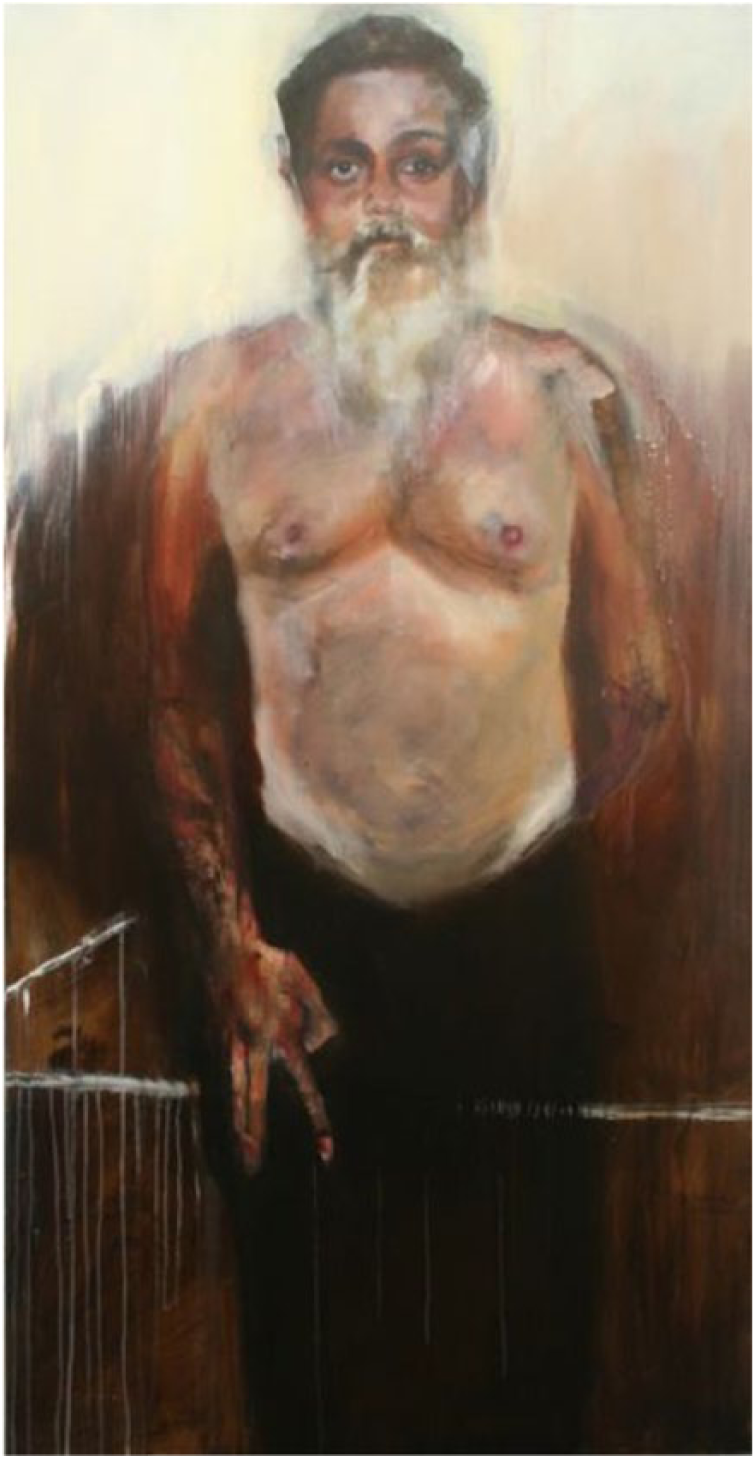
The Beeston Series: Figure I, Philip Gurrey (2008). Permission: the artist.
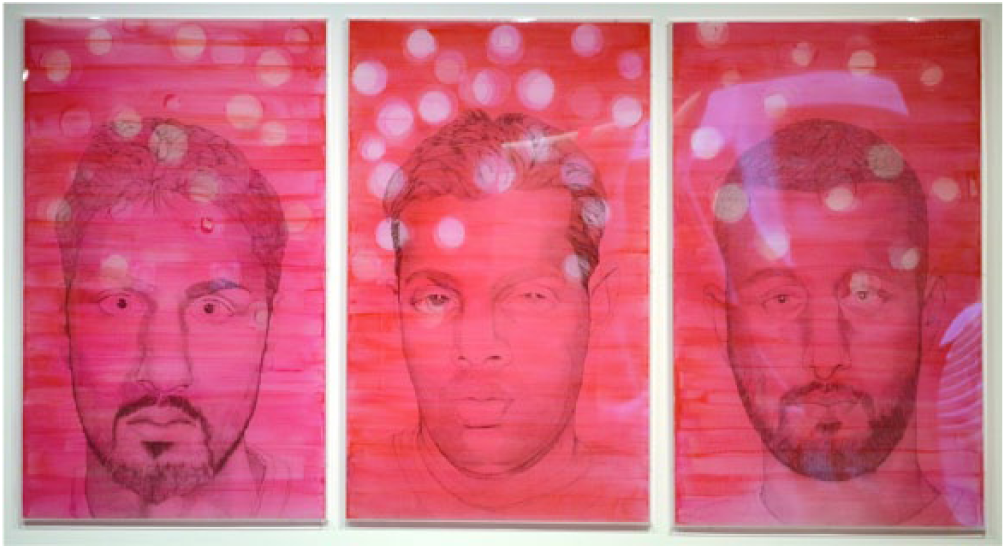
Is This the Man IV, V, VI, Faiza Butt (2010). Permission: the artist/Grosvenor Gallery.
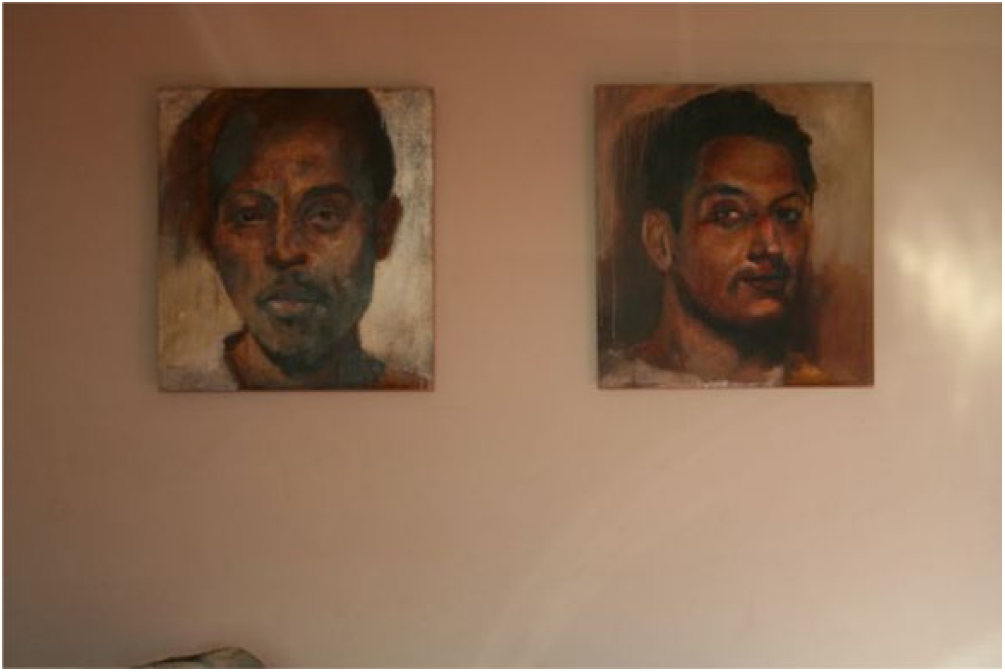
The Beeston Series: installation view of Heads V and IV (2009), Philip Gurrey (2012). Permission: the artist.
The people from working- and lower-middle-class white, immigrant, and mixed-race backgrounds whose homes Gurrey visited in September 2008 to gather impressions — described by the artist not as a “cross-section”, but rather as a “natural” selection of “shopkeepers and take-away owners, Muslim, Christian, Catholic: prominent members of the community, characters you would encounter” (2014b) — are indeed starkly portrayed. Drawing on previous experimentation with the portrait in its regal and later mercantile forms typified by Dutch Golden Age painting, but now working from a fresh bank of faces taken from contemporary sources, Gurrey created The Beeston Series by splicing together the faces and bodies of his photographed subjects, grafting features and merging skin-tones. The outcome is a set of arresting portraits of persons of ambiguous, even indeterminate, gender, religion, and race, dissociated from a discernible site or profession by means of unfurnished backgrounds, which are simultaneously striking and yet mundane and unsensational in comparison to Butt’s mugshot inspired artworks. They contain within them the traces of Gurrey’s technical struggles to make the colours of dark and light flesh “come together” in potentially “jarring” but “still unified” mode (2014b: n.p.). Yet the artist stops short of allowing his colours to “jar too much”, seemingly aware of the “danger” when working in this sensitive social context of allowing the clashing of paint to take over and “become the image” to such an extent that the outcome runs counter to his initial intentions. In other words, he regulates the painting process sufficiently to prevent an exploration in “merging and blending” from transforming into an exercise in depicting, for example, a “woman who looks battered and bruised” (Gurrey, 2014b: n.p.). The picture of Beeston that emerges is therefore, quite deliberately, mixed. It stops short of reinforcing stereotypes, recreating instead a semblance of real faces that cannot be pinned to any one identity or place (the chip shops and terraced houses of press shots are absent), or definitively categorized (see Figure 3). These faces may inevitably conjure a resemblance to demonized “others”, but, with their eyes cast just aslant and their hard-worn features softened, they avoid a confrontation with their viewers and invite them to contemplate the ordinary, lived realities of multiculturalism in communities that Gurrey describes as united less perhaps by faith or culture than by their (lack of) finances (2014b). He can neither excise from his “true” portraits of Beeston residents features shared with the 7/7 bombers, nor prevent them from being associated with the sites of terror depicted in press coverage. But Gurrey is able to separate his figures from specific sights which have come to signify “northern”, suburban, “Muslim” threat, and create composite faces which, while echoing those of real people, offer no exact resemblances, and rather than conforming to preconceived, prejudged types, present viewers with visages of irregular, ambiguous normality.
Unlike the works discussed by Butt and Sinckler, Gurrey’s portraits of south Leeds residents were not exhibited in an idealized white cube space in a central metropolitan location frequented by art collectors. Instead, in 2012, the paintings were shown — according to the artist’s preference — as part of an end-of-residency show at the BasementArtsProject, a domestic arts space located in a terraced house in Beeston (see Figure 4). Hence, in two senses, they were returned home, and the fringe gallery that hosted them endorsed as an alternative, artistic capital. Crucially for the artist, his works’ original subjects were invited to come and view the portraits. Gurrey recalls that he gained from this audience “a sense of ‘yes, this is Beeston’”, but — save for one particularly enthusiastic subject who saw a direct likeness in a drawing — received quite a “nonchalant” response (2014b, 2015). Audience responses were not formally documented, so the reasons for this seeming detachment are unclear. It is possible that Gurrey’s unorthodox approach to portraiture was a factor affecting local people’s responses (he describes his disappointment with their possible acceptance of the notion that the artworks were “not necessarily for them”, despite having striven to make work for and of the community), yet the artist has also expressed concern that his paintings were overly representative: “too literal” (2014b, 2015), rather than too obscure. Gurrey’s attempt to de-sensationalize his depictions by exhibiting ordinary, unadorned portraits in a non-purpose-built location may also, paradoxically, have contributed to the art objects’ demystification, and so to feelings of regret and disenfranchisement amongst marginal viewers who were also the paintings’ subjects. Some visitors do appear to have been intrigued. Gurrey describes one art teacher who worked in adult education as struck by the unusual nature of the images, which were different from those commonly seen in such suburban contexts (2015). The related press carried animated headlines such as “Underground art exploding myths” (Casey, 2012) but, although positive, largely previewed the work rather than reviewing it, and was descriptive and uncontentious.
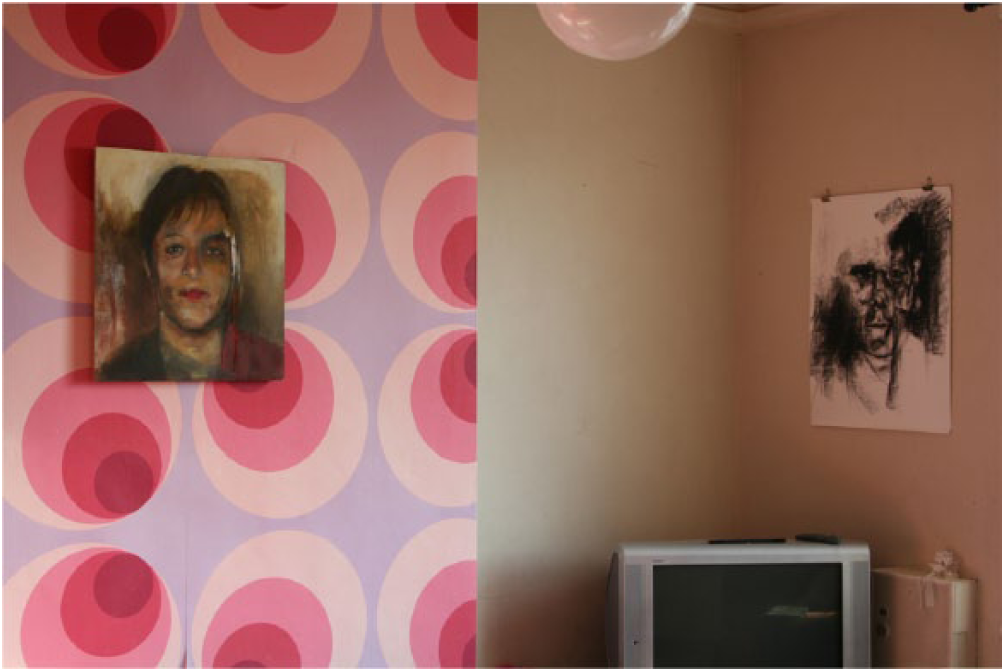
The Beeston Series: installation view of Head II (2009) and Charcoal III (2009), Philip Gurrey (2012). Permission: the artist.
Beeston residents’ apparently ambivalent responses to the portraits Gurrey professedly created for the suburb’s sake point both to the importance of contemporary attempts culturally to represent specific named areas of multicultural, working-class Britain (particularly those which have attracted negative interest in the wake of controversial events), and to the limitations of such creative projects. As Rehana Ahmed has observed, “what is at stake” (in her case, in the fictional representation of London’s Brick Lane; in mine, in the artistic depiction of Beeston) is the image of “a specific community that occupies a subordinate class position and rarely has access to cultural discourse” (2015: 143). This community may be “endow[ed] […] with legitimate subjectivity” and hence “empower[ed]” through representation “predicated on social position”, but the position of the image maker, at a social remove from his or her subject, may result in the creation of a representation which that community does not recognize as “authentic” (2015: 143). The Glasgow School of Art-trained Gurrey would make images that offer “a conscious understanding of [a particular] place” and community and, by situating his work outside of exclusive galleries and “amongst the real”, attempt to “break down [the] ideological systems” (2015) which might separate the two. Yet the Beeston public’s seemingly underwhelmed reaction to (and limited “recognition” of) his sensitive, nuanced, and unorthodox portraits raises new, practical questions about how the artist can reconfigure dominant perceptions of specific (and subordinate) communities in ways that may impact them more positively and communicate with them more effectively.
Meditating on the power of a photograph of three of the London bombers entering Luton railway station on the day of the 7/7 attacks, journalist Jonathan Freedland suggested: “what we see most in this [otherwise “nondescript”] image is not what’s in it, but what we put there. Because we know what happened next, we detect a purpose in the men’s steps” (2005: n.p.). We should therefore “change [our] nightmares […] For scenes of bland normality, like this one, can contain devastation” (2005: n.p.). When reflecting on the “effect[s] of terror”, Young identifies an “overpowering sense of imminent danger […] so near that it overwhelms and paralyzes”, yet so affective that it “moves you into a state of producing fiction: it makes you live imaginatively on the borderlines of the real” (2010: 307, 308–09). This shift into a state of creating fearful fictions of numerous nameless, faceless, yet ordinary others, is of course exactly what Freedland describes and seeks to encourage in his article, and what Gurrey’s original, textured, and recontextualized artworks effectively circumvent. The “nonchalant” local responses Gurrey’s (2015) portraits generated in such an emotive media climate may therefore be seen as an indication not of their failure but, at least partially, of their success. Using compositions in paint effectively to de-link depictions of Beeston’s residents from the affective associations of terror, Gurrey offers a countervailing aesthetic of mixed, working-class normalcy — neither sensationally segregated nor stagily harmonious. For Bennett, “an aesthetic project […] offers more than a record, a flashback or reconstruction; it generates a means of inhabiting and simultaneously reconfiguring the historical event as a radically different experience” (2012: 40). The more mainstream metropolitan works by Sinckler and Butt examined in this essay achieve this in some measure as they unsettle and invest with new significance photographs selected from what might be termed the “particular conflagration of images”, now integral to the post-7/7 period’s visual record, through which its politics have emotively “played out” (Bennett, 2012: 24). But it is Gurrey’s negation of the power of those most iconic images of multicultural Britain in supposed meltdown and the grip of Islamic extremism, and his endeavour to replace them with sensitive portraits of ordinary subjects sourced from and reinstalled among the south Leeds streets which had initially caused such consternation, that offer the clearest sense of how, from this radically decentred aesthetic perspective, we might experience 7/7’s aftermath differently.
Footnotes
Funding
This research received no specific grant from any funding agency in the public, commercial, or not-for-profit sectors.