




Abstract
This article seeks to make precise some of the challenges faced by Caribbean bibliography. I focus on two periods and texts in twentieth century Guyana: N.E. Cameron’s 1931 anthology, Guianese Poetry, Covering the Hundred Years’ Period, 1831-1931, and early 1950s issues of Thunder, the journal of the socialist anticolonial People’s Progressive Party. Attending to these publications could lead to a narrative about Guyana’s transformation from a cultural hub within the British Empire to a centre of anticolonial politics and poetics. This is part of the way we can view them, but transitions between the colonial and anticolonial do not emerge neatly. When we think more about Guyana through the lens of textual culture we build a picture of practices and values that cut across place and period. Paradoxically, even regarding the twentieth century, we cannot rely only on what Jerome J. McGann calls our inescapable “textual condition” to understand Caribbean textual culture. I show how the literary interests evidenced in Guianese Poetry and Thunder can lead us towards a local history of the book that takes seriously overlapping textual and non-textual perspectives. In doing so, we can chart more clearly the rise of poetry in colonial Guyana, an emerging national poetics, and the knotted poetics and politics of Empire, slavery, and anticolonialism. Guyana’s complicated and often contradictory textual cultures, I argue, must be sited locally and transnationally, and in order to assess them we must stay attuned to the ways that sites of textual culture connect authors, editors, publishers, and audiences. To adapt Erna Brodber’s approach to writing village histories, what we arrive at is the beginnings of a “nearly go so” literary history – a history that is sensitive to the inconsistencies between archival data, cultural memory, and oral testimony.
Keywords
At the beginning of Wilson Harris’s novel, Jonestown, the semi-autobiographical figure, “WH”, receives a manuscript which he then makes public as a book. This long-established literary gesture ― the presenting of a text by a fictionalized editor to a readership ― offers one way for literature to enter the world. The place of texts in the world has arguably interested Caribbean writers more than their critics. Derek Walcott’s tactile description in Another Life of George Campbell’s First Poems (1945) (“a new book, / bound in sea-green linen” (2004: 9)), can be situated alongside Harris’s meta-textual framing (1994: 3–10) and V.S. Naipaul’s satire of publishing and print culture in The Mystic Masseur (1957). Set in 1940s Trinidad, the latter novel represents a community’s responses to the printed word, from the awe-struck to the casual:
[Leela] never ceased to marvel at this husband of hers who read pages of print, chapters of print, why whole big books; this husband who, awake in bed at night spoke, as though it were nothing, of one day writing a book of his own and having it printed! (Naipaul, 1964/1957: 85)
The wonder which surrounds the books (Ganesh owns an extensive Penguin and Everyman library) may point to Homi Bhabha’s view that the English book becomes “an insignia of colonial authority” (1994: 102). However, the mystique of pages, chapters, and whole big books “of print” that furnish Leela’s and Ganesh’s home is not simply produced by British colonial authority. Naipaul is interested in the authority of the West Indian colonial book: in this case, books produced by Trinidadians for a Trinidadian readership.
Naipaul’s comedy of publishing charts the failures of textual production in the West Indies (and authors, printers, and readers are all targeted in this satire). The Dharma newspaper of Ganesh’s group runs for only one issue, replicating the short lives of many publishing ventures in the region (Naipaul, 1964/1957: 198). 1 Basdeo, the printer, caustically notes “Everybody in Trinidad bringing out magazine these days” (Naipaul, 1964/1957: 95). But Naipaul’s bite is modulated by a pleasure in the paratextual details that make a book a book. The narrator assiduously catalogues the material forms and reception of what Srinivas Aravamudan calls Ganesh’s “Guru English” (2005: 6). 2 He reports discussions about point size and type; narrates how books become bestsellers; and turns bibliographer: “The Years of Guilt (Ganesh Publishing Co. Ltd, Port of Spain. $2.40)” (Naipaul, 1964/1957: 96; 143; 18; 218). The narrator’s conscientious rendering of this information is part of Naipaul’s joke on the religious, political, and literary pretender, Ganesh (modelled on his pandit uncle, Simbhoonath Capildeo). However, Naipaul’s inclusion of this detail ― considered alongside biographical knowledge of his father’s and uncle’s local publishing ventures (French, 2008: 38; 43; 46) ― emphasizes the varied ways that books in the colonial Caribbean become valued.
Even though The Mystic Masseur can be re-read as a fictional history of the book in the Caribbean, bibliographical interests emerge unevenly in colonial and postcolonial studies. Nigel Westmaas writes that while
research on print culture in Europe is well developed in volume, the same does not obtain for the British Caribbean or Guyana. Guyana is even more ill served [. . .] because its collection of newspapers, reaching back to the nineteenth century, has suffered from the neglect of human agency, time and the ally of neglect, paper worms. (2006: 1)
It would be too strong to say that the study of print culture is missing from Caribbean Studies, but critical editions of Caribbean writers have only recently appeared, accounting for authorial composition and editorial decisions (see, for example, McKay, 2004; Walcott, 2004; Carter, 2006). Significant pockets of Caribbean literary criticism have taken interest in bibliographical histories (e.g., Benjamin, 1980; Breiner, 1998; Cobham-Sander, 1981; Cudjoe, 2003; Donnell, 2006; Donnell & Lawson Welsh, 1996; Edwards, 2003; Granger and Westmaas, 1999; Low, 2011; O’Callaghan, 2004; Rosenberg, 2008; Sander, 1988; Sander and Ayers, 1978; Tiffin, 2001), and Macmillan Caribbean’s “Caribbean Classics” and Peepal Tree’s “Modern Caribbean Classics” have kept key texts in print. Yet, understanding the “life cycle of printed books” remains a challenge to be met in Caribbean Studies because these “communications circuits” ― running unevenly “from the author to the publisher [. . .], the printer, the shipper, the bookseller, and the reader” (Darnton, 1982: 69) ― throw up multiple perspectives and resources, offering competing ways to tell stories of Caribbean print culture.
These stories also intersect with questions about archives. Jacques Derrida’s near-maxim ― “The archivization produces as much as it records the event” (1995: 9) ― should be placed alongside Derek Walcott’s meditation: “what is archival in the Caribbean, as the Caribbean writer knows, is what got lost in the annals of sugar cane burned every harvest like the library of Alexandria, what disappeared in the spray of the wake of the slaves. A huge amnesia rather than a history” (2000: n.p.). This Caribbean absence or amnesia is a constant reminder that the possibilities of Caribbean literary history have always been circumscribed. Indeed, we should remember that Walcott’s statement appears in a review of Thomas W. Krise’s edition, Caribbeana: An Anthology of English Literature of the West Indies, 1657–1777 (1999), in which Walcott questions how we should read in the shadow of slavery and asks what literary history we want to construct out of its past. Even when we consider the twentieth century, paradoxically, we cannot rely only on what Jerome J. McGann calls our inescapable “textual condition” to understand Caribbean textual culture (1991: 3). In “Writing Your Village History”, Erna Brodber insists on personal, anecdotal, and intimate forms of located storytelling that express the intangibility of “performing cultural memory in the Americas” (Taylor, 2003: 27). Brodber’s methods test the limits of any “textual condition”:
Jamaican wisdom holds that, “Anything black people say, if it nuh go so, it nearly go so”. What black people say, as a result of applying imagination and meditation to an issue, given the paucity of records for a conventional history of us, we should perhaps accordingly see as hypotheses to be tested, as leads to be followed in writing our family and local history, for it might “nearly go so”. It is with this taking-what-my-black-people-said-seriously that I started the research into my own village history. It is a path that I am recommending to you. I began with the myths circulating in my village and I want to show you how using them as an entry into the past can unearth data towards the reconstruction of the history of our myth-makers and myth-keepers. (2003: 160)
Brodber’s recommendations for village research could be usefully applied to Caribbean bibliography. Her intervention is an important reminder that in relation to any Caribbean histories, oral testimony and speculation – the thresholds between myth and data – are crucial. In this respect “nearly go so” histories suggest ways to take seriously the problems of destruction and silencing associated with notions of the archive and the textual condition. 3
To make more precise sense of the challenges faced by Caribbean bibliography, I turn to two periods and texts in twentieth-century Guyana: N.E. Cameron’s 1931 anthology, Guianese Poetry, Covering the Hundred Years’ Period, 1831-1931, and early 1950s issues of Thunder, the journal of the socialist anticolonial People’s Progressive Party (PPP). Attending to these publications could lead to a narrative about Guyana’s transformation from a cultural hub within the British Empire to a centre of anticolonial politics and poetics. This is certainly part of the way we can view them, but transitions between the colonial and anticolonial do not emerge neatly. When we think more about Guyana through the lens of textual culture we build a picture of practices and values that can cut across place and period in unexpected ways. Guyana’s complicated and often contradictory textual culture, I argue, must be sited locally and transnationally, and in order to start to assess it we must stay attuned to the ways that these sites of textual culture connected discursively to audiences. What we arrive at is the beginnings of a “nearly go so” literary history.
An anthology for “Guiana”
For N.E. Cameron ― researching the poetry in the Reading Rooms of the Royal Agricultural and Commercial Society in Georgetown ― the production of the first anthology of Guyanese literature answered a request: “to give some account of the literature of this country” (1931: 1). But this was not a straightforward concern. It raised questions about the nature, status, even the possibility of a literary tradition, in what was then British Guiana. Cameron admits: “I revealed the state of my ignorance when I replied, not without much embarrassment, that I did not think the people were much addicted to literature” (1931: 1). This response, given to friends at Cambridge while Cameron was in the UK as a student in the 1920s, provided the impetus for a collection of work that took seriously Guyana’s literary legacy from the nineteenth to the twentieth century. The results are an anthology that charts not only the rise of poetry in colonial Guyana, but also one that surveys an emerging national poetics, the poetics of Empire and slavery, experiments in literary form, and one that provides a key chapter in the country’s history of the book. Materially, the anthology became even more precious in 1945, when the rare copies of Guyanese literature housed in the library of the Royal Agricultural and Commercial Society that Cameron consulted were destroyed in the fire that consumed much of Georgetown. 4
The ninety-three poems in the anthology voice the shifting emphases of several generations of poets, variously identifying their population as “Demerara’s sons” (Martin, 1931a: 108), “sons of Africa” (Elliot, 1931a: 142) and “Guiana’s sons” (MacA. Lawrence, 1931a: 179). These differing labels mark out possible identities, and the date of the anthology’s publication is significant. Cameron states “1931 was a year of great inspiration to Guianese. It was the Centenary of the Union of the three counties of Berbice, Essequibo and Demerara into the Colony of British Guiana. An outburst of literary activity greeted the event” (Cameron, 1968: 40). It is hard to imagine 2031 as a significant anniversary, but in 1931 Cameron was able to delimit a textual community that brought together A.R.F. Webber’s Centenary History and Handbook of British Guiana, Hildred Britton’s Stages of Development of British Guiana’s Womanhood, 1831–1931, his own anthology, and play, Balthasar (Cameron, 1968: 40). While it is true that the anthology is noted as a “pioneering” literary collection (Breiner, 1998: 77–78; deCaires Narain, 2002: 7–8; Donnell and Lawson-Welsh, 1996), it remains an under-researched curiosity. Webber’s history has only recently been viewed within the complex literary, journalistic, political, and historical concerns of its author (Cudjoe, 2009), and Britton has almost disappeared from critical view (James, 1999: 319; McAlmont, 2008: n.p.). Although the people Cameron links are not today seen as making up an “inspired” textual community, in 1934 Cameron was able to claim: “Nearly everybody is writing. Legion is the number of those who have been in print, multitudinous those who complain of having piles of manuscript lying at home” (1970: 107). Cameron may be exaggerating, but his anecdote is a parallel to the literary ambitions and productivities registered in Naipaul’s fiction of Trinidadian textual communities.
Largely ignored today, the Centenary works and events show a growing interest in charting specifically Guyanese achievement, and it is notable that Cameron does not query the British imperial context for these activities, dedicating his anthology to the Governor, Sir Edward Denham. 5 It is not clear if this reveals a tension between an assertion of cultural self-determination and an imperial status quo. Cameron’s remarks may place him in a zone where neither term ― colonial or anticolonial ― accurately characterizes how Caribbean peoples were mapping out their pasts and present. The nineteenth century saw the rise of multiple institutions that would explicitly locate cultural production in Guyana and Georgetown more specifically. 6 And increasingly, poets ― from differing sections of Guyanese society ― would be drawn to local subjects and the possibilities of a local poetry. Voices from abroad remained of high prestige, at least in some quarters of the press. The Australian-born, eighteen-year-old Vincent Roth (included in the anthology), who had recently arrived from the UK in 1907, was immediately offered a post at the Argosy as Assistant Sub-Editor “with an extra $3 per column for literary contributions” (Roth, 2003: 88). 7 Nevertheless, in the same period the local writer, Harold W.B. Moore (also included in Guianese Poetry), best known as a weekly newspaper columnist, was publishing poetry in the Argosy, and in Cameron’s generation the B.G. Literary Society (which he founded) focused on activities for Georgetown writers (Cameron, 1946: 17). Certainly, Cameron’s editorial endeavours in Guyana were not isolated. In 1925, the publication of Louis Morpeau’s Anthologie d’un siècle de poésie haitienne, 1817-1925 set a precedent for collecting nineteenth- and twentieth-century poets together. In 1929, J.E. Clare McFarlane’s Voices from Summerland: An Anthology of Jamaican Poetry was published in London. Eight years later Albert Gomes would edit From Trinidad: A Selection from the Fiction and Verse of the Island of Trinidad, British West Indies (1937). Part of a regional trend, then, but Cameron’s efforts were not financially supported. Like many writers and researchers in Guyana before the 1960s, Cameron was self-published, using the printing services of the local newspapers, and selling his work to interested Guyanese (largely Georgetown) residents. 8 He writes in his “Introductory Essay” that “I consider it a service to the community to present this publication” (Cameron, 1931: 2). With this anthology Cameron begins the job of collecting the ephemeral poetry of Guyana, from both the past and his present. He is not comprehensive (he identifies eight published collections, but his acknowledgements thank only the Daily Argosy and the Chronicle Christmas Annual and only sketchy bibliographical details accompany the text), but he begins an important task, and one unfinished today (1931: 181).
Cameron’s anthology is of an insistently print, rather than oral, culture. According to the 1827 and 1829 censuses, the total population of what would become British Guiana was just over 100,000, of which approximately 90% was enslaved (Schomburgk, 1840: 42; 46). To be a published poet in Guyana in the first part of the nineteenth century, we might assume, was to be a member of a white colonial elite, and the anthology’s earliest author fits this description. Known only as “Colonist”, this poet published Midnight Musings: Being a Collection of Poems on Various Subjects in 1832, with (as Cameron records in his “Introductory Essay”) a damning proviso: “the Colony, though fertile in everything else, is barren in incidents for poetical display” (Cameron 1931: 2). Here we find a first model of literary composition in Guyana: that of the displaced colonist, uninterested or unable to respond to a Guyanese cultural landscape. In “A Wish” he writes “Affection that, in life’s decline, / Would just as warm and fondly shine / As when the gay, the merry spring, / Its sunny hopes and joys could bring” (Colonist, 1931: 152). But the anthology’s hundred years’ period includes slavery, emancipation, indentureship, the age of British imperialism and intimations of its decline. Cameron’s later study of education in British Guiana reflected on literacy in the colony, imagining within the enslaved population “here and there one who could read or write, a Mohammedan from the Gambia maybe, or a few trained by some benevolent persons”. In contrast to this literate minority he identifies the “comparatively highly educated but often immoral white colonists” and “free persons of African descent (pure or mixed), taking their lead from the whites” (Cameron, 1968: 9). The discovery of early poetic voices from the black populations of Guyana is significant in part because it begins to make sense of the cultural origins of a contemporary post-emancipation, if not post-colonial, population. Simon Christian Oliver’s occasional poem on emancipation (1838) is a particular editorial triumph, as are the poems from Thomas Don’s Pious Effusions (printed in New Amsterdam in 1873), and the commemorative songs from the Emancipation Jubilee of 1888, organized by T.R.F. Elliott and recorded in H.V.P. Bronkhurst’s Among the Hindus and Creoles of British Guiana (1888).
Oliver (who Cameron describes as a free Grenadian-born schoolmaster), is preceded chronologically only by “Colonist” in the anthology, but Oliver’s work makes clear the limited nature of his predecessor’s complaint about the “barrenness” of incidents in the colony. This is how A.J. Seymour assessed the poem in 1977:
The occasion is grand, the quality is poor, but here is the evidence of creative imagination, the first authentic singing voice in Guyanese literary history. Compared with later developments, it reads like the stammering of a child not yet given to speech. (1977: 26)
Whatever we might think of it now, colonial beliefs and experience drive the poem:
WRITTEN BY SIMON CHRISTIAN OLIVER, SCHOOLMASTER AT ST. AUGUSTINE’S, BUXTON, FOR THE 1ST AUGUST, 1838, B.G. Oh! ye first of August freed men who now liberty enjoy; Salute the day and shout hurrah to Queen Victoria On this glad day the galling chains of Slavery were broke From off the necks of Afric’s sons, who bled beneath its yoke. With hearts and voice you should rejoice, to God the glory give; Now freedom is your happy lot, as freedmen you should live; Your minds you ought to cultivate as well as till the ground, And virtuous actions imitate wherein true bliss abound. To your masters then you’ll fill a glass and drink with grateful glee, And to all those of the same class who nobly set you free. Then you should sing, God save the Queen, oh, may she live for ever; Great Britain your true friend has been — forsake you, may she never. (1931: 139)
For Seymour and to a contemporary ear, Oliver’s emphatic fourteeners (so emphatic that the opening “Oh!” seems to stand outside the meter like a tuning note) register the troubling compromise of being “freed” rather than “free” men. But if the poem is founded on this compromise, Cameron recuperates it in the anthology as “an insight into early Negro ability” (1931: 4). Both he and Seymour recast this poem of celebratory commands and moral policing as part of a new kind of literary mobility and proof of the beginnings of an African-Caribbean or Guyanese literary tradition. Fifty years later the songwriters of the Emancipation Jubilee would retain only God as their object of gratitude (Blades, 1931; Elliot, 1931b), and by 1930 Cameron’s own “A Brave Boy” venerates “Christophe’s breed”, invoking one of the leaders in the Haitian Revolution, Henri Christophe, to link Haitian independence to a Caribbean present (Cameron, 1931b: 154).
What Cameron and Seymour do not comment on, however, is the context for Oliver’s publication or the strong village movement in and around Buxton that might, in the late 1830s, have complicated Oliver’s position. 9 The publication history of the poem is elusive. Neither Oliver nor his poetry is remembered in Eusi Kwayana’s study, Buxton Friendship in Print & Memory (2000). The occasional nature of the poem suggests that it was written in 1838, but then Cameron’s title cannot be original since Buxton was not founded until 1840. St Augustine’s, Oliver’s school, was established in 1838, when John Gardiner Austin, the proprietor of Friendship plantation, gave permission for the erection of a church, school, and vicarage (Duke, 2000: 178), and this context places the poem as commemorating new ecclesiastical as well as social forms of community. Buxton was the new name for Plantation New Orange Nassau, bought collectively by 128 formerly enslaved people, and its history is suggestive of the textual community that might have engaged positively and negatively with aspects of the poem. Cameron notes in The Evolution of the Negro that 117 pupils attended St Augustine’s by 1842, and that they were taught “divinity, writing, and arithmetic” by Oliver (1970: 69). Oliver’s generous salary of £50 a year from the Bishop set him apart financially from the labouring villagers whom he served and positioned him between the Church and the community.
According to Kwayana religious observance became important as villagers wanted to express “gratitude for what God had done for them in relieving them from their captivity” (2000: 27). This spiritual dimension should not be seen to subsume the active role of both enslaved people in ensuring their freedom and that of abolitionists. Buxton and its neighbouring plantations have complex histories in terms of rebellion and abolition. The Demerara Slave Rebellion of 1823 was within living memory in 1838 and included slaves from Plantations Friendship (Friendship) and New Orange Nassau (Buxton), among others (Viotti da Costa, 1994: 182–3; 190–1; 198–9; 245; 366–7). In the run up to the rebellion the name of King George IV was seen as a marker of liberation. Emilia Viotti da Costa notes that the Demerara slave rebels spread the word that the British King had “sent out their freedom” (1994: 185). Buxton was named after Thomas Fowell Buxton, the MP who in 1825 took over the leadership from William Wilberforce of the parliamentary campaign for the emancipation of all slaves in British colonies. Nearby Plantation Northbrook had been purchased in 1839 and, by request from the villagers to the British Queen, was renamed Victoria (McAlmont, 2010: n.p.). Therefore, when Oliver invokes God Save the Queen it expresses a narrowly didactic imperial horizon for emancipation, but it may also be heard by its audiences in terms of movements that link their communities to dimensions of British abolitionism and monarchy. The motives for these allegiances may never be disentangled, but they, like Oliver’s poem, are connected facets of the emancipatory moment. His uneven appeal to a certain kind of popular mood might also be seen in the choice of form: the iambic heptameters refigure the common metre of ballads (each rhyming couplet being divisible into a 4-3-4-3 stress and xaxa rhyming pattern), and as such are suggestive of performative song as much as printed text. Seymour is convincing when he describes the poem as a flawed song of “gratitude to the master class” (1977: 26), but recognizing the contradictory cultural horizons this poem might have had for readers and listeners helps us to gauge more clearly its flaws and appeal.
Of course, this is only one poem among many, but what is so intriguing about Guianese Poetry now is the part that it might play in a speculative “nearly go so” literary history that prompts us to consider cultural memory and performance in relation to textual culture. What emerges in Cameron’s anthology as a whole is a Creole literary tradition narrowed to African-Caribbean and European print culture. He explicitly edits out racism concerning “black” culture ― noting that he has replaced “nigger”, with “skipper” in Henry G. Dalton’s 1858 poem “The Essequebo and its Tributaries” (1931: 25) ― but other cultures are also obscured. No Indian-Guyanese writers are included, Amerindians are included as subjects for poetry but not as creative artists, only two poems are by women and the Creole language is absent (Martin, 1931a; Mrs Z.G.R, 1931a; Mrs Z.G.R, 1931b). 10 Cameron’s “On Favouritism: A Sonnet and a Tale” rewrites Guianese folk traditions into standard English iambic pentameters (Cameron, 1931c). Just as striking is the precarious balancing act of proto-nationalist work (such as Walter MacA. Lawrence’s “Forward Guiana’s Sons” (1931a) and Vere T. Daly’s 1929 poem, “The Song of Young Guiana” (1931)) with the unacknowledged prevalence of pro-Empire, but not pro-slavery, verse (Egbert Martin’s “Additional Verses Written for the National Anthem” being the famous late nineteenth-century example (1931b)).
If Guianese Poetry fails to fully register song and folk traditions within its pages, and offers a limited picture of writing, ethnicity, gender and class, there is still much to discover about poetic sensibility. The four main sections ― Narrative Poems, Nature Poems, Topical and Miscellaneous Poems, Moral and Religious Poems ― identify modes of Caribbean writing that persist into the twenty-first century. Topography and climate provide many comparative examples of Caribbean writers’ wish to describe a local landscape. At times this is taxonomic, as in Walter MacA. Lawrence’s “Sylvan Guiana”:
Each towering Greenheart an ingot, Each Mora, a nugget of gold; Each Purpleheart an expression Of something more brilliant than wood. (1931b: 95)
With each name comes an articulation of Caribbean particularity, and this is repeated throughout the anthology: in the detailed focus of Egbert Martin’s praise song for “the love-star” of “The Sorrel Tree” (1931b), Harold W.B. Moore’s for the “sea-scent” of “The North Wind” (1931: 65) or W.A. Buttery’s “Mighty Mazaruni” (1931). It is important to remember the longevity of this impulse, from near contemporaries, such as A.J. Seymour, and most famously in the Adamic poetry of Derek Walcott.
Were we to judge Cameron’s anthology by the endurance of these nineteenth-and twentieth-century poets, we could conclude that it failed to create a reading public for Guyana’s early writers. His anthology only ran to one edition in Guyana in the 1930s. 11 When A.J. Seymour edited A Treasury of Guyanese Poetry the goal of historical representation remained important, but he notes that it is the period from 1940 to 1980 “which marks the emergence of the modern Guyana” (1980: xi). Writing about twentieth-century West Indian poetry, Edward Baugh claims “the poets of the post-1940 mainstream do not consider themselves to be descendants of [their] forerunners, who produced a strictly colonial poetry” (1971: 33). Reading Seymour’s anthology alongside Cameron’s we might have to agree. Of the twenty-nine poets in Cameron’s collection, only Cameron, “Colonist”, Thomas Don, Walter MacA. Lawrence, Egbert Martin, and A.R.F. Webber find a home in Seymour’s later selection.
By contrast, Selwyn R. Cudjoe makes a case for genealogies between A.R.F. Webber’s political campaigning in the 1930s and the anticolonial politics of later periods: “Their radical thinking also set the stage for the nationalist agenda of the 1930s, the socialist agenda of the 1940s, and the emergence of figures such as Cheddi Jagan, Forbes Burnham, Norman Manley, Alexander Bustamante” (2009: 9). It would be a neat form of literary history that could map political and literary trajectories onto one another, but Cameron’s work in Guianese Poetry does not quite “set the stage” ― in the sense of being a cause ― for later literary concerns. Instead what emerges are different generations tackling the same problems about the nature of literary traditions and textual conditions in Guyana, but with renewed and revised concerns. Textual communities, archives, and textual conditions may not be the terms that they use but these ideas animate much of the writing and discussion in these connected periods.
Thunder: Textual communities beyond the textual condition
Cameron’s literary interests can lead us towards a local history of the book that takes seriously overlapping textual and non-textual perspectives. A common concern across the 1930s and the 1950s lies in a commitment to constructing a discursive community of writers, readers, audiences, and participants, even if success is limited. When we turn to Thunder we should maintain our attention on the varied practices that build Guyana’s textual culture and extend beyond it, practices that allow us to attend to the PPP in terms of the literary and the textual as well as the political.
It cost 60c to join the PPP in the early 1950s and members received 12 free issues of Thunder ― the party’s 12-page journal. The pages of Thunder offer numerous reports of anticolonial organizations: for example George Padmore’s “Unity of Africans & Indians in Kenya”, outlines how the African Union of Kenya and the Indian National Congress of Kenya are united in their campaign for the restoration of lands confiscated for European settlement (1951a: 3; 11). Earlier that year, Padmore ― a Trinidadian trade unionist based in London, and later a key member of the Pan-African movement ― had reported the overwhelming electoral victory of Kwame Nkrumah’s Convention People’s Party in the Gold Coast. Padmore reports that once in government Nkrumah used his platform to denounce “African capitalists for exploiting their own people” (1951b: 3). Such stories, and Thunder’s internationalist mandate, emphasize similarities in imperial and capitalist exploitation throughout the colonized world: articles on the monopoly in Guyana of the British sugar conglomerate, Bookers, exposés on the substandard housing in which estate workers lived, and statements voicing PPP demands for constitutional reform are bolstered by reports of similar experiences elsewhere in British colonies (Anon, 1950a; Anon, 1950b; Anon, 1950c; Padmore, 1951b).
The PPP’s cultural interests were wide-ranging and have yet to be researched comprehensively.
12
Where Cameron operated as a one-man industry, Thunder was managed by an editorial board including Martin Carter and Janet Jagan, PPP members with dedicated cultural concerns. The interest in poetry was serious and encouraged by the model of the US-based Masses and Mainstream, to which Janet Jagan, Thunder’s editor, had a subscription, and in which Carter’s poetry later appeared (Carter, 1953). A motto appearing on the cover, taken from William Morris’s “The March of the Workers”, highlights a figurative language for political contexts: “Hark the rolling of the thunder! / Lo the sun! and lo thereunder / Riseth wrath, and hope, and wonder” (1984: 114–5). But the PPP’s cultural activities extended beyond print and literature. For example, a “Grand PPP Moonlight Excursion to Buxton” organized in 1952 (see Figure 1) returns us to Buxton, and the rarely considered leisure dimensions of Caribbean political activism. Here the village is a site of PPP fund-raising, music, and dancing till 3am. Furthermore, Buxton became a focus for literary and cultural celebration beyond the PPP’s remit. The Demerara Youth Rally (DYR) held a festival in 1953, processing along the east coast villages, accompanied by singing and Taja drums. Kwayana notes:
The DYR saw its task as uniting the young generation. [. . .] It did not spout or even study ideology. It was a counterculture to the colonial ethos with wide appeal. It protested against exploitation of young women for jobs. It agitated for education and friendship among [. . .] young people. It often came out against the official churches, but it attracted church youth as well. (Kwayana, 2011: n.p.)
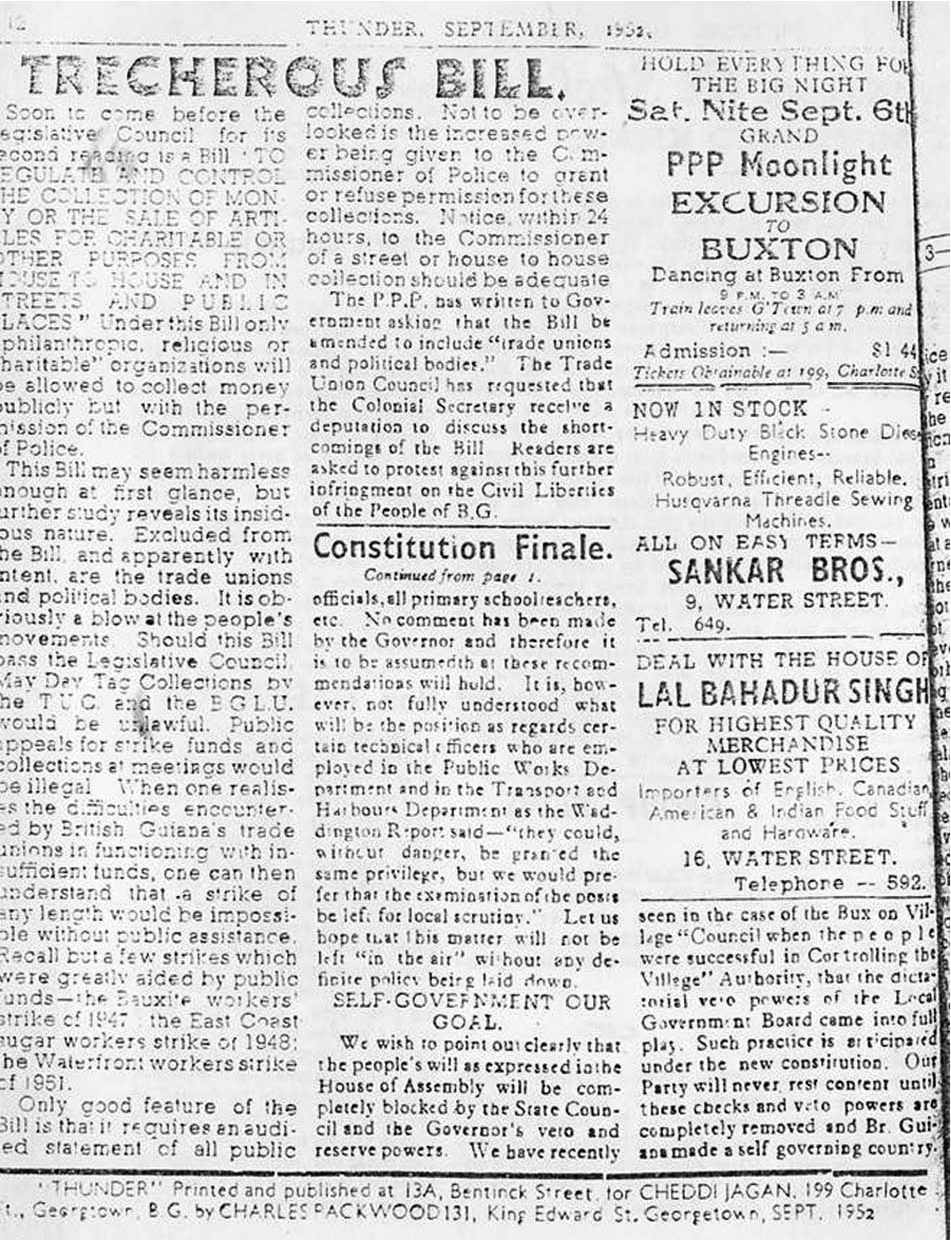
Advertisement in Thunder for PPP Moonlight Excursion to Buxton, 1952 (top right)
The “Demerara Youth Rally Hymn” sang “Every evil thing, every robber king / Tremble when Youth’s armies march” (Kwayana, 2011: n.p.) and Kwayana recalls the festival winding up at Buxton’s cinema, where Martin Carter, Wilson Harris, and Jan Carew spoke and read their work to the large crowd. We seldom think of Harris in this protesting discursive community, but our reckoning of his fictions of the interior (in both geographical and psychological terms) can inform and be informed by the coastal politics of the time. Kwayana remembers: “the same class forces we were talking about he would call ‘the anonymous forces that were coming forward’. He was on the same direction but with a different sort of interests, you know, and an entirely different idiom” (Kwayana, 1998: n.p.). To make room for Harris within this counterculture of the PPP and the DYR we have to see how clashes of ideas and idioms, and shifting sites for cultural performance, helped people experiment with and articulate their possible new futures.
These idiomatic experiments took different forms in Thunder. Comrade Davson’s one poem, “Sugar Psalm” (a rewriting of Psalm 23), mocks the stranglehold of estate life:
The sugar producer is my shepherd. I’m always in want, They maketh me to lie down on sugar plantations. [. . .] These bandits, they loathe to bargain with unions; They bind me to their plantations by building loans and their incentive bonus And I shall dwell in their huts forever. (Davson, 1953)
This poem of religious transpositions and reversals keeps us within the complicated Caribbean literary tradition of spirituality, slavery, and emancipation that Oliver tackled a century earlier. In their different ways both confront the paradox of living within a post-emancipation, but not post-colonial, society. This later poem also has something of the “tragicomic” impulse that Walcott identifies as the Caribbean’s creative response to slavery: “humor, mockery, and self-parody, an attitude incomprehensible to those who tortured [enslaved people]” (2000: n.p.). In contrast, Martin Carter’s “For A Dead Comrade” incorporates mockery in a startling elegy dependent on new attitudes and idioms for its expression of grief. Written in memory of Ivan Edwards, a PPP member and trade unionist, the poem appeared in a two-page spread, “Workers Lose Great Leader”, alongside obituaries (Figure 2). Positioned on the far right of the second page, Carter’s poem can act as a conclusion to the news reports, abstracting and anonymizing the event for a political readership. The poem also can function in the same inclusive, performative manner as the songs that were part of the Demerara Youth Rally, so that its printed form is only one facet of a larger complex of performing cultural memory and identity. The articles tell of a funeral procession of thousands in Georgetown (Burnham, 1952; Ramkarran, 1952), and Carter’s poem registers this with its discussion of “the banner”, the “scarlet fold”, and “the mourning vanguard” (1952: 7). But the central section shifts our focus to consolation. On poetry in Thunder Jagan comments: “anything that expressed what our party was standing for ― independence, anticolonialism, various things ― I’d put it in” (1998: n.p.). The remit is wide and in this poem, Carter finds in tropical nature energy and tranquility that can incorporate, but are not limited to, political sensibilities:
Dear Comrade— if it must be you speak no more with me nor smile no more with me nor march no more with me then let me take a patience and a calm— for even now the greener leaf explodes sun brightens stone
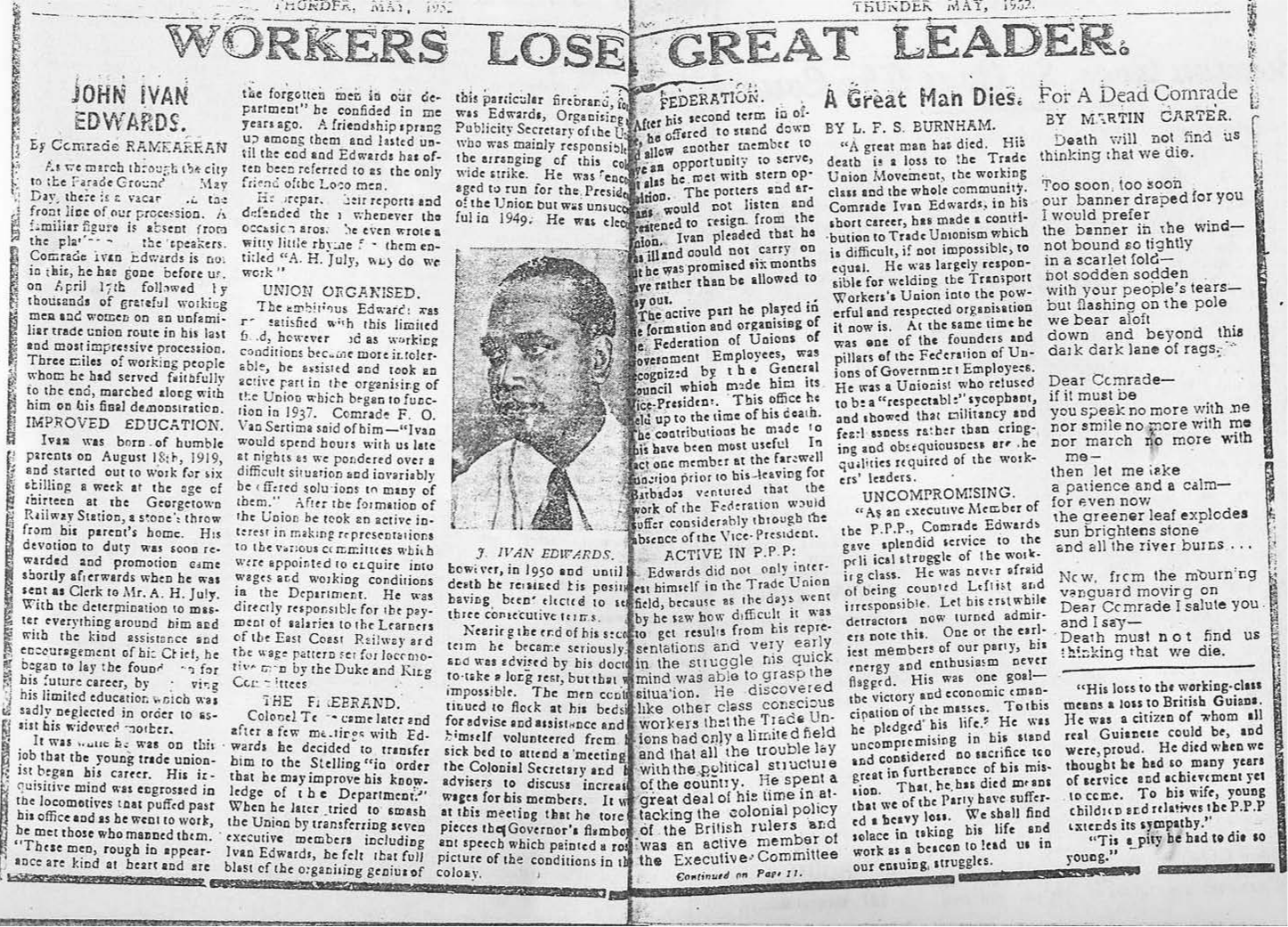
“Workers Lose Great Leader”, Thunder, May 1952
“Patience” and “calm” take an indefinite article, but the article functions as specific not indefinite. They are not sweeping responses to death, but generalized as a new kind of patience and calm arising from the new politics and social relationships embodied in comradeship. If this is consolation it is a complex consolation sought through a new, even revolutionary vocabulary of the local and nature’s place in the local, and Carter’s resistance to death ― “death will not find us thinking that we die” (1952: 7) ― is charged with a bittersweet mockery.
It is well-known that Carter’s Poems of Resistance from British Guiana (1954) played a special role in the textual culture of the PPP (Carter, 2006: 84-104; 249-262). Yet we should extend our investigation to consider textual communities more widely to see a complex local and transnational network where print is always closely associated with discursive communities. In Georgetown, Cheddi Jagan’s dental practice became the unofficial bookshop for left-wing publications. If a PPP member recruited 20 people they received a free copy of White Sahibs in India (1937) by Reginald Reynolds, a prominent left-wing British author who had lived in India and admired Gandhi’s anticolonialism. Advertisements were placed in Thunder for the New Times from Moscow and Labour Research, a union magazine published by the UK’s Labour Research Department. In an article from March 1952, Sydney King (now Eusi Kwayana) set out a defence of the PPP’s attitude to books:
Q. Why do you sell books? A. Books contain knowledge. Knowledge is power. The PPP has to fill the role of the poor man’s university. We sell books which tell the workers and the colonial people that they are inferior to no one. Books through which they can learn history, science, economics and philosophy like any rich man’s son. These perhaps are the books which the Hon. Lionel Luckhoo is, by way of motion in Legco [Legislative Council], trying to stop coming to BG [British Guiana]. Many progressive people are correctly angry with Luckhoo for proposing this “DUNCE MOTION.” But it only shows that the aristocrats fear that the common people of BG will one day invade the political battlefield and expose the rascality of the present rulers. THAT IS WHY THEY HATE THESE BOOKS. (King, 1952: 10)
One estimate suggests that “by 1952, at least half a million books and pamphlets were bought into the country and sold by the PPP, which by this process, initiated one of the greatest onrushes of intellectual life Guyana ever experienced” (Ishmael, 2005: n.p.). It is not clear how Ishmael arrived at this figure for a population of about 450,000, but just after King’s article was published the “Dunce Motion” or (using its official title) the Undesirable Publications Ordinance was passed by a majority in the Legislative Council. This led to the incongruous situation in which books that were openly available in Great Britain and the US were seized and banned in Guyana. When the Constitution was suspended in 1953, along with charges of fomenting strikes for political ends, of seizing control of the trade unions and the Public Service, one of the key acts of misconduct by the PPP that the government identified was: “Introduction of a bill to repeal the Undesirable Publications Ordinance and the flooding of the territory with communist literature” (HMSO, 1953: 22).
These measures did not stop different discussion groups emerging to test the relationships between literature and culture. Janet Jagan remembers Martin Carter, Wilson Harris, and Jan Carew: “they used to come over to my house and we used to read their poetry” (1998: n.p.). Carew first met the Jagans, Carter, and Kwayana in 1949: “There was an easy comraderie born of shared convictions and pristine dreams of Guyana’s liberation from colonial rule, binding this group together” (2000: 295). There was no one location for this “easy comraderie”, and these young activists from the Peace Affairs Committee (later the PPP) would meet at Carter’s house in Anira Street (Westmaas, 1998: n.p.). Kwayana remembers Anira Street and recalls another venue:
[W]e used to meet in a place I think it was Hadfield Street. Some one of the boys had a room there full of books, so after public meetings we would go there on Friday nights, you know, and sit down there and talk for hours about ― hear everybody and argue about life, fought and so on. (Kwayana, 1998: n.p.)
Having access to “a room full of books” was key to being political in Guyana, and Kwayana remembers some of their collective reading: Karl Marx, Friedrich Engels, Lenin, Christopher Caudwell, Nazim Hikmet, Pablo Neruda, R. Palme Dutt, and Vladimir Mayakovsky. What these shared domestic spaces suggest are groups of urban readers accessing an international political world of letters, but Carter and Kwayana and other PPP members extended these rooms further, visiting estates around Georgetown to share political literature:
We used independent school rooms, and very often we would sleep in the same lecture place and get home next morning to work. The most interesting was a weekend we had at Devonshire Castle along the Essequibo coast. It was a farming community, rice farmers here, I mean all the, the best example of native feudalism you can imagine: a landlord and all these tenants on the entire estate, you know, and all the old things. You had to use his shop, you had to use his mill, they had to do their own drainage, he’d charge them for drainage and they had to turn back and do it. So we made a thorough study of that and of the rice industry as well.
So you were teaching within that community?
Teaching and learning! Teaching and learning! (Kwayana, 1998: n.p.)
Eusi Kwayana’s resistance to my effort to define these encounters is instructive. The aims and results were multiple: to distribute PPP literature to potential readers might have been one purpose, but the study of “native feudalism” and the processes of “teaching and learning” point us towards the ways that different communities (ranging from Devonshire Castle, along the Essequibo coast to Georgetown and beyond) might be connected by texts and the discussion of political interests. In his interviews and in Thunder, Kwayana makes it clear that if the PPP acted as “the poor man’s university”, he and Martin Carter thought of it as a place of reciprocal, discursive learning that was always on the move. It was an organization that looked to makeshift bookshops, libraries, evening school rooms, and forums to provide alternative places to talk, argue, listen, and learn. However fragmented the cultural memories are that recall these events and meetings, they are essential to a reckoning of textual culture. The production and consumption of textual culture in the context of the PPP is, therefore, best seen as a set of mutual practices enacted across different sites, and bridging divisions between artists and audiences.
When we extend our perspective and remember Cameron’s endeavours of twenty years earlier we see how editorial, creative, and receptive practices serve or hope to bring into being communities of readers, writers, audiences, and participants, even though we can only provide “nearly go so” renderings of these relationships of cultural self-determination. If we fail to attend to these processes of production and reception as part of Caribbean literary history (as fragmentary as the archive and textual conditions have rendered them), we overlook the practices and values that create Guyanese textual communities. Not quite a history of the book without books, then, but we are moving here towards a history of the book beyond the textual condition. For Guyana it can be a history that questions how people perform, exchange, and embody knowledge and culture ― both through and beyond the text ― during Emancipation celebrations, commemorations, rallies, funeral processions, and through the politics of city, village, and estate life.
Footnotes
Acknowledgements
I would like to register my gratitude to the late Phyllis Carter for her permission to reproduce the work of Martin Carter. Many thanks are also due to Eusi Kwayana, Nigel Westmaas, and the late Janet Jagan for discussing the events and ideas that inform this article. Parts of this paper were presented at the 30th West Indian Literature Conference at St Augustine, University of the West Indies in October 2011.
Funding.
I would like to acknowledge the support of the UK’s Arts and Humanities Research Council.