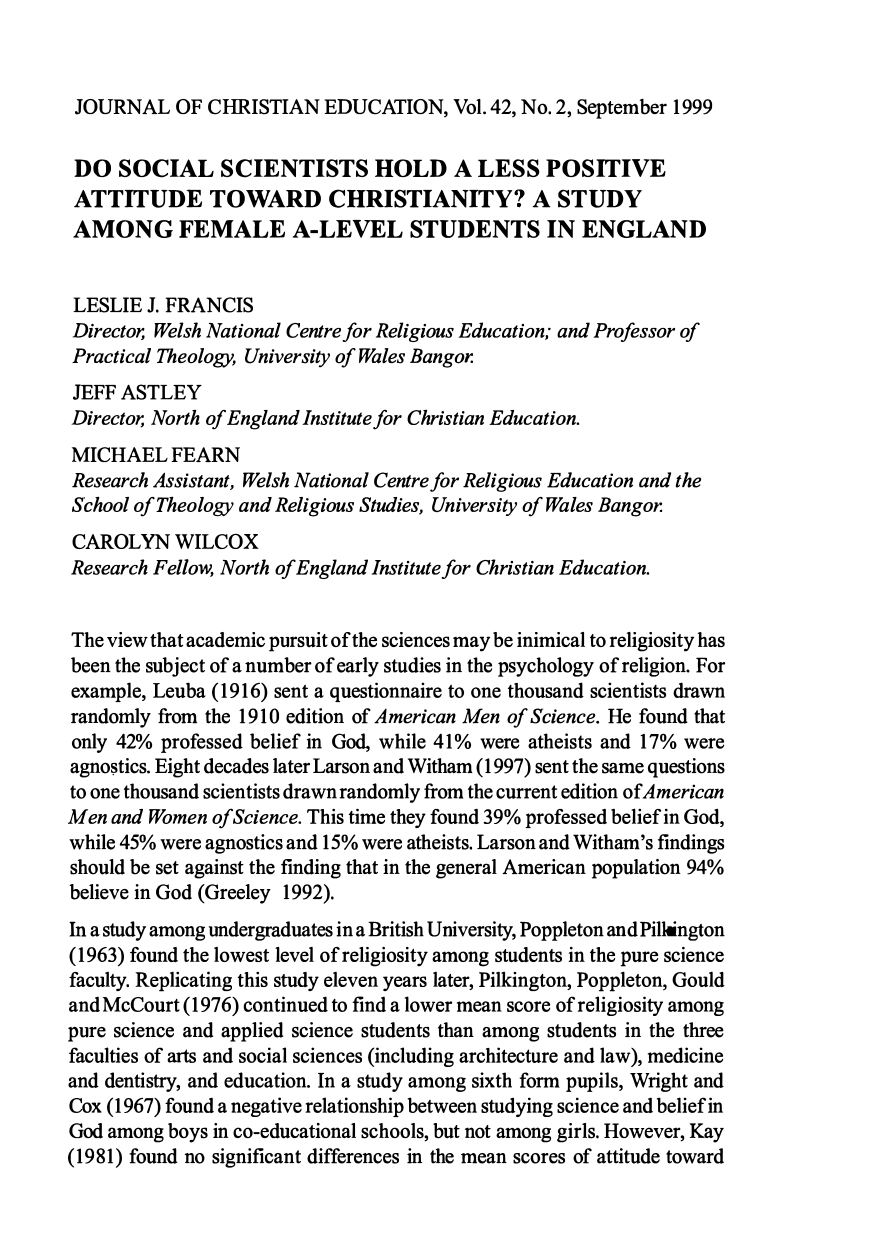
CarterM.KayW.K.FrancisL.J. (1996). Personality and attitude toward Christianity among committed adult Christias. Personality and Individual Differences, 20, 265–266.
2.
CronbachL.J. (1951). Coefficient alpha and the internal structure of tests, Psychometrika., 16, 297–334.
3.
DiducaD.JosephS. (1997). Schizotypal traits and dimensions of religiosity. British Journal of Clinical Psychology, 36, 635–638.
4.
EckertR.M.LesterD. (1997). Altruism and religiosity. Psychological Reports, 81, 562.
5.
FrancisL.J. (1978). Attitude and longitude: A study in measurement. Character Potential, 8, 119–130.
6.
FrancisL.J. (1989). Measuring attitude towards Christianity during childhood and adolescence, Personality and Individual Differences, 10, 695–698.
7.
FrancisL.J. (1999). Christianity and dogmatism revisited: A study among fifteen and sixteen year olds in the UK. Religious Education, (in press).
8.
FrancisL.J.JonesS.H.WilcoxC. (1997). Religiosity and dimensions of psychological well-being among 16–19 year olds. Journal of Christian Education, 40, 1, 15–20.
9.
FrancisL.J.LewisJ.M.PhilipchalkR.BrownL.B.LesterD. (1995). The internal consistency reliability and construct validity of the Francis scale of attitude toward Christianity (adult) among undergraduate students in the UK, USA, Australia and Canada. Personality and Individual Differences, 19, 949–953.
10.
FrancisL.J.WilcoxC. (1996). Religion and gender orientation. Personality and Individual Differences, 20, 119–121.
11.
FulljamesP. (1996). Science, creation and Christianity: A further look. I FrancisL.J.KayW.K.CampbellW. S. (eds.), Research in Religious Education (pp. 257–266). Leominster: Gracewing.
12.
GreeleyA. (1992). Religion in Britain, Ireland and the USA. In JowellR.BrookL.PriorG.TaylorB. (eds.), British Social Attitudes: The 9th report (pp. 51–70). Aldershot: Dartmouth Publishers.
13.
HogeD.R.KeeterL. (1976). Determinants of college teachers' religious beliefs and participation. Journal for the Scientific Study of Religion, 15, 221–235.
14.
JonesS.H.FrancisL.J. (1996). Religiosity and self-esteem during childhood ad adolescence. I FrancisL.J.KayW.K.CampbellW.S. (eds.). Research in Religious Education (p. 189–205). Leominster: Gracewing.
15.
JonesV. (1970). Attitudes of college students and their changes: A 37-year study. Genetic Psychology Monograph, 81, 3–80.
16.
KayW.K. (1981). Subject preference and attitude to religion in secondary school. Educational Review, 33, 47–51.
17.
KayW.K.FrancisL.J. (1996). Drift from the Churches: Attitude toward Christianity during childhood and adolescence. Cardiff: University of Wales Press.
18.
KayW.K.FrancisL.J.GibsonH.M. (1996). Attitude toward Christianity and the transition to formal operational thinkng. British Journal of Religious Education, 19, 45–55.
19.
LarsonE.J.WithamL. (1997). Scientists are still keeping the faith. Nature, 386, 435–436.
20.
LehmanE. (1973). Academic discipline and faculty religiosity in secular and church related colleges. Journal for the Scientific Study of Religion, 13, 205–220.
21.
LehmanE.C.JrShriverD.W. (1968). Academic disciplines as predictive of faculty religiosity. Social Forces, 47, 171–182.
22.
LehmanH.C.WittyP.A. (1931). Certain attitudes of present-day physicists and psychologists. American Journal of Psychology, 43, 664–678.
23.
LeubaJ.H. (1916). The Belief in God and Immortality: A psychological, anthropological and statistical studyBoston: Sherman, French & Co.
24.
LeubaJ.H. (1934). Religious beliefs of American scientists. Harper's Monthly Magazine, 169, 292–300.
25.
LewisC.A. (1996). Religiosity and obsessionality In FrancisL.J.KayW.K.CampbellW. S. (eds.), Research in Religious Education (p. 219–227). Leominster: Gracewing.
26.
LewisC.A.JosephS.NobleK.E. (1996). Is religiosity associated with life satisfaction?Psychological Reports, 79, 429–430.
27.
PilkingtonG.W.PoppletonP.K.GouldJ.B.McCourtM.M. (1976). Changes in religious beliefs, practices and attitudes among university students over an eleven-year period in relation to sex differences, denominational differences and differences between faculties and years of study. British Journal of Social and Clinical Psychology, 15, 1–9.
28.
PoppletonP.K.PilkingtonG.W. (1963). The measurement of religious attitudes in a university population. British Journal of Social and Clinical Psychology, 2, 20–36.
29.
RobbinsM.FrancisL.J. (1996). Are religious people happier? A study among undergraduates. In FrancisL.J.KayW.K.CampbellW. S. (eds.), Research in Religious Education (p. 207–217). Leominster: Gracewing.
30.
SPSS Inc. (1988). SPSSX User's Guide. New York: McGraw-Hill
31.
ThalheimerF. (1973). Religiosity and secularisation in the academic professions. Sociolog of Education, 16, 183–202.
32.
ThurstoneL.L.ChaveE.J. (1929). The Measurement of attitude: A psychological method and some experiments with a scale of measuring attitude toward the church. Chicago: University of Chicago Press.
33.
TjeltveitA.C.FiordalisiA.M.SmithC. (1996). Relationships among mental health values and various dimensions of religiousness. Journal of Social and Clinical Psychology, 15, 364–377.
34.
WrightD.CoxE. (1967). Religious belief ad co-education in a sample of sixth form boys and girls. British Journal of Social and Clinical Psychology, 6, 23–31.
35.
YoungR.K.DustinD.S.HoltzmanW.H. (1966). Change in attitude toward religion in a Southern University. Psychological Reports, 18, 39–46.