




Abstract
Historically, educators and policymakers have viewed Black students from a deficit lens, often presuming they lack the necessary skills needed to become academically successful. Today, teachers have countered deficit framing of Black students by learning more about and incorporating Black students’ assets and critical views of the world into their learning. One issue teachers run into, however, is knowing how to incorporate Black students’ cultures in their classroom learning. Using an embedded case study, this study analyzes how one white teacher draws on Black students’ cultural capital and the ways it impacts students’ classroom experiences. Findings reveal that disconnecting Black students’ cultural capital from their classroom learning is still an issue for teachers, resulting in simplistic assignments for Black students. This study also reveals that teachers may not know enough about Black students to draw on their cultural capital. Implications share that understanding Black students’ cultural capital is another way to expand what more teachers need to know about students to deepen their practice and aid in Black students’ academic success.
Plain language summary
This study is about how one white teacher utilizes Black students’ strengths. Findings reveal that teachers still do not meaningfully connect Black students’ strengths into their classroom learning, resulting in simplistic assignments for Black students. This study also reveals that teachers may not know enough about Black students to draw on their strengths. Implications share that understanding Black students’ strengths (later described as students’ “cultural capital”’) is another way to expand what more teachers need to know about students to deepen their practice and aid in Black students’ academic success.
Keywords
Historically, educators and policymakers have viewed Black students from a deficit lens (Valencia, 1997), often labeling them as “at-risk” or “troubled” and presuming they lack the necessary skills needed to become academically successful (see critique by Ladson-Billings, 2014). As a result, Black students have often experienced frustration (Tyson, 2003), microaggressions (Allen et al., 2013) and less rigorous work because of teachers’ lowered expectations (Davis, 2014; Marsh & Noguera, 2017; Oakes, 1992).
Today, many teachers recognize the need to counter deficit views of Black students by acknowledging students’ lived experiences as relevant to their learning. However, many teachers struggle in knowing how to effectively integrate Black students’ cultural backgrounds into classroom learning. Rather than collaborating with students and families to integrate their knowledge into curriculum and lessons, many teachers simply teach about culture (Sleeter, 2012), missing how students’ cultural backgrounds fundamentally shape their learning processes (N. S. Nasir, 2000). This often results in teachers implementing “foods and festival” models where school-wide cultural celebrations are used to highlight aspects of students’ cultures, such as their favorite food, rather than embedding students’ cultures to support their everyday learning (Ladson-Billings & Dixson, 2021).
As a way to problematize how teachers incorporate Black students’ cultures, this study examines how and why integrating Black students’ strengths and cultures remains a challenge for teachers. This study is especially important because it occurred during the COVID-19 pandemic, providing context for what more we can learn from this time period and beyond. Despite the focal teacher being identified as “culturally relevant” by community members, this study examines how one white teacher inconsistently engages with young Black students’ cultures, often failing to incorporate their assets, and analyzes how this limited engagement impacts students’ classroom experiences. Using an embedded case study, the Community Cultural Wealth model (Yosso, 2005), and asset-based pedagogy literature, such as Culturally Relevant Pedagogy (Ladson-Billings, 1995), I analyze how culturally relevant teachers can improve their practice by integrating students’ cultural capital.
Theoretical Framework
This study uses the Community Cultural Wealth model (CCW; Yosso, 2005) and Culturally Relevant Pedagogy (CRP; Ladson-Billings, 1995) as a lens to study two phenomena: (1) Black students’ knowledge and cultural capital, and (2) how teachers embed students’ cultural capital in the classroom—which can be seen through asset-based pedagogies such as CRP. Given the decades of research on CRP and its positive impact on educational outcomes (Civil & Khan, 2001; Howard & Rodriguez-Minkoff, 2017), this study emphasizes the importance of CRP for Black students and educators, while examining its current limitations for teachers: ways to deeply understand and incorporate students’ cultural backgrounds. Because of this, I argue that integrating the CCW framework with CRP would enhance teachers’ ability to comprehend and leverage students’ cultural assets in their practice.
Culturally Relevant Pedagogy (CRP)
Ladson-Billings’ (1995) work on CRP asserts students of Color can become academically successful when teachers: (1) use students’ home cultures to teach subject matter content, (2) allow students to learn about cultures different from their own, and (3) help students become critical of the world around them. Research around CRP has resulted in: improved student engagement (e.g., Emdin, 2008; May, 2010), students feeling empowered to discuss the love of their own culture (e.g., Lynn et al., 1999; Singer & Singer, 2004), civic engagement (e.g., Tate, 1995), students developing skills to understand multiple perspectives (e.g., Martell, 2013), and students engaging in more meaningful projects (e.g., Hefflin, 2002). For example, to support students’ academic success, teachers have modeled metacognitive processes that demonstrate complex thinking strategies (Lee, 1995) and implemented targeted skill-building approaches (Howard, 2001). In order to encourage cultural competence, Lynn et al. (1999) found that methods such as “critical conversations” allowed Black students to discuss their culture while exploring connections with other minority groups, particularly around social justice issues. Some teachers have even guided students to address community issues and foster a critical consciousness through identifying issues, researching solutions, and implementing strategies (Tate, 1995). These studies demonstrate that culturally relevant pedagogy not only provides a framework to foster academic excellence, it also empowers students to critically examine and improve their communities. For teachers, especially, CRP is an asset-based framework that helps them see students’ cultures as an asset to learning versus an obstacle, creating environments where students thrive both academically and culturally.
Critiques of CRP: Encapsulating Students’ Cultures in a Limiting Manner
Despite its theoretical promise, scholars have raised important critiques about CRP’s implementation in practice (Elmesky & Marcucci, 2023; Schmeichel, 2012). One significant concern centers on how teachers conceptualize culture, where some scholars believe CRP limits what educators think about students and how students think about themselves. For example, Schmeichel (2012) asks:
What happens, then, when an African American student fails to respond to strategies which have been designed to complement her culture? Does this make her less than African American? Has she been, to use a familiar term, culturally deprived, if she doesn’t share an interest in classroom activities planned with her cultural group in mind? (p. 223)
Schmeichel’s (2012) critique is important for three reasons: (1) it questions how educators think about culture, (2) problematizes how teachers’ limited cultural knowledge constrains CRP’s implementation, and (3) it presents an argument that classroom activities can be planned for entire cultural groups as monoliths. While Ladson-Billings (2014) views culture as “an amalgamation of human activity, production, thought, and belief systems” (p. 75), she acknowledges students often encounter only “static images of cultural histories, customs, and traditional ways of being” (p. 75). Effective culturally relevant teachers understand that “no one individual is the embodiment of an entire culture” and students “participate in a range of cultural practices” (Ladson-Billings & Dixson, 2021, p. 123). When implementing CRP, educators must recognize the “fluidity and variety within cultural groups” (Ladson-Billings, 2014, p. 77) rather than relying on static cultural assumptions. Critiques of CRP reveal a greater need to clarify what culture looks like and ways to identify it. Furthermore, it reveals the need to clarify what culture is and what it looks like for students. As a start, I have incorporated CCW into CRP’s framework to address these limitations in the current study.
Community Cultural Wealth
By using Yosso’s (2005) CCW model, educators can have a better understanding of students’ cultures and the “fluidity” within their cultures. Yosso’s CCW model argues that communities of Color have a wealth of resources in the form of “cultural capital” that are useful for navigating a racist and oppressive society that views them from a deficit perspective. Yosso argues that communities of Color have six forms of cultural capital (aspirational capital, navigational capital, social capital, linguistic capital, familial capital, and resistant capital)—all of which counter deficit framing literature that states communities of Color, including Black students, lack social mobility (Bourdieu, 1986) and are “culturally poor” compared to white, upper class citizens. Below I share three of the six forms of cultural capital identified in this study’s findings and examine how they shape Black students’ experiences within the education system. Finally, I explain how the CCW model enhances CRP by addressing its limitations and emphasizing the importance of understanding students’ cultural backgrounds, or cultural capital.
Aspirational Capital
Yosso shares that aspirational capital is the ability to preserve ambitious dreams even when confronted with difficulty. Black students experience this capital with the help of their family’s encouragement (e.g., Lane & Id-Deen, 2020; Samuelson & Litzler, 2016), often counteracting deficit narratives that question Black students’ ability to achieve their goals despite systemic barriers (Samuelson & Litzler, 2016). Because “aspirations are developed within social and familial contexts,” Yosso (2005) notes that aspirational capital often overlaps with each of the other forms of capital (p. 78). Understanding aspirational capital is crucial for educators because it reveals how Black students and their families maintain hope and academic ambitions despite systemic barriers. When educators recognize this concept, they understand that Black students’ ability to maintain high aspirations is not developed in isolation, but is actively nurtured through family support systems and cultural practices—challenging deficit-based perspectives that might underestimate their potential or overlook their sources of resilience.
Familial Capital
Yosso (2005) defines familial capital as the knowledge nurtured within and between families. For Black students, familial capital can be seen in the ways students rely on their families’ histories and experiences to contextualize why they pursue their dreams and persist in their educational journey, such as earning a college degree (e.g., Brooms & Davis, 2017; Holland, 2016). Familial capital is important to Black students because their connections to their families become a source of refuge and care. Understanding familial capital is essential for teachers because it illuminates how Black students’ family connections and historical knowledge serve as powerful resources for academic motivation and emotional support. When teachers recognize familial capital, they gain insight into how family histories, stories, and experiences shape students’ educational aspirations and persistence.
Navigational Capital
Navigational capital refers to the skills needed to maneuver social institutions that were “not created with communities of color in mind” (Yosso, 2013, p. 80). Many studies that examined navigational capital often looked at how students of Color navigated schools, particularly higher education (e.g., Cooper et al., 2017; Samuelson & Litzler, 2016). Black students’ ability to navigate systems is connected to their social network (e.g., peers; teacher) or families (e.g., Forbes, 2016; Holland, 2016; McPherson, 2012). Thus, it’s important for educators to understand Black students’ navigational capital because it reveals how Black students develop and utilize specific skills to succeed within educational institutions that weren’t historically designed to serve them. This knowledge helps teachers recognize that Black students’ ability to navigate academic spaces is not by happenstance, but rather a developed set of strategies often supported by their social networks and families, including their teachers. Understanding navigational capital can help teachers become more effective allies in their students’ educational journeys.
Bridging CRP and CCW
By having a more definitive understanding of students’ cultures through their cultural capital (using the CCW model), culturally relevant teachers can more concretely enact CRP, lending toward students’ academic success. Furthermore, teachers’ understanding of students’ cultures positively impacts their classroom experiences. This cultural awareness helps counter deficit narratives, increases student engagement, reduces cultural misconceptions, and creates more inclusive learning environments (Davis, 2014; Ladson-Billings, 2021). To meaningfully improve students’ educational experiences, teachers must actively work to understand and incorporate their students’ perspectives and cultural backgrounds.
In the next section, I expound upon a gap in the literature where very few studies examine what young Black students’ cultural capital entails—particularly given the deficit narratives and disciplinary actions they face as early as preschool (Gilliam et al., 2016).
This gap in literature means that educators do not have a full understanding of how young Black students’ cultural capital influences their learning. Without this knowledge, teachers using culture-centered pedagogies like CRP cannot adequately recognize or leverage students’ cultural capital, limiting teachers’ ability to support academic success and creating the need for my study.
Literature Review
Deficit Framing
Dating as early as the 1600s, deficit thinking positions one group of people over another (Feagin, 1989; Menchacha, 1997). In schools, the deficit thinking model argues that students—particularly students of Color from low-SES families—fail academically due to “internal deficiencies” which have been attributed to genetics, culture, class, and familial socialization of people of Color (Valencia, 1997). This deficit perspective is problematic because it fails to examine the inequalities and injustices embedded in systems and institutions that disadvantage students of Color (Milner, 2017). Rather than addressing systemic failures, it incorrectly “diagnoses” school failure as stemming from what students of Color supposedly “lack,” instead of recognizing what the education system itself lacks.
Deficit narratives continue today through “veiled arguments” about what Black children, especially those in poverty, supposedly lack from their families and home environments (Lee, 2007, p. 9). Such deficit framing portrays Black students as deficient and unintelligent, while contemporary rhetoric labels them as “in crisis” or “failures,” leading to counterproductive approaches that blame students rather than systems (Dumas, 2015).
Deficit Framing Shaping Students’ School Experiences
When teachers operate from a deficit perspective toward students of Color, the consequences directly impact educational outcomes. These include placement in lower academic tracks (Oakes, 1992), disproportionate referrals of Black students to special education compared to white peers (Howard & Rodriguez-Minkoff, 2017), and higher rates of disciplinary actions against Black students (Morris, 2005; U.S. Department of Education Office for Civil Rights, 2014).
Changing the Deficit-Framing Narrative
In contrast to viewing students of Color from a deficit lens in schools, educators who have utilized the CCW model by centering students’ cultural capital have been able to help students reach their career goals (e.g., Lane & Id-Deen, 2020; Samuelson & Litzler, 2016), reminded students of the importance of their families’ past stories and experiences to navigate college (e.g., Rosbottom, 2016), and been a form of social capital as they navigate institutions (e.g., Forbes, 2016; Holland, 2016).
Gap in CCW Literature
While various scholars use Yosso’s (2005) CCW model to highlight the CCW of students’ of Color at various stages in students’ lives including middle school (e.g., Baker, 2019; Jimenez, 2019), high school (e.g., Liou et al., 2015), out-of-school programs (e.g., Habig et al., 2021), college (e.g., Oropeza et al., 2010; Samuelson & Litzler, 2016), and post-secondary education (e.g., Espino, 2014), there are very few studies that focus on the cultural capital of Black elementary students. To my knowledge, only one study focuses on Black elementary students: Bean-Folkes and Ellison (2018). Bean-Folkes and Ellison (2018) use Yosso’s (2005) CCW model to highlight what it might mean to use Black students’ cultural capital as a way to develop third to eighth grade students’ digital literacy. Yet, educators still have a lot to learn about young Black students’ cultural capital and ways to embed it in the classroom that includes insights of students younger than third grade.
There is a need for CCW in K-12 schools, particularly for younger students. Acevedo and Solorzano (2021) add to this argument by sharing that using CCW in K-12 schools “has the potential to create a wave of opportunities to resist against the marginalizing experiences [students of Color] have to navigate” (p. 12). CCW serves as a powerful response to racist experiences young students of Color face, directly countering harmful deficit orientations that have particularly impacted Black students. As a direct response to Acevedo and Solorzano’s (2021) call for action, my study centers Black, elementary students’ perspectives and identifies the cultural capital Black students bring from home that “most often go unacknowledged or unrecognized” (Yosso, 2005, p. 70), but that can be utilized in classrooms to support their learning.
Methods
In this study I ask: How does one white teacher draw on Black elementary students CCW in their class? Data was taken from a larger study that identified young Black students’ cultural capital and examined one teacher’s practices during the COVID-19 pandemic (Quince, 2022). The current study used an embedded, single-case study design to understand the experiences of one white teacher and six Black elementary students in the same classroom. I used an embedded, single-case study design because it allowed me to explore a single, bounded entity, or “case,” in detail in order to gain the perspective of my participants—both the teacher and students (Creswell, 2007; Merriam, 1998; Yin, 2014). Furthermore, a case study design allows me to study young, Black students’ experiences in the classroom and the cultural capital that young, Black students bring with them from home—two phenomena that are not well understood given the literature on CCW, where few studies focus on young, Black students’ cultural capital and their perspectives (Merriam, 1998). Secondly, a case study design allows me to “bound” my data collection, given the context of my study, by time and place (Creswell, 2007; Yin, 2014). Because the context of my study takes place at a predominantly Black elementary school during the COVID-19 pandemic, I am able to focus on the population of students that I am interested in learning from: young, Black students. Within the context of the school, the classroom was “bounded” or chosen because the teacher’s classroom (and thus the teacher within the classroom) was nominated by families and school leaders as a classroom that helped students succeed in school, valued their family and community, and helped students think about the world around them.
Context
This study took place at Madison Academy, 1 a public, K-8 charter school in Northland, an urban city in the Midwest, during the 2020–2021 school year. This school year happened during the COVID-19 pandemic, which meant that classroom learning was modified to prevent the spread of the COVID-19 virus and led to classroom learning using a hybrid learning model where students were on Zoom for 3 weeks (April 12, 2021–April 30, 2021) due to the governor’s order. Then, Madison Academy used a hybrid model for the remainder of my study (May 2021–June 2021). I selected Madison Academy because it had a high percentage of Black students (99%); I had a trusting relationship with the vice principal (with whom I had previously taught); and my key point of contact—the vice principal—had and shared specialized knowledge of the school community (Hesse-Biber, 2017).
Participants
The participants from the larger study consisted of six Black second grade students in the classroom and their white teacher (“Mrs. S”). Consistent with a case study approach, the teacher was selected using purposive sampling (Merriam, 1998), which uses specific criteria to gain insight into a phenomenon. Because my phenomenon of interest—whether and how Black elementary students’ cultural capital was embedded in their classroom experiences—was reflective of asset-based pedagogies, I asked parents and school leadership to recommend a teacher who supported students in culturally relevant ways. To do so, I presented the three tenets of Ladson-Billings’s (1995) culturally relevant pedagogy (academic success, cultural competence, and sociopolitical consciousness) to school leadership and asked which teachers they believed were helping students become academically successful (academic success), incorporating Black culture into the classroom (cultural competence), and applying student learning to real-world problems (sociopolitical consciousness). Later, I presented my study to parents and sent a survey that asked parents, “Is there a teacher who has helped your child succeed in school, values their family and community, and/or thinks about the world around them?” After reviewing parent survey responses (15 total) and talking with the school leadership team, the focal teacher, Mrs. S, was selected.
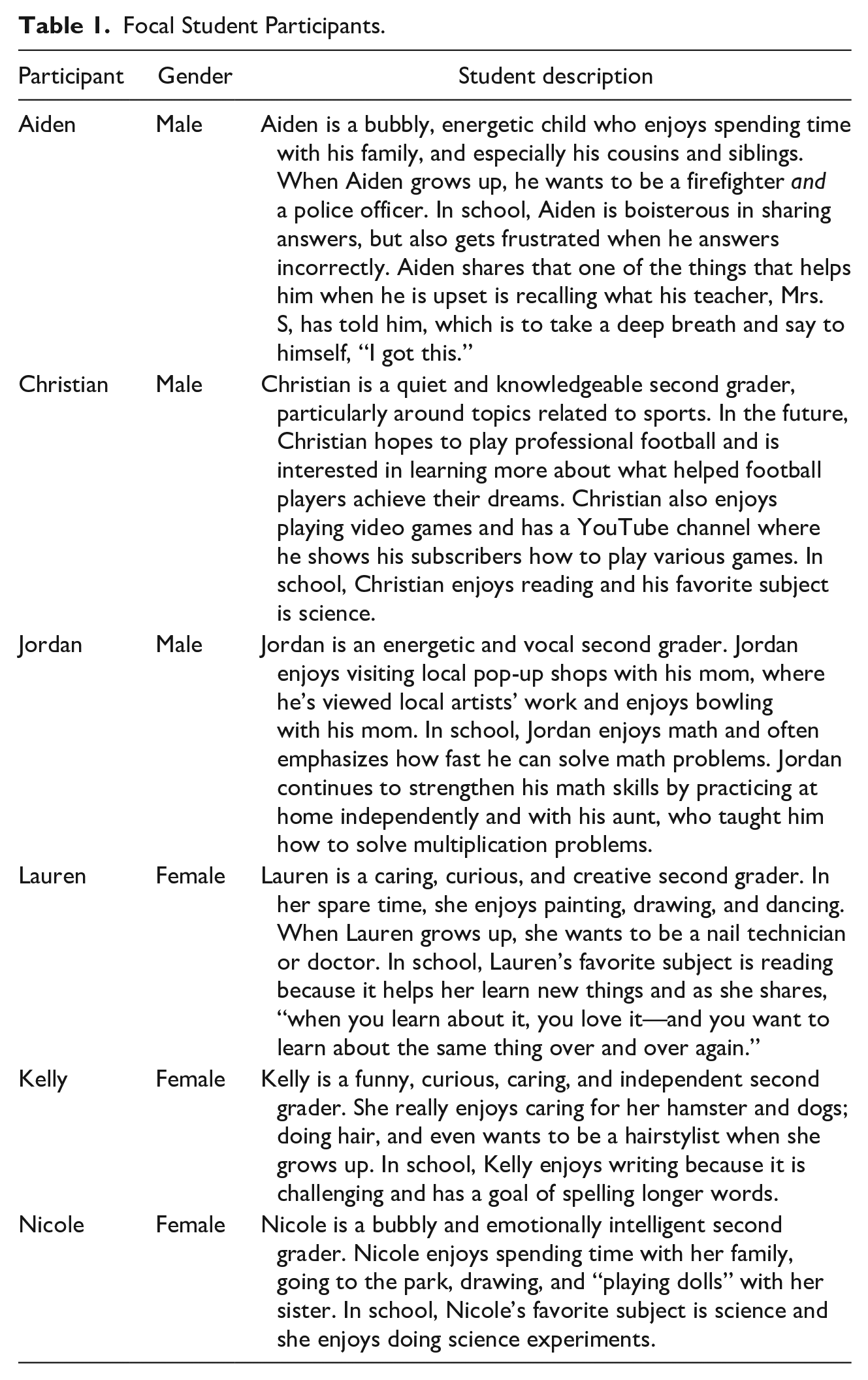
Mrs. S’s classroom consisted of 25 second-grade students. Given the hybrid model—where 3 days out of the week students were on Zoom and the remaining 2 days students could opt-in to attend in-person—only 10 out of the 25 students opted to meet in person for 2 days out of the week during the course of the study. Because of this, I worked with Mrs. S to solicit the six focal students. Mrs. S identified students who consistently attended school in-person and on Zoom. Once students were identified, I presented the study’s intent, gained consent from their parents, and assent from the focal students to participate in the study. I described in detail each focal student in the larger study (Quince, 2022), but include brief details about each student in Table 1.
Focal Student Participants.
Data Sources
Data for my study comes from a larger study (Quince, 2022) which included video recorded one-on-one interviews with the teacher (“Mrs. S”) and with six focal second-grade students, photographs taken by students and discussed in interviews (also called photovoice interviews), classroom artifacts, and field notes from observations of students’ classroom experiences. Using photovoice interviews, in particular, allowed students to capture photos they wanted to share, explain why they were important, and the meaning behind them (Wass et al., 2020) as I learned more about whether and how the teacher embedded students’ cultural capital in the classroom.
In total I spent 100 hr doing classroom observations, 17 hr (approximately 1,024 min) in seven one-on-one interviews with each student, and 3 hr (approximately 191 min) in two one-on-one interviews with the teacher. Students also submitted a total of 132 photos for the five photovoice interviews they completed. The current study centers the classroom observations, photovoice interviews with students, and the one-on-one interviews with their teacher.
Data Analysis
Data analysis for this study followed Yin’s (2014) ground-up approach, where I used theoretical propositions to code for students’ CCW and then for how students’ CCW was represented in their learning (e.g., a reflection of CRP). I began by transcribing each one-on-one interview and identified recurring patterns in students’ home and school lives, highlighting both unique individual experiences and common trends shared by several students. Then, by using Yosso’s (2005) CCW model, which aligned with Yin’s ideals around theoretical propositions in their ground-up approach, I analyzed how my data supported or negated the CCW model. For instance, when students mentioned examples that represented their understanding of family values (Yosso, 2005), I coded it as “Familial capital.” In addition, I found evidence of strengths students had that did not fit within one of Yosso’s six forms of capital. This disconfirming evidence was useful to explore because it allowed me to create a code that I named “Knowledge students know (not school related).” Examples of findings that fit within this code included skills students had around technology and the ways some students expressed their creativity through doing hair and decorating.
To ensure the accuracy of my findings, I used Guba and Lincoln’s (1981) criteria for naturalistic inquiry. Thus, I (a) adjusted and developed new codes if the data did not reflect an example of one of Yosso’s six forms of capital, or how it was represented in classroom observations, (b) conducted member checks with both teacher and students to ensure the research reflected their perspectives, (c) reviewed to see to what extent the methods and findings could be replicated given the context of the study, and (d) used an outside rater (a university student) to review, provide feedback on codes I developed, and ensure that the findings were not solely influenced by my own biases. The outside rater and I came to a consensus on codes by sharing Yosso’s definition of each form of capital, reviewing the code created, and sharing if we were in agreement.
Findings
Overview
Throughout my time in the classroom—both online and in hybrid learning—I observed the ways the teacher, Mrs. S, taught content areas, such as math and literacy and the ways she presented positive stories of Black people during a learning period called “advisory.” I also found that when Mrs. S taught content areas, she rarely incorporated students’ cultural capital. In addition, the positive stories shared in advisory did not connect to content areas like literacy and math. Advisory’s attempts to focus on “Black culture”—per Mrs. S’s wording (Teacher Interview 1, April 14, 2021)—resulted in a common issue many teachers have when trying to implement asset-based pedagogies. Mrs. S treated students’ cultures (which in actuality were positive stories about Black people, not students’ cultures) as separate entities to learn about, instead of embedding students’ cultures into how they learn content (Ladson-Billings, 1995; Sleeter, 2012).
Because of this disconnect, I also explored how Mrs. S’s interpretations and presentation of what she believed Black culture to be—as separate from content areas—leaves little room for students to draw on their cultural capital as they learn other subjects throughout the school day. Furthermore, I share how the types of connections Mrs. S made in class (both in advisory and while teaching content subjects) focused on minor interests in students’ lives, such as their favorite food or drink, and did not connect students’ cultures and the skills they have learned from their families (their cultural capital) to their classroom learning. Below I share examples of focal students’ forms of cultural capital and then analyze the disconnect and disregard Mrs. S makes embedding Black students’ cultural capital into their classroom learning, and ultimately the cost of overlooking Black students’ cultural capital.
Black Students’ Cultural Capital
In the larger study (Quince, 2022), students demonstrated all six forms of cultural capital, though this article focuses specifically on their familial, navigational, and aspirational capital. Lauren, for example, shares the ways racism operates in her daily life—a reality many Black children, including elementary students, learn from their families. In Lauren’s photovoice interview, she shares a “Black Lives Matter” sign, and discusses what she’s seen about police brutality and her fear around police officers (see Figure 1). Despite Lauren’s fear, though, she discussed ways she and her mom began problem-solving and what they could do to address racist practices. Lauren states, “I remember one day that I said to my mama. . .it’s like, I wanna open a lemonade stand and have a ‘Black Lives Matter’ thing. You know, write it down. . .where we can share some love and to show that they’re [Black people] really not who they think they are and to show that they’re really nice and beautiful.” Lauren’s casual conversation around how Black people are treated compared to the violence that took place that initiated the 2020 Black Lives Matter movement speaks to how “normal” racism is in our society and how Lauren may believe everyday ideas can address “normal” problems for Black people. This way of thinking stemmed from conversations with her mom—Lauren’s familial capital—but were never reflected in Lauren’s classroom learning.

A photo Lauren uses to reference the Black Lives Matter movement.
Furthermore, Lauren’s mother demonstrated navigational capital by skillfully balancing hard truths with emotional support. She helps Lauren confront her fear of police by providing age-appropriate strategies while honestly acknowledging the realities Black Americans face. This guidance equips Lauren with tools to navigate racist systems, exemplifying how Black parents carefully prepare their children for racial challenges while maintaining a foundation of love and affirmation.
Students also shared their aspirational capital—or the dreams they wanted to accomplish. Jordan, for example, shared his desire to become a doctor and the help he received from his aunt. Jordan stated, “My aunt, like she’s not mean, but she’s tough. I’m okay with it because I know she is forcing me to do good and that is forcing me to always be better” (see Figure 2). Jordan’s interactions with his aunt often included him practicing his math problems and reading a diverse range of books because his aunt often reminded him of what was required to be an informed doctor. Despite Jordan wanting to do other things, Jordan reminds us that his aunt’s “tough” love is important, given the insight she has about his aspirations and wanting him to “always be better.” Despite Jordan’s discussion of his aspirational capital—it was never utilized or explicitly connected in classroom interactions.

A photo Jordan uses to reference his aspirational capital.
Classroom Learning Neglected Black Students’ Cultural Capital
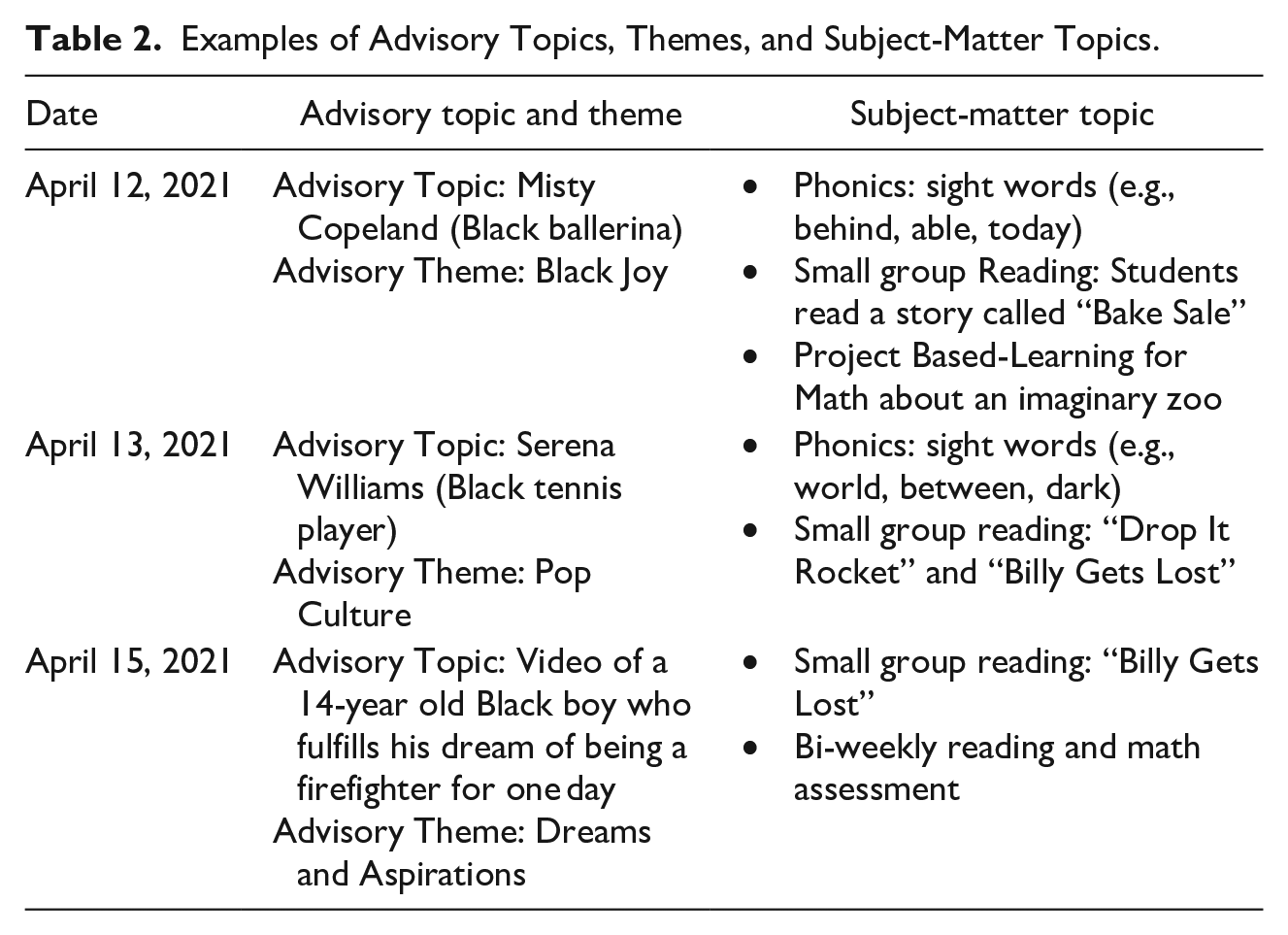
Given my observations of students’ experiences in class, there were limited moments where students had the opportunity to speak about their forms of capital in a substantive way. Advisory provided students an opportunity to see their own culture from an asset-based lens. Yet, once advisory ended, discussions around those same positive stories around Black people ended as well. As shown in Table 2, the connections to what students learn in advisory do not overlap with what students learn in phonics, reading, or math. For example, on May 4, 2021, Mrs. S introduces to students what affirmations are in advisory and shows a video of a Black dad practicing affirmations in the mirror and then Mrs. S has students practice sharing their own affirmations. Students, including Lauren share examples such as, “I am worthy. I am special. I am smart” (Observation Field Notes, May 4, 2021). Immediately after, Mrs. S transitions students to phonics and has them practice writing vocabulary words in alphabetical order (e.g., “happy,” “our,” “first,” “gave,” “last”) review long vowel sounds, have a brain break, learn about homophones and plural nouns, have another brain break, and then the morning ends with reading where Mrs. S pulls students for small groups while other students read independently (Observation Field Notes, May 4, 2021). During my study, I never observed Mrs. S use topics explored during advisory to support students’ learning of subject matter content during or after the advisory time block. This finding aligns with Walker’s (2011) study which suggests that a reason teachers do not connect subject matter content to learning is because teachers need to learn more about using students’ cultures throughout the curriculum and across disciplines.
Examples of Advisory Topics, Themes, and Subject-Matter Topics.
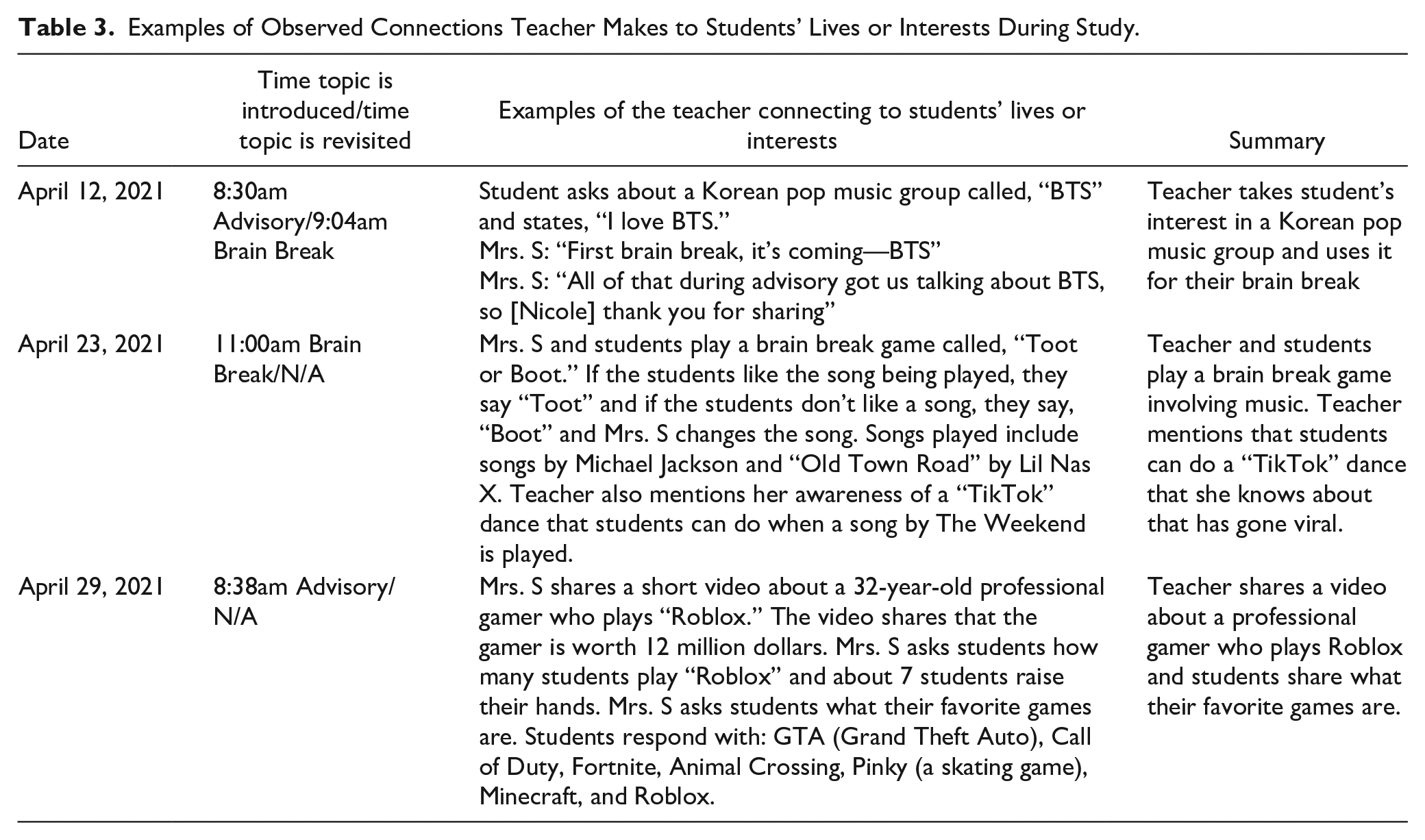
Instead of incorporating students’ cultural capital into content-area learning, Mrs. S incorporated students’ every day interests in class (see Table 3). For example, Mrs S. created a math project called, “The Smoothie Project.” In this project, students were asked to tally the cost of ingredients to make a smoothie of their choice and then Mrs. S double-checked their calculations so that they could create a smoothie using real ingredients.
Examples of Observed Connections Teacher Makes to Students’ Lives or Interests During Study.
Mrs. S shares:
. . .smoothies weren’t even a part of it. That was just—we had gone off on favorite, like, to-go spots. I don’t know. . .I ask questions. . .like, I try to gauge things. And I just feel like, okay, like at the end of the day, they’re kids so they’re going to like the hands on. . .activity right? Like, I assume, because that’s more fun than, you know, writing on the board or something (Teacher Interview 2, June 15, 2021).
Mrs. S believed that incorporating students’ interests by creating smoothies was an easy connection to make. But the extent to which the project drew on students’ knowledge is minimal and simplistic. Furthermore, it does not allow students a chance to connect aspects of their cultural capital to how they might learn content subjects. Many of the students know how to make smoothies. But, again, the project does not draw on anything more complex that students might know or extend students’ thinking. This is not to say that Mrs. S should exclude students’ interests, but rather the connections she made are not substantive or culturally relevant.
To learn more about Mrs. S’s understanding of culturally relevant teaching, Mrs. S shared that she draws on students’ home lives, including the music, dances, and foods students like. I often saw examples of this during the students’ brain breaks where students mentioned a food they enjoyed eating for lunch. After lunch Mrs. S even participated in a game with students called, “Would You Rather?” During the impromptu game students compared some of their favorite foods or interests (e.g., “Would you rather eat hot Cheetos or Takis for the rest of your life?”). My conversations with Mrs. S also led me to learn during our first interview that she is often intentional in knowing what students’ interests are. She states:
I try and make all the connections, like listen to their [music]—they listen to music, I’m like let me hear it. Let’s share it. Okay, video games, like dance moves, types of foods, like, I mean those connections are happening daily. But again, I’m not sure if that’s, like, not deep enough of a home connection. That’s just, like, [a] “getting to know your students” connection. I don’t know. (Teacher Interview 1, April 14, 2021).
Mrs. S is aware of the importance of making connections with students, including what’s happening in their daily lives, but also shows hesitancy in whether the connection is “deep enough” for students. In both examples (“The Smoothie Project” and how Mrs. S continues to make daily interactions a way to learn more about students) it appears that Mrs. S’s connections do not draw on students’ cultural capital. The cost of this decision leads to the types of connections Mrs. S makes—less substantive—which in the interim are fine because they keep students’ engaged. However, the cultural difference and cost-benefit of this decision compared to the work families are putting in through their familial or aspirational capital is what will last with students in the long-run, given the impact families have on students’ lives.
Discussion
Challenging Deficit-Oriented Literature
Despite deficit-oriented literature on Black students (e.g., Deutsch, 1964; Gladwin, 1961), this article reveals that Black students—and even young, Black students—have cultural capital that helps them navigate school and a world that often frames them from a racist and deficit perspective (Valencia, 1997). The focal students’ point of view in my study directly counters historical research that shows students of Color have “internal deficiencies” where families are seen as “the transmitter of deficiencies” (Valencia, 1997). My findings show that for young Black students, families are a major contributor to their knowledge and cultural capital. These findings are important because it shows young Black students are receptive to their families’ support. Students’ forms of cultural capital are especially useful because we live in a world that frames Black students as unsuccessful, lazy, “lost causes” and “intellectually impaired” (Davis, 2014; Valencia, 1997). While many studies focus on students of Color in college using each form of cultural capital in higher education institutions (e.g., Brooms & Davis, 2017; Foxx, 2014; Sáenz et al., 2017), my study shows a parallel where, even young Black students rely on their cultural capital and the emotional support from their families to move forward in their goals and navigate spaces.
Using CCW Model to Study Asset-Based Teaching Practices
Starting with students’ cultural capital allowed me, as the researcher, to see that students’ classroom experiences did not provide opportunities for students to draw on their cultural capital and offered a way to systematically examine and articulate those differences. What I found was that the types of connections Mrs. S made to students’ lives related to minor interests, such as students’ favorite foods. I also found that students’ classroom experiences highlighted positive stories of Black people during advisory, but their learning did not transfer over into subject-area learning like math and reading. While enlightening, highlighting positive stories of Black people during advisory and not aspects of students’ home culture (and consequently their cultural capital) can lead to a common issue many educators have when trying to implement asset-based pedagogies. Sleeter (2012) argues that oftentimes teachers end up teaching about culture, rather than embedding students’ culture into their learning opportunities. When teachers teach about culture, students miss opportunities to see how aspects of their culture can aid in their learning (Ladson-Billings, 1995). For example, using an asset-based pedagogy like culturally relevant pedagogy (Ladson-Billings, 1995) could mean Mrs. S would find ways to incorporate students’ home culture throughout the school day to help students become academically successful in different subject-areas. It also might mean that she could help students build their sociopolitical consciousness if she drew on the knowledge students have related to issues they’re interested in.
It is also apparent that while Mrs. S had good intentions in her efforts to keep students engaged through advisory, I would be remiss if I did not mention whether the COVID-19 pandemic had an impact on the ways Mrs. S taught, given her nomination as a culturally relevant teacher. Given the context of this study, where COVID-19 interrupted teachers’ traditional methods of teaching in the classroom, it is possible that Mrs. S and other teachers alike were simply trying to manage what they could. However, this study still leaves room for educators and researchers to question in what ways they understand culture and how it is and could be represented in the classroom. The disconnect between the focal students’ home culture and school also relates to a common issue teachers have, which is not drawing on students’ cultures. Instead teachers incorporate topics students are interested in, rather than incorporating students’ cultures. For example, while Emenahaha (2020)—the teacher and researcher in this study—cites her work as being culturally relevant, she uses students’ general interests in pop culture to help students learn science topics like genetics. While incorporating pop culture is helpful for engaging students, it is not the same as embedding students’ cultures, knowledge, and experiences, into students’ classroom learning. Furthermore, as it relates to this study, teachers need to move beyond engaging students and find more substantive ways to incorporate students’ cultures by learning more about their cultural capital, for example, and guiding students in critical conversations where their capital could be useful in learning content areas (Lynn et al., 1999).
Scholarly Significance
Given the cultural capital young, Black students have (see Quince, 2022), it is important that teachers continue learning about and talking with Black students and their families on what they know and do at home. These conversations should shift from learning about students’ interests (though, this is important), to learning about students’ CCW. This shift in perspective highlights students’ assets and can lead to teachers enacting asset-based pedagogies like CRP better. For example, using CRP could mean Mrs. S would help students build their sociopolitical consciousness if she drew on the cultural capital students like Lauren had on issues they’re interested in.
Naming and incorporating Black students’ cultural capital in schools is important because Black students are often reminded that their lives or thoughts don’t matter. Black students need to see and hear that they bring value to spaces and starting with what they know and do at an early age can shift Black students’ classroom experiences. Equally important, teachers need to know how to incorporate students’ cultural capital—including what it does not look like. There is a difference between capturing students’ interests and incorporating their cultural capital. This study adds to the body of literature that shares that teachers have good intentions and want to engage students in their classrooms, but may not recognize that teaching about culture (Sleeter, 2012) such as what Mrs. S did in advisory and incorporating students’ interests is drastically different than embedding students’ cultural capital into classroom learning. Literature shares that many educators recognize the issue in the “foods and festival” model (Ladson-Billings, 1995; Ladson-Billings & Dixson, 2021). But this study highlights that knowing Black students’ CCW is another way to expand what more teachers need to know about students to deepen their practice and aid in Black students’ academic success.
The cost of ignoring Black students’ cultural capital is far too high, given the outpour of deficit narratives seen in the media and in news outlets. As educators, we need to consistently challenge deficit narratives of Black students in much more substantive ways—which will reflect how serious we take Black students’ lives. In addition, by highlighting and utilizing Black students’ cultural capital in their learning, students will begin to leverage their own strengths and speak to them using language, including naming the forms of cultural capital they possess. There is power in language—and what we say and do not say will ultimately impact Black students’ confidence, reassurance, and their learning experiences for generations to come. In a world where Black lives’ values are constantly being put on the forefront, fostering an inclusive, rigorous space and at an early age is far too costly to ignore.
Footnotes
Declaration of Conflicting Interests
The author declared no potential conflicts of interest with respect to the research, authorship, and/or publication of this article.
Funding
The author received no financial support for the research, authorship, and/or publication of this article.

1.
All proper nouns, including student names, teachers, locations and schools are pseudonyms.