




Abstract
Ethnogenesis is a powerful mechanism which outlines how ethnic groups are formed. It is a complex process which often involves factors such as migration, cultural exchanges, intermarriage as well as religion. Ethnogenesis is also described as the historical and contemporary emergence of a group of people who define themselves in relation to a common socio-cultural and historical heritage. Focusing on African American migration during the Great Migration and its subsequent reverse migration, this study uses the theme of ethnogenesis to describe how migration to northern cities were shaped by a desire for solidarity and opportunity in as much as an escape from racial violence in the South. In the current trend of reverse migration, this work contends that migration is built on a need for opportunity as well as a desire for connectedness to ancestral homelands in the South. Examining the emergence of the “New South” in the post Jim-Crow landscape, this work evaluates the cultural, social and economic appeal of current migration streams. Using data from the Census Bureau’s American Community Survey (ACS) Public Use Microdata Sample (PUMS) files, significant population declines are reported in former destinations like San Francisco, Chicago, and New York. Data also show southern resurgences in destinations like Lafayette, Louisiana and Charlotte, North Carolina. Likewise, there are also marked increases in new destinations like Las Vegas, Nevada and Phoenix-Mesa-Glendale, Arizona. Additionally, data show that the Black population is growing in its diversity as well as density. People who identify as single-race Black, Black Latinx, and Black multiracial are a large (and growing) part of the Black population.
Introduction
One of the most significant demographic shifts in the United States was the Great Migration of African Americans. While movement from rural areas in the South to the Northern metropolitan areas was occurring prior to 1915, it took the outbreak of war in Europe to accelerate the streams of migration. Underscoring a watershed moment in American history, the Great Migration ushered in a cultural significance tied to movements like the Harlem Renaissance and the Chicago Black Renaissance—movements which exemplified a surge of artistic expression, black community organizing and social activity within the African American community. Sernett (1997) describes the Great Migration’s religious significance as migrants often claimed that they were “bound for the Promised Land” or part of an “exodus.” Coming largely from the rural areas of Mississippi, Alabama, Georgia and the Carolinas, migrants and their families moved to centers in New York, Ohio, Illinois and Pennsylvania. While the movement slowed during the Great Depression of the 1930s, Census Data indicates that in the 30-year period from 1940 to 1970, the movement continued to grow (during and after World War II). Between 1955 and 1960, over 300,000 people migrated to the North and Midwest. Driven by entrenched traditions of racism, segregation and scarcity of opportunity, African Americans moved north for freedom from Jim Crow, fairer wage labor and a fresh start (Price-Spratlen, 1998, 1999). Movement to the North was not however a freedom from racism as many Northern and Midwestern states began writing and enforcing discriminatory legislation to limit African American access to education, housing, home ownership as well as economic and social mobility. While policies such as redlining and restrictive covenants have been officially outlawed, African Americans in Northern and Midwestern cities continue to express frustration at the lingering effects of such policies and the sentiments which led to their creation and implementation.
By the 1970s, demographers documented the emergence of a counter stream of black migration as African Americans began to return to the South in greater numbers. With the demise of Jim Crow in the South and the reduction of economic opportunities in urban centers in the North and Midwest, many saw the economic and social utility for a return to the South. According to Harrison (2017), the economic boom which facilitated the post-World War II migration had started to subside by the 1970s. Many manufacturing plants which had lured African Americans were shuttered in the wake of a globalizing economy.
In a steady reversal, the percentage of African Americans returning to the South has been steadily increasing since the 1990s. Census data illustrates that the black population of the Atlanta metro area doubled between 1990 and 2020 surpassing 1 million. Likewise, Atlanta has overtaken Chicago as having the second largest concentrations of African Americans in the country—second only to the New York metro area. In the North and Midwest, researchers have described the reverse migration of African Americans as a black flight similar to the white flight of the 1960s (Tolnay & Beck, 1990). The greater Chicago area has lost over 46,000 residents since 2010. In Michigan, the Detroit and Flint metro areas have seen declines in their absolute numbers. Likewise, the St. Louis, Milwaukee and Cleveland metropolitan areas have also recorded declines in their African American population. Data from the U.S Census states that the New York metropolitan area has also recorded losses as well as metro areas in the West such as Los Angeles and San Francisco (Toukabri & Delbe, 2022).
Building on a growing body of research which documents the emigration of African Americans from Great Migration destinations, this work draws on the theme of ethnogenesis. Ethnogenesis is the process whereby ethnic groups come into being by defining and re-defining a common social structure. This means that while economic factors may be a large driving force for migration (just as they were during the Great Migration), they are not the only reason—selections of destinations are often influenced by more than just logistical convenience. Characteristics of destinations are known to play an important role in migration decision making. As such, movement is often based on the existence of community structures which provide “ethnogenic” support and structure. Price-Spratlen (1999, 1998) underscores the importance of regions with support systems such as the presence of a chapter for the National Association for the Advancement of Colored People (NAACP), National Urban League, African American newspapers as well as churches. Likewise, Pendergrass (2017) states that while many African Americans stated that their migration to the South was rooted in economic concerns, it was also tied to strong “ethnogenic” connections to religion and the Black church in the South. Examining the attractiveness of the South as a destination for return-migration, this work explores the emergence of the “New-South” and its economic growth since the late 20th century.
Using data from the Census Bureau’s American Community Survey (ACS) Public Use Microdata Sample (PUMS) files, this work provides details on changes in the size and geographic distribution of the Black population in the United States. Using the theme of ethnogenesis, this work documents the complex push factors in northern cities which prompted out-migration, this work also characterizes pull factors from the South which have sustained migration in recent years. Lastly, this manuscript evaluates the growing diversity of the Black population in the United States. As an increasing number of individuals identify as Black multiracial, Black Latinx as well as Black “single-race,” this work evaluates how this growing racial mosaic contributes to Black diversity in the United States.
Ethnogenesis, Place Utility, and Destination
Ethnogenesis is derived from two Greek words “ethnos” which means a group of people and “genesis” which means beginning. As a term, ethnogenesis refers to the formation of an ethnic group (Hill, 1996; Roosens, 1989). This group formation could occur through a number of different processes including migration as well as an amalgamation of different groups within the wider community. It may occur through either self-identification or outside identification processes. Within the context of the Great Migration—as well as reverse migration, ethnogenesis provides a lens to specify how African Americans have attached to new places while taking into account the roles their internal bonds, networks and institutions have played in these attachments. According _________to ethnic groups are:
Those human groups that entertain a subjective belief in their common descent because of similarities of physical type or of customs or both, or because of memories of colonization and migration; this belief must be important for group formation; conversely, it does not matter whether an objective blood relationship exists.
In a sense, ethnogenesis describes a hybridity without losing the familiarity of the ethnic group. Shaped by patterns of migration and geography, African Americans have built communities through evolving institutionalized practices seen through distinct food, churches, music and community supports. Considering that ethnogenesis varies in time and space, the Great Migration as well as reverse migration have also changed in time and space. Yet these two migration events are also bonded by a glue which defines their singularities as well as their complexities. One of such bonds is nostalgia. Wheeler (2017) states that nostalgia bridges the past and present as well as different localities. Yet the concept is highly differentiated. For other researchers such as Cohen (2008) during ethnogenesis, migrants tend to realign with their communities back home. For African Americans, migration to the North meant an ethnogenic realignment with linkages between new destinations as well as older ones in the South. These linkages span familial, political, economic and socio-cultural contexts. Still, ethnic communities change in due course and with the end of Jim Crow in the South the reverse migration emphasizes the significance of ethnogenic bonds to the ancestral homelands for many African Americans.
Migration rarely occurs into areas where migrants have no connections and the connectivity may be through marriage, prior migration or familial ties (Obinna, 2018a). Many African Americans have familial connections to the South as the region was home to generations of enslaved African Americans and their descendants. Thus, it can be inferred that in a reverse trend some of the grandchildren and great-grandchildren of these original migrants are returning back to the South—a trend which has shaped southern cities in recent decades. As such, ethnogenesis represents the maintenance of connections between longer residents of the South and new arrivals—who also possess connections to the South. Ethnogenesis details the direct relationship between ethnic identity, migration and the human capital costs of moving. A migration network can be defined by its composite of interpersonal relationships, embedded kinship networks and social connections. Being embedded in social networks influences decisions to migrate and the form in which the migration takes place. As social networks are enriched and strengthened, more and more migrants are able to take advantage of communities already established in destination locations. For African Americans, race, ethnicity and embeddedness are categories which reflect the ethnogenic nature of group and community alignment.
As with the era of the Great Migration, the identity of that period and the rationale for relocating is really a historical category which carries its own unique identity. In the case of return or reverse migration, the meanings and implications may be different, yet it remains relevant to African American ethnogenesis. That is, the process of group alignment and re-alignment which reflects the group’s dynamics and impact on larger society. In this sense, the migration of African Americans from Northern and Midwestern cities to the South has very much to do with major historical developments such as the fall of Jim Crow, economic restructuring in the South and new opportunities which were previously excluded to prior generations. To illustrate the historical and contemporary implications of this ethnogenesis, it is necessary to evaluate the migration consequences of African American efforts to sustain group identity and establish social and communal networks in everyday life. During the Great Migration, Price-Spratlen (1999, 1998) states that ethnogenesis created a sense of “place” whereby living conditions in urban destinations were enhanced. Support systems like the National Urban League (NUL) were instrumental in finding jobs for African Americans when they arrived in Northern and Midwestern metropolitan areas. Also, in addition to economic support, northern churches provided access to social supports and empowerment. So, in a sense African American ethnogenesis also tells a story of how social networks are able to assist in the embeddedness of migrants in a new city or community.
Migration north also provided another opportunity for oppositional resistance amid the ongoing struggle for social justice. While much attention has rightfully focused on the importance of the South during the Civil Rights Movement, Goldstein (2017) states that in many ways, movements like the Harlem and Chicago Renaissance helped to start the Civil Rights Movement. With tens of thousands of African Americans arriving to urban metropolises, they contributed to the development of a culture reflected in literature, music as well as visual and performing arts. Through this artistic ethnogenic expression, African Americans cultivated a spirit of self-determination and pride. They also renewed a commitment to political activism which would provide a foundation for the struggle for civil rights which swelled in the 1950s and 60s. Scholars such as W.E.B Du Bois, Langston Hughes, and Cyril Briggs encouraged a sense of black excellence and pride widely known as the “New Negro” movement which sought to show a different side to “Negro Life” which rejected the stereotypes which were forced on African Americans (Wallace, 2008). Through organizations such as the NAACP and the Universal Negro Improvement Association and African Communities League, these organizations were able to promote the need for social change and civil rights—including protesting the practice of lynching in the United States.
Northern Disillusionment, Rust Belt, and Gentrification
In the Jim Crow era, the Great Migration was borne out of necessity and the right to freedom. Yet African Americans who migrated to the North and Midwest would meet discrimination, redlining, restrictive covenants and segregated neighborhoods which served to perpetuate existing racial disparities in wealth in the United States. As migration increased, so did the “white flight” to the suburbs and with-it economic stagnation and disinvestment. In the post-World War II economy, heavy manufacturing in the North and Midwest declined as the United States suffered a serious recession. Manufacturing later moved to the American South (Sunbelt) and people started to emigrate in large numbers.
Still, it is important to note that the Rust Belt was not the only reason triggering out-migration from Northern and Midwestern states. The cycle of community disinvestment and displacement of low-income people of color rapidly forced many African Americans out of their neighborhoods. In conjunction with rising property values and disinvestment, rapid gentrification occurred in many cities. Northern and Midwestern cities like Philadelphia, Chicago and New York dismantled many African American neighborhoods long dealing with the effects of residential segregation. Vacant lots often become visible markers of displacement where they become placeholders for future development. Vacant lots also represent the loss of ethnogenic community spaces such as shops, schools and churches which define neighborhood vibrancy and activity. Closing these spaces in neighborhoods already dealing with historic racism and neglect only exacerbates it. Data from the Chicago Tribune states that between 2010 and 2016, more than 20,000 homes in two, three, and four-flats were demolished (Freishtat, 2021). When combined with high rates of poverty, these neighborhoods also suffered high rates of violence, over-policing and neglect. As long-term residents are displaced from their communities, the disruption of sustaining ethnogenic social networks often leads many to search for other opportunities outside their city or state.
Although poverty in the rural South continues to be one of the most entrenched economic problems in the country, poverty in the North has also made it less desirable as a “Black Mecca” for African Americans (Allums et al., 2022; Obinna, 2022). In contrast to the increasingly grim sense of life in Northern and Midwestern cities, the South has ironically emerged as a place which is more promising economically; in addition to granting a chance to connect (or reconnect) with its rich historical legacy. Undergoing a transformation, the North/South divide illustrates a disillusionment with its status as a “Promised Land.” Massey et al. (1994) state that in many ways, the North became a hostile place which failed to generate much loyalty or attachment. Declining opportunities, concerns over a growing “underclass” and hyper segregation caused many northerners to return to the South by the 1970s.
Southern Revival, Historical Roots, and Economic Resurgence
In his seminal work The Philadelphia Negro, W.E.B Du Bois predicted a reverse migration where African Americans would eventually reduce their migration to the North when conditions in the South improved. He stated:
When the Negroes in the South have a larger opportunity to work, accumulate property, be protected in life and limb, and encourage pride and self-respect in their children, there will be a diminution in the stream of immigrants to Northern cities (Du Bois’s, 1899, p. 355).
Having an almost prophetic significance, Du Bois words ring true in the current reversal of African American migration from the North. The 2020 Census depicts the picture of a new landscape where African Americans are departing Northern, Midwestern and Western cities for newer locales—some to the ever-expanding suburbs and some to new states altogether. Most of the states that were the largest Great Migration destinations like New York, Illinois, Michigan, and California are now some of the largest contributors to southern migration gains. These states include cities long considered “Black Meccas” where African Americans profoundly shaped American politics, policy and culture (Goldstein, 2017; Obinna, 2018b). Yet data from the Census Bureau suggests that nearly as soon as the Great Migration ended, it began reversing. Between 1965 and 1970, the South lost about 280,000 residents. A decade later, it gained more than 100,000. This trend has continued until the present day. Curtis (2018) states that while many of the people returning to the South have never lived there, it is still a return migration.
Between 1965 and 1970, about two-thirds of the African American migrants who moved to South were returning to the region of their birth. However, many migrants can also be considered “non-return” migrants that is, northern-born people returning to places in which they have had long lasting ethnogenic kinship networks. In other words, they are the children or grandchildren of those who left the South during the Great Migration and are returning back to settle. Price-Spratlen (1998, 1999) states that African American migrants-both return and non-return often follow familial paths linking them to established and new ethnogenic networks. Even for migrants who have never lived in the South, the history of the region is saturated with complexities and long-term multi-generational kinship bonds. Author, poet, and civil rights activist Maya Angelou (originally from St. Louis, Missouri) relocated to Winston Salem, North Carolina in the 1980s and wrote in Ebony magazine:
The answer to the question: ‘Why are so many young Black people moving South today?’ is that the American South sings a siren song to all Black Americans. The melody may be ignored; despised or ridiculed, but we all hear it. . . . They return and find or make their places in the land of their fore parents. They find and make friends under the shade of trees their ancestors left decades earlier. Many find themselves happy, without being able to explain the emotion. I think it is simply that they feel generally important. (Angelou, 1990, pp. 44–48)
As such, ethnogenic ties often indicate how migrants, their friends and family are connected though social relationships across time and space. Since the 1970s when social scientists began studying African American return migration, it has fascinated demographers. Anthropologist Carol Stack (1996) in her book Call to Home stresses the importance of kinship networks and familial bonds. These networks disclose the significance of interpersonal networks in migration and demonstrate how migrants in places of origin and destination are connected through ties of kinship as well as race and ethnicity. In this regard, existing ties (old or new) to the South increases the likelihood of emigration from the North and reduces the risks associated with moving (Tolnay, 2003; Wilkerson, 2011). From an ethnogenic standpoint, these networks operate at different levels from personal ties such as immediate family and friends to broad patterns of social links and migration channels. In many instances, kinship ties (sometimes even fictive kinship connections) provide the infrastructure for maintenance of connections in the migration process. For some return migrants, returning to the South is also reclaiming their heritage. In an interview with Gates (2005) for America Behind the Color Line: Dialogues with African Americans, actor Morgan Freeman (born in Tennessee and grew up in Mississippi) returned to Mississippi stating:
This is home. This is where my roots are. . .. [W]e built the South, and we know it. What I own in the South isn’t because I went and bought it. What I own is my place here, because my mother, my father, my grandmother, my grandfather, my great-grandmother. . .all the way back to my great-great-great-grandmother, who happened to be a Virginian – that’s where they had the farms. (Gates, 2005, pp. 124–125).
In addition to the familial, kinship and historical significance of returning to the South, Frey (2004) states that recent trends show that college educated African Americans are choosing to migrate to Southern metropolitan areas like Memphis, Atlanta, Dallas, and Houston.
This is different from streams during the Great Migration where people from rural areas migrated to northern metropolises. Now African Americans mainly from urban areas in the North are relocating to urban and suburban areas in the South. Schneider (2022) states that in addition to cities like Atlanta or Houston, other less densely populated cities like Forth Worth, Columbus, Ohio, Jacksonville, Florida, and Charlotte have gained between 32,000 and 40,000 new residents from 2010 to 2020. Likewise, African Americans moving from northern cities to cities like Charlotte have often done so for the economic stability, banking and tech jobs it provided. He also adds that improvements in the Southern economy with lower energy costs, non-union wages and state policies are favorable to business. Historically, most of the nation’s population and economic power was based in the Northeast and upper Midwest. However, the term “New South” came to describe economic and social changes in the South. Now, many college-educated African Americans are making their way to the South for employment. According to the Georgia Department of Labor, employment rose 3.9% in April, 2022. Likewise, data from the Florida Department of Economic Opportunity (DEO) show that jobs in Florida also reported a 3.2% increase in May, 2022 (Florida DEO, 2022; Georgia Department of Labor, 2022).
According to Wilkerson (2011) the migration of African Americans to the South is an economic pull as much as it is a pull of established kinship traditions. Leibbrand et al. (2019) add that in many ways, the return migration of college educated African Americans to the South contributes to a “brain gain” enriching its growing economic base. Still, it should be pointed out that the new reverse migration has little to do with the rural areas or the “Old South states” like Louisiana, Alabama, and Arkansas which experienced a vast exodus during the Great Migration. Frey (2021) states that migrants are not moving to rural areas of the “Old South” but to cities in the post-Civil Rights era. African Americans returning to the South on average tend to have higher occupation and educational status than non-migrants. This “brain gain” has led to the rise of a powerful black middle class that has also developed a degree of political power which would have been unheard of just a few decades ago. Researchers have attributed the increase of the black population in states like Georgia for example to gains in black political power (Blow, 2021). For instance, in 2020, Georgia elected its first black senator in the state’s history—Raphael Warnock, a pastor from the historic Ebenezer Baptist Church where Dr. King preached.
Post-Civil Rights, the Black Church and the Search for a “Black Mecca”
Within the context of the “New South,” African Americans have continued to mobilize and fight for their civil and political rights. Among the most powerful forces for the reverse or return migration to the South were political and social changes in the post-Civil Rights era. Although African Americans would continue to face discrimination, the actions taken by the federal government to formally dismantle Jim Crow generated economic and social changes which reverberated across the South. The passage of the Civil Rights Act (1964) and the Voting Rights Act (1965) emphasized the power of community and collective action which was successful in challenging white supremacy. As an important aspect of ethnogenesis, collective action, mobilization and activism were successful through one of the oldest social institutions in the African American community—the church. During the tumultuous period in the 1950s and 1960s, churches in the South were the backbone of the Civil Rights Movement (Nelsen & Nelsen, 2014). Hosting meetings and providing much needed emotional support, churches have been safe havens where African Americans could meet friends, family and neighbors in a comfortable environment.
Serving both secular and spiritual needs, the church’s organizational infrastructure and ready-made membership made it crucial to launching political and economic mobilization. For instance, Atlanta’s Ebenezer Baptist Church and its famous leader Dr. Martin Luther King Jr. helped to motivate the congregation to fight against oppression. For these reasons, the Southern Christian Leadership Conference (SCLC) saw great success in the early stages of the Civil Rights Movement. Calhoun-Brown (2000) states that the church gave many southerners the strength to challenge Jim Crow with the belief that they were morally correct since “God was on their side” (Harris, 1999). As such, it is this increasing awareness and activism among southerners which brought about immense societal change. As the Great Migration reversed in the 1970s, Pendergrass (2017) states that many return migrants have emphasized the importance of faith and faith-based institutions to help the moving process go more smoothly. The Great Migration illustrates the importance of ethnogenic ties and social networks in the migration process. It is unsurprising that return migrants share similar correlations.
Gates (2021) states that although African Americans (like all Americans) are becoming more secular, nationwide surveys show that almost 80% of African Americans state that religion is very important to their lives. And so, religion provides a form of solidarity which is a key component of ethnogenesis. It is a focal point where feelings of loyalty, shared interest and an awareness of group position are bound together. Still, it is not to say that racism and discrimination have disappeared in the American South. Recent examples such as the murders of Ahmaud Arbery (in 2020) who was killed in a racially motivated hate-crime when jogging in Glynn Country, Georgia and Botham Jean who was killed in 2018 by a police officer when in this home in Dallas, Texas illustrates that racism is not constrained by geographic boundaries. All things considered, many returnees describe a sense of community and solidarity to be around other African Americans. In 1982, Maya Angelou told Ebony magazine that returning to the South was about reclaiming a right and a sense of community:
The South had not changed. Yet it had changed, but not of its own accord. People cause people to change. [. . .] I knew that morning, that one day, I would return to the South in general, and North Carolina in particular. I would find friends, join a church, and add my energy to the positive movement to make this country more than it is today. More than what James Baldwin calls ‘these yet to be United States.’ And I have done so. (Angelou, 1982, p. 134)
Racial Mosaic and Growing Black Diversity
The growing diversity of the Black population in the United States is evident at all spatial levels. Its members have varied histories as majority are the descendants of enslaved persons brought to the United States. Others are voluntary migrants—as well as their descendants who came to the U.S. as immigration laws became less restrictive in the post-Civil Rights era (Johnson, 2003). At the same time, the Black population’s self-identification is changing. Multiracial Black and Black Latinx groups (both young and rapidly expanding populations) have grown considerably since 2000—the first year when Americans were allowed to choose more than one racial identity on Census surveys. Today, the Census as well as the American Community Survey allow respondents to choose their racial categories themselves. Prior to 1960, racial identification was selected by a Census Bureau employee who chose a racial category on a person’s behalf. Several changes have occurred since then and in 2000 persons could include themselves in other categories in addition to “multiracial” (Strmic-Pawl et al., 2018).
Contributing to a complex racial mosaic, Black America’s diversity is multifaceted and varied. On one hand, the settlement of earlier migrants of the Great Migration was made a bit easier by the ethnogenic connections which they formed with residents in northern destinations. On another hand, return migrants are likely relying on similar ethnogenic connections as they return to the South. In the same way, new Black immigrants are likely to establish themselves in regions where they have relatives, friends and close connections. Likewise, in addition to increased rates of interracial relationships, shifting attitudes about racial identity has prompted more Black Americans to identify in multiple ways. America’s changing face has transformed race relations and shaped the traditional Black/White dichotomy into a complex mix with race and ethnicity. Yet, in the United States, the construction and maintenance of an ethnic identity means that people must adapt to an existing social structure.
For all Black Americans, regardless of spatial location, ethnogenesis means that in a vast country with numerous destinations where people can establish themselves, it is these ethnogenic connections which determine where in the country they settle. While racial and ethnic self-identity is deeply personal and may change in a person’s lifetime, it is important to note that the growth in the Black population is largely due to this breadth in racial and ethnic self-identification. According to Census data, the Black or African American population in combination grew since 2010. In 2022, the Black single race population accounted for 12.4% of all people living in the United States compared to 12.6% in 2010 (Toukabri & Delbe, 2022). When including the 5.8 million people who self-identified as Black in combination or multiracial (mixed with another group such as White, Native American and Alaska native) as well as those who identify as Black Latinx, the Black population totaled 14.2% of the total population in the U.S. in 2020. This growth signifies a growing Black population as well as the growth of a multifaceted Black racial mosaic.
Methodology
Building on themes outlined, this manuscript uses data from the Census Bureau’s American Community Survey (ACS) Public Use Microdata Sample (PUMS) to create detailed demographic and geographic tables and graphs of the Black population in the United States from 1990 to 2020. The ACS PUMS files contain data on individuals and housing units in 1- and 5-year files. In 2020, the Census did not release its ACS 1-year PUMS files due to the impact(s) of the COVID-19 pandemic. Still, the data presented provide details on changes in the size and geographic distribution of the Black population in the U.S. In the statistical analyses, “Black” refers to all people who self-identify as Black or African American on Census surveys. This includes single-race Black, multiracial Black and Black Latinx people. “Single race” refers to people who only self-identify as Black and do not identify as Hispanic or Latino. “Multiracial” refers to people who self-identify as Black and one or more races in combination, but do not identify as Hispanic or Latino. “Black Latinx” refers to people who self-identify as Hispanic or Latino and as Black (multiracial or otherwise). Taken together, the data include samples from the United States population in 50 states as well as Washington D.C. It especially analyzes the growth and distribution of the African American population in cities across the country and how regional distributions of the Black population have changed in recent years. Shifts and growth in the population imply widespread changes occurring nationally and this work evaluates how closely these changes resemble those of the Great Migration of the last century. For details about the ACS PUMS data including its sampling strategy and associated error, see the ACS statement provided by the U.S Census Bureau at: https://www.census.gov/programs-surveys/acs/data.html
Results
Descriptive Tables
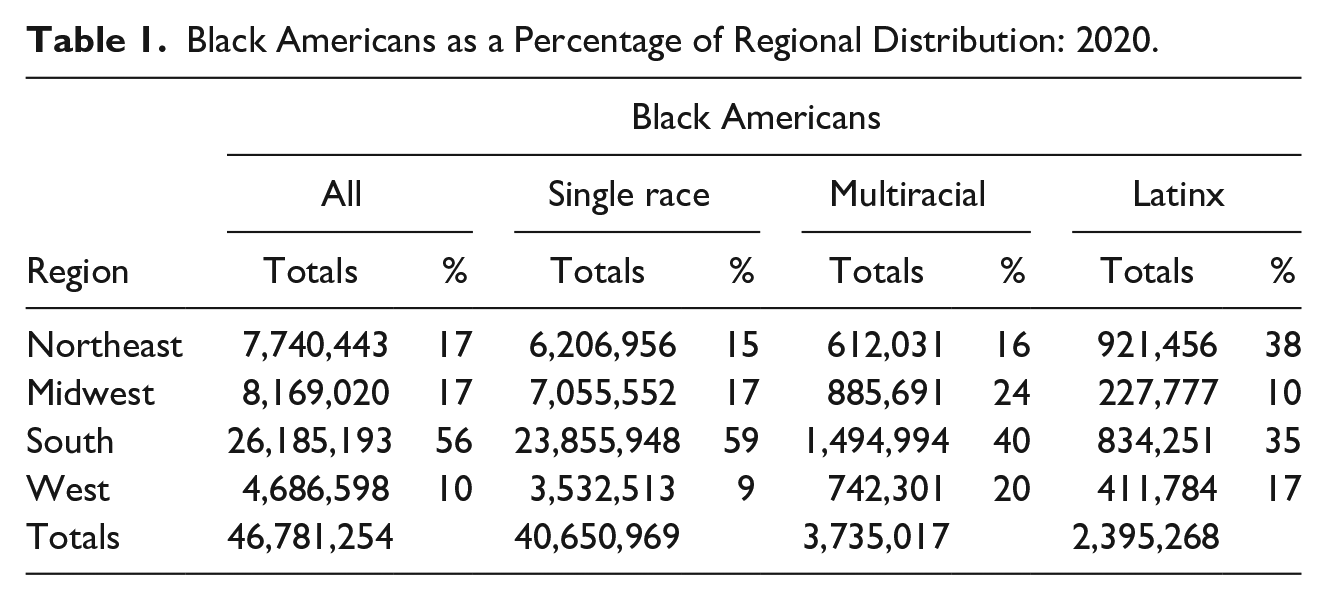
Table 1 illustrates regional dispersion of Black Americans in the United States as of 2020. This includes persons who are single race, multiracial and Latinx. In total, the South has the largest share of Black Americans in the country. At 59%, this is especially true for the share of the Black population that identify as Black “single race.” It is also true for those who identify as Black-multiracial who make up about 40% of the Black population in the South. The largest share of the Black population that identify as multiracial (outside the South) reside in the Midwest followed by about 20% who live in the West. At about 38%, the largest Black Latinx population resides in the Northeast. Outside of the Northeast, most people who identify as Black-Latinx live in the South. Building on these statistics, Table 2 shows the 10 states with the largest share of the Black population by population density. Texas has the largest share of the Black population followed by Florida and Georgia. At 19%, New York has the highest percentage of people who identify as Black Latinx followed by Florida at 11% and California at 10%. As a share of the Black population, California also has the largest percentage of people who identify as multiracial at 9%.
Black Americans as a Percentage of Regional Distribution: 2020.
States With the Largest Black American Population by Density: 2020.
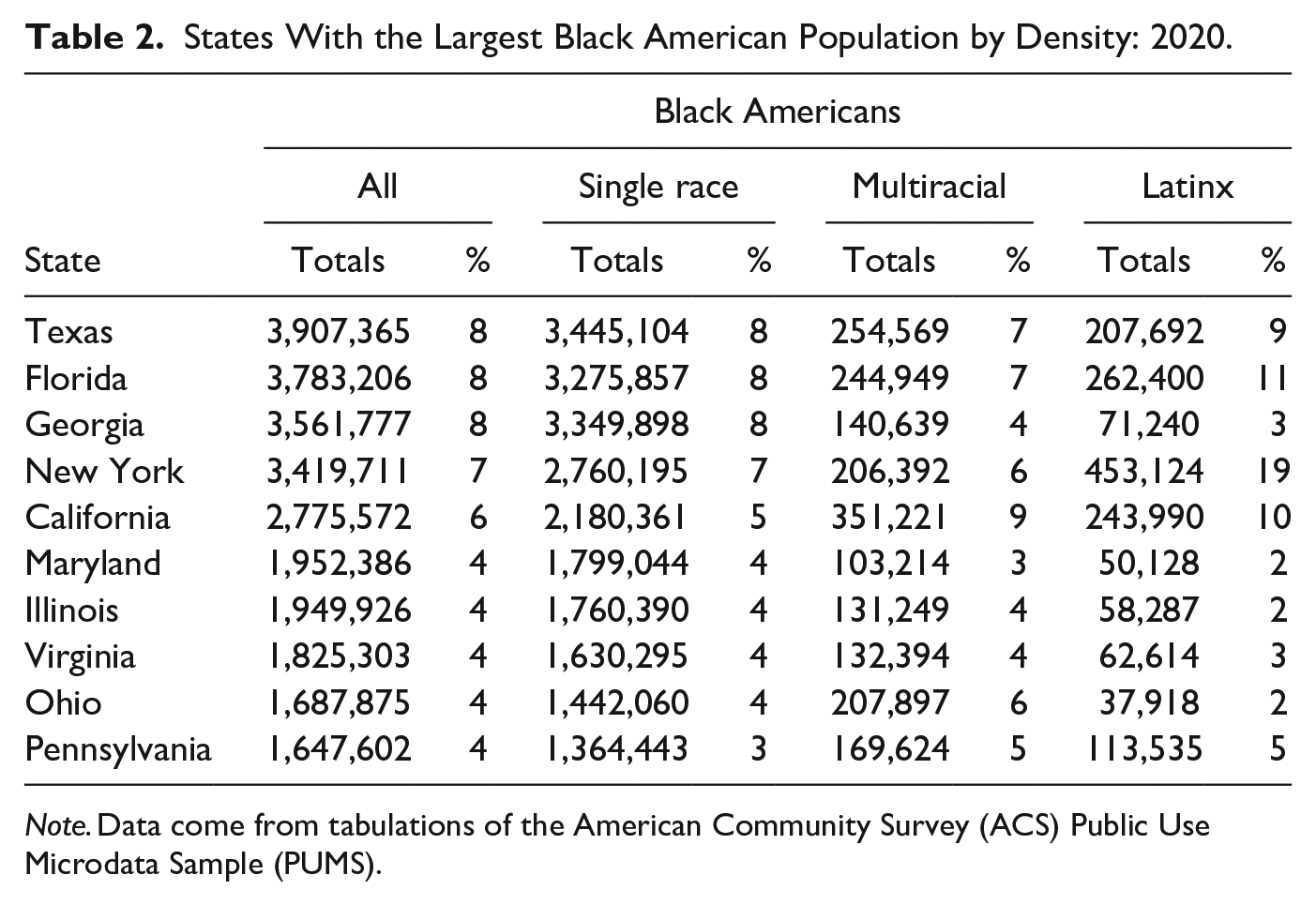
Note. Data come from tabulations of the American Community Survey (ACS) Public Use Microdata Sample (PUMS).
Statistical Portraits
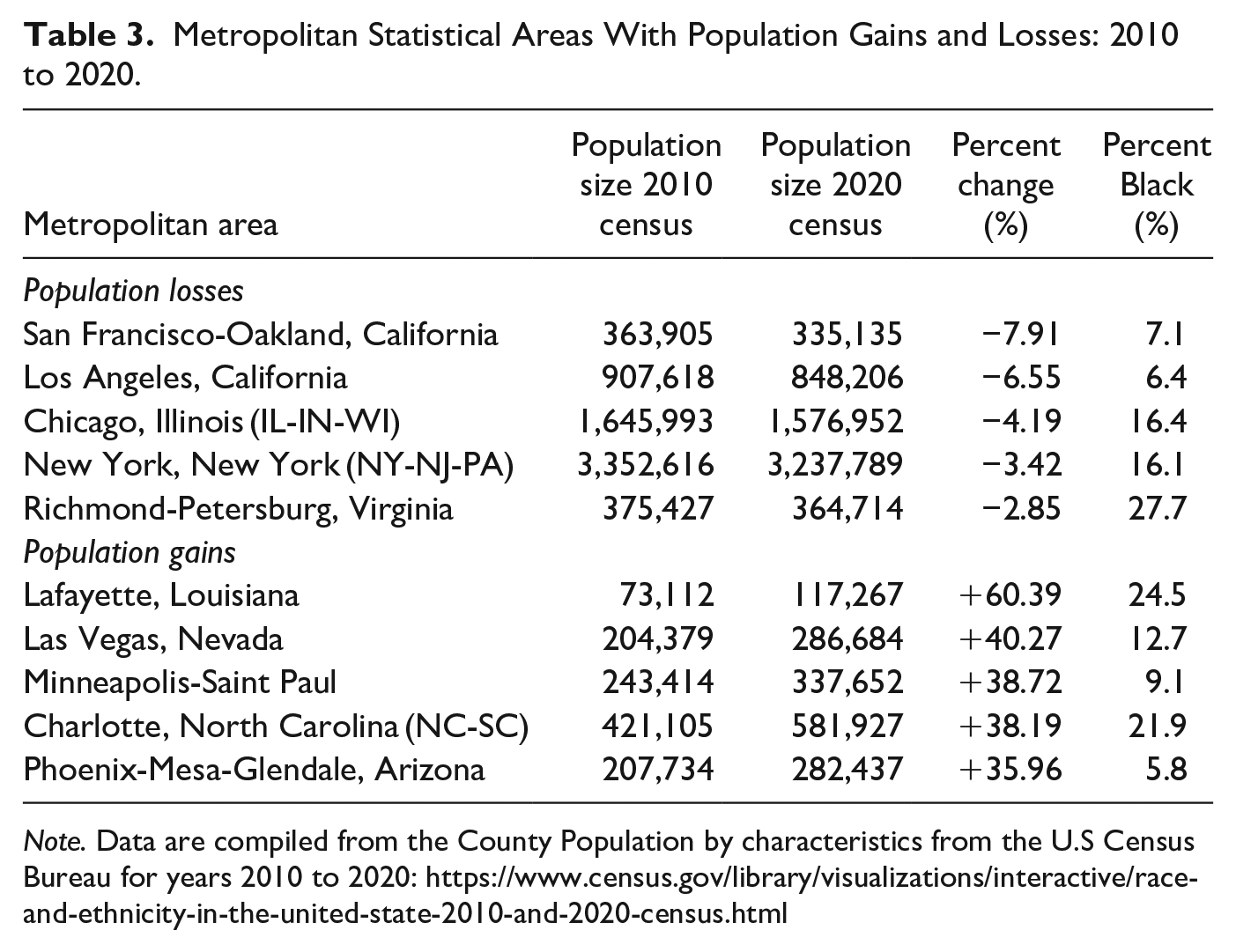
To illustrate the changes to the Black population in the United States, Table 3 shows the five Metropolitan Statistical Areas (MSA) which reported population gains and the five which reported population losses in the 2010 to 2020 Census years. Reporting some of the largest population declines, California saw its Black population decline significantly during the last decade. San Francisco-Oakland MSA and Los Angeles MSA reported the largest population losses for African Americans with net deficits of −7.91% and −6.55%, respectively. In the Midwest, Chicago Illinois (IL-IN-WI) also saw its Black population decline by −4.19% during the last decade. This is also true of the New York (NY, NJ, PA) metropolitan area which experienced a −3.42% decline in is Black population and Richmond-Petersburg, Virginia which experienced a −2.85% decline. The Richmond-Petersburg, Virginia MSA is the only region in the South which has experienced significant population loss.
Metropolitan Statistical Areas With Population Gains and Losses: 2010 to 2020.
Note. Data are compiled from the County Population by characteristics from the U.S Census Bureau for years 2010 to 2020: https://www.census.gov/library/visualizations/interactive/race-and-ethnicity-in-the-united-state-2010-and-2020-census.html
In terms of population gains, Census data indicate that during the last decade, Lafayette, Louisiana had some of the highest increases in Black population density. This MSA saw an increase of 60.39% between 2010 and 2020. Las Vegas, Nevada also reported significant gains in its Black population. The Black population for this region grew over 40% in the last decade. In the Midwest, Minneapolis-Saint Paul saw a significant 38.72% gain in its Black population while Southern metropolitan areas like Charlotte, North Carolina (NC-SC) also reported significant gains during the last decade. In the West, the Phoenix-Mesa-Glendale MSA in Arizona reported a significant 35.96% increase in its Black population over the last decade.
Over a 30-year period from 1990 to 2020, Figures 1 and 2 show five of the top cities which experienced population losses and the ones which experienced gains. Figure 1 shows five of the top metropolitan areas where the Black share of the population decreased. San Francisco recorded the highest decline from 11% to 7% in the 30-year span. Other cities like Richmond, Chicago, and Los Angeles recorded 3% decreases while New York recorded a 2% decrease. Figure 2 illustrates five of the top metropolitan areas where the Black share of the population increased between 1990 and 2020. With an 8% increase, Atlanta shows the largest gains in its black population. Memphis and Columbus, Ohio both show 5% increases while Minneapolis and Tampa show 3% and 2% increases respectively. Columbus, Ohio and Minneapolis are the only cities in the Midwest to record increases in their black population.
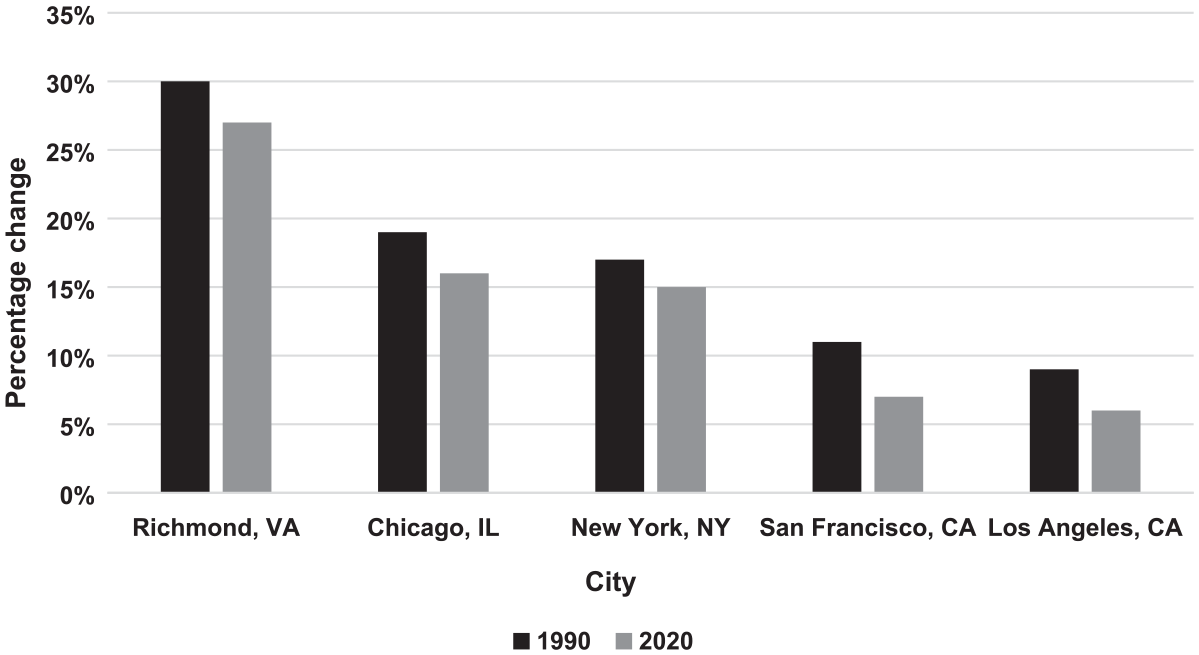
Cities where Black share of population has decreased from 1990 to 2020.
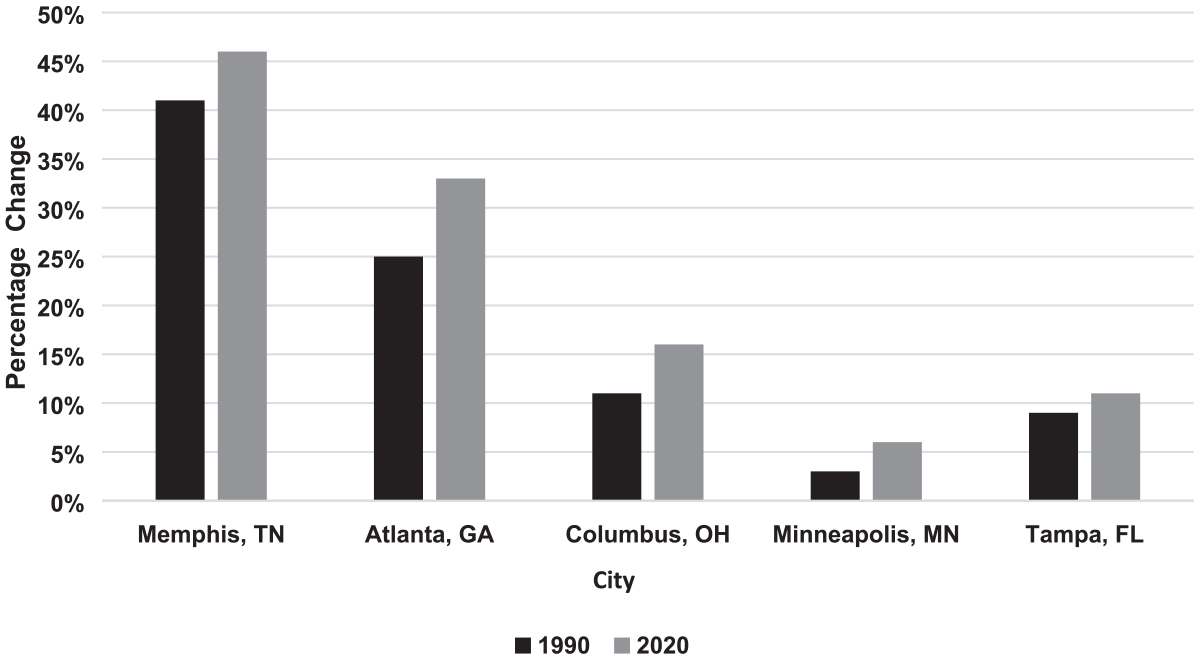
Cities where Black share of population has increased from 1990 to 2020.
Conclusion and Societal Implications
In addition to changes in demographic and settlement patterns, this study highlights two important points: the Black population is growing in its density as well as its diversity. Census data report that people who identify as single-race Black, Black Latinx and Black multiracial are a large (and growing) part of the Black population. The data also illustrate that most people who identify as Black single-race tend to live in the South in states like Texas, Florida and Georgia. This does reflect a continued reversal of earlier streams from the Great Migration. Additionally, Black people who identify as multiracial are more evenly distributed across the country while those identify as Black Latinx are more likely to live in the Northeast—particularly in New York. Keeping the Great Migration in mind, new migrant destinations also tell an interesting story. While prior northern metropolitan areas like Chicago and New York have experienced significant declines, so have metropolitan areas in the West like San Francisco and Los Angeles. In the South, Richmond-Petersburg, Virginia is the only region to experience significant Black population loss in the time periods examined. For researchers, this trend is noteworthy as it represents a return or reverse migration which—in some ways mirrors the historic Great Migration of African Americans. Yet the exact reasons for this reversal are numerous as migration decisions are often complex and multifaceted. Highlighting a number of push and pull factors (historical and contemporary), African Americans are choosing to return South in their search for economic, political and social freedoms. Underscoring the importance of ethnogenesis, this study contends that African American migration draws on more than just place utility. In decisions about whether or not to migrate, the South is for many, a place which has strong historical and ancestral ties. It represents a place where individuals can be inconspicuously Black, share in the long legacy of solidarity among others and find familiar solace in the Black church. The “New South” or the South in the post-Jim Crow era has been remarkable given its economic growth. While it has its long history of racial caste, many African Americas have found familiarity in the “pull” or return to the South. In the same vein, the rapid population loss of former “Black Meccas” like Chicago, Detroit and Philadelphia illustrate a disillusionment with a region that failed to fully live up to its expectation as a “Promised Land.”
Interestingly, while the data do show a southern resurgence especially in destinations like Lafayette, Louisiana and Charlotte, there are also marked increases in destinations like Las Vegas and Phoenix-Mesa-Glendale. Results suggest that in the post-Civil Rights era, return migration is not as clearly linear as it was during the Great Migration. This means that while southern destinations like Atlanta, Memphis and Tampa are experiencing tremendous population growth, so are certain destinations in the West and Midwest-like Minneapolis Saint Paul and Columbus, Ohio. It can also be argued that whether migrants are returning to the South or going to new destinations in the West, ethnogenesis underscores the importance of social networks and embeddedness. From an economic standpoint, migrants may choose to relocate from expensive cities like San Francisco, New York, and Los Angeles in search of opportunity in newer destinations. In conjunction with rising property values, divestment and gentrification, the rapid population loss in former “Black Meccas” do seem to indicate a growing disillusionment with the region. In terms of ethnogenic connections, findings suggest that while African Americans who return to the South may be returning to established ethnogenic ties, those who migrate to newer ones—especially those with smaller aggregate Black populations (i.e., Minneapolis Saint Paul and Phoenix Mesa-Glendale MSA) are likely building new connections in their new destinations. This likely holds for new black immigrants who are also part of America’s racial mosaic. They are just as likely choose destinations where they can achieve economic prosperity in addition to an enrichment of racial and cultural ties. So, although the Great Migration ushered in a South-North migration pattern, newer migration channels illustrate more diverse destinations. As migration trends continue, they remain significant since African Americans (through their own agency) are choosing to locate to regions where they can expect the most progress.
Still, American history represents a cautionary tale for African Americans. Regardless of where they live in the country, racism is still a reality. As such, organizations such as the NAACP, Urban League and BLM represent a continued need for black solidarity and awareness. It is an acknowledgment of the universality of the black experience and the right to seek a better life for oneself and one’s family. African Americans have always resisted subjugation and helped create civil society organizations which have pushed for social change. Through ethnogenesis, this shared ethnic and cultural heritage has engendered reforms in the law which have protected the rights of African Americans—and all Americans. As the reverse migration trend continues, it remains significant as African Americans (through their own agency) are choosing to locate to regions where they can expect the most progress. Chronicling this demographic shift is important and its effects will undoubtedly be studied for a long time as African American migration once again transforms the landscape of the United States.
Footnotes
Acknowledgements
The author would like to thank the editor and the peer reviewers at Journal of Black Studies for all their constructive comments and feedback on previous drafts of the manuscript
Declaration of Conflicting Interests
The author declared no potential conflicts of interest with respect to the research, authorship, and/or publication of this article.
Funding
The author received no financial support for the research, authorship, and/or publication of this article.
