




Abstract
This study is an investigation of how Black faculty, staff, administration, and students relate to one another at an institution of higher education, and how their campus experiences diverge and converge. Twenty-one focus group interviews were conducted with 26 Black students, 18 Black faculty members, and 17 Black staff members and administrators. The objective was to contribute knowledge that could lead to more informed service, teaching, support, administration, and leadership on the Black campus and in the university. Several themes were discovered in the analysis, resulting in the identification of key challenges faced by the Black campus, the solutions respondents perceived as promising, and the supports they benefit.
Black faculty, staff, administrators, and students play significant roles in institutions of higher education. They serve as peers, scholars, teachers, guides, role models, and many other significant aides to themselves and others (Weems, 2003). Their increased representation on college and university campuses makes higher education workforces and student bodies more representative of the U.S. population (Perna et al., 2007). Their presence increases the likelihood that universities will conduct more wide-ranging scholarship and that students will have diversified college experiences that prepare them for an increasingly interconnected, pluralistic society. When they are underrepresented, unsupported, or unfairly treated, the consequences include reduced support, guidance, and mentorship, particularly for students of African descent, on campuses across the country (Guiffrida, 2005; Kelly et al., 2017; Tuitt, 2012).
The current literature on the experiences of Black faculty, staff, administrators, and students tends to focus on each population in isolation. It will take an examination of them in the context of a college or other environment to uncover how co-constructed and interrelated these experiences are. The purpose of this investigation is to produce information that will be useful for plans to improve the experiences of Black students, faculty, staff, and administrators by exploring their collective campus experiences and perspectives. Kendi (2012) used the term the Black campus to refer to Black student movements on Historically Black colleges and universities (HBCU) and predominantly White institutions of higher education (PWI) campuses. Building on this language, the phrase is used here to refer to Black-identified employees and students and their communities and cultures on PWI, minority-serving institutions (MSI), HIS, and other campuses where they are underrepresented.
Literature Review
A review of the research on Black campus experiences in higher education is an important starting point for understanding the convergence of their worlds. The following literature review summarizes scholarship in several areas: the representation, supports, and challenges of Black students, faculty, staff, and administrators on campuses, and potential ways to improve their experiences.
Black Faculty Experiences
Black student enrollment rates in higher education have prompted demands and protests from student populations and callow rationales from campus leadership. Black students at universities across the U.S. in recent years have demanded greater representation of Black faculty for reasons that deserve intense investigation (Jaschik, 2018). The Legion of Black Collegians, the only Black student government in the country, demanded a 10% increase in Black faculty by 2018 (Kelly et al., 2017). This is because Black faculty remain numerically underrepresented on campuses across the U.S. (Darden et al., 1998). Moreover, Black faculty play a significant role in Black students’ success and engagement. Yet the diversity of the post-secondary student population has outpaced that of the faculty, particularly the Black faculty (Perna et al., 2007; Southern Regional Education Board [SREB], 2015). Currently, Black faculty make up between 6 and 7% of the full-time U.S. college and university faculty population, although Black people make up 13% of the U.S. population (Porter & Rozell, 2022; U.S. Department of Education, 2006, 2017; Zippia, 2022). Universities’ rationales for low numbers of Black faculty range from a lack of qualified applicants to budget cuts and hiring freezes (Darden et al., 1998). Other explanations include institutional failure to adequately recruit Black faculty members and failure to provide adequate support to retain them (Darden et al., 1998).
One setting where Black faculty members face marginalization is the classroom. Many teach courses that address race and ethnicity, and when they do so, they sometimes have their authority, integrity, and legitimacy questioned and their safety threatened, particularly by White students but also by other non-Black students (Closson et al., 2014; Kelly et al., 2017). Closson et al. (2014) argued that this causes them to experience racial battle fatigue or psychological and emotional stress related to subtle, racially motivated insults.
Black faculty retention may also be related to the presence of Black students. Darden et al. (1998) analyzed data from the 1995 release of the 1993 Integrated Post-secondary Education Data System (IPEDS), which indicated that Black faculty representation on campuses is related to Black student enrollment. Their analysis revealed that the percentage of Black students enrolled is significantly positively related to the representation of Black faculty in institutions of higher education. For the purposes of understanding the larger Black campus context, the underrepresentation, marginalization, and microaggressions Black faculty face, have to be examined in relation to the challenges Black staff and administrators and students face.
Black Staff and Administrators’ Experiences
According to the Race and Ethnicity in Higher Education status report, Black staff members make up 13.7% of clerical staff (e.g., administrative assistants and records clerks), 25.2% of service and maintenance staff (e.g., construction and facilities), 11.7% of technical and paraprofessional staff (e.g., paralegals and IT specialists), and 7% of skilled craftspeople (e.g., electricians and carpenters; Espinosa et al., 2019). Higher education Black administrators, who make up 10.6% of higher education administrators (down from 12.7% in 2010) have not increased while administrative opportunities have increased (Rollins, 2017; Zippia, 2020). Their representation is the greatest in MSIs, as compared to PWIs, yet that presence comes with a range of experiences, both positive and negative.
Rollins (2017) investigated the ways that Black males must also employ unique strategies to navigate and make meaning of the racism they experience in higher education. Similarly, Black women administrators increasingly must negotiate how they view themselves and how others view them, which can take time and energy away from professional tasks such as supporting and mentoring students (Tevis et al., 2020). In fact, Allen (2018) investigated how women of color are discouraged from applying to high-level administrative positions but employ strategies to be resilient.
Black staff and administrators face problems such as racial hostility in campus cultures, which can contribute to low retention among them (Hicks & Watson, 2018; Norman, 2019). Using qualitative interviews to explore Black staff members’ experiences at PWIs, Cunningham et al. (2007) discovered a profound sense of invisibility on campus. Although the subjects reported enjoyment and satisfaction with their work, their work was ignored, regarded as unimportant, or met with a lack of interest by their non-Black peers. Black staff members at universities also reported frequent experiences of racism, although many were reluctant to address these issues out of fear that someone would be offended (Davis, 2013). Black students are confronted with similar obstacles.
Black Student Experiences
According to the Postsecondary National Policy Institute (PNPI, 2022), in the fall of 2019 Black students made up 12.7% of the U.S. undergraduate population. Research on the experiences of Black college students is dominated by studies of student engagement—their passion for and interest in their studies, and the resources and efforts that institutions put into creating an environment that promotes their involvement (Chen et al., 2014; Kuh et al., 2008). Black student engagement is enhanced in climates that are instructionally inclusive and sensitive to their cultures of origin and their needs and priorities (Shappie & Debb, 2017). These climates increase Black students’ self-concept, self-efficacy, and achievement orientation (Harper et al., 2004).
HBCUs have been more likely to create these environments than PWIs, yet Black students can equally find themselves underserved at minority-serving institutions (MSIs) (McDougal et al., 2018; Pirtle et al., 2021). For example, McDougal et al. (2018) conducted a qualitative investigation of Black students’ engagement at an MSI and found that Black students are undersupported and many face resource insecurity, underrepresentation, isolation, discouragement, and the burden of counter-activity. Using narrative analysis and intersectional theory, Willis et al. (2019) uncovered reports of similar microaggressions among Black student women at an HSI. Black student difficulties at MSIs can go unrecognized because equity and inclusion are sometimes measured by demographic diversity, and because racial- and cultural-equity trainings and programs are often present but non-inclusive of the cultures, experiences, and needs of students of African descent.
At PWIs, Black students often feel isolated, marginalized, and excluded in their attempts to adjust to the campus environment (Patton et al., 2011), primarily because of racist climates, low teacher expectations, being expected to represent all members of their racial or ethnic group, being excluded from study groups, and other racial microaggressions (Patton et al., 2011). Black college students’ experiences with racism in the form of microaggressions, cultural isolation, and avoidance have physiological, psychological, behavioral, and academic consequences.
At colleges and universities across the country, Black students find social and academic support in Black studies departments and programs. In unique ways, Black studies’ pedagogical approaches have been found to provide students with social support, racial socialization, cultural pride, culturally responsive departmental activities and services, and knowledge of their intellectual heritage in various subject areas (Adams, 2014; Carey & Allen, 1977). These approaches are associated with positive racial identity development and increased self-esteem, self-efficacy, and likelihood of graduating (Marie, 2016). Black students also find support by joining communities such as African and Black student unions (BSUs), Black culture and student centers, Black residence communities, and Black Greek-letter organizations (BGLOs), which have played instrumental roles in Black campus life for more than a century.
One seldom-acknowledged factor that Shappie and Debb (2017) pointed out is the positive impact of HBCUs’ common mission of racial uplift on Black student engagement. Similarly, on campuses where Black students are a numeric minority, when they do work together to support their academic, social, and psychological resilience, it is sometimes called racial cohesion. Racial cohesion is related to students’ engagement and involvement in culture-based organizations. The concept is similar to Dawson’s (2001) use of the idea of linked fate, which describes African American citizens’ beliefs that their quality of life is linked to the fate of the race.
Black students, faculty, staff, and administrators bring unique experiences to college campuses across the U.S. They often share common challenges such as underrepresentation, alienation, and anti-Blackness that undermine their efforts. However, they also create and engage in supportive practices such as cultural enrichment and racial cohesion that provide them with resilience. Moreover, their experiences are as interrelated and varied as the whole Black campus is. But this interrelatedness remains under-researched, particularly at MSIs. In the present study, we address their interrelatedness by answering the following question: What are the qualities of the campus experiences of Black faculty, staff, administrators, and students, and how are they related?
Methods
This investigation took place at an institution of higher education designated as both a minority-serving institution (MSI) and a Hispanic-serving institution (HSI) on the West Coast of the United States. At the time of data collection, the institution had a student population of 24,574 (Institutional Effectiveness, 2022a). There were a total of 1,395 Black (5.5%) students, 839 female (60%) and 556 male (40%).
The faculty population of 1,485 (531 tenure-track, 954 adjuncts) 6.4% Black or African American (Institutional Effectiveness, 2022b). The staff and administrative workforce numbered 2,805 (1,695 full-time, 1,107 part-time; Office for Equity, Diversity, and Inclusion [OEDI], 2021). The administrative population of 302 was 14% Black or African American. The full-time staff of 1,290 was 9% Black or African American. The part-time staff of 319 was 5% Black or African American.
The researchers gained certification from the university’s institutional review board before collecting data. Focus groups were used to interview Black students, faculty, staff, and administrators to explore their attitudes about the quality of their interactions with peers, faculty, staff and administrators, curriculum, students, and the overall campus environment. Focus group interviews were determined to be best suited to exploring dimensions of their experiences that might not be covered by quantitative measures. The researchers obtained a self-selected sample of 61 African, Black, or African American students, faculty and staff members, and administrators. Twenty-one focus groups (5 with staff and administrators, 6 with faculty, and 10 with students) were conducted. The researchers found potential participants by recruiting from campus organizations geared toward Black students, faculty, staff, or administrators. Only those who completed the forms were allowed to take part. Ultimately, the participants consisted of 23 female and 3 male students, 13 female and 4 male staff and administration members, and 13 female and 5 male faculty members. The students consisted of one first-year student, seven sophomores, five juniors, six seniors, and seven graduate students. All participants’ names were replaced with pseudonyms.
Interview responses were subjected to content analysis and coded into several themes or patterns for each question. Themes representing the attitudes and opinions of fewer than 20% of participants were discarded. Preliminary themes were then reanalyzed, and ultimately the strongest themes remained while the least-represented themes were eliminated. The coding of responses revealed several key themes, presented in the following section. The themes that were common among all three subgroups are listed under “Black Campus.” Themes unique to a single group are listed under that group (“faculty,” “students,” or “staff/administrators”).
Results
The results and themes that emerged from this study are organized by strength and by prevalence across sub-populations. Those that emerged among all three groups are referred to as Black campus themes. Those that emerged only in one are labeled as such (e.g., “Black students,” “Black staff and administration”). The results that follow include the strongest themes that emerged in response to questions about the greatest problems they faced, their strongest sources of support, what they saw, and the solutions to the problems faced by the Black campus (Table 1).
Summary of Thematic Analysis.
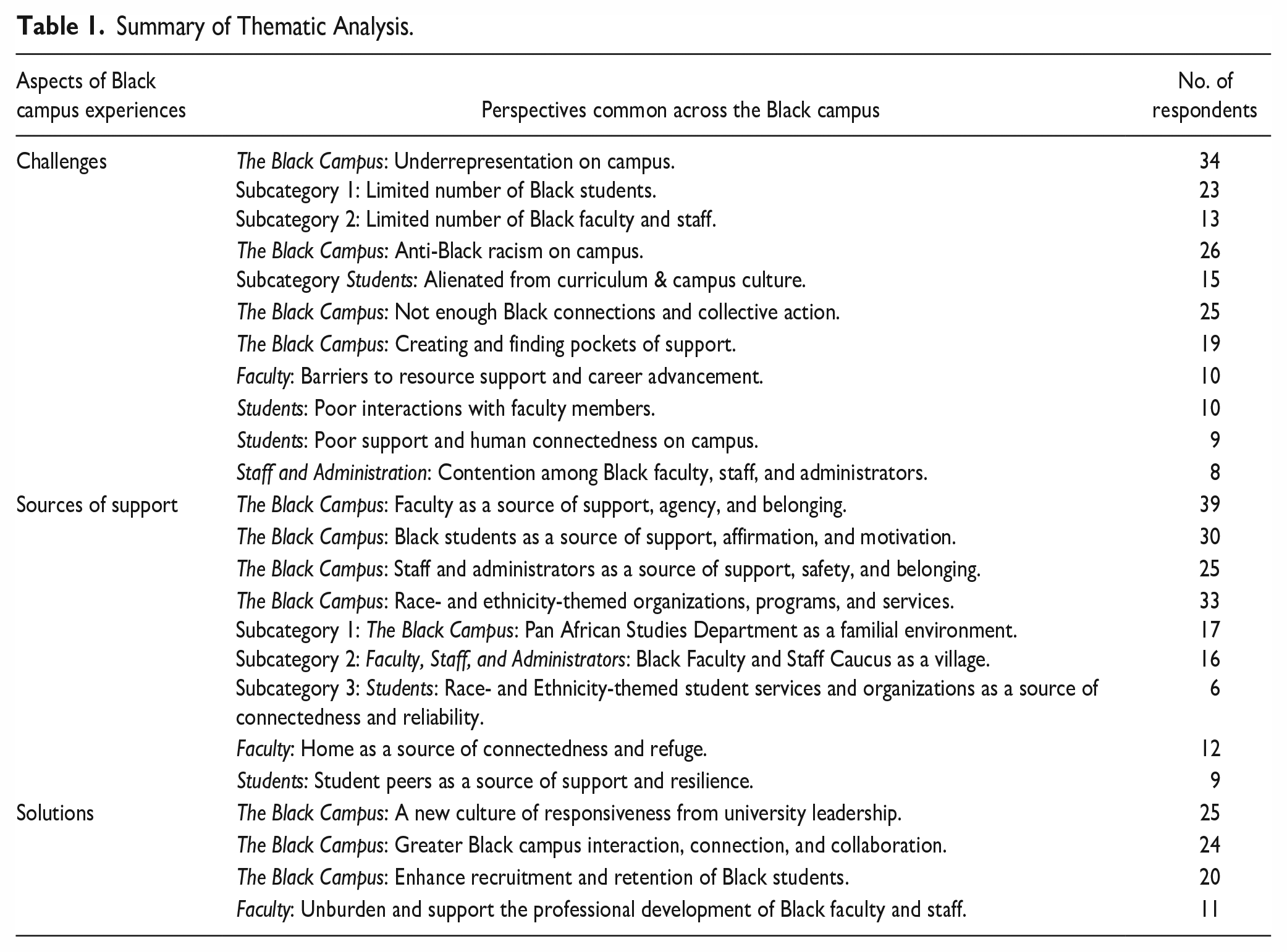
Challenges
The Black Campus: Underrepresentation on Campus
Thirty-four of the 61 respondents (56%) reported the limited number of Black people on campus as a major challenge. Fifteen of 18 faculty members (83%), 14 of 26 students (54%), and 5 of 17 (29%) staff members and administrators made this claim. Some referred to the general lack of Black people on campus, and others identified a specific category, such as Black faculty, staff, administrators, or students, but not all four. There were two major subthemes to this general concern with underrepresentation: lack of Black students on campus, and lack of Black faculty, staff, and administrators.
Subcategory 1: Limited Number of Black Students
Twenty-three of 61 respondents (38%) identified the limited number of Black students on campus as a challenge for them. Six of 18 (33%) Black faculty members and 5 of 17 (29%) staff members and administrators identified this as a challenge specifically because they drew motivation and inspiration from the presence of Black students. They described having a special connection with Black students and getting a unique sense of gratification from teaching and mentoring them. Twelve of 26 students (46%) explained that the limited number of Black students on campus was a problem because it made it difficult for them to find peers they could easily identify with and relate to and increased their feelings of loneliness and culture shock from being on campus.
Subcategory 2: Limited Black Faculty and Staff
Thirteen of the 18 faculty participants (72%) described the limited number of Black faculty and staff members as a challenge. They explained that some of their most positive relationships on campus were with other Black faculty or staff members and that the lack of those increased their sense of alienation. Similarly, 9 of 26 students (35%) identified the limited number of Black faculty members as a challenge: it made them feel less comfortable and supported on campus because Black faculty members would give them more professors they feel connected with and comfortable approaching for guidance, and who might be more likely to connect the class material to their own experiences.
The Black Campus: Anti-Black Racism on Campus
Twenty-six of 61 respondents (43%) identified anti-Black racism as a major obstacle to their academic and social success and well-being. Eight out of 18 faculty members (44%), 6 out of 26 students (23%), and 10 out of 17 (59%) staff and administrators identified this barrier. There was one subtheme in this category, a particular type of racialized exclusion experienced by students: being alienated from the curriculum and campus culture. Experiences with anti-Blackness had similarities and differences between the students, faculty, staff, and administrators. Students more often highlighted classroom experiences, such as being tokenized and ignored or excluded by their professors. Faculty members more often identified how their intelligence was often undervalued or questioned, and their scholarship was undervalued and less supported than that of their peers. Administrators and staff members more often identified the way Black people are overlooked or excluded from opportunities for promotion, racism in the hiring process, and ethnicity-themed programming going unsupported or being deliberately obstructed.
Subcategory: Students: Alienated from Curriculum and Campus Culture
Students expressed feelings of alienation from the curriculum and campus culture. Fifteen of 26 students (58%) identified the exclusion of Black intellectual heritage from the curriculum as a factor reducing the quality of their courses. These students said that their professors were often unable or unwilling to discuss how the subject matter in their classes related to Black people, or how Black people had contributed to it.
Each population mentioned being subjected to extraordinary scrutiny or hyper-surveillance in comparison to their peers of other races and ethnicities, being subjected to racist comments, being excluded from various opportunities and mentorships, and having their intelligence, qualifications, or deservingness consistently questioned or doubted. Each group described how these experiences caused anxiety, insecurity, and exhaustion. The faculty interviewees described experiences with colleagues in which they were subjected to outdated racial terminology, stereotypes about Black people, and racist and sexist comments. They also described often being subjected to higher scrutiny than their peers, particularly in promotion and pursuit of other opportunities. Black staff members and administrators described having their qualifications questioned and their employment dismissed because of racial nepotism. Several staff members, administrators, and students explained how the anti-Blackness they experienced intersected with gender and sexuality in the form of racialized sexism and homophobia.
Additional Challenges
Two other major challenges identified by participants were (1) not enough Black connections and collective action, and (2) the challenge of creating and finding pockets of support. Twenty-five of 61 participants (41%) identified insufficient communication and connection in the Black campus population as a problem. Nine of 18 faculty members (50%), 11 of 26 students (42%), and 5 of 17 staff and administrators (29%) identified this as a problem. These participants were not referring to the small number of Black people on campus; their concern was that among them, there was not enough communication, organizing, and action.
Nineteen out of 61 interviewees (33%) described the difficulty of finding pockets of support and community on campus. Seven of the 18 faculty members (39%), 6 of the 26 students (23%), and 7 of the 17 staff members and administrators (41%) described this as a particularly significant problem given the small numbers of Black people and the culture of anti-Blackness on campus. This was described as an act of agency as well as a challenge for the Black campus.
There were several other challenges, including barriers to resource support and career advancement, poor interactions with faculty members, poor support and human connectedness on campus, and points of contention among Black faculty, staff, and administrators. Ten of the 18 faculty respondents (56%) described difficulties accessing resources and advancing their careers as among the greatest obstacles they faced at the university. These participants expressed their disappointment that the university did not live up to its promise of commitment to diversity and equity, particularly when resources were concerned. Ten of the 26 student participants (38%) identified insensitivity, rigidity, and poor communication by certain professors as damaging the quality of their professor-student relationships. Nine of 25 students (36%) identified difficulty finding support and lack of human connectedness on campus as obstacles. These students said that they had a general unfamiliarity with the campus, and their interactions with staff and faculty were lacking or poor in quality. Eight of 17 staff and administration interviewees (47%) described certain points of contention that frustrated their relationships with other staff members and, especially, administrators and faculty. Some described having contentious interactions about methods of resisting anti-Blackness. Others described not relating to staff members, administrators, or faculty members who were out for themselves or not genuine or authentic in their commitment to serving Black students and advancing the Black collective on campus.
Sources of Support
The Black Campus: Faculty as a Source of Support, Agency, and Belonging
Thirty-nine of 61 participants (64%) identified their relationships with faculty as a source of support; they identified Black faculty in particular. Sixteen of 18 faculty members (89%), 16 of 26 students (62%), and 7 of 17 staff members and administrators (29%) identified this as a support and a source of satisfaction, enjoyment, and resilience. For both common and unique reasons, faculty, staff, and administrators viewed their relationships with faculty members, particularly Black faculty members, as sources of support because they provided a sense of common identity, perspective, struggle, mentorship, camaraderie, and belonging. Students identified their faculty members as sources of support but were less racially specific.
Student interviewees identified supportive faculty as those who made themselves available and were responsive to students’ questions and concerns. They also viewed faculty as supportive when they provided mentorship, advice, and help with seeking resources, pointed them toward opportunities, and counseled them on important decisions about their futures. They also appreciated the faculty members who provided motivation and empathy and showed flexibility. These qualities were important regardless of race. However, seven students specifically noted that Black faculty members went out of their way to support them, help them solve problems they encountered on campus, and make them feel welcome. Faculty members who described other faculty members as sources of support spoke primarily about other Black faculty members. They described relationships with Black faculty members as supportive because they shared similar worldviews, faced common challenges (particularly on campus), and had similar backgrounds and identities. A smaller percentage of Black staff members and administrators identified Black faculty as sources of support. When they did, they described them as familial, communal, and natural relationships in comparison to their relationships with non-Black faculty members.
The Black Campus: Race- and Ethnicity-Themed Organizations, Programs, and Services
Thirty-three of 61 respondents (54%) identified race- and ethnicity-themed initiatives as particularly supportive because they addressed their specific interests, needs, and concerns as Black people on campus while also connecting them to peers and colleagues with whom they shared a special commonality. There were three major subthemes in this general appreciation: (1) the Pan African Studies Department as a familial environment, (2) the Black Faculty and Staff Caucus as a village, and (3) race- and Ethnicity-themed student services and organizations as a source of connectedness and reliability.
Subcategory 1: The Black Campus: The Pan African Studies Department as a Familial Environment
Seventeen of 61 participants (28%) identified the Department of Pan African Studies as a source of support. Six of 18 faculty members (33%) and 9 of 26 students (35%) identified the department as a source of support. The students saw the department as supportive because it offered them exposure to and knowledge about the African/Black experience, intellectual heritage, and perspectives. They also saw it as a place they could expect to meet and form meaningful connections with other Black students, like-minded peers, and supportive Black faculty and staff. Pan African Studies faculty members identified the department as a supportive, safe, familial environment. Furthermore, non-Pan African Studies faculty saw it as a place they could meet other Black faculty members and attend culturally relevant events.
Students who described Pan African Studies as supportive felt that they experienced an approach to teaching that was equitable. They distinguished it from many of the other courses they took. In fact, some said they wished their other courses talked about the Black experience more. Others talked about discovering the department too late in their college careers. Some expressed frustration that they couldn’t meet their other majors’ requirements by taking Pan African Studies classes, and others mentioned disappointment that they did not see more of their Black student peers in the classes. Pan African Studies faculty described it as a familial environment where they benefited from socio-emotional support, a common commitment to racial uplift, and a culturally familial home environment. In addition to cultural events and exposure to Black colleagues, non-Pan African Studies faculty saw it as a place where they could find social and political support and advocacy, particularly when they faced inequitable treatment at the university.
Subcategory 2: Faculty, Staff, and Administrators: The Black Faculty and Staff Caucus as a Village
Sixteen of 61 participants (26%) identified the Black Faculty and Staff Caucus as a source of support. Ten of 18 faculty members (56%) and 6 of 17 staff members and administrators (35%) identified the caucus as a source of support. They reported that the caucus provides Black faculty, staff, and administrators with a “village” on campus where they can receive professional support, mentorship, and friendship. They also described it as an organization where they feel uniquely welcomed.
Subcategory 3: Students: Race- and Ethnicity-Themed Services and Organizations as a Source of Connectedness and Reliability
Six of the 26 students (23%) participants identified ethnicity-themed initiatives geared toward Black students or centered on Black experiences or cultures as major sources of support. The Pan African Studies Resource Center, programs between Black students and the Black Faculty and Staff Caucus, Pan African Studies programs and services, and other Black campus meetings and events, gave them a sense of support, connectedness to campus, and relatability, and avenues to connect with other Black students, faculty, staff, and administrators.
The Black Campus: Black Students as a Source of Support, Affirmation, and Motivation
Thirty of the 61 respondents (49%) identified students, particularly Black students, as a source of support and affirmation. Eleven of 26 Black students (42%), 10 of 18 faculty members (56%), and 9 of 17 staff members and administrators (53%) made this claim, particularly about Black students, whom they described as an important source of motivation, support, and affirmation. For both common and different reasons, Black faculty, staff, administrators, and students identified Black students as a population that sustains them at school.
The faculty members identified students as a source of support for unique reasons. They described how they would go out of their way to assist Black students because they were conscious of how Black students are generally alienated and underserved on campus. Providing Black students with support gave the faculty members a special sense of fulfillment. Others mentioned how Black students would seek them out for support, which enhanced their sense of belonging on campus. They described their enjoyment and desire to see Black students and provide them with nurturing and academic and professional guidance. Administrators discussed the satisfaction they took in finding and supporting Black students or putting together events for them. Several discussed their appreciation for the honor, recognition, and respect they received from Black students. Similarly, staff interviewees described having a special sense of obligation to Black students and a special sense of satisfaction from providing them with a feeling of belonging on campus because others would mistreat them. The students who described their peers as supportive and positive explained that their peers helped them succeed despite the challenges they faced. They described looking to their student peers for learning support, study partnerships, motivation, advice, emotional support, and connectedness. They relied on their peers to listen to them and provide them with understanding and empathy, particularly because they faced similar challenges. Peers also provided a sense of community, which was particularly important for countering the sense of loneliness and isolation they felt, given the few Black students on campus. However, they also said it took a lot of effort to find or create networks with other Black students.
Additional Sources of Support
Another source of support participants identified was Staff and Administrators as a Source of Support, Safety, and Belonging. Twenty-five of the 61 participants (41%) identified their relationships with staff and administrators as sources of support, with Black staff and administrators in particular. Seven of 16 faculty members (44%), 10 of 25 students (38%), and 8 of 17 staff members and administrators (47%) made this claim. For both common and unique reasons, faculty, staff, and administrators viewed their relationships with staff and administrators, particularly Black ones, as sources of support because they provided a sense of comfort, safety, and belonging.
There were two other themes which emerged as supports, including home as a source of connectedness and refuge and student peers as a source of support and resilience. Twelve of 18 faculty members (67%) identified their neighborhood, home, or family members and loved ones as sources of connectedness, community, relaxation, and destressing from their experiences on campus. Many contrasted the diversity of their home environments and at-home relationships with the lack of diversity on campus. Nine of the 26 students (35%) identified their peers as their main source of support and a source of resilience and motivation. These students described how their peers helped them succeed despite the challenges they faced on campus.
Solutions
The Black Campus: A New Culture of Responsiveness from University Leadership
Twenty-five of the 61 participants (41%) reported insufficient and evasive university responses to Black campus problems and calls for change. Six of 18 faculty members (33%), 6 of 26 students (23%), and 13 of 17 staff members and administrators (76%) identified this as a problem. These respondents described a culture of campus leadership that skirts accountability for racial inequity and consistently reacts to the concerns of the Black campus by ignoring them or making symbolic gestures or under-resourced, short-lived initiatives. The interviewees called the leadership to seek out Black students, faculty, staff, and administrators to hear their concerns and acknowledge them, but also to develop meaningful solutions, put significant resources behind them, and involve the Black campus in their development and implementation.
Faculty and staff members who spoke about the need for a new culture of responsiveness from university leadership described how having their concerns listened to and acknowledged was an important sign of respect, which is necessary but insufficient on its own. Several faculty, staff, and administration members spoke about how some people in upper administration and leadership positions have developed a strategy of listening to and acknowledging Black people’s concerns but believe. Faculty interviewees said the university has a culture of punishing those who express dissent, particularly when they address issues of racial injustice, causing some Black people on campus to self-silence in response to racism. They also expressed the need for the university to hire more Black people in positions of administrative leadership. Student interviewees spoke more specifically about the need for the university to move beyond rhetoric and provide Black students with more concrete support. They discussed their desire for Black students’ voices to be listened to and included in decisions. Others mentioned the need for curriculum review to ensure that courses are racially equitable and that Black culture and intellectual heritage are included. Black staff members and administrators, like Black faculty, mentioned the importance of going beyond acknowledgment and implementing solutions or the ideas of Black faculty and staff members, administrators, and students. Several staff members reported a concern that research is being done, but the main problem is a lack of will by the university to actively respond to the concerns presented to them by Black people on campus. They also expressed the concern that Black campus voices not be watered down in the name of inclusiveness. One strategy the university uses, according to some staff interviewees, is not listening to Black student voices independently and so letting them be drowned out by the concerns of the general campus population or people of color (POC) concerns. Another approach is to suffocate the unique needs and concerns of the Black campus. Some Black administrators raised the idea of having dedicated forums for speaking to Black campus constituents so that the administration is actively seeking their input.
Additional Solutions
Two other major solutions proposed by participants were (1) greater Black campus interaction, connection, and collaboration, and (2) enhance recruitment and retention of Black students. Twenty-four of the 61 respondents (39%) reported a need for greater communication, collaboration, and connection between Black people on and off campus to enhance their experiences. Ten of 18 faculty members (56%), 5 of 26 students(19%), and 9 of 17 staff and administration members (53%) expressed a desire to have more Black campus events or meetings, organizations, and regular communication to improve their collective ability to support and advocate for one another and create a greater sense of safety and belonging.
Twenty out of the 61 respondents (33%) said that the Black campus climate would be greatly improved if the university enhanced its recruitment of Black students and its support for them when they arrive. Nine of the 25 Black students (35%), 6 of the 18 faculty members (33%), and 5 of the 17 staff and administration members (29%) saw this as something that would improve their experiences on campus. For both similar and unique reasons, students, faculty, staff, and administrators identified a key area of advancement as increasing the numbers of Black students and revamping the university’s approach to recruiting them. In addition, students linked recruitment to on-campus support, such as academic and mental health support, which might increase retention.
There was one other theme which emerged as a solution: unburden and support the professional development of Black faculty & staff. Eleven of the 18 faculty participants (61%) identified unburdening Black faculty and staff members and supporting their professional development as a step university leadership could take to improve their experiences on campus. Nine of the 18 faculty members (50%) identified this as a solution. They expressed doubt about the wisdom and ethics of expecting Black faculty and staff members to do more when they are already overworked on campus. These faculty members felt that the university needs to unburden Black faculty and staff members and invest in them so that they can be retained.
Discussion
This investigation revealed a great deal about the experiences and hopes of the Black campus—primarily, that their success and wellness are inextricably tied to one another. Their sense of belonging and well-being centered around connectedness: the accessibility, strength, and quality of important connections at the university. They described the conditions that nurture, block, strengthen, and weaken their connections to one another and to non-Black faculty, staff, administrators, and students, to key campus initiatives, departments, and programs, and to the surrounding communities.
Every Black campus sub-population identified the underrepresentation of Black people as a major problem. This finding is consistent with previous studies on how low numbers of Black students can reduce their academic engagement (Chen et al., 2014; Kuh et al., 2008). According to some of the participants, this underrepresentation deprives them of connections to students, faculty, staff, and administrators with whom they might share unique connections based on common cultures, racial identities, struggles, challenges, experiences, and perspectives.
These experiences all came at a cost. Among those who spoke of anti-Blackness, faculty, staff, students, and administrators alike explained how the anti-Blackness they experienced resulted in increased anxiety, insecurity, and exhaustion, which is consistent with the concept of racial battle fatigue, the psychological and emotional stress brought on by the experience of subtle racially motivated insults (Closson et al., 2014; Kelly et al., 2017). The experience is also known to affect Black collegians and employees’ performance, academically and professionally (Modica & Mamiseishvili, 2010). However, the experience of anti-Blackness also came with a heightened sensitivity to equitable treatment on campus.
Thirty-three percent of faculty participants and 35% of students identified the Department of Pan African Studies as a source of support and affirmation for students as a place they can go to connect with other Black students, like-minded peers, and supportive Black mentors and advisors while providing faculty and staff with a supportive, safe, familial, and culturally familiar environment. The Department of Pan African Studies and the Black Faculty and Staff Caucus, and other race-themed initiatives on campus promote and support racial cohesion and deliver messages of racial pride and uplift on a campus where Black people are underrepresented (Patton et al., 2011). Racial cohesion and messages of racial uplift have proven to have a positive impact on Black student populations, but in the present study faculty, staff, and administrators described its positive impact on their own sense of belonging, success, and satisfaction as well (Bentley-Edwards et al., 2015). The interviewees described the importance of cultural familiarity and comfortability in such a way that the term cultural cohesion might be just as appropriate.
There was an interesting paradox of demanding change which emerged among participants. Although participants did mention the importance of demanding change from the university, many questioned this logic and argued that the anti-Blackness and ambivalence toward racial inequity they encountered were intentional and willful and not simple due to university leaders’ ignorance or lack of resources. They thought it unwise to ask the university to do better when it essentially is invested in and benefits from anti-Blackness. Still, others questioned the wisdom and ethics of asking Black faculty and staff members to do more when they are already overworked and underpaid.
Ultimately, the participants’ ideas represented an intersection among belief in the values espoused by the university’s mission, responsibility for holding the university accountable, hope for a more equitable and culturally relevant campus experience, and hesitance to rely too heavily on an institution with a significantly anti-Black campus climate. Taken together, the Black campus expressed hope in the university’s potential, a desire to increase the overall equity, including racial equity, and a readiness to prevail if and when campus leadership calculates that the cost of maintaining a racially inequitable status quo is one campus leadership is willing to pay.
Conclusion
If comparable universities around the country make findings similar to those of the present study, there may be calls for (1) efforts to ensure that Black campus constituents play a key role in the development of racial justice/equity initiatives on campuses; (2) development of task forces on recruitment and retention of Black faculty, staff, administrators, and students; (3) policies that allow cultural validity, cultural relevance, and gender equity to play a more structural role in course revision and approval processes; (4) development of employee workshops and training on confronting anti-Black racism and coping with related anxieties; (5) required completion and annual renewal of anti-racist workshops; (6) policy updates to foreground race and equity in the hiring process as well as policies and procedures for hiring evaluations and decisions to require updated training on equity for search committees and decision-makers; (7) development of African American and Black research and policy of cultural institutes (on and/or off campus); (8) welcoming events designed to introduce new Black students to Black campus life (e.g., Black student organizations); (9) efforts to encourage Black faculty, staff, and administrators to play a greater role in welcoming and recruitment events; (10) efforts to see that such individuals are compensated or credited for that work; and (11) as part of the onboarding and welcoming of new Black faculty, staff, and administrators to campuses, introductions to Black cultural and professional life and resources in the region around the university. Finally, this work adds validity to the argument that an adequately supported Black Studies or Pan African Studies Department is a crucial anchor for Black populations on college campuses, extending far beyond its academic functions. The department along with the organization of Black faculty and staff were both reported by our participants as critical sources of support.
This knowledge is a starting point for Black campus action plans and can be integrated into universities’ strategies, perhaps most acutely at institutions where people of African ancestry are in the numeric minority. It is important to be cautious about drawing large conclusions about Black campuses from investigations of schools with unique qualities. However, it is our position that Black campuses across the country, especially where Black people are underrepresented, are not always fully visible in standard university assessments and strategies. Likewise, democratic pathways forward for the Black campus must begin with efforts to hear their collective voices.
Footnotes
Contributors
Mr. Keith Carter
Ms. Favour Edwin
Ms. Annese Everage
Ms. Ashley Jackson
Ms. Zyaire Jones
Dr. Ezekiel Joubert
Ms. Regan Logwood
Ms. Beatrice Obialisi
Ms. Melody Singleton
Declaration of Conflicting Interests
The authors declared no potential conflicts of interest with respect to the research, authorship, and/or publication of this article.
Funding
The authors received no financial support for the research, authorship, and/or publication of this article.