




Abstract
In many southern African countries, the incumbents have retained control of executive power since independence, while opposition parties fare poorly. Why have liberation movements-turned government tended to produce dominant party systems, despite multiparty elections? And, what accounts for this dynamic of beleaguered opposition politics? It is theorised that the historical influence of Marxism-Leninism and its ideas of the vanguard party, ‘democratic’ centralism, the use of violence and casting opposition as enemies of the state produces dominant party systems hostile to opposition. Using public survey data from Afrobarometer, a further cultural explanation is provided – a society distrustful of opposition. As citizens, eager for civil and political liberty, grow in their understanding of the importance of opposition politics, the region may yet see an expansion of competitive politics.
Keywords
Introduction
Southern Africa 1 is the southernmost region of the African continent and is demarcated to include Angola, Botswana, Eswatini, Lesotho, Mozambique, Namibia, South Africa, Zambia and Zimbabwe. In most of these countries, the incumbent has retained control of executive power since independence and the subsequent transition to multiparty democracy. Of the nine identified countries, only two have had an alternation in political power and one has entered a form of coalition politics as of mid-2024 but with the former dominant party still at the helm. Focus is given to the central trends in opposition politics in the region; in particular, a beleaguered opposition that operates within the context of prolonged control of the executive by one political party. A litmus test for a liberal democratic regime and its consolidation is an alternation in executive power; Samuel Huntington’s (1991) so-called two-turnover test (p. 267). In light of this, what accounts for the supposed ‘poor performance’ of opposition politics in the region? And, why have liberation movements-turned government tended to produce dominant party systems, despite multiparty elections? It appears that incumbent parties are averse to the idea of letting go of political power and remain hostile to opposition politics. Why?
While opposition weakness (including fragmentation, personalistic politics, inexperience, disorganisation, corruption and so forth) has been acknowledged in the literature, 2 focus here will be given to the weakening of opposition. Thus, while reference is made to specific opposition parties, the aim is rather a broader consideration of the state of opposition politics. As Chiroro (2006: 103) notes, ‘the environment in southern Africa has never been conducive to the growth of opposition politics’. Two key hindrances to political opposition are identified: first, the historically hostile context in which they were and are expected to perform, and second, a society distrustful of opposition.
The article is structured as follows: the rationale for opposition politics, considering its historical development, is presented – without vibrant opposition politics civil and political liberties remain tenuous in southern Africa; the state of play of opposition politics in the region, including recognition of the literature on opposition politics in southern Africa as well as noting the contemporary empirical data on civil and political liberties in the region; and finally, the two identified hindrances to opposition politics in the region are delved into.
To start, a brief reminder of the historical raison d’état of political parties as primary participants in opposition politics is presented. Political parties, historically, have played a key part in restraining executive power (and thus protecting political liberties) and guarding civil liberties. These challenges remain relevant in the southern African region, highlighting the present and future importance of opposition politics.
Opposition politics and the raison d’état of political parties
Protective democracy, the 17th/18th century forerunner of contemporary liberal democracy, was initially less about citizen participation and representation than it was about restraining those who held political power (Heywood, 2019). Such power was largely characterised by centralised, monarchical rule – rule by the few, often in the interests of the few. Democracy was thus a mechanism to push back against the excesses of political power and for people to protect themselves against rulers acting without compunction. During this period, political philosopher, John Locke, argued for the extension of voting rights to enable people to defend themselves against the encroachment of government. 3 Locke contended that people had God-given natural rights as provided by natural law – ‘a universal moral code binding on all men and ultimately ordained by God’ (Holden, 1988: 13). This was thus one of the earlier forms of opposition politics, deriving from the understanding (and experience) that political power could be used for malevolent purposes and should be restrained. ‘On prudential grounds, therefore, liberal regimes typically feature multiple, often competing centers of power’ (Galston, 2020: 1) so as to limit excesses of political power. In the pushback against the power of monarchies, princes and the feudalistic system, the ‘procedurally limited monarchy’ was invented, essentially setting off the development of an instrument crucial to a representative political system, namely: ‘the competitive political party’ (Finer, 1999a: 93).
Political parties are thus a relatively recent political development, not just in Africa but in the world over, having only formed in the 18th century. They became an organising mechanism to restrain executive power as well as vie for political power (instead of using violence and bloodshed), and to represent and aggregate the interests of citizens. They thus serve to restrain those in political power from using the state for narrow, personal interests and to extend and protect the so-called natural rights of citizens.
Opposition parties (parties that do not control the executive but contest for power during elections and may have representation in the legislature) have become a distinctive and necessary feature of liberal democratic regimes and opposition politics. Where a regime is understood as a means of organising the relationship between state and society, liberal democratic regimes stand in contrast to totalitarian and authoritarian regimes. In totalitarian regimes, the aim is the state’s total control of every aspect of society – social, economic and political – underpinned by the imposition of a single ideology. In authoritarian regimes those in control of state power, whether the military, a dictator or single party, actively seek to weaken or eliminate any form of opposition to their continued control. In both these regimes, the state is centralised and controlled by a small political elite hostile to opposition. In contrast, liberal democratic regimes ideally ensure a healthy balance between state and society. To do so, the power of the state is limited, and political and civil liberties are constitutionally protected. On a spectrum of systems of rule, democratic regimes sit on one side providing mechanisms for morally equal citizens to participate and have representation in public decision-making, with the other extreme being the complete exclusion of society from any form of political decision-making (Beetham, 1992). Political parties are thus an integral part of enabling citizen participation and representation. In modern democratic systems, opposition needs to not only limit executive excesses (Rakner and van de Walle, 2009: 109) but also provide an alternative option should the incumbent fail to perform.
In his recognition of the development of opposition, Southall (2001: 9) notes the more recent idea of ‘constitutional opposition’ – opposition that while robust in its engagement with the government in power remains committed to the democratic regime and respects the outcome of free and fair elections. Key to this understanding of opposition is the separation between state, which remains constant, and the government, which changes dependent on election outcomes. This is a key challenge in dominant party systems, where the dominant party tends to conflate party with government and state. The incumbent positions itself not just as a temporary government but as the guardian of the state. As Giliomee and Simkins (1999: 12) noted, dominant parties, especially if they are liberation movements, tend to also become ‘identified with and then synonymous with the regime they established’. In such a context, opposition parties can be portrayed as being averse to the state and not just the government in power. Adding to their challenges.
A cornerstone value of liberal democratic regimes is freedom; ‘for without liberty there can be no democracy’ (Beetham, 2004: 61). In a democracy, a multiparty system providing for opposition politics is considered the ‘unavoidable consequence’ of the exercise of fundamental rights such as the freedom of expression and the freedom of association (Randall and Svasand, 2002: 2). In summary, opposition politics is therefore desirable in a healthy democratic system as it can serve to limit political power excesses, protect civil and political rights, and offer an alternative government. In short, no opposition means no democracy (Southall, 2001: 20).
The state of play: Southern Africa’s enduring dominant parties and beleaguered opposition
Of the nine identified southern Africa countries, barring two, all have the same party in power from independence. 4 Angola launched into civil war in the wake of the withdrawal of the Portuguese colonial power in 1975, it then had democratic elections in 1992 before returning to civil war. The People’s Movement for the Liberation of Angola (MPLA) has controlled the country since 1979, repressing all forms of political dissent. It has dominated subsequent elections, although by diminishing margins, winning 72% in 2012, 61% in 2017 and 51% in 2022. The primary political contender, from the civil wars into the election period, has remained the National Union for the Total Independence of Angola (UNITA). UNITA, having transformed itself from a rural party to an urban-supported party, attained 44% in the 2022 elections even amid allegations of vote-rigging by the ruling party.
Mozambique’s civil war, 1977–1992, ended with the collapse of the Soviet Union. Even though the Soviet Union’s financial and military support of the Front for the Liberation of Mozambique (FRELIMO) stopped, the party continued to rule the authoritarian regime and has enjoyed unbroken incumbency since the 1994 elections. The main opposition, the Mozambican National Resistance (RENAMO), formed in 1976 as an anti-communist movement, maintained its own armed force until 2023 when its last camp disarmed and demobilised with the intention of integration into the civilian army. It has thus officially transformed into a political party that contends for power without violence.
The South West African People’s Organisation (SWAPO) has controlled the executive authority of Namibia since independence from South Africa in 1990. It continues to win national elections by a wide margin, although its parliamentary support significantly declined from 80% in 2014 to 65% in 2019, while presidential support declined from 87% in 2014 to 56% in 2019. Part of the explanation for the decline in SWAPO’s support appears to be opposition parties mobilising and forming alliances to contest not just for parliamentary seats but for presidential power. Prior to this shift, opposition parties seemed content to contest for parliamentary representation and the renumeration package such positions offered, with little interest in grand alliances and mobilising beyond ethnic or regional lines (Cooper, 2014).
In South Africa, the continent’s oldest liberation movement, the African National Congress (ANC), won every national election since its first democratic, multiparty election in 1994 until the 2024 elections. In the 2019 national elections, the ANC’s support declined below 60% for the first time. The official opposition, the Democratic Alliance (DA), trailed behind with 21% of the national vote. The DA governs the Western Cape, one of the most successful provinces in the country, but struggles to garner support in township areas where its party members and campaigns are often met with violence and intimidation (Zille, 2016: 188–219). The May 2024 national elections ushered in a new dispensation for South Africa as the ANC lost its majority falling to only 40% of the vote. A Government of National Unity (GNU) was subsequently formed, which includes the DA and 8 other parties (thus 10 in total). The ANC retains the positions of president, deputy-president and more than 60% of the cabinet positions; thus, its political power is still well entrenched. Time will tell whether the GNU was negotiated in genuine good faith or whether the ANC sees this as another area of ‘struggle’ for its dominance.
Following independence in 1980, the executive power of Zimbabwe has been filled by the Zimbabwe African National Union-Patriotic Front (ZANU-PF) with Robert Mugabe at its helm (until he turned 93 years old). With the rise of a viable opposition party, the Movement for Democratic Change (MDC) in 2000, election periods became characterised by state-sponsored violence and intimidation. ZANU-PF has ensured its position through violence, threats of violence, imprisoning opposition leaders, delegitimising the opposition and then passing legislation to extend its power. Emmerson Mnangagwa of the ZANU-PF won the presidential elections in 2023 for a second term, amid continuous allegations of election fraud and intimidation. Nelson Chamisa, the candidate of official opposition, Citizens Coalition for Change, still managed to attain 44% of the vote, despite the adverse conditions. Foreign poll monitors noted that the elections once again failed regional and international standards (Mutsaka and Imray, 2023).
Botswana, while having a dominant party system since its independence, is somewhat of an outlier. A former protectorate of Britain, it did not have a liberation movement or fall into civil war. Nevertheless, it is yet to experience a turnover in executive power, having been governed by the same political party, the Botswana Democratic Party (BDP), since its first democratic elections in 1966. Part of the dominance can be explained in terms of its adoption of the First Past the Post Electoral system and the lack of public funding for political parties, while the other is the ruling party’s socio-economic successes. It avoided the one-party system post-independence and embraced pluralistic democracy where opposition parties and civil society are free to organise and operate (Sebudubudu and Osei-Hwedie, 2010: 87–88). Botswana’s multiple small and weak opposition parties are largely the consequence of their own splintering and fragmenting; many having initially broken away from the Botswana National Front (BNF), which was formed in 1966. In the 2019 elections, the BDP maintained its dominance with 53% of the vote, with the Umbrella for Democratic Change (UDC) – an alliance of opposition parties – receiving 36%.
Angola, Mozambique, Namibia, South Africa and Zimbabwe are therefore characterised by liberation movements-turned government turned dominant parties with the former liberation movement retaining executive power. While Botswana also has a long-standing dominant party, it does not have a liberation movement history and the BDP did not engage in an armed struggle. There are, of course, exceptions to these enduring dominant party systems in southern Africa. For example, Zambia, and the smaller states of Lesotho and Eswatini (formerly Swaziland). Zambia’s independence from colonial rule in 1964 was characterised by a peaceful transfer of power. Unlike Angola, Mozambique, Zimbabwe, Namibia and South Africa armed struggle played no role in the liberation of the country, giving violence and the military a circumscribed role in public life. Following the initial competitive elections in 1968, Zambia quickly moved into a one-party system under the leadership of Kenneth Kaunda and the United National Independence Party (UNIP). President Kaunda viewed opposition parties as a threat to his governing UNIP and declared a one-party state in December 1972. With regional and global pressures for democratic rule in the 1990s, Zambia shifted to multiparty elections. It is an interesting country as it has had multiparty elections since 1991, the first of which the Movement for Multi-Party Democracy won (MMD). This made it one of the first African countries where elections, following one-party rule, resulted in a change in leadership (Chabal, 2014). It subsequently fulfilled Huntington’s two-turnover test. And yet, it is like the other countries in that opposition parties face considerable legal and practical obstacles, and the ruling incumbents often invoke restrictive laws to limit political space or rig election outcomes in their favour. Once in power, the newly elected parties do not attempt to strengthen the democratic institutions or level the playing field, as this would undermine their own electoral future (Beardsworth et al., 2022). The Catholic Commission for Justice and Peace refers to a ‘one party system mentality’ (Burnell, 2001: 240). In the 2021 elections, the United Party for National Development (UPND) defeated the incumbent Patriotic Front (PF). This was the third attempt by the UPND’s leader, Hakainde Hichilema, to contest against the PF’s Edgar Lungu. As Cheeseman has previously observed elections tend to be highly controversial taking the country to the brink, and yet, each time pulling back from outright authoritarianism (Cheeseman, 2017).
Lesotho, landlocked within South Africa, became a sovereign state in 1966. It is a constitutional monarchy, with the king serving as a ceremonial head of state. The country has experienced party turnovers and coalition governments, albeit unstable. Following the 2022 elections, the newly established, Revolution for Prosperity (RFP) party, founded by businessman Sam Matekane, formed a three-party coalition that controls a small majority in the parliament. Eswatini is unique in the region as it is Africa’s last remaining absolute monarchy, with King Mswati III ruling since 1986 (Election Experts Mission (EEM) Swaziland, 2013). 5 Political parties are banned, and pro-democracy activists are met with repressive laws and violence.
With some differentiation, the region is thus characterised as having beleaguered opposition politics. Opposition de jure exists (except for Eswatini) but it does not thrive.
What others have written: opposition politics in southern Africa
Scholarly work that engages specifically with opposition politics in the southern Africa region is limited. Focus tends to rather be on country case studies 6 and the incumbent parties, with South Africa under the ANC receiving much of the academic attention 7 or on democracy, in general, in the region (Du Toit, 1995). An example of the latter is Democratic Backsliding in Africa? (2023) edited by Leonardo R. Arriola, Lise Rakner and Nicolas van de Walle. While the scope of the book extends to the whole of Africa, a key argument of it remains relevant to southern Africa, namely the trend of incumbents resisting democratisation. As civil society organisations, citizens and other political parties push for basic liberties and democratic opening, so the ruling elites attempt to contain such pressures. As Bleck and Van de Walle (2018: 6) had previously noted, ‘The striking characteristic of the region that needs to be explained is how little negative or positive regime change has actually taken place since the conclusion of the democratic transitions of the mid 1990s’.
The edited volume Against all odds: Opposition political parties in southern Africa (Solomon, 2011) remains one of the few books dedicated to opposition political parties in the region. The editor, Hussein Solomon (2011: 1), notes that the ineffectiveness of political opposition is indicative of a dire democratic deficit. A vital link between state and society is missing. Challenges facing political opposition are identified as emanating from the external environment as well as internal factors. External reasons include the institutional environment, which range from relatively benign institutional arrangements, for example in Botswana where the supervisor of the Electoral Commission reports to the Office of the President, to the outright repressive, as in Eswatini with its de facto monarchical rule. A further challenge is party funding, where incumbents use state resources without recourse but for opposition parties there is either very limited public funding, for example in Lesotho, or no public funding, for example in Botswana. Considering internal factors, opposition parties are also held to account. Intra-party democracy is undermined by leadership jostles and the personalisation of politics. For example, until his death in 2018, Afonso Dhlakama was portrayed as the embodiment of Mozambique’s opposition party, RENAMO. Internal factions and divisions have also weakened opposition parties, as was evident in Zimbabwe’s MDC, with its first split in 2005. Even so, the book and its authors continue to acknowledge the importance of political opposition for democratic development in the region.
Another body of literature recognises key political dynamics prevalent in the region, with consequences for opposition politics. These political dynamics are liberation movements that become governments and then entrenched as dominant parties in ostensibly democratic settings. With the former (liberation movements) tending to result in the latter (party dominance). In his book, Liberation movements in power: Party & State in Southern Africa, Roger Southall (2013) considers the liberation movements of Namibia (SWAPO), South Africa (ANC) and Zimbabwe (ZANU-PF) – as governments. Initially seen as the answers to southern Africa’s woes, these liberation movements-turned government have increasingly become part of the problem. Possible explanations provided in the literature 8 for the disappointing performance of liberation movements once in government include exclusive nationalism where liberationists use their struggle credentials to claim the right to rule, forever; Frantz Fanon’s depicting the movements as tools of an avaricious post-national bourgeoisie; and Southall’s own analytical framework, namely the development of liberation movements into party machines. He argues that post-liberation the movement transforms into a ‘party machine’, capturing state power, merging the party-state, institutionalising hegemony, prioritising exclusive nationalisms over democracy and subordinating individual freedoms.
The region with its prevalent history of liberation movements tends towards dominant party systems. 9 Following multiparty elections, those countries with liberation movement histories turn into party systems where one party dominates the executive over a prolonged period. Opposition exists and contests during election times, but it does not win executive power. Friend or Foe? Dominant party systems in southern Africa: Insights from the developing world edited by Nicola de Jager and Du Toit (2013) seeks to understand the longevity of this party system in the region and its consequences for the quality of democracy. It is argued that resources play an important role, noting the skewed access to economic and political resources provided by hyper-incumbency. Once hegemonic control is established, where the party no longer distinguishes itself from the state or the people, then it ceases to be a democracy. On the positive side, such party systems are acknowledged for being stable due to marginalising political extremes and for having ‘broad-church’ ruling parties, like the ANC in South Africa. On the other hand, opposition parties in these countries struggle to contend with the ruling dominant party’s liberation movement credentials. Botswana is recognised as somewhat different, the BDP’s continued dominance is largely based on its historical role in the country’s peaceful democratic transition from chiefly rule and custodianship as a British Protectorate, together with its market-friendly approach which has brought economic development to the country.
While cognisant of the importance of these political dynamics, what this scholarship does not fully answer is why: why do the liberation movements consider it legitimate to rule forever, and to exclude and denigrate political opposition? Why do incumbents merge party and state, capturing state power for themselves alone? Why do dominant parties actively perpetuate uneven playing fields, making contestation for political power particularly challenging?
The regional problem: civil and political liberties under strain
In southern Africa, civil and political liberties remain under strain, especially in a context of hyper-incumbency of the executive political power, highlighting that the raison d’état for opposition politics is relevant in the region. Freedom House, a non-partisan organisation, produces research and data on issues related to democracy and freedom, including civil and political liberties. Its foundational conviction is that ‘freedom flourishes in democratic nations where governments are accountable to their people’ (Freedom House, 2024a). Using the 2024 Freedom House data on civil and political liberties, which are combined to produce an overall score ranking the countries as either free, partly free or not free; four of the nine southern African countries are measured as free (and imperfectly so), two as partly free and three as not free. In 2023, Lesotho’s status improved from partly free to free, due to the formation of a new government following competitive national elections in 2022. In general, the data from Freedom House show that in the southern African region, civil and political liberties are under strain, and dominance of the executive power by one party over prolonged periods is common (see Table 1).
Freedom status and party systems of southern Africa, 2024.
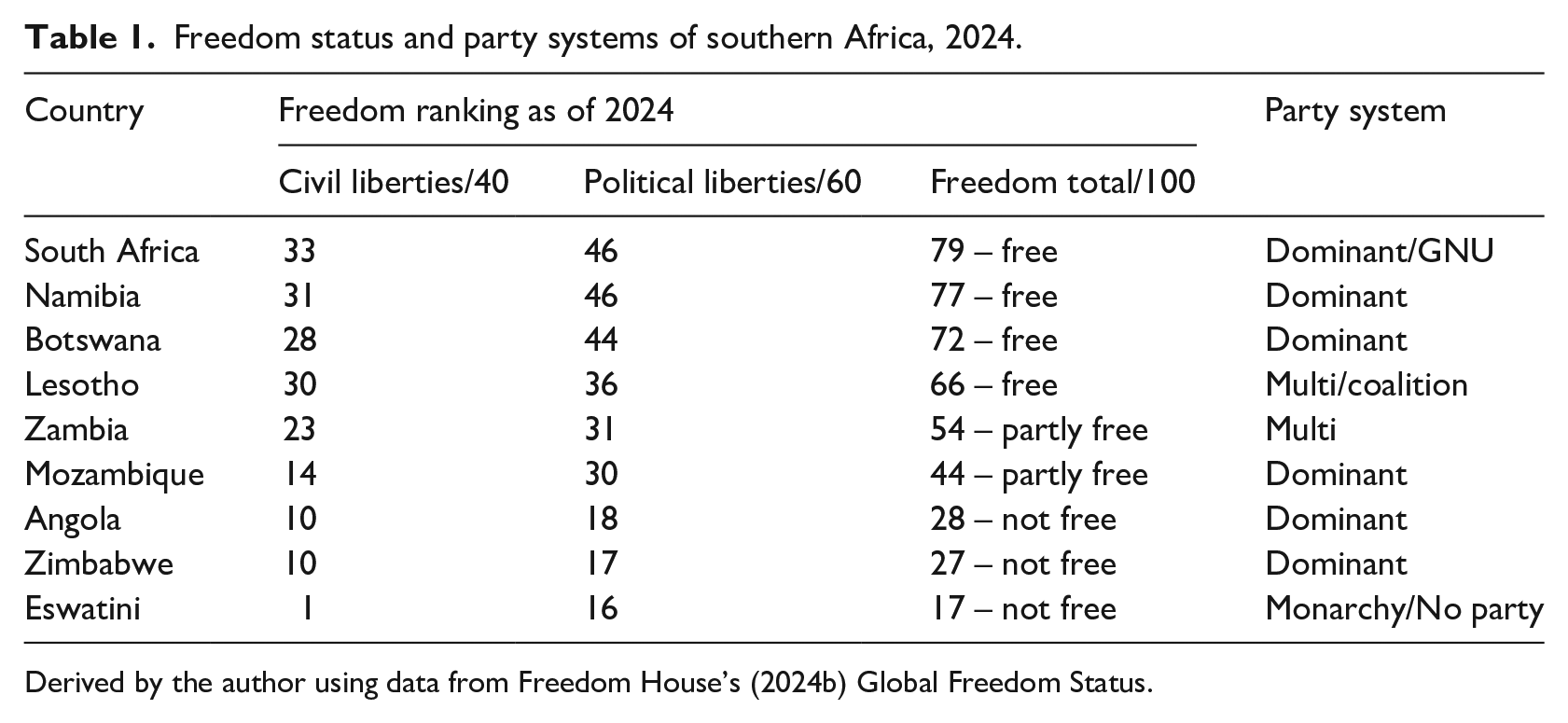
Derived by the author using data from Freedom House’s (2024b) Global Freedom Status.
It is worthwhile considering how southern African society understands democracy and whether the dearth of civil and political liberties is of any concern to them. To do this, survey data from Afrobarometer was used. In the Afrobarometer surveys, the following question was asked: ‘What, if anything, does “democracy” mean to you?’ The respondents’ answers are reflected in Table 2. For this question, the publicly available results from Round 6 (2014/2015) were used from surveys conducted in eight of the southern African countries. The survey results provide a clear indication of the inclinations regarding freedom in the region. Based on their responses, it is evident that the largest proportion (by a wide margin) understand democracy in terms of civil liberties and personal freedoms (54%) and voting/elections/ multiparty competition (25%). Thus, the predominant understanding of democracy in the region is in terms of having civil and political liberties – a liberal democracy.
Top four understandings of democracy for society in southern Africa, Afrobarometer Round 6 (2014/2015).
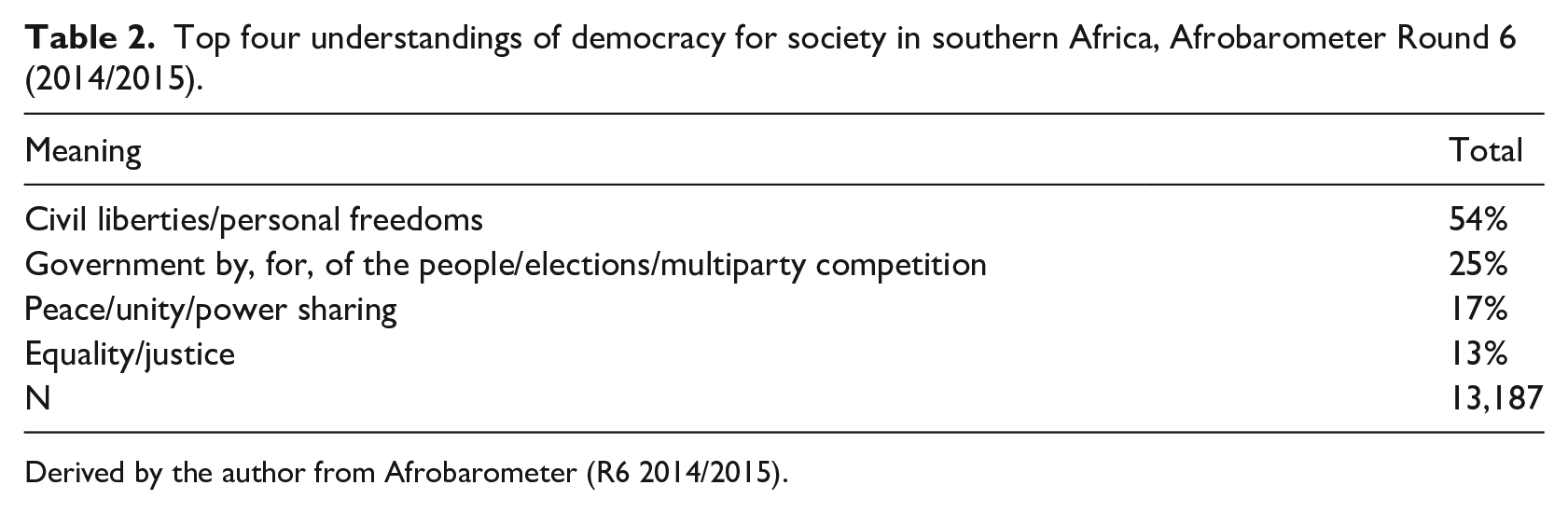
Derived by the author from Afrobarometer (R6 2014/2015).
Respondents in the survey were asked: ‘What, if anything, does democracy mean to you?’ A list of responses was provided, and the respondents were asked to select their first, second and third choice. For this reason, the percentages do not tally to 100%. Countries included in the survey: Botswana, Lesotho, Mozambique, Namibia, South Africa, then Swaziland, Zambia and Zimbabwe. Round 6 (2014/2015) was the only round in which this question was asked. Angola was not part of Round 6.
Considering that the southern African region’s current freedom deficit, as evident in the Freedom House data, is out of alignment with the society’s understanding of democracy in terms of civil and political liberties, the importance of opposition politics for the region is highlighted. What then accounts for the apparent poor performance of opposition politics? An investigation of why opposition politics remains stifled in the region is therefore needed.
Beleaguered: hindrances to opposition politics in southern Africa
The academic literature and the empirical data show consistently that civil and political liberties remain under strain in the region as do opposition politics. This is despite regular multiparty elections (with the exception of the monarchical state of Eswatini). The question to consider now is why. Two explanations are presented, the first is a historical context, namely the influence of the proxy Cold War and the transference of ideas hostile to political opposition, and the second is cultural, underlying norms and values of citizens who remain suspicious of opposition parties. It is acknowledged that these are not the only challenges, for example the perpetuation of uneven playing fields serves to strengthen the ruling position of incumbents, while limiting the access to resources for opposition parties (De Jager and Meintjes, 2013). 10 Dominant parties tend to use state resources for party benefit – a resource opposition parties cannot access. 11 In addition, electoral systems also play an important though not determining role for the viability of opposition. 12 Despite opposition parties being beleaguered, opposition politics remains important and much needed for the region, its citizens and liberal democracy.
A historical context hostile to opposition
Much of southern Africa’s party politics has been influenced by the proxy Cold War which was contested on the African continent. Many of the liberation movements (which turned government post-independence) were militarily supported and ideologically influenced by the Soviet Union, communist China, Cuba and North Korea. While the direct influence through arms, training and advice was relatively short-lived, the indirect Marxist-Leninist ideological imprint, which included support of violence, has been long-lasting. The ideas of the vanguard party, ‘democratic’ centralism, the acceptability of violence and casting opposition (inclusive of political parties, civil society, and the media) as enemies of the state and reactionaries found fertile ground in the post-colonial environment. It has created a political climate supportive of centralised rule and hostile to any form of opposition or dissent.
In the 1970s, the Soviet Union adopted an expansionist programme into Africa, militarily supporting southern Africa’s liberation movements, with the intention of creating a tier of allied socialist oriented countries and fermenting anti-Western sentiment (Singleton, 1987). The Soviet Union justified its support of what were essentially middle class, bourgeois movements (and not working-class movements), by calling for a two-stage revolution (Filatova, 2012): first liberation and then the move to socialism. Even so, the Soviet theory of the national liberation still stressed the leading role of the ‘proletariat’ (in other words the communists) in such a revolution (Filatova, 2012: 5). An armed struggle was the preferred mode of liberation as it was considered to be more revolutionary and likely to bring in a socialist regime (Filatova, 2012: 8). As a result, between 1978 and 1982, the Soviet Union was the major supplier of arms to many southern African countries (Singleton, 1987:51). It sought to secure a political base in Angola through keeping the MPLA in power and discrediting UNITA; keep some measure of influence in Mozambique through FRELIMO; build relations in Zimbabwe; and create relatively strong ties in South Africa through supplying and training the armed struggle, Umkhonto we Sizwe (MK), and assisting the South African Communist Party (SACP) to gain access into the ANC (Singleton, 1987: 48).
The Soviet’s time of direct influence was not long-lasting, except for South Africa. From the early 1980s, the Soviet support shifted away from Africa to Latin America. The fall of the Berlin Wall in 1989 and the eventual collapse of the Soviet Union in 1990 appeared to mean the end of the socialist project. Instead, the Marxist ideology and derivatives thereof have remained prevalent on the African continent. The African political elite were susceptible to the promises of an alternative to the ideas of the former colonialists. As a result ‘African socialism’ took root. Part of the socialist dogma were the attractive ideals of egalitarianism, and the social control and distribution of the means of production (Neal, 1993). In the post-colonial confusion, ‘Marxists were able to seize power, and consolidate their authority through nationalization and the centralization of decision-making’ (Neal, 1993: 3). Social control of the means of production resulted in the removal of private ownership or at least heavy regulation of the labour market and centralised control by the state (Ottaway, 1987), resulting in centralised access to limited resources. These developments lead to the suffocation of independent sources of income and power, and thus severely limiting alternative resources for political and civil society opposition to access.
Even so, it was less the African socialism than the steady adoption of Leninism that would have long-term effects, in particular the Leninist ideas of the vanguard party and the dictatorship of state power. This ideological remnant has created a particularly hostile environment for opposition politics, for example, the idea of the ‘dictatorship of the proletariat’, a supposed interim stage along the path to communism where the proletariat controls the state to safeguard the ‘gains of the revolution’ from so-called counterrevolutionaries (Heywood, 2012: 120–122). For Marx, the state was to act in the special interests of the working class and therefore could never be neutral. Instead, he argued,
Between capitalist and communist society, there lies the period of the revolutionary transformation of the one into the other. Corresponding to this is also a political transition period in which the state can be nothing but the revolutionary dictatorship of the proletariat. (Marx, 1875)
This idea was further developed by Lenin who argued for the need of a revolutionary or vanguard party to lead the working class towards revolutionary class consciousness (Heywood, 2012: 122). Lenin believed that the working class had been deluded by bourgeois ideas and thus needed to be led by a revolutionary party tightly disciplined and controlled by its leaders who better understood the interests of the working class (Finer, 1999b: 1646). Leninist theory thus made provision for a monopolistic party which had sole responsibility for representing and articulating the interests of the working class. These working-class interests would later translate into the interests of the nation, with the vanguard party being the interpreter and voice of the nation’s interests. If the vanguard party is accepted to act in the interest of the working class (and later the nation), the logic followed that opposition parties then represented hostile interests and should be suppressed. It is thus no surprise that opposition in many southern African countries with communist-supported liberation movements were and are labelled as counter-revolutionary and anti-transformation, finding themselves beleaguered in the region.
In Mozambique, FRELIMO replaced its self-conception as ‘vanguard party of the worker-peasant alliance’ to its now ‘vanguard party of the Mozambican people’ (Herbst, 1990: 96). ‘One Namibia, one nation’ and ‘SWAPO is the nation and the nation is SWAPO’ have remained the struggle slogans of SWAPO (Melber, 2020: 13). The ANC (2022: 24) refers to itself as the ‘vanguard of the National Democratic Revolution’ – its stated national project. The ANC (2012: 32; 2022: 37, 91) regularly refers to any form of opposition whether it be opposition parties, the media or civil society as ‘counter-revolutionary forces’ and more recently as disseminators of ‘misinformation’ and ‘fake news’. In The People’s Voice (1999), a newspaper of Zimbabwe’s ruling party, the opposition party, the MDC, was denigrated as having
ties with ex-Rhodesians and Western powers who have been working against the realization of our people’s aspirations . . . clear testimony that they are enemies of our revolution. To be more precise, they are puppets of these imperialists who want to re-colonize Zimbabwe.
The Leninist approach left behind a polarising us-versus-them narrative, where the liberation movements were conceived as the only true leaders while any opposition is portrayed as anti-transformation, counter-revolutionary, stooges of the West, spreaders of misinformation and reactionary. The result is liberation movement-turned vanguard party as the only ‘legitimate’ voice of the nation.
Further examples of the Marxist imprint abound. In 1977, following independence from their Portuguese colonisers, the liberation movements of Angola and Mozambique adopted Marxism-Leninism at their party congresses, self-describing themselves as vanguard parties (Herbst, 1990). Angolan party politics are dominated by the MPLA, Marxist in nature and historically supported by the Soviet Union and Cuba. UNITA is a pertinent opposition party, initially aided by China to counter Soviet assistance to the MPLA. Considered crucial to Soviet and Cuban prestige was the protection of the MPLA from UNITA. Cold War veteran José Eduardo dos Santos led the MPLA and Angola for 38 years, from 1979 until 2017 (The Guardian, 2017). The MPLA has little to show for this uninterrupted rule; inflation reaching over 40%, eroding living standards, endemic corruption and millions mired in poverty despite the country’s oil riches. In Mozambique, the 1990 Constitution made provision for a multiparty system, and while there have been elections since 1994, FRELIMO has continued to rule.
Former president Robert Mugabe, a nationalist with a Marxist persuasion, ruled Zimbabwe from 1980 until 2017 (when his party through an internal military coup compelled him to step down). There were initially two liberation movements: the Zimbabwe African People’s Union (ZAPU) and Zimbabwe African National Union (ZANU). The Soviets supported ZAPU, while ZANU was supported by the Chinese. When the two merged (or rather when ZAPU was bludgeoned into the merger) ties with the Soviet Union were broken. ZANU’s army named the Fifth Brigade, trained by the North Korean army, were used to coercively ‘convince’ ZAPU into the merger. In 1983, the Fifth Brigade was sent to Western Zimbabwe to crack down on opposition supporters in the area. Thousands were killed and tortured. From independence in 1980, Zimbabwe has taken on the outward form of a multiparty democracy, but in reality, it has been a one-party state that has consistently and violently hindered opposition parties from fairly contesting in and winning elections (Hamill, 2017). This was consistent with Mugabe’s proclamations that he would eliminate party competition as soon as the Lancaster House Constitution prohibition on a one-party state expired in 1990 (Herbst, 1990; Ottaway, 1987). The MDC, a political party that grew from a trade union background and the most probable winner of the 2018 national elections, was intimidated through arrests and violence, and delegitimised by the ruling party as being ‘imperialists’ (Chiroro, 2006: 105). Mugabe oversaw the effective destruction of a country originally dubbed the breadbasket of Africa, leaving behind a country with the world’s highest inflation rate and an unemployment rate of over 90%. ZANU-PF under President Emmerson Mnangagwa continues its rule in a political climate of its own making where election periods are characterised by intimidation and violence. There have been calls to change the constitution again to ensure that he can rule beyond his two terms.
The ANC during the apartheid years had a close relationship with the Soviet Union, a relationship facilitated by the South African Communist Party (SACP) and cemented with the decision to move towards an armed struggle in 1961 and form the armed wing, Umkhonto we Sizwe (MK). Besides organisational discipline, revolutionary theory and ideological conviction, the SACP schooled the ANC in authoritarian ‘democratic-centralist’ practices and attitudes. For the SACP, secrecy was ‘a cherished virtue and a mark of a true revolutionary’ (Gevisser, 2007: 147). The ANC–SACP alliance recognised the formation of a ‘black republic’ as the first step to socialism; the ‘two-stage theory of revolution: democracy first, socialism second’ (Southall, 2008: 105). South Africa had been a key focus in southern Africa for the Soviet Union, with the hope that through fermenting polarisation and radicalising the black community, it would eventually result in revolution (Singleton, 1987). Instead, and for many unexpectedly, South Africa had a relatively peaceful transition into democracy with its first non-racial, multiparty elections in 1994. While the ANC holds political power, it persists with the Soviet theory of the National Democratic Revolution (NDR) as its national policy (ANC, 2022). The party refers to itself as the ‘true leader’ of the NDR, using the NDR as its justification to be the driver of ‘transformation’ and to shield itself from opposition. Those who have highlighted the ruling party’s shortcomings or held the ANC to account have been portrayed as ‘forces opposed to transformation’ (ANC, 2000) and disseminators of ‘misinformation’ and ‘false news’ (ANC, 2022: 48).
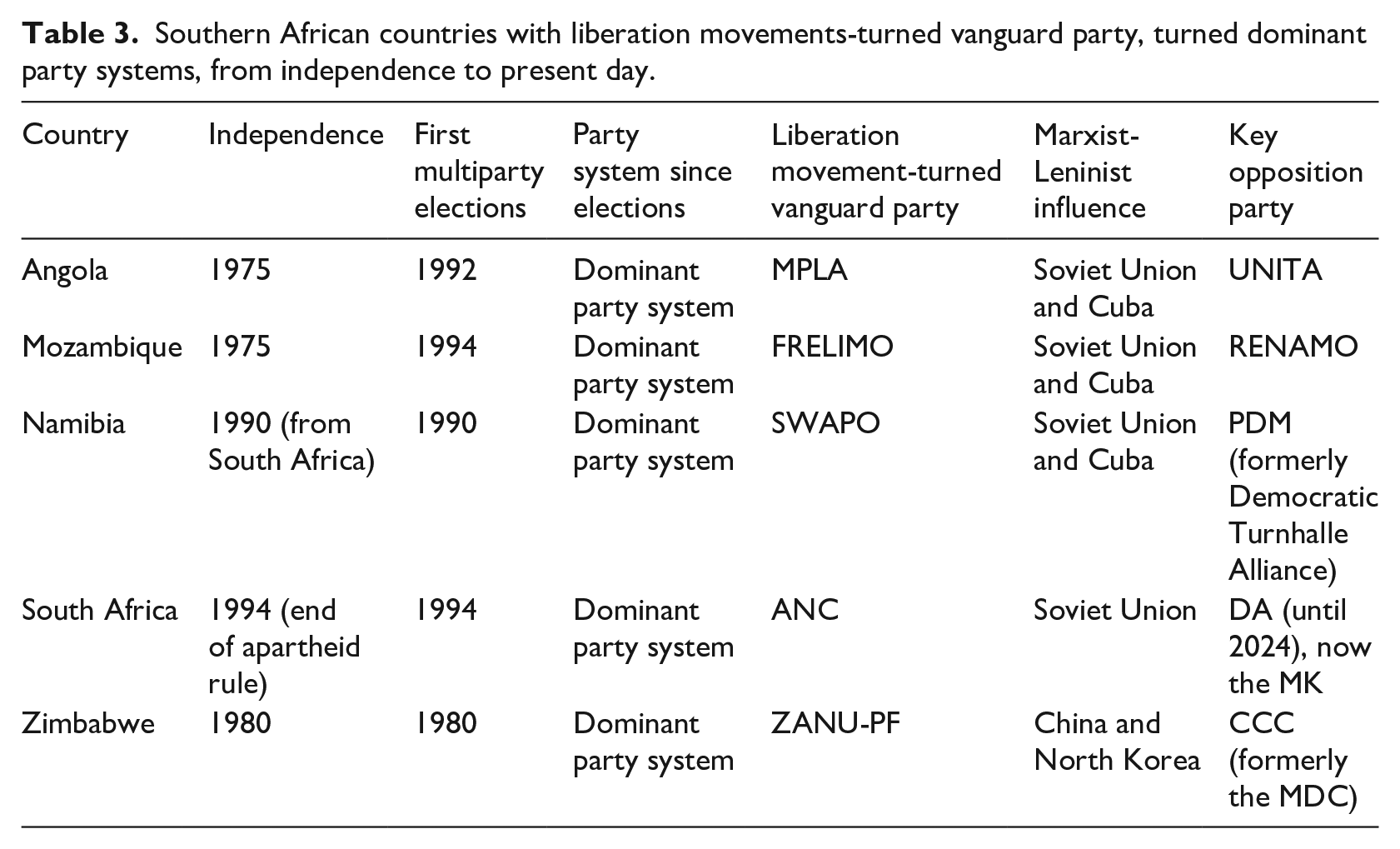
Of the nine southern African countries considered, five of them have had liberation movements that were militarily, financially and ideologically influenced by communist regimes (see Table 3). All five of these liberation movements turned into dominant party systems. While the financial and military support, particularly during the proxy Cold War period, was short-lived and limited, it appears that the Marxist-Leninist ideas of the vanguard party, democratic ‘centralism’ and opposition denigration, if not elimination, have been enduring. From this, it can be theorised that a Marxist-Leninist history tends to create a hostile environment for opposition politics and produce a dominant party system in which incumbents conflate party-state and government.
Southern African countries with liberation movements-turned vanguard party, turned dominant party systems, from independence to present day.
Jeffery Herbst noted in 1990 that unlike what was happening in Eastern Europe – the abandonment of the single-party state – in sub-Saharan Africa the Leninist notion of the all-powerful party-state was likely to persist. Following the fall of communism, Herbst had not expected there to be a complete rejection of the one-party state or an imminent move to democracy on the continent. What he had not fully accounted for was global pressure spilling over into Africa where ‘multiparty democracy is increasingly perceived as the only legitimate political system’ (Herbst, 1990: 93). Thus, following the two World Wars and with the end of the Cold War, the global momentum turned towards liberal democratic forms of government, where political power is regularly contested through multiparty elections. The normative victory of liberal democracy (Francis Fukuyama’s ‘end of history’) meant one-party states did not have global legitimacy or support. Furthermore, with the end of support from the Soviet Union and others, these countries turned to the West and with it the demand for democracy. In this context, many of these liberation movements-turned vanguard parties acceded to ostensibly democratic forms of government. But it appears that the procedural and outward displays of democracy and multiparty elections were more a move to legitimise the incumbent’s stay in government, rather than a genuine commitment to competitive politics. Thomson similarly argues that many African political elites, both incumbent and opposition, tend to use multiparty democracy ‘instrumentally’: supporting it as a way of retaining or maintaining power, not because of an inherent belief ‘in its moral value’ (Thomson, 2010: 259–260). The outcome is a region predominantly characterised by dominant party systems led by vanguard parties with beleaguered and/or weak opposition parties. In such a political context, opposition politics, evidenced in multiparty elections, is tolerated as a tool of legitimising the ruling party’s position, but opposition political parties are not perceived to have the right to govern, ever. This history of Marxism-Leninism and the vanguard party is part of the explanation of why opposition politics flounders in southern Africa, especially in five of the nine southern African countries led by liberation movements-turned vanguard party, where there has been no turnover in executive power. Another explanation for opposition weakness can also be found in societal perceptions of opposition.
Societal distrust of opposition
When many southern African countries initially turned to one-party states following independence, they regarded opposition parties ‘as enemies of the state’ (Chiroro, 2006: 101). ZANU-PF used coercive tactics and authoritarian populist policies to maintain its support base, while portraying the opposition as the enemy (Muzondidya, 2011: 9). Following the transitions to multiparty elections, the language softened, and turned to delegitimising terms like anti-transformation, reactionary and more recently spreaders of misinformation. Zambian politics, while not having a Marxist-Leninist history, are also characterised by ambivalence to opposition, and in Eswatini it is simply not tolerated at all. There do seem to be deeper roots to this anti-opposition sentiment, which may be held beyond the ruling parties.
Using two rounds of Afrobarometer surveys, the question of trust of opposition parties is considered over time. Trust in opposition is found severely wanting. However, there has been some change, in a positive direction, between 2002/2003 and 2019/2021 (see Table 4). The hard-line of not trusting opposition at all declined from a high of 46% (2002/2003) to 37% (2019/2021), while trusting opposition ‘a lot’ increased from 4% to 14% in 2019/2021. If the two categories for distrust in opposition are merged, then the distrust declines from 76% (2002/2003) to 63% (2019/2021). On the other hand, the trust in opposition parties increases from 16% to 33%, a doubling in trust. These are still high levels of distrust, but hopefully the 13% decrease in distrust and the 17% increase in trust in the 17-year period are indicative of an increasing understanding of and support for opposition politics.
Trust in opposition political parties for society in southern Africa, Afrobarometer.
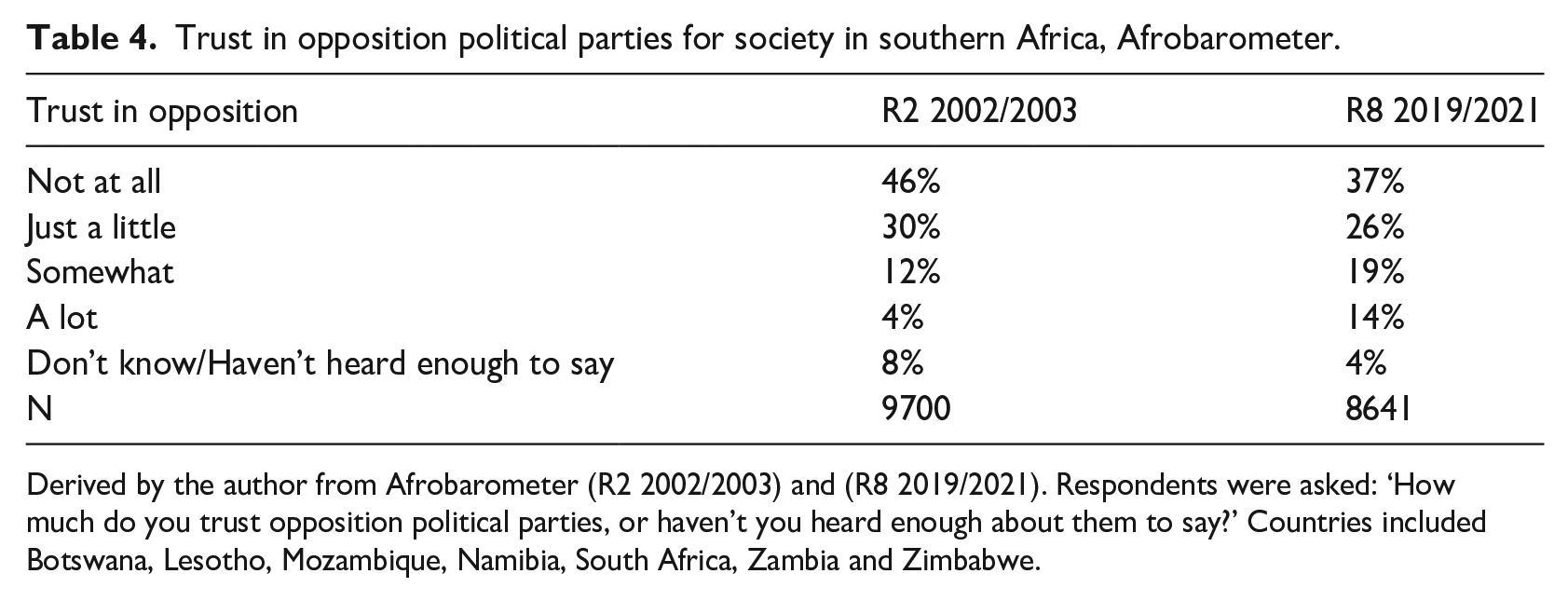
Derived by the author from Afrobarometer (R2 2002/2003) and (R8 2019/2021). Respondents were asked: ‘How much do you trust opposition political parties, or haven’t you heard enough about them to say?’ Countries included Botswana, Lesotho, Mozambique, Namibia, South Africa, Zambia and Zimbabwe.
What can explain this low level of societal trust in opposition parties? First, since the instrument of political parties is a fairly recent development, there may remain from traditional cultures a distrust in ‘opposition’ per se. Osabu-Kle (2000: 19) notes that in African culture, ‘the concept of opposition and enemy came to mean the same thing’; as the ‘only known opposing force was the enemy from outside’. Similarly, Nkala (2015: 11) notes how ‘FRELIMO continues to treat RENAMO as a defeated foe’. The idea of ‘loyal opposition’ or ‘constitutional opposition’ – non-governing parties holding the executive to account while remaining loyal to the democratic system and the country’s constitution – is thus yet to be properly understood by society. This requires a change from seeing politics as a zero-sum game and opposition parties as the ‘enemy’ to be eliminated. The second explanation refers back to the previous discussion of liberation movements that portray themselves as the ‘embodiment’ of the nation or the ‘people’ and the state (Osabu-Kle, 2000: 19). In such a worldview, opposition is then considered to not be opposing the ruling party in a competitive, multiparty system, but to actually be against the ‘people’. It is a delegitimising context, where de jure, opposition parties may contend for political power, but de facto, they may not. A third explanation is opposition failure and weakness itself. Opposition tends to be fragmented into ‘smaller non-viable parties’, contending on the fringes along narrow ethnic and regional lines, and the cult of personality (Nkala, 2015: 14). For example, prior to the 2013 elections in Zimbabwe, the MDC splintered into multiple factions. In Botswana, opposition parties, weakened due to a lack of public funding, are also fragmented and struggle to contend against the BDP’s relatively successful governing track record.
A future of more vibrant opposition politics?
A study of South Africa, Zimbabwe, (and Uganda) using Elite surveys and the World Values Survey found that those who supported opposition were demanding fewer abuses by those in power; whether against society or abuse of state institutions and public resources. The study concluded that it was ‘these fundamental issues that appear to be driving opposition party support in Africa’ (Kotzé and García-Rivero, 2008: 485). In turn, many opposition parties in the region have arisen in protest to the incumbents’ authoritarian inclinations and abuses of power (Chiroro, 2006: 103). This resonates with potential opposition supporters. The upside is thus that the desire for civil and political liberties (see Table 2) may eventually drive increasing support for opposition parties. In the liberal democratic logic, this should in turn motivate competitive politics with more accountable and better governance as incumbents feel the pressure of the ballot box.
While the southern African region’s liberation movements-turned vanguard party turned into dominant party systems, recent elections in many of these southern African countries show an increasing decline in social support for the ruling parties, and the potential for opposition parties to become real challengers. Opposition parties are growing in their political savviness, increasingly understanding the importance of forming alliances prior to elections and considering the possibility of coalitions post-elections.
Strong contenders for change look to be Angola, Botswana, South Africa and Namibia. In 2022, Angola’s MPLA received only 51% of the vote, closely followed by UNITA with 44%. While a dominant party, but not a liberation movement, the BDP in Botswana won 53% versus the UDC’s 36% in 2019. The 2024 national elections ushered in a new dispensation for South Africa as the ANC’s support plummeted by 17% taking it to 40%. This required the party to consider coalition politics and the need to share executive power. In response, the ANC with its president Cyril Ramaphosa put together a GNU. Admittedly, this resulted in a bloated cabinet, increasing from 30 to 32 ministries so as to accommodate the coalition partners while not diminishing too much of the ANC’s own power. The DA winning 22% of the vote was given six of the cabinet positions. The question is whether the ANC has negotiated in good faith and will respond to being punished at the ballot box with humility, acknowledging itself to not be the embodiment of the state, but rather a responsible part of the executive, sharing power with others. The 2029 elections will provide a clearer indication of whether the dominant party system has ended, or if the ANC merely skilfully used the GNU as the next ‘site of struggle’ to retain power, despite its decline in electoral support. In Namibia, SWAPO declined from ruling without match with 80% of the national vote in 2014 to 65% in 2019. The country’s opposition parties have begun to act strategically; forming alliances with each other. This was evident in the 2019 presidential elections, where they successfully worked together to break SWAPO’s two-thirds majority. For example, the United Democratic Front (UDF) withdrew their candidate to back the presidential candidate of the Popular Democratic Movement (PDM) and leader of the official opposition.
Social support for the incumbents is becoming tenuous, as is evident in South Africa. Using the democratic system as a form of legitimation for the control of the executive is not enough in the face of the undermining of civil and political liberties, and lacklustre socio-economic records. Such a context appears to be turning social support towards considering opposition parties. The test is then whether or not the liberation movements-turned dominant parties will relinquish their Leninist vanguard identity and be willing to recognise themselves as a party among others, and not the party. And, in light of their undermined liberties, whether citizens will shake their distrust of opposition and support competitive politics. If so, the region does look posed for change and for more vibrant opposition politics.
Footnotes
Funding
The author(s) received no financial support for the research, authorship and/or publication of this article.
