




Abstract
This article investigates the transformative potential of social policy interventions in restructuring gender relations and women’s economic empowerment. It specifically examines Zimbabwe’s Fast Track Land Reform Programme as a social policy instrument designed to reshape women’s economic and social positioning in rural settings. Through qualitative and quantitative analyses of data from 30 women land beneficiaries, the study reveals significant shifts in women’s roles from being marginalised individuals to landowners and employers, thereby challenging traditional patriarchal structures. The findings indicate that these transitions not only enhance women’s economic autonomy but also elevate their social status within their communities, fostering a sense of agency and participation in agricultural production and community leadership. The article highlights the transformation of agricultural production dynamics and labour relations, as women increasingly assume leadership roles, disrupting conventional dynamics and promoting equity in agrarian contexts. The micro-level experiences documented provide insight into how women navigate and reshape agrarian relations. This contributes to a reframing of the social policy discourse that emphasises the necessity for policies recognising women’s contributions to agrarian economies. The study also acknowledges the limitations of land reform as a universal solution, suggesting that its effectiveness is contingent upon having support systems in place. The article concludes that land reform can serve as a powerful catalyst for social transformation, paving the way for a more equitable and sustainable agrarian landscape in Zimbabwe.
Keywords
Introduction
The centrality of women in African agriculture is evidenced by empirical data that demonstrates their substantial contribution to the sector. Women constitute 75% of the agricultural workforce (Matthew et al., 2022; Obayelu et al., 2019), with farming activities generating approximately 79% of their income (Edafe et al., 2023). Recent analyses of sub-Saharan Africa’s agrifood systems reveal women’s employment rate of 66% compared to men’s at 60% (FAO, 2023: xx). This significant female presence in the agricultural sector, representing 52% of the agricultural population and contributing half of the farm labour, reveals a paradoxical landscape of gender marginalisation, where women’s critical economic contributions are systematically undermined by persistent gender biases in agricultural policies, land ownership rights and access to resources. Drawing on empirical research and policy analysis from Zimbabwe, this study demonstrates how systematic gender biases are embedded in agricultural development frameworks, which persistently undervalue women’s economic contributions despite their critical role in agricultural production.
The multi-dimensional nature of women’s marginalisation presents a critical challenge for African agricultural transformation initiatives. It is evidenced through unequal land access, limited decision-making power, restricted credit opportunities and exclusionary agricultural policy design that historically sidelines women’s economic agency (FAO, 2023). Addressing this systematic oversight is considered essential for achieving global sustainable development objectives and fostering agricultural growth in rural areas (Balezentis et al., 2021). Of note is that despite the significant contribution of women in agriculture, in some contexts, their engagement is undervalued and remains constrained by structural barriers that are circumscribed by multiple intersecting constraints (Noll, 2023; Pradhan et al., 2024). These include the burden of unpaid care work, limited education, restricted market access and systematic exclusion from high-value agricultural opportunities. Women have thus been largely relegated to homestead-based agricultural activities or precarious labour marked by informality, seasonality and poor remuneration (Marter-Kenyon et al., 2023; Odey et al., 2022). This narrative however differs, with context. In some instances, the contribution of women is valued and considered to be of importance. Adebayo and Worth (2024) for example note that in some African countries the contributions of women in marketing, food processing, cropping and animal husbandry as well as in decision making are valued and considered to be of critical importance. This point is important in highlighting the different dynamics which occur in different contexts and regions across the continent.
In contexts where the role of women is undermined, the constraints faced are deeply embedded in and perpetuated by prevailing patriarchal structures, traditional norms and cultural values, which severely curtail women’s economic agency and agricultural productivity. It is worth noting that these constraints reflect deeper structural inequalities that are embedded in patriarchal social systems. These social systems have historically defined women’s relationship to land, labour and agricultural production (FAO, 2023). Traditional norms and cultural values can be seen as having legitimised these gender hierarchies, restricting women’s roles to specific, often marginalised, positions within agricultural systems. For women, these challenges have become more complex in a world facing multiple interlocking crises. The post Covid-19 context has seen the exacerbation of existing vulnerabilities, occurring alongside climate and biodiversity crises, increasing austerity, privatisation and the rolling back of state social service provision (UNRISD, 2023). These overlapping socio-economic, political and ecological crises have particularly affected women, whose coping mechanisms and resilience to shocks as indicated above are largely shaped by persistent gender inequalities. Considering these dynamics and a changing world marked by efforts towards realising the Sustainable Development Goals as well as national and international imperatives for gender equity and women’s empowerment, there has arisen an urgent need to reassess the role of women socially and economically and in the case of this article in agriculture, rural livelihoods and social transformation.
This research examines how Zimbabwe’s Fast Track Land Reform Program (FTLRP), which has lately been conceptualised as a transformative social policy (TSP) instrument (see Chipenda, 2024a; Tom, 2024), reconfigures gender relations and creates pathways for women’s economic empowerment in rural economies. For this article, women’s economic empowerment which is one of the key concepts is viewed as the process of acquiring economic resources (specifically land ownership), gaining decision-making power within the household and community contexts and developing economic agency through independent agricultural production and labour management. Transforming gender relations, on the other hand which is another key concept, is understood as challenging and restructuring traditional patriarchal norms by disrupting existing power dynamics. This enables women’s leadership roles and creates spaces for women’s increased social and economic participation beyond historically prescribed gender boundaries.
Through fieldwork held in rural Zimbabwe’s Zvimba and Goromonzi Districts, which engaged with 30 women land reform beneficiaries 1 (20 A1 smallholder farmers and 10 A2 medium-scale farmers), the research investigates how women beneficiaries have transitioned since becoming landowners and how this has had implications on economic relations, the traditional labour regime and social relations. This transformation is shown as representing a fundamental challenge to conventional narratives about gender, agency and social policy outcomes in Africa’s agricultural transformation. The study’s theoretical contribution lies in its reconceptualisation of land reform as a TSP instrument. This makes it move beyond conventional social protection frameworks to examine its potential for structural transformation. Through examining the experiences of women who benefitted from the FTLRP, the study documents how access to productive resources challenges and reshapes traditional gender hierarchies, contributing to theoretical understandings of gender and social transformation in African contexts. The analysis reveals emerging forms of women’s agency and economic empowerment that challenge conventional narratives about gender relations in African agriculture.
The study is framed around the TSP conceptual framework, which positions land and agrarian reforms as social policy instruments with functional equivalents to conventional social policies (Adesina, 2015; Tom, 2024). Using this lens, the research examines how land reform transforms social relations and institutions while enhancing human welfare and wellbeing (Adesina, 2015). The study addresses how land reform creates pathways for women’s economic empowerment in Zimbabwe’s rural economy, investigating their transition from confined homestead roles and precarious agricultural and informal labour to becoming farm owners, employers and agricultural entrepreneurs. The research documents how this transition alters traditional labour regimes and social relations, examining how women beneficiaries’ micro-level experiences challenge conventional narratives about gender, agency and social policy outcomes in African agricultural transformation. As it provides empirical evidence of how access to productive resources reshapes traditional gender hierarchies, this research advances theoretical understandings of gender and social transformation in African contexts. The study demonstrates how land reform’s transformative potential extends beyond economic improvements to fundamental shifts in social relations, cultural norms and gender dynamics. The manner in which women beneficiaries navigate and reshape traditional constraints contributes to a new social policy discourse centered on African experiences and solutions, providing insights into how TSP can address structural inequalities and advance gender equality in African agricultural contexts. In the next section, I look at the theoretical framework that guided the study.
Theoretical Framework: Transformative Social Policy
The TSP framework, originating from the Social Policy in a Development Context Research Project at the United Nations Research Institute for Social Development (UNRISD), which provided comprehensive analytical lens for understanding social policy in Africa’s development context (UNRISD, 2006). For this study, it offers critical perspectives into how land reform reconfigures gender relations and labour regimes while facilitating broader agrarian transformation. The framework emerged as a critique of what was perceived as narrow neoliberal approaches to social policy. It challenged the restricted focus on safety nets and targeted interventions that failed to address systemic causes of poverty, gender inequality and labour exploitation (Adesina, 2011; Mkandawire, 2004). Recent applications by Tom (2024), Chipenda (2024a, 2024b) and Tekwa (2023) demonstrate its utility in analysing how land, as an enabler of socioeconomic wellbeing, can transform gendered power relations, labour relationships and social structures in agrarian contexts. The framework’s strength lies in its integrated approach encompassing five interconnected transformative tasks that address gender and labour dynamics (Adesina, 2011, 2015; Tekwa and Adesina, 2018). These are the production, redistribution, protection, reproduction and social cohesion or nation building functions. The production function examines women’s transition to being producers, employers and decision-makers, while the redistribution function addresses asset inequality and dismantles patriarchal control over resources. The protection function ensures social security for vulnerable households, particularly women-headed households navigating production and agrarian labour markets. The reproduction function recognises women’s care work and examines how land ownership affects productive and reproductive labour organisation. The social cohesion or nation-building function analyses how transformed gender and labour relations contribute to new forms of rural solidarity and collective welfare (Adesina, 2011; Mkandawire, 2007).
Unlike conventional social policy approaches focused on poverty alleviation through targeting and safety nets, TSP advocates for structural transformation by examining how land reform reshapes power relations, labour regimes and social institutions (Tom and Banda, 2023). This broader vision promotes social solidarity, equity norms and marginalised groups participation and the positioning of the state rather than the market as central to social transformation (Adesina, 2011). As Adesina (2015: 113) articulates, land reform transcends historical redress; with appropriate agrarian support, it addresses multiple social policy tasks while transforming traditional labour arrangements and gender hierarchies.
While the TSP framework has been used to primarily focuses on local-level transformations, it inherently acknowledges the broader economic and policy landscape that shapes household dynamics. As highlighted above, the framework critiques narrow neoliberal approaches and positions the state, rather than the market, as central to social transformation. It thus recognises the interconnectedness between global economic structures and local agrarian contexts. As it challenges conventional social policy approaches that emphasise targeted interventions, the TSP framework provides lens that consider how global economic policies and market dynamics intersect with local-level social and gender relations. As demonstrated by recent applications by scholars like Tom (2024) and Chipenda (2024a), the framework examines how external economic and policy environments mediate land reform’s potential to reshape power relations, labour regimes and social institutions. Specifically, it analyses how broader economic policies impact asset redistribution, women’s productive and reproductive labour, social security and the potential for social cohesion. It thus offers a comprehensive approach that connects local household experiences with wider structural economic and policy contexts.
For this study, the framework’s value was seen to be in its capacity to analyse the complex nexus between gender, labour and social transformation in agrarian contexts. It provides tools to understand how women beneficiaries navigate and reshape the agrarian landscape, challenging patriarchal structures and creating new forms of social organisation benefiting both women landowners and agrarian communities. These changes intersect with broader social transformations in household power dynamics, community leadership structures, and local governance systems. TSP reveals how land reform catalyses multiple transformative processes. It can be seen altering gender relations through women’s control over productive resources, transforming labour regimes through new classes of women employers and facilitating social transformation through new forms of rural organisation and solidarity. While not a panacea for Africa’s development challenges, the TSP framework demonstrates how land and agrarian reforms, when appropriately designed and supported, can fundamentally transform gender relations, labour regimes and social structures in Zimbabwe’s rural economy. It was due to this utility that it was considered appropriate for the study.
Women and land in Zimbabwe
Zimbabwe’s land reform experience provides an interesting case study of how land and agrarian reforms as a social policy instrument can fundamentally transform gender relations and labour dynamics in agrarian societies. The historical context of women’s relationship to land and agricultural production in Zimbabwe reveals deeply entrenched patterns of subordination. At independence in 1980, women’s land ownership in the country stood at a mere 5% (Zvokuomba and Batisai, 2020). The marginalisation of women was a direct result of the colonial system, which operated on two intersecting forms of discrimination, namely racial and gender based. This system was designed not only to dispossess Indigenous peoples of their productive resources but also to overtly create a gendered socio-economic hierarchy. Through various legislative frameworks, colonial authorities systematically restricted women’s socio-economic and political roles, denying them opportunities for example in land ownership and entrepreneurship. Beyond colonial structures, patriarchy itself emerged as a persistent and deeply rooted system of oppression. There could be found indigenous cultural practices and social norms that continuously reproduced women’s subordination through inheritance patterns, traditional leadership structures and entrenched gender-based power dynamics (Chipenda, 2019a; Gaidzanwa, 2011). These systematically excluded women from land ownership and economic decision-making. The colonial administration could be seen further reinforcing this gender inequality by actively supporting and preserving patriarchal traditions and cultural practices that subordinated women (Chipenda, 2019a).
Land dispossession and discriminatory social and economic policies worked systematically to advance British colonial interests while marginalising the black majority, particularly women. From the earliest colonial period, a series of draconian legislative measures including the Rudd Concession, Native Reserve Order in Council, Native Reserve Areas, Land Apportionment Act (1930), Maize Control Act, Land Husbandry Act (1951) and others created a comprehensive framework of dispossession and control (Tom, 2024). This colonial legislative architecture established a system of dual subordination that enforced both racial segregation and gender-based discrimination. The laws not only facilitated widespread land alienation from the black majority but also systematically marginalised women by restricting their economic autonomy and property rights. This effectively limited their ability to accumulate wealth or establish independent livelihoods (Bhatasara, 2021; Gaidzanwa, 2011). The subsequent evolution of land policy through the Land Acquisition Act, Land Tenure Act, Tribal Trust Lands Act (1967) and Communal Land Act (1981) further entrenched these inequalities by vesting administrative authority in patriarchal institutions (Bhatasara, 2021; Chipenda, 2019a; Gaidzanwa, 2011). This legislative framework ensured that women’s access to economic resources and political participation remained mediated through male relatives, creating a persistent pattern of dependency. The laws institutionalised women’s subordinate status by denying them direct access to property rights, credit facilities and decision-making positions while reinforcing their economic and political dependence on male authority (Gaidzanwa, 2011; Nyandoro, 2019).
Zimbabwe’s land reform process evolved through two phases before culminating in the FTLRP. The initial phases known as the first and second phases of land reform, implemented from September 1980 to 1998, were designed with multiple objectives. These included expanding agricultural production, improving national welfare, addressing historical inequities in land distribution and creating a more efficient system of land ownership while maintaining agricultural productivity (Utete, 2003). These early reform efforts achieved limited success, with the government acquiring only 3,498,444 hectares of land and resettling 71,000 families during this period (Utete, 2003). The slow pace of these reforms, combined with persistent poverty and growing frustration over land inequality, ultimately triggered a dramatic shift in Zimbabwe’s rural landscape. This culminated in widespread spontaneous occupations of white-owned farms, led by war veterans and land-hungry peasants (Mkodzongi and Lawrence, 2019). These occupations precipitated the implementation of the FTLRP, marking a decisive break from the previous measured approach to land redistribution. In just over a decade, the FTLRP succeeded in the resettlement of approximately 180,000 families on 13 million hectares of land (Moyo, 2011). Compared to previous efforts, the FTLRP was highly redistributive and contributed most to reconfiguring the country’s agrarian structure from bimodal to trimodal (Moyo, 2011). The program was implemented through two models with the A1 (a smallholder farming model intended to decongest areas under communal tenure) and the A2 (a commercially oriented medium-scale scheme). For women, the FTLRP created opportunities for socio-economic advancement in rural Zimbabwe. These have included land access and ownership has empowered women economically and socially, including increased participation in agricultural production, improved household income and enhanced community status (Chipenda, 2019a). This transformation, while significant, revealed complex gender dimensions in its implementation. The achievement of 18% female beneficiaries under the A1 model and 12% under the A2 model represented progress in women’s economic empowerment, though falling short of the overall target of 20% female allocation in the whole programme (Chipenda, 2019b). As Bhatasara and Chiweshe (2017) importantly note, these statistics require careful disaggregation by age, location and marital status to fully understand their transformative impact on women’s social and economic status. The program’s implementation revealed persistent structural barriers to women’s full participation. In the A1 scheme, application processes requiring registration with local authorities and traditional leaders often reproduced patriarchal biases that limited women’s access (Chambati and Mazwi, 2020; Moyo, 2011). The A2 model presented additional challenges, as women’s limited access to financial resources constrained their participation, particularly given the requirements for business plans and proof of funds (Bhatasara and Chiweshe, 2017). Despite these challenges, women beneficiaries who gained access to land have demonstrated a capacity for economic independence and social transformation, though operating within persistent structural constraints.
The legal framework supporting these transformations following land reform in Zimbabwe have evolved significantly. The 2013 Constitution of Zimbabwe established progressive provisions for gender equality and mandated positive measures to address historical imbalances (GoZ, 2013, Section 17(2):20). This constitutional foundation has been critical as it has empowered the government and the Ministry responsible for lands and agriculture (now the Ministry of Lands, Agriculture, Fisheries, Water and Rural Development (MLAFWRD) to implement policies that specifically promote women’s access to land and agricultural resources. Over the past few years, the MLAFWRD has initiated various programs aimed at enhancing women’s participation in the agricultural sector, recognising their vital contributions to food security and rural development. These initiatives have sought to ensure that women’s rights to land ownership and access are not only protected but actively promoted, fostering an environment where women can thrive as landowners and leaders in agricultural production.
This foundation has been reinforced by Statutory Instrument 53 of 2014 (SI 2014-053), which provides crucial support for women (Moyo et al., 2016). SI 2014-053 came in a context where the experiences of women were seen to be vulnerable in traditional contexts. Experiences with the land reform process have provided valuable lessons on both the challenges and transformative potential of land reform on women. Hence, these active measures were implemented and have positively contributed to women’s access and ownership of land (Moyo et al., 2016). Despite facing disproportionate limitations in patrilineal contexts, women have demonstrated significant agency in negotiating access and control over land, thanks in part to the supportive legal and policy frameworks established by the government. This transformation challenges traditional patriarchal structures and elevates women’s roles within their communities. The experiences of women who have been shown as being vulnerable in most cases, provides particularly valuable lessons on both the challenges and transformative potential of land reform. Women have demonstrated significant agency in negotiating access and control over land despite disproportionate limitations in patrilineal contexts which often limit their rights to land ownership and inheritance (Moyo et al., 2016).
In recent years in the country’s rural context, it is important to highlight that women have shown a lot of agency. This is exemplified by the commercialisation of customary land which has introduced new dynamics in women’s economic empowerment trajectories. As Mutopo (2014: 200–201) observes, women’s engagement with informal land markets, though often operating outside formal structures, demonstrates their capacity to utilise economic opportunities and transform traditional social relationships. The current agrarian structure, comprising 1.3 million small-scale farmers on 25.8 million hectares, medium-scale farmers on 4.4 million hectares and 1618 large-scale commercial farms on 2.6 million hectares (Moyo, 2011: 512), reflects a complex terrain where women beneficiaries are actively developing new models of economic organisation and social networks that challenge traditional patriarchal structures. These transformations in rural socio-economic relations represent a significant shift in Zimbabwe’s rural economy. It can be seen demonstrating the potential of land reform as a TSP instrument. Women’s emergence as independent agricultural entrepreneurs and decision-makers (see Tekwa, 2023; Tekwa and Adesina, 2018; Tom and Banda, 2023) as shall be discussed in this article marks a decisive break from historical patterns of economic dependency and gender subordination. This shift has facilitated new forms of rural organisation, including different women led initiatives, agricultural marketing initiatives and innovative resource management approaches. While significant challenges remain in fully realising this potential, these changes are contributing to a broader reframing of social policy discourse in the African context, particularly regarding women’s economic empowerment and rural transformation.
Research Methodology
The study was undertaken in Goromonzi and Zvimba Districts in Zimbabwe between 2022 and 2024 as part of a larger project at the DSI/NRF SARChI Chair in Social Policy at the University of South Africa titled The Social Policy Dimensions of Land Reform in International Perspective. The project explored the social dimensions of land reform in five districts namely Chiredzi, Goromonzi, Kwekwe, Mangwe and Zvimba Districts. This article is focused on Goromonzi and Zvimba. Drawing on a pragmatic research paradigm, this study employed a sequential explanatory mixed-methods design (see Foster, 2023; Johnson and Onwuegbuzie, 2004; Shannon-Baker, 2016). This methodological approach aligned with the TSP framework’s emphasis on understanding the multiple dimensions of social transformation (see Gillespie et al., 2024). In the context of this research, the approach is valuable for examining the intersections of gender, labour relations and agricultural development. The research design unfolded in two interconnected phases. The first phase employed quantitative methods through a survey of 30 women farmers (beneficiaries of the FTLRP in the small scale A1 and medium scale A2 tenure regimes) in Goromonzi and Zvimba districts. It saw the utilisation of a structured survey questionnaire that captured over 1500 variables related to agricultural production, household dynamics, asset accumulation, social relations among other pertinent issues. This extensive quantitative foundation provided crucial perspectives into patterns of agricultural transformation and women’s economic empowerment. The sampling strategy combined purposive and random techniques to ensure representation across farming categories and geographical locations. Emphasis was on comprehensive understanding through strategic sample selection. The second phase employed qualitative methods through in-depth interviews with 20 key informants. These participants were strategically selected to represent government officials, resettled farmers and local authorities. This phase was particularly valuable in unpacking the nuances of gender relations, labour regime transformations and institutional dynamics that emerged from the quantitative findings (see Caesar, 2024; Gerzso and Riedl, 2024). The qualitative component was useful in showing how women beneficiaries navigate power relations, reshape labour arrangements and contribute to broader social transformation in the resettlement areas.
Data analysis employed SPSS for quantitative data processing. This enabled robust statistical analysis of agricultural production, labour dynamics, income generation, welfare outcomes among other dimensions. Qualitative data underwent systematic thematic analysis (see Kumar, 2011), with particular attention to emerging themes around gender dynamics, production outcomes, labour relations and social transformation. This dual analytical approach provided both statistical rigour and rich contextual understanding of how land reform reconfigures gender relations and facilitates social transformation. The methodological framework’s strength lay in its capacity to capture both the structural patterns of agrarian transformation and the lived experiences of women land beneficiaries. Its comprehensive approach aligned with TSP’s emphasis on understanding multiple dimensions of social transformation, providing empirical insights into how land reform serves as a TSP instrument in Zimbabwe’s rural economy.
As highlighted in the preceding sections, the study was undertaken in Zvimba and Goromonzi district in Zimbabwe. The two district are in Zimbabwe’s agricultural heartland. Goromonzi which is in Mashonaland East Province and Zvimba located in Mashonaland West Province exemplify prime agricultural zones within agro-ecological region II (Chipenda, 2019b). Their exceptional agricultural potential, characterised by optimal rainfall patterns (750–1000 mm annually) and moderate temperatures (15°C–24°C), provide a critical context for examining women’s agricultural transformation and economic empowerment through land reform (Chipenda, 2019a, 2024a). These two districts agro-ecological conditions support diverse farming enterprises, from intensive crop cultivation to livestock production systems, making them crucial to national food security and agricultural output (Chipenda, 2024a, 2024b, 2019b). The agricultural landscape in both districts features a mosaic of production spaces. These range from expansive commercial fields to integrated homestead gardens which were seen during the study as enabling women beneficiaries to engage in multiple agricultural enterprises. The proximity of the two districts to major markets, transport routes and their well-established agricultural infrastructure can be seen as further enhancing their significance as case studies for examining gender-based agrarian transformation within Zimbabwe’s redistributive land reform program. The two districts were thus selected as exemplary case studies due to factors highlighted above namely their prime location in Zimbabwe’s agricultural heartland with optimal rainfall and temperature conditions. Their diverse agricultural landscapes, proximity to markets and well-established infrastructure provide a comprehensive context for examining women’s agricultural transformation through land reform.
Findings and analysis
Redistributive outcomes and women
As highlighted in the preceding sections, the FTLRP marked a significant shift in Zimbabwe’s agrarian structure, particularly in reconfiguring gender dynamics within agricultural production. While earlier analyses by Moyo (2009) highlighted its redistributive nature compared to previous reforms, emerging evidence reveals a more dynamic transformation in women’s roles and social positions (Tekwa, 2023; Tom and Banda, 2023). This transformation has been seen as extending beyond mere land ownership to encompass fundamental changes in production and labour relations as well as social hierarchies. Despite persistent challenges in achieving comprehensive gender equality in land ownership (Tom and Banda, 2023), women beneficiaries of the FTLRP can be seen as carving out unique positions in the country’s agrarian sector which are challenging traditional patriarchal structures. This evolution represents a significant departure from conventional narratives that primarily frame women as occupying low positions in the agrarian sector and as being passive beneficiaries. The transition, however, is complicated, with women having to navigate multiple challenges including intergenerational pressures from youth seeking agricultural opportunities (Chipenda and Tom, 2022) and evolving social expectations of their roles as landowners, employers, household heads and caregivers.
To examine how the FTLRP’s redistributive outcomes manifested at the micro-level, particularly in terms of women’s transition from beneficiaries to agricultural employers, the study analysed demographic data from 30 women land beneficiaries across different resettlement schemes. The age distribution revealed a significant bias toward older participants. Those aged 55 years and older represented over half of participants (16 or 53.3%), with seven participants (23.3%) aged 55–64 years and nine participants (30%) aged 65+ years. The middle-aged cohort of 11 participants (36.7%) was split between those aged 35–44 (5 participants, 16.7%) and 45–54 (6 participants, 20%), while only three participants (10%) were in the 25–34 age bracket. Of note was that there were no participants younger than 25 years, an understandable dynamic since this age group would not have participated in the initial land redistribution phase where many of the research participants had been allocated land. In understanding the demographics and characteristics of women farmers in the study sample, it was considered important to look at marital status. Marital status analysis revealed that married women constituted the majority at 18 participants (60%), with 12 participants (40%) in monogamous marriages and 6 participants (20%) in polygamous relationships. Widows formed the second largest group with participants (26.7%), while single women represented the smallest category of four participants (13.3%). The distribution of marital statuses was seen being important as it revealed the dynamics of women’s agency in agricultural decision-making. While married women formed the majority of beneficiaries, the data suggested that agency is not uniformly determined by marital status. One participant from Goromonzi exemplified this complexity, noting that:
Even when my husband was still alive, I had become independent, we were both equally contributing money for the upkeep of the family. (Interview with A1 farmer in Goromonzi)
Persistent patriarchal structures could be seen continuing to challenge women’s full autonomy. Regardless of marital status, women faced similar systemic challenges in establishing their authority as landowners, with both married and unmarried women navigating intergenerational pressures and evolving social expectations as landowners, employers and household heads. This distribution was thus considered to be of importance for the reasons outlined above and also because it highlighted the various pathways through which women have managed to navigate land ownership within different household structures. This dynamic was particularly relevant given the joint titling provisions under SI 2014-053 as discussed earlier which has impacted on landownership by women in rural Zimbabwe in significant ways.
The timing of land allocation among participants was seen as aligning with different phases of the FTLRP. It was noted that 16 participants (53.3%) received land during the peak period of 2002–2005, nine participants (30%) during 2005–2008 and five participants (16.7%) after 2008. Land was primarily acquired through direct state allocation (either individually or jointly) or inheritance. This reflected the formal and informal mechanisms through which women gained agricultural assets. Closely related to this were the geographical origins of the 30 women land beneficiaries which demonstrated the diverse redistributive impact of the FTLRP. The largest cohort reportedly originated from urban areas with 13 participants (43.3%), followed by those from communal areas within the province with seven participants (23.3%) and large-scale commercial farming areas four participants (13.3%). Smaller numbers came from local communal areas within the district with three participants (10%), communal areas in other provinces with two participants (6.7%) and the old resettlement areas with one participant (3.3%). The diversity in beneficiaries’ origins, particularly the significant proportion from urban areas, was seen to be suggestive that the FTLRP had facilitated both geographical and social mobility as indicated by a participant who said:
When I received this land, it was a dream come true, but I felt overwhelmed as well. Coming from the city and having been a civil servant for many years I really never imagined I would be a farmer. The opportunity arose and I took it, I have no regrets. I have grown over the years and gained so much experience. Now, I grow my own food and have the power to provide for my family. Even when my husband was still alive I had become independent, we were both equally contributing money for the upkeep of the family. (Interview with A1 farmer in Goromonzi)
The study revealed significant variations in land holdings between A1 and A2 schemes across the two districts. In Goromonzi, all 10 A1 farmers (33.3%) held standardised 6-hectare plots, while the A2 holdings of five participants (16.7%) ranged from 35 to 180 hectares. Zvimba showed greater variation, with the 10 A1 farmers (33.3%) having land holdings ranging from 5 to 10 hectares and the five A2 farmers (16.7%) having land sizes spanning from 56 to 178 hectares. These disparities in land size were seen to have important implications for women’s capacity to transition from being either landless or engaging in subsistence farming to commercial agriculture. It was also seen as having implications in their ability to engage in employer-employee relationships and to occupy positions of authority which are themes that are central to understanding the transformative potential of land reform as a social policy instrument. The importance of being in possession of land was expressed by a respondent who said:
We used to share a small piece of land in the communal areas with my in-laws, my husband’s brothers and their families. The land was not enough, and you know were there are many people there are always conflicting even on very small issues. Getting this land provided so much relief, I was very happy to get it. It was important in providing me with my own fields and a home. Over the years it has become an important livelihood source. We educated all our children through farming. (Interview with A1 farmer in Zvimba)
The responses of participants were generally positive in relation to being given land. Of interest was that while some respondents reported gaining independence from being too dependent on males especially their husbands, fathers, brothers, uncles and other relatives, others felt that land reform had reinforced masculine privileges, as it had benefitted too many men compared to women. Even when women were the principal beneficiaries, the dynamics of household, family and community were seen as tending to subordinate and restrict them. Despite this complexity, from a TSP perspective, the redistribution of land represents more than an economic intervention. It can be seen as catalysing broader social transformation, and the first step to understanding this is by examining agricultural production dynamics.
Agricultural production
Before looking at agricultural production patterns, it is important to look at land utilisation dynamics following redistributive land reform in Zimbabwe. In the study, an analysis of land utilisation patterns among women beneficiaries gave some insight into their transformative journey from land recipients to agricultural employers and managers. The data demonstrated how land reform, as a social policy instrument, has created differentiated pathways for women’s economic empowerment across A1 and A2 tenure regimes. In the A1 sector, women beneficiaries have demonstrated progressive improvement in productive capabilities, with land utilisation increasing from 75 hectares (56% of total available land) in 2019 to 90 hectares (67.2%) by 2022. This upward trajectory was seen suggesting a steady transition from traditional smallholder subsistence-oriented farming to more commercialised production, partly responsive to state agricultural policy imperatives. This was seen to be a challenging narratives about women’s agricultural management capabilities. The intensive land use in A1 schemes was seen as being reflective of women’s agency in maximising limited resources and potentially restructuring labour relations at the micro-level.
On the other hand, the A2 sector presented a more dynamic picture of women’s transition to large-scale commercial farming. Despite lower overall utilisation rates which rose from 395 hectares (52.7%) in 2019 to 435 hectares (58.1%) in 2022, these figures were taken to represent significant shifts in traditional gender roles, with women managing substantial agricultural operations. There were witnessed fluctuations in utilisation rates by 54.7% in 2020, dropping to 53.3% in 2021. This revealed that women are not immune to challenges, but critical was the observation of how they have managed to capitalise on available opportunities. An A2 farmer had this to say on this:
We do have challenges in terms of inputs and generally capital. Fluctuations in prices of crops and the challenges that are coming due to climate change when rainfall is erratic influence our decisions when it comes to the amount of land which we cultivate each year. So, it can differ but not that much Ideally it is every farmers dream to cultivate as much land as possible and reap the maximum benefit. (Interview with A2 farmer in Zvimba)
While the land utilisation data suggests progressive capabilities, the marital dynamics could be seen revealing a more detailed picture of women’s autonomy. Of the 30 women land beneficiaries, 60% were married (12 in monogamous and 6 in polygamous marriages), raising questions about decision-making power within households. Narratives from some of the participants which highlighted dynamics were the sharing of communal land with in-laws, husband’s brothers and their families as well as other relatives. The land was not enough and this was said to be a trigger of most conflict. Statements from respondents suggested that land reform provided not just economic opportunity, but personal relief from restrictive familial structures. Another participant candidly noted that despite land ownership even when women were the principal beneficiaries, the dynamics of household, family and community were seen as tending to subordinate and restrict them (Interview with Zvimba A1 farmer). The testimonies of respondents showed that while women have gained land access, navigating patriarchal expectations remains an ongoing challenge. This revealed that at times legal ownership does not automatically translate to complete agricultural and economic autonomy.
From the information presented above, the differentiated pattern of land utilisation between A1 and A2 schemes (67.2% vs 58.1% in 2022) was interpreted as providing critical micro-level evidence of how land reform reconfigures gender relations and creates varied pathways for women’s economic autonomy. The empirical data suggests that while land size matters, women’s ability to maximise productive capabilities depends on multiple factors. This was seen contributing to an understanding of the dynamics of agricultural transformation with women at the centre made clearer by agricultural output and income generation.
Agricultural production and income generation
Maize is life and tobacco provides for these pockets, these two crops are our lifeline and producing them is important. We cannot afford not to produce them. When I grew up, men used to control cash crops at that time it was cotton, while women provided the labour, getting nothing in return for their efforts, in fact vegetables and maize for household consumption were their crops. With education and women being landowners like me things are changing. We our own farming, generate income and the money comes in our names to use it as we see fit. (Interview with A2 farmer in Goromonzi)
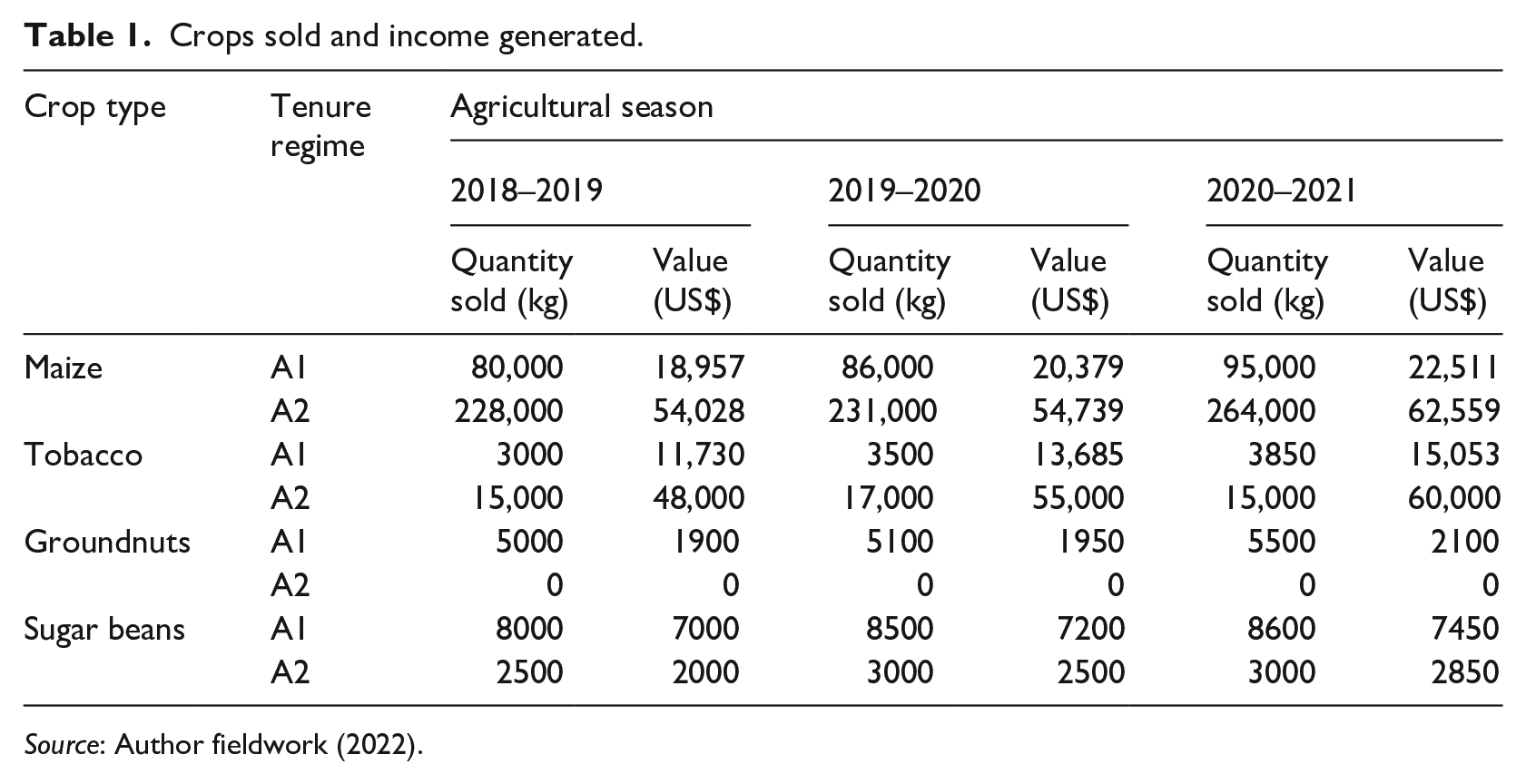
The quote above gives an example of many of the perspectives given by respondents in relation to the importance of autonomy in agricultural production and income generation by women farmers in the resettlement areas. In line with this, the study engaged with agricultural production and income generation activities. Agricultural production data from 2018 to 2021 was seen revealing unique patterns of market engagement and crop specialisation among women farmers. It demonstrated significant variations across tenure regimes and crop types. In both districts under the A1 scheme, women farmers exhibited consistent growth across all crops, with maize production increasing by 18.75% from 80,000 to 95,000 kg with income generated rising from US$18,957 to US$22,511. Tobacco showed the highest growth rate of 28.33% from 3000 to 3850 kg and its generated income was US$11,730 which rose to US$15,053 during the same period. The A2 farmers demonstrated stronger market presence in staple crops, with maize production reaching 264,000 kg in 2020–2021, up by 15.79% from 228,000 kg in 2018 to 2019. It generated US$62,559 in revenue.
In the study, it was observed that the production patterns of A2 women farmers revealed strategic specialisation. While tobacco production fluctuated from 15,000 to 17,000 kg, decreasing to 15,000 kg, there was increased value from US$48,000 to US$60,000. This was interpreted as suggesting improved market positioning despite volume volatility. The complete absence of groundnut production in A2 farms contrasted with A1 farm’s modest 10% growth of 5000 to 5500 kg. This was indicative of divergent crop selection strategies based on scale economies. Sugar bean production could be seen highlighting this differentiation, with A2 farmers achieving higher value appreciation with a 42.5% increase from US$2000 to US$2850. This was despite lower volumes compared to A1 farmers who saw only 6.43% value increase from US$7000 to US$7450. The detailed findings are summarised in Table 1 below. It shows patterns that suggest that while A1 farmers pursue diversified production strategies with steady incremental growth, A2 farmers optimise for market value through selective crop engagement and scale advantages. This is particularly significant if one looks at high-value crops. This differentiation reflects women farmers’ strategic adaptation to their resource endowments and market opportunities. To some extent, this was seen as challenging traditional narratives about gender constraints in agricultural commercialisation as they were seen women playing very important roles in agricultural production activities.
Crops sold and income generated.
Source: Author fieldwork (2022).
From Table 1, it can be argued that income generation patterns among women farmers provide evidence of land reform’s transformative potential as a social policy instrument. Income trajectories across three agricultural seasons demonstrate a measure of wealth creation, with gross agricultural income among the 30 farmers increasing from US$143,700 (2018–2019) to US$155,453 (2019–2020) and further rising to US$172,523 (2020–2021). This represents a cumulative growth of 20.1% over the study period. The year-on-year growth rates of 8.2% between 2018–2019 and 2019–2020 and a further 11% increase from 2019–2020 to 2020–2021, indicates accelerating economic gains and enhanced market integration. These financial outcomes translate to average annual incomes per farmer, these increased from US$4,790 to US$5,751 over the 3-year period, significantly exceeding Zimbabwe’s rural poverty threshold. This sustained income growth trajectory, emerging from diversified agricultural enterprises, substantiates the TSP perspective that land reform serves as a crucial mechanism for economic empowerment and poverty reduction. The consistent upward trend in income generation, despite various market, climatic and pandemic induced challenges, demonstrates women farmers growing capacity to utilise land access for sustainable wealth creation. To some extent it was seen challenging traditional narratives about the viability of women-led agricultural enterprises in land reform contexts.
Livestock production
In the study, it was observed that the agricultural activities of the women farmers are not just restricted to crop production, but they also extend to livestock production. The integration of crop and livestock production in Goromonzi and Zvimba districts reveals what the Agricultural Extension Officer of Zvimba viewed as ‘. . . an important agricultural broadening strategy (diversification) among the farmers, that facilitates different income and household food sources and protects them in case of failure by one of the farming streams . . .’ For the AEO’s in both districts, while farmers have traditionally engaged in crop and livestock production, the believed there has been a renewed impetus driven by government policy and strategic agrarian objectives which is giving rise to a cohort of agricultural entrepreneurs who are a product of the different initiatives being implemented that target farmers. For the research, the high prevalence of livestock ownership (88% of farmers) alongside crop production was seen as representing a significant transformation in traditional farming systems, with women actively reconstructing asset ownership patterns. Cattle ownership, reported by 62% of farmers, showed remarkable growth from 283 head in 2019/2020 to 324 in 2020/21 and 366 in 2021/2022, representing a 29.3% increase. This was seen as being reflective of a successful wealth accumulation strategy. For respondents, the increase could have been significant, but it was reported that challenges with diseases like theileriosis popularly known locally as January disease had negatively affected their livestock production activities. The growth in cattle numbers was seen parallelling women’s diversified livestock portfolios, including free-range chickens (23%), goats (14%) and broilers (8%).
The multifunctional role of livestock, particularly cattle, could be seen extending beyond conventional agricultural production, serving simultaneously as a productive asset, a social protection mechanism and a wealth store, thus complementing women’s crop production strategies. This is especially significant given cattle’s historically male-dominated ownership patterns in African agricultural systems (Chipenda, 2019b). The tripartite increase in cattle holdings was seen coinciding with women’s strategic crop selection patterns, where A1 farmers demonstrated consistent growth across diverse crops, while A2 farmers optimised for market value through selective crop engagement, particularly in high-value commodities. This integrated approach to agricultural production, combining strategic livestock accumulation with differentiated crop production strategies was seen as an important example demonstrating how women land reform beneficiaries are utilising multiple pathways to enhance their economic autonomy and social standing. In the long run, this was seen as effectively challenging traditional gender-based constraints in agricultural asset ownership and market participation.
Agricultural labour
In this study, the relationship between women and agricultural labour proved critical for examination. Through the lens of the TSP, a fundamental transformation in rural socio-economic relations could be seen emerging as women beneficiaries have evolved from their former status as landless individuals. Many have transitioned from being agricultural labourers, precarious informal and formal sector workers and home-based caregivers to becoming landowners and employers in Zimbabwe’s resettlement areas. Empirical evidence from Goromonzi and Zvimba districts, corroborated by similar patterns in Chiredzi, Mangwe and Mt Darwin (see Tekwa, 2023; Tom, 2024; Tom and Banda, 2023), demonstrates this transformation. In Zvimba and Goromonzi, it was reported that 96% of women beneficiaries are now engaging in hired labour. This was seen as representing a dramatic shift from their historical positioning as actors without much power and influence in the agricultural sector. Their emergence as agricultural employers was evidenced by systematic labour management patterns, exemplified by casual labour deployment which increased from 205 workers (2020) to 215 (2021) and further to 240 (2022), representing a 17.1% growth over the period. Permanent employment patterns revealed equally significant transitions, with 21 of the 30 farmers employing permanent workers, increasing from 27 workers in 2020–2021 to 29 in 2022, with a notable gender composition of 20 males and 7 females. The establishment of structured wage systems further demonstrates their evolution into formal agricultural entrepreneurs with 62.5% of employers offering US$3 daily wages for casual labour, while 13% reportedly paid US$4 and 8.7% provide US$5. For permanent workers, monthly salaries ranged from US$50 to US$120, with 60% of employers maintaining a standard wage of US$70. On this transition, a respondent put this into perspective by saying that:
As an employer, I manage three permanent workers and hire approximately 20 casual workers annually for specific tasks. I make all major decisions regarding hiring, remuneration, and termination, when necessary, with some assistance from my manager. As a woman employer, I have learned to be firm and to maintain control, as people sometimes try to undermine my authority or take shortcuts. Through this experience, I have gained significant knowledge about managing people and people see me as the boss. (Interview with A2 farmer in Zvimba)
Another significant dynamic that was observed in the study was the utilisation of family labour by the women farmers. It was observed that on the 30 farms, 82 family members (44 males, 38 females, including 17 children) were contributing their labour with a hybrid compensation system combining monetary and non-monetary rewards being in place. For the study, this comprehensive transition in labour relations which encompasses formal wage structures, strategic labour deployment and family labour coordination was seen as exemplifying how land reform, viewed through the TSP framework, facilitates fundamental changes in rural power dynamics. Women beneficiaries could be seen simultaneously navigating roles as landowners, employers and primary caregivers. It challenges some of the narratives about gender constraints in agricultural commercialisation while demonstrating land reform’s capacity to catalyse women’s socio-economic empowerment through property ownership and labour control. Worth noting is that despite these changes and dynamics some respondents indicated that men despite them not being the principal landowners still want to play roles in the labour regime on the farms. These dynamics were put into perspective by a relatively successful A2 farmer from Goromonzi who said:
On my farm, I work with my husband, our two grown children and my brother-in-law’s family. While I am the registered owner and make the major decisions, my husband helps oversee some of the workers and handles negotiations with service providers, they sometimes respond better to him. I pay our relatives through a combination of cash, crops and provide free accommodation. It is a delicate balance because family expectations are different from those of hired workers. Sometimes my husband wants to make decisions about hiring or firing workers without consulting me, but I have to remind him that we need to discuss, and these decisions ultimately rest with me. We have learned to work together, but it took time to establish these boundaries and roles (Interview with A2 farmer in Goromonzi).
The study’s examination of labour dynamics revealed a layered landscape of transformation and persistent structural inequalities. Women landowners demonstrated a strategic approach to labour management, carefully balancing hired and family labour arrangements. Their transition into agricultural actors and employers was seen to mark a significant shift that challenges traditional gender roles. The employment strategies of women landowners exposed the dynamic power negotiations within agricultural systems. Interview narratives revealed a delicate balance of authority, where women’s emerging economic agency exists alongside deeply rooted patriarchal structures. Husbands for example occasionally intervene in worker negotiations, showing that traditional power dynamics remain influential. Women’s advancement emerges as a careful process of negotiating power, simultaneously challenging and working within existing social constraints.
Wage structures indicated a formal yet potentially unstable labour regime. Women’s landownership represents both a pathway to empowerment and a reflection of existing labour hierarchies. This dual nature highlighted the gradual and uneven nature of rural labour relations transformations. Women were seen as not simply replacing existing power structures but strategically working within and around them. The economic implications thus reach beyond land redistribution. Women are creating diverse economic opportunities, challenging assumptions about limited job creation. By becoming landowners and employers, they are generating new income streams and employment possibilities previously out of reach. While the employment scale may not be large, the qualitative changes are significant.
This transformation represents more than a change in land ownership. It signals a fundamental shift in economic agency and gender relations within Zimbabwe’s agricultural sector. Women are emerging as strategic economic actors, managing agricultural operations and creating jobs. Their progress reflects a careful negotiation of power, challenging traditional gender boundaries while working within broader systemic limitations of agricultural labour relations. The findings were seen to show that women’s economic empowerment is an ongoing process of gradual change. By creating economic opportunities, challenging existing power structures and strategically navigating social constraints, women are slowly reshaping the agricultural landscape and their social position.
Strategic crop retention and social protection
Social protection and social networks have been critical focal points in scholarly analyses of the FTLRP. Scholars have extensively explored the transformative dynamics of these social mechanisms in the context of rural land reform (see Chiweshe, 2011, 2014; Chiweshe and Bhatasara, 2022; Marewo, 2022; Mutopo, 2014; Mutopo et al., 2014; Scoones et al., 2010;). These studies have collectively highlighted the significant reshaping of traditional support systems and the emergence of innovative social protection strategies that have become critical in Zimbabwe’s rural communities. This existing literature highlights several key dimensions of this transformation. Notably, these scholarly have demonstrated how land reform has not merely been an economic redistribution process, but a dynamic social reconfiguration that has fundamentally altered community structures, support networks and livelihood strategies. This article complements this literature, emphasising how women have been central actors in these adaptive processes, challenging pre-existing narratives about rural social organisation and economic participation.
With these pioneering studies in mind, in the study, it was noted that an analysis of crop retention patterns among women land beneficiaries revealed some interesting social protection strategies. For farmers in both tenure regimes, this dynamic was important as it showed an extension beyond mere subsistence farming, but it demonstrated how agricultural production now serves multiple social protection functions if viewed from a TSP perspective. As one A1 farmer expressed:
Keeping enough maize is not just about feeding my family today; it is about securing our tomorrow, ensuring we have enough to eat especially now with these food shortages and droughts occurring. Food is never enough so if one has the opportunity you need to save, making sure every year you set aside something, and your reserves grow. Besides that, I think it is also important as it maintains our dignity in the community. After being given land, we cannot be seen going hungry and begging for food. People in this community should actually be coming to us for help not the other way round. (Interview with A1 farmer in Zvimba)
This sentiment was seen reflecting the multidimensional nature of crop retention decisions, where farmers strategically balance immediate consumption needs with longer-term social protection objectives. The retention patterns across different crops highlighted deliberate social protection strategies. In maize production, farmers were seen to be maintaining reserves not only for household consumption but also for livestock feed and community obligations. As explained by a respondent:
When I decide how much maize to keep, I think about my children’s food, livestock feed, and my ability to help relatives in need, especially my parents who are still alive. This land has given me the power to provide adequate food for my family while supporting others. It is a significant change, I really have come a long way and would never have imagined myself being in such a position as I am today, helping others using my food reserves. (Interview with A1 farmer in Zvimba)
This interconnection between crop retention and social responsibilities was considered as demonstrating how women beneficiaries are utilising agricultural resources for both economic security and social capital formation. In addition to maize, the strategic importance of groundnut retention provided another dimension of social protection. This was particularly evident in seed preservation practices. This approach to seed retention was seen to be representing both economic strategy and social empowerment, thus challenging traditional dependency patterns. It was also seen as critical for sugar bean retention. Despite decreased harvests, sugar bean retention revealed prioritisation strategies in social protection. As was noted by a respondent that:
Even with less harvest, I ensure we keep enough for food and emergencies. These beans are like money in the bank, they help us through difficult times, and an available source of income. We also share with other farmers; you know how women are we are always sharing some of these things and this helps a lot. (Interview with A1 farmer in Goromonzi)
This integration of crop retention with social networks was seen as exemplifying how women farmers strategically manage agricultural resources for both economic and social resilience. This was in a context where the complementary role of livestock in this social protection framework was seen as adding another layer of security. Women’s increasing cattle ownership (from 283 in 2019/2020 to 366 in 2021/2022) as highlighted earlier was seen as representing a strategic diversification of social protection mechanisms. As articulated by one A2 farmer in Zvimba who has been successfully indicated that ‘. . . my cattle are more than just animals; they are our insurance policy, our savings account and our status in the community all rolled into one . . .’ (Interview with A2 farmer in Zvimba). This integration of crop retention and livestock ownership, for the study demonstrated how women beneficiaries have constructed comprehensive social protection strategies that combine immediate food security with longer-term asset accumulation. These multi-layered approaches to social protection through agricultural management from a TSP perspective can be seen as challenging narratives about the farming practices of women. Rather than merely practicing subsistence agriculture, women beneficiaries can be seen actively constructing resilient social protection mechanisms that serve multiple functions. They are ensuring food security, maintaining social networks, building assets and establishing autonomous decision-making powers in their local communities.
Discussion
The research findings highlight the transformative potential of land reform as a social policy instrument in Zimbabwe. It is significant in reshaping gender relations and enhancing women’s economic empowerment within the rural agrarian context. In addition, the study emphasises that land reform initiatives have catalysed broader social transformation. The data indicates that the FTLRP has facilitated a shift, enabling women to transition from traditional marginal roles to becoming landowners, providers and employers. This transition significantly challenges entrenched patriarchal norms that have historically limited women’s access to land and economic resources (Chipenda, 2019a).
The findings reveal that redistributive outcomes vary significantly between A1 and A2 tenure regimes, demonstrating differentiated pathways for women’s economic empowerment. In the A1 sector, women beneficiaries have shown progressive improvement in productive capabilities, with land utilisation increasing from 75 hectares (56% of total available land) in 2019 to 90 hectares (67.2%) by 2022. This upward trajectory suggests a steady transition from traditional smallholder subsistence-oriented farming to more commercialised production, partly responsive to state agricultural policy imperatives. Such changes challenge narratives regarding women’s agricultural management capabilities (Tom and Banda, 2023).
On the other hand, the A2 sector presents a more dynamic picture of women’s transition to large-scale commercial farming. Despite lower overall utilisation rates, which rose from 395 hectares (52.7%) in 2019 to 435 hectares (58.1%) in 2022, these figures represent shifts in traditional gender roles, with women managing substantial agricultural operations. The fluctuations in utilisation rates also highlight the challenges women face, particularly from climate change and market volatility. This is an important aspect, repeatedly articulated by respondents signifying challenges faced as they emphasised the impact of erratic rainfall and fluctuating crop prices on their cultivation decisions.
While the land utilisation data suggests progressive capabilities, the marital dynamics reveal a more dynamic picture of women’s autonomy. Of the 30 women land beneficiaries, 60% were married, raising questions about decision-making power within households. Some participants highlighted the dynamics of sharing land which often triggers conflicts. Such narratives indicate that land reform provides economic opportunities but, on some instances, it does not fully liberate women from restrictive familial structures. Despite land ownership, navigating patriarchal expectations remains an ongoing challenge, revealing that legal ownership does not automatically translate to complete agricultural and economic autonomy.
The differentiated pattern of land utilisation between A1 and A2 schemes (67.2% vs 58.1% in 2022) provides critical micro-level evidence of how land reform reconfigures gender relations and creates varied pathways for women’s economic autonomy. While land size matters, women’s ability to maximise productive capabilities depends on multiple factors (see also Tekwa, 2023), contributing to an understanding of agricultural transformation dynamics, with women at the centre of agricultural output and income generation.
The integration of crop and livestock production also highlights the significance of social protection strategies among women farmers. The study observed that women are not only focused on crop production but also engage in livestock farming as a diversification strategy. This approach facilitates different income sources and household food security, protecting them against failures in one farming stream (see also Chipenda, 2019a, 2019b). The high prevalence of livestock ownership (88% of farmers) alongside crop production represents a significant transformation in traditional farming systems.
The agricultural production data from the study can be seen revealing dynamic patterns of market engagement and crop specialisation among women farmers. In both districts under the A1 scheme, women farmers exhibited consistent growth across all crops, A2 farmers showed stronger market presence in staple crops, for example with maize production reaching 264,000 kg in 2020–2021, indicating enhanced market integration and economic gains. Income generation patterns among women farmers provide further evidence of land reform’s transformative potential as a social policy instrument. Gross agricultural income among the 30 farmers increased significantly over the study period, indicating not just subsistence but substantial wealth creation. This sustained income growth trajectory substantiates the TSP perspective that land reform serves as a crucial mechanism for economic empowerment and poverty reduction (Chipenda, 2024a; Tom, 2024).
The findings can be seen affirming that land reform in Zimbabwe has significant transformative potential for women’s economic empowerment and the reconfiguration of gender relations. While challenges remain, particularly regarding representation of younger women in land ownership, the evidence suggests that strategic land reform initiatives can catalyse social transformation and advance gender equality in the agrarian sector. Future policies should focus on enhancing women’s participation and addressing the structural barriers that limit their agency, ensuring a more inclusive and equitable rural economy.
Conclusion
This study has highlighted the significant transformative potential of land reform in Zimbabwe as a means to reshape gender relations and enhance women’s economic empowerment within the rural agrarian context. The findings reveal that the FTLRP has enabled women to transition from marginalised roles to positions of landownership and employment, challenging entrenched patriarchal norms and increasing their economic autonomy. To capitalise on these gains, it is essential to implement gender-responsive policies that address the structural barriers limiting women’s participation in agriculture, particularly for younger women who remain underrepresented in land ownership. Policy recommendations include enhancing access to resources, providing targeted support for female entrepreneurs and fostering inclusive agricultural practices that recognise the critical roles women play in rural development. The implications of this research extend to the social policy discourse by emphasising the need for a reconceptualisation of land reform as a process that incorporates gender considerations. Future research should explore the long-term impacts of land reform on women’s agency and the evolving dynamics of labour relations in agriculture, particularly in the context of changing socio-economic conditions. While land reform initiatives in Zimbabwe can be seen presenting significant opportunities for advancing gender equality and social transformation, focused efforts are necessary to ensure that these benefits are fully realised and sustained in the future.
Footnotes
Data availability
All the data can be accessed from the author on reasonable request.
Ethical approval
The study’s ethical clearance was provided by the University of South Africa, College of Graduate Studies – RERC, Ref: 1057.
Funding
The author disclosed receipt of the following financial support for the research, authorship and/or publication of this article: The research was produced with the support from the DSI/NRF SARChI Chair in Social Policy, College of Graduate Studies, University of South Africa.
