




Abstract
Climate change risks exacerbating gender inequalities in agrifood systems; hence, the importance of understanding how women’s empowerment and gender equality of climate adaptive capacities relate. Using primary gender-disaggregated intrahousehold data collected in climate hotspots in Zambia, this study shows a positive relationship between women’s empowerment in the household and intrahousehold gender equality in access, knowledge and adoption of climate-smart agricultural practices. Showing that different dimensions of women’s empowerment – gender norms, access to resources and group membership – relate differently with gender-equal adaptive capacities, the study emphasizes the importance of a contextual analysis, unpacking the prevailing key constraints to gender equality, and the need for simultaneous investments in women’s empowerment and gender-equitable access to climate information services and climate-adaptive practices.
Keywords
Introduction
Climate change is putting substantial stress on agrifood systems, including agriculture, livestock keeping, forestry, fisheries and aquaculture. Despite contributing minimally to greenhouse gas emissions, Sub-Saharan Africa faces significant threats to its agrifood systems by recurring climate hazards, shortened growing seasons and water shortages. These are highly likely to reduce crop productivity and yields, increase livestock vulnerability and reduce fish catch (IPCC, 2022a). Significant proportions of the population depend on agrifood systems and their surrounding natural environments for their livelihoods. Due to climate change, these populations face risks of livelihood loss, food insecurity, hunger or malnutrition (IPCC, 2022b).
It is widely acknowledged that climate change and its impacts are not gender-neutral (Alston, 2013). Men and women in agrifood systems are not only differently exposed and sensitive to the adverse effects of climate hazards and stressors. There are also gender differences in climate adaptive capacities, some of which are linked to socio-economic and cultural factors, such as restricted access to resources and information (Lottering et al., 2021; Thinda et al., 2021), discriminatory gender norms and limited decision-making power (Bryan et al., 2024). Limited adaptation by women to climate change can hinder their empowerment by increasing their vulnerability to climate change impacts. This can lead to loss of livelihoods and opportunities for economic empowerment, as well as increased workload due to climate-induced disasters (Bryan et al., 2024; Huyer, 2021). These challenges can limit women’s time for education and participation in community activities, further hindering their empowerment. On the contrary, access to climate-smart agriculture (CSA) practices can have a supportive role to women’s empowerment (Bryan et al., 2024; Huyer, 2021; Simelton et al., 2021). CSA has the potential to offer a variety of benefits for women in adapting to climate change (Jost et al., 2016), as well as serve as a supportive factor for women’s empowerment (Farnworth et al., 2017; Huyer and Partey, 2020).
Zambia has been identified as a climate hotspot country for women in agrifood systems – defined as an area with converging high levels of climate hazards, significant exposure of agrifood systems affecting women because of their involvement in agriculture and high vulnerability faced particularly by women due to systemic gender inequalities (Lecoutere et al., 2023). Luapula province has been identified within Zambia as a subnational hotspot area for perennial crops and the North-Western province for mixed (crop and livestock) farming (Lecoutere et al., 2023).
This study examines the relationship between women’s empowerment and intrahousehold gender equality in climate adaptive capacities in these hotspot areas in Zambia based on primary data analysis.
We rely on the Gendered Food Systems framework by Njuki et al. (2022) which lays out the relationship between agrifood system outcomes and formal and informal structural barriers to gender equality at the individual and systemic levels. These relate to women’s agency, their access to and control over resources, gender norms and policies and governance. It also identifies drivers of agrifood systems, including biophysical and environmental drivers such as climate and weather, that can be subject to gender inequalities and gendered shocks and vulnerabilities. Besides, recent frameworks linking climate change and gender equality in agrifood systems show that women and men have different adaptive capacities that are similarly tied to structural barriers to gender equality (Bryan et al., 2024).
We derive the following research hypotheses from the combined conceptual frameworks. These were tested in the study:
Hypothesis H1 (H1). There is a positive correlation between women’s empowerment in the household and intrahousehold gender equality of access, knowledge and adoption of climate-smart practices in agrifood systems in the face of climate change (Figure 1).
Hypothesis H2 (H2). There is a difference in the strength of association between different dimensions of women’s empowerment in the household – being norms, collective agency, access to and control over resources and income – and intrahousehold gender equality of access, knowledge and adoption of climate-smart practices in agrifood systems in the face of climate change.
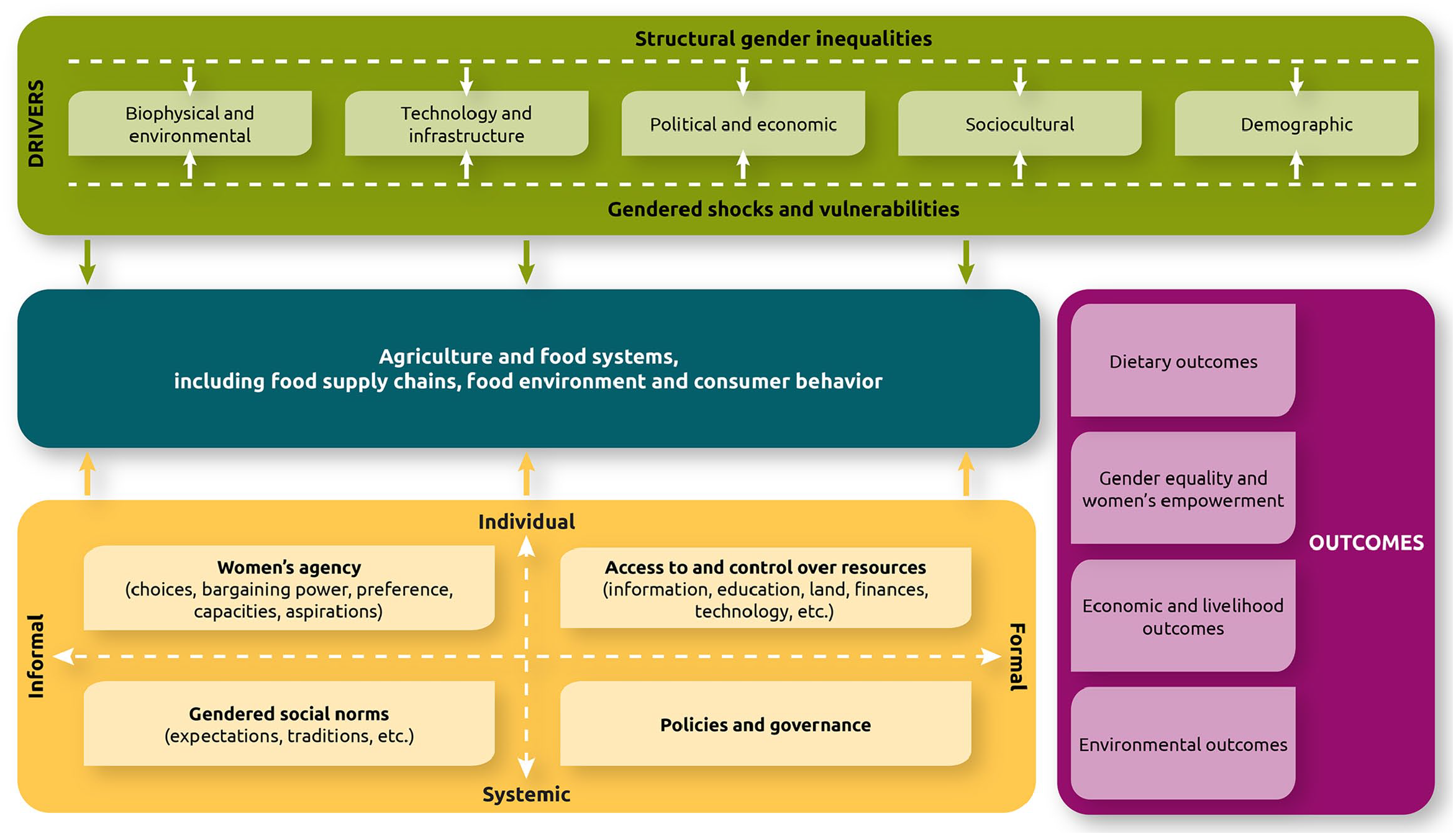
Gendered food systems framework – adapted from Njuki et al. (2022).
We anticipate that the intrahousehold gender equality of access, knowledge and adoption of climate-smart practices are related to the (perceived) severity of climate change. While we will control (perceived) the severity of climate change in the analysis, we will not formally test these relationships as hypotheses.
Understanding the relationships between gender equality, and gender differences in climate adaptive capacities in places where climate hazards, significant exposure and high vulnerability faced by women converge is essential to inform policy and programmes that can enable women to seize opportunities for enhancing their empowerment and climate adaptive capacities in transforming agrifood systems. This is essential to avoid women in agrifood systems – and their families – being left behind and for the intrinsic value of gender equality. This study will contribute to understanding the two-way relationship between women’s empowerment in the household and climate-adaptive in agrifood systems and what dimensions of women’s empowerment are more strongly associated with climate adaptative practices needed to optimize gender equality in contexts faced with climate change. The results of this study will help identify entry points for policy and interventions to simultaneously support women’s empowerment and gender-equitable climate adaptive and resilience capacities.
In the next section, we will discuss prior evidence of the relationship between women empowerment and gendered climate adaptive capacities against the background of climate change. We will then lay out the methods and discuss the results. We will conclude the paper by discussing the results and recommendations for further research, policy and practice.
Literature review
This section presents previous literature on the relationship between women’s empowerment in the household and gender equality in climate-adaptive capacities in rural African and Asian contexts. In most cases, the relationship between gender and climate change is studied based on an inter-household comparison of male and female-headed households (Cavanagh et al., 2017; Jost et al., 2015; Murray et al., 2016). However, an intrahousehold gender analysis enables exploring the gender dynamics within households that underpin differential exposure and vulnerability to climate change (Mudege et al., 2017; Twyman et al., 2015). An intrahousehold gender analysis reveals that women are disproportionately exposed and vulnerable to climate change due to gendered dynamics within households (Mudege et al., 2017; Twyman et al., 2015). Furthermore, this analysis explores the connection between women’s empowerment within the household and the household’s capacity to adapt to climate change. Climate change refers to significant and long-term alterations in average weather patterns, these changes can lead to various impacts affecting food production, including severe weather events, droughts, floods and disruptions to human societies (IPCC, 2019). There is increasing evidence that climate change intensifies existing gender inequalities. This can lead to a worsening of dispossession, marginalization, and discrimination faced by women and girls in affected communities, jeopardizing their ability to adapt to or recover from climate-induced emergencies (Castañeda et al., 2020). Climate
In what follows, we discuss some prior evidence of gender equality in climate adaptive capacities and its relationship with women’s empowerment in rural African and Asian contexts.
Ngigi et al. (2017) investigated the intrahousehold gender equality of adaptive capacities to climate change in rural Kenya. Their study showed that gender-specific roles, responsibilities and social norms govern husbands’ and wives’ perceptions of risk, their access to resources, and their participation in social groups in a gender-differentiated way. Climate risk is perceived differently by husbands and wives, and these diverging perceptions influence their adaptive behaviour. Wives’ limited access to land and resources hinders their adoption of climate-smart practices in agroforestry and conservation agriculture. The fact that husbands are more likely to acquire climate information and access farm input through social groups than wives is another reason for gender-differentiated adaptive capacities. Consequently, husbands’ and wives’ coping, and adaptation, strategies differ by gender as well as their well-being outcomes.
A mixed methods study conducted in Ethiopia found that women have limited access to productive resources, with an average intrahousehold gender parity gap of 38%, which renders them more vulnerable to climate change (Mekonnen, 2022). A 59% intrahousehold gender parity gap in ownership, access to and decision-making power over agricultural equipment (at the disadvantage of women) constrains women’s adaptive capacity to climate change.
A comparative study of two states in India investigated if higher participation by women in household decisions about the adoption of agricultural technology affects the adoption of climate-smart agriculture (CSA) (Aryal et al., 2020). The study found that both women’s participation in agricultural technology adoption decisions and the likelihood of adopting CSA are much higher in Haryana state, compared to Bihar state. Apart from women’s participation in technology adoption decision-making, wealth, training, and access to extension and markets positively influence CSA adoption. Qualitative data suggest that women’s main motive for adopting CSA is ensuring household food security. In the context of Pakistan, Shahbaz et al. (2022) found that women farmers with more decision-making power and innovativeness adopt more CSA practices than women farmers with weaker decision-making power and innovativeness.
In the context of Niger, Wouterse (2017) examined the role of drought perception and household-level empowerment 1 in climate change adaptation using zaї pits (i.e. planting the seeds in holes filled with compost) based on quantitative intrahousehold gender-disaggregated data collected among men and women in 500 households. The author found a positive relationship between household-level empowerment and the likelihood of adopting zaї pits. Apart from the ability to make strategic life choices (i.e. empowerment), skill and experience are also positively related to adaptive behaviour, as does the perception that the frequency of droughts has increased over time.
Ngigi and Muange (2022) studied the relationship between gendered access to climate information services (CIS) and the adoption of CSA by husbands and wives in 156 couples in rural Kenya. They demonstrated that access to CIS differs by gender. Husbands tend to have more access than wives to early warning systems and advisory services on adaptation; wives tend to have better access to weather forecasts. They found a positive relationship between access to early warning systems and advisory services and decisions to adopt CSA, both among husbands and wives. Access to seasonal forecasts, however, only makes husbands more likely to adopt. They showed that, apart from the gender-differentiated access to CIS, gender differences in access to resources and gender roles also play a role in intrahousehold gender differences in the adoption of CSA practices.
CSA can provide various benefits for women in adapting to climate change (Jost et al., 2016). In addition, CSA can serve as a supportive factor for women’s empowerment (Farnworth et al., 2017; Huyer and Partey, 2020). Women’s uptake of climate adaptive practices can lead to several changes: it can alter women’s exposure to and sensitivity to shocks and stressors, enhance their adaptive capacities, and increase their integration with other actors in the implementation of CSA activities (Bryan et al., 2024; Huyer, 2021; Huyer et al., 2021). In addition, it can boost their participation in decision-making and leadership roles through increased community engagements (Huyer, 2021; Huyer et al., 2021; Simelton et al., 2021). These factors collectively influence women’s agency and relationships, ultimately impacting their overall empowerment levels.
Context
Zambia is one of the lowest carbon emitters in Africa and globally (ClimateWatchData, 2019), but is hit hard by climate hazards and stressors, including drought and dry spells, seasonal and flash floods, extreme temperatures, and changes in season onset and cessation of rainfall (CIAT and World Bank, 2017).
Weather data from the Zambia Meteorological Department reveal that long-term maximum and minimum temperatures have been rising between 2000 and 2020 in the North-Western province, while no discernible trends in temperatures have been noted in Luapula province (Gbegbelegbe, 2022). Neither province seem to have experienced statistically significant changes in total seasonal rainfall. 2 Both Luapula and North-Western provinces, however, have faced high rainfall variability during the cropping season over the last 10 years. North-Western province faced too little rain in some years, which led to droughts; too much rain in other years, at times causing floods. Adverse effects are felt across all economic sectors in the country, but much more in agriculture, which is mostly rain-fed. In the study communities, women and men share a similar perception that crop and animal production suffer from dry spells, drought and storms as well as pests and diseases.
Agriculture is an important economic sector, accounting for about 20% of Zambia’s gross domestic product and employing close to 50% of Zambia’s economically active population (IFAD, n.d.). Zambia counts approximately 1.5 million smallholder farmers. An estimated 55% of the agricultural labour force in Zambia are women (ILO, 2021). Women are engaged in every stage of agriculture and are lead agents of food and nutritional security by producing 80% of the food consumed in the country (WFP, 2020). Hence, women face the exposure of Zambia’s agrifood systems to climate hazards and stressors because of their important role.
There are important gender inequalities in multiple domains in Zambia, which raises various constraints, particularly for women, in dealing with climate hazards and stressors that affect agrifood systems. The Social Institutions and Gender Index (SIGI) 2014 placed Zambia very high (relatively high gender discrimination) in the ranking (score of 0.45) and medium based on the SIGI 2019 (score of 34.8%), which suggests an improvement over time. 3 The Gender Development Index (GDI) of 2021 suggests there is little difference in the female and male human development index (HDI). However, the female HDI decreased between 2018 and 2021, suggesting that the conditions of women in the country might have deteriorated (UNDP, 2021).
Women farmers in Zambia have limited access to land, resources and infrastructure, technology, finance, training and capacity building, despite their significant contribution to agriculture. While formal law allocates equal rights to own land to men and women, in practice, women have less access to and control over land than men. Men usually receive land rights after marriage, while women tend to only receive the right to cultivation (OECD, 2019). According to Demographic and Health Survey (DHS) data (2018), approximately 58% of women in rural Zambia do not own any land (Zambia Statistics Agency (ZSA) et al., 2020).
Women also have limited access to credit and financial services (OECD, 2019). According to DHS 2018 data, only 3.2% of women in rural Zambia have and use a bank account (ZSA et al., 2020). An inter-household analysis based on the nationally representative Rural Agricultural Livelihood Survey (RALS) data sets of 2012 and 2015 revealed that, in 2012, both male and female-headed households had limited access to financial services, credit, and social capital (Gbegbelegbe, 2022). This only slightly improved by 2015. But, generally, both in 2012 and 2015, female-headed households had more limited access than male-headed households. Women in the study communities confirm their limited access to financial services and loans.
Gender roles and norms restrict women’s decision-making power within the household. Data from RALS 2012 and 2015 show few women in male-headed households have control over income from crop sales or make independent decisions on earnings and purchases (Gbegbelegbe, 2022). However, joint decision-making between spouses has increased over time. According to the 2019 RALS data, over two-thirds of decisions about field management and crop sales and income use were made by men (Indaba Agricultural Policy Research Institute, 2019). Nevertheless, women (in male-headed households) have a higher involvement in decisions about income from specific crops such as groundnut, sweet potato, millet, fruits and vegetables (Indaba Agricultural Policy Research Institute, 2019). Women’s ability to meaningfully participate in collective action and institutions and take up leadership roles remains limited as it is constrained by prevailing gender norms (Indaba Agricultural Policy Research Institute, 2019).
Materials and methods
In this section, we present the data, indicators and methods.
Study population and data
We conducted this study in the North-Western and Luapula provinces in Zambia. We selected these provinces based on the results from mapping subnational climate hotspot areas for women in agrifood systems in selected hotspot countries (Lecoutere et al., 2023). In the hotspot country of Zambia, Luapula was identified as a hotspot for perennial crops. The North-Western province was identified as a hotspot specifically for vegetables, mixed farming, as well as for cereals and perennials. We collected data in the Zambezi district in the North-Western province and in the Kawambwa district in Luapula province, which are rural areas where most households derive a livelihood from agrifood systems.
Our sample size is 199 households in which both male and female co-heads have been interviewed separately. 4 Out of the 199 households, 82 reside in the Zambezi district in the North-Western province and 117 in the Kawambwa district in Luapula province. Data on various aspects of women’s empowerment; access, knowledge, and adoption of CSA and CIS; perceptions and experience of climate change; and socio-economic and demographic household characteristics (see excerpts from the survey in Annex 4 in the Online Supplementary Materials (OSM)). Survey questions for collecting data on women’s empowerment were inspired by the project-level Women’s Empowerment in Agriculture Index (pro-WEAI) tool.
Through gender-segregated group sessions in the study communities, views by women and men on climate change, adaptation and gender issues with regard to climate adaptation were collected.
Indicators
We test the research hypotheses by examining the correlation between measures of women’s empowerment in the household, on one hand, and indicators of access/knowledge/adoption of CSA, on the other hand. We additionally include variables to control for household socio-economic status and individual and household socio-demographic characteristics, and geographic location (province). (We included an overview of the research hypotheses, the key indicators of interest, and the control variables in Appendix 1.)
Indicators of intrahousehold gender equality in access, knowledge and adoption of CSA
We constructed three indicators of the female co-head’s access to TA on CSA (Y1), knowledge intensity of CSA upon receiving TA (Y2) and adoption intensity of CSA practices at the time of climate shock (Y3) based on the female co-head’s responses.
We constructed three indicators of intrahousehold gender differences in access to TA on CSA (Y4), knowledge intensity of CSA upon receiving TA (Y5) and adoption intensity of CSA practices at the time of climate shock (Y6). We did so by constructing the above three indicators for female co-heads and also for male co-heads, based on male co-heads’ responses. We then subtracted the value of the female co-head’s indicator from that of the male co-head’s in each household i (see Table 1).
Indicators, their construction and meaning.
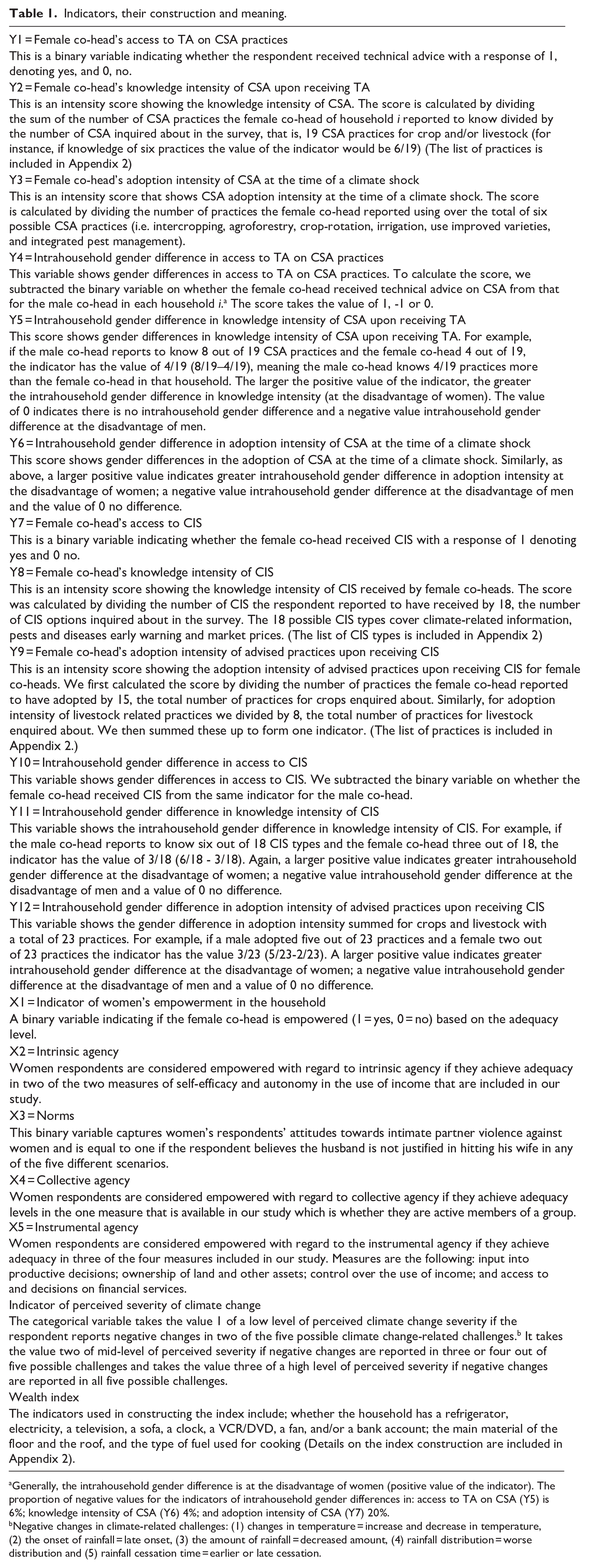
Generally, the intrahousehold gender difference is at the disadvantage of women (positive value of the indicator). The proportion of negative values for the indicators of intrahousehold gender differences in: access to TA on CSA (Y5) is 6%; knowledge intensity of CSA (Y6) 4%; and adoption intensity of CSA (Y7) 20%.
Negative changes in climate-related challenges: (1) changes in temperature = increase and decrease in temperature, (2) the onset of rainfall = late onset, (3) the amount of rainfall = decreased amount, (4) rainfall distribution = worse distribution and (5) rainfall cessation time = earlier or late cessation.
Indicators of intrahousehold gender equality in access to, knowledge of CIS and adoption of advised practices upon CIS
We constructed three indicators of female co-head’s access to CIS (Y7), knowledge intensity of CIS (Y8) and adoption of advised practices upon CIS (Y9) based on the female co-head’s responses.
We constructed three indicators of intrahousehold gender differences in access to CIS (Y10), knowledge intensity of CIS (Y11) and adoption of advised practices upon CIS (Y12). Similar to before, we constructed the previous three indicators for female co-heads and also for male co-heads, based on male co-heads’ responses and then subtracted the value of the female co-head’s indicator from the male co-head’s in each household i. 5 (see Table 1.)
Indicators of women’s empowerment in the household
Our indicators of women’s empowerment in the household largely follow the project-level Women’s Empowerment in Agriculture Index (pro-WEAI) (Malapit et al., 2019). 6 Pro-WEAI distinguishes different dimensions, including intrinsic agency (power within), instrumental agency (power to) and collective agency (power with). The various dimensions and measures as included in pro-WEAI are presented in Appendix 3, in which we also indicated which data are available in our study.
Inspired by procedures for calculating Pro-WEAI, we constructed a binary indicator of women’s empowerment in the household of the female co-head of each household i (X1) by judging whether a respondent is empowered based on the required adequacy level (see Appendix 2 for details; Adequacy thresholds in Annex 1 in the OSM). We also defined indicators for the different dimensions of women’s empowerment to test our second hypothesis. These include intrinsic agency X2; norms X3; collective agency X4 and instrumental agency X5 (see Table 1).
Indicator of perceived severity of climate change
To measure the perceived severity of climate change, we constructed a categorical variable based on five possible climate change-related challenges perceived over the last 20 years reported by the female co-head of the household. Possible climate change-related challenges include (1) changes in temperature, (2) the onset of rainfall, (3) the amount of rainfall, (4) rainfall distribution and (5) rainfall cessation time (see Table 1)
Socio-economic status, socio-demographic characteristics and location of the household
Socio-economic status of the households was measured by land size (land owned in acres, reported by the male co-head) and a wealth index. We constructed a wealth index based on asset ownership of the household using Equity Tool (Management for Metrics, 2015) (see Table 1).
Socio-demographic characteristics include (1) the age of the male co-head; (2) the age difference between male and female co-head of the household; (3) the education level of the male co-head (binary variable taking the value one if he attained education above primary school); and (4) household size. Province is a binary variable taking the value one if the household resides in Luapula province.
Methods of analysis
To test the first two research hypotheses, we employed ordinary least squares (OLS) regression as our method of analysis. By utilizing OLS, we examine the correlation between indicator(s) of women’s empowerment in the household and indicators of, intrahousehold gender equality in access, knowledge and adoption of climate-smart practices. We thereby control women’s perceived severity of climate change and households’ socio-economic status, socio-demographic characteristics, and geographic location. We estimate the following model.
To test the first hypothesis

where
To test the second hypothesis about a difference in the strength of association of different dimensions of women’s empowerment being norms, intrinsic agency, instrumental agency and collective agency with intrahousehold gender equality of access/knowledge/adoption of CSA, we apply OLS and estimate following the model

where X2 is the female co-head’s attitude on intimate partner violence, X3 is the intrinsic agency, X4 is the collective agency and X5 is the instrumental agency.
In addition, we formally test if β2, β3, β4 and β5 are statistically significantly different from one another based on a post-estimate test of (bilateral) difference of the estimated coefficients. 7
Results
In this section, we present the results of testing our research hypotheses about the relationship between women’s empowerment and intrahousehold gender equality in climate adaptive capacities and the differences in the strength of association with different dimensions of women’s empowerment. The descriptive statistics of the key variables used in our analyses are included in Appendix 4.
The relationship between women’s empowerment and intrahousehold gender equality in climate adaptive capacities
In this section, we present the results of testing a first hypothesis of a positive relationship between women’s empowerment and gender equality in climate adaptive capacities in households in the face of climate change. We test this hypothesis by looking at female co-heads’ and the intrahousehold gender differences in access, knowledge, and adoption of CSA practices upon receiving technical advice (section ‘The relationship between women’s empowerment and access, knowledge, and adoption of CSA practices’). We additionally look at female co-heads’ and the intrahousehold gender differences in access to climate information services (CIS), knowledge intensity of CIS, and adoption of advised practices upon receiving CIS (section ‘The relationship between women’s empowerment and access to CIS, knowledge intensity of CIS, and adoption of advised practices upon CIS’).
The relationship between women’s empowerment and access, knowledge, and adoption of CSA practices
Table 2 shows the results of examining the correlation between the indicator of women’s empowerment and indicators of female co-head’s access to TA on CSA, knowledge of CSA through TA, and adoption of CSA upon receiving TA, respectively (Columns 1, 2 and 3); as well as between the indicator of women’s empowerment and indicators of intrahousehold gender difference in access, knowledge and adoption of CSA upon receiving TA (Columns 4, 5, and 6).
The relationship between women’s empowerment and access, knowledge and adoption of CSA upon receiving TA.

Standard errors in parentheses ***p < 0.01; **p < 0.05; *p < 0.1; the indicator of women’s empowerment takes the value 1 if empowered, 0 otherwise; Reference category for climate change severity is 1 = low.
Results in Table 2 Column 4 show a statistically significant negative correlation between women’s empowerment and gender difference in access to TA on CSA. These results support the hypothesis of a positive relationship between women’s empowerment and gender equality in climate adaptive capacities. Else, there is no support nor rejection, of this hypothesis as there is no indication of other statistically significant relationships between women’s empowerment and indicators of gender equality in knowledge and adoption of CSA upon receiving TA (Table 2 Columns 1–3 and 5–6).
Evidence suggests that compared to households where the female co-head perceived low climate change severity, perceiving moderate, respectively high, climate change severity is significantly negatively associated with intrahousehold gender difference in knowledge intensity of CSA upon TA (Table 2 Columns 5). These results are in line with expectations.
The relationship between women’s empowerment and access to CIS, knowledge intensity of CIS, and adoption of advised practices upon CIS
Table 3 shows the results of examining the correlation between the indicator of women’s empowerment and indicators of female co-head’s access to CIS, knowledge intensity of CIS, and adoption intensity of advised practices upon receiving CIS, respectively (Columns 1, 2 and 3); as well as between the indicator of women’s empowerment and indicators of intrahousehold gender difference in access, knowledge intensity in CIS and adoption intensity of advised practices upon CIS (Columns 4, 5 and 6).
The relationship between women’s empowerment and CIS (access to CIS, knowledge intensity in CIS and adoption intensity of advised practices upon receiving CIS) in the face of climate change.

Standard errors in parentheses ***p < 0.01; **p < 0.05; *p < 0.1; the indicator of women’s empowerment takes the value 1 if empowered, 0 otherwise; Reference category for climate change severity is 1 = low.
There is no evidence of any statistically significant relationship between women’s empowerment with female co-head’s access to and knowledge of CIS, and adoption intensity of advised practices upon CIS (Table 3, Columns 1-3 and Columns 4-6); nor with intrahousehold gender differences in these. Hence, these results do not support nor reject the hypothesis of a positive relationship between women’s empowerment and gender equality in climate adaptive capacities.
Compared to households where the female co-head perceived low climate change severity, perceiving high climate change severity is significantly positively associated with the female co-head’s access to CIS and knowledge intensity of CIS (Table 3 Columns 1 and 2). These results are in line with expectations. In contrast, compared to perceived low climate change severity, perceiving moderate climate change severity is associated with greater intrahousehold gender difference in access to CIS (Table 3 Column 4).
Differences in the strength of association between different dimensions of women’s empowerment and intrahousehold gender equality in climate adaptive capacities
Here, we present results of testing the hypothesis of differences in the strength of association between various dimensions of women’s empowerment, being attitudes towards intimate partner violence against women, collective agency, women’s access to and control over resources and income (instrumental agency), women’s autonomy in income (intrinsic agency) and intrahousehold gender equality in climate adaptive capacities in agrifood systems faced with climate change.
Table 4 presents the results of examining this for access to, knowledge of and adoption of CSA practices upon receiving TA; Table 5 for access to CIS, knowledge intensity of CIS and adoption of advised practices upon receiving CIS.
The relationship between various dimensions of women’s empowerment and access, knowledge and adoption of CSA upon receiving TA.

Superscript letters indicate bilaterally significantly different coefficients.
Intrinsic agency versus norms.
Intrinsic agency versus collective agency.
Intrinsic agency versus instrumental agency.
(Detailed test of significant difference of coefficients in Appendix 6 in the OSM).
Standard errors in parentheses ***p < 0.01; **p < 0.05; *p < 0.1.
Correlation between various dimensions of women’s empowerment and CIS (access to CIS, knowledge intensity in CIS and adoption intensity of advised practices upon receiving CIS) in the face of climate change.

Superscript letters indicate bilaterally significantly different coefficients.
Intrinsic agency versus norms.
Intrinsic agency versus collective agency.
Norms versus instrumental agency.
Collective agency versus instrumental agency (Detailed test of significant difference of coefficients in Appendix 7 in the OSM).
Standard errors in parentheses ***p < 0.01; **p < 0.05; *p < 0.1.
Results in Table 4 show a statistically significant positive correlation between female co-head’s adoption of CSA and instrumental agency (Column 3); and a statistically significant negative correlation between gender difference in access to TA on CSA and attitudes towards intimate partner violence.
Results in Table 5 show a statistically significant positive correlation between female co-head’s access to CIS and collective agency (Column 1). There is also a statistically significant positive correlation between female co-head’s knowledge intensity in CIS and, respectively, intrinsic agency and instrumental agency (Column 2).
We formally tested bilateral differences where coefficients of correlation were statistically significant (detailed results of tests of difference of coefficients are available in the Supplementary Materials Appendices 6 and 7 in the OSM). As compared to intrinsic agency, women’s instrumental agency emerges as relatively more strongly (positively) associated with female co-head’s adoption intensity of CSA (Table 5 Column 3). As compared to intrinsic agency, attitudes towards intimate partner violence (as a proxy for norms) are relatively more strongly negatively associated with intrahousehold gender differences in access to TA on CSA (hence, more positively associated with gender equality) (Table 4 Column 4). 8 Collective agency is relatively more strongly associated with female co-head’s access to CIS as compared to both intrinsic and instrumental agency (Table 5 Column 1). As compared to attitudes towards intimate partner violence, both intrinsic and instrumental agencies are relatively more strongly associated with the female co-head’s knowledge intensity of CIS (Table 5 Column 2).
These results support the hypothesis of differences in the strength of association between various dimensions of women’s empowerment in the household and intrahousehold gender equality agrifood in climate adaptive capacities in the face of climate change.
Full model results with the covariates are available in Appendix 7 in the OSM. The full model results present results for all the models presented above.
Discussion and conclusion
In this study, we test research hypotheses derived from the Gendered Food Systems framework and frameworks linking climate change and gender equality in agrifood systems (Njuki et al., 2022). More particularly, we examine the relationship between women’s empowerment in the household and intrahousehold gender equality in climate adaptive capacities against the background of climate change. We additionally investigate if there is a difference in the strength of association between different dimensions of women’s empowerment and intrahousehold gender equality in climate adaptive capacities. We conducted the study in Luapula and North-Western provinces in Zambia which have been identified as climate–agriculture–gender inequality hotspots where women in agrifood systems are at high climate risk (Lecoutere et al., 2023).
We based our analysis on primary intrahousehold gender-disaggregated data collected separately from male and female co-head’s in dual agricultural households. We used Ordinary Least Square (OLS) regression to test the hypotheses about the relationships between women’s empowerment and gender equality in climate adaptive capacities while controlling for female respondents’ perceived climate change severity and other relevant individual and household characteristics.
We acknowledge that our study may have some limitations. First, the sample size was smaller than planned due to challenges in the accessibility of the study sites and the high geographical dispersion of the respondents. The representativeness of the data is potentially compromised which has implications for external validity. We recommend that future studies have larger sample sizes for greater statistical power and to allow a formal analysis of the influence of (perceived) climate change severity by including interaction terms. Second, the model for testing our second hypothesis includes independent variables capturing different dimensions of women’s empowerment that are correlated, in particular intrinsic agency and attitudes towards violence (see Appendix 5). This arguably generates multicollinearity even if these variables are only moderately correlated. While multicollinearity may have inflated the variance of the coefficients, the OLS estimates are likely unbiased (Wooldrige, 2013). Third, the fact that we test multiple hypotheses may have increased the risk of false-positive conclusions; which we checked for by calculating p-values that account for multiple hypotheses testing.
Our study results show that, in support of our first hypothesis, women’s empowerment in the household is associated with more intrahousehold gender-equal access to technical advice (TA) on CSA practices. This suggests that either women’s empowerment supports accessing advice on CSA; or that access to advice on CSA contributes to empowerment; or that women’s empowerment and gender equal access to advice on CSA are mutually beneficial.
Our hypothesis of a positive relationship between women’s empowerment with gender equality in knowledge and adoption of CSA upon receiving TA, however, was not empirically supported nor rejected; neither was the hypothesis about a positive relationship with access to, knowledge intensity of climate information services (CIS), and adoption intensity of advised practices upon receiving CIS. These results suggest that, in our study sample, more gender-equal access to TA on CSA did not necessarily translate into more gender-equal knowledge and adoption of CSA. The main reasons for not adopting the recommended adaptation strategies to longer-term climate change effects, weather adversities or increased pest and diseases mentioned by women in our study villages relate to lack of money and lack of access to loans to buy the appropriate seeds, fertilizer, pesticides or animal medicine or to invest in irrigation or other farming equipment. As most land in the study villages is under customary law and controlled by the community chief, most people, women as well as men, do not have (permanent) land titles which impedes the adoption of measures like, tree planting. Other studies have similarly found that women face constraints, more so than men, in acting upon increased access to information and extension (Ngigi et al., 2017; Ngigi and Muange, 2022).
In support of our second hypothesis, we found that different dimensions of women’s empowerment relate differently with indicators of access, knowledge, and adoption of CSA upon receiving TA.
We observed that more positive attitudes towards intimate partner violence (as a proxy for norms) are associated with a smaller intrahousehold gender difference in access to TA on CSA. The association with attitudes towards intimate partner violence is significantly stronger than with intrinsic agency (‘power within’ which captures self-efficacy and one’s sense of autonomy in the use of income).
These observations could indicate that discriminatory norms – proxied by attitude towards intimate partner violence – otherwise constrain gender equal access to TA on CSA, more so than a women’s beliefs in their own abilities and autonomy. This implies that societal norms, rather than individual beliefs or capabilities, are a significant barrier to gender-equal access to agricultural resources and knowledge (Forsythe, 2023; Jost et al., 2016). Conversely, more gender equal access to TA on CSA may have influenced women’s attitudes towards violence and discriminatory norms, again, more so than their beliefs in self-efficacy and autonomy. For instance during group discussions, women mentioned the presence of norms and customs that assigned them an equal agricultural work load as men, the need to ask for permission for travel outside the community and hindered their access to financial resources. There is a possible relationship with women’s access to training or assistance on CSA even if women did not explicitly mention this. In any case, the results highlight an important link between gender-equal climate adaptive capacities and more positive attitudes towards intimate partner violence and norms. Promoting gender-equal climate adaptive capacities therefore can have broader societal benefits, including reducing gender-based violence (Forsythe, 2023). In addition, addressing gender norms can positively impact gender-equal climate adaptive capacities. This resonates with Bryan et al. (2024) who show that facilitated household and community dialogues, along with engagement with community opinion leaders, can help shift patriarchal norms, attitudes and behaviours, leading to increased adoption of climate adaptive practices.
We also found that instrumental agency (‘power to’, capturing access, control and decision-making power over resources and income) is positively related with the adoption of CSA upon TA by female co-heads. This observation aligns with the views of women in the study villages as well as with other studies suggesting that, despite having access and knowledge, women’s adoption of CSA may still be constrained by their lack of access to resources, including financial resources (Mekonnen, 2022; Ngigi et al., 2017). Alternatively, it can point to women’s strengthened access to resources when they have adopted CSA; although the women in the study villages did not mention this. The fact that women’s instrumental agency is more strongly (positively) associated with CSA adoption than intrinsic agency could indicate that belief in self-efficacy and autonomy is not as important for women’s adoption of CSA or, conversely, is less likely to follow from CSA adoption. In any case, this fact emphasizes the key two-way relationship between gender-equal climate adaptive capacities and women’s access and control over resources.
Similarly, access and knowledge of CIS are differentially related to different dimensions of women’s empowerment. Collective agency (‘power with’) is positively correlated with female co-head’s access to CIS, and it is more strongly associated with it than both intrinsic and instrumental agency. This positive relationship between membership in social groups and women’s access to CIS is consistent with other studies (Bryan et al., 2024; Ngigi et al., 2017) argue that collective action can significantly support women’s climate actions by increasing women’s knowledge and adoption of climate-resilient practices. Other studies show that women’s participation in farmer groups provides both information and access to resources, such as micro-credit and insurance that empower women to increase productivity and income which may further enhance their adaptive capacity (Bryan et al., 2024; Huyer, 2021; Huyer and Partey, 2020). Furthermore, group membership can enhance women’s agency, leading to better, participation in local environmental management activities (Jost et al., 2015). It could also be that the availability of CIS encourages group formation and membership for accessing it (be it intentionally by the programme providing CIS or spontaneously) (Cherotich, 2012). Women in the study communities value (women) groups and cooperatives for pooling resources, group loans and joint investments in CSA practices but, at the same time, indicated they would like to see more of these collective efforts as these are still limited.
Female co-heads’ knowledge intensity of CIS is positively related to, respectively, intrinsic agency and instrumental agency. These respective correlations are stronger than with norms (proxied by women’s attitudes towards intimate partner violence). These findings could imply women’s knowledge of CIS is beneficial for their access to and control over resources as well as their belief in self-efficacy and autonomy but has less influence on their attitudes towards intimate partner violence. Alternatively, the findings could mean that women’s access to and control over resources and their belief in self-efficacy and autonomy stimulate knowledge of CIS and that norms are less important for that. Knowledge of CIS and women’s access to and control over resources and their belief in self-efficacy and autonomy, and to some extent norms, could also be mutually supportive.
In line with expectations, generally, we observed more intrahousehold gender equality in elements that support climate adaptive capacities when female co-heads perceive climate change as severe. This may suggest that more gender equality in measures supporting climate adaptive capacities (CIS, TA on CSA) made female co-heads more aware of climate change. Or, if their husbands are equally aware of severe climate change, their husbands may have involved or encouraged them in accessing, knowing, and adopting climate smart practices. Alternatively, female co-heads that were more aware of severe climate change may have invested more in seeking access to, knowledge of and adopting measures that support climate adaptive capacities. This in turn can have positive effects on their gender equality outcomes within the household.
Policy implications
Our findings show a two-way relationship between women’s empowerment in the household and intrahousehold gender equality in climate adaptive capacities. Recognizing the multifaceted nature of gender-specific vulnerabilities to climate change, which arise from sociocultural, structural, and institutional inequalities, CSA, CIS and similar initiatives should be designed to respond to this reciprocal relationship.
To promote gender-equal climate adaptive capacities in agrifood systems with significant – and gendered – climate change risks, governments and development organizations should simultaneously invest in women’s empowerment and gender-responsive CSA, CIS, and other climate-adaptive technologies and practices. This includes not only improving access and ensuring gender-equal access to climate information services, to information and knowledge on climate adaptation and mitigation practices and climate adaptive technologies; but also ensuring these responds to the women’s specific challenges and needs (Bryan et al., 2024; Huyer and Partey, 2020; Simelton et al., 2021). Building on the positive relationship with women’s collective agency, working with women through women’s groups and collective action arrangements can be instrumental in achieving gender-equal climate adaptive capacities. Targeted training programmes in areas like resource management, disaster preparedness, and CSA can equip women with the necessary knowledge and skills (Mudege et al., 2017). Strengthening women’s leadership roles in community groups and creating platforms for peer-to-peer knowledge exchange can further enhance their capacity (Bryan et al., 2024). In addition, providing support systems that facilitate women’s group membership and collective action and address women’s specific constraints, such as childcare and healthcare, can ensure their full participation in adaptation efforts.
To enhance women’s empowerment and their capacities to adapt to climate change, policymakers and development actors should prioritize initiatives that challenge discriminatory norms, expand women’s access to resources, strengthen their decision-making power, and recognize and value their contributions to agricultural production, food security, and climate adaptation. While achieving women’s empowerment requires sustained policy, social, and institutional efforts, taking incremental steps towards this goal, in conjunction with enhancing intrahousehold gender equality in climate adaptive capacities, is essential. This would necessitate capacity building for project implementers and other stakeholders to implement climate actions, at a minimum in a gender-responsive manner, and where possible combined with gender-transformative approaches (Bryan et al., 2024). In addition, a contextual unpacking of gender differences in exposure to climate shocks and stressors, and how these intersect with existing gender inequalities within the agrifood systems, will help in developing better targeted gender-responsive – and gender-transformative – strategies and interventions to increase women’s and men’s adaptive capacities in climate-affected agrifood systems.
Supplemental Material
sj-docx-1-jas-10.1177_00219096241300450 – Supplemental material for Uncovering the Intersections of Women’s Empowerment and Gender Equality in Climate Adaptive Capacities in Climate Hotspots for Women in Zambia
Supplemental material, sj-docx-1-jas-10.1177_00219096241300450 for Uncovering the Intersections of Women’s Empowerment and Gender Equality in Climate Adaptive Capacities in Climate Hotspots for Women in Zambia by Esther Kihoro, Els Lecoutere and Avni Mishra in Journal of Asian and African Studies
Footnotes
Appendix 1
Appendix 2
Acknowledgements
We acknowledge and are thankful for the collaboration with IITA, in particular, Sika Gbegbelegbe, Steve Cole and David Chikoye, for the development of research tools and for designing and conducting the data collection in the study areas in Luapula and North-Western provinces, Zambia. We would like to thank Ranjitha Puskur for input into the conceptualization of the wider research project and initializing the research project.
Declaration of conflicting interests
The author(s) declared no potential conflicts of interest with respect to the research, authorship, and/or publication of this article.
Funding
The author(s) disclosed receipt of the following financial support for the research, authorship, and/or publication of this article: This study has been funded via the CGIAR GENDER Impact Platform with the support of the International Development Research Centre, Canada (IDRC-CRDI). The CGIAR GENDER Impact Platform is also grateful for the support of CGIAR Trust Fund Contributors:  .
.
Data statement
The data used in this study are published as part of the AICCRA Zambia Baseline Survey 2022 (Zambezi district, North-Western province and Kawambwa district, Luapula province) (AICCRA Zambia Baseline Survey 2022; Gbegbelegbe et al. 2022 Harvard Dataverse, V1, https://doi.org/10.7910/DVN/NLWWKM). (Access upon request until the end of the embargo period; thereafter open access.) A pre-analysis plan has been registered here . Replication data and code are available on Mendeley data sets as; ‘Replication data: Gender Equality in Climate Adaptive Capacities in Climate Hotspots in Zambia’. DOI: 10.17632/67kv49684m.1 (Available online from 26 July 2024. Prior to that available on request).
Supplemental material
Supplemental material for this article is available online.
Notes
Author biographies
References
Supplementary Material
Please find the following supplemental material available below.
For Open Access articles published under a Creative Commons License, all supplemental material carries the same license as the article it is associated with.
For non-Open Access articles published, all supplemental material carries a non-exclusive license, and permission requests for re-use of supplemental material or any part of supplemental material shall be sent directly to the copyright owner as specified in the copyright notice associated with the article.
