




Abstract
Burgeoning evidence suggests that rural households face a range of stressors and shocks. Using a qualitative strand, the study examines the drivers of livelihood vulnerability in selected farms in Matabeleland, Zimbabwe. Results insinuate that socioeconomic and historical contingencies are the overriding determinants triggering rural livelihood vulnerabilities to poverty. Erratic rainfall, lack of financial and social capitals in particular, had practically heightened livelihood vulnerabilities to shocks. Livelihoods diversification is used to reduce losses from rain-fed farming, improve the quality of life and manage risk more effectively. The evidence of growing susceptibility also highlights how urgent it is for local communities and government agencies to work together to lower the risk associated with climate change. Specifically, creative and reasonably priced solutions that link dry lands and urban markets are required. The results are useful in developing interventions such as crop diversification and rural income-generating opportunities. Changing climate and livelihood policies for improved well-being and resilient communities should take into consideration the major components responsible for vulnerability along with other environmental, socioeconomic and demographic drivers.
Introduction
Developing countries’ rural areas are characterised by their reliance on agriculture and natural resources, as well as by their high rates of poverty, marginalisation and confinement (Intergovernmental Panel on Climate Change (IPCC, 2014). Nearly half of all people on earth reside in rural areas, with 90% of them residing in developing nations (IPCC, 2014). Furthermore, it is unsettling to be exposed to several stresses, particularly in developing nations where the conditions of the economy, politics, society and climate change have an impact on food security (Leichenko and O’Brien, 2002; Mekonen and Berlie, 2021). Many climatic and non-climatic stressors such as insufficient land and natural resource policies, environmental degradation and a lack of agricultural investment affect the rural population in emerging nations (Eadie et al., 2020; Nef et al., 2022). The interplay between human activity and climate change has resulted in a higher frequency of worldwide natural disasters and public safety incidents since the start of the 21st century. This has put additional strain on ecosystem services and natural resources, while also posing a serious threat to the security of human livelihoods for those who depend on them (IPCC, 2014; Thuy and Anh, 2021). In addition, it is anticipated that global risks will grow more systemic and complex. As a result, governments and academics are facing pressing practical challenges in reducing the vulnerability of natural and socio-ecological systems and thus enhancing adaptive capacity, and mitigating the effects of multidimensional risks (Baffoe and Matsuda, 2018; Gupta et al., 2020; IPCC, 2001). In addition to creating vulnerability among farm households, the intensification of both climate change and non-climate change challenges such as the emergency and resurgence of health pandemics like COVID-19 and HIV/AIDS, the global economic recession, the persistence of unfavourable development policies, historical circumstances and the intricate functioning of markets, seriously threaten and undermine residents’ livelihoods (Nyathi, 2024).
Our understanding of the susceptibility, sensitivity and adaptability of various farm households’ livelihoods to multifaceted risks or pressures will, therefore, be improved by investigating the livelihood vulnerability of these households in agrarian settings and the factors influencing it from a Sustainable Livelihood perspective. This will also enable us to provide policy recommendations for boosting these households’ resilience (Adger, 2006; Eakin and Luers, 2006; Bauer et al, 2018). Households have turned to diversifying their portfolios of livelihoods to address the consequences of both climate change and food security as a result of livelihood vulnerability (Nyathi, 2024). In addition, households have been practising conservation agriculture, raising small animals and integrating other climate-smart agricultural techniques into their small-scale farming operations (Phiri et al., 2020, 2021). In light of this, the study aims to investigate the vulnerability of livelihoods at three specifically chosen farms: Fox, Springrange, and Rocksdale. The study addresse the following research questions: What traits distinguish households with precarious livelihood strategies? What factors contribute to the three study farms’ vulnerability to livelihood loss? Which historical factors have the effect of increasing or decreasing social differentiation and vulnerability? How do farm households handle the risks to their livelihood and the consequences that follow? What part do migration, social capital and varied livelihoods play in coping with vulnerability? The study uses original empirical data for an assessment of livelihood vulnerability. Only very few studies on livelihood vulnerability have collected some form of primary empirical data in the three study sites (Nyathi, 2024; Phiri et al., 2020). On the contrary, most were built on secondary data from various sources (Mavhura, 2019). This study assesses livelihood vulnerability based on primary data in the field to provide insight for informing local climate change adaptation and mitigation planning. The findings of this study provide valuable policy inputs towards improving the food security and livelihood of the marginalised communities in dry land Zimbabwe (Ndlovu et al., 2020; Thebe, 2017). Finally, by identifying key points of intersection between historical contingencies, land tenure and vulnerability, this study contributes to designing appropriate climate change adaptation activities in international research and development initiatives (Nyathi, 2024). This article first elaborates on vulnerability as the conceptual framework. Concepts that include risk, exposure and sensitivity are interrogated. The next section looks at an overview of livelihood vulnerability dynamics in Zimbabwe. This is followed by an evaluation of the Sustainable Livelihoods Framework.The framework’s main argument is that the five fundamental components of any sustainable livelihood system are context, livelihood resources, livelihood techniques, outcomes and institutional processes. The next section explores the study setting and the methodology of the study. This is followed by the presentation and discussion of the findings. The last part of the article concludes by emphasising the need to look at the historical contingencies and how these contribute to vulnerability.
A conceptual overview of vulnerability
According to Chambers (1989), vulnerability is a complex socioeconomic and political state that impairs a person’s or a household’s capacity to meet their basic needs. For Chambers (1989), vulnerability is defined as being helpless, uneasy and exposed to dangers, shocks and stressors with little ability to handle them. Scoones (1998) contends that vulnerability has two side; an internal defencelessness, or the inability to withstand catastrophic losses and an external side of risks, shocks and stresses that a person or household is exposed to, which agrees with Chambers’ conceptualisation of vulnerability. Researchers like Ellis (1998) and Nyathi et al. (2018) allude that trends, shocks and seasonality have an impact on people’s means of subsistence and the availability of assets. Vulnerability is therefore configured as ‘the degree to which a system is susceptible to or unable to cope with adverse effects of climate change’ (IPCC, 2001: 1). Stated differently, a system’s vulnerability is determined by how sensitive it is to climate change and how resilient it is to the change. It is crucial to remember that the IPCC’s definition is relevant to climate change. Because vulnerability is generated by a variety of causes, it consequently ignores the equally significant human ecology, political economics and environmental risks (Nyathi et al, 2024). Moser (1998) views vulnerability as sensitivity and insecurity regarding people’s personal, domestic and communal well-being in the face of environmental change. Baffoe and Matsuda (2018) contextualise vulnerability as the degree to which a household is vulnerable to or unable to cope with the effects of natural, social, political and economic pressures by combining these factors and broadening the definition to include social, political and economic forces. Therefore, the concept encompasses the schools of thinking about human ecology, political economy and natural hazards.
The IPCC’s definition of vulnerability, which focuses on a particular environmental issue and defines it as the risk of exposure of an ecosystem to a hazard is different from the human ecology definition, which emphasises social systems and defines it as a social unit’s exposure to the economic, political and social structures and institutions that govern human lives (Prowse and Bird, 2009; Baffoe and Matsuda, 2018; Ngcamu, 2023). Thus, vulnerability is mostly the outcome of human action and it is usually addressed through the application of context-specific techniques (Adger, 2006; Eadie et al., 2020). According to Carney (1999) and Moser (1998), lowering vulnerability can increase livelihood systems’ overall sustainability and make people more shock-resistant. Achieving this resilience depends on the rights and resources that individuals, families, or communities can utilise and govern during disruptive times. Because they have less ability to withstand stressors and shocks brought on by social dynamics like institutional failure or environmental processes like climate change, or both, vulnerable rural families are those with restricted access to resources (Adger, 2006). For example, vulnerability is known to be influenced by both biophysical and social processes in the instance of livelihood vulnerability caused by climate change (Cutter et al., 2000; Mekonen and Berlie, 2021). According to some scholars (Kiragu, 2010; Prowse and Bird, 2009), development plans that improve people’s streams of income must include vulnerability mitigation.
Taking stock of rural livelihood vulnerability in Zimbabwe
People often remark on how vulnerable the Sub-Saharan region is to socioeconomic shocks and climate change because it is one of the poorest regions economically, plagued by political unrest, constant conflicts and diseases. The agricultural sectors in the region are very vulnerable due to climate change (Dalle et al., 2024). In rural Sub-Saharan Africa, farming, mostly mixed crops and livestock production, are the primary source of income. It is noteworthy to concede that during farming seasons, the majority of households diversify through mining and rural-urban mobility, though they return to their rural homes to continue farming. This demonstrates how agriculture is the primary source of subsistence. Unganai and Murwira (2010), Ndlovu et al., (2020) and Phiri et al. (2021) have all noted that Zimbabwe has a low mean annual rainfall and that many of the country’s drier regions IV and V, have non-permanent rivers. This results in a higher frequency and intensity of mid-season dry spells, changes when the rains begin and early termination of the rains; all of which have an impact on different socio-economic sectors. This finally results in droughts that never end and this has a detrimental impact on the fundamental health and livelihoods centred on agriculture. Droughts also have an adverse influence on food availability, water resources and agricultural productivity. In Zimbabwe, where there are 16 million people, climate hazards such as Cyclone Idai which left a path of destruction and 270,000 people homeless in 2019, and the devastating drought caused by El Nino, which is likely to continue and place the 2023–2024 farming season in jeopardy, have left 8.5 million people facing acute food insecurity (Zimbabwe Vulnerability Assessment Committee, 2020).
Crop cultivation is usually the main source of revenue in rural Zimbabwe, but livestock also offer food, insurance, financial support and assistance when things become uncertain. Small-scale farmers in rural Zimbabwe, particularly in the Matabeleland region rely on cattle, goats, sheep and poultry, in addition to crops, as a means of subsistence, food production, social standing and organic fertiliser (Phiri et al., 2021). Nonetheless, the rural Matabeleland region study areas’ open grazing, stall feeding and tethering of animals speed up local climate’s changes. In addition, conventional livestock production, overgrazing and poor land management, in conjunction with rapid population growth contribute to the changing climate conditions (Gukurume, 2013; Phiri et al., 2021). To its reliance on ecosystem services and goods, low adaptive capacity and peripheral location, Zimbabwe is one of the most vulnerable countries to extreme climate events on the continent (Dube et al., 2016; Nyathi, 2024). Communities throughout Africa are already experiencing the effects of the continent’s changing climate (Esayas et al., 2018). Climate change affects every economic sector in Africa, whether directly or indirectly, but subsistence agriculture remains one of the most susceptible and inherently sensitive to the phenomenon’s extremes (Asfaw et al., 2021). Rare and unpredictable, high-intensity climate-related risks primarily affect rural African households whose primary source of income is subsistence agriculture, resulting in greatest suffering (IPCC, 2018; Ngcamu, 2023). This is mainly because of Africa’s biophysical fragility and inadequate socioeconomic infrastructure development, which negatively affect the continent’s desire for sustainable development goals aimed at reducing its susceptibility to dangers brought about by climate change. Zimbabwe is a poor nation that is among the most vulnerable to climate change in Africa. It faces several challenges that weaken its security of livelihood and increases its vulnerability, including drought, economic collapse, HIV/AIDS and COVID-19 shocks (Dube et al., 2018; Tanyanyiwa and Mufunda, 2019; ZimVac, 2020). Zimbabwe’s vulnerability is especially exacerbated by trends in the country’s economy, population, health and governance (Dube et al., 2017; Phiri et al., 2021). Household susceptibility is, therefore, influenced by a range of social, economic and biophysical factors in addition to climatic stress. This suggests that a household system has limited adaptation ability and is vulnerable if it is exposed and susceptible to the effects of multiple stressors (Dube et al., 2016; Food and Agricultural Organization (FAO), 2019; Ngcamu, 2023). Therefore, examining economic vulnerability and social distinction in Zimbabwean rural households serves as a roadmap for creating livelihood resilience measures that take household exposure, sensitivity and resilience capability into account.
Recasting the sustainable livelihoods framework (SLF)
This study examines livelihoods vulnerability in recently resettled communities using the Sustainable Livelihoods Framework (Chambers and Conway, 1992; Scoones, 1998) as a conceptual tool. The framework is a broad and multidisciplinary approach that aims to promote a better understanding of, and response to the multiple dimensions of livelihood. It combines ongoing development trends with concepts derived mainly from the fields of political economy and political ecology. These included Amartya Sen’s Capitals and Capability Framework and concepts from the New Institutional Economics with regard to the importance of institutions in economic growth and development (Allison and Horemans, 2006). The SLA is concerned with the differential capability of rural families to cope with shocks such as drought, floods or plant and animal pests and diseases (Allison and Ellis, 2001). The approach brings together assets and activities, and illustrates the interactions between them (Allison and Horemans, 2006). The framework’s main argument is that the five fundamental components of any sustainable livelihood system are context, livelihood resources, livelihood techniques, outcomes and institutional processes. According to the framework,
a livelihood consists of the skills, resources (material and social), and activities necessary for a means of subsistence. When a livelihood can withstand shocks and strains, preserve or improve its assets and capacities, and avoid jeopardising the basis of natural resources, it is considered sustainable. (Nef et al., 2022; Scoones, 1998: 3)
The paradigm is helpful because it makes it easier to identify the specific barriers or limitations that the impoverished face while trying to improve their well-being (Carney, 1998; Chambers, 1989; Krantz, 2001). Each of these elements must be carefully examined and tracked to determine whether a livelihood system is sustainable. Since the approach recognises that the impoverished seek livelihood strategies that include a variety of occupations to lessen their vulnerability to poverty, it is also applied in this study. In addition, by emphasising a range of variables and levels that either directly or indirectly influence people’s access to a variety of resources, the framework helps to understand the fundamental causes of poverty (Carney, 1998; Scoones, 1998). In general, the sustainable livelihoods approach offers a framework for dealing with vulnerability and poverty in humanitarian and development contexts. As a result, the approach has been used to pinpoint the means of subsistence or employment that people employ. The diversity of resources that individuals employ to build their livelihoods is highlighted by the sustainable livelihood approach. The method results in a comprehensive understanding of the resources – or combinations of resources – that are crucial to the impoverished, considering not just their material and natural resources but also their human and social capital (Nef et al., 2022; Solesbury, 2003). One significant drawback of the SL method is that while it addresses sensitivity and adaptive ability regarding stressors on assets, it ignores exposures that put people at risk (Krantz, 2001).
Study setting, methods and materials
Zimbabwe is one of the last African countries to gain its independence (in 1980) and was also one of the most intensively colonised. Until 1980, development opportunities were heavily biased in favour of the white settlers, and even after 1980 the small white population controlled many aspects of the national economy (Thebe, 2017). In the early part of the 20th century, land was divided along racial grounds with the settlers being allocated the best land, forcing the bulk of the increasingly marginalised and impoverished black community into heavily populated communal areas. The inequitable distribution of land was a major factor prompting Zimbabwe’s war of independence and continues to be an integral component in Zimbabwean politics. The pattern of land distribution remained until 2000 when government embarked on the fast track resettlement programme.The Fox, Springrange and Rocksdale farms were the sites of the study. While Springrange and Rocksdale are situated in Umguza and Bubi districts, which are parts of Matabeleland North province; Fox Farm is located in Matobo District, which is part of Matabeleland South province. Zimbabwe’s North Western region is covered by Matabeleland North, while the larger South Eastern region is covered by Matabeleland South (see Figure 1). According to the Census of 2012, 61 883 people are living in the Bubi District, with 31,680 men and 30,203 women. The Bubi District’s Ward 14 is home to Rocksdale Farm. Matabeleland North comprises Umguza District. According to the 2012 Census, 89 687 people are living there (47 091 men and 42 596 women). The Umguza district’s ward 9 is where Springrange Farm is situated. The three districts are vulnerable to heat waves, droughts, poor incomes, chronic poverty and food insecurity (Ndiweni, 2015), just like the majority of the larger Matabeleland region (Thebe, 2017). The districts of Bubi and Umguza are categorised as belonging to Agro-ecological Region 4, and Matobo district is classed as belonging to Agro-ecological Region 5. Agro-ecology region 4 experiences 450–600 mm of annual rainfall, while region 5 experiences extremely variable rainfall of less than 400 mm. Matabeleland is known for forestry-based livelihoods and cattle ranching. However, climate change and variability is reportedly reducing the viability of livestock rearing in the region (Dube et al., 2018; Dube et al., 2016). The frequency of droughts, heat waves and water shortages are crippling small holders’ farming activities (Nyathi et al., 2022; Phiri et al., 2020).
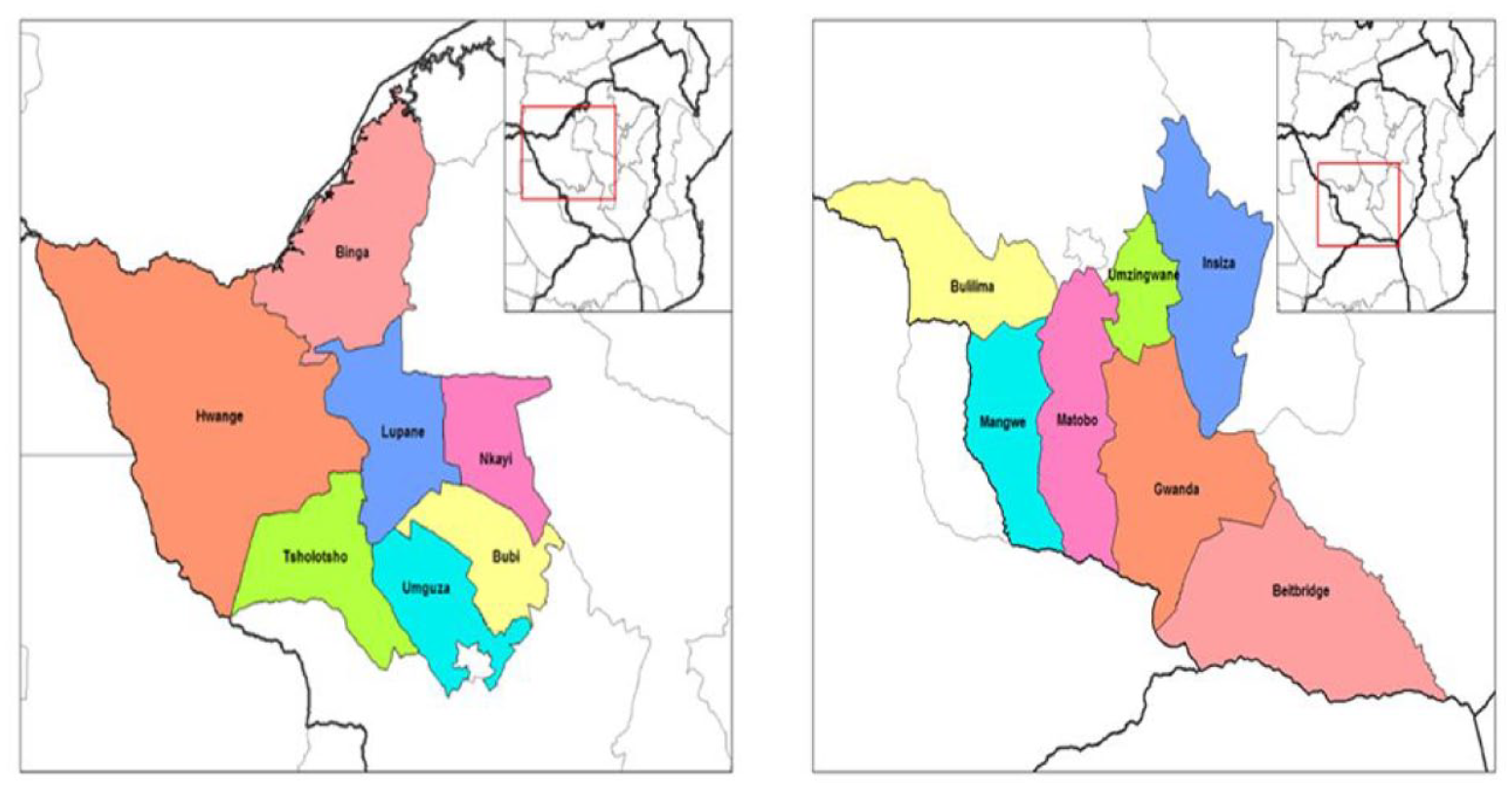
Showing Matabeleland South and North provinces.
The livelihood vulnerability in the chosen rural settings was investigated using a qualitative case study research design. In particular, the participants’ perceptions, opinions and experiences about the topic under investigation were investigated using a qualitative technique (Lincoln and Guba, 1985). Key informants, focus groups, in-depth face-to-face interviews and observations were employed to get information from the participants on the topic. Two officers from Agricultural Extension, two from Social Development, two employees from the NGO field, three members from the traditional leadership and three representatives from the Local Authority were among the key informants. We conducted 28 in-depth interviews which lasted 2 hours on average. The locations chosen by the participants were used for these interviews. Focus groups with an average of ten participants from various backgrounds were held on the three research farms. To guarantee that participants had excellent experience with livelihood vulnerability in the research locations, purposeful sampling was employed. The traditional chiefs’ aides in each of the three regions helped recruit research participants. Nobody was coerced into taking part in the research. In particular, individuals gave their full and voluntary agreement to participate. Inductive coding was utilised in conjunction with qualitative analysis to find themes and patterns in the transcripts of the interviews.
Study results and discussion
The study’s findings are shown and discussed in this section. In particular, we first examine the characteristics of households with precarious livelihoods, then we look at the factors that contribute to livelihood vulnerability. The presentation’s final section focuses on how historical circumstances have affected vulnerability and the coping strategies used by farm households to handle shocks and stressors.
Features of vulnerable livelihood households
Documenting the traits of households in the three study farms with precarious livelihoods was one of the goals of the research. To better understand the characteristics of farm households with precarious livelihoods, we posed questions to participants that aimed at profiling households with vulnerable livelihoods. The focus group talks revealed that the meaning of ‘livelihood vulnerability’ varied depending on the village. Communities employed the idea to characterise homes deemed impoverished from their understanding. The engagement revealed that poverty and livelihood vulnerability was mutually exclusive. One male focus group participant stated that:
I believe that the concept of livelihood vulnerability is centred on poverty. It is well recognised that the poor’s livelihoods are susceptible to shocks and other pressures in our communities. Recall that people who depend on certain sources of income find it difficult to manage their vulnerability on their own, even in the absence of outside support from the government or other non-state actors. More specifically, these are low-income households with little access to productive resources outside their land, such as social capital.
Subsequent interactions suggested that homes with precarious livelihoods had a reputation for always experiencing food instability, hunger and in the worst situations, famine. According to a 63-year-old male key source from the Department of Agricultural Extension Services, households with precarious livelihoods have a constant struggle with food security. These households do not receive even a bag of corn as their harvest, not even during normal to above-average wet seasons. Lack of draught power, poor purchasing power and in certain cases, the inability to hire labour for fencing, weeding and even harvesting makes it difficult for households to engage in meaningful farming. Study participants also reported that households with precarious livelihoods were typically known to have few possessions and to reside in unsanitary housing such as run-down huts. A 36-year-old female participant made a strong argument in one in-depth interview:
Families that are vulnerable to poverty are often led by young people who have limited employment opportunities, elderly women, people with long-term health conditions, and livestock owners. Remittances from the diaspora are not received by the majority of these homes. These households also lack diversification in their sources of income. Smallholder farming provides the majority of vulnerable households with a limited diversity of sources of income. The few that attempt diversification do so to ensure their survival and seek out low-return livelihood possibilities.
Additional discussions with participants also revealed the traits of people who are perceived as wealthy or as leading resilient and sustainable lives. The conclusion drawn from the in-depth interviews and focus groups was that people who were seen as well-off were able to take care of themselves, help others in need, save money, own animals and have an adequate supply of food in their houses. A participant made the following observation:
Rich people can withstand shocks, have impressive spending power, and afford to protect their cattle from drought. These homes also employ people, have their boreholes, and have other profitable revenue streams.
In addition, it became apparent that the group was able to access health care, had some revenue and had multiple sources of income, not for survival but for accumulation.
Drivers of vulnerability in livelihoods
We also looked into what factors made the three study farms’ livelihoods vulnerable. Questions about the causes of poverty and livelihood vulnerability were posed to study participants. Prominent academics like Ellis (1998), Chambers and Conway (1992) and Bird and Shepherd (2003) concur that a variety of interrelated socio-economic and environmental processes acting at various scales cause rural poverty and livelihood vulnerability in the semi-arid regions, of which Zimbabwe is a part. Very insightful comments were received during discussions on the factors that contribute to poverty and livelihood vulnerability, demonstrating the complexity of the idea of vulnerability. The farms were specifically chosen to provide evidence of the relationship between land tenure instability, poverty and livelihood risk. According to Ellis (2000) and Moyo (2004), land tenure refers to factors that determine who has access to a piece of land at any given time, including ownership arrangements, whether or not private freehold title or customary rights define ownership, and whether or not there is a marketing land. In brief, land tenure pertains to how land is possessed, utilised, managed and potentially transferred. Insecure land tenure is deterring some recently resettled farmers in the three research locations from investing in their plots of land, according to participant discussions. Participants at Fox and Springrange farms disclosed that they had received eviction notices from the Ministry of Lands and Rural Resettlement and the Zimbabwe High Court during the previous two years. Even though members at the Rocksdale farm said they had never received an eviction letter, they nevertheless felt uneasy because some people had been evicted from the district. The experiences of the participants at three distinct farms vividly capture the implications of insecure land tenure on poverty and livelihood vulnerability:
Our problem at Fox Farm is that even eighteen years after the land reform project began, some of us still lack the offer letters that allow us to remain here, and others who do have the letters do not yet own the title deeds to their plots of land. Sincerity be damned, how can you grow your land-based businesses with such unstable tenure? A neighbour of ours who had the necessary skills intended to drill a borehole and initiate a small irrigation system but was ultimately deterred by the dynamics of tenure insecurity in this area.
Another noteworthy observation regarding the instability of land ownership and its impact on means of subsistence was made by a 47-year-old female participant who stated,
We can develop this place more than what you are seeing; my husband is in South Africa and doing well. There are presently 50 sheep, 4 donkeys, 30 goats, and 56 cattle. We were able to install the infrastructure needed for domestic and animal water by drilling a borehole. We cannot invest more than what we have done because of the unstable land tenure. We don’t have title to this land. We only have an offer letter from the ministry of lands.
Discussions with study participants also revealed that in these recently resettled communities, HIV and AIDS was exacerbating poverty and livelihood risk. In-depth interviews conducted in all the three study locations revealed that the HIV epidemic caused time losses in the caring economy, labour shortages and the death of breadwinners. The participants also revealed that women’s essential role in meeting household livelihood needs and providing routes out of poverty had been undermined, as they were primarily responsible for caring for the terminally ill or accompanying them to far-off medical facilities for treatment rather than concentrating on lucrative and productive livelihood pursuits. Participants who had just been resettled believed that the government had abandoned them as seen by the dilapidation of roads, telecommunications, the dearth of market growth and non-electrification in their locations. In addition, it emerged from conversations, particularly with young, recently resettled farmers, that their ability to advance in life was being hampered by a lack of job prospects and possibilities for skill development. A 26-year-old farmer who had recently relocated and acquired Rocksdale Farm after his parents passed away hinted that
We have a challenge in this community of job prospects. Most of the people you see in this community are unemployed and some have no skills to use to diversify their livelihoods. We are poor with limited capacity to even grow crops during favourable rain season.
Participants also mentioned how their possibilities for a living were being affected by their inability to obtain bank credit due to a lack of collateral. It became apparent that it is challenging to raise start-up funds for a potential business or even to enhance livestock breeding and seed varieties (inputs) in newly inhabited areas without access to financing. Unpredictable rainfall, unsuccessful harvests and reduced soil fertility were also mentioned as factors influencing household poverty and possibilities for livelihood. At Rocksdale Farm, the focus was on how the local agro-ecological features might adversely affect their farming opportunities. According to a key informant, Rocksdale’s soils are rocky and have low fertility and moisture retention capacity, making it impossible for plants to thrive there. Despite the rich black soils of Fox Farm and Springrange Farm, the participants disclosed that the inadequacies of rain-fed agriculture, in addition to the difficulty posed by pests and problematic animals, led to livelihood vulnerability and poverty.
Some participants also mentioned that the vulnerability of livelihoods in the research areas was made worse by a lack of social capital. Establishing and growing both internal and external social networks was considered a critical component in being able to respond appropriately to vulnerabilities in the farms that were chosen. The interactions revealed that the highly networked households were able to successfully adapt to shocks and stressors. These farming households received emotional support, monetary loans, food and other essential information from a variety of sources during hard times. They also had easy access to vital information and guidance about markets and enhancing farming practices.
When food scarcity was pervasive during and after the 1988 farming season, Adams (1993) noticed that in central Mali, a household’s ability to network at village-level associations facilitated its participation in non-market community in exchange of food and labour. Intermarriages have also been found to lessen the intensity of some of these cultural issues and to expand the boundaries of sources of household assistance during difficult times in Tanzania’s semi-arid regions where ethnicity has strong effects on people’s culture and livelihoods (Morris et al., 2002). However, as Oduro (2009) contends, social networks might not offer total insurance if shocks and/or pressures are covariant and the home network is not dispersed geographically. Scholars like Gallopin (2006), Adger (2006), IPCC (2007) and Smit and Wandel (2006) have validated the conversations on livelihood vulnerability in the three study farms. These academics concur that an individual’s livelihood risk and poverty resilience are determined by their natural, social, physical and financial capital. The researchers also hint that rural residents’ ability to adjust to seasonality and poverty, in general, is diminished by the unpredictability of climate change and the demise of rain-fed agriculture. According to Hoddinott (2006), the rainfall shock significantly decreased agricultural and household income overall while increasing livestock sales, the size of which was heavily affected by pre-shock asset-holding levels. Lack of education, chronic illnesses, the absence of vital infrastructure and inadequate resource governance were cited by Nkondze et al. (2013) in Swaziland and Zhan (2016) in China as contributing to rural poverty.
Historical events that either make a place more or less vulnerable
We also asked about the role that past events had in raising or lowering the study communities’ vulnerability to livelihood threats. According to Karlsson and Bryceson (2016), ‘a wide range of uncertain and unpredictable environmental and political-economic factors affect the rural folks and these factors often occurred as episodic events with considerable discontinuities and major variability in space and time’, underlining the significance of applying a historical lens. Interesting historical developments that continue to affect the contemporary livelihood development in the farms under study were brought up during participant discussions. During a focus group discussion, a 72-year-old male participant who had experienced war said that understanding Zimbabwe’s rural livelihoods would need an understanding of its political history. He bemoaned the fact that the colonial government established ‘Bantu reserves’, forcing black people to relocate to desolate regions with little promise for agriculture while the few white people took up all the arable land. He contended that:
Our goal in engaging in the armed fight was to de-racialize land ownership in Zimbabwe. It was heavily biased against the native black population. Therefore, our administration had to correct that historical imbalance through a land reform programme. Therefore, this nation’s land reform placed a strong emphasis on the need to raise the social standing and conditions of peasants, reduce poverty, and redistribute wealth and income in their favour. Regretfully, the land reform plan led to the imposition of sanctions on the nation, which explains why our administration has not made significant efforts to construct infrastructure in these recently relocated areas. We are being suffocated by sanctions, which are impeding all of our government’s objectives for rural development.
The participant’s remarks brought up significant issues regarding the impact of Zimbabwe’s ‘sanctions’ on the vulnerability of rural livelihoods. Study participants also indicated that the Gukurahundi political unrest of the 1980s which featured state-sponsored brutality against civilians, was a contributing factor to the poverty that some Matabeleland households face today. Forty years after the Gukurahundi atrocities, a female participant expressed her opinion that the impacts are still being felt. She hypothesised that:
You won’t believe that the political violence that the state fostered in the 1980s left some of the houses on this farm never fully healed. Certain households suffered the loss of important possessions like animals, others had their homes destroyed by fire, some were raped, and some were taken away and never returned. I think it’s important to understand the backgrounds of some of these households to comprehend their current poverty. There are households on this farm that have severe documentation issues. One of my neighbours is still without a national identity card and a birth certificate. He has not been able to obtain documents for any of his children. It is challenging to even obtain government funding for agricultural inputs without the necessary paperwork. Undocumented individuals are not welcomed by financial institutions. He is currently facing a generational challenge that creates a vicious cycle of poverty.
The study demonstrated that development-induced displacement and ineffective state policies are partially to blame for the difficulties people face in sustaining their livelihoods. Participants in a focus group discussion noted policies that have affected rural households’ lives and means of subsistence. One participant effectively summed up the discussion by pointing out that:
The Government of Zimbabwe implemented the Structural Adjustment Programme (SAP) in the 1990s. Rural dwellers were negatively impacted by rises in the cost of essential goods and public service fees, even though the effects of ESAP have been felt more keenly in urban areas than in rural ones. When remittances fall and migrants return to their rural homes, the burden there increases, and rural households are impacted by layoffs and rising poverty in the city. The influence of structural adjustment is not well defined geographically because of the intensity of contact between rural and urban areas and the economic interdependence between them.
Our analysis highlights the intricate relationships that exist between local lives and national and international political-economic processes that support the extraction and export of natural resources. These relationships are based on resource access and market mechanisms which both expand and limit farm households’ possibilities for adaptation.
Cameron (2012) contends that historical processes such as long-term socio-environmental insecurity and the ensuing loss of biodiversity support the study’s conclusions. The societal ability to deal with vulnerability in the present is affected by these circumstances. Cameron (2012), in particular, draws attention to the under appreciation of colonial history and the historical and current legacies of resource extraction which Wisner et al. (2004) identify as the primary causes of ‘unsafe conditions’ in research on the societal aspects of climate change. Cameron (2012) alludes that the risk of adaptation is conceptualised as ‘a technical contemporary and local problem that can be addressed with specific policy intervention’ (p. 107) rather than as an investigation of the structural and systematic processes that affect people’s ability to adapt. This is because there is a tendency to ignore both past and present colonial relations. It is critical to go beyond current issues to have a deeper understanding of livelihood vulnerability, adjustments and transformations (Nef et al., 2022; Richardson, 2009). According to de Haan and Zoomers (2005), adaptations are rarely just a result of climate change or environmental changes, and livelihoods are part of larger systems that influence local adaptation trajectories. Analysis of the linkages between macro and local levels can be enhanced by including more historical background in discussions of the deep interactions that larger political-economic processes have on people, places and local occurrences (Mekonen and Berlie, 2021; Thuy and Anh, 2021; Whitehead, 2001).
Household coping strategies for livelihood vulnerability
Disaster management experts like Wisner et al. (2004) contend that ‘coping’ refers to patterns and strategies in which individuals use their assets to achieve the outcomes they anticipate. It has a lot to do with capacity. A common definition of strategies is that they are a collection of actions or methods people use to try to survive emergencies, get back on their feet and improve their circumstances following a disaster (Chambers, 2008; Richardson, 2009; Scoones, 2008). To get insight into how households manage the risk of losing their livelihood, we posed the following questions to participants: How does your household handle the difficulties in making a living on this farm? In addition, we investigated the potential roles of migration, food assistance and farming diversification using probes. Our discussions with the participants revealed that households engaged in non-farm and off-farm activities to manage livelihood vulnerability and the ensuing poverty. Any activity that takes place outside of a worker’s self-owned agricultural farm is considered off-farm, though it may still have some connection to agriculture. Small-scale mining and migration are examples of non-farm activities that are unrelated to farming.
The conversation revealed how people raised crops like sorghum and millet that could withstand drought. The non-governmental organisations that operated on the individual farms were the main ones who promoted these tiny grains. However, it became apparent that the hardy tiny grains in the research regions were not being supported by any coherent government plan. The study’s participants also mentioned that little grains required a lot of labour, making it difficult for people who could not afford to pay workers to ward off the birds. This is supported by Rukuni and Eicher (1994) who contend that farmers were deterred from adopting tiny grains due to the issue of birds and the absence of government assistance for their production, processing and consumption. A few people reported growing a variety of crops on the same land. For farm households, crop diversity was thought to offer significant advantages such as lower risk, higher revenue, better soil health, increased food security and environmental ones. Study participants also mentioned that during difficult times, some people move to other areas in search of better opportunities for a living. Migration from rural to urban areas as well as migration to South Africa and Botswana has reportedly been mentioned as potential solutions. It was believed that the wealthy were moving as far as the United States and the United Kingdom. To boost their income and diversify their sources of income, some families have moved seasonally. This has allowed them to use family labour, reduce risk and collect remittances more quickly.
Numerous homes in the three study farms are directly or indirectly involved in small-scale mining, according to survey participants. One activity that is simple to get started in is small-scale mining, according to probing. The topic of small-scale mining and its value as a source of income was lively discussed by the participants. A considerable number of households engage in small-scale mining due to the abundance of gold resources in their localities as revealed by the talks that followed. Certain participants maintained that, unlike farming, small-scale mining is independent of rainfall and overall meteorological trends. The participants made the case that small-scale mining offers many young people, especially those without formal educational credentials, employment opportunities. Some delegates did, however, point out that small-scale mining was posing significant problems for environmental sustainability. This was copiously captured by one key informant who posited that:
As an extension worker, I have found that most households engaging in small-scale mining have reduced labour effort committed to crop production since they are always in the mines, despite the fact that there are a few exceptional examples earning well out of the livelihood option. Other recently resettled farmers have decreased the amount of land they cultivate, and in the worst situations, others have given up farming completely. We must also examine the harm that small-scale mining has done to the ecosystem, particularly to grazing land.
Hilson (2011) contends that over five million people in Sub-Saharan Africa are employed in small-scale mining. The researcher further argues that small-scale mining has a large multiplier impact in contrast to small holder agriculture. The assertion that the sector ‘has a positive impact in terms of development, creation of small-scale local industries, enterprise development, and employment’ made by Kumar and Amaratunga (1994) amply captures this (p. 23). Nonetheless, scholars like Barret et al. (2001) and Ellis (1998) believed that this means of subsistence is essential to understanding the de-agrarianisation of Sub-Saharan Africa. However, Hilton (2011) claimes that most studies are flawed as they disregarded the contribution that small-scale mining made in the re-agrarianisation of livelihoods. Cartier and Burge (2011) support this by stating that gold mining can significantly improve economic opportunities and lessen poverty in rural areas. Study participants reported that several coping techniques were used by households in response to food insecurity. Some chose to eat fewer meals each day, while others chose to buy cheap food from the market. Group discussions also brought up food aid schemes as a possible source of food for certain homes. One informant proposed that some extremely poor women turned to risky coping mechanisms like engaging in transactional sexual relations.
Conclusion and recommendations
The study findings show that farm households, particularly small holders, are usually more vulnerable to many types of risks. The results also imply that several climatic catastrophes, including cyclones, floods and seasonal droughts that periodically afflict the areas, have a significant impact on the distribution of livelihood capitals of vulnerable households in these agrarian contexts. Because of the continued effects of climate change, households that are characterised by fragile livelihoods encounter several issues in their daily lives, including vulnerability to their income, household assets, life and health, food security, education, water supplies, sanitation and transportation networks. The research on poverty and vulnerability fails to take these elements into account, even though it has been shown that the dimensions of political economy and history have a significant impact on the vulnerability of modern livelihood in the farm households under study. The causes and solutions to present-day vulnerability reside in a complex set of relationships, so-called contingencies, many of which are historically rooted. For everyone concerned with catastrophe and risk management, both in Zimbabwe and in the developing nations affected by climate change, the findings have significant policy implications. Despite the many tactics used, households’ ability to handle shocks and bounce back from them is still low in these rural environments. Therefore, it is essential to start developing ways to support farm households’ ability to adapt to lessen the hardship that comes with their vulnerability to loss of livelihood. Policies aimed at reducing vulnerability should also reinforce regional systems that disperse and diversify risk, as well as build on the reality of environmental instability. Sustainable rural living depends on the efficient delivery of agricultural inputs, a steady market for agricultural products, efficient management of natural resources and efficient provision of local ecosystem services. This is true because agriculture and resource management are the main sources of income for people living in rural areas. To ensure effective governance of natural resources and the delivery of local ecosystem services that are resilient to current natural shocks and stresses for sustainable rural livelihood in such agrarian dry land areas, policies, institutions and communities must be integrated. Given the circumstances of the chosen farms, non-exploitative credit, stronger safety nets and a gradual transition away from traditional emergency relief methods and towards ex-ante steps to lessen and mitigate hazard impacts should all be promoted.
Footnotes
Funding
The author(s) received no financial support for the research, authorship, and/or publication of this article.
