




Abstract
This study is a systematic review of research on higher education in Zimbabwe, in particular, it assesses the contribution of higher education towards engendering socio-economic development. This is achieved through identifying higher education activities prioritised in research during the study period which spans a three-year period from 2021 to 2023. This period comes just after the introduction of Education 5.0, which includes innovation and industrialisation. Furthermore, the articles are assessed on whether they address socio-economic development issues. A total of 41 abstracts of research articles were subjected to qualitative content analysis. The findings reveal five major activities that research has focussed on in priority order: teaching and learning; quality in education; management operations and policy; knowledge and research; and equity and equality. Furthermore, while the analysis indicates that the prioritised activities contribute towards socio-economic development, the nuances of balancing political, individual and epistemic priorities affecting higher education institutions are brought to the fore. The identified activities underscore the need for interventions at national, institutional, departmental and individual lecturer levels. However, there are concerns about the de-prioritisation of gender equality and equity in higher learning institutions in Zimbabwe. In conclusion, the research topics not only highlight the complexities and the dynamics faced by higher education institutions in Zimbabwe in playing their expected role of contributing to socio-economic development but also the need to foreground specificity to allow for the identification of effective interventions and processes required to support higher education’s goal of contributing towards economic growth. The study further concludes that the neglect of equity and equality issues may be detrimental to educational outcomes geared towards economic growth.
Introduction
Higher education institutions (HEIs), which are colleges and universities, continue to be the principal producers of national political officials, public administrators, business managers, teachers and civic leaders, amongst other professions. According to UNCTAD (2014), higher education’s roles in research, evaluation, information transfer and technology development are critical to social progress and economic growth globally. Therefore, due to the nature of the public good service that education plays in societies, higher education institutions are argued to be semi-independents or adjuncts of governments to provide constructive criticism and strategic options, and expert information that helps both the state and the public to reach considered opinions (Marginson, 2018: 329). Marginson (2018) further avers that higher education institutions contribute to upward social mobility and enhance the lives of those who are educated, contribute to productivity and prosperity, supply innovators to industry, create employment, produce knowledge and contribute to policy formulation in government level (p. 322). However, for a number of years now, the higher education sector globally has witnessed a number of challenges key amongst them the declining student enrolment, a rise in operational costs, as well as technology and changing educational demands (Alenezi, 2021). These trends have compelled leaders within the HE sector to restructure the university business models around the four main and consistent goals, those of: improving the students’ learning environment; increasing operational efficiency; increasing cutting-edge research and stimulating innovation in education (Alenezi, 2021). The implementation of these goals, with the aid of technology and broader digital transformation, is imperative for the survival of higher education institutions and for sustaining the competition. In many countries, including Zimbabwe, the goal of stimulating innovation in education has been identified as key for overall socio-economic transformation and development. In fact, according to UNESCO (2022), HEIs have begun to embrace their ‘third mission’ which involves an active role in local development – where university missions have been re-structured towards contributing to the economic, social and cultural aspects of communities they operate in. This third mission has forced HEIs to identify the change needed and the most dynamic, effective and relevant processes to aid the desired transformation (Mirgorodskaya et al., 2023). The goal of this article is to review research by higher education institutions in Zimbabwe, to identify the topics that are foregrounded for discourses on educational transformation. Furthermore, this article assesses whether these topics contribute towards the drive to transform higher education to engender socio-economic development. The drive to transform HE institutions to play a leading role in socio-economic development has gained currency in Africa since the late 1990s and is evident in the various regional, sub-regional and national or country-level higher education frameworks.
In Zimbabwe, for example, the government has set a vision for the nation to become an upper middle-income economy by 2030 and the higher education sector has been identified as the most powerful catalyst for the transformation of the economy (Murwira n.d.). To this end, the government of Zimbabwe introduced an Education 5.0 framework for Higher and Tertiary education institutions to deliver goods and services to society. Education 5.0 policy, driven by a heritage-based philosophy, adds critical activities of innovation and industrialisation to the community service missions of universities. Therefore, HEIs in Zimbabwe are expected to not only focus on the professional development of learners but to inculcate what Klemencic and Ashwin (2015, 318) term, ‘citizenship, creative and innovative agency’ in learners. The expectation is that this type of education results in economic and social benefits and consequently economic growth. The period 2021–2023, targeted in this study, is important to assess higher and tertiary education’s adoption and readiness for the heritage-based education philosophy launched in 2019.
Thus, a review of research by higher education institutions in Zimbabwe, in a changing societal context, may reveal the priority areas and issues of concern to stakeholders within the educational process, the nuances and complexities faced by higher education in pursuit of its additional role of societal transformation and economic development. Previous studies on research in higher education (for example Horta and Jung, 2014; Kuzhabekova et al., 2015; MacFarlane, 2012) have shed light on the evolution of the higher education contexts. However, these studies have employed either global- or regional-level analyses, devoid of micro-analysis of specific contexts and countries. Furthermore, the majority research analysing themes in higher education has captured latent topics prevalent in research and not provided an assessment of how these topics contribute to wider societal expectations, such as development (for example Daenekindt and Huisman, 2020). In addition, most research has been deductive in nature, fitting topics into predetermined categories and themes. We therefore take an inductive approach in our analysis to assess how institutions of higher education in Zimbabwe engender socio-economic development in their programmes, if at all. The questions below guide the review.
Systematic literature review research questions
This paper is structured as follows: a review of literature; followed by methodology; then findings and discussion; contribution to education theory and practice, and lastly conclusion.
Higher education and economic development: global perspectives
Higher education institutions have moved from being educational establishments to assuming knowledge-creating hubs and most recently to the third mission of community engagement (Chankseliani and McCowan, 2021). This expansion of roles to wider society has enabled higher education institutions to contribute towards wider societal development. Earlier, Brennan and Teichler (2008) proffered that higher education plays a critical role in today’s knowledge economies and is seen as a major driver, not only of economic and sustainable development and growth – but also of social equity and mobility and for social cohesion and integration. The expectations of higher education by society have resulted in institutions of higher learning implementing a diverse range of engagement with global challenges. These expectations came in the background of the 2015 Sustainable Development Goals (SDGs) adopted by UN member states. The member states approved the 2030 Agenda for Sustainable Development (UN, 2015). Therefore, to assist these, higher education is expected to contribute towards eradicating problems and issues such as poverty (SDG 1), reducing hunger (SDG 2), Health and well-being (SDG 3), equal education (SDG 4), and gender equality (SDG 5), amongst the 17 SDGs (Filho et al., 2023). SDG 4 – equal education is argued to be pivotal as it correlates with all the other SDG goals (Fonseca et al., 2020). Therefore, through research, teaching and community engagement, higher education can contribute to economic development.
Chankseliani and McCowan (2021: 1) cite some examples of higher education institutions in Africa engaging in societal challenges including the University of Pretoria which focuses on food security and the University of Johannesburg also pursuing social impact project engagements. However, while higher education is adapting to the needs of societies, it remains to be seen how exactly university systems and processes are adapting, if at all, to incorporate the socio-development needs of their communities through research, teaching, and community engagement. For example, Chankseliani and McCowan (2021) proffer that such evidence is currently scarce on how this transformation is working or how higher education activities are aligned with SDGs. Teichler (2010) propose that education and research systems of higher education institutions should have broader dimensions necessary for such systems to contribute effectively to the communities they serve. Similarly, Chankseliani and McCowan (2021) proffer that higher education’s contribution to development requires an expansive approach and a broader understanding of the role of education to encompass the rights-based, capabilities and liberative approaches. Thus the transformation of higher education to engender socio-economic development should be multifaceted integrating local and global challenges. Currently, universities globally face the challenge of producing the requisite human capital and knowledge to tackle the twenty-first-century challenges facing societies and ensure sustainable and social development. Alsubaie (2016, 106) on the other hand emphasises the importance of specificity of an educational setting arguing that a successful education is one that can meet the needs and current demands of a nation’s culture, the society and the expectations of the populations being served. Other scholars (for example Mohammedbai, 2011) argue that challenges such as underfunding due to poor-performing economies have negatively impacted the contribution of the higher education sector to the wider economy. Another challenge relates to the failure to balance the political, moral and epistemic priorities (Chankseliani and McCowan, 2021).
However, the drive for transforming higher education for economic development has gained impetus following the adoption of the 2030 Agenda for Sustainable Development Goals by UN member states in 2015 (UN, 2015). Higher education has been identified as the engine for achieving sustainable development goals and transforming national economies. In Zimbabwe specifically, there is a deliberate drive to extend the transmission of knowledge role of the higher education sector, to that which addresses complex challenges bedevilling society such as economic decline, climate change challenges and other sociopolitical issues, amongst others. Through the Education 5.0 framework, Zimbabwe seeks to transform into a middle-income nation by 2030 – a vision which is expected to be driven by the higher education sector through promoting creativity and innovation, which subsequently is expected to lead to industrialisation. With such expectations, it is therefore imperative to assess, through a systematic review of research, how the higher education activities and processes in Zimbabwe are aligning with the expectations of socio-economic development. A recent global systematic review of literature conducted on higher education research by Fia et al. (2022) revealed that of the 130 papers, 73 focussed on teaching and learning activities, while 42 addressed management operations required to implement SDG-related strategies, and 11 concentrated on a third mission and lastly 4 on research related to SDGs. Their conclusion is that institutions of higher learning are developing various strategies to meet the requirements for addressing sustainable development goals.
From this premise, our argument is that research carried out in specific contexts and specific periods of economic downturns, such as the one obtained in Zimbabwe, can assist in assessing what the academia illuminates as critical and important for the educational process to achieve its desired societal outcomes – that of contributing towards socio-economic development. We further argue that higher education research is an important indicator of key contextual issues of any society that warrants public attention as well as organisational and national policy interventions. As Klemencic and Ashwin (2015) argue, the direct contribution of higher education to the knowledge economies and knowledge societies has been brought to the fore in policy, and also consequently shapes the research agenda. This link between the research agenda and national goals, and societal expectations is discussed next.
Higher education research agenda, national goals and societal expectations
Higher education research is closely linked to the debates in higher education frameworks and practice (Teichler, 2010). We further argue that these are also linked to national goals and societal expectations. This is because it provides information basis for debates and decisions about the present and the future of higher education in any context. Furthermore, research in higher education, we argue, reveals topical issues relating to the theory and practice of higher education, and provides, on one hand, a glimpse into wider societal expectations of higher education, and on another, the societal challenges that higher education prioritises and opts to engage in. Curaj et al. (2015) posit that there is no agreement on how to classify higher education research as this differs according to context. For example, Horta and Jung (2014) conducting research in East Asia and Macfarlane (2012) cite two overarching topics: Teaching and learning as well as higher education policy organisation. From these two themes, three major foci areas are identified as: (i) teaching, learning, curricula, competencies, teachers and learners, (ii) governance, management and organisation, and (iii) the higher education system and its social context. In a global study, Kuzhabekova et al. (2015) found that ‘teaching and learning’ was the largest research area followed by social justice and access, a topic that was not proposed earlier on. In another study, Calma and Davies (2017) divide the topics into seven categories: university management; assessment; transition and internationalisation; doctoral education; student identity; university leadership and research impact; student experience. Other scholars such as Tight (2004) proposed eight topics that higher education research should be concerned with and these include teaching and learning; course design; student experiences; quality of education; system policy; institutional management, academic work and lastly knowledge and research. What is evident from the review of the literature is that despite the different national goals, contextual needs and other expectations of higher education, topics such as teaching and learning remain high on the agenda, an indication that teaching and learning remain at the core of higher education business models now and into the future, in meeting the expectations of society. Prioritisation of different aspects of teaching and learning, we argue, is then what differentiates the success and failures of educational systems in specific contexts, especially in meeting socio-economic development expectations.
Methodology
This study was conducted through a systematic literature review based on guidelines proposed by Kitchenham and Charters (2007) that includes planning, execution and results. The planning stage involved identifying the objectives of the review and deriving questions from these. This process guided the search method and helped identify the elements that need to be included in the study. Phase two of the review entailed execution where abstracts for the study were extracted from Google Scholar. The Google Scholar database was selected for this study due to the fact that it publishes a wide range of resources including grey literature which may be valuable for this review. The choice for Google Scholar database, compared to the other academic databases such as Scopus and Web of Science, was guided by the scholarly arguments that compared to the other databases, Google Scholar (GS) also published a wide range of resources including grey literature (for example Bernes et al., 2015). Grey literature refers to documents not published by commercial publishers, and they include academic theses, organisational reports, government papers, and conference proceedings amongst others. According to Bernes et al. (2015), grey papers are very often practitioner-held data and may prove to be very influential despite them not being formally published.
A search was conducted on the Google Scholar database using the search phrase ‘higher education Zimbabwe’, all the terms in the title, and for the years 2021–2023. The first 70 records of this search were screened, taking a cue from other similar studies that argue that the first 50–100 search records on Google Scholar are viable for systematic analyses (see for example Reed et al., 2015; Roe et al., 2014). From the 70 search records, an advanced search was utilised to screen books and 11 such research titles were discarded resulting in 59 research papers. Furthermore, an inclusion criterion was applied, which resulted in 41 articles for this review, as shown in Figure 1.
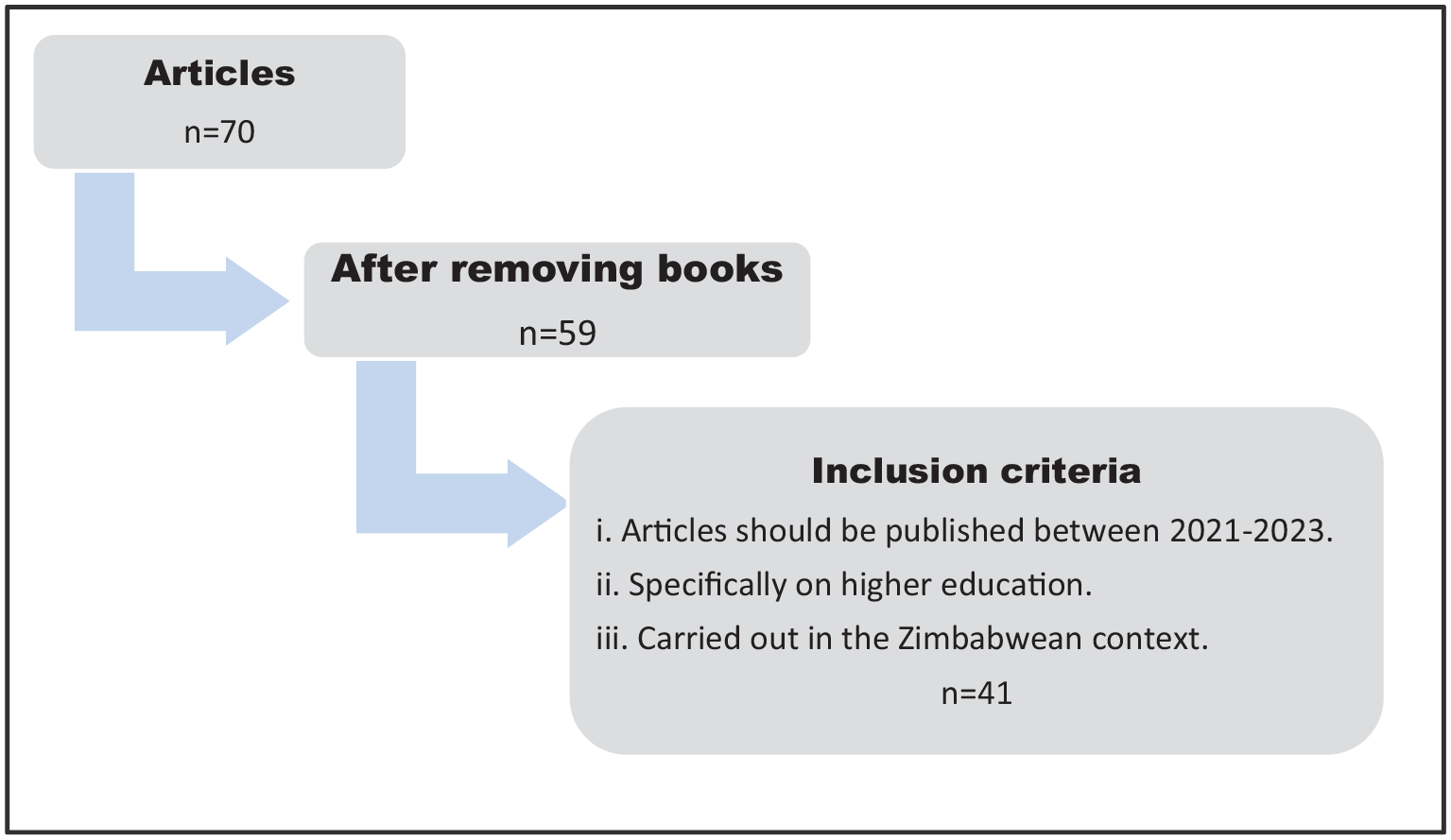
Data selection procedure (Source: Reseachers’ own).
Database: Google Scholar
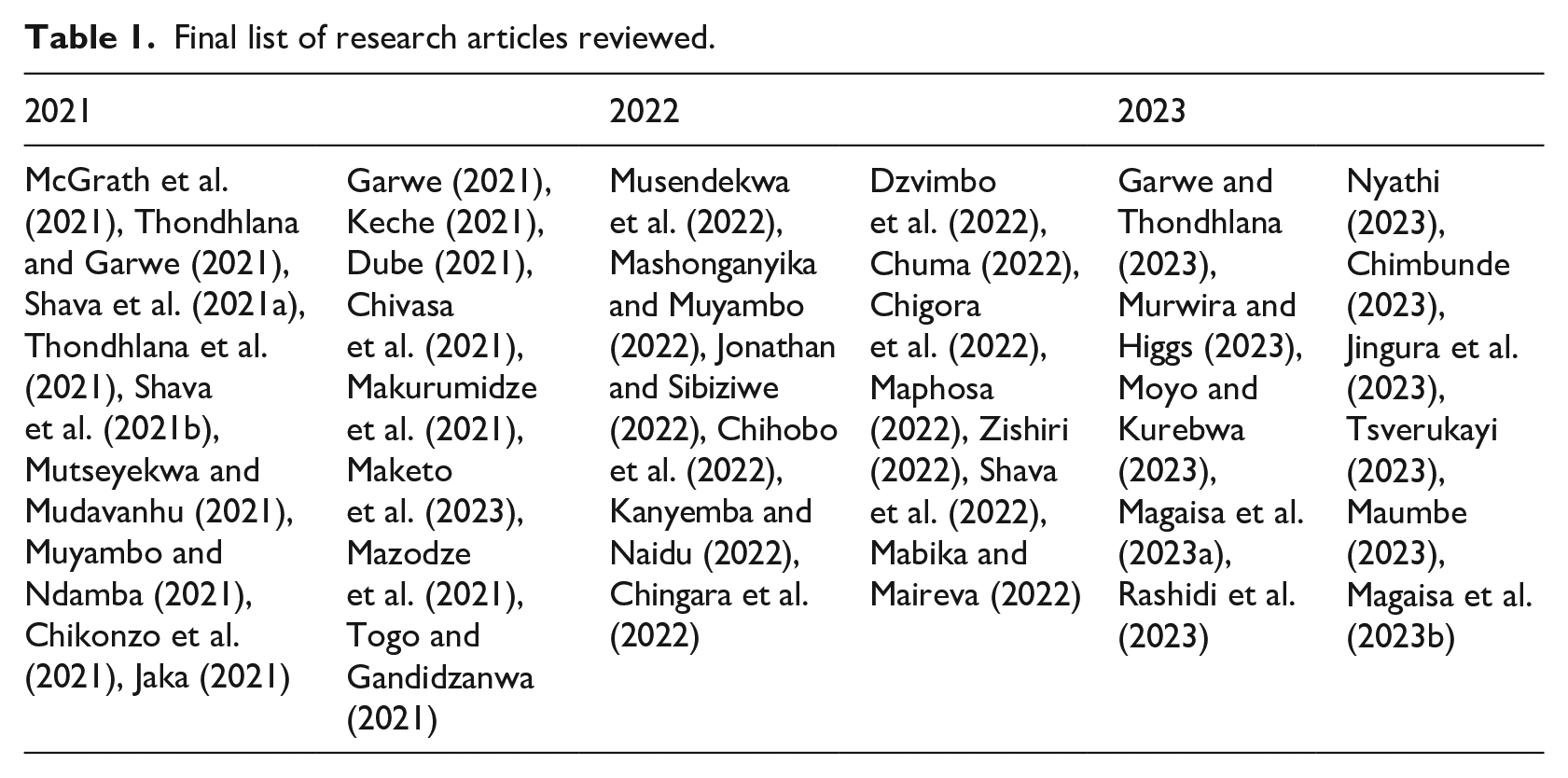
After the corpus for the review was screened, we then recorded research titles and downloaded the research papers, and stored these in a secure research folder. We then extracted the abstracts onto a worksheet, where we manually subjected these to qualitative content analysis. The focus on abstracts is because these provide a concise summary of the research article, and also is in line with previous studies, for example, Griffiths and Steyvers (2004). Daenekindt and Huisman (2020) also posit that using abstracts minimises the chances of identifying peripheral/minor topics. The final list of research articles is shown in⚐ Table 1.
Final list of research articles reviewed.
In phase 3, the results of each research question were analysed using qualitative content analysis. Qualitative content analysis is a research method that offers a subjective interpretation of the content of text through a systematic classification process of coding and identifying themes or patterns (Hsieh and Shannon, 2005). The main advantage of QCA is that besides allowing the identification of themes within a body of text, researchers are able to draw descriptions of the social reality that is created by the themes or categories as they are played out in a particular setting (Shava et al., 2021a, 2021b, 2021c: 557). The inferences to the social reality of the texts is valuable to this paper as it enables the description of the higher education phenomena in Zimbabwe through a close reading of the abstracts. The initial step in the analysis involved reading the abstract to identify the focus of the research article by identifying the goal and/or objective, and then we coded these. Both researchers read and manually coded the abstracts separately and later exchanged to assess if there were discrepancies in identifying the topics. The second step involved a close reading of the abstract to identify the connections of the topics with the expected role(s) of education as contained in national or institutional education frameworks. Individual research notes were made on the coding table, for later brainstorming and correlating the findings. The third and final step in the analysis involved reading the abstracts to identify the underlying meaning and the context and in particular, the social reality captured the abstracts for the overall assessment and to answer our research inquiry.
Findings and discussion
Research question 1 sought to identify through research, the activities that are a priority for higher education institutions during the identified period, and how these activities contribute towards the promotion of higher education to that which engender socio-economic development. The results reveal that of the 41 research articles, the activities given priority are those related to teaching and learning (16 articles). This is similar to findings elsewhere by Filho et al. (2023) who also found that out of 130 articles published between 2015–2020, 73 of those focussed on teaching activities. The concerns in teaching and learning are the need to improve teaching strategies and methods, for example the need to integrate the students’ experiences, and perceptions in the teaching and learning process, the need for improved assessment, and knowledge in designing relevant courses were foregrounded in the topic. The second most prevalent activities are those that relate to quality in higher education (9 articles). The issues projected on this topic are Zimbabwe’s readiness to improve the quality of higher education; the meaning of quality in the Zimbabwean context. Eight (8) addressed management operations, including policies required to engender socio-economic development, four articles focussed on research related to development and specifically to the SDGs. A further four articles focussed on diversity in higher education, in particular issues of equity and equality.
Teaching and learning
Similar to other studies elsewhere, for example Kuzhabekova et al. (2015) and Filho et al. (2023), activities that relate to teaching and learning were the largest research area in the selected research population of the study. This topic largely focussed on student learning experiences, especially in view of COVID-19-induced learning. This line of research is indicative of the context obtained at the time, with calls for the adoption of hybrid teaching and learning in view of the pandemic. Focussing on students’ experiences further indicates a shift from the traditional educational approach to a student-centred approach that integrates the students’ experiences and perspectives in the teaching and learning process. We concur with Chasokela and Mpofu (2024) who proffer that in pursuit of digital transformation, higher education institutions and universities in particular have been analysing the needs and demands of key stakeholders, to improve research services and teaching. We however add that in addition to the pressures of digital transformation, socio-economic challenges faced by societies continuously pressure universities to improve student competencies. The other issues pronounced within teaching and learning activities include enhancing students’ safety and security in online platforms in the advent of online learning, and the need to vary teaching methods to meet the needs of different students. This is similar to findings by Fia et al. (2022) that teaching practices need to be inclusive in order for higher education to fulfil students’ individual needs and those of wider society. Other teaching activities include improved assessment methods and the need for new forms of assessment in the areas of innovation and business development in the teaching and learning process. However, while societal and technological factors drive the need to reorient such pedagogical practices such as assessment strategies, extent literature already shows that one of the critical impediments towards transforming teaching and learning in higher education is resistance to change – where very often university leadership finds it difficult to move away from the conventional practices where they have invested a lot of resources (Coates, 2015). In addition, relevant professional capability and capacity are required to change assessment practice, with Coates and Richardson (2012) arguing that higher education itself lacks dedicated assessment professionals, and there appears to be too few assessment specialists with relevant industry experience. However, despite this, the fact that teaching and learning are prioritised is indicative of the fact that such activities require the attention of academics, administrators and policymakers, if a major overhaul of the entire teaching and learning process is to be implemented.
Quality in education
The activities on quality in higher and tertiary education include (i) the need for quality assurance systems that promote quality research, innovation and development, (ii) improving the quality of education to the sustainable development goals (SDGs), (iii) the need to localise quality standards, that is what quality means in the Zimbabwean context, (iv) the role of quality education in enabling transition in Zimbabwe, (v) accreditation processes, and (vi) internationalisation. The focus on quality assurance has been key in higher education in recent years with most governments, seeking accountability measures for public funding of universities, and to make sure that relevant skills are produced for the job market. We argue that implementing quality assurance systems enhances the public’s trust in higher education and boosts accountability – making higher education relevant to societies. Quality assurance is therefore important to help universities tackle the shifting and wide-ranging and often ambiguous institutional needs as argued by Dinh et al., (2021) and Zhu and Caliskan (2022). The scholars argue that globalisation, industry needs, cultural shifts, changing technologies, the battle for global rankings and the volatile disruption of events, including the recent COVID-19; complicate the roles and needs of universities.
Furthermore, there are efforts to bring to public and policy discourses the role of higher education in the SDGs. There is a realisation that the country’s national strategic development goals are closely tied to the global SDGs, and with the transformative education expected under the current education framework, Education 5.0, the expectations are for universities in Zimbabwe to contribute towards eradicating societal problems through quality education that also emphasise sustainable development in the curriculum and throughout other university processes. Therefore, these activities indicate the need for quality processes to be in place at both administrative/institutional levels and departmental and individual lecturer levels. This finding is similar to findings by Filho et al. (2023) – although their study also identified connections to the broader macro level. What is deciphered therefore is that quality is of the essence if higher educational outcomes are to be transposed into economic and social benefits and ultimately socio-economic growth.
Management operations and policy
The activities outlined in this stream of research papers include the following: (i) the need for adjustment of higher education in the wake of Education 5.0 and COVID-19, (ii) the educational environment specifically academic power and sexual harassment in public universities, (iii) implications for harmonisation of minimum bodies of knowledge, (iv) institutional needs in view of digitisation. Management operations have been identified as in university transformation towards engendering socio-economic development. One of the key priorities facing universities in Zimbabwe is to re-orient higher education in line with the demands of the education framework, Education 5.0, and at the same time, in the wake of the global pandemic COVID-19. There is a lamentation of superficial understanding of the Education 5.0 philosophy by academics in Zimbabwe, and that there is lack of expertise in the revisions of curriculum, which may be a drawback on the impact of this educational approach to the nation’s socio-economic development. Therefore, the need for adjustment requires the co-existence of institutional structures, and requisite national activities to support the goals of education. This is similar to findings in Ghana, for example, where effective institutional structures, specific research activities and national activities all contributed to a better understanding of societal development (Owusu-Agyeman, 2020). In the Zimbabwean context, one of the impeding factors cited in transforming the higher education sector is the lack of extensive consultation of the key actors during the early processes of the education reform. Other activities highlighted as part of management operations are the need for university codes of conduct and policies relating to harassment. The need for clear guidelines on what constitutes sexual harassment has been one of the major policy discussions in Zimbabwe, in an attempt to level the playing field and enhance the safety of both students and academics in a university setting. An enabling environment is key for inclusive education – which is a key requirement for sustainable development. Furthermore, an enabling environment that takes care of the students’ needs motivates learning and fosters development, as also argued by Chiba et al. (2021). Other issues relate to what institutions of higher learning should do to achieve successful e-learning outcomes, and what needs to be done to ensure the life-long competencies of university graduates. Last, there is also the need for institutions of higher learning to come up with policies to reduce the second-order digital divide, which broadly encompasses the economic and social inequalities regarding access and use of technologies including their impact. For higher education, this is an imperative, especially in the wake of COVID-19 where most universities have adopted blended learning.
Knowledge and research
This group of papers focussed on research related to the following areas: (i) the Fourth Industrial Revolution and the role of education thereof, (ii) human capital development and roles of higher education, (iii) graduate employability skills in vocational training, and (iv) deconstruction of higher education, in particular the need to promote the decoloniality approach. There are deliberate efforts to address economic issues through leveraging opportunities brought by the industrial revolution as well as addressing the human capital competent enough to tackle the socio-economic development needs of the country. What is further highlighted is the need for homegrown solutions, through deconstructing higher education from Western thought to that which allows for indigenous epistemologies. This proposition extends arguments by post-colonialists who view globalisation of higher education as efforts to impose economic and political agendas through the education system (for example Olson, 2006). By prioritising ‘other’ and home-grown knowledge, education may be relevant to local cultures and conditions. There has been a continent-wide drive in recent years towards decolonising education and for educators and researchers to apply Indigenous epistemologies that are able to generate the kind of knowledge relevant to society. Articles in the sample discuss the need to embed African Indigenous epistemologies into student development in university education to emancipate it from the Eurocentric hegemony, and also the need for differentiation in higher education in Zimbabwe through allowing private online universities.
Equity and equality
The least focussed area in the reviewed research was equity and equality. Four papers specifically highlighted: (i) the challenges that hinder the pursuit of higher education by ethnic students in Zimbabwe, (ii) the relationship between gender and sustainable development competencies, (iii) the inclusion of students with disabilities, and (iv) general gender inequalities in higher education. According to Wang (2023), equity involves ensuring fair representation of students from diverse backgrounds in higher education and should cover a spectrum of social, economic, ethnic, gender, physical and mental characteristics. Closely linked to equity is inclusion. Therefore, according to OECD (2008), equitable higher education systems are those that ensure access to and participation in higher education by all students. Furthermore, learning outcomes under equitable higher education systems should be based only on an individual’s innate ability and study efforts, and not on economic status, gender, disability and other identity categories (OECD, 2008: 13). While the current situation requires increased attention to issues of equity and equality which are a cornerstone for engendering socio-economic development and generally, for ensuring sustainable development, activities relating to equity and equality in higher education in Zimbabwe remain de-prioritised. Thus, equity and equality, despite being high on the agenda – as key for democracy and sustainable development, still falls far short of prioritisation in academic research in the Zimbabwean context.
Alignment with educational framework and contribution to socio-economic goals
Question 2 sought to assess whether the prevalent activities in higher education during the specific period in Zimbabwe aligned with educational framework, national goals and general socio-economic development. The findings reveal that the five topics, do speak to the current frameworks, and national as well as institutional strategic goals. For example, topic 1 (teaching and learning) proposes a move towards the student-centred approach, so that the higher education sector produces graduates with the skills to tackle problems facing society. While this issue aligns with global trends in view of globalisation, its implementation should be supported and informed by the local educational philosophy and educational systems and policies. Furthermore, digital safety in online platforms is an important area of concern in Zimbabwe in recent years in the wake of an increase in gender-based violence, including online violence. Public debates on the matter have contributed to policy interventions such as the enactment of the Cyber and Data Protection Act in 2021. In addition, research interest in this area conforms to educational frameworks and national goals of reducing all forms of violence. By creating awareness and providing a deeper understanding of higher education students’ experiences and perceptions with regard to online safety in view of online learning, this topic area aligns with societal expectations. What we glean from topic 2 (quality in higher education) is that issues of quality of education are highly contextual, and individual countries globally have enacted agencies [external to universities] that oversee quality compliance in education. In Zimbabwe, the Zimbabwe Council for Higher Education (Zimche) was established to oversee quality assurance in university education (Garwe, 2014). Thus, the production of knowledge in this area is indicative of the high prioritisation of quality assurance discussions in academic, policy and public discourses in Zimbabwe. The prioritisation of quality assurance further reveals the various perspectives on the issue and the key areas that need focus in order to improve the quality of higher education in Zimbabwe, in line with both national goals and societal expectations. Overall, research on this theme emphasises the need for both national and institutional policies to create a conducive educational environment to enable relevant processes such as teaching and learning and quality education to aid the economic development process.
Furthermore, the overall inquiry in this literature review study was to assess how research can contribute towards transforming higher education to engender socio-economic development in Zimbabwe. The analysis indicates that through the projection of the key roles of universities – that of producing human capital that can push the country’s political and economic agenda – innovation and industrialisation, we are able to discern the challenges and interventions that are required for universities to effectively contribute towards economic development, this is projected in topic four, management operations and Policy. Furthermore, the choice to highlight the need to revisit the education philosophy, and in particular, how curriculum can be decolonised, so that the education system is relevant and can create local knowledge required for socio-economic development. The topic of teaching and learning further highlights the need for improved teaching innovations, especially assessment methods, so that creativity and innovation are instilled in learners, Critical thinking skills and innovation have been cited as key requirements for today’s world economies (Yunus and Li, 2005), and specifically for socio-economic development. The topic, quality in education, while it highlights the need for HE to play its role as mandated in the current educational framework and in national strategic goals, it further foregrounds how quality education is necessary for the country to attain Sustainable Development Goals. Similarly, the topic knowledge and research highlighted the need to use African-grown epistemologies in both teaching and research in order to deconstruct knowledge. Such research enables key stakeholders such as policymakers, university administrators, academics, students and wider society to play their roles in contributing towards educational outcomes that aid the country’s socio-economic development. Furthermore, equity and equality in education foreground the social issue, that of lack of inclusion in the Zimbabwean higher education context. What is deciphered from these articles is that gender discrimination is a social reality in Zimbabwe and that there is no gender equity and equality in higher education spaces in Zimbabwe. Mott (2022) reminds us that higher education institutions are incubators for thought leaders and that higher education institutions should create systems where norms of gender equality are practised and modelled and where voices and ideas of women are valued creating transformative societies. Education for transformation requires respect for gender equality. Mott (2022: 5) further argues that despite higher education institutions being drivers for equality and empowerment, the evidence shows that they also reproduce discrimination against women, often ‘by default rather than design’. We therefore argue that despite the national and global statutes and conventions on gender equality – gender inequality, and marginalisation of minority groups still exist – rendering higher education largely a male terrain and favouring groups from particular socio-economic classes. Therefore, for higher education to effectively engender socio-economic development, there is a need to address gender equality and inclusion within institutions of higher learning.
Conclusion
Based on our review of the 41 abstracts, we make the following conclusions: National socio-economic goals, societal expectations and global drive for sustainable development drive the transformation of higher education, albeit with challenges. The re-engineering of teaching and learning strategies, including calls for curriculum adaptation, inclusive teaching, and revamping of management operations and structures including implementing institutional policies, and re-orienting education towards addressing specific local challenges all point towards the drive to engender socio-economic development. Furthermore, policymakers and university leadership are drawn to the need to create an equitable environment both nationally and institutionally to ensure equal participation of both men and women in development.
In addition, the challenges impeding the higher education institutions from meeting their socio-economic goals are highlighted for the attention of policymakers and other key stakeholders in the education process. The novelty of this review is that it not only assesses higher education and its contribution to socio-economic development, but it also identifies key societal concerns specific to the Zimbabwean context, and expectations of higher education. In particular, the complexities of seeking to balance specificity and at the same time, globalisation. This analysis has shown the priority activities that universities are concerned with which include teaching and learning, quality in education, management operations and policy, knowledge and research, equity and equality. The identified activities reveal the need to improve educational outcomes in a manner that can be transposed to socio-economic development. Thus overall, addressing the changes required both at national, institutional, and individual lecturer levels would significantly contribute towards transforming the Zimbabwean higher education to engender socio-economic development.
Footnotes
Declaration of conflicting interests
The authors declared no potential conflicts of interest with respect to the research, authorship, and/or publication of this article.
Funding
The authors received no financial support for the research, authorship, and/or publication of this article.
